

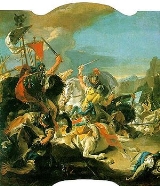
Battle of Vercellae

Encyclopedia
The Battle of Vercellae, or Battle of the Raudine Plain, in 101 BC
was the Roman
victory of Consul
Gaius Marius
over the invading Germanic Cimbri
tribe near the settlement of Vercellae in Cisalpine Gaul
.
The Cimbri were virtually wiped out, with the Romans claiming to have killed 140,000 and captured 60,000, including large numbers of women and children. Much credit for this victory has been given to the actions of Proconsul
Quintus Lutatius Catulus's
legate
, Lucius Cornelius Sulla
who led the Roman and allied Italian cavalry.
, Piedmont
, in northern Italy
.
Some historians think that "vercellae" is not a proper name and may refer to any mining area at the confluence of two rivers.
These historians think that the Cimbri followed the river Adige
after having crossed the Brenner Pass
, instead of "unreasonably" turning west to the modern Vercelli; this way, the location of the battle would be in the modern Polesine
instead, possibly near the modern Rovigo
. At Borgo Vercelli
, near the river Sesia
, 5 km from Vercelli, items have been found that supposedly strengthen the tradition.
:
Mommsen continues:
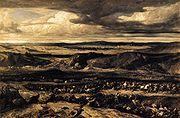 The victory of Vercellae, following close on the heels of Marius' destruction of the Teutons
at the Battle of Aquae Sextiae
the previous year, put an end to Germanic plans to invade Rome
.
Politically, this battle had great implications for Rome as well. It marked a continuation in the rivalry between Marius and Sulla, which would eventually lead to the first of Rome's great civil wars. As a reward for their gallant service, Marius granted Roman citizenship to his Italian allied soldiers, without consulting or asking permission from the Senate first. When some Senators questioned this action, he would claim that in the heat of battle he could not distinguish the voice of Roman from ally from the voice of the law. Henceforth all Italian legions would be Roman legion
s. This was also the first time a victorious general had openly defied the Senate and it would not be the last; in 88 BC
, Sulla, in defiance of both the Senate and tradition, would lead his troops into the city of Rome itself. And Julius Caesar
, when ordered by the Senate to lay down his command and return to Rome to face misconduct charges, would instead lead one of his legions across the Rubicon
in 49 BC
. This would mark the start of the civil war between himself and Senatorial forces under Pompey
which would effectively end the Roman Republic
.
101 BC
Year 101 BC was a year of the pre-Julian Roman calendar. At the time it was known as the Year of the Consulship of Marius and Aquillius...
was the Roman
Roman Republic
The Roman Republic was the period of the ancient Roman civilization where the government operated as a republic. It began with the overthrow of the Roman monarchy, traditionally dated around 508 BC, and its replacement by a government headed by two consuls, elected annually by the citizens and...
victory of Consul
Consul
Consul was the highest elected office of the Roman Republic and an appointive office under the Empire. The title was also used in other city states and also revived in modern states, notably in the First French Republic...
Gaius Marius
Gaius Marius
Gaius Marius was a Roman general and statesman. He was elected consul an unprecedented seven times during his career. He was also noted for his dramatic reforms of Roman armies, authorizing recruitment of landless citizens, eliminating the manipular military formations, and reorganizing the...
over the invading Germanic Cimbri
Cimbri
The Cimbri were a tribe from Northern Europe, who, together with the Teutones and the Ambrones threatened the Roman Republic in the late 2nd century BC. The Cimbri were probably Germanic, though some believe them to be of Celtic origin...
tribe near the settlement of Vercellae in Cisalpine Gaul
Cisalpine Gaul
Cisalpine Gaul, in Latin: Gallia Cisalpina or Citerior, also called Gallia Togata, was a Roman province until 41 BC when it was merged into Roman Italy.It bore the name Gallia, because the great body of its inhabitants, after the expulsion of the Etruscans, consisted of Gauls or Celts...
.
The Cimbri were virtually wiped out, with the Romans claiming to have killed 140,000 and captured 60,000, including large numbers of women and children. Much credit for this victory has been given to the actions of Proconsul
Proconsul
A proconsul was a governor of a province in the Roman Republic appointed for one year by the senate. In modern usage, the title has been used for a person from one country ruling another country or bluntly interfering in another country's internal affairs.-Ancient Rome:In the Roman Republic, a...
Quintus Lutatius Catulus's
Quintus Lutatius Catulus
Quintus Lutatius Catulus was consul of the Roman Republic in 102 BC, and the leading public figure of the gens Lutatia of the time. His colleague in the consulship was Gaius Marius, but the two feuded and Catulus sided with Sulla in the civil war of 88–87 BC...
legate
Legatus
A legatus was a general in the Roman army, equivalent to a modern general officer. Being of senatorial rank, his immediate superior was the dux, and he outranked all military tribunes...
, Lucius Cornelius Sulla
Lucius Cornelius Sulla
Lucius Cornelius Sulla Felix , known commonly as Sulla, was a Roman general and statesman. He had the rare distinction of holding the office of consul twice, as well as that of dictator...
who led the Roman and allied Italian cavalry.
Location
Traditionally most historians locate the settlement of the battle in near the modern VercelliVercelli
Vercelli is a city and comune of about 47,000 inhabitants in the Province of Vercelli, Piedmont, northern Italy. One of the oldest urban sites in northern Italy, it was founded, according to most historians, around the year 600 BC.The city is situated on the river Sesia in the plain of the river...
, Piedmont
Piedmont
Piedmont is one of the 20 regions of Italy. It has an area of 25,402 square kilometres and a population of about 4.4 million. The capital of Piedmont is Turin. The main local language is Piedmontese. Occitan is also spoken by a minority in the Occitan Valleys situated in the Provinces of...
, in northern Italy
Italy
Italy , officially the Italian Republic languages]] under the European Charter for Regional or Minority Languages. In each of these, Italy's official name is as follows:;;;;;;;;), is a unitary parliamentary republic in South-Central Europe. To the north it borders France, Switzerland, Austria and...
.
Some historians think that "vercellae" is not a proper name and may refer to any mining area at the confluence of two rivers.
These historians think that the Cimbri followed the river Adige
Adige
The Adige is a river with its source in the Alpine province of South Tyrol near the Italian border with Austria and Switzerland. At in length, it is the second longest river in Italy, after the River Po with ....
after having crossed the Brenner Pass
Brenner Pass
- Roadways :The motorway E45 leading from Innsbruck via Bolzano to Verona and Modena uses this pass, and is one of the most important north-south connections in Europe...
, instead of "unreasonably" turning west to the modern Vercelli; this way, the location of the battle would be in the modern Polesine
Polesine
Polesine is a geographic and historic area in the north-east of Italy corresponding nowadays with the province of Rovigo; it is a strip of land about 100-km long and 18-km wide located between the lower courses of the Adige and the Po rivers.- Geography :...
instead, possibly near the modern Rovigo
Rovigo
Rovigo is a town and comune in the Veneto region of North-Eastern Italy, the capital of the eponymous province. -Geography:...
. At Borgo Vercelli
Borgo Vercelli
Borgo Vercelli is a comune in the Province of Vercelli in the Italian region Piedmont, located about 70 km northeast of Turin and about 7 km northeast of Vercelli....
, near the river Sesia
Sesia
Sesia may refer to:* Sesia River, in northwest Italy* Sesia , a district during the First French Empire, named after the river* Sesia, a genus of moths* The Valsesia, the river’s valley...
, 5 km from Vercelli, items have been found that supposedly strengthen the tradition.
The battle
According to German historian Theodor MommsenTheodor Mommsen
Christian Matthias Theodor Mommsen was a German classical scholar, historian, jurist, journalist, politician, archaeologist, and writer generally regarded as the greatest classicist of the 19th century. His work regarding Roman history is still of fundamental importance for contemporary research...
:
Mommsen continues:
Aftermath
Teutons
The Teutons or Teutones were mentioned as a Germanic tribe by Greek and Roman authors, notably Strabo and Marcus Velleius Paterculus and normally in close connection with the Cimbri, whose ethnicity is contested between Gauls and Germani...
at the Battle of Aquae Sextiae
Battle of Aquae Sextiae
The Battle of Aquae Sextiae took place in 102 BC. After a string of Roman defeats , the Romans under Gaius Marius finally defeated the Teutones and Ambrones.-The battle:...
the previous year, put an end to Germanic plans to invade Rome
Rome
Rome is the capital of Italy and the country's largest and most populated city and comune, with over 2.7 million residents in . The city is located in the central-western portion of the Italian Peninsula, on the Tiber River within the Lazio region of Italy.Rome's history spans two and a half...
.
Politically, this battle had great implications for Rome as well. It marked a continuation in the rivalry between Marius and Sulla, which would eventually lead to the first of Rome's great civil wars. As a reward for their gallant service, Marius granted Roman citizenship to his Italian allied soldiers, without consulting or asking permission from the Senate first. When some Senators questioned this action, he would claim that in the heat of battle he could not distinguish the voice of Roman from ally from the voice of the law. Henceforth all Italian legions would be Roman legion
Roman legion
A Roman legion normally indicates the basic ancient Roman army unit recruited specifically from Roman citizens. The organization of legions varied greatly over time but they were typically composed of perhaps 5,000 soldiers, divided into maniples and later into "cohorts"...
s. This was also the first time a victorious general had openly defied the Senate and it would not be the last; in 88 BC
88 BC
Year 88 BC was a year of the pre-Julian Roman calendar. At the time it was known as the Year of the Consulship of Sulla and Rufus...
, Sulla, in defiance of both the Senate and tradition, would lead his troops into the city of Rome itself. And Julius Caesar
Julius Caesar
Gaius Julius Caesar was a Roman general and statesman and a distinguished writer of Latin prose. He played a critical role in the gradual transformation of the Roman Republic into the Roman Empire....
, when ordered by the Senate to lay down his command and return to Rome to face misconduct charges, would instead lead one of his legions across the Rubicon
Rubicon
The Rubicon is a shallow river in northeastern Italy, about 80 kilometres long, running from the Apennine Mountains to the Adriatic Sea through the southern Emilia-Romagna region, between the towns of Rimini and Cesena. The Latin word rubico comes from the adjective "rubeus", meaning "red"...
in 49 BC
49 BC
Year 49 BC was a year of the pre-Julian Roman calendar. At the time, it was known as the Year of the Consulship of Lentulus and Marcellus...
. This would mark the start of the civil war between himself and Senatorial forces under Pompey
Pompey
Gnaeus Pompeius Magnus, also known as Pompey or Pompey the Great , was a military and political leader of the late Roman Republic...
which would effectively end the Roman Republic
Roman Republic
The Roman Republic was the period of the ancient Roman civilization where the government operated as a republic. It began with the overthrow of the Roman monarchy, traditionally dated around 508 BC, and its replacement by a government headed by two consuls, elected annually by the citizens and...
.