
All Topics  
Thucydides

 
Thucydides

   Email Print
   Bookmark   Link


Thucydides


Thucydides (c.
C.

c. is an abbreviation which may have several meanings depending on the context in which it is used:* Circa: in geneaology and historical writing, c. means circa, and is used when the dates of events are approximately known....
 460 B.C.
460 BC

Events...
 – c.
C.

c. is an abbreviation which may have several meanings depending on the context in which it is used:* Circa: in geneaology and historical writing, c. means circa, and is used when the dates of events are approximately known....
  395 B.C.
395 BC

Events...
) (Greek
Ancient Greek

Ancient Greek is the historical stage in the development of the Greek language spanning across the Archaic Greece , Classical Greece , and Hellenistic civilization periods of ancient Greece and the classical antiquity....
 T????d?d??, Thoukydídes) was a Greek
Greeks

The Greeks , also known as Hellenes, are a nation and ethnic group native to Greece, Cyprus and neighbouring regions, who can also be found in Greek diaspora communities around the world....
 historian
HIStory

HIStory: Past, Present and Future, Book I is a double album by Michael Jackson, released on June 20, 1995, and is Jackson's ninth. The first disc, named "HIStory Begins" consists of a selection of Jackson's greatest hits from the singer's past fifteen years, while the second, named "HIStory Continues" features new songs, with the...
 and author of the History of the Peloponnesian War
History of the Peloponnesian War

The History of the Peloponnesian War is an account of the Peloponnesian War in Ancient Greece, fought between the Peloponnesian League and the Delian League ....
, which recounts the 5th century B.C. war between Sparta
Sparta

Sparta was a city-state in ancient Greece, situated on the Eurotas River in the southern part of the Peloponnese. From circa 650 BC it rose to become the dominant military power in the region and as such was recognized as the overall leader of the combined Greek forces during the Greco-Persian Wars....
 and Athens
Athens

Athens , the Capital and largest city of Greece, dominates the Attica periphery; as one of the List of cities by time of continuous habitation, its recorded history spans around 3,400 years....
 to the year 411 B.C. Thucydides has been dubbed the father of "scientific history" due to his strict standards of evidence-gathering and analysis in terms of cause and effect
Cause and effect

Cause and effect refers to the philosophical concept of causality.It can also refer to:* Cause-and-effect diagram, or Ishikawa diagram, a diagram that shows the causes of a certain event...
 without reference to intervention by the gods, as outlined in his introduction to his work.

He has also been called the father of the school of political realism, which views the relations between nations as based on might rather than right.


Discussion
Ask a question about 'Thucydides'
Start a new discussion about 'Thucydides'
Answer questions from other users
Full Discussion Forum


Quotations


Contempt for an assailant is best shown by bravery in action.

Book VI, 34

Hope leads men to venture, and no one ever yet put himself in peril without the inward conviction that he would succeed in his design.

Book III, 35

I have written my work, not as an essay which is to win the applause of the moment, but as a possession for all time.

Book I, 22

It is from the greatest dangers that the greatest glory is to be won.

Book I, 144

That which makes the splendour of the present and the glory of the future remains for ever unforgotten.

Book II, 64

The rarest dangers are those in which failure brings little loss and success the greatest advantage.

Book VII, 68


Encyclopedia


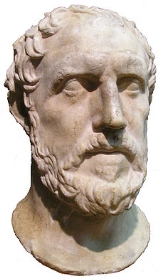
Thucydides Bust Cutout Rom
Thucydides (c.
C.

c. is an abbreviation which may have several meanings depending on the context in which it is used:* Circa: in geneaology and historical writing, c. means circa, and is used when the dates of events are approximately known....
 460 B.C.
460 BC

Events...
 – c.
C.

c. is an abbreviation which may have several meanings depending on the context in which it is used:* Circa: in geneaology and historical writing, c. means circa, and is used when the dates of events are approximately known....
  395 B.C.
395 BC

Events...
) (Greek
Ancient Greek

Ancient Greek is the historical stage in the development of the Greek language spanning across the Archaic Greece , Classical Greece , and Hellenistic civilization periods of ancient Greece and the classical antiquity....
 T????d?d??, Thoukydídes) was a Greek
Greeks

The Greeks , also known as Hellenes, are a nation and ethnic group native to Greece, Cyprus and neighbouring regions, who can also be found in Greek diaspora communities around the world....
 historian
HIStory

HIStory: Past, Present and Future, Book I is a double album by Michael Jackson, released on June 20, 1995, and is Jackson's ninth. The first disc, named "HIStory Begins" consists of a selection of Jackson's greatest hits from the singer's past fifteen years, while the second, named "HIStory Continues" features new songs, with the...
 and author of the History of the Peloponnesian War
History of the Peloponnesian War

The History of the Peloponnesian War is an account of the Peloponnesian War in Ancient Greece, fought between the Peloponnesian League and the Delian League ....
, which recounts the 5th century B.C. war between Sparta
Sparta

Sparta was a city-state in ancient Greece, situated on the Eurotas River in the southern part of the Peloponnese. From circa 650 BC it rose to become the dominant military power in the region and as such was recognized as the overall leader of the combined Greek forces during the Greco-Persian Wars....
 and Athens
Athens

Athens , the Capital and largest city of Greece, dominates the Attica periphery; as one of the List of cities by time of continuous habitation, its recorded history spans around 3,400 years....
 to the year 411 B.C. Thucydides has been dubbed the father of "scientific history" due to his strict standards of evidence-gathering and analysis in terms of cause and effect
Cause and effect

Cause and effect refers to the philosophical concept of causality.It can also refer to:* Cause-and-effect diagram, or Ishikawa diagram, a diagram that shows the causes of a certain event...
 without reference to intervention by the gods, as outlined in his introduction to his work.

He has also been called the father of the school of political realism, which views the relations between nations as based on might rather than right. His classical text is still studied at advanced military colleges worldwide, and the Melian dialogue
Melian dialogue

The Melian dialogue is a passage found in Book V of the History of the Peloponnesian War by the ancient Greece historian Thucydides. It is a classic example of the clash of Liberal international relations theory and Realism ideas about international relations, and is often paraphrased in discussions of realist thought....
 remains a seminal work of international relations theory
International relations theory

International relations theory attempts to provide a Model upon which international relations can be analyzed. Each theory is reductive and essentialist to different degrees, relying on different sets of assumptions respectively....
.

More generally, Thucydides showed an interest in developing an understanding of human nature to explain behaviour in such crises as plague
Plague

Plague may refer to:...
, genocide
Genocide

Genocide is the deliberate and systematic destruction, in whole or in part, of an ethnic, racial, religious, or national group.While precise genocide definitions, a legal definition is found in the 1948 United Nations Convention on the Prevention and Punishment of the Crime of Genocide ....
 (as practised against the Melians), and civil war
Civil war

A civil war is a war between organized groups to take control of a nation or region, or to change government policies. It is high-intensity conflict, often involving Regular Army, that is sustained, organized and large-scale....
.

Life

In spite of his stature as a historian, modern historians know relatively little about Thucydides' life. The most reliable information comes from his own History of the Peloponnesian War
History of the Peloponnesian War

The History of the Peloponnesian War is an account of the Peloponnesian War in Ancient Greece, fought between the Peloponnesian League and the Delian League ....
, which expounds his nationality, paternity and native locality. Thucydides informs us that he fought in the war, contracted the plague and was exiled by the democracy
Athenian democracy

Athenian democracy developed in the Ancient Greece city-state of Classical Athens, comprising the central city-state of Athens and the surrounding territory of Attica, around 500 BC....
.

Evidence from the Classical Period

Thucydides identifies himself as an Athenian, telling us that his father's name was Olorus
Olorus

Olorus was the name of a king of Thrace. His daughter Hegesipyle married the Athens statesman and general Miltiades, who defeated the Persian Empirens at the Battle of Marathon Marathon, Greece in 490 BC....
 and that he was from the Athenian deme
Deme

In Ancient Greece, a deme was a subdivision of Attica, the region of Greece surrounding Classical Athens. Demes as simple subdivisions of land in the countryside seem to have existed in the 6th century BC and earlier, but did not acquire particular significance until the reforms of Cleisthenes in 508 BC....
 of Halimous
Alimos

Alimos , Latin and older form: Alimus, is a suburb in the south southwestern part of Athens, Greece, also known as Kalamaki . Poseidonos Avenue runs in the western part of Alimos, with the Hymettus mountain to the east meeting mainly grassland, while areas to the north of Argyroupoli are forested....
. He survived the Plague of Athens
Plague of Athens

The Plague of Athens was a devastating epidemic which hit the city-state of History of Athens in ancient Greece during the second year of the Peloponnesian War , when an Athenian victory still seemed within reach....
 that killed Pericles
Pericles

Pericles was a prominent and influential statesman, orator, and general of History of Athens during the city's Age of Pericles?specifically, the time between the Greco-Persian Wars and Peloponnesian War wars....
 and many other Athenians. He also records that he owned gold mines at Scapte Hyle (literally: "Dug Woodland"), a coastal area in Thrace
Thrace

Thrace is a historical and geographic area in southeast Europe. Today the name Thrace designates a region spread over southern Bulgaria , northeastern Greece , and European Turkey ....
, opposite the island of Thasos
Thasos

Thasos or Thassos is a Greece island in the northern Aegean Sea, close to the coast of Western Thrace and the plain of the river Mesta River but geographically part of Macedonia ....
.
Amphipolis Cousinery
Because of his influence in the Thracian region, Thucydides wrote, he was sent as a strategos
Strategos

The term strategos is used in Greek language to mean "general". In the Hellenistic and Byzantine Empires the term was also used to describe a military governor....
 (general) to Thasos
Thasos

Thasos or Thassos is a Greece island in the northern Aegean Sea, close to the coast of Western Thrace and the plain of the river Mesta River but geographically part of Macedonia ....
 in 424 B.C. During the winter of 424-423 B.C., the Spartan general Brasidas
Brasidas

Brasidas was a Spartan officer during the first decade of the Peloponnesian War.He was the son of Tellis and Argileonis, and won his first laurels by the relief of Methone, which was besieged by the Athens ....
 attacked Amphipolis
Amphipolis

Amphipolis was an Ancient Greece Greece Polis in the region once inhabited by the Edoni people in the present-day Peripheries of Greece of Central Macedonia....
, a half-day's sail west from Thasos on the Thracian coast. Eucles, the Athenian commander at Amphipolis, sent to Thucydides for help. Brasidas, aware of Thucydides's presence on Thasos and his influence with the people of Amphipolis, and afraid of help arriving by sea, acted quickly to offer moderate terms to the Amphipolitans for their surrender, which they accepted. Thus, when Thucydides arrived, Amphipolis was already under Spartan control. (See Battle of Amphipolis
Battle of Amphipolis

The Battle of Amphipolis was fought in 422 BC during the Peloponnesian War between Athens and Sparta. It was the culmination of events that began in 424 BC with the capture of Amphipolis by the Spartans....
.)

Amphipolis was of considerable strategic importance, and news of its fall caused great consternation in Athens. It was blamed on Thucydides, although he claimed that it was not his fault and that he had simply been unable to reach it in time. Because of his failure to save Amphipolis, he was sent into exile
Exile

Exile means to be away from one's home while either being explicitly refused permission to return and/or being threatened by prison or death upon return....
:

Using his status as an exile from Athens to travel freely among the Peloponnesian allies, he was able to view the war from the perspective of both sides. During this time, he conducted important research for his history, having claimed that he pursued the project as he thought it would be one of the greatest wars waged among the Greeks in terms of scale.This is all that Thucydides wrote about his own life, but a few other facts are available from reliable contemporary sources. Herodotus
Herodotus

Herodotus of Halicarnassus was a Greeks historian who lived in the 5th century BC and is regarded as the "Father of History" in Western culture....
 wrote that Thucydides' father's name, ?loros
Olorus

Olorus was the name of a king of Thrace. His daughter Hegesipyle married the Athens statesman and general Miltiades, who defeated the Persian Empirens at the Battle of Marathon Marathon, Greece in 490 BC....
, was connected with Thrace
Thrace

Thrace is a historical and geographic area in southeast Europe. Today the name Thrace designates a region spread over southern Bulgaria , northeastern Greece , and European Turkey ....
 and Thracian royalty. Thucydides was probably connected through family to the Athenian statesman and general Miltiades
Miltiades

Several historic persons have been called Miltiades .* Miltiades the Elder wealthy Athenian, and step-uncle of Miltiades the Younger* Miltiades the Younger , tyrant of the Thracian Chersonese; took part in the Battle of Marathon...
, and his son Cimon, leaders of the old aristocracy
Aristocracy

Aristocracy is a form of government, in which a few of the most prominent citizens rule. This may be a hereditary elite, or it may be by a system of cooption where a council of prominent citizens add leading soldiers, merchants, land owners, priests, and lawyers to their number....
 supplanted by the Radical Democrats
Democracy

Democracy is a form of government in which power is held directly or indirectly by citizens under a free electoral system. It is derived from the Greek language d?????at?a , "popular government" which was coined from d???? , "people" and ???t?? , "rule, strength" in the middle of the 5th-4th century BC to denote the political syst...
. Cimon's maternal grandfather's name was also Olorus
Olorus

Olorus was the name of a king of Thrace. His daughter Hegesipyle married the Athens statesman and general Miltiades, who defeated the Persian Empirens at the Battle of Marathon Marathon, Greece in 490 BC....
, making the connection exceedingly likely. Another Thucydides
Thucydides (politician)

Thucydides was a prominent politician of ancient Athens and the leader for a number of years of the powerful conservative faction.Thucydides, the son of Melesias, was born in the ancient deme of Alopec? of Athens....
 lived before the historian and was also linked with Thrace, making a family connection between them very likely as well. Finally, Herodotus
Herodotus

Herodotus of Halicarnassus was a Greeks historian who lived in the 5th century BC and is regarded as the "Father of History" in Western culture....
 confirms the connection of Thucydides' family with the mines at Scapté Hýle.

Combining all the fragmentary evidence available, it seems that his family had owned a large estate in Thrace
Thrace

Thrace is a historical and geographic area in southeast Europe. Today the name Thrace designates a region spread over southern Bulgaria , northeastern Greece , and European Turkey ....
, one that even contained gold mines, and which allowed the family considerable and lasting affluence. The security and continued prosperity of the wealthy estate must have necessitated formal ties with local kings or chieftains, which explains the adoption of the distinctly Thracian royal name "?loros" into the family. Once exiled, Thucydides took permanent residence in the estate and, given his ample income from the gold mines, he was able to dedicate himself to full-time history writing and research, including many fact-finding trips. In essence he was by then a retired, well-connected gentleman of considerable resources who, by then retired from the political and military spheres, decided to fund his own scientific project.

Later sources

The remaining evidence for Thucydides' life comes from rather less reliable later ancient sources. According to Pausanias
Pausanias (geographer)

Pausanias was a Roman Greece traveller and geographer of the 2nd century AD, who lived in the times of Hadrian, Antoninus Pius and Marcus Aurelius....
, someone named Oenobius was able to get a law passed allowing Thucydides to return to Athens, presumably sometime shortly after the city's surrender and the end of the war in 404 B.C. Pausanias goes on to say that Thucydides was murdered on his way back to Athens. Many doubt this account, seeing evidence to suggest he lived as late as 397 B.C. Plutarch
Plutarch

Lucius Mestrius Plutarchus , c. AD 46 ? 120 ? commonly known in English as Plutarch ? was a Ancient Rome historian , biographer, essayist, and Middle Platonism....
 claims that his remains were returned to Athens and placed in Cimon's family vault.

The abrupt end to Thucydides' narrative, which breaks off in the middle of the year 411 B.C., has traditionally been interpreted as indicating that he died while writing the book, although other explanations have been put forward. A attempt at a written history of the Peloponnesian War was continued by Xenophon
Xenophon

Xenophon , son of Gryllus, of the deme Erchia of Athens, also known as Xenophon of Athens and Xenophon of Thebes, was a soldier, mercenary and a contemporary and admirer of Socrates....
.

Education

Although there is no certain evidence to prove it, the rhetorical character of Thucydides' narrative suggests that he was at least familiar with the teachings of the Sophists, traveling lecturers who frequented Athens
Athens

Athens , the Capital and largest city of Greece, dominates the Attica periphery; as one of the List of cities by time of continuous habitation, its recorded history spans around 3,400 years....
 and other Greek cities.

It has also been asserted that Thucydides' strict focus on cause and effect, his fastidious devotion to observable phenomena to the exclusion of other factors and his austere prose were influenced by the methods and thinking of early medical writers such as Hippocrates
Hippocrates

Hippocrates of Cos II or Hippokrates of Kos - ancient Greek: ; Hippokr?tes was an Ancient Greece physician of the Age of Pericles, and was considered one of the most outstanding figures in the history of medicine....
 of Kos
Kos

Kos or Cos is a Greece island in the south Sporades group of the Dodecanese, next to the Gulf of G?kova. It measures 40 km by 8 km, and is only 4 km from the coast of Bodrum, Turkey and the ancient region of Caria....
.

Character

Inferences about Thucydides' character can only be drawn (with due caution) from his book. His sardonic sense of humor is evident throughout, as when, during his description of the Athenian plague, he remarks that old Athenians seemed to remember a rhyme which said that with the Dorian War would come a "great death". Some claimed that the rhyme was actually about a "great dearth" (limos), and was only remembered as "death" (loimos) due to the current plague. Thucydides then remarks that, should another Dorian War come, this time attended with a great dearth, the rhyme will be remembered as "dearth," and any mention of "death" forgotten.

Thucydides admired Pericles
Pericles

Pericles was a prominent and influential statesman, orator, and general of History of Athens during the city's Age of Pericles?specifically, the time between the Greco-Persian Wars and Peloponnesian War wars....
, approving of his power over the people, and shows a palpable distaste for the demagogues who followed him. Thucydides did not approve of the democratic mob nor the radical democracy that Pericles ushered in but felt that it was acceptable in the hands of a good leader. Generally, Thucydides exhibits a lack of bias in his presentation of events, refusing, for example, to minimize the negative effect of his own failure at Amphipolis
Battle of Amphipolis

The Battle of Amphipolis was fought in 422 BC during the Peloponnesian War between Athens and Sparta. It was the culmination of events that began in 424 BC with the capture of Amphipolis by the Spartans....
. Occasionally, however, strong passions break through, as in his scathing appraisals of the demagogues Cleon
Cleon

Cleon was an Athens statesman and a Strategos during the Peloponnesian War. He was the first prominent representative of the commercial class in Athenian politics, although he was an aristocrat himself....
 and Hyperbolus. Cleon
Cleon

Cleon was an Athens statesman and a Strategos during the Peloponnesian War. He was the first prominent representative of the commercial class in Athenian politics, although he was an aristocrat himself....
 has sometimes been connected with Thucydides' exile.

Thucydides was clearly moved by the suffering inherent in war and concerned about the excesses to which human nature is apt to resort in such circumstances. This is evident in his analysis of the atrocities committed during civil conflict on Corcyra, which includes the phrase "War is a violent teacher".

The History of the Peloponnesian War

Acropolis From South West
Sparta Ruins
Thucydides wrote a history that was divided into 8 books after his death: its modern title is the History of the Peloponnesian War
History of the Peloponnesian War

The History of the Peloponnesian War is an account of the Peloponnesian War in Ancient Greece, fought between the Peloponnesian League and the Delian League ....
. His entire contribution to history and historiography
Historiography

Historiography is the aspect of semiotics that is the study of how knowledge of the past, recent or distant, is obtained and transmitted. Broadly speaking, historiography examines the writing of history and the use of historical methods, drawing upon such elements such as authorship, sourcing, interpretation, style, bias, and audience....
 is contained in this one dense history of the 27-year war
Peloponnesian War

The Peloponnesian War which lasted from 431-404BC was an Ancient Greece military conflict, fought by Athens and its Athenian empire against the Peloponnesian League, led by Sparta....
 between Athens
Athens

Athens , the Capital and largest city of Greece, dominates the Attica periphery; as one of the List of cities by time of continuous habitation, its recorded history spans around 3,400 years....
 and its allies, and Sparta
Sparta

Sparta was a city-state in ancient Greece, situated on the Eurotas River in the southern part of the Peloponnese. From circa 650 BC it rose to become the dominant military power in the region and as such was recognized as the overall leader of the combined Greek forces during the Greco-Persian Wars....
 and its allies. The history breaks off near the end of the 21st year, the last sketchy book suggests that his death was not anticipated and could possibly have been sudden or violent. Thucydides believed that the Peloponnesian War represented an event of unmatched magnitude. He intended for his account of the events of the late fifth century to serve as "a possession for all time."

Thucydides is generally regarded as one of the first true historians. Like his predecessor Herodotus
Herodotus

Herodotus of Halicarnassus was a Greeks historian who lived in the 5th century BC and is regarded as the "Father of History" in Western culture....
 (often called "the father of history"), Thucydides places a high value on autopsy
Autopsy

An autopsy, also known as a post-mortem examination, necropsy , autopsia cadaverum, or obduction, is a medical procedure that consists of a thorough examination of a Dead body to determine the cause and manner of death and to evaluate any disease or injury that may be present....
 and eye-witness testimony, and writes about many episodes in which he himself probably took part. He also assiduously consulted written documents and interviewed participants in the events that he records. Unlike Herodotus, he did not recognize divine interventions in human affairs.

One major difference between Thucydides' history and modern historical writing is that the former includes lengthy speeches that, as he himself states, were as best as could be remembered of what was said — or, perhaps, what he thought ought to have been said. Nevertheless, it can be argued that, unless a historian were to write them down, these speeches would not have been otherwise archived at all, which is certainly not the case in the modern era, when records and archives abound. Therefore Thucydides did not merely "go to the source", as a historian proper is nowadays routinely urged to do, but actually rescued his mostly oral sources from certain oblivion. These speeches are composed in a literary manner. Pericles' funeral oration
Pericles' Funeral Oration

Pericles' Funeral Oration is a famous speech from Thucydides' History of the Peloponnesian War. The speech was delivered by Pericles, an eminent Athenian politician, at the end of the first year of the Peloponnesian War as a part of the annual public funeral for the war dead....
, which includes a moral defence of democracy, heaps honour on the dead:

Although attributed to Pericles, this passage appears to have been written by Thucydides for deliberate contrast with the account of the plague in Athens
Athens

Athens , the Capital and largest city of Greece, dominates the Attica periphery; as one of the List of cities by time of continuous habitation, its recorded history spans around 3,400 years....
 which immediately follows it:

Classical scholar Jacqueline de Romilly
Jacqueline de Romilly

Jacqueline Worms de Romilly is a France philology of Jewish ancestry ...
 first pointed out, just after World War II
World War II

World War II, or the Second World War , was a global military conflict which involved a Participants in World War II, including all of the great powers, organised into two opposing military alliances: the Allies of World War II and the Axis powers....
, that one of Thucydides' central themes was the ethic of Athenian imperialism
Imperialism

Imperialism has two meanings; one describing an action and the other describing an attitude.#Action: Imperialism is the practice of extending the power, control or rule by one country over areas outside its borders....
. Her analysis put his history in the context of Greek thought on the topic of international politics. Since her fundamental study, many scholars have begun studying the theme of power politics, i.e. realpolitik
Realpolitik

Realpolitik refers to politics or diplomacy based primarily on practical considerations, rather than ideological notions. The term realpolitik is often used pejoratively to imply politics that are coercive, amoral, or Machiavellian....
, in Thucydides' history.

On the other hand, some authors, including Richard Ned Lebow
Richard Ned Lebow

Richard Ned Lebow is an United States political science best known for his work in international relations and U.S. foreign policy. He is a noted constructivist and Cold War expert....
, reject the common perception of Thucydides as a historian of realpolitik. They argue that actors on the world stage who had read his work would all have been put on notice that someone would be scrutinising their actions with a reporter's objectivity, rather than the storyteller's passion, and were thus consciously or unconsciously participating in the writing of it. His Melian dialogue
Melian dialogue

The Melian dialogue is a passage found in Book V of the History of the Peloponnesian War by the ancient Greece historian Thucydides. It is a classic example of the clash of Liberal international relations theory and Realism ideas about international relations, and is often paraphrased in discussions of realist thought....
 is an example.

Thucydides does not take the time to discuss the arts, literature or society in which the book is set and in which he himself grew up. He was writing about an event, not a period, and as such took lengths not to discuss anything unrelated.

Leo Strauss
Leo Strauss

Leo Strauss was a Germany-born Jewish-American Political philosophy who specialized in classical political philosophy. He spent most of his career as a professor of political science at the University of Chicago, where he taught several generations of students and published 15 books....
, in his study The City and Man, argued that Thucydides had a deeply ambivalent understanding of Athenian democracy: on one hand, "his wisdom was made possible" by the Periclean democracy, on account of its liberation of individual daring and enterprise and questioning; but this same liberation spurred the immoderation of limitless political ambition and thus imperialism, and eventually civic strife. More conventional scholars view him as recognising and teaching the lesson that democracies need leadership, but that leadership can be dangerous to democracy.

Thucydides versus Herodotus

Thucydides and his immediate predecessor Herodotus
Herodotus

Herodotus of Halicarnassus was a Greeks historian who lived in the 5th century BC and is regarded as the "Father of History" in Western culture....
 both exerted a significant influence on Western historiography. Thucydides does not mention his counterpart by name, but his famous introductory statement is thought to refer to him.

Herodotus records in his Histories
Histories (Herodotus)

The Histories of Herodotus of Halicarnassus is considered the first work of history in Western literature. Written about 440 BC in the Ionic dialect of classical Greek, The Histories tells the story of the Greco-Persian Wars between the Achaemenid Empire and the Polis in the 5th century BC....
 not only the events of the Persian Wars but also geographical and ethnographical information, as well as the fables related to him during his extensive travels. If confronted with conflicting or unlikely accounts, he leaves the reader to decide what to believe. The work of Herodotus is reported to have been read ("rehearsed") at festivals, where prizes were awarded, as at Olympia
Olympia, Greece

Olympia , a sanctuary of ancient Greece in Elis, is known for having been the site of the Olympic Games in classical times, comparable in importance to the Pythian Games held in Delphi....
.

Herodotus views history as a source of moral lessons, with conflicts and wars flowing from initial acts of injustice that propagate through cycles of revenge. In contrast, Thucydides claims to confine himself to factual reports of contemporary political and military events, based on unambiguous, first-hand, eye-witness accounts, although - unlike Herodotus - he does not reveal his sources. Thucydides views life exclusively as political life, and history in terms of political history. Morality plays no role in the analysis of political events while geographic and ethnographic
Ethnography

Ethnography is a genre of writing that uses fieldwork to provide a descriptive study of human societies. Ethnography presents the results of a holism research method founded on the idea that a system's properties cannot necessarily be accurately understood independently of each other....
 aspects are, at best, of secondary importance.

Subsequent Greek historians — such as Ctesias
Ctesias

Ctesias of Cnidus was a Hellenic civilization physician and historian from Cnidus in Caria. Ctesias, who flourished in the 5th century BC, was physician to Artaxerxes II, whom he accompanied in 401 BC on his expedition against his brother Cyrus the Younger....
, Diodorus, Strabo
Strabo

Strabo was a Ancient Greeks history, geography and philosophy....
, Polybius
Polybius

Polybius was a Greek historian of the Hellenistic Period noted for his book called The Histories covering in detail the period of 220–146 BC....
 and Plutarch
Plutarch

Lucius Mestrius Plutarchus , c. AD 46 ? 120 ? commonly known in English as Plutarch ? was a Ancient Rome historian , biographer, essayist, and Middle Platonism....
 — held up Thucydides' writings as a model of truthful history. Lucian
Lucian

Lucian of Samosata was an Assyrian people rhetorician, and satire who wrote in the Greek language. He is noted for his witty and scoffing nature....
 refers to Thucydides as having given Greek historians their law, requiring them to say what had been done . Greek historians of the 4th century B.C. accepted that history was political and that contemporary history was the proper domain of a historian. Unlike Thucydides, however, they continued to view history as a source of moral lessons. Some of them wrote pamphlets denigrating Herodotus, the "father of lies", although the Roman
Ancient Rome

Ancient Rome was a civilization that grew out of a small agricultural community founded on the Italian Peninsula as early as the 10th century BC....
 politician and writer Cicero
Cicero

Marcus Tullius Cicero was a Ancient Rome philosopher, statesman, lawyer, political theorist, and Constitution of the Roman Republic. Cicero is widely considered one of Rome's greatest rhetoric and prose stylists....
 dubs him the "father of history."
Santi Di Tito   Niccolo Machiavelli's Portrait Headcrop
Thucydides and Herodotus were largely forgotten during the Middle Ages
Middle Ages

File:Karl 1 mit papst gelasius gregor1 sacramentar v karl d kahlen.jpgThe Middle Ages of European history are a period in history which lasted for roughly a millennium, commonly dated from the fall of the Roman Empire in the 5th century to the beginning of the Early Modern Period in the 16th century, marked by the division of Western Christi...
, but the latter became highly respected again in the 16th and 17th century, in part due to the discovery of America
United States

The United States of America is a Federal government constitutional republic comprising U.S. state and a federal district. The country is situated mostly in central North America, where its Contiguous United States and Washington, D.C., the Capital districts and territories, lie between the Pacific Ocean and Atlantic Oceans, Borders of the U...
, where customs and animals were encountered even more surprising than those related by Herodotus. During the Reformation
Protestant Reformation

The Protestant Reformation was a Christian reform movement in Europe. It is thought to have begun in 1517 with Martin Luther's Ninety-Five Theses and may be considered to have ended with the Peace of Westphalia in 1648....
, the Histories provided a basis for establishing Biblical
Bible

The Bible is the central religious text of Judaism and Christianity. The exact Books of the Bible is dependent on the religious traditions of specific denominations....
 chronology as advocated by Isaac Newton
Isaac Newton

Sir Isaac Newton, Fellow of the Royal Society was an English people physicist, mathematician, Astronomy, Natural philosophy, Alchemy, and Theology and one of the the 100 in human history....
.

Even during the Renaissance
Renaissance

The Renaissance was a cultural movement that spanned roughly the 14th to the 17th century, beginning in Italy in the late Middle Ages and later spreading to the rest of Europe....
, Thucydides attracted less interest among historians than his successor, Polybius
Polybius

Polybius was a Greek historian of the Hellenistic Period noted for his book called The Histories covering in detail the period of 220–146 BC....
. Niccolò Machiavelli
Niccolò Machiavelli

Niccol? di Bernardo dei Machiavelli is the philosopher, writer, and Italian politician considered the founder of modern political science. As a Renaissance Man, he was a Diplomacy, Political philosophy, musician, poet, and playwright, but, foremost, he was a Civil Servant of the Florence....
 does not mention Thucydides much in Il Principe (The Prince), in which he held that the sole aim of a prince (politician) was to seek power regardless of religious or ethical considerations, but later authors have observed a close affinity between them. In the 17th century, the English
England

native_name =|conventional_long_name = England|common_name = England|image_flag = Flag of England.svg|image_coat = England COA.svg|symbol_type = Royal Coat of Arms...
 political philosopher Thomas Hobbes
Thomas Hobbes

Thomas Hobbes was an English philosophy, remembered today for his work on political philosophy. His 1651 book Leviathan established the foundation for most of Western political philosophy from the perspective of social contract theory....
, whose Leviathan
Leviathan (book)

Leviathan, The Matter, Forme and Power of a Common Wealth Ecclesiasticall and Civil, commonly called Leviathan, is a book written by Thomas Hobbes which was published in 1651....
 advocated highly authoritarian systems of government, admired Thucydides and wrote a translation in 1628. Thucydides, Hobbes and Machiavelli are together considered the founding fathers of political realism, according to which states are primarily motivated by the desire for military and economic power
Power in international relations

Power in international relations is defined in several different ways. Political science, historians, and practitioners of international relations have used the following concepts of political power:...
 or security, rather than ideals or ethics.

Thucydides' reputation was greatly revived in the 19th century. A cult following
Cult following

A cult following is a group of fan devoted to a specific area of pop culture. These dedicated followings are usually relatively small, and often pertain to items that don't have broad mainstream appeal....
 developed among German
Germany

Germany , officially the Federal Republic of Germany , is a country in Central Europe. It is bordered to the north by the North Sea, Denmark, and the Baltic Sea; to the east by Poland and the Czech Republic; to the south by Austria and Switzerland; and to the west by France, Luxembourg, Belgium, and the Netherlands....
 philosophers like Friedrich Schelling, Friedrich Schlegel and Friedrich Nietzsche
Friedrich Nietzsche

Friedrich Wilhelm Nietzsche was a 19th century philosophy Germans philosophy and classical philology. He wrote critical texts on religion, morality, contemporary culture, philosophy, and science, using a distinctive German language style and displaying a fondness for metaphor and aphorism....
, who claimed that, "in him [Thucydides], the portrayer of man, that culture of the most impartial knowledge of the world finds its last glorious flower." Among leading historians, such as Eduard Meyer
Eduard Meyer

Eduard Meyer was an eminent Germans historian, born at Hamburg and educated at the universities of University of Bonn and University of Leipzig....
, Macaulay
Thomas Babington Macaulay, 1st Baron Macaulay

Thomas Babington Macaulay, 1st Baron Macaulay, Privy Council of the United Kingdom was a nineteenth-century British poet, historian and British Whig Party politician and one of the two Member of Parliament for Edinburgh ....
, and Leopold von Ranke
Leopold von Ranke

Leopold von Ranke was a Germany historian of the 19th century, and frequently considered one of the founders of modern source-based history. Ranke set the tone for much of later historical writing, introducing such ideas as reliance on primary sources , an emphasis on narrative history and especially international politics and a commitment...
, who developed modern source-based history writing, Thucydides was again the model historian. They valued in particular the philosophical and artistic component of his work. However, German historians also admired Herodotus: the history of civilization was increasingly viewed as complementary to political history.

In the 20th century, Johan Huizinga
Johan Huizinga

Johan Huizinga , was a Netherlands historian and one of the founders of modern cultural history....
, Marc Bloch
Marc Bloch

Marc L?opold Benjamin Bloch was a French historian of Middle Ages France, active in the period between the First and Second World Wars. Bloch was a founder of the Annales School....
 and Braudel pioneered a different mode of historiography which emphasized the study of long-term cultural and economic developments, and the patterns of everyday life, over that of political history. The Annales School
Annales School

The Annales School is a style of historiography developed by France historians in the 20th century. It is named after its French-language scholarly journal , which remains the main source, along with many books and monographs....
, which represents this direction, has been viewed as extending the tradition of Herodotus. At the same time, Thucydides' influence became increasingly prominent in the area of international relations
International relations

International relations represents the study of foreign affairs and global issues among states within the international system, including the roles of states, international organization , non-governmental organizations , and multinational corporations ....
 through the work of Hans Morgenthau
Hans Morgenthau

Hans Joachim Morgenthau was a pioneer in the field of international relations theory. He was born in Coburg, Germany, and educated at the universities of Berlin, Frankfurt and Munich....
, Leo Strauss
Leo Strauss

Leo Strauss was a Germany-born Jewish-American Political philosophy who specialized in classical political philosophy. He spent most of his career as a professor of political science at the University of Chicago, where he taught several generations of students and published 15 books....
 and Edward Carr.

The tension between the Thucydidean and Herodotean traditions extends beyond historical research. According to Irving Kristol
Irving Kristol

Irving Kristol has been dubbed the "godfather of Neoconservatism ." As the founder, editor, and contributor to various magazines, he has played an influential role in the intellectual and political culture of the last half-century....
, considered the founder of American Neoconservatism
Neoconservatism

Neoconservatism is a political philosophy that emerged in the United States. Its key distinction is in international affairs, where it espouses an interventionist approach that seeks to defend what neo-conservatives deem as national interests....
, Thucydides wrote "the favorite neoconservative text on foreign affairs," and Thucydides is a required text at the Naval War College
Naval War College

The U.S. Naval War College is an education and research institution of the United States Navy that specializes in developing ideas for naval warfare and passing them along to officers of the Navy....
. On the other hand, author and labour lawyer Thomas Geoghegan
Thomas Geoghegan

Thomas Geoghegan is a Chicago labor lawyer and author.He is a graduate of Harvard University and Harvard Law School. He has represented the United Mine Workers, Teamsters for a Democratic Union, and currently works at Despres, Schwartz and Geoghegan....
 recommends Herodotus as a better source than Thucydides for drawing historical lessons relevant for the present.

Thucydides in popular culture

In 1991, the BBC broadcast a new version of John Barton's 'The War that Never Ends', which had first been performed on stage in the 1960s. This adapts Thucydides' text, together with short sections from Plato
Plato

Plato , was a Classical Greece Greeks philosopher, mathematician, writer of philosophical dialogues, and founder of the Platonic Academy in Ancient Athens, the first institution of higher learning in the western world....
's dialogues. More information about it can be found on the .

Quotations

  • "But, the bravest are surely those who have the clearest vision of what is before them, glory and danger alike, and yet notwithstanding, go out to meet it."
  • "The strong do what they can and the weak suffer what they must."
  • "It is a general rule of human nature that people despise those who treat them well, and look up to those who make no concessions."
  • "War takes away the easy supply of daily wants, and so proves a rough master, that brings most men's characters to a level with their fortunes."
  • "The cause of all these evils was the lust for power arising from greed and ambition; and from these passions proceeded the violence of parties once engaged in contention."


Quotations about Thucydides

  • ... the first page of Thucydides is, in my opinion, the commencement of real history. All preceding narrations are so intermixed with fable, that philosophers ought to abandon them, to the embellishments of poets and orators. (David Hume
    David Hume

    David Hume was a Scotland philosopher, economist, historian and a key figure in the history of Western philosophy and the Scottish Enlightenment....
    , "Of the Populousness of Ancient Nations")


See also

  • Pericles' Funeral Oration
    Pericles' Funeral Oration

    Pericles' Funeral Oration is a famous speech from Thucydides' History of the Peloponnesian War. The speech was delivered by Pericles, an eminent Athenian politician, at the end of the first year of the Peloponnesian War as a part of the annual public funeral for the war dead....
  • Melian dialogue
    Melian dialogue

    The Melian dialogue is a passage found in Book V of the History of the Peloponnesian War by the ancient Greece historian Thucydides. It is a classic example of the clash of Liberal international relations theory and Realism ideas about international relations, and is often paraphrased in discussions of realist thought....
  • History of the Peloponnesian War
    History of the Peloponnesian War

    The History of the Peloponnesian War is an account of the Peloponnesian War in Ancient Greece, fought between the Peloponnesian League and the Delian League ....
  • Speech of Hermocrates at Gela
    Speech of Hermocrates at Gela

    The Speech of Hermocrates at Gela is a speech recorded by the historian Thucydides in book four of his History of the Peloponnesian War. The speeches in Thucydides' History are usually considered not to be verbatim accounts of historical speeches, but rather records of the general sense of a given speech....


Primary sources

  • Herodotus
    Herodotus

    Herodotus of Halicarnassus was a Greeks historian who lived in the 5th century BC and is regarded as the "Father of History" in Western culture....
    , Histories, A. D. Godley
    A. D. Godley

    Alfred Denis Godley was a classics scholar and author of humorous poems. From 1910 to 1920 he was Public Orator at the University of Oxford, a post that involved composing citations in Latin for the recipients of honorary degrees....
     (translator), Cambridge: Harvard University Press (1920). ISBN 0-674-99133-8.
  • Pausanias
    Pausanias (geographer)

    Pausanias was a Roman Greece traveller and geographer of the 2nd century AD, who lived in the times of Hadrian, Antoninus Pius and Marcus Aurelius....
    , Description of Greece, Books I-II, (Loeb Classical Library
    Loeb Classical Library

    The Loeb Classical Library is a series of books, today published by the Harvard University Press, which presents important works of ancient Greek Literature and Latin Literature in a way designed to make the text accessible to the broadest possible audience, by presenting the original Greek or Latin text on each left-hand leaf, and a fairly...
    ) translated by W. H. S. Jones; Cambridge, Massachusetts: Harvard University Press; London, William Heinemann Ltd. (1918). ISBN 0-674-99104-4..
  • Plutarch
    Plutarch

    Lucius Mestrius Plutarchus , c. AD 46 ? 120 ? commonly known in English as Plutarch ? was a Ancient Rome historian , biographer, essayist, and Middle Platonism....
    , Lives
    Parallel Lives

    File:Plutarchs LIVES.jpgPlutarch's Lives of the Noble Greeks and Romans, commonly called Parallel Lives or Plutarch's Lives, is a series of biography of famous men, arranged in tandem to illuminate their common moral virtues or failings....
    , Bernadotte Perrin (translator), Cambridge, MA. Harvard University Press. London. William Heinemann Ltd. (1914). ISBN 0674990536 .
  • Thucydides, The Peloponnesian War. London, J. M. Dent; New York, E. P. Dutton (1910)..


Secondary sources

  • Cochrane, Charles Norris, Thucydides and the Science of History, Oxford University Press (1929).
  • Connor, W. Robert, Thucydides. Princeton: Princeton University Press (1984). ISBN 0691035695
  • Dewald, Carolyn. Thucydides' War Narrative: A Structural Study. Berkeley, CA: University of California Press, 2006 (hardcover, ISBN 0520241274).
  • Forde, Steven, The ambition to rule : Alcibiades and the politics of imperialism in Thucydides. Ithaca : Cornell University Press (1989). ISBN 0-8014-2138-1.
  • Hanson, Victor Davis, A War Like No Other: How the Athenians and Spartans Fought the Peloponnesian War. New York: Random House (2005). ISBN 1-4000-6095-8.
  • Hornblower, Simon, A Commentary on Thucydides. 2 vols. Oxford: Clarendon (1991-1996). ISBN 0-19-815099-7 (vol. 1), ISBN 0-19-927625-0 (vol. 2).
  • Hornblower, Simon, Thucydides. London: Duckworth (1987). ISBN 0-7156-2156-4.
  • Kagan, Donald. (2003). The Peloponnesian War. New York: Viking Press. ISBN 0-670-03211-5.
  • Luce, T.J., The Greek Historians. London: Routledge (1997). ISBN 0-415-10593-5.
  • Momigliano, Arnaldo
    Arnaldo Momigliano

    Arnaldo Dante Momigliano KBE was an Italy historian known for his work in historiography, characterized by Donald Kagan as the "world?s leading student of the writing of history in the ancient world."...
    , The Classical Foundations of Modern Historiography. Sather Classical Lectures, 54 Berkeley: University of California Press (1990).
  • Meyer, Eduard, Kleine Schriften
    Kleine Schriften

    is a German language phrase often used as a title for a collection of Article and essays written by a single scholarly method over the course of a career....
     (1910), (Zur Theorie und Methodik der Geschichte).
  • Orwin, Clifford
    Clifford Orwin

    Clifford Orwin is a Canadian scholar of ancient, modern, contemporary and Jewish political thought. He is also a prominent controversial writer on contemporary politics and culture....
    , The Humanity of Thucydides. Princeton: Princeton University Press (1994). ISBN 0-691-03449-4.
  • Podoksik, Efraim. ‘Justice, Power, and Athenian Imperialism: An Ideological Moment in Thucydides’ History’, History of Political Thought. 26(1): 21-42, 2005.
  • Romilly, Jacqueline de, Thucydides and Athenian Imperialism. Oxford: Basil Blackwell (1963). ISBN 0-88143-072-2.
  • Rood, Tim, Thucydides: Narrative and Explanation. Oxford: Oxford University Press (1998). ISBN 0-19-927585-8.
  • de Sainte Croix, The origins of the Peloponesian War (1972). London: Duckworth. 1972. Pp. xii, 444.
  • Strassler, Robert B, ed. The Landmark Thucydides: A Comprehensive Guide to the Peloponnesian War. New York: Free Press (1996). ISBN 0-684-82815-4.
  • Strauss, Leo, The City and Man Chicago: Rand McNally, 1964.


External links

  • Lowell Edmunds, Rutgers University
    Rutgers University

    Rutgers, The State University of New Jersey , is the largest institution for higher education in the U.S. state of New Jersey. It was originally chartered as Queen's College in 1766 and is the Colonial colleges in the United States....
  • Perseus Project
    Perseus Project

    The Perseus Project is a digital library project of Tufts University that assembles digital collections of humanities resources. It is hosted by the Department of Classics....