


Cyrus the Younger

Encyclopedia
Cyrus the Younger, son of Darius II of Persia
(Dārayavahuš) and Parysatis
, was a Persian prince and general
. The time of his birth is unknown, but he died in 401 B.C. The history of Cyrus and of the retreat of the Greeks is told by Xenophon
in his Anabasis
. Another account, probably from Sophaenetus of Stymphalus, was used by Ephorus
. Further information is contained in the excerpts from Ctesias
by Photius; Plutarch
’s lives of Artaxerxes II and Lysander
; also Thucydides
' History of Peloponnesian War. These are the only sources of information for Cyrus the Younger.
According to Xenophon, Cyrus the Younger was born after the accession of his father in 424 BC. In 408 BC, after the victories of Alcibiades
, Darius II decided to continue the war against Athens
and give strong support to the Sparta
ns. He sent Cyrus the Younger into Asia Minor
, as satrap
of Lydia
and Phrygia
Major with Cappadocia
, and commander of the Persian troops, "which gather into the field of Castolos", i.e. of the army of the district of Asia Minor.
In the Spartan general Lysander, Cyrus found a man who was willing to help him; as Lysander himself hoped to become absolute ruler of Greece, by the aid of the Persian prince. So Cyrus put all his means at the disposal of Lysander in the Peloponnesian War
, but denied them to his successor Callicratidas
.
At the same time Darius fell ill and called his son to his deathbed; Cyrus handed over all his treasures to Lysander and went to Susa
. After the accession of Artaxerxes II in 404 BC, Tissaphernes
(Ciθrafarna) denounced the plans of Cyrus against his brother but, by the intercession of Parysatis, was pardoned and sent back to his satrapy.
Lysander won the battle of Aegospotami
and Sparta became more influential in the Greek world. Cyrus managed to gather a large army by beginning a quarrel with Tissaphernes, satrap of Caria
, about the Ionia
n towns; he also pretended to prepare an expedition against the Pisidia
ns, a mountainous tribe in the Taurus, which was never obedient to the Empire.
In the spring of 401 BC, Cyrus united all his forces into the group now called the "Ten Thousand
" and advanced from Sardis
, without announcing the object of his expedition. By dexterous management and large promises he overcame the scruples of the Greek troops against the length and danger of the war; a Spartan fleet of thirty-five trireme
s sent to Cilicia
opened the passes of the Amanus into Syria
and conveyed to him a Spartan detachment of 700 men under Cheirisophus. The king had only been warned at the last moment by Tissaphernes and gathered an army in haste; Cyrus advanced into Babylonia, before he met with an enemy. In October 401 BC, the battle of Cunaxa
ensued. Cyrus had 10,400 Greek hoplite
s and 2,500 peltast
s, and an Asiatic army of approximately 10,000 under the command of Ariaeus
.
Cyrus saw that the outcome depended on the fate of the king; he therefore wanted Clearchus, the commander of the Greeks, to take the centre against Artaxerxes. Clearchus, out of arrogance, disobeyed. As a result the left wing of the Persians under Tissaphernes was free to engage the rest of Cyrus' forces; Cyrus in the centre threw himself upon Artaxerxes, but was slain in a desperate struggle. Tissaphernes pretended to have killed the rebel himself, with the result that Parysatis took cruel vengeance upon the slayer of her favorite son. The Persian troops, instead of attacking the Greeks via a direct assault, decoyed them into the interior, beyond the Tigris
, and then attack through trickery. It was a solid and clever plan but, after their commanders had been taken prisoners, the Greeks managed to force their way to the Black Sea
. This achievement demonstrated the potential superiority of Greek soldiers against their Persian adversaries. It is thought that this was the reason why Philip II of Macedon
formulated his strategy of defeating the Persian Empire
by means of a compact and well-trained army: a feat accomplished by his son, Alexander the Great.
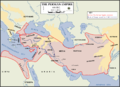 Xenophon says that all who knew Cyrus well say that he was the most worthy of being king of all those born since Cyrus the Great. When he was a child, he was taught with his brother and the other children, and he was considered the best of everyone in all things. And he learned how to rule and how to be ruled. And Cyrus was the most respectful to his elders. And he loved horses and he was the best in using his horses. He was the most eager and diligent to learn the things of war, both archery and javelin-throwing. When he was old enough, he was fond of hunting and was not afraid of dangerous animals. And once he did not flee a bear attacking him, but having grappled with it he was dragged down from his horse, and here he suffered the wounds of which he later had scars. And in the end he killed the bear. Cyrus made the first person who came to help him enviable to many people.
When Cyrus was sent by his father to be Satrap it was very important to him that if he should promise anything to anybody, it would not be a lie. And Cyrus made sure that anyone who had formerly been his enemy but had made a peace treaty would not suffer anything in violation of the treaty. Therefore all the cities liked him, and when fought against Tissaphernes, all the cities chose to support Cyrus except Miletus. And whenever anyone did Cyrus good or bad, Cyrus took care to pay him back double. Most of all, Cyrus honored those men brave in war. He appointed those who chose danger in battle archons of the land which he subdued, and he honored them with other gifts. For that reason, there was an abundance of men willing to face danger whenever they thought Cyrus might see them. And if he saw anyone managing his region well and making money, Cyrus did not envy him and did not try to take his money, but instead gave him more money. But Cyrus did try to take the money of men who hid it.
Cyrus made friends so that he would have enough helpers for whatever he wanted to accomplish. And he gave gifts to his friends paying attention to what each one desired and needed. Cyrus himself received so many clothes, both for war and for decoration, as gifts that he said he would not be able to wear them all and instead gave them out. For he thought that well-decorated friends was the best decoration a man could have. And while it is not surprising that he outdid his friends in giving gifts, because he was more able, he is praiseworthy because he outdid his friends in thoughtfulness and desire to do favors. For Cyrus often sent half-empty jars of wine whenever he received a very sweet wine, saying that he had not for a long time happened upon a sweeter wine. Sending wine, Cyrus said "I send this to you and order you to drink it up on this day with the people you love best." And often Cyrus sent half-eaten gooses or loaves of bread and ordered the bearer to say this message: "Cyrus was pleased by these things. Therefore, he wants you to taste them too." Whenever there was a shortage of fodder, Cyrus could get some on account of his having a lot helpers and his forethought. And he sent it to his friends and ordered them to feed the horses carrying them, lest they hunger while carrying his friends. And whenever he was marching a bunch of people came to see him, he summoned his friends together and talked with them, that he might show whom he honored. For all these reasons, no one either Greek or barbarian was ever loved by more people. And therefore, all his friends did not abandon him, but fought together with him until the end of his life, because Cyrus knew how to pick friends who were friendly and trustworthy and reliable.
's Life of Artaxerxes II, a young Persian soldier named Mithridates
accidentally killed Cyrus the Younger during the Battle of Cunaxa
(Greek
: Κούναξα). Unwisely, Mithridates boasted of this in the court and was then executed by scaphism
.
, The Warriors (film), and The Warriors (video game)
, all of which are based on Anabasis
.
Michael Curtis Ford
- The Ten Thousand - Is a historical novel about the 10 000 Greek mercanaries who made up the core of Cyrus's army.
Darius II of Persia
Darius II , was king of the Persian Empire from 423 BC to 405 BC.Artaxerxes I, who died on December 25, 424 BC, was followed by his son Xerxes II. After a month and a half Xerxes II was murdered by his brother Secydianus or Sogdianus...
(Dārayavahuš) and Parysatis
Parysatis
Parysatis was the 5th-century BCE illegitimate daughter of Artaxerxes I, Emperor of Persia and Andia of Babylon.She was the half-sister of Xerxes II, Sogdianus and Darius II...
, was a Persian prince and general
General
A general officer is an officer of high military rank, usually in the army, and in some nations, the air force. The term is widely used by many nations of the world, and when a country uses a different term, there is an equivalent title given....
. The time of his birth is unknown, but he died in 401 B.C. The history of Cyrus and of the retreat of the Greeks is told by Xenophon
Xenophon
Xenophon , son of Gryllus, of the deme Erchia of Athens, also known as Xenophon of Athens, was a Greek historian, soldier, mercenary, philosopher and a contemporary and admirer of Socrates...
in his Anabasis
Anabasis (Xenophon)
Anabasis is the most famous work, in seven books, of the Greek professional soldier and writer Xenophon. The journey it narrates is his best known accomplishment and "one of the great adventures in human history," as Will Durant expressed the common assessment.- The account :Xenophon accompanied...
. Another account, probably from Sophaenetus of Stymphalus, was used by Ephorus
Ephorus
Ephorus or Ephoros , of Cyme in Aeolia, in Asia Minor, was an ancient Greek historian. Information on his biography is limited; he was the father of Demophilus, who followed in his footsteps as a historian, and to Plutarch's claim that Ephorus declined Alexander the Great's offer to join him on his...
. Further information is contained in the excerpts from Ctesias
Ctesias
Ctesias of Cnidus was a Greek physician and historian from Cnidus in Caria. Ctesias, who lived in the 5th century BC, was physician to Artaxerxes Mnemon, whom he accompanied in 401 BC on his expedition against his brother Cyrus the Younger....
by Photius; Plutarch
Plutarch
Plutarch then named, on his becoming a Roman citizen, Lucius Mestrius Plutarchus , c. 46 – 120 AD, was a Greek historian, biographer, essayist, and Middle Platonist known primarily for his Parallel Lives and Moralia...
’s lives of Artaxerxes II and Lysander
Lysander
Lysander was a Spartan general who commanded the Spartan fleet in the Hellespont which defeated the Athenians at Aegospotami in 405 BC...
; also Thucydides
Thucydides
Thucydides was a Greek historian and author from Alimos. His History of the Peloponnesian War recounts the 5th century BC war between Sparta and Athens to the year 411 BC...
' History of Peloponnesian War. These are the only sources of information for Cyrus the Younger.
According to Xenophon, Cyrus the Younger was born after the accession of his father in 424 BC. In 408 BC, after the victories of Alcibiades
Alcibiades
Alcibiades, son of Clinias, from the deme of Scambonidae , was a prominent Athenian statesman, orator, and general. He was the last famous member of his mother's aristocratic family, the Alcmaeonidae, which fell from prominence after the Peloponnesian War...
, Darius II decided to continue the war against Athens
Athens
Athens , is the capital and largest city of Greece. Athens dominates the Attica region and is one of the world's oldest cities, as its recorded history spans around 3,400 years. Classical Athens was a powerful city-state...
and give strong support to the Sparta
Sparta
Sparta or Lacedaemon, was a prominent city-state in ancient Greece, situated on the banks of the River Eurotas in Laconia, in south-eastern Peloponnese. It emerged as a political entity around the 10th century BC, when the invading Dorians subjugated the local, non-Dorian population. From c...
ns. He sent Cyrus the Younger into Asia Minor
Asia Minor
Asia Minor is a geographical location at the westernmost protrusion of Asia, also called Anatolia, and corresponds to the western two thirds of the Asian part of Turkey...
, as satrap
Satrap
Satrap was the name given to the governors of the provinces of the ancient Median and Achaemenid Empires and in several of their successors, such as the Sassanid Empire and the Hellenistic empires....
of Lydia
Lydia
Lydia was an Iron Age kingdom of western Asia Minor located generally east of ancient Ionia in the modern Turkish provinces of Manisa and inland İzmir. Its population spoke an Anatolian language known as Lydian....
and Phrygia
Phrygia
In antiquity, Phrygia was a kingdom in the west central part of Anatolia, in what is now modern-day Turkey. The Phrygians initially lived in the southern Balkans; according to Herodotus, under the name of Bryges , changing it to Phruges after their final migration to Anatolia, via the...
Major with Cappadocia
Cappadocia
Cappadocia is a historical region in Central Anatolia, largely in Nevşehir Province.In the time of Herodotus, the Cappadocians were reported as occupying the whole region from Mount Taurus to the vicinity of the Euxine...
, and commander of the Persian troops, "which gather into the field of Castolos", i.e. of the army of the district of Asia Minor.
In the Spartan general Lysander, Cyrus found a man who was willing to help him; as Lysander himself hoped to become absolute ruler of Greece, by the aid of the Persian prince. So Cyrus put all his means at the disposal of Lysander in the Peloponnesian War
Peloponnesian War
The Peloponnesian War, 431 to 404 BC, was an ancient Greek war fought by Athens and its empire against the Peloponnesian League led by Sparta. Historians have traditionally divided the war into three phases...
, but denied them to his successor Callicratidas
Callicratidas
Callicratidas was a Spartan naval commander in the Peloponnesian War. In 406 BC, he was sent to the Aegean to take command of the Spartan fleet from Lysander, the first navarch....
.
At the same time Darius fell ill and called his son to his deathbed; Cyrus handed over all his treasures to Lysander and went to Susa
Susa
Susa was an ancient city of the Elamite, Persian and Parthian empires of Iran. It is located in the lower Zagros Mountains about east of the Tigris River, between the Karkheh and Dez Rivers....
. After the accession of Artaxerxes II in 404 BC, Tissaphernes
Tissaphernes
Tissaphernes was a Persian soldier and statesman, grandson of Hydarnes.In 413 BC he was satrap of Lydia and Caria, and commander in chief of the Persian army in Asia Minor...
(Ciθrafarna) denounced the plans of Cyrus against his brother but, by the intercession of Parysatis, was pardoned and sent back to his satrapy.
Lysander won the battle of Aegospotami
Battle of Aegospotami
The naval Battle of Aegospotami took place in 405 BC and was the last major battle of the Peloponnesian War. In the battle, a Spartan fleet under Lysander completely destroyed the Athenian navy...
and Sparta became more influential in the Greek world. Cyrus managed to gather a large army by beginning a quarrel with Tissaphernes, satrap of Caria
Caria
Caria was a region of western Anatolia extending along the coast from mid-Ionia south to Lycia and east to Phrygia. The Ionian and Dorian Greeks colonized the west of it and joined the Carian population in forming Greek-dominated states there...
, about the Ionia
Ionia
Ionia is an ancient region of central coastal Anatolia in present-day Turkey, the region nearest İzmir, which was historically Smyrna. It consisted of the northernmost territories of the Ionian League of Greek settlements...
n towns; he also pretended to prepare an expedition against the Pisidia
Pisidia
Pisidia was a region of ancient Asia Minor located north of Lycia, and bordering Caria, Lydia, Phrygia and Pamphylia. It corresponds roughly to the modern-day province of Antalya in Turkey...
ns, a mountainous tribe in the Taurus, which was never obedient to the Empire.
In the spring of 401 BC, Cyrus united all his forces into the group now called the "Ten Thousand
Ten Thousand (Greek)
The Ten Thousand were a group of mercenary units, mainly Greek, drawn up by Cyrus the Younger to attempt to wrest the throne of the Persian Empire from his brother, Artaxerxes II...
" and advanced from Sardis
Sardis
Sardis or Sardes was an ancient city at the location of modern Sart in Turkey's Manisa Province...
, without announcing the object of his expedition. By dexterous management and large promises he overcame the scruples of the Greek troops against the length and danger of the war; a Spartan fleet of thirty-five trireme
Trireme
A trireme was a type of galley, a Hellenistic-era warship that was used by the ancient maritime civilizations of the Mediterranean, especially the Phoenicians, ancient Greeks and Romans.The trireme derives its name from its three rows of oars on each side, manned with one man per oar...
s sent to Cilicia
Cilicia
In antiquity, Cilicia was the south coastal region of Asia Minor, south of the central Anatolian plateau. It existed as a political entity from Hittite times into the Byzantine empire...
opened the passes of the Amanus into Syria
Syria
Syria , officially the Syrian Arab Republic , is a country in Western Asia, bordering Lebanon and the Mediterranean Sea to the West, Turkey to the north, Iraq to the east, Jordan to the south, and Israel to the southwest....
and conveyed to him a Spartan detachment of 700 men under Cheirisophus. The king had only been warned at the last moment by Tissaphernes and gathered an army in haste; Cyrus advanced into Babylonia, before he met with an enemy. In October 401 BC, the battle of Cunaxa
Battle of Cunaxa
The Battle of Cunaxa was fought in 401 BC between Cyrus the Younger and his elder brother Arsaces, who had inherited the Persian throne as Artaxerxes II in 404 BC. The great battle of the revolt of Cyrus took place 70 km north of Babylon, at Cunaxa , on the left bank of the Euphrates River...
ensued. Cyrus had 10,400 Greek hoplite
Hoplite
A hoplite was a citizen-soldier of the Ancient Greek city-states. Hoplites were primarily armed as spearmen and fought in a phalanx formation. The word "hoplite" derives from "hoplon" , the type of the shield used by the soldiers, although, as a word, "hopla" could also denote weapons held or even...
s and 2,500 peltast
Peltast
A peltast was a type of light infantry in Ancient Thrace who often served as skirmishers.-Description:Peltasts carried a crescent-shaped wicker shield called pelte as their main protection, hence their name. According to Aristotle the pelte was rimless and covered in goat or sheep skin...
s, and an Asiatic army of approximately 10,000 under the command of Ariaeus
Ariaeus
Ariaeus was a Persian general who fought alongside Cyrus the Younger at the Battle of Cunaxa and later was involved in the assassination of Tissaphernes.-Life:...
.
Cyrus saw that the outcome depended on the fate of the king; he therefore wanted Clearchus, the commander of the Greeks, to take the centre against Artaxerxes. Clearchus, out of arrogance, disobeyed. As a result the left wing of the Persians under Tissaphernes was free to engage the rest of Cyrus' forces; Cyrus in the centre threw himself upon Artaxerxes, but was slain in a desperate struggle. Tissaphernes pretended to have killed the rebel himself, with the result that Parysatis took cruel vengeance upon the slayer of her favorite son. The Persian troops, instead of attacking the Greeks via a direct assault, decoyed them into the interior, beyond the Tigris
Tigris
The Tigris River is the eastern member of the two great rivers that define Mesopotamia, the other being the Euphrates. The river flows south from the mountains of southeastern Turkey through Iraq.-Geography:...
, and then attack through trickery. It was a solid and clever plan but, after their commanders had been taken prisoners, the Greeks managed to force their way to the Black Sea
Black Sea
The Black Sea is bounded by Europe, Anatolia and the Caucasus and is ultimately connected to the Atlantic Ocean via the Mediterranean and the Aegean seas and various straits. The Bosphorus strait connects it to the Sea of Marmara, and the strait of the Dardanelles connects that sea to the Aegean...
. This achievement demonstrated the potential superiority of Greek soldiers against their Persian adversaries. It is thought that this was the reason why Philip II of Macedon
Philip II of Macedon
Philip II of Macedon "friend" + ἵππος "horse" — transliterated ; 382 – 336 BC), was a king of Macedon from 359 BC until his assassination in 336 BC. He was the father of Alexander the Great and Philip III.-Biography:...
formulated his strategy of defeating the Persian Empire
Achaemenid Empire
The Achaemenid Empire , sometimes known as First Persian Empire and/or Persian Empire, was founded in the 6th century BCE by Cyrus the Great who overthrew the Median confederation...
by means of a compact and well-trained army: a feat accomplished by his son, Alexander the Great.
Xenophon's account of Cyrus' life
When Cyrus was sent by his father to be Satrap it was very important to him that if he should promise anything to anybody, it would not be a lie. And Cyrus made sure that anyone who had formerly been his enemy but had made a peace treaty would not suffer anything in violation of the treaty. Therefore all the cities liked him, and when fought against Tissaphernes, all the cities chose to support Cyrus except Miletus. And whenever anyone did Cyrus good or bad, Cyrus took care to pay him back double. Most of all, Cyrus honored those men brave in war. He appointed those who chose danger in battle archons of the land which he subdued, and he honored them with other gifts. For that reason, there was an abundance of men willing to face danger whenever they thought Cyrus might see them. And if he saw anyone managing his region well and making money, Cyrus did not envy him and did not try to take his money, but instead gave him more money. But Cyrus did try to take the money of men who hid it.
Cyrus made friends so that he would have enough helpers for whatever he wanted to accomplish. And he gave gifts to his friends paying attention to what each one desired and needed. Cyrus himself received so many clothes, both for war and for decoration, as gifts that he said he would not be able to wear them all and instead gave them out. For he thought that well-decorated friends was the best decoration a man could have. And while it is not surprising that he outdid his friends in giving gifts, because he was more able, he is praiseworthy because he outdid his friends in thoughtfulness and desire to do favors. For Cyrus often sent half-empty jars of wine whenever he received a very sweet wine, saying that he had not for a long time happened upon a sweeter wine. Sending wine, Cyrus said "I send this to you and order you to drink it up on this day with the people you love best." And often Cyrus sent half-eaten gooses or loaves of bread and ordered the bearer to say this message: "Cyrus was pleased by these things. Therefore, he wants you to taste them too." Whenever there was a shortage of fodder, Cyrus could get some on account of his having a lot helpers and his forethought. And he sent it to his friends and ordered them to feed the horses carrying them, lest they hunger while carrying his friends. And whenever he was marching a bunch of people came to see him, he summoned his friends together and talked with them, that he might show whom he honored. For all these reasons, no one either Greek or barbarian was ever loved by more people. And therefore, all his friends did not abandon him, but fought together with him until the end of his life, because Cyrus knew how to pick friends who were friendly and trustworthy and reliable.
Plutarch's account of Cyrus' death
According to PlutarchPlutarch
Plutarch then named, on his becoming a Roman citizen, Lucius Mestrius Plutarchus , c. 46 – 120 AD, was a Greek historian, biographer, essayist, and Middle Platonist known primarily for his Parallel Lives and Moralia...
's Life of Artaxerxes II, a young Persian soldier named Mithridates
Mithridates (soldier)
Mithridates was a young Persian soldier in the army of king Artaxerxes II who according to a version in Plutarch's Life of Artaxerxes II, accidentally killed the rebel claimant to the throne Cyrus the Younger in the Battle of Cunaxa .-Account of events:Shortly after, Cyrus's death was reported to...
accidentally killed Cyrus the Younger during the Battle of Cunaxa
Battle of Cunaxa
The Battle of Cunaxa was fought in 401 BC between Cyrus the Younger and his elder brother Arsaces, who had inherited the Persian throne as Artaxerxes II in 404 BC. The great battle of the revolt of Cyrus took place 70 km north of Babylon, at Cunaxa , on the left bank of the Euphrates River...
(Greek
Greek language
Greek is an independent branch of the Indo-European family of languages. Native to the southern Balkans, it has the longest documented history of any Indo-European language, spanning 34 centuries of written records. Its writing system has been the Greek alphabet for the majority of its history;...
: Κούναξα). Unwisely, Mithridates boasted of this in the court and was then executed by scaphism
Scaphism
Scaphism, also known as the boats, was an ancient Persian method of execution designed to inflict torturous death. The name comes from the Greek word skaphe, meaning "scooped out"....
.
Modern appearances
Cyrus is a principal character in The Warriors (novel)The Warriors (novel)
The Warriors is a novel written by Sol Yurick in 1965. It became the inspiration for the cult classic movie The Warriors. Compared to the movie, the novel takes a closer look at the concepts of sexuality, reputation, family, and survival...
, The Warriors (film), and The Warriors (video game)
The Warriors (video game)
The Warriors is a beat 'em up video game published by Rockstar Games. It was released on October 17, 2005 for PlayStation 2 and Xbox, and February 12, 2007 for PlayStation Portable. The game is based on the 1979 film, The Warriors...
, all of which are based on Anabasis
Anabasis (Xenophon)
Anabasis is the most famous work, in seven books, of the Greek professional soldier and writer Xenophon. The journey it narrates is his best known accomplishment and "one of the great adventures in human history," as Will Durant expressed the common assessment.- The account :Xenophon accompanied...
.
Michael Curtis Ford
Michael Curtis Ford
Michael Curtis Ford is an American historical novelist, writing novels about Ancient Rome and Ancient Greece. He has worked variously as a laborer, a ski patrolman, a musician, a consultant, a banker, a Latin teacher, and a translator. He holds degrees in Economics and Linguistics and lives in...
- The Ten Thousand - Is a historical novel about the 10 000 Greek mercanaries who made up the core of Cyrus's army.