
All Topics  
Warring States Period

 
Warring States Period

   Email Print
   Bookmark   Link


Warring States Period


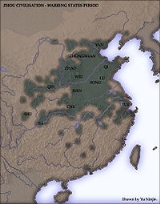
The Warring States Period , also known as the Era of Warring States, covers the period from 476 BCE to the unification of China
China

China is a Culture of China, an ancient civilization, and, depending on perspective, a national or multinational entity extending over a large area in East Asia....
 by the Qin Dynasty
Qin Dynasty

The Qin Dynasty was preceded by the feudal Zhou Dynasty and followed by the Han Dynasty in China. The unification of China in 221 BCE under the Qin Shi Huang marked the beginning of Imperial China, a period which lasted until the fall of the Qing Dynasty in 1912 CE....
 in 221 BCE. It is nominally considered to be the second part of the Eastern Zhou Dynasty
Zhou Dynasty

The Zhou Dynasty was preceded by the Shang Dynasty and followed by the Qin Dynasty in China. The Zhou dynasty lasted longer than any other dynasty in China history?though the actual political and military control of China by the dynasty only lasted during the Western Zhou....
, following the Spring and Autumn Period
Spring and Autumn Period

The Spring and Autumn Period was a period in Chinese history, which roughly corresponds to the first half of the Eastern Zhou dynasty . Its name comes from the Spring and Autumn Annals, a chronicle of the state of Lu between 722 BC and 481 BC, which tradition associates with Confucius....
, although the Zhou dynasty itself ended in 256 BCE, 35 years earlier than the end of the Warring States period. As with the Spring and Autumn Period, the king of Zhou acted merely as a figurehead
Figurehead

A figurehead is a carved wooden decoration, often female or bestial, found at the prow of ships largely made between the 16th and 19th century....
.


Discussion
Ask a question about 'Warring States Period'
Start a new discussion about 'Warring States Period'
Answer questions from other users
Full Discussion Forum


Encyclopedia


The Warring States Period , also known as the Era of Warring States, covers the period from 476 BCE to the unification of China
China

China is a Culture of China, an ancient civilization, and, depending on perspective, a national or multinational entity extending over a large area in East Asia....
 by the Qin Dynasty
Qin Dynasty

The Qin Dynasty was preceded by the feudal Zhou Dynasty and followed by the Han Dynasty in China. The unification of China in 221 BCE under the Qin Shi Huang marked the beginning of Imperial China, a period which lasted until the fall of the Qing Dynasty in 1912 CE....
 in 221 BCE. It is nominally considered to be the second part of the Eastern Zhou Dynasty
Zhou Dynasty

The Zhou Dynasty was preceded by the Shang Dynasty and followed by the Qin Dynasty in China. The Zhou dynasty lasted longer than any other dynasty in China history?though the actual political and military control of China by the dynasty only lasted during the Western Zhou....
, following the Spring and Autumn Period
Spring and Autumn Period

The Spring and Autumn Period was a period in Chinese history, which roughly corresponds to the first half of the Eastern Zhou dynasty . Its name comes from the Spring and Autumn Annals, a chronicle of the state of Lu between 722 BC and 481 BC, which tradition associates with Confucius....
, although the Zhou dynasty itself ended in 256 BCE, 35 years earlier than the end of the Warring States period. As with the Spring and Autumn Period, the king of Zhou acted merely as a figurehead
Figurehead

A figurehead is a carved wooden decoration, often female or bestial, found at the prow of ships largely made between the 16th and 19th century....
. The name Warring States Period was derived from the Record of the Warring States, a work historically compiled early in the Han Dynasty
Han Dynasty

The Han Dynasty followed the Qin Dynasty and preceded the Three Kingdoms in China. The Han Dynasty was ruled by the family known as the Liu clan who had peasant origins....
. The date for the beginning of the Warring States Period is somewhat in dispute. While it is frequently cited as 475 BCE (following the Spring and Autumn Period), 403 BCE – the date of the tripartition of the Jin
Jin (state)

Jin was one of the most powerful states in the Spring and Autumn Period, based in Shanxi, China. Jin was founded by Tang Shuyu, a descendant of the Zhou Dynasty royal family....
 – is also sometimes considered as the beginning of the period.

China 2c
The Warring States Period, in contrast to the Spring and Autumn Period, was a period when regional warlords annexed smaller states around them and consolidated their rule. The process began in the Spring and Autumn Period
Spring and Autumn Period

The Spring and Autumn Period was a period in Chinese history, which roughly corresponds to the first half of the Eastern Zhou dynasty . Its name comes from the Spring and Autumn Annals, a chronicle of the state of Lu between 722 BC and 481 BC, which tradition associates with Confucius....
, and by the 3rd century BC, seven major states had risen to prominence. These Seven Warring States
Seven Warring States

The Seven Warring States or Seven Kingdoms refers to the seven warring states in China during the Warring States period in Chinese history....
 (????/???? Zhànguó Qixióng, literally "Seven Hegemonial among the Warring States"), were the Qi
Qi (state)

Qi was a powerful state during the Spring and Autumn Period and Period of the Warring States. Its capital was Linzi, which is part of the present city of Zibo in Shandong Province....
 (?/?), the Chu
Chu (state)

Chu was a monarchy in what is now central and southern China during the Spring and Autumn period and Warring States Period . Its ruling house had the Chinese surname mi , and clan name xiong , and originally was of the noble rank of Chinese nobility#Princehood and Peerage, roughly comparable to a viscount....
, the Yan
Yan (state)

Yan was a state during the Western Zhou, Spring and Autumn and Warring States Periods in China. Its capital was Ji .During the first years of the Zhou Dynasty, Yan was located near the Yellow River, but after the failed revolt led by the leaders of the Shang Dynasty, the fiefdom was relocated further north in what is now Hebei Province t...
, the Han
Han (state)

Han was a monarchy during the Warring States Period in China. Not to be confused with South Korea which shares the same name.Its territory directly blocked the passage of the state of Qin into the North China Plain, thus becoming a frequent target of Qin's military operations....
 (?/?), the Zhao
Zhao (state)

Zhao was a China state during the Warring States Period. Zhao was a significant state in the period, along with six others. At the beginning of the Warring States Period, the state of Zhao was one of the weakest states but gained strength during the reign of King Wuling of Zhao....
 (?/?), the Wei
Wei (state)

The Wei was a state during the Warring States Period in China. Its territory lay between the states of Qin and Qi and included modern areas in Henan, Hebei and Shanxi and Shandong....
and the Qin
Qin (state)

Q?n or Ch'in , was a state during the Spring and Autumn Period and Warring States Periods of China. It eventually grew to dominate the country and unite it in 221 BC, after which it is referred to as the Qin Dynasty....
. Another sign of this shift in power was a change in title: warlords once considered themselves dukes (? gong) of the Zhou dynasty king; but now the warlords began to call themselves kings (? wáng), meaning they were equal to the Zhou king.

The Warring States Period saw the proliferation of iron working
Iron

Iron is a chemical element with the symbol Fe and atomic number 26. Iron is a Group 8 element and period 4 element. Iron is lustrous and silvery in color....
 in China
China

China is a Culture of China, an ancient civilization, and, depending on perspective, a national or multinational entity extending over a large area in East Asia....
, replacing bronze
Bronze

Bronze is a metal alloy consisting primarily of copper, usually with tin as the main additive, but sometimes with other chemical element such as phosphorus, manganese, aluminium, or silicon....
 as the dominant metal used in warfare. Areas such as Shu
Shu (state)

Shu was an ancient state in what is now Sichuan, China. Shu derived its power from the Chengdu Plain, with its territory primarily in the central and western Sichuan basin, as well as in the upper Han River ....
 (modern Sichuan
Sichuan

is a Province in western China proper with its capital in Chengdu. The current name of the province, ?? , is an abbreviation of ??? , or "Four circuit #Circuits in East Asia of rivers", which is itself abbreviated from ???? , or "Four circuits of rivers and gorges", named after the division of the existing circuit into four during the Song...
) and Yue
Yue (state)

Yue was a state in China which existed during the Spring and Autumn Period and the Warring States Period, in the modern province of Zhejiang. During the Spring and Autumn Period, its capital was in Guiji , near the modern city of Shaoxing....
 (modern Zhejiang
Zhejiang

Zhejiang is an eastern coastal province of China of the People's Republic of China. The word Zhejiang was the old name of the Qiantang River, which passes through Hangzhou, the provincial capital....
) were also brought into the Chinese cultural sphere during this time. Different philosophies developed into the Hundred Schools of Thought
Hundred Schools of Thought

The Hundred Schools of Thought were philosophers and schools that had flourished from 770 to 221 BC, an era of great cultural and intellectual expansion in China....
, including Confucianism
Confucianism

Confucianism is a China Ethics and Philosophy developed from the teachings of the Chinese philosopher Confucius . It focuses on human morality and right action....
 (elaborated by Mencius
Mencius

Mencius , most accepted dates: 372 ? 289 BCE; other possible dates: 385 ? 303/302 BCE) was a Chinese philosophy who was arguably the most famous Confucian after Confucius himself....
), Taoism
Taoism

Taoism refers to a variety of related philosophical and religious traditions and concepts. These traditions have influenced East Asia for over two thousand years and some have spread to the West....
 (elaborated by Lao Zi and to a lesser extent Zhuang Zi, in that it is possible to see the philosophy espoused in the text of the Zhuang Zi as separate from what could be considered "classical Daoism"), Legalism (formulated by Han Feizi) and Mohism
Mohism

Mohism or Moism was a Chinese philosophy developed by the followers of Mozi , 470 BCE–c.391 BC. It evolved at about the same time as Confucianism, Taoism and Legalism and was one of the four main Hundred Schools of Thought during the Spring and Autumn Period and the Warring States Period ....
 (formulated by Mozi
Mozi

Mozi , was a philosopher who lived in China during the Hundred Schools of Thought period . He founded the school of Mohism and argued strongly against Confucianism and Daoism....
). Trade
Trade

Tradeis the willing exchange of goods, Service , or both. Trade is also called commerce. A mechanism that allows trade is called a market. The original form of trade was barter , the direct exchange of goods and services....
 also became important, and some merchants had considerable power in politics. Military tactics also changed. Unlike the Spring and Autumn Period, most armies in the Warring States Period made combined use of infantry and cavalry, and the use of chariots gradually fell into disfavor. Thus from this period on, the nobles in China remained a literate rather than warrior class, as the kingdoms competed by throwing masses of soldiers against each other. Arms of soldiers gradually changed from bronze to unified iron arms. Dagger-axes were an extremely popular weapon in various kingdoms, especially for the Qin who produced eighteen-foot long pikes.

This was also around the time the legendary military strategist Sun Tzu
Sun Tzu

Sun Tzu , also called Sun Wu , is traditionally believed to be the author of The Art of War, sometimes called the Sun Tzu, an influential ancient China book on military strategy considered to be a prime example of Taoism strategy....
 (Sun Zi) wrote The Art of War
The Art of War

The Art of War is a China military science treatise that was written during the 6th century BC by Sun Tzu. Composed of 13 chapters, each of which is devoted to one aspect of warfare, it has long been praised as the definitive work on military strategy and Military tactics of its time....
 which is recognized today as the most influential, and oldest known military strategy guide. Along with this are other military writings that make up the Seven Military Classics
Seven Military Classics

The Seven Military Classics of China were seven important military texts of ancient China which included Sun-tzu's The Art of War. The texts were canonized under this name during the 11th century AD, and from the Song Dynasty onwards were included in most military encyclopedias....
 of ancient China: T'ai Kung
Jiang Ziya

Jiang Ziya was a Chinese historical and legendary figure who resided next to the Wei River about 3,000 years ago. The region was the feudal estate of King Wen of Zhou Dynasty....
's Six Secret Teachings
Six Secret Teachings

The Six Secret Strategic Teachings was a treatise on military strategy attributed to the legendary figure Jiang Ziya, a confederate of King Wen of Zhou, founder of the Zhou Dynasty....
, The Methods of the Sima, Sun Bin
Sun Bin

Sun Bin was a military strategist who lived during the Warring States Period in ancient China. Born in Qi , he wrote his own military treatise, the Sun Bin Bing Fa, that Yinqueshan Han Slips after being lost for almost 2000 years....
's Art of War, Wu Qi
Wu Qi

Wu Qi was a China military leader and politician in the Warring States period. Born in the State of Wei , he was good at leading an army. He had served in the states of Lu and Wei....
, Wei Liaozi, Three strategies of Huang Shigong, and The Questions and Replies of Tang Taizong and Li Weigong (the last being made ±800 years after this era ended). Once China was unified, these seven military classics were locked away and access was restricted due to their tendency to promote revolution.

Partition of Jin

Bianzhong
In the Spring and Autumn Period
Spring and Autumn Period

The Spring and Autumn Period was a period in Chinese history, which roughly corresponds to the first half of the Eastern Zhou dynasty . Its name comes from the Spring and Autumn Annals, a chronicle of the state of Lu between 722 BC and 481 BC, which tradition associates with Confucius....
, the State of Jin was arguably the most powerful state in China. However, near the end of the Spring and Autumn Period
Spring and Autumn Period

The Spring and Autumn Period was a period in Chinese history, which roughly corresponds to the first half of the Eastern Zhou dynasty . Its name comes from the Spring and Autumn Annals, a chronicle of the state of Lu between 722 BC and 481 BC, which tradition associates with Confucius....
, the power of the ruling family weakened, and Jin gradually came under the control of six ministers belonging to six different families. By the beginning of the Warring States Period, after numerous power struggles, there were four families left: the Zhi family, the Wei family, the Zhao family, and the Han family, with the Zhi family being the dominant power in Jin. Zhi Yao, the last head of the Zhi family, attempted a coalition with the Wei family and the Han family to destroy the Zhao family. However, because of Zhi Yao's arrogance and disrespect towards the other families, the Wei family and Han family secretly allied with the Zhao family, and the three families launched a surprise attack at Jinyang
Battle of Jinyang

The Battle of Jinyang was fought between the elite families of the Jin , the house of Zhao and the house of Zhi , in the Spring and Autumn period of China....
, which was besieged by Zhi Yao at the time, and annihilated the Zhi.

In 403 BC, the three major families of Jin, with the approval of the Zhou king, partitioned Jin into three states, which was historically known as 'The Partition of Jin of the Three Families'. The new states were: the State of Han, the State of Zhao, and the State of Wei. The three family heads were given the title of Marquis, and because the three states were originally part of Jin, they are also referred to as the Three Jins. The State of Jin continued to exist with a tiny piece of territory until 376 BC when the rest of the territory was partitioned by the Three Jins.

Change of government in Qi


In 389 BCE, the Tian family seized control of the State of Qi, and were given the title of Duke. The old Jiang family's State of Qi continued to exist with a small piece of territory until 379 BCE, when it was finally absorbed into Tian family's State of Qi.

Early strife in the Three Jins, Qi, and Qin

In 371 BCE, Marquess Wu of Wei died without specifying a successor, causing Wei to fall into an internal war of succession. After three years of civil war, Zhao and Han, sensing an opportunity, invaded Wei. On the verge of conquering Wei, the leaders of Zhao and Han fell into disagreement on what to do with Wei and both armies mysteriously retreated. As a result, King Hui of Wei
King Hui of Wei

King Hui of Wei or King Hui of Liang was the third ruler of the state of Wei during the Warring States Period, ruling from approximately 370 BC?319 BC....
 (still a Marquess at the time) was able to jump onto the throne of Wei.

In 354 BCE, King Hui of Wei
King Hui of Wei

King Hui of Wei or King Hui of Liang was the third ruler of the state of Wei during the Warring States Period, ruling from approximately 370 BC?319 BC....
 initiated a large scale attack at Zhao, which some historians believe was to avenge the earlier near destruction of Wei. By 353 BCE, Zhao was losing the war badly, and one of their major cities — Handan
Handan

Handan is a prefecture-level city located in the southwestern part of Hebei Province of China....
 (??/??), a city that would eventually become Zhao's capital — was being besieged. As a result, the neighbouring State of Qi decided to help Zhao. The strategy Qi used, suggested by the famous tactician Sun Bin
Sun Bin

Sun Bin was a military strategist who lived during the Warring States Period in ancient China. Born in Qi , he wrote his own military treatise, the Sun Bin Bing Fa, that Yinqueshan Han Slips after being lost for almost 2000 years....
 (??/??), a descendant of Sun Tzu, who at the time was the Qi army advisor, was to attack Wei's territory while the main Wei army is busy sieging Zhao, forcing Wei to retreat. The strategy was a success; the Wei army hastily retreated, and encountered the Qi midway, culminating into the Battle of Guiling
Battle of Guiling

The Battle of Gu?l?ng was fought between the states of Qi and Wei in the Warring States period of Chinese history. In 354 BC, an army from W?i was laying siege to Handan city, the capital of State of Zhao....
 (Pinyin: guì líng) (????/????) where Wei was decisively defeated. The event spawned the idiom "????/????", meaning "Surrounding Wei to save Zhao", which is still used in modern Chinese to refer to attacking an enemy's vulnerable spots in order to relieve pressure being applied by that enemy upon an ally.

In 341 BCE, Wei attacked Han, and Qi interfered again. The two generals from the previous Battle of Guiling
Battle of Guiling

The Battle of Gu?l?ng was fought between the states of Qi and Wei in the Warring States period of Chinese history. In 354 BC, an army from W?i was laying siege to Handan city, the capital of State of Zhao....
 met again, and due to the brilliant strategy of Sun Bin
Sun Bin

Sun Bin was a military strategist who lived during the Warring States Period in ancient China. Born in Qi , he wrote his own military treatise, the Sun Bin Bing Fa, that Yinqueshan Han Slips after being lost for almost 2000 years....
, Wei was again decisively defeated at the Battle of Maling
Battle of Maling

The Battle of Maling was conducted in Maling, currently Dazhangjia Town , Shen County , Henan, in 342 BC during the Warring States Period. The combatants were the state of Qi , who fought on behalf of state of State of Han, and the state of Wei ....
 (????/????).

The situation for Wei took an even worse turn when Qin, taking advantage of Wei series of defeats by Qi, attacked Wei in 340 BC under the advice of famous Qin reformer Shang Yang
Shang Yang

Shang Yang was an important statesman of Qin in the Warring States Period of ancient China. With the support of Duke Xiao of Qin, Shang enacted numerous reforms in the state of Qin that helped to change Qin from a peripheral state into a militarily powerful and strongly centralized kingdom, changing the administration by emphasizing mer...
. Wei was devastatingly defeated and was forced to cede a large portion of its territory to achieve a truce. This left their capital Anyi
Anyi

Anyi may refer to:*Anyin language, spoken principally in C?te d'Ivoire and in Ghana*Anyi County, in Nanchang, Jiangxi, China...
 vulnerable, so Wei was also forced to move their capital to Daliang
Daliang

Daliang may refer to:China*?? D?li?ng, subdistrict of Shunde, China*??, another name for Kaifeng, China...
.

After these series of events, Wei became severely weakened, and the Qi and Qin states became the two dominant states in China.

Shang Yang's reforms in Qin

Around 359 BCE, Shang Yang
Shang Yang

Shang Yang was an important statesman of Qin in the Warring States Period of ancient China. With the support of Duke Xiao of Qin, Shang enacted numerous reforms in the state of Qin that helped to change Qin from a peripheral state into a militarily powerful and strongly centralized kingdom, changing the administration by emphasizing mer...
, a minister of the State of Qin, initiated a series of reforms based on the political doctrine of Legalism
Legalism

Legalism may refer to:In legal theory:*Liberal legalism - A theory on the relationship between politics and lawIn philosophy:* Legalism , a concept in Western jurisprudence...
 that transformed Qin from a backward state into one that surpasses the other six states. It is generally regarded that this is the point where Qin started to become the most dominant state in China.

Ascension of the Kingdoms

In 334 BCE, the rulers of Wei and Qi agreed to recognize each other as Kings, formalizing the independence of the states and the powerlessness of the Zhou throne since the beginning of the Eastern Zhou Dynasty
Zhou Dynasty

The Zhou Dynasty was preceded by the Shang Dynasty and followed by the Qin Dynasty in China. The Zhou dynasty lasted longer than any other dynasty in China history?though the actual political and military control of China by the dynasty only lasted during the Western Zhou....
. The King of Wei and the King of Qi joined the ranks of the King of Chu, whose predecessors had been Kings since the Spring and Autumn Period
Spring and Autumn Period

The Spring and Autumn Period was a period in Chinese history, which roughly corresponds to the first half of the Eastern Zhou dynasty . Its name comes from the Spring and Autumn Annals, a chronicle of the state of Lu between 722 BC and 481 BC, which tradition associates with Confucius....
. From this point on, all the other states eventually declare their Kingship, signifying the beginning of the end of the Zhou Dynasty
Zhou Dynasty

The Zhou Dynasty was preceded by the Shang Dynasty and followed by the Qin Dynasty in China. The Zhou dynasty lasted longer than any other dynasty in China history?though the actual political and military control of China by the dynasty only lasted during the Western Zhou....
.

In 325 BCE, the ruler of Qin declared himself as King.

In 323 BCE, the rulers of Han and Yan declared themselves as King.

In 318 BCE, the ruler of Song, a relatively minor state, declared himself as King.

The ruler of Zhao held out until around 299 BC, and was the last to declare himself as King.

Chu expansion and defeats


Early in the Warring States Period, Chu was one of the strongest states in China. The state rose to a new level of power around 389 BCE when the King of Chu named the famous reformer Wu Qi
Wu Qi

Wu Qi was a China military leader and politician in the Warring States period. Born in the State of Wei , he was good at leading an army. He had served in the states of Lu and Wei....
to be his prime minister.

Chu rose to its peak in 334 BCE, when it gained vast amounts of territory. The series of events leading up to this began when Yue prepared to attack Qi. The King of Qi sent an emissary who persuaded the King of Yue to attack Chu instead. Yue initiated a large scale attack at Chu, but was devastatingly defeated by Chu's counter-attack. Chu then proceeded to conquer the State of Yue. This campaign expanded the Chu's borders to the coasts of the Pacific Ocean
Pacific Ocean

The Pacific Ocean is the largest of the Earth's oceanic divisions. Its name is derived from the Latin name Mare Pacificum, "peaceful sea", bestowed upon it by the Portugal explorer Ferdinand Magellan....
.

The folkloric figure, Qu Yuan figures into this historical period, as a minister in the court of the King of Chu. [Refer to Duan Wu Festival]

The Domination of Qin and the resulting Grand Strategies


Towards the end of the Warring States Period, the State of Qin became disproportionately powerful compared to the other six states. As a result, the policies of the six states became overwhelmingly oriented towards dealing with the Qin threat, with two opposing schools of thought: Hezong (??/?? pinyin
Pinyin

Pinyin, more formally Hanyu pinyin, is the most commonly used Romanization system for Standard Mandarin. Hanyu is the Chinese Language, and pinyin means "phonetics", or more literally, "spelling sound" or "spelled sound"....
: hézòng, "vertically linked"), or alliance with each other to repel Qin expansionism
Expansionism

In general, expansionism consists of expansionist policies of government. While some have linked the term to promoting economic growth , more commonly expansionism refers to the doctrine of a nation's expanding its territorial base usually by means of military aggression....
; and Lianheng (??/?? pinyin
Pinyin

Pinyin, more formally Hanyu pinyin, is the most commonly used Romanization system for Standard Mandarin. Hanyu is the Chinese Language, and pinyin means "phonetics", or more literally, "spelling sound" or "spelled sound"....
: liánhéng, "horizontally linked"), or alliance with Qin to participate in its ascendancy. There were some initial successes in Hezong, though it eventually broke down. Qin repeatedly exploited the Lianheng strategy to defeat the states one by one. During this period, many philosophers and tacticians travelled around the states recommending the rulers to put their respective ideas into use. These "lobbyists" were famous for their tact and intellect, and were collectively known as Zonghengjia, taking its name from the two main schools of thought.

In 316 BCE, Qin conquered the Shu area.

Around 300 BCE, Qi was almost totally annihilated by a coalition of five states led by Yue Yi
Yue Yi

Yue Yi was an officer of the State of Yan during the Warring State period, also known as Lord Guojun. He was the son of the prime minister of the small nation of Zhongshan , but when Zhongshan was destroyed by Zhao's King Wuling, he was forced to wander from country to country....
 of Yan (Qin were among those five). Although under General Tian Dan Qi managed to recover their lost territories, it would never be a great power again. Yan was also too exhausted afterwards to be of much importance in national affairs after this campaign.

In 293 BCE the Battle of Yique
Battle of Yique

Battle of Yique 293 BC, levied by King Zhaoxiang of Qin against the alliance of State of Wei and State of Han at Yique , commanded by general Bai Qi....
 against Wei and Han resulted in victory for Qin. This effectively removed Wei and Han threat to further Qin aspirations.

In 278 BCE, Qin attacked Chu and managed to capture their capital city, Ying, forcing the Chu king to move eastwards to Shouchun. This campaign virtually destroyed Chu's military might, although they recovered sufficiently to mount serious resistance against Qin 50 years later.

In 260 BCE, the Battle of Changping
Battle of Changping

The Battle of Changping in 260 BC was a decisive victory of the state of Qin of China over Zhao during the Warring States Period. Even by today's standards it is one of the Most lethal battles in world history#Major operations, although a great majority of the Zhao soldiers were executed after battle instead of being killed in battle....
 was fought between Qin and Zhao, resulting in a catastrophic defeat for the latter. Although both sides were utterly exhausted after the titanic clash, Zhao, unlike Qin, could not recover after the event.

In about 50 years Qin superiority was secure, thanks to its powerful military and, in part, constant feuding between the other states.

Military developments

The Warring States Period saw the introduction of many new innovations to the art of warfare in China, such as the use of iron and cavalry.

The various states fielded massive armies of infantry, cavalry and chariots. Complex logistical systems maintained by efficient government bureaucracy, was needed to supply, train, and control such large forces. The size of the armies ranged from tens of thousands to several hundred thousand men.

Iron became more widespread and began to replace bronze. Most armour and weapons of this period were made from iron.

The first official native Chinese cavalry unit was formed in 307 BC by King Wuling of Zhao
King Wuling of Zhao

King Wuling of Zhao reigned in the State of Zhao during the Warring States Period of Chinese history. His reign was famous for one important event: the reforms consisting of "Wearing Barbarian Uniform and the Use of Cavalry in Battle" ....
. But the war chariot still retained its prestige and importance, despite the tactical superiority of cavalry.

Crossbow was the preferred long range weapon of this period due to many reasons. The crossbow could be mass-produced easily, and mass training of crossbowmen was possible. These qualities made it a powerful weapon against the enemy.

Infantrymen deployed a varieties of weapons, but the most popular was the dagger-axe. The dagger-axe came in various length from 9–18 ft, the weapon comprising a thrusting spear with a slashing blade appended to it.

Zhao's military reforms


In 307 BCE, King Wuling of Zhao
King Wuling of Zhao

King Wuling of Zhao reigned in the State of Zhao during the Warring States Period of Chinese history. His reign was famous for one important event: the reforms consisting of "Wearing Barbarian Uniform and the Use of Cavalry in Battle" ....
 adopted superior non-Chinese horse-riding clothing (trousers
Trousers

Trousers are an item of clothing worn on the lower part of the body from the waist to the ankles, covering both legs separately . Such items of clothing are often referred to as pants in countries such as Canada, South Africa and The United States....
) to better facilitate cavalry fighting tactics.

Qin's conquest of China

In 230 BCE, the State of Qin conquered the State of Han. Han, the weakest of the seven Warring States, was adjacent to the much stronger Qin, and had sufferred continuous assaults by Qin in earlier years of the Warring states period. This went on until Emperor Qin Shi Huang
Qin Shi Huang

Qin Shi Huang , personal name Ying Zheng , was king of the Chinese Qin from 246 BCE to 221 BCE during the Warring States Period. He became the first emperor of a unified China in 221 BCE....
 sent the famed general Wang Jian
Wang Jian

Gaozu of Former Shu is the posthumous name of the founding emperor of the Former Shu kingdom which was created from the ashes of the Later Tang Dynasty in 907....
 to attack the state of Zhao. King An of Han, frightened by the thought that Han would be the next target of the Qin state, immediately sent diplomats to surrender the entire kingdom without a fight, saving the Han populace from the potential terrible consequences of an unsuccessful resistance.

In 225 BCE, Qin conquered Wei. The Qin army led a direct invasion into the state of Wei by besieging its capital Daliang
Daliang

Daliang may refer to:China*?? D?li?ng, subdistrict of Shunde, China*??, another name for Kaifeng, China...
but soon realized that the city walls were too tough to break into. They devised a new strategy in which they utilized the power of a local river which was linked to the Yellow River
Yellow River

The Yellow River or Huang He / Hwang Ho is the second-longest river in China and the List of rivers by length in the world at 4,845 kilometers ....
. The river was then used to flood the city's walls, causing massive devastation to the city. Upon realizing the situation, King Jia of Wei hurriedly came out of the city and surrendered its city to the Qin army in order to avoid further bloodshed of his people.

In 223 BCE, Qin invaded the relatively strong State of Chu. However, the first invasion was an utter disaster when northern style Qin troops, led by the inexperienced Li Xing, were defeated by 500,000 Chu troops in the unfamiliar territory of Huaiyang, modern-day northern Jiangsu and Anhui provinces.

The following year, the famed conqueror of the state of Zhao, Wang Jian, was recalled to lead a second invasion with 600,000 men. Complacent after their victory in the previous year, the Chu forces were content to sit back and defend against what they expected to be a siege
Siege

A siege is a military blockade of a city or fortress with the intent of conquering by Battle of attrition and/or assault. The term derives from sedere, Latin for "to sit." A siege occurs when an attacker encounters a city or fortress that cannot be easily taken by a coup de main and refuses to surrender ....
 of Chu. However, Wang Jian tricked the Chu army by appearing to be idle in his fortifications whilst secretly training his troops to fight in Chu territory. After a year, the Chu defenders decided to disband due to apparent lack of action from the Qin. Wang Jian invaded at that point, with full force, and overran Huaiyang and the remaining Chu forces. Chu lost the initiative and could only sustain local guerrilla-style resistance until it too was fully conquered with the destruction of Shouchun and death of its last leader, Lord Chang Ping of Chu, in 223 BCE . During their peak sizes, both armies of Chu and Qin combined numbered over 1,000,000 troops, more than the massive battle of Changping between Qin and Zhao 35 years before.

In 222 BCE, Qin conquered Yan and Zhao. After the conquest of Zhao the Qin army then turned its attention towards the state of Yan. Realizing the danger & gravity of this situation, Yan Prince Dan had sent an assassin Jing Ke
Jing Ke

Jing Ke was a guest residing in the estates of Dan, crown prince of Yan and renowned for his failed assassination of the Chinese emperor Qin Shi Huang who reigned from 221 BC to 210 BC....
 to kill the Qin emperor but this failure only helped to fuel the rage & determination of Qin Shi Huang and he increased the number of troops to conquer the state of Yan.

In 221 BCE, Qin conquered Qi. Qi was the final unconquered warring state. It had not previously contributed or helped other states when Qin was conquering them. As soon as Qin's intention to invade it became clear, Qi swiftly surrendered all its cities, completing the unification of China, and ushering in the Qin Dynasty
Qin Dynasty

The Qin Dynasty was preceded by the feudal Zhou Dynasty and followed by the Han Dynasty in China. The unification of China in 221 BCE under the Qin Shi Huang marked the beginning of Imperial China, a period which lasted until the fall of the Qing Dynasty in 1912 CE....
.

See also

  • Horses in East Asian warfare
    Horses in East Asian warfare

    Horses in East Asian warfare are inextricably linked with the strategic and tactical evolution of armed conflict. A warrior on horseback or horse-drawn chariot changed the balance of power between civilizations....


External links