
All Topics  
Wright brothers

 
Wright Brothers

   Email Print
   Bookmark   Link


Wright brothers


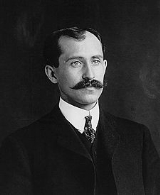
The Wright brothers, Orville (August 19, 1871 – January 30, 1948) and Wilbur (April 16, 1867 – May 30, 1912), were two Americans
United States

The United States of America is a Federal government constitutional republic comprising U.S. state and a federal district. The country is situated mostly in central North America, where its Contiguous United States and Washington, D.C., the Capital districts and territories, lie between the Pacific Ocean and Atlantic Oceans, Borders of the U...
 who are generally credited with inventing and building the world's first successful airplane
Fixed-wing aircraft

A fixed-wing aircraft is an aircraft capable of heavier-than-air flight whose Lift is generated not by wing motion relative to the aircraft, but by forward motion through the air....
 and making the first controlled, powered and sustained heavier-than-air human flight
Flight

Flight is the process by which an object moves either through the air, or movement beyond earth's atmosphere , by aerodynamically generating Lift , propulsion or Lighter than air using buoyancy, or by simple ballistic movement....
, on December 17, 1903. They are also officially credited worldwide through the Fédération Aéronautique Internationale
Fédération Aéronautique Internationale

The F?d?ration A?ronautique Internationale is the world governing body for air sports and aeronautics and astronautics world records. This includes man-carrying vehicles from Balloon to spacecraft, and unmanned vehicles ....
, the standard-setting and record-keeping body for aeronautics and astronautics, as "the first sustained and controlled heavier-than-air powered flight".


Discussion
Ask a question about 'Wright brothers'
Start a new discussion about 'Wright brothers'
Answer questions from other users
Full Discussion Forum


Recent Posts


Encyclopedia


The Wright brothers, Orville (August 19, 1871 – January 30, 1948) and Wilbur (April 16, 1867 – May 30, 1912), were two Americans
United States

The United States of America is a Federal government constitutional republic comprising U.S. state and a federal district. The country is situated mostly in central North America, where its Contiguous United States and Washington, D.C., the Capital districts and territories, lie between the Pacific Ocean and Atlantic Oceans, Borders of the U...
 who are generally credited with inventing and building the world's first successful airplane
Fixed-wing aircraft

A fixed-wing aircraft is an aircraft capable of heavier-than-air flight whose Lift is generated not by wing motion relative to the aircraft, but by forward motion through the air....
 and making the first controlled, powered and sustained heavier-than-air human flight
Flight

Flight is the process by which an object moves either through the air, or movement beyond earth's atmosphere , by aerodynamically generating Lift , propulsion or Lighter than air using buoyancy, or by simple ballistic movement....
, on December 17, 1903. They are also officially credited worldwide through the Fédération Aéronautique Internationale
Fédération Aéronautique Internationale

The F?d?ration A?ronautique Internationale is the world governing body for air sports and aeronautics and astronautics world records. This includes man-carrying vehicles from Balloon to spacecraft, and unmanned vehicles ....
, the standard-setting and record-keeping body for aeronautics and astronautics, as "the first sustained and controlled heavier-than-air powered flight". In the two years afterward, the brothers developed their flying machine
Aircraft

An aircraft is a vehicle which is able to flight by being supported by the air, or in general, the atmosphere, of a planet. Examples include balloons, airplanes and helicopters....
 into the first practical fixed-wing aircraft. Although not the first to build and fly experimental aircraft, the Wright brothers were the first to invent aircraft controls that made fixed wing flight possible.

The brothers' fundamental breakthrough was their invention of "three-axis control
Flight dynamics

Flight dynamics is the science of aircraft and spacecraft vehicle orientation and control in three dimensions. The three critical flight dynamics parameters are the angles of rotation in three dimensions about the vehicle's center of mass, known as pitch, roll and yaw ....
", which enabled the pilot to steer the aircraft effectively and to maintain its equilibrium. This method became standard and remains standard on fixed wing aircraft of all kinds. From the beginning of their aeronautical work, the Wright brothers focused on unlocking the secrets of control to conquer "the flying problem", rather than developing more powerful engines as some other experimenters did. Their careful wind tunnel tests produced better aeronautical data than any before, enabling them to design and build wings and propellers more effective than any before. Their U.S. patent 821,393 claims the invention of a system of aerodynamic control that manipulates a flying machine's surfaces.

They gained the mechanical skills essential for their success by working for years in their shop with printing presses, bicycles, motors, and other machinery. Their work with bicycles in particular influenced their belief that an unstable vehicle like a flying machine could be controlled and balanced with practice. From 1900 until their first powered flights in late 1903, they conducted extensive glider tests that also developed their skills as pilots. Their bicycle shop employee Charlie Taylor
Charlie Taylor

Charles Edward Taylor built the first aircraft engine used by the Wright brothers and was a vital contributor of mechanical skills in the building and maintaining of early Wright engines and airplanes....
 became an important part of the team, building their first aircraft engine in close collaboration with the brothers.

The Wright brothers' status as inventors of the airplane has been subject to counter-claims by various parties. Much controversy persists over the many competing claims of early aviators
First flying machine

There are conflicting views as to what was the first flying machine.This kind of controversy of invention is not limited to flight. For example, debates over the world's tallest structures tend to break into debates around what constitutes a building and what is the most important measure of such structures' height....
.

Childhood

The Wright brothers were two of seven children born to Milton Wright
Milton Wright (Bishop)

Milton Wright was the father of aviation pioneers Wilbur Wright and Orville Wright, and a Bishop of the Church of the United Brethren in Christ....
 (1828–1917) and Susan Catherine Koerner (1831–1889). Wilbur Wright was born near Millville, Indiana
Millville, Indiana

Millville is an unincorporated town in Liberty Township, Henry County, Indiana, Henry County, Indiana, Indiana....
 in 1867; Orville in Dayton
Dayton, Ohio

Dayton is a city in and the county seat of Montgomery County, Ohio, Ohio, United States, in the southwestern part of the state. The population was 166,179 at the United States Census, 2000....
, Ohio
Ohio

Ohio is a Midwestern United States U.S. state of the United States. As part of the Great Lakes region , Ohio has long been a cultural and geographical crossroads in North America....
 in 1871. The brothers never married. The other Wright siblings were named Reuchlin (1861–1920), Lorin (1862–1939), Katharine
Katharine Wright

Katharine Wright was the only sister of aviation pioneers Wright brothers, and was very supportive of the brothers in their quest to perfect manned flight....
 (1874–1929), and twins Otis and Ida (born 1870, died in infancy). In elementary school, Orville was given to mischief and was once expelled. In 1878 their father, who traveled often as a bishop in the Church of the United Brethren in Christ
Church of the United Brethren in Christ

The Church of the United Brethren in Christ is an evangelicalism Christian Christian denomination based in Huntington, Indiana.Overview ...
, brought home a toy "helicopter" for his two younger sons. The device was based on an invention of French aeronautical pioneer Alphonse Penaud
Alphonse Pénaud

Alphonse P?naud , was a 19th-century France pioneer of aviation, inventor of the rubber powered model airplane Planophore and founder of the aviation industry....
. Made of paper, bamboo and cork with a rubber band to twirl its rotor, it was about a foot long. Wilbur and Orville played with it until it broke, then built their own. In later years, they pointed to their experience with the toy as the initial spark of their interest in flying.

Early career and research

Both brothers attended high school, but did not receive diplomas. The family's abrupt move in 1884 from Richmond, Indiana
Richmond, Indiana

Richmond is a city in Wayne Township, Wayne County, Indiana, Wayne County, Indiana, in east central Indiana, which borders Ohio. The city also includes the Richmond Municipal Airport in Boston Township, Wayne County, Indiana which is separated from the rest of the city....
 to Dayton (where the family had lived during the 1870s) prevented Wilbur from receiving his diploma after finishing four years of high school.

In the winter of 1885-86 Wilbur was accidentally struck in the face by a hockey stick while playing an ice-skating game with friends, resulting in the loss of his front teeth. He had been vigorous and athletic until then, and although his injuries did not appear especially severe, he became withdrawn, and did not attend Yale as planned. Had he enrolled, his career might have taken a very different path than the extraordinary one he eventually followed with Orville. Instead, he spent the next few years largely housebound, caring for his mother who was terminally ill with tuberculosis and reading extensively in his father's library. He ably assisted his father during times of controversy within the Brethren Church but also expressed unease over his own lack of ambition.

Orville dropped out of high school after his junior year to start a printing business in 1889, having designed and built his own printing press with Wilbur's help. Wilbur shook off the lingering depression caused by his accident and joined the print shop, serving as editor while Orville was publisher of the weekly newspaper the West Side News, followed for only a few months by the daily Evening Item. One of their clients for printing jobs was Orville's friend and classmate in high school, Paul Laurence Dunbar
Paul Laurence Dunbar

Paul Laurence Dunbar was a seminal United States poet of the late 19th and early 20th centuries. Dunbar gained national recognition for his 1896 Lyrics of a Lowly Life, one poem in the collection Ode to Ethiopia....
, who rose to international acclaim as a ground-breaking African-American poet and writer. The Wrights printed the Dayton Tattler, a weekly newspaper that Dunbar edited for a brief period.

Capitalizing on the national bicycle craze, the brothers opened a repair and sales shop in 1892 (the Wright Cycle Exchange, later the Wright Cycle Company
Wright Cycle Company

The bicycle business of the Wright brothers, the Wright Cycle Company occupied five different locations in Dayton, Ohio. Orville and Wilbur Wright began their bicycle repair business in 1892, and soon added rentals and sales....
) and began manufacturing their own brand in 1896. They used this endeavor to fund their growing interest in flight. In the early or mid-1890s they saw newspaper or magazine articles and probably photographs of the dramatic glides by Otto Lilienthal
Otto Lilienthal

Otto Lilienthal was a pioneer of human aviation who became known as the German people Glider King. He was the first person to make repeated successful Unpowered aircrafts....
 in Germany. The year 1896 brought three important aeronautical events. In May, Smithsonian Institution Secretary Samuel Langley successfully flew an unmanned steam-powered model aircraft. In the summer, Chicago engineer and aviation authority Octave Chanute
Octave Chanute

Octave Chanute, was a French-born United States railroad engineer and aviation pioneer. He provided the Wright brothers with help and advice, and helped to publicize their flying experiments....
 brought together several men who tested various types of gliders over the sand dunes along the shore of Lake Michigan. In August, Lilienthal was killed in the plunge of his glider. These events lodged in the consciousness of the brothers. In May 1899 Wilbur wrote a letter to the Smithsonian Institution requesting information and publications about aeronautics. Drawing on the work of Sir George Cayley, Chanute
Octave Chanute

Octave Chanute, was a French-born United States railroad engineer and aviation pioneer. He provided the Wright brothers with help and advice, and helped to publicize their flying experiments....
, Lilienthal, Leonardo da Vinci
Leonardo da Vinci

Leonardo di ser Piero da Vinci was an Italy polymath, being a scientist, mathematician, engineer, inventor, anatomist, Painting, sculptor, architect, botanist, musician and writer....
, and Langley, they began their mechanical aeronautical experimentation that year.

The Wright brothers always presented a unified image to the public, sharing equally in the credit for their invention. Biographers note, however, that Wilbur took the initiative in 1899–1900, writing of "my" machine and "my" plans before Orville became deeply involved when the first person singular became the plural "we" and "our". Author James Tobin asserts, "it is impossible to imagine Orville, bright as he was, supplying the driving force that started their work and kept it going from the back room of a store in Ohio to conferences with capitalists, presidents, and kings. Will did that. He was the leader, from the beginning to the end."

"It is possible to fly without motors, but not without knowledge and skill."

Ideas about control

Despite Lilienthal's fate, the brothers favored his strategy: to practice gliding in order to master the art of control before attempting motor-driven flight. The death of British aeronaut Percy Pilcher
Percy Pilcher

Percy Sinclair Pilcher was a United Kingdom inventor and pioneer aviator who was his country's foremost experimenter in unpowered flight at the end of the 19th Century....
 in another hang gliding crash in 1899 only reinforced their opinion that a reliable method of pilot control was the key to successful—and safe—flight. At the outset of their experiments they regarded control as the unsolved third part of "the flying problem". They believed sufficiently promising knowledge of the other two issues—wings and engines—already existed. The Wright brothers thus differed sharply from more experienced practitioners of the day, notably Ader
Clément Ader

Cl?ment Ader was a France engineer born in Muret, Haute Garonne remembered primarily for his pioneering work in aviation....
, Maxim and Langley who built powerful engines, attached them to airframes equipped with unproven control devices, and expected to take to the air with no previous flying experience. Though agreeing with Lilienthal's idea of practice, the Wrights saw that his method of balance and control—shifting his body weight—was fatally inadequate. They were determined to find something better.

Based on observation, Wilbur concluded that birds changed the angle of the ends of their wings to make their bodies roll right or left. The brothers decided this would also be a good way for a flying machine to turn—to "bank" or "lean" into the turn just like a bird—and just like a person riding a bicycle, an experience with which they were thoroughly familiar. Equally important, they hoped this method would enable recovery when the wind tilted the machine to one side (lateral balance). They puzzled over how to achieve the same effect with man-made wings and eventually discovered wing-warping when Wilbur idly twisted a long inner tube box at the bicycle shop.

Other aeronautical investigators regarded flight as if it were not so different from surface locomotion, except the surface would be elevated. They thought in terms of a ship's rudder for steering, while the flying machine remained essentially level in the air, as did a train or an automobile or a ship at the surface. The idea of deliberately leaning, or rolling, to one side seemed either undesirable or did not enter their thinking. Some of these other investigators, including Langley and Chanute, sought the elusive ideal of "inherent stability", believing the pilot of a flying machine would not be able to react quickly enough to wind disturbances to use mechanical controls effectively. The Wright brothers, on the other hand, wanted the pilot to have absolute control. For that reason, their early designs made no concessions toward built-in stability (such as dihedral
Dihedral

Dihedral is the upward angle from horizontal of the wings or tail pane of a fixed-wing aircraft or the wing of a bird. Dihedral is also used in some types of kites such as box kites....
 wings). They deliberately designed their 1903 first powered flyer with anhedral (drooping) wings, which are inherently unstable, but less susceptible to upset by gusty sidewinds.

Flights


Toward flight

In July 1899 Wilbur put wing-warping to the test by building and flying a five-foot box kite in the approximate shape of a biplane. When the wings were warped, or twisted, one end would receive more lift and rise, starting a turn in the direction of the lower end. Warping was controlled by four lines attached to the kite. The lines led to two sticks held by the kite flyer, who tilted them in opposite directions to twist the wings and make the kite bank left or right.

In 1900 the brothers journeyed to Kitty Hawk
Kitty Hawk, North Carolina

Kitty Hawk is a town in Dare County, North Carolina, North Carolina, United States. The population was 2,991 at the 2000 census. It was established in the early 1700s as Chickahawk....
, North Carolina
North Carolina

North Carolina is a U.S. state located on the Atlantic Seaboard in the southeastern United States. The state borders South Carolina and Georgia to the south, Tennessee to the west and Virginia to the north....
 to begin their manned gliding experiments. Wilbur chose the location based on a reply to his first letter to Octave Chanute
Octave Chanute

Octave Chanute, was a French-born United States railroad engineer and aviation pioneer. He provided the Wright brothers with help and advice, and helped to publicize their flying experiments....
, whose suggestions included the Atlantic coast for regular breezes and a soft sandy landing surface. Wilbur also requested and scrutinized U.S. Weather Bureau
National Weather Service

The National Weather Service , once known as the Weather Bureau, is one of the six scientific agencies that make up the National Oceanic and Atmospheric Administration of the United States Federal government of the United States....
 data, and selected Kitty Hawk after writing to the government meteorologist stationed there. The location, although remote, was closer to Dayton than other places Chanute had suggested, including California and Florida. The spot also gave them privacy from reporters, who had turned the 1896 Chanute experiments at Lake Michigan into something of a circus. Chanute visited them in camp each season from 1901 to 1903 and saw gliding experiments, but not the powered flights. The trip from Dayton required a train ride to Cincinnati; change trains for an overnight ride to Old Point Comfort, Virginia (near Newport News); ferryboat to Norfolk; train to Elizabeth City, North Carolina; and boat ride to Kitty Hawk on the Outer Banks.

The gliders


The Wrights based the design of their first full-size glider on the work of their recent predecessors, chiefly the Chanute-Herring biplane hang glider ("double-decker," as the Wrights called it), which flew well in the 1896 experiments near Chicago; and aeronautical data on lift
Lift (force)

In the context of a fluid flow relative to a body, the lift force is the Vector #Vector components of the aerodynamic force that is perpendicular to the oncoming flow direction....
 that Lilienthal had published. The Wrights designed the wings with camber
Camber (aerodynamics)

Camber, in aerospace engineering, is the asymmetry between the top and the bottom curves of an airfoil in cross-section. Camber in its relation to planing surfaces was first discovered and utilised by Sir George Cayley in the early 19th century in England....
, a curvature of the top surface. The brothers did not discover this principle, but took advantage of it. The better lift of a cambered surface compared to a flat one was first discussed scientifically by Sir George Cayley
George Cayley

Sir George Cayley, 6th Baronet , sometimes known as "the father of Aerodynamics", was a prolific English engineer from Brompton, Scarborough, near Scarborough, England in Yorkshire....
. Lilienthal, whose work the Wrights carefully studied, used cambered wings in his gliders, proving in flight the advantage over flat surfaces. The wooden uprights between the wings of the Wright glider were braced by wires in their own adaptation of Chanute's modified "Pratt truss," a bridge-building design he used in his 1896 glider. The Wrights mounted the horizontal elevator
Elevator (aircraft)

Elevators are control surfaces, usually at the rear of an aircraft, which control the aircraft's orientation by changing the Flight dynamics of the aircraft, and so also the angle of attack of the wing....
 in front of the wings rather than behind, apparently believing this feature would help avoid a nosedive and crash like the one that killed Lilienthal. (Later, when Brazilian aviation pioneer Santos-Dumont, flew his 14-bis in Paris in 1906, French newspapers dubbed the tail-first arrangement a "canard
Canard (aeronautics)

In aeronautics, canard is an airframe configuration of fixed-wing aircraft in which the tailplane is ahead of the main wing, rather than behind them as in conventional aircraft empennage....
", due to the supposed resemblance to a duck in flight.) Wilbur incorrectly believed a tail was not necessary, and their first two gliders did not have one. According to some Wright biographers, Wilbur probably did all the gliding until 1902, perhaps to exercise his authority as older brother and to protect Orville from harm.

Glider Vital Statistics
WingspanWing area Chord Camber Aspect ratioLength Weight
1900 17 ft 6 in 1/20 3.5 11 ft 6 in 52 lb
19017 ft1/12,*1/193 14 ft 98 lb
1902 32 ft 1 in 5 ft1/20-1/246.5 17 ft 112 lb
* (This airfoil caused severe pitch problems; the Wrights modified the camber on-site.) "We came down here for wind and sand, and we have got them."
1900 Glider
The brothers flew the glider only a few days in the early autumn of 1900 at Kitty Hawk. In the first tests, probably October 3, Wilbur was aboard while the glider flew as a kite not far above the ground with men below holding tether ropes. Most of the kite tests were unpiloted with sandbags or chains (and even a local boy) as onboard ballast.They tested wing-warping using control ropes from the ground. The glider was also tested unmanned while suspended from a small homemade tower. Wilbur (but not Orville) made about a dozen free glides on only a single day. For those tests, the brothers trekked four miles (6 km) south to the Kill Devil Hills, a group of sand dunes up to high (where they made camp in each of the next three years). Although the glider's lift was less than expected (causing most tests to be unmanned), the brothers were encouraged because the craft's front elevator worked well and they had no accidents. However, the small number of free glides meant they were not able to give wing-warping a true test.

The pilot lay flat on the lower wing, as planned, to reduce aerodynamic drag. As a glide ended, the pilot was supposed to lower himself to a vertical position through an opening in the wing and land on his feet with his arms wrapped over the framework. Within a few glides, however, they discovered the pilot could remain prone on the wing, headfirst, without undue danger when landing. They made all their flights in that position for the next five years.

1901 Glider
Wright1901gliderbottom
Hoping to improve lift, they built the 1901 glider with a much larger wing area and made 50 to 100 flights in July and August for distances of 20 to . The glider stalled a few times, but the parachute effect of the forward elevator allowed Wilbur to make a safe flat or "pancake" landing, instead of a nose-dive. These incidents wedded the Wrights even more strongly to the canard
Canard (aeronautics)

In aeronautics, canard is an airframe configuration of fixed-wing aircraft in which the tailplane is ahead of the main wing, rather than behind them as in conventional aircraft empennage....
 design, which they did not give up until 1910. The glider, however, delivered two major disappointments. It produced only about one-third the lift calculated and sometimes failed to respond properly to wing-warping, turning opposite the direction intended—a problem later known as adverse yaw
Adverse yaw

Adverse yaw is a secondary effect of the application of the ailerons in aircraft. Its cause and effect can be explained as follows:When the control column of an aircraft is moved to the right, the right aileron is deflected upwards, and the left aileron is deflected downwards, causing the aircraft to roll to the right....
. On the trip home after their second season, Wilbur, stung with disappointment, remarked to Orville that man would fly, but not in their lifetimes.

The poor lift of the gliders led the Wrights to question the accuracy of Lilienthal's data, as well as the "Smeaton
John Smeaton

John Smeaton, Fellow of the Royal Society, was a civil engineer – often regarded as the "father of civil engineering" – responsible for the design of bridges, canals, harbours and lighthouses....
 coefficient" of air pressure, which had been in existence for over 100 years and was part of the accepted equation for lift.
The Lift Equation
L = lift in pounds
k = coefficient of air pressure (Smeaton coefficient)
S = total area of lifting surface in square feet
V = velocity (headwind plus ground speed) in miles per hour
CL = coefficient of lift (varies with wing shape)
Wb Wind Tunnel
The Wrights—and Lilienthal—used the equation to calculate the amount of lift that wings of various sizes would produce. Based on measurements of lift and wind during the 1901 glider's kite and free flights, Wilbur believed (correctly, as tests later showed) that the Smeaton number was very close to 0.0033, not the traditionally used 60% larger 0.0054, which would exaggerate predicted lift.

Back home, furiously pedaling a strange-looking bicycle on neighborhood streets, they conducted makeshift open-air tests with a miniature Lilienthal airfoil and a counter-acting flat plate, which were both attached to a freely rotating third bicycle wheel mounted horizontally in front of the handlebars. Because the third wheel rotated against the airfoil instead of remaining motionless as the calculations predicted, the Wrights confirmed their suspicion that published data on lift were unreliable, and they decided to expand their investigation. They also realized that trial-and-error with different wings on full-size gliders was too costly and time-consuming. Putting aside the three-wheel bicycle, they built a six-foot wind tunnel
Wind tunnel

A wind tunnel is a research tool developed to assist with studying the effects of air moving over or around solid objects.Ways that wind-speed and flow are measured in wind tunnels:...
 in their shop and conducted systematic tests on miniature wings from October to December 1901. The "balances" they devised and mounted inside the tunnel to hold the wings looked crude, made of bicycle spokes and scrap metal, but were "as critical to the ultimate success of the Wright brothers as were the gliders." The devices allowed the brothers to balance lift against drag and accurately calculate the performance of each wing. They could also see which wings worked well as they looked through the viewing window in the top of the tunnel. Prior to beginning their wind tunnel experiments, Wilbur, at Chanute's invitation, traveled to Chicago
Chicago

Chicago is the largest city in the U.S. state of Illinois and the Midwestern United States, as well as the List of United States cities by population city in the United States with more than 2.8 million residents....
 to give a speech to the on September 18, 1901. Wilbur's speech consisted of detailed accounts of his and Orville's glider experiments at Kitty Hawk up to the fall of 1901 and was complemented by a lantern slide show of photographs. Wilbur's speech was the first public account of the brothers' experiments.

1902 Glider

Lilienthal had made "whirling arm" tests on only a few wing shapes, and the Wrights mistakenly assumed the data would apply to their wings, which had a different shape. The Wrights took a huge step forward and made basic wind tunnel tests on 200 wings of many shapes and airfoil
Airfoil

An airfoil or aerofoil is the shape of a wing or blade or sail as seen in cross-section.An airfoil-shaped body moved through a fluid produces a force perpendicular to the motion called lift ....
 curves, followed by detailed tests on 38 of them. The tests, according to biographer Howard, "were the most crucial and fruitful aeronautical experiments ever conducted in so short a time with so few materials and at so little expense". An important discovery was the benefit of longer narrower wings: in aeronautical terms, wings with a larger aspect ratio
Aspect ratio

The aspect ratio of a shape is the ratio of its longer dimension to its shorter dimension. It may be applied to two characteristic dimensions of a three-dimensional shape, such as the ratio of the longest and shortest axis, or for symmetrical objects that are described by just two measurements, such as the length and diameter of a rod....
 (wingspan divided by chord
Chord (aircraft)

In reference to aircraft, chord refers to the distance between the leading edge and trailing edge of a wing, horizontal stabilizer or vertical stabilizer, measured in the direction of the normal airflow....
—the wing's front-to-back dimension). Such shapes offered much better lift-to-drag ratio
Lift-to-drag ratio

In aerodynamics, the lift-to-drag ratio, or L/D ratio , is the amount of Lift generated by a wing or vehicle, divided by the drag it creates by moving through the air....
 than the broader wings the brothers had tried so far.

With this knowledge, and a more accurate Smeaton number, the Wrights designed their 1902 glider. Using another crucial discovery from the wind tunnel, they made the airfoil flatter, reducing the camber
Camber

Camber may refer to a variety of curvatures and angles:* Camber angle in automobile technology* In the steel industry, the concavity of rolls....
 (the depth of the wing's curvature divided by its chord). The 1901 wings had significantly greater curvature, a highly inefficient feature the Wrights copied directly from Lilienthal. Fully confident in their new wind tunnel results, the Wrights discarded Lilienthal's data, now basing their designs on their own calculations.
1902 Wrightbrosglider
With characteristic caution, the brothers first flew the 1902 glider as an unmanned kite, as they had done with their two previous versions. Rewarding their wind tunnel work, the glider produced the expected lift. It also had a new structural feature: a fixed, rear vertical rudder, which the brothers hoped would eliminate turning problems.

By 1902 they realized that wing-warping created "differential drag" at the wingtips. Greater lift at one end of the wing also increased drag, which slowed that end of the wing, making the aircraft swivel — or "yaw" — so the nose pointed away from the turn. That was how the tailless 1901 glider behaved.

The improved wing design enabled consistently longer glides, and the rear rudder prevented adverse yaw—so effectively that it introduced a new problem. Sometimes when the pilot attempted to level off from a turn, the glider failed to respond to corrective wing-warping and persisted into a tighter turn. The glider would slide toward the lower wing, which hit the ground, spinning the aircraft around. The Wrights called this "well digging"; modern aviators refer to a "ground loop
Ground loop (aviation)

In aviation, a ground loop refers to the rapid rotation of a fixed-wing aircraft in the horizontal Plane while on the ground. Aerodynamic and centrifugal force forces may cause one wing to rise, which may then cause the other wingtip to touch the ground....
".

Orville apparently visualized that the fixed rudder resisted the effect of corrective wing-warping when attempting to level off from a turn. He wrote in his diary that on the night of October 2, "I studied out a new vertical rudder". The brothers then decided to make the rear rudder movable to solve the problem. They hinged the rudder and connected it to the pilot's warping "cradle", so a single movement by the pilot simultaneously controlled wing-warping and rudder deflection. Tests while gliding proved that the trailing edge of the rudder should be turned away from whichever end of the wings had more drag (and lift) due to warping. The opposing pressure produced by turning the rudder enabled corrective wing-warping to reliably restore level flight after a turn or a wind disturbance. Furthermore, when the glider banked into a turn, rudder pressure overcame the effect of differential drag and pointed the nose of the aircraft in the direction of the turn, eliminating adverse yaw.

In short, the Wrights discovered the true purpose of the movable vertical rudder. Its role was not to change the direction of flight, but rather, to aim or align the aircraft correctly during banking turns and when leveling off from turns and wind disturbances. The actual turn — the change in direction — was done with roll control using wing-warping. The principles remained the same when ailerons superseded wing-warping.

With their new method the Wrights achieved true control in turns for the first time on October 8, 1902, a major milestone. During September and October they made between 700 and 1,000 glides, the longest lasting 26 seconds and covering . Hundreds of well-controlled glides after they made the rudder steerable convinced them they were ready to build a powered flying machine.

Thus did three-axis control
Flight dynamics

Flight dynamics is the science of aircraft and spacecraft vehicle orientation and control in three dimensions. The three critical flight dynamics parameters are the angles of rotation in three dimensions about the vehicle's center of mass, known as pitch, roll and yaw ....
 evolve: wing-warping for roll (lateral motion), forward elevator for pitch (up and down) and rear rudder for yaw (side to side). On March 23, 1903, the Wrights applied for their famous patent for a "Flying Machine", based on their successful 1902 glider. Some aviation historians believe that applying the system of three-axis flight control on the 1902 glider was equal to, or even more significant, than the addition of power to the 1903 Flyer. Peter Jakab of the Smithsonian asserts that perfection of the 1902 glider essentially represents invention of the airplane.

Adding power

Wrightflyer
In 1903, the brothers built the powered Wright Flyer
Wright Flyer

The Wright Flyer was the first powered aircraft designed and built by the Wright brothers. The flight of the Wright Flyer is recognized by the F?d?ration A?ronautique Internationale, the standard setting and record-keeping body for aeronautics and astronautics, as "the first sustained and controlled heavier-than-air powered flight"....
 I, using their preferred material for construction, spruce
Spruce

A spruce is a tree of the genus Picea, a genus of about 35 species of coniferous evergreen trees in the Family Pinaceae, found in the northern temperate and boreal regions of the earth....
, a strong and lightweight wood. They also designed and carved their own wooden propellers, and had a purpose-built gasoline engine fabricated in their bicycle shop. They thought propeller design would be a simple matter and intended to adapt data from shipbuilding. However, their library research disclosed no established formulas for either marine or air propellers, and they found themselves with no sure starting point. They discussed and argued the question, sometimes heatedly, until they concluded that an aeronautical propeller is essentially a wing rotating in the vertical plane. On that basis, they used data from more wind tunnel tests to design their propellers. The finished blades were just over eight feet long, made of three laminations of glued spruce. The Wrights decided on twin "pusher
Pusher configuration

An aircraft constructed with a pusher configuration has the engine mounted forward of the propeller - which faces in a rearwards direction - giving an appearance that the aircraft is "pushed" through the air....
" propellers (counter-rotating to cancel torque), which would act on a greater quantity of air than a single relatively slow propeller and not disturb airflow over the leading edge of the wings.

Wilbur made a March 1903 entry in his notebook indicating the prototype propeller was 66% efficient. Modern wind tunnel tests on reproduction 1903 propellers show they were more than 75% efficient under the conditions of the first flights, and actually had a peak efficiency of 82%. This is a remarkable achievement, considering that modern wooden propellers have a maximum efficiency of 85%.
Wright Brothers Engine 17
The Wrights wrote to several engine manufacturers, but none met their need for a sufficiently lightweight powerplant. They turned to their shop mechanic, Charlie Taylor
Charlie Taylor

Charles Edward Taylor built the first aircraft engine used by the Wright brothers and was a vital contributor of mechanical skills in the building and maintaining of early Wright engines and airplanes....
, who built an engine in just six weeks in close consultation with the brothers. To keep the weight low enough, the engine block was cast from aluminum, a rare practice for the time. The Wright/Taylor engine was a primitive version of modern fuel-injection systems, having no carburetor
Carburetor

A carburetor or carburettor , is a device that blends Earth's atmosphere and fuel for an internal combustion engine. It was invented by Karl Benz before 1885 and patented in 1886....
 or fuel pump
Fuel pump

A fuel pump is a frequently essential component on a automobile or other internal combustion engined device. Many engines do not require any fuel pump at all, requiring only gravity to feed fuel from the fuel tank through a line or hose to the engine....
. Gasoline was gravity
Gravitation

Gravitation is a natural phenomenon that gives weight to objects. In everyday life, attraction due to gravity is the result of the presence of relatively large bodies, such as the Earth and the Moon....
-fed into the crankcase through a rubber tube from the fuel tank mounted on a wing strut.

The propeller drive chains, resembling those of bicycles, were actually supplied by a manufacturer of heavy-duty automobile chain-drives. The Flyer cost less than a thousand dollars to construct, this in contrast to the 50,000 plus dollars given to Samuel Langley
Samuel Pierpont Langley

Samuel Pierpont Langley was an United States astronomer, physicist, inventor of the bolometer and pioneer of aviation. He graduated from Boston Latin School, was an assistant in the Harvard College Observatory, then became chair of mathematics at the United States Naval Academy....
 for his man-carrying Great Aerodrome. The Flyer had a wingspan of 40 feet (12 m), weighed 625 pounds (283 kg), and sported a 12 hp (9 kW), 170 pound (77 kg) engine.

In camp at Kill Devil Hills, they suffered weeks of delays caused by broken propeller shafts during engine tests. After the shafts were replaced (requiring two trips back to Dayton), Wilbur won a coin toss and made a three-second flight attempt on December 14, 1903, stalling after takeoff and causing minor damage to the Flyer. In a message to their family, Wilbur referred to the trial as having "only partial success", stating "the power is ample, and but for a trifling error due to lack of experience with this machine and this method of starting, the machine would undoubtedly have flown beautifully." Following repairs, the Wrights finally took to the air on December 17, 1903, making two flights each from level ground into a freezing headwind gusting to an hour. The first flight, by Orville, of 120 feet (36.5 m) in 12 seconds, at a speed of only 6.8 mph over the ground, was recorded in a famous photograph. The next two flights covered approximately 175 and , by Wilbur and Orville respectively. Their altitude was about 10 ft above the ground. Here is Orville Wright's account of the final flight of the day:
Wilbur started the fourth and last flight at just about 12 o'clock. The first few hundred feet were up and down, as before, but by the time three hundred feet had been covered, the machine was under much better control. The course for the next four or five hundred feet had but little undulation. However, when out about eight hundred feet the machine began pitching again, and, in one of its darts downward, struck the ground. The distance over the ground was measured to be ; the time of the flight was 59 seconds. The frame supporting the front rudder was badly broken, but the main part of the machine was not injured at all. We estimated that the machine could be put in condition for flight again in about a day or two.
Five people witnessed the flights: Adam Etheridge, John Daniels and Will Dough of the coastal lifesaving crew; area businessman W.C. Brinkley; and Johnny Moore, a teen boy from the village, making these arguably the first public flights. After the men hauled the Flyer back from its fourth flight, a powerful gust of wind flipped it over several times, despite the crew's attempt to hold it down. Severely damaged, the airplane never flew again. The brothers shipped it home, and years later Orville restored it, lending it to several U.S. locations for display, then to a British museum (see Smithsonian dispute below), before it was finally installed in the Smithsonian Institution in Washington, D.C. in 1948.

The Wrights sent a telegram about the flights to their father, requesting that he "inform press." However, the Dayton Journal refused to publish the story, saying the flights were too short to be important. Meanwhile, against the brothers' wishes, a telegraph operator leaked their message to a Virginia newspaper, which concocted a highly inaccurate news article that was reprinted the next day in several newspapers elsewhere, including Dayton. The Wrights issued their own factual statement to the press in January. Nevertheless, the flights did not create public excitement—if people even knew about them—and the news soon faded. (In France, however, Aero Club of Paris members, already stimulated by Chanute's reports of Wright gliding successes, took the news more seriously and increased their efforts to catch up to the brothers.)

Trouble establishing legitimacy

In 1904 the Wrights built the Flyer II
Wright Flyer II

The Flyer II was the second powered aircraft built by Wright brothers, in 1904. The design of the Flyer II was very similar to the original Wright Flyer, but with a slightly more powerful engine and construction using white pine instead of the spruce they used in the 1903 machine as well as the gliders of 1900-1902....
. They decided to avoid the expense of travel and bringing supplies to the Outer Banks and set up an airfield at Huffman Prairie
Huffman Prairie

Huffman Prairie, also known as Huffman Prairie Flying Field or Huffman Field is part of Dayton Aviation Heritage National Historical Park....
, a cow pasture eight miles (13 km) northeast of Dayton
Dayton, Ohio

Dayton is a city in and the county seat of Montgomery County, Ohio, Ohio, United States, in the southwestern part of the state. The population was 166,179 at the United States Census, 2000....
. They received permission to use the field rent-free from owner and bank president Torrance Huffman. They invited reporters to their first flight attempt of the year on May 23, on the condition that no photographs be taken. Engine troubles and slack winds prevented any flying, and they could manage only a very short hop a few days later with fewer reporters present. Some scholars of the Wrights speculate the brothers may have intentionally failed to fly in order to disinterest reporters in their experiments. Whether that is true is not known, but after their poor showing local newspapers virtually ignored them for the next year and a half.
1904wrightflyer
The Wrights were glad to be free from the distraction of reporters. The absence of newsmen also reduced the chance of competitors learning their methods. After the Kitty Hawk powered flights, the Wrights made a decision to begin withdrawing from the bicycle business so they could devote themselves to creating and marketing a practical airplane. The decision was financially risky, since they were neither wealthy nor government-funded (unlike other experimenters such as Ader
Clément Ader

Cl?ment Ader was a France engineer born in Muret, Haute Garonne remembered primarily for his pioneering work in aviation....
, Maxim
Hiram Stevens Maxim

Sir Hiram Stevens Maxim was an United States born inventor who emigrated to England and adopted British citizenship. He was the inventor of the Maxim Gun, the first portable, fully automatic machine gun, and the ubiquitous mousetrap, and he lays a claim to inventing the lightbulb....
, Langley
Samuel Pierpont Langley

Samuel Pierpont Langley was an United States astronomer, physicist, inventor of the bolometer and pioneer of aviation. He graduated from Boston Latin School, was an assistant in the Harvard College Observatory, then became chair of mathematics at the United States Naval Academy....
 and Santos-Dumont
Alberto Santos-Dumont

File:Alberto Santos Dumont .jpgAlberto Santos-Dumont was an early pioneer of aviation. He was born and died in Brazil. Heir of a prosperous coffee producer family, Santos-Dumont dedicated himself to science studies in Paris....
). They did not have the luxury of giving away their invention; it was to be their livelihood. Thus, their secrecy intensified, encouraged by advice from their patent attorney, Henry Toulmin
Harry Aubrey Toulmin, Sr.

Harry Aubrey Toulmin, Sr. was the United States lawyer located in Springfield, Ohio, who wrote the "flying machine" patent application that resulted in the patent granted to Dayton, Ohio inventors Wilbur and Orville Wright on May 22, 1906....
, not to reveal details of their machine.

At Huffman Prairie, lighter winds and lower air density than in Kitty Hawk (due to Ohio's higher altitude and higher temperatures) made takeoffs very difficult, and they had to use a much longer starting rail, stretching to hundreds of feet, compared to the rail at Kitty Hawk. During the spring and summer they suffered many hard landings, real crackups, repeated Flyer damage, and bodily bumps and bruises. On August 13, making an unassisted takeoff, Wilbur finally exceeded their best Kitty Hawk effort with a flight of . Then they decided to use a weight-powered catapult to make takeoffs easier and tried it for the first time on September 7. On September 20, 1904, Wilbur flew the first complete circle in history by a manned heavier-than-air powered machine, covering in about a minute and a half. Their two best flights were November 9 by Wilbur and December 1 by Orville, each exceeding five minutes and covering nearly three miles in almost four circles. By the end of the year the brothers had accumulated about 50 minutes in the air in 105 flights over the rather soggy 85 acre pasture, which, remarkably, is virtually unchanged today from its original condition and is now part of Dayton Aviation Heritage National Historical Park
Dayton Aviation Heritage National Historical Park

Dayton Aviation Heritage National Historical Park is a United States National Historical Park in Dayton, Ohio, USA that commemorates three exceptional men—Wilbur Wright, Orville Wright, and Paul Laurence Dunbar—and their work in the Miami Valley....
, adjacent to Wright-Patterson Air Force Base
Wright-Patterson Air Force Base

Wright-Patterson Air Force Base is a United States Air Force base located in Greene County, Ohio and Montgomery County, Ohio counties, eight miles northeast of the central business district of Dayton, Ohio, Ohio, United States....
.

Despite progress in 1904, the Flyer was still frequently out of control. The Wrights scrapped the battered and much-repaired airplane, but saved the engine, and in 1905 built a new Flyer III
Wright Flyer III

The Wright Flyer III was the third powered aircraft built by the Wright Brothers. Orville Wright made the first flight with it on June 23, 1905....
, which included an important design change. The brothers installed a separate control for the rear rudder instead of linking the rudder to the wing-warping "cradle" as before. Each of the three axes—pitch, roll and yaw—now had its own independent control. Nevertheless, this Flyer offered the same marginal performance as the first two. Its maiden flight was June 23 and the first several flights were no longer than 10 seconds. After Orville suffered a bone-jarring and potentially fatal crash on July 14, they rebuilt the Flyer with the forward elevator and rear rudder both enlarged and placed several feet farther away from the wings.
Wright Flyer Iii Above
These modifications greatly improved stability and control, setting the stage for a series of six dramatic "long flights" ranging from 17 to 38 minutes and 11 to around the three-quarter mile course over Huffman Prairie between September 26 and October 5. Wilbur made the last and longest flight, in 38 minutes and 3 seconds, ending with a safe landing when the fuel ran out. The flight was seen by a number of people, including several invited friends, their father Milton, and neighboring farmers. Reporters showed up the next day (only their second appearance at the field since May the previous year), but the brothers declined to fly. The long flights convinced the Wrights they had achieved their goal of creating a flying machine of "practical utility" which they could offer to sell.

The only photos of the flights of 1904-1905 were taken by the brothers. (A few photos were damaged in the Great Dayton Flood
Great Dayton Flood

The Great Dayton Flood of 1913 flooded Dayton, Ohio, and the surrounding area with water from the Great Miami River, causing the greatest natural disaster in Ohio history....
 of 1913, but most survived intact.) In 1904 Ohio beekeeping businessman Amos Root
Amos Root

Amos Ives Root developed innovative beekeeping techniques in the United States during the mid-1800s, a period when the industry played an important role in the economy of many communities....
, a technology enthusiast, saw a few flights including the first circle. Articles he wrote for his beekeeping magazine were the only published eyewitness reports of the Huffman Prairie flights, except for the unimpressive early hop local newsmen saw. Root offered a report to Scientific American magazine, but the editor turned it down. As a result, the news was not widely known outside of Ohio, and was often met with skepticism. The Paris edition of the Herald Tribune headlined a 1906 article on the Wrights "FLYERS OR LIARS?"

In years to come Dayton newspapers would proudly celebrate the hometown Wright brothers as national heroes, but the local reporters somehow missed one of the most important stories in history as it was happening a few miles from their doorstep. James M. Cox
James M. Cox

James Middleton Cox was a List of Governors of Ohio, United States House of Representatives from Ohio and Democratic candidate for President of the United States in the U.S....
, publisher at that time of the Dayton Daily News (later governor of Ohio and Democratic presidential nominee in 1920), expressed the attitude of newspapermen—and the public—in those days when he admitted years later, "Frankly, none of us believed it." A few newspapers published articles about the long flights, but no reporters or photographers had been there. The lack of splashy eyewitness press coverage was a major reason for disbelief in Washington, D.C. and Europe and in journals like Scientific American, whose editors doubted the "alleged experiments" and asked how U.S. newspapers, "alert as they are, allowed these sensational performances to escape their notice."

The Wright brothers were certainly complicit in the lack of attention they received. Fearful of competitors stealing their ideas, and still without a patent, they flew on only one more day after October 5. From then on, they refused to fly anywhere unless they had a firm contract to sell their aircraft. They wrote to the U.S. government, then to Britain, France and Germany with an offer to sell a flying machine, but were rebuffed because they insisted on a signed contract before giving a demonstration. They were unwilling even to show their photographs of the airborne Flyer. The American military, having recently spent $50,000 on the Langley Aerodrome
Langley Aerodrome

The Langley Aerodrome was an experimental aircraft commissioned by the United States Army from Samuel Pierpont Langley for United States dollar50,000 in 1898....
—a product of the nation's foremost scientist—only to see it plunge twice into the Potomac River "like a handful of mortar," was particularly unreceptive to the claims of two unknown bicycle makers from Ohio. Thus, doubted or scorned, the Wright brothers continued their work in semi-obscurity, while other aviation pioneers like Brazilian Alberto Santos-Dumont
Alberto Santos-Dumont

File:Alberto Santos Dumont .jpgAlberto Santos-Dumont was an early pioneer of aviation. He was born and died in Brazil. Heir of a prosperous coffee producer family, Santos-Dumont dedicated himself to science studies in Paris....
 and American Glenn Curtiss
Glenn Curtiss

Glenn Hammond Curtiss was an American aviation pioneer and founder of the Curtiss Aeroplane and Motor Company, now part of Curtiss-Wright Corporation....
 entered the limelight.

Return To Kitty Hawk May 1908

The Wright brothers made no flights at all in 1906 and 1907 while they pursued fitful negotiations with the U.S. and European governments. In 1907 the brothers journeyed to Europe for the first time for face-to-face talks with government bureaucrats and businessmen. Orville joined his brother two months after Wilbur's departure, but first packed a new Model A Flyer in a crate which was shipped to France and left in storage at Le Havre
Le Havre

Le Havre is a city in the northwest region of France situated on the right bank of the mouth of the Seine River as it outlets into the Bay of the Seine section of the English Channel....
 in anticipation of demonstration flights. In early 1908 the Wrights finally signed contracts with a French company and the U.S. Army. In May they went back to Kitty Hawk with their 1905 Flyer to practice for their all-important demonstration flights. They had not been to the camp in four and a half years and had to rebuild their two sheds, which had been badly damaged by weather and scavengers; the 1902 glider was in a hopeless state of disrepair.

Their American and French contracts required them to be able to carry a passenger. They modified the 1905 Flyer by installing two seats and adding upright control levers. After tests with sandbags in the passenger seat, Charlie Furnas
Charles Furnas

Charles *Charley* W. Furnas was born in West Milton, Ohio, Miami County, Ohio, Ohio, the second son of Tanzy and Elizabeth Furnas. He is chiefly remembered for his work as a mechanic in the Wright Brothers and being the world's first aeroplane passenger....
, a helper from Dayton, became the first fixed-wing aircraft passenger on a few short flights May 14. For safety, and as a promise to their father, Wilbur and Orville did not fly together. However, several newspaper accounts at the time mistakenly took Orville's flight with Furnas as both brothers flying together. Later that day after flying solo seven minutes, Wilbur suffered his worst crash when, still not well-acquainted with the two control levers, he apparently moved one the wrong way and slammed the Flyer into the sand between 40 and 50 miles an hour. He emerged with only bruises and a cut nose, but the accident ended the practice flights—and the airplane's flying career.

The patent

Their 1903 patent application
Patent application

A patent application is a request pending at a patent office for the grant of a patent for the invention described and claim by that application....
, which they wrote themselves, was rejected. In early 1904, they hired Ohio patent attorney Henry Toulmin
Harry Aubrey Toulmin, Sr.

Harry Aubrey Toulmin, Sr. was the United States lawyer located in Springfield, Ohio, who wrote the "flying machine" patent application that resulted in the patent granted to Dayton, Ohio inventors Wilbur and Orville Wright on May 22, 1906....
, and on May 22, 1906, they were granted U.S. Patent 821393 for a "Flying Machine". The patent illustrated a non-powered flying machine—namely, the 1902 glider. The patent's importance lies in its claim of a new and useful method of controlling a flying machine, powered or not. The technique of wing-warping is described, but the patent explicitly states that other methods instead of wing-warping could be used for adjusting the outer portions of a machine's wings to different angles on the right and left sides to achieve lateral (roll) control. The concept of varying the angle presented to the air near the wingtips, by any suitable method, is central to the patent. The broad protection intended by this language succeeded when the Wrights won patent infringement lawsuits against Glenn Curtiss
Glenn Curtiss

Glenn Hammond Curtiss was an American aviation pioneer and founder of the Curtiss Aeroplane and Motor Company, now part of Curtiss-Wright Corporation....
 and other early aviators who devised aileron
Aileron

For the band with a similar name, see The AileronsAilerons are hinged control surfaces attached to the trailing edge of the wing of a fixed-wing aircraft....
s to emulate lateral control described in the patent and demonstrated by the Wrights in their 1908 public flights. U.S. courts decided that ailerons were also covered by the patent, but European court decisions were less definitive—see Patent War section below. The patent also describes the steerable rear vertical rudder and its innovative use in combination with wing-warping, enabling the airplane to make a coordinated turn, a technique that prevents hazardous adverse yaw
Adverse yaw

Adverse yaw is a secondary effect of the application of the ailerons in aircraft. Its cause and effect can be explained as follows:When the control column of an aircraft is moved to the right, the right aileron is deflected upwards, and the left aileron is deflected downwards, causing the aircraft to roll to the right....
, the problem Wilbur had when trying to turn the 1901 glider. Finally, the patent describes the forward elevator, used for ascending and descending.

Public showing

Wright Fort Myer
The brothers' contracts with the U.S. Army and a French syndicate depended on successful public flight demonstrations that met certain conditions. The brothers had to divide their efforts. Wilbur sailed for Europe; Orville would fly near Washington, D.C.

Facing deep skepticism in the French aeronautical community and outright scorn by some newspapers that called him a "bluffeur", Wilbur began official public demonstrations on August 8, 1908 at the Hunaudières horse racing track near the town of Le Mans
Le Mans

Le Mans is a commune in France in France, located on the Sarthe River. Traditionally the capital of the province of Maine , it is now the pr?fecture of the Sarthe D?partement in France, and is furthermore the seat of the Roman Catholic diocese of Le Mans....
, France
France

France , officially the French Republic , is a country whose Metropolitan France is located in Western Europe and that also comprises various Overseas departments and territories of France....
. His first flight lasted only one minute 45 seconds, but his ability to effortlessly make banking turns and fly a circle amazed and stunned onlookers, including several pioneer French aviators, among them Louis Bleriot
Louis Blériot

Louis Bl?riot was a French inventor and engineer. In 1909 he completed the first flight across a large body of water in a heavier-than-air craft when he crossed the English Channel, receiving a prize of 1000 pound sterlings for doing so....
. In the following days Wilbur made a series of technically challenging flights including figure-eights, demonstrating his skills as a pilot and the capability of his flying machine, which far surpassed those of all other pilot pioneers.

The French public was thrilled by Wilbur's feats and flocked to the field by the thousands. The Wright brothers catapulted to world fame overnight. Former doubters issued apologies and effusive praise. "L'Aérophile" editor Georges Besançon wrote that the flights "have completely dissipated all doubts. Not one of the former detractors of the Wrights dare question, today, the previous experiments of the men who were truly the first to fly..." Leading French aviation promoter Ernest Archdeacon wrote, "For a long time, the Wright brothers have been accused in Europe of bluff... They are today hallowed in France, and I feel an intense pleasure...to make amends."

On October 7, 1908, Edith Berg, the wife of the brothers' European business agent, became the first American woman airplane passenger when she flew with Wilbur—one of many passengers who rode with him that autumn.

Orville followed his brother's success by demonstrating another nearly identical flyer to the United States Army
United States Army

The United States Army is the branch of the United States Armed Forces responsible for Army operations. It is the largest and oldest established branch of the U.S....
 at Fort Myer
Fort Myer

Fort Myer is a U.S. Army Military base adjacent to Arlington National Cemetery in Arlington County, Virginia, across the Potomac River from Washington, DC....
, Virginia, starting on September 3, 1908. On September 9, he made the first hour-long flight, lasting 62 minutes and 15 seconds.
First Powered Aviation Crash
On September 17, Army lieutenant Thomas Selfridge
Thomas Selfridge

Thomas Etholen Selfridge was a First Lieutenant in the United States Army and the first person to die in a crash of a powered fixed-wing aircraft....
 rode along as his passenger, serving as an official observer. A few minutes into the flight at an altitude of about , a propeller split and shattered, sending the aircraft out of control. Selfridge suffered a fractured skull in the crash and died that evening in the nearby Army hospital, becoming the first fatality of an airplane crash. Orville was badly injured, suffering a broken left leg and four broken ribs. Twelve years later, after he suffered increasingly severe pains, X-rays revealed the accident had also caused three hip bone fractures and a dislocated hip. The brothers' sister Katharine, a school teacher, rushed from Dayton to Virginia and stayed by Orville's side for the seven weeks of his hospitalization. She helped negotiate a one-year extension of the Army contract. A friend visiting Orville in the hospital asked, "Has it got your nerve?" "Nerve?" repeated Orville, slightly puzzled. "Oh, do you mean will I be afraid to fly again? The only thing I'm afraid of is that I can't get well soon enough to finish those tests next year."

Deeply shocked by the accident, Wilbur determined to make even more impressive flight demonstrations; in the ensuing days and weeks he set new records for altitude and duration. In January 1909 Orville and Katharine joined him in France, and for a time they were the three most famous people in the world, sought after by royalty, the rich, reporters and the public. The kings of England, Spain and Italy came to see Wilbur fly.
1909 Flyer and Derrick
The Wrights traveled to Pau, in the south of France, where Wilbur made many more public flights, giving rides to a procession of officers, journalists and statesmen—and his sister Katharine on February 15. He trained two French pilots, then transferred the airplane to the French company. In April the Wrights went to Italy where Wilbur assembled another Flyer, giving demonstrations and training more pilots. A cameraman climbed aboard and made the first motion picture from an airplane.

After their return to the U.S., the brothers and Katharine were invited to the White House where President Taft bestowed awards upon them. Dayton followed up with a lavish two-day homecoming celebration. In July 1909 Orville, with Wilbur assisting, completed the proving flights for the U.S. Army, meeting the requirements of a two-seater able to fly with a passenger for an hour at an average of speed of 40 miles an hour (64 km/h) and land undamaged. They sold the aircraft to the Army's Aeronautical Division, U.S. Signal Corps
Aeronautical Division, U.S. Signal Corps

The Aeronautical Division, U.S. Signal Corps was the first progenitor of the United States Air Force, and as such is the first military air organization....
 for $30,000 (which included a $5,000 bonus for exceeding the speed specification). Wilbur climaxed an extraordinary year in early October when he flew at New York City's Hudson-Fulton celebrations, circling the Statue of Liberty
Statue of Liberty

The Statue of Liberty , or, more formally, Liberty Enlightening the World , was presented to the United States by the people of France in 1886....
 and making a 33-minute flight up and down the Hudson River alongside Manhattan in view of up to one million New Yorkers. These flights solidly established the fame of the Wright brothers in America.

Family flights

On May 25, 1910 back at Huffman Prairie, Orville piloted two unique flights. First, he took off on a six-minute flight with Wilbur as his passenger, the only time the Wright brothers ever flew together. They received permission from their father to make the flight. They had always promised Milton they would never fly together to avoid the chance of a double tragedy and to ensure one brother would remain to continue their experiments. Next, Orville took his 82-year old father on a nearly seven-minute flight, the first and only one of Milton Wright's life. The airplane rose to about while the elderly Wright called to his son, "Higher, Orville, higher!"

The patent war

In 1908, the brothers warned Glenn Curtiss not to infringe their patent by profiting from flying or selling aircraft that used ailerons. Curtiss refused to pay license fees to the Wrights and sold an airplane to the Aeronautic Society of New York in 1909. The Wrights filed a lawsuit, beginning a years-long legal conflict. They also sued foreign aviators who flew at U.S. exhibitions, including the leading French aviator Louis Paulhan
Louis Paulhan

Isidore Auguste Marie Louis Paulhan, known as Louis Paulhan, was a French pilot who in 1910 flew "Le Canard", the world's first seaplane, designed by Henri Fabre....
. The Curtiss people derisively suggested that if someone jumped in the air and waved his arms, the Wrights would sue. The brothers' licensed European companies, which owned foreign patents the Wrights had received, sued manufacturers in their countries. The European lawsuits were only partly successful. Despite a pro-Wright ruling in France, legal maneuvering dragged on until the patent expired in 1917. A German court ruled the patent not valid due to prior disclosure in speeches by Wilbur Wright in 1901 and Octave Chanute
Octave Chanute

Octave Chanute, was a French-born United States railroad engineer and aviation pioneer. He provided the Wright brothers with help and advice, and helped to publicize their flying experiments....
 in 1903. In the U.S. the Wrights made an agreement with the Aero Club of America
Aero Club of America

The Aero Club of America issued the first pilot's licenses in the US. It was founded in 1905, and had many sister organizations. The organization gave out the Collier Trophy....
 to license airshows which the Club approved, freeing participating pilots from a legal threat. Promoters of approved shows paid fees to the Wrights. The Wright brothers won their initial case against Curtiss in February 1913, but the decision was appealed.

From 1910 until his death from typhoid fever
Typhoid fever

Typhoid fever, also known as enteric fever, or commonly just typhoid, is an illness caused by the bacterium Salmonella typhi. Common worldwide, it is transmitted by the ingestion of food or water contaminated with feces from an infected person....
 in 1912, Wilbur took the leading role in the patent struggle, traveling incessantly to consult with lawyers and testify in what he felt was a moral cause, particularly against Curtiss, who was creating a large company to manufacture aircraft. The Wrights' preoccupation with the legal issue hindered their development of new aircraft designs, and by 1911 Wright aircraft were considered inferior to those made by other firms in Europe. Indeed, aviation development in the US was suppressed to such an extent that when the U.S. entered World War I no acceptable American-designed aircraft were available, and the U.S. forces were compelled to use French machines. Orville and Katharine Wright believed Curtiss was partly responsible for Wilbur's premature death, which occurred in the wake of his exhausting travels and the stress of the legal battle.

In January 1914, a U.S. Circuit Court of Appeals upheld the verdict in favor of the Wrights against the Curtiss company, which continued to avoid penalties through legal tactics. Orville apparently felt vindicated by the decision, and much to the frustration of company executives, he did not push vigorously for further legal action to ensure a manufacturing monopoly. In fact, he was planning to sell the company. In 1917, with World War I underway, the U.S. government pressured the industry to form a cross-licensing organization, the Manufacturers Aircraft Association, to which member companies paid a blanket fee for the use of aviation patents, including the original and subsequent Wright patentsThe Wright-Martin company (successor to the Wright company) and the Curtiss company (which held a number of its own patents) each received a $2 million payment. The "patent war" ended, although side issues lingered in the courts until the 1920s. In a twist of irony, the Wright Aeronautical Corporation (another successor) and the Curtiss Aeroplane company merged in 1929 to form the Curtiss-Wright
Curtiss-Wright

The Curtiss-Wright Corporation was once a leading aircraft manufacturer of the United States, but has since become a component manufacturer, specializing in actuators, controls , valves, and metal treatment....
 corporation, which remains in business today producing high-tech components for the aerospace industry.

The lawsuits damaged the public image of the Wright brothers, who were generally regarded before this as heroes. Critics said the brothers were greedy and unfair, and compared their actions unfavorably to European inventors, who worked more openly. Supporters said the brothers were protecting their interests and were justified in expecting fair compensation for the years of work leading to their successful invention. Their ten-year friendship with Octave Chanute, already strained by tension over how much credit, if any, he might deserve for their success, collapsed after he publicly criticized their actions.

In business

The Wright Company
Wright Company

The Wright Company or Wright & Co. was the initial aviation business of the Wright Brothers, who had previously run a bicycle shop.They established the company in 1909 to sell aircraft to the U.S....
 was incorporated on November 22, 1909. The brothers sold their patents to the company for $100,000 and also received one-third of the shares in a million dollar stock issue and a 10 percent royalty on every airplane sold. With Wilbur as president and Orville as vice president, the company set up an airplane factory in Dayton and a flying school/test flight field at Huffman Prairie; the headquarters office was in New York City.

In mid-1910 the Wrights changed the design of their airplane, moving the horizontal elevator from the front to the back and adding wheels. It had become apparent by then that a rear elevator would make the airplane easier to control, especially as higher speeds grew more common. This aircraft was designated the "Model B", although the original canard design was never referred to as the "Model A" by the Wrights.

There were not many customers for aircraft, so in the spring of 1910 the Wrights hired and trained a team
Wright Exhibition Team

The Wright Exhibition Team was a group of early aviators trained by the Wright brothers at Wright Flying School. The team made its first public appearance on June 13, 1910 at the Indianapolis Motor Speedway....
 of salaried exhibition pilots to show off their machines and win prize money for the company — despite Wilbur's disdain for what he called "the mountebank business". The team debuted at the Indianapolis Speedway on June 13. Before the year was over, pilots Ralph Johnstone
Ralph Johnstone

Ralph Johnstone was a pioneering early aviator who died in a crash.He was born in Kansas City, Missouri in 1886. He started as a vaudeville trick bicycle rider....
 and Arch Hoxsey died in air show crashes, and in November 1911 the brothers disbanded the team on which nine men had served (four other former team members died in crashes afterward).

The Wright Company transported the first known commercial air cargo on November 7, 1910 by flying two bolts of dress silk from Dayton to Columbus, Ohio for the Moorehouse-Marten Department Store, which paid a $5,000 fee. Company pilot Phil Parmelee
Philip Orin Parmelee

Philip Orin Parmelee was an American aviation pioneer trained by the Wright brothers and credited with several early world aviation records and "firsts" in flight....
 made the flight—which was more an exercise in advertising than a simple delivery—in an hour and six minutes with the cargo strapped in the passenger's seat. The silk was cut into small pieces and sold as souvenirs.

Between 1910 and 1916 the Wright Company flying school at Huffman Prairie trained 115 pilots who were instructed by Orville and his assistants. Several trainees became famous, including Henry "Hap" Arnold, who rose to Five-Star General, commanded U.S. Army Air Forces in World War II, and became first head of the U.S. Air Force; Calbraith Perry Rodgers
Calbraith Perry Rodgers

Calbraith Perry Rodgers was a pioneer American aviator who was the first civilian to purchase a Wright Flyer and the first to make a transcontinental flight....
, who made the first coast-to-coast flight in 1911 (with many stops and crashes) in a Wright Model EX named the "Vin Fiz
Vin Fiz Flyer

The Vin Fiz Flyer was an early Wright Brothers Model EX pusher configuration biplane, that in 1911 became the first to cross the North American continent by air....
" after the sponsor's soft drink; and Eddie Stinson, founder of the Stinson Aircraft Company
Stinson Aircraft Company

The Stinson Aircraft Company was an aircraft manufacturing company in the United States between the 1920s and the 1950s.The Company...
.

The Smithsonian feud

Samuel P. Langley, secretary of the Smithsonian Institution
Smithsonian Institution

The Smithsonian Institution is an educational and research institute and associated museum complex, administered and funded by the government of the United States and by funds from its Financial endowment, contributions, and profits from its shops and its magazine....
 from 1887 until his death in 1906, experimented for years with model flying machines and successfully flew unmanned powered model aircraft in 1896 and 1903. Two tests of his manned full-size motor-driven Aerodrome in October and December 1903, however, were complete failures. Nevertheless, the Smithsonian later proudly displayed the Aerodrome in its museum as the first heavier-than-air craft "capable" of manned powered flight, relegating the Wright brothers' invention to secondary status and ironically triggering a decades-long feud with Orville Wright, whose brother had received help from the Smithsonian when beginning his own quest for flight. The Smithsonian based its claim for the Aerodrome on short test flights Glenn Curtiss
Glenn Curtiss

Glenn Hammond Curtiss was an American aviation pioneer and founder of the Curtiss Aeroplane and Motor Company, now part of Curtiss-Wright Corporation....
 and his team made with it in 1914. The Smithsonian allowed Curtiss, in an unsavory alliance, to make major modifications to the craft before attempting to fly it. The Smithsonian hoped to salvage Langley's aeronautical reputation by proving the Aerodrome could fly; Curtiss wanted to prove the same thing to defeat the Wrights' patent lawsuits against him. The tests had no effect on the patent battle, but the Smithsonian made the most of them, honoring the Aerodrome in its museum and publications. The Institution did not reveal the extensive Curtiss modifications, but Orville Wright learned of them from his brother Lorin and a close friend, Griffith Brewer, who both witnessed and photographed some of the tests.

Orville repeatedly objected to misrepresentation of the Aerodrome, but the Smithsonian was unyielding. Orville responded by loaning the restored 1903 Kitty Hawk Flyer to the London Science Museum in 1928, refusing to donate it to the Smithsonian while the Institution "perverted" the history of the flying machine. Subsequently Orville would never see his airplane again as he would die before its return to the United States. Charles Lindbergh
Charles Lindbergh

Charles Augustus Lindbergh was an United States aviator, author, inventor and explorer.On May 20?21, 1927, Lindbergh emerged instantaneously from virtual obscurity to world fame as the result of his Orteig Prize-winning solo non-stop flight from Roosevelt Field, Long Island in New York City to Paris - Le Bourget Airport in Paris in the s...
 attempted to mediate the dispute, to no avail. In 1942, after years of bad publicity, and encouraged by Wright biographer Fred Kelly, the Smithsonian finally relented by publishing, for the first time, a list of the Aerodrome modifications and recanting misleading statements it had made about the 1914 tests. Orville then privately requested the British museum to return the Flyer, but the airplane remained in protective storage for the duration of World War II and finally came home after Orville's death.

On November 23, 1948, the executors of Orville's estate signed an agreement for the Smithsonian to purchase the Flyer for one dollar. At the insistence of the executors, the agreement also included strict conditions for display of the airplane. The agreement reads, in part, "Neither the Smithsonian Institution or its successors, nor any museum or other agency, bureau or facilities administered for the United States of America by the Smithsonian Institution or its successors shall publish or permit to be displayed a statement or label in connection with or in respect of any aircraft model or design of earlier date than the 1903 Wright Aeroplane, claiming in effect that such aircraft was capable of carrying a man under its own power in controlled flight." If this agreement is not fulfilled, the Flyer can be reclaimed by the heir of the Wright brothers. Some aviation buffs, particularly those who promote the legacy of Gustave Whitehead
Gustave Whitehead

Gustave Albin Whitehead, born Gustav Albin Weisskopf was a Germany immigrant to the United States and an List of aviation pioneers who designed and built Internal combustion engine and very early aircraft in which he reportedly made Aviation history more than two years before the Wright brothers....
, now accuse the Smithsonian of refusing to investigate claims of earlier flights.After a ceremony in the Smithsonian museum, the Flyer went on public display on December 17, 1948, the 45th anniversary of the only day it was flown successfully. The Wright brothers' nephew Milton (Lorin's son), who had seen gliders and the Flyer under construction in the bicycle shop when he was a boy, gave a brief speech and formally transferred the airplane to the Smithsonian, which displayed it with the accompanying label:
The original Wright brothers aeroplane The world's first power-driven heavier-than-air machine in which man made free, controlled, and sustained flight
Invented and built by Wilbur and Orville Wright
Flown by them at Kitty Hawk, North Carolina December 17, 1903
By original scientific research the Wright brothers discovered the principles of human flight
As inventors, builders, and flyers they further developed the aeroplane, taught man to fly, and opened the era of aviation


Last years


Wilbur Wright

Neither brother married. Wilbur once quipped that he "could not support a wife and a flying machine". He became ill on a trip to Boston in April 1912. After returning to Dayton, he was diagnosed with typhoid fever. He died, age 45, in the Wright family home on May 30. His father Milton wrote about Wilbur in his diary: "A short life, full of consequences. An unfailing intellect, imperturbable temper, great self-reliance and as great modesty, seeing the right clearly, pursuing it steadfastly, he lived and died."

Orville Wright

Orville succeeded to the presidency of the Wright company upon Wilbur's death. Sharing Wilbur's distaste for business but not his brother's executive skills, Orville sold the company in 1915. He, Katharine and their father Milton moved to a mansion, Hawthorn Hill
Hawthorn Hill

Hawthorn Hill in Oakwood, Montgomery County, Ohio, USA, was the post-1914 home of Orville, Milton, and Katharine Wright. Wilbur and Orville Wright intended for it to be their joint home, but Wilbur died in 1912, before the home's 1914 completion....
, Oakwood, Ohio
Oakwood, Montgomery County, Ohio

Oakwood is a city in Montgomery County, Ohio, Ohio, United States. The population was 9,215 at the United States Census 2000. Oakwood is part of the Dayton, Ohio Metropolitain Area....
, which the newly wealthy family built. Milton died in his sleep in 1917. Orville made his last flight as a pilot in 1918. He retired from business and became an elder statesman of aviation, serving on various official boards and committees, including the National Advisory Committee for Aeronautics (NACA
NACA

NACA may refer to:*Neighborhood Assistance Corporation of America a non-profit community advocacy and homeownership organization helping victims of predatory mortgages....
), predecessor agency to the National Aeronautics and Space Administration (NASA
NASA

The National Aeronautics and Space Administration is an agency of the Federal government of the United States, responsible for the nation's public list of space agencies....
). Katharine married a former Oberlin classmate in 1926, which greatly upset Orville. He refused to attend the wedding or even communicate with her. He finally agreed to see her, apparently at Lorin's insistence, just before she died of pneumonia in 1929.

Orville Wright served NACA
NACA

NACA may refer to:*Neighborhood Assistance Corporation of America a non-profit community advocacy and homeownership organization helping victims of predatory mortgages....
 for 28 years. In 1930, Orville Wright received the first Daniel Guggenheim Medal established in 1928 by the Daniel Guggenheim Fund for the Promotion of Aeronautics.

In 1936, Orville Wright was elected a member of the National Academy of Sciences.

On April 19, 1944, the second production Lockheed
Lockheed Corporation

The Lockheed Corporation was an United States aerospace company founded in 1912 which merged with Martin Marietta in 1995 in aviation to form Lockheed Martin....
 Constellation
Lockheed Constellation

The Lockheed Constellation, affectionately known as the "Connie", was a four-engine propeller-driven airliner built by Lockheed between 1943 and 1958 at its Burbank, California, USA, facility....
, piloted by Howard Hughes
Howard Hughes

Howard Robard Hughes, Jr. was an American aviator, industrialist, film producer and director, philanthropist, and one of the wealthiest people in the world....
 and TWA president Jack Frye
Jack Frye

William John "Jack" Frye was an aviation pioneer, who with Paul E. Richter and Walter A. Hamilton, built TWA into a world class airline during his tenure as chairman from 1934-1947....
, flew from Burbank, California
Burbank, California

Burbank is a city in Los Angeles County, California, United States. The population was 100,316 at the United States Census, 2000.Burbank is located in the eastern region of the San Fernando Valley, north of Downtown Los Angeles, California....
 to Washington D.C. in 6 hours and 57 minutes. On the return trip, the aircraft stopped at Wright Field to give Orville Wright his last airplane flight, more than 40 years after his historic first flight. He may even have briefly handled the controls. He commented that the wingspan of the Constellation was longer than the distance of his first flight.

Orville died in 1948 after his second heart attack
Myocardial infarction

Myocardial infarction , commonly known as a heart attack, occurs when the Blood flow to part of the heart is interrupted. This is most commonly due to occlusion of a coronary artery following the rupture of a Vulnerable plaque, which is an unstable collection of lipids and white blood cells in the wall of an artery....
, having lived from the horse-and-buggy age to the dawn of supersonic flight. Both brothers are buried at the family plot at Woodland Cemetery, Dayton, Ohio
Woodland Cemetery, Dayton, Ohio

Woodland Cemetery and Arboretum , located at 118 Woodland Avenue, Dayton, Ohio, is one of the oldest "garden" cemeteries in the United States....
.

Legacy

The Flyer I is now on display in the National Air and Space Museum
National Air and Space Museum

The National Air and Space Museum of the Smithsonian Institution is a museum in Washington, D.C., United States, and is the most popular of the Smithsonian museums....
, a division of the Smithsonian Institution
Smithsonian Institution

The Smithsonian Institution is an educational and research institute and associated museum complex, administered and funded by the government of the United States and by funds from its Financial endowment, contributions, and profits from its shops and its magazine....
 in Washington, D.C.
Washington, D.C.

Washington, D.C. , formally the District of Columbia and commonly referred to as Washington, the District, or simply D.C., is the Capital of the United States, founded on July 16, 1790....
 (See The Smithsonian Issue).

Competing claims

Numerous claims before the Wrights aspire to the title of first powered, manned, controlled, and self-sustaining heavier than air flight, or variations of this classification—see First flying machine
First flying machine

There are conflicting views as to what was the first flying machine.This kind of controversy of invention is not limited to flight. For example, debates over the world's tallest structures tend to break into debates around what constitutes a building and what is the most important measure of such structures' height....
 for details. Several claims actually were made after the Wrights' first successful flights, and attempt to discount the achievement due to one or more of the following technical reasons: the takeoff rail, the lack of wheels, ground effect, the need for a headwind, and, beginning in 1904, the use of a catapult. Such criticisms are based on the fact that the Wright Flyer did not operate exactly the way people, then and now, expect of fixed-wing aircraft.

The Flyer certainly did not incorporate all the elements and conveniences of a modern airplane, such as wheels. Criticism, however, while faulting the Flyer on the points listed above, often pays less attention to an additional but essential fact: the Flyer, especially by 1905, was the first heavier-than-air, manned, powered, winged machine to fly successfully under full control, using aerodynamic principles developed by the Wright brothers and applied since then on all practical airplanes. That achievement defines the Wright brothers, in the view of many people, as the inventors of the airplane.

The Wright brothers' December 17, 1903 flight is recognized by the Fédération Aéronautique Internationale
Fédération Aéronautique Internationale

The F?d?ration A?ronautique Internationale is the world governing body for air sports and aeronautics and astronautics world records. This includes man-carrying vehicles from Balloon to spacecraft, and unmanned vehicles ....
, the standard setting and record-keeping body for aeronautics
Aeronautics

File:An-225 Mriya.jpgFile:Atlantis on Shuttle Carrier Aircraft.jpgFile:Typhoon f2 zj910 arp.jpgAeronautics is the science involved with the study, design, and manufacture of flight-capable machines, or the techniques of operating aircraft....
 and astronautics
Astronautics

Astronautics, or astronautical engineering, is the branch of engineering that deals with machines designed to exit or work entirely beyond the Earth's atmosphere....
, as "the first sustained and controlled heavier-than-air powered flight".

Ohio/North Carolina rivalry

The U.S. states of Ohio
Ohio

Ohio is a Midwestern United States U.S. state of the United States. As part of the Great Lakes region , Ohio has long been a cultural and geographical crossroads in North America....
 and North Carolina
North Carolina

North Carolina is a U.S. state located on the Atlantic Seaboard in the southeastern United States. The state borders South Carolina and Georgia to the south, Tennessee to the west and Virginia to the north....
 both take credit for the Wright brothers and their world-changing inventions — Ohio because the brothers developed and built their design in Dayton, and North Carolina because Kitty Hawk was the site of the first flight. With a spirit of friendly rivalry, Ohio adopted the slogan
List of U.S. state slogans

This list of U.S. state slogans is made up the advertising slogans, currently and formerly used by U.S. states. Most states establish such slogans for the promotion of tourism....
 "Birthplace of Aviation" (later "Birthplace of Aviation Pioneers", recognizing not only the Wrights, but also John Glenn
John Glenn

John Herschel Glenn Jr. is a former astronaut who became the third person and first American to orbit the Earth, and later, United States Senate....
 and Neil Armstrong
Neil Armstrong

Neil Alden Armstrong is a former American astronaut, test pilot, university professor, and United States Naval Aviator. He is List of Apollo astronauts#People who have walked on the Moon Moon....
, both Ohio natives), while North Carolina has adopted the slogan "First In Flight".

Each state features these phrases on their standard-issue state automobile license plate
US and Canadian license plates

In the United States, license plates are issued by an Department of Motor Vehicles of the state or territorial government, and in the case of the District of Columbia the city government....
s, and both states also included an image of a Wright Flyer
Wright Flyer

The Wright Flyer was the first powered aircraft designed and built by the Wright brothers. The flight of the Wright Flyer is recognized by the F?d?ration A?ronautique Internationale, the standard setting and record-keeping body for aeronautics and astronautics, as "the first sustained and controlled heavier-than-air powered flight"....
 on their respective 50 state quarters
50 State Quarters

The 50 State Quarters program is the release of a series of United States Commemorative Coins by the United States Mint. Between 1999 and 2008, it featured each of the 50 individual U.S....
 designs.

The site of the first flights in North Carolina is preserved as Wright Brothers National Memorial
Wright Brothers National Memorial

Wright Brothers National Memorial, located in Kill Devil Hills, North Carolina, commemorates the first successful, sustained, powered flights in a heavier-than-air machine....
, while their Ohio facilities are part of Dayton Aviation Heritage National Historical Park
Dayton Aviation Heritage National Historical Park

Dayton Aviation Heritage National Historical Park is a United States National Historical Park in Dayton, Ohio, USA that commemorates three exceptional men—Wilbur Wright, Orville Wright, and Paul Laurence Dunbar—and their work in the Miami Valley....
. As the positions of both states can be factually defended, and each played a significant role in the history of flight, neither state truly has an exclusive claim to the Wrights' accomplishment. While speaking at a presentation at the National Museum of the United States Air Force
National Museum of the United States Air Force

The National Museum of the United States Air Force is the official National Museum of the United States Air Force and is located at Wright-Patterson Air Force Base, in Riverside, Ohio near Dayton, Ohio, Ohio....
 in Dayton, Neil Armstrong joked that there is enough credit for both states: North Carolina provided the right winds and soft landing material and Dayton provided the know-how, resources and engineering.

Family genetics

They may have belonged to Y-DNA haplogroup E1b1b1a2 E-V13, and are descended from Robert Wright of Brook Hall.

The family participates in the .

See also

  • History by Contract
    History by Contract

    History by Contract, published in 1978, is a book written by Major William J. O'Dwyer, U.S. Air Force Reserve , of Fairfield, Conn. about the aviation pioneer Gustave Whitehead....
  • Wilbur Wright Middle School
    Wilbur Wright Middle School

    Wilbur Wright Middle School is an integrative learning serving grades sixth grade through eighth grade in the Dayton school district of Dayton, Ohio....
  • Wright Brothers Medal
    Wright Brothers Medal

    Established in 1927, this award recognizes individuals who have made notable contributions in the engineering design, development, or operation of air and space vehicles....
  • Wright Cycle Company
    Wright Cycle Company

    The bicycle business of the Wright brothers, the Wright Cycle Company occupied five different locations in Dayton, Ohio. Orville and Wilbur Wright began their bicycle repair business in 1892, and soon added rentals and sales....
  • Wright Exhibition Team
    Wright Exhibition Team

    The Wright Exhibition Team was a group of early aviators trained by the Wright brothers at Wright Flying School. The team made its first public appearance on June 13, 1910 at the Indianapolis Motor Speedway....
  • Wright Flyer
    Wright Flyer

    The Wright Flyer was the first powered aircraft designed and built by the Wright brothers. The flight of the Wright Flyer is recognized by the F?d?ration A?ronautique Internationale, the standard setting and record-keeping body for aeronautics and astronautics, as "the first sustained and controlled heavier-than-air powered flight"....
  • Wright Flying School
    Wright Flying School

    The Wright Flying School was operated by the Wright brothers from 1910 to 1916. Orville Wright began training students on March 19, 1910 in Montgomery, Alabama, USA....
  • Wright Glider
    Wright Glider

    The Wright Glider was designed and built by the Wright Brothers. The Brothers developed a series of three manned Unpowered aircrafts after preliminary tests with a kite as they worked towards achieving powered flight....
  • Katharine Wright
    Katharine Wright

    Katharine Wright was the only sister of aviation pioneers Wright brothers, and was very supportive of the brothers in their quest to perfect manned flight....
  • Milton Wright


Bibliography

  • Anderson, John D. Inventing Flight: The Wright Brothers and Their Predecessors. Baltimore, Maryland: Johns Hopkins University Press, 2004. ISBN 0-8018-6875-0.
  • Ash, Russell
    Russell Ash

    Russell Ash is the British author of the The Top 10 of Everything series of books, as well as Great Wonders of the World, Incredible Comparisons and many other reference, art and humour titles....
    . The Wright Brothers. London: Wayland, 1974. ISBN 978-0853403425.
  • Ciampaglia, Giuseppe. "Il soggiorno romano dei Fratelli Wright". Roma 1992. In: La Strenna dei Romanisti 1992. RomaAmor editore.
  • Ciampaglia, Giuseppe. "I Fratelli Wright e le loro macchine volanti". Roma, 1993. IBN Editore
  • Combs, Harry, with Martin Caidin. Kill Devil Hill: Discovering the Secret of the Wright Brothers. Denver, CO: Ternstyle Press Ltd, 1979. ISBN 0-94005-301-2.
  • Crouch, Tom D. The Bishop's Boys: A Life of Wilbur and Orville Wright. New York: W. W. Norton & Company, 2003. ISBN 0-39330-695-X.
  • Howard, Fred, Wilbur And Orville: A Biography of the Wright Brothers. New York: Ballantine Books, 1988. ISBN 0-34535-393-5.
  • Jakab, Peter L. Visions of a Flying Machine: The Wright Brothers and the Process of Invention (Smithsonian History of Aviation and Spaceflight Series). Washington, DC: Smithsonian, 1997. ISBN 1-56098-748-0.
  • Kelly, Fred C., ed. Miracle At Kitty Hawk, The Letters of Wilbur & Orville Wright. New York: Da Capo Press, 2002. ISBN 0-306-81203-7.
  • Kelly, Fred C. The Wright Brothers: A Biography Authorized by Orville Wright. Mineola, NY: Dover Publications, originally published in 1943, 1989. ISBN 0-48626-056-9.
  • Langewiesche, Woflgang
    Wolfgang Langewiesche

    Wolfgang Langewiesche aviator, author and journalist, is one of the most quoted authors in aviation writing. His book, Stick and Rudder , is still in print, and is considered a primary reference on the art of flying fixed-wing aircraft....
    . Stick and Rudder: An Explanation of the Art of Flying. New York: McGraw-Hill, Copyright 1944 and 1972. ISBN 0-07-036240-8.
  • McFarland, Marvin W., ed. The Papers of Wilbur and Orville Wright: Including the Chanute-Wright Letters and the Papers of Octave Chanute. New York: McGraw-Hill, 2001, originally published in 1953. ISBN 0-30680-671-1.
  • Tobin, James. To Conquer The Air: The Wright Brothers and the Great Race for Flight. New York: Simon & Schuster, 2004. ISBN 0-74325-536-4.
  • Wright, Orville. How We Invented the Airplane. Mineola, NY: Dover Publications, 1988. ISBN 0-48625-662-6.
  • Walsh, John E. One Day at Kitty Hawk: The Untold Story of the Wright Brothers. New York: Ty Crowell Co, 1975. ISBN 0-69000103-7.
  • Winchester, Jim, ed. "Wright Flyer." Biplanes, Triplanes and Seaplanes (The Aviation Factfile). Rochester, Kent, UK: Grange Books plc, 2004. ISBN 1-84013-641-3.
  • Yenne, Bill, Lockheed. Greenwich, CT: Bison Books, 1987. ISBN 0-69000-103-7.


External links

  • Smithsonian Institution


Patents