
|
|
|
|
East Asia
|
| |
|
| |
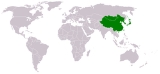
East Asia is a subregion of Asia that can be defined in either geographical or cultural terms. Geographically and geopolitically, it covers about 12,000,000 km˛, or about 28 percent of the Asian continent, about 15 percent bigger than the area of Europe, though some categorize Tibet, Xinjiang, and Mongolia as Central Asia. More than 1.5 billion people, about 38 percent of the population of Asia or 22 percent of all the people in the world, live in geographic East Asia, which is about twice the population of Europe.

Discussion
Ask a question about 'East Asia'
Start a new discussion about 'East Asia'
Answer questions from other users
|
Recent Posts

Encyclopedia
East Asia is a subregion of Asia that can be defined in either geographical or cultural terms. Geographically and geopolitically, it covers about 12,000,000 km˛, or about 28 percent of the Asian continent, about 15 percent bigger than the area of Europe, though some categorize Tibet, Xinjiang, and Mongolia as Central Asia. More than 1.5 billion people, about 38 percent of the population of Asia or 22 percent of all the people in the world, live in geographic East Asia, which is about twice the population of Europe. The region is one of the world's most populated places, with the population density of East Asia, 131 per km˛, being about three times the world average of 45 per km˛. Using the UN subregion definitions, it ranks second in population only to South Asia.
Historically, many societies in East Asia have been part of the Chinese cultural sphere, and East Asian vocabulary and scripts are often derived from Classical Chinese and Chinese script. Major religions include Buddhism (mostly Mahayana), Confucianism or Neo-Confucianism, Taoism, and Chinese folk religion, and Shinto in Japan. East Asian calendars are often derived from Chinese Calendar.
This combination of language, political philosophy, and religion (as well as art, architecture, holidays and festivals, etc.) overlaps with the geographical designation of East Asia for the most part, with a few exceptions, such as the overseas Chinese (including those in Singapore, Malaysia, Vietnam, and the West).
East Asia and Eastern Asia (the latter form preferred by the United Nations) are both more modern terms for the traditional name the Far East, which describes the region's geographical position in relation to Europe rather than its location within Asia. However, in contrast to the United Nations definition, East Asia commonly is used to refer to the eastern part of Asia, as the term implies.
The region is sometimes called Northeast Asia to inclusively include Southeast Asia to the term East Asia.
Other uses of the term East Asia
The following political entities are consistently seen as located in geographical East Asia:
The following peoples or societies are commonly seen as being encompassed by cultural East Asia:
Some consider the following countries or regions as part of East Asia, while others do not. Disagreements hinge on the difference between the cultural and geographic definitions of the term. Political perspective is also an important factor. In descending order in terms of the frequency with which they are described as East Asian:
- The parts of China that are not historically dominated by Han Chinese: Qinghai, Tibet, Xinjiang (considered either East Asia or Central Asia or South Asia in the case of Tibet—here the primary question is cultural, with geography also at issue)
- (considered either East Asia or Central Asia—here culture and/or geography may be at issue)
- (considered either East Asia or Southeast Asia—here the primary question is geographic)
- Russian Far East (considered either East Asia or North Asia—here the primary question is political, with culture and geography also at issue)
In many circumstances, the term East Asia is purposefully used to include all countries in Southeast Asia, especially when used in dualism with the term West Asia, the latter of which is then used to include those regions commonly considered West Asia, Central Asia and Southwest Asia.
Recently, East Asia has increasingly and commonly been described as a wide geographical area covering ten countries in ASEAN, P.R.China, Japan, South Korea, and the Republic of China (Taiwan) as part of economic and political regionalism and integration. The tendency of this usage, perhaps, started especially since the publication of World Bank on The East Asian Miracle in 1993 explaining the economic success of the Asian Tiger and emerging Southeast Asian economies (Indonesia, Malaysia, and Thailand). In addition, this usage has also been driven by Asia-wide economic interconnectedness since the co-operation between ASEAN and its three dialogue partners was institutionalised under the ASEAN Plus Three Process (ASEAN+3 or APT) in 1997. The idea of East Asian Community arising from ASEAN+3 framework is also gradually shaping the term East Asia to cover more than greater China, Korea, and Japan. Therefore, the term Northeast Asia is generally used to avoid confusion if only the greater China area, the Korean Peninsula, and Japan are specifically referred to, while Southeast Asia covers ten ASEAN countries.mographics
East Asian peoples:
List of Chinese ethnic groups (historical), Sino-Tibetan peoples, Japanese people, Koreans.
Other subregions of Asia
See also
External links
|
| |
|
|