All Topics  
Spy satellite

 
Spy Satellite

   Email Print
   Bookmark   Link


Spy satellite


A spy satellite (officially referred to as a reconnaissance satellite) is an Earth observation satellite
Earth observation satellite

Earth observation satellites are satellites specifically designed to observe Earth from orbit, similar toreconnaissance satellites but intended for non-military uses such as natural environmental monitoring, meteorology, map making etc....
 or communications satellite
Communications satellite

A communications satellite is an artificial satellite stationed in space for the purposes of telecommunications. Modern communications satellites use a variety of orbits including geostationary orbits, Molniya orbits, other elliptical orbits and low Earth orbits....
 deployed for military
Military

A military is an organization authorized by its nation to use force, usually including use of weapons, in defending its country by combating actual or Threat of force ....
 or intelligence
Espionage

Espionage or spying involves an individual obtaining information that is considered secrecy or confidential without the permission of the holder of the information....
 applications.


Discussion
Ask a question about 'Spy satellite'
Start a new discussion about 'Spy satellite'
Answer questions from other users
Full Discussion Forum


Encyclopedia


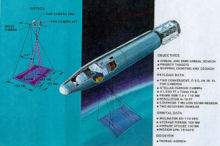
Kh 4b Corona
Lacrosse Sat
A spy satellite (officially referred to as a reconnaissance satellite) is an Earth observation satellite
Earth observation satellite

Earth observation satellites are satellites specifically designed to observe Earth from orbit, similar toreconnaissance satellites but intended for non-military uses such as natural environmental monitoring, meteorology, map making etc....
 or communications satellite
Communications satellite

A communications satellite is an artificial satellite stationed in space for the purposes of telecommunications. Modern communications satellites use a variety of orbits including geostationary orbits, Molniya orbits, other elliptical orbits and low Earth orbits....
 deployed for military
Military

A military is an organization authorized by its nation to use force, usually including use of weapons, in defending its country by combating actual or Threat of force ....
 or intelligence
Espionage

Espionage or spying involves an individual obtaining information that is considered secrecy or confidential without the permission of the holder of the information....
 applications. These are essentially space telescopes
Space observatory

A space observatory is any instrument in outer space which is used for observation of distant planets, galaxies, and other outer space objects....
 that are pointed toward the Earth instead of toward the stars. The first generation type (i.e. Corona
Corona (satellite)

Corona was a United States military reconnaissance satellite system operated by the CIA Directorate of Science & Technology with substantial assistance from the US Air Force, used for photographic surveillance of the Soviet Union, China and other areas from June 1959 until May 1972....
and Zenit
Zenit spy satellite

Zenit is the name of a series of military spy satellites launched by the Soviet Union between 1961 and 1994. To conceal their nature, all flights were given the public Cosmos designation....
) took photographs then ejected canisters of photographic film
Photographic film

Photographic film is a sheet of plastic coated with an emulsion containing light-sensitive silver halide salts with variable crystal sizes that determine the sensitivity, contrast and of the film....
, which would descend to earth. Corona capsules were retrieved in mid-air
Mid-air retrieval

Mid-air retrieval is a technique used in atmospheric reentry when the reentering vehicle is incapable of a satisfactory unassisted landing. The vehicle is slowed by means of parachutes, and then a specially-equipped aircraft matches the vehicle's trajectory and catches it in mid-air....
 as they floated down on parachute
Parachute

A parachute is a device used to slow the motion of an object through an atmosphere by creating Drag .Parachutes are made out of cloth, most commonly nylon....
s. Later spacecraft had digital imaging systems and downloaded the images via encrypted radio links.

In the United States
United States

The United States of America is a Federal government constitutional republic comprising U.S. state and a federal district. The country is situated mostly in central North America, where its Contiguous United States and Washington, D.C., the Capital districts and territories, lie between the Pacific Ocean and Atlantic Oceans, Borders of the U...
, most information available is on programs that existed up to 1972. Some information about programs prior to that time are still classified
Classified information

Classified information is sensitive information to which access is restricted by law or regulation to particular classes of persons. A formal security clearance is required to handle classified documents or access classified data....
, and a small trickle of information is available on subsequent missions. A few up-to-date reconnaissance satellite images have been declassified on occasion, or leaked, as in the case of KH-11
KH-11

The KH-11, also referenced by the codenames 1010, Crystal and Kennan, also commonly known as "Key Hole", was a type of reconnaissance satellite launched by the United States National Reconnaissance Office between December 1976 and 1990 and used until present....
 photographs which were sent to Jane's Defence Weekly
Jane's Defence Weekly

Jane's Defence Weekly is a weekly magazine reporting on military and corporation affairs, edited by Peter Felstead. It is one of a number of military-related publications named after John F.T....
 in 1985.

Origins

On March 16, 1955, the United States Air Force
United States Air Force

The United States Air Force is the aerial warfare branch of the Military of the United States and one of the uniformed services of the United States....
 officially ordered the development of an advanced reconnaissance satellite to provide continuous surveillance of “preselected areas of the earth” in order “to determine the status of a potential enemy’s war-making capability.” In October 1957, the Russians launched Sputnik
Sputnik 1

Sputnik 1 was the world's first Earth-orbiting artificial satellite. It was launched into a low altitude elliptical orbit by the Soviet Union on October 4, 1957, and was the first in a series of satellites collectively known as the Sputnik program....
. It was the first man made object to be put into space.

Missions

Examples of reconnaissance satellite missions:
  • High resolution photography (IMINT
    IMINT

    IMINT, short for IMagery INTelligence, is an list of intelligence gathering disciplines which collects information via satellite and aerial photography....
    )
  • Measurement and Signature Intelligence (MASINT)
  • Communications eavesdropping (SIGINT
    SIGINT

    Signals intelligence is list of intelligence gathering disciplines by interception of signals, whether between people or between machines , or mixtures of the two....
    )
  • Covert communications
  • Monitoring of nuclear test ban
    Comprehensive Test Ban Treaty

    The Comprehensive Nuclear-Test-Ban Treaty bans all nuclear weapon explosions in all environments, for military or civilian purposes....
     compliance (see National Technical Means)
  • Detection of missile launches


Types


United States

  • Naval ELINT:
    • GRAB
      Galactic Radiation and Background

      The Galactic Radiation and Background series of intelligence satellites were operated by the United States Naval Research Laboratory shortly after the Cold War U-2 Crisis of 1960....
    • Poppy
      Poppy (satellite)

      POPPY is the code name given to a series of U.S. intelligence satellites operated by the National Reconnaissance Office. The POPPY satellites recorded ELINT data, targeting radar installations in the Soviet Union....
    • Naval Ocean Surveillance System
      Naval Ocean Surveillance System

      The Naval Ocean Surveillance System , reportedly also called White Cloud and PARCAE, refers to one or several systems of SIGINT reconnaissance satellites which conducted ELINT for the U.S....
  • Samos F
    SAMOS F

    SAMOS-F or Air Force Program 102 refers to a series of SIGINT reconnaissance satellites launched and operated by the United States Air Force and National Reconnaissance Office during the 1960s....
  • Molniya SIGINT
    SIGINT

    Signals intelligence is list of intelligence gathering disciplines by interception of signals, whether between people or between machines , or mixtures of the two....
    :
    • Jumpseat
      Jumpseat (satellite)

      Jumpseat, also known as AFP-711 is reportedly a code name for a class of SIGINT reconnaissance satellites operated by the National Reconnaissance Office for the United States Air Force in the 1970s and 1980s....
    • Trumpet
      Trumpet (satellite)

      TRUMPET, called Advanced Jumpseat by some observers, is reportedly a codename for a series of ELINT reconnaissance satellites launched by the United States during the 1990s to replace the Jumpseat satellites....
  • Geosynchronous SIGINT:
    • Rhyolite/Aquacade
      Rhyolite/Aquacade

      Rhyolite and later, Aquacade are reportedly code names for a class of SIGINT reconnaissance satellites operated by the National Reconnaissance Office for the United States Central Intelligence Agency....
    • Magnum/Orion
      Magnum (satellite)

      Magnum is reportedly a code name for a class of SIGINT reconnaissance satellite operated by the National Reconnaissance Office for the United States Central Intelligence Agency....
    • Mentor
      Mentor (satellite)

      MENTOR, sometimes called Advanced Orion by observers, is reportedly a code-name for a class of United States reconnaissance satellites that collect signals intelligence from space....
  • Air Force Geosynchronous SIGINT:
    • Canyon
      Canyon (satellite)

      CANYON refers to a series of seven United States reconnaissance satellites launched between 1968 and 1977. Also known as AFP-827 , the satellites were developed with the participation of the United States Air Force....
    • Vortex/Chalet
    • Mercury
      Mercury (satellite)

      MERCURY is reportedly the name of a series of three United States reconnaissance satellites launched in the 1990s. These satellites were launched and operated by the National Reconnaissance Office with the participation of the United States Air Force....
  • Lacrosse/Onyx
    Lacrosse (satellite)

    Lacrosse and Onyx are the code names for the United States' National Reconnaissance Office terrestrial radar imaging reconnaissance satellite....
     (RADINT)
  • Misty/Zirconic
    Zirconic

    Zirconic is the name of a program for the development of Stealth technology reconnaissance satellites for the National Reconnaissance Office. The program includes the Misty and Prowler spacecraft....
  • Quasar
  • Vela
    Vela (satellite)

    Vela was the name of a group of satellites developed as the Vela Hotel element of Project Vela by the United States to monitor compliance with the 1963 Partial Test Ban Treaty by the Soviet Union, and other nuclear-capable states....
  • Key Hole
    Key Hole

    Key Hole is the designation for a series of United States optical reconnaissance satellites:*KH-1 Corona *KH-2 Corona *KH-3 Corona *KH-4 Corona ...
     (KH) series of imaging satellites:


Time period Designation Code name or Nickname Optics Notes
1959–1962 KH-1 to KH-3 Corona
Corona (satellite)

Corona was a United States military reconnaissance satellite system operated by the CIA Directorate of Science & Technology with substantial assistance from the US Air Force, used for photographic surveillance of the Soviet Union, China and other areas from June 1959 until May 1972....
 
Resolution: 7.5 m
Focal length: 0.6 m
First series of US imaging spy satellites; photographs returned by film canister ejection. Each satellite carried a single panoramic camera.
1960–1962 Samos
Samos (satellite)

The Samos E or SAMOS SAMOS was also known by the unclassified terms Program 101 and Program 201....
 
Res: 30 to 1.5 m
Foc len: 0.7 to 1.83 m
Most flights used radio
Radio

Radio is the transmission of signals, by modulation of electromagnetic radiation with frequency below those of visible light.Electromagnetic radiation radio propagation by means of oscillating electromagnetic fields that pass through the air and the vacuum of space....
 to relay images; some film returns; probably cancelled due to poor-quality imagery.
1962-1963 KH-4 Corona Resolution: 7.5 m Film return. Two panoramic cameras.
1963-1969 KH-4A Corona Resolution: 2.75 m Film return with two reentry vehicles and two panoramic cameras. Large volume of imagery.
1967-1972 KH-4B Corona Resolution: 1.8 m Film return with two reentry vehicles and two panoramic cameras.
1961–1964 KH-5
KH-5

Codenamed Argon, the KH-5 was a series of reconnaissance satellites produced by the United States from February 1961 to August 1964. The KH-5 operated similarly to the Corona series of satellites, as it ejected a canister of photographic film....
 
Argon Res: 140 m
Foc len: 76 mm
Film return. Low-resolution, high coverage-area images used for mapping.
1963 KH-6
KH-6

Codenamed Lanyard, the KH-6 was a short-lived series of reconnaissance satellites produced by the United States from March to July 1963. The project was quickly put together to get imagery of a site near Tallinn suspected of having ICBMs....
 
Lanyard Res: 1.8 m
Foc len: 1.67 m
Short-lived operation for imaging a specific site; used a camera from the Samos program; film return.
1963–1967 KH-7
KH-7

Codenamed Gambit, the KH-7 was a reconnaissance satellite used by the United States from July 1963 to June 1967. Like the older CORONA system, it acquired by taking photographs and returning the undeveloped film to earth....
 
Gambit Res: 0.46 m Film return with single reentry vehicle per launch.
1966–1984 KH-8
KH-8

The KH-8, codenamed GAMBIT was a long-lived series of reconnaissance satellites used by the United States from July 1966 to April 1984. Also known as Low Altitude Surveillance Platform....
 
Gambit Res: 0.5 m Film return.
1971–1986 KH-9 Hexagon
"Big Bird
Big Bird (satellite)

KH-9, codenamed HEXAGON, and popularly known as Big Bird, was a series of photographic reconnaissance satellites launched by the United States between 1971 and 1986....
"
Res: 0.30 m Film return with four or five reentry vehicles per launch.
cancelled KH-10 Dorian Manned Orbital Laboratory; space station
Space station

A space station is an artificial structure designed for humans to live in outer space. So far only low earth orbit stations are implemented, also known as orbital stations....
 based on Gemini program.
1976–1995 KH-11
KH-11

The KH-11, also referenced by the codenames 1010, Crystal and Kennan, also commonly known as "Key Hole", was a type of reconnaissance satellite launched by the United States National Reconnaissance Office between December 1976 and 1990 and used until present....
 
Crystal
Kennan
Res: 0.15 m
Mirror: 2.3 m
First known digital imaging
Digital imaging

Digital imaging or digital image acquisition is the creation of digital images, typically from a physical object. The term is often assumed to imply or include the digital image processing, , , digital printing, and display of such images....
 spy satellite. Thought possibly to be similar in size and overall layout to the Hubble Space Telescope
Hubble Space Telescope

The Hubble Space Telescope is a Space observatory that was carried into Low Earth orbit STS-31 in April 1990. It is named after the American astronomer Edwin Hubble....
.
1990—? KH-12
KH-12

"KH-12" is an unofficial designation of the successor to the KH-11 spy satellite. A system with the official designation KH-12 does not exist because the National Reconnaissance Office decided to refer to satellites by a random numbering scheme after repeated public references to KH-8, KH-9, and KH-11 satellites....
 
Ikon
Improved Crystal
Res: 0.15 to 0.10? m
Mirror: 2.4 to 4? m
Digital imaging; probably incorporates low light level visible and 3 to 5 micrometre
Micrometre

A micrometre or micron is one Micro- of a metre, or equivalently one thousandth of a millimetre. It is also commonly known as a micron....
 infrared imaging capabilities; possible "live" intelligence gathering.
1999—? KH-13
KH-13

The KH-13 is a name used by observers of U.S. military space programs to refer to a class of imaging spy satellite operated by the United States....
 
8X? EIS? Res: 0.10? to 0.04? m (*)
Mirror: 4? m
Very little known; possibly includes radar imaging or maybe stealth technology
Stealth technology

Stealth technology also known as LO technology is a sub-discipline of military electronic countermeasures which covers a range of techniques used with stealth aircraft, stealth ship, submarines, and missiles, in order to make them less visible to radar, infrared, sonar and other detection methods....
.


(*) Although there is much speculation concerning imaging resolution, any optical system is limited by diffraction
Diffraction

Diffraction is normally taken to refer to various phenomena which occur when a wave encounters an obstacle. It is described as the apparent bending of waves around small obstacles and the spreading out of waves past small openings....
. For example, a satellite with a 4 m telescope at an orbit of 600 km has a diffraction limited resolution of 10 cm at 550 nm (green light), so it certainly cannot read a license plate. Other effects such as an inhomogeneous atmosphere further degrade resolution. The apogee of a typical filming mission would have been close to 100 km (~62 miles). Using the above calculation the resolution would have been less than 2 cm (<1 inch).

Soviet Union/Russia

  • Persona
    Persona (satellite)

    Persona is a class of Russian reconnaissance satellites, derived from the Resurs DK class of remote sensing satellite, itself derived from the Soviet Yantar reconnaissance satellites....
  • Resurs DK
    Resurs DK

    Resurs-DK1 is a commercial earth observation satellite capable of transmitting high-resolution imagery to the ground stations as it passes overhead. The spacecraft is operated by NTs OMZ ....
  • Cosmos
    Cosmos (satellite)

    Cosmos is the name of a series of satellites which were launched by the Soviet Union and are being launched now by Russia. The first of them was launched on March 16 1962....
  • RORSAT
    RORSAT

    Radar Ocean Reconnaissance SATellite or RORSAT is the western name given to the Soviet Union Upravlyaemyj Sputnik Aktivnyj satellites....
     (under cover of Cosmos series). Radar
    Radar

    Radar is a system that uses electromagnetic radiation waves to identify the range, altitude, direction, or speed of both moving and fixed objects such as aircraft, ships, motor vehicles, weather formations, and terrain....
     type powered by Topaz
    Topaz Nuclear Reactor

    The TOPAZ nuclear reactor is a lightweight nuclear reactor developed for long term space use by the Soviet Union. Cooled by liquid metal, it uses a high-temperature moderator containing hydrogen and highly enriched fuel and produces electricity using a thermionic converter....
     nuclear reactors.
  • Almaz
    Almaz

    The Almaz program was a series of military space stations launched by the Soviet Union under cover of the civilian Salyut DOS-17K program after 1971....
  • Yantar
    Yantar

    Yantar may refer to:*Yantar, Kaliningrad, a place in Russia*Yantar , a series of reconnaissance satellitesSee also:*Jantar - Polish language variant...
  • Zenit
    Zenit spy satellite

    Zenit is the name of a series of military spy satellites launched by the Soviet Union between 1961 and 1994. To conceal their nature, all flights were given the public Cosmos designation....


China

  • Fanhui Shi Weixing
    Fanhui Shi Weixing

    Fanhui Shi Weixing is a series of Chinese space program recoverable reconnaissance satellites. The satellites were designed for both military and civilian observation needs, with a total of 26 flights....
    • FSW-0
    • FSW-1
    • FSW-2
    • FSW-3


Germany

  • SAR-Lupe
    SAR-Lupe

    SAR-Lupe is Germany's first reconnaissance satellite system. SAR is an abbreviation for Synthetic Aperture Radar and "Lupe" is German for magnifying glass....
    • SAR-Lupe 1
    • SAR-Lupe 2
    • SAR-Lupe 3
    • SAR-Lupe 4
    • SAR-Lupe 5


France

  • Helios 1B
    Helios 1B

    The H?lios 1B was a French military photo-reconnaissance spacecraft. It was launched from the Guiana Space Centre, French Guiana on 3 December 1999 at 16:22:00 UTC....
     (destroyed), Helios 2A
    Helios 2A

    Helios 2A is a France military observation satellite which was launched on December 18, 2004 by an Ariane 5 rocket from French Guiana. The ground resolution is about 30 cm....


United Kingdom

  • Zircon
    Zircon (satellite)

    Zircon was the codename for a British signals intelligence satellite, intended to be launched in 1988, before being cancelled.During the Cold War, Britain's GCHQ was heavily reliant on America's National Security Agency for communications interception from space....
     (cancelled in 1987)


India

  • Technology Experiment Satellite
    Technology Experiment Satellite

    Technology Experiment Satellite or is an experimental satellite to demonstrate and validate, in orbit, technologies that could be used in the future satellites of Indian Space Research Organization ....
  • Cartosat 2A (Launched on April 28, 2008)


Iran

  • Sinah-1
    Sinah-1

    Sina-1 is the first Iranian satellite, launched at 6:52 UTC October 28, 2005 on board a Cosmos-3M Russian launch vehicle from the Plesetsk Cosmodrome....
  • Mesbah (ready for launch)
  • Omid
    Omid (satellite)

    Omid is Iran's first domestically made satellite. Described as a data-processing satellite for research and telecommunications, Iran's state television reported that it was successfully launched on February 2, 2009....
     or Hope Satellite (launched in February 2, 2009)


Israel

  • Ofeq
    Ofeq

    Ofeq, also spelled Offek or Ofek is the designation of a series of Israeli reconnaissance satellites first launched in 1988. All Ofeq satellites have been carried on top of Shavit rockets from Palmachim Airbase in Israel, on the Mediterranean coast....
  • TecSAR
    TecSAR

    TecSAR, also known as TechSAR and Polaris, is an Israeli reconnaissance satellite, equipped with synthetic aperture radar developed by Elta....


Italy

  • COSMO-SkyMed
    COSMO-SkyMed

    COSMO-SkyMed is an Earth observation satellite system funded by the Italy Ministry of Research and Ministry of Defence andconducted by the Italian Space Agency , intended for both military and civilian use....


Japan

  • Information Gathering Satellite
    Information Gathering Satellite

    An Information Gathering Satellite is a satellite in a Japanese spy satellite program. It was started as a response to the 1998 North Korean missile test over Japan....


Egypt

  • EgyptSat 1
    EgyptSat 1

    EgyptSat-1 is Egypt's first Earth remote-sounding satellite. This satellite has been jointly built by Egypt's National Authority for Remote Sensing and Space Sciences together with the Yuzhnoye Design Bureau in Ukraine and was launched onboard a Dnepr rocket on 17 April 2007....
     
  • EgyptSat 2 (planned)
  • DesertSat (planned end of 2007)


South Korea

  • Arirang-2
    Arirang-2

    Arirang-2, also known as KOMPSAT-2, is a South Korean multipurpose satellite. It was launched from Plesetsk, Russia at 4:05 PM Korea Standard Time on July 28 2006....


Turkey

    • Gokturk-1 (An electro-optical satellite to be co-produced with Italian firm Telespazio
      Telespazio

      Telespazio is a space systems services company, based in Rome, Italy. Telespazio was founded in 1961; however the company as it exists today was formed on July 1 2005 with the merger of the original Telespazio with the space services division of Alcatel....
       and Turkish Aerospace Industries
      Turkish Aerospace Industries

      Turkish Aerospace Industries, Inc. Turkish Aerospace Industries, Inc. , the center of technology in design, development, manufacturing, integration of aerospace systems, modernization and after sales support in Turkey, was established under the Turkish Commercial Code and Foreign Investment Encouragement Law on 15 May 1984....
      . Alcatel of France will supply the 1.0m resolution camera. The platform has integration with all Turkish Army, Navy and Air Force platforms. It is scheduled to be launched into orbit in 2012
    • Gokturk-2 (An indegenous Turkish designed and manufactured platform which will have a 2.5m resolution. The Project is carried out by two prominent Turkish institutions, TAI
      TAI

      As a three letter acronym, TAI can be:*TAI is the IATA airport code for Ta'izz International Airport*TAI is the ICAO code for Taca International Airlines...
       and [TÜBITAK SPACE]. Production has commenced at Turkish Aerospace Industries and the satellite is scheduled to be launched into orbit in 2011)
    • Türk Gölgesi
    • Türk Gölgesi 1
    • Türk Gölgesi 2
    • Türk Gölgesi 3
    • Kuzey YILDIZI (1 and 2) are sub-meter resolution surveillance satellites programmes being held by a private company for technology demonstration and reconnaissance. The satellites (except for the imagers), are being designed and built entirely in Turkey. First part of this project (Kuzey YILDIZI 1) is about to be fulfilled and the satellite is planned to be launched in the second half of 2010. The second satellite (Kuzey YILDIZI -2) will be a follow on satellite to be launched in space by 2012. Since this is a classifed programme, official data regarding the platform has not been releaased at this stage.
    • Other classified programs


In fiction


Spy satellites are commonly seen in spy fiction
Spy fiction

The genre of spy fiction?sometimes called political thriller or spy thriller or sometimes shortened simply to spy-fi?arose before World War I at about the same time that the first modern intelligence agencies were formed....
 and military fiction. Some works of fiction that focus specifically on spy satellites include:

  • The OMAC Project
    The OMAC Project

    The OMAC Project is a six issue American comic book limited series written by Greg Rucka with art by Jesus Saiz and published by DC Comics in 2005 in comics....
  • Enemy of the State (film)
  • Ice Station Zebra
    Ice Station Zebra

    Ice Station Zebra is a 1963 in literature Thriller novel written by Scotland author Alistair MacLean. This was the last of MacLean's classic sequence of first person narratives which began with Night Without End, and represented a return to that earlier novel's Arctic setting....


See also

  • National Reconnaissance Office
    National Reconnaissance Office

    The National Reconnaissance Office , located in Chantilly, Virginia, is one of the U.S. intelligence community in the U.S. It designs, builds and operates the reconnaissance satellites of the United States government....
  • Defense Support Program
    Defense Support Program

    The Defense Support Program is a program of the U.S. Air Force that operates the reconnaissance satellites which form the principal component of the Satellite Early Warning System currently used by the United States....
  • European Union Satellite Centre
    European Union Satellite Centre

    The European Union Satellite Centre is an Agency of the Council of the European Union which gathers information through satellite images to help the EU prevent conflicts and provide humanitarian aid....
  • Atmospheric reentry
    Atmospheric reentry

    Atmospheric reentry refers to the movement of human-made or natural objects as they enter the atmosphere of a planet from outer space, in the case of Earth from an altitude above the "edge of space." This article primarily addresses the process of controlled reentry of vehicles which are intended to reach the planetary surface intact, but th...
  • List of intelligence gathering disciplines
    List of intelligence gathering disciplines

    Intelligence Gathering Disciplines...


External links

  • (NASA, remote sensing tutorial)