

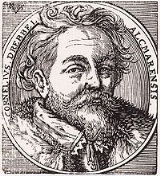
Cornelius Drebbel

Encyclopedia
Cornelis Jacobszoon Drebbel (Alkmaar,1572 – London,November 7, 1633) was the Dutch
builder
of the first navigable submarine
in 1620. Drebbel was an innovator who contributed to the development of measurement
and control systems, optics
and chemistry
.
, Holland. After some years at the Latin school in Alkmaar, around 1590, he attended the Academy in Haarlem
, also located in North-Holland. Teachers at the Academy were Hendrick Goltzius, engraver, painter and humanist, Karel van Mander, painter, writer, humanist and Cornelis Corneliszoon
of Haarlem. Cornelis became a skilled engraver.
In 1595 he married Sophia Jansdochter Goltzius, sister of Hendrick. They had 4 children. In 1600, Drebbel was in Middelburg where he built a fountain at the Noorderpoort. He met there with Hans Lippershey
, spectacle maker and constructor of telescopes and his colleague Zacharias Jansen. There Drebbel learned lens grinding and optics. Around 1604 the Drebbel family moved to England, probably at the invitation of the new king, James I of England
(VI of Scotland). Drebbel also worked at the masques, that are performed by and for the court. He was related to the court of Renaissance crown-prince Henry. In 1610 Drebbel and family were invited to come to the court of Emperor Rudolf II in Prague. After Rudolf's death in 1612, Drebbel went back to London. Unfortunately his patron prince Henry had also died and Drebbel was in financial trouble.
 In 1619 Drebbel designed and built telescopes and microscopes and was involved in a building project for the Duke of Buckingham. William Boreel, the Dutch Ambassador to England, mentions the microscope that was developed by Drebbel. Drebbel became famous for his invention in 1621 of a microscope
with two convex lenses. Several authors, including Christiaan Huygens assign the invention of the compound microscope to Drebbel. However, a Neapolitan, named Fontana, claimed the discovery for himself in 1618. Other sources attribute the invention of the compound microscope directly to Hans Jansen and his son Zacharias around 1595. In 1624 Galileo sent a Drebbel-type microscope to Federico Cesi
(1585–1630), a wealthy noble man in Rome who used it to illustrate Apiarum, his book about bees.
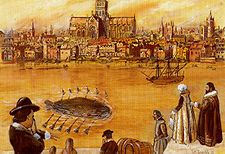
He also built the first navigable submarine
in 1620 while working for the English Royal Navy
. Using William Bourne
's design from 1578, he manufactured a steerable submarine with a leather-covered wooden frame. Between 1620 and 1624 Drebbel successfully built and tested two more submarines, each one bigger than the last. The final (third) model had 6 oar
s and could carry 16 passengers. This model was demonstrated to King James I in person and several thousand Londoners. The submarine stayed submerged for three hours and could travel from Westminster
to Greenwich
and back, cruising at a depth of from 12 to 15 feet (4 to 5 metres). Drebbel even took James in this submarine on a test dive beneath the Thames, making James I the first monarch to travel underwater. This submarine was tested many times in the Thames
, but it couldn't attract enough enthusiasm from the Admiralty and was never used in combat.
To re-oxygenate the air inside one or more of these submarines, he likely generated oxygen
by heating nitre (potassium nitrate
or sodium nitrate
) in a metal pan to make it emit oxygen. That would also turn the nitrate into sodium or potassium oxide
or hydroxide
, which would tend to absorb carbon dioxide from the air around. That may explain how Drebbel's men were not affected by carbon dioxide build-up
as much as would be expected. If so, he accidentally made a crude rebreather
nearly three centuries before Fluess and Davis. Drebbel had been taught by the alchemist Michael Sendivogius (1566–1636) (perhaps when both were at the court of Rudolf II) that warming nitre produced oxygen. The most reliable source suggesting the use of oxygen is a note by Robert Boyle
. In 1662 Boyle wrote that he had spoken with an excellent mathematician, who was still alive and had been on the submarine, who said that Drebbel had a chemical liquor that would replace that quintessence of air that was able to cherish the vital flame residing in the heart.
More recently it has been suggested that the contemporary accounts of the craft contained significant elements of exaggeration and it was at most a semi-submersible
that was able to travel down the Thames by the force of the current.
Drebbel's most famous written work was Een kort Tractaet van de Natuere der Elementen (A short treatise of the nature of the elements) (Haarlem
, 1621). He was also involved in the invention of mercury fulminate. He had found out that mixtures of “spiritus vini” with mercury
and silver
in “aqua fortis
” could explode
Drebbel also invented a chicken incubator and a mercury
thermostat
that automatically kept it at a constant temperature. This is one of the first recorded feedback-controlled
devices. He also developed and demonstrated a working air conditioning
system. The invention of a working thermometer
is also ascribed to Drebbel
Towards the end of his life, in 1633, Drebbel was involved in a plan to drain the Fens around Cambridge, while living in near-poverty running an ale house in England. He died in London
.
A small lunar crater Drebbel
has been named after him.
A theory in Renaissance Magazine (issue #53, March 2007) speculates that the Voynich Manuscript
may be Drebbel's cipher notebook on microscopy and alchemy.
Cornelis dropped a flask of Aqua regia
on a tin
window sill, and discovered that stannous chloride
makes the color of carmine
much brighter and more durable. Though the inventor himself never made much money from his work, his daughters Anna and Catharina and his sons-in-law Abraham and Johannes Sibertus Kuffler
set up a very successful dye works.
One was set up in 1643 in Bow, London
, and the resulting color was called bow dye.
The recipe for "color Kufflerianus" was kept a family secret and the new bright red color was all the rage in Europe.
(1974). A small leatherclad submersible surfaces off the coast of England, and the top opens clamshell-wise revealing Cornelis Drebbel and the Duke of Buckingham
.
Drebbel was honored in an episode of the cartoon Sealab 2021
during a submarine rescue of workers on a research station in the Arctic
. A German U-boat
captain fired a pistol in celebration at the mention of Drebbel, to shouts of, "Sieg Heil! Cornelis Drebbel!" Also, on the Sealab 2021 Season 3 DVD, Cornelis Drebbel has two DVD commentaries devoted to the story of his life. However, the first is highly inaccurate and the narrator
of the second gets easily distracted, so much so that he spends most of the eleven minutes of commentary talking about the languages of northern Europe
and the domestic policies of the Swiss.
In the Dutch Eighty Years War comic Gilles de Geus, Drebbel is a supporting character to the warhero Gilles. He is drawn as a crazy inventor, similar to Q
in the James Bond series
. His submarine plays a role in the comic.
Netherlands
The Netherlands is a constituent country of the Kingdom of the Netherlands, located mainly in North-West Europe and with several islands in the Caribbean. Mainland Netherlands borders the North Sea to the north and west, Belgium to the south, and Germany to the east, and shares maritime borders...
builder
Builder
Builder may refer to:* General contractor, that specializes in building work**Subcontractor* Construction worker who specializes in building work* Builder a component of modern detergents...
of the first navigable submarine
Submarine
A submarine is a watercraft capable of independent operation below the surface of the water. It differs from a submersible, which has more limited underwater capability...
in 1620. Drebbel was an innovator who contributed to the development of measurement
Measurement
Measurement is the process or the result of determining the ratio of a physical quantity, such as a length, time, temperature etc., to a unit of measurement, such as the metre, second or degree Celsius...
and control systems, optics
Optics
Optics is the branch of physics which involves the behavior and properties of light, including its interactions with matter and the construction of instruments that use or detect it. Optics usually describes the behavior of visible, ultraviolet, and infrared light...
and chemistry
Chemistry
Chemistry is the science of matter, especially its chemical reactions, but also its composition, structure and properties. Chemistry is concerned with atoms and their interactions with other atoms, and particularly with the properties of chemical bonds....
.
Early life
Drebbel was born at AlkmaarAlkmaar
Alkmaar is a municipality and a city in the Netherlands, in the province of Noord Holland. Alkmaar is well known for its traditional cheese market. For tourists, it is a popular cultural destination.-History:...
, Holland. After some years at the Latin school in Alkmaar, around 1590, he attended the Academy in Haarlem
Haarlem
Haarlem is a municipality and a city in the Netherlands. It is the capital of the province of North Holland, the northern half of Holland, which at one time was the most powerful of the seven provinces of the Dutch Republic...
, also located in North-Holland. Teachers at the Academy were Hendrick Goltzius, engraver, painter and humanist, Karel van Mander, painter, writer, humanist and Cornelis Corneliszoon
Cornelis Corneliszoon
Cornelis Corneliszoon van Uitgeest, or Krelis Lootjes was a Dutch windmill owner from Uitgeest who invented the wind-powered sawmill, which made the conversion of log timber into planks 30 times faster than before.-Biography:...
of Haarlem. Cornelis became a skilled engraver.
In 1595 he married Sophia Jansdochter Goltzius, sister of Hendrick. They had 4 children. In 1600, Drebbel was in Middelburg where he built a fountain at the Noorderpoort. He met there with Hans Lippershey
Hans Lippershey
Hans Lippershey , also known as Johann Lippershey or Lipperhey, was a German-Dutch lensmaker commonly associated with the invention of the telescope, although it is unclear if he was the first to build one.-Biography:...
, spectacle maker and constructor of telescopes and his colleague Zacharias Jansen. There Drebbel learned lens grinding and optics. Around 1604 the Drebbel family moved to England, probably at the invitation of the new king, James I of England
James I of England
James VI and I was King of Scots as James VI from 24 July 1567 and King of England and Ireland as James I from the union of the English and Scottish crowns on 24 March 1603...
(VI of Scotland). Drebbel also worked at the masques, that are performed by and for the court. He was related to the court of Renaissance crown-prince Henry. In 1610 Drebbel and family were invited to come to the court of Emperor Rudolf II in Prague. After Rudolf's death in 1612, Drebbel went back to London. Unfortunately his patron prince Henry had also died and Drebbel was in financial trouble.
Drebbel's legacy
Microscope
A microscope is an instrument used to see objects that are too small for the naked eye. The science of investigating small objects using such an instrument is called microscopy...
with two convex lenses. Several authors, including Christiaan Huygens assign the invention of the compound microscope to Drebbel. However, a Neapolitan, named Fontana, claimed the discovery for himself in 1618. Other sources attribute the invention of the compound microscope directly to Hans Jansen and his son Zacharias around 1595. In 1624 Galileo sent a Drebbel-type microscope to Federico Cesi
Federico Cesi
Federico Angelo Cesi was an Italian scientist, naturalist, and founder of the Accademia dei Lincei. On his father's death in 1630, he became briefly lord of Acquasparta.- Biography :...
(1585–1630), a wealthy noble man in Rome who used it to illustrate Apiarum, his book about bees.
He also built the first navigable submarine
Submarine
A submarine is a watercraft capable of independent operation below the surface of the water. It differs from a submersible, which has more limited underwater capability...
in 1620 while working for the English Royal Navy
Royal Navy
The Royal Navy is the naval warfare service branch of the British Armed Forces. Founded in the 16th century, it is the oldest service branch and is known as the Senior Service...
. Using William Bourne
William Bourne (mathematician)
William Bourne was an English mathematician, innkeeper and former Royal Navy gunner who invented the first navigable submarine and wrote important navigational manuals...
's design from 1578, he manufactured a steerable submarine with a leather-covered wooden frame. Between 1620 and 1624 Drebbel successfully built and tested two more submarines, each one bigger than the last. The final (third) model had 6 oar
Oar
An oar is an implement used for water-borne propulsion. Oars have a flat blade at one end. Oarsmen grasp the oar at the other end. The difference between oars and paddles are that paddles are held by the paddler, and are not connected with the vessel. Oars generally are connected to the vessel by...
s and could carry 16 passengers. This model was demonstrated to King James I in person and several thousand Londoners. The submarine stayed submerged for three hours and could travel from Westminster
Westminster
Westminster is an area of central London, within the City of Westminster, England. It lies on the north bank of the River Thames, southwest of the City of London and southwest of Charing Cross...
to Greenwich
Greenwich
Greenwich is a district of south London, England, located in the London Borough of Greenwich.Greenwich is best known for its maritime history and for giving its name to the Greenwich Meridian and Greenwich Mean Time...
and back, cruising at a depth of from 12 to 15 feet (4 to 5 metres). Drebbel even took James in this submarine on a test dive beneath the Thames, making James I the first monarch to travel underwater. This submarine was tested many times in the Thames
River Thames
The River Thames flows through southern England. It is the longest river entirely in England and the second longest in the United Kingdom. While it is best known because its lower reaches flow through central London, the river flows alongside several other towns and cities, including Oxford,...
, but it couldn't attract enough enthusiasm from the Admiralty and was never used in combat.
To re-oxygenate the air inside one or more of these submarines, he likely generated oxygen
Oxygen
Oxygen is the element with atomic number 8 and represented by the symbol O. Its name derives from the Greek roots ὀξύς and -γενής , because at the time of naming, it was mistakenly thought that all acids required oxygen in their composition...
by heating nitre (potassium nitrate
Potassium nitrate
Potassium nitrate is a chemical compound with the formula KNO3. It is an ionic salt of potassium ions K+ and nitrate ions NO3−.It occurs as a mineral niter and is a natural solid source of nitrogen. Its common names include saltpetre , from medieval Latin sal petræ: "stone salt" or possibly "Salt...
or sodium nitrate
Sodium nitrate
Sodium nitrate is the chemical compound with the formula NaNO3. This salt, also known as Chile saltpeter or Peru saltpeter to distinguish it from ordinary saltpeter, potassium nitrate, is a white solid which is very soluble in water...
) in a metal pan to make it emit oxygen. That would also turn the nitrate into sodium or potassium oxide
Oxide
An oxide is a chemical compound that contains at least one oxygen atom in its chemical formula. Metal oxides typically contain an anion of oxygen in the oxidation state of −2....
or hydroxide
Hydroxide
Hydroxide is a diatomic anion with chemical formula OH−. It consists of an oxygen and a hydrogen atom held together by a covalent bond, and carrying a negative electric charge. It is an important but usually minor constituent of water. It functions as a base, as a ligand, a nucleophile, and a...
, which would tend to absorb carbon dioxide from the air around. That may explain how Drebbel's men were not affected by carbon dioxide build-up
Hypercapnia
Hypercapnia or hypercapnea , also known as hypercarbia, is a condition where there is too much carbon dioxide in the blood...
as much as would be expected. If so, he accidentally made a crude rebreather
Rebreather
A rebreather is a type of breathing set that provides a breathing gas containing oxygen and recycled exhaled gas. This recycling reduces the volume of breathing gas used, making a rebreather lighter and more compact than an open-circuit breathing set for the same duration in environments where...
nearly three centuries before Fluess and Davis. Drebbel had been taught by the alchemist Michael Sendivogius (1566–1636) (perhaps when both were at the court of Rudolf II) that warming nitre produced oxygen. The most reliable source suggesting the use of oxygen is a note by Robert Boyle
Robert Boyle
Robert Boyle FRS was a 17th century natural philosopher, chemist, physicist, and inventor, also noted for his writings in theology. He has been variously described as English, Irish, or Anglo-Irish, his father having come to Ireland from England during the time of the English plantations of...
. In 1662 Boyle wrote that he had spoken with an excellent mathematician, who was still alive and had been on the submarine, who said that Drebbel had a chemical liquor that would replace that quintessence of air that was able to cherish the vital flame residing in the heart.
More recently it has been suggested that the contemporary accounts of the craft contained significant elements of exaggeration and it was at most a semi-submersible
Semi-submersible
A semi-submersible is a specialised marine vessel with good stability and seakeeping characteristics. The semi-submersible vessel design is commonly used in a number of specific offshore roles such as for offshore drilling rigs, safety vessels, oil production platforms and heavy lift cranes.The...
that was able to travel down the Thames by the force of the current.
Drebbel's most famous written work was Een kort Tractaet van de Natuere der Elementen (A short treatise of the nature of the elements) (Haarlem
Haarlem
Haarlem is a municipality and a city in the Netherlands. It is the capital of the province of North Holland, the northern half of Holland, which at one time was the most powerful of the seven provinces of the Dutch Republic...
, 1621). He was also involved in the invention of mercury fulminate. He had found out that mixtures of “spiritus vini” with mercury
Mercury (element)
Mercury is a chemical element with the symbol Hg and atomic number 80. It is also known as quicksilver or hydrargyrum...
and silver
Silver
Silver is a metallic chemical element with the chemical symbol Ag and atomic number 47. A soft, white, lustrous transition metal, it has the highest electrical conductivity of any element and the highest thermal conductivity of any metal...
in “aqua fortis
Aqua fortis
Aqua fortis, or "strong water," in alchemy, is a solution of nitric acid in water. Being highly corrosive, the solution was used in alchemy for dissolving silver and most other metals with the notable exception of gold, which can only be dissolved using aqua regia...
” could explode
Drebbel also invented a chicken incubator and a mercury
Mercury (element)
Mercury is a chemical element with the symbol Hg and atomic number 80. It is also known as quicksilver or hydrargyrum...
thermostat
Thermostat
A thermostat is the component of a control system which regulates the temperature of a system so that the system's temperature is maintained near a desired setpoint temperature. The thermostat does this by switching heating or cooling devices on or off, or regulating the flow of a heat transfer...
that automatically kept it at a constant temperature. This is one of the first recorded feedback-controlled
Feedback
Feedback describes the situation when output from an event or phenomenon in the past will influence an occurrence or occurrences of the same Feedback describes the situation when output from (or information about the result of) an event or phenomenon in the past will influence an occurrence or...
devices. He also developed and demonstrated a working air conditioning
Air conditioning
An air conditioner is a home appliance, system, or mechanism designed to dehumidify and extract heat from an area. The cooling is done using a simple refrigeration cycle...
system. The invention of a working thermometer
Thermometer
Developed during the 16th and 17th centuries, a thermometer is a device that measures temperature or temperature gradient using a variety of different principles. A thermometer has two important elements: the temperature sensor Developed during the 16th and 17th centuries, a thermometer (from the...
is also ascribed to Drebbel
Towards the end of his life, in 1633, Drebbel was involved in a plan to drain the Fens around Cambridge, while living in near-poverty running an ale house in England. He died in London
London
London is the capital city of :England and the :United Kingdom, the largest metropolitan area in the United Kingdom, and the largest urban zone in the European Union by most measures. Located on the River Thames, London has been a major settlement for two millennia, its history going back to its...
.
A small lunar crater Drebbel
Drebbel (crater)
Drebbel is a small lunar crater that is located to the northeast of the large walled plain Schickard, in the southwestern part of the Moon. Further to the northeast is the Lacus Excellentiae and the small crater Clausius....
has been named after him.
A theory in Renaissance Magazine (issue #53, March 2007) speculates that the Voynich Manuscript
Voynich manuscript
The Voynich manuscript, described as "the world's most mysterious manuscript", is a work which dates to the early 15th century, possibly from northern Italy. It is named after the book dealer Wilfrid Voynich, who purchased it in 1912....
may be Drebbel's cipher notebook on microscopy and alchemy.
Scarlet dye
The story goes that, while making a coloured liquid for a thermometerThermometer
Developed during the 16th and 17th centuries, a thermometer is a device that measures temperature or temperature gradient using a variety of different principles. A thermometer has two important elements: the temperature sensor Developed during the 16th and 17th centuries, a thermometer (from the...
Cornelis dropped a flask of Aqua regia
Aqua regia
Aqua regia or aqua regis is a highly corrosive mixture of acids, fuming yellow or red solution, also called nitro-hydrochloric acid. The mixture is formed by freshly mixing concentrated nitric acid and hydrochloric acid, usually in a volume ratio of 1:3, respectively...
on a tin
Tin
Tin is a chemical element with the symbol Sn and atomic number 50. It is a main group metal in group 14 of the periodic table. Tin shows chemical similarity to both neighboring group 14 elements, germanium and lead and has two possible oxidation states, +2 and the slightly more stable +4...
window sill, and discovered that stannous chloride
Tin(II) chloride
Tin chloride is a white crystalline solid with the formula 2. It forms a stable dihydrate, but aqueous solutions tend to undergo hydrolysis, particularly if hot. SnCl2 is widely used as a reducing agent , and in electrolytic baths for tin-plating...
makes the color of carmine
Carmine
Carmine , also called Crimson Lake, Cochineal, Natural Red #4, C.I. 75470, or E120, is a pigment of a bright-red color obtained from the aluminum salt of carminic acid, which is produced by some scale insects, such as the cochineal beetle and the Polish cochineal, and is used as a general term for...
much brighter and more durable. Though the inventor himself never made much money from his work, his daughters Anna and Catharina and his sons-in-law Abraham and Johannes Sibertus Kuffler
Johannes Sibertus Kuffler
Johannes Sibertus Kuffler was a German inventor and chemist, from Cologne. He started in a successful dyeing business in Leiden, with his brother Abraham, and then moved it to Bow, London. The new colour was called "Color Kufflerianus" or "Bow dye"...
set up a very successful dye works.
One was set up in 1643 in Bow, London
Bow, London
Bow is an area of London, England, United Kingdom in the London Borough of Tower Hamlets. It is a built-up, mostly residential district located east of Charing Cross, and is a part of the East End.-Bridges at Bowe:...
, and the resulting color was called bow dye.
The recipe for "color Kufflerianus" was kept a family secret and the new bright red color was all the rage in Europe.
Cultural references
A portrayal of Cornelis Drebbel and his submarine can be briefly seen in the film The Four MusketeersThe Four Musketeers (film)
The Four Musketeers is a 1974 Richard Lester film that follows upon his film of the year before, The Three Musketeers, and covers the second half of Dumas' novel The Three Musketeers...
(1974). A small leatherclad submersible surfaces off the coast of England, and the top opens clamshell-wise revealing Cornelis Drebbel and the Duke of Buckingham
Duke of Buckingham
The titles Marquess and Duke of Buckingham, referring to Buckingham, have been created several times in the peerages of England, Great Britain, and the United Kingdom. There have also been Earls of Buckingham.-1444 creation:...
.
Drebbel was honored in an episode of the cartoon Sealab 2021
Sealab 2021
Sealab 2021 is an American animated television series. It was shown on Cartoon Network's adult-oriented programming block, Adult Swim. It premiered on November 23, 2000 and the final episode aired on April 25, 2005...
during a submarine rescue of workers on a research station in the Arctic
Arctic
The Arctic is a region located at the northern-most part of the Earth. The Arctic consists of the Arctic Ocean and parts of Canada, Russia, Greenland, the United States, Norway, Sweden, Finland, and Iceland. The Arctic region consists of a vast, ice-covered ocean, surrounded by treeless permafrost...
. A German U-boat
U-boat
U-boat is the anglicized version of the German word U-Boot , itself an abbreviation of Unterseeboot , and refers to military submarines operated by Germany, particularly in World War I and World War II...
captain fired a pistol in celebration at the mention of Drebbel, to shouts of, "Sieg Heil! Cornelis Drebbel!" Also, on the Sealab 2021 Season 3 DVD, Cornelis Drebbel has two DVD commentaries devoted to the story of his life. However, the first is highly inaccurate and the narrator
Narrator
A narrator is, within any story , the fictional or non-fictional, personal or impersonal entity who tells the story to the audience. When the narrator is also a character within the story, he or she is sometimes known as the viewpoint character. The narrator is one of three entities responsible for...
of the second gets easily distracted, so much so that he spends most of the eleven minutes of commentary talking about the languages of northern Europe
Germanic languages
The Germanic languages constitute a sub-branch of the Indo-European language family. The common ancestor of all of the languages in this branch is called Proto-Germanic , which was spoken in approximately the mid-1st millennium BC in Iron Age northern Europe...
and the domestic policies of the Swiss.
In the Dutch Eighty Years War comic Gilles de Geus, Drebbel is a supporting character to the warhero Gilles. He is drawn as a crazy inventor, similar to Q
Q (James Bond)
Q is a fictional character in the James Bond novels and films. Q , like M, is a job title rather than a name. He is the head of Q Branch , the fictional research and development division of the British Secret Service...
in the James Bond series
James Bond
James Bond, code name 007, is a fictional character created in 1953 by writer Ian Fleming, who featured him in twelve novels and two short story collections. There have been a six other authors who wrote authorised Bond novels or novelizations after Fleming's death in 1964: Kingsley Amis,...
. His submarine plays a role in the comic.