

Siege

Encyclopedia
Military
A military is an organization authorized by its greater society to use lethal force, usually including use of weapons, in defending its country by combating actual or perceived threats. The military may have additional functions of use to its greater society, such as advancing a political agenda e.g...
blockade
Blockade
A blockade is an effort to cut off food, supplies, war material or communications from a particular area by force, either in part or totally. A blockade should not be confused with an embargo or sanctions, which are legal barriers to trade, and is distinct from a siege in that a blockade is usually...
of a city
City
A city is a relatively large and permanent settlement. Although there is no agreement on how a city is distinguished from a town within general English language meanings, many cities have a particular administrative, legal, or historical status based on local law.For example, in the U.S...
or fortress with the intent of conquering by attrition
Attrition warfare
Attrition warfare is a military strategy in which a belligerent side attempts to win a war by wearing down its enemy to the point of collapse through continuous losses in personnel and matériel....
or assault. The term derives from sedere, Latin
Latin
Latin is an Italic language originally spoken in Latium and Ancient Rome. It, along with most European languages, is a descendant of the ancient Proto-Indo-European language. Although it is considered a dead language, a number of scholars and members of the Christian clergy speak it fluently, and...
for "to sit". Generally speaking, siege warfare is a form of constant, low intensity conflict characterized by one party holding a strong, static defensive position. Consequently, an opportunity for negotiation between combatants is not uncommon, as proximity and fluctuating advantage can encourage diplomacy.
A siege occurs when an attacker encounters a city or fortress that cannot be easily taken by a coup de main
Coup de main
A coup de main is a swift attack that relies on speed and surprise to accomplish its objectives in a single blow. The United States Department of Defense defines it as:The literal translation from French means a stroke or blow of the hand...
and refuses to surrender
Surrender (military)
Surrender is when soldiers, nations or other combatants stop fighting and eventually become prisoners of war, either as individuals or when ordered to by their officers. A white flag is a common symbol of surrender, as is the gesture of raising one's hands empty and open above one's head.When the...
. Sieges involve surrounding the target and blocking the reinforcement or escape of troops or provision of supplies (a tactic known as "investment
Investment (military)
Investment is the military tactic of surrounding an enemy fort with armed forces to prevent entry or escape.A circumvallation is a line of fortifications, built by the attackers around the besieged fortification facing towards the enemy fort...
"), typically coupled with attempts to reduce the fortifications by means of siege engine
Siege engine
A siege engine is a device that is designed to break or circumvent city walls and other fortifications in siege warfare. Some have been operated close to the fortifications, while others have been used to attack from a distance. From antiquity, siege engines were constructed largely of wood and...
s, artillery
Artillery
Originally applied to any group of infantry primarily armed with projectile weapons, artillery has over time become limited in meaning to refer only to those engines of war that operate by projection of munitions far beyond the range of effect of personal weapons...
bombardment, mining (also known as sapping), or the use of deception or treachery to bypass defences. Failing a military outcome, sieges can often be decided by starvation, thirst or disease, which can afflict either the attacker or defender.
Sieges probably predate the development of cities as large population centres. Ancient cities in the Middle East show archaeological
Archaeology
Archaeology, or archeology , is the study of human society, primarily through the recovery and analysis of the material culture and environmental data that they have left behind, which includes artifacts, architecture, biofacts and cultural landscapes...
evidence of having had fortified city walls. During the Warring States era of ancient China, there is both textual and archaeological evidence of prolonged sieges and siege machinery used against the defenders of city walls. Siege machinery was also a tradition of the ancient Greco-Roman world
Greco-Roman world
The Greco-Roman world, Greco-Roman culture, or the term Greco-Roman , when used as an adjective, as understood by modern scholars and writers, refers to those geographical regions and countries that culturally were directly, protractedly and intimately influenced by the language, culture,...
. During the Renaissance
Renaissance
The Renaissance was a cultural movement that spanned roughly the 14th to the 17th century, beginning in Italy in the Late Middle Ages and later spreading to the rest of Europe. The term is also used more loosely to refer to the historical era, but since the changes of the Renaissance were not...
and the Early Modern period
Early modern period
In history, the early modern period of modern history follows the late Middle Ages. Although the chronological limits of the period are open to debate, the timeframe spans the period after the late portion of the Middle Ages through the beginning of the Age of Revolutions...
, siege warfare dominated the conduct of war in Europe. Leonardo da Vinci
Leonardo da Vinci
Leonardo di ser Piero da Vinci was an Italian Renaissance polymath: painter, sculptor, architect, musician, scientist, mathematician, engineer, inventor, anatomist, geologist, cartographer, botanist and writer whose genius, perhaps more than that of any other figure, epitomized the Renaissance...
gained as much of his renown from the design of fortifications as from his artwork.
Medieval campaigns were generally designed around a succession of sieges. In the Napoleonic
Napoleon I of France
Napoleon Bonaparte was a French military and political leader during the latter stages of the French Revolution.As Napoleon I, he was Emperor of the French from 1804 to 1815...
era, increasing use of ever more powerful cannon
Cannon
A cannon is any piece of artillery that uses gunpowder or other usually explosive-based propellents to launch a projectile. Cannon vary in caliber, range, mobility, rate of fire, angle of fire, and firepower; different forms of cannon combine and balance these attributes in varying degrees,...
reduced the value of fortifications. In the 20th century, the significance of the classical siege declined. With the advent of mobile warfare
Maneuver warfare
Maneuver warfare, or manoeuvre warfare , is the term used by military theorists for a concept of warfare that advocates attempting to defeat an adversary by incapacitating their decision-making through shock and disruption brought about by movement...
, a single fortified stronghold is no longer as decisive as it once was. While traditional sieges do still occur, they are not as common as they once were due to changes in modes of battle, principally the ease by which huge volumes of destructive power can be directed onto a static target. Modern sieges are more commonly the result of smaller hostage, militant, or extreme resisting-arrest situations such as the Waco Siege
Waco Siege
The Waco siege began on February 28, 1993, and ended violently 50 days later on April 19. The siege began when the United States Bureau of Alcohol, Tobacco and Firearms attempted to execute a search warrant at the Branch Davidian ranch at Mount Carmel, a property located east-northeast of Waco,...
.
The necessity of city walls
The Assyrians deployed large labour forces to build new palaces, temples and defensive walls. Some settlements in the Indus Valley CivilizationIndus Valley Civilization
The Indus Valley Civilization was a Bronze Age civilization that was located in the northwestern region of the Indian subcontinent, consisting of what is now mainly modern-day Pakistan and northwest India...
were also fortified. By about 3500 BC, hundreds of small farming villages dotted the Indus River
Indus River
The Indus River is a major river which flows through Pakistan. It also has courses through China and India.Originating in the Tibetan plateau of western China in the vicinity of Lake Mansarovar in Tibet Autonomous Region, the river runs a course through the Ladakh district of Jammu and Kashmir and...
floodplain. Many of these settlements had fortifications and planned streets.
The stone and mud brick houses of Kot Diji
Kot Diji
The ancient site at Kot Diji was the forerunner of the Indus Civilization. The people of this site lived about 3000 BCE. The remains consist of two parts; the citadel area on high ground , and outer area...
were clustered behind massive stone flood dikes and defensive walls, for neighbouring communities quarreled constantly about the control of prime agricultural land. Mundigak (c. 2500 BC) in present-day southeast Afghanistan
Afghanistan
Afghanistan , officially the Islamic Republic of Afghanistan, is a landlocked country located in the centre of Asia, forming South Asia, Central Asia and the Middle East. With a population of about 29 million, it has an area of , making it the 42nd most populous and 41st largest nation in the world...
has defensive walls and square bastions of sun-dried bricks.
City walls and fortifications were essential for the defense of the first cities in the ancient Near East
Ancient Near East
The ancient Near East was the home of early civilizations within a region roughly corresponding to the modern Middle East: Mesopotamia , ancient Egypt, ancient Iran The ancient Near East was the home of early civilizations within a region roughly corresponding to the modern Middle East: Mesopotamia...
. The walls were built of mud bricks, stone, wood or a combination of these materials depending on local availability. They may also have served the dual purpose of showing presumptive enemies the might of the kingdom. The great walls surrounding the Sumer
Sumer
Sumer was a civilization and historical region in southern Mesopotamia, modern Iraq during the Chalcolithic and Early Bronze Age....
ian city of Uruk
Uruk
Uruk was an ancient city of Sumer and later Babylonia, situated east of the present bed of the Euphrates river, on the ancient dry former channel of the Euphrates River, some 30 km east of modern As-Samawah, Al-Muthannā, Iraq.Uruk gave its name to the Uruk...
gained such a widespread reputation. The walls were 9.5 km (6 mi) in length, and up to 12 m (40 ft) in height.
Later the walls of Babylon
Babylon
Babylon was an Akkadian city-state of ancient Mesopotamia, the remains of which are found in present-day Al Hillah, Babil Province, Iraq, about 85 kilometers south of Baghdad...
, reinforced by towers and moats, gained a similar reputation. In Anatolia
Anatolia
Anatolia is a geographic and historical term denoting the westernmost protrusion of Asia, comprising the majority of the Republic of Turkey...
, the Hittites
Hittites
The Hittites were a Bronze Age people of Anatolia.They established a kingdom centered at Hattusa in north-central Anatolia c. the 18th century BC. The Hittite empire reached its height c...
built massive stone walls around their cities, taking advantage of the hillsides. In Shang Dynasty
Shang Dynasty
The Shang Dynasty or Yin Dynasty was, according to traditional sources, the second Chinese dynasty, after the Xia. They ruled in the northeastern regions of the area known as "China proper" in the Yellow River valley...
China, at the site of Ao, large walls were erected in the 15th century BC that had dimensions of 20 m (65 ft) in width at the base and enclosed an area of some 2100 yards (1,920.2 m) squared. The ancient Chinese capital for the State of Zhao
Zhao (state)
Zhao was a significant Chinese state during the Warring States Period, along with six others...
, Handan
Handan
Handan is a prefecture-level city located in the southwestern part of Hebei Province of China.- History :Handan was the capital of the State of Zhao during the Warring States period , after the capital moved from Zhongmu. The city was conquered by the State of Qin after the virtual annexation of...
, founded in 386 BC), also had walls that were 20 m (65 ft) wide at the base; they were 15 m (50 ft) tall, with two separate sides of its rectangular enclosure at a length of 1,530 yd (1,400 m).
The cities of the Indus Valley Civilization showed less effort in constructing defences, as did the Minoan civilization
Minoan civilization
The Minoan civilization was a Bronze Age civilization that arose on the island of Crete and flourished from approximately the 27th century BC to the 15th century BC. It was rediscovered at the beginning of the 20th century through the work of the British archaeologist Arthur Evans...
on Crete
Crete
Crete is the largest and most populous of the Greek islands, the fifth largest island in the Mediterranean Sea, and one of the thirteen administrative regions of Greece. It forms a significant part of the economy and cultural heritage of Greece while retaining its own local cultural traits...
. These civilizations probably relied more on the defence of their outer borders or sea shores. Unlike the ancient Minoan civilization, the Mycenaean Greeks
Mycenaean Greece
Mycenaean Greece was a cultural period of Bronze Age Greece taking its name from the archaeological site of Mycenae in northeastern Argolis, in the Peloponnese of southern Greece. Athens, Pylos, Thebes, and Tiryns are also important Mycenaean sites...
emphasized the need for fortifications alongside natural defenses of mountainous terrain, such as the massive Cyclopean walls
Cyclopean masonry
Cyclopean masonry is a type of stonework found in Mycenaean architecture, built with huge limestone boulders, roughly fitted together with minimal clearance between adjacent stones and no use of mortar...
built at Mycenae during the last half of the 2nd millennium BC.
Archaeological evidence
- The late 9th century BC siege system surrounding Tell es-SafiTell es-SafiGath, Gat, or Geth , often referred to as Gath of the Philistines, was one of the five Philistine city-states, established in northwestern Philistia. According to the Bible, the king of the city was Achish, in the times of Saul, David, and Solomon. It is not certain whether this refers to two or...
/Gath, IsraelIsraelThe State of Israel is a parliamentary republic located in the Middle East, along the eastern shore of the Mediterranean Sea...
, consists of a 2.5 km long siege trench, towers and other elements, and is the earliest evidence of a circumvallation system known in the world. It was apparently built by HazaelHazaelHazael was a court official and later an Aramean king who is mentioned in the Bible. Under his reign, Aram-Damascus became an empire that ruled over large parts of Syria and Palestine....
of AramAram-Bible:* Aram, son of Shem, according to the "Table of Nations" in Genesis 10* Aram-Naharaim , the land in which the city of Haran lay* Aram , an ancient region containing the state of Aram Damascus...
DamascusDamascusDamascus , commonly known in Syria as Al Sham , and as the City of Jasmine , is the capital and the second largest city of Syria after Aleppo, both are part of the country's 14 governorates. In addition to being one of the oldest continuously inhabited cities in the world, Damascus is a major...
, as part of his siege and conquest of Philistine Gath in the late 9th century BC (mentioned in II Kings 12:18).
- The late 8th century BC siege system surrounding the site of LachishLachishLachish was an ancient Near East town located at the site of modern Tell ed-Duweir in the Shephelah, a region between Mount Hebron and the maritime plain of Philistia . The town was first mentioned in the Amarna letters as Lakisha-Lakiša...
(Tell el-Duweir) in Israel, built by SennacheribSennacheribSennacherib |Sîn]] has replaced brothers for me"; Aramaic: ) was the son of Sargon II, whom he succeeded on the throne of Assyria .-Rise to power:...
of AssyriaAssyriaAssyria was a Semitic Akkadian kingdom, extant as a nation state from the mid–23rd century BC to 608 BC centred on the Upper Tigris river, in northern Mesopotamia , that came to rule regional empires a number of times through history. It was named for its original capital, the ancient city of Assur...
in 701 BC, is not only evident in the archaeological remains, but is described in Assyrian and biblical sources and in the reliefs of Sennacherib's palace in NinevehNinevehNineveh was an ancient Assyrian city on the eastern bank of the Tigris River, and capital of the Neo Assyrian Empire. Its ruins are across the river from the modern-day major city of Mosul, in the Ninawa Governorate of Iraq....
.
- The siege of Alt-PaphosPaphosPaphos , sometimes referred to as Pafos, is a coastal city in the southwest of Cyprus and the capital of Paphos District. In antiquity, two locations were called Paphos: Old Paphos and New Paphos. The currently inhabited city is New Paphos. It lies on the Mediterranean coast, about west of the...
, CyprusCyprusCyprus , officially the Republic of Cyprus , is a Eurasian island country, member of the European Union, in the Eastern Mediterranean, east of Greece, south of Turkey, west of Syria and north of Egypt. It is the third largest island in the Mediterranean Sea.The earliest known human activity on the...
by the Persian army in the 4th century BC.
Depictions
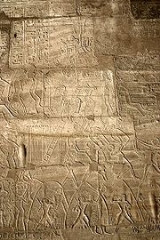
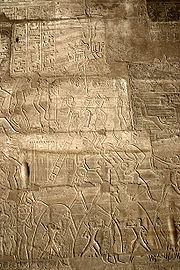
The earliest representations of siege warfare have been dated to the Protodynastic Period of Egypt, c. 3000 BC. These show the symbolic destruction of city walls by divine animals using hoes.The first siege equipment is known from Egyptian tomb reliefs of the 24th century BC, showing Egyptian soldiers storming Canaan
Canaan
Canaan is a historical region roughly corresponding to modern-day Israel, Palestine, Lebanon, and the western parts of Jordan...
ite town walls on wheeled siege ladders. Later Egyptian temple reliefs of the 13th century BC portray the violent siege of Dapur
Siege of Dapur
The Siege of Dapur occurred as part of Ramesses II's campaign to suppress Galilee and conquer Syria in 1269 BC. He inscribed his campaign on the wall of his mortuary temple, the Ramesseum in Thebes. The inscriptions say that Dapur was "in the land of Hatti"...
, a Syrian city, with soldiers climbing scale ladders supported by archers.
Assyria
Assyria
Assyria was a Semitic Akkadian kingdom, extant as a nation state from the mid–23rd century BC to 608 BC centred on the Upper Tigris river, in northern Mesopotamia , that came to rule regional empires a number of times through history. It was named for its original capital, the ancient city of Assur...
n palace reliefs of the 9th to 7th centuries BC display sieges of several Near Eastern cities. Though a simple battering ram had come into use in the previous millennium, the Assyrians improved siege warfare and used huge wooden tower-shaped battering rams with archers positioned on top.
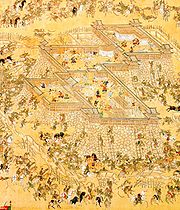
In ancient China, sieges of city walls (along with naval battles) were portrayed on bronze
Bronze
Bronze is a metal alloy consisting primarily of copper, usually with tin as the main additive. It is hard and brittle, and it was particularly significant in antiquity, so much so that the Bronze Age was named after the metal...
'hu' vessels
Hu (vessel)
A hu is a type of pear-shaped ritual wine bronze vessel from ancient China. They would be placed in the grave of an ancestor as part of ritual banquet in order to ensure the good favor of that ancestor's spirit...
, like those found in Chengdu
Chengdu
Chengdu , formerly transliterated Chengtu, is the capital of Sichuan province in Southwest China. It holds sub-provincial administrative status...
, Sichuan
Sichuan
' , known formerly in the West by its postal map spellings of Szechwan or Szechuan is a province in Southwest China with its capital in Chengdu...
in 1965 which have been dated to the Warring States Period
Warring States Period
The Warring States Period , also known as the Era of Warring States, or the Warring Kingdoms period, covers the Iron Age period from about 475 BC to the reunification of China under the Qin Dynasty in 221 BC...
(5th century BC to 3rd century BC).
Offensive
Earthworks (engineering)
Earthworks are engineering works created through the moving or processing of quantities of soil or unformed rock.- Civil engineering use :Typical earthworks include roads, railway beds, causeways, dams, levees, canals, and berms...
(a line of circumvallation) to completely encircle their target, preventing food, water, and other supplies from reaching the besieged city. If sufficiently desperate as the siege progressed, defenders and civilians might have been reduced to eating anything vaguely edible - horses, family pets, the leather from shoes, and even each other
Cannibalism
Cannibalism is the act or practice of humans eating the flesh of other human beings. It is also called anthropophagy...
.
The Egyptian
Ancient Egypt
Ancient Egypt was an ancient civilization of Northeastern Africa, concentrated along the lower reaches of the Nile River in what is now the modern country of Egypt. Egyptian civilization coalesced around 3150 BC with the political unification of Upper and Lower Egypt under the first pharaoh...
siege of Megiddo
Battle of Megiddo (15th century BC)
The Battle of Megiddo was fought between Egyptian forces under the command of Pharaoh Thutmose III and a large Canaanite coalition under the king of Kadesh. It is the first battle to have been recorded in what is accepted as relatively reliable detail. Megiddo is also the first recorded use of the...
in the 15th century BC lasted for 7 months before its inhabitants surrendered. The Hittite
Hittites
The Hittites were a Bronze Age people of Anatolia.They established a kingdom centered at Hattusa in north-central Anatolia c. the 18th century BC. The Hittite empire reached its height c...
siege of a rebellious Anatolian vassal in the 14th century BC ended when the queen mother came out of the city and begged for mercy on behalf of her people. The Hittite campaign against the kingdom of Mitanni
Mitanni
Mitanni or Hanigalbat was a loosely organized Hurrian-speaking state in northern Syria and south-east Anatolia from ca. 1500 BC–1300 BC...
in the 14th century BC bypassed the fortified city of Carchemish
Carchemish
Carchemish or Kargamış was an important ancient city of the Mitanni, Hittite and Neo Assyrian Empires, now on the frontier between Turkey and Syria. It was the location of an important battle between the Babylonians and Egyptians, mentioned in the Bible...
. If the main objective of a campaign was not the conquest of a particular city, it could simply be passed by. When the main objective of the campaign had been fulfilled, the Hittite army returned to Carchemish and the city fell after an eight-day siege.
The well-known Assyrian Siege of Jerusalem
Assyrian Siege of Jerusalem
In approximately 701 BCE, Sennacherib, king of Assyria, attacked the fortified cities of Judah, laying siege on Jerusalem. The historical outcome of the siege is unclear.-Background:...
in the 8th century BC came to an end when the Israelites bought them off with gifts and tribute, according to the Assyria
Assyria
Assyria was a Semitic Akkadian kingdom, extant as a nation state from the mid–23rd century BC to 608 BC centred on the Upper Tigris river, in northern Mesopotamia , that came to rule regional empires a number of times through history. It was named for its original capital, the ancient city of Assur...
n account, or when the Assyrian camp was struck by mass death, according to the Biblical
Bible
The Bible refers to any one of the collections of the primary religious texts of Judaism and Christianity. There is no common version of the Bible, as the individual books , their contents and their order vary among denominations...
account. Due to logistics, long-lasting sieges involving a minor force could seldom be maintained.
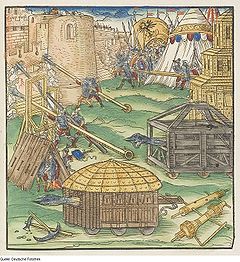
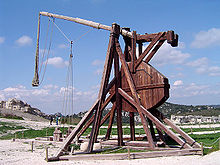
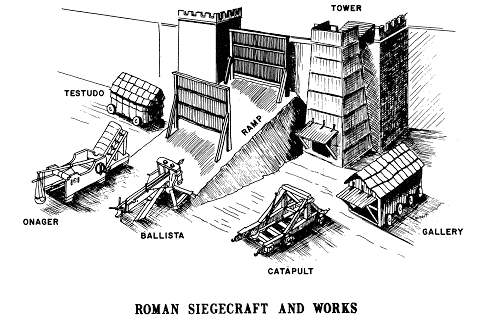
To end a siege more rapidly various methods were developed in ancient and medieval times to counter fortifications, and a large variety of siege engine
Siege engine
A siege engine is a device that is designed to break or circumvent city walls and other fortifications in siege warfare. Some have been operated close to the fortifications, while others have been used to attack from a distance. From antiquity, siege engines were constructed largely of wood and...
s were developed for use by besieging armies. Ladders could be used to escalade
Escalade
Escalade is the act of scaling defensive walls or ramparts with the aid of ladders, and was a prominent feature of siege warfare in medieval times...
over the defences. Battering ram
Battering ram
A battering ram is a siege engine originating in ancient times and designed to break open the masonry walls of fortifications or splinter their wooden gates...
s and siege hook
Siege hook
A siege hook is a weapon used to pull stones from a wall during a siege.The Greek historian Polybius, in his Histories, mentions the use of such weapons at the Roman siege of Ambracia:...
s could also be used to force through gates or walls, while catapult
Catapult
A catapult is a device used to throw or hurl a projectile a great distance without the aid of explosive devices—particularly various types of ancient and medieval siege engines. Although the catapult has been used since ancient times, it has proven to be one of the most effective mechanisms during...
s, ballista
Ballista
The ballista , plural ballistae, was an ancient missile weapon which launched a large projectile at a distant target....
e, trebuchet
Trebuchet
A trebuchet is a siege engine that was employed in the Middle Ages. It is sometimes called a "counterweight trebuchet" or "counterpoise trebuchet" in order to distinguish it from an earlier weapon that has come to be called the "traction trebuchet", the original version with pulling men instead of...
s, mangonel
Mangonel
A mangonel was a type of catapult or siege engine used in the medieval period to throw projectiles at a castle's walls. The exact meaning of the term is debatable, and several possibilities have been suggested. Mangonel may also be indirectly referring to the 'mangon' a French hard stone found in...
s, and onagers
Onager (siege weapon)
The onager was a Roman siege engine, which derived its name from the kicking action of the machine, similar to that of an onager , it was created as a simpler, cheaper version of the ballista. The Onager is a type of catapult that uses torsional pressure, generally from twisted rope, to store...
could be used to launch projectiles in order to break down a city's fortifications and kill its defenders. A siege tower
Siege tower
A siege tower is a specialized siege engine, constructed to protect assailants and ladders while approaching the defensive walls of a fortification. The tower was often rectangular with four wheels with its height roughly equal to that of the wall or sometimes higher to allow archers to stand on...
, a substantial structure built to equal or greater height than the fortification's walls, could allow the attackers to fire down upon the defenders and also advance troops to the wall with less danger than using ladders.
Foundation (architecture)
A foundation is the lowest and supporting layer of a structure. Foundations are generally divided into two categories: shallow foundations and deep foundations.-Shallow foundations:...
of the walls, and then deliberately collapsing or exploding the tunnel. This process is known as mining. The defenders could dig counter-tunnels to cut into the attackers' works and collapse them prematurely.
Fire was often used as a weapon when dealing with wooden fortifications. The Byzantine Empire
Byzantine Empire
The Byzantine Empire was the Eastern Roman Empire during the periods of Late Antiquity and the Middle Ages, centred on the capital of Constantinople. Known simply as the Roman Empire or Romania to its inhabitants and neighbours, the Empire was the direct continuation of the Ancient Roman State...
used Greek fire
Greek fire
Greek fire was an incendiary weapon used by the Byzantine Empire. The Byzantines typically used it in naval battles to great effect as it could continue burning while floating on water....
, which contained additives that made it hard to extinguish. Combined with a primitive flamethrower
Flamethrower
A flamethrower is a mechanical device designed to project a long controllable stream of fire.Some flamethrowers project a stream of ignited flammable liquid; some project a long gas flame. Most military flamethrowers use liquids, but commercial flamethrowers tend to use high-pressure propane and...
, it proved an effective offensive and defensive weapon.
Disease
Disease
A disease is an abnormal condition affecting the body of an organism. It is often construed to be a medical condition associated with specific symptoms and signs. It may be caused by external factors, such as infectious disease, or it may be caused by internal dysfunctions, such as autoimmune...
was another effective siege weapon, although the attackers were often as vulnerable as the defenders. In some instances, catapults or similar weapons were used to fling diseased animals over city walls in an early example of biological warfare
Biological warfare
Biological warfare is the use of biological toxins or infectious agents such as bacteria, viruses, and fungi with intent to kill or incapacitate humans, animals or plants as an act of war...
. If all else failed, a besieger could claim the booty of his conquest undamaged, and retain his men and equipment intact, for the price of a well-placed bribe to a disgruntled gate-keeper.
Defensive
The universal method for defending against siege is the use of fortifications, principally walls and ditchesDitch (fortification)
A ditch in military engineering is an obstacle, designed to slow down or break up an attacking force, while a trench is intended to provide cover to the defenders...
to supplement natural features. A sufficient supply of food and water was also important to defeat the simplest method of siege warfare: starvation
Starvation
Starvation is a severe deficiency in caloric energy, nutrient and vitamin intake. It is the most extreme form of malnutrition. In humans, prolonged starvation can cause permanent organ damage and eventually, death...
. On occasion, the defenders would drive 'surplus' civilians out to reduce the demands on stored food and water.
During the Warring States Period
Warring States Period
The Warring States Period , also known as the Era of Warring States, or the Warring Kingdoms period, covers the Iron Age period from about 475 BC to the reunification of China under the Qin Dynasty in 221 BC...
in China (481–221 BC), warfare lost its honorable, gentlemen's duty that was found in the previous era of the Spring and Autumn Period, and became more practical, competitive, cut-throat, and efficient for gaining victory. The Chinese invention of the hand-held, trigger-mechanism crossbow
Crossbow
A crossbow is a weapon consisting of a bow mounted on a stock that shoots projectiles, often called bolts or quarrels. The medieval crossbow was called by many names, most of which derived from the word ballista, a torsion engine resembling a crossbow in appearance.Historically, crossbows played a...
during this period revolutionized warfare, giving greater emphasis to infantry and cavalry and less to traditional chariot
Chariot
The chariot is a type of horse carriage used in both peace and war as the chief vehicle of many ancient peoples. Ox carts, proto-chariots, were built by the Proto-Indo-Europeans and also built in Mesopotamia as early as 3000 BC. The original horse chariot was a fast, light, open, two wheeled...
warfare.
The philosophically-pacifist Mohists (followers of the philosopher Mozi
Mozi
Mozi |Lat.]] as Micius, ca. 470 BC – ca. 391 BC), original name Mo Di , was a Chinese philosopher during the Hundred Schools of Thought period . Born in Tengzhou, Shandong Province, China, he founded the school of Mohism, and argued strongly against Confucianism and Daoism...
) of the 5th century BC believed in aiding the defensive warfare of smaller Chinese states against the hostile offensive warfare of larger domineering states. The Mohists were renowned in the smaller states (and the enemies of the larger states) for the inventions of siege machinery to scale or destroy walls. These included traction trebuchet catapult
Catapult
A catapult is a device used to throw or hurl a projectile a great distance without the aid of explosive devices—particularly various types of ancient and medieval siege engines. Although the catapult has been used since ancient times, it has proven to be one of the most effective mechanisms during...
s, eight-foot-high ballista
Ballista
The ballista , plural ballistae, was an ancient missile weapon which launched a large projectile at a distant target....
s, a wheeled siege ramp with grappling hooks known as the Cloud Bridge (the protractable, folded ramp slinging forward by means of a counterweight with rope and pulley), and wheeled 'hook-carts' used to latch large iron hooks onto the tops of walls to pull them down.
Bellows
A bellows is a device for delivering pressurized air in a controlled quantity to a controlled location.Basically, a bellows is a deformable container which has an outlet nozzle. When the volume of the bellows is decreased, the air escapes through the outlet...
(the type the Chinese commonly used in heating up a blast furnace
Blast furnace
A blast furnace is a type of metallurgical furnace used for smelting to produce industrial metals, generally iron.In a blast furnace, fuel and ore and flux are continuously supplied through the top of the furnace, while air is blown into the bottom of the chamber, so that the chemical reactions...
for smelting cast iron
Cast iron
Cast iron is derived from pig iron, and while it usually refers to gray iron, it also identifies a large group of ferrous alloys which solidify with a eutectic. The color of a fractured surface can be used to identify an alloy. White cast iron is named after its white surface when fractured, due...
) to pump smoke into the tunnels in order to suffocate the intruders.
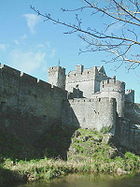
Advances in the prosecution of sieges in ancient and medieval times naturally encouraged the development of a variety of defensive counter-measures. In particular, medieval fortification
Medieval fortification
Medieval fortification is military methods of Medieval technology that covers the development of fortification construction and use in Europe roughly from the fall of the Western Roman Empire to the Renaissance...
s became progressively stronger—for example, the advent of the concentric castle
Concentric castle
A concentric castle is a castle with two or more concentric curtain walls, such that the outer wall is lower than the inner and can be defended from it. The word concentric does not imply that these castles were circular; in fact if taken too literally the term "concentric" is quite misleading...
from the period of the Crusades
Crusades
The Crusades were a series of religious wars, blessed by the Pope and the Catholic Church with the main goal of restoring Christian access to the holy places in and near Jerusalem...
—and more dangerous to attackers—witness the increasing use of machicolation
Machicolation
A machicolation is a floor opening between the supporting corbels of a battlement, through which stones, or other objects, could be dropped on attackers at the base of a defensive wall. The design was developed in the Middle Ages when the Norman crusaders returned. A machicolated battlement...
s and murder-hole
Murder-hole
A murder hole or meurtrière is a hole in the ceiling of a gateway or passageway in a fortification through which the defenders could fire, throw or pour harmful substances, such as rocks, arrows, scalding water, hot sand, quicklime, tar, or boiling oil, down on attackers. They also allowed water to...
s, as well the preparation of hot or incendiary substances. Arrow slits (also called arrow loops or loopholes), sally port
Sally port
The primary modern meaning for sally port is a secure, controlled entryway, as at a fortification or a prison. The entrance is usually protected in some way, such as with a fixed wall blocking the door which must be circumvented before entering, but which prevents direct enemy fire from a distance...
s (airlock-like doors) for sallies, and deep water wells were also integral means of resisting siege at this time. Particular attention would be paid to defending entrances, with gates protected by drawbridge
Drawbridge
A drawbridge is a type of movable bridge typically associated with the entrance of a castle surrounded by a moat. The term is often used to describe all different types of movable bridges, like bascule bridges and lift bridges.-Castle drawbridges:...
s, portcullis
Portcullis
A portcullis is a latticed grille made of wood, metal, fibreglass or a combination of the three. Portcullises fortified the entrances to many medieval castles, acting as a last line of defence during time of attack or siege...
es and barbican
Barbican
A barbican, from medieval Latin barbecana, signifying the "outer fortification of a city or castle," with cognates in the Romance languages A barbican, from medieval Latin barbecana, signifying the "outer fortification of a city or castle," with cognates in the Romance languages A barbican, from...
s. Moat
Moat
A moat is a deep, broad ditch, either dry or filled with water, that surrounds a castle, other building or town, historically to provide it with a preliminary line of defence. In some places moats evolved into more extensive water defences, including natural or artificial lakes, dams and sluices...
s and other water defences, whether natural or augmented, were also vital to defenders.
In the European Middle Ages
Middle Ages
The Middle Ages is a periodization of European history from the 5th century to the 15th century. The Middle Ages follows the fall of the Western Roman Empire in 476 and precedes the Early Modern Era. It is the middle period of a three-period division of Western history: Classic, Medieval and Modern...
, virtually all large cities had city walls—Dubrovnik
Walls of Dubrovnik
The Walls of Dubrovnik are a series of defensive stone walls that have surrounded and protected the citizens of the afterward proclaimed maritime city-state of Dubrovnik , situated in southern Croatia, since the city's founding prior to the 7th century as a Byzantium castrum on a rocky island...
in Dalmatia
Dalmatia
Dalmatia is a historical region on the eastern coast of the Adriatic Sea. It stretches from the island of Rab in the northwest to the Bay of Kotor in the southeast. The hinterland, the Dalmatian Zagora, ranges from fifty kilometers in width in the north to just a few kilometers in the south....
is an impressive and well-preserved example—and more important cities had citadel
Citadel
A citadel is a fortress for protecting a town, sometimes incorporating a castle. The term derives from the same Latin root as the word "city", civis, meaning citizen....
s, forts or castle
Castle
A castle is a type of fortified structure built in Europe and the Middle East during the Middle Ages by European nobility. Scholars debate the scope of the word castle, but usually consider it to be the private fortified residence of a lord or noble...
s. Great effort was expended to ensure a good water supply inside the city in case of siege. In some cases, long tunnels were constructed to carry water into the city. Complex systems of underground tunnels were used for storage and communications in medieval cities like Tábor
Tábor
Tábor is a city of the Czech Republic, in the South Bohemian Region. It is named after Mount Tabor, which is believed by many to be the place of the Transfiguration of Christ; however, the name became popular and nowadays translates to "camp" or "encampment" in the Czech language.The town was...
in Bohemia
Bohemia
Bohemia is a historical region in central Europe, occupying the western two-thirds of the traditional Czech Lands. It is located in the contemporary Czech Republic with its capital in Prague...
, similar to those used much later in Vietnam
Vietnam
Vietnam – sometimes spelled Viet Nam , officially the Socialist Republic of Vietnam – is the easternmost country on the Indochina Peninsula in Southeast Asia. It is bordered by China to the north, Laos to the northwest, Cambodia to the southwest, and the South China Sea –...
during the Vietnam War
Vietnam War
The Vietnam War was a Cold War-era military conflict that occurred in Vietnam, Laos, and Cambodia from 1 November 1955 to the fall of Saigon on 30 April 1975. This war followed the First Indochina War and was fought between North Vietnam, supported by its communist allies, and the government of...
.
Until the invention of gunpowder
Gunpowder
Gunpowder, also known since in the late 19th century as black powder, was the first chemical explosive and the only one known until the mid 1800s. It is a mixture of sulfur, charcoal, and potassium nitrate - with the sulfur and charcoal acting as fuels, while the saltpeter works as an oxidizer...
-based weapons (and the resulting higher-velocity projectiles), the balance of power and logistics definitely favored the defender. With the invention of gunpowder, cannon and (in modern times) mortar
Mortar (weapon)
A mortar is an indirect fire weapon that fires explosive projectiles known as bombs at low velocities, short ranges, and high-arcing ballistic trajectories. It is typically muzzle-loading and has a barrel length less than 15 times its caliber....
s and howitzer
Howitzer
A howitzer is a type of artillery piece characterized by a relatively short barrel and the use of comparatively small propellant charges to propel projectiles at relatively high trajectories, with a steep angle of descent...
s, the traditional methods of defence became less effective against a determined siege.
Siege accounts
Although there are numerous ancient accounts of cities being sacked, few contain any clues to how this was achieved. Some popular tales existed on how the cunning heroes succeeded in their sieges. The best-known is the Trojan HorseTrojan Horse
The Trojan Horse is a tale from the Trojan War about the stratagem that allowed the Greeks finally to enter the city of Troy and end the conflict. In the canonical version, after a fruitless 10-year siege, the Greeks constructed a huge wooden horse, and hid a select force of men inside...
of the Trojan War
Trojan War
In Greek mythology, the Trojan War was waged against the city of Troy by the Achaeans after Paris of Troy took Helen from her husband Menelaus, the king of Sparta. The war is among the most important events in Greek mythology and was narrated in many works of Greek literature, including the Iliad...
, and a similar story tells how the Canaan
Canaan
Canaan is a historical region roughly corresponding to modern-day Israel, Palestine, Lebanon, and the western parts of Jordan...
ite city of Joppa
Jaffa
Jaffa is an ancient port city believed to be one of the oldest in the world. Jaffa was incorporated with Tel Aviv creating the city of Tel Aviv-Yafo, Israel. Jaffa is famous for its association with the biblical story of the prophet Jonah.-Etymology:...
was conquered by the Egyptians in the 15th century BC. The Biblical Book of Joshua
Book of Joshua
The Book of Joshua is the sixth book in the Hebrew Bible and of the Old Testament. Its 24 chapters tell of the entry of the Israelites into Canaan, their conquest and division of the land under the leadership of Joshua, and of serving God in the land....
contains the story of the miraculous Battle of Jericho
Battle of Jericho
The Battle of Jericho is an incident in Bible's Book of Joshua, the first battle of the Israelites during their conquest of Canaan. According to the narrative, the walls of Jericho fell after Joshua's Israelite army marched around the city blowing their trumpets.- Spying on Jericho:Before crossing...
.
A more detailed historical account from the 8th century BC, called the Piankhi stela
Piye
Piye, was a Kushite king and founder of the Twenty-fifth dynasty of Egypt who ruled Egypt from 747 BCE to 716 BCE according to Peter Clayton. He ruled from the city of Napata, located deep in Nubia, Sudan...
, records how the Nubians
Kingdom of Kush
The native name of the Kingdom was likely kaš, recorded in Egyptian as .The name Kash is probably connected to Cush in the Hebrew Bible , son of Ham ....
laid siege to and conquered several Egyptian cities by using battering rams, archers, and slingers and building causeways across moats.
Greco-Roman era
Alexander the Great's MacedonMacedon
Macedonia or Macedon was an ancient kingdom, centered in the northeastern part of the Greek peninsula, bordered by Epirus to the west, Paeonia to the north, the region of Thrace to the east and Thessaly to the south....
ian army successfully besieged many powerful cities during his astounding conquests. Two of his most impressive achievements in siegecraft took place in the Siege of Tyre and the Siege of the Sogdian Rock. His engineer
Engineer
An engineer is a professional practitioner of engineering, concerned with applying scientific knowledge, mathematics and ingenuity to develop solutions for technical problems. Engineers design materials, structures, machines and systems while considering the limitations imposed by practicality,...
s built a causeway
Causeway
In modern usage, a causeway is a road or railway elevated, usually across a broad body of water or wetland.- Etymology :When first used, the word appeared in a form such as “causey way” making clear its derivation from the earlier form “causey”. This word seems to have come from the same source by...
that was originally 60 m (200 ft) wide and reached the range of his torsion-powered artillery, while his soldiers pushed siege tower
Siege tower
A siege tower is a specialized siege engine, constructed to protect assailants and ladders while approaching the defensive walls of a fortification. The tower was often rectangular with four wheels with its height roughly equal to that of the wall or sometimes higher to allow archers to stand on...
s housing stone throwers and light catapults to bombard the city walls.
Most conquerors before him had found Tyre, a Phoenicia
Phoenicia
Phoenicia , was an ancient civilization in Canaan which covered most of the western, coastal part of the Fertile Crescent. Several major Phoenician cities were built on the coastline of the Mediterranean. It was an enterprising maritime trading culture that spread across the Mediterranean from 1550...
n island-city about 1 km from the mainland, impregnable. The Macedonians built a mole
Mole (architecture)
A mole is a massive structure, usually of stone, used as a pier, breakwater, or a causeway between places separated by water. The word comes from Middle French mole and ultimately Latin mōlēs meaning a large mass, especially of rock and has the same root as molecule.Historically, the term "mole"...
, a raised spit of earth across the water, by piling stones up on a natural land bridge that extended underwater to the island, and although the Tyrians rallied by sending a fire-ship to destroy the towers, and captured the mole in a swarming frenzy, the city eventually fell to the Macedonians after a seven-month siege. In complete contrast to Tyre, Sogdian Rock was captured by stealthy attack. Alexander used commando-like tactics to scale the cliffs and capture the high ground, and the demoralized defenders surrendered.
Roman Republic
The Roman Republic was the period of the ancient Roman civilization where the government operated as a republic. It began with the overthrow of the Roman monarchy, traditionally dated around 508 BC, and its replacement by a government headed by two consuls, elected annually by the citizens and...
and Empire
Roman Empire
The Roman Empire was the post-Republican period of the ancient Roman civilization, characterised by an autocratic form of government and large territorial holdings in Europe and around the Mediterranean....
are noted as being particularly skilled and determined in siege warfare. An astonishing number and variety of sieges, for example, formed the core of Julius Caesar's
Julius Caesar
Gaius Julius Caesar was a Roman general and statesman and a distinguished writer of Latin prose. He played a critical role in the gradual transformation of the Roman Republic into the Roman Empire....
mid-1st century BC conquest of Gaul
Gaul
Gaul was a region of Western Europe during the Iron Age and Roman era, encompassing present day France, Luxembourg and Belgium, most of Switzerland, the western part of Northern Italy, as well as the parts of the Netherlands and Germany on the left bank of the Rhine. The Gauls were the speakers of...
(modern France).
In his Commentarii de Bello Gallico
Commentarii de Bello Gallico
Commentarii de Bello Gallico is Julius Caesar's firsthand account of the Gallic Wars, written as a third-person narrative. In it Caesar describes the battles and intrigues that took place in the nine years he spent fighting local armies in Gaul that opposed Roman domination.The "Gaul" that Caesar...
(Commentaries on the Gallic War), Caesar describes how at the Battle of Alesia
Battle of Alesia
The Battle of Alesia or Siege of Alesia took place in September, 52 BC around the Gallic oppidum of Alesia, a major town centre and hill fort of the Mandubii tribe...
the Roman legion
Roman legion
A Roman legion normally indicates the basic ancient Roman army unit recruited specifically from Roman citizens. The organization of legions varied greatly over time but they were typically composed of perhaps 5,000 soldiers, divided into maniples and later into "cohorts"...
s created two huge fortified walls around the city. The inner circumvallation, 10 miles (16.1 km), held in Vercingetorix
Vercingetorix
Vercingetorix was the chieftain of the Arverni tribe, who united the Gauls in an ultimately unsuccessful revolt against Roman forces during the last phase of Julius Caesar's Gallic Wars....
's forces, while the outer contravallation kept relief from reaching them. The Romans held the ground in between the two walls. The besieged Gauls, facing starvation, eventually surrendered after their relief force met defeat against Caesar's auxiliary cavalry.
The Sicarii
Sicarii
Sicarii is a term applied, in the decades immediately preceding the destruction of Jerusalem in 70 AD, to an extremist splinter group of the Jewish Zealots, who attempted to expel the Romans and their partisans from Judea using concealed daggers .-History:The Sicarii used...
Zealots who defended Masada
Masada
Masada is the name for a site of ancient palaces and fortifications in the South District of Israel, on top of an isolated rock plateau, or horst, on the eastern edge of the Judean Desert, overlooking the Dead Sea. Masada is best known for the violence that occurred there in the first century CE...
in AD 73 were defeated by the Roman legions who built a ramp 100 m high up to the fortress's west wall.
Chinese and Mongols
In the Middle Ages, the Mongol EmpireMongol Empire
The Mongol Empire , initially named as Greater Mongol State was a great empire during the 13th and 14th centuries...
's campaign against China (then comprising the Western Xia Dynasty, Jin Dynasty, and Southern Song Dynasty) by Genghis Khan
Genghis Khan
Genghis Khan , born Temujin and occasionally known by his temple name Taizu , was the founder and Great Khan of the Mongol Empire, which became the largest contiguous empire in history after his death....
until Kublai Khan
Kublai Khan
Kublai Khan , born Kublai and also known by the temple name Shizu , was the fifth Great Khan of the Mongol Empire from 1260 to 1294 and the founder of the Yuan Dynasty in China...
, who eventually established the Yuan Dynasty
Yuan Dynasty
The Yuan Dynasty , or Great Yuan Empire was a ruling dynasty founded by the Mongol leader Kublai Khan, who ruled most of present-day China, all of modern Mongolia and its surrounding areas, lasting officially from 1271 to 1368. It is considered both as a division of the Mongol Empire and as an...
in 1271, with their armies was extremely effective, allowing the Mongols to sweep through large areas. Even if they could not enter some of the more well-fortified cities, they used innovative battle tactics to grab hold of the land and the people:
- "By concentrating on the field armies, the strongholds had to wait. Of course, smaller fortresses, or ones easily surprised, were taken as they came along. This had two effects. First, it cut off the principal city from communicating with other cities where they might expect aid. Secondly, refugees from these smaller cities would flee to the last stronghold. The reports from these cities and the streaming hordes of refugees not only reduced the morale of the inhabitants and garrison of the principal city, it also strained their resources. Food and water reserves were taxed by the sudden influx of refugees. Soon, what was once a formidable undertaking became easy. The Mongols were then free to lay siege without interference of the field army as it had been destroyed... At the siege of AleppoAleppoAleppo is the largest city in Syria and the capital of Aleppo Governorate, the most populous Syrian governorate. With an official population of 2,301,570 , expanding to over 2.5 million in the metropolitan area, it is also one of the largest cities in the Levant...
, HuleguHulagu KhanHulagu Khan, also known as Hülegü, Hulegu , was a Mongol ruler who conquered much of Southwest Asia...
used twenty catapults against the Bab al-Iraq (Gate of Iraq) alone. In Jûzjânî, there are several episodes in which the Mongols constructed hundreds of siege machines in order to surpass the number which the defending city possessed. While Jûzjânî surely exaggerated, the improbably high numbers which he used for both the Mongols and the defenders do give one a sense of the large numbers of machines used at a single siege."
Another Mongol tactic was to use catapults to launch corpses of plague
Bubonic plague
Plague is a deadly infectious disease that is caused by the enterobacteria Yersinia pestis, named after the French-Swiss bacteriologist Alexandre Yersin. Primarily carried by rodents and spread to humans via fleas, the disease is notorious throughout history, due to the unrivaled scale of death...
victims into besieged cities. The disease-carrying flea
Flea
Flea is the common name for insects of the order Siphonaptera which are wingless insects with mouthparts adapted for piercing skin and sucking blood...
s from the bodies would then infest the city, and the plague would spread allowing the city to be easily captured, although this transmission mechanism was not known at the time. In 1346 the bodies of Mongol warriors of the Golden Horde
Golden Horde
The Golden Horde was a Mongol and later Turkicized khanate that formed the north-western sector of the Mongol Empire...
who had died of plague were thrown over the walls of the besieged Crimea
Crimea
Crimea , or the Autonomous Republic of Crimea , is a sub-national unit, an autonomous republic, of Ukraine. It is located on the northern coast of the Black Sea, occupying a peninsula of the same name...
n city of Kaffa (now Feodosiya). It has been speculated that this operation may have been responsible for the advent of the Black Death
Black Death
The Black Death was one of the most devastating pandemics in human history, peaking in Europe between 1348 and 1350. Of several competing theories, the dominant explanation for the Black Death is the plague theory, which attributes the outbreak to the bacterium Yersinia pestis. Thought to have...
in Europe. The Black Death is estimated to have killed 30% – 60% of Europe's population.
On the first night while laying siege to a city, the leader of the Mongol forces would lead from a white tent
Tent
A tent is a shelter consisting of sheets of fabric or other material draped over or attached to a frame of poles or attached to a supporting rope. While smaller tents may be free-standing or attached to the ground, large tents are usually anchored using guy ropes tied to stakes or tent pegs...
: if the city surrendered, all would be spared. On the second day, he would use a red tent: if the city surrendered, the men would all be killed, but the rest would be spared. On the third day, he would use a black tent: no quarter would be given.
Flamethrower
A flamethrower is a mechanical device designed to project a long controllable stream of fire.Some flamethrowers project a stream of ignited flammable liquid; some project a long gas flame. Most military flamethrowers use liquids, but commercial flamethrowers tend to use high-pressure propane and...
s, grenade
Grenade
A grenade is a small explosive device that is projected a safe distance away by its user. Soldiers called grenadiers specialize in the use of grenades. The term hand grenade refers any grenade designed to be hand thrown. Grenade Launchers are firearms designed to fire explosive projectile grenades...
s, firearm
Firearm
A firearm is a weapon that launches one, or many, projectile at high velocity through confined burning of a propellant. This subsonic burning process is technically known as deflagration, as opposed to supersonic combustion known as a detonation. In older firearms, the propellant was typically...
s, cannons, and land mine
Land mine
A land mine is usually a weight-triggered explosive device which is intended to damage a target—either human or inanimate—by means of a blast and/or fragment impact....
s) to fight back against the Khitans, the Tanguts, the Jurchens
Jurchens
The Jurchens were a Tungusic people who inhabited the region of Manchuria until the 17th century, when they adopted the name Manchu...
, and then the Mongols.
The Chinese of the Song period also discovered the explosive potential of packing hollowed cannonball shells with gunpowder. Written later around 1350 in the Huo Long Jing
Jiao Yu
Jiao Yu was a Chinese military officer loyal to Zhu Yuanzhang , the founder of the Ming Dynasty . He was entrusted by Emperor Hongwu as a leading artillery officer for the rebel army that overthrew the Mongol Yuan Dynasty, and established the Ming Dynasty...
, this manuscript of Jiao Yu
Jiao Yu
Jiao Yu was a Chinese military officer loyal to Zhu Yuanzhang , the founder of the Ming Dynasty . He was entrusted by Emperor Hongwu as a leading artillery officer for the rebel army that overthrew the Mongol Yuan Dynasty, and established the Ming Dynasty...
recorded an earlier Song-era cast-iron cannon known as the 'flying-cloud thunderclap eruptor' (fei yun pi-li pao). The manuscript stated that (Wade-Giles
Wade-Giles
Wade–Giles , sometimes abbreviated Wade, is a romanization system for the Mandarin Chinese language. It developed from a system produced by Thomas Wade during the mid-19th century , and was given completed form with Herbert Giles' Chinese–English dictionary of 1892.Wade–Giles was the most...
spelling):
The shells (phao) are made of cast iron, as large as a bowl and shaped like a ball. Inside they contain half a pound of 'magic' gunpowder (shen huo). They are sent flying towards the enemy camp from an eruptor (mu phao); and when they get there a sound like a thunder-clap is heard, and flashes of light appear. If ten of these shells are fired successfully into the enemy camp, the whole place will be set ablaze...
During the Ming Dynasty
Ming Dynasty
The Ming Dynasty, also Empire of the Great Ming, was the ruling dynasty of China from 1368 to 1644, following the collapse of the Mongol-led Yuan Dynasty. The Ming, "one of the greatest eras of orderly government and social stability in human history", was the last dynasty in China ruled by ethnic...
(AD 1368–1644), the Chinese were very concerned with city planning in regards to gunpowder warfare. The site for constructing the walls and the thickness of the walls in Beijing's Forbidden City
Forbidden City
The Forbidden City was the Chinese imperial palace from the Ming Dynasty to the end of the Qing Dynasty. It is located in the middle of Beijing, China, and now houses the Palace Museum...
were favored by the Chinese Yongle Emperor
Yongle Emperor
The Yongle Emperor , born Zhu Di , was the third emperor of the Ming Dynasty of China from 1402 to 1424. His Chinese era name Yongle means "Perpetual Happiness".He was the Prince of Yan , possessing a heavy military base in Beiping...
(r. 1402–1424), because they were in pristine position to resist cannon volley and were built thick enough to withstand attacks from cannon fire.
For more see Technology of the Song Dynasty
Technology of the Song Dynasty
The Song Dynasty provided some of the most significant technological advances in Chinese history, many of which came from talented statesmen drafted by the government through imperial examinations....
.
Age of gunpowder
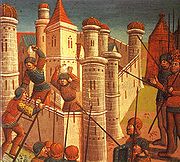
Song Dynasty
The Song Dynasty was a ruling dynasty in China between 960 and 1279; it succeeded the Five Dynasties and Ten Kingdoms Period, and was followed by the Yuan Dynasty. It was the first government in world history to issue banknotes or paper money, and the first Chinese government to establish a...
China during the early 13th century, but did not become significant weapons for another 150 years or so. By the 16th century, they were an essential and regularized part of any campaigning army, or castle's defences.
The greatest advantage of cannons over other siege weapons was the ability to fire a heavier projectile, further, faster and more often than previous weapons. They could also fire projectiles in a straight line, so that they could destroy the bases of high walls. Thus, 'old fashioned' walls - that is high and, relatively, thin - were excellent targets and, over time, easily demolished. In 1453, the great walls of Constantinople
Constantinople
Constantinople was the capital of the Roman, Eastern Roman, Byzantine, Latin, and Ottoman Empires. Throughout most of the Middle Ages, Constantinople was Europe's largest and wealthiest city.-Names:...
, the capital of the Byzantine Empire
Byzantine Empire
The Byzantine Empire was the Eastern Roman Empire during the periods of Late Antiquity and the Middle Ages, centred on the capital of Constantinople. Known simply as the Roman Empire or Romania to its inhabitants and neighbours, the Empire was the direct continuation of the Ancient Roman State...
, were broken through in just six weeks by the 62 cannons of Mehmet II's army.
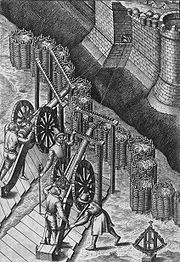
Renaissance
The Renaissance was a cultural movement that spanned roughly the 14th to the 17th century, beginning in Italy in the Late Middle Ages and later spreading to the rest of Europe. The term is also used more loosely to refer to the historical era, but since the changes of the Renaissance were not...
and the Early Modern period, siege warfare continued to dominate the conduct of the European wars.
Once siege guns were developed the techniques for assaulting a town or a fortress became well known and ritualized. The attacking army would surround a town. Then the town would be asked to surrender. If they did not comply the besieging army would surround the town with temporary fortifications to stop sallies from the stronghold or relief getting in. The attackers would then build a length of trenches parallel to the defences and just out of range of the defending artillery. They would then dig a trench towards the town in a zigzag
Zigzag
A zigzag is a pattern made up of small corners at variable angles, though constant within the zigzag, tracing a path between two parallel lines; it can be described as both jagged and fairly regular....
pattern so that it could not be enfiladed by defending fire. Once within artillery range another parallel trench would be dug with gun emplacements. This was called sapping
Sapping
Mining, landmining or undermining is a siege method which has been used since antiquity against a walled city, fortress, castle or other strongly held and fortified military position.-Antiquity:...
.
If necessary using the first artillery fire for cover this process would be repeated until guns were close enough to be laid accurately to make a breach in the fortifications. In order to allow the forlorn hope
Forlorn hope
A forlorn hope is a band of soldiers or other combatants chosen to take the leading part in a military operation, such as an assault on a defended position, where the risk of casualties is high....
and support troops to get close enough to exploit the breach, more zigzag trenches could be dug even closer to the walls with more parallel trenches to protect and conceal the attacking troops. After each step in the process the besiegers would ask the besieged to surrender. If the forlorn hope stormed the breach successfully the defenders could expect no mercy.
Emerging theories
The castles that in earlier years had been formidable obstacles were easily breached by the new weapons. For example, in Spain, the newly equipped army of Ferdinand and Isabella was able to conquer MoorishMoors
The description Moors has referred to several historic and modern populations of the Maghreb region who are predominately of Berber and Arab descent. They came to conquer and rule the Iberian Peninsula for nearly 800 years. At that time they were Muslim, although earlier the people had followed...
strongholds in Granada
Granada
Granada is a city and the capital of the province of Granada, in the autonomous community of Andalusia, Spain. Granada is located at the foot of the Sierra Nevada mountains, at the confluence of three rivers, the Beiro, the Darro and the Genil. It sits at an elevation of 738 metres above sea...
in 1482–92 that had held out for centuries before the invention of cannons.
In the early 15th century, Italian architect Leon Battista Alberti wrote a treatise entitled De Re aedificatoria which theorized methods of building fortifications capable of withstanding the new guns. He proposed that walls be "built in uneven lines, like the teeth of a saw." He proposed star-shaped fortresses with low thick walls.
However, few rulers paid any attention to his theories. A few towns in Italy began building in the new style late in the 1480s, but it was only with the French invasion of the Italian peninsula in 1494–95 that the new fortifications were built on a large scale. Charles VIII
Charles VIII of France
Charles VIII, called the Affable, , was King of France from 1483 to his death in 1498. Charles was a member of the House of Valois...
invaded Italy with an army of 18,000 men and a horse-drawn siege-train. As a result he could defeat virtually any city or state, no matter how well defended. In a panic, military strategy was completely rethought throughout the Italian states of the time, with a strong emphasis on the new fortifications that could withstand a modern siege.
New fortresses
The most effective way to protect walls against cannon fire proved to be depth (increasing the width of the defences) and angles (ensuring that attackers could only fire on walls at an oblique angle, not square on). Initially walls were lowered and backed, in front and behind, with earth. Towers were reformed into triangular bastions. This design matured into the trace italienne. Star-shaped fortressesStar fort
A star fort, or trace italienne, is a fortification in the style that evolved during the age of gunpowder, when cannon came to dominate the battlefield, and was first seen in the mid-15th century in Italy....
surrounding towns and even cities with outlying defences proved very difficult to capture, even for a well equipped army. Fortresses built in this style throughout the 16th century did not become fully obsolete until the 19th century, and were still in use throughout World War I
World War I
World War I , which was predominantly called the World War or the Great War from its occurrence until 1939, and the First World War or World War I thereafter, was a major war centred in Europe that began on 28 July 1914 and lasted until 11 November 1918...
(though modified for 20th century warfare). During World War II trace italienne fortresses could still present a formidable challenge, for example in the last days of World War II, during the Battle in Berlin
Battle in Berlin
The Battle in Berlin was an end phase of the Battle of Berlin. While the Battle of Berlin encompassed the attack by three Soviet Army Groups to capture not only Berlin but the territory of Germany east of the River Elbe still under German control, the Battle in Berlin details the fighting, and...
that saw some of the heaviest urban fighting of the war, the Soviets did not attempt to storm the Spandau Citadel
Spandau Citadel
The Spandau Citadel is a fortress in Berlin, Germany, one of the best-preserved Renaissance military structures of Europe. Built from 1559–94 atop a medieval fort on an island created by the meeting of the Havel and the Spree, it was designed to protect the town of Spandau, which is now...
(built between 1559 and 1594) but chose to invest
Investment (military)
Investment is the military tactic of surrounding an enemy fort with armed forces to prevent entry or escape.A circumvallation is a line of fortifications, built by the attackers around the besieged fortification facing towards the enemy fort...
it and negotiate its surrender.
However, the cost of building such vast modern fortifications was incredibly high, and was often too much for individual cities to undertake. Many were bankrupted in the process of building them; others, such as Siena
Siena
Siena is a city in Tuscany, Italy. It is the capital of the province of Siena.The historic centre of Siena has been declared by UNESCO a World Heritage Site. It is one of the nation's most visited tourist attractions, with over 163,000 international arrivals in 2008...
, spent so much money on fortifications that they were unable to maintain their armies properly, and so lost their wars anyway. Nonetheless, innumerable large and impressive fortresses were built throughout northern Italy in the first decades of the 16th century to resist repeated French invasions that became known as the Italian Wars
Italian Wars
The Italian Wars, often referred to as the Great Italian Wars or the Great Wars of Italy and sometimes as the Habsburg–Valois Wars, were a series of conflicts from 1494 to 1559 that involved, at various times, most of the city-states of Italy, the Papal States, most of the major states of Western...
. Many stand to this day.
In the 1530s and 1540s, the new style of fortification began to spread out of Italy into the rest of Europe, particularly to France, the Netherlands
Netherlands
The Netherlands is a constituent country of the Kingdom of the Netherlands, located mainly in North-West Europe and with several islands in the Caribbean. Mainland Netherlands borders the North Sea to the north and west, Belgium to the south, and Germany to the east, and shares maritime borders...
, and Spain. Italian engineers were in enormous demand throughout Europe, especially in war-torn areas such as the Netherlands, which became dotted by towns encircled in modern fortifications. The densely populated areas of Northern Italy
Northern Italy
Northern Italy is a wide cultural, historical and geographical definition, without any administrative usage, used to indicate the northern part of the Italian state, also referred as Settentrione or Alta Italia...
and the United Provinces
Dutch Republic
The Dutch Republic — officially known as the Republic of the Seven United Netherlands , the Republic of the United Netherlands, or the Republic of the Seven United Provinces — was a republic in Europe existing from 1581 to 1795, preceding the Batavian Republic and ultimately...
(the Netherlands
Netherlands
The Netherlands is a constituent country of the Kingdom of the Netherlands, located mainly in North-West Europe and with several islands in the Caribbean. Mainland Netherlands borders the North Sea to the north and west, Belgium to the south, and Germany to the east, and shares maritime borders...
) were infamous for their high degree of fortification of cities. It made campaigns in these areas very hard to successfully conduct, considering even minor cities had to be captured by siege within the span of the campaigning season. In the Dutch case, the possibility of flooding large parts of the land provided an additional obstacle to besiegers, for example at the Siege of Leiden
Siege of Leiden
The Siege of Leiden occurred during the Eighty Years' War in 1573 and 1574, when the Spanish attempted to capture the rebellious city of Leiden, South Holland, Netherlands, and ultimately failed.-Background:...
. For many years, defensive and offensive tactics were well balanced leading to protracted and costly wars such as Europe had never known, involving more and more planning and government involvement. The new fortresses ensured that war rarely extended beyond a series of sieges. Because the new fortresses could easily hold 10,000 men, an attacking army could not ignore a powerfully fortified position without serious risk of counterattack. As a result, virtually all towns had to be taken, and that was usually a long, drawn-out affair, potentially lasting from several months to years, while the members of the town were starved to death. Most battles in this period were between besieging armies and relief columns sent to rescue the besieged.
Marshal Vauban and Van Coehoorn

Marshal
Marshal , is a word used in several official titles of various branches of society. The word is an ancient loan word from Old French, cf...
Vauban
Vauban
Sébastien Le Prestre, Seigneur de Vauban and later Marquis de Vauban , commonly referred to as Vauban, was a Marshal of France and the foremost military engineer of his age, famed for his skill in both designing fortifications and breaking through them...
and the Dutch military engineer Menno van Coehoorn
Menno van Coehoorn
Menno, Baron van Coehoorn was a Dutch soldier and military engineer of Swedish extraction. He made a number of influential weaponry innovations in siege warfare and fortification techniques...
, developed modern fortification to its pinnacle, refining siege warfare without fundamentally altering it: ditches would be dug; walls would be protected by glacis
Glacis
A glacis in military engineering is an artificial slope of earth used in late European fortresses so constructed as to keep any potential assailant under the fire of the defenders until the last possible moment...
; and bastion
Bastion
A bastion, or a bulwark, is a structure projecting outward from the main enclosure of a fortification, situated in both corners of a straight wall , facilitating active defence against assaulting troops...
s would enfilade an attacker. Both engineers developed their ideas independently but came to similar general rules regarding defensive construction and offensive action against fortifications. Both were skilled in conducting sieges and defences themselves. Before Vauban and Van Coehoorn, sieges had been somewhat slapdash operations. Vauban and Van Coehoorn refined besieging to a science with a methodical process that, if uninterrupted, would break even the strongest fortifications. Examples of their styles of fortifications are Arras
Arras
Arras is the capital of the Pas-de-Calais department in northern France. The historic centre of the Artois region, its local speech is characterized as a Picard dialect...
(Vauban) and the no-longer existant fortress of Bergen op Zoom
Bergen op Zoom
Bergen op Zoom is a municipality and a city located in the south of the Netherlands.-History:Bergen op Zoom was granted city status probably in 1266. In 1287 the city and its surroundings became a lordship as it was separated from the lordship of Breda. The lordship was elevated to a margraviate...
(Van Coehoorn). The main differences between the two lay in the difference in terrain on which Vauban and Van Coehoorn constructed their defences: Vauban in the sometimes more hilly and mountainous terrain of France, Van Coehoorn in the flat and floodable lowlands of the Netherlands.
Planning and maintaining a siege is just as difficult as fending one off. A besieging army must be prepared to repel both sortie
Sortie
Sortie is a term for deployment or dispatch of one military unit, be it an aircraft, ship, or troops from a strongpoint. The sortie, whether by one or more aircraft or vessels, usually has a specific mission....
s from the besieged area and also any attack that may try to relieve the defenders. It was thus usual to construct lines of trenches and defenses facing in both directions. The outermost lines, known as the lines of contravallation, would surround the entire besieging army and protect it from attackers.
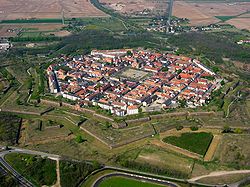
Mortar (weapon)
A mortar is an indirect fire weapon that fires explosive projectiles known as bombs at low velocities, short ranges, and high-arcing ballistic trajectories. It is typically muzzle-loading and has a barrel length less than 15 times its caliber....
and would act as a staging area
Staging area
A staging area is a location where organisms, people, vehicles, equipment or material are assembled before use.- In construction :...
for attack parties once the walls were breached. Van Coehoorn developed a small and easily movable mortar named the coehorn
Coehorn
A Coehorn was a portable mortar developed in the Netherlands by Menno van Coehoorn in 1674 and in use from the seventeenth to the mid nineteenth centuries. Unlike larger, heavier mortars, the Coehorn was designed to be movable by as few as four men...
, variations of which were used in sieges until the nineteenth century. It would also be from this line that miners working to undermine the fortress would operate.
The trenches connecting the various lines of the besiegers could not be built perpendicular to the walls of the fortress, as the defenders would have a clear line of fire along the whole trench. Thus, these lines (known as saps
Sapping
Mining, landmining or undermining is a siege method which has been used since antiquity against a walled city, fortress, castle or other strongly held and fortified military position.-Antiquity:...
) needed to be sharply jagged.
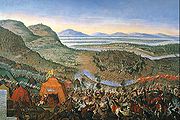
Citadel
A citadel is a fortress for protecting a town, sometimes incorporating a castle. The term derives from the same Latin root as the word "city", civis, meaning citizen....
. Usually a citadel was a "mini fortress" within the larger fortress, sometimes designed as a reduit
Reduit
A reduit is a fortified structure such as a citadel or a keep into which the defending troops can retreat when the outer defences are breached...
, but more often as a means of protecting the garrison from potential revolt in the city. The citadel was used in wartime and peacetime to keep the residents of the city in line.
As in ages past, most sieges were decided with very little fighting between the opposing armies. An attacker's army was poorly served incurring the high casualties that a direct assault on a fortress would entail. Usually they would wait until supplies inside the fortifications were exhausted or disease had weakened the defenders to the point that they were willing to surrender. At the same time, diseases, especially typhus
Typhus
Epidemic typhus is a form of typhus so named because the disease often causes epidemics following wars and natural disasters...
were a constant danger to the encamped armies outside the fortress, and often forced a premature retreat. Sieges were often won by the army that lasted the longest.
An important element of strategy
Strategy
Strategy, a word of military origin, refers to a plan of action designed to achieve a particular goal. In military usage strategy is distinct from tactics, which are concerned with the conduct of an engagement, while strategy is concerned with how different engagements are linked...
for the besieging army was whether or not to allow the encamped city to surrender. Usually it was preferable to graciously allow a surrender
Surrender (military)
Surrender is when soldiers, nations or other combatants stop fighting and eventually become prisoners of war, either as individuals or when ordered to by their officers. A white flag is a common symbol of surrender, as is the gesture of raising one's hands empty and open above one's head.When the...
, both to save on casualties, and to set an example for future defending cities. A city that was allowed to surrender with minimal loss of life was much better off than a city that held out for a long time and was brutally butchered at the end. Moreover, if an attacking army had a reputation of killing and pillaging regardless of a surrender, then other cities' defensive efforts would be redoubled. Usually a city would surrender (with no honour lost) when its inner lines of defence were reached by the attacker. In case of refusal however, the inner lines would have to be stormed by the attacker and the attacking troops would be justified in sacking the city.
Mobile warfare
Siege warfare dominated in Western Europe for most of the seventeenth and eighteenth centuries. An entire campaign, or longer, could be used in a single siege (for example, OstendOstend
Ostend is a Belgian city and municipality located in the Flemish province of West Flanders. It comprises the boroughs of Mariakerke , Stene and Zandvoorde, and the city of Ostend proper – the largest on the Belgian coast....
in 1601–04; La Rochelle
La Rochelle
La Rochelle is a city in western France and a seaport on the Bay of Biscay, a part of the Atlantic Ocean. It is the capital of the Charente-Maritime department.The city is connected to the Île de Ré by a bridge completed on 19 May 1988...
in 1627–28). This resulted in extremely prolonged conflicts. The balance was that while siege warfare was extremely expensive and very slow, it was very successful—or, at least, more so than encounters in the field. Battles arose through clashes between besiegers and relieving armies, but the principle was a slow grinding victory by the greater economic power. The relatively rare attempts at forcing pitched battles (Gustavus Adolphus in 1630; the French against the Dutch in 1672 or 1688) were almost always expensive failures.
The exception to this rule were the English. During the English Civil War
English Civil War
The English Civil War was a series of armed conflicts and political machinations between Parliamentarians and Royalists...
anything which tended to prolong the struggle, or seemed like want of energy and avoidance of a decision, was bitterly resented by the men of both sides. In France and Germany, the prolongation of a war meant continued employment for the soldiers, but in England both sides were looking to end the war quickly. Even when in the end the New Model Army
New Model Army
The New Model Army of England was formed in 1645 by the Parliamentarians in the English Civil War, and was disbanded in 1660 after the Restoration...
—a regular professional army developed—the original decision-compelling spirit permeated the whole organisation as was seen when pitched against regular professional continental troops the Battle of the Dunes
Battle of the Dunes (1658)
The Battle of the Dunes, fought on 14 June , 1658, is also known as the Battle of Dunkirk. It was a victory of the French army, under Turenne, against the Spanish army, led by John of Austria the Younger and Louis II de Condé...
during the Interregnum
English Interregnum
The English Interregnum was the period of parliamentary and military rule by the Lord Protector Oliver Cromwell under the Commonwealth of England after the English Civil War...
.
Experienced commanders on both sides in the English Civil War recommended the abandonment of garrisoned fortifications for two primary reasons. The first, as for example proposed by the Royalist Sir Richard Willis to King Charles, was that by abandoning the garrisoning of all but the most strategic locations in ones own territory, far more troops would be available for the field armies and it was the field armies which would decide the conflict. The other argument was that by slighting potential strong points in ones own territory, an enemy expeditionary force, or local enemy rising, would find it more difficult to consolidate territorial gains against an inevitable counter attack. Sir John Meldrum
John Meldrum
Sir John Meldrum was a soldier of Scottish origin who spent 36 years in the service of the Stuart kings of Scotland and England, James VI and I and Charles I. In 1636, Meldrum was granted by letters-patent from the king licence to continue and renew the lighthouses erected by Charles I on the...
put forward just such an argument to the Parliamentary Committee of Both Kingdoms
Committee of Both Kingdoms
The Committee of Both Kingdoms, , was a committee set up during the English Civil War by the Parliamentarian faction in association with representatives from the Scottish Covenanters, to oversee the conduct of the War and Foreign Policy...
, to justify his slighting of Gainsborough
Gainsborough, Lincolnshire
Gainsborough is a town 15 miles north-west of Lincoln on the River Trent within the West Lindsey district of Lincolnshire, England. At one time it served as an important port with trade downstream to Hull, and was the most inland in England, being more than 55 miles from the North...
in Lincolnshire.
Sixty years later during the War of the Spanish Succession
War of the Spanish Succession
The War of the Spanish Succession was fought among several European powers, including a divided Spain, over the possible unification of the Kingdoms of Spain and France under one Bourbon monarch. As France and Spain were among the most powerful states of Europe, such a unification would have...
the Duke of Marlborough
John Churchill, 1st Duke of Marlborough
John Churchill, 1st Duke of Marlborough, Prince of Mindelheim, KG, PC , was an English soldier and statesman whose career spanned the reigns of five monarchs through the late 17th and early 18th centuries...
preferred to engage the enemy in pitched battles rather than engage in siege warfare, although he was very proficient in both types of warfare.
On 15 April 1746, the day before the Battle of Culloden
Battle of Culloden
The Battle of Culloden was the final confrontation of the 1745 Jacobite Rising. Taking place on 16 April 1746, the battle pitted the Jacobite forces of Charles Edward Stuart against an army commanded by William Augustus, Duke of Cumberland, loyal to the British government...
, at Dunrobin Castle
Dunrobin Castle
Dunrobin Castle is a stately home in Sutherland, in the Highland area of Scotland. It is the seat of the Countess of Sutherland and the Clan Sutherland. It is located north of Golspie, and approximately south of Brora, on the Dornoch Firth close to the A9 road. Nearby Dunrobin Castle railway...
, a party of the William Sutherland, 17th Earl of Sutherland’s militia conducted the last siege fought on the mainland of Great Britain against Jacobin members of clan MacLeod.
Strategic concepts
In the French RevolutionaryFrench Revolutionary Wars
The French Revolutionary Wars were a series of major conflicts, from 1792 until 1802, fought between the French Revolutionary government and several European states...
and Napoleonic Wars
Napoleonic Wars
The Napoleonic Wars were a series of wars declared against Napoleon's French Empire by opposing coalitions that ran from 1803 to 1815. As a continuation of the wars sparked by the French Revolution of 1789, they revolutionised European armies and played out on an unprecedented scale, mainly due to...
, new techniques stressed the division of armies into all-arms corps that would march separately and only come together on the battlefield. The less concentrated army could now live off the country and move more rapidly over a larger number of roads.
Fortresses commanding lines of communication could be bypassed and would no longer stop an invasion. Since armies could not live off the land indefinitely, Napoleon Bonaparte always sought a quick end to any conflict by pitched battle. This military revolution was described and codified by Clausewitz.
Industrial advances
Advances in artillery made previously impregnable defenses useless. For example, the walls of ViennaBattle of Vienna
The Battle of Vienna took place on 11 and 12 September 1683 after Vienna had been besieged by the Ottoman Empire for two months...
that had held off the Turks
Ottoman Empire
The Ottoman EmpireIt was usually referred to as the "Ottoman Empire", the "Turkish Empire", the "Ottoman Caliphate" or more commonly "Turkey" by its contemporaries...
in the mid-seventeenth century were no obstacle to Napoleon in the late eighteenth.
Where sieges occurred (such as the Siege of Delhi
Siege of Delhi
The Siege of Delhi was one of the decisive conflicts of the Indian rebellion of 1857.The rebellion against the authority of the British East India Company was widespread through much of Northern India, but essentially it was sparked by the mass uprising by the sepoys of the units of the Army which...
and the Siege of Cawnpore
Siege of Cawnpore
The Siege of Cawnpore was a key episode in the Indian rebellion of 1857. The besieged British in Cawnpore were unprepared for an extended siege and surrendered to rebel Indian forces under Nana Sahib, in return for a safe passage to Allahabad. However, under ambiguous circumstances, their...
during the Indian Rebellion of 1857
Indian Rebellion of 1857
The Indian Rebellion of 1857 began as a mutiny of sepoys of the British East India Company's army on 10 May 1857, in the town of Meerut, and soon escalated into other mutinies and civilian rebellions largely in the upper Gangetic plain and central India, with the major hostilities confined to...
), the attackers were usually able to defeat the defenses within a matter of days or weeks, rather than weeks or months as previously. The great Swedish white-elephant fortress of Karlsborg
Karlsborg Fortress
Karlsborg Fortress is situated on the Vannäs peninsula in Karlsborg by lake Vättern, the province of Västergötland, Sweden. Construction on the fortress began 1819 to realize the so-called central defense idea adopted by the Swedish military after the Finnish and Napoleonic Wars...
was built in the tradition of Vauban and intended as a reserve capital for Sweden, but it was obsolete before it was completed in 1869.
Railways, when they were introduced, made possible the movement and supply of larger armies than those that fought in the Napoleonic Wars. It also reintroduced siege warfare, as armies seeking to use railway lines in enemy territory were forced to capture fortresses which blocked these lines.
During the Franco-Prussian War
Franco-Prussian War
The Franco-Prussian War or Franco-German War, often referred to in France as the 1870 War was a conflict between the Second French Empire and the Kingdom of Prussia. Prussia was aided by the North German Confederation, of which it was a member, and the South German states of Baden, Württemberg and...
, the battlefield front-lines moved rapidly through France. However, the Prussian and other German armies were delayed for months at the Siege of Metz
Siege of Metz
The Siege of Metz lasting from 19 August – 27 October 1870 was fought during the Franco-Prussian War and ended in a decisive Prussian victory.-History:...
and the Siege of Paris
Siege of Paris
The Siege of Paris, lasting from September 19, 1870 – January 28, 1871, and the consequent capture of the city by Prussian forces led to French defeat in the Franco-Prussian War and the establishment of the German Empire as well as the Paris Commune....
, due to the greatly increased firepower of the defending infantry, and the principle of detached or semi-detached forts with heavy-caliber artillery
Artillery
Originally applied to any group of infantry primarily armed with projectile weapons, artillery has over time become limited in meaning to refer only to those engines of war that operate by projection of munitions far beyond the range of effect of personal weapons...
. This resulted in the later construction of fortress works across Europe such as the massive fortifications at Verdun. It also led to the introduction of tactics which sought to induce surrender by bombarding the civilian population within a fortress rather than the defending works themselves.
The Siege of Sevastopol (1854–1855) during the Crimean War
Crimean War
The Crimean War was a conflict fought between the Russian Empire and an alliance of the French Empire, the British Empire, the Ottoman Empire, and the Kingdom of Sardinia. The war was part of a long-running contest between the major European powers for influence over territories of the declining...
and the Siege of Petersburg
Siege of Petersburg
The Richmond–Petersburg Campaign was a series of battles around Petersburg, Virginia, fought from June 9, 1864, to March 25, 1865, during the American Civil War...
(1864–1865) during the American Civil War
American Civil War
The American Civil War was a civil war fought in the United States of America. In response to the election of Abraham Lincoln as President of the United States, 11 southern slave states declared their secession from the United States and formed the Confederate States of America ; the other 25...
showed that modern citadels, when improved by improvised defences, could still resist an enemy for many months. The Siege of Plevna during the Russo-Turkish War (1877–1878) proved that hastily-constructed field defences could resist attacks prepared without proper resources, and were a portent of the trench warfare of World War I
World War I
World War I , which was predominantly called the World War or the Great War from its occurrence until 1939, and the First World War or World War I thereafter, was a major war centred in Europe that began on 28 July 1914 and lasted until 11 November 1918...
.
Advances in firearms technology without the necessary advances in battlefield communications gradually led to the defense again gaining the ascendancy. An example of siege during this time, prolonged during 337 days due to the isolation of the surrounded troops, was the Siege of Baler
Siege of Baler
The Siege of Baler, from July 1, 1898 to June 2, 1899, was a battle of the Philippine Revolution and concurrently the Spanish-American War. Filipino revolutionaries laid siege to a fortified church manned by colonial Spanish troops in the town of Baler, Philippines for 11 months.The battle is...
, in which a reduced group of Spanish
Spain
Spain , officially the Kingdom of Spain languages]] under the European Charter for Regional or Minority Languages. In each of these, Spain's official name is as follows:;;;;;;), is a country and member state of the European Union located in southwestern Europe on the Iberian Peninsula...
soldiers, was besieged in a small church by the Philippine
Philippines
The Philippines , officially known as the Republic of the Philippines , is a country in Southeast Asia in the western Pacific Ocean. To its north across the Luzon Strait lies Taiwan. West across the South China Sea sits Vietnam...
rebels, in the course of the Philippine Revolution
Philippine Revolution
The Philippine Revolution , called the "Tagalog War" by the Spanish, was an armed military conflict between the people of the Philippines and the Spanish colonial authorities which resulted in the secession of the Philippine Islands from the Spanish Empire.The Philippine Revolution began in August...
and the Spanish-American War
Spanish-American War
The Spanish–American War was a conflict in 1898 between Spain and the United States, effectively the result of American intervention in the ongoing Cuban War of Independence...
, until months after the Treaty of Paris
Treaty of Paris (1898)
The Treaty of Paris of 1898 was signed on December 10, 1898, at the end of the Spanish-American War, and came into effect on April 11, 1899, when the ratifications were exchanged....
, the end of the conflict.
Furthermore, the development of steamships availed greater speed to blockade runner
Blockade runner
A blockade runner is usually a lighter weight ship used for evading a naval blockade of a port or strait, as opposed to confronting the blockaders to break the blockade. Very often blockade running is done in order to transport cargo, for example to bring food or arms to a blockaded city...
s, ships with the purpose of bringing cargo, e.g. food, to cities under blockade, as with Charleston, South Carolina
Charleston, South Carolina
Charleston is the second largest city in the U.S. state of South Carolina. It was made the county seat of Charleston County in 1901 when Charleston County was founded. The city's original name was Charles Towne in 1670, and it moved to its present location from a location on the west bank of the...
during the American Civil War.
Modern warfare

Machine gun
A machine gun is a fully automatic mounted or portable firearm, usually designed to fire rounds in quick succession from an ammunition belt or large-capacity magazine, typically at a rate of several hundred rounds per minute....
s) available to defensive forces, First World War
World War I
World War I , which was predominantly called the World War or the Great War from its occurrence until 1939, and the First World War or World War I thereafter, was a major war centred in Europe that began on 28 July 1914 and lasted until 11 November 1918...
trench warfare
Trench warfare
Trench warfare is a form of occupied fighting lines, consisting largely of trenches, in which troops are largely immune to the enemy's small arms fire and are substantially sheltered from artillery...
briefly revived a form of siege warfare. Although siege warfare had moved out from an urban setting because city walls had become ineffective against modern weapons, trench warfare was nonetheless able to use many of the techniques of siege warfare in its prosecution (sapping, mining, barrage
Artillery
Originally applied to any group of infantry primarily armed with projectile weapons, artillery has over time become limited in meaning to refer only to those engines of war that operate by projection of munitions far beyond the range of effect of personal weapons...
and, of course, attrition
Attrition warfare
Attrition warfare is a military strategy in which a belligerent side attempts to win a war by wearing down its enemy to the point of collapse through continuous losses in personnel and matériel....
) but on a much larger scale and on a greatly extended front.
More traditional sieges of fortifications took place in addition to trench sieges. The Siege of Tsingtao was one of the first major sieges of the war, but the inability for significant resupply of the German garrison made it a relatively one-sided battle. The Germans and the crew of an Austro-Hungarian protected cruiser
Protected cruiser
The protected cruiser is a type of naval cruiser of the late 19th century, so known because its armoured deck offered protection for vital machine spaces from shrapnel caused by exploding shells above...
put up a hopeless defense and after holding out for more than a week surrendered to the Japanese, forcing the German East Asia Squadron
German East Asia Squadron
The German East Asia Squadron was a German Navy cruiser squadron which operated mainly in the Pacific Ocean between the 1870s and 1914...
to steam towards South America for a new coal source.
The other major siege outside Europe during the First World War was in Mesopotamia
Mesopotamia
Mesopotamia is a toponym for the area of the Tigris–Euphrates river system, largely corresponding to modern-day Iraq, northeastern Syria, southeastern Turkey and southwestern Iran.Widely considered to be the cradle of civilization, Bronze Age Mesopotamia included Sumer and the...
, at the Siege of Kut
Siege of Kut
The siege of Kut Al Amara , was the besieging of 8,000 strong British-Indian garrison in the town of Kut, 100 miles south of Baghdad, by the Ottoman Army. Its known also as 1st Battle of Kut. In 1915, its population was around 6,500...
. After a failed attempt to move on Baghdad, stopped by the Ottomans at the bloody Battle of Ctesiphon
Battle of Ctesiphon
The Battle of Ctesiphon may refer to several battles fought near Ctesiphon:* Battle of Ctesiphon * Battle of Ctesiphon * Battle of Ctesiphon , between Roman emperor Julian the Apostate & Persian emperor Shapur II outside the walls of Ctesiphon...
, the British and their large contingent of Indian sepoy
Sepoy
A sepoy was formerly the designation given to an Indian soldier in the service of a European power. In the modern Indian Army, Pakistan Army and Bangladesh Army it remains in use for the rank of private soldier.-Etymology and Historical usage:...
soldiers were forced to retreat to Kut, where the Ottomans under German General Baron Colmar von der Goltz
Colmar Freiherr von der Goltz
Wilhelm Leopold Colmar Freiherr von der Goltz also known as Goltz Pasha, was a Prussian Field Marshal and military writer.-Military career:...
laid siege. The British attempts to resupply the force via the Tigris
Tigris
The Tigris River is the eastern member of the two great rivers that define Mesopotamia, the other being the Euphrates. The river flows south from the mountains of southeastern Turkey through Iraq.-Geography:...
river failed, and rationing was complicated by the refusal of many Indian troops to eat cattle products. By the time the garrison fell on 29 April 1916, starvation was rampant. Conditions did not improve greatly under Turkish imprisonment. Along with the Battle of Tanga
Battle of Tanga
The Battle of Tanga, sometimes also known as the Battle of the Bees, was the unsuccessful attack by the British Indian Expeditionary Force “B” under Major General A.E. Aitken to capture German East Africa during World War I in concert with the invasion Force “C” near Longido on the slopes of...
, the Battle of Sandfontein
Battle of Sandfontein
The Battle of Sandfontein took place in South-West Africa at the outset of World War I.General Sir Henry Lukin commanded the South African forces...
, the Battle of Gallipoli
Battle of Gallipoli
The Gallipoli Campaign, also known as the Dardanelles Campaign or the Battle of Gallipoli, took place at the peninsula of Gallipoli in the Ottoman Empire between 25 April 1915 and 9 January 1916, during the First World War...
and the Battle of Namakura, it would be one of Britain's numerous embarrassing colonial defeats of the war.
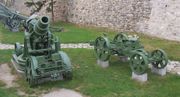
Battle of Liège
The Battle of Liège was the opening engagement of the German invasion of Belgium, and the first battle of World War I. The attack on the city began on 5 August 1914 and lasted until the 16th when the last Belgian fort finally surrendered...
, the Battle of Namur, the Siege of Maubeuge
Siege of Maubeuge
The Siege of Maubeuge took place between August 24 and September 7, 1914 when the French garrison of the Maubeuge Fortress finally surrendered to the Germans at the start of World War I on the Western Front....
and the Siege of Antwerp
Siege of Antwerp
The Siege of Antwerp was an engagement between the German and the Belgian armies during World War I. A small number of British and Austrian troops took part as well.-Strategic Context:...
. All three would prove crushing German victories, at Liege and Namur against the Belgians, at Maubeuge against the French and at Antwerp against a combined Anglo-Belgian force. The weapon that made these victories possible were the German Big Bertha
Big Bertha (Howitzer)
Big Bertha Bertha") is the name of a type of super-heavy howitzer developed by the famous armaments manufacturer Krupp in Germany on the eve of World War I...
s and the Skoda 305 mm Model 1911
Skoda 305 mm Model 1911
The Škoda 30.5 cm Mörser M. 11 was a siege howitzer produced by Škoda Works and used by the Austro-Hungarian Army during World War I.-Development:...
siege mortars, one of the best siege mortars of the war, on loan from Austria-Hungary. These huge guns were the decisive weapon of siege warfare in the 20th century, taking part at Przemysl, the Belgian sieges, on the Italian Front and Serbian Front, and even being reused in World War II.
At the second Siege of Przemysl
Siege of Przemysl
The Siege of Przemyśl was one of the greatest sieges of the First World War, and a crushing defeat for Austria-Hungary. The investment of Przemyśl began on September 24, 1914 and was briefly suspended on October 11 due to an Austro-Hungarian offensive...
, the Austro-Hungarian
Austro-Hungarian Army
The Austro-Hungarian Army was the ground force of the Austro-Hungarian Dual Monarchy from 1867 to 1918. It was composed of three parts: the joint army , the Austrian Landwehr , and the Hungarian Honvédség .In the wake of fighting between the...
garrison showed an excellent knowledge of siege warfare, not only waiting for relief, but sending sorties into Russian lines and employing an active defense that resulted in the capture of the Russian General Lavr Kornilov
Lavr Kornilov
Lavr Georgiyevich Kornilov was a military intelligence officer, explorer, and general in the Imperial Russian Army during World War I and the ensuing Russian Civil War...
. Despite its excellent performance, the garrison's food supply had been requisitioned for earlier offensives, a relief expedition was stalled by the weather, ethnic rivalries flared up between the defending soldiers and a breakout attempt failed. When the commander of the garrison Hermann Kusmanek finally surrendered, his troops were eating their horses and the first attempt of large-scale air supply had failed. It was one of the few great victories obtained by either side during the war; 110,000 Austro-Hungarian prisoners were marched back to Russia. Use of aircraft for siege running, bringing supplies to areas under siege, would nevertheless prove useful in many sieges to come.
The largest siege of the war, and the arguably the roughest, most gruesome battle in history, was the Battle of Verdun
Battle of Verdun
The Battle of Verdun was one of the major battles during the First World War on the Western Front. It was fought between the German and French armies, from 21 February – 18 December 1916, on hilly terrain north of the city of Verdun-sur-Meuse in north-eastern France...
. Whether the battle can be considered true siege warfare is debatable. Under the theories of Erich von Falkenhayn
Erich von Falkenhayn
Erich von Falkenhayn was a German soldier and Chief of the General Staff during World War I. He became a military writer after World War I.-Early life:...
it is more distinguishable as purely attrition with a coincidental presence of fortifications on the battlefield. When considering the plans of Crown Prince Wilhelm, purely concerned with taking the citadel and not with French casualty figures, it can be considered a true siege. The main fortifications were Fort Douaumont
Douaumont
Douaumont is a commune in the Meuse department in Lorraine in north-eastern France.The village was destroyed during World War I. Today the Douaumont ossuary, which contains the remains of more than 100,000 unknown soldiers of both French and German nationalities found on the battlefield, stands...
, Fort Vaux
Fort Vaux
Fort Vaux, located in Vaux-Devant-Damloup, Meuse, France, became the second Fort to fall in the Battle of Verdun. The first fort to fall had been Fort Douaumont which was virtually undefended and had been captured by a small German raiding party in February 1916 . Fort de Vaux , on the other hand ,...
and the fortified city of Verdun itself. The Germans, through the use of huge artillery bombardments, flamethrowers and infiltration tactics were able to capture both Vaux and Douaumont, but were never able to take the city, and eventually lost most of their gains. It was a battle that, despite the French ability to fend off the Germans, neither side won. The German losses were not worth the potential capture of the city and the French casualties were not worth holding the symbol of her defense.
The development of the armoured tank
Tank
A tank is a tracked, armoured fighting vehicle designed for front-line combat which combines operational mobility, tactical offensive, and defensive capabilities...
and improved infantry
Infantry
Infantrymen are soldiers who are specifically trained for the role of fighting on foot to engage the enemy face to face and have historically borne the brunt of the casualties of combat in wars. As the oldest branch of combat arms, they are the backbone of armies...
tactics
Military tactics
Military tactics, the science and art of organizing an army or an air force, are the techniques for using weapons or military units in combination for engaging and defeating an enemy in battle. Changes in philosophy and technology over time have been reflected in changes to military tactics. In...
at the end of World War I swung the pendulum back in favour of maneuver, and with the advent of Blitzkrieg in 1939, the end of traditional siege warfare was at hand. The Maginot Line
Maginot Line
The Maginot Line , named after the French Minister of War André Maginot, was a line of concrete fortifications, tank obstacles, artillery casemates, machine gun posts, and other defences, which France constructed along its borders with Germany and Italy, in light of its experience in World War I,...
would be the prime example of the failure of immobile, post–World War I fortifications. Although sieges would continue, it would be in a totally different style and on a reduced scale.
Second World War
The BlitzkriegBlitzkrieg
For other uses of the word, see: Blitzkrieg Blitzkrieg is an anglicized word describing all-motorised force concentration of tanks, infantry, artillery, combat engineers and air power, concentrating overwhelming force at high speed to break through enemy lines, and, once the lines are broken,...
of the Second World War truly showed that fixed fortifications are easily defeated by maneuver instead of frontal assault or long sieges. The great Maginot Line
Maginot Line
The Maginot Line , named after the French Minister of War André Maginot, was a line of concrete fortifications, tank obstacles, artillery casemates, machine gun posts, and other defences, which France constructed along its borders with Germany and Italy, in light of its experience in World War I,...
was bypassed and battles that would have taken weeks of siege could now be avoided with the careful application of air power (such as the German paratrooper
Paratrooper
Paratroopers are soldiers trained in parachuting and generally operate as part of an airborne force.Paratroopers are used for tactical advantage as they can be inserted into the battlefield from the air, thereby allowing them to be positioned in areas not accessible by land...
capture of Fort Eben-Emael
Fort Eben-Emael
Fort Eben-Emael is an inactive Belgian fortress located between Liège and Maastricht, on the Belgian-Dutch border, near the Albert Canal, and designed to defend Belgium from a German attack across the narrow belt of Dutch territory in the region. Constructed in 1931–1935, it was reputed to be...
, Belgium, early in World War II).
The most important siege was the Siege of Leningrad
Siege of Leningrad
The Siege of Leningrad, also known as the Leningrad Blockade was a prolonged military operation resulting from the failure of the German Army Group North to capture Leningrad, now known as Saint Petersburg, in the Eastern Front theatre of World War II. It started on 8 September 1941, when the last...
, that lasted over 29 months, about half of the duration of the entire Second World War. Along with the Battle of Stalingrad
Battle of Stalingrad
The Battle of Stalingrad was a major battle of World War II in which Nazi Germany and its allies fought the Soviet Union for control of the city of Stalingrad in southwestern Russia. The battle took place between 23 August 1942 and 2 February 1943...
, the Siege of Leningrad on the Eastern Front
Eastern Front (World War II)
The Eastern Front of World War II was a theatre of World War II between the European Axis powers and co-belligerent Finland against the Soviet Union, Poland, and some other Allies which encompassed Northern, Southern and Eastern Europe from 22 June 1941 to 9 May 1945...
was the deadliest siege of a city in history. In the west, apart from the Battle of the Atlantic the sieges were not on the same scale as those on the European Eastern front; however, there were several notable or critical sieges: the island of Malta
Malta
Malta , officially known as the Republic of Malta , is a Southern European country consisting of an archipelago situated in the centre of the Mediterranean, south of Sicily, east of Tunisia and north of Libya, with Gibraltar to the west and Alexandria to the east.Malta covers just over in...
, for which the population won the George Cross
George Cross
The George Cross is the highest civil decoration of the United Kingdom, and also holds, or has held, that status in many of the other countries of the Commonwealth of Nations...
, Tobruk
Siege of Tobruk
The siege of Tobruk was a confrontation that lasted 240 days between Axis and Allied forces in North Africa during the Western Desert Campaign of the Second World War...
. In the South-East Asian Theatre
South-East Asian theatre of World War II
The South-East Asian Theatre of World War II was the name given to the campaigns of the Pacific War in Burma , Ceylon, India, Thailand, Indochina, Malaya and Singapore. Conflict in the theatre began when the Empire of Japan invaded Thailand and Malaya from bases located in Indochina on December 8,...
there was the siege of Singapore
Singapore
Singapore , officially the Republic of Singapore, is a Southeast Asian city-state off the southern tip of the Malay Peninsula, north of the equator. An island country made up of 63 islands, it is separated from Malaysia by the Straits of Johor to its north and from Indonesia's Riau Islands by the...
and in the Burma Campaign
Burma Campaign
The Burma Campaign in the South-East Asian Theatre of World War II was fought primarily between British Commonwealth, Chinese and United States forces against the forces of the Empire of Japan, Thailand, and the Indian National Army. British Commonwealth land forces were drawn primarily from...
sieges of Myitkyina
Myitkyina
Myitkyina is the capital city of Kachin State in Myanmar , located from Yangon, and from Mandalay. In Burmese it means "near the big river", and in fact "Myitkyina" lies on the west bank of the Ayeyarwady River, just below from Myit-son of its two headstreams...
, the Admin Box
Battle of the Admin Box
The Battle of the Admin Box took place on the Southern Front of the Burma Campaign from 5 February to 23 February 1944, in the South-East Asian Theatre of World War II...
, Imphal
Battle of Imphal
The Battle of Imphal took place in the region around the city of Imphal, the capital of the state of Manipur in North-East India from March until July 1944. Japanese armies attempted to destroy the Allied forces at Imphal and invade India, but were driven back into Burma with heavy losses...
and Kohima
Battle of Kohima
The Battle of Kohima was the turning point of the Japanese U Go offensive into India in 1944 in the Second World War. The battle was fought from 4 April to 22 June 1944 around the town of Kohima in northeast India. It is often referred to as the "Stalingrad of the East".The battle took place in...
which was the high-water mark for the Japanese advance into India.
The siege of Sevastopol
Siege of Sevastopol
There have been two Sieges of Sevastopol, a city on the Crimean peninsula:*Siege of Sevastopol - during the Crimean War*Siege of Sevastopol - during the Second World War* "The Siege of Sevastopol" is a traditional song...
saw the use of the heaviest and most powerful individual siege engines ever to be used: the German 800mm railway gun
Schwerer Gustav
Schwerer Gustav and Dora were the names of two massive World War II German 80 cm K railway siege guns. They were developed in the late 1930s by Krupp for the express purpose of destroying heavy fortifications, specifically those in the French Maginot Line...
and the 600mm siege mortar
Mörser Karl
"Karl-Gerät" , also known as Thor and Mörser Karl, was a World War II German self-propelled siege mortar designed and built by Rheinmetall. It was the largest self-propelled weapon to see service. Its heaviest munition was a diameter, shell, and the range for its lightest shell of was just over...
. Though a single shell could have disastrous local effect, the guns were susceptible to air attack in addition to being slow to move.
The airbridge
Airbridge (logistics)
An airbridge is the route and means of delivering material from one place to another by an airlift.An airbridge is the means by which an airhead is kept supplied by overflying enemy held territory...
methods which were developed and used extensively in the Burma Campaign for supplying the Chindits
Chindits
The Chindits were a British India "Special Force" that served in Burma and India in 1943 and 1944 during the Burma Campaign in World War II. They were formed into long range penetration groups trained to operate deep behind Japanese lines...
and other units, including those in sieges such as Imphal, as well as flying the Hump
The Hump
The Hump was the name given by Allied pilots in the Second World War to the eastern end of the Himalayan Mountains over which they flew military transport aircraft from India to China to resupply the Chinese war effort of Chiang Kai-shek and the units of the United States Army Air Forces based in...
into China, allowed the western powers to develop air lift expertise which would prove vital during the Cold War
Cold War
The Cold War was the continuing state from roughly 1946 to 1991 of political conflict, military tension, proxy wars, and economic competition between the Communist World—primarily the Soviet Union and its satellite states and allies—and the powers of the Western world, primarily the United States...
Berlin Blockade
Berlin Blockade
The Berlin Blockade was one of the first major international crises of the Cold War and the first resulting in casualties. During the multinational occupation of post-World War II Germany, the Soviet Union blocked the Western Allies' railway and road access to the sectors of Berlin under Allied...
. Air supply failed to prevent the fall of Dien Bien Phu
Battle of Dien Bien Phu
The Battle of Dien Bien Phu was the climactic confrontation of the First Indochina War between the French Union's French Far East Expeditionary Corps and Viet Minh communist revolutionaries. The battle occurred between March and May 1954 and culminated in a comprehensive French defeat that...
to the Vietnamese in 1954 but proved crucial in maintaining the American base at Khe Sanh
Khe Sanh
Khe Sanh is the district capital of Hướng Hoá District, Quảng Trị Province, Vietnam, located 63 km west of Đông Hà.Khe Sanh Combat Base was a United States Marine Corps outpost in South Vietnam used during the Vietnam War. The airstrip was built in September 1962...
in 1968.
Post Second World War
During the Vietnam WarVietnam War
The Vietnam War was a Cold War-era military conflict that occurred in Vietnam, Laos, and Cambodia from 1 November 1955 to the fall of Saigon on 30 April 1975. This war followed the First Indochina War and was fought between North Vietnam, supported by its communist allies, and the government of...
the battles of Dien Bien Phu
Battle of Dien Bien Phu
The Battle of Dien Bien Phu was the climactic confrontation of the First Indochina War between the French Union's French Far East Expeditionary Corps and Viet Minh communist revolutionaries. The battle occurred between March and May 1954 and culminated in a comprehensive French defeat that...
(1954) and Khe Sanh
Battle of Khe Sanh
The Battle of Khe Sanh was conducted in northwestern Quang Tri Province, Republic of Vietnam , between 21 January and 9 July 1968 during the Vietnam War...
(1968) possessed siege-like characteristics. In both cases, the Viet Minh
Viet Minh
Việt Minh was a national independence coalition formed at Pac Bo on May 19, 1941. The Việt Minh initially formed to seek independence for Vietnam from the French Empire. When the Japanese occupation began, the Việt Minh opposed Japan with support from the United States and the Republic of China...
and NLF
National Front for the Liberation of South Vietnam
The Vietcong , or National Liberation Front , was a political organization and army in South Vietnam and Cambodia that fought the United States and South Vietnamese governments during the Vietnam War . It had both guerrilla and regular army units, as well as a network of cadres who organized...
were able to cut off the opposing army by capturing the surrounding rugged terrain. At Dien Bien Phu, the French were unable to use air power to overcome the siege and were defeated. However, at Khe Sanh a mere 14 years later, advances in air power allowed the United States to withstand the siege. The resistance of US forces was assisted by the PAVN and PLAF
National Front for the Liberation of South Vietnam
The Vietcong , or National Liberation Front , was a political organization and army in South Vietnam and Cambodia that fought the United States and South Vietnamese governments during the Vietnam War . It had both guerrilla and regular army units, as well as a network of cadres who organized...
forces' decision to use the Khe Sanh siege as a strategic distraction to allow their mobile warfare offensive, the first Tet Offensive, to unfold securely.
The Siege of Khe Sanh displays typical features of modern sieges, as the defender has greater capacity to withstand the siege, the attacker's main aim is to bottle operational forces or create a strategic distraction, rather than take the siege to a conclusion.
In neighboring Cambodia, at that time known as the Khmer Republic
Cambodian coup of 1970
The Cambodian coup of 1970 refers to the removal of the Cambodian Head of State, Prince Norodom Sihanouk, after a vote in the National Assembly on 18 March 1970. Emergency powers were subsequently invoked by the Prime Minister Lon Nol, who became effective head of state...
, the Khmer Rouge
Khmer Rouge
The Khmer Rouge literally translated as Red Cambodians was the name given to the followers of the Communist Party of Kampuchea, who were the ruling party in Cambodia from 1975 to 1979, led by Pol Pot, Nuon Chea, Ieng Sary, Son Sen and Khieu Samphan...
used siege tactics to cut off supplies from Phnom Penh
Phnom Penh
Phnom Penh is the capital and largest city of Cambodia. Located on the banks of the Mekong River, Phnom Penh has been the national capital since the French colonized Cambodia, and has grown to become the nation's center of economic and industrial activities, as well as the center of security,...
to other government-held enclaves in an attempt to break the will of the government to continue fighting.
In 1972 the Easter offensive, the Siege of An Loc Vietnam occurred. ARVN troops and U.S. advisers and air power successfully defeated communist forces. The Battle of An Loc pitted some 6,350 ARVN men against a force three times that size. During the peak of the battle, ARVN had access to only one 105 mm howitzer to provide close support while the enemy attack was backed by an entire artillery division. ARVN had no tanks, the NVA communist forces had two armored regiments. ARVN prevailed after over two month of continuous fighting. As General Paul Vanuxem, a French veteran of the Indochina War, wrote in 1972 after visiting the liberated city of An Loc: "An Loc was the Verdun of Vietnam, where Vietnam received as in baptism the supreme consecration of her will."
Police activity
Despite the overwhelming might of the modern state, siege tactics continue to be employed in police conflicts. This has been due to a number of factors, primarily risk to life, whether that of the police, the besieged, bystanders or hostageHostage
A hostage is a person or entity which is held by a captor. The original definition meant that this was handed over by one of two belligerent parties to the other or seized as security for the carrying out of an agreement, or as a preventive measure against certain acts of war...
s. Police make use of trained negotiators
Negotiation
Negotiation is a dialogue between two or more people or parties, intended to reach an understanding, resolve point of difference, or gain advantage in outcome of dialogue, to produce an agreement upon courses of action, to bargain for individual or collective advantage, to craft outcomes to satisfy...
, psychologists
Psychology
Psychology is the study of the mind and behavior. Its immediate goal is to understand individuals and groups by both establishing general principles and researching specific cases. For many, the ultimate goal of psychology is to benefit society...
and, if necessary, force, generally being able to rely on the support of their nation's armed forces
Armed forces
The armed forces of a country are its government-sponsored defense, fighting forces, and organizations. They exist to further the foreign and domestic policies of their governing body, and to defend that body and the nation it represents from external aggressors. In some countries paramilitary...
if required.
One of the complications facing police in a siege involving hostages is the Stockholm syndrome
Stockholm syndrome
In psychology, Stockholm Syndrome is an apparently paradoxical psychological phenomenon wherein hostages express empathy and have positive feelings towards their captors, sometimes to the point of defending them...
where sometimes hostages can develop a sympathetic rapport with their captors. If this helps keep them safe from harm this is considered to be a good thing, but there have been cases where hostages have tried to shield the captors during an assault or refused to co-operate with the authorities in bringing prosecutions.
The 1993 police siege
Waco Siege
The Waco siege began on February 28, 1993, and ended violently 50 days later on April 19. The siege began when the United States Bureau of Alcohol, Tobacco and Firearms attempted to execute a search warrant at the Branch Davidian ranch at Mount Carmel, a property located east-northeast of Waco,...
on the Branch Davidian
Branch Davidian
The Branch Davidians are a Protestant sect that originated in 1955 from a schism in the Davidian Seventh Day Adventists , a reform movement that began within the Seventh-day Adventist Church around 1930...
church in Waco, Texas
Waco, Texas
Waco is a city in and the county seat of McLennan County, Texas. Situated along the Brazos River and on the I-35 corridor, halfway between Dallas and Austin, it is the economic, cultural, and academic center of the 'Heart of Texas' region....
, lasted 51 days, an atypically long police siege. Unlike traditional military sieges, police sieges tend to last for hours or days rather than weeks, months or years.
In Britain, if the siege involves perpetrators who are considered by the British Government to be terrorists, and if an assault is to take place, the civilian authorities hand command and control over to the military. The threat of such an action ended the Balcombe Street Siege
Balcombe Street Siege
The Balcombe Street Siege was an incident involving members of the Provisional Irish Republican Army and the Metropolitan Police Service of London, England lasting from 6 December to 12 December 1975. The siege ended with the surrender of the four IRA volunteers and the release of their two hostages...
in 1975 but the Iranian Embassy Siege
Iranian Embassy Siege
The Iranian Embassy siege took place from 30 April to 5 May 1980, after a group of six armed men stormed the Iranian embassy in South Kensington, London. The gunmen took 26 people hostage—mostly embassy staff, but several visitors and a police officer, who had been guarding the embassy, were also...
in 1980 ended in a military assault and the deaths of all but one of the hostage takers.
See also
- InfiltrationInfiltration tacticsIn warfare, infiltration tactics involve small, lightly equipped infantry forces attacking enemy rear areas while bypassing enemy front line strongpoints and isolating them for attack by follow-up troops with heavier weapons.-Development during World War I:...
- Last standLast standLast stand is a loose military term used to describe a body of troops holding a defensive position in the face of overwhelming odds. The defensive force usually takes very heavy casualties or is completely destroyed, as happened in "Custer's Last Stand" at the Battle of Little Big HornBryan Perrett...
- BattleplanBattleplanBattleplan is a military television documentary series examing various military strategies used in modern warfare since World War I. It is shown on the Military Channel in the U.S. and UKTV History...
(documentary TV series)
Siege engines
Siege equipment
Lists:
Further reading
- Duffy, Christopher. Fire & Stone: The Science of Fortress Warfare (1660–1860). 1975. 2nd ed. New York: Stackpole Books, 1996.
- Duffy, Christopher. Siege Warfare: Fortress in the Early Modern World, 1494–1660. Routledge and Kegan Paul, 1996.
- Duffy, Christopher. Siege Warfare, Volume II: The Fortress in the Age of Vauban and Frederick the Great. Routledge and Kegan Paul: London, 1985.
- Lynn, John A. The Wars of Louis XIV.
- May, Timothy. "Mongol Arms." Explorations in Empire, Pre-Modern Imperialism Tutorial: the Mongols. University of Wisconsin-Madison. 27 June 2004.
- Saltini Antonio, L'assedio della Mirandola. Vita, guerra e amore al tempo di Pico e di papa Giulio, Diabasis, Reggio Emilia 2003.
External links
- Native American Siege Warfare.
- Siege Kits
- Scenes of Siege Warfare
- Three ancient Egyptian Sieges: Megiddo, Dapur, Hermopolis
- The Siege Of The City Biblical perspectives.
- Secrets of Lost Empires: Medieval Siege (PBS) Informative and interactive webpages about medieval siege tactics.