
All Topics  
Flintlock

 
Flintlock

   Email Print
   Bookmark   Link


Flintlock


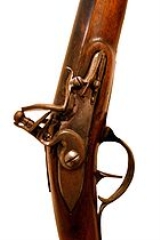
Flintlock is the general term for any firearm
Firearm

A firearm is a tool that projects either single or multiple projectiles at high velocity through a controlled explosion. The firing is achieved by the gases produced through rapid, confined combustion of a propellant....
 based on the flintlock mechanism
Flintlock mechanism

Sorry, no overview for this topic
. The term may also apply to the mechanism itself. Introduced about 1630, the flintlock rapidly replaced earlier firearm-ignition technologies, such as the matchlock
Matchlock

The Matchlock was the first mechanism or "lock" invented to uncomplicate the firing of a hand-held firearm. This design removed the need to lower by hand a lit match into the weapon's flash pan and made it possible to have both hands free to keep a firm grip on the weapon at the moment of firing, and more importantly to keep both eyes on the...
 and wheellock
Wheellock

Wheellock, wheel-lock or wheel lock, is a mechanism for firing a firearm. It was the next major development in firearms technology after the matchlock and the first self-igniting firearm....
 mechanisms. It continued to be in common use for over two centuries, replaced by percussion cap
Percussion cap

The percussion cap, introduced around 1830, was the crucial invention that enabled Muzzleloader firearms to fire reliably in any weather. Before this development, firearms used flintlock ignition systems which produced flint-on-steel sparks to ignite a pan of priming powder and thereby fire the gun's main powder charge....
 and, later, cartridge-based
Cartridge (firearms)

A cartridge, also called a round, packages the bullet, gunpowder and Percussion cap into a single metallic case precisely made to fit the firing chamber of a firearm....
 systems in the early-to-mid 19th century.


Discussion
Ask a question about 'Flintlock'
Start a new discussion about 'Flintlock'
Answer questions from other users
Full Discussion Forum


Recent Posts


Encyclopedia


Musee Historique Lausanne Img 0086
Flintlock is the general term for any firearm
Firearm

A firearm is a tool that projects either single or multiple projectiles at high velocity through a controlled explosion. The firing is achieved by the gases produced through rapid, confined combustion of a propellant....
 based on the flintlock mechanism
Flintlock mechanism

Sorry, no overview for this topic
. The term may also apply to the mechanism itself. Introduced about 1630, the flintlock rapidly replaced earlier firearm-ignition technologies, such as the matchlock
Matchlock

The Matchlock was the first mechanism or "lock" invented to uncomplicate the firing of a hand-held firearm. This design removed the need to lower by hand a lit match into the weapon's flash pan and made it possible to have both hands free to keep a firm grip on the weapon at the moment of firing, and more importantly to keep both eyes on the...
 and wheellock
Wheellock

Wheellock, wheel-lock or wheel lock, is a mechanism for firing a firearm. It was the next major development in firearms technology after the matchlock and the first self-igniting firearm....
 mechanisms. It continued to be in common use for over two centuries, replaced by percussion cap
Percussion cap

The percussion cap, introduced around 1830, was the crucial invention that enabled Muzzleloader firearms to fire reliably in any weather. Before this development, firearms used flintlock ignition systems which produced flint-on-steel sparks to ignite a pan of priming powder and thereby fire the gun's main powder charge....
 and, later, cartridge-based
Cartridge (firearms)

A cartridge, also called a round, packages the bullet, gunpowder and Percussion cap into a single metallic case precisely made to fit the firing chamber of a firearm....
 systems in the early-to-mid 19th century. The Model 1840 U.S. musket
Springfield Model 1840 Flintlock Musket

The Model 1840 Flintlock Musket was produced at Springfield Armory. The .69 caliber Musket had a 42" barrel, an overall length of 58", and a weight of 9.8 lbs....
 was the last flintlock firearm produced for the U.S. military although there is evidence obsolete flintlocks were seeing action in the earliest days of the American Civil War
American Civil War

The American Civil War , also known as the War Between the States and several Naming the American Civil War, was a civil war in the United States....
. In fact, during the first year of the war, the Army of Tennessee (Confederacy) had over 2,000 flintlock muskets in service. While technologically obsolete, flintlock firearms have enjoyed a renaissance among black powder shooting enthusiasts and many fine flintlock rifles and pistols are being made today.

Subtypes

Flintlocks may be any type of small arm: long gun
Long gun

The term long gun is used to describe classes of firearm and cannon with longer Gun barrel than other classes. In small arms, a long gun is designed to be fired braced against the shoulder, in contrast to a handgun, while in artillery a long gun would be contrasted with a howitzer or carronade....
 or pistol, smoothbore
Smoothbore

A smoothbore weapon is one which has a gun barrel without rifling. Smoothbores range from handheld firearms to powerful tank guns and large artillery mortar s....
 or rifle
Rifle

A rifle is a firearm designed to be fired from the shoulder, with a barrel that has a helical groove or pattern of grooves cut into the barrel walls....
, muzzleloader
Muzzleloader

A muzzleloader is any firearm into which the bullet and usually the propellant charge is loaded from the firearm muzzle of the gun . This is distinct from the more popular modern design of breech-loading firearms....
 or breechloader. Because of the time needed to reload (the fastest experts could reload a smooth-bore muzzle-loading musket in about fifteen seconds), these weapons were sometimes produced with two, three, four or more barrels; however, multiple-barreled weapons were never very popular. The designs tended to be expensive to make and failure-prone. It was frequently cost-effective and more reliable to simply carry multiple single-shot weapons instead. Multi-barreled (up to eight) pistols had the barrels spread out in a 180 degree fan. All barrels fired at the same time, with a single lock. Known as a "Duck Foot" because of the resemblance in shape, they were intended primarily to be used by a ship's captain as a last ditch effort to defend against mutiny.
Flintlock
Flintlock muskets were the mainstay of Europe
Europe

Europe is, conventionally, one of the world's seven continents. Comprising the westernmost peninsula of Eurasia, Europe is generally divided from Asia to its east by the water divide of the Ural Mountains, the Ural , the Caspian Sea, and by the Caucasus Mountains to the southeast....
an armies
Army

An army , in the broadest sense, is the land-based armed forces of a nation. It may also include other branches of the military such as an air force....
 between 1660 and 1840. A musket was a muzzle-loading smoothbore long gun that was loaded with a round lead ball, but it could also be loaded with shot
Lead shot

Lead shot is a collective term for small balls of lead. It is used primarily as projectiles in shotguns, but is also used for a variety of other purposes....
 for hunting
Hunting

Hunting is the practice of pursuing living animals for food, recreation, or trade. In present-day use, the term refers to lawful hunting, as distinguished from poaching, which is the killing, trapping or capture of the hunted species contrary to law....
. For military purposes, the weapon was loaded with ball, or a mixture of ball with several large shot, and had an effective range between 40 and 100 meters. Smoothbore weapons that were designed for hunting birds were called "fowlers". They tended to be of large caliber. They usually had no choke
Shotgun

A shotgun is a firearm that is usually designed to be fired from the shoulder, which uses the energy of a fixed shell to fire a number of small spherical pellets called lead shot, or a solid projectile called a shotgun slug....
, so they could also be used to fire a ball.

Some flintlock hunting arms had rifled barrels. Rifling
Rifling

Rifling is the helix-shaped pattern in the Gun barrel of a gun or firearm, which imparts a spin to a projectile around its long axis. This spin serves to gyroscope stabilize the projectile, improving its Aerodynamics stability and accuracy....
 is the process of cutting spiral grooves into the inside of the barrel. A tight-fitting projectile will tend to spin, which stabilizes its flight by the gyroscopic principle. Rifles are more accurate and have longer effective ranges than muskets but they take more time to load than a smooth-bore musket. The first rifled arms were introduced about 1500. Versions made in Germany
Germany

Germany , officially the Federal Republic of Germany , is a country in Central Europe. It is bordered to the north by the North Sea, Denmark, and the Baltic Sea; to the east by Poland and the Czech Republic; to the south by Austria and Switzerland; and to the west by France, Luxembourg, Belgium, and the Netherlands....
  for hunting large game such as boar had barrels about 50-75 centimeters long. When German immigrants settled in America, particularly in Pennsylvania
Pennsylvania

The Commonwealth of Pennsylvania , often colloquially referred to as PA by natives and Northeasterners, is a U.S. state located in the Northeastern United States and Mid-Atlantic States regions of the United States....
, they adapted their technology to the type of game available and the demands of the Indian trade
Fur trade

The fur trade is a worldwide industry dealing in the acquisition and sale of animal fur....
, and built the long rifle
Long rifle

The term Long Rifle refers to a type of rifle used in History of the United States by both United States Armed Forces and civilians. It is characterized by an unusually long barrel, sometimes over four feet in length, which is felt to be in large part a unique development of American rifles, and is almost never seen in European rifles of t...
, an improvement on the small game rifles used in Europe. This weapon
Weapon

A weapon is a tool used to apply or threaten to apply force for the purpose of hunting, attack or defense in combat, subduing enemy personnel, or to destroy enemy weapons, equipment and defensive structures....
 has a barrel 90 to 115 centimeters long, and carefully loaded and shot, will be accurate up to 300 meters.

Flintlock pistols were used as self-defense weapons and for duelling, and as a cavalry arm. Their effective range was very short, and they were frequently used as an adjunct to the sword
Sword

A sword is a long, edged piece of metal, used as a cutting, thrusting, and clubbing weapon in many civilizations throughout the world. The word sword comes from the Old English language wikt:sweord, cognate to Old High German swert, Middle Dutch swaert, Old Norse sver? Old Frisian and Old Saxon swerd and Dutch langua...
 or cutlass
Cutlass

A cutlass is a short, broad sabre or slashing sword, with a straight or slightly curved blade sharpened on the cutting edge, and a hilt often featuring a solid cupped or Basket-hilted sword shaped Hilt#Guard....
. Pistols were usually smoothbore although rifled pistols were produced.

History

French courtier Marin le Bourgeoys
Marin le Bourgeoys

Marin le Bourgeoys is most well known for inventing the flintlock mechanism that was used on weapons for over two hundred years.Marin le Bourgeoys was born into a noted artisan family in Lisieux, in Normandy, France....
 made the first firearm
Firearm

A firearm is a tool that projects either single or multiple projectiles at high velocity through a controlled explosion. The firing is achieved by the gases produced through rapid, confined combustion of a propellant....
 incorporating a true flintlock mechanism for King Louis XIII
Louis XIII of France

Louis XIII reigned as List of French monarchs and List of Navarrese monarchs from 1610 to 1643....
 shortly after his accession to the throne in 1610. The development of firearm lock mechanisms had proceeded from matchlock
Matchlock

The Matchlock was the first mechanism or "lock" invented to uncomplicate the firing of a hand-held firearm. This design removed the need to lower by hand a lit match into the weapon's flash pan and made it possible to have both hands free to keep a firm grip on the weapon at the moment of firing, and more importantly to keep both eyes on the...
 to wheellock
Wheellock

Wheellock, wheel-lock or wheel lock, is a mechanism for firing a firearm. It was the next major development in firearms technology after the matchlock and the first self-igniting firearm....
 to snaplock
Snaplock

A Snaplock is a particular type of mechanism for firing a gun .A snaplock ignites the weapon's propellent by means of sparks produced when a spring-powered cock strikes a flint down on to a piece of hardened steel....
 to snaphance
Snaphance

A Snaphance or Snaphaunce is a particular type of mechanism for firing a gun .Like the earlier snaplock and later flintlock, the snaphaunce drives a flint onto a steel to create a shower of sparks to ignite the main charge ....
 and miquelet
Miquelet

This is about firearms. For the militia, see Miquelet Miquelet is a modern convention, largely used by and for the benefit of the English speaking world, widely applied to a distinctive form of flint-against-steel ignition mechanism prevalent in the Mediterranean lands in the late 16th to early 19th centuries....
 in the previous two centuries, and each type had been an improvement, contributing some design features which were useful. Le Bourgeoys fitted these various features together to create the flintlock mechanism. The new system quickly became popular, and was known and used in various forms throughout Europe by 1630.

Various breech-loading flintlocks were developed starting around 1650. The most popular action has a barrel which was unscrewed from the rest of the gun. Obviously this is more practical on pistols because of the shorter barrel length. This type is known as a Queen Anne
Anne of Great Britain

Anne became Queen of England, Queen of Scots and Kingdom of Ireland on 8 March 1702, succeeding her brother-in-law, William III of England. Her Roman Catholic father, James II of England, was Glorious Revolution in 1688/9; her brother-in-law and her sister then became joint monarchs as William III & II and Mary II of England, the only such c...
 pistol because it was during her reign that it became popular (although it was actually introduced in the reign of King William III
William III of England

William III was a Prince of Orange by birth. From 1672 onwards, he governed as List_of_stadtholders_for_the_Low_Countries_provinces William III of Orange over Holland, Zeeland, Utrecht, Guelders, and Overijssel of the Dutch Republic....
). Another type has a removable screw plug set into the side or top or bottom of the barrel. A large number of sporting rifles were made with this system, as it allowed easier loading compared with muzzle loading with a tight fitting bullet and patch. One of the more successful was the system built by Isaac de la Chaumette starting in 1704. The plug passed completely through the barrel and could be opened by 3 revolutions of the triggerguard, to which it was attached. The plug stayed attached to the barrel and the ball and powder were loaded from the top. This system was improved in the 1770s by Colonel Patrick Ferguson
Patrick Ferguson

Major Patrick Ferguson , was a British Army officer, rifle-designer, and early advocate of light infantry.Patrick Ferguson was born in Edinburgh, Scotland, on May 25 /June 4 1744, the second son and fourth child of advocate James Ferguson of Pitfour and his wife Anne Murray, a sister of the literary patron Patrick Murray, 5th Lord Eliba...
 and 100 experimental rifles used in the American Revolutionary War
American Revolutionary War

The American Revolutionary War , also known as the American War of Independence, began as a war between the Kingdom of Great Britain and Thirteen Colonies on the North America, and ended in a global war between several European great powers....
. The only two flintlock breechloaders to be produced in quantity were the Hall and the Crespi. The first was invented by John Hall for the US Army in 1810. The Hall rifles and carbines were loaded using a combustible paper cartridge
Paper cartridge

Paper cartridge refers to one of various types of small arms ammunition used before the advent of the cartridge . These cartridges consisted of a paper cylinder or cone containing the bullet, gunpowder, and, in some cases, a primer or a lubricant and anti-fouling agent....
 inserted into the upward tilting breechblock. Hall rifles leaked gas from the often poorly fitted action. The same problem affected the muskets produced by Giuseppe Crespi and adopted by the Austrian Army in 1771. Nonetheless, the Crespi System was experimented with by the British during the Napoleonic Wars
Napoleonic Wars

The Napoleonic Wars were a series of conflicts involving Napoleon I of France First French Empire and changing sets of European allies and opposing coalitions that ran from 1803 to 1815....
, and percussion Halls guns saw service in the American Civil War
American Civil War

The American Civil War , also known as the War Between the States and several Naming the American Civil War, was a civil war in the United States....
.

Method of operation


  • A cock or hammer tightly holding a bladed piece of flint
    Flint

    Flint is a hard, sedimentary rock cryptocrystalline form of the mineral quartz, categorized as a variety of chert. It occurs chiefly as Nodule s and masses in sedimentary rocks, such as chalks and limestones....
     is rotated to half-cock;
  • The operator loads the gun, usually from the muzzle end, with black powder followed by shot
    Shot

    Shot may refer to:* Shot , a part of a film between two cuts* Shot glass, a liquor measure* Lead shot, small balls of shot generally used as weights or as firearms projectiles...
     or a round lead ball, usually wrapped in a paper or cloth patch, all rammed down with a special rod (the ramrod
    Ramrod

    This article is about the firearm component. For other uses, see Ramrod .A ramrod is a device used with early firearms to push the projectile up against the propellant ....
    ), that is usually stored on the underside of the barrel;
  • The flash pan is primed with a small amount of very finely ground powder, and the flashpan lid or frizzen is closed;


The gun is now in a "primed and ready" state, and this is how it would typically be carried while hunting
Hunting

Hunting is the practice of pursuing living animals for food, recreation, or trade. In present-day use, the term refers to lawful hunting, as distinguished from poaching, which is the killing, trapping or capture of the hunted species contrary to law....
 or if going into battle. A safety notch at half-cock locks the cock to prevent it from falling by pulling the trigger.

To fire:

  • The cock or hammer is moved from half-cock to full-cock, releasing the safety lock on the cock;
  • The gun is aimed and the trigger is pulled, releasing the cock or hammer holding the flint;
  • The flint strikes the frizzen
    Frizzen

    The frizzen is an "L" shaped piece of steel hinged at the rear used in flintlock firearms. It is positioned over the flash pan so to enclose a small priming charge of black powder next to the flash hole that is drilled through the barrel into where the main charge is loaded....
    , a piece of steel on the priming pan lid, opening it and exposing the priming powder;
  • The contact between flint and frizzen produces a spark that is directed into the flashpan;
  • The powder ignites, and the flame passes through a small hole in the barrel (called a vent, or touchhole) that leads to the combustion chamber, igniting the main powder charge there; and the gun discharges.


The British army used paper cartridge
Paper cartridge

Paper cartridge refers to one of various types of small arms ammunition used before the advent of the cartridge . These cartridges consisted of a paper cylinder or cone containing the bullet, gunpowder, and, in some cases, a primer or a lubricant and anti-fouling agent....
s to load their weapons. The powder charge and ball were instantly available to the soldier inside this small paper envelope. When commanded, he:

  • Moved the cock to the half-cock position;
  • Tore the cartridge open with his teeth;
  • Poured a small amount of powder into the flashpan;
  • Closed the frizzen to keep the priming charge in the pan;
  • Poured the rest of the powder in the cartridge down the muzzle and stuffed the cartridge in after it;
  • Took out his ramrod and rammed the ball (still in the cartridge) all the way to the breech;
  • Returned his ramrod and shouldered his weapon. Now he is ready to place the weapon on full cock and fire when commanded.


Cultural impact

Unlike most weapons systems and configurations, which last a few decades, the flintlock mechanism was center stage for both military and civilian use for over 200 years. Not until the Reverend Alexander John Forsyth
Alexander John Forsyth

Alexander Forsyth was a Scottish Presbyterian clergyman who invented the percussion ignition.He was educated at King's College, Aberdeen, and succeded his father as minister of Belhelvie in 1791....
, a Scottish minister, invented the rudimentary percussion cap
Percussion cap

The percussion cap, introduced around 1830, was the crucial invention that enabled Muzzleloader firearms to fire reliably in any weather. Before this development, firearms used flintlock ignition systems which produced flint-on-steel sparks to ignite a pan of priming powder and thereby fire the gun's main powder charge....
 system in 1807 did the flintlock system begin to decline in popularity. The slide from flintlock to percussion cap
Percussion cap

The percussion cap, introduced around 1830, was the crucial invention that enabled Muzzleloader firearms to fire reliably in any weather. Before this development, firearms used flintlock ignition systems which produced flint-on-steel sparks to ignite a pan of priming powder and thereby fire the gun's main powder charge....
 was a slow one, even at that, since the percussion system was not widely used until around 1830. The flintlock continued in common use until the time of the American Civil War
American Civil War

The American Civil War , also known as the War Between the States and several Naming the American Civil War, was a civil war in the United States....
.

As a result of the flintlock's long active life, it has left lasting marks on the language and on drill and parade
Parade

A parade is a procession of people, usually organized along a street, often in costume, and often accompanied by marching bands, float or sometimes large balloons....
. Terms such as: "lock, stock and barrel," "going off half-cocked" and "flash in the pan" remain current in the English language
English language

English is a West Germanic language that originated in Anglo-Saxon England and has lingua franca status in many parts of the world as a result of the military, economic, scientific, political and cultural influence of the British Empire in the 18th, 19th and early 20th centuries and that of the United States from the mid 20th century onwa...
. In addition, the weapon positions and drill commands
Drill commands

Drill commands are commands that are generally utilized in regard to a group that is marching, most often military or marching band. All branches of the military utilize drill commands....
 that were originally devised to standardize carrying, loading and firing a flintlock weapon remain the standard for drill and display (see manual of arms
Manual of arms

A manual of arms was an instruction book for handling and using weapons in formation , whether in the field or on parade. Such manuals were especially important in the matchlock and flintlock eras, when loading and firing was a complex and lengthy process typically carried out in close order formation....
).


See also

  • Boyer Rifle
    Boyer Rifle

    The Boyer Rifle was a specialized over-and-under flintlock gun with one smooth barrel and one rifled barrel. This allowed it to be used as either a rifle or a shotgun....
  • Hand cannon
  • Wheellock
    Wheellock

    Wheellock, wheel-lock or wheel lock, is a mechanism for firing a firearm. It was the next major development in firearms technology after the matchlock and the first self-igniting firearm....
  • Caplock
  • Snaplock
    Snaplock

    A Snaplock is a particular type of mechanism for firing a gun .A snaplock ignites the weapon's propellent by means of sparks produced when a spring-powered cock strikes a flint down on to a piece of hardened steel....
  • Snaphance
    Snaphance

    A Snaphance or Snaphaunce is a particular type of mechanism for firing a gun .Like the earlier snaplock and later flintlock, the snaphaunce drives a flint onto a steel to create a shower of sparks to ignite the main charge ....
  • Miquelet
    Miquelet

    This is about firearms. For the militia, see Miquelet Miquelet is a modern convention, largely used by and for the benefit of the English speaking world, widely applied to a distinctive form of flint-against-steel ignition mechanism prevalent in the Mediterranean lands in the late 16th to early 19th centuries....
  • Blunderbuss
    Blunderbuss

    The blunderbuss is a muzzleloader firearm with a short, large caliber Barrel , which is flared at the muzzle , and used with Lead shot . The blunderbuss is an early form of shotgun adapted to military and defensive use....


External links