
In Depth
See Also

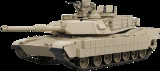
Tank

A tank is a tracked Caterpillar track

Caterpillar tracks are large tracks used on tank [i]s, construction equipment [i] an ... 

 armoured fighting vehicle Armoured fighting vehicle

An armoured fighting vehicle is a military vehicle [i], protected by armour and armed with weapon [i]s. ... 

, designed to engage enemy forces by the use of direct fire. A tank is characterized by heavy weapon Weapon

A weapon is a tool [i] which is intended to or is used to injure [i], kill, or [i] ... 

s and armour Vehicle armour

Military vehicle [i]s are commonly armoured to withstand the impact of shrapnel [i] ... 

, as well as by a high degree of mobility that allows it to cross rough terrain at relatively high speeds. While tanks are expensive to operate and logistically demanding, they are among the most formidable and versatile weapons of the modern battlefield, both for their ability to engage other ground targets and their shock value against infantry Infantry

Infantry is a term for soldiers who fight primarily on foot with small arms [i] in organized military unit [i] ... 

.

Discussions

  Discussion Features

   Ask a question about 'Tank'

   Start a new discussion about 'Tank'

   Answer questions about 'Tank'

   'Tank' discussion forum

Timeline

1915   The first prototype tank is tested for the British Army British Army

The British Army is the land armed forces [i] branch of the British Armed Forces [i]. ... 

 for the first time.

1968   Two hundred thousand Warsaw Pact Warsaw Pact

he Warsaw Pact or Warsaw Treaty, officially named the Treaty of Friendship, Co-operation and Mu... 

 troops and 5,000 tanks invade Czechoslovakia Czechoslovakia

Czechoslovakia was a country in Central Europe [i] that existed from 1918 until early 1993 . ... 

, to end the "Prague Spring Prague Spring

The Prague Spring was a period of political liberalization in Czechoslovakia [i] starting January 5 [i] ... 

" of political liberalization.

1991   Massive demonstrations are held against Slobodan Miloševic Slobodan Miloševic

Slobodan Miloevic listen was President of Serbia [i] and of Yugoslavia [i]. ... 

 in Belgrade Belgrade

Belgrade is the capital [i] and largest city of the Republic of Serbia [i]. ... 

; 2 people are killed and tanks are in the streets.

1995   Shawn Nelson, 35, goes on a tank rampage in San Diego San Diego, California

San Diego is a coastal Southern California [i] city located in the southwestern corner of the continental United States [i] ... 

.


Quotations

If the tanks succeed, then victory follows.

The finest tank in the world.

Field-Marshal Ewald von Kleist

All you saw in your imagination was the muzzle of an 88 behind each leaf.

British Tank Commander Andrew Wilson

The Tiger was the best tank and was particularly successful in heavy fighting.

German Tank Commander Oberst Franz Bäke

You need five of your tanks to destroy a single German one, but you always have six.

A captured German tanker said to Allied soldiers

       More Quotes >>


Encyclopedia


A tank is a tracked Caterpillar track

Caterpillar tracks are large tracks used on tank [i]s, construction equipment [i] an ... 

 armoured fighting vehicle Armoured fighting vehicle

An armoured fighting vehicle is a military vehicle [i], protected by armour and armed with weapon [i]s. ... 

, designed to engage enemy forces by the use of direct fire. A tank is characterized by heavy weapon Weapon

A weapon is a tool [i] which is intended to or is used to injure [i], kill, or [i] ... 

s and armour Vehicle armour

Military vehicle [i]s are commonly armoured to withstand the impact of shrapnel [i] ... 

, as well as by a high degree of mobility that allows it to cross rough terrain at relatively high speeds. While tanks are expensive to operate and logistically demanding, they are among the most formidable and versatile weapons of the modern battlefield, both for their ability to engage other ground targets and their shock value against infantry Infantry

Infantry is a term for soldiers who fight primarily on foot with small arms [i] in organized military unit [i] ... 

.

While tanks are powerful fighting machines, they seldom operate alone, being organised into armoured units in combined arms forces. Without such support, tanks, despite their armour and mobility, are vulnerable to infantry, mines Land mine

A land mine is a type of self-contained explosive [i] device which is placed onto or into the ground, ex ... 

, artillery Artillery

Historically, artillery refers to any engine used for the discharge of projectile [i]s during war [i] ... 

, and air power. Tanks are also at a disadvantage in wooded Forest

A forest is an area with a high density of tree [i]s . ... 

 terrain and urban environments, which cancel the advantages of the tank's long-range firepower, limit the crew's ability to detect potential threats, and can even limit the turret's ability to traverse.

Tanks were first used in the First World War World War I

World War I, also known as the First World War, the Great War and "The War to End All War... 

 to break the deadlock of the trenches Trench warfare

Trench warfare is a form of war [i] in which both opposing armies have static lines of fortification [i] ... 

, and they evolved gradually to assume the role of cavalry Cavalry

Soldiers or warriors who fought mounted on horseback are commonly known as cavalry .... 

 on the battlefield. The name tank first arose in British factories making the hulls of the first battle tanks: the workmen were given the impression they were constructing tracked water containers for the British Army British Army

The British Army is the land armed forces [i] branch of the British Armed Forces [i].... 

, hence keeping the production of a fighting vehicle secret.

Tanks and armour tactics have undergone many generations of evolution over nearly a century. Although weapons systems and armour continue to be developed, many nations have reconsidered the need for such heavy weaponry in a period characterised by unconventional warfare.

History

Main article: History of the tank History of the tank

This article is about the history [i] of the tank [i]. ... 


World War One: The first tanks

The fighting conditions on the Western Front Western Front

Western Front was a term used during the First [i] and Second [i] World Wars to ... 

 prompted the British Army British Army

The British Army is the land armed forces [i] branch of the British Armed Forces [i].... 

 to begin research into a self-propelled vehicle which could cross trenches, crush barbed wire Barbed wire

Barbed wire is a type of fencing wire [i] constructed with sharp edges or points arranged at intervals a ... 

, and would be impervious to fire from machine-guns Machine gun

A machine gun is a fully-automatic [i] mounted or portable firearm [i], usually design ... 

. Having already seen a Rolls-Royce Armoured Car Rolls-Royce Armoured Car

The Rolls-Royce armoured car was a British [i] armoured car [i] developed in ... 

 used by Royal Naval Air Service Royal Naval Air Service

The Royal Naval Air Service or RNAS was the air arm of the Royal Navy [i] until near the end of World War I [i] ... 

 in 1914, and aware of schemes prompted by Major Ernest Swinton to create a tracked fighting vehicle, First Lord of the Admiralty Winston Churchill Winston Churchill

Sir Winston Leonard Spencer-Churchill, KG [i], OM [i], CH [i] ... 

 sponsored the Landships Committee to oversee development of this new weapon. The Landships Committee created the first successful prototype tank, nicknamed Little Willie Little Willie

Little Willie was the prototype of the Mark I tank [i].... 

, which was tested by the British Army British Army

The British Army is the land armed forces [i] branch of the British Armed Forces [i].... 

 on September 6, 1915. Although initially termed landships by the Admiralty, the initial vehicles were colloquially referred to as water-carriers, later shortened to tanks, to preserve secrecy. The word tank was used to give the workers the impression they were constructing tracked water containers for the British army in Mesopotamia, and it was made official on December 24, 1915.

The first tank became operational when Captain H. W. Mortimore of the Royal Navy took a Mark I into action at Delville Wood during the Battle of the Somme on September 15 1916. The French developed the Schneider CA1 Schneider CA1

The Schneider CA1 was the first French [i] tank [i].... 

 working from Holt caterpillar Caterpillar Inc.

company_name = Caterpillar Inc.|
... 

 tractors, and first used it on April 16 1917. The first successful use of massed tanks in combat occurred at the Battle of Cambrai Battle of Cambrai

The Battle of Cambrai was a British [i] campaign of World War I [i]. ... 

 on November 20, 1917. Tanks were later used again to great effect in the Battle of Amiens Battle of Amiens

conflict=Battle of Amiens
| partof=World War I [i]
... 

, Allied forces breaking an entrenched German position with armoured support. The tank would eventually make trench warfare Trench warfare

Trench warfare is a form of war [i] in which both opposing armies have static lines of fortification [i] ... 

 obsolete, and the thousands of tanks fielded during the war by French and British forces made a significant contribution.

Initial results with tanks were mixed, with problems in reliability causing considerable attrition in combat. Deployment in small groups also lessened their tactical value and impact, which was still formidable during first encounters. German forces suffered from shock and lacked counter-weapons, though they did discover solid anti-tank shot, and the use of wider trenches to limit the British tanks' mobility.

Changing battlefield conditions and continued unreliability forced Allied tanks to continue evolving for the duration of the war, producing models such as the very long Mark V, which could navigate large obstacles, especially wide trenches, more easily than many modern armoured fighting vehicle Armoured fighting vehicle

An armoured fighting vehicle is a military vehicle [i], protected by armour and armed with weapon [i]s. ... 

s .

Germany fielded a small number of tanks, mainly captured, during World War I. They only produced approximately twenty of their own design, the A7V A7V

The A7V was a tank [i] introduced by Germany [i] in 1918 [i], near the end of World War I [i]. ... 

. The first tank versus tank action took place on 24 April 1918 at Villers-Bretonneux Villers-Bretonneux

Villers-Bretonneux is a commune [i] of the Somme [i] dpartement [i] ... 

, France France

France, officially the French Republic, is a country [i] whose metropolitan territory [i] ... 

, when three British Mark IVs met three German A7V A7V

The A7V was a tank [i] introduced by Germany [i] in 1918 [i], near the end of World War I [i]. ... 

s.

Demands from infantry to have tanks close by during attacks would have pernicious effects on British tank design and tactics well into WW2.

The interwar years: advances in design and tactics


With the tank concept now established, several nations designed and built tanks between the two world wars. The British designs were the most advanced, due largely to their interest in an armoured force during the 1920s. France and Germany did not engage in much development during the early inter War years due to the state of their economy, and the Versailles Treaty respectively. The US did little development during this period because the Cavalry branch was senior to the Armoured branch and managed to absorb most of the funding earmarked for tank development. Even George S. Patton George S. Patton

George Smith Patton, Jr. was a leading U.S. Army [i] general [i] in World War II [i]. ... 

, with tank experience during WWI, transferred from the Armoured branch back to the Cavalry branch during this period.

Throughout this period several classes of tanks were common, most of this development taking place in the United Kingdom. Light tanks, typically weighing ten tons or less, were used primarily for scouting and generally mounted a light gun that was useful only against other light tanks. The medium tanks, or cruiser tanks as they were known in the United Kingdom, were somewhat heavier and focused on long-range high-speed travel. Finally, the heavy or infantry tank Infantry tank

The infantry tank was a concept developed by the British [i] in the years leading up to World War II [i] ... 

s were heavily armoured and generally very slow. The overall idea was to use infantry tanks in close concert with infantry to effect a breakthrough, their heavy armour allowing them to survive enemy anti-tank weapons. Once this combined force broke the enemy lines, groups of cruiser tanks would be sent through the gap, operating far behind the lines to attack supply lines and command units. This one-two punch was the basic combat philosophy of the British tank formations, and was adopted by the Germans as a major component of the blitzkrieg Blitzkrieg

Blitzkrieg is a popular name for an offensive operational-level [i] military doctrine [i]... 

 concept. J.F.C. Fuller's doctrine of WWI was the fount for work by all the main pioneers: Hobart Percy Hobart

Major-General Sir Percy Cleghorn Stanley Hobart was a British [i] military engineer [i] a... 

 in Britain, Guderian Heinz Guderian

Heinz Wilhelm Guderian was a military theorist [i] and innovative General [i] of the German [i] ... 

 in Germany, Chaffee Adna R. Chaffee, Jr.

Adna Romanza Chaffee, Jr., was a general of the United States Army [i], called the "Father of the Armor [i] ... 

 in the U.S., de Gaulle Charles de Gaulle

Charles Andr Joseph Marie de Gaulle , in France [i] commonly referred to as Gnral de Gaulle, ... 

 in France, and Tukhachevsky Mikhail Tukhachevsky

Mikhail Nikolayevich Tukhachevsky, Soviet [i] military commander, was one of the most promi... 

 in the USSR. All came to roughly the same conclusions, Tukhachevsky's integration of airborne pathfinders arguably the most sophisticated; only Germany would actually put the theory to practise, and it was their superior tactics, not superior weapons, that made blitzkrieg Blitzkrieg

Blitzkrieg is a popular name for an offensive operational-level [i] military doctrine [i]... 

 so formidable.

There was thought put into tank-against-tank combat, but the focus was on powerful anti-tank guns and similar weapons, including dedicated anti-tank vehicles. This achieved its fullest expression in the United States, where tanks were expected to avoid enemy armour, and let dedicated tank destroyer Tank destroyer

A self-propelled anti-tank gun, or tank destroyer, is a type of armoured fighting vehicle [i]. ... 

 units deal with them. Britain took the same path, and both produced light tanks in the hope that with speed, they could avoid being hit, comparing tanks to ducks. In practice these concepts proved dangerous. As the numbers of tanks on the battlefield increased, the chance of meetings grew to the point where all tanks had to be effective anti-tank vehicles as well. However, tanks designed to cope only with other tanks were relatively helpless against other threats, and were not well suited for the infantry support role. Vulnerability to tank and anti-tank fire led to a rapid up-armouring and up-gunning of almost all tank designs. Tank shape, previously guided purely by considerations of obstacle clearance, now became a trade-off, with a low profile desirable for stealth and stability.

The tank in World War II


World War II World War II

World War II, or the Second World War, was a worldwide [i] conflict [i] fought betwe ... 

 saw a series of advances in tank design. Germany for example, initially fielded lightly armoured and lightly armed tanks, such as the Panzer I Panzer I

The Panzerkampfwagen I, more commonly referred to as the Panzer I, was a light tank [i] produced by Germany [i] ... 

, which had been intended for training use only. These fast-moving tanks and other armoured vehicles were a critical element of the Blitzkrieg. However, they fared poorly in direct combat with British tanks and suffered severely against the Soviet T-34 T-34

The T-34 is a Soviet medium tank [i] produced from 1940 to 1958. ... 

, which was superior in the armour, weaponry and cross-country performance while being equal in speed. By the end of the war all forces had dramatically increased their tanks' firepower and armour; for instance, the Panzer I had only two machine guns, and the Panzer IV, the "heaviest" early war German design, carried a low-velocity 75mm gun and weighed under twenty tonnes. By the end of the war the standard German medium tank, the Panther Panther tank

The Panther was a tank [i] of Germany [i] in World War II [i] that served from mid-1943 [i] ... 

, mounted a powerful, high-velocity 75mm gun and weighed forty-five tonnes.

Another major wartime advance was the introduction of radically improved suspension systems. Although this might not sound important, the quality of the suspension is the primary determinant of a tank's cross-country performance. Tanks with limited suspension travel subject their crew to massive shaking, making operation difficult, limiting speed, and making firing on the move practically impossible. Newer systems like the Christie Christie suspension

The Christie suspension is a suspension [i] system developed by Walter Christie [i] for his tank [i] ... 

 or torsion bar suspension dramatically improved performance, allowing the late-war Panther to travel cross country at speeds that would have been difficult for earlier designs to reach on pavement.

By this time most tanks were equipped with radio Radio

Radio is the wireless transmission of signals [i], by modulation [i] of electromagnetic waves [i] ... 

s , vastly improving the direction of units. Tank chassis were adapted to a wide range of military jobs, including mine-clearing and combat engineering Combat engineering

Combat Engineering is the practice of using the knowledge, tools and techniques of engineering [i] in combat [i] ... 

 tasks. All major combatant powers also developed specialised self-propelled guns: artillery Artillery

Historically, artillery refers to any engine used for the discharge of projectile [i]s during war [i] ... 

, tank destroyer Tank destroyer

A self-propelled anti-tank gun, or tank destroyer, is a type of armoured fighting vehicle [i]. ... 

s, and assault gun Assault gun

An assault gun is a gun [i] or howitzer [i] mounted on a motor vehicle or armored chassis, designed for... 

s . German and Soviet assault guns, simpler and cheaper than tanks, had the heaviest guns in any vehicles of the war, while American and British tank destroyers were scarcely distinguishable from tanks.

Turret Gun turret

A gun turret is a means of giving a otherwised fixed weapon the ability to cover an area of fire.
... 

s, which were not previously a universal feature on tanks, were recognised as the way forward. It was appreciated that if the tank's gun was to be used to engage armoured targets then it needed to be as large and powerful as possible, making having one large gun with an all-round field of fire vital. Multiple-turreted tank designs like the Soviet T-35 T-35

The T-35 was a Soviet [i] multi-turreted heavy tank [i] of the interwar period and early Second World War [i] ... 

 were abandoned by World War II. Most tanks retained at least one hull machine gun. Even post-war, the M60 Patton tank

The M46, M47, M48 and M60 Patton were the U.S army [i]'s principal ... 

 MBT had a smaller secondary turret for the commander's cupola.

The Cold War and beyond


After WWII, tank development proceeded largely as it had before, with improvement to both the medium and heavy classes. Light tanks were now limited to the reconnaissance role, and in U.S. use, airborne support as well. However, the weight limitations of air transport made a practical light tank almost impossible to build, and this class gradually disappeared over time.

But the seeds for a true transformation had already been working their way into existing designs. A combination of better suspensions and greatly improved engines allowed late-war medium tanks to outperform early-war heavies. With only slightly more armour and somewhat larger engines to compensate, mediums were suddenly protected against almost all anti-tank weapons, even those mounted on heavy tanks, while at the same time having the mobility of a medium tank. Many consider the turning point to be the Panther, which became the inspiration for almost every tank design after it. However the Panther was not terribly well armoured, and could not really fight the heavy tanks on an equal basis.

A highly successful post-war tank was the Soviet T-54 T-55

The T-54 and T-55 tank [i] series was the Soviet Union [i]'s front-line main battle tank [i] from ... 

, which started production in 1947. This successor to the T-34 T-34

The T-34 is a Soviet medium tank [i] produced from 1940 to 1958. ... 

 of World War II represented a direct evolution of that tank's design principles, improving on its low profile, good armour, high mobility, and adding a 100mm tank gun.

Another new tank was the British Centurion tank Centurion tank

The Centurion was the primary British [i] Main Battle Tank [i] of the immediate post-war... 

. Centurion marks built in the late 1950s were able to resist hits from the infamous German 88 mm gun 88 mm gun

The German [i] eighty-eight is probably the best known artillery [i] piece of World War II [i]. ... 

, were armed with the deadly 105 mm Royal Ordnance L7, and could reach 56 km/h due to the excellent 650-hp Rolls-Royce Meteor engine. The Centurion replaced all British medium cruiser tanks and finally led to the demise of the heavy infantry tank class entirely, becoming what the British referred to as the Universal Tank, soon to be known as the main battle tank in most forces, abbreviated MBT.

In response to the threat of antitank guided missiles , the focus in development shifted away from armour thickness, to armour technology. Gun technology remained remarkably similar even to WWI-era gun technology, with most tanks in service still being manually loaded, but with big advances in shell effectiveness.

Although the basic roles and traits of tanks were almost all developed by the end of WWI, the performance of twenty-first-century counterparts had increased by an order of magnitude. They had been refined dramatically in response to continually changing threats and requirements, especially the threat of other tanks. The advancing capabilities of tanks have been balanced by developments of other tanks and by continuous development of anti-tank weapons.

Design

The three traditional factors determining a tank's effectiveness are its firepower, mobility and protection. The psychological effect on enemy soldiers of a tank's imposing battlefield presence is called shock action.

Firepower is the ability of a tank to defeat a target. This takes into account the maximum distance at which targets can be engaged, the ability to engage moving targets, the speed with which multiple targets can be attacked, and the capability to defeat armoured vehicles or entrenched infantry.

Mobility includes the speed and agility of driving cross-country, the types of terrain that can be covered, the dimensions of obstacles, trenches, and water that can be crossed, the ability to cross small bridges, and the distance that can be covered before refuelling is required. "Strategic mobility" also includes the ability to travel at high speed on roads, and the ability to be carried on rail or truck transport. Traditionally AFV mobility is measured by the following metrics:

  • engine power
  • engine torque
  • power-to-weight ratio
  • road speed
  • off-road speed
  • road range
  • off-road range
  • weight
  • ground pressure
  • width of trench crossed
  • vertical step climbed
  • angle of slope that can be climbed
  • angle of side slope that can be negotiated
  • ground clearance
  • unprepared fording depth
  • prepared fording depth


Protection is the amount of armour, the type, how it is arranged , and which areas are given more protection and which receive less . It also includes low profile, low noise and thermal signature, active countermeasures and other methods of avoiding enemy fire, and the ability to continue fighting after damage has been sustained.

Tank design is traditionally held to be a compromise between these three factors — it is not considered possible to maximise all three. For example, increasing protection by adding armour will increase weight and therefore decrease manoeuvrability; increasing firepower by using a larger gun will decrease both manoeuvrability and protection .

How the compromise is achieved is influenced by a combination of factors, including military strategies, budget, geography, political will, and the requirement to sell the tank to other countries.

Examples of how different countries are influenced in their decisions are as follows:

  • Britain United Kingdom

    The United Kingdom of Great Britain and Northern Ireland is a country and sovereign state [i] tha ... 

     has historically opted for better firepower and increased protection at the expense of speed and manoeuvrability. Britain maintains a small, highly-trained professional army, and so tank crew survivability is important. As limited resources may be available, the crew needs to be able to maintain their tanks in the field.
  • The USA United States

    The United States of America, also known as the United States, the U.S., the U.S.A., a... 

     has a large army with sophisticated weaponry and a complex array of mobile support services. As their tanks are expected to rarely be away from support and repair units, less emphasis is placed on the crew's ability to maintain the tank themselves or to continue fighting with it once damage has been sustained.
  • Germany Germany

    Germany , officially the Federal Republic of Germany , is a country [i] in central Europe [i]. ... 

     has benefited from a technically superior armament industry and, following initial encounters with the T-34, have often mounted the most advanced main guns. Importance being placed on vehicle range, speed, and fire control systems due to the highly aggressive posture of German armoured doctrine.
  • Soviet Soviet Union

    The Union of Soviet Socialist Republics , more commonly known as the Soviet Union, was a Communist state [i] ... 

     tanks are traditionally rugged, simple for production and maintenance, as exemplified by the T-34 T-34

    The T-34 is a Soviet medium tank [i] produced from 1940 to 1958. ... 

    . State-controlled design development proceeds in incremental changes. Extensive maintenance is expected to be done in specialised depots. Russian tanks utilise an auto-loader to reduce both crew size and delay between shots.
  • Israel Israel

    Israel , officially the State of Israel, is a country in Western Asia [i] on the so ... 

     is a small, but relatively rich, nation, with limited manpower in a hostile political environment. Its primary concern is therefore crew survivability. To this end it is the only nation to have produced a main battle tank with the engine placed at the front and fuel surrounding the crew to increase protection, the Merkava Merkava

    [i]s developed and manufactured by [[Israel Military Industries]... 

    .
  • French France

    France, officially the French Republic, is a country [i] whose metropolitan territory [i] ... 

     tanks tend to favour manoeuvrability and firepower over heavy armour. For instance, the Leclerc Leclerc

    The Leclerc is a main battle tank [i] built by GIAT Industries [i] of France [i]. ... 

     is relatively light , but is capable of accelerating from 0 to 32 km/h in 5 seconds, and braking at 7 m/s˛. French tanks also use an auto-loader.
  • Pakistan Pakistan

    [i] located in [[South Asia]... 

     is a relative newcomer to the tank development game. Facing a very varied opertational situation, the army has traditionally been forced to use different types of tanks in differnt sectors, for example, heavy American style tanks are were used in the Punjab plains, with its well developed network of bridges and roads, while lighter more mobile Chinese Tanks were used in the pooerer southern desert sectors of Sindh. To reduce the logistical problems, the army developed the MBT-2000 MBT 2000

    MBT 2000, or Al-Khalid, is the main battle tank [i] of the Pakistan Army [i]. ... 

    , Al Khalid Tank, a tank with sufficent armour protection and firepower for the north, but able to fight in the south as well.

Weapons


The main weapon of any modern tank is a single large gun Gun

A gun is a mechanical device that fires projectile [i]s at high velocity, using a propellant such as gunpowder [i] ... 

. Tank guns are among the largest-calibre weapons in use on land, with only a few artillery Artillery

Historically, artillery refers to any engine used for the discharge of projectile [i]s during war [i] ... 

 pieces being larger. Although the calibre has not changed substantially since the end of the Second World War, modern guns are technologically superior. The current common sizes are 120mm calibre for Western tanks and 125mm for Eastern tanks. Tank gun Tank gun

A tank gun is the main armament of a tank [i]. ... 

s have been able to fire many types of rounds, but their current use is commonly limited to kinetic energy  penetrator Kinetic energy penetrator

A kinetic energy penetrator is a type of ammunition [i] which, like a bullet [i], does not contain explosive [i] ... 

s and high explosive Explosive material

Any explosive material has the following characteristics:
... 

  rounds. Some tanks can fire missiles through the gun. Smoothbore  guns are the dominant type of gun today. The British Army and the Indian Army Indian Army

The Indian Army is the land force [i] of the Armed Forces of India [i] and has the prime responsibi ... 

 are now the only ones to field main battle tanks carrying rifled guns.

Modern tank guns are generally fitted with thermal jackets which reduce the effect of uneven temperature on the barrel. For instance, if it were to rain on a tank barrel the top would cool faster than the bottom, or a breeze on the left might cause the left side to cool faster than the right. This uneven cooling will cause the barrel to bend slightly and will affect long range accuracy.

Usually, tanks carry other armament for short range defence against infantry or targets where the use of the main weapon would be ineffective or wasteful. Typically, this is a small calibre machine gun Machine gun

A machine gun is a fully-automatic [i] mounted or portable firearm [i], usually design ... 

 mounted coaxial Coaxial

In geometry [i], coaxial means that two or more forms which share a common axis [i]; it ... 

ly with the main gun. However, a couple of French tanks such as the AMX-30 AMX 30

The AMX-30 is perhaps the most successful post-war French armoured vehicle [i] design, a main battle tank [i] ... 

 and AMX-40 carry a coaxial 20mm cannon Cannon

A cannon is any large tubular firearm [i] designed to fire a heavy projectile [i] over a considerable di ... 

 that has a high rate of fire and can destroy lightly armoured vehicles. Additionally, many tanks carry a roof-mounted or commander's cupola machine gun for close-in ground or limited air defence. The 12.7-mm and 14.5-mm machine guns commonly carried on U.S. United States

The United States of America, also known as the United States, the U.S., the U.S.A., a... 

 and Russian Russia

Russia , also the Russian Federation , is a country [i] that stretches over a vast expanse of Eurasia [i] ... 

 tanks and the French Leclerc Leclerc

The Leclerc is a main battle tank [i] built by GIAT Industries [i] of France [i]. ... 

 are also capable of destroying lightly-armoured vehicles at close range.

Some tanks have been adapted to specialised roles and have had unusual main armament such as flame-thrower Flamethrower

A flamethrower is a mechanical device designed to project a long, controllable stream of fire [i], hence ... 

s. These specialised weapons are now usually mounted on the chassis of an armoured personnel carrier.

Fire control

Historically, tank weapons were aimed through simple optical sights and laid onto target by hand, with windage estimated or assisted with a reticle. Range to the target was estimated with the aid of a reticle . Consequently, accuracy was limited at long range and concurrent movement and accurate shooting were largely impossible. Over time these sights were replaced with stereoscopic Stereoscopy

Stereoscopy, stereoscopic imaging or 3-D imaging is any technique capable of recording three... 

 rangefinders, and later by Laser range-finder Laser range-finder

A laser range-finder is a device which uses a laser [i] beam in order to determine the distance [i] to a ... 

s.

Most modern main battle tanks in the armies of industrialised countries use laser range-finders but optical and reticule range-finders are still in use in older and less sophisticated vehicles. Modern tanks have a variety of sophisticated systems to make them more accurate. Gyroscope Gyroscope

A gyroscope is a device for measuring or maintaining orientation [i], based on the principl... 

s are used to stabilise the main weapon; computer Computer

A computer is a machine [i] for manipulating data [i] according to a list of instructions [i] ... 

s calculate the appropriate elevation Elevation

The elevation of a geographic [i] location [i] is its height above a fixed reference point, oft ... 

 and aim-point, taking input from sensors for wind speed, air temperature, humidity, the gun-barrel temperature, warping and wear, the speed of the target , and the movement of the tank. Infrared Infrared

Infrared radiation is electromagnetic radiation [i] of a wavelength [i] longer than that of visible light [i] ... 

, light-amplification, or thermal night vision Night vision

Night vision is the ability to see, whether through biological or technological means, in a dark [i] env ... 

 equipment is also commonly incorporated. Laser target designator Laser Target Designator

Sorry, no overview for this topic 

s may also be used to illuminate targets for guided munitions. As a result modern tanks can fire reasonably accurately while moving.

Ammunition

There are several types of ammunition designed to defeat armour, including High explosive squash head , High explosive anti-tank High explosive anti-tank

High explosive anti-tank rounds are made of an explosive [i] shaped charge [i] that uses the Neumann effect [i] ... 

 , and kinetic energy penetrator Kinetic energy penetrator

A kinetic energy penetrator is a type of ammunition [i] which, like a bullet [i], does not contain explosive [i] ... 

s . For accuracy, shells are spun by gun-barrel rifling Rifling

Rifling refers to helix shaped grooves that have been formed into the barrel of a firearm.... 

, or fin-stabilised .

Some tanks, including the M551 Sheridan M551 Sheridan

The M551 Sheridan is a light tank [i] and armoured reconnaissance vehicle developed by the United States [i] ... 

, T-72 T-72

The T-72 is a Soviet [i]-designed main battle tank [i] that entered production in 1971 [i]. ... 

, T-64 T-64

The T-64, a Soviet [i] main battle tank [i], was introduced in the late 1960s. ... 

, T-80 T-80

The T-80 is a Soviet [i]/Russian [i]/Ukrainian [i] main battle tank [i]. ... 

, T-90 T-90

The T-90 is the newest main battle tank [i] of the Russian army [i], a further development of the T-72 [i] ... 

, T-84 T-84

The T-84 Main Battle Tank [i] is a Ukrainian [i] development of the Soviet [i] T-80 [i] main bat... 

, and PT-91 PT-91

The PT-91 Twardy is a Polish [i] main battle tank [i]. ... 

 can fire ATGM Anti-tank guided missile

An Anti-Tank Guided Missile or Anti-Tank Guided Weapon is a guided [i] missile [i] ... 

s through their gun barrel or from externally mounted launchers. This functionality can extend the effective combat range of the tank beyond the range afforded by conventional shells, depending on the capabilities of the ATGM system. It also provides the tank with a useful weapon against slow, low-flying airborne targets like helicopters. The United States has abandoned this concept, phasing the M551 and M60A2 out of their forces in favour of helicopters and aircraft for long range anti-tank roles, but CIS Commonwealth of Independent States

|+ style="font-size: larger; margin-left: inherit;" | ??????????? ??????????? ??????????Commonwealth ... 

 countries continue to employ gun-missile systems in their main battle tanks.

Protection


The main battle tank is the most heavily armoured vehicle in modern armies. Its armour is designed to protect the vehicle and crew against a wide variety of threats. Commonly, protection against kinetic energy penetrator Kinetic energy penetrator

A kinetic energy penetrator is a type of ammunition [i] which, like a bullet [i], does not contain explosive [i] ... 

s fired by other tanks is considered the most important. Tanks are also vulnerable to antitank guided missile Anti-tank guided missile

An Anti-Tank Guided Missile or Anti-Tank Guided Weapon is a guided [i] missile [i] ... 

s; antitank mines Land mine

A land mine is a type of self-contained explosive [i] device which is placed onto or into the ground, ex ... 

, larger bomb Bomb

A bomb is an explosive device that generates and releases its energy very rapidly as an explosion [i]... 

s, and direct artillery Artillery

Historically, artillery refers to any engine used for the discharge of projectile [i]s during war [i] ... 

 hits, which can disable or destroy them. Tanks are especially vulnerable to airborne threats. Most modern MBTs do offer near complete protection from artillery fragmentation and lighter antitank weapons such as rocket propelled grenades Rocket propelled grenade

A rocket propelled grenade is a loose term describing hand-held, shoulder-launched anti-tank [i] weapon ... 

. The amount of armour needed to protect against all conceivable threats from all angles would be far too heavy to be practical, so when designing an MBT much effort goes into finding the right balance between protection and weight.

Armour


Most armoured fighting vehicles are manufactured of hardened steel plate, or in some cases aluminium. The relative effectiveness of armour is expressed by comparison to rolled homogeneous armour.

Most armoured vehicles are best-protected at the front, and their crews always try to keep them pointed toward the likeliest direction of the enemy. The thickest and best-sloped armour is on the glacis plate and the turret front. The sides have less armour and the rear, belly and roof are least protected. Today, tanks are vulnerable to specialised top-attack missile weapons and air attack. During WW2, aircraft rocket Rocket

The traditional definition of a rocket is a vehicle [i], missile [i] or aircraft [i] which obtains thrust [i] ... 

s earned a formidable reputation, especially in France after the Normandy landings D-Day

In English military [i] parlance, D-Day is a term often used to denote the day on which a combat attack ... 

 ; post-war analysis revealed many reported kills were near-misses. Aircraft cannon firing armour-piercing ammunition, such as the Hurribomber Hawker Hurricane

The Hawker Hurricane is a fighter [i] design from the 1930s [i]. ... 

's 40mm or Stuka Junkers Ju 87

The Junkers Ju 87 or Stuka was the best known Sturzkampfflugzeug in World War II [i] ... 

's 37mm, could be effective, also. Even a simple Molotov cocktail Molotov cocktail

Molotov cocktail, named after Vyacheslav Molotov [i] also known as petrol bomb, benzine torch ... 

 on the engine deck, however, may disable most tanks.

Before the Second World War, several tank designers tried sloping the armour Sloped armour

Sloped armour is armor that is mounted at a non-vertical and non-horizontal angle, typically on tank [i] ... 

 on experimental tanks. The most famous and successful example of this approach at the time was the T-34 T-34

The T-34 is a Soviet medium tank [i] produced from 1940 to 1958. ... 

. Angling armour plates greatly increases their effectiveness against projectiles, by increasing the effective perpendicular thickness of the armour, and by increasing the chance of deflection. German tank crews were said to be horrified to find that shots fired at the angled plates of T-34s would sometimes simply ricochet.

Even light infantry antitank weapons can immobilise a tank by damaging its suspension or track. Many tracked military vehicles have side skirts, protecting the suspension.

High explosive anti-tank High explosive anti-tank

High explosive anti-tank rounds are made of an explosive [i] shaped charge [i] that uses the Neumann effect [i] ... 

 weapons , such as the bazooka Bazooka

The bazooka was a man-portable anti-tank [i] rocket [i] launcher made famous during World War II [i] whe ... 

, were a new threat in the Second World War. These weapons carry a warhead with a shaped charge Shaped charge

A shaped charge is an explosive [i] charge shaped to focus the effect of the explosive's energy. ... 

, which focuses the force of an explosion into a narrow penetrating stream. Thin plates of spaced armour Spaced Armour

Sorry, no overview for this topic 

, steel mesh "RPG Rocket propelled grenade

A rocket propelled grenade is a loose term describing hand-held, shoulder-launched anti-tank [i] weapon ... 

 screens", or rubber skirts, were found to cause HEAT rounds to detonate too far from the main armour, greatly reducing their penetrating power.


Some anti-tank ammunition uses flexible explosive material, which squashes against a vehicle's armour, and causes dangerous spalling Spall

Spall are flakes of a material that are broken off a larger solid body.... 

 of material inside the tank when the charge explodes. This may kill the crew without penetrating the armour, still neutralising the tank. As a defence, some vehicles have a layer of anti-spall material lining their insides.

Since the 1970s, some tanks have been protected by more complex composite armour, a sandwich of various alloy Alloy

An alloy is a combination, either in solution [i] or compound [i], of two or more elements [i] ... 

s and ceramic Ceramic

The word ceramic is derived from the Greek [i] word ?e?a???? . ... 

s. One of the best types of passive armour is the British-developed Chobham armour, which is comprised of spaced ceramic Ceramic

The word ceramic is derived from the Greek [i] word ?e?a???? . ... 

 blocks contained by a resin Resin

Resin is a hydrocarbon [i] secretion [i] of many plant [i]s, particularly coniferous trees [i]... 

-fabric Textile

A textile is a flexible material comprised of a network of natural or artificial fibre [i]s often referr ... 

 matrix between layers of conventional armour. A form of Chobham armour is encased in depleted uranium Depleted uranium

Depleted uranium is uranium [i] that has a reduced proportion of the isotope Uranium-235 [i]. ... 

 on the very well-protected M1A1 Abrams M1 Abrams

The M1 Abrams main battle tank [i] is the principal combat tank of the United States Army [i] and the United States Marine Corps [i] ... 

 MBT.

The Israeli Merkava Merkava

[i]s developed and manufactured by [[Israel Military Industries]... 

 tank takes the design of protection systems to an extreme, using the engine and fuel tanks as secondary armour.

When the armour is defeated then the ability of the surviving crew to escape becomes an issue. The provision of escape hatches in for instance the bottom of the hull as in the T-34 or the side, as in the Churchill, are necessary potential weaknesses in the armour.

Grenade launchers, smoke and passive defences

Most armoured vehicles carry smoke grenade launcher Grenade launcher

A grenade launcher is a weapon [i] that launches a grenade [i] greater distances, more accu ... 

s which can rapidly deploy a smoke screen to visually shield a withdrawal from an enemy ambush or attack. The smoke screen Smoke-screen

A smoke-screen is a release of smoke [i] in order to mask the movement or location of military units suc ... 

 is very rarely used offensively, since attacking through it blocks the attacker's vision and gives the enemy an early indication of impending attack. Modern smoke grenade Hand grenade

A hand grenade is a small hand-held bomb [i] designed to be thrown [i]. ... 

s work in the infrared Infrared

Infrared radiation is electromagnetic radiation [i] of a wavelength [i] longer than that of visible light [i] ... 

 as well as visible spectrum Visible spectrum

The visible spectrum is the portion of the electromagnetic spectrum [i] that is visible [i] ... 

 of light.

Some smoke grenades are designed to make a very dense cloud capable of blocking the laser beams of enemy target designators or range finders and of course obscuring vision, reducing probability of a hit from visually aimed weapons, especially low speed weapons, such as anti-tank missiles which require the operator to keep the tank in sight for a relatively long period of time. In many MBTs, such as the French-built Leclerc Leclerc

The Leclerc is a main battle tank [i] built by GIAT Industries [i] of France [i]. ... 

, the smoke grenade launchers are also meant to launch tear gas grenades and anti-personnel fragmentation grenades. Many Israeli tanks contain small vertical mortar tubes which can be operated from within the tank, enhancing the anti-personnel capabilities and allowing it to engage targets which are behind obstacles. There have been proposals to equip other tanks with dual-purpose smoke/fragmentation grenade launchers that can be reloaded from the interior.

Prior to the widespread introduction of thermal imaging Thermography

Thermography can refer to a printing process and an imaging process.... 

 the most common smoke grenade in AFV launchers was white phosphorus which created a very rapid smoke screen as well as having a very useful incendiary effect against any infantry in the burst area .

Since the advent of thermal imagers most tanks carry a smoke grenade that contains a plastic or rubber compound whose tiny burning fragments provide better obscurant qualities against thermal imagers.

Some tanks also have smoke generators which can generate smoke continuously, rather than the instantaneous, but short duration of smoke grenades. Generally smoke generators work by injecting fuel into the exhaust, which partially burns the fuel, but leaves sufficient unburned or partially burned particles to create a dense smoke screen.

Modern tanks are increasingly being fitted with passive defensive systems such as laser warning devices, which activate an alarm if the tank is "painted" by a laser range-finder or designator.

Other passive defences include radio warning devices, which provide warning if the tank is targeted by radar systems that are commonly used to guide antitank weapons such as millimetre and other very short wave radar.

Countermeasures

Passive countermeasures, like the Russian Shtora system, attempt to jam the guidance systems of incoming guided missiles.

Explosive reactive armour Reactive armour

Reactive armour is a type of vehicle armour [i] that reacts in some way to the impact of a weapon to red ... 

, or ERA, is another major type of protection against high explosive antitank High explosive anti-tank

High explosive anti-tank rounds are made of an explosive [i] shaped charge [i] that uses the Neumann effect [i] ... 

 weapons, in which sections of armour explode to dissipate the focused explosive force of a shaped charge Shaped charge

A shaped charge is an explosive [i] charge shaped to focus the effect of the explosive's energy. ... 

 warhead. Reactive armour is attached to the outside of an MBT in small, replaceable bricks.

Active protection systems go one step further than reactive armour. An APS uses radar or other sensing technology to automatically react to incoming projectiles. When the system detects hostile fire, it calculates a firing resolution and directs an explosive-launched counter-projectile to intercept or disrupt the incoming fire a few metres from the target.

Exposed crew


Paradoxically, a tank is usually in its safest state when the commander is in a personally unsafe position, riding in the open, head out of the turret, with no personal protection save his helmet Helmet

A helmet is a form of protective clothing [i] worn on the head [i] and usually made of metal [i] or ... 

 and a flak jacket. In this rather high position the commander can see around the vehicle with no restrictions, and has the greatest chance of spotting enemy antitank operations or natural and artificial obstacles which might immobilise or slow down the tank. Tank periscope Periscope

A periscope is an instrument for observation from a concealed position.... 

s and other viewing devices give a sharply inferior field of vision and sense of the countryside, despite constant advances in optics and electronics. Thus, when a tank advances in hostile territory with hatches closed, the commander and the crew might be personally safer, but the tank as a whole is more at risk given the extremely reduced vision. In order to overcome this problem improvements in onboard optical systems are ongoing.

Mobility

There are essentially three main aspects of mobility to consider, the tank's basic mobility such as its speed across terrain, the ability to climb obstacles and its overall battlefield mobility such as range, what bridges it can cross, and what transport vehicles can move it and turning. Mobility is what tankers and tank designers call 'agility'. Mobility of a tank is categorised as Battlefield Mobility, Tactical Mobility, or Strategic Mobility. The first is a function of its engine performance and capability of its running gear and is determined by aspects such as acceleration, speed, vertical obstacle capability and so on. The second is the ability of the tank to be readily transported within a theatre of operation. The third is its ability to be transported from one theatre of operation to other, dependent on its weight, air portability and so on.

A main battle tank is designed to be very mobile and able to tackle most types of terrain Topography

Topography is a general term in geography [i], derived from the Greek [i] "topos" and "gr ... 

. Its wide track Caterpillar track

Caterpillar tracks are large tracks used on tank [i]s, construction equipment [i] an ... 

s disperse the heavy weight of the vehicle over a large area, resulting in a specific ground pressure that might be lower than that of a man's foot . The types of terrain that do pose a problem are usually extremely soft ground such as swamp Swamp

A swamp is a wetland [i] that features permanent inundation of large areas of land by shallow bodies of ... 

s, or rocky terrain scattered with large boulder Boulder

In geology [i], a boulder is a rock [i] with grain size [i] of usually no less than 256 mm [i] ... 

s. In "normal" terrain, a tank can be expected to travel at about 30 to 50 km/h. The road Road

A road is an identifiable route or path between two or more places.... 

 speed may be up to 70 km/h.

The logistics of getting from point A to point B are not as simple as they appear. On paper, or during any test drive of a few hours, a single tank offers better off-road Off-roading

Off Roading is a recreational pursuit popular among a small sub-section of the owners of four wheel drive [i] ... 

 performance than any wheeled fighting vehicle. On the road the fastest tank design is not much slower than the average wheeled fighting vehicle Armoured fighting vehicle

An armoured fighting vehicle is a military vehicle [i], protected by armour and armed with weapon [i]s. ... 

 design. But in practice, the huge weight of the tank combined with the relative weakness of the track assembly makes the maximum road speed of a tank really a burst speed, which can be kept up for only a short time before there is a mechanical breakdown. Although the maximum off-road speed is lower, it cannot be kept up continuously for a day, given the variety and unpredictability of off-road terrain .


Since an immobilised tank is an easy target for mortars, artillery Artillery

Historically, artillery refers to any engine used for the discharge of projectile [i]s during war [i] ... 

, and the specialised tank hunting Anti-tank warfare

Anti tank refers to any method of combating military armored fighting vehicle [i]s, notably tank [i]s. ... 

 units of the enemy forces, speed is normally kept to a minimum, and every opportunity is used to move tanks on wheeled tank transporters and by railway Rail transport

Rail transport is the transport [i] of passenger [i]s and goods [i] along railways or ... 

 instead of under their own power. Tanks invariably end up on railcars in any country with a rail infrastructure, because no army has enough wheeled transporters to carry all its tanks. Planning for railcar loading and unloading is crucial staff work, and railway bridge Bridge

A bridge is a structure built to span [i] a gorge [i], valley [i], road [i], railroad track [i]... 

s and yards are prime targets for enemy forces wishing to slow a tank advance.

When moving in a country or region with no rail infrastructure and few good roads, or a place with roads riddled by mines Land mine

A land mine is a type of self-contained explosive [i] device which is placed onto or into the ground, ex ... 

 or frequent ambushes, the average speed of advance of a tank unit in a day is comparable to that of a man on a horse Horse

The horse is a large odd-toed ungulate [i] mammal [i], one of ten modern species of the genus Equus [i]... 

 or bicycle Bicycle

A bicycle, or bike, can be defined generally as a pedal-driven [i] human-powered vehicle [i]... 

. Frequent halts must be planned for preventive maintenance and verifications in order to avoid breakdowns during combat. This is in addition to the tactical halts needed so that the