
Encyclopedia
An
aircraft is any
machine capable of
atmospheric flight.
Categories and classification
Aircraft fall into two broad categories:
Heavier than air
Heavier than air aircraft, or aerodynes, include
autogyros,
helicopters and variants, and conventional
fixed-wing aircraft . Fixed-wing aircraft generally use an
internal-combustion engine in the form of a
piston engine or a
turbine engine , to provide
thrust that moves the craft forward through the air. The movement of air over the wings produces lift that causes the aircraft to fly. Exceptions include
gliders which have no engines and gain their thrust, initially, from
winches or tugs and then from gravity and thermal currents. For a glider to maintain its forward speed it must descend in relation to the air . Helicopters and autogyros use a spinning rotor to provide lift; helicopters also use the rotor to provide thrust.
Gyrodynes are aircraft intermediate between helicopters and autogyros, whose rotor is sometimes powered but which do not have a tail rotor.
Heliplanes are combination aircraft with both a rotor and wings; they can take off and land vertically, and hover, like a helicopter, but use their wings for high speed flight. The abbreviation
VTOL is applied to aircraft that can take off and land vertically.
STOL stands for Short Take Off and Landing.
Lighter than air
Lighter than air
aerostats:
balloons and
airships. Aerostats use
buoyancy to float in the air in much the same manner as ships float on the water. In particular, these aircraft use a relatively low density gas such as
helium,
hydrogen or heated air, to displace the air around the craft. The distinction between a balloon and an airship is that an airship has some means of controlling both its forward motion and steering itself, while balloons are carried along with the wind.
Types of aircraft
- See also: List of aircraft
There are several ways to classify aircraft. Below, we describe classifications by design, propulsion and usage.
By design
A first division by design among aircraft is between lighter-than-air,
aerostat, and heavier-than-air aircraft,
aerodyne.
Examples of lighter-than-air aircraft include non-steerable
balloons, such as
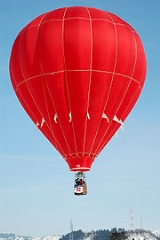
hot air balloons and
gas balloons, and steerable
airships such as blimps and
rigid airships that have an internal frame. The most successful type of rigid airship was the
Zeppelin. Several accidents, such as the
Hindenburg fire at
Lakehurst, NJ, in 1937 led to the demise of large rigid airships.
In heavier-than-air aircraft, there are two ways to produce lift: aerodynamic lift and engine lift. In the case of aerodynamic lift, the aircraft is kept in the air by wings or rotors . With engine lift, the aircraft defeats gravity by use of vertical thrust. Examples of engine lift aircraft are
rockets, and
VTOL aircraft such as the Hawker-Siddeley Harrier.
Among aerodynamically lifted aircraft, most fall in the category of
fixed-wing aircraft, where horizontal airfoils produce lift, by profiting from airflow patterns determined by
Bernoulli's equation and, to some extent, the
Coanda effect.
The forerunner of these type of aircraft is the
kite. Kites depend upon the tension between the cord which anchors it to the ground and the force of the
wind currents. Much aerodynamic work was done with kites until test aircraft, wind tunnels and now computer modelling programs became available.
In a "conventional" configuration, the lift surfaces are placed in front of a control surface or
tailplane. The other configuration is the
canard where small horizontal control surfaces are placed forward of the wings, near the nose of the aircraft. Canards are becoming more common as supersonic aerodynamics grows more mature and because the forward surface contributes lift during straight-and-level flight.
The number of lift surfaces varied in the pre-1950 period, as
biplanes and
triplanes were numerous in the early days of aviation. Subsequently most aircraft are
monoplanes. This is principally an improvement in structures and not aerodynamics.
Other possibilities include the
delta-wing, where lift and horizontal control surfaces are often combined, and the
flying wing, where there is no separate vertical control surface .
A variable geometry has also been employed in a few examples of combat aircraft .
The
lifting body configuration is where the body itself produce lift. So far, the only significant practical application of the lifting body is in the
Space Shuttle, but many aircraft generate lift from nothing other than wings alone.
A second category of aerodynamically lifted aircraft are the rotary-wing aircraft. Here, the lift is provided by rotating
aerofoils or
rotors. The best-known examples are the
helicopter, the
autogyro and the
tiltrotor aircraft . Some craft have reaction-powered rotors with gas jets at the tips but most have one or more lift rotors powered from engine-driven shafts.
A further category might encompass the
wing-in-ground-effect types, for example the Russian
ekranoplan also nicknamed the "Caspian Sea Monster" and
hovercraft; most of the latter employing a skirt and achieving limited ground or water clearance to reduce friction and achieve speeds above those achieved by
boats of similar weight.
A recent innovation is a completely new class of aircraft, the fan wing. This uses a fixed wing with a forced airflow produced by cylindrical fans mounted above. It is in development in the
United Kingdom.
And finally the flapping-wing
ornithopter is a category of its own. These designs may have potential but currently have no major practical applications.
By propulsion
Some types of aircraft, such as the balloon or
glider, do not have any propulsion. Balloons drift with the wind, though normally the pilot can control the altitude either by heating the air or by releasing ballast, giving some directional control . For gliders, takeoff takes place from a high location, or the aircraft is pulled into the air by a ground-based winch or vehicle, or towed aloft by a powered "tug" aircraft.
Airships combine a balloon's
buoyancy with some kind of propulsion, usually
propeller driven.
Until
World War II, the
internal combustion piston engine was virtually the only type of propulsion used for powered aircraft. The piston engine is still used in the majority of aircraft produced, since it is efficient at the lower altitudes used by small aircraft, but the
radial engine has largely given way to the
horizontally-opposed engine . Water cooled
V engines, as used in automobiles, were common in high speed aircraft, until they were replaced by jet and turbine power. Piston engines typically operate using avgas or regular gasoline, though some new ones are being designed to operate on diesel or jet fuel. Piston engines normally become less efficient above 7,000-8,000 ft above sea level because there is less oxygen available for combustion; to solve that problem, some piston engines have mechanically powered compressors or turbine-powered
turbochargers or turbonormalizers that compress the air before feeding it into the engine; these piston engines can often operate efficiently at 20,000 ft above sea level or higher, altitudes that require the use of supplemental oxygen or cabin pressurization.
During the forties and especially following the
1973 energy crisis, development work was done on propellers with swept tips or even scimitar-shaped blades for use in high-speed commercial and military transports.
Pressurised aircraft, however, are more likely to use the
turbine engine, since it is naturally efficient at higher altitudes and can operate above 40,000 ft. Helicopters also typically use turbine engines. In addition to turbine engines like the
turboprop and
turbojet, other types of high-altitude, high-performance engines have included the
ramjet and the
pulse jet. Rocket aircraft have occasionally been experimented with. They are restricted to rather specialised niches, such as
spaceflight, where no oxygen is available for combustion .
By usage
The major distinction in aircraft usage is between
military aviation, which includes all uses of aircraft for military purposes , and
civil aviation, which includes all uses of aircraft for non-military purposes.
Military aircraft
Combat aircraft like fighters or bombers represent only a minority of the category. Many civil aircraft have been produced in separate models for military use, such as the civil
Douglas DC-3 airliner, which became the military
C-47/C-53/R4D transport in the U.S. military and the "Dakota" in the UK and the
Commonwealth. Even the small fabric-covered two-seater
Piper J3 Cub had a military version, the L-4 liaison, observation and trainer aircraft. In the past, gliders and balloons have also been used as military aircraft; for example, balloons were used for observation during the
American Civil War and
World War I, and cargo gliders were used during
World War II to land troops.
Combat aircraft themselves, though used a handful of times for reconnaissance and
surveillance during the
Italo-Turkish War, did not come into widespread use until the
Balkan War when
first air-dropped bomb was invented and widely used by Bulgarian air force against
Turkey.
On January 24, 1913 the first naval co-operation mission took place by
Greek Air Force planes above the Dardanelles.
During
World War I many types of aircraft were adapted for attacking the ground or enemy vehicles/ships/guns/aircraft, and the first aircraft designed as
bombers were born. In order to prevent the enemy from bombing,
fighter aircraft were developed to intercept and shoot down enemy aircraft. Tankers were developed after
World War II to refuel other aircraft in mid-air, thus increasing their operational range. By the time of the
Vietnam War,
helicopters had come into widespread military use, especially for transporting, supplying, and supporting ground troops.
Civil aviation
Civil aviation includes both scheduled airline flights and
general aviation, a catch-all covering other kinds of private and commercial use. The vast majority of flights flown around the world each day belong to the general aviation category, ranging from recreational balloon flying to civilian flight training to business trips to firefighting to medevac flights to cargo transportation on
freight aircraft.
Within general aviation, the major distinction is between private flights and commercial flights . Private pilots use aircraft primarily for personal travel, business travel, or recreation. Usually these private pilots own their own aircraft and take out loans from banks or specialized lenders to purchase them. Commercial general aviation pilots use aircraft for a wide range of tasks, such as flight training, pipeline surveying, passenger and freight transport, policing, crop dusting, and medical transport . Piston-powered propeller aircraft are especially common for both private and commercial general aviation, but even private pilots occasionally own and operate helicopters like the
Bell JetRanger or turboprops like the
Beechcraft King Air. Business jets are typically flown by commercial pilots, although there is a new generation of small jets arriving soon for private pilots.
Future Developments
A number of future aircraft development projects are under way, ranging from relatively simple aerodynamic enhancements to the development of new engine technologies to all-new designs such as the Blended Wing-Body. The Peebles Fanwing is an example of a new approach to lift.
To date there has been only limited consideration of alternative fuels for aircraft.
Hydrogen is perhaps the most obvious alternative to existing kerosene/
gasoline-type fuels, but the technical and infrastructural challenges inherent in developing a commercially usable hydrogen-powered aircraft are huge. The
Russian manufacturer
Tupolev built a prototype hydrogen-powered version of the
Tu-154 airliner, named the
Tu-155, which made its first flight in 1989.
See also
Lists
- List of aircraft by category
- List of aircraft by date and usage category
- List of civil aircraft
- List of helicopter models
- List of military aircraft
- List of World War II jet aircraft
- List of aircraft engines
- List of aviation, aerospace and aeronautical terms
- List of early flying machines
- List of altitude records reached by different aircraft types
- List of large aircraft
Topics
...
...
External links
History- - Excellent online collection with a particular focus on history of aircraft and spacecraft
Information- — Provided by New Scientist is a weekly international [i] science magazine [i] covering recent developments in sci ...
. - - Information Portal about Homebuilt Aircraft
-
-
- published on Usenet
- – hundreds of photos of aircraft around the world
Patents- US -- Flying machine -- O. & W. Wright
Groups and Societies- - Gyroplanes, gyrocopters, autogyros in South Africa