


Nuclear submarine

Encyclopedia
.jpg)
Submarine
A submarine is a watercraft capable of independent operation below the surface of the water. It differs from a submersible, which has more limited underwater capability...
powered by a nuclear reactor
Nuclear reactor
A nuclear reactor is a device to initiate and control a sustained nuclear chain reaction. Most commonly they are used for generating electricity and for the propulsion of ships. Usually heat from nuclear fission is passed to a working fluid , which runs through turbines that power either ship's...
(see also nuclear marine propulsion
Nuclear marine propulsion
Nuclear marine propulsion is propulsion of a ship by a nuclear reactor. Naval nuclear propulsion is propulsion that specifically refers to naval warships...
). The performance advantages of nuclear submarines over "conventional" (typically diesel-electric
Diesel-electric
Diesel-electric transmission or diesel-electric powertrain is used by a number of vehicle and ship types for providing locomotion.A diesel-electric transmission system includes a diesel engine connected to an electrical generator, creating electricity that powers electric traction motors...
) submarines are considerable: nuclear propulsion
Nuclear marine propulsion
Nuclear marine propulsion is propulsion of a ship by a nuclear reactor. Naval nuclear propulsion is propulsion that specifically refers to naval warships...
, being completely independent of air, frees the submarine from the need to surface frequently, as is necessary for conventional submarines; the large amount of power generated by a nuclear reactor allows nuclear submarines to operate at high speed for long durations; and the long interval between refuellings grants a range limited only by consumables such as food. Current generations of nuclear submarines never need to be refueled throughout their 25-year lifespans. Conversely, the limited power stored in electric batteries means that even the most advanced conventional submarine
Submarine
A submarine is a watercraft capable of independent operation below the surface of the water. It differs from a submersible, which has more limited underwater capability...
can only remain submerged for a few days at slow speed, and only a few hours at top speed; recent advances in air-independent propulsion
Air-independent propulsion
Air-independent propulsion is a term that encompasses technologies which allow a submarine to operate without the need to surface or use a snorkel to access atmospheric oxygen. The term usually excludes the use of nuclear power, and describes augmenting or replacing the diesel-electric propulsion...
have eroded this disadvantage somewhat. The high cost of nuclear technology means that relatively few states have fielded nuclear submarines. Some of the most serious nuclear and radiation accidents
Nuclear and radiation accidents by death toll
There have been more than 20 nuclear and radiation accidents involving fatalities. These involved nuclear power plant accidents, nuclear submarine accidents, radiotherapy accidents, and other mishaps.-Chernobyl disaster:...
in the world have involved Soviet nuclear submarine mishaps.
History
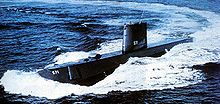
The United States launched the , the first nuclear submarine, in 1954. Nautilus could remain underwater for up to four months without resurfacing.
Construction of the Nautilus was made possible by the successful development of a nuclear propulsion plant by a group of scientists and engineers at the Naval Reactors Branch
Naval Reactors
Naval Reactors is an umbrella term for the U.S. government office that has comprehensive responsibility for the continued safe and reliable operation of the United States Navy's nuclear propulsion program and thus for United States Naval reactors...
of the Atomic Energy Commission
United States Atomic Energy Commission
The United States Atomic Energy Commission was an agency of the United States government established after World War II by Congress to foster and control the peace time development of atomic science and technology. President Harry S...
. In July 1951, the U.S. Congress
United States Congress
The United States Congress is the bicameral legislature of the federal government of the United States, consisting of the Senate and the House of Representatives. The Congress meets in the United States Capitol in Washington, D.C....
authorized construction of the world's first nuclear-powered submarine, under the leadership of Captain Hyman G. Rickover
Hyman G. Rickover
Hyman George Rickover was a four-star admiral of the United States Navy who directed the original development of naval nuclear propulsion and controlled its operations for three decades as director of Naval Reactors...
, USN.
The Westinghouse Corporation was assigned to build its reactor. After the submarine was completed, Mamie Eisenhower
Mamie Eisenhower
Mamie Geneva Doud Eisenhower was the wife of President Dwight D. Eisenhower, and First Lady of the United States from 1953 to 1961.-Early life:...
broke the traditional bottle
Ship naming and launching
The ceremonies involved in naming and launching naval ships are based in traditions thousands of years old.-Methods of launch:There are three principal methods of conveying a new ship from building site to water, only two of which are called "launching." The oldest, most familiar, and most widely...
of champagne on Nautilus bow. On January 17, 1955, it began its sea trial
Sea trial
A sea trial is the testing phase of a watercraft . It is also referred to as a "shakedown cruise" by many naval personnel. It is usually the last phase of construction and takes place on open water, and can last from a few hours to many days.Sea trials are conducted to measure a vessel’s...
s after leaving its dock in Groton, Connecticut
Groton, Connecticut
Groton is a town located on the Thames River in New London County, Connecticut, United States. The population was 39,907 at the 2000 census....
. The submarine was 320 feet long, and cost about $55 million.
The Soviet Union
Soviet Union
The Soviet Union , officially the Union of Soviet Socialist Republics , was a constitutionally socialist state that existed in Eurasia between 1922 and 1991....
soon followed the United States
United States
The United States of America is a federal constitutional republic comprising fifty states and a federal district...
in developing nuclear-powered submarines in the 1950s. Stimulated by the U.S. development of the Nautilus, Soviet work on nuclear propulsion reactors began in the early 1950s at the Institute of Physics and Power Engineering, in Obninsk
Obninsk
Obninsk is a city in Kaluga Oblast, Russia, located southwest of Moscow. Population: Obninsk is one of the major Russian science cities. The first nuclear power plant in the world for the large-scale production of electricity opened here on June 27, 1954, and it also doubled as a training...
, under Anatoliy P. Alexandrov, later to become head of the Kurchatov Institute
Kurchatov Institute
The Kurchatov Institute is Russia's leading research and development institution in the field of nuclear energy. In the Soviet Union it was known as I. V. Kurchatov Institute of Atomic Energy , abbreviated KIAE . It is named after Igor Kurchatov....
. In 1956, the first Soviet propulsion reactor designed by his team began operational testing. Meanwhile, a design team under Vladimir N. Peregudov worked on the vessel that would house the reactor.
After overcoming many obstacles, including steam generation
Steam generator (nuclear power)
Steam generators are heat exchangers used to convert water into steam from heat produced in a nuclear reactor core. They are used in pressurized water reactors between the primary and secondary coolant loops....
problems, radiation
Radiation
In physics, radiation is a process in which energetic particles or energetic waves travel through a medium or space. There are two distinct types of radiation; ionizing and non-ionizing...
leaks, and other difficulties, the first nuclear submarine based on these combined efforts entered service in the Soviet Navy
Soviet Navy
The Soviet Navy was the naval arm of the Soviet Armed Forces. Often referred to as the Red Fleet, the Soviet Navy would have played an instrumental role in a Warsaw Pact war with NATO, where it would have attempted to prevent naval convoys from bringing reinforcements across the Atlantic Ocean...
in 1958.
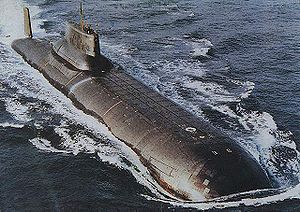
Cold War
The Cold War was the continuing state from roughly 1946 to 1991 of political conflict, military tension, proxy wars, and economic competition between the Communist World—primarily the Soviet Union and its satellite states and allies—and the powers of the Western world, primarily the United States...
, approximately five to ten nuclear submarines were being commissioned from each of the four Soviet submarine yards (Sevmash
Sevmash
JSC PO Sevmash is a shipbuilding company based in Severodvinsk, a port city on Russia's White Sea. The name Sevmash is an abbreviation of Severnoye Mashinostroitelnoye Predpriyatie , i.e. "Northern Machine-Building Enterprise". Sevmash is the largest shipbuilding enterprise in Russia and today the...
in Severodvinsk
Severodvinsk
Severodvinsk is a city in the north of Arkhangelsk Oblast, Russia, located in the delta of the Northern Dvina River, west of Arkhangelsk. Administratively, it is incorporated as a town of oblast significance . Municipally, it is incorporated as Severodvinsk Urban Okrug. The city was founded as...
, Admiralteyskiye Verfi in St. Petersburg, Krasnoye Sormovo in Nizhny Novgorod
Nizhny Novgorod
Nizhny Novgorod , colloquially shortened to Nizhny, is, with the population of 1,250,615, the fifth largest city in Russia, ranking after Moscow, St. Petersburg, Novosibirsk, and Yekaterinburg...
, and Amurskiy Zavod in Komsomolsk-on-Amur
Komsomolsk-on-Amur
Komsomolsk-on-Amur is a city in Khabarovsk Krai, Russia, situated on the left bank of Amur River. It is located on the BAM railway line, northeast of Khabarovsk. Population: -Geography and climate:...
).
From the late 1950s through the end of 1997, the Soviet Union
Soviet Union
The Soviet Union , officially the Union of Soviet Socialist Republics , was a constitutionally socialist state that existed in Eurasia between 1922 and 1991....
, and later Russia
Russia
Russia or , officially known as both Russia and the Russian Federation , is a country in northern Eurasia. It is a federal semi-presidential republic, comprising 83 federal subjects...
, built a total of 245 nuclear submarines, more than all other nations combined.
Today, six countries deploy some form of nuclear-powered strategic submarines: the United States
United States
The United States of America is a federal constitutional republic comprising fifty states and a federal district...
, Russia
Russia
Russia or , officially known as both Russia and the Russian Federation , is a country in northern Eurasia. It is a federal semi-presidential republic, comprising 83 federal subjects...
, France
France
The French Republic , The French Republic , The French Republic , (commonly known as France , is a unitary semi-presidential republic in Western Europe with several overseas territories and islands located on other continents and in the Indian, Pacific, and Atlantic oceans. Metropolitan France...
, the United Kingdom
United Kingdom
The United Kingdom of Great Britain and Northern IrelandIn the United Kingdom and Dependencies, other languages have been officially recognised as legitimate autochthonous languages under the European Charter for Regional or Minority Languages...
, People's Republic of China
People's Republic of China
China , officially the People's Republic of China , is the most populous country in the world, with over 1.3 billion citizens. Located in East Asia, the country covers approximately 9.6 million square kilometres...
, and India
India
India , officially the Republic of India , is a country in South Asia. It is the seventh-largest country by geographical area, the second-most populous country with over 1.2 billion people, and the most populous democracy in the world...
. Several other countries, including Argentina
Argentina
Argentina , officially the Argentine Republic , is the second largest country in South America by land area, after Brazil. It is constituted as a federation of 23 provinces and an autonomous city, Buenos Aires...
and Brazil
Brazil
Brazil , officially the Federative Republic of Brazil , is the largest country in South America. It is the world's fifth largest country, both by geographical area and by population with over 192 million people...
, have ongoing projects in different phases to build nuclear-powered submarines.
In the United Kingdom, all former and current nuclear submarines for the Royal Navy
Royal Navy
The Royal Navy is the naval warfare service branch of the British Armed Forces. Founded in the 16th century, it is the oldest service branch and is known as the Senior Service...
(with the exception of three: HMS Conqueror
HMS Conqueror (S48)
HMS Conqueror was a nuclear-powered fleet submarine that served in the Royal Navy from 1971 to 1990. She was built by Cammell Laird in Birkenhead...
, HMS Renown
HMS Renown (S26)
HMS Renown was the third of the Royal Navy's Resolution-class ballistic missile submarines.Built by Cammell Laird and launched on 25 February 1967, she was decommissioned in 1996.- External links :*...
and HMS Revenge
HMS Revenge (S27)
HMS Revenge was the fourth of the Royal Navy's Resolution-class ballistic missile submarines.Built by Cammell Laird and launched on 15 March 1968, she was marked for disposal in 1992...
) have been constructed in Barrow-in-Furness
Barrow-in-Furness
Barrow-in-Furness is an industrial town and seaport which forms about half the territory of the wider Borough of Barrow-in-Furness in the county of Cumbria, England. It lies north of Liverpool, northwest of Manchester and southwest from the county town of Carlisle...
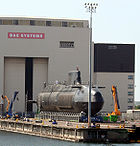
(at BAE Systems Submarine Solutions or its predecessor VSEL) where construction of nuclear submarines continues. Conqueror the only nuclear-powered submarine ever to have engaged an enemy ship with torpedoes, sinking the cruiser ARA General Belgrano
ARA General Belgrano
The ARA General Belgrano was an Argentine Navy light cruiser in service from 1951 until 1982. Formerly the , she saw action in the Pacific theater of World War II before being sold to Argentina. After almost 31 years of service, she was sunk during the Falklands War by the Royal Navy submarine ...
with two Mark 8 torpedoes during the 1982 Falklands War
Falklands War
The Falklands War , also called the Falklands Conflict or Falklands Crisis, was fought in 1982 between Argentina and the United Kingdom over the disputed Falkland Islands and South Georgia and the South Sandwich Islands...
.The only other submarine to sink a warship since World War II is the Pakistan
Pakistan
Pakistan , officially the Islamic Republic of Pakistan is a sovereign state in South Asia. It has a coastline along the Arabian Sea and the Gulf of Oman in the south and is bordered by Afghanistan and Iran in the west, India in the east and China in the far northeast. In the north, Tajikistan...
i Navy's PNS Hangor
PNS Hangor
PNS Hangor was a Daphné class submarine that served in the Pakistan Navy from 1970 to 2006. She was built by France, and was a type of diesel-electric submarine class. She earned renown, when during the 1971 Indo-Pakistani War, she sank the Indian Navy's ASW frigate INS Khukri with two Homing...
.
Technology
Nuclear reactor
A nuclear reactor is a device to initiate and control a sustained nuclear chain reaction. Most commonly they are used for generating electricity and for the propulsion of ships. Usually heat from nuclear fission is passed to a working fluid , which runs through turbines that power either ship's...
s for this task. They either generate electricity that powers electric motor
Electric motor
An electric motor converts electrical energy into mechanical energy.Most electric motors operate through the interaction of magnetic fields and current-carrying conductors to generate force...
s connected to the propeller
Propeller
A propeller is a type of fan that transmits power by converting rotational motion into thrust. A pressure difference is produced between the forward and rear surfaces of the airfoil-shaped blade, and a fluid is accelerated behind the blade. Propeller dynamics can be modeled by both Bernoulli's...
shaft or rely on the reactor heat to produce steam
Steam
Steam is the technical term for water vapor, the gaseous phase of water, which is formed when water boils. In common language it is often used to refer to the visible mist of water droplets formed as this water vapor condenses in the presence of cooler air...
that drives steam turbine
Steam turbine
A steam turbine is a mechanical device that extracts thermal energy from pressurized steam, and converts it into rotary motion. Its modern manifestation was invented by Sir Charles Parsons in 1884....
s (cf. nuclear marine propulsion
Nuclear marine propulsion
Nuclear marine propulsion is propulsion of a ship by a nuclear reactor. Naval nuclear propulsion is propulsion that specifically refers to naval warships...
). Reactors used in submarines typically use highly enriched
Enriched uranium
Enriched uranium is a kind of uranium in which the percent composition of uranium-235 has been increased through the process of isotope separation. Natural uranium is 99.284% 238U isotope, with 235U only constituting about 0.711% of its weight...
fuel
Nuclear fuel
Nuclear fuel is a material that can be 'consumed' by fission or fusion to derive nuclear energy. Nuclear fuels are the most dense sources of energy available...
(often greater than 20%) to enable them to deliver a large amount of power from a smaller reactor.
The nuclear reactor also supplies power to the submarine's other subsystems, such as for maintenance of air quality, fresh water production by distilling salt water from the ocean, temperature regulation, etc. All naval nuclear reactors currently in use are operated with diesel generator
Diesel generator
A diesel generator is the combination of a diesel engine with an electrical generator to generate electrical energy....
s as a backup power system. These engines are able to provide emergency electrical power for reactor decay heat
Decay heat
Decay heat is the heat released as a result of radioactive decay. This is when the radiation interacts with materials: the energy of the alpha, beta or gamma radiation is converted into the thermal movement of atoms.-Natural occurrence:...
removal, as well as enough electric power to supply an emergency propulsion mechanism. Submarines may carry nuclear fuel for up to 30 years of operation. The only resource that limits the time underwater is the food supply for the crew and maintenance of the vessel.
The stealth weakness of nuclear submarines is the need to cool the reactor even when the submarine is not moving; about 70% of the reactor output heat is coupled into the sea water. This leaves a "thermal wake", a plume of warm water of lower density which ascends to the sea surface and creates a "thermal scar" observable by thermal imaging systems, e.g. FLIR.
Decommissioned
- SCB-64:
- SCB-64A:
- SCB-121: Skate class attack submarinesSkate class submarineThe Skate-class submarines were the United States Navy's first production run of nuclear powered submarines. They were an evolution of the Tang class in everything but their propulsion plants, which were based on the experimental . The four Skate class boats re-introduced stern torpedo tubes...
- SCB-132:
- SCB-137A:
- SCB-154: Skipjack class attack submarinesSkipjack class submarineThe Skipjack class was a class of United States Navy nuclear submarines. This class was named after its lead ship, the . This new class introduced the teardrop hull and the S5W reactor to U.S. nuclear submarines. The Skipjacks were the fastest U.S...
- SCB-178:
- SCB-180A: George Washington class ballistic missile submarinesGeorge Washington class submarineThe George Washington class was a class of nuclear-powered ballistic missile submarines deployed by the United States Navy. The Navy ordered a class of nuclear-powered submarines armed with long-range strategic missiles on 31 December 1957, and tasked Electric Boat with converting two existing...
- SCB-180: Ethan Allen class ballistic missile submarinesEthan Allen class submarineThe Ethan Allen class of fleet ballistic missile submarine was an evolutionary development from the George Washington class. The Ethan Allen, together with the , , , and classes comprise the "41 for Freedom."...
- SCB-188: Permit class attack submarinesThresher/Permit class submarineThe Thresher/Permit-class was a class of nuclear-powered fast attack submarines in service with the United States Navy from the 1960s until 1994. They replaced the class...
- SCB-188A: Sturgeon class attack submarinesSturgeon class submarineThe Sturgeon class were a class of nuclear-powered fast attack submarines in service with the United States Navy from the 1960s until 2004. They were the "work horses" of the submarine attack fleet throughout much of the Cold War...
- SCB-216: Lafayette class ballistic missile submarinesLafayette class submarineThe Lafayette class of submarine was an evolutionary development from the of fleet ballistic missile submarine, slightly larger and generally improved...
- SCB-216: James Madison class ballistic missile submarinesJames Madison class submarineThe James Madison class of submarine was an evolutionary development from the of fleet ballistic missile submarine. They were identical to the Lafayettes except for being designed to carry the Polaris A-3 missile instead of the earlier A-2. During the late 1970s and early 1980s, select units were...
- SCB-216: Benjamin Franklin class ballistic missile submarinesBenjamin Franklin class submarineThe Benjamin Franklin class of submarine was an evolutionary development from the of fleet ballistic missile submarine. Having quieter machinery and other improvements, they are considered a separate class. A subset of this class is the re-engineered 640 class starting with...
- NR-1
- SCB-245:
- SCB-302:
Operational
- SCB-303: Los Angeles class attack submarinesLos Angeles class submarineThe Los Angeles class, sometimes called the LA class or the 688 class, is a class of nuclear-powered fast attack submarines that forms the backbone of the United States submarine fleet. With 43 submarines on active duty and 19 retired, the Los Angeles class is the most numerous nuclear powered...
- SCB-304: Ohio class ballistic missile submarinesOhio class submarineThe Ohio class is a class of nuclear-powered submarines used by the United States Navy. The United States has 18 Ohio-class submarines:...
- Seawolf class attack submarinesSeawolf class submarineThe Seawolf class is a class of nuclear-powered fast attack submarines in service with the United States Navy. The class was the intended successor to the , ordered at the end of the Cold War in 1989. At one time, an intended fleet of 29 submarines was to be built over a ten-year period, later...
- Virginia class attack submarinesVirginia class submarineThe Virginia class is a class of nuclear-powered fast attack submarines in service with the United States Navy. The submarines are designed for a broad spectrum of open-ocean and littoral missions...
Under development
- Ohio replacement SSBN(X)SSBN-X future follow-on submarineThe SSBN-X Future Follow-on Submarine is a future United States Navy submarine designed to replace the Trident missile-armed ballistic missile submarines.-Overview:...
(In development)
Decommissioned
- Project 627 (November) attack submarinesNovember class submarineThe Project 627 class submarine was the Soviet Union's first class of nuclear-powered submarines. The North Atlantic Treaty Organization used the standard radio communication phonetic alphabet to denote submarine classes...
- Project 645 test attack submarine K-27Soviet submarine K-27The K-27 was the only submarine of Projekt 645 in the Soviet Navy. Project 645 did not have or need its own NATO reporting name. That project produced just one test model nuclear submarine, one which incorporated a pair of experimental VT-1 nuclear reactors that used a liquid-metal coolant ,...
- Project 658 (Hotel) ballistic missile submarinesHotel class submarineThe Hotel class is the general NATO classification for a type of nuclear-powered ballistic missile submarine that was originally put into service by the Soviet Union around 1959. The Soviet designation is Project 658.-Design:...
- Project 659/675 (Echo) cruise missile submarinesEcho class submarineThe Echo class submarines were nuclear cruise missile submarines of the Soviet Navy built during the 1960s. Their Soviet designation was Project 659 class for the first five vessels, and Project 675 for the following twenty-nine...
- Project 661 (Papa) attack submarinesPapa class submarineSoviet submarine K-162 was the world's fastest submarine. The first submarine constructed with a titanium hull, she was the only vessel of the Soviet Union's Project 661 Anchar nuclear-powered attack submarine design. The boat is best known in the West by its NATO reporting name Papa class...
- Project 667 (Yankee) ballistic missile submarinesYankee class submarineThe Yankee class is the NATO classification for a type of nuclear-powered submarine that was constructed by the Soviet Union from 1968 onward. 34 units were produced under Project 667A Navaga and Project 667AU Nalim...
- Project 667B, Murena (Delta I) ballistic missile submarinesDelta class submarineThe Delta class is a class of submarines which formed the backbone of the Soviet and Russian strategic submarine fleet since its introduction in 1973...
- Project 667BD, Murena-M (Delta II) ballistic missile submarinesDelta class submarineThe Delta class is a class of submarines which formed the backbone of the Soviet and Russian strategic submarine fleet since its introduction in 1973...
- Project 670 (Charlie) cruise missile submarinesCharlie class submarineThe Charlie class submarine is a nuclear powered cruise missile submarine built for the Soviet Navy and later operated by the Russian Navy.-Background:...
- Project 671 (Victor) attack submarinesVictor class submarineThe Victor class is the NATO reporting name for a type of nuclear-powered submarine that was originally put into service by the Soviet Union around 1967. In the USSR, they were produced as Project 671. Victor-class subs featured a teardrop shape, which allowed them to travel at high speed...
- Project 678 (X-Ray) research submersible
- Project 685 (Mike) attack submarine K-278 KomsomoletsSoviet submarine K-278 KomsomoletsK-278 Komsomolets was the only Project 685 Плавник nuclear-powered attack submarine of the Soviet Navy. The boat sank in 1989 and is currently resting on the floor of the Barents Sea, one mile deep, with its nuclear reactor and two nuclear warheads still on board...
- Project 705 (Alfa) attack submarinesAlfa class submarineThe Soviet Union/Russian Navy Project 705 was a class of hunter/killer nuclear powered submarines. The class is also known by the NATO reporting name of Alfa...
Operational submarines
- Project 941 (Typhoon) ballistic missile submarinesTyphoon class submarineThe Project 941 or Akula, Russian "Акула" class submarine is a type of nuclear-powered ballistic missile submarine deployed by the Soviet Navy in the 1980s...
- Project 945 (Sierra) attack submarinesSierra class submarineThe Sierra I class or Project 945 nuclear submarine was the Soviet Union's successor class to the partly successful Project 705 Lira class submarine...
- Project 949 (Oscar) cruise missile submarinesOscar class submarineThe Project 949 and Project 949A Soviet Navy/Russian Navy cruise missile submarines ....
- Project 667BDR, Kalmar (Delta III) ballistic missile submarinesDelta class submarineThe Delta class is a class of submarines which formed the backbone of the Soviet and Russian strategic submarine fleet since its introduction in 1973...
- Project 667BDRM, Delfin (Delta IV) ballistic missile submarinesDelta class submarineThe Delta class is a class of submarines which formed the backbone of the Soviet and Russian strategic submarine fleet since its introduction in 1973...
- Project 1910 (Uniform) special purpose submarines
- Project 971 (Akula) attack submarinesAkula class submarineProject 971 Щука-Б , is a nuclear-powered attack submarine first deployed by the Soviet Navy in 1986...
- Project 671RTM Shchuka (Victor III) attack submarinesVictor class submarineThe Victor class is the NATO reporting name for a type of nuclear-powered submarine that was originally put into service by the Soviet Union around 1967. In the USSR, they were produced as Project 671. Victor-class subs featured a teardrop shape, which allowed them to travel at high speed...
Under development
- Project 885 (Graney) attack submarinesGraney class submarineThe Yasen-class submarine , also known in the literature as the Graney class and Severodvinsk class, is a new Russian nuclear multipurpose attack submarine class...
(In development) - Project 935 (Borei) ballistic missile submarinesBorei class submarineThe Borei class is a class of nuclear-powered ballistic missile submarine produced and operated by the Russian Navy. The class is intended to replace the Delta III, Delta IV and Typhoon classes now in Russian Navy service...
(Sea trials)
Decommissioned
- Valiant class attack submarinesValiant class submarineThe Valiant class were a class of nuclear-powered fleet submarines in service with the Royal Navy from the mid 1960s until 1994. They were the first fully British nuclear fleet submarine; the earlier used an American nuclear reactor...
- Resolution class ballistic missile submarinesResolution class submarineThe Resolution-class submarine armed with the Polaris missile was the United Kingdom's primary nuclear deterrent from the late 1960s to 1994, when they were replaced by the Vanguard-class submarine carrying the Trident II.-Background:...
- Churchill class attack submarinesChurchill class submarineThe three Improved Valiant class submarines, sometimes known as the Churchill class, were nuclear powered fleet submarines which served with the Royal Navy from the 1970s until the early 1990s...
- Swiftsure class attack submarinesSwiftsure class submarineThe Swiftsure class were a class of nuclear-powered fleet submarines in service with the Royal Navy from the early 1970s until 2010....
Operational
- Trafalgar class attack submarinesTrafalgar class submarineThe Trafalgar class is a class of nuclear-powered fleet submarines in service with the Royal Navy. They are a direct follow on from the Swiftsure class and were, until the introduction of the Astute class, the Royal Navy's most advanced nuclear fleet submarines.Seven boats were built and...
- Vanguard class ballistic missile submarinesVanguard class submarineThe Vanguard class are the Royal Navy's current nuclear ballistic missile submarines , each armed with up to 16 Trident II Submarine-launched ballistic missiles...
- Astute class attack submarinesAstute class submarineThe Astute-class is the latest class of nuclear-powered fleet submarines in service with the Royal Navy. The class sets a new standard for the Royal Navy in terms of weapons load, communication facilities and stealth. The boats are being constructed by BAE Systems Submarine Solutions at...
Under development
- Vanguard replacement SSBNBritish replacement of the Trident systemThe British replacement of Trident is a proposal to replace the existing Vanguard class of four Trident ballistic-missile armed submarines with a new class designed to continue a nuclear deterrent after the current boats reach the end of their service lives...
(In development)
Decommissioned
- Redoutable class ballistic missile submarines
Operational
- Rubis class attack submarinesRubis class submarineThe Rubis type is a class of first-generation nuclear attack submarines of the French Navy. They are the most compact nuclear attack submarines to date.All submarines of the class are named after gemstones.-History:...
- Triomphant class ballistic missile submarines
Under development
- Barracuda class attack submarines (In development)
Operational
- Type 091 (Han) attack submarines
- Type 092 (Xia) ballistic missile submarines
- Type 093 (Shang) attack submarinesType 093 submarineThe Type 093 is a nuclear powered attack submarine class deployed by the Chinese People's Liberation Army Navy. These boats are expected to replace the older Type 091 SSNs currently in service...
- Type 094 (Jin) ballistic missile submarinesType 094 submarineThe Type 094 is a new class of ballistic missile submarine developed by the Chinese People's Liberation Army Navy. The first-of-class was constructed at Huludao Shipyard in Huludao, Liaoning Province and launched in July 2004...
Under development
- Type 095 attack submarinesType 095 submarineThe Type 095 is a proposed class of third generation nuclear-powered attack submarines for the People's Liberation Army Navy of the People's Republic of China....
(In development) - Type 096 (Tang) ballistic missile submarinesType 096 submarineThe Type 096 submarine is a new class of SSBN rumored to be in development for the Chinese People's Liberation Army Navy . Little information exists about the project. Some sources suggests that the new submarine will carry 24 SLBMs. It will be the successor to the Type 094 SSBN currently under...
(In development)
Under development
- INS Arihant, currently undergoing sea-trials. Scheduled to be operational in 2012.
Accidents
Some of the most serious nuclear and radiation accidentsNuclear and radiation accidents by death toll
There have been more than 20 nuclear and radiation accidents involving fatalities. These involved nuclear power plant accidents, nuclear submarine accidents, radiotherapy accidents, and other mishaps.-Chernobyl disaster:...
in the world have involved Soviet nuclear submarine mishaps. Notable nuclear submarine accidents include:
- K-19Soviet submarine K-19K-19, KS-19, BS_19 was one of the first two Soviet submarines of the 658, 658м, 658с class , the first generation nuclear submarine equipped with nuclear ballistic missiles, specifically the R-13 . Its keel was laid down on 17 October 1958, christened on 8 April 1959 and launched on 11 October 1959...
, 4 July 1961, the reactor almost had a meltdown and exploded, resulting in 8 deaths and more than 30 other people being over-exposed to radiation. The events on board the submarine are dramatized by the film K-19: The WidowmakerK-19: The WidowmakerK-19: The Widowmaker is a movie released on July 19, 2002, about the first of many disasters that befell the Soviet submarine of the same name. The film was directed by Kathryn Bigelow...
., 1963, was lost during deep diving tests and later investigation concluded that failure of a brazed pipe joint and ice formation in the ballast blow valves prevented surfacing. The accident motivated a number of safety changesSUBSAFESUBSAFE is a quality assurance program of the United States Navy designed to maintain the safety of the nuclear submarine fleet; specifically, to provide maximum reasonable assurance that subs' hulls will stay watertight, and that they can recover from unanticipated flooding.SUBSAFE covers all...
to the US fleet., 1968, lost. - K-27Soviet submarine K-27The K-27 was the only submarine of Projekt 645 in the Soviet Navy. Project 645 did not have or need its own NATO reporting name. That project produced just one test model nuclear submarine, one which incorporated a pair of experimental VT-1 nuclear reactors that used a liquid-metal coolant ,...
, 24 May 1968, experienced a near meltdown of one of its liquid metal (lead-bismuth) cooledLiquid metal cooled reactorA liquid metal cooled nuclear reactor, liquid metal fast reactor or LMFR is an advanced type of nuclear reactor where the primary coolant is a liquid metal. Liquid metal cooled reactors were first adapted for nuclear submarine use but have also been extensively studied for power generation...
VT-1 reactorVT-1 reactorThe VT-1 reactor was the nuclear fission reactor used in a pair to power Soviet submarine K-27 as part of the Soviet Navy's Project 645 Кит-ЖМТ. It is a liquid metal cooled reactor , using highly enriched uranium-235 fuel to produce 73 MWt of power....
s, resulting in 9 fatalities and 83 other injuries. The ship was deactivated by 20 July 1968. - K-431Soviet submarine K-431The Soviet submarine K-431 was a Soviet nuclear-powered submarine that had a reactor accident on August 10, 1985. An explosion occurred during refueling of the submarine at Chazhma Bay, Vladivostok...
reactor accident on 10 August 1985 resulted in 10 fatalities and 49 other people suffered radiation injuries. - K-219Soviet submarine K-219K-219 was a Navaga-class ballistic missile submarine of the Soviet Navy. She carried 16 SS-N-6 liquid-fuel missiles powered by UDMH with IRFNA, equipped with an estimated 34 nuclear warheads....
, 1986, the reactor almost had a meltdown. Sergei PremininSergei PremininSergei Preminin was a Russian sailor who sacrificed his life on the submarine K-219, when he manually prevented an impending meltdown by means of a reactor SCRAM.-Biography:Preminin's father was an electrician and his mother worked in a flax factory...
died after he manually lowered the control rods, and stopped the explosion. The submarine sank three days later. - K-278 KomsomoletsSoviet submarine K-278 KomsomoletsK-278 Komsomolets was the only Project 685 Плавник nuclear-powered attack submarine of the Soviet Navy. The boat sank in 1989 and is currently resting on the floor of the Barents Sea, one mile deep, with its nuclear reactor and two nuclear warheads still on board...
, 1989, Soviet submarine sank in Barents SeaBarents SeaThe Barents Sea is a marginal sea of the Arctic Ocean, located north of Norway and Russia. Known in the Middle Ages as the Murman Sea, the sea takes its current name from the Dutch navigator Willem Barents...
due to a fire. - K-141 KurskRussian submarine K-141 KurskK-141 Kursk was an Oscar-II class nuclear-powered cruise missile submarine of the Russian Navy, lost with all hands when it sank in the Barents Sea on August 12, 2000...
, 2000, the generally accepted theory is that a leak of hydrogen peroxideHydrogen peroxideHydrogen peroxide is the simplest peroxide and an oxidizer. Hydrogen peroxide is a clear liquid, slightly more viscous than water. In dilute solution, it appears colorless. With its oxidizing properties, hydrogen peroxide is often used as a bleach or cleaning agent...
in the forward torpedo room led to the detonation of a torpedo warhead, which in turn triggered the explosion of half a dozen other warheads about two minutes later. - Ehime Maru & USS GreenevilleEhime Maru and USS Greeneville collisionThe Ehime Maru and USS Greeneville collision was a ship collision between the United States Navy submarine USS Greeneville and the Japanese fishery high school training ship Ehime Maru on 9 February 2001, about off the south coast of Oahu, Hawaii, United States...
, February 2001, the American submarine surfaced underneath the Japanese training vessel. Nine Japanese were killed when their ship sank as a result of the collision., 2005, collided with a seamountSeamountA seamount is a mountain rising from the ocean seafloor that does not reach to the water's surface , and thus is not an island. These are typically formed from extinct volcanoes, that rise abruptly and are usually found rising from a seafloor of depth. They are defined by oceanographers as...
in the Pacific Ocean. A crew member was killed and 23 others were injured. - HMS Vanguard & Le TriomphantHMS Vanguard and Triomphant submarine collisionThe submarines HMS Vanguard and Le Triomphant collided in the Atlantic Ocean in the night between 3–4 February 2009. Both are nuclear-powered ballistic missile submarines. The Royal Navy's HMS Vanguard and the French Navy's Le Triomphant both sustained damage, but no injuries or radiation...
, February 2009, the French and British submarines collided in the Atlantic while on routine patrols. There were no injuries among the crews, but both ships were damaged during the collision.
See also
- Ballistic missile submarineBallistic missile submarineA ballistic missile submarine is a submarine equipped to launch ballistic missiles .-Description:Ballistic missile submarines are larger than any other type of submarine, in order to accommodate SLBMs such as the Russian R-29 or the American Trident...
- List of nuclear submarines
- SubmarineSubmarineA submarine is a watercraft capable of independent operation below the surface of the water. It differs from a submersible, which has more limited underwater capability...
- SSN (hull classification symbol)
External links
- Nuclear Propulsion - Federation of American ScientistsFederation of American ScientistsThe Federation of American Scientists is a nonpartisan, 501 organization intent on using science and scientific analysis to attempt make the world more secure. FAS was founded in 1945 by scientists who worked on the Manhattan Project to develop the first atomic bombs...
- V.M. Bukhalov - Atomic-powered submarine design