
All Topics  
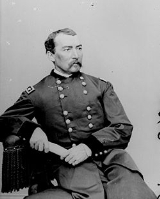
Philip Sheridan

 
Philip Sheridan

   Email Print
   Bookmark   Link


Philip Sheridan


Philip Henry Sheridan (March 6, 1831 – August 5, 1888) was a career United States Army
United States Army

The United States Army is the branch of the United States Armed Forces responsible for Army operations. It is the largest and oldest established branch of the U.S....
 officer and a Union
Union Army

The Union Army was the army that fought for the Union during the American Civil War. It was also known as the Federal Army, the U.S....
 general in the American Civil War
American Civil War

The American Civil War , also known as the War Between the States and several Naming the American Civil War, was a civil war in the United States....
. His career was noted for his rapid rise to major general
Major general (United States)

In the United States Army, United States Marine Corps, and United States Air Force, major general is a 2 star rank general officer rank, with the U.S....
 and his close association with Lt. Gen.
Lieutenant General (United States)

In the United States Army, the United States Marine Corps and the United States Air Force, lieutenant general is a 3 star rank general officer rank, with the U.S....
 Ulysses S. Grant
Ulysses S. Grant

Ulysses S. Grant, born Hiram Ulysses Grant , was an United States general and the List of Presidents of the United States President of the United States ....
, who transferred Sheridan from command of an infantry division in the Western Theater
Western Theater of the American Civil War

This article presents an overview of major military and naval operations in the Western Theater of the American Civil War....
 to lead the Cavalry Corps of the Army of the Potomac
Army of the Potomac

The Army of the Potomac was the major Union Army in the Eastern Theater of the American Civil War of the American Civil War....
 in the East. In 1864, he defeated Confederate
Confederate States Army

The Confederate States Army was a military organization whose primary mission was to provide the necessary forces and capabilities to support the National Security and defense of the Confederate States of America during its brief existence from 1861 to 1865....
 forces in the Shenandoah Valley
Valley Campaigns of 1864

The Valley Campaigns of 1864 were American Civil War operations and battles that took place in the Shenandoah Valley of Virginia from May to October 1864....
 and his destruction of the economic infrastructure of the Valley, called "The Burning" by residents, was one of the first uses of scorched earth
Scorched earth

A scorched earth policy is a military strategy or operational method which involves destroying anything that might be useful to the enemy while advancing through or withdrawing from an area....
 tactics in the war.


Discussion
Ask a question about 'Philip Sheridan'
Start a new discussion about 'Philip Sheridan'
Answer questions from other users
Full Discussion Forum


Quotations


If I owned Hell and Texas, I'd rent out Texas and live in Hell.

Circa 1867

The only good Indians I ever saw were dead.

January 1869 at Fort Cobb


Encyclopedia


Philip Henry Sheridan (March 6, 1831 – August 5, 1888) was a career United States Army
United States Army

The United States Army is the branch of the United States Armed Forces responsible for Army operations. It is the largest and oldest established branch of the U.S....
 officer and a Union
Union Army

The Union Army was the army that fought for the Union during the American Civil War. It was also known as the Federal Army, the U.S....
 general in the American Civil War
American Civil War

The American Civil War , also known as the War Between the States and several Naming the American Civil War, was a civil war in the United States....
. His career was noted for his rapid rise to major general
Major general (United States)

In the United States Army, United States Marine Corps, and United States Air Force, major general is a 2 star rank general officer rank, with the U.S....
 and his close association with Lt. Gen.
Lieutenant General (United States)

In the United States Army, the United States Marine Corps and the United States Air Force, lieutenant general is a 3 star rank general officer rank, with the U.S....
 Ulysses S. Grant
Ulysses S. Grant

Ulysses S. Grant, born Hiram Ulysses Grant , was an United States general and the List of Presidents of the United States President of the United States ....
, who transferred Sheridan from command of an infantry division in the Western Theater
Western Theater of the American Civil War

This article presents an overview of major military and naval operations in the Western Theater of the American Civil War....
 to lead the Cavalry Corps of the Army of the Potomac
Army of the Potomac

The Army of the Potomac was the major Union Army in the Eastern Theater of the American Civil War of the American Civil War....
 in the East. In 1864, he defeated Confederate
Confederate States Army

The Confederate States Army was a military organization whose primary mission was to provide the necessary forces and capabilities to support the National Security and defense of the Confederate States of America during its brief existence from 1861 to 1865....
 forces in the Shenandoah Valley
Valley Campaigns of 1864

The Valley Campaigns of 1864 were American Civil War operations and battles that took place in the Shenandoah Valley of Virginia from May to October 1864....
 and his destruction of the economic infrastructure of the Valley, called "The Burning" by residents, was one of the first uses of scorched earth
Scorched earth

A scorched earth policy is a military strategy or operational method which involves destroying anything that might be useful to the enemy while advancing through or withdrawing from an area....
 tactics in the war. In 1865, his cavalry pursued Gen. Robert E. Lee
Robert E. Lee

Robert Edward Lee , was a career United States United States Army officer , an engineer, and among the most celebrated generals in American history....
 and was instrumental in forcing his surrender at Appomattox
Appomattox Court House

File:New Appomattox Court House.jpgFile:Appomattox Court House new and old marker.jpgThe Appomattox Court House is a courthouse in Appomattox, Virginia built in 1892....
.

Sheridan prosecuted the later years of the Indian Wars
Indian Wars

Indian Wars is the name generally used in the United States to describe a series of conflicts between the colonial or federal government and the indigenous peoples of North America....
 of the Great Plains
Great Plains

The Great Plains are the broad expanse of prairie and steppe which lie west of the Mississippi River and east of the Rocky Mountains in the United States and Canada....
, tainting his reputation with some historians, who accuse him of racism and genocide. Both as a soldier and private citizen, he was instrumental in the development and protection of Yellowstone National Park
Yellowstone National Park

Yellowstone National Park, established by the U.S. Congress as a national park on March 1, 1872, is located primarily in the U.S. state of Wyoming, though it also extends into Montana and Idaho....
.

Early life

Sheridan claimed he was born in Albany, New York
Albany, New York

Albany is the Capital of the state of New York and the county seat of Albany County, New York. Albany is roughly 136 miles north of the city of New York City, and slightly south of the confluence of the Mohawk River and Hudson Rivers....
, the third child of six by John and Mary Meenagh Sheridan, immigrants from the parish of Killinkere
Killinkere

Killinkere is a large Civil parish of East Cavan province of Ulster in Ireland, noted for its fine Gaelic footballers.The leisure centre in Killinkere is one Irelands finests with two of the best football pitches in the country....
, County Cavan
County Cavan

File:Loughter.JPGCounty Cavan is a county in Republic of Ireland....
, Ireland
Ireland

Ireland is the List of islands by area in Europe, and the twentieth-largest island in the world. It lies to the north-west of continental Europe and is surrounded by hundreds of islands and islet....
. He grew up in Somerset, Ohio
Somerset, Ohio

Somerset is a village #Ohio in Perry County, Ohio, Ohio, United States. The population was 1,549 at the United States Census 2000.St. Joseph Church, the oldest Catholic church in Ohio, is located just outside of Somerset on Ohio State Route 383....
. Fully grown, he reached only 5 feet 5 inches (1.65 m) tall, a stature that led to the nickname, "Little Phil." Abraham Lincoln
Abraham Lincoln

Abraham Lincoln was the List of Presidents of the United States President of the United States. He successfully led the country through its greatest internal crisis, the American Civil War, preserving the Union and ending slavery....
 described his appearance in a famous anecdote: "A brown, chunky little chap, with a long body, short legs, not enough neck to hang him, and such long arms that if his ankles itch he can scratch them without stooping."

Sheridan worked as a boy in town general stores, and eventually as head clerk and bookkeeper for a dry goods store. In 1848, he obtained an appointment to the United States Military Academy
United States Military Academy

The United States Military Academy at West Point is a four-year coeducational United States Service academies located at West Point, New York, New York....
 from one of his customers, Congressman Thomas Ritchey
Thomas Ritchey

Thomas Ritchey was a United States House of Representatives from Ohio.Born in Bedford County, Pennsylvania, Ritchey moved to Somerset, Ohio....
; Ritchey's first candidate for the appointment was disqualified by failing an examination of mathematics skill and a "poor attitude." In his third year at West Point, Sheridan was suspended for a year for fighting with a classmate, William R. Terrill
William R. Terrill

William Rufus Terrill was a United States Army soldier and general who was killed in action at the Battle of Perryville during the American Civil War....
. The previous day, Sheridan had threatened to run him through with a bayonet in reaction to a perceived insult on the parade ground. He graduated in 1853, 34th in his class of 52 cadets.

Sheridan was commissioned as a brevet
Brevet (military)

In the U.K. and U.S. military, brevet referred to a warrant authorizing a commissioned officer to hold a higher Military rank temporarily, but usually without receiving the pay of that higher rank....
 second lieutenant
Second Lieutenant

Second Lieutenant is the lowest Officer military rank in many armed forces.In British English the rank is pronounced second /l?f't?n?nt/ , while in American English it is pronounced second /lu't?n?nt/ ....
 and was assigned to the 1st U.S. Infantry
U.S. 1st Infantry Regiment

The 1st Infantry Regiment draws its lineage from a distinguished line of post Revolutionary War Infantry Regiments and is credited with thirty-nine campaign streamers....
 regiment at Fort Duncan
Fort Duncan

Fort Duncan was a U.S. Army post, set up to protect the first U.S. settlement on the Rio Grande near the current town of Eagle Pass, Texas.Fort Duncan was established on March 27, 1849, when Captain Sidney Burbank occupied the site with companies A, B, and F of the 1st Infantry Regiment ....
, Texas
Texas

Texas is a U.S. state located in the South Central United States, nicknamed the Lone Star State. Texas is the second largest U.S. state in both area and population, spanning , and with a growing population of 24.3 million residents....
, then to the 4th U.S. Infantry
U.S. 4th Infantry Regiment

The U.S. 4th Infantry Regiment is an infantry regiment in the United States Army. It has served in the defense of the United States for approximately two hundred years....
 at Fort Reading, California
California

California is a U.S. state on the West Coast of the United States of the United States, along the Pacific Ocean. It is bordered by Oregon to the north, Nevada to the east, Arizona to the southeast, and to the south the Mexico state of Baja California....
. Most of his service with the 4th U.S. was in the Pacific Northwest
Pacific Northwest

The Pacific Northwest is a region in the northwest of North America . There are several partially overlapping definitions but the term Pacific Northwest should not be confused with the Northwest Territory or the Northwest Territories of Canada....
, starting with a topographical survey mission to the Willamette Valley
Willamette Valley

The Willamette Valley is the region in northwest Oregon in the United States that surrounds the Willamette River as it proceeds northward from its emergence from mountains near Eugene, Oregon to its confluence with the Columbia River at Portland, Oregon....
 in 1855, during which he became involved with the Yakima War
Yakima War

The Yakima War was a conflict between the United States and the Yakama people, a Sahaptian-speaking people on the Northwest Plateau, then Washington Territory and now the southern interior of Eastern Washington, from 1855 to 1858....
 and Rogue River Wars
Rogue River Wars

The Rogue River Wars was an armed conflict between the US Army, local militias and volunteers, and the Native Americans in the United States tribes commonly grouped under the designation of Rogue River , in the Rogue River Valley area of what today is southern Oregon in 1855–56....
, gaining experience in leading small combat teams, being wounded (a bullet grazed his nose on March 28, 1857, at Middle Cascade, Oregon Territory
Oregon Territory

The Oregon Territory is the name applied both to the unorganized Oregon Country claimed by both the United States and United Kingdom , as well as to the Organized incorporated territories of the United States formed from it that existed between 1848 and 1859....
), and some of the diplomatic skills needed for negotiating with Indian tribes. He lived with a mistress during part of his tour of duty, an Indian
Native Americans in the United States

Native Americans in the United States are the Indigenous peoples of the Americas from the regions of North America now encompassed by the continental United States United States, including parts of Alaska and the island state of Hawaii....
 woman named Sidnayoh (called Frances by her white friends), daughter of the chief of the Klickitat Tribe
Klickitat Tribe

The Klickitat are a Native Americans in the United States tribe of the Pacific Northwest. A Sahaptian languages tribe, their eastern neighbors were the Yakama, who speak a closely related language....
. Sheridan neglected to mention this relationship in his memoirs. He was promoted to first lieutenant
First Lieutenant

First Lieutenant is a military rank.The rank of Lieutenant has different meanings in different military formations , but the majority of cases it is common for it to be sub-divided into a senior and junior rank....
 in March 1861, just before the Civil War, and to captain in May, immediately after Fort Sumter
Battle of Fort Sumter

The Battle of Fort Sumter was the bombardment and surrender of Fort Sumter near Charleston, South Carolina, that started the American Civil War....
.

Civil War


Western Theater

In the fall of 1861, Sheridan was ordered to travel to Jefferson Barracks
Jefferson Barracks Military Post

The Jefferson Barracks Military Post, located on the Mississippi River at Lemay, Missouri, which is just south of St. Louis, Missouri, was an active U.S....
, Missouri, for assignment to the 13th U.S. Infantry
13th Infantry Regiment (United States)

The 13th Infantry Regiment is a United States Army infantry regiment whose battalions are currently tasked as basic training battalions....
. He departed from his command of Fort Yamhill
Fort Yamhill

Fort Yamhill was an United States military fortification in what became the state of Oregon. Built in 1856 in the Oregon Territory, it remained an active post until 1866....
, Oregon, by way of San Francisco
San Francisco, California

The City and County of San Francisco is the fourth most populous city in California and the List of United States cities by population in the United States, with a 2007 estimated population of 799,183....
, across the Isthmus of Panama
Isthmus of Panama

The Isthmus of Panama, also historically known as the Isthmus of Darien, is the narrow strip of land that lies between the Caribbean Sea and the Pacific Ocean, linking North America and South America....
, and through New York City
New York City

The City of New York is the List of United States cities by population in the United States, while the New York metropolitan area ranks among the List of urban areas by population....
 to home in Somerset for a brief leave. On the way to his new post, he made a courtesy call to Maj. Gen.
Major general (United States)

In the United States Army, United States Marine Corps, and United States Air Force, major general is a 2 star rank general officer rank, with the U.S....
 Henry W. Halleck in St. Louis
St. Louis, Missouri

St. Louis is an independent city in the U.S. state of Missouri, located near the confluence of the Mississippi River and the Missouri River. St....
, who commandeered his services to audit the financial records of his immediate predecessor, Maj. Gen. John C. Frémont
John C. Frémont

John Charles Fr?mont , was an United States military Commissioned officer, List of explorers, the first candidate of the History of United States Republican Party for the office of President of the United States, and the first presidential candidate of a major party to run on a platform in opposition to slavery....
, whose administration of the Department of the Missouri
Department of the Missouri

Department of the Missouri was a division of the United States Army that functioned through the American Civil War and the Indian Wars afterwards....
 was tainted by charges of wasteful expenditures and fraud that left the status of $12 million in doubt. Sheridan sorted out the mess, impressing Halleck in the process. Much to Sheridan's dismay, Halleck's vision for Sheridan consisted of a continuing role as a staff officer. Nevertheless, Sheridan performed the task assigned to him and entrenched himself as an excellent staff officer in Halleck's view.

In December, Sheridan was appointed chief commissary officer of the Army of Southwest Missouri, but convinced the department commander, Halleck, to give him the position of quartermaster general
Quartermaster general

A Quartermaster general is the staff officer in charge of supplies for a whole army....
 as well. In January 1862, he reported for duty to Maj. Gen. Samuel Curtis
Samuel Curtis

Samuel Ryan Curtis was an United States military officer, most famous for his role in the Trans-Mississippi Theater of the American Civil War....
 and served under him at the Battle of Pea Ridge
Battle of Pea Ridge

The Battle of Pea Ridge was a land battle of the American Civil War, fought on March 7 and March 8, 1862, at Pea Ridge, Arkansas in northwest Arkansas, near Bentonville, Arkansas....
. Sheridan soon discovered that officers were engaged in profiteering. They stole horses from civilians and demanded payment from Sheridan. He refused to pay for the stolen property and confiscated the horses for the use of Curtis's army. When Curtis ordered him to pay the officers, Sheridan brusquely retorted, "No authority can compel me to jayhawk or steal." Curtis had Sheridan arrested for insubordination but Halleck's influence appears to have ended any formal proceedings. Sheridan performed aptly in his role under Curtis and, now returned to Halleck's headquarters, he accompanied the army on the Siege of Corinth and served as an assistant to the department's topographical engineer, but also made the acquaintance of Brig. Gen.
Brigadier general (United States)

A brigadier general in the United States Army, United States Air Force, and United States Marine Corps, is a 1 star rank general officer, with the U.S....
 William T. Sherman, who offered him the colonel
Colonel (United States)

In the United States Army, United States Air Force, and United States Marine Corps, Colonel is a senior field officer United States Military Officer military rank just above the rank of Lieutenant Colonel and just below the rank of Brigadier General ....
cy of an Ohio infantry regiment. This appointment fell through, but Sheridan was subsequently aided by friends (including future Secretary of War
United States Secretary of War

File:Swearing in of Secretary Dwight Davis.jpgThe Secretary of War was a member of the United States President of the United States United States Cabinet, beginning with George Washington's administration....
 Russell A. Alger
Russell A. Alger

Russell Alexander Alger was a Governor of Michigan and U.S. Senator from the U.S. state of Michigan and also U.S. Secretary of War during the U.S....
), who petitioned Michigan Governor Austin Blair
Austin Blair

Austin Blair , also known as the Civil War Governor, was a politician from the U.S. state of Michigan. He was known as a strong opponent of slavery and secession and he also championed human rights by leading the effort to ban capital punishment and supporting efforts to give women and black citizens the right to vote....
 on his behalf. Sheridan was appointed colonel of the 2nd Michigan Cavalry on May 27, 1862, despite having no experience in the mounted arm.

A month later, Sheridan commanded his first forces in combat, leading a small brigade that included his regiment. At the Battle of Booneville
Battle of Booneville

The Battle of Booneville was fought on July 1, 1862, in Booneville, Mississippi, during the American Civil War. It occurred in the aftermath of the Union Army victory at the Battle of Shiloh and within the context of Confederate States Army General Braxton Bragg's efforts to recapture the rail junction at Siege of Corinth, twenty miles nort...
, Mississippi
Mississippi

Mississippi is a U.S. state located in the Deep South of the United States. Jackson, Mississippi is the state capital and largest city. The state's name comes from the Mississippi River, which flows along its western boundary, and takes its name from the Anishinaabe language word misi-ziibi ....
, July 1, 1862, he held back several regiments of Brig. Gen. James R. Chalmers's Confederate cavalry, deflected a large flanking attack with a noisy diversion, and reported critical intelligence about enemy dispositions. His actions so impressed the division commanders, including Brig. Gen. William S. Rosecrans, that they recommended Sheridan's promotion to brigadier general
Brigadier general (United States)

A brigadier general in the United States Army, United States Air Force, and United States Marine Corps, is a 1 star rank general officer, with the U.S....
. They wrote to Halleck, "Brigadiers scarce; good ones scarce. ... The undersigned respectfully beg that you will obtain the promotion of Sheridan. He is worth his weight in gold." The promotion was approved in September, but dated effective July 1 as a reward for his actions at Booneville. It was just after Booneville that one of his fellow officers gave him the horse that he named Rienzi (after the skirmish of Rienzi, Mississippi
Rienzi, Mississippi

Rienzi is a town in Alcorn County, Mississippi, Mississippi, United States. The population was 330 at the 2000 census....
), which he would ride throughout the war.

Sheridan was assigned to command the 11th Division, III Corps, in Maj. Gen. Don Carlos Buell
Don Carlos Buell

Don Carlos Buell was a career United States Army officer who fought in the Seminole War, the Mexican-American War, and the American Civil War. Buell led Union Army armies in two great Civil War battles—Battle of Shiloh and Battle of Perryville—but was relieved of field command in late 1862 and made no more significant military co...
's Army of the Ohio
Army of the Ohio

The Army of the Ohio was the name of two Union Army armies in the American Civil War. The first army became the Army of the Cumberland and the second army was created in 1863....
. On October 8, 1862, Sheridan led his division in the Battle of Perryville
Battle of Perryville

The Battle of Perryville, also known as the Battle of Chaplin Hills, was fought on October 8, 1862, in the Chaplin Hills west of Perryville, Kentucky, as the culmination of the Confederate Heartland Offensive during the American Civil War....
. Under orders from Buell and his corps commander, Maj. Gen. Charles Gilbert
Charles Champion Gilbert

Charles Champion Gilbert was a United States Army officer during the Mexican-American War and the American Civil War....
, Sheridan sent Col. Daniel McCook
Daniel McCook

Daniel McCook was an attorney and an officer in the Union army during the American Civil War. He was one of two Ohio brothers who, along with 13 of their sons, became widely known as the ?Fighting McCooks? for their contributions to the war effort....
's brigade to secure a water supply for the army. McCook drove off the Confederates and secured water for the parched Union troops at Doctor's Creek. Gilbert ordered McCook not to advance any further and then rode to consult with Buell. Along the way, Gilbert ordered his cavalry to attack the Confederates in Dan McCook's front. Sheridan heard the gunfire and came to the front with another brigade. Although the cavalry failed to secure the heights in front of McCook, Sheridan's reinforcements drove off the Southerners. Gilbert returned and ordered Sheridan to return to McCook's original position. Sheridan's aggressiveness convinced the opposing Confederates under Maj. Gen. Leonidas Polk
Leonidas Polk

Leonidas Polk was a Confederate States Army general who was once a planter in Maury County, Tennessee, and a second cousin of President of the United States James K....
, that he should remain on the defensive. His troops repulsed Confederate attacks later that day, but did not participate in the heaviest fighting of the day, which occurred on the Union left.

On December 31, 1862, the first day of the Battle of Stones River
Battle of Stones River

The Battle of Stones River or Second Battle of Murfreesboro, Tennessee , was fought from December 31, 1862, to January 2, 1863, in Middle Tennessee, as the culmination of the Stones River Campaign in the Western Theater of the American Civil War of the American Civil War....
, Sheridan anticipated a Confederate assault and positioned his division in preparation for it. His division held back the Confederate onslaught on his front until their ammunition ran out and they were forced to withdraw. This action was instrumental in giving the Union army time to rally at a strong defensive position. For his actions, he was promoted to major general on April 10, 1863 (with date of rank December 31, 1862). In six months, he had risen from captain to major general.

The Army of the Cumberland recovered from the shock of Stones River and prepared for its summer offensive against Confederate General Braxton Bragg
Braxton Bragg

Braxton Bragg was a career United States Army officer, and then a General officer in the Confederate States Army, a principal commander in the Western Theater of the American Civil War of the American Civil War....
. Sheridan's was the lead division advancing against Bragg in Rosecrans's brilliant Tullahoma Campaign
Tullahoma Campaign

The Tullahoma Campaign or Middle Tennessee Campaign was fought between June 24 and July 3, 1863, during the American Civil War. The Union Army Army of the Cumberland, commanded by Major general William S....
. On the second day of the Battle of Chickamauga
Battle of Chickamauga

The Battle of Chickamauga, fought September 19–20, 1863, marked the end of a Union Army offensive in south-central Tennessee and northwestern Georgia called the Chickamauga Campaign....
, September 20, 1863, Rosecrans was shifting Sheridan's division behind the Union battle line when Bragg launched an attack into a gap in the Confederate line. Sheridan's division made a gallant stand on Lytle Hill against an attack by the Confederate corps of Lt. Gen. James Longstreet
James Longstreet

James Longstreet was one of the foremost Confederate States Army General officers of the American Civil War and the principal subordinate to General Robert E....
, but was swamped by retreating Union soldiers. The Confederates drove Sheridan's division from the field in confusion. He gathered as many men as he could and withdrew toward Chattanooga, rallying troops along the way. Learning of Maj. Gen. George H. Thomas's XIV Corps
XIV Corps (ACW)

XIV Corps was a corps of the Union Army during the American Civil War....
 stand on Snodgrass Hill, Sheridan ordered his division back to the fighting, but they took a circuitous route and did not participate in the fighting as some histories claim. His return to the battlefield ensured that he did not suffer the fate of Rosecrans who rode off to Chattanooga leaving the army to its fate, and was soon relieved of command.

During the Battle of Chattanooga, at Missionary Ridge on November 25, 1863, Sheridan's division and others in George Thomas's army broke through the Confederate lines in a wild charge that exceeded the orders and expectations of Thomas and Ulysses S. Grant. Just before his men stepped off, Sheridan told them, "Remember Chickamauga," and many shouted its name as they advanced as ordered to a line of rifle pits in their front. Faced with enemy fire from above, however, they continued up the ridge. Sheridan spotted a group of Confederate officers outlined against the crest of the ridge and shouted, "Here's at you!" An exploding shell sprayed him with dirt and he responded, "That's damn ungenerous! I shall take those guns for that!" The Union charge broke through the Confederate lines on the ridge and Bragg's army fell into retreat. Sheridan impulsively ordered his men to pursue Bragg to the Confederate supply depot at Chickamauga Station, but called them back when he realized that his was the only command so far forward. General Grant reported after the battle, "To Sheridan's prompt movement, the Army of the Cumberland and the nation are indebted for the bulk of the capture of prisoners, artillery, and small arms that day. Except for his prompt pursuit, so much in this way would not have been accomplished."

Overland Campaign

Overland Richmond
Sheridan Staff
Lt. Gen. Ulysses S. Grant
Ulysses S. Grant

Ulysses S. Grant, born Hiram Ulysses Grant , was an United States general and the List of Presidents of the United States President of the United States ....
, newly promoted to be general-in-chief of all the Union armies, summoned Sheridan to the Eastern Theater
Eastern Theater of the American Civil War

This article presents an overview of major military and naval operations in the Eastern Theater of the American Civil War....
 to command the Cavalry Corps of the Army of the Potomac
Army of the Potomac

The Army of the Potomac was the major Union Army in the Eastern Theater of the American Civil War of the American Civil War....
. Unbeknownst to Sheridan, he was actually Grant's second choice, after Maj. Gen. William B. Franklin
William B. Franklin

William Buel Franklin was a career United States Army officer and a Union Army general in the American Civil War. He rose to the rank of a corps commander in the Army of the Potomac, fighting in several notable early battles in the Eastern Theater of the American Civil War....
, but Grant agreed to a suggestion about Sheridan from Chief of Staff Henry W. Halleck. After the war, and in his memoirs, Grant claimed that Sheridan was the very man he wanted for the job. Sheridan arrived at the headquarters of the Army of the Potomac on April 5, 1864, less than a month before the start of Grant's massive Overland Campaign
Overland Campaign

The Overland Campaign, also known as Grant's Overland Campaign and the Wilderness Campaign, was a series of battles fought in Virginia during May and June 1864, in the American Civil War....
 against Robert E. Lee
Robert E. Lee

Robert Edward Lee , was a career United States United States Army officer , an engineer, and among the most celebrated generals in American history....
.

In the early battles of the campaign, Sheridan's cavalry was relegated by army commander Maj. Gen. George G. Meade to its traditional role—screening, reconnaissance, and guarding trains and rear areas—much to Sheridan's frustration. In the Battle of the Wilderness
Battle of the Wilderness

The Battle of the Wilderness, fought May 5–7, 1864, was the first battle of Lieutenant general Ulysses S. Grant's 1864 Virginia Overland Campaign against General Robert E....
 (May 5 and May 6, 1864), the dense forested terrain prevented any significant cavalry role. As the army swung around the Confederate right flank in the direction of Spotsylvania Court House
Battle of Spotsylvania Court House

The Battle of Spotsylvania Court House, sometimes simply referred to as the Battle of Spotsylvania, was the second major battle in Lieutenant general Ulysses S....
, Sheridan's troopers failed to clear the road from the Wilderness, losing engagements along the Plank Road on May 5 and Todd's Tavern on May 6 through May 8, allowing the Confederates to seize the critical crossroads before the Union infantry could arrive.

When Meade reprimanded Sheridan for not performing his duties of screening and reconnaissance as ordered, Sheridan went directly to Meade's superior, General Grant, recommending that his corps be assigned to strategic raiding missions. Grant agreed, and from May 9 through May 24, sent him on a raid toward Richmond
Richmond, Virginia

Richmond is the Capital of the Commonwealth of Virginia, in the United States. Like all Virginia municipalities incorporated as cities, it is an independent city and not part of any county....
, directly challenging the Confederate cavalry. The raid was less successful than hoped; although his soldiers managed to kill Confederate cavalry commander Maj. Gen. J.E.B. Stuart
J.E.B. Stuart

James Ewell Brown "Jeb" Stuart was an American soldier from Virginia and a Confederate States Army general during the American Civil War. He was known to his friends as "Jeb", from the initials of his given names....
 at Yellow Tavern
Battle of Yellow Tavern

The Battle of Yellow Tavern was fought on May 11, 1864, as part of the Overland Campaign of the American Civil War. A clash between Union Army and Confederate States Army cavalry forces, it is best known for the mortal wounding of legendary Confederate cavalry commander Major General J.E.B....
 on May 11, the raid never seriously threatened Richmond and it left Grant without cavalry intelligence for Spotsylvania and North Anna
Battle of North Anna

The Battle of North Anna was fought from May 23 to May 26, 1864, as part of Union Army Lieutenant General Ulysses S. Grant's Overland Campaign against Confederate States Army Gen....
. Historian Gordon C. Rhea wrote, "By taking his cavalry from Spotsylvania Court House, Sheridan severely handicapped Grant in his battles against Lee. The Union Army was deprived of his eyes and ears during a critical juncture in the campaign. And Sheridan's decision to advance boldly to the Richmond defenses smacked of unnecessary showboating that jeopardized his command."

Rejoining the Army of the Potomac, Sheridan's cavalry fought to a technical victory at Haw's Shop
Battle of Haw's Shop

The Battle of Haw's Shop was fought on May 28 1864, in Hanover County, Virginia, as part of Union Army Lieutenant General Ulysses S. Grant's Overland Campaign against Confederate States Army Gen....
 (May 28), but one with heavy casualties and one that allowed the Confederate cavalry to obtain valuable intelligence about Union dispositions. It seized the critical crossroads that triggered the Battle of Cold Harbor
Battle of Cold Harbor

The Battle of Cold Harbor, the final battle of Union Army Lieutenant general Ulysses S. Grant's 1864 Overland Campaign during the American Civil War, is remembered as one of History of the United States bloodiest, most lopsided battles....
 (June 1 to June 12) and withstood a number of assaults until reinforced. Sheridan then proceeded on a raid to the northwest to break the Virginia Central Railroad
Virginia Central Railroad

Virginia Central Railroad was chartered as the Louisa Railroad in 1836 by the Virginia Board of Public Works and had its name changed to Virginia Central Railroad in 1850....
 and to link up with the Shenandoah Valley
Shenandoah Valley

The Shenandoah Valley is both a geographic valley and cultural region of western Virginia and West Virginia in the United States. The valley is bound to the east by the Blue Ridge Mountains, to the west by the eastern front of the Ridge-and-valley Appalachians , to the north by the Potomac River and to the south by the James River ....
 army of Maj. Gen. David Hunter
David Hunter

David Hunter was a Union Army general in the American Civil War. He achieved fame by his unauthorized 1862 order emancipating slaves in three Southern states and as the president of the military commission trying the conspirators involved with the assassination of President of the United States Abraham Lincoln....
. He was intercepted by the Confederate cavalry under Maj. Gen. Wade Hampton
Wade Hampton III

Wade Hampton III was a Confederate States of America cavalry leader during the American Civil War and afterwards a politician from South Carolina, serving as its governor and as a U.S....
 and defeated at the Battle of Trevilian Station
Battle of Trevilian Station

}|-||}The Battle of Trevilian Station was fought on June 11 and June 12, 1864, in Union Army Lieutenant General Ulysses S. Grant's Overland Campaign against Confederate States of America Gen....
, failing in all of the objectives of the raid.

History draws decidedly mixed opinions on the success of Sheridan in the Overland Campaign, in no small part because the very clear Union victory at Yellow Tavern
Battle of Yellow Tavern

The Battle of Yellow Tavern was fought on May 11, 1864, as part of the Overland Campaign of the American Civil War. A clash between Union Army and Confederate States Army cavalry forces, it is best known for the mortal wounding of legendary Confederate cavalry commander Major General J.E.B....
, highlighted by the death of Jeb Stuart, tends to overshadow other actions and battles. In Sheridan's report of the Cavalry Corps' actions in the campaign, discussing the strategy of cavalry fighting cavalry, he wrote, "The result was constant success and the almost total annihilation of the rebel cavalry. We marched when and where we pleased; we were always the attacking party, and always successful." A contrary view has been published by historian Eric J. Wittenberg, who notes that of four major strategic raids (Richmond, Trevilian, Wilson-Kautz, and First Deep Bottom) and thirteen major cavalry engagements of the campaign, only Yellow Tavern can be considered a Union victory, with Haw's Shop, Trevilian Station, Meadow Bridge, Samaria Church, and the Wilson-Kautz raid defeats in which some of Sheridan's forces barely avoided destruction.

Army of the Shenandoah

Throughout the war, the Confederacy sent armies out of Virginia through the Shenandoah Valley
Shenandoah Valley

The Shenandoah Valley is both a geographic valley and cultural region of western Virginia and West Virginia in the United States. The valley is bound to the east by the Blue Ridge Mountains, to the west by the eastern front of the Ridge-and-valley Appalachians , to the north by the Potomac River and to the south by the James River ....
 to invade Maryland
Maryland

Maryland is a U.S. state located in the Mid Atlantic States of the United States, bordering Virginia, West Virginia and the Washington, D.C. to the south and west, Pennsylvania to the north, and Delaware to the east....
 and Pennsylvania
Pennsylvania

The Commonwealth of Pennsylvania , often colloquially referred to as PA by natives and Northeasterners, is a U.S. state located in the Northeastern United States and Mid-Atlantic States regions of the United States....
 and threaten Washington, D.C.
Washington, D.C.

Washington, D.C. , formally the District of Columbia and commonly referred to as Washington, the District, or simply D.C., is the Capital of the United States, founded on July 16, 1790....
 Lt. Gen. Jubal A. Early
Jubal Anderson Early

Jubal Anderson Early was a lawyer and Confederate States of America general in the American Civil War. The articles written by him for the Southern Historical Society in the 1870s established the Lost Cause of the Confederacy point of view as a long-lasting literary and cultural phenomenon....
, following the same pattern in the Valley Campaigns of 1864
Valley Campaigns of 1864

The Valley Campaigns of 1864 were American Civil War operations and battles that took place in the Shenandoah Valley of Virginia from May to October 1864....
, and hoping to distract Grant from the Siege of Petersburg
Siege of Petersburg

The Richmond-Petersburg Campaign was a series of battles around Petersburg, Virginia, fought from June 9, 1864, to March 25, 1865, during the American Civil War....
, attacked Union forces near Washington and raided several towns in Pennsylvania. Grant, reacting to the political commotion caused by the invasion, organized the Middle Military Division
Middle Military Division

The Middle Military Division was an organization of the Union Army during the American Civil War, responsible for operations around the Shenandoah Valley of Virginia and the Valley Campaigns of 1864....
, whose field troops were known as the Army of the Shenandoah
Army of the Shenandoah

Army of the Shenandoah refers to two armies in the American Civil War:* Army of the Shenandoah * Army of the Shenandoah ...
. He considered various candidates for command, including George Meade, William B. Franklin, and David Hunter
David Hunter

David Hunter was a Union Army general in the American Civil War. He achieved fame by his unauthorized 1862 order emancipating slaves in three Southern states and as the president of the military commission trying the conspirators involved with the assassination of President of the United States Abraham Lincoln....
, with the latter two intended for the military division while Sheridan would command the army. All of these choices were rejected by either Grant or the War Department and, over the objection of Secretary of War
United States Secretary of War

File:Swearing in of Secretary Dwight Davis.jpgThe Secretary of War was a member of the United States President of the United States United States Cabinet, beginning with George Washington's administration....
 Edwin M. Stanton
Edwin M. Stanton

Edwin McMasters Stanton was an American lawyer, politician, United States Attorney General in 1860-61 and United States Secretary of War through most of the American Civil War and Reconstruction era of the United States era....
, who believed him to be too young for such a high post, Sheridan took command in both roles at Harpers Ferry
Harpers Ferry, West Virginia

Harpers Ferry is a historic town in Jefferson County, West Virginia, West Virginia. It is situated at the confluence of the Potomac River and Shenandoah Rivers where the U.S....
 on August 7, 1864. His mission was not only to defeat Early's army and to close off the Northern invasion route, but to deny the Shenandoah Valley as a productive agricultural region to the Confederacy. Grant told Sheridan, "The people should be informed that so long as an army can subsist among them recurrences of these raids must be expected, and we are determined to stop them at all hazards. ... Give the enemy no rest ... Do all the damage to railroads and crops you can. Carry off stock of all descriptions, and negroes, so as to prevent further planting. If the war is to last another year, we want the Shenandoah Valley to remain a barren waste."

Sheridan's Ride
Sheridan got off to a slow start, needing time to organize and to react to reinforcements reaching Early; Grant ordered him not to launch an offensive "with the advantage against you." And yet Grant expressed frustration with Sheridan's lack of progress. The armies remained unengaged for over a month, causing political consternation in the North as the 1864 election
United States presidential election, 1864

In the United States Presidential election of 1864, Abraham Lincoln was re-elected as president. Lincoln ran under the Republican Party banner against his former top Civil War general, the Democratic Party candidate, George B....
 drew near. The two generals conferred on September 16 at Charles Town
Charles Town, West Virginia

Charles Town is a city in Jefferson County, West Virginia, West Virginia USA. The population was 2,907 at the 2000 census. Due to its similar name, travelers have sometimes confused this city with the state's capital, Charleston, West Virginia....
 and agreed that Sheridan would begin his attacks within four days.

On September 19, Sheridan beat Early's much smaller army at Third Winchester
Battle of Opequon

}|-||}The Battle of Opequon, more commonly known as the Third Battle of Winchester, was fought in Winchester, Virginia, Virginia, on September 19, 1864, during the Valley Campaigns of 1864 in the American Civil War....
 and followed up on September 22 with a victory at Fisher's Hill
Battle of Fisher's Hill

In the Battle of Fisher's Hill, Phil Sheridan had almost 30,000 men while Jubal Anderson Early had just under 10,000. Early, following the Third Battle of Winchester took a strong position....
. As Early attempted to regroup, Sheridan began the punitive operations of his mission, sending his cavalry as far south as Waynesboro
Waynesboro, Virginia

Waynesboro, deriving its name from Anthony Wayne, is an independent city located within the confines of Augusta County, Virginia in the U.S. state of Virginia....
 to seize or destroy livestock and provisions, and to burn barns, mills, factories, and railroads. Sheridan's men did their work relentlessly and thoroughly, rendering over 400 mi.˛ uninhabitable. The destruction presaged the scorched earth
Scorched earth

A scorched earth policy is a military strategy or operational method which involves destroying anything that might be useful to the enemy while advancing through or withdrawing from an area....
 tactics of Sherman's March to the Sea through Georgia
Georgia (U.S. state)

Georgia is a U.S. state in the United States and was one of the original Thirteen Colonies that revolted against United Kingdom rule in the American Revolution....
—deny an army a base from which to operate and bring the effects of war home to the population supporting it. The residents referred to this widespread destruction as "The Burning." The Confederates were not idle during this period and Sheridan's men were plagued by guerrilla
Guerrilla warfare

Guerrilla warfare is the Irregular warfare warfare and combat with which a small group of combatants use mobile Military tactics to combat a larger and less mobile formal army....
 raids by partisan ranger Col. John S. Mosby
John S. Mosby

John Singleton Mosby also known as the "Gray Ghost," was a regular Confederate States Army Cavalry battalion commander in the American Civil War....
.

Although Sheridan assumed that Jubal Early was effectively out of action and he considered withdrawing his army to rejoin Grant at Petersburg, Early received reinforcements and, on October 19 at Cedar Creek
Battle of Cedar Creek

The Battle of Cedar Creek, or The Battle of Belle Grove, October 19, 1864, was one of the final, and most decisive, battles in the Valley Campaigns of 1864 during the American Civil War....
, launched a well-executed surprise attack while Sheridan was absent from his army, ten miles away at Winchester
Winchester, Virginia

Winchester is an independent city located in the extreme northwestern portion of the Commonwealth of Virginia in the USA. The city's population was 23,585 according to the United States Census 2000....
. Hearing the distant sounds of artillery
Artillery

Artillery is a military Combat Arms which employs any apparatus, machine, an assortment of tools or instruments, a system or systems used as weapons for the discharge of large projectiles in combat as a major contribution of fire power within the overall military capability of an armed force....
, he rode aggressively to his command. He reached the battlefield about 10:30 a.m. and began to rally his men. Fortunately for Sheridan, Early's men were too occupied to take notice; they were hungry and exhausted and fell out to pillage the Union camps. Sheridan's actions are generally credited with saving the day (although Maj. Gen. Horatio G. Wright, commanding Sheridan's VI Corps
VI Corps (ACW)

The VI Corps was a corps of the Union Army during the American Civil War....
, had already rallied his men and stopped their retreat). Early had been dealt his most significant defeat, rendering his army almost incapable of future offensive action. Sheridan received a personal letter of thanks from Abraham Lincoln and a promotion to major general in the regular army as of November 8, 1864, making him the fourth ranking general in the Army, after Grant, Sherman, and Meade. A famous poem, Sheridan's Ride, was written by Thomas Buchanan Read
Thomas Buchanan Read

'Thomas Buchanan Read' , was an American poet and portrait painter born in Chester County, Pennsylvania.Read wrote a prose romance, The Pilgrims of the Great St....
 to commemorate the general's return to the battle. Sheridan reveled in the fame that Read's poem brought him, renaming his horse Rienzi to "Winchester," based on the poem's refrain, "Winchester, twenty miles away." The poem was widely used in Republican
Republican Party (United States)

The Republican Party is one of the two major party contemporary political parties in the United States, along with the Democratic Party . It is often called the Grand Old Party or the GOP....
 campaign efforts and some have credited Abraham Lincoln's margin of victory to it.

Sheridan spent the next several months occupied with light skirmishing and fighting guerrillas. Although Grant continued his exhortations for Sheridan to move south and break the Virginia Central Railroad supplying Petersburg, Sheridan resisted. Wright's VI Corps returned to join Grant in November. Sheridan's remaining men, primarily cavalry and artillery, finally moved out of their winter quarters on February 27, 1865, and headed east. The orders from Gen. Grant were largely discretionary: they were to destroy the Virginia Central Railroad and the James River Canal
James River and Kanawha Canal

The James River and Kanawha Canal was a canal in Virginia, which was built to facilitate shipments of passengers and freight by water between the western counties of Virginia and the coast....
, capture Lynchburg
Lynchburg, Virginia

Lynchburg is an independent city in the Commonwealth of Virginia. The population was 71,282 at the 2007 United States Census. Located in the foothills of the Blue Ridge Mountains along the banks of the James River , Lynchburg is known as the "City of Seven Hills", "The Hill City" and sometimes described as "A City Unto Itself" mostly in ref...
 if practicable, then either join William T. Sherman in North Carolina or return to Winchester.

Appomattox Campaign

Sheridan interpreted Grant's orders liberally and instead of heading to North Carolina in March 1865, he moved to rejoin the Army of the Potomac at Petersburg. He wrote in his memoirs, "Feeling that the war was nearing its end, I desired my cavalry to be in at the death." His finest service of the Civil War was demonstrated during his relentless pursuit of Robert E. Lee
Robert E. Lee

Robert Edward Lee , was a career United States United States Army officer , an engineer, and among the most celebrated generals in American history....
's Army, effectively managing the most crucial aspects of the Appomattox Campaign
Appomattox Campaign

The Appomattox Campaign was a series of battles fought in Virginia that culminated in the surrender of Confederate States Army General Robert E....
 for Grant.

On the way to Petersburg, at the Battle of Waynesboro
Battle of Waynesboro

The Battle of Waynesboro, was fought on March 2, 1865, in Augusta County, Virginia, in the American Civil War. It was the last battle for Confederate States of America lieutenant general Jubal Anderson Early, whose force was destroyed....
, March 2, he trapped the remainder of Early's army and 1,500 soldiers surrendered. On April 1, he cut off Gen. Lee's lines of support at Five Forks
Battle of Five Forks

The Battle of Five Forks was fought on April 1, 1865, southwest of Petersburg, Virginia, in Dinwiddie County, during the Appomattox Campaign of the American Civil War....
, forcing Lee to evacuate Petersburg. During this battle he ruined the military career of Maj. Gen. Gouverneur K. Warren
Gouverneur K. Warren

Gouverneur Kemble Warren was a civil engineer and prominent General officer in the Union Army during the American Civil War. He is best remembered for arranging the last-minute defense of Little Round Top during the Battle of Gettysburg and is often referred to as the "Hero of Little Round Top." His subsequent service as a corps commander an...
 by removing him from command of the V Corps
V Corps (ACW)

The V Corps was a unit of the Union Army Army of the Potomac during the American Civil War....
 under circumstances that a court of inquiry later determined were unjustified.

Sheridan's aggressive and well-executed performance at the Battle of Sayler's Creek
Battle of Sayler's Creek

}|-||}The Battle of Sayler's Creek was fought April 6, 1865, southwest of Petersburg, Virginia, as part of the Appomattox Campaign, in the final days of the American Civil War....
 on April 6 effectively sealed the fate of Lee's army, capturing over 20% of his remaining men. President Lincoln sent Grant a telegram on April 7: "Gen. Sheridan says 'If the thing is pressed I think that Lee will surrender.' Let the thing be pressed." At Appomattox Court House, April 9, 1865, Sheridan blocked Lee's escape, forcing the surrender of the Army of Northern Virginia
Army of Northern Virginia

The Army of Northern Virginia was the primary military force of the Confederate States of America in the Eastern Theater of the American Civil War of the American Civil War....
 later that day. Grant summed up Little Phil's performance in these final days: "I believe General Sheridan has no superior as a general, either living or dead, and perhaps not an equal."

Reconstruction

After the surrender of Lee, and of Gen. Joseph E. Johnston
Joseph E. Johnston

Joseph Eggleston Johnston was a career United States Army officer, serving with distinction in the Mexican-American War and Seminole Wars, and was also one of the most senior general officers in the Confederate States Army during the American Civil War....
 in North Carolina, the only significant Confederate field force remaining was in Texas under Gen. Edmund Kirby Smith
Edmund Kirby Smith

Edmund Kirby Smith was a career United States Army officer, an educator, and a Full General in the Confederate States Army during the American Civil War, notable for his command of the Trans-Mississippi Department of the Confederacy after the fall of Battle of Vicksburg....
. Grant appointed Sheridan commander of the Military District of the Southwest on May 17, 1865, with orders to defeat Smith without delay and restore Texas and Louisiana to Union control. However, Smith surrendered before Sheridan reached New Orleans
New Orleans, Louisiana

New Orleans is a major United States port city and the largest city in Louisiana. New Orleans is the center of the New Orleans metropolitan area metropolitan area, the largest metro area in the state....
. Grant was also concerned about the situation in neighboring Mexico, where 40,000 French soldiers were propping up the puppet regime of Austrian Archduke Maximilian
Maximilian I of Mexico

Maximilian I was a member of Austria's Imperial Habsburg-Lorraine family who was Emperor of Mexico. With the backing of Napoleon III of France and a group of Mexican monarchy, he was proclaimed Emperor of Mexico on 10 April 1864....
, and gave Sheridan permission for a large Texas occupation force. Sheridan assembled 50,000 men in three corps, quickly occupied Texas coastal cities, spread inland, and began to patrol the U.S.-Mexico border. The Army's presence, U.S. political pressure, and the growing resistance of Benito Juárez
Benito Juárez

Benito Pablo Ju?rez Garc?a was a Zapotec people Amerindian who served five terms as president of Mexico: 1858?1861 as interim, 1861?1865, 1865?1867, 1867?1871 and 1871?1872....
 induced the French to abandon their claims against Mexico and Napoleon III
Napoleon III of France

Napol?on III, also known as Louis-Napol?on Bonaparte was the first President of the French Republic and the only emperor of the Second French Empire....
 withdrew his troops in 1866. Sheridan later admitted in his memoirs that he had supplied arms to Juárez's forces: "... supplied with arms and ammunition, which we left at convenient places on our side of the river to fall into their hands."

On July 30, 1866, while Sheridan was in Texas, a white mob broke up the state constitutional convention in New Orleans
New Orleans, Louisiana

New Orleans is a major United States port city and the largest city in Louisiana. New Orleans is the center of the New Orleans metropolitan area metropolitan area, the largest metro area in the state....
. Thirty-four blacks were killed. Shortly after Sheridan returned, he wired Grant, "The more information I obtain of the affair of the 30th in this city the more revolting it becomes. It was no riot; it was an absolute massacre." In March 1867, with Reconstruction barely started, Sheridan was appointed military governor of the Fifth Military District
Fifth Military District

The 5th Military District was a temporary administrative unit of the United States set up during the Reconstruction era of the United States period following the American Civil War....
 (Texas and Louisiana). He severely limited voter registration for former Confederates and then required that only registered voters (including black men) be eligible to serve on juries.

An inquiry into the deadly riot of 1866 implicated numerous local officials and Sheridan dismissed the mayor of New Orleans, the Louisiana attorney general, and a district judge. He later removed Louisiana Governor James M. Wells, accusing him of being "a political trickster and a dishonest man." He also dismissed Texas Governor James W. Throckmorton
James W. Throckmorton

James Webb Throckmorton was an United States politician who served as Governor of Texas from 1866 to 1867 during the early days of Reconstruction era of the United States....
, a former Confederate, for being an "impediment to the reconstruction of the State," replacing him with the Republican who had lost to him in the previous election. Sheridan had been feuding with President Andrew Johnson
Andrew Johnson

Andrew Johnson was the List of Presidents of the United States President of the United States , succeeding to the Presidency upon Abraham Lincoln assassination of Abraham Lincoln....
 for months over interpretations of the Military Reconstruction Acts and voting rights issues, and within a month of the second firing, the president removed Sheridan, stating to an outraged Gen. Grant that, "His rule has, in fact, been one of absolute tyranny, without references to the principles of our government or the nature of our free institutions."

If Sheridan was unpopular in Texas, neither did he have much appreciation for the Lone Star State. In 1866 newspapers quoted him as saying, "If I owned Texas and Hell, I would rent Texas and live in Hell", a statement which he repeated in later years in various forms.

During the Grant administration, while Sheridan was assigned to duty in the West, he was sent to Louisiana on two additional occasions to deal with problems that lingered in Reconstruction. In January 1875, federal troops intervened in the Louisiana Legislature following attempts by both Republicans and Democrats to seize control by illegal means. Sheridan supported Republican carpetbagger
Carpetbagger

In United States history, carpetbaggers was the term southerners gave to northerners who moved to the South during the Reconstruction era of the United States, between 1865 and 1877....
 Governor William P. Kellogg
William P. Kellogg

William Pitt Kellogg was an American politician and a carpetbagger governor of Louisiana from 1873-1877. He was the state's last Republican Party governor until the inauguration of David C....
, winner of the disputed 1872 state election, and declared that all opponents of his regime were "banditti" who should be subjected to military tribunals and loss of their habeas corpus
Habeas corpus

For the Living Things CD, see Habeas Corpus Habeas corpus is a legal action, or writ, through which a person can seek justice from the unlawful detention of him or herself, or of another person....
 rights. The Grant administration backed down after an enormous public outcry. A headline in the New York World
New York World

The New York World was a newspaper published in New York from 1860 until 1931. It played a major role in the history of American newspapers....
 newspaper was "Tyranny! A Sovereign State Murdered!" In 1876, Sheridan was sent to New Orleans to command troops keeping the peace in the aftermath of the disputed presidential election
United States presidential election, 1876

The United States presidential election of 1876 was one of the most disputed and intense presidential elections in American history. Samuel J. Tilden of New York defeated Ohio's Rutherford B....
.

Indian Wars

The Indians
Native Americans in the United States

Native Americans in the United States are the Indigenous peoples of the Americas from the regions of North America now encompassed by the continental United States United States, including parts of Alaska and the island state of Hawaii....
 on the Great Plains
Great Plains

The Great Plains are the broad expanse of prairie and steppe which lie west of the Mississippi River and east of the Rocky Mountains in the United States and Canada....
 had been generally peaceful during the Civil War. In 1864, major
Major (United States)

In the United States Army, United States Air Force, and United States Marine Corps, major is a field officer United States Military Officer military rank just above the rank of Captain and just below the rank of Lieutenant colonel ....
 John Chivington
John Chivington

John Milton Chivington was a 19th century United States Army officer noted for his role in the New Mexico Campaign of the American Civil War and in the Colorado War....
, a Colorado militia officer, attacked a peaceful village of Arapaho
Arapaho

The Arapaho are a tribe of Native Americans in the United States historically living on the eastern Great Plains of Colorado and Wyoming. They were close allies of the Cheyenne tribe and loosely aligned with the Sioux....
s and Southern Cheyenne
Cheyenne

Cheyenne are a native Americans in the United States nation of the Great Plains. The Cheyenne Nation is composed of two united Indian tribe, the S?'taa'e and the Ts?-ts?h?st?hese , which translates to "those like us"....
 at Sand Creek
Sand Creek Massacre

The Sand Creek Massacre was an incident in the Indian Wars of the United States that occurred on November 29, 1864, when Colorado Territory militia attacked and destroyed a village of Cheyenne and Arapaho encamped in southeastern Colorado Territory....
 in Colorado
Colorado

The State of Colorado is a U.S. state located in the Mountain States of the United States of America. Colorado may also be considered to be a part of the Western United States and Southwestern United States regions of the United States....
, killing over 150 Indians. That attack ignited a general war with the Indians. The protection of the Great Plains fell under the Department of the Missouri
Department of the Missouri

Department of the Missouri was a division of the United States Army that functioned through the American Civil War and the Indian Wars afterwards....
, an administrative area of over 1,000,000 mi.˛, encompassing all land between the Mississippi River and the Rocky Mountains. Maj. Gen. Winfield S. Hancock was assigned to the department in 1866, but had mishandled his campaign, resulting in Sioux
Sioux

Sioux are a Native Americans in the United States and First Nations people. The term can refer to any ethnic group within the Great Sioux Nation or any of the nation's many dialects....
 and Cheyenne
Cheyenne

Cheyenne are a native Americans in the United States nation of the Great Plains. The Cheyenne Nation is composed of two united Indian tribe, the S?'taa'e and the Ts?-ts?h?st?hese , which translates to "those like us"....
 raids of retaliation. The Indians continued to attack mail coaches
Stagecoach

A stagecoach is a type of four-wheeled closed coach for passengers and goods, strongly sprung and drawn by four horses, usually four-in-hand....
, burn the stations, and kill the employees. They also raped, killed, and kidnapped a considerable number of settlers on the frontier. Under pressure from the various governors in the Great Plains, General Grant turned to Phil Sheridan.

In August 1867, Grant appointed Sheridan to head the Department of the Missouri and pacify the Plains. His troops, even supplemented with state militia, were spread too thin to have any real effect. He conceived a strategy similar to the one he used in the Shenandoah Valley. In the Winter Campaign of 1868–69 he attacked the Cheyenne, Kiowa
Kiowa

The Kiowa are a nation of American Indians in the United States who migrated from what is now Canada to their present location in Southwestern Oklahoma....
, and Comanche
Comanche

The Comanche are a Native Americans in the United States ethnic group whose range consisted of present-day eastern New Mexico, southern Colorado, southern Kansas, all of Oklahoma, and most of northwest Texas....
 tribes in their winter quarters, taking their supplies and livestock and killing those who resisted, driving the rest back into their reservations
Indian reservation

An Indian reservation is an area of land managed by a Native Americans of the United States tribe under the United States Department of the Interior Bureau of Indian Affairs....
. By promoting in Congressional
United States Congress

The United States Congress is the Bicameralism legislature of the Federal government of the United States of the United States of America, consisting of two houses, the United States Senate and the United States House of Representatives....
 testimony the hunting and slaughter of the vast herds of American Bison
American Bison

The American Bison is a bovinae mammal, also commonly known as the American buffalo. "Buffalo" is somewhat of a misnomer for this animal, as it is only distantly related to either of the two "true buffaloes", the Wild Asian Water Buffalo and the African buffalo....
 on the Great Plains and by other means, Sheridan helped deprive the Indians of their primary source of food. Professional hunters, trespassing on Indian land, killed over 4 million bison by 1874. When the Texas legislature considered outlawing bison poaching on tribal lands, Sheridan personally testified against it in Austin, Texas
Austin, Texas

Austin is the capital of the U.S. state of Texas and the county seat of Travis County, Texas. Situated in Central Texas and part of the Southwestern United States, it is the fourth-largest city in Texas and the 16th-largest in the United States....
. He suggested that the legislature should give each of the hunters a medal, engraved with a dead buffalo on one side and a discouraged-looking Indian on the other. This strategy continued until the Indians honored their treaties. Sheridan's department conducted the Red River War
Red River War

The Red River War was a military campaign launched by the U.S. Army in 1874 to remove the Comanche, Kiowa, Southern Cheyenne, and Arapaho Indian tribes from the Southern Plains and enforce their relocation to reservations in Indian Territory....
, the Ute War
Ute War

Ute War may refer to a number of conflicts with the Ute tribe:*Walkara#Walker War 1853-1854*Tintic War 1856*Black Hawk War 1865-1872*White River War 1879...
, and the Great Sioux War of 1876-77
Great Sioux War of 1876-77

The Great Sioux War of 1876-77 was a series of battles and negotiations between the Lakota people , Northern Cheyenne, and the United States between 1876 and 1877....
, which resulted in the death of a trusted subordinate, Lt. Col. George Armstrong Custer
George Armstrong Custer

George Armstrong Custer was a United States Army officer and cavalry commander in the American Civil War and the Indian Wars. At the start of the Civil War, Custer was a cadet at the United States Military Academy at West Point, New York, and his class's graduation was accelerated so that they could enter the war....
. The Indian raids subsided during the 1870s and were almost over by the early 1880s, as Sheridan became the commanding general of the U.S. Army.

There is an anecdote told concerning Sheridan during his campaign against the Indians. Comanche Chief Tosawi
Tosawi

Tosawi was a Penateka Comanche chief. He was deemed "cooperative" by William Babcock Hazen. He is best known for an alleged exchange with Philip Sheridan where Sheridan purportedly stated "The only good Indians I ever saw were dead", which was sometimes rephrased as "the only good Indian is a dead Indian." Sheridan denied ever making either...
, or Silver Knife, reputedly told Sheridan in 1869, "Me Tosawi. Me good Indian," to which Sheridan is said to have replied, "The only good Indians I ever saw were dead." This was then misquoted as "The only good Indian is a dead Indian". Sheridan later denied he had made the statement to Tosawi. Earlier that year, on May 28, Rep. James M. Cavanaugh said in the House
United States House of Representatives

The United States House of Representatives, commonly referred to as "the House", is one of the bicameralism of the United States Congress; the other is the United States Senate....
, "I have never seen in my life a good Indian ... except when I have seen a dead Indian." That remark may have been mistakenly attributed to Sheridan.

Other assignments

Sheridan was promoted to lieutenant general
Lieutenant General (United States)

In the United States Army, the United States Marine Corps and the United States Air Force, lieutenant general is a 3 star rank general officer rank, with the U.S....
 on March 4, 1869. In 1870, President Grant, at Sheridan's request, sent him to observe and report on the Franco-Prussian War
Franco-Prussian War

The Franco-Prussian War or Franco-German War, often referred to in France as the 1870 War was a conflict between Second French Empire and Kingdom of Prussia, while Prussia was backed by the North German Confederation, of which it was a member, and the South German states of Grand Duchy of Baden, History of W?rttemberg#The Kingdom...
. As a guest of the King of Prussia
William I, German Emperor

Wilhelm I, also known as Wilhelm the Great of the House of Hohenzollern was the monarch of Kingdom of Prussia and the first German Emperor ....
, he was present when Napoleon III surrendered to the Germans, which was gratifying to Sheridan following his experiences with the French in Mexico. He later toured most of Europe
Europe

Europe is, conventionally, one of the world's seven continents. Comprising the westernmost peninsula of Eurasia, Europe is generally divided from Asia to its east by the water divide of the Ural Mountains, the Ural , the Caspian Sea, and by the Caucasus Mountains to the southeast....
 and returned to the U.S. to report to Grant that although the Prussians were "very good brave fellows [who] had gone into each battle with the determination to win, ... there is nothing to be learned here professionally." He criticized their handling of cavalry and likened their practices to the manner in which Meade had attempted to supervise him.

In 1871, Sheridan was present in Chicago during the Great Chicago Fire
Great Chicago Fire

The Great Chicago Fire was a conflagration that burned from Sunday October 8 to early Tuesday October 10, 1871, killing hundreds and destroying about four square miles in Chicago, Illinois....
 and coordinated military relief efforts. The mayor, to calm the panic, placed the city under martial law
Martial law

Martial law is the system of rules that takes effect when the military takes control of the normal administration of justice.Martial law is sometimes imposed during wars or occupied territory in the absence of any other civil government....
, and issued a proclamation putting Sheridan in charge. As there were no widespread disturbances, martial law was lifted within a few days. Although Sheridan's personal residence was spared, all of his professional and personal papers were destroyed. When Chicago's Washington Park Race Track
Washington Park Race Track

Washington Park Race Track was a popular horse racing track in the Chicago metropolitan area from 1884 until 1977. It had two locations during its existence....
 organized the American Derby
American Derby

The American Derby is a Thoroughbred horse race in the United States run annually at Arlington Park in Arlington Heights, Illinois, Illinois. The inaugural American Derby was held at the city's old Washington Park race track and raced there until 1905 when the facility was closed and the track demolished....
 in 1883 he served as its first president.

Sheridan served as commander in chief of the Military Order of the Loyal Legion of the United States
Military Order of the Loyal Legion of the United States

The Military Order of the Loyal Legion of the United States, also known by its acronym MOLLUS or simply as the Loyal Legion, is a United States patriotic order, organized April 15, 1865, by officers of the army, navy, and marine corps of the United States who "had aided in maintaining the honor, integrity, and supremacy o...
 (MOLLUS) veterans' organization from 1886 to 1888.

On November 1, 1883, Sheridan succeeded William T. Sherman
William Tecumseh Sherman

William Tecumseh Sherman was an United States soldier, businessman, educator and author. He served as a General officer in the Union Army during the American Civil War , for which he received recognition for his outstanding command of military strategy as well as criticism for the harshness of the "scorched earth" policies that he implemente...
 as Commanding General, U.S. Army, and held that position until shortly before his death. He was promoted on June 1, 1888, shortly before his death, to the rank of general in the regular army (the rank was titled "General of the Army of the United States", by Act of Congress June 1, 1888, the same rank achieved earlier by Grant and Sherman, which is equivalent to a four-star general, O-10, in the modern U.S. Army).

Yellowstone

The protection of the Yellowstone area was Sheridan's personal crusade. He authorized Lieutenant Gustavus Doane to escort the Washburn Expedition
Washburn-Langford-Doane Expedition

The Washburn Expedition of 1870, explored the region of northwestern Wyoming that a couple years later became Yellowstone National Park. Led by Henry D....
 in 1870 and for Captain John W. Barlow
John W. Barlow

John Whitney Barlow was a career Officer in the United States Army. During and after the American Civil War, he was noted for his engineering talents....
 to escort the Hayden Expedition in 1871. As early as 1875, Sheridan promoted military control of the area to prevent the destruction of natural formations and wildlife.

In 1882, the Department of the Interior granted rights to the Yellowstone Park Improvement Company to develop 4,000 acres (16 km˛) in the park. Their plan was to build a railroad into the park and sell the land to developers. Sheridan personally organized opposition to the plan and lobbied Congress
United States Congress

The United States Congress is the Bicameralism legislature of the Federal government of the United States of the United States of America, consisting of two houses, the United States Senate and the United States House of Representatives....
 for protection of the park; including expansion, military control, reducing the development to 10 acres (40,000 m˛), and prohibiting leases near park attractions. In addition, he arranged an expedition to the park for President Chester A. Arthur
Chester A. Arthur

Chester Alan Arthur was an Politics of the United States who served as the List of Presidents of the United States President of the United States....
 and other influential men. His lobbying soon paid off. A rider was added to the Sundry Civil Bill of 1883, giving Sheridan and his supporters almost everything for which they had asked. In 1886, after a string of ineffectual and sometimes criminal superintendents, Sheridan ordered the 1st U.S. Cavalry into the park. The military operated the park until the National Park Service
National Park Service

The National Park Service is the List of United States federal agencies that manages all List of areas in the United States National Park System, many U.S....
 took it over in 1916.

Personal life

Sheridanheadstone
On June 3, 1875, Sheridan married Irene Rucker, a daughter of Army Quartermaster General Daniel H. Rucker. She was 22, he 44. They had four children: Mary, born in 1876; twin daughters, Irene and Louise, in 1877; and Philip, Jr., in 1880. After the wedding, Sheridan and his wife moved to Washington, D.C. They lived in a house given to them by Chicago citizens in appreciation for Sheridan's protection of the city after the Great Chicago Fire in 1871.

Philip Sheridan suffered a series of massive heart attacks two months after sending his memoirs to the publisher. Although only 57, hard living and hard campaigning and a lifelong love of good food and drink had taken their toll. Thin in his youth, he had reached over 200 pounds. After his first heart attack, the U.S. Congress quickly passed legislation to promote him to general and he received the news from a congressional delegation with joy, despite his pain. His family moved him from the heat of Washington and he died in his vacation cottage at Nonquitt
Bristol County, Massachusetts

Bristol County is a county located in the Commonwealth of Massachusetts, adjacent to the state of Rhode Island. As of 2005, the population was estimated at 546,331....
, Massachusetts
Massachusetts

The Commonwealth of Massachusetts is a U.S. state located in the New England region of the Northeastern United States United States. It borders Rhode Island and Connecticut to the south, New York to the west, and Vermont and New Hampshire to the north....
. His body was returned to Washington and he was buried on a hillside facing the capital city near Arlington House
Arlington House, The Robert E. Lee Memorial

Arlington House , is a Greek Revival architecture style mansion located in Arlington, Virginia, USA and was once the home of Confederate States of America General Robert E....
 in Arlington National Cemetery
Arlington National Cemetery

Arlington National Cemetery, in Arlington, Virginia is a United States National Cemetery in the United States of America, established during the American Civil War on the grounds of Arlington House, The Robert E....
. The burial helped elevate Arlington to national prominence. His wife Irene never remarried, saying, "I would rather be the widow of Phil Sheridan than the wife of any man living." Curiously, Irene Rucker and his family are never mentioned in his memoirs.

Philip Sheridan, Jr., followed in his father's footsteps and graduated near the bottom of the West Point class of 1902. He served as a cavalry lieutenant, a military aide to President Theodore Roosevelt
Theodore Roosevelt

Theodore Roosevelt , also known as T.R., and to the public as Teddy, was the List of Presidents of the United States President of the United States....
, and in Washington with the general staff. He was also felled by a heart attack, at age 37, in 1918.

In memoriam

Philip Sheridan Statue Detail
Fort Sheridan
Fort Sheridan, Illinois

Fort Sheridan is a neighborhood spread between Lake Forest, Illinois, Highwood, Illinois, and Highland Park, Illinois in Lake County, Illinois, Illinois, United States....
 in Illinois
Illinois

The State of Illinois is a U.S. state of the United States, the 21st to be admitted to the United States. Illinois is the most populous and demographically diverse Midwestern United States state and the fifth most populous state in the nation....
 was named to honor General Sheridan's many services to Chicago.

The M551 Sheridan
M551 Sheridan

The M551 Sheridan was an Armored Airborne Reconnaissance Assault Vehicle developed by the United States, named after American Civil War General Philip Sheridan....
 tank is named after General Sheridan.

Mt. Sheridan in Yellowstone National Park
Yellowstone National Park

Yellowstone National Park, established by the U.S. Congress as a national park on March 1, 1872, is located primarily in the U.S. state of Wyoming, though it also extends into Montana and Idaho....
 was named for Sheridan by Captain John W. Barlow in 1871.

Sheridan appeared on $10 U.S. Treasury Notes issued in 1890 and 1891. His bust then reappeared on the $5 Silver Certificate
Educational Series

The Educational Series series of notes is the informal nickname given by numismatists to a series of United States Silver Certificates produced by the United States Treasury in 1896....
 in 1896. These rare notes are in great demand by collectors today.

Sheridan County, Montana

Sheridan County is a county located in the U.S. state of Montana. As of 2000, the population was 4,105. Its county seat is Plentywood, Montana....
, Sheridan County, Wyoming
Sheridan County, Wyoming

Sheridan County is a county located in the U.S. state of Wyoming. As of 2000, the population was 26,560. The county seat is Sheridan, Wyoming....
, and Sheridan County, Kansas
Sheridan County, Kansas

Sheridan County is a county located in the U.S. state of Kansas. As of 2000, the population was 2,813. Its county seat is Hoxie, Kansas. The county was named in honor of Phillip H....
, are named for him, as are the cities of Sheridan, Montana
Sheridan, Montana

Sheridan is a town in Madison County, Montana, Montana, United States named after the American Civil War general Philip Sheridan. The population was 659 at the 2000 United States Census....
 (in Madison County) Sheridan, Wyoming
Sheridan, Wyoming

Sheridan is a city in Sheridan County, Wyoming, Wyoming, United States. The population was 15,804 at the United States Census, 2000. It is the county seat of Sheridan County, Wyoming....
, Sheridan, Arkansas
Sheridan, Arkansas

Sheridan is a city in Grant County, Arkansas, Arkansas, United States. The population was 3,872 at the United States Census, 2000. It is part of the Little Rock, Arkansas–North Little Rock, Arkansas–Conway, Arkansas Little Rock-North Little Rock-Conway metropolitan area....
, Sheridan, Oregon
Sheridan, Oregon

Sheridan is a city in Yamhill County, Oregon, Oregon, United States. The population was 3,570 at the 2000 census. The 2006 estimate is 5,785 residents....
, and Sheridan, Illinois
Sheridan, Illinois

Sheridan is a village in LaSalle County, Illinois, Illinois, in the United States. As of the United States Census, 2000, the village population was 2,411....
 (LaSalle County).

Sheridan Square in the West Village of New York City
New York City

The City of New York is the List of United States cities by population in the United States, while the New York metropolitan area ranks among the List of urban areas by population....
 is named for the general and his statue is displayed nearby in Christopher Street Park. Sheridan Circle
Sheridan Circle

Sheridan Circle is a traffic circle in the Washington, D.C. neighborhood of Embassy Row. It is named for General Philip Sheridan, Union general of the American Civil War and later general of the United States Army....
 and Sheridan Street in Washington, D.C., are also named for him.

The only equestrian Civil War statue in Ohio
Ohio

Ohio is a Midwestern United States U.S. state of the United States. As part of the Great Lakes region , Ohio has long been a cultural and geographical crossroads in North America....
 honors Sheridan. It is in the center traffic circle on US Route 22 in Somerset, Ohio
Somerset, Ohio

Somerset is a village #Ohio in Perry County, Ohio, Ohio, United States. The population was 1,549 at the United States Census 2000.St. Joseph Church, the oldest Catholic church in Ohio, is located just outside of Somerset on Ohio State Route 383....
, not far from the house where Sheridan grew up.

Sheridan High School is located 5 miles north of General Sheridan's home town of Somerset. The high school team is nicknamed "The Generals".

There is an equestrian statue of Sheridan in front of the New York State Capitol near Sheridan Avenue.

Sheridan Road in Lawton
Lawton, Oklahoma

Lawton is a city in and the county seat of Comanche County, Oklahoma, Oklahoma, United States. It is the principal city of the Lawton, Oklahoma Metropolitan Statistical Area....
, Oklahoma
Oklahoma

Oklahoma is a U.S. state and a sovereignty located in the South Central United States and Southern United States of the United States of America ....
, leads to Fort Sill
Fort Sill

Fort Sill is a United States Army post near Lawton, Oklahoma, Oklahoma, about 85 miles southwest of Oklahoma City.Today, Fort Sill remains the only active Army installation of all the forts on the South Plains built during the Indian Wars....
, where Sheridan uttered the words "The only good Indians I ever saw were dead."

Sheridan Drive in Arlington National Cemetery partially encircles the area that contains the general's gravesite. The Sheridan Gate, constructed in 1879 and demolished in the 1960s, was once the Cemetery's main entrance.

A statue of Sheridan by Allen George Newman
Allen George Newman

Allen George Newman was an United States sculptor. He was born in New York City, where he studied at the National Academy of Design. His works are chiefly monumental and include The Triumph of Peace ; The Hiker, Spanish-American War soldier ; monuments to Henry Hudson, , Philip Sheridan , Joel Chandler Harris ; Monument to the W...
 is sited in Scranton, Pennsylvania
Scranton, Pennsylvania

Scranton is a city in Northeastern Pennsylvania Pennsylvania, United States. It is the county seat of Lackawanna County, Pennsylvania and the largest principal city in the Scranton-Wilkes-Barre, Pennsylvania Metropolitan Statistical Area....
.

Sheridan Road
Sheridan Road

Sheridan Road is a major north-south thoroughfare that leads from Diversey Parkway in Chicago, Illinois, north to the Illinois-Wisconsin border and beyond....
 in Chicago and the North Shore
North Shore (Chicago)

Historically, the North Shore referred to the area serviced by the now defunct Chicago North Shore and Milwaukee Railroad, which ran along Lake Michigan western shore between Chicago and Milwaukee from 1896 until 1963....
 suburbs is named in honor of Philip Sheridan and leads to the Town of Fort Sheridan, the landmark former U.S. Army base now converted to an upscale residential community.

An equestrian statue of Sheridan by Gutzon Borglum
Gutzon Borglum

Gutzon de la Mothe Borglum was an American Painting and sculpture famous for creating the monumental President of the United Statess' heads at Mount Rushmore National Memorial, as well as other public works of art....
 (sculptor of the figures on Mt. Rushmore) at Belmont Avenue and Sheridan Road in Chicago depicts the general on his horse, Rienzi.

In popular media

Philip Sheridan has been portrayed in Hollywood movies and television over the years:
  • Wide Open Spaces (1924), portrayed by actor Billy Engle.
  • In Old Chicago
    In Old Chicago

    In Old Chicago is a 1937 in film dramatic film. It tells the story of the Great Chicago Fire of 1871, with a fictionalized plot, the story of the two sons of Mrs....
     (1937), portrayed by Sidney Blackmer
    Sidney Blackmer

    Sidney Blackmer was an United States actor.Blackmer was born and raised in Salisbury, North Carolina. As a young man in his late teens, he went to New York City looking for acting work in the theater....
    .
  • Santa Fe Trail
    Santa Fe Trail (film)

    Santa Fe Trail is a 1940 in film Western film directed by Michael Curtiz and starring Errol Flynn and Olivia de Havilland. Despite glaring historical inaccuracies and racist overtones, the film was one of the top-grossing films of the year, being the seventh Flynn-de Havilland collaboration....
     (1940), portrayed by David Bruce
    David Bruce (actor)

    David Bruce was an American film actor.Born in Kankakee, Illinois he signed a movie contract with Warner Brothers in 1940 in film. The Northwestern graduate appeared in many movies from the 1940s until 1955 when Bruce decided to give up acting....
    .
  • They Died with Their Boots On
    They Died with Their Boots On

    They Died with Their Boots On is a 1941 in film Western film directed by Raoul Walsh and starring Errol Flynn and Olivia de Havilland. Despite being rife with historical inaccuracies, the film was one of the top-grossing films of the year, being the last of eight Flynn-de Havilland collaborations....
     (1941), portrayed by John Litel
    John Litel

    John Litel was a film actor.He was born John Beach Litel in Albany, Wisconsin, and died in Woodland Hills, Los Angeles, California.During World War I, Litel enlisted in the French Army and was twice decorated for bravery....
    . The movie inaccurately portrays Sheridan as a colonel and the commandant of the U.S. Military Academy before the start of the Civil War.
  • Rio Grande
    Rio Grande (film)

    Rio Grande is a 1950 in film western film and the third installment of John Ford's "cavalry trilogy", following two RKO Pictures releases: Fort Apache and She Wore a Yellow Ribbon ....
     (1950), portrayed by J. Carrol Naish
    J. Carrol Naish

    Joseph Patrick Carrol Naish was an United States character actor born in New York City, New York. Naish did many film roles, but they were eclipsed when he found fame in the title role of radio's Life with Luigi, which surpassed Bob Hope in the 1950 ratings....
    .
  • The Rifleman
    The Rifleman

    The Rifleman is an United States Western television program that ran from on American Broadcasting Company, from September 30, 1958 to April 8, 1963, a production of Four Star Television....
     (1958), featured in an episode where he helps a wounded Confederate veteran on Lucas McCain's ranch. It is revealed that McCain served under Sheridan during the war.
  • Custer of the West
    Custer of the West

    Custer of the West is a 1967 in film USA Western film directed by Robert Siodmak. It tells a highly fictionalised version of the life and death of George Armstrong Custer....
     (1968), portrayed by Lawrence Tierney
    Lawrence Tierney

    Lawrence Tierney was an United States actor, known for his many screen portrayals of mobsters and hardened criminals, which mirrored his own frequent brushes with the law....
    .
  • Son of the Morning Star
    Son of the Morning Star

    Son of the Morning Star is a 1984 in literature, and a 1991 in television based on the book. It chronicles the Battle of the Little Bighorn, the personalities involved and the events leading up to and following it....
     (1991) (TV movie), portrayed by Dean Stockwell
    Dean Stockwell

    Dean Stockwell is an Academy Award-nominated, Emmy Award-nominated, Best Actor Award and Golden Globe-winning United States actor of film and television, active for over 60 years....
    .


In the television series Babylon 5
Babylon 5

Babylon 5 is an United States science fiction on television created, produced and largely written by J. Michael Straczynski. The show centers on the Babylon 5 space station: a focal point for politics, diplomacy, and conflict in the late 2250s and early 2260s....
, the fictional character of Captain John Sheridan
John Sheridan (Babylon 5)

John J. Sheridan is a lead character in the fictional universe of the science-fiction television series Babylon 5, played by Bruce Boxleitner....
 (played by Bruce Boxleitner
Bruce Boxleitner

Bruce William Boxleitner is an United States actor and science fiction writer....
) is said to be a direct descendant of Philip Sheridan.

Bruce Catton
Bruce Catton

Bruce Catton was a journalist and a notable historian of the American Civil War. He won a Pulitzer Prize for history in 1954 for A Stillness at Appomattox, his study of the final campaign of the war in Virginia....
's 1955 novel for juveniles, Banners at Shenandoah: A Story of Sheridan's Fighting Cavalry, depicts Sheridan in the Shenandoah Valley in 1864.

See also


Further reading

  • Bissland, James, Blood, Tears, and Glory, Wilmington, Ohio: Orange Frazer Press, 2007, ISBN 1-933197-05-6.


External links