


Themistocles

Encyclopedia
Themistocles; c. 524–459 BC, was an Athenian politician and a general. He was one of a new breed of politicians who rose to prominence in the early years of the Athenian democracy
, along with his great rival Aristides
. As a politician, Themistocles was a populist, having the support of lower class Athenians, and generally being at odds with the Athenian nobility. Elected archon
in 493 BC, he took steps to increase the naval power of Athens, which would be a recurring theme in his political career. During the first Persian invasion of Greece
, he fought at the Battle of Marathon
, and was possibly one of the 10 Athenian strategoi (generals) in that battle.
In the years after Marathon, and in the run up to the second Persian invasion
he became the most prominent politician in Athens. He continued to advocate a strong Athenian navy, and in 483 BC he persuaded the Athenians to build a fleet of 100 triremes; these would prove crucial in the forthcoming conflict with Persia. During the second invasion, he was in effective command of the Greek allied navy at the battles of Artemisium
and Salamis
. Due to subterfuge on the part of Themistocles, the Allies lured the Persian fleet into the Straits of Salamis, and the decisive Greek victory there was the turning point in the invasion, which was ended the following year by the defeat of the Persians at the Battle of Plataea
.
After the conflict ended, Themistocles continued to be pre-eminent amongst Athenian politicians. However, he aroused the hostility of Sparta
by ordering Athens to be re-fortified, and his perceived arrogance began to alienate him from the Athenians. In 472 or 471 BC, he was ostracised, and went into exile in Argos
. The Spartans now saw an opportunity to destroy Themistocles, and implicated him in the treasonous plot of their own general Pausanias
. Themistocles thus fled from Greece, and travelled to Asia Minor
, where he entered the service of the Persian king Artaxerxes I. He was made governor of Magnesia
, and lived there for the rest of his life.
Themistocles died in 459 BC, probably of natural causes. Themistocles's reputation was posthumously rehabilitated, and he was re-established as a hero of the Athenian (and indeed Greek) cause. Themistocles can still reasonably be thought of as "the man most instrumental in achieving the salvation of Greece" from the Persian threat, as Plutarch
describes him. His naval policies would have a lasting impact on Athens as well, since maritime power became the cornerstone of the Athenian Empire and golden age
. It was Thucydides
's judgement that Themistocles was "a man who exhibited the most indubitable signs of genius; indeed, in this particular he has a claim on our admiration quite extraordinary and unparalleled".
woman called Abrotonon
, or Euterpe, a Caria
n from Halicarnassus
. Like many contemporaries, little is known of his early years. Some authors report that he was unruly as a child and was consequently disowned by his father. Plutarch considers this to be false. Plutarch indicates that, on account of his mother's background, Themistocles was considered something of an outsider; furthermore the family appear to have lived in an immigrant district of Athens, Cynosarges, outside the city walls. However, in an early example of his cunning, Themistocles persuaded "well-born" children to exercise with him in Cynosarges, thus breaking down the distinction between "alien and legitimate". Plutarch further reports that Themistocles was preoccupied, even as a child, with preparing for public life. His teacher is said to have told him:
Themistocles left three sons by Archippe, daughter to Lysander of Alopece, - Archeptolis, Polyeuctus, and Cleophantus. Plato
the philosopher mentions Cleophantus as a most excellent horseman, but otherwise insignificant person. And Themistocles had two sons older than these three, Neocles and Diocles. Neocles died when he was young by the bite of a horse, and Diocles was adopted by his grandfather, Lysander. Themistocles had many daughters, of whom Mnesiptolema, whom he had by a second marriage, was wife to Archeptolis, her brother by another mother, she became priestess of Cybele
; Italia was married to Panthoides, of the island of Chios
; Sybaris to Nicomedes the Athenian. After the death of Themistocles, his nephew, Phrasicles, went to Magnesia
, and married, with her brothers' consent, another daughter, Nicomache, and took charge of her sister Asia, the youngest of all ten children.
, began to scheme to overthrow Hippias and return to Athens. In 510 BC, he persuaded the Sparta
n king Cleomenes I
to launch an attack on Athens, which succeeded in overthrowing Hippias. However, in the aftermath, the other noble ('eupatrid') families of Athens rejected Cleisthenes, electing Isagoras
as archon
, with the support of Cleomenes. On a personal level, Cleisthenes wanted to return to Athens; however, he also probably wanted to prevent Athens becoming a Spartan client state. Outmaneuvering the other nobles, he proposed to the Athenian people a radical program in which political power would be invested in the people - a "democracy". The Athenian people thus overthrew Isagoras, repelled a Spartan attack under Cleomenes, and invited Cleisthenes to return to Athens, to put his plan into action. The establishment of the democracy was to radically change Athens:
, to replace the existing facilities at Phalerum. Although further away from Athens, Piraeus offered three natural harbours, and could be easily fortified. Since Athens was to become an essentially maritime power during the 5th century BC, Themistocles's policies were to have huge significance for the future of Athens, and indeed Greece. In advancing naval power, Themistocles was probably advocating a course of action he thought essential for the long-term prospects of Athens. However, as Plutarch implies, since naval power relied on the mass mobilisation of the common citizens (thetes) as rowers, such a policy put more power into the hands of average Athenians—and thus into Themistocles's own hands.
, the hero of Marathon, was injured in a minor battle. Taking advantage of his incapacitation, the powerful Alcmaeonid family arranged for him to be prosecuted. The Athenian aristocracy, and indeed Greek aristocrats in general, were loath to see one person pre-eminent, and such maneuvers were commonplace. Miltiades was given a massive fine for the crime of 'deceiving the Athenian people', but died weeks later as a result of his wound. In the wake of this prosecution, the Athenian people chose to use a new institution of the democracy, which had been part of Cleisthenes's reforms, but remained so far unused. This was 'ostracism'—each Athenian citizen was required to write on a shard of pottery (ostrakon) the name of a politician that they wished to see exiled for a period of ten years. This may have been triggered by Miltiades's prosecution, and used by the Athenians to try and stop such power-games amongst the noble families. Certainly, in the years (487 BC) following, the heads of the prominent families, including the Alcmaeonids, were exiled. The career of a politician in Athens thus became fraught with more difficulty, since displeasing the population was likely to result in exile.
Themistocles, with his power-base firmly established amongst the poor, moved naturally to fill the vacuum left by Miltiades's death, and in that decade became the most influential politician in Athens. However, the support of the nobility began to coalesce around the man who would become Themistocles's great rival - Aristides
. Aristides cast himself as Themistocles's opposite - virtuous, honest and incorruptible - and his followers called him "the just". Plutarch suggests that the rivalry between the two had more sordid beginnings, when they competed over the love
of a boy: "... they were rivals for the affection of the beautiful Stesilaus of Ceos, and were passionate beyond all moderation."
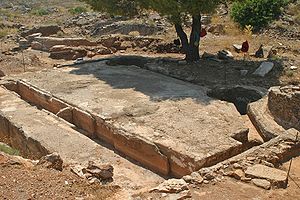 During the decade, Themistocles continued to advocate the expansion of Athenian naval power. The Athenians were certainly aware throughout this period that the Persian interest in Greece had not ended; Darius's son and successor, Xerxes I, had continued the preparations for the invasion of Greece. Themistocles seems to have realised that for the Greeks to survive the coming onslaught required there to be a Greek navy which could hope to face up to the Persian navy, and he therefore attempted to persuade the Athenians to build such a fleet. Aristides, as champion of the zeugites (the upper, 'hoplite-class') vigorously opposed such a policy.
In 483 BC, a massive new seam of silver was found in the Athenian mines at Laurium
. Themistocles proposed that the silver should be used to build a new fleet of 200 triremes, whilst Aristides suggested it should instead be distributed amongst the Athenian citizens. Themistocles avoided mentioning Persia, deeming that it was too distant a threat for the Athenians to act on, and instead focused their attention on Aegina
. At the time, Athens was embroiled in a long-running war with the Aeginetans, and building a fleet would allow the Athenians to finally defeat them at sea. As a result, Themistocles's motion was carried easily, although only 100 warships of the trireme
type were to be built. Aristides refused to countenance this; conversely Themistocles was not pleased that only 100 ships would be built. Tension between the two camps built over the winter, so that the ostracism of 482 BC became a direct contest between Themistocles and Aristides. In what has been characterized as the first referendum
, Aristides was ostracised, and Themistocles's policies were endorsed. Indeed, becoming aware of the Persian preparations for the coming invasion, the Athenians voted for the construction of more ships than Themistocles had initially asked for. In the run up to the Persian invasion, Themistocles had thus become the foremost politician in Athens.
The Spartans claimed the command of land forces, and since the Greek (hereafter referred to as "Allied") fleet would be dominated by Athens, Themistocles tried to claim command of the naval forces. However, the other naval powers, including Corinth
and Aegina refused to give command to the Athenians, and Themistocles pragmatically backed down. Instead, as a compromise, the Spartans (an insignificant naval power), in the person of Eurybiades
were to command the naval forces. It is clear from Herodotus
, however, that Themistocles would be the real leader of the fleet.
The 'congress' met again in the spring of 480 BC. A Thessalian
delegation suggested that the allies could muster in the narrow Vale of Tempe
, on the borders of Thessaly, and thereby block Xerxes's advance. A force of 10,000 hoplite
s was dispatched to the Vale of Tempe, through which they believed the Persian army would have to pass, under the command of the Spartan polemarch Euenetus and Themistocles. However, once there, they were warned by Alexander I of Macedon
that the vale could be bypassed by several other passes, and that the army of Xerxes was overwhelmingly large, and the Greeks retreated. Shortly afterwards, they received the news that Xerxes had crossed the Hellespont.
Themistocles now developed a second strategy. The route to southern Greece (Boeotia, Attica and the Peloponnesus) would require the army of Xerxes to travel through the very narrow pass of Thermopylae
. This could easily be blocked by the Greek hoplite
s, despite the overwhelming numbers of Persians; furthermore, to prevent the Persians bypassing Thermopylae by sea, the Athenian and allied navies could block the straits of Artemisium
. However, after the Tempe debacle, it was uncertain whether the Spartans would be willing to march out from the Peloponnesus again. In order to persuade the Spartans to defend Attica
, Themistocles needed to show them that the Athenians were willing to do everything necessary for the success of the alliance. In short, the entire Athenian fleet must be dispatched to Artemisium; in order to do this, every able-bodied Athenian male would be required to man the ships; and this in turn meant that the Athenians must prepare to abandon Athens. Persuading the Athenians to take this course was undoubtedly one of the highlights of Themistocles's career. As Holland has it:
at Artemisium. Over three days of battle, the Allies held their own against the much larger Persian fleet, but sustained significant losses. However, the loss of the simultaneous Battle of Thermopylae
to the Persians made their continued presence at Artemisium irrelevant, and the Allies thus evacuated. According to Herodotus, Themistocles left messages at every place where the Persian fleet might stop for drinking water, asking the Ionians in the Persian fleet to defect, or at least fight badly. Even if this did not work, Themistocles apparently intended that Xerxes would at least begin to suspect the Ionians, thereby sowing dissension in the Persian ranks.
, thus abandoning Athens to the Persians. From Artemisium, the Allied fleet sailed to the island of Salamis
, where the Athenian ships helped with the final evacuation of Athens. The Peloponnesian contingents wanted to sail to the coast of the Isthmus, in order to concentrate forces with the army. However, Themistocles tried to convince them to remain in the Straits of Salamis, invoking the lessons of Artemisium; "battle in close conditions works to our advantage". After threatening to sail with the whole Athenian people into exile in Sicily, he eventually persuaded the other Allies, whose security after all relied on the Athenian navy, to accept his plan. Therefore, even after Athens had fallen to the Persians, and the Persian navy had arrived off the coast of Salamis, the Allied navy remained in the Straits. Themistocles appears to have been aiming to fight a battle which would cripple the Persian navy, and thus guarantee the security of the Peloponnesus.
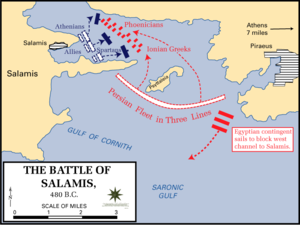 To bring about this battle, Themistocles used a cunning mix of subterfuge and misinformation, psychologically exploiting Xerxes's desire to finish the invasion. Xerxes's actions indicate that he was keen to finish the conquest of Greece in 480 BC, and to do this, he needed a decisive victory over the Allied fleet. Themistocles sent a servant, Sicinnus, to Xerxes, with a message proclaiming that Themistocles was "on king's side and prefers that your affairs prevail, not the Hellenes". Themistocles claimed that the Allied commanders were infighting, that the Peloponnesians were planning to evacuate that very night, and that to gain victory all the Persians needed to do was to block the straits. In performing this subterfuge, Themistocles seems to have been trying to lure the Persian fleet into the Straits. The message also had a secondary purpose, namely that in the event of an Allied defeat, the Athenians would probably receive some degree of mercy from Xerxes (having indicated their readiness to submit). At any rate, this was exactly the kind of news that Xerxes wanted to hear. Xerxes evidently took the bait, and the Persian fleet was sent out to effect the block. Perhaps over-confident and expecting no resistance, the Persian navy sailed into the Straits, only to find that, far from disintegrating, the Allied navy was ready for battle.
According to Herodotus, after the Persian navy began its maneuvers, Aristides arrived at the Allied camp from Aegina. Aristides had been recalled from exile along with the other ostracised Athenians on the order of Themistocles, so that Athens might be united against the Persians. Aristides told Themistocles that the Persian fleet had encircled the Allies, which greatly pleased Themistocles, as he now knew that the Persians had walked into his trap. The Allied commanders seem to have taken this news rather uncomplainingly, and Holland therefore suggests that they were party to Themistocles's ruse all along. Either way, the Allies prepared for battle, and Themistocles delivered a speech to the marines before they embarked on the ships. In the ensuing battle
, the cramped conditions in the Straits hindered the much larger Persian navy which became disarrayed, and the Allies took advantage to win a famous victory.
Salamis was the turning point in the second Persian invasion, and indeed the Greco-Persian Wars
in general. Whilst the battle did not end the Persian invasion, it effectively ensured that all Greece would not be conquered, and allowed the Allies to go on the offensive in 479 BC. A significant number of historians have stated that Salamis is one of the most significant battles in human history. Since it was his long-standing advocacy of Athenian naval power which enabled the Allied fleet to fight at all, and it was his stratagem that brought about the Battle of Salamis, it is probably not an exaggeration to say, as Plutarch does, that Themistocles "is thought to have been the man most instrumental in achieving the salvation of Hellas".
to attempt to complete the conquest. Mardonius wintered in Boeotia and Thessaly, and the Athenians were thus able to return to their city, which had been burnt and razed by the Persians, for the winter. For the Athenians, and Themistocles personally, the winter would be a testing one. The Peloponnesians refused to countenance marching north of the Isthmus to fight the Persian army; the Athenians tried to shame them into doing so, with no success.
During the winter, the Allies held a meeting at Corinth to celebrate their success, and award prizes for achievement. However, perhaps tired of the Athenians pointing out their role at Salamis, and of their demands for the Allies to march north, the Allies awarded the prize for civic achievement to Aegina. Furthermore, although the admirals all voted for Themistocles in second place, they all voted for themselves in first place, so that no-one won the prize for individual achievement. In response, realising the importance of the Athenian fleet to their security, and probably seeking to massage Themistocles's ego, the Spartans brought Themistocles to Sparta. There, he was awarded a special prize "for his wisdom and cleverness", and won high praise from all. Furthermore, Plutarch reports that at the next Olympic Games:
was to command the Athenian fleet, and Aristides the land forces. Though Themistocles was no doubt politically and militarily active for the rest of the campaign, no mention of his activities in 479 BC is made in the ancient sources. In the summer of that year, after receiving an Athenian ultimatum, the Peloponnesians finally agreed to assemble an army and march to confront Mardonius, who had reoccupied Athens in June. At the decisive Battle of Plataea
, the Allies destroyed the Persian army, whilst apparently on the same day, the Allied navy destroyed the remnants of the Persian fleet at the Battle of Mycale
. These twin victories completed the Allied triumph, and ended the Persian threat to Greece.
In the aftermath of the invasion, the Athenians began rebuilding their city under the guidance of Themistocles. They wished to restore the fortifications of Athens, but the Spartans objected, on the grounds that no place north of the Isthmus should be left which the Persians might be able to use as a fortress. Themistocles urged the citizens to build the fortifications as quickly as possible, then went to Sparta as an ambassador to answer the charges levelled by the Spartans. There, he assured them that no building work was on-going, and urged them to send emissaries to Athens to see for themselves. By the time the ambassadors arrived, the Athenians had finished building, and then detained the Spartan ambassadors when they complained about the presence of the fortifications. By delaying in this manner, Themistocles gave the Athenians enough time to fortify the city, and thus ward off any Spartan attack aimed at preventing the re-fortification of Athens. Furthermore, the Spartans were obliged to repatriate Themistocles in order to free their own ambassadors. However, this episode may be seen as the beginning of the Spartan mistrust of Themistocles which would return to haunt him.
Themistocles also now returned to his naval policy, and "more ambitious undertakings which would serve to increase the dominant position of his native state". He further extended and fortified the port complex at Piraeus, and "fastened the city [Athens] to the Piraeus, and the land to the sea". Themistocles was probably aiming to make Athens the dominant naval power in the Aegean. Indeed, Athens would create the Delian League
in 478 BC, uniting the naval power of the Aegean Islands and Ionia under Athenian leadership. Themistocles introduced tax breaks for merchants and artisans, to attract both people and trade to the city, in order to make Athens a great mercantile centre. He also instructed the Athenians to build 20 triremes per year, to ensure that their dominance in naval matters continued. Plutarch reports that Themistocles also proposed in secret to destroy the beached ships of the other Allied navies, in order to ensure complete naval dominance, but was overruled by Aristides and the council of Athens.
 It seems clear that, towards the end of the decade, Themistocles had begun to accrue enemies, and had become arrogant; moreover his fellow citizens had become jealous of his prestige and power. The Spartans actively worked against him, trying to promote Cimon (son of Miltiades) as a rival to Themistocles. Furthermore, after the treason and disgrace of the Spartan general Pausanias
, the Spartans tried to implicate Themistocles in the plot; he was, however, acquitted of these charges. In Athens itself, he lost favour by building a sanctuary of Artemis
, with the epithet
Aristoboulë ("of good counsel") near his home, a blatant reference to his own role in delivering Greece from the Persian invasion. Eventually, in either 472 or 471 BC, he was ostracised. In itself, this did not mean that Themistocles had done anything wrong; ostracism, in the words of Plutarch,
Themistocles first went to live in exile in Argos
. However, perceiving that they now had a prime opportunity to bring Themistocles down for good, the Spartans again levelled accusations of Themistocles's complicity in Pausanias's treason. They demanded that he be tried by the 'Congress of Greeks', rather than in Athens, although it seems that in the end he was actually summoned to Athens to stand trial. Perhaps realising he had little hope of surviving this trial, Themistocles fled, first to Kerkyra, and thence to Admetus, king of Molossia. Themistocles's flight probably only served to convince his accusers of his guilt, and he was declared a traitor in Athens, his property to be confiscated. It should be noted that both Diodorus and Plutarch considered that the charges were false, and made solely for the purposes of destroying Themistocles. The Spartans sent ambassadors to Admetus, threatening that the whole of Greece would go to war with the Molossians unless they surrendered Themistocles. Admetus, however, allowed Themistocles to escape, giving him a large sum of gold to aid him on his way. Themistocles then fled from Greece, apparently never to return, thus effectively bringing his political career to an end.
, from where he took a ship for Asia Minor
. This ship was blown off course by a storm, and ended up at Naxos
, which an Athenian fleet was in the process of besieging. Desperate to avoid identification, Themistocles cajoled the captain of the ship to continue the journey immediately. According to Thucydides, who wrote within living memory of the events, the ship eventually landed safely at Ephesus, where Themistocles disembarked. Plutarch has the ship docking at Cyme
in Aeolia
, and Diodorus has Themistocles making his way to Asia in an undefined manner. Diodorus and Plutarch next recount a similar tale, namely that Themistocles stayed briefly with an acquaintance (Lysitheides or Nicogenes) who was also acquainted with the Persian king, Artaxerxes I. Since there was a bounty on Themistocles's head, this acquaintance devised a plan to safely convey Themistocles to the Persian king in the type of covered wagon that the King's concubines travelled in. All three chroniclers agree that Themistocles's next move was to contact the Persian king; in Thucydides, this is by letter, while Plutarch and Diodorus have a face-to-face meeting with the king. The spirit is the same in all three however: Themistocles introduces himself to the king and seeks to enter his service.
Thucydides and Plutarch say that Themistocles asked for a year's grace to learn the Persian language and customs, after which he would serve the king, and Artaxerxes granted this. Plutarch reports that, as might be imagined, Artaxerxes was elated that such a dangerous and illustrious foe had come to serve him.
At some point in his travels, Themistocles's wife and children were extricated from Athens by a friend, and joined him in exile. His friends also managed to send him many of his belongings, although up to 100 talents worth of his goods were confiscated by the Athenians. When, after a year, Themistocles returned to the king's court, he appears to have made an immediate impact, and "he attained...very high consideration there, such as no Hellene has ever possessed before or since". Plutarch recounts that "honors he enjoyed were far beyond those paid to other foreigners; nay, he actually took part in the King's hunts and in his household diversions." Themistocles advised the king on his dealings with the Greeks, though it seems that for a long period, the king was distracted by events elsewhere in the empire, and thus Themistocles "lived on for a long time without concern". He was made governor of the district of Magnesia
on the Maeander River in Asia Minor
, and assigned the revenues of three cities; Magnesia (about 50 talents per year - "for bread"), Myus ("for meat") and Lampsacus ("for wine"). Neanthes of Cyzicus and Phanias add two more, the city of Palaescepsis ("for clothes") and the city of Percote
with bedding and furniture for his house.
Themistocles died at Magnesia in 459 BC, at the age of 65, according to Thucydides
, from natural causes. However, perhaps inevitably, there were also rumours surrounding his death; that finding that he could not keep the promises that he had made to the king, he committed suicide by taking poison, or drinking bull's blood. Plutarch provides the most evocative version of this story:
After his death, Themistocles's bones were transported to Attica on his request, and buried in his native soil in secret, it being illegal to bury a Athenian traitor in Attica
. The Magnesians built a "splendid tomb" in their market place for Themistocles, which still stood during the time of Plutarch, and continued to dedicate part of their revenues to the family of Themistocles. Plutarch indicates that he met in Athens a lineal descendant of Themistocles (also called Themistocles) who was still paid these revenues, 600 years after the events in question.
Yet, set against these negative traits, was an apparently natural brilliance and talent for leadership:
Both Herodotus and Plato record variations of an anecdote in which Themistocles responded with subtle sarcasm to an undistinguished man who complained that the great politician owed his fame merely to the fact that he came from Athens. As Herodotus tells it:
As Plato tells it, the heckler hails from the small island of Seriphus; Themistocles retorts that it is true that he would not have been famous if he had come from that small island, but that the heckler would not have been famous either if he had been born in Athens.
Themistocles was undoubtedly intelligent, but also possessed natural cunning; "the workings of his mind [were] infinitely mobile and serpentine". Themistocles was evidently sociable and appears to have enjoyed strong personal loyalty from his friends. At any rate, it seems to have been Themistocles's particular mix of virtues and vices that made him such an effective politician.
in the 450s BC, and by the time Herodotus wrote his history, Themistocles was once again seen as a hero. Thucydides evidently held Themistocles in some esteem, and is uncharacteristically fulsome in his praise for him (see above). Diodorus also extensively praises Themistocles, going as far as to offer a rationale for the length at which he discusses him: "Now on the subject of the high merits of Themistocles, even if we have dwelt over-long on the subject in this digression, we believed it not seemly that we should leave his great ability unrecorded." Indeed, Diodorus goes so far as to say that
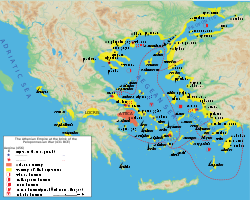 Undoubtedly the greatest achievement of Themistocles's career was his role in the defeat of Xerxes's invasion of Greece. Against overwhelming odds, Greece survived, and classical Greek culture, so influential in 'western civilization' was able to develop unabated. Moreover, Themistocles's doctrine of Athenian naval power, and the establishment of Athens as a major power in the Greek world were of enormous consequence during the 5th century BC. In 478 BC, the Hellenic alliance was reconstituted without the Peloponnesian states, into the Delian League
, in which Athens was the dominant power. This was essentially a maritime alliance of Athens and her colonies, the Aegean islands, and the Ionian cities. The Delian league took the war to Persia, eventually invading Persian territory and dominating the Aegean. Under the guidance of Pericles, the Delian league gradually evolved into the Athenian Empire, the zenith of Athenian power and influence. Themistocles seems to have deliberately set Athens up as a rival to Sparta in the aftermath of Xerxes's invasion, basing this strategy on Athenian naval power (contrasted with the power of the Spartan army). Tension grew throughout the century between Athens and Sparta, as they competed to be the leading state in Greece. Finally, in 431 BC, this tension erupted into the Peloponnesian War
, the first of a series of conflicts which would tear Greece apart for the next century; an unforeseen, if indirect, legacy of Themistocles's.
Diodorus provides a rhetorical summary which reflects upon Themistocles's achievements:
Athenian democracy
Athenian democracy developed in the Greek city-state of Athens, comprising the central city-state of Athens and the surrounding territory of Attica, around 508 BC. Athens is one of the first known democracies. Other Greek cities set up democracies, and even though most followed an Athenian model,...
, along with his great rival Aristides
Aristides
Aristides , 530 BC – 468 BC was an Athenian statesman, nicknamed "the Just".- Biography :Aristides was the son of Lysimachus, and a member of a family of moderate fortune. Of his early life, it is only told that he became a follower of the statesman Cleisthenes and sided with the aristocratic party...
. As a politician, Themistocles was a populist, having the support of lower class Athenians, and generally being at odds with the Athenian nobility. Elected archon
Archon
Archon is a Greek word that means "ruler" or "lord", frequently used as the title of a specific public office. It is the masculine present participle of the verb stem ἀρχ-, meaning "to rule", derived from the same root as monarch, hierarchy, and anarchy.- Ancient Greece :In ancient Greece the...
in 493 BC, he took steps to increase the naval power of Athens, which would be a recurring theme in his political career. During the first Persian invasion of Greece
First Persian invasion of Greece
The first Persian invasion of Greece, during the Persian Wars, began in 492 BCE, and ended with the decisive Athenian victory at the Battle of Marathon in 490 BCE. The invasion, consisting of two distinct campaigns, was ordered by the Persian king Darius I primarily in order to punish the...
, he fought at the Battle of Marathon
Battle of Marathon
The Battle of Marathon took place in 490 BC, during the first Persian invasion of Greece. It was fought between the citizens of Athens, aided by Plataea, and a Persian force commanded by Datis and Artaphernes. It was the culmination of the first attempt by Persia, under King Darius I, to subjugate...
, and was possibly one of the 10 Athenian strategoi (generals) in that battle.
In the years after Marathon, and in the run up to the second Persian invasion
Second Persian invasion of Greece
The second Persian invasion of Greece occurred during the Greco-Persian Wars, as King Xerxes I of Persia sought to conquer all of Greece. The invasion was a direct, if delayed, response to the defeat of the first Persian invasion of Greece at the Battle of Marathon which ended Darius I's attempts...
he became the most prominent politician in Athens. He continued to advocate a strong Athenian navy, and in 483 BC he persuaded the Athenians to build a fleet of 100 triremes; these would prove crucial in the forthcoming conflict with Persia. During the second invasion, he was in effective command of the Greek allied navy at the battles of Artemisium
Battle of Artemisium
The Battle of Artemisium was a series of naval engagements over three days during the second Persian invasion of Greece. The battle took place simultaneously with the more famous land battle at Thermopylae, in August or September 480 BC, off the coast of Euboea and was fought between an alliance of...
and Salamis
Battle of Salamis
The Battle of Salamis was fought between an Alliance of Greek city-states and the Persian Empire in September 480 BCE, in the straits between the mainland and Salamis, an island in the Saronic Gulf near Athens...
. Due to subterfuge on the part of Themistocles, the Allies lured the Persian fleet into the Straits of Salamis, and the decisive Greek victory there was the turning point in the invasion, which was ended the following year by the defeat of the Persians at the Battle of Plataea
Battle of Plataea
The Battle of Plataea was the final land battle during the second Persian invasion of Greece. It took place in 479 BC near the city of Plataea in Boeotia, and was fought between an alliance of the Greek city-states, including Sparta, Athens, Corinth and Megara, and the Persian Empire of Xerxes...
.
After the conflict ended, Themistocles continued to be pre-eminent amongst Athenian politicians. However, he aroused the hostility of Sparta
Sparta
Sparta or Lacedaemon, was a prominent city-state in ancient Greece, situated on the banks of the River Eurotas in Laconia, in south-eastern Peloponnese. It emerged as a political entity around the 10th century BC, when the invading Dorians subjugated the local, non-Dorian population. From c...
by ordering Athens to be re-fortified, and his perceived arrogance began to alienate him from the Athenians. In 472 or 471 BC, he was ostracised, and went into exile in Argos
Argos
Argos is a city and a former municipality in Argolis, Peloponnese, Greece. Since the 2011 local government reform it is part of the municipality Argos-Mykines, of which it is a municipal unit. It is 11 kilometres from Nafplion, which was its historic harbour...
. The Spartans now saw an opportunity to destroy Themistocles, and implicated him in the treasonous plot of their own general Pausanias
Pausanias (general)
Pausanias was a Spartan general of the 5th century BC. He was the son of Cleombrotus and nephew of Leonidas I, serving as regent after the latter's death, since Leonidas' son Pleistarchus was still under-age. Pausanias was also the father of Pleistoanax, who later became king, and Cleomenes...
. Themistocles thus fled from Greece, and travelled to Asia Minor
Asia Minor
Asia Minor is a geographical location at the westernmost protrusion of Asia, also called Anatolia, and corresponds to the western two thirds of the Asian part of Turkey...
, where he entered the service of the Persian king Artaxerxes I. He was made governor of Magnesia
Magnesia on the Maeander
Magnesia or Magnesia on the Maeander was an ancient Greek city in Anatolia, considerable in size, at an important location commercially and strategically in the triangle of Priene, Ephesus and Tralles. The city was named Magnesia, after the Magnetes from Thessaly who settled the area along with...
, and lived there for the rest of his life.
Themistocles died in 459 BC, probably of natural causes. Themistocles's reputation was posthumously rehabilitated, and he was re-established as a hero of the Athenian (and indeed Greek) cause. Themistocles can still reasonably be thought of as "the man most instrumental in achieving the salvation of Greece" from the Persian threat, as Plutarch
Plutarch
Plutarch then named, on his becoming a Roman citizen, Lucius Mestrius Plutarchus , c. 46 – 120 AD, was a Greek historian, biographer, essayist, and Middle Platonist known primarily for his Parallel Lives and Moralia...
describes him. His naval policies would have a lasting impact on Athens as well, since maritime power became the cornerstone of the Athenian Empire and golden age
Age of Pericles
Fifth-century Athens refers to the Greek city-state of Athens in the period of roughly 480 BC-404 BC. This was a period of Athenian political hegemony, economic growth and cultural flourishing formerly known as the Golden Age of Athens or The Age of Pericles. The period began in 480 BC when an...
. It was Thucydides
Thucydides
Thucydides was a Greek historian and author from Alimos. His History of the Peloponnesian War recounts the 5th century BC war between Sparta and Athens to the year 411 BC...
's judgement that Themistocles was "a man who exhibited the most indubitable signs of genius; indeed, in this particular he has a claim on our admiration quite extraordinary and unparalleled".
Family
Themistocles was born in Athens around 524 BC, the son of Neocles, who was, in the words of Plutarch "no very conspicuous man". His mother is more obscure; according to Plutarch, she was either a ThracianThrace
Thrace is a historical and geographic area in southeast Europe. As a geographical concept, Thrace designates a region bounded by the Balkan Mountains on the north, Rhodope Mountains and the Aegean Sea on the south, and by the Black Sea and the Sea of Marmara on the east...
woman called Abrotonon
Abrotonum
Abrotonum was a Thracian hetaera, who, according to some accounts, was the mother of Themistocles. There is an epigram preserved recording this fact. Plutarch also refers to her in his Erotikos ; and Lucian speaks of a hetaera of the same name.-Sources:...
, or Euterpe, a Caria
Caria
Caria was a region of western Anatolia extending along the coast from mid-Ionia south to Lycia and east to Phrygia. The Ionian and Dorian Greeks colonized the west of it and joined the Carian population in forming Greek-dominated states there...
n from Halicarnassus
Halicarnassus
Halicarnassus was an ancient Greek city at the site of modern Bodrum in Turkey. It was located in southwest Caria on a picturesque, advantageous site on the Ceramic Gulf. The city was famous for the tomb of Mausolus, the origin of the word mausoleum, built between 353 BC and 350 BC, and...
. Like many contemporaries, little is known of his early years. Some authors report that he was unruly as a child and was consequently disowned by his father. Plutarch considers this to be false. Plutarch indicates that, on account of his mother's background, Themistocles was considered something of an outsider; furthermore the family appear to have lived in an immigrant district of Athens, Cynosarges, outside the city walls. However, in an early example of his cunning, Themistocles persuaded "well-born" children to exercise with him in Cynosarges, thus breaking down the distinction between "alien and legitimate". Plutarch further reports that Themistocles was preoccupied, even as a child, with preparing for public life. His teacher is said to have told him:
"My boy, thou wilt be nothing insignificant, but something great of a surety, either for good or evil."
Themistocles left three sons by Archippe, daughter to Lysander of Alopece, - Archeptolis, Polyeuctus, and Cleophantus. Plato
Plato
Plato , was a Classical Greek philosopher, mathematician, student of Socrates, writer of philosophical dialogues, and founder of the Academy in Athens, the first institution of higher learning in the Western world. Along with his mentor, Socrates, and his student, Aristotle, Plato helped to lay the...
the philosopher mentions Cleophantus as a most excellent horseman, but otherwise insignificant person. And Themistocles had two sons older than these three, Neocles and Diocles. Neocles died when he was young by the bite of a horse, and Diocles was adopted by his grandfather, Lysander. Themistocles had many daughters, of whom Mnesiptolema, whom he had by a second marriage, was wife to Archeptolis, her brother by another mother, she became priestess of Cybele
Cybele
Cybele , was a Phrygian form of the Earth Mother or Great Mother. As with Greek Gaia , her Minoan equivalent Rhea and some aspects of Demeter, Cybele embodies the fertile Earth...
; Italia was married to Panthoides, of the island of Chios
Chios
Chios is the fifth largest of the Greek islands, situated in the Aegean Sea, seven kilometres off the Asia Minor coast. The island is separated from Turkey by the Chios Strait. The island is noted for its strong merchant shipping community, its unique mastic gum and its medieval villages...
; Sybaris to Nicomedes the Athenian. After the death of Themistocles, his nephew, Phrasicles, went to Magnesia
Magnesia on the Maeander
Magnesia or Magnesia on the Maeander was an ancient Greek city in Anatolia, considerable in size, at an important location commercially and strategically in the triangle of Priene, Ephesus and Tralles. The city was named Magnesia, after the Magnetes from Thessaly who settled the area along with...
, and married, with her brothers' consent, another daughter, Nicomache, and took charge of her sister Asia, the youngest of all ten children.
Background
Themistocles grew up in a period of upheaval in Athens. The tyrant Peisistratos had died in 527 BC, passing power to his sons, Hipparchus and Hippias. Hipparchus was murdered in 514 BC, and in response to this, Hippias became paranoid and started to rely increasingly on foreign mercenaries to keep a hold on power. The head of the powerful, but exiled (according to Herodotus only - the fragmentary Archon List for 525/4 shows a Cleisthenes, an Alcmaeonid, holding office in Athens during this period), Alcmaeonid family, CleisthenesCleisthenes
Cleisthenes was a noble Athenian of the Alcmaeonid family. He is credited with reforming the constitution of ancient Athens and setting it on a democratic footing in 508/7 BC...
, began to scheme to overthrow Hippias and return to Athens. In 510 BC, he persuaded the Sparta
Sparta
Sparta or Lacedaemon, was a prominent city-state in ancient Greece, situated on the banks of the River Eurotas in Laconia, in south-eastern Peloponnese. It emerged as a political entity around the 10th century BC, when the invading Dorians subjugated the local, non-Dorian population. From c...
n king Cleomenes I
Cleomenes I
Cleomenes or Kleomenes was an Agiad King of Sparta in the late 6th and early 5th centuries BC. During his reign, which started around 520 BC, he pursued an adventurous and at times unscrupulous foreign policy aimed at crushing Argos and extending Sparta's influence both inside and outside the...
to launch an attack on Athens, which succeeded in overthrowing Hippias. However, in the aftermath, the other noble ('eupatrid') families of Athens rejected Cleisthenes, electing Isagoras
Isagoras
Isagoras , son of Tisander, was an Athenian aristocrat in the late 6th century BC.He had remained in Athens during the tyranny of Hippias, but after Hippias was overthrown, he became involved in a struggle for power with Cleisthenes, a fellow aristocrat. In 508 BC he was elected archon eponymous,...
as archon
Archon
Archon is a Greek word that means "ruler" or "lord", frequently used as the title of a specific public office. It is the masculine present participle of the verb stem ἀρχ-, meaning "to rule", derived from the same root as monarch, hierarchy, and anarchy.- Ancient Greece :In ancient Greece the...
, with the support of Cleomenes. On a personal level, Cleisthenes wanted to return to Athens; however, he also probably wanted to prevent Athens becoming a Spartan client state. Outmaneuvering the other nobles, he proposed to the Athenian people a radical program in which political power would be invested in the people - a "democracy". The Athenian people thus overthrew Isagoras, repelled a Spartan attack under Cleomenes, and invited Cleisthenes to return to Athens, to put his plan into action. The establishment of the democracy was to radically change Athens:
"And so it was that the Athenians found themselves suddenly a great power...they gave vivid proof of what equality and freedom of speech might achieve"
Early years of the democracy
The new system of government in Athens opened up a wealth of opportunity for men like Themistocles, who previously would have had no access to power. Moreover, the new institutions of the democracy required skills which had previously been unimportant in government. Themistocles was to prove himself a master of the new system; "he could infight, he could network, he could spin...and crucially, he knew how to make himself visible." Themistocles moved to the Ceramicus, a down-market part of Athens. This move marked him out as a 'man of the people', and allowed him to interact more easily with ordinary citizens. He began building up a support base amongst these newly-empowered citizens:"he wooed the poor; and they, not used to being courted, duly loved him back. Touring the taverns, the markets, the docks, canvassing where no politician had thought to canvas before, making sure never to forget a single voter's name, Themistocles had set his eyes on a radical new constituency"However, he took care to ensure that he did not alienate the nobility of Athens. He began to practice law, the first person in Athens to prepare for public life in this way. His ability as attorney and arbitrator, used in the service of the common people, gained him further popularity.
Archonship
Themistocles probably turned 30 in 494 BC, which qualified him to become an archon, the highest magistracies in Athens. On the back of his popularity, he evidently decided to run for this office and was elected Eponymous Archon (the effective head of the Athenian government) in the following year (493 BC). Themistocles's archonship saw the beginnings of a major theme in his career; the advancement of Athenian sea-power. Under his guidance, the Athenians began the building of a new port at PiraeusPiraeus
Piraeus is a city in the region of Attica, Greece. Piraeus is located within the Athens Urban Area, 12 km southwest from its city center , and lies along the east coast of the Saronic Gulf....
, to replace the existing facilities at Phalerum. Although further away from Athens, Piraeus offered three natural harbours, and could be easily fortified. Since Athens was to become an essentially maritime power during the 5th century BC, Themistocles's policies were to have huge significance for the future of Athens, and indeed Greece. In advancing naval power, Themistocles was probably advocating a course of action he thought essential for the long-term prospects of Athens. However, as Plutarch implies, since naval power relied on the mass mobilisation of the common citizens (thetes) as rowers, such a policy put more power into the hands of average Athenians—and thus into Themistocles's own hands.
Rivalry with Aristides
A year later, MiltiadesMiltiades the Younger
Miltiades the Younger or Miltiades IV was the son of one Cimon, a renowned Olympic chariot-racer. Miltiades considered himself a member of the Aeacidae, and is known mostly for his role in the Battle of Marathon; as well as his rather tragic downfall afterwards. His son Cimon was a major Athenian...
, the hero of Marathon, was injured in a minor battle. Taking advantage of his incapacitation, the powerful Alcmaeonid family arranged for him to be prosecuted. The Athenian aristocracy, and indeed Greek aristocrats in general, were loath to see one person pre-eminent, and such maneuvers were commonplace. Miltiades was given a massive fine for the crime of 'deceiving the Athenian people', but died weeks later as a result of his wound. In the wake of this prosecution, the Athenian people chose to use a new institution of the democracy, which had been part of Cleisthenes's reforms, but remained so far unused. This was 'ostracism'—each Athenian citizen was required to write on a shard of pottery (ostrakon) the name of a politician that they wished to see exiled for a period of ten years. This may have been triggered by Miltiades's prosecution, and used by the Athenians to try and stop such power-games amongst the noble families. Certainly, in the years (487 BC) following, the heads of the prominent families, including the Alcmaeonids, were exiled. The career of a politician in Athens thus became fraught with more difficulty, since displeasing the population was likely to result in exile.
Themistocles, with his power-base firmly established amongst the poor, moved naturally to fill the vacuum left by Miltiades's death, and in that decade became the most influential politician in Athens. However, the support of the nobility began to coalesce around the man who would become Themistocles's great rival - Aristides
Aristides
Aristides , 530 BC – 468 BC was an Athenian statesman, nicknamed "the Just".- Biography :Aristides was the son of Lysimachus, and a member of a family of moderate fortune. Of his early life, it is only told that he became a follower of the statesman Cleisthenes and sided with the aristocratic party...
. Aristides cast himself as Themistocles's opposite - virtuous, honest and incorruptible - and his followers called him "the just". Plutarch suggests that the rivalry between the two had more sordid beginnings, when they competed over the love
Pederasty in ancient Greece
Pederasty in ancient Greece was a socially acknowledged relationship between an adult and a younger male usually in his teens. It was characteristic of the Archaic and Classical periods...
of a boy: "... they were rivals for the affection of the beautiful Stesilaus of Ceos, and were passionate beyond all moderation."
In 483 BC, a massive new seam of silver was found in the Athenian mines at Laurium
Laurium
Laurium or Lavrio is a town in southeastern part of Attica, Greece. It is the seat of the municipality of Lavreotiki...
. Themistocles proposed that the silver should be used to build a new fleet of 200 triremes, whilst Aristides suggested it should instead be distributed amongst the Athenian citizens. Themistocles avoided mentioning Persia, deeming that it was too distant a threat for the Athenians to act on, and instead focused their attention on Aegina
Aegina
Aegina is one of the Saronic Islands of Greece in the Saronic Gulf, from Athens. Tradition derives the name from Aegina, the mother of Aeacus, who was born in and ruled the island. During ancient times, Aegina was a rival to Athens, the great sea power of the era.-Municipality:The municipality...
. At the time, Athens was embroiled in a long-running war with the Aeginetans, and building a fleet would allow the Athenians to finally defeat them at sea. As a result, Themistocles's motion was carried easily, although only 100 warships of the trireme
Trireme
A trireme was a type of galley, a Hellenistic-era warship that was used by the ancient maritime civilizations of the Mediterranean, especially the Phoenicians, ancient Greeks and Romans.The trireme derives its name from its three rows of oars on each side, manned with one man per oar...
type were to be built. Aristides refused to countenance this; conversely Themistocles was not pleased that only 100 ships would be built. Tension between the two camps built over the winter, so that the ostracism of 482 BC became a direct contest between Themistocles and Aristides. In what has been characterized as the first referendum
Referendum
A referendum is a direct vote in which an entire electorate is asked to either accept or reject a particular proposal. This may result in the adoption of a new constitution, a constitutional amendment, a law, the recall of an elected official or simply a specific government policy. It is a form of...
, Aristides was ostracised, and Themistocles's policies were endorsed. Indeed, becoming aware of the Persian preparations for the coming invasion, the Athenians voted for the construction of more ships than Themistocles had initially asked for. In the run up to the Persian invasion, Themistocles had thus become the foremost politician in Athens.
Second Persian invasion of Greece
In 481 BC, a congress of Greek city-states was held, during which 30 or so states agreed to ally themselves against the forthcoming invasion. The Spartans and Athenians were foremost in this alliance, being sworn enemies of the Persians.The Spartans claimed the command of land forces, and since the Greek (hereafter referred to as "Allied") fleet would be dominated by Athens, Themistocles tried to claim command of the naval forces. However, the other naval powers, including Corinth
Ancient Corinth
Corinth, or Korinth was a city-state on the Isthmus of Corinth, the narrow stretch of land that joins the Peloponnesus to the mainland of Greece, roughly halfway between Athens and Sparta. The modern town of Corinth is located approximately northeast of the ancient ruins...
and Aegina refused to give command to the Athenians, and Themistocles pragmatically backed down. Instead, as a compromise, the Spartans (an insignificant naval power), in the person of Eurybiades
Eurybiades
Eurybiades was the Spartan commander in charge of the Greek navy during the Persian Wars.He was the son of Eurycleides, and was chosen as commander in 480 BC because the Peloponnesian city-states led by Sparta, worried about the growing power of Athens, did not want to serve under an Athenian,...
were to command the naval forces. It is clear from Herodotus
Herodotus
Herodotus was an ancient Greek historian who was born in Halicarnassus, Caria and lived in the 5th century BC . He has been called the "Father of History", and was the first historian known to collect his materials systematically, test their accuracy to a certain extent and arrange them in a...
, however, that Themistocles would be the real leader of the fleet.
The 'congress' met again in the spring of 480 BC. A Thessalian
Thessaly
Thessaly is a traditional geographical region and an administrative region of Greece, comprising most of the ancient region of the same name. Before the Greek Dark Ages, Thessaly was known as Aeolia, and appears thus in Homer's Odyssey....
delegation suggested that the allies could muster in the narrow Vale of Tempe
Vale of Tempe
The Vale of Tempe is a gorge in northern Thessaly, Greece, located between Olympus to the north and Ossa to the south. The valley is 10 kilometers long and as narrow as 25 meters in places, with cliffs nearly 500 meters high, and through it flows the Pineios River on its way to the Aegean Sea...
, on the borders of Thessaly, and thereby block Xerxes's advance. A force of 10,000 hoplite
Hoplite
A hoplite was a citizen-soldier of the Ancient Greek city-states. Hoplites were primarily armed as spearmen and fought in a phalanx formation. The word "hoplite" derives from "hoplon" , the type of the shield used by the soldiers, although, as a word, "hopla" could also denote weapons held or even...
s was dispatched to the Vale of Tempe, through which they believed the Persian army would have to pass, under the command of the Spartan polemarch Euenetus and Themistocles. However, once there, they were warned by Alexander I of Macedon
Alexander I of Macedon
- Biography :Alexander was the son of Amyntas I and Queen Eurydice.According to Herodotus, he was unfriendly to Persia, and had the envoys of Darius I killed when they arrived at the court of his father during the Ionian Revolt...
that the vale could be bypassed by several other passes, and that the army of Xerxes was overwhelmingly large, and the Greeks retreated. Shortly afterwards, they received the news that Xerxes had crossed the Hellespont.
Themistocles now developed a second strategy. The route to southern Greece (Boeotia, Attica and the Peloponnesus) would require the army of Xerxes to travel through the very narrow pass of Thermopylae
Thermopylae
Thermopylae is a location in Greece where a narrow coastal passage existed in antiquity. It derives its name from its hot sulphur springs. "Hot gates" is also "the place of hot springs and cavernous entrances to Hades"....
. This could easily be blocked by the Greek hoplite
Hoplite
A hoplite was a citizen-soldier of the Ancient Greek city-states. Hoplites were primarily armed as spearmen and fought in a phalanx formation. The word "hoplite" derives from "hoplon" , the type of the shield used by the soldiers, although, as a word, "hopla" could also denote weapons held or even...
s, despite the overwhelming numbers of Persians; furthermore, to prevent the Persians bypassing Thermopylae by sea, the Athenian and allied navies could block the straits of Artemisium
Artemisium
Artemisium is a cape north of Euboea, Greece. The legendary hollow cast bronze statue of a debatable Zeus or Poseidon was found off this cape in a sunken ship.-See also:* Temple of Artemis...
. However, after the Tempe debacle, it was uncertain whether the Spartans would be willing to march out from the Peloponnesus again. In order to persuade the Spartans to defend Attica
Attica
Attica is a historical region of Greece, containing Athens, the current capital of Greece. The historical region is centered on the Attic peninsula, which projects into the Aegean Sea...
, Themistocles needed to show them that the Athenians were willing to do everything necessary for the success of the alliance. In short, the entire Athenian fleet must be dispatched to Artemisium; in order to do this, every able-bodied Athenian male would be required to man the ships; and this in turn meant that the Athenians must prepare to abandon Athens. Persuading the Athenians to take this course was undoubtedly one of the highlights of Themistocles's career. As Holland has it:
"What precise heights of oratory he attained, what stirring and memorable phrases he pronounced, we have no way of knowing...only by the effect it had on the assembly can we gauge what surely must have been its electric and vivifying quality - for Themistocles' audacious proposals, when put to the vote, were ratified. The Athenian people, facing the gravest moment of peril in their history, committed themselves once and for all to the alien element of the sea, and put their faith in a man whose ambitions many had long profoundly dreaded."His proposals accepted, Themistocles issued orders for the women and children of Athens to be sent to the city of Troezen, safely inside the Peloponnesus. He was then able to travel to a meeting of the Allies, at which he proposed his strategy; with the Athenian fleet fully committed to the defence of Greece, the other Allies accepted his proposals.
Battle of Artemisium
Thus, in August 480 BC, when the Persian army was approaching Thessaly, the Allied fleet sailed to Artemisium, and the Allied army marched to Thermopylae. Themistocles himself took command of the Athenian contingent of the fleet, and went to Artemisium. When the Persian fleet finally arrived at Artemisium after a significant delay, Eurybiades, who both Herodotus and Plutarch suggest was not the most inspiring commander, wished to sail away without fighting. At this point Themistocles accepted a large bribe from the local people for the fleet to remain at Artemisium, and used some of it to bribe Eurybiades to remain, whilst pocketing the rest. From this point on, Themistocles appears to have been more-or-less in charge of the Allied effortBattle of Artemisium
The Battle of Artemisium was a series of naval engagements over three days during the second Persian invasion of Greece. The battle took place simultaneously with the more famous land battle at Thermopylae, in August or September 480 BC, off the coast of Euboea and was fought between an alliance of...
at Artemisium. Over three days of battle, the Allies held their own against the much larger Persian fleet, but sustained significant losses. However, the loss of the simultaneous Battle of Thermopylae
Battle of Thermopylae
The Battle of Thermopylae was fought between an alliance of Greek city-states, led by King Leonidas of Sparta, and the Persian Empire of Xerxes I over the course of three days, during the second Persian invasion of Greece. It took place simultaneously with the naval battle at Artemisium, in August...
to the Persians made their continued presence at Artemisium irrelevant, and the Allies thus evacuated. According to Herodotus, Themistocles left messages at every place where the Persian fleet might stop for drinking water, asking the Ionians in the Persian fleet to defect, or at least fight badly. Even if this did not work, Themistocles apparently intended that Xerxes would at least begin to suspect the Ionians, thereby sowing dissension in the Persian ranks.
Battle of Salamis
In the aftermath of Thermopylae, Boeotia fell to the Persians, who then began to advance on Athens. The Peloponnesian Allies prepared to now defend the Isthmus of CorinthIsthmus of Corinth
The Isthmus of Corinth is the narrow land bridge which connects the Peloponnese peninsula with the rest of the mainland of Greece, near the city of Corinth. The word "isthmus" comes from the Ancient Greek word for "neck" and refers to the narrowness of the land. The Isthmus was known in the ancient...
, thus abandoning Athens to the Persians. From Artemisium, the Allied fleet sailed to the island of Salamis
Salamis Island
Salamis , is the largest Greek island in the Saronic Gulf, about 1 nautical mile off-coast from Piraeus and about 16 km west of Athens. The chief city, Salamina , lies in the west-facing core of the crescent on Salamis Bay, which opens into the Saronic Gulf...
, where the Athenian ships helped with the final evacuation of Athens. The Peloponnesian contingents wanted to sail to the coast of the Isthmus, in order to concentrate forces with the army. However, Themistocles tried to convince them to remain in the Straits of Salamis, invoking the lessons of Artemisium; "battle in close conditions works to our advantage". After threatening to sail with the whole Athenian people into exile in Sicily, he eventually persuaded the other Allies, whose security after all relied on the Athenian navy, to accept his plan. Therefore, even after Athens had fallen to the Persians, and the Persian navy had arrived off the coast of Salamis, the Allied navy remained in the Straits. Themistocles appears to have been aiming to fight a battle which would cripple the Persian navy, and thus guarantee the security of the Peloponnesus.
According to Herodotus, after the Persian navy began its maneuvers, Aristides arrived at the Allied camp from Aegina. Aristides had been recalled from exile along with the other ostracised Athenians on the order of Themistocles, so that Athens might be united against the Persians. Aristides told Themistocles that the Persian fleet had encircled the Allies, which greatly pleased Themistocles, as he now knew that the Persians had walked into his trap. The Allied commanders seem to have taken this news rather uncomplainingly, and Holland therefore suggests that they were party to Themistocles's ruse all along. Either way, the Allies prepared for battle, and Themistocles delivered a speech to the marines before they embarked on the ships. In the ensuing battle
Battle of Salamis
The Battle of Salamis was fought between an Alliance of Greek city-states and the Persian Empire in September 480 BCE, in the straits between the mainland and Salamis, an island in the Saronic Gulf near Athens...
, the cramped conditions in the Straits hindered the much larger Persian navy which became disarrayed, and the Allies took advantage to win a famous victory.
Salamis was the turning point in the second Persian invasion, and indeed the Greco-Persian Wars
Greco-Persian Wars
The Greco-Persian Wars were a series of conflicts between the Achaemenid Empire of Persia and city-states of the Hellenic world that started in 499 BC and lasted until 449 BC. The collision between the fractious political world of the Greeks and the enormous empire of the Persians began when Cyrus...
in general. Whilst the battle did not end the Persian invasion, it effectively ensured that all Greece would not be conquered, and allowed the Allies to go on the offensive in 479 BC. A significant number of historians have stated that Salamis is one of the most significant battles in human history. Since it was his long-standing advocacy of Athenian naval power which enabled the Allied fleet to fight at all, and it was his stratagem that brought about the Battle of Salamis, it is probably not an exaggeration to say, as Plutarch does, that Themistocles "is thought to have been the man most instrumental in achieving the salvation of Hellas".
Autumn/Winter 480/479 BC
The Allied victory at Salamis ended the immediate threat to Greece, and Xerxes now returned to Asia with part of the army, leaving his general MardoniusMardonius
Mardonius was a leading Persian military commander during the Persian Wars with Greece in the early 5th century BC.-Early years:Mardonius was the son of Gobryas, a Persian nobleman who had assisted the Achaemenid prince Darius when he claimed the throne...
to attempt to complete the conquest. Mardonius wintered in Boeotia and Thessaly, and the Athenians were thus able to return to their city, which had been burnt and razed by the Persians, for the winter. For the Athenians, and Themistocles personally, the winter would be a testing one. The Peloponnesians refused to countenance marching north of the Isthmus to fight the Persian army; the Athenians tried to shame them into doing so, with no success.
During the winter, the Allies held a meeting at Corinth to celebrate their success, and award prizes for achievement. However, perhaps tired of the Athenians pointing out their role at Salamis, and of their demands for the Allies to march north, the Allies awarded the prize for civic achievement to Aegina. Furthermore, although the admirals all voted for Themistocles in second place, they all voted for themselves in first place, so that no-one won the prize for individual achievement. In response, realising the importance of the Athenian fleet to their security, and probably seeking to massage Themistocles's ego, the Spartans brought Themistocles to Sparta. There, he was awarded a special prize "for his wisdom and cleverness", and won high praise from all. Furthermore, Plutarch reports that at the next Olympic Games:
"[when] Themistocles entered the stadium, the audience neglected the contestants all day long to gaze on him, and pointed him out with admiring applause to visiting strangers, so that he too was delighted, and confessed to his friends that he was now reaping in full measure the harvest of his toils in behalf of Hellas."
Spring/Summer 479 BC
However, as happened to many prominent individuals in the Athenian democracy, Themistocles's fellow citizens grew jealous of his success, and possibly tired of his boasting. It is probable that in early 479 BC, Themistocles was stripped of his command; instead, XanthippusXanthippus
Xanthippus was a Greek mercenary general hired by the Carthaginians to aid in their war against the Romans during the First Punic War...
was to command the Athenian fleet, and Aristides the land forces. Though Themistocles was no doubt politically and militarily active for the rest of the campaign, no mention of his activities in 479 BC is made in the ancient sources. In the summer of that year, after receiving an Athenian ultimatum, the Peloponnesians finally agreed to assemble an army and march to confront Mardonius, who had reoccupied Athens in June. At the decisive Battle of Plataea
Battle of Plataea
The Battle of Plataea was the final land battle during the second Persian invasion of Greece. It took place in 479 BC near the city of Plataea in Boeotia, and was fought between an alliance of the Greek city-states, including Sparta, Athens, Corinth and Megara, and the Persian Empire of Xerxes...
, the Allies destroyed the Persian army, whilst apparently on the same day, the Allied navy destroyed the remnants of the Persian fleet at the Battle of Mycale
Battle of Mycale
The Battle of Mycale was one of the two major battles that ended the second Persian invasion of Greece during the Greco-Persian Wars. It took place on or about August 27, 479 BC on the slopes of Mount Mycale, on the coast of Ionia, opposite the island of Samos...
. These twin victories completed the Allied triumph, and ended the Persian threat to Greece.
Aftermath of the Persian invasion
Whatever the cause of Themistocles's unpopularity in 479 BC, it obviously did not last long. Both Diodorus and Plutarch suggest he was quickly restored to the favour of the Athenians. Indeed, after 479 BC, he seems to have enjoyed a relatively long period of popularity.In the aftermath of the invasion, the Athenians began rebuilding their city under the guidance of Themistocles. They wished to restore the fortifications of Athens, but the Spartans objected, on the grounds that no place north of the Isthmus should be left which the Persians might be able to use as a fortress. Themistocles urged the citizens to build the fortifications as quickly as possible, then went to Sparta as an ambassador to answer the charges levelled by the Spartans. There, he assured them that no building work was on-going, and urged them to send emissaries to Athens to see for themselves. By the time the ambassadors arrived, the Athenians had finished building, and then detained the Spartan ambassadors when they complained about the presence of the fortifications. By delaying in this manner, Themistocles gave the Athenians enough time to fortify the city, and thus ward off any Spartan attack aimed at preventing the re-fortification of Athens. Furthermore, the Spartans were obliged to repatriate Themistocles in order to free their own ambassadors. However, this episode may be seen as the beginning of the Spartan mistrust of Themistocles which would return to haunt him.
Themistocles also now returned to his naval policy, and "more ambitious undertakings which would serve to increase the dominant position of his native state". He further extended and fortified the port complex at Piraeus, and "fastened the city [Athens] to the Piraeus, and the land to the sea". Themistocles was probably aiming to make Athens the dominant naval power in the Aegean. Indeed, Athens would create the Delian League
Delian League
The Delian League, founded in circa 477 BC, was an association of Greek city-states, members numbering between 150 to 173, under the leadership of Athens, whose purpose was to continue fighting the Persian Empire after the Greek victory in the Battle of Plataea at the end of the Greco–Persian Wars...
in 478 BC, uniting the naval power of the Aegean Islands and Ionia under Athenian leadership. Themistocles introduced tax breaks for merchants and artisans, to attract both people and trade to the city, in order to make Athens a great mercantile centre. He also instructed the Athenians to build 20 triremes per year, to ensure that their dominance in naval matters continued. Plutarch reports that Themistocles also proposed in secret to destroy the beached ships of the other Allied navies, in order to ensure complete naval dominance, but was overruled by Aristides and the council of Athens.
Fall and exile
Pausanias (general)
Pausanias was a Spartan general of the 5th century BC. He was the son of Cleombrotus and nephew of Leonidas I, serving as regent after the latter's death, since Leonidas' son Pleistarchus was still under-age. Pausanias was also the father of Pleistoanax, who later became king, and Cleomenes...
, the Spartans tried to implicate Themistocles in the plot; he was, however, acquitted of these charges. In Athens itself, he lost favour by building a sanctuary of Artemis
Artemis
Artemis was one of the most widely venerated of the Ancient Greek deities. Her Roman equivalent is Diana. Some scholars believe that the name and indeed the goddess herself was originally pre-Greek. Homer refers to her as Artemis Agrotera, Potnia Theron: "Artemis of the wildland, Mistress of Animals"...
, with the epithet
Epithet
An epithet or byname is a descriptive term accompanying or occurring in place of a name and having entered common usage. It has various shades of meaning when applied to seemingly real or fictitious people, divinities, objects, and binomial nomenclature. It is also a descriptive title...
Aristoboulë ("of good counsel") near his home, a blatant reference to his own role in delivering Greece from the Persian invasion. Eventually, in either 472 or 471 BC, he was ostracised. In itself, this did not mean that Themistocles had done anything wrong; ostracism, in the words of Plutarch,
"was not a penalty, but a way of pacifying and alleviating that jealousy which delights to humble the eminent, breathing out its malice into this disfranchisement."
Themistocles first went to live in exile in Argos
Argos
Argos is a city and a former municipality in Argolis, Peloponnese, Greece. Since the 2011 local government reform it is part of the municipality Argos-Mykines, of which it is a municipal unit. It is 11 kilometres from Nafplion, which was its historic harbour...
. However, perceiving that they now had a prime opportunity to bring Themistocles down for good, the Spartans again levelled accusations of Themistocles's complicity in Pausanias's treason. They demanded that he be tried by the 'Congress of Greeks', rather than in Athens, although it seems that in the end he was actually summoned to Athens to stand trial. Perhaps realising he had little hope of surviving this trial, Themistocles fled, first to Kerkyra, and thence to Admetus, king of Molossia. Themistocles's flight probably only served to convince his accusers of his guilt, and he was declared a traitor in Athens, his property to be confiscated. It should be noted that both Diodorus and Plutarch considered that the charges were false, and made solely for the purposes of destroying Themistocles. The Spartans sent ambassadors to Admetus, threatening that the whole of Greece would go to war with the Molossians unless they surrendered Themistocles. Admetus, however, allowed Themistocles to escape, giving him a large sum of gold to aid him on his way. Themistocles then fled from Greece, apparently never to return, thus effectively bringing his political career to an end.
Later life and death
From Molossia, Themistocles apparently fled to PydnaPydna
Pydna was a Greek city in ancient Macedon, the most important in Pieria. Modern Pydna is a small town and a former municipality in the northeastern part of Pieria regional unit, Greece. Since the 2011 local government reform it is part of the municipality Pydna-Kolindros, of which it is a...
, from where he took a ship for Asia Minor
Asia Minor
Asia Minor is a geographical location at the westernmost protrusion of Asia, also called Anatolia, and corresponds to the western two thirds of the Asian part of Turkey...
. This ship was blown off course by a storm, and ended up at Naxos
Naxos (island)
Naxos is a Greek island, the largest island in the Cyclades island group in the Aegean. It was the centre of archaic Cycladic culture....
, which an Athenian fleet was in the process of besieging. Desperate to avoid identification, Themistocles cajoled the captain of the ship to continue the journey immediately. According to Thucydides, who wrote within living memory of the events, the ship eventually landed safely at Ephesus, where Themistocles disembarked. Plutarch has the ship docking at Cyme
Cyme (Aeolis)
Cyme was an Aeol city in Aeolis close to the kingdom of Lydia. The Aeolians regarded Cyme as the largest and most important of their twelve cities, which were located on the coastline of Asia Minor...
in Aeolia
Aeolia
Aeolia may refer to:*Aeolia, another name for Aeolis in Anatolia*Aeolia, an older name for Thessaly before the Greek Dark Ages*The home of Æolus, son of Hippotes, a character in the Odyssey*Aeolia , a character found in Mother 3...
, and Diodorus has Themistocles making his way to Asia in an undefined manner. Diodorus and Plutarch next recount a similar tale, namely that Themistocles stayed briefly with an acquaintance (Lysitheides or Nicogenes) who was also acquainted with the Persian king, Artaxerxes I. Since there was a bounty on Themistocles's head, this acquaintance devised a plan to safely convey Themistocles to the Persian king in the type of covered wagon that the King's concubines travelled in. All three chroniclers agree that Themistocles's next move was to contact the Persian king; in Thucydides, this is by letter, while Plutarch and Diodorus have a face-to-face meeting with the king. The spirit is the same in all three however: Themistocles introduces himself to the king and seeks to enter his service.
"I, Themistocles, am come to you, who did your house more harm than any of the Hellenes, when I was compelled to defend myself against your father's invasion - harm, however, far surpassed by the good that I did him during his retreat, which brought no danger for me but much for him." (Thucydides)
Thucydides and Plutarch say that Themistocles asked for a year's grace to learn the Persian language and customs, after which he would serve the king, and Artaxerxes granted this. Plutarch reports that, as might be imagined, Artaxerxes was elated that such a dangerous and illustrious foe had come to serve him.
At some point in his travels, Themistocles's wife and children were extricated from Athens by a friend, and joined him in exile. His friends also managed to send him many of his belongings, although up to 100 talents worth of his goods were confiscated by the Athenians. When, after a year, Themistocles returned to the king's court, he appears to have made an immediate impact, and "he attained...very high consideration there, such as no Hellene has ever possessed before or since". Plutarch recounts that "honors he enjoyed were far beyond those paid to other foreigners; nay, he actually took part in the King's hunts and in his household diversions." Themistocles advised the king on his dealings with the Greeks, though it seems that for a long period, the king was distracted by events elsewhere in the empire, and thus Themistocles "lived on for a long time without concern". He was made governor of the district of Magnesia
Magnesia on the Maeander
Magnesia or Magnesia on the Maeander was an ancient Greek city in Anatolia, considerable in size, at an important location commercially and strategically in the triangle of Priene, Ephesus and Tralles. The city was named Magnesia, after the Magnetes from Thessaly who settled the area along with...
on the Maeander River in Asia Minor
Asia Minor
Asia Minor is a geographical location at the westernmost protrusion of Asia, also called Anatolia, and corresponds to the western two thirds of the Asian part of Turkey...
, and assigned the revenues of three cities; Magnesia (about 50 talents per year - "for bread"), Myus ("for meat") and Lampsacus ("for wine"). Neanthes of Cyzicus and Phanias add two more, the city of Palaescepsis ("for clothes") and the city of Percote
Percote
Percote was a town or city on the southern side of the Hellespont, to the northeast of Troy. Percote is mentioned a few times in Greek mythology, where it plays a very minor role each time. It was said to be the home of a notable seer named Merops, also its ruler...
with bedding and furniture for his house.
Themistocles died at Magnesia in 459 BC, at the age of 65, according to Thucydides
Thucydides
Thucydides was a Greek historian and author from Alimos. His History of the Peloponnesian War recounts the 5th century BC war between Sparta and Athens to the year 411 BC...
, from natural causes. However, perhaps inevitably, there were also rumours surrounding his death; that finding that he could not keep the promises that he had made to the king, he committed suicide by taking poison, or drinking bull's blood. Plutarch provides the most evocative version of this story:
But when Egypt revolted with Athenian aid...and Cimon's mastery of the sea forced the King to resist the efforts of the Hellenes and to hinder their hostile growth...messages came down to Themistocles saying that the King commanded him to make good his promises by applying himself to the Hellenic problem; then, neither embittered by anything like anger against his former fellow-citizens, nor lifted up by the great honor and power he was to have in the war, but possibly thinking his task not even approachable, both because Hellas had other great generals at the time, and especially because Cimon was so marvelously successful in his campaigns; yet most of all out of regard for the reputation of his own achievements and the trophies of those early days; having decided that his best course was to put a fitting end to his life, he made a sacrifice to the gods, then called his friends together, gave them a farewell clasp of his hand, and, as the current story goes, drank bull's blood, or as some say, took a quick poison, and so died in Magnesia, in the sixty-fifth year of his life...They say that the King, on learning the cause and the manner of his death, admired the man yet more, and continued to treat his friends and kindred with kindness.
After his death, Themistocles's bones were transported to Attica on his request, and buried in his native soil in secret, it being illegal to bury a Athenian traitor in Attica
Attica
Attica is a historical region of Greece, containing Athens, the current capital of Greece. The historical region is centered on the Attic peninsula, which projects into the Aegean Sea...
. The Magnesians built a "splendid tomb" in their market place for Themistocles, which still stood during the time of Plutarch, and continued to dedicate part of their revenues to the family of Themistocles. Plutarch indicates that he met in Athens a lineal descendant of Themistocles (also called Themistocles) who was still paid these revenues, 600 years after the events in question.
Character
It is possible to draw some conclusions about Themistocles's character. Perhaps his most evident trait was his massive ambition; "In his ambition he surpassed all men"; "he hankered after public office rather as a man in delirium might crave a cure". He was proud and vain, and anxious for recognition of his deeds. His relationship with power was of a particularly personal nature; whilst he undoubtedly desired the best for Athens, many of his actions also seem to have been made in self-interest. He also appears to have been corrupt (at least by modern standards), and was known for his fondness of bribes.Yet, set against these negative traits, was an apparently natural brilliance and talent for leadership:
- "Themistocles was a man who exhibited the most indubitable signs of genius; indeed, in this particular he has a claim on our admiration quite extraordinary and unparalleled. By his own native capacity, alike unformed and unsupplemented by study, he was at once the best judge in those sudden crises which admit of little or of no deliberation, and the best prophet of the future, even to its most distant possibilities. An able theoretical expositor of all that came within the sphere of his practice, he was not without the power of passing an adequate judgment in matters in which he had no experience. He could also excellently divine the good and evil which lay hid in the unseen future. In fine, whether we consider the extent of his natural powers, or the slightness of his application, this extraordinary man must be allowed to have surpassed all others in the faculty of intuitively meeting an emergency."
Both Herodotus and Plato record variations of an anecdote in which Themistocles responded with subtle sarcasm to an undistinguished man who complained that the great politician owed his fame merely to the fact that he came from Athens. As Herodotus tells it:
- "Timodemus of Aphidnae, who was one of Themistocles' enemies but not a man of note, was crazed with envy and spoke bitterly to Themistocles of his visit to Lacedaemon, saying that the honors he had from the Lacedaemonians were paid him for Athens' sake and not for his own. This he kept saying until Themistocles replied, 'This is the truth of the matter: if I had been a man of Belbina I would not have been honored in this way by the Spartans, nor would you, sir, for all you are a man of Athens.' Such was the end of that business."
As Plato tells it, the heckler hails from the small island of Seriphus; Themistocles retorts that it is true that he would not have been famous if he had come from that small island, but that the heckler would not have been famous either if he had been born in Athens.
Themistocles was undoubtedly intelligent, but also possessed natural cunning; "the workings of his mind [were] infinitely mobile and serpentine". Themistocles was evidently sociable and appears to have enjoyed strong personal loyalty from his friends. At any rate, it seems to have been Themistocles's particular mix of virtues and vices that made him such an effective politician.
Historical reputation
Themistocles died with his reputation in tatters, a traitor to the Athenian people; the "saviour of Greece" had turned into the enemy of liberty. However, his reputation in Athens was rehabilitated by PericlesPericles
Pericles was a prominent and influential statesman, orator, and general of Athens during the city's Golden Age—specifically, the time between the Persian and Peloponnesian wars...
in the 450s BC, and by the time Herodotus wrote his history, Themistocles was once again seen as a hero. Thucydides evidently held Themistocles in some esteem, and is uncharacteristically fulsome in his praise for him (see above). Diodorus also extensively praises Themistocles, going as far as to offer a rationale for the length at which he discusses him: "Now on the subject of the high merits of Themistocles, even if we have dwelt over-long on the subject in this digression, we believed it not seemly that we should leave his great ability unrecorded." Indeed, Diodorus goes so far as to say that
"But if any man, putting envy aside, will estimate closely not only the man's natural gifts but also his achievements, he will find that on both counts Themistocles holds first place among all of whom we have record. Therefore one may well be amazed that the Athenians were willing to rid themselves of a man of such genius."Since Diodorus's history includes such luminaries as Alexander the Great and Hannibal, this is high praise indeed. Plutarch offers a more nuanced view of Themistocles, with more of a critique of Themistocles's character. He does not detract from Themistocles's achievements, but also highlights his failings.
Political and military legacy
Delian League
The Delian League, founded in circa 477 BC, was an association of Greek city-states, members numbering between 150 to 173, under the leadership of Athens, whose purpose was to continue fighting the Persian Empire after the Greek victory in the Battle of Plataea at the end of the Greco–Persian Wars...
, in which Athens was the dominant power. This was essentially a maritime alliance of Athens and her colonies, the Aegean islands, and the Ionian cities. The Delian league took the war to Persia, eventually invading Persian territory and dominating the Aegean. Under the guidance of Pericles, the Delian league gradually evolved into the Athenian Empire, the zenith of Athenian power and influence. Themistocles seems to have deliberately set Athens up as a rival to Sparta in the aftermath of Xerxes's invasion, basing this strategy on Athenian naval power (contrasted with the power of the Spartan army). Tension grew throughout the century between Athens and Sparta, as they competed to be the leading state in Greece. Finally, in 431 BC, this tension erupted into the Peloponnesian War
Peloponnesian War
The Peloponnesian War, 431 to 404 BC, was an ancient Greek war fought by Athens and its empire against the Peloponnesian League led by Sparta. Historians have traditionally divided the war into three phases...
, the first of a series of conflicts which would tear Greece apart for the next century; an unforeseen, if indirect, legacy of Themistocles's.
Diodorus provides a rhetorical summary which reflects upon Themistocles's achievements:
"What other man, while Sparta still had the superior strength and the Spartan Eurybiades held the supreme command of the fleet, could by his single-handed efforts have deprived Sparta of that glory? Of what other man have we learned from history that by a single act he caused himself to surpass all the commanders, his city all the other Greek states, and the Greeks the barbarians? In whose term as general have the resources been more inferior and the dangers they faced greater? Who, facing the united might of all Asia, has found himself at the side of his city when its inhabitants had been driven from their homes, and still won the victory?"
In popular culture
- In the movie The 300 SpartansThe 300 SpartansThe 300 Spartans is a 1962 Cinemascope film depicting the Battle of Thermopylae. Made with the cooperation of the Greek government, it was shot in the village of Perachora in the Peloponnese...
(1962), Themistocles is portrayed by the actor Ralph RichardsonRalph RichardsonSir Ralph David Richardson was an English actor, one of a group of theatrical knights of the mid-20th century who, though more closely associated with the stage, also appeared in several classic films....
- In the film Lawrence of ArabiaLawrence of Arabia (film)Lawrence of Arabia is a 1962 British film based on the life of T. E. Lawrence. It was directed by David Lean and produced by Sam Spiegel through his British company, Horizon Pictures, with the screenplay by Robert Bolt and Michael Wilson. The film stars Peter O'Toole in the title role. It is widely...
(1962) T. E. LawrenceT. E. LawrenceLieutenant Colonel Thomas Edward Lawrence, CB, DSO , known professionally as T. E. Lawrence, was a British Army officer renowned especially for his liaison role during the Arab Revolt against Ottoman Turkish rule of 1916–18...
, played by actor Peter O'ToolePeter O'ToolePeter Seamus Lorcan O'Toole is an Irish actor of stage and screen. O'Toole achieved stardom in 1962 playing T. E. Lawrence in Lawrence of Arabia, and then went on to become a highly-honoured film and stage actor. He has been nominated for eight Academy Awards, and holds the record for most...
, quotes Themistocles saying, "I cannot fiddle, but I can make a great state from a little city."
- The historical novel "Farewell Great King" by Jill Paton WalshJill Paton WalshJill Paton Walsh, CBE, FRSL is an English novelist and children's writer.Born as Gillian Bliss and educated at St. Michael's Convent, North Finchley, London, she read English Literature at St Anne's College, Oxford...
follows the life, until death, of Themistocles. It is based primarily upon the Life of Themistocles and Life of Aristides from Plutarch.
- The historical novel "Themistocles: The Towering Oak" by Jan Ward Maxwell, presents the life of Themistocles in an easy-to-read manner, incorporating fact with fiction. Although much of the dialogue is fiction, it sets the scene for the facts.
- Themistocles appears as a character in The Ionia Sanction, by Gary CorbyGary CorbyGary Corby is an Australian author of historical mysteries set in the world of Classical Greece.His novels feature historical men and women from the time as recurring characters, notably Socrates, Pericles, and the priestess Diotima of Mantinea...
External links
- Livius.org, Themistocles by Jona Lendering