
All Topics  
Three Kingdoms

 
Three Kingdoms

   Email Print
   Bookmark   Link


Three Kingdoms


The Three Kingdoms period is a period in the history of China
History of China

China civilization originated in various city-states along the Yellow River valley in the Neolithic era. The written history of China begins with the Shang Dynasty ....
, part of an era of disunity called the Six Dynasties
Six Dynasties

Six Dynasties is a collective noun for six China dynasties during the periods of the Three Kingdoms , Jin Dynasty , and Southern and Northern Dynasties ....
 following immediately the loss of de facto
De facto

De facto is a Latin expression that means "concerning the fact" or in practice but not necessarily ordained by law. It is commonly used in contrast to de jure when referring to matters of law, governance, or technique that are found in the common experience as created or developed without or contrary to a regulation....
 power of the Han Dynasty
Han Dynasty

The Han Dynasty followed the Qin Dynasty and preceded the Three Kingdoms in China. The Han Dynasty was ruled by the family known as the Liu clan who had peasant origins....
 emperors. In a strict academic sense it refers to the period between the foundation of the Wei
Cao Wei

Cao Wei was one of the empires that competed for control of China during the Three Kingdoms period. With the capital at Lu?y?ng, the empire was established by Cao Pi in 220, based upon the foundations that his father Cao Cao laid....
 in 220 and the conquest of the Wu
Eastern Wu

Eastern Wu , also known as Sun Wu , was one of the Three Kingdoms competing for control of China after the fall of the Han Dynasty in the Jiangnan region of China....
 by the Jin Dynasty
Jìn Dynasty (265-420)

The J?n Dynasty , one of the Six Dynasties, followed the Three Kingdoms period and preceded the Southern and Northern Dynasties in China. The dynasty was founded by the Sima family ....
 in 280. However, many Chinese historians and laymen extend the starting point of this period back to the uprising of the Yellow Turbans in 184.

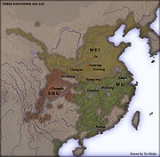
The three kingdoms were Wèi
Cao Wei

Cao Wei was one of the empires that competed for control of China during the Three Kingdoms period. With the capital at Lu?y?ng, the empire was established by Cao Pi in 220, based upon the foundations that his father Cao Cao laid....
, Shu
Shu Han

Shu Han , sometimes known as the Kingdom of Shu was one of the Three Kingdoms competing for control of China after the fall of the Han Dynasty, based on areas around Sichuan which was then known as Shu ....
, and
Eastern Wu

Eastern Wu , also known as Sun Wu , was one of the Three Kingdoms competing for control of China after the fall of the Han Dynasty in the Jiangnan region of China....
.


Discussion
Ask a question about 'Three Kingdoms'
Start a new discussion about 'Three Kingdoms'
Answer questions from other users
Full Discussion Forum


Timeline

214   Liu Bei takes Yi Province from his clansman Liu Zhang, forming the later basis for Shu Han during the Three Kingdoms period.

220   Han Xiandi abdicates his throne to Cao Pi, symbolizing the end of the Han Dynasty and the beginning of the Three Kingdoms period in China.

222   Kingdom of Wu is established in China.

223   Died

226   Accession of Cao Rui as emperor of the Kingdom of Wei of China.

239   In the Chinese Kingdom of Wei, Wei Qi Wang succeeds Wei Ming Di

252   Sun Liang succeeds Sun Quan as king of the Chinese Kingdom of Wu.

258   Sun Xiu succeeds Sun Liang as ruler of the Chinese kingdom of Wu

263   The Wei Kingdom conquers the kingdom of Shu Han, one of the Chinese Three Kingdoms.

264   Sun Hao succeeds Sun Xiu as ruler of the Chinese kingdom of Wu.


Encyclopedia


The Three Kingdoms period is a period in the history of China
History of China

China civilization originated in various city-states along the Yellow River valley in the Neolithic era. The written history of China begins with the Shang Dynasty ....
, part of an era of disunity called the Six Dynasties
Six Dynasties

Six Dynasties is a collective noun for six China dynasties during the periods of the Three Kingdoms , Jin Dynasty , and Southern and Northern Dynasties ....
 following immediately the loss of de facto
De facto

De facto is a Latin expression that means "concerning the fact" or in practice but not necessarily ordained by law. It is commonly used in contrast to de jure when referring to matters of law, governance, or technique that are found in the common experience as created or developed without or contrary to a regulation....
 power of the Han Dynasty
Han Dynasty

The Han Dynasty followed the Qin Dynasty and preceded the Three Kingdoms in China. The Han Dynasty was ruled by the family known as the Liu clan who had peasant origins....
 emperors. In a strict academic sense it refers to the period between the foundation of the Wei
Cao Wei

Cao Wei was one of the empires that competed for control of China during the Three Kingdoms period. With the capital at Lu?y?ng, the empire was established by Cao Pi in 220, based upon the foundations that his father Cao Cao laid....
 in 220 and the conquest of the Wu
Eastern Wu

Eastern Wu , also known as Sun Wu , was one of the Three Kingdoms competing for control of China after the fall of the Han Dynasty in the Jiangnan region of China....
 by the Jin Dynasty
Jìn Dynasty (265-420)

The J?n Dynasty , one of the Six Dynasties, followed the Three Kingdoms period and preceded the Southern and Northern Dynasties in China. The dynasty was founded by the Sima family ....
 in 280. However, many Chinese historians and laymen extend the starting point of this period back to the uprising of the Yellow Turbans in 184.

The three kingdoms were Wèi
Cao Wei

Cao Wei was one of the empires that competed for control of China during the Three Kingdoms period. With the capital at Lu?y?ng, the empire was established by Cao Pi in 220, based upon the foundations that his father Cao Cao laid....
, Shu
Shu Han

Shu Han , sometimes known as the Kingdom of Shu was one of the Three Kingdoms competing for control of China after the fall of the Han Dynasty, based on areas around Sichuan which was then known as Shu ....
, and
Eastern Wu

Eastern Wu , also known as Sun Wu , was one of the Three Kingdoms competing for control of China after the fall of the Han Dynasty in the Jiangnan region of China....
. To help further distinguish these states from other historical Chinese states of the same name, historians add a relevant character: Wei is also known as Cáo Wèi, Shu is also known as Shu Hàn, and Wu is also known as Dong Wú or Eastern Wu. The term Three Kingdoms itself is somewhat of a mistranslation, since each state was eventually headed not by kings, but by an emperor
Emperor

An emperor is a monarch, usually the sovereign ruler of an empire or another type of imperial realm. Empress is the female equivalent. As a title, "empress" may indicate the wife of an emperor or a woman who rules in her own right ....
 who claimed legitimate succession from the Han Dynasty
Han Dynasty

The Han Dynasty followed the Qin Dynasty and preceded the Three Kingdoms in China. The Han Dynasty was ruled by the family known as the Liu clan who had peasant origins....
. Although the translation Three Empires is more contextually accurate, the term Three Kingdoms has become standard among sinologists.

The earlier, "unofficial" part of the period, from 190 to 220, was marked by chaotic infighting between warlords in various parts of China
China

China is a Culture of China, an ancient civilization, and, depending on perspective, a national or multinational entity extending over a large area in East Asia....
. The middle part of the period, from 220 and 263, was marked by a more militarily stable arrangement between three rival states, Cao Wei, Shu Han, and Eastern Wu. The later part of this period was marked by the collapse of the tripartite situation: first the destruction of Shu by Wei (263), then the overthrow of Wei by the Jin Dynasty
Jìn Dynasty (265-420)

The J?n Dynasty , one of the Six Dynasties, followed the Three Kingdoms period and preceded the Southern and Northern Dynasties in China. The dynasty was founded by the Sima family ....
 (265), and the destruction of Wu by Jin (280).

Although relatively short, this historical period has been greatly romanticised in the cultures
Culture of China

The Culture of China is one of the world's oldest and most complex cultures. The area in which the culture is dominant covers a large geographical region with customs and traditions varying greatly between towns, cities and Province ....
 of China
China

China is a Culture of China, an ancient civilization, and, depending on perspective, a national or multinational entity extending over a large area in East Asia....
, Japan
Japan

Japan is an island country in East Asia. Located in the Pacific Ocean, it lies to the east of the Sea of Japan, People's Republic of China, North Korea, South Korea and Russia, stretching from the Sea of Okhotsk in the north to the East China Sea and Taiwan in the south....
, Korea
Korea

Korea is a geographic area composed of two sovereign countries, a civilization, and a former state situated on the Korean Peninsula in East Asia....
, and Vietnam
Vietnam

Vietnam , officially the Socialist Republic of Vietnam , is the easternmost country on the Indochina Peninsula in Southeast Asia. It is bordered by People's Republic of China to the north, Laos to the northwest, Cambodia to the southwest, and the South China Sea to the east....
. It has been celebrated and popularised in operas, folk stories, novels and in more recent times, films, television serials, and video games. The best known of these is undoubtedly the Romance of the Three Kingdoms
Romance of the Three Kingdoms

Romance of the Three Kingdoms , written by Luo Guanzhong in the 14th century, is a Chinese historical novel based upon events in the turbulent years near the end of the Han Dynasty and the Three Kingdoms era of China, starting in 169 and ending with the reunification of the land in 280....
, a fictional account of the period which draws heavily on history. The authoritative historical record of the era is Chen Shou
Chen Shou

Chen Shou , born in Nanchong, Sichuan, was the author of the Sanguo Zhi, a historical account of the Three Kingdoms period of China. He was once an officer from the Shu Han of Three Kingdoms....
's Sanguo Zhi, along with Pei Songzhi's later annotations of the text.

The Three Kingdoms period was one of the bloodiest in Chinese history. A population census in late Eastern Han Dynasty reported a population of approximately 50 million, while a population census in early Western Jin Dynasty (after Jin re-unified China) reported a population of approximately 16 million. However, the Jin dynasty's consensus was far less complete than Han consensus, so these figures are in question. Even after taking into account possible inaccuracies of these census reports, a large percentage of the population was wiped out during the constant wars waged during this period.

Technology advanced significantly during this period. Zhuge Liang
Zhuge Liang

Zhuge Liang was Chancellor of China of Shu Han during the Three Kingdoms period of China. He is often recognised as the greatest and most accomplished strategist of his era....
 invented the wooden ox
Wooden ox

The wooden ox was created by Zhuge Liang while he served Shu Han. It was a machine, walking replica of an ox whose main purpose was to carry supplies such as cereal to an army that was running low on supplies....
, suggested to be an early form of the wheelbarrow
Wheelbarrow

A wheelbarrow is a small hand-propelled vehicle, usually with just one wheel, designed to be pushed and guided by a single person using two handles to the rear or a sail may be used to guide the ancient wheelbarrow by wind....
. A brilliant mechanical engineer known as Ma Jun
Ma Jun

Ma Jun , Chinese style name Deheng , was a Chinese mechanical engineer and government official during the Three Kingdoms era of China. His most notable invention was that of the South Pointing Chariot, a directional compass vehicle which actually had no magnetic function, but was operated by use of differential gears ....
, in the Kingdom of Wei, is considered by many to be as brilliant as his predecessor Zhang Heng
Zhang Heng

Zhang Heng was an Chinese astronomy, Chinese mathematics, List of Chinese inventions, Chinese geography, History of cartography#China, Chinese art, Chinese poetry, Government of the Han Dynasty, and Chinese literature from Nanyang, Henan, Henan, and lived during the Eastern Han Dynasty of China....
. He invented a hydraulic-powered, mechanical puppet theatre designed for Emperor Ming of Wei (Cao Rui), square-pallet chain pumps
Chain pumps

The chain pump is a type of water pump where an endless chain has positioned on it a series of circular discs. One end of the chain dips in to the water, and the chain runs through a tube, slightly bigger than the diameter of the discs....
 for irrigation of gardens in Luoyang
Luoyang

Luoyang is a prefecture-level city in western Henan province of China, People's Republic of China. It borders the provincial capital of Zhengzhou to the east, Pingdingshan to the southeast, Nanyang to the south, Sanmenxia to the west, Jiyuan to the north, and Jiaozuo to the northeast....
, and the ingenious design of the South Pointing Chariot
South Pointing Chariot

The South Pointing Chariot is widely regarded as one of the most complex geared mechanisms of the ancient History of China, and was continually used throughout the medieval period as well....
, a non-magnetic directional compass
Compass

A compass, magnetic compass or mariner's compass is a navigational instrument for determining direction relative to the earth's magnetic poles....
 operated by differential gears.

Collapse of dynastic power

China 5
What is traditionally thought of as the beginning of the "unofficial" Three Kingdoms Period is the Yellow Turban Rebellion
Yellow Turban Rebellion

The Yellow Turban Rebellion, sometimes also translated as the Yellow Scarves Rebellion, was a wikt:AD 184 peasant rebellion against Emperor Ling of Han....
 led by Zhang Jiao
Zhang Jiao

Zhang Jiao or Zhang Jue was the leader of the Yellow Turbans during the late Eastern Han Dynasty of China. He was said to be a sorcerer, and was a follower of Taoism....
 in 184. The year long revolt devastated northern China, as Zhang's religious sect, the Way of Peace, battled the weakened Han Empire, whose army was led by He Jin
He Jin

He Jin was the elder half-brother of Empress He , consort to Emperor Ling of Han China of the late Eastern Han Dynasty in China. He shared power with his sister as regents in 189, following the death of Emperor Ling....
. The Way of Peace was primarily composed of farmers who had suffered greatly under the corrupt government system and thus easily converted by Zhang Jiao to create a "new and peaceful world." The rebellion ended when Zhang Jiao died of illness, but the chaos the rebellion wrought, when combined with the natural disasters that had overrun China in the same period, destabilized the Han Dynasty and doomed it to fall. The rebellion also caused the central government to increase the allowance of military power of the local governments, which is one of the causes of the warring period that followed.

The series of events leading to the collapse of dynastic power and the rise of Cáo Cao
Cao Cao

C?o Cao was a warlord and the penultimate Chancellor of China of the Eastern Han Dynasty who rose to great power during its final years in ancient China....
 are extremely complex. The death of Emperor Ling in May 189 led to an unstable regency under General-in-chief He Jin and renewed rivalry between the factions of the eunuchs and regular civil bureaucracy. Following the assassination of He Jin, his chief ally the Colonel-Lieutenant of Retainers Yuan Shao
Yuan Shao

Yuan Shao was a powerful warlord during the late Eastern Han Dynasty and Three Kingdoms era of China. He occupied the northern territories of ancient China during the massive civil war towards the end of the Eastern Han Dynasty and the beginning of the Three Kingdoms era....
 led a massacre of the eunuchs in the imperial palaces in Luoyang
Luoyang

Luoyang is a prefecture-level city in western Henan province of China, People's Republic of China. It borders the provincial capital of Zhengzhou to the east, Pingdingshan to the southeast, Nanyang to the south, Sanmenxia to the west, Jiyuan to the north, and Jiaozuo to the northeast....
. This event prompted the invitation of frontier general Dong Zhuo
Dong Zhuo

Dong Zhuo was a powerful warlord during the late Eastern Han Dynasty and Three Kingdoms era of China. He seized control of Luoyang in 189 after the capital fell into chaos following the death of Emperor Ling of Han China and a bloody clash between the powerful eunuch faction and the court officials....
 to enter Luoyang from the northwest boundary of China. At the time China faced the powerful barbarians of Qiang tribe to the northwest, and thus Dong Zhuo controlled a large army with elite training. When he brought the army to Luoyang, he was able to easily overpower the existing armies of both sides and took control of the imperial court, ushering in a period of civil war across China.

Dong Zhuo then manipulated the succession so that the future Emperor Xian could take the throne in lieu of his elder half-brother. Dong Zhuo, while ambitious, genuinely wished for a more capable emperor. On his way to Luoyang, he encountered a small team of soldiers protecting the two sons of Emperor Ling fleeing the war zone. In the encounter, Dong Zhuo acted arrogantly and threatening, causing the elder half-brother to be paralyzed with fear; the younger brother, future Emperor Xian, responded calmly with authority and commanded Dong Zhuo to protect the royal family with his army to return to the Imperial Court.

While Dong Zhuo originally wanted to re-establish the authority of Han Empire and manage all the political conflict properly, his political capability proved to be much worse than his military leadership. His behaviour grew more and more violent and authoritarian, executing or sending into exile all that opposed him, and showed less and less respect to the Emperor. He ignored all royal etiquette and frequently carried open weapons into the imperial court. In 190 a coalition led by Yuan Shao
Campaign against Dong Zhuo

The Campaign against Dong Zhuo in the year 190 was initiated by a coalition of regional officials hoping to end Chancellor of China Dong Zhuo's influence in the ailing Han Dynasty court in China....
 was formed between nearly all the provincial authorities in the eastern provinces of the empire against Dong Zhuo. The mounting pressure from repeated defeat on the southern frontline against the Sun Jian
Sun Jian

Sun Jian was a military general and minor warlord during the late Eastern Han Dynasty and Three Kingdoms era in ancient China. He allied himself with Yuan Shu in 190 when warlords from eastern China formed a coalition to oust Dong Zhuo, a tyrannical warlord who held the puppet Emperor Xian of Han China in his power....
 forces drove the Han Emperor and later Dong Zhuo himself west to Chang'an
Chang'an

Chang'an is an ancient Capital of more than ten Dynasties in Chinese history in Chinese history. Chang'an literally means "Perpetual Peace" in Classical Chinese....
 in May 191.

Dong Zhuo once again demonstrated his political shortcomings by forcing millions of residents of Luoyang to migrate to Chang'an. He then set fire to Luoyang, preventing occupation by his enemies and destroying the biggest city in China at that time. In addition, he ordered his army to slaughter a whole village of civilians. The soldiers beheaded civilians and carried their heads into Chang'an to show off as war trophies, pretending to have had a great victory against his enemies. A year later Dong Zhuo was killed in a coup d'etat
Coup d'état

A coup d??tat , often simply called a coup, is the sudden unconstitutional overthrow of a government by a part of the state establishment – usually the military – to replace the branch of the stricken government, either with another civil government or with a military government....
 by Wang Yun
Wang Yun

Wang Yun was the Minister over the Masses under Emperor Xian of Han China during the late Eastern Han Dynasty of China. During Wang Yun's time, the emperors were mere puppets under the power of eunuch#Chinas and warlords....
 and Lü Bu
Lü Bu

L? Bu was a military general and later a minor warlord during the late Eastern Han Dynasty and Three Kingdoms era of China. According to the Records of Three Kingdoms, L? Bu was a master in horseback riding and archery, and was thus known as the Flying General....
.

Rise of Cao Cao

In 191, there was some talk among the coalition of appointing Liu Yu, an imperial relative, as emperor
Emperor

An emperor is a monarch, usually the sovereign ruler of an empire or another type of imperial realm. Empress is the female equivalent. As a title, "empress" may indicate the wife of an emperor or a woman who rules in her own right ....
, and gradually its members began to fall out. Most of the warlords in the coalition, with a few exceptions, sought the increase of personal military power in the time of instability instead of seriously wishing to restore the Han Dynasty's authority. The Han empire was divided between a number of regional warlords. Yuan Shao occupied the northern area of Ye
Ye, China

Ye was an ancient Chinese city located in what is now Linzhang County, Hebei and the neighbouring Anyang County, Henan.Ye was first built in the Spring and Autumn Period by Lord Huan of Qi, and by the time of the Warring States Period the city belonged to the state of Wei ....
 and extended his power, by taking over his superior Han Fu
Han Fu

Han Fu was a bureaucrat during the late Eastern Han Dynasty and Three Kingdoms era of China. He was the governor of Jizhou when the Yellow Turban Rebellion broke out in 184....
 with trickery and intimidation, north of the Yellow River
Yellow River

The Yellow River or Huang He / Hwang Ho is the second-longest river in China and the List of rivers by length in the world at 4,845 kilometers ....
 against Gongsun Zan
Gongsun Zan

Gongsun Zan , styled Bogui . A native of Liaoxi , he was a warlord with fierce reputation during the late Eastern Han Dynasty era of China....
, who held the northern frontier. Cáo Cao, directly to Yuan's south, was engaged in a struggle against Yuan Shu
Yuan Shu

Yuan Shu was a warlord during the late Eastern Han Dynasty and Three Kingdoms era of China. He rose to prominence following the collapse of the Han court in 189....
 and Liu Biao
Liu Biao

Li? Biao was the governor of the Jingzhou during the late Eastern Han Dynasty and Three Kingdoms era of China. He was a member of the same extended family as the Han emperors....
, who occupied respectively the Huai River basin and Middle Yangzi regions. Further south the young warlord Sun Ce
Sun Ce

Sun Ce was a military general and warlord during the late Eastern Han Dynasty and Three Kingdoms era in ancient China. He was the eldest of five sons and one daughter of Sun Jian, who was killed in battle when Sun Ce was only sixteen....
, taking over after the untimely death of Sun Jian
Sun Jian

Sun Jian was a military general and minor warlord during the late Eastern Han Dynasty and Three Kingdoms era in ancient China. He allied himself with Yuan Shu in 190 when warlords from eastern China formed a coalition to oust Dong Zhuo, a tyrannical warlord who held the puppet Emperor Xian of Han China in his power....
, was establishing his rule in the Lower Yangzi, albeit as a subordinate of Yuan Shu. In the west, Liu Zhang
Liu Zhang (warlord)

Liu Zhang was a warlord during the late Eastern Han Dynasty and Three Kingdoms era of China. He became governor of Yizhou , succeeding his father Liu Yan and ruled the region until 214, when he surrendered to Liu Bei....
 held Yizhou province while Hanzhong
Hanzhong

Hanzhong is a city in Shaanxi province, in central China. The population in 2004 was approximately 3.7 million....
 and the northwest were controlled by a motley collection of smaller warlords such as Ma Teng
Ma Teng

Ma Teng was a warlord during the late Eastern Han Dynasty and Three Kingdoms era of China. He controlled the Liangzhou region together with his sworn brother Han Sui....
 of Xiliang, the original post of Dong Zhuo.

Dong Zhuo, confident in his success, was slain by his own adopted son, Lü Bu
Lü Bu

L? Bu was a military general and later a minor warlord during the late Eastern Han Dynasty and Three Kingdoms era of China. According to the Records of Three Kingdoms, L? Bu was a master in horseback riding and archery, and was thus known as the Flying General....
 and his father-in-law Wang Yun. Lü Bu, in turn, was attacked by Dong Zhuo's supporters: Li Jue
Li Jue

Li Jue was a military general under the warlord Dong Zhuo during the Three Kingdoms era of China. He took command of Dong Zhuo's army after the latter was assassinated by L? Bu, and with the help of Fan Chou, Guo Si, and Zhang Ji he managed to take control over Chang'an, and secure power within the Imperial Court....
, Guo Si
Guo Si

Guo S? was formerly an officer under Niu Fu, who was a general serving under Dong Zhuo. After the death of his Lord, Guo Si occupied the capital of Chang'an with other former Dong Zhuo generals, Fan Chou and Li Jue, on the advice of Jia Xu....
, Zhang Ji
Zhang Ji

Zhang Ji a notable officer under Cao Wei. At one time, Zhang Ji greatly helped defend Chang'an along with Xiahou Yuan. According to the records of history, Zhang Ji later became the protector Yong and then later Liang....
 (Zhang Xiu's Uncle) and Fan Chou
Fan Chou

Fan Chou was an officer under Dong Zhuo. After the death of Dong Zhuo, he joined with Guo Si, Li Jue and Zhang Ji and helped take Chang'an. Later, he enjoyed successes in the battles against Ma Teng and Han Sui in the west, but on one occasion he allowed Han Sui, his fellow townsman, to go unharmed and talked amiably with him....
. Wang Yun and his whole family were executed. Lu fled to Zhang Yang, a northern warlord, and remained with him for a time before briefly joining Yuan Shao, but it was clear that Lü Bu was far too independent to serve another.

In August 195, Emperor Xian fled the tyranny of Li Jue at Chang'an and made a year long hazardous journey east in search of supporters. By 196, when he was received by Cao Cao
Cao Cao

C?o Cao was a warlord and the penultimate Chancellor of China of the Eastern Han Dynasty who rose to great power during its final years in ancient China....
, most of the smaller contenders for power had either been absorbed by larger ones or destroyed. This is an extremely important move for Cao Cao with the suggestion from his primary advisor, Xun Yu
Xun Yu

Xun Yu , styled Wenruo , was a strategist and statesman who served as a key advisor to Cao Cao during the Three Kingdoms era of China....
, commenting that by supporting the authentic Emperor, Cao Cao would have the formal legal authority to control the other warlords and force them to comply in order to restore the Han dynasty.

Cao Cao
Cao Cao

C?o Cao was a warlord and the penultimate Chancellor of China of the Eastern Han Dynasty who rose to great power during its final years in ancient China....
, whose zone of control was the precursor to the Kingdom of Wei, had raised an army in the winter of 189. In several strategic movements and battles, he controlled the Dui province and defeated several factions of the Yellow Turban rebels. This earned him the aid of other local militaries controlled by Zhang Miao
Zhang Miao

Zhang Miao was a minister of the Three Kingdoms Period who acted as prefect of Chenliu. Zhang Miao led an army during Campaign against Dong Zhuo against Dong Zhuo....
 and Chen Gong
Chen Gong

Chen Gong was an advisor to the warlord L? Bu during the late Eastern Han Dynasty and Three Kingdoms era of China. He, however, started his career under Cao Cao before he later defected to L? Bu and was executed when the latter was defeated by Cao Cao....
, who joined his cause to create his first sizable army. He continued the effort and absorbed approximately 300,000 Yellow Turbans
Yellow Turban Rebellion

The Yellow Turban Rebellion, sometimes also translated as the Yellow Scarves Rebellion, was a wikt:AD 184 peasant rebellion against Emperor Ling of Han....
 into his army as well as a number of clan-based military groups particular to the eastern side of Qing province. In 196 he established an imperial court at Xuchang
Xuchang

Xuchang is a prefecture-level city in central Henan province of China, People's Republic of China. It borders the provincial capital of Zhengzhou to the northwest, Kaifeng to the northeast, Zhoukou to the east, Luohe to the southeast, and Pingdingshan to the southwest....
 and developed military agricultural colonies (tuntian
Tuntian

The Tuntian or Duntian system was a system of government-encouraged agriculture originated in the Western Han, it was also practiced by the warlord Cao Cao during the Three Kingdoms Period....
) to support his army. Although the system imposed a heavy tax for hired civilian farmers (40% to 60% of agricultural production), the farmers were more than pleased to be able to work with relative stability and professional military protection in a time of chaos. This was later said to be his second important policy to success.

In 194, Cao Cao went to war with Tao Qian
Tao Qian (Three Kingdoms)

Tao Qian was governor of Xu province during the late Eastern Han Dynasty of China. The incident for which he is perhaps best known for is the death of Cao Cao's father Cao Song in his territory....
 of Xuzhou
Xuzhou

Xuzhou , known as Pengcheng in ancient times, is the forth largest prefecture-level city in Jiangsu province of China, People's Republic of China....
, whose officers had executed his whole family. Tao Qian received the support of Liu Bei
Liu Bei

Liu Bei , Chinese style name Xu?nd? , was a general, warlord, and later the founding emperor of Shu Han during the Three Kingdoms era of China....
 and Gongsun Zan
Gongsun Zan

Gongsun Zan , styled Bogui . A native of Liaoxi , he was a warlord with fierce reputation during the late Eastern Han Dynasty era of China....
, but even then, it seemed as if Cao Cao's superior forces would overrun Xuzhou entirely. However, Cao Cao received word that Lü Bu
Lü Bu

L? Bu was a military general and later a minor warlord during the late Eastern Han Dynasty and Three Kingdoms era of China. According to the Records of Three Kingdoms, L? Bu was a master in horseback riding and archery, and was thus known as the Flying General....
 had seized Yan province in Cao Cao's absence, and thus, he retreated, putting a halt to hostilities with Tao Qian for the time being. Tao Qian died that same year, leaving his province to Liu Bei. A year later, in 195, Cao Cao managed to drive Lü Bu out of Yan. Lu Bu fled to Xuzhou and was received by Liu Bei, and an uneasy alliance began between the two.

In the south, Sun Ce
Sun Ce

Sun Ce was a military general and warlord during the late Eastern Han Dynasty and Three Kingdoms era in ancient China. He was the eldest of five sons and one daughter of Sun Jian, who was killed in battle when Sun Ce was only sixteen....
, then an independent general under the service of Yuan Shu, defeated the warlords of Yangzhou
Yangzhou

Yangzhou is a prefecture-level city in central Jiangsu province of China, People's Republic of China. Sitting on the northern bank of the Yangtze River, it borders the provincial capital of Nanjing to the southwest, Huai'an to the north, Yancheng to the northeast, Taizhou, Jiangsu to the east, and Zhenjiang across the river to the south....
, including Liu Yao
Liu Yao

Liu Yao , courtesy name Yongming , was the final emperor of the History of China/Xiongnu state Han Zhao. He became emperor in 318 after most other members of the imperial Liu clan were massacred by Jin Zhun in a coup....
, Wang Lang
Wang Lang

Wang Lang was a politician during the end of the Han Dynasty and during the Three Kingdoms era of China. Through his granddaughter's marriage to Sima Zhao, he would become great grandfather to Sima Yan, who would later become Emperor Wu of the Jin Dynasty ....
, and Yan Baihu
Yan Baihu

Yan Baihu was a bandit leader in the Eastern Wu territory during the late Eastern Han Dynasty and Three Kingdoms era of China. Yan Baihu called himself "East Wu's King of Morals"....
. The speed with which Sun Ce accomplished his conquests led to his nickname, "Little Conqueror", a reference to the late Xiang Yu
Xiang Yu

Xiang Yu was one of the most prominent generals in China history. His name was Ji , Yu was his courtesy name. He was a descendant of Xiang Yan , a general of Chu nobility....
. In 197, Yuan Shu, who was at odds with Cao Cao, Yuan Shao, and Liu Bei, felt assured of victory with his subordinate's conquests, and thus declared himself emperor of the Cheng Dynasty. The move, however, was a tactical blunder, as it drew the ire of many warlords across the land, including Yuan Shu's own subordinate Sun Ce, who had advised Yuan Shu not to make such a move. Cao Cao issued orders to Sun Ce to attack Yuan Shu. Sun Ce complied, but first convinced Cao Cao to form a coalition against Yuan Shu, of which Liu Bei and Lü Bu were members. Attacked on all sides, Yuan Shu was defeated and fled into hiding.

Afterwards, Lü Bu betrayed Liu Bei and seized Xuzhou, forming an alliance with Yuan Shu's remnant forces. Liu Bei fled to Cao Cao, who accepted him. Soon, preparations were made for an attack on Lü Bu, and the combined forces of Cao Cao and Liu Bei besieged Xia Pi. Lü Bu's officers deserted him, Yuan Shu's forces never arrived as reinforcements, and he was bound by his own officers Song Xian
Song Xian

Song Xian was a military officer under the minor warlord L? Bu during the late Eastern Han Dynasty and Three Kingdoms era in ancient China. In 198, when rival warlord Cao Cao besieged L? Bu in Xiapi, Song Xian and his colleagues Hou Cheng and Wei Xu kidnapped L? Bu's chief advisor Chen Gong and defected....
 and Wei Xu
Wei Xu

Wei Xu was a military officer under the minor warlord L? Bu during the late Eastern Han Dynasty and Three Kingdoms era in ancient China. In 198, when rival warlord Cao Cao besieged L? Bu in Xiapi, Wei Xu and his colleagues Hou Cheng and Song Xian kidnapped L? Bu's chief advisor Chen Gong and defected....
 and executed along with many of his officers. Thus, the man known as the mightiest warrior in the land was no more.

In 200, Dong Cheng
Dong Cheng

Dong Cheng was a government official during the late Eastern Han/Three Kingdoms era of China. He was allegedly given the task to assassinate Cao Cao by Emperor Xian of Han China ....
, an officer of the Imperial Court, received a secret edict from the Emperor to assassinate Cao Cao. He collaborated with Liu Bei on this effort, but Cao Cao soon found out about the plot and had Dong Cheng and his co-conspirators executed, with only Liu Bei surviving and fleeing to the Yuan Shao in the north.

After settling the nearby provinces, including a rebellion led by former Yellow Turbans, and internal affairs with the court, Cao Cao turned his attention north to Yuan Shao, who himself had eliminated his northern rival Gongsun Zan that same year. Yuan Shao, himself of higher nobility than Cao Cao, amassed a large army and camped along the northern bank of the Yellow river.

In 200, after winning a decisive battle against Liu Biao at Shaxian and putting down the rebellions of Xu Gong and others, Sun Ce was struck by an arrow and fatally wounded. On his deathbed, he named his younger brother, Sun Quan
Sun Quan

Sun Quan , son of Sun Jian, courtesy name Zh?ngm?u , formally Emperor Da of Wu was the founder of Eastern Wu, during the Three Kingdoms period, in China....
, as his heir.

Following months of planning, Cao Cao and Yuan Shao met in force at Guandu
Battle of Guandu

The Battle of Guandu was a battle during the End of the Han Dynasty to the Three Kingdoms period of Chinese history that took place at the Yellow River in the spring of 200....
. Overcoming Yuan's superior numbers, (actual numbers vary in different sources, but Yuan Shao having a manifestly superior number is universally accepted) Cao Cao decisively defeated him by setting fire to his supplies, and in doing so crippled the northern army. Liu Bei fled to Liu Biao of Jing province, and many of Yuan Shao's forces were destroyed. In 202, Cao Cao took advantage of Yuan Shao's death and the resulting division among his sons to advance north of the Yellow River. He captured Ye
Ye, China

Ye was an ancient Chinese city located in what is now Linzhang County, Hebei and the neighbouring Anyang County, Henan.Ye was first built in the Spring and Autumn Period by Lord Huan of Qi, and by the time of the Warring States Period the city belonged to the state of Wei ....
 in 204 and occupied the provinces of Ji, Bing, Qing and You. By the end of 207, after a lightning campaign against the Wuhuan
Wuhuan

The Wuhuan were a nomadic people who inhabited northern China, in what is now the provinces of Hebei, Liaoning, Shanxi, the municipality of Beijing and the autonomous region of Inner Mongolia....
 barbarians, Cao Cao
Cao Cao

C?o Cao was a warlord and the penultimate Chancellor of China of the Eastern Han Dynasty who rose to great power during its final years in ancient China....
 had achieved undisputed dominance of the North China Plain
North China Plain

The North China Plain is based on the deposits of the Yellow River and is the largest alluvial plain of eastern Asia. The plain is bordered on the north by the Yanshan Mountains and on the west by the Taihang Mountains....
.

Red Cliffs and its aftermath

Chibi
In 208, Cao Cao
Cao Cao

C?o Cao was a warlord and the penultimate Chancellor of China of the Eastern Han Dynasty who rose to great power during its final years in ancient China....
 marched south with his army hoping to quickly unify the empire. Liu Biao
Liu Biao

Li? Biao was the governor of the Jingzhou during the late Eastern Han Dynasty and Three Kingdoms era of China. He was a member of the same extended family as the Han emperors....
's son Liu Cong
Liú Cong

Liu Cong , courtesy name Xuanmen , nickname Zai , formally Emperor Zhaowu of Han , was an emperor of the History of China/Xiongnu state Han Zhao....
 surrendered the province of Jing and Cao was able to capture a sizeable fleet at Jiangling. Sun Quan
Sun Quan

Sun Quan , son of Sun Jian, courtesy name Zh?ngm?u , formally Emperor Da of Wu was the founder of Eastern Wu, during the Three Kingdoms period, in China....
, the successor to Sun Ce
Sun Ce

Sun Ce was a military general and warlord during the late Eastern Han Dynasty and Three Kingdoms era in ancient China. He was the eldest of five sons and one daughter of Sun Jian, who was killed in battle when Sun Ce was only sixteen....
 in the Lower Yangzi, continued to resist however. His advisor Lu Su
Lu Su

Lu Su , styled Zijing, was an advisor for the Eastern Wu during the Three Kingdoms era of China. He took control of the military after the death of Zhou Yu....
 secured an alliance with Liu Bei, himself a recent refugee from the north, and Sun Ce's sworn brother Zhou Yu
Zhou Yu

Zhou Yu was a famous and one of the most capable military strategists for Sun Ce and his successor Sun Quan during the Three Kingdoms era; the turbulent years leading to the end of Han Dynasty in China.Zhou Yu was the stratigist for Sun Ce and he was very well at his job....
 was placed in command of Sun Quan's navy, along with a veteran officer of the Sun family, Cheng Pu
Cheng Pu

Cheng Pu was a veteran warrior who served the Sun family for three generations in the Eastern Wu during the Three Kingdoms era of China. He was skilled in wielding his serpent spear as a weapon....
. Their combined armies of 50,000 met Cao Cao's fleet and 200,000-strong force at Red Cliffs
Battle of Red Cliffs

The Battle of Red Cliffs, otherwise known as the Battle of Chibi, was a decisive battle at the end of the Han Dynasty, immediately prior to the period of the Three Kingdoms in China....
 (Chinese: ?? Chi Bi) that winter. After an initial skirmish, an attack beginning with a plan to set fire to Cao Cao's fleet was set in motion to lead to a decisive defeat on Cao Cao, forcing him to retreat in disarray back to the north. The allied victory at Red Cliffs ensured the survival of Liu Bei
Liu Bei

Liu Bei , Chinese style name Xu?nd? , was a general, warlord, and later the founding emperor of Shu Han during the Three Kingdoms era of China....
 and Sun Quan
Sun Quan

Sun Quan , son of Sun Jian, courtesy name Zh?ngm?u , formally Emperor Da of Wu was the founder of Eastern Wu, during the Three Kingdoms period, in China....
, and provided the basis for the states of Shu and Wu.

After his return to the north, Cao Cao
Cao Cao

C?o Cao was a warlord and the penultimate Chancellor of China of the Eastern Han Dynasty who rose to great power during its final years in ancient China....
 contented himself with absorbing the northwestern regions in 211 and consolidating his power. He progressively increased his titles and power, eventually becoming the Prince of Wei in 217, a title bestowed upon him by the puppet Han emperor that he controlled. Liu Bei
Liu Bei

Liu Bei , Chinese style name Xu?nd? , was a general, warlord, and later the founding emperor of Shu Han during the Three Kingdoms era of China....
, having defeated the weak Jing warlords Han Xuan
Han Xuan

Han Xuan was governor of Changsha during the Han dynasty and Three Kingdoms era in China. He served under Liu Biao, governor of Jingzhou, for three years....
, Jin Xuan
Jin Xuan

Jin Xuan the protector of Wu Ling. At one time when Zhang Fei attacked Wu Ling, Jin Xuan ignored the suggestion of Gong Zhi to surrender, and instead he marched....
, Zhao Fan
Zhao Fan

Zhao Fan was a minister the Kingdom of Cao Wei during the Three Kingdoms Period of China. Zhao Fan served as the prefect of Gui Yang, but surrendered to Zhao Yun after being attacked by his army at Gui Yang following the Battle of Chi Bi ....
, and Liu Du
Liu Du

Liu Du was a minister of the Three Kingdoms Period that was the prefect of Ling Ling. Liu Du at one time sent his son Liu Xian and Xing Daorong against Liu Bei....
, entered Yi province and later in 214 displaced Liu Zhang as ruler, leaving his commander Guan Yu
Guan Yu

Guan Yu was a general under the warlord Liu Bei during the late Eastern Han Dynasty and Three Kingdoms era of China. He played a significant role in the civil war that led to the collapse of the Han Dynasty and the establishment of the Shu Han, of which Liu Bei was the first emperor....
 in charge of Jing province. Sun Quan
Sun Quan

Sun Quan , son of Sun Jian, courtesy name Zh?ngm?u , formally Emperor Da of Wu was the founder of Eastern Wu, during the Three Kingdoms period, in China....
, who had in the intervening years being engaged with defenses against Cao Cao in the southeast at Hefei
Hefei

Hefei is a prefecture-level city and the capital of Anhui province of China, People's Republic of China. Located in central Anhui, it borders Huainan to the north, Chuzhou to the northeast, Chaohu to the southeast and Lu'an to the west....
, now turned his attention to Jing province and the Middle Yangzi. Tensions between the allies were increasingly visible. In 219, after Liu Bei successfully seized Hanzhong from Cao Cao
Cao Cao

C?o Cao was a warlord and the penultimate Chancellor of China of the Eastern Han Dynasty who rose to great power during its final years in ancient China....
 and as Guan Yu
Guan Yu

Guan Yu was a general under the warlord Liu Bei during the late Eastern Han Dynasty and Three Kingdoms era of China. He played a significant role in the civil war that led to the collapse of the Han Dynasty and the establishment of the Shu Han, of which Liu Bei was the first emperor....
 was engaged in the siege of Fan
Battle of Fancheng

The Battle of Fancheng was fought between the forces of Liu Bei and Cao Cao in the End of the Han Dynasty to the Three Kingdoms period in Ancient China China....
, Sun Quan's commander-in-chief Lu Meng secretly seized Jing province, and his forces captured and slew Guan Yu.

Three emperors

In the first month of 220, Cao Cao
Cao Cao

C?o Cao was a warlord and the penultimate Chancellor of China of the Eastern Han Dynasty who rose to great power during its final years in ancient China....
 died and in the tenth month his son Cao Pi
Cao Pi

Cao Pi , formally Emperor Wen of Wei , courtesy name Zihuan , was born in Qiao County, Pei Commandery . He was the second son of the China politician and poet Cao Cao and was the first Emperor of China and the real founder of Cao Wei , one of the Three Kingdoms....
 forced Emperor Xian to abdicate, thus ending the Han Dynasty. He named his state Wei and made himself emperor at Luoyang. In 221, Liu Bei named himself Emperor of Han, in a bid to restore the fallen Han dynasty. (His state is known to history as "Shu" or "Shu Han".) In the same year, Wei bestowed on Sun Quan
Sun Quan

Sun Quan , son of Sun Jian, courtesy name Zh?ngm?u , formally Emperor Da of Wu was the founder of Eastern Wu, during the Three Kingdoms period, in China....
 the title of King of Wu. A year later, Shu Han troops declared war on Wu and met the Wu armies at the Battle of Yiling. At Yiling, Liu Bei was disastrously defeated by Sun Quan's commander Lu Xun
Lu Xun (Three Kingdoms)

Lu Xun was an officer of Eastern Wu during the Three Kingdoms era of China. He was instrumental in causing Guan Yu's downfall, but is most famous for defeating Liu Bei in the celebrated Battle of Yiling....
 and forced to retreat back to Shu, where he died soon afterward. After the death of Liu Bei, Shu and Wu resumed friendly relations at the expense of Wei, thus stabilizing the tripartite configuration. In 222, Sun Quan renounced his recognition of Cao Pi
Cao Pi

Cao Pi , formally Emperor Wen of Wei , courtesy name Zihuan , was born in Qiao County, Pei Commandery . He was the second son of the China politician and poet Cao Cao and was the first Emperor of China and the real founder of Cao Wei , one of the Three Kingdoms....
's regime and, in 229, he declared himself emperor at Wuchang.

Dominion of the north completely belonged to Wei, whilst Shu occupied the southwest and Wu the central south and east. The external borders of the states were generally limited to the extent of Chinese civilization. For example, the political control of Shu on its southern frontier was limited by the Tai
Tai peoples

"Thai peoples" redirects here. For the subgroup of the Tai, see Thai peopleThe 'Tai' ethnicity refers collectively to the ethnic groups of southern China and Southeast Asia, stretching from Hainan to eastern India and from southern Sichuan to Laos, Thailand, and parts of Vietnam, which speak languages in the Tai languages family and share s...
 tribes of modern Yunnan
Yunnan

is a political divisions of China of the People's Republic of China, located in the far southwest of the country spanning approximately 394,000 square kilometers ....
 and Burma
Myanmar

Burma, officially the Union of Myanmar, is the largest country by geographical area in mainland Southeast Asia, or Indochina. The country is bordered by the People's Republic of China on the northeast, Laos on the east, Thailand on the southeast, Bangladesh on the west, India on the northwest, and the Bay of Bengal to the southwest with...
, known collectively as the Southern Barbarians
Nanman

File:Tianxia_zh-hant.svgNanman were aboriginal tribes who lived in Southwest China China. They may have been related to the Sanmiao, dated to around the 3rd century BC....
.

Population

The population could be derived from the official record of Chen Shou's Sanguo Zhi. In terms of manpower, the Wei was by far the largest, retaining more than 660,000 households and 4,400,000 people within its borders(263). Shu had a population of 940,000(263), and Wu 2,300,000(280).The total population of Three Kingdoms is about one-tenth of late Eastern Han Dynasty. Thus, Wei had more than 58% of the population and around 40% of territory. With these resources, it is estimated that it could raise an army of 440,000 whilst Shu and Wu could manage 100,000 and 230,000. The Wu-Shu alliance against the Wei proved itself to be a militarily stable configuration; the basic borders of the Three Kingdoms remained almost unchanged for more than forty years.

Trade and transport

In economic terms the division of the Three Kingdoms reflected a reality that long endured. Even in the Northern Song
Northern song

Northern song is the English language title of the popular song of Ruslana, ,Pivnicha....
, seven hundred years after the Three Kingdoms, it was possible to think of China as being composed of three great regional markets. (The status of the northwest was slightly ambivalent, as it had links with the northern region and Sichuan
Sichuan

is a Province in western China proper with its capital in Chengdu. The current name of the province, ?? , is an abbreviation of ??? , or "Four circuit #Circuits in East Asia of rivers", which is itself abbreviated from ???? , or "Four circuits of rivers and gorges", named after the division of the existing circuit into four during the Song...
). These geographical divisions are underscored by the fact that the main communication routes between the three main regions were all man-made: the Grand Canal
Grand Canal of China

The Grand Canal of China , also known as the Beijing-Hangzhou Grand Canal is the longest ancient canal or artificial river in the world....
 linking north and south, the hauling-way through the Three Gorges
Three Gorges

The Three Gorges region is a scenic area along the Yangtze River in the People's Republic of China with a total length of approximately 200 km....
 of the Yangzi linking southern China with Sichuan and the gallery road
Gallery road

The gallery roads were roads through remote mountain areas of China. They consisted of wooden planks erected on holes cut into the sides of cliffs....
s joining Sichuan with the northwest. The break into three separate entities was quite natural and even anticipated by such political foresight as that of Zhuge Liang
Zhuge Liang

Zhuge Liang was Chancellor of China of Shu Han during the Three Kingdoms period of China. He is often recognised as the greatest and most accomplished strategist of his era....
 (see Longzhong Plan
Longzhong Plan

The Longzhong Plan is the name given to a strategic plan given by the famed third century China tactician and administrator Zhuge Liang. It formed the basis for the grand plan of the warlord Liu Bei and later the Three Kingdoms state of Kingdom of Shu....
).

Consolidation

In 223 Liu Shan
Liu Shan

Liu Shan, , was the second and last emperor of the Kingdom of Shu during the Three Kingdoms era of China. As he ascended the throne at the young age of sixteen, Liu Shan was entrusted to the care of a group of veteran ministers, including the Chancellor Zhuge Liang and Imperial Secretary Li Yan ....
 rose to the throne of Shu following his father's defeat and death. The defeat of Liu Bei at Yiling ended the period of hostility between Wu and Shu and both used the opportunity to concentrate on internal problems and the external enemy of Wei. For Sun Quan, the victory terminated his fears of Shu expansion into Jing province and he turned to the aborigines of the southeast, whom the Chinese collectively called the "Shanyue" peoples (see Yue
Yue (peoples)

Yue refers to ancient semi-Sinicized or non-Sinicized peoples of southern China, originally those along the eastern coastline of present-day Zhejiang....
). A collection of successes against the rebellious tribesmen culminated in the victory of 234. In that year Zhuge Ke
Zhuge Ke

Zhuge Ke , courtesy name Yuanxun , was an officer for Eastern Wu during the Three Kingdoms era of China. He was the son of the Wu minister, Zhuge Jin, whose younger brother was the great Shu Han strategist, Zhuge Liang....
 ended a three year siege of Danyang with the surrender of 100,000 Shanyue. Of these, 40,000 were drafted as auxiliaries into the Wu army. Meanwhile Shu was also experiencing troubles with the indigenous tribes of their south. The Southwestern Nanman
Nanman

File:Tianxia_zh-hant.svgNanman were aboriginal tribes who lived in Southwest China China. They may have been related to the Sanmiao, dated to around the 3rd century BC....
 peoples rose in revolt against Han authority, captured and looted the city of Yizhou. Zhuge Liang, recognising the importance of stability in the south, ordered the advance of the Shu armies in three columns against the Nanman. He fought a number of engagements against the chieftain Meng Huo
Meng Huo

Meng Huo was aristocrat in the Nanzhong region, south of Shu Han, during the Three Kingdoms era of China. He was involved in several small skirmishes with Shu Han, and in retaliation Shu's strategist Zhuge Liang launched a full invasion on the Nanzhong region....
, at the end of which Meng submitted. A tribesman was allowed to reside at the Shu capital Chengdu
Chengdu

Chengdu , located in southwest People's Republic of China, is the capital of Sichuan provinces of China and a sub-provincial city. Chengdu is also one of the most important economic centers and transportation and communication hubs in Southwestern China....
 as an official and the Nanman formed their own battalions within the Shu army.

Zhuge Liang's Northern Expeditions

At the end of Zhuge Liang
Zhuge Liang

Zhuge Liang was Chancellor of China of Shu Han during the Three Kingdoms period of China. He is often recognised as the greatest and most accomplished strategist of his era....
's southern campaign, the Wu-Shu alliance came to fruition and Shu was free to move against the north. In 227 Zhuge Liang
Zhuge Liang

Zhuge Liang was Chancellor of China of Shu Han during the Three Kingdoms period of China. He is often recognised as the greatest and most accomplished strategist of his era....
 transferred his main Shu armies to Hanzhong
Hanzhong

Hanzhong is a city in Shaanxi province, in central China. The population in 2004 was approximately 3.7 million....
, and opened up the battle for the northwest with Wei. The next year, he ordered the general Zhao Yun
Zhao Yun

Zhao Yun was a major military general during the civil wars of the late Han Dynasty and during the Three Kingdoms era of China. For most of his career, Zhao Yun served the warlord Liu Bei, playing a part in the establishment of Shu Han....
 to attack from Ji Gorge as a diversion while Zhuge himself led the main force to Qishan. The vanguard Ma Su
Ma Su

Ma Su was a military strategist for the Shu Han during the Three Kingdoms era of China. He was the younger brother of Shu advisor, Ma Liang . Ma Su had extraordinary talents in military stratagems and was admired by the Prime Minister of Shu, Zhuge Liang....
, however, suffered a tactical defeat at Jieting
Battle of Jieting

The Battle of Jieting was a battle fought in 228 during the Zhuge Liang's Northern Expeditions#First expedition led by Zhuge Liang....
 and the Shu army was forced to withdraw. In the next six years Zhuge Liang
Zhuge Liang

Zhuge Liang was Chancellor of China of Shu Han during the Three Kingdoms period of China. He is often recognised as the greatest and most accomplished strategist of his era....
 attempted several more offensives, but supply problems limited the capacity for success. In 234 he led his last great northern offensive, reaching the Battle of Wuzhang Plains
Battle of Wuzhang Plains

The Battle of Wuzhang Plains is a famous standoff between the kingdoms of Cao Wei and Shu Han in 234 A.D. during the Three Kingdoms period of China....
 south of the Wei River
Wei River

The Wei River is a river in west-central China and is the largest tributary of the Yellow River. The source of the Wei River is close to Weiyuan County in Gansu province, at less than 200 kilometres from the Yellow River at Lanzhou....
. Due to the death of Zhuge Liang (234 AD), however, the Shu army was forced once again to withdraw, but were pursued by Wei. The Shu forces began to withdraw; Sima Yi deduced Zhuge's demise and ordered an attack. Shu struck back almost immediately, causing Sima Yi to second guess and allow Shu to withdraw successfully.

Wu and development of the south

In the times of Zhuge Liang
Zhuge Liang

Zhuge Liang was Chancellor of China of Shu Han during the Three Kingdoms period of China. He is often recognised as the greatest and most accomplished strategist of his era....
's great northern offensives, the state of Wu had always been on the defensive against invasions from the north. The area around Hefei
Hefei

Hefei is a prefecture-level city and the capital of Anhui province of China, People's Republic of China. Located in central Anhui, it borders Huainan to the north, Chuzhou to the northeast, Chaohu to the southeast and Lu'an to the west....
 was the scene of many bitter battles and under constant pressure from Wei after the Battle of Red Cliffs. Warfare had grown so intense that many of the residents chose to migrate and resettle south of the Yangzi. After Zhuge Liang
Zhuge Liang

Zhuge Liang was Chancellor of China of Shu Han during the Three Kingdoms period of China. He is often recognised as the greatest and most accomplished strategist of his era....
's death, attacks on the Huainan
Huainan

})|-| Area| 2,596.4 km?|-| Population| 2,335,798 |-| GDP'- Total'- Per Capita|  Renminbi31.4 billion ?13,500 ...
 region intensified but nonetheless, Wei could not break through the line of the river defenses erected by Wu, which included the Ruxu fortress.

Sun Quan
Sun Quan

Sun Quan , son of Sun Jian, courtesy name Zh?ngm?u , formally Emperor Da of Wu was the founder of Eastern Wu, during the Three Kingdoms period, in China....
's long reign is regarded as a time of plenty for his southern state. Migrations from the north and the settlement of the Shanyue increased manpower for agriculture, especially along the lower reaches of the Yangzi and in Kuaiji commandery. River transport blossomed, with the construction of the Zhedong and Jiangnan canals. Trade with Shu flourished, with a huge influx of Shu cotton and the development of celadon
Celadon

Celadon is a term for ceramics denoting both a type ceramic glaze, and a ware of a specific color, also called celadon . This type of ware was invented in ancient China, particularly in Zhejiang Province....
 and metal industries. Ocean transport was improved to such an extent that sea journeys were made to Manchuria
Manchuria

Manchuria is a historical name given to a vast geographic region in northeast Asia. Depending on the definition of its extent, Manchuria either falls entirely within People's Republic of China, or is divided between China and Russia....
 and the island of Taiwan
Taiwan

Taiwan is an island in East Asia. "Taiwan" is also commonly used to refer to the country governed by the Republic of China and to the ROC itself, which governs the island of Taiwan, Orchid Island and Green Island, Taiwan in the Pacific Ocean off the Taiwan coast, the Penghu islands in the Taiwan Strait, and Kinmen and the Matsu Islands...
. In the south, Wu merchants reached Linyi (southern Vietnam
Vietnam

Vietnam , officially the Socialist Republic of Vietnam , is the easternmost country on the Indochina Peninsula in Southeast Asia. It is bordered by People's Republic of China to the north, Laos to the northwest, Cambodia to the southwest, and the South China Sea to the east....
) and Fu'nan (Cambodia
Cambodia

The Kingdom of Cambodia is a country in South East Asia with a population of over 13 million people. The kingdom's capital and largest city is Phnom Penh....
). As the economy prospered, so too did the arts and culture. In the Yangzi delta, the first Buddhist influences reached the south from Luoyang. (See Buddhism in China
Buddhism in China

Chinese Buddhism refers collectively to the various schools of Buddhism that have flourished in China proper since ancient times. Many of these schools integrated the ideas of Confucianism, Taoism and other indigenous philosophical systems so that what was initially a foreign religion came to be a natural part of Chinese civilization, albe...
)

Decline and end of the Three Kingdoms

From the late 230s tensions began to become visible between the imperial Cao clan and the Sima clan. Following the death of Cao Zhen
Cao Zhen

Cao Zhen was a military general under the powerful warlord Cao Cao and the succeeding rulers of Cao Wei during the late Eastern Han Dynasty and Three Kingdoms era of China....
, factionalism was evident between Cao Shuang
Cao Shuang

Cao Shuang was the son of Cao Zhen, a famous commander of the Kingdom of Wei during the Three Kingdoms period. He initially held great power in the kingdom of Wei as the Grand Commander but later, he lost his power to Sima Yi and was executed on charges of treason....
 and the Grand Commander Sima Yi
Sima Yi

Sima Yi was a strategist, general, and politician of Cao Wei during the Three Kingdoms era of China. He is perhaps best known for defending Cao Wei from Zhuge Liang's Zhuge Liang's Northern Expeditions....
. In deliberations, Cao Shuang placed his own supporters in important posts and excluded Sima, whom he regarded as a threat. The power of the Sima clan, one of the great landowning families of the Han, was bolstered by Sima Yi's military victories. Additionally, Sima Yi
Sima Yi

Sima Yi was a strategist, general, and politician of Cao Wei during the Three Kingdoms era of China. He is perhaps best known for defending Cao Wei from Zhuge Liang's Zhuge Liang's Northern Expeditions....
 was an extremely capable strategist and politician. In 238 he crushed the rebellion of Gongsun Yuan
Gongsun Yuan

Gongsun Yuan was a general of Cao Wei during the Three Kingdoms period.He was born to Gongsun Kang, Governor of Liaodong, Xuantu commandery, Lelang commandery and Daifang commandery commandery....
 and brought the Liaodong region directly under central control. Ultimately, he outmaneuvered Cao Shuang
Cao Shuang

Cao Shuang was the son of Cao Zhen, a famous commander of the Kingdom of Wei during the Three Kingdoms period. He initially held great power in the kingdom of Wei as the Grand Commander but later, he lost his power to Sima Yi and was executed on charges of treason....
 in power play. Taking advantage of an excursion by the imperial clansmen to the Gaoping tombs, Sima undertook a putsch in Luoyang, forcing Cao Shuang's faction from authority. Many protested to the overwhelming power of the Sima family; notable of which were the Seven Sages of the Bamboo Grove
Seven Sages of the Bamboo Grove

The Seven Sages of the Bamboo Grove were a group of China Taoist Qingtan scholars, writers, and musicians who came together in the bloody 3rd century CE....
. One of the sages, Xi Kang, was executed as part of the purges after Cao Shuang's downfall.

Fall of Shu

The decreasing strength of the Cao clan was mirrored by the decline of Shu. After Zhuge Liang
Zhuge Liang

Zhuge Liang was Chancellor of China of Shu Han during the Three Kingdoms period of China. He is often recognised as the greatest and most accomplished strategist of his era....
's death, his position as Lieutenant Chancellor
Chancellor of China

The Chancellor , variously translated as Prime Minister, Premier or Chief Councillor, was a generic name given to the highest-ranking official in the imperial government in ancient China....
 fell to Jiang Wan
Jiang Wan

Jiang Wan , courtesy name Gongyan was an official of Shu Han during the Three Kingdoms era of China. After Zhuge Liang's death, he succeeded Zhuge as the regent for the Shu emperor, Liu Shan....
, Fei Yi
Fei Yi

Fei Yi , courtesy name Wenwei , was an official of Shu Han during the Three Kingdoms era of China. He served as regent after Jiang Wan....
 and Dong Yun
Dong Yun

Dong Yun was a minister for Shu Han during the Three Kingdoms era of China. Dong Yun was one of the four very famous prime ministers under Shu, which also included Zhuge Liang, Jiang Wan, and Fei Yi....
, in that order. But after 258, Shu politics became increasingly controlled by the eunuch
Eunuch

A eunuch is a castrated man, in particular one castrated early enough to have major hormonal consequences; the term usually refers to those castrated in order to perform a specific social function, as was common in many societies of the past....
 faction and corruption rose. Despite the energetic efforts of Jiang Wei
Jiang Wei

Jiang Wei was a military general and later regent of Shu Han during the Three Kingdoms era of China. He was originally a Cao Wei middle-level military officer, but because his mother was captured by Shu Han strategist Zhuge Liang, Jiang Wei joined him on Zhuge's first Zhuge Liang's Northern Expeditions against Cao Wei in 228....
, Zhuge's protege, Shu was unable to secure any decisive achievement. In 263, Wei launched a three-pronged attack and the Shu army was forced into general retreat from Hanzhong. Jiang Wei hurriedly held a position at Jian'ge but he was outflanked by the Wei commander Deng Ai
Deng Ai

Deng Ai was a talented general of Cao Wei during the Three Kingdoms era of China. It was said that whenever he saw a hill or wide valley, he would immediately size up the best places to store grain and position troops....
, who force-marched his army from Yinping through territory formerly considered impassable. By the winter of the year, the capital Chengdu fell due to the strategic invasion of Wei by Deng Ai who invaded Chengdu personally. The emperor Liu Shan
Liu Shan

Liu Shan, , was the second and last emperor of the Kingdom of Shu during the Three Kingdoms era of China. As he ascended the throne at the young age of sixteen, Liu Shan was entrusted to the care of a group of veteran ministers, including the Chancellor Zhuge Liang and Imperial Secretary Li Yan ....
 thus surrendered. The state of Shu had come to an end after forty-three years.

Fall of Wei

Cao Huan
Cáo Huàn

Cao Huan, Chinese character ??, Pinyin. c?o h?an, wg. Ts'ao-Huan was a grandson of Cao Cao and last emperor of Cao Wei during the Three Kingdoms period....
 succeeded to the throne in 260 after Cao Mao
Cao Mao

Cao Mao , courtesy name Yanshi was an emperor of Cao Wei during the Three Kingdoms period. He was a grandson of Cao Pi and the Duke of Gaoguixiang....
 was killed by Sima Zhao
Sima Zhao

Sima Zhao , courtesy name Zishang , was the son of chief military strategist Sima Yi of Cao Wei, during the Three Kingdoms era of China....
. Soon after, Sima Zhao died and his title as Lord of Jin was inherited by his son Sima Yan. Sima Yan immediately began plotting to become Emperor but faced stiff opposition. However, due to advice from his advisors, Cao Huan decided the best course of action would be to abdicate, unlike his predecessor Cao Mao. Sima Yan seized the throne in 264 after forcing Cao Huan's abdication, effectively overthrowing the Wei Dynasty and establishing the successor Jin Dynasty
Jìn Dynasty (265-420)

The J?n Dynasty , one of the Six Dynasties, followed the Three Kingdoms period and preceded the Southern and Northern Dynasties in China. The dynasty was founded by the Sima family ....
. This situation was similar to the deposal of Emperor Xian of the Han Dynasty by Cao Pi
Cao Pi

Cao Pi , formally Emperor Wen of Wei , courtesy name Zihuan , was born in Qiao County, Pei Commandery . He was the second son of the China politician and poet Cao Cao and was the first Emperor of China and the real founder of Cao Wei , one of the Three Kingdoms....
, the founder of the Wei Dynasty.

Fall of Wu

Following Sun Quan's death and the ascension of the young Sun Liang
Sun Liang

Sun Liang was an emperor of Eastern Wu during the Three Kingdoms period. He was the founding emperor Sun Quan's youngest son and heir. He is also known as the Prince of Kuaiji or Marquess of Houguan , which were his successive titles after his removal in 258 by the regent Sun Lin following his failed attempt to remove Sun Lin...
 as emperor in 252, the kingdom of Wu went into a period of steady decline. Successful Wei suppression of rebellions in the Huainan
Huainan

})|-| Area| 2,596.4 km?|-| Population| 2,335,798 |-| GDP'- Total'- Per Capita|  Renminbi31.4 billion ?13,500 ...
 region by Sima Zhao
Sima Zhao

Sima Zhao , courtesy name Zishang , was the son of chief military strategist Sima Yi of Cao Wei, during the Three Kingdoms era of China....
 and Sima Shi
Sima Shi

Sima Shi , courtesy name Ziyuan , was an official of Cao Wei during the Three Kingdoms era of China. He ultimately became the actual wielder of imperial power....
 reduced any opportunity of Wu influence. The fall of Shu signaled a change in Wei politics. After Liu Shan surrendered to Wei, Sima Yan (grandson of Sima Yi), overthrew the Wei emperor and proclaimed his own dynasty of Jin in 264, ending forty-six years of Cao dominion in the north. After Jin's rise, Emperor Sun Xiu
Sun Xiu

Sun Xiu , courtesy name Zilie , formally Emperor Jing of Wu, was the third emperor of Eastern Wu during the Three Kingdoms period in ancient China....
 of Wu died, and his ministers left the throne to Sun Hao
Sun Hao

Sun Hao , courtesy name Yuanzong , originally named Sun Pengzu with the courtesy name Yuanzong , was the fourth and final emperor of Eastern Wu during the Three Kingdoms period....
. Sun Hao was a promising young man, but upon ascension he became a tyrant, killing or exiling all who dared oppose him in the court. In 269 Yang Hu, Jin commander in the south, started preparing for the invasion of Wu by ordering the construction of a fleet and training of marines in Sichuan under Wang Jun. Four years later, Lu Kang
Lu Kang

Lu Kang was an advisor and general for Eastern Wu during the Three Kingdoms era of China. Lu Kang was the son of Lu Xun and the grandson of Sun Ce from his mother's side....
, the last great general of Wu, died, leaving no competent successor. The planned Jin offensive finally came in the winter of 279. Sima Yan launched five simultaneous offensives along the Yangzi River from Jianye to Jiangling whilst the Sichuan
Sichuan

is a Province in western China proper with its capital in Chengdu. The current name of the province, ?? , is an abbreviation of ??? , or "Four circuit #Circuits in East Asia of rivers", which is itself abbreviated from ???? , or "Four circuits of rivers and gorges", named after the division of the existing circuit into four during the Song...
 fleet sailed downriver to Jing province. Under the strain of such an enormous attack, the Wu forces collapsed and Jianye
Jianye

Jianye may refer to:*Jianye District, district of Nanjing, Jiangsu, China*Jiankang, ancient city, also named Jianye*Henan Jianye, Chinese football club...
 fell in the third month of 280. Emperor Sun Hao surrendered and was given a fiefdom
Fiefdom

Under the system of feudalism, a fiefdom, fief, feud, feoff, or fee, often consisted of inheritance lands or revenue-producing property granted by a Allegiance lord, generally to a vassal, in return for a form of allegiance, originally to give him the means to fulfill his military duties when called upon....
 to live out his days on. This marked the end of the Three Kingdoms era, and the beginning of a break in the upcoming 300 years of chaos.

The Three Kingdoms in popular culture

Numerous people and affairs from the period later became Chinese legend
Legend

A legend is a narrative of human actions that are perceived both by teller and listeners to take place within human history and to possess certain qualities that give the tale verisimilitude ....
s. The most complete and influential example is the historical fiction
Historical fiction

Historical fiction is a sub-genre of fiction that often portrays fictional accounts or dramatization of historical figures or events. Writers of stories in this genre, while penning fiction, nominally attempt to capture the spirit, manners, and social conditions of the persons or time presented in the story, with due attention paid to period...
 Romance of the Three Kingdoms
Romance of the Three Kingdoms

Romance of the Three Kingdoms , written by Luo Guanzhong in the 14th century, is a Chinese historical novel based upon events in the turbulent years near the end of the Han Dynasty and the Three Kingdoms era of China, starting in 169 and ending with the reunification of the land in 280....
, written by Luo Guanzhong
Luo Guanzhong

Luo Guanzhong , born Luo Ben , was a Chinese literature author attributed with writing Romance of the Three Kingdoms , and editing Water Margin , two of the most revered adventure Epic poetry in Chinese literature....
 during the Ming dynasty
Ming Dynasty

The Ming Dynasty , or Empire of the Great Ming , was the ruling Dynasties in Chinese history of China from 1368 to 1644, following the collapse of the Mongol-led Yuan Dynasty....
. Fictional accounts of the Three Kingdoms play a significant role in Chinese (and even Japanese) popular culture
Popular culture

Popular culture is the totality of Distinction memes, ideas, Perspective s and Attitude s that are deemed preferred per an informal consensus within the mainstream of a given culture....
. Books, TV serials, movies, cartoons, games, and music on the topic are still regularly produced. In 2008, two popular films depicting the tales were made: Red Cliff by John Woo
John Woo

John Woo Yu-Sen is a critically acclaimed international China film director and film producer. Recognized for his stylized films of highly choreographed action sequences, Mexican standoffs, and use of slow-motion, Mr....
, and Three Kingdoms: Resurrection of the Dragon
Three Kingdoms: Resurrection of the Dragon

Three Kingdoms: Resurrection of the Dragon is a Chinese films of the 2000s Cinema of Hong Kong based on the historical novel Romance of Three Kingdoms....
 by Daniel Lee
Daniel Lee Yan-Kong

Daniel Lee Yan-Kong is a Hong Kong film director, screenwriter, assistant director and art director....
.

See also

  • Romance of the Three Kingdoms
    Romance of the Three Kingdoms

    Romance of the Three Kingdoms , written by Luo Guanzhong in the 14th century, is a Chinese historical novel based upon events in the turbulent years near the end of the Han Dynasty and the Three Kingdoms era of China, starting in 169 and ending with the reunification of the land in 280....
  • Romance of the Three Kingdoms (TV series)
    Romance of the Three Kingdoms (TV series)

    In 1995, China Central Television produced a television adaptation of the novel Romance of the Three Kingdoms. It was a 84-part series with 44-minute long episodes....
  • Records of Three Kingdoms
    Records of Three Kingdoms

    The Records of Three Kingdoms , is the official and authoritative historical text on the period of Three Kingdoms covering from 189 to 280, that was written by Chen Shou in the 3rd century....
  • Personages of the Three Kingdoms
    Personages of the Three Kingdoms

    The following is a list of personages significant to the Three Kingdoms period of History of China. They provided the basis of what is often termed "Matter of the Three Kingdoms", a favourite subject for Chinese folklore....
  • Timeline of the Three Kingdoms period
    Timeline of the Three Kingdoms period

    This is a timeline of the Three Kingdoms period of Chinese history.Notes...
  • Military history of the Three Kingdoms
    Military history of the Three Kingdoms

    The military history of the Three Kingdoms period, part of the greater military history of China incorporated almost a century of prolonged warfare and disorder....
  • Battle of Hulao Pass
    Battle of Hulao Pass

    The Battle of Hulao Pass was a fictional battle set in 190 AD China, described in the novel Romance of the Three Kingdoms. According to Sanguo Zhi, the authoritative source for the Three Kingdoms period, the battle for Hulao Pass never occurred during the period....
  • Dynasty Warriors
    Dynasty Warriors

    is a series of Fighting game/tactical Action game video games created by Omega Force/Koei. The award-winning series is a spin-off of Koei's turn-based strategy Romance of the Three Kingdoms series, based loosely around the Chinese epic Romance of the Three Kingdoms....
  • End of Han Dynasty
    End of Han Dynasty

    The End of the Han Dynasty refers to a period roughly coinciding with the reign of Han Dynasty's final emperor Emperor Xian of Han when the empire, with its institutions destroyed by the warlord Dong Zhuo, fractured into regional regimes ruled by various warlords....
  • List of tributaries of Imperial China
    List of tributaries of Imperial China

    The following is a list of tribute of Imperial China....
  • Rafe de Crespigny
    Rafe de Crespigny

    Dr Rafe de Crespigny is a retired Adjunct Professor with the China and Korea Centre, Australian National University in Canberra, Australia. He specialises in Chinese history, geography and literature in the Han Dynasty period and has been acknowledged internationally as a pioneer in the translation and historiography of historical material c...
  • Period of Disunity
    Period of Disunity

    The Period of Disunity, also known as the first disunion, was a long period of disunity and civil wars in China, lasting from 220 to 589. It followed the collapse of the Han Dynasty, when a large number of kingdoms had sprung up and fought for domination....
  • Six Dynasties
    Six Dynasties

    Six Dynasties is a collective noun for six China dynasties during the periods of the Three Kingdoms , Jin Dynasty , and Southern and Northern Dynasties ....


External links