

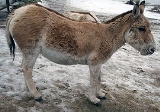
Onager

Encyclopedia
The Onager is a large member of the genus Equus
of the family Equidae
(horse
family) native to the deserts of Syria
, Iran
, Pakistan
, India
, Israel
and Tibet
. It is sometimes known as the Wild Asian Ass.
Like many other large grazing animals, the onager's range
has contracted greatly under the pressures of hunting and habitat loss, and of the six subspecies
, one is extinct and two are endangered. The kiang
(E. kiang), a Tibetan relative, was previously considered to be a subspecies of the onager as E. hemionus kiang, but recent molecular studies indicate that it is a distinct species.
The specific name
is Ancient Greek
ἡμίονος (hēmíonos), from ἡμι- (hēmi-), half, and ὄνος (ónos), donkey; thus, half-donkey or mule
. In Persian
the archaic word, "gur" preserves the second syllable of the common Indo-European term that includes ona/ono (donkey) and ger/gur (swift).
Onagers are a little larger than donkey
s at about 290 kilograms (639.3 lb) and 2.1 metres (6.9 ft) (head-body length), and are a little more horse-like. They are short-legged compared to horses, and their coloring varies depending on the season. They are generally reddish-brown in color during the summer, becoming yellowish-brown in the winter months. They have a black stripe bordered in white that extends down the middle of the back. They are notoriously untameable.
Equids were used in ancient Sumer
to pull wagons circa 2600 BC, and then chariot
s on the Standard of Ur
, circa 2000 BC. Clutton-Brock suggested that these were donkeys rather than onagers on the basis of a "shoulder stripe" (1992:88). However, close examination of the animals (equids, sheep and cattle
) on both sides of the piece indicate that what appears to be a stripe may well be a harness, a trapping, or a joint in the inlay. For Sumerian references to onagers, see Heimpel (1968) and Maekawa (1979).
Equus (genus)
Equus is a genus of animals in the family Equidae that includes horses, donkeys, and zebras. Within Equidae, Equus is the only extant genus. Like Equidae more broadly, Equus has numerous extinct species known only from fossils. This article deals primarily with the extant species.The term equine...
of the family Equidae
Equidae
Equidae is the taxonomic family of horses and related animals, including the extant horses, donkeys, and zebras, and many other species known only from fossils. All extant species are in the genus Equus...
(horse
Horse
The horse is one of two extant subspecies of Equus ferus, or the wild horse. It is a single-hooved mammal belonging to the taxonomic family Equidae. The horse has evolved over the past 45 to 55 million years from a small multi-toed creature into the large, single-toed animal of today...
family) native to the deserts of Syria
Syria
Syria , officially the Syrian Arab Republic , is a country in Western Asia, bordering Lebanon and the Mediterranean Sea to the West, Turkey to the north, Iraq to the east, Jordan to the south, and Israel to the southwest....
, Iran
Iran
Iran , officially the Islamic Republic of Iran , is a country in Southern and Western Asia. The name "Iran" has been in use natively since the Sassanian era and came into use internationally in 1935, before which the country was known to the Western world as Persia...
, Pakistan
Pakistan
Pakistan , officially the Islamic Republic of Pakistan is a sovereign state in South Asia. It has a coastline along the Arabian Sea and the Gulf of Oman in the south and is bordered by Afghanistan and Iran in the west, India in the east and China in the far northeast. In the north, Tajikistan...
, India
India
India , officially the Republic of India , is a country in South Asia. It is the seventh-largest country by geographical area, the second-most populous country with over 1.2 billion people, and the most populous democracy in the world...
, Israel
Israel
The State of Israel is a parliamentary republic located in the Middle East, along the eastern shore of the Mediterranean Sea...
and Tibet
Tibet
Tibet is a plateau region in Asia, north-east of the Himalayas. It is the traditional homeland of the Tibetan people as well as some other ethnic groups such as Monpas, Qiang, and Lhobas, and is now also inhabited by considerable numbers of Han and Hui people...
. It is sometimes known as the Wild Asian Ass.
Like many other large grazing animals, the onager's range
Range (biology)
In biology, the range or distribution of a species is the geographical area within which that species can be found. Within that range, dispersion is variation in local density.The term is often qualified:...
has contracted greatly under the pressures of hunting and habitat loss, and of the six subspecies
Subspecies
Subspecies in biological classification, is either a taxonomic rank subordinate to species, ora taxonomic unit in that rank . A subspecies cannot be recognized in isolation: a species will either be recognized as having no subspecies at all or two or more, never just one...
, one is extinct and two are endangered. The kiang
Kiang
The kiang is the largest of the wild asses. It is native to the Tibetan Plateau, where it inhabits montane and alpine grasslands. Its current range is restricted to Ladakh in Jammu and Kashmir, plains of the Tibetan plateau and northern Nepal along the Tibetan border...
(E. kiang), a Tibetan relative, was previously considered to be a subspecies of the onager as E. hemionus kiang, but recent molecular studies indicate that it is a distinct species.
The specific name
Species
In biology, a species is one of the basic units of biological classification and a taxonomic rank. A species is often defined as a group of organisms capable of interbreeding and producing fertile offspring. While in many cases this definition is adequate, more precise or differing measures are...
is Ancient Greek
Ancient Greek
Ancient Greek is the stage of the Greek language in the periods spanning the times c. 9th–6th centuries BC, , c. 5th–4th centuries BC , and the c. 3rd century BC – 6th century AD of ancient Greece and the ancient world; being predated in the 2nd millennium BC by Mycenaean Greek...
ἡμίονος (hēmíonos), from ἡμι- (hēmi-), half, and ὄνος (ónos), donkey; thus, half-donkey or mule
Mule
A mule is the offspring of a male donkey and a female horse. Horses and donkeys are different species, with different numbers of chromosomes. Of the two F1 hybrids between these two species, a mule is easier to obtain than a hinny...
. In Persian
Persian language
Persian is an Iranian language within the Indo-Iranian branch of the Indo-European languages. It is primarily spoken in Iran, Afghanistan, Tajikistan and countries which historically came under Persian influence...
the archaic word, "gur" preserves the second syllable of the common Indo-European term that includes ona/ono (donkey) and ger/gur (swift).
Onagers are a little larger than donkey
Donkey
The donkey or ass, Equus africanus asinus, is a domesticated member of the Equidae or horse family. The wild ancestor of the donkey is the African Wild Ass, E...
s at about 290 kilograms (639.3 lb) and 2.1 metres (6.9 ft) (head-body length), and are a little more horse-like. They are short-legged compared to horses, and their coloring varies depending on the season. They are generally reddish-brown in color during the summer, becoming yellowish-brown in the winter months. They have a black stripe bordered in white that extends down the middle of the back. They are notoriously untameable.
Equids were used in ancient Sumer
Sumer
Sumer was a civilization and historical region in southern Mesopotamia, modern Iraq during the Chalcolithic and Early Bronze Age....
to pull wagons circa 2600 BC, and then chariot
Chariot
The chariot is a type of horse carriage used in both peace and war as the chief vehicle of many ancient peoples. Ox carts, proto-chariots, were built by the Proto-Indo-Europeans and also built in Mesopotamia as early as 3000 BC. The original horse chariot was a fast, light, open, two wheeled...
s on the Standard of Ur
Standard of Ur
The Standard of Ur is a Sumerian artifact excavated from what had been the Royal Cemetery in the ancient city of Ur .-History:...
, circa 2000 BC. Clutton-Brock suggested that these were donkeys rather than onagers on the basis of a "shoulder stripe" (1992:88). However, close examination of the animals (equids, sheep and cattle
Cattle
Cattle are the most common type of large domesticated ungulates. They are a prominent modern member of the subfamily Bovinae, are the most widespread species of the genus Bos, and are most commonly classified collectively as Bos primigenius...
) on both sides of the piece indicate that what appears to be a stripe may well be a harness, a trapping, or a joint in the inlay. For Sumerian references to onagers, see Heimpel (1968) and Maekawa (1979).
Subspecies
- Mongolian wild assMongolian Wild AssThe Mongolian Wild Ass is a subspecies of the Onager. It may be synonymous with the Gobi Kulan, Chigetai or Dziggetai...
- khulan, Equus hemionus hemionus - Turkmenian kulan, Equus hemionus kulan
- Persian onager or gur, Equus hemionus onager
- Indian wild assIndian Wild AssThe Indian wild ass also called khur, is a subspecies of the Onager native to Southern Asia.-Description:The Indian wild ass, as with most other Asian wild ass subspecies, is quite different from the African species. The coat is usually sandy, but varies from reddish grey, fawn, to pale chestnut...
or khur, Equus hemionus khur - Syrian wild assSyrian Wild AssThe Syrian Wild Ass is an extinct subspecies of Equus hemionus that ranged across Syria, Jordan and Iraq.The Syrian Wild Ass was the smallest form of Equidae and could not be domesticated...
, Equus hemionus hemippus (extinctExtinctionIn biology and ecology, extinction is the end of an organism or of a group of organisms , normally a species. The moment of extinction is generally considered to be the death of the last individual of the species, although the capacity to breed and recover may have been lost before this point...
)