
All Topics  
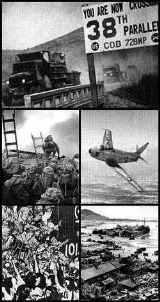
Korean War


Korean War


EtymologyIn South Korea, the war is often called 6·25 or 6·25 War, from the date of the start of the conflict or, more formally, Hanguk Jeonjaeng. In North Korea, while commonly known as the Korean War, it is formally called the Joguk Haebang Jeonjaeng or Fatherland Liberation War (Korean: ??????; Hanja: ??????). In the United States, the conflict was officially termed a police actionPolice action

A police action in military/security studies and international relations, is a military action undertaken without a formal d...
 — the Korean Conflict — rather than a war, largely in order to avoid the necessity of a declaration of war by the U.S. CongressDeclaration of war by the United States

A declaration of war is a formal declaration issued by a national government indicating that a state of war exists between t...
. The war is sometimes called The Forgotten War or The Unknown War because it is a major conflict of the 20th century that gets far less attention than World War IIWorld War II

World War II, or the Second World War, was a worldwide conflict fought between the Allied Powers and the Axis Powers ,...
, which preceded it, and the Vietnam WarVietnam War

The Vietnam War was a conflict in which the Democratic Republic of Vietnam and its allies fought against the Republic of Vi...
, which succeeded it.


Discussion
Ask a question about 'Korean War'
Start a new discussion about 'Korean War'
Answer questions from other users
Full Discussion Forum


Timeline

1950   Beginning of Korean War. In the USA, people began to hoard supplies in case of rationing and shortages.

1950   Korean War - North Korean forces capture Seoul

1950   Korean War: While in an F-80, United States Air Force Lt. Russell J. Brown intercepts two North Korean MiG-15s near the Yalu River and shoots them down in the first jet-to-jet dog fight in history.

1950   Korean War: Troops from the People's Republic of China move into North Korea and launch a massive counterattack against South Korean and American forces, ending any thought of a quick end to the conflict.

1951   Korean War: Chinese and North Korean forces capture Seoul.

1951   United Nations General Assembly declares that China is the aggressor in the Korean War

1951   Korean War: Operation Ripper - In Korea, United Nations troops led by General Matthew Ridgeway begin an assault against the Chinese "volunteers".

1951   Korean War: At Kaesong, armistice negotiations begin.

1952   Korean War: U.S. President-elect Dwight D. Eisenhower fulfills a political campaign promise by traveling to Korea to find out what can be done to end the conflict.

1953   Korean War ends: The United States, People's Republic of China, North Korea, and South Korea sign an armistice agreement.


Encyclopedia


Etymology

In South Korea, the war is often called 6·25 or 6·25 War, from the date of the start of the conflict or, more formally, Hanguk Jeonjaeng. In North Korea, while commonly known as the Korean War, it is formally called the Joguk Haebang Jeonjaeng or Fatherland Liberation War (Korean: ??????; Hanja: ??????). In the United States, the conflict was officially termed a police actionPolice action

A police action in military/security studies and international relations, is a military action undertaken without a formal d...
 — the Korean Conflict — rather than a war, largely in order to avoid the necessity of a declaration of war by the U.S. CongressDeclaration of war by the United States

A declaration of war is a formal declaration issued by a national government indicating that a state of war exists between t...
. The war is sometimes called The Forgotten War or The Unknown War because it is a major conflict of the 20th century that gets far less attention than World War IIWorld War II

World War II, or the Second World War, was a worldwide conflict fought between the Allied Powers and the Axis Powers ,...
, which preceded it, and the Vietnam WarVietnam War

The Vietnam War was a conflict in which the Democratic Republic of Vietnam and its allies fought against the Republic of Vi...
, which succeeded it. The war was a unique combination of the techniques utilized in both World War IWorld War I

World War I, also known as the First World War, the Great War and "The War to End All Wars" was a global m...
 and World War II, beginning with swift, fast-paced infantryInfantry

Infantry is a term for soldiers who fight primarily on foot with small arms in organized military units....
 advances following well-choreographed bombingTactical bombing

Tactical bombing uses aircraft to attack troops and military equipment in the battle zone....
 raids from the air by the American military and its UN allies. However, following both sides' failures at holding the land captured, battles quickly evolved into World War I-type trench warfareTrench warfare

Trench warfare is a form of war in which both opposing armies have static lines of fortifications dug into the ground, facin...
 in January 1951, lasting until the essential border stalemateStalemate

Stalemate is a situation in chess where the player whose turn it is to move has no legal moves but is not in check....
 at the end. In China, the conflict was known as the War to Resist America and Aid Korea, but is today commonly called the "Korean War" Peoples Daily (English version) | url =http://english.people.com.cn/english/200010/26/eng20001026_53620.html | accessdate =2007-08-16 }} ???? Hanguo Zhanzheng, or simply ?? Hanzhan).

Last Japanese occupation

Korea had been a unified country since the 7th century. During the 19th century, imperialist nations threatened Korea's long-standing sovereignty. After defeating China in the Sino-Japanese War of 1894-95First Sino-Japanese War

The First Sino–Japanese War was a war fought between Qing Dynasty China and Meiji Japan over control of Korea....
, the JapaneseFacts About Empire of Japan

????? Dai Nippon Teikoku Empire of Great Japan...
 forces remained in Korea, occupying strategically important parts of the country and exploiting the Korean people. Ten years later, the Japanese defeated the RussianRussian Empire

The Russian Empire was a state that existed from 1721 until it was declared a republic in August 1917....
 navy in the Russo-Japanese WarRusso-Japanese War

The Russo-Japanese War was a conflict that grew out of the rival imperialist ambitions of Russia and Japan in Manchuria and...
 (1904-1905), contributing to Japan's emergence as an imperial power. The Japanese continued to forcibly occupy the Korean peninsulaKorean Peninsula

! colspan="2" bgcolor="#CCCCCC" | Korean Peninsula...
 against the wishes of the Korean government and people, expanded their control over local institutions through force, and finally annexed KoreaKorea under Japanese rule

Korea under Japanese rule refers to the period of Japan's administrative control of the Korean peninsula in the early 20th c...
 in August 1910. From 1910 until 1945, the Japanese Governor General implemented a cruel and efficient set of policies aimed at eradicating Korean identity. After liberation in 1945, many Koreans expected to have control over their own country.

At the close of World War II, forces of both the Soviet UnionSoviet Union Summary

The Union of Soviet Socialist Republics , more commonly known as the Soviet Union, was a Communist state that existed...
 and the United StatesUnited States

The United States of America, also known as the United States, the U.S., the U.S.A., and America, is...
 occupied the peninsula in accordance with an agreement put forth by the United States government to divide the Korean peninsula. This decision, made by then Colonel Dean RuskDean Rusk

David Dean Rusk was the United States Secretary of State from 1961 to 1969 under presidents John F....
 and Army officer Charles BonesteelCharles Bonesteel

Charles Hartwell Bonesteel III was an American military commander....
, was made because the 38th parallel was already on most maps of Korea. The Soviet forces entered the peninsula on August 10, 1945 and remained north of the 38th parallel waiting for the US forces to arrive. A few weeks later the American forces who entered through Inchon and were lead by U.S. Army Lt. Gen. John R. HodgeJohn R. Hodge

John Reed Hodge was a military officer of the United States Army....
 formally accepted the surrender of Japanese forces south of the 38th parallel on September 9, 1945 at the Government House in SeoulSeoul

Seoul listen) is the capital and largest city of South Korea ....
.

Many Korean people had organized politically prior to the arrival of American troops.

Post-World War II division of Korea

Though the eventual division of Korea was considered at the Potsdam ConferencePotsdam Conference

The Potsdam Conference was held at Cecilienhof in Potsdam, Germany, from July 17 to August 2, 1945....
, boundaries, however, the wishes of the Korean people to be free of foreign interference were not considered. British Prime Minister Winston ChurchillWinston Churchill

Sir Winston Leonard Spencer-Churchill, KG, OM, CH, TD, FRS, PC was an English statesman and author, best known as Prime Min...
, Chinese Premier Chiang Kai-shekChiang Kai-shek Overview

Chiang Kai-shek was a Chinese military and political leader who assumed the leadership of the Kuomintang after the 1925 d...
 and U.S. President Franklin D. RooseveltFranklin D. Roosevelt

Franklin Delano Roosevelt served as the 32nd President of the United States and was elected to four terms in office....
 had stated a determination for Korean independence and freedom at the Cairo ConferenceCairo Conference

The Cairo Conference of November 22-November 26, 1943, held in Cairo, Egypt, addressed the Allied position against Japan dur...
. During the earlier Yalta ConferenceYalta Conference

The Yalta Conference, sometimes called the Crimea Conference and codenamed the Argonaut Conference, was the war...
 in February 1945, Soviet Premier Joseph StalinJoseph Stalin

Joseph Vissarionovich Stalin , alternatively transliterated Josef Stalin, was the de facto leader and dictator of ...
 called for “buffer zones” in both Asia and Europe. Stalin believed that Russia should have preeminence in China, and after the US requested that the USSR join in the war against Japan “three months after the surrender of GermanyNazi Germany Overview

Nazi Germany, or the Third Reich, refers to Germany in the years 1933 to 1945, when it was governed by the National So...
.” On August 6, 1945. The Soviet Union declared war on the Japanese Empire, and on August 8 it began the liberation on the northern part of the Korean peninsula. As agreed with the United States, the USSR halted its troops at the 38th parallel38th parallel north

The 38th parallel north is a line of latitude that cuts across Asia, the Mediterranean and the United States....
 on August 26. However, on September 3 Lt. Gen. John R. Hodge, commander of XXIV Corps and designated U.S. Commander in Korea, received a radio message from Lt. Gen. Yoshio Kozuki, commander of the Japanese 17th Area Army in Korea, reporting that Soviet forces had advanced south of the 38th parallel only in the Kaesong area. Hodge decided to trust the Japanese reports of events in Korea. U.S. troops arrived in the southern part of the peninsula in early September 1945.

On August 10, 1945, with the Japanese surrender imminent, the American government was unsure whether the Soviets would adhere to the proposal arranged by the U.S. government. A month earlier, Colonels Dean RuskDean Rusk

David Dean Rusk was the United States Secretary of State from 1961 to 1969 under presidents John F....
 and Charles Bonesteel, after deciding in their 1/2 hour session that at least two major ports should be included in the U.S. zone, had drawn the dividing line at the 38th parallel in less than one-half an hour using a National Geographic map for reference. Rusk, later U.S. Secretary of State, commented that the American military was “faced with the scarcity of U.S. forces immediately available and time and space factors which would make it difficult to reach very far north before Soviet troops could enter the area.”

The USSR agreed to the 38th parallel being the demarcation between occupation zones in the Korean peninsula, partly to better their position in the negotiations with the AlliesAllies of World War II

The Allies of World War II were the countries officially opposed to the Axis Powers during the Second World War. ...
 over eastern EuropeEastern Europe

Eastern Europe is the eastern region of Europe variably defined....
. It was agreed that the USSR would receive surrendering Japanese troops on the northern part of Korea; the U.S., on the southern side. The Soviet forces entered and liberated the northern part of the peninsula weeks prior to the entry of American forces. In accordance with the arrangements made with the American government, the Soviet forces halted their advance at the 38th parallel.

The American forces arrived in Korea in early September. One of Hodge's first directives was to restore many Japanese colonial administrators and collaborators to their previous positions of power within Korea. This policy was understandably very unpopular among Koreans who had suffered horribly under Japanese colonial rule for 35 years, and would prove to have enormous consequences for the American occupation.

A second policy set forth by Hodge was to refuse to recognize the existing political organizations that had been established by the Korean people. Hodge sought to establish firm U.S. control over events throughout the southern half of the peninsula. These policies would help give rise to the later insurrections and guerrilla warfare that preceded the outbreak of the civil war.

In December 1945, the United States and the Soviet Union agreed to administer the country under the U.S.-Soviet Joint Commission, as termed by the Moscow Conference of Foreign Ministers. It was agreed by the US and the USSR, but not the Koreans, that Korea would govern itself independently after four years of international oversight. However, both the U.S. and the USSR approved Korean-led governments in their respective halves, each of which were favorable to the occupying power's political ideology. Some elements of the population responded with violent insurrections and protests in the South. The USAMGIK tried to contain civil violence by banning strikes on December 8 and outlawing the revolutionary government and the people's committees on December 12. Events spiraled quickly out of US control, however, when Koreans staged a massive strike on September 23, 1946 by 8,000 railway workers in BusanBusan Overview

Busan Metropolitan City, also known as Pusan, is the largest harbor city in South Korea....
 which quickly spread to other cities in the South. The Daegu uprising occurred on October 1, in which police attempts to control rioters caused the death of three student demonstrators and injuries to many others, sparking a mass counter-attack killing 38 policemen. It should be noted that at this time, the vast majority of members of the South Korean police force officers had been members of the Japanese police force during the colonial period. When the US forces sided with these former collaborators, it discredited the US in the eyes of many Koreans. Over in YeongcheonYeongcheon Overview

Yeongcheon is a city in North Gyeongsang Province, South Korea....
, a police station came under attack by a 10,000-strong crowd on October 3, killing over 40 policemen and the county chief. Other attacks killed about 20 landlords and pro-Japanese officials. The US administration responded by declaring martial lawMartial law

Martial law is the system of rules that takes effect when a military authority takes control of the normal administration o...
, firing into crowds of demonstrators and killing an unknown number of people.

In South Korea, an anti-trusteeship right wing group known as the Representative Democratic CouncilRepresentative Democratic Council

The Representative Democratic Council was a group that emerged in Korea after World War II....
 emerged, this group came to oppose these U.S. sponsored agreements. Because Koreans had suffered under Japanese colonization for 35 years, most Koreans opposed another period of foreign control. This opposition caused the U.S. to abandon the Soviet-supported Moscow Accords. The Americans did not want a communist government in South Korea, so they called for elections in all of Korea. Since the population of the South was double that of the North, the Soviets knew that Kim Il-sungKim Il-sung Overview

Kim Il-sung was the leader of North Korea from its founding in 1948 until his death, when he was succeeded by his son Kim J...
 would lose the election.

The government that emerged was led by anti-communistAnti-communism

Anti-communism is an ideology of opposition to communist organization, government and ideology....
 U.S.-educated strongmanStrongman (politics)

A strongman is a political leader who rules by force and runs an authoritarian regime....
 Syngman RheeSyngman Rhee

Syngman Rhee or Lee Seungman was the first president of South Korea....
, a Korean who had been imprisoned by the Japanese as a young man and later fled to the United States. The Soviets, in turn, approved and furthered the rise of a CommunistCommunism

Communism is an ideology that seeks to establish a future classless, stateless social organization, based upon common owners...
 government in the North. Bolstered by his history as an anti-Japanese fighter, his political skills, and his connections with the Soviet Union, Kim Il-sungKim Il-sung

Kim Il-sung was the leader of North Korea from its founding in 1948 until his death, when he was succeeded by his son Kim J...
 rose to become leader of this new government and crushed any opposition to his rule by the summer of 1947. In the south, those who supported Communism were driven into hiding in the hills, where they prepared for a guerrilla war against the American-supported government.

South Korean President Syngman Rhee and North Korean General SecretaryGeneral secretary

The term General Secretary denotes a leader of various unions, parties or associations....
 Kim Il-Sung were each intent on reuniting the peninsula under his own system. Partly because of numbers of Soviet tanks and heavy arms, the North Koreans were able to escalate ongoing border clashes and go on the offensive, while South Korea, with only limited American backing, had far fewer options. The American government believed at the time that the Communist bloc was a unified monolith, and that North Korea acted within this monolith as a pawn of the Soviet Union.

Prelude to war

Rhee and Kim competed to reunite the peninsula which had been divided by foreign powers. Each regime used military attacks along the border throughout 1949 and early 1950. Although Kim and his close associates believed in unifying Korea by force, Stalin was reluctant to embark on a course that might provoke a war with the United States.

On January 12, 1950, United States Secretary of StateUnited States Secretary of State

The United States Secretary of State is the head of the United States Department of State, concerned with foreign affairs....
 Dean AchesonDean Acheson

Dean Gooderham Acheson was a prominent lawyer whose career included many stints in United States government service, culmina...
 gave a speech declaring that America's Pacific defense perimeter was made up of the AleutiansAleutian Islands

The Aleutian Islands are a chain of more than 300 small volcanic islands forming an island arc in the Northern Pacific Ocea...
, Ryukyu, JapanJapan

is an island country in East Asia. Located in the Pacific Ocean, it lies to the east of China, Korea, and Russia, stretching from...
, and the PhilippinesPhilippines

The Philippines , officially the Republic of the Philippines , is an island nation located in the Malay archipelago in...
, implying that America might not fight over Korea. Acheson said Korea's defense would be the responsibility of the United NationsUnited Nations

name = United NationsNations Unies...
.

In mid-1949, Kim Il-Sung pressed his case with Joseph Stalin that the time had come for a reunification of the Korean peninsula. Kim needed Soviet support to successfully execute an offensive far across a rugged, mountainous peninsula. Stalin, however, refused support, concerned with the relative lack of preparedness of the North Korean armed forces and with possible U.S. involvement.

Over the next year, the North Korean leadership molded its army into a relatively formidable offensive war machine modeled partly on a Soviet mechanized force but strengthened primarily by an influx of Korean veterans who had served with the Chinese People's Liberation ArmyPeople's Liberation Army

The Chinese People's Liberation Army , which includes an army, navy, air force, and strategic nuclear forces, serves as the...
 since the 1930s. By early 1950 the possibility of reunification through insurgency seemed closed, and Rhee's regime was gaining in strength if not popularity. Kim was left with the sole option of conventional invasion if he wished to unify Korea and remove foreign control. By 1950, the North Korean military was equipped with modern Soviet weaponry, and it enjoyed substantial advantages over the Southern forces in virtually every category of equipment. On January 30, 1950, Stalin, via telegram, informed Kim Il-Sung that he was willing to help Kim in his plan to unify Korea. In the discussions with Kim that followed, Stalin suggested that he wanted lead and said that a yearly minimum of 25,000 tons would help. After another visit by Kim to MoscowMoscow

Moscow is the capital of Russia and the country's principal political, economic, financial, educational, and transportation...
 in March and April 1950, Stalin approved an attack. On March 9, 1950, North Korea had agreed to send to the Soviet Union 9 tons of gold, 40 tons of silver, and 15,000 tons of monaziteMonazite

In geology, the mineral monazite is a reddish-brown phosphate containing rare earth metals and an important source of thoriu...
 concentrate as payment for additional Soviet arms, ammunition and military technical equipment.

Course


Invasion of South Korea

Under the guise of a counter-attack, the North Korean ArmyKorean People's Army

Korean People's Army refers to the armed personnel of the military of North Korea....
 struck in the pre-dawn hours of Sunday, June 25, 1950, crossing the 38th parallel behind a firestorm of artillery. The North claimed Republic of Korea ArmyRepublic of Korea Army

The Republic of Korea Army is by far the largest of the military branches, with over 560,000 effectives as of 2004....
 (ROK) troops under the “bandit traitor Syngman RheeSyngman Rhee

Syngman Rhee or Lee Seungman was the first president of South Korea....
" had crossed the border first, and that Rhee would be arrested and executed.

The United Nations Security CouncilUnited Nations Security Council

The United Nations Security Council is the organ of the United Nations charged with maintaining peace and security among na...
 was convened in a few hours and passed the UNSC Resolution 82United Nations Security Council Resolution 82

United Nations Security Council Resolution 82, adopted on June 25, 1950, recalling General Assembly Resolution 293, which fo...
 condemning the North Korean aggression unanimously. The resolution was adopted mainly because the Soviet Union, a veto-wielding powerUnited Nations Security Council veto power

The United Nations Security Council veto power is a veto power wielded solely by the five permanent members of the United Na...
, had been boycotting proceedings since January, in protest that the Republic of ChinaRepublic of China

The Republic of China is a country in East Asia....
 (Taiwan) and not the People's Republic of ChinaPeople's Republic of China Overview

The People's Republic of China , is a country in East Asia....
 held a permanent seat on the council.

Critics charged that the information on this resolution was based on U.S. sources referring to reports of the South Korean army. The DPRK was not invited to sit as a temporary member in the UN which some say violated Article 32 of the UN Charter. It was argued that the situation in Korea did not fall within the scope of the UN Charter since the initial clashes between North and South Korean forces would have to be classified as a civil war. Since the USSR representative decided to boycott the United Nations with the announced purpose of preventing action by the Security Council, the legality of UN action was challenged; legal scholars argued that unanimity among the five permanent members was required to take action on important matters.

At the outbreak of war, the North Korean Army was equipped with 150 Soviet-made tanks, about 40 YAKYakovlev Summary

A.S. Yakovlev Design Bureau JSC is a Russian aircraft designer and manufacturer....
 fighters, 70 attack bombers, 60 YAK trainers and 10 reconnaissance planes. These aircraft were assigned to the invasion while 114 more planes were serving in North Korea. Their navy had several small warships, and launched attacks on the South Korean Navy. North Korea's most serious weakness was its lack of a reliable logistics system for moving supplies south as the army advanced, but the South Korean forces were weak and ill-equipped compared to the North Koreans. Thousands of Korean civilians running south were forced to hand-carry supplies, many of whom later died in North Korean air attacks.

The South Korean Army had 150,000 soldiers armed, trained, and equipped by the U.S. military, and as a force was deficient in armor and artillery. The South Korean military had only 40 tanks, 14 attack planes, and few anti-tank weapons. There were no large foreign combat units in the country when the war began, but there were large American forces stationed in nearby Japan.

The North's well-planned attack with about 415,000 troops achieved surprise and quick successes. North Korea attacked a number of key places including KaesongKaesong

colspan=2 align=center bgcolor=#FFCCCC>Kaesong City...
, ChuncheonChuncheon Summary

Chuncheon is the capital of Gangwon Province, South Korea....
, UijeongbuUijeongbu Summary

Uijeongbu is a city in Gyeonggi Province, South Korea....
 and OngjinOngjin, South Hwanghae

Ongjin is a county in southern South Hwanghae province, North Korea....
.

Within days, South Korean forces – outnumbered, outgunned, and often of dubious loyalty to the Southern regime – were in full retreat or defecting en masse to the North. As the ground attack continued, the North Korean Air Force conducted bombing of Kimpo Airport near SeoulSeoul

Seoul listen) is the capital and largest city of South Korea ....
. North Korean forces occupied Seoul on the afternoon of June 28.

However, North Korea's hope for a quick surrender by the Rhee government and the reunification of the peninsula evaporated when the United States and other foreign powers intervened with UN approval.

U.S. intervention

Despite the post-World War II demobilization of U.S. and allied forces, which caused serious supply problems for American troops in the region, the United States still had substantial forces in Japan to oppose the North Korean military. These American forces were under the command of GeneralGeneral of the Army (United States)

General of the Army is historically the second most senior rank in the United States Army, equivalent to a Field Marshal in ...
 Douglas MacArthurDouglas MacArthur Summary

Douglas MacArthur was an American general and Medal of Honor recipient, who was Supreme Commander of Allied forces in the S...
. Apart from British CommonwealthBritish Commonwealth Forces Korea

British Commonwealth Forces Korea was the formal name, from 1952, of the Commonwealth army, naval and air units serving with...
 units, no other nation could supply sizable manpower.

On being told of the outbreak of large-scale hostilities in Korea, U.S. President Harry S. TrumanHarry S. Truman

Harry S. Truman was the thirty-third President of the United States; as Vice President, he succeeded to the office upon the ...
 ordered MacArthur to transfer munitions to the ROK Army, while using air cover to protect the evacuation of U.S. citizens. Truman did not agree with his advisors, who called for unilateral U.S. airstrikes against the North Korean forces, but did order the Seventh Fleet to protect Chiang Kai-ShekChiang Kai-shek

Chiang Kai-shek was a Chinese military and political leader who assumed the leadership of the Kuomintang after the 1925 d...
's TaiwanRepublic of China

The Republic of China is a country in East Asia....
. The Nationalist government (confined to the island of TaiwanTaiwan

Taiwan is an island in East Asia, but the term "Taiwan" is also commonly used to collectively refer to the territories gove...
) asked to participate in the war. Their request was denied by the Americans, who felt that it would only encourage intervention by the People's Republic of ChinaPeople's Republic of China

The People's Republic of China , is a country in East Asia....
 (PRC).

The first significant foreign military intervention was the American Task Force Smith, part of the U.S. ArmyUnited States Army

The United States Army is the largest branch of the United States armed forces and has primary responsibility for land-based...
's 24th Infantry DivisionU.S. 24th Infantry Division

The Hawaiian Division, now called the 24th Infantry Division—also known as the Victory Division—was ...
 based in Japan. On July 5, it fought for the first time at OsanOsan

This article is about the city of Osan, Republic of Korea....
 and was defeated with heavy losses. The victorious North Korean forces advanced southwards, and the half-strength 24th Division was forced to retreat to Taejeon, which also fell to the Northern forces. Major General William F. DeanWilliam F. Dean

William F. Dean was a soldier in the United States Army during World War II and the Korean War....
, commander of the division, was taken prisoner.

By August, the South Korean forces and the U.S. Eighth ArmyU.S. Eighth Army

The Eighth US Army—often abbreviated EUSA— is the commanding formation of all US Army troops in South Kore...
 under General Walton WalkerWalton Walker

Walton Harris Walker was an American army officer and the first commander of the U.S....
 had been driven back into a small area in the southeast corner of the Korean peninsula around the city of Pusan. As the North Koreans advanced, they rounded up and killed civil servants. On August 20, MacArthur sent a message warning Kim Il Sung that he would be held responsible for further atrocities committed against UN troops.

By September, only the area around Pusan — about 10 percent of the Korean peninsula — was still in coalition hands. With the aid of massive American supplies, air support, and additional reinforcements, the UN forces managed to stabilize a line along the Nakdong RiverFacts About Nakdong River

The Nakdong River is the longest river in South Korea, and passes through major cities such as Daegu and Busan....
. This desperate holding action became known in the United States as the Pusan PerimeterPusan Perimeter

The Pusan Perimeter was the area in extreme southeast Korea that was held by U.S....
.

Escalation of the Korean war


In the face of fierce North Korean attacks, the allied defense became a desperate battle called the Battle of Pusan PerimeterBattle of Pusan Perimeter

The Battle of Pusan Perimeter was fought in August and September of 1950 between United Nations forces combined with South K...
 by Americans. However, the North Koreans failed to capture Pusan.

American air power arrived in force, flying 40 sorties per day in ground support actions, targeting North Korean forces. Strategic bomberStrategic bomber

A strategic bomber is a large aircraft designed to drop large amounts of ordnance on a distant target for the purposes of de...
s (mostly B-29s based in Japan) closed most rail and road traffic by day, and destroyed 32 critical bridges necessary for the conduct of warfare. Trains used by military and civilians alike waited out the daylight hours in tunnels.

Throughout all parts of Korea, the American bombers knocked out the main supply dumps and eliminated oil refineries and seaports that handled imports to starve North Korean forces of ammunition and other martial supplies. Naval air power also attacked transportation choke points. The North Korean forces were already strung out over the peninsula, and the destruction caused by American bombers prevented needed supplies from reaching North Korean forces in the south.

Meanwhile, supply bases in Japan were pouring weapons and soldiers into Pusan. American tank battalions were rushed in from San Francisco; by late August, America had over 500 medium tanks in the Pusan perimeter. By early September, UN-ROK forces were decidedly more powerful and outnumbered the North Koreans by 180,000 to 100,000. At that point, they began a counterattack.

South Korean and allied forces move north


In the face of these overwhelming reinforcements, the North Korean forces found themselves undermanned and with weak logistical support. They also lacked the substantial naval and air support of the Americans. In order to alleviate pressure on the Pusan Perimeter, General MacArthur, as UN commander-in-chiefCommander-in-Chief

A Commander-in-Chief is the commander of a nation's military forces or significant element of those forces....
 for Korea, argued for an amphibious landingAmphibious warfare

This article is about a military strategy involving land troops dispatched from naval ships....
 far behind the North Korean lines at Inchon (??; ??).

The violent tides and strong enemy presence made this an extremely risky operation. MacArthur had started planning a few days after the war began, but he had been strongly opposed by the PentagonThe Pentagon

The Pentagon is the headquarters of the United States Department of Defense, located at 48 N....
. When he finally received permission, MacArthur activated the X CorpsU.S. X Corps

X Corps was a unit of the United States Army that took part in the invasion of Leyte under Sixth Army during 1944....
 under General Edward AlmondEdward Almond

Edward Mallory Almond was an American military officer best known as the commander of the United States Army X Corps during ...
 (comprising 70,000 troops of the 1st Marine Division and the Army's 7th Infantry Division and augmented by 8,600 Korean troops) and ordered them to land at Inchon in Operation Chromite. By the time of the attack on September 15, thanks to reconnaissance by guerrillas, misinformation and extensive shelling prior to the invasion, the North Korean military had few soldiers stationed in Inchon, so the U.S. forces met only light resistance when they landed.

The landing was a decisive victory, as X Corps rolled over the few defenders and threatened to trap the main North Korean army. MacArthur quickly recaptured Seoul. The North Koreans, almost cut off, rapidly retreated northwards; about 25,000 to 30,000 made it back.

Invasion of North Korea

The United Nations troops drove the North Koreans back past the 38th parallel.

The UN forces crossed into North Korea in early October 1950. The U.S. X Corps made amphibious landings at WonsanFacts About Wonsan

Wonsan is a port city and naval base in southeastern North Korea....
 and IwonIWon

iWon is an Internet portal and search engine that offers users the chance to win money by earning entries in a sweepstakes....
, which had already been captured by South Korean forces advancing by land. The Eighth U.S. Army, along with the South Koreans, drove up the western side of Korea and captured PyongyangPyongyang

Pyongyang is the capital city of North Korea, located on the Taedong River, at ....
 on October 19. By the end of October, the North Korean Army was rapidly disintegrating, and the UN took 135,000 prisoners.

The UN offensive greatly concerned the Chinese, who worried that the UN forces would not stop at the Yalu RiverYalu River

The Yalu River or the Amrok River , is a river on the border between China and North Korea....
, the border between North Korea and China, and might extend their rollback policy into China. Many in the West, including General MacArthur, thought that spreading the war to China would be necessary and that since North Korean troops were being supplied by bases in China, those supply depots should be bombed. However, Truman and the other leaders disagreed, and MacArthur was ordered to be very cautious when approaching the Chinese border.

Chinese intervention

China warned American leaders through neutral diplomats that it would intervene to protect its national securityNational security

National security refers to the public policy of maintaining the integrity and survival of the nation-state through the use ...
. Truman regarded the warnings as “a bald attempt to blackmail the U.N.” and did not take it seriously. The Chinese Government argued that in making Japan its main war base in the Far East, launching an invasion against Korea and the Chinese province of Taiwan, and carrying out active intervention in other countries in Asia, the United States was building up a military encirclement of China. The Chinese Government reported that the United States violated Chinese airspace, bombing peaceful towns and villages.

On October 15, 1950, Truman went to Wake IslandWake Island

Wake Island is a coral atoll having a coastline of 12 miles in the North Pacific Ocean, located about two-thirds of t...
 for a short, highly publicized meeting with MacArthur. MacArthur, saying he was speculating, saw little risk. MacArthur explained that the Chinese had lost their window of opportunity to help North Korea's invasion. He estimated the Chinese had 300,000 soldiers in ManchuriaManchuria

Manchuria is a vast territorial region in northeast Asia....
, with between 100,000-125,000 men along the Yalu; half could be brought across the Yalu. But the Chinese had no air force; hence, “if the Chinese tried to get down to Pyongyang, there would be the greatest slaughter.” MacArthur assumed that Chinese wished to avoid heavy casualties.


On October 8, 1950, the day after American troops crossed the 38th parallel, Chairman Mao ZedongFacts About Mao Zedong

Mao Zedong was a Chinese Marxist military and political leader, who led China's communist revolution after decades of fo...
 issued the order to assemble the Chinese People's Volunteer ArmyPeople's Volunteer Army

People's Volunteer Armywas a Volunteer army used by the Chinese government during the Korean War ....
. Seventy percent of the members of the PVA were Chinese regulars from the Chinese People's Liberation ArmyPeople's Liberation Army

The Chinese People's Liberation Army , which includes an army, navy, air force, and strategic nuclear forces, serves as the...
. Mao ordered the army to move to the Yalu River, ready to cross. Mao sought Soviet aid and saw intervention as essentially defensive: “If we allow the U.S. to occupy all of Korea… we must be prepared for the U.S. to declare… war with China,” he told Stalin. Premier Zhou EnlaiZhou Enlai

Zhou Enlai , a prominent Chinese Communist leader, was Premier of the People's Republic of China from 1949 until his death....
 was sent to MoscowMoscow

Moscow is the capital of Russia and the country's principal political, economic, financial, educational, and transportation...
 to add force to Mao's cabled arguments. Mao delayed while waiting for substantial Soviet help, postponing the planned attack from October 13 to October 19. However, Soviet assistance was limited to providing air support no nearer than sixty miles (100 km) from the battlefront. The Soviet MiG-15s in PRC colors did pose a serious challenge to UN pilots. In one area nicknamed “MiG AlleyFacts About MiG Alley

The name given by U.S. Air Force pilots to the northwestern portion of North Korea, where the Yalu River empties into the Yellow S...
” by UN forces, they held local air superiority against the American-made Lockheed F-80 Shooting Stars until the newer North American F-86 Sabres were deployed. The Chinese were angry at the limited extent of Soviet involvement, having assumed that they had been promised full scale air support.

The Chinese made contact with American troops on November 1, 1950. Thousands of Chinese had attacked from the north, northwest, and west against scattered U.S. and South Korean (Republic of Korea or ROK) units moving deep into North Korea. The Chinese seemed to come out of nowhere as they swarmed around the flanks and over the defensive positions of the surprised United Nations (UN) troops.

The Chinese march and bivouacBivouac shelter

A Bivouac is a shelter constructed of natural materials....
 discipline also minimized any possible detection. In a well-documented instance, a Chinese army of three divisionsDivision (military)

A division is a large military unit or formation usually consisting of around ten to fifteen thousand soldiers....
 marched on foot from An-tung in Manchuria, on the north side of the Yalu River, 286 miles (460 km) to its assembly area in North Korea, in the combat zone, in a period ranging from 16 to 19 days. One division of this army, marching at night over circuitous mountain roads, averaged 18 miles (29 km) per day for 18 days. The day's march began after dark at 19:00 and ended at 03:00 the next morning. Defense measures against aircraft were to be completed before 05:30. Every man, animal, and piece of equipment were to be concealed and camouflaged. During daylight, bivouac scouting parties moved ahead to select the next day's bivouac area. When Chinese units were compelled for any reason to march by day, they were under standing orders for every man to stop in his tracks and remain motionless if aircraft appeared overhead. Officers were empowered to shoot any man who violated this order.


In late November, the Chinese struck in the west, along the Chongchon River, and completely overran several South Korean divisions and successfully landed a heavy blow to the flank of the remaining UN forces. The ensuing defeat of the U.S. Eighth Army resulted in the longest retreat of any American military unit in history. In the east, at the Battle of Chosin ReservoirBattle of Chosin Reservoir

The Battle of Chosin Reservoir was a battle in the Korean War, in which 30,000 United Nations troops under the command of A...
, a 30,000 man unit from the U.S. 7th Infantry Division and U.S. Marine CorpsUnited States Marine Corps

The United States Marine Corps is a branch of the U.S....
 was also unprepared for the Chinese tactics and was soon surrounded, though they eventually managed to escape the encirclementEncirclement

Encirclement is a military term for the situation when a force or target is isolated and surrounded by enemy forces....
, albeit with over 15,000 casualties, after inflicting heavy casualties on six Chinese divisions.

While the Chinese soldiers initially lacked heavy fire support and light infantry weapons, their tactics quickly adapted to this disadvantage, as explained by Bevin AlexanderBevin Alexander

Bevin Alexander is a military historian and author....
 in his book How Wars Are Won:

"The usual method was to infiltrate small units, from a platoonPlatoon

A platoon is a military unit. In an army, a platoon is a unit of thirty to forty soldiers typically commanded by a lieutenan...
 of fifty men to a company of 200, split into separate detachments. While one team cut off the escape route of the Americans, the others struck both the front and the flanks in concerted assaults. The attacks continued on all sides until the defenders were destroyed or forced to withdraw. The Chinese then crept forward to the open flank of the next platoon position, and repeated the tactics."


Roy Appleman further clarified the initial Chinese tactics as:
"In the First Phase Offensive, highly skilled enemy light infantry troops had carried out the Chinese attacks, generally unaided by any weapons larger than mortars. Their attacks had demonstrated that the Chinese were well-trained disciplined fire fighters, and particularly adept at night fighting. They were masters of the art of camouflage. Their patrols were remarkably successful in locating the positions of the UN forces. They planned their attacks to get in the rear of these forces, cut them off from their escape and supply roads, and then send in frontal and flanking attacks to precipitate the battle. They also employed a tactic which they termed Hachi Shiki, which was a V-formation into which they allowed enemy forces to move; the sides of the V then closed around their enemy while another force moved below the mouth of the V to engage any forces attempting to relieve the trapped unit. Such were the tactics the Chinese used with great success at Onjong, Unsan, and Ch'osan but with only partial success at Pakch'on and the Ch'ongch'on bridgehead."


The U.S. forces in northeast Korea, who had rushed forward with great speed only a few months earlier, were forced to race southwards with even greater speed and form a defensive perimeter around the port city of HungnamHungnam

Hungnam is a port city on the eastern coast of North Korea, on the Sea of Japan....
, where a major evacuation was carried out in late December 1950. Facing complete defeat and surrender, 193 shiploads of American men and material were evacuated from Hungnam Harbor, and about 105,000 soldiers, 98,000 civilians, 17,500 vehicles, and 350,000 tons of supplies were shipped to Pusan in orderly fashion. As they left, the American forces blew up large portions of the city to deny its use to the communists, depriving many Korean civilians of shelter during the winter.

Fighting across the 38th Parallel (early 1951)


In January 1951, the Chinese and North Korean forces struck again in their 3rd Phase Offensive (also known as the Chinese Winter Offensive). The Chinese repeated their previous tactics of mostly night attacks, with a stealthy approach from positions some distance from the front, followed by a rush with overwhelming numbers, and using trumpets or gongs both for communication and to disorient their foes. Against this the UN forces had no remedy, and their resistance crumbled; they retreated rapidly to the south (referred to by UN forces as the “bug-out”). Seoul was abandoned and was captured by communist forces on January 4, 1951.

To add to the Eighth Army's difficulties, General Walker was killed in an accident. He was replaced by a World War II airborne veteran, Lieutenant-General Matthew RidgwayMatthew Ridgway Overview

Matthew Bunker Ridgway was a United States Army general....
, who took immediate steps to raise the morale and fighting spirit of the battered Eighth Army, which had fallen to low levels during its retreat. Nevertheless, the situation was so grim that MacArthur mentioned the use of atomic weapons against China, much to the alarm of America's allies.

UN forces continued to retreat until they had reached a line south of SuwonSuwon

Suwon is the provincial capital and largest city of Gyeonggi-do, South Korea....
 in the west and WonjuWonju

Wonju is a city in Gangwon province, South Korea. ...
 in the center, and north of Samchok in the east, where the front stabilized. The People's Volunteer Army had outrun its supply line and was forced to recoil. The Chinese could not go beyond Seoul because they were at the end of their logistics supply line — all food and ammunition had to be carried at night on foot or bicycle from the Yalu River.

In late January, finding the lines in front of his forces deserted, Ridgway ordered reconnaissance in force, which developed into a full-scale offensive, Operation RoundupOperation Roundup

Military history records two operations called Operation Roundup:...
. The operation was planned to proceed gradually, to make full use of the UN's superiority in firepower on the ground and in the air; by the time Roundup was completed in early February, UN forces had reached the Han River and re-captured Wonju.

The Chinese struck back in mid-February with their Fourth Phase Offensive, from Hoengsong in the center against IX CorpsU.S. IX Corps

For the IX Corps of the Union Army during the American Civil War, see IX Corps....
 positions around Chipyong-ni. A short but desperate siege there fought by units of the U.S. 2nd Infantry DivisionU.S. 2nd Infantry Division

The 2nd Infantry Division is a formation of the United States Army....
, including the French BattalionFrench Battalion in the Korean War

The French Battalion in the Korean War was a battalion of volunteers made up of active and reserve French military personnel...
, broke up the offensive; in this action, the UN learned how to deal with Chinese offensive tactics and be able to stand their ground.

Roundup was followed in the last two weeks of February 1951, with Operation KillerOperation Killer

Operation Killer was a major offense launched by United Nations forces against the People's Volunteer Army during the Korean...
, by a revitalized Eighth Army, restored by Ridgway to fighting trim. This was a full-scale offensive across the front, again staged to maximize firepower and with the aim of destroying as much of the Chinese and North Korean armies as possible. By the end of Killer, I CorpsU.S. I Corps

The I Corps aka, nicknamed America's Corps, is a corps of the United States Army with headquarters in Fort Lewis, Wash...
 had re-occupied all territory south of the Han, while IX Corps had captured Hoengsong.

On March 7, 1951, the Eighth Army pushed forward again, in Operation RipperFacts About Operation Ripper

Operation Ripper was a military operation during the Korean War intended to repel the Chinese and North Korean troops from S...
, and on March 14 they expelled the North Korean and Chinese troops from Seoul, the fourth time in a year the city had changed hands. Seoul was in utter ruins; its prewar population of 1.5 million had dropped to 200,000, with severe food shortages.

MacArthur was removed from command by President Truman on April 11, 1951 for insubordinationInsubordination

Insubordination is the act of a subordinate deliberately disobeying a lawful order....
, setting off a firestorm of protest back in the U.S. The new supreme commander was Ridgway, who had managed to regroup UN forces for the series of effective counter-offensives. Command of Eighth Army passed to General James Van FleetJames Van Fleet

James Alward Van Fleet was a U.S. Army general during World War II and the Korean War....
.


A further series of attacks slowly drove back the communist forces, such as Operations CourageousOperation Courageous Summary

Operation Courageous was a military operation performed by the United States Army during the Korean War designed to trap lar...
 and TomahawkOperation Tomahawk

Operation Tomahawk was an airborne military operation by the 187th Regimental Combat Team in March 1951 at Munsan-ni as part...
, a combined ground- and air-assault to trap communist forces between KaesongKaesong

colspan=2 align=center bgcolor=#FFCCCC>Kaesong City...
 and SeoulSeoul

Seoul listen) is the capital and largest city of South Korea ....
. UN forces continued to advance until they reached Line Kansas, some miles north of the 38th parallel.

The Chinese were far from beaten, however; In April 1951 they launched their Fifth Phase Offensive (also called the Chinese Spring Offensive). This was a major effort, involving three field armies (up to 700,000 men). The main blow fell on I Corps, but fierce resistance in battles at the Imjin RiverBattle of the Imjin River Summary

The Battle of the Imjin River took place between April 22 – April 25 1951 during the Korean War....
 and KapyongBattle of Kapyong

The Battle of Kapyong was waged during the Korean War....
, blunted its impetus, and the Chinese were halted at a defensive line north of Seoul (referred to as the No-Name Line).

A further Communist offensive in the east against ROK and X Corps on May 15 also made initial gains, but by May 20 the attack had ground to a halt. Eighth Army counterattacked and by the end of May had regained Line Kansas.

The decision by UN forces to halt at Line Kansas, just north of the 38th Parallel, and not to persist in offensive action into North Korea, ushered in the period of stalemate which typified the remainder of the conflict.

Stalemate (July 1951 - July 1953)

The rest of the war involved little territory change, large-scale bombing of the north, and lengthy peace negotiations, which began on July 10, 1951 at KaesongKaesong

colspan=2 align=center bgcolor=#FFCCCC>Kaesong City...
. Even during the peace negotiations, combat continued. For the South Korean and allied forces, the goal was to recapture all of South Korea before an agreement was reached in order to avoid loss of any territory. The Chinese and North Koreans attempted similar operations, and later in the war they undertook operations designed to test the resolve of the UN to continue the conflict. Principal military engagements in this period were the actions around the Punchbowl, in the east, such as Bloody RidgeBattle of Bloody Ridge

The Battle of Bloody Ridge took place during the Korean War from August 18 to September 5, 1951....
 and Heartbreak RidgeBattle of Heartbreak Ridge

The Battle of Heartbreak Ridge was a month-long battle in the Korean War....
 in 1951, the battles for Old BaldyBattle of Old Baldy

The Battle of Old Baldy refers to a series of five engagements over a period of 10 months for Hill 266 in west-central Korea...
, in the center, and the HookBattle of the Hook

The Battle of the Hook was a battle of the Korean War that took place between a United Nations force, consisting mostly of B...
, in the west, during 1952–53, Battle of Hill EerieBattle of Hill Eerie

The Battle of Hill Eerie refers to several Korean War engagements between the United Nations forces and the Chinese Communis...
 in 1952, and the battle for Pork Chop HillBattle of Pork Chop Hill

The Battle of Pork Chop Hill refers to a pair of related Korean War engagements during the spring and summer of 1953....
 in 1953.

The peace negotiations went on for two years, first at Kaesong, and later at Panmunjon. A major issue of the negotiations was repatriation of POWsPrisoner of war Overview

A prisoner of war is a combatant who is imprisoned by an enemy power during or immediately after an armed conflict....
. The Communists agreed to voluntary repatriation but only if the majority would return to China or North Korea, something that did not occur. Since many refused to be repatriated to the communist North Korea and China, the war continued until the Communists eventually dropped this issue.

In October 1951, U.S. forces performed Operation Hudson Harbor intending to establish the capability to use nuclear weaponNuclear weapon

A nuclear weapon derives its destructive force from nuclear reactions of fission or fusion....
s. Several B-29s conducted individual simulated bomb runs from Okinawa to North Korea, delivering “dummy” nuclear bombs or heavy conventional bombs; the operation was coordinated from Yokota Air BaseYokota Air Base Summary

, a base of the United States Air Force, is located in the city of Fussa and nearby communities in the suburbs of Tokyo, Japan....
 in Japan. The battle exercise was intended to test “actual functioning of all activities which would be involved in an atomic strike, including weapons assembly and testing, leading, ground control of bomb aiming,” and so on. The results indicated that nuclear bombs would be less effective than anticipated, because “timely identification of large masses of enemy troops was extremely rare.”

On November 29, 1952, U.S. President-elect Dwight D. EisenhowerDwight D. Eisenhower

Dwight David "Ike" Eisenhower was an American soldier and politician....
 fulfilled a campaign promise by going to Korea to find out what could be done to end the conflict. With the UN's acceptance of IndiaIndia Summary

India , officially the Republic of India, is a country in South Asia....
's proposal for a Korean armisticeFacts About Armistice

An armistice is the effective end of a war, when the warring parties agree to stop fighting....
, a cease-fire was established on July 27, 1953, by which time the front line was back around the proximity of the 38th parallel, and so a demilitarized zoneKorean Demilitarized Zone

The Demilitarized Zone in Korea is a strip of land running across the Korean Peninsula that serves as a buffer zone be...
 (DMZ) was established around it, presently defended by North Korean troops on one side and by South Korean, American and UN troops on the other. The DMZ runs north of the parallel towards the east, and to the south as it travels west. The site of the peace talks, KaesongKaesong

colspan=2 align=center bgcolor=#FFCCCC>Kaesong City...
, the old capital of Korea, was part of the South before hostilities broke out but is currently a special city of the North. North Korea and the United States signed the , with Syngman Rhee refusing to sign.

Casualties


The total numbers of casualties suffered by all parties involved may never be known. Each country's self-reported casualties were largely based upon troop movements, unit rosters, battle casualty reports, and medical records.

The Western numbers of Chinese and/or North Korean casulties are based primarily on battle reports of estimated casualties, interrogation of POWs and captured documents.

The Chinese estimation of UN casualties states that the joint declaration of the Chinese People's Volunteers and the Korean People's Army said their forces "eliminated 1.09 million enemy forces, including 390,000 from the United States, 660,000 from South Korean, and 29,000 from other countries." The vague "eliminated" number gave no details to that of dead, wounded and captured. Regarding their own casualties, the same source said that "the Chinese People's Volunteers suffered 148,000 deaths altogether (among which 114,000 died in combat, incidents, and winterkill, 21,000 died after being hospitalized and 13,000 died from diseases); 380,000 were wounded and 29,000 missing, including 21,400 POWs (of whom 14,000 were sent to Taiwan, 7,110 were repatriated)." This same source concluded with these numbers for North Korean casualties, "the Korean People's Army had 290,000 casualties and 90,000 POWs; there was a large number of civilian deaths in the northern part of Korea, but no accurate figures were available."

The casulties of the various UN forces are listed in the infobox, along with their estimates of Chinese and North Korean forces.

Characteristics


Armored warfare


In the initial invasion stage of the war, North Korean armor was able to establish dominance using their Soviet-supplied T-34-85T-34

The T-34 is a Soviet medium tank produced from 1940 to 1958....
 medium tanks. The WW2-vintage North Korean tanks were facing a South Korean force with no tanks of their own and few modern anti-tank weapons.


The South Korean army had anti-tank rockets but these were World War II vintage 2.36 inch (60 mm) M9 bazookaBazooka Overview

The bazooka was a man-portable anti-tank rocket launcher made famous during World War II where it was one of the United Stat...
s. The bazooka rocket could easily penetrate the 45 mm side armor of the T-34-85s at any range, but the bazooka was nonetheless found to be ineffective.

As U.S. forces arrived in Korea, they were accompanied only by light M24 ChaffeeM24 Chaffee

The Light Tank M24 was an American light tank used during World War II and in postwar conflicts including the Korean War....
 tanks which had been left in Japan for post-WWII occupation duties (heavier tanks would have torn up Japanese roads). These light tanks were ineffective against the larger North Korean T-34-85 tanks. U.S. 105 mm howitzers were used on at least one occasion to fire HEAT ammunition over open sights.

As the U.S. buildup continued, shipments of heavier American tanks such as the M4 ShermanM4 Sherman

WWII foreign variants and use: Lend-Lease Sherman tanks...
, the M26 PershingM26 Pershing

The Heavy Tank M26 Pershing was an American tank used during World War II and the Korean War....
, the M46 PattonM46 Patton Summary

The M46 was an improved M26 Pershing tank and one of the U.S army's principal main battle tanks of the early Cold War, with...
, and the British CenturionCenturion tank

The Centurion was the primary British Main Battle Tank of the immediate post-war era, and considered by many to be one of th...
 as well as American and Allied ground attack aircraft were able to reverse the Communists' tank advantage.

However, in contrast to World War II's heavy emphasis on armor, few open tank battles actually occurred over the course of the Korean War. The country's heavily forested and mountainous terrain, as well as the poor road network, meant that tanks were able to operate only in small groups.

Air warfare


The Korean War was the last major war where propeller-powered fighters such as the P-51 MustangP-51 Mustang

The North American P-51 Mustang was a long-range single-seat fighter aircraft that entered service with Allied air forces in...
, F4U CorsairF4U Corsair

The Chance Vought F4U Corsair was a fighter aircraft that saw service in World War II and the Korean War....
 and aircraft carrierAircraft carrier

Additive synthesis is a technique of audio synthesis which creates musical timbre....
-based Hawker Sea FuryHawker Sea Fury

The Sea Fury was a fighter aircraft developed for the British Fleet Air Arm by Hawker during World War II....
 and Supermarine SeafireSupermarine Seafire Overview

The Seafire was a naval version of the Supermarine Spitfire, specially adapted for operation from aircraft carriers....
 were used. TurbojetTurbojet

Turbojets are the simplest and oldest kind of general purpose jet engine....
 fighter aircraft such as F-80s and F9F PantherF9F Panther

The Grumman F9F Panther was the manufacturer's first jet fighter and the U.S....
s came to dominate the skies, overwhelming North Korea’s propeller-driven Yakovlev Yak-9Yakovlev Yak-9

The Yakovlev Yak-9 was a single-engine fighter aircraft used by the Soviet Union in World War II....
s and Lavochkin La-9Lavochkin La-9 Overview

The Lavochkin La-9 was an early post-World War II Soviet fighter aircraft....
s.

From 1950, North Koreans began flying the Soviet-made MiG-15 jet fighters, some of which were piloted by experienced Soviet Air ForceSoviet Air Force

The Soviet Air Force, also known under the abbreviation VVS, transliterated from Russian: ???, ??????-????????? ...
 pilots, a casus belliCasus belli

Casus belli is a modern Latin language expression meaning the justification for acts of war....
deliberately overlooked by the UN allied forces who were reluctant to engage in open war with the Soviet Union and the People's Republic of China. At first, UN jet fighters, which also included Royal Australian Air ForceRoyal Australian Air Force

The Royal Australian Air Force is the air force branch of the Australian Defence Force....
 Gloster MeteorsGloster Meteor

The Gloster Meteor was the first operational Allied jet fighter aircraft of World War II....
, had some success, but the superior quality of the MiGs soon held sway over the first-generation jets used by the UN early in the war.

In December 1950, the U.S. Air Force began using the F-86 SabreF-86 Sabre

The North American F-86 Sabre was a transonic combat aircraft developed for the US Air Force....
. The MiG could fly higher, 50,000 vs. , offering a distinct advantage at the start of combat. In level flight, their maximum speeds were comparable — about . The MiG could climb better, while the Sabre could turn and dive better. For weapons, the MiG carried two 23 mm and one 37 mm cannon, compared to the Sabre’s six .50 (12.7 mm) caliber machine guns. The American .50 caliber machine guns, while not packing the same punch, carried many more rounds and were aimed with a superior radar-ranging gunsight. The U.S. pilots also had the advantage of G-suitG-suit

A G-suit is worn by aviators and astronauts subject to high levels of acceleration in order to prevent a blackout and g-LOC....
s, which were used for the first time in this war. However, maintenance was an issue with the Sabre, and a large proportion of the UN air strength was grounded because of repairs during the war.

Even after the Air Force introduced the advanced F-86, its pilots often struggled against the jets piloted by elite Soviet pilots. The UN gradually gained air superiorityAir superiority

Air superiority is the dominance in the air power of one side's air forces over the other side's during a military campaign....
 over most of Korea that lasted until the end of the war — a decisive factor in helping the UN first advance into the north, and then resist the Chinese invasion of South Korea. The Chinese and North Koreans also had jet power, but their training and experience were limited. With the introduction of the F-86F in late 1952, the Soviet and American aircraft had virtually identical performance characteristics.

After the war, the USAF claimed 792 MiG-15s and 108 additional aircraft shot down by Sabres for the loss of 78 Sabres, a ratio in excess of 10:1. Some post-war research has been able to confirm only 379 victories, although the USAF continues to maintain its official credits and the debate is possibly irreconcilable.

The Soviets claimed about 1,100 air-to-air victories and 335 combat MiG losses at that time. China's official losses were 231 planes shot down in air-to-air combat (mostly MiG-15) and 168 other losses. The number of losses of the North Korean Air Force was not revealed. It is estimated that it lost about 200 aircraft in the first stage of the war, and another 70 aircraft after Chinese intervention. Soviet claims of 650 victories over the Sabres, and China's claims of another 211 F-86s, are considered to be exaggerated by the USAF. According to a recent U.S. publication, the number of F-86s ever present in the Korean peninsula during the war totaled only 674 and the total F-86 losses from all causes were about 230.

Direct comparison of Sabre and MiG losses seem irrelevant, since primary targets for MiGs were heavy B-29 SuperfortressB-29 Superfortress

The Boeing B-29 Superfortress was a four-engine heavy bomber propeller aircraft flown by the United States Army Air Forces ...
 bombers and ground-attack aircraft, while the primary targets for Sabres were MiG-15s.

By early 1951, the battle lines hardened and did not change much for the rest of the conflict. Throughout the summer and early fall of 1951, the outnumbered Sabres (as few as 44 at one point) of the 4th FIW4th Fighter Wing

The 4th Fighter Wing is a F-15E Strike Eagle unit based at Seymour Johnson Air Force Base , North Carolina....
 continued to seek battle in MiG AlleyMiG Alley

The name given by U.S. Air Force pilots to the northwestern portion of North Korea, where the Yalu River empties into the Yellow S...
 near the Yalu against an enemy fielding as many as 500 planes, although only a fraction of these were operational and active. Following Colonel Harrison ThyngHarrison Thyng

Brigadier General Harrison Reed Thyng wa