
All Topics  
Genghis Khan


   Email Print
   Bookmark   Link


Genghis Khan


Genghis Khan ( or ; , , Cinggis Qa?an; 1162–1227), born (meaning "ironworker"), was the founder, Khan (ruler) and Khagan
Khagan

Khagan or Great Khan , is a title of empire rank in the Turkic languages and Mongolian language languages equal to the status of emperor and someone who rules a Khaganate ....
 (emperor) of the Mongol Empire
Mongol Empire

The Mongol Empire was the List of largest empires#Contiguous Empires empire and the largest bar none. It emerged from the unification of Mongols and Turkic peoples tribes in modern day Mongolia, and grew through Mongol invasions, after Genghis Khan had been proclaimed ruler of all Mongols in 1206....
, the largest contiguous empire
Empire

Empire derives from the Latin word imperium, denoting ?military command? in Roman. Politically, an empire is a geographically extensive group of states and peoples united and ruled either by a monarch or an oligarchy....
 in history.

He came to power by uniting many of the nomadic tribes of northeast Asia. After founding the Mongol Empire and being proclaimed "Genghis Khan", he started the Mongol invasions
Mongol invasions

The Mongol invasions progressed throughout the 13th century, resulting in the vast Mongol Empire covering much of Asia by 1300.The Mongol Empire emerged in the course of the 13th century by a series of conquests and invasions throughout Central Asia and Western Asia, reaching Eastern Europe by the 1240s....
 and raids of the Kara-Khitan Khanate
Kara-Khitan Khanate

The Kara-Khitan Khanate, or Western Liao was a Khitan people empire in Central Asia. The dynasty was founded by Yel? Dashi, who led the remnants of the Chinese Liao Dynasty to Central Asia after fleeing from the Jurchen conquest of their homeland in North and Northeast China....
, Caucasus
Caucasus

The Caucasus or Caucas is a geopolitical region located between Europe, Asia, and the Middle East. It is home to Europe's highest mountain ....
, Khwarezmid Empire, Western Xia
Western Xia

The Western Xia Dynasty or the Tangut Empire was a state that existed from 1038 up to 1227 in what are now the northwestern provinces of China of Gansu, Shaanxi, and Ningxia....
 and Jin
Jin Dynasty

Jin Dynasty may refer to:* Jin Dynasty , Chinese dynasty, subdivided into the Western and Eastern Jin periods* Later Jin Dynasty , one of the Five Dynasties during the Five Dynasties and Ten Kingdoms Period in China....
 dynasties.


Discussion
Ask a question about 'Genghis Khan'
Start a new discussion about 'Genghis Khan'
Answer questions from other users
Full Discussion Forum


Quotations


All who surrender will be spared; whoever does not surrender but opposes with struggle and dissension, shall be annihilated.

As my calling is high, the obligations incumbent upon me are also heavy; and I fear that in my ruling there may be something wanting.

Be of one mind and one faith, that you may conquer your enemies and lead long and happy lives.

Conquering the world on horseback is easy; it is dismounting and governing that is hard.

Heaven has appointed me to rule all the nations, for hitherto there has been no order upon the steppes.

I will rule them by fixed laws so that rest and happiness shall prevail in the world.

Said after being named Khan.


Encyclopedia


Genghis Khan ( or ; , , Cinggis Qa?an; 1162–1227), born (meaning "ironworker"), was the founder, Khan (ruler) and Khagan
Khagan

Khagan or Great Khan , is a title of empire rank in the Turkic languages and Mongolian language languages equal to the status of emperor and someone who rules a Khaganate ....
 (emperor) of the Mongol Empire
Mongol Empire

The Mongol Empire was the List of largest empires#Contiguous Empires empire and the largest bar none. It emerged from the unification of Mongols and Turkic peoples tribes in modern day Mongolia, and grew through Mongol invasions, after Genghis Khan had been proclaimed ruler of all Mongols in 1206....
, the largest contiguous empire
Empire

Empire derives from the Latin word imperium, denoting ?military command? in Roman. Politically, an empire is a geographically extensive group of states and peoples united and ruled either by a monarch or an oligarchy....
 in history.

He came to power by uniting many of the nomadic tribes of northeast Asia. After founding the Mongol Empire and being proclaimed "Genghis Khan", he started the Mongol invasions
Mongol invasions

The Mongol invasions progressed throughout the 13th century, resulting in the vast Mongol Empire covering much of Asia by 1300.The Mongol Empire emerged in the course of the 13th century by a series of conquests and invasions throughout Central Asia and Western Asia, reaching Eastern Europe by the 1240s....
 and raids of the Kara-Khitan Khanate
Kara-Khitan Khanate

The Kara-Khitan Khanate, or Western Liao was a Khitan people empire in Central Asia. The dynasty was founded by Yel? Dashi, who led the remnants of the Chinese Liao Dynasty to Central Asia after fleeing from the Jurchen conquest of their homeland in North and Northeast China....
, Caucasus
Caucasus

The Caucasus or Caucas is a geopolitical region located between Europe, Asia, and the Middle East. It is home to Europe's highest mountain ....
, Khwarezmid Empire, Western Xia
Western Xia

The Western Xia Dynasty or the Tangut Empire was a state that existed from 1038 up to 1227 in what are now the northwestern provinces of China of Gansu, Shaanxi, and Ningxia....
 and Jin
Jin Dynasty

Jin Dynasty may refer to:* Jin Dynasty , Chinese dynasty, subdivided into the Western and Eastern Jin periods* Later Jin Dynasty , one of the Five Dynasties during the Five Dynasties and Ten Kingdoms Period in China....
 dynasties. During his life, the Mongol Empire eventually occupied a substantial portion of Central Asia
Central Asia

Central Asia is a region of Asia from the Caspian Sea in the west to central China in the east, and from southern Russia in the north to northern India in the south....
.

Before Genghis Khan died, he assigned Ogedei Khan as his successor and split his empire into khanate
Khanate

Khanate or Chanat is a Turkic language-originated word used to describe a political entity ruled by a Khan . In modern Turkish the word used is hanlik, and in Azeri, xanliq....
s among his sons and grandsons. He died in 1227 after defeating the Tangut
Tangut

The Tangut , identified with the state of Western Xia, were a Qiangic languages-speaking people who moved to Northwest China sometime before the 10th century AD....
s. He was buried in an unmarked grave somewhere in Mongolia at a location unknown. His descendants went on to stretch the Mongol Empire across most of Eurasia
Eurasia

Eurasia is a large landmass covering about 53,990,000 km? or about 10.6% of the Earth's surface . Often considered a single continent, Eurasia comprises the traditional continents of Europe and Asia, concepts which date back to classical antiquity and the borders for which are somewhat arbitrary....
 by conquering and/or creating vassal
Vassal

A vassal in the terminology that both preceded and accompanied the feudal of medieval Europe, is one who enters into mutual obligations with a monarch, usually of military support and mutual protection, in exchange for certain guarantees, which came to include the terrain held as a fiefdom....
 states out of all of modern-day China
China

China is a Culture of China, an ancient civilization, and, depending on perspective, a national or multinational entity extending over a large area in East Asia....
, Korea
Korea

Korea is a geographic area composed of two sovereign countries, a civilization, and a former state situated on the Korean Peninsula in East Asia....
, the Caucasus
Caucasus

The Caucasus or Caucas is a geopolitical region located between Europe, Asia, and the Middle East. It is home to Europe's highest mountain ....
, Central Asia
Central Asia

Central Asia is a region of Asia from the Caspian Sea in the west to central China in the east, and from southern Russia in the north to northern India in the south....
n countries, and substantial portions of modern Eastern Europe
Eastern Europe

Eastern Europe is a term that applies to the geopolitical region encompassing the easternmost part of the Europe. Throughout history and to a lesser extent today, parts of Eastern Europe has been distinguishable from Western Europe and other regions due to cultural, religious, economic, and historical reasons, even though there i...
 and the Middle East
Middle East

File:GreaterMiddleEast1.pngThe Middle East is a region that spans southwestern Asia, western Asia, and northeastern Africa. It has no clear boundaries, often used as a synonym to Near East, in opposition to Far East....
.

Early life


Lineage

Temüjin was related on his father's side to Qabul Khan, Ambaghai
Ambaghai

Ambaghai Khan was a Mongol ruler, the cousin and successor of Qutula Khan. During his rule, he was kidnapped by the Tatars. He was a relative of Yesugei and Genghis Khan....
 and Qutula Khan
Qutula Khan

Qutula Khan was a Mongol Khan and the uncle of Yesugei, and thus great-uncle of the legendary Genghis Khan. He was killed in battle and succeeded by Ambaghai....
 who had headed the Mongol confederation. When the Jin Dynasty switched support from the Mongols to the Tatars in 1161, they destroyed Qabul Khan. Genghis' father, Yesugei
Yesugei

Yesugei Baghatur , literally meaning Yesugei Warrior in the Mongolian language was Genghis Khan's father. Yes?gei was the son of Bartan-Baghatur, who was the son of Qabul Khan, who was recognized as a Khagan by the Jin Dynasty ....
 (leader of the Borjigin
Borjigin

Borjigin were the imperial clan of Genghis Khan and his successors.The clan's probably legendary ancestor was Bodonchar Mungakgh , who along with his brothers sired the entire Mongol nation....
 and nephew to Ambaghai and Qutula Khan), emerged as the head of the ruling clan of the Mongols, but this position was contested by the rival Tayichi’ud clan, who descended directly from Ambaghai
Ambaghai

Ambaghai Khan was a Mongol ruler, the cousin and successor of Qutula Khan. During his rule, he was kidnapped by the Tatars. He was a relative of Yesugei and Genghis Khan....
. When the Tatars grew too powerful after 1161, the Jin switched their support from the Tatars to the Kerait
Kerait

The Keraits or Kereits were a cluster of tribes in central Mongolia before the rise of the Mongol Empire. They lived in the area between the Orkhon River and the Kherlen rivers, to the east of the Naimans....
s.

Birth

Onon
Because of the lack of contemporary written records, there is very little factual information about the early life of Temüjin. The few sources that provide insight into this period are often conflicting.

Temüjin was born 1162 in a Mongol tribe near Burkhan Khaldun mountain and the Onon
Onon River

The Onon gol is a river in Mongolia and Russia of length 818 km and drainage basin 94,010 km?. It originates at the Eastern slope of the Khentii Mountains....
 and Kherlen
Kherlen River

The Kherlen or Ker?len is a river of List of rivers by length length in Mongolia and People's Republic of China....
 rivers in modern day Mongolia
Mongolia

Mongolia is a landlocked country in East Asia and Central Asia. It borders Russia to the north and People's Republic of China to the south, east and west....
, not far from its current capital Ulaanbaatar
Ulaanbaatar

Ulan Bator, or Ulaanbaatar , is the Capital and largest city of Mongolia. The city is an independent municipality not part of any aimags of Mongolia, and its population as of 2008 is just over 1 million....
. The Secret History of the Mongols
The Secret History of the Mongols

The Secret History of the Mongols is the oldest surviving Mongolian language literary work. It was written for the Mongol Empire royal family some time after Genghis Khan's death in AD 1227, by an Anonymity author and probably originally in the Mongolian script, though the surviving texts all derive from transcriptions into Chinese chara...
 purports that Temüjin was born with a blood clot grasped in his fist, a sign that he was destined to become a great leader. He was the third-oldest son of his father Yesükhei, a minor tribal chief of the Kiyad and an ally of Ong Khan of the Kerait
Kerait

The Keraits or Kereits were a cluster of tribes in central Mongolia before the rise of the Mongol Empire. They lived in the area between the Orkhon River and the Kherlen rivers, to the east of the Naimans....
 tribe, and the oldest son of his mother Hoelun
Hoelun

Hoelun was the mother of Genghis Khan and the wife of his father Yesugei, the chief of the Kiyad clan....
. According to the Secret History, Temüjin was named after a Tatar chieftain that his father had just captured. The name also suggests that they may have been descended from a family of blacksmiths (see section Name and title
Genghis Khan

Genghis Khan , born , was the founder, Khan and Khagan of the Mongol Empire, the World's largest empires contiguous empire in history....
 below).

Yesükhei's clan was called Borjigin
Borjigin

Borjigin were the imperial clan of Genghis Khan and his successors.The clan's probably legendary ancestor was Bodonchar Mungakgh , who along with his brothers sired the entire Mongol nation....
 (????????), and Hoelun was from the Olkhunut
Olkhunut

Olkhunut was the tribe of Hoelun, the mother of Genghis Khan, more widely known as Genghis Khan. They helped Genghis to defeat the Naimans. The Olkhunut people were very closely related to the Khunggirad clan....
 tribe. Like other tribes, they were nomad
Nomad

Nomadic people, , also known as nomads, are communities of people who move from one place to another, rather than Settler in one location....
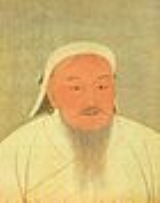
s. Because his father was a chieftain, as were his predecessors, Temüjin was of a noble background. This relatively higher social standing made it easier to solicit help from and eventually consolidate the other Mongol tribes. No accurate portraits of Genghis exist today, and any surviving depictions are considered to be artistic interpretations. Persian historian Rashid al-Din
Rashid al-Din

Rashid al-Din Tabib also Rashid ad-Din Fadhlullah Hamadani , was a Persian physician of Jewish origin, polymathic writer and historian, who wrote an enormous Islamic history, the Jami al-Tawarikh, in the Persian language, often considered a landmark in intercultural historiography and a key document on the Ilkhanids ....
 recorded in his "Chronicles
Jami al-Tawarikh

The Jami al-tawarikh or Universal History is an Iranian work of literature and history written by Rashid al-Din at the start of the 14th century....
" that the legendary "glittering" ancestor of Genghis was tall, long-bearded, red-haired, and green-eyed. Rashid al-Din also described the first meeting of Genghis and Kublai Khan
Kublai Khan

Sorry, no overview for this topic
, when Genghis was shocked to find Kublai had not inherited his red hair. Genghis's Borjigid clan, al-Din also revealed, had a legend involving their clan: it began as the result of an affair (technically a virgin birth) between Alan-ko and a stranger to her land, a glittering man who happened to have red hair and bluish-green eyes. Modern historian Paul Ratchnevsky has suggested in his Genghis biography that the "glittering man" may have been from the Kyrgyz
Kyrgyz

The Kyrgyz are a Turkic peoples ethnic group found primarily in Kyrgyzstan....
 people, who historically displayed these same characteristics. Controversies aside, the closest depiction generally accepted by most historians is the portrait currently in the National Palace Museum in Taipei, Taiwan (see picture above).

Early life and family

Temüjin had three brothers named Khasar (or Qasar), Khajiun, and Temüge
Temüge

Tem?ge was the youngest brother of Genghis Khan. As the youngest sibling, Tem?ge and his mother, by Mongol traditions, were allotted the most land and people by Genghis Khan during his coronation....
, and one sister named Temülen (or Temülin), as well as two half-brothers named Bekhter and Belgutei
Belgutei

Belgutei was the son of Yesugei and half-brother to Genghis Khan.References...
. Like many of the nomads of Mongolia, Temüjin's early life was difficult. At nine years old, as part of the marriage arrangement, he was delivered by his father to the family of his future wife Börte
Börte

B?rte Ujin was the first wife of Genghis Khan , the founder of the Mongol Empire. B?rte became the head of the first Court of Genghis Khan, and Grand Empress of his Empire....
, who was a member of the same tribe as his mother. He was to live there in service to Sansar, the head of the household, until he reached the marriageable
Arranged marriage

Arranged marriage is a marriage arranged by someone other than the couple getting wedded, curtailing or avoiding the process of courtship. Such marriages had deep roots in royal and aristocratic families around the world, including Europe....
 age of 12. While heading home, his father was poisoned during a meal with the neighbouring Tatars
Tatars

Tatars , sometimes spelled Tartars, refers to a Turkic people ethnic group mainly inhabiting Russia, Uzbekistan, Kazakhstan, Ukraine, Kyrgyzstan, Bulgaria, Romania, Lithuania, and Poland....
, who had long been enemies of the Mongols. Temüjin returned home to claim the position of khan. However, his father's tribe refused to be led by a boy so young. They abandoned Hoelun
Hoelun

Hoelun was the mother of Genghis Khan and the wife of his father Yesugei, the chief of the Kiyad clan....
 and her children, leaving them without protection.

For the next several years, Hoelun and her children lived in poverty, surviving primarily on wild fruits, marmot
Marmot

Marmots are members of the genus Marmota, in the rodent family Sciuridae .Marmots are generally large ground squirrels. Those most often referred to as marmots tend to live in mountainous areas such as the Alps, northern Apennines, Carpathian_Mountains, Tatra_Mountains, and Pyrenees in Europe, the Rockies and the Sierra Nevada...
s, and other small game hunted by Temüjin and his brothers. It was during one hunting excursion that 13-year-old Temüjin killed his half-brother, Bekhter, during a fight which resulted from a dispute over hunting spoils. This incident cemented his position as head of the household.

In another incident in 1182 he was captured in a raid and held prisoner by his father's former allies, the Bjartskular ("wolves"). The Bjartskular enslaved Temüjin (reportedly with a cangue
Cangue

Sorry, no overview for this topic
), but with the help of a sympathetic watcher, the father of Chilaun
Chilaun

Chilaun was a general in the Mongol Empire, known as one of Genghis Khan's four "talented men". His relatives, specifically his father, helped a young Genghis escape from captivity at the hands of the Tai'chuids....
 (who would later become a general of Genghis Khan), he was able to escape from the ger
Yurt

A yurt is a portable, felt-covered, wood latticework-framed dwelling structure used by nomads in the steppes of Central Asia....
 by hiding in a river crevice. It was around this time that Jelme and Arslan, two of Genghis Khan's future generals, joined forces with him. Along with his brothers, they provided the manpower needed for early expansion. Temüjin's reputation also became relatively widespread after his escape from the Bjartskular.

At this time, none of the tribal confederations of Mongolia were united politically, and arranged marriages were often used to solidify temporary alliances. Temujin grew up observing the tough political climate of Mongolia, surrounded by tribal warfare, thievery, raids, corruption and continuing acts of revenge carried out between the various confederations, all compounded by interference from foreign forces such as the Chinese dynasties to the south. Temüjin's mother Ho'elun taught him many lessons about the unstable political climate of Mongolia, especially the need for alliances.

As previously arranged by his father, Temüjin married Börte
Börte

B?rte Ujin was the first wife of Genghis Khan , the founder of the Mongol Empire. B?rte became the head of the first Court of Genghis Khan, and Grand Empress of his Empire....
 of the Olkut'hun tribe when he was around 16 in order to cement alliances between their respective tribes. Börte had four sons, Jochi
Jochi

Jochi , was the eldest of the Mongols chieftain Genghis Khan's four sons by his principal wife B?rte. An accomplished military leader, he participated in his father's conquest of Central Asia, along with his brothers and uncles....
 (1185–1226), Chagatai
Chagatai Khan

Chagatai Khan was the second son of Genghis Khan and first khan and name of the Chagatai Khanate and the Chagatai language.He inherited most of what are now the five Central Asian states after the death of his father and ruled until his death in 1241....
 (1187—1241), Ögedei
Ögedei Khan

?gedei Khan, , was the third son of Genghis Khan and second Great Khan of the Mongol Empire by succeeding his father. He continued the expansion of the empire that his father had begun, and was the Great Khan when the Mongol Empire reached its furthest extent west during the mongol invasion of europe....
 (1189—1241), and Tolui
Tolui

Tolui, also rendered Toluy or Tolui Khan , was the youngest son of Genghis Khan by B?rte. His ulus, or territorial inheritance, at his father's death in 1227 was the homelands in Mongolia, and it was he who served as civil administrator in the time it took to confirm ?gedei Khan as second khan....
 (1190–1232). Genghis Khan also had many other children with his other wives, but they were excluded from the succession, and records of daughters are nonexistent. Soon after Börte's marriage to Temüjin, she was kidnapped by the Merkit
Merkit

The Merkit, Merged, or Mergid were a Turkic peoples or Mongol tribe with a fiercereputation that inhabited southeastern Siberia during the Middle Ages....
s, and reportedly given away as a wife. Temüjin rescued her with the help of his friend and future rival, Jamuka, and his protector, Ong Khan of the Kerait
Kerait

The Keraits or Kereits were a cluster of tribes in central Mongolia before the rise of the Mongol Empire. They lived in the area between the Orkhon River and the Kherlen rivers, to the east of the Naimans....
 tribe. She gave birth to a son, Jochi
Jochi

Jochi , was the eldest of the Mongols chieftain Genghis Khan's four sons by his principal wife B?rte. An accomplished military leader, he participated in his father's conquest of Central Asia, along with his brothers and uncles....
, nine months later, clouding the issue of his parentage. Despite speculation over Jochi, Börte would be his only empress, though Temüjin did follow tradition by taking several morganatic
Morganatic marriage

A morganatic marriage is a type of marriage which can be contracted in certain countries, usually between people of unequal social rank, which prevents the passage of the husband's titles and privileges to the wife and any children born of the marriage....
 wives.

Religion

Genghis Khan's religion is widely speculated to be Shamanism
Shamanism

Shamanism is a range of traditional beliefs and practices concerned with communication with the spirit world. A practitioner of shamanism is known as a shaman, , noun ....
 or Tengriism
Tengriism

Tengriism was the major belief of the Mongols and Turkic peoples before the vast majority joined the established world religions. It focuses around the sky deity Tengri and incorporates elements of shamanism, animism, totemism and ancestor worship....
, which was very likely among nomadic Mongol-Turkic
Turkic peoples

The Turkic peoples are Eurasian peoples residing in northern, central and western Eurasia, and who mostly speak languages belonging to the Turkic languages....
 tribes of Central Asia. But he was very tolerant religiously, and interested to learn philosophical and moral lessons from other religions. To do so, he consulted among others with Christian
Christianity

Christianity is a Monotheistic religion #Christian view religion centered on the life and teachings of Jesus as New Testament view on Jesus' life....
 missionaries, Muslim
Islam

Islam is a Monotheism, Abrahamic religion originating with the teachings of the Prophets of Islam Muhammad, a 7th century Arab religious and political figure....
 merchants, and the Taoist
Taoism

Taoism refers to a variety of related philosophical and religious traditions and concepts. These traditions have influenced East Asia for over two thousand years and some have spread to the West....
 monk Qiu Chuji
Qiu Chuji

Qiu Chuji was a Quanzhen Taoist, the most famous of Wang Chongyang's seven disciples, or The Seven Immortals. He was also the founder of the Dragon Gate Taoism....
.

Uniting the confederations

The Central Asia
Central Asia

Central Asia is a region of Asia from the Caspian Sea in the west to central China in the east, and from southern Russia in the north to northern India in the south....
n plateau (north of China
China

China is a Culture of China, an ancient civilization, and, depending on perspective, a national or multinational entity extending over a large area in East Asia....
) around the time of Temüjin (the early 1200s) was divided into several tribes or confederation
Confederation

Usually created by treaty but often later adopting a common constitution, confederations tend to be established for dealing with critical issues such as defense , foreign affairs, or a common currency, with the central government being required to provide support for all members....
s, among them Naimans
Naimans

The Naimans, also Naiman Turks or Naiman Mongols, was a Mongolian name given to a group of people dwelling on the steppe of Central Asia, having diplomatic relations with the Kara-Khitai, and subservient to them until 1177....
, Merkit
Merkit

The Merkit, Merged, or Mergid were a Turkic peoples or Mongol tribe with a fiercereputation that inhabited southeastern Siberia during the Middle Ages....
s, Uyghurs
Uyghur people

The Uyghur are a Turkic peoples of Central Asia. Many English speakers pronounce it as "wEEger" but the pronunciation "ooygOOr" is closer to native ....
, Tatars
Tatars

Tatars , sometimes spelled Tartars, refers to a Turkic people ethnic group mainly inhabiting Russia, Uzbekistan, Kazakhstan, Ukraine, Kyrgyzstan, Bulgaria, Romania, Lithuania, and Poland....
, Mongols
Mongols

The name Mongol specifies one or several ethnic groups, now mainly located in Mongolia, China, and Russia....
, and Keraits, that were all prominent in their own right and often unfriendly toward each other as evidenced by random raids, revenges, and plundering.

Temüjin began his slow ascent to power by offering himself as an ally (or, according to others sources, a vassal
Vassal

A vassal in the terminology that both preceded and accompanied the feudal of medieval Europe, is one who enters into mutual obligations with a monarch, usually of military support and mutual protection, in exchange for certain guarantees, which came to include the terrain held as a fiefdom....
) to his father's anda (sworn brother or blood brother
Blood brother

Blood brother can refer to one of two things: two males related by birth, or two or more men not related by birth, who swear loyalty to one another....
) Toghrul
Wang Khan

Wang Khan, also Ong Khan, was the title given to the Kerait ruler Toghrul by the Jurchen Jin Dynasty of China. Like the rest of their tribe he may have been Nestorian Christian....
, who was Khan of the Kerait
Kerait

The Keraits or Kereits were a cluster of tribes in central Mongolia before the rise of the Mongol Empire. They lived in the area between the Orkhon River and the Kherlen rivers, to the east of the Naimans....
, and is better known by the Chinese title Ong Khan (or "Wang Khan
Wang Khan

Wang Khan, also Ong Khan, was the title given to the Kerait ruler Toghrul by the Jurchen Jin Dynasty of China. Like the rest of their tribe he may have been Nestorian Christian....
"), which the Jin Empire granted him in 1197. This relationship was first reinforced when Börte was captured by the Merkits; it was Toghrul to whom Temüjin turned for support. In response, Toghrul offered his vassal 20,000 of his Kerait warriors and suggested that he also involve his childhood friend Jamuka, who had himself become Khan (ruler) of his own tribe, the Jadaran. Although the campaign was successful and led to the recapture of Börte and utter defeat of the Merkits, it also paved the way for the split between the childhood friends, Temüjin and Jamuka. Temüjin had become blood brother
Blood brother

Blood brother can refer to one of two things: two males related by birth, or two or more men not related by birth, who swear loyalty to one another....
 (anda) with Jamuka earlier, and they had vowed to remain eternally faithful.

The main opponents of the Mongol confederation (traditionally the "Mongols") around 1200 were the Naimans
Naimans

The Naimans, also Naiman Turks or Naiman Mongols, was a Mongolian name given to a group of people dwelling on the steppe of Central Asia, having diplomatic relations with the Kara-Khitai, and subservient to them until 1177....
 to the west, the Merkits to the north, Tanguts to the south, and the Jin
Jin

The Chinese character ? can mean either "muscle" or "tendon" . Exercises designed to develop Jin are known as Jingong . In the context of Chinese martial arts, such exercises develop the ability to recruit the tendons at the beginning and end of a movement as a means of enhancing and delivering the force generated by the stance and body....
 and Tatars
Tatars

Tatars , sometimes spelled Tartars, refers to a Turkic people ethnic group mainly inhabiting Russia, Uzbekistan, Kazakhstan, Ukraine, Kyrgyzstan, Bulgaria, Romania, Lithuania, and Poland....
 to the east. By 1190, Temüjin, his followers, and their advisors, had united the smaller Mongol confederation only. In his rule and his conquest of rival tribes, Temüjin broke with Mongol tradition in a few crucial ways. He delegated authority based on merit and loyalty, rather than family ties. As an incentive for absolute obedience and following his rule of law, the Yassa
Yassa

Yassa was a secret written code of law created by Genghis Khan. It was the principal law under the Mongol Empire even though no copies were made available....
 code, Temüjin promised civilians and soldiers wealth from future possible war spoils. As he defeated rival tribes, he didn't drive away enemy soldiers and abandon the rest. Instead, he took the conquered tribe under his protection and integrated its members into his own tribe. He would even have his mother adopt orphans from the conquered tribe, bringing them into his family. These political innovations inspired great loyalty among the conquered people, making Temüjin stronger with each victory.

Toghrul's (Wang Khan) son Senggum was jealous of Temüjin's growing power, and his affinity with his father. He allegedly planned to assassinate Temüjin. Toghrul, though allegedly saved on multiple occasions by Temüjin, gave in to his son and became uncooperative with Temüjin. Temüjin learned of Senggum's intentions and eventually defeated him and his loyalists. One of the later ruptures between Toghrul and Temüjin was Toghrul's refusal to give his daughter in marriage to Jochi
Jochi

Jochi , was the eldest of the Mongols chieftain Genghis Khan's four sons by his principal wife B?rte. An accomplished military leader, he participated in his father's conquest of Central Asia, along with his brothers and uncles....
, the eldest son of Temüjin, a sign of disrespect in the Mongolian culture. This act led to the split between both factions, and was a prelude to war. Toghrul allied himself with Jamuka, who already opposed Temüjin's forces; however the internal dispute between Toghrul and Jamuka, plus the desertion of a number of their allies to Temüjin, led to Toghrul's defeat. Jamuka escaped during the conflict. This defeat was a catalyst for the fall and eventual dissolution of the Kerait
Kerait

The Keraits or Kereits were a cluster of tribes in central Mongolia before the rise of the Mongol Empire. They lived in the area between the Orkhon River and the Kherlen rivers, to the east of the Naimans....
 tribe.

Genghiskhantraditional
The next direct threat to Temüjin was the Naimans
Naimans

The Naimans, also Naiman Turks or Naiman Mongols, was a Mongolian name given to a group of people dwelling on the steppe of Central Asia, having diplomatic relations with the Kara-Khitai, and subservient to them until 1177....
 (Naiman Mongols), with whom Jamuka and his followers took refuge
Refuge

Refuge is a place or state of safety. Refuge may also refer to:...
. The Naimans did not surrender, although enough sectors again voluntarily sided with Temüjin. In 1201, a kurultai
Kurultai

Kurultai is a political and military council of ancient Mongol and Turkic chiefs and Khan . The root of the word "Kural" or "Khural" means political "meeting" or "assembly" in the Mongolian language and having also these meanings in the Turkish language it is also a verb for "to be established"....
 elected Jamuka as Gur Khan, "universal ruler", a title used by the rulers of the Kara-Khitan Khanate
Kara-Khitan Khanate

The Kara-Khitan Khanate, or Western Liao was a Khitan people empire in Central Asia. The dynasty was founded by Yel? Dashi, who led the remnants of the Chinese Liao Dynasty to Central Asia after fleeing from the Jurchen conquest of their homeland in North and Northeast China....
. Jamuka's assumption of this title was the final breach with Temüjin, and Jamuka formed a coalition of tribes to oppose him. Before the conflict, however, several generals abandoned Jamuka, including Subutai
Subutai

File:Subudei.jpgSubutai was the primary military strategist and general of Genghis Khan and ?gedei Khan. He directed more than 20 campaigns during which he conquered or overran more territory than any other commander in history....
, Jelme's well-known younger brother. After several battles, Jamuka was finally turned over to Temüjin by his own men in 1206.

According to the Secret History, Temüjin again offered his friendship to Jamuka, asking him to return to his side. Temüjin had killed the men who betrayed Jamuka, stating that he did not want disloyal men in his army. Jamuka refused the offer of friendship and reunion, saying that there can only be one Sun in the sky, and he asked for a noble death. The custom is to die without spilling blood, which is granted by breaking the back. Jamuka requested this form of death, despite the fact that in the past Jamuka had been infamously known to have boiled his opponent's generals alive.

The rest of the Merkit
Merkit

The Merkit, Merged, or Mergid were a Turkic peoples or Mongol tribe with a fiercereputation that inhabited southeastern Siberia during the Middle Ages....
 clan that sided with the Naimans
Naimans

The Naimans, also Naiman Turks or Naiman Mongols, was a Mongolian name given to a group of people dwelling on the steppe of Central Asia, having diplomatic relations with the Kara-Khitai, and subservient to them until 1177....
 were defeated by Subutai
Subutai

File:Subudei.jpgSubutai was the primary military strategist and general of Genghis Khan and ?gedei Khan. He directed more than 20 campaigns during which he conquered or overran more territory than any other commander in history....
, a member of Temüjin's personal guard who would later become one of the successful commander
Commander

Commander is a military rank which is also sometimes used as a military title depending on the individual customs of a given military service. Commander is also used as a rank or title in some organizations outside of the military, particularly in police and law enforcement....
s of Genghis Khan. The Naimans' defeat left Genghis Khan as the sole ruler of the Mongol plains, which means all the prominent confederations fell and/or united under Temüjin's Mongol confederation. Accounts of Genghis Khan's life are marked by claims of a series of betrayals and conspiracies. These include rifts with his early allies such as Jamuka (who also wanted to be a ruler of Mongol tribes) and Wang Khan (his and his father's ally), his son Jochi, and problems with the most important Shaman who was allegedly trying to break him up with brother Qasar who was serving Genghis Khan loyally.

His military strategies
Military strategy

Military strategy is a policy implemented by military organizations to pursue desired Strategic goal s. Derived from the Greek language strategos, strategy when it appeared in use during the 18th century, was seen in its narrow sense as the "art of the general", 'the art of arrangement' of troops....
 showed a deep interest in gathering good intelligence
Intelligence (information gathering)

Intelligence is not information, but the product of evaluated information, valued for its currency and relevance rather than its detail or accuracy —in contrast with "data" which typically refers to precision or particular information, or "fact," which typically refers to veracity information....
 and understanding the motivation
Motivation

Motivation is the set of reasons that determines one to engage in a particular behavior. The term is generally used for human motivation but, theoretically, it can be used to describe the causes for animal behavior as well....
s of his rivals as exemplified by his extensive spy network and Yam
Yam (route)

Yam is a supply point route messenger system employed and extensively used and expanded by Genghis Khan and used by subsequent Great Khans and Khan ....
 route systems. He seemed to be a quick student, adopting new technologies and ideas that he encountered, such as siege warfare from the Chinese
Military history of China

The recorded military history of China extends from about 1500 BC to the present day. China has the longest period of continuous development of military Chinese culture of any civilization in world history and had some of the world's most advanced military until the 16th century....
.

As a result by 1206 Temüjin had managed to unite or subdue the Merkit
Merkit

The Merkit, Merged, or Mergid were a Turkic peoples or Mongol tribe with a fiercereputation that inhabited southeastern Siberia during the Middle Ages....
s, Naimans
Naimans

The Naimans, also Naiman Turks or Naiman Mongols, was a Mongolian name given to a group of people dwelling on the steppe of Central Asia, having diplomatic relations with the Kara-Khitai, and subservient to them until 1177....
, Mongols
Mongols

The name Mongol specifies one or several ethnic groups, now mainly located in Mongolia, China, and Russia....
, Keraits, Tatars
Tatars

Tatars , sometimes spelled Tartars, refers to a Turkic people ethnic group mainly inhabiting Russia, Uzbekistan, Kazakhstan, Ukraine, Kyrgyzstan, Bulgaria, Romania, Lithuania, and Poland....
, Uyghurs
Uyghur people

The Uyghur are a Turkic peoples of Central Asia. Many English speakers pronounce it as "wEEger" but the pronunciation "ooygOOr" is closer to native ....
 and disparate other smaller tribes under his rule. It was a monumental feat for the "Mongols" (as they became known collectively). At a Kurultai
Kurultai

Kurultai is a political and military council of ancient Mongol and Turkic chiefs and Khan . The root of the word "Kural" or "Khural" means political "meeting" or "assembly" in the Mongolian language and having also these meanings in the Turkish language it is also a verb for "to be established"....
, a council of Mongol chiefs, he was acknowledged as "Khan" of the consolidated tribes and took the new title "Genghis Khan". The title Khagan
Khagan

Khagan or Great Khan , is a title of empire rank in the Turkic languages and Mongolian language languages equal to the status of emperor and someone who rules a Khaganate ....
 was not conferred on Genghis until after his death, when his son and successor, Ögedei took the title for himself and extended it posthumously to his father (as he was also to be posthumously declared the founder of the Yuan Dynasty
Yuan Dynasty

The Yuan Dynasty , or Great Yuan Empire was both the continuation of the Mongol Empire and the Mongol founded historical state in Mongolia and China, lasting officially from 1271 to 1368....
). This unification of all confederations by Genghis Khan established peace between previously warring tribes and a single political and military force under Genghis Khan.

Military campaigns


Western Xia Dynasty

During the 1206 political rise of Genghis Khan, the Mongol Empire
Mongol Empire

The Mongol Empire was the List of largest empires#Contiguous Empires empire and the largest bar none. It emerged from the unification of Mongols and Turkic peoples tribes in modern day Mongolia, and grew through Mongol invasions, after Genghis Khan had been proclaimed ruler of all Mongols in 1206....
 created by Genghis Khan and his allies was neighboured to the west by the Tangut
Tangut

The Tangut , identified with the state of Western Xia, were a Qiangic languages-speaking people who moved to Northwest China sometime before the 10th century AD....
s' Western Xia Dynasty
Western Xia

The Western Xia Dynasty or the Tangut Empire was a state that existed from 1038 up to 1227 in what are now the northwestern provinces of China of Gansu, Shaanxi, and Ningxia....
. To its east and south was the Jin Dynasty
Jin Dynasty, 1115–1234

The Jin Dynasty , also known as the Jurchen Dynasty, was founded by the Wanyan clan of the Jurchens, the ancestors of the Manchus who established the Qing Dynasty some 500 years later....
, founded by the Manchu
Manchu

The Manchu people are a Tungusic peoples who originated in Manchuria . During their rise in the seventeenth century, with the help of Ming rebels , they conquered the Ming Dynasty and founded the Qing Dynasty, which ruled China until its abolition in 1911 after the Xinhai Revolution, which established Republic of China in its place....
rian Jurchen
Jurchen

Jurchen may refer to:* Jurchen people, Tungusic people who inhabited the region of Manchuria until the 17th century* Jurchen script, writing system of Jurchen people...
s, who ruled northern China
China

China is a Culture of China, an ancient civilization, and, depending on perspective, a national or multinational entity extending over a large area in East Asia....
 as well as being the traditional overlord of the Mongolian tribes for centuries.

Genghis Khan organized his people, army, and his state to first prepare for war with Western Xia, or Xi Xia, which was closer to the Mongolian lands. He correctly believed that the more powerful Jin Dynasty's young ruler would not come to the aid of Xi Xia. When the Tanguts requested help from the Jin Dynasty, they were flatly refused. Despite initial difficulties in capturing its well-defended cities, Genghis Khan forced the surrender of Western Xia by 1209.

Jin Dynasty

In 1211, after the conquest of Western Xia, Genghis Khan planned again to conquer the Jin Dynasty. The commander of the Jin Dynasty army made a tactical mistake in not attacking the Mongols at the first opportunity. Instead, the Jin commander sent a messenger, Ming-Tan, to the Mongol side, who promptly defected and told the Mongols that the Jin army was waiting on the other side of the pass. At this engagement fought at Badger Pass the Mongols massacred thousands of Jin troops. In 1215 Genghis besieged, captured, and sacked the Jin capital of Yanjing (later known as Beijing
Beijing

is a metropolis in northern China and the Capital of the People's Republic of China. It is one of the four municipality of China, which are equivalent to province in China's Political divisions of China....
). This forced the Emperor Xuanzong
Emperor Xuanzong of Jin

Emperor Xuanzong of Jin was emperor of the Jin Dynasty which ruled most of northern China in the 12th and 13th centuries. His name at birth was Wanyan X?n ...
 to move his capital south to Kaifeng
Kaifeng

Kaifeng , formerly known as Bianliang , Bianjing , Daliang , or simply Liang , is a prefecture-level city in eastern Henan province of China, People's Republic of China....
, abandoning the northern half of his kingdom to the Mongols.

Kara-Khitan Khanate

Premongol
Kuchlug
Kuchlug

Kuchlug was a member of the Naiman tribe of western Mongolia. He was defeated by Genghis Khan and fled westward to the Kara-Khitan Khanate, where he became an advisor....
, the deposed Khan of the Naiman
Naimans

The Naimans, also Naiman Turks or Naiman Mongols, was a Mongolian name given to a group of people dwelling on the steppe of Central Asia, having diplomatic relations with the Kara-Khitai, and subservient to them until 1177....
 confederation
Confederation

Usually created by treaty but often later adopting a common constitution, confederations tend to be established for dealing with critical issues such as defense , foreign affairs, or a common currency, with the central government being required to provide support for all members....
 that Temüjin defeated and folded into the Mongol nation, fled west and usurped the khanate
Khanate

Khanate or Chanat is a Turkic language-originated word used to describe a political entity ruled by a Khan . In modern Turkish the word used is hanlik, and in Azeri, xanliq....
 of Kara-Khitan
Kara-Khitan Khanate

The Kara-Khitan Khanate, or Western Liao was a Khitan people empire in Central Asia. The dynasty was founded by Yel? Dashi, who led the remnants of the Chinese Liao Dynasty to Central Asia after fleeing from the Jurchen conquest of their homeland in North and Northeast China....
 (also known as Kara Kitay). Genghis Khan decided to conquer the Kara-Khitan khanate and defeat Kuchlug
Kuchlug

Kuchlug was a member of the Naiman tribe of western Mongolia. He was defeated by Genghis Khan and fled westward to the Kara-Khitan Khanate, where he became an advisor....
, possibly to take him out of power. By this time the Mongol army was exhausted from ten years of continuous campaigning in China against the Western Xia
Western Xia

The Western Xia Dynasty or the Tangut Empire was a state that existed from 1038 up to 1227 in what are now the northwestern provinces of China of Gansu, Shaanxi, and Ningxia....
 and Jin Dynasty. Therefore Genghis sent only two tumen
Tumen

Tumen or T?men was a part of the decimal system used by Turkic peoples, and Mongols peoples to organize their armies. Tumen is an army unit of 10,000 soldiers....
 (20,000 soldiers) against Kuchlug, under his younger general, Jebe
Jebe

Jebe or Jebei Noyan was one of the greatest generals of Genghis Khan. His clan was Besud, which belonged to the Taichud tribe, which was at the time of Genghis Khan under Targudai Khiriltug's leadership....
, known as "The Arrow".

With such a small force, the invading Mongols were forced to change strategies and resort to inciting internal revolt among Kuchlug's supporters, leaving the Khara-Khitan khanate more vulnerable to Mongol conquest. As a result, Kuchlug's army was defeated west of Kashgar
Kashgar

Kashgar or Kashi ...
. Kuchlug fled again, but was soon hunted down by Jebe's army and executed. By 1218, as a result of defeat of Kara-Khitan khanate, the Mongol Empire and its control extended as far west as Lake Balkhash
Lake Balkhash

Lake Balkhash is a lake in southeastern Kazakhstan, the second largest in Central Asia after the Aral Sea. It is a Endorheic that is part of the endorheic basin that includes the Caspian Sea and Aral seas....
, which bordered the Khwarezmia (Khwarezmid Empire), a Muslim
Islam

Islam is a Monotheism, Abrahamic religion originating with the teachings of the Prophets of Islam Muhammad, a 7th century Arab religious and political figure....
 state that reached the Caspian Sea
Caspian Sea

The Caspian Sea is the largest enclosed body of water on Earth by area, variously classed as the List of lakes by area or a full-fledged sea. It has a surface area of 371,000 square kilometers and a volume of 78,200 cubic kilometers ....
 to the west and Persian Gulf
Persian Gulf

The Persian Gulf, in the Southwest Asian region, is an extension of the Indian Ocean located between Iran and the Arabian Peninsula. Historically and commonly known as the Persian Gulf, this body of water is sometimes Persian Gulf naming dispute referred to as the Arabian Gulf by certain Arab countries or simply The Gulf, although nei...
 and the Arabian Sea
Arabian Sea

The Arabian Sea is a region of the Indian Ocean bounded on the east by India, on the north by Pakistan and Iran, on the west by Arabian Peninsula, on the south, approximately, by a line between Cape Guardafui, the north-east point of Somalia, Socotra, Kanyakumari in India, and the western coast of Sri Lanka....
 to the south.

Khwarezmid Empire

In the early 1200s, the Khwarezmian Dynasty was governed by Shah
Shah

Shah is a Persian language term for a monarch that has been adopted in many other languages.Shah used as a last name by Jains and Hindus is unrelated....
 Ala ad-Din Muhammad
Muhammad II of Khwarezm

Ala ad-Din Muhammad II was the ruler of the Khwarezmid Empire from 1200 to 1220. His father was a Turkic slave who eventually became a viceroy of a small province named Khwarizm....
. Genghis Khan saw the potential advantage in Khwarezmia as a commercial trading partner, and, instead of sending an invasion force, he initially sent a 500-man caravan
Camel train

A camel train is a series of camels carrying goods or passengers in a group as part of a regular or semi-regular service between two points....
 to establish trade ties with the empire. However, Inalchuq
Inalchuq

Inalchuq or Inalchuk was governor of Otrar in the Khwarezmian Empire in the early 13th century, known mainly for helping to provoke the successful Mongol invasion of Central Asia by Genghis Khan....
, the governor of the Khwarezmian city of Otrar
Otrar

Otrar or Utrar is a Central Asian ghost town that was a city located along the Silk Road near the current town of Karatau in Kazakhstan....
, attacked the caravan that came from Mongolia, claiming that the caravan was a conspiracy against Khwarezmia. The situation became more complicated as the governor later refused to make repayments for the looting of the caravan and murder of its members. Genghis Khan then sent again a second group of ambassadors to meet the Shah himself. The Shah had all the men shaved and all but one beheaded
Decapitation

Decapitation , or beheading, is the cutting off of the head of a person or animal. Beheading typically refers to the act of intentional decapitation, e.g., as a means of murder or capital punishment; it may be accomplished, for example, with an axe, sword, knife, wire, or by means of a guillotine....
. This was seen as an affront and insult to Genghis Khan. Outraged, Genghis Khan planned one of his largest invasion campaigns by organizing together around 200,000 soldiers (20 tumen
Tumen

Tumen or T?men was a part of the decimal system used by Turkic peoples, and Mongols peoples to organize their armies. Tumen is an army unit of 10,000 soldiers....
s), his most capable generals and some of his sons.

The Mongol army under personal command of Genghis Khan, generals and son(s) crossed the Tien Shan
Tian Shan

The Tian Shan , also commonly spelled Tien Shan, is a mountain range located in Central Asia. The Chinese name for Tian Shan or Tien Shan, may in turn go back to a Xiongnu name, qilian reported by the Shiji as the last place where they met and had their baby as in of the Yuezhi, which has been argued to refer to the Tian Shan...
 mountains by entering the area controlled by the Khwarezmid Empire. After compiling intelligence from many sources Genghis Khan carefully prepared his army, which was divided into three groups. His son Jochi
Jochi

Jochi , was the eldest of the Mongols chieftain Genghis Khan's four sons by his principal wife B?rte. An accomplished military leader, he participated in his father's conquest of Central Asia, along with his brothers and uncles....
 led the first division into the northeast of Khwarezmia. The second division under Jebe
Jebe

Jebe or Jebei Noyan was one of the greatest generals of Genghis Khan. His clan was Besud, which belonged to the Taichud tribe, which was at the time of Genghis Khan under Targudai Khiriltug's leadership....
 marched secretly to the southeast part of Khwarzemia to form, with the first division, a pincer attack
Pincer movement

The pincer movement or double envelopment is a basic element of military strategy which has been used, to some extent, in many wars, and is considered to be the consummate Maneuver, executed by Hannibal at the Battle of Cannae in 216 BC, over 2,200 years ago....
 on Samarkand
Samarkand

Samarkand , is the second-largest city in Uzbekistan and the capital of Samarqand Province.The city is most noted for its central position on the Silk Road between China and the West, and for being an Islamic centre for scholarly study....
. The third division under Genghis Khan and Tolui
Tolui

Tolui, also rendered Toluy or Tolui Khan , was the youngest son of Genghis Khan by B?rte. His ulus, or territorial inheritance, at his father's death in 1227 was the homelands in Mongolia, and it was he who served as civil administrator in the time it took to confirm ?gedei Khan as second khan....
 marched to the northwest and attacked Khwarzemia from that direction.

The Shah's army was split by diverse internal disquisitions and by the Shah's decision to divide his army into small groups concentrated in various cities. This fragmentation was decisive in Khwarezmia's defeats, as it allowed the Mongols, although exhausted from the long journey, to immediately set about defeating small fractions of the Khwarzemi forces instead of facing a unified defense. The Mongol army quickly seized the town of Otrar
Otrar

Otrar or Utrar is a Central Asian ghost town that was a city located along the Silk Road near the current town of Karatau in Kazakhstan....
, relying on superior strategy and tactics. Genghis Khan ordered the execution of many of the inhabitants and executed Inalchuq by pouring molten silver
Silver

Silver is a chemical element with the chemical symbol Ag and atomic number 47. A soft, white, lustrous transition metal, it has the highest electrical conductivity of any element and the highest thermal conductivity of any metal....
 into his ears and eyes, as retribution for his actions. Near the end of the battle the Shah fled rather than surrender. Genghis Khan charged Subutai
Subutai

File:Subudei.jpgSubutai was the primary military strategist and general of Genghis Khan and ?gedei Khan. He directed more than 20 campaigns during which he conquered or overran more territory than any other commander in history....
 and Jebe with hunting him down, giving them two years and 20,000 men. The Shah died under mysterious circumstances on a small island within his empire.

The Mongols' conquest, even by their own standards, was brutal. After the capital Samarkand
Samarkand

Samarkand , is the second-largest city in Uzbekistan and the capital of Samarqand Province.The city is most noted for its central position on the Silk Road between China and the West, and for being an Islamic centre for scholarly study....
 fell, the capital was moved to Bukhara
Bukhara

Bukhara , also spelled as Bukhoro and Bokhara, from the Soghdian ?uxarak , is the Capital of the Bukhara Province of Uzbekistan. The nation's fifth-largest city, it has a population of 237,900 ....
 by the remaining men, and Genghis Khan dedicated two of his generals and their forces to completely destroying the remnants of the Khwarezmid Empire, including not only royal buildings, but entire towns and even vast swaths of farmland. According to stories, Genghis Khan even went so far as to divert a river through the Khwarezmid emperor's birthplace, erasing it from the map.

The heir Shah Jalal Al-Din, who was supported by a nearby town, battled the Mongols several times with his father's armies. However, internal disputes once again split his forces apart, and they were forced to flee Bukhara after yet another devastating defeat, effectively bringing the Khwarezmid Empire to an end.

In the meantime, Genghis Khan selected his third son Ögedei
Ögedei Khan

?gedei Khan, , was the third son of Genghis Khan and second Great Khan of the Mongol Empire by succeeding his father. He continued the expansion of the empire that his father had begun, and was the Great Khan when the Mongol Empire reached its furthest extent west during the mongol invasion of europe....
 as his successor before his army set out, and specified that subsequent Khans should be his direct descendants. Genghis Khan also left Muqali
Muqali

Muqali was one of the greatest generals under Genghis Khan of Jalayir origin. The fact that his father died trying to save Genghis Khan during a battle coupled with his own skills in battle led Muqali to become one of the Khan's most trusted generals....
, one of his most trusted generals, as the supreme commander of all Mongol forces in Jin China while he was out battling the Khwarezmid Empire to the west.

Georgia and Volga Bulgaria

Geor Mong
After the complete defeat of the Khwarezmid Empire in 1220, the Mongol army was split into two component forces. Genghis Khan led a division on a raid through Afghanistan
Afghanistan

Afghanistan , officially the Islamic republic of Afghanistan, is a landlocked country that is located approximately in the center of Asia....
 and northern India
India

India, officially the Republic of India , is a country in South Asia. It is the List of countries and outlying territories by total area country by geographical area, the List of countries by population country, and the most populous liberal democracy in the world....
, while another contingent marched through the Caucasus
Caucasus

The Caucasus or Caucas is a geopolitical region located between Europe, Asia, and the Middle East. It is home to Europe's highest mountain ....
 and into Russia
Russia

Russia , or the Russian Federation , is a list of countries spanning more than one continent country extending over much of northern Eurasia....
. As Genghis Khan gathered his forces in Persia
Iran

Iran , officially the Islamic Republic of Iran and formerly known internationally as Persian Empire until 1935, is a country in Central Eurasia, located on the northeastern shore of the Persian Gulf and the southern shore of the Caspian Sea....
 and Armenia
Armenia

Armenia , officially the Republic of Armenia , is a landlocked mountainous country in South Caucasus between the Black Sea and the Caspian Sea....
 to return to the Mongolian steppes, the second force of 20,000 troops (two tumen), commanded by generals Jebe
Jebe

Jebe or Jebei Noyan was one of the greatest generals of Genghis Khan. His clan was Besud, which belonged to the Taichud tribe, which was at the time of Genghis Khan under Targudai Khiriltug's leadership....
 and Subutai
Subutai

File:Subudei.jpgSubutai was the primary military strategist and general of Genghis Khan and ?gedei Khan. He directed more than 20 campaigns during which he conquered or overran more territory than any other commander in history....
, pushed deep into Armenia
Armenia

Armenia , officially the Republic of Armenia , is a landlocked mountainous country in South Caucasus between the Black Sea and the Caspian Sea....
 and Azerbaijan
Azerbaijan

Azerbaijan , officially the Republic of Azerbaijan , is the largest and most populous country in the South Caucasus, located partially in Eastern Europe and partially in Western Asia....
. The Mongols destroyed Georgia
Georgia (country)

Georgia is a transcontinental country in the Caucasus region, located at the dividing line between Europe and Asia. It is bordered by the Russia to the north, Azerbaijan to the east, Armenia to the south, and Turkey to the southwest....
, sacked the Genoese
Republic of Genoa

The Most Serene Republic of Genoa was an independent state in Liguria on the northwestern Italy coast from the 11th century to 1797, when it was invaded by armies of First French Republic under Napoleon I of France....
 trade-fortress of Caffa in Crimea
Crimea

Crimea or the Autonomous Republic of Crimea is an autonomous republic of Ukraine located on the northern coast of the Black Sea, occupying a peninsula of the same name....
, and overwintered near the Black Sea
Black Sea

The Black Sea is an inland sea sea bounded by southeastern Europe, the Caucasus and the Anatolia and is ultimately connected to the Atlantic Ocean via the Mediterranean Sea and Aegean Seas and various straits....
. Heading home, Subutai's forces attacked the Kipchaks and were intercepted by the allied but poorly coordinated troops of Mstislav the Bold
Mstislav the Bold

File:???????? ???????????? ? ?????? ????????.jpgMstislav Mstislavich the Bold was one of the most popular and active princes of Kievan Rus' in the decades preceding Mongol invasion of Russia....
 of Halych
Halych

Halych is a historic city on the Dniester River in western Ukraine. The town gave its name to the historic province and kingdom of Galicia , of which it was the capital until the early 14th century, when the seat of the local princes was moved to Lviv....
 and Mstislav III of Kiev
Mstislav III of Kiev

Mstislav Romanovich the Old , Prince of Pskov , Smolensk , Belgorod Kievsky , Halych and Grand Prince of Kiev . Son of Roman of Kiev.Mstislav went to war against the Mongols of Genghis Khan in 1223 and was defeated at the Battle of the Kalka River by the Mongol generals, Jebe and Subutai, after which he was executed by suffocation ....
, along with about 80,000 Kievan Rus'
Kievan Rus'

Kievan Rus' , also written as Kyivan Rus', was a medieval state which existed from approximately 880 to the middle of the 12th century. Founded by the Scandinavian traders called "Rus' " and centered in the city of Kiev , Rus' polity is considered an early predecessor of three modern East Slavs nations: Belarusians, Russians, and Ukrai...
 to stop their actions. Subutai
Subutai

File:Subudei.jpgSubutai was the primary military strategist and general of Genghis Khan and ?gedei Khan. He directed more than 20 campaigns during which he conquered or overran more territory than any other commander in history....
 sent emissaries to the Slavic
Slavic peoples

The Slavic Peoples are a linguistic branch of Indo-European peoples, living mainly in eastern Europe. From the early 6th century they spread from their original homeland to inhabit most of eastern Central Europe, Eastern Europe and the Balkans....
 prince
Prince

Prince, from the Latin root princeps, is a general term for a monarch, for a member of a monarch's or former monarch's family, and is a hereditary title in some members of Europe's highest nobility....
s calling for a separate peace, but the emissaries were executed. At the Battle of Kalka River in 1223, Subutai's forces defeated the larger Kievan force, while losing the battle of Samara Bend
Battle of Samara Bend

The Battle of Samara Bend or the Battle of Kernek was the first battle between Volga Bulgaria and the Mongols, probably one of the first major battles the Mongols lost....
 against the neighboring Volga Bulgars.

The Mongols learned from captives of the abundant green pastures beyond the Bulgar territory, allowing for the planning for conquest of Hungary
Hungary

Hungary , officially in English the Republic of Hungary , is a landlocked country in the Carpathian Basin of Central Europe, bordered by Austria, Slovakia, Ukraine, Romania, Serbia, Croatia, and Slovenia....
 and Europe. The Russian princes then sued for peace. Subutai
Subutai

File:Subudei.jpgSubutai was the primary military strategist and general of Genghis Khan and ?gedei Khan. He directed more than 20 campaigns during which he conquered or overran more territory than any other commander in history....
 agreed but was in no mood to pardon the princes. As was customary in Mongol society for nobility, the Russian princes were given a bloodless death. Subutai had a large wooden platform constructed on which he ate his meals along with his other generals. Six Russian princes, including Mstislav III of Kiev
Mstislav III of Kiev

Mstislav Romanovich the Old , Prince of Pskov , Smolensk , Belgorod Kievsky , Halych and Grand Prince of Kiev . Son of Roman of Kiev.Mstislav went to war against the Mongols of Genghis Khan in 1223 and was defeated at the Battle of the Kalka River by the Mongol generals, Jebe and Subutai, after which he was executed by suffocation ....
, were put under this platform and crushed to death.

Genghis Khan recalled Subutai back to Mongolia soon afterwards, and Jebe died on the road back to Samarkand. Subutai and Jebe's famous cavalry expedition, in which they encircled the entire Caspian Sea defeating all armies in their path, except for that of the Volga Bulgars, remains unparalleled to this day, and word of the Mongol triumphs began to trickle to other nations, particularly Europe.

These two campaigns are generally regarded as reconnaissance campaigns that tried to get the feel of the political and cultural elements of the regions. In 1225 both divisions returned to Mongolia. These invasions ultimately added Transoxiana
Transoxiana

Transoxiana is the ancient name used for the portion of Central Asia corresponding approximately with modern-day Uzbekistan, Tajikistan and southwest Kazakhstan....
 and Persia
Iran

Iran , officially the Islamic Republic of Iran and formerly known internationally as Persian Empire until 1935, is a country in Central Eurasia, located on the northeastern shore of the Persian Gulf and the southern shore of the Caspian Sea....
 to an already formidable empire while destroying any resistance along the way.

Under Genghis Khan's grandson Batu and the Golden Horde
Golden Horde

The Golden Horde is a East-Slavic designation for the Mongol?later Turkic languages?Muslim khanate established in the western part of the Mongol Empire after the Mongol invasion of Rus' in the 1240s: present-day Russia, Ukraine, Moldova, Kazakhstan, and the Caucasus....
, the Mongols returned to definitively conquer Volga Bulgaria and the Kievan Rus in 1237, concluding the campaign in 1240.

Western Xia and Jin Dynasty

China 11b
The vassal
Vassal

A vassal in the terminology that both preceded and accompanied the feudal of medieval Europe, is one who enters into mutual obligations with a monarch, usually of military support and mutual protection, in exchange for certain guarantees, which came to include the terrain held as a fiefdom....
 emperor of the Tanguts (Western Xia
Western Xia

The Western Xia Dynasty or the Tangut Empire was a state that existed from 1038 up to 1227 in what are now the northwestern provinces of China of Gansu, Shaanxi, and Ningxia....
) had refused to take part in the war against the Khwarezmid Empire. While most of the Mongol forces under Genghis Khan and his generals were out on campaign against the Khwarezmid Empire, the Western Xia and the defeated Jin Dynasty formed a coalition to resist the Mongols, counting on the campaign against the Khwarezmids to drain the Mongols' ability to respond effectively. Their cause was further emboldened by the Khan's expeditions further west, which had drawn the bulk of his army off into prolonged campaigns in Persia and Eastern Europe.

In 1226, immediately after returning from the east, Genghis Khan began a retaliatory attack on the Tangut
Tangut

The Tangut , identified with the state of Western Xia, were a Qiangic languages-speaking people who moved to Northwest China sometime before the 10th century AD....
s. His armies quickly took Heisui, Ganzhou
Ganzhou

Ganzhou is a prefecture-level city in Jiangxi province, China. Its administrative seat is at Zhanggong ....
 and Suzhou (not the Suzhou in Jiangsu province), and in the autumn he took Xiliang-fu. One of the Tangut generals challenged the Mongols to a battle near Helanshan, but was soundly defeated. In November, Genghis laid siege
Siege

A siege is a military blockade of a city or fortress with the intent of conquering by Battle of attrition and/or assault. The term derives from sedere, Latin for "to sit." A siege occurs when an attacker encounters a city or fortress that cannot be easily taken by a coup de main and refuses to surrender ....
 to the Tangut city Lingzhou
Lingzhou

Lingzhou may refer to:*?? - a famous park in Nanjing *?? - sand island in a waterbody.*??? - a mountain in Guangdong, China*?? - God's land...
, and crossed the Yellow River
Yellow River

The Yellow River or Huang He / Hwang Ho is the second-longest river in China and the List of rivers by length in the world at 4,845 kilometers ....
, defeating the Tangut relief army. According to legend, it was here that Genghis Khan reportedly saw a line of five stars arranged in the sky, and interpreted it as an omen of his victory.

In 1227, Genghis Khan's army attacked and destroyed the Tangut capital of Ning Hia, and continued to advance, seizing Lintiao-fu, Xining
Xining

Xining in Chinese or Silung in Tibetan is the Capital of Qinghai Province, People's Republic of China....
 province, Xindu-fu, and Deshun province in quick succession in the Spring. At Deshun, the Tangut general Ma Jianlong put up a fierce resistance for several days and personally led charges against the invaders outside the city gate. Ma Jianlong later died from wounds received from arrows in battle. Genghis Khan, after conquering Deshun, went to Liupanshan (Qingshui County, Gansu
Gansu

or , is a political divisions of China located in the northwest of the People's Republic of China. It lies between Qinghai, Inner Mongolia, and the Loess Plateau, and borders Mongolia to the north and Xinjiang to the west....
 Province) to escape the severe summer. The new Tangut emperor quickly surrendered to the Mongols, and the rest of the Tanguts officially surrendered soon after. Not happy with their betrayal and resistance, Genghis Khan ordered the entire imperial family to be executed, effectively ending the Tangut lineage.

Succession

The succession topic of Genghis Khan was already significant during the later years of Genghis Khan's reign since he was already reaching his older years. Also the long running paternity discussion about Genghis' oldest son Jochi was already a relatively hot topic behind the scenes, which particularly was contentious because of the seniority of Jochi among the brothers. According to traditional historical accounts, the issue over Jochi's paternity was voiced most strongly by Chagatai. In The Secret History of the Mongols
The Secret History of the Mongols

The Secret History of the Mongols is the oldest surviving Mongolian language literary work. It was written for the Mongol Empire royal family some time after Genghis Khan's death in AD 1227, by an Anonymity author and probably originally in the Mongolian script, though the surviving texts all derive from transcriptions into Chinese chara...
, just before the invasion of the Khwarezmid Empire by Genghis Khan, Chagatai declares before his father and brothers that he would never accept Jochi as Genghis Khan's successor. In response to this tension and possibly for other reasons, it was Ögedei who was appointed as successor.

Jochi

Jochi died in 1226, during his father's lifetime. Some scholars, notably Ratchnevsky, have commented on the possibility that Jochi was secretly poisoned by an order from Genghis Khan. Rashid al-Din reports that the great Khan sent for his sons in the spring of 1223, and while his brothers heeded the order, Jochi remained in Khorasan
Khorasan

Khorasan Khorasan is famous world wide for its saffron and Berberis#Zereshk which are produced in the southern cities of the province. Production is more than 170 tons per year....
. Juzjani suggests that the disagreement arose from a quarrel between Jochi and his brothers in the siege of Urgench
Urgench

Urgench is a city in southern Uzbekistan. It is the capital of the Khorezm Province, on the Amu Darya River and the Shavat canal. The city is situated 450 km west of Bukhara across the Kyzyl Kum Desert....
. Jochi had attempted to protect Urgench from destruction, as it belonged to territory allocated to him as a fief. He concludes his story with the clearly apocryphal statement by Jochi: "Genghis Khan is mad to have massacred so many people and laid waste so many lands. I would be doing a service if I killed my father when he is hunting, made an alliance with Sultan Muhammad, brought this land to life and gave assistance and support to the Muslims." Juzjani claims that it was in response to hearing of these plans that Genghis Khan ordered his son secretly poisoned; however, as Sultan Muhammad was already dead in 1223, the accuracy of this story is questionable.

Genghis Khan was aware of this friction between his sons (particularly between Chagatai and Jochi) and worried of possible conflict between them if he passed away and therefore he decided to explicitly divide his empire among his sons and make all of them Khan in their own right and by appointing one of his sons as his successor. Chagatai was considered relatively unstable due to his temper and rash behavior because of his statements he made that he would not follow Jochi if he were to become his father's successor. Tolui
Tolui

Tolui, also rendered Toluy or Tolui Khan , was the youngest son of Genghis Khan by B?rte. His ulus, or territorial inheritance, at his father's death in 1227 was the homelands in Mongolia, and it was he who served as civil administrator in the time it took to confirm ?gedei Khan as second khan....
, Genghis Khan's youngest son was definitely not to be his successor because he was the youngest and in the Mongol culture, youngest sons weren't given a huge responsibility due to their age. If Jochi was to become successor, it was likely that Chagatai would engage in warfare with him and collapse the empire. Therefore Genghis Khan decided to give the throne to Ogedei. Ogedei was seen by Genghis Khan as dependable in character and relatively stable and down to earth and would be a neutral candidate and might defuse the situation between his brothers.

Death and burial

Genghis Khan Empire At His Death
In 1227, after defeating the Tangut people, Genghis Khan died (according to The Secret History of the Mongols). The reason for his death is uncertain and speculations abound. Some historians maintain that he fell off his horse during a horseback pursuit from the land of present day Egypt due to battle wounds and physical fatigue, ultimately dying of his injuries. Others contend that he was felled by a protracted illness such as pneumonia. The Galician-Volhynian Chronicle alleges he was killed by the Tangut
Tangut

The Tangut , identified with the state of Western Xia, were a Qiangic languages-speaking people who moved to Northwest China sometime before the 10th century AD....
s in battle. Later Mongol chronicles connect Genghis' death with a Tangut princess taken as war booty. One chronicle from the early 17th century even relates that the princess hid a small pair of pliers inside her vagina, and hurt the Great Khan so badly that he died. Some Mongol authors have doubted this version and suspected it to be an invention by the rival Oirads.

Genghis Khan asked to be buried without markings, according to the customs of his tribe. After he died, his body was returned to Mongolia
Mongolia

Mongolia is a landlocked country in East Asia and Central Asia. It borders Russia to the north and People's Republic of China to the south, east and west....
 and presumably to his birthplace in Khentii Aimag, where many assume he is buried somewhere close to the Onon River
Onon River

The Onon gol is a river in Mongolia and Russia of length 818 km and drainage basin 94,010 km?. It originates at the Eastern slope of the Khentii Mountains....
 and the Burkhan Khaldun mountain (part of the Kentii mountain range). According to legend, the funeral escort killed anyone and anything across their path to conceal where he was finally buried. The Genghis Khan Mausoleum, constructed many years after his death, is his memorial, but not his burial site.

On October 6, 2004, a joint Japanese-Mongolian archaeological dig uncovered what is believed to be Genghis Khan's palace in rural Mongolia, which raises the possibility of actually locating the ruler's long-lost burial site. Folklore says that a river was diverted over his grave to make it impossible to find (the same manner of burial of Sumerian King Gilgamesh
Gilgamesh

Gilgamesh also known as Bilgames in the earliest text , was the son of Lugalbanda and the fifth king of Uruk , ruling circa 2700 BC, according to the Sumerian king list....
 of Uruk.) Other tales state that his grave was stampeded over by many horses, over which trees were then planted, and the permafrost also did its part in hiding the burial site.

Genghis Khan left behind an army of more than 129,000 men; 28,000 were given to his various brothers and his sons. Tolui, his youngest son, inherited more than 100,000 men. This force contained the bulk of the elite Mongolian cavalry
Cavalry

The Cavalry is the second oldest of the Combat Arms, and as soldiers or warriors who fought mounted on horseback in combat, it represents the mobility and offensive power of the armed forces....
. By tradition, the youngest son inherits his father's property. Jochi
Jochi

Jochi , was the eldest of the Mongols chieftain Genghis Khan's four sons by his principal wife B?rte. An accomplished military leader, he participated in his father's conquest of Central Asia, along with his brothers and uncles....
, Chagatai
Chagatai Khan

Chagatai Khan was the second son of Genghis Khan and first khan and name of the Chagatai Khanate and the Chagatai language.He inherited most of what are now the five Central Asian states after the death of his father and ruled until his death in 1241....
, Ögedei Khan
Ögedei Khan

?gedei Khan, , was the third son of Genghis Khan and second Great Khan of the Mongol Empire by succeeding his father. He continued the expansion of the empire that his father had begun, and was the Great Khan when the Mongol Empire reached its furthest extent west during the mongol invasion of europe....
, and Kulan's son Gelejian received armies of 4,000 men each. His mother and the descendants of his three brothers received 3,000 men each.

Mongol Empire


Politics and economics

The Mongol Empire
Mongol Empire

The Mongol Empire was the List of largest empires#Contiguous Empires empire and the largest bar none. It emerged from the unification of Mongols and Turkic peoples tribes in modern day Mongolia, and grew through Mongol invasions, after Genghis Khan had been proclaimed ruler of all Mongols in 1206....
 was governed by a civilian
Civilian

A civilian under international humanitarian law is a person who is not a member of his or her country's armed forces. The term is also often used colloquially to refer to people who are not members of a particular profession or occupation, especially by law enforcement agency, which often use rank structures similar to those of military units...
 and military
Military

A military is an organization authorized by its nation to use force, usually including use of weapons, in defending its country by combating actual or Threat of force ....
 code
Code

In communications, a code is a Operator for converting a piece of information into another form or representation , not necessarily of the same type....
, called the Yassa
Yassa

Yassa was a secret written code of law created by Genghis Khan. It was the principal law under the Mongol Empire even though no copies were made available....
, created by Genghis Khan. The Mongol Empire did not emphasize the importance of ethnicity and race in the administrative realm, instead adopting an approach grounded in meritocracy
Meritocracy

Meritocracy is a -cracy or other organization wherein appointments are made and responsibilities are given based on demonstrated talent and ability , rather than by wealth , family connections , social class privilege , friends , seniority , popularity or other historical determinants of social position and political power....
. The exception was the role of Genghis Khan and his family. The Mongol Empire was one of the most ethnically and culturally diverse empires in history, as befitted its size. Many of the empire's nomadic inhabitants considered themselves Mongols in military and civilian life, including Turks, Mongols
Mongols

The name Mongol specifies one or several ethnic groups, now mainly located in Mongolia, China, and Russia....
, and others and included many diverse Khans of various ethnicities as part of the Mongol Empire such as Muhammad Khan
Muhammad Khan (Ilkhan)

Muhammad Khan was a claimant to the throne of the Ilkhanate. He was a great-grandson of Mengu Timur, who was a son of Hulegu.During the breakup of the Ilkhanate following the death of Abu Sa'id in 1335, the Jalayirid Hasan Buzurg raised Muhammad Khan to the throne....
.

There were tax
Tax

To tax is to impose a financial charge or other levy upon an individual or Legal person by a state or the functional equivalent of a state.Taxes are also imposed by many subnational entity....
 exemptions for religious figures and, to some extent, teachers and doctor
Physician

A physician, medical practitioner, doctor of medicine, or medical doctor practices medicine, and is concerned with maintaining or restoring human health through the study, diagnosis, and treatment of disease and injury....
s. The Mongol Empire practiced religious tolerance to a large degree because Mongol tradition had long held that religion was a very personal concept, and not subject to law or interference. Sometime before the rise of Genghis Khan, Ong Khan, his mentor and eventual rival, had converted to Nestorian Christianity. Various Mongol tribes were Buddhist, Muslim, shamanist or Christian. Religious tolerance was thus a well established concept on the Asian steppe.

Modern Mongolian historians say that towards the end of his life, Genghis Khan attempted to create a civil state
Civilian

A civilian under international humanitarian law is a person who is not a member of his or her country's armed forces. The term is also often used colloquially to refer to people who are not members of a particular profession or occupation, especially by law enforcement agency, which often use rank structures similar to those of military units...
 under the Great Yassa that would have established the legal equality of all individuals, including women
Women's rights

The term women's rights refers to Freedom and entitlements of women and girls of all ages. These rights may or may not be institutionalized, ignored or suppressed by law, local custom, and behavior in a particular society....
. However, there is no contemporary evidence of this, or of the lifting of discriminatory policies towards sedentary peoples such as the Chinese. Women played a relatively important role in Mongol Empire and in family, for example Töregene Khatun
Töregene Khatun

T?regene Khatun was a Khatun and regent of the Mongol Empire from the death of her husband ?gedei Khan in 1241 until the election of her eldest son G?y?k Khan in 1246....
 was briefly in charge of the Mongol Empire when next male Khagan
Khagan

Khagan or Great Khan , is a title of empire rank in the Turkic languages and Mongolian language languages equal to the status of emperor and someone who rules a Khaganate ....
 was being chosen. Modern scholars refer to the alleged policy of encouraging trade and communication as the Pax Mongolica
Pax Mongolica

The Pax Mongolia or "Mongol Peace" is a phrase coined by Western scholars to describe the stabilizing effects of the conquest of the Mongol Empire on the social, cultural and economic life of the inhabitants of the vast Eurasian territory they conquered in the 13th and 14th centuries....
 (Mongol Peace).

Genghis Khan realised that he needed people who could govern cities and states conquered by him. He also realised that such administrators could not be found among his Mongol people because they were nomads and thus had no experience governing cities. For this purpose Genghis Khan invited a Khitan
Khitan people

The Khitan people , or Khitai, were a nomadic people, originally located at Mongolia and modern Manchuria from the 4th century. They dominated a vast area in northern China by the 10th century under the Liao Dynasty, but have left few relics that have survived until today....
 prince, Chu'Tsai, who worked for the Jin and had been captured by the Mongol army after the Jin Dynasty were defeated. Jin had captured power by displacing Khitan. Genghis told Chu'Tsai, who was a lineal descendant of Khitan rulers, that he had avenged Chu'Tsai's forefathers. Chu'Tsai responded that his father served the Jin Dynasty honestly and so did he; he did not consider his own father his enemy, so the question of revenge did not apply. Genghis Khan was very impressed by this reply. Chu'Tsai administered parts of the Mongol Empire and became a confidant of the successive Mongol Khans.

Military

Genghis Khan put absolute trust in his generals, such as Muqali, Jebe and Subutai
Subutai

File:Subudei.jpgSubutai was the primary military strategist and general of Genghis Khan and ?gedei Khan. He directed more than 20 campaigns during which he conquered or overran more territory than any other commander in history....
, and regarded them as close advisors, often extending them the same privileges and trust normally reserved for close family members. He allowed them to make decisions on their own when they embarked on campaigns far from the Mongol Empire capital Karakorum
Karakorum

Karakorum was the capital of the Mongol Empire in the 13th century, although for only about 30 years. Its ruins lie in the northwestern corner of the ?v?rkhangai Province of Mongolia, near today's town of Kharkhorin, and adjacent to the Erdene Zuu monastery....
. Genghis Khan expected unwavering loyalty from his generals, and granted them a great deal of autonomy in making command decisions. Muqali, a trusted general, was given command of the Mongol forces against the Jin Dynasty while Genghis Khan was fighting in Central Asia
Central Asia

Central Asia is a region of Asia from the Caspian Sea in the west to central China in the east, and from southern Russia in the north to northern India in the south....
, and Subutai
Subutai

File:Subudei.jpgSubutai was the primary military strategist and general of Genghis Khan and ?gedei Khan. He directed more than 20 campaigns during which he conquered or overran more territory than any other commander in history....
 and Jebe
Jebe

Jebe or Jebei Noyan was one of the greatest generals of Genghis Khan. His clan was Besud, which belonged to the Taichud tribe, which was at the time of Genghis Khan under Targudai Khiriltug's leadership....
 were allowed to pursue the Great Raid into the Caucausus and Kievan Rus, an idea they had presented to the Khagan on their own initiative. The Mongol military was also successful in siege warfare, cutting off resources for cities and towns by diverting certain rivers, taking enemy prisoners and driving them in front of the army, and adopting new ideas, techniques and tools from the people they conquered, particularly in employing Muslim and Chinese siege engines and engineers to aid the Mongol cavalry in capturing cities. Another standard tactic of the Mongol military was the commonly practiced feigned retreat
Withdrawal (military)

A withdrawal is a type of military operation, generally meaning retreating forces back while maintaining contact with the enemy. A withdrawal may be undertaken as part of a general retreat, to consolidate forces, to occupy ground that is more easily defended, or to lead the enemy into an ambush....
 to break enemy formations and to lure small enemy groups away from the larger group and defended position for ambush
Ambush

An ambush is a long-established military tactics, in which the aggressors use concealment to attack a passing enemy. Ambushers strike from concealed positions, such as among dense underbrush or behind hilltops....
 and counterattack
Counterattack

A counterattack is a military military tactics used by some or all of a defense against their attackers. The general objective is to negate or thwart the advantage gained by the enemy in attack and the specific objectives are usually to regain lost ground or to destroy attacking enemy units....
.

Another important aspect of the military organization
Organization

An organization is a social arrangement which pursues collective goals, which controls its own performance, and which has a boundary separating it from its environment....
 of Genghis Khan was the communications
Transport

Transport or transportation is the movement of passenger and cargo from one location to another. Transport is performed by various modes of transport, such as aviation, rail transport, road transport, ship transport, cable transport, pipeline transport and space transport....
 and supply
Supply

supply is the amount of good or services a business providesSupply may refer to:*Supply and demand theory*Confidence and supply#Supply for a Government budget, in the Westminster System...
 route or Yam
Yam (route)

Yam is a supply point route messenger system employed and extensively used and expanded by Genghis Khan and used by subsequent Great Khans and Khan ....
, adapted from previous Chinese models. Genghis Khan dedicated special attention to this in order to speed up the gathering of military intelligence
Military intelligence

Military intelligence , is a military service that uses List of intelligence gathering disciplines which informs the commanders' decision making process by providing intelligence analysis of Intelligence from a wide range of sources including forecast environmental changes , and opposing force intentions....
 and official communications. To this end, Yam waystations were established all over the empire.

Khanates

Before his death, Genghis Khan divided his empire
Mongol Empire

The Mongol Empire was the List of largest empires#Contiguous Empires empire and the largest bar none. It emerged from the unification of Mongols and Turkic peoples tribes in modern day Mongolia, and grew through Mongol invasions, after Genghis Khan had been proclaimed ruler of all Mongols in 1206....
 among his sons Ögedei
Ögedei Khan

?gedei Khan, , was the third son of Genghis Khan and second Great Khan of the Mongol Empire by succeeding his father. He continued the expansion of the empire that his father had begun, and was the Great Khan when the Mongol Empire reached its furthest extent west during the mongol invasion of europe....
, Chagatai
Chagatai Khan

Chagatai Khan was the second son of Genghis Khan and first khan and name of the Chagatai Khanate and the Chagatai language.He inherited most of what are now the five Central Asian states after the death of his father and ruled until his death in 1241....
, Tolui
Tolui

Tolui, also rendered Toluy or Tolui Khan , was the youngest son of Genghis Khan by B?rte. His ulus, or territorial inheritance, at his father's death in 1227 was the homelands in Mongolia, and it was he who served as civil administrator in the time it took to confirm ?gedei Khan as second khan....
, and Jochi
Jochi

Jochi , was the eldest of the Mongols chieftain Genghis Khan's four sons by his principal wife B?rte. An accomplished military leader, he participated in his father's conquest of Central Asia, along with his brothers and uncles....
 (Jochi's death several months before Genghis Khan meant that his lands were instead split between his sons, Batu
Batu Khan

Batu Khan was a Mongols ruler and the founder of the Blue Horde. Batu was a son of Jochi and grandson of Genghis Khan. His Blue Horde became the Golden Horde , which ruled Kievan Rus' and the Caucasus for around 250 years, after also destroying the armies of Poland and Hungary....
 and Orda
Orda Khan

Orda Ichen was a Mongol Khan and military strategist who ruled during the 13th century....
) into several Khanates designed as sub-territories: their Khans were expected to follow the Great Khan, who was, initially, Ögedei.

Harhorin
Following are the Khanate
Khanate

Khanate or Chanat is a Turkic language-originated word used to describe a political entity ruled by a Khan . In modern Turkish the word used is hanlik, and in Azeri, xanliq....
s in the way in which Genghis Khan assigned after his death:
  • Empire of the Great Khan
    Yuan Dynasty

    The Yuan Dynasty , or Great Yuan Empire was both the continuation of the Mongol Empire and the Mongol founded historical state in Mongolia and China, lasting officially from 1271 to 1368....
    : Ögedei Khan
    Ögedei Khan

    ?gedei Khan, , was the third son of Genghis Khan and second Great Khan of the Mongol Empire by succeeding his father. He continued the expansion of the empire that his father had begun, and was the Great Khan when the Mongol Empire reached its furthest extent west during the mongol invasion of europe....
    , as Great Khan, took most of Eastern Asia, including China
    China

    China is a Culture of China, an ancient civilization, and, depending on perspective, a national or multinational entity extending over a large area in East Asia....
    ; this territory later to comprise the Yuan Dynasty
    Yuan Dynasty

    The Yuan Dynasty , or Great Yuan Empire was both the continuation of the Mongol Empire and the Mongol founded historical state in Mongolia and China, lasting officially from 1271 to 1368....
     under Kubilai Khan.
  • Mongol homeland (present day Mongolia
    Mongolia

    Mongolia is a landlocked country in East Asia and Central Asia. It borders Russia to the north and People's Republic of China to the south, east and west....
    , including Karakorum
    Karakorum

    Karakorum was the capital of the Mongol Empire in the 13th century, although for only about 30 years. Its ruins lie in the northwestern corner of the ?v?rkhangai Province of Mongolia, near today's town of Kharkhorin, and adjacent to the Erdene Zuu monastery....
    ): Tolui Khan
    Tolui

    Tolui, also rendered Toluy or Tolui Khan , was the youngest son of Genghis Khan by B?rte. His ulus, or territorial inheritance, at his father's death in 1227 was the homelands in Mongolia, and it was he who served as civil administrator in the time it took to confirm ?gedei Khan as second khan....
    , being the youngest son, received a small territory near the Mongol homeland, following Mongol custom.
  • Chagatai Khan
    Chagatai Khan

    Chagatai Khan was the second son of Genghis Khan and first khan and name of the Chagatai Khanate and the Chagatai language.He inherited most of what are now the five Central Asian states after the death of his father and ruled until his death in 1241....
    ate
    : Chagatai Khan
    Chagatai Khan

    Chagatai Khan was the second son of Genghis Khan and first khan and name of the Chagatai Khanate and the Chagatai language.He inherited most of what are now the five Central Asian states after the death of his father and ruled until his death in 1241....
    , Genghis Khan's second son, was given Central Asia and northern Iran
    Iran

    Iran , officially the Islamic Republic of Iran and formerly known internationally as Persian Empire until 1935, is a country in Central Eurasia, located on the northeastern shore of the Persian Gulf and the southern shore of the Caspian Sea....
    .
  • Blue Horde
    Blue Horde

    The Blue Horde was one of the uluses within the Mongol Empire formed around 1227, after the death of Genghis Khan and subsequent division of his empire....
     to Batu Khan
    Batu Khan

    Batu Khan was a Mongols ruler and the founder of the Blue Horde. Batu was a son of Jochi and grandson of Genghis Khan. His Blue Horde became the Golden Horde , which ruled Kievan Rus' and the Caucasus for around 250 years, after also destroying the armies of Poland and Hungary....
    , and White Horde
    White Horde

    The White Horde was one of the uluses within the Mongol Empire formed around 1226, after the death of Genghis Khan and subsequent division of his empire....
     to Orda Khan
    Orda Khan

    Orda Ichen was a Mongol Khan and military strategist who ruled during the 13th century....
    , both were later combined into the Kipchak Khanate, or Khanate of the Golden Horde
    Golden Horde

    The Golden Horde is a East-Slavic designation for the Mongol?later Turkic languages?Muslim khanate established in the western part of the Mongol Empire after the Mongol invasion of Rus' in the 1240s: present-day Russia, Ukraine, Moldova, Kazakhstan, and the Caucasus....
    , under Toqtamysh. Genghis Khan's eldest son, Jochi, had received most of the distant Russia
    Russia

    Russia , or the Russian Federation , is a list of countries spanning more than one continent country extending over much of northern Eurasia....
     and Ruthenia
    Ruthenia

    Ruthenia is a geographic and culturo-ethnic name applied to the parts of Eastern Europe populated by Eastern Slavic peoples, as well as to the past Russian states that existed in these territories....
    . Because Jochi died before Genghis Khan, his territory was further split up between his sons. Batu Khan
    Batu Khan

    Batu Khan was a Mongols ruler and the founder of the Blue Horde. Batu was a son of Jochi and grandson of Genghis Khan. His Blue Horde became the Golden Horde , which ruled Kievan Rus' and the Caucasus for around 250 years, after also destroying the armies of Poland and Hungary....
     launched an invasion of Russia, and later Hungary
    Hungary

    Hungary , officially in English the Republic of Hungary , is a landlocked country in the Carpathian Basin of Central Europe, bordered by Austria, Slovakia, Ukraine, Romania, Serbia, Croatia, and Slovenia....
     and Poland
    Poland

    Poland , officially the Republic of Poland , is a country in Central Europe. Poland is bordered by Germany to the west; the Czech Republic and Slovakia to the south; Ukraine, Belarus and Lithuania to the east; and the Baltic Sea and Kaliningrad Oblast, a Russian Enclave and exclave, to the north....
    , and crushed several armies before being summoned back by the news of Ögedei's death.

After Genghis Khan

Ogadai Khan
Contrary to popular belief, Genghis Khan did not conquer all of the areas of the Mongol Empire. At the time of his death, the Mongol Empire stretched from the Caspian Sea
Caspian Sea

The Caspian Sea is the largest enclosed body of water on Earth by area, variously classed as the List of lakes by area or a full-fledged sea. It has a surface area of 371,000 square kilometers and a volume of 78,200 cubic kilometers ....
 to the Sea of Japan
Sea of Japan

The Sea of Japan is a marginal sea of the western Pacific Ocean, bordered by Japan, South Korea, North Korea and Russia. It is referred to in North Korea as the Korea East Sea and in South Korea as the East Sea....
. The empire's expansion continued for a generation or more after Genghis's death in 1227. Under Genghis's successor Ögedei Khan
Ögedei Khan

?gedei Khan, , was the third son of Genghis Khan and second Great Khan of the Mongol Empire by succeeding his father. He continued the expansion of the empire that his father had begun, and was the Great Khan when the Mongol Empire reached its furthest extent west during the mongol invasion of europe....
 the speed of expansion reached its peak. Mongol armies pushed into Persia, finished off the Xi Xia and the remnants of the Khwarezmids, and came into conflict with the imperial Song Dynasty
Song Dynasty

The Song Dynasty was a ruling Chinese dynasty in China between 960–1279 AD; it succeeded the Five Dynasties and Ten Kingdoms Period, and was followed by the Yuan Dynasty....
 of China, starting a war that would last until 1279 and that would conclude with the Mongols gaining control of all of China.

Perceptions

Like other notable conquerors, Genghis Khan is portrayed very differently by those he conquered and those who conquered with him. Negative views of Genghis Khan are very persistent within histories written by many different cultures, from various different geographical regions. They often cite the cruelties and destructions brought upon by Mongol armies; however, other authors cite positive aspects of Genghis Khan's conquests as well.

Positive

Genghis Khan is credited with bringing the Silk Road
Silk Road

The Silk Road is an extensive interconnected network of trade routes across the Asian continent connecting East, South, and Western Asia with the Mediterranean world, including North Africa and Europe....
 under one cohesive political environment. This allowed increased communication
Communication

Communication is commonly defined as "the imparting or interchange of thoughts, opinions, or information by speech, writing, or signs...",, 1: an act or instance of transmitting and 3 a: "a process by which information is exchanged between individuals through a common system of symbols, signs, or beha...
 and trade between the West
Western world

The term Western world, the West or the Occident can have multiple meanings dependent on its context . Accordingly, the basic definition of what constitutes "the West" varies, expanding and contracting over time, in relation to various historical circumstances....
, Middle East
Middle East

File:GreaterMiddleEast1.pngThe Middle East is a region that spans southwestern Asia, western Asia, and northeastern Africa. It has no clear boundaries, often used as a synonym to Near East, in opposition to Far East....
 and Asia, thus expanding the horizons of all three cultural areas. Some historians have noted that Genghis Khan instituted certain levels of meritocracy
Meritocracy

Meritocracy is a -cracy or other organization wherein appointments are made and responsibilities are given based on demonstrated talent and ability , rather than by wealth , family connections , social class privilege , friends , seniority , popularity or other historical determinants of social position and political power....
 in his rule, and was tolerant of different religions. In much of modern-day Turkey
Turkey

Turkey , known officially as the Republic of Turkey , is a Eurasian country that stretches across the Anatolian peninsula in southwest Asia and Thrace in the Balkans region of Southern Europe....
, Genghis Khan is looked on as a great military leader, and it is popular for male children to carry his title as name.

In Mongolia
Traditionally Genghis Khan had been revered for centuries among the Mongols, and also among other ethnic groups like the Turks
Turkish people

The Turkish people , also known as "Turks" are defined mainly as citizens of the Republic of Turkey. An early history text provided the definition of being a Turk as "any individual within the Republic of Turkey, whatever his faith who speaks Turkish, grows up with Turkish culture and adopts the Turkish ideal is a Turk." This ideal...
, largely because of his association with Mongol statehood, political and military organization, and his historic victories in war. He eventually evolved into a larger-than-life figure chiefly among the Mongols.

During the communist period, Genghis Khan was often described as reactionary, and positive statements about him were generally avoided. In 1962, the erection of a monument at his birthplace and a conference held in commemoration of his 800th birthday led to criticism from the Soviet Union
Soviet Union

The Union of Soviet Socialist Republics was a Constitution of the Soviet Union socialist state that existed in Eurasia from 1922 to 1991.The name is a translation of the , romanization of Russian Soyuz Sovetskikh Sotsialisticheskikh Respublik, abbreviated ????, SSSR....
, and resulted in the dismissal of Tömör-Ochir, a secretary of the ruling Mongolian People's Revolutionary Party
Mongolian People's Revolutionary Party

The 'Mongolian People's Revolutionary Party' is an ex-communist political party in Mongolia. The party is abbreviated 'MPRP' in English language and in Mongolian....
 Central Committee
Central Committee

Central Committee most commonly refers to the central executive unit of a Leninist or Communist party, whether ruling or non-ruling. In a Communist party, the Central Committee is made up of delegates elected at a Party Congress....
. In the early 1990s, when democracy
Democracy

Democracy is a form of government in which power is held directly or indirectly by citizens under a free electoral system. It is derived from the Greek language d?????at?a , "popular government" which was coined from d???? , "people" and ???t?? , "rule, strength" in the middle of the 5th-4th century BC to denote the political syst...
 was established in Mongolia, the memory of Genghis Khan with the Mongolian traditional national identity has had a powerful revival. Genghis Khan became the central figure of the national identity. He is now a source of pride for Mongolians with ties to their historic roots. For example, it is not uncommon for Mongolians to refer to Mongolia as "Genghis Khan's Mongolia," to themselves as "Genghis Khan's children," and to Genghis Khan as the "father of the Mongols" especially among the younger generation. His name and likeness are endorsed on products, streets, buildings, and other places. His face can be found on everyday commodities, from liquors to the largest denominations of 500, 1000, 5000 and 10,000 Mongolian tögrög. Mongolia's main international airport
International airport

An international airport is an airport typically equipped with customs and immigration facilities to handle international flights to and from other countries....
 has been renamed Chinggis Khaan International Airport
Chinggis Khaan International Airport

Chinggis Khaan International Airport is the international airport serving Ulan Bator, Mongolia. It is the largest international air facility in the country, and the only facility to offer scheduled international flights....
, and major Genghis Khan statues have been erected before the parliament and near Ulaanbaatar. There have been repeated discussions about regulating the use of his name and image to avoid trivialization. In summary, Mongolians see him as the fundamental figure in the founding of the Mongol Empire
Mongol Empire

The Mongol Empire was the List of largest empires#Contiguous Empires empire and the largest bar none. It emerged from the unification of Mongols and Turkic peoples tribes in modern day Mongolia, and grew through Mongol invasions, after Genghis Khan had been proclaimed ruler of all Mongols in 1206....
, and therefore the basis for Mongolia
Mongolia

Mongolia is a landlocked country in East Asia and Central Asia. It borders Russia to the north and People's Republic of China to the south, east and west....
 as a country
Country

Country may refer to the territory of a state, or to a smaller, or former, political division of a geographical region. In another meaning of the word, the country is also a term used to refer to rural areas....
.

Genghis Khan is now widely regarded as one of Mongolia's greatest and most legendary leaders. He is responsible for the emergence of the Mongols as a political and ethnic identity. He reinforced many Mongol traditions and provided stability and unity during a time of great uncertainty, due to both internal and external factors. He is also given credit for the introduction of the traditional Mongolian script
Mongolian script

Mongolian script was the first of many Mongolian writing systems created for the Mongolian language and the most successful until the introduction of Cyrillic to Mongolia in 1946....
 and the creation of the Ikh Zasag
Yassa

Yassa was a secret written code of law created by Genghis Khan. It was the principal law under the Mongol Empire even though no copies were made available....
, the first written Mongolian law. There is a chasm in the perception of his brutality - Mongolians maintain that the historical records written by non-Mongolians are unfairly biased against Genghis Khan; and that his butchery is exaggerated, while his positive role is underrated.

In China
There is conflicting view of Genghis Khan in the People's Republic of China
People's Republic of China

The People's Republic of China , commonly known as China, is the largest country in East Asia and the List of countries by population in the world with over 1.3 billion people, approximately a fifth of the world's population....
 with some viewing him relatively positively in the Inner Mongolia
Inner Mongolia

Inner Mongolia is the Mongols autonomous region of China of the People's Republic of China, located in the country's north.Inner Mongolia borders, from east to west, the provinces of Heilongjiang, Jilin, Liaoning, Hebei, Shanxi, Shaanxi, Ningxia, and Gansu, while to the north it borders Mongolia and Russia....
 section where there is monument and buildings about him and where there are considerable Mongols
Mongols

The name Mongol specifies one or several ethnic groups, now mainly located in Mongolia, China, and Russia....
 in the area with a population of around 5 million, almost twice the population of Mongolia
Mongolia

Mongolia is a landlocked country in East Asia and Central Asia. It borders Russia to the north and People's Republic of China to the south, east and west....
. While Genghis Khan never conquered all of China, his grandson Kublai Khan
Kublai Khan

Sorry, no overview for this topic
 completed that conquest, and established the Yuan Dynasty
Yuan Dynasty

The Yuan Dynasty , or Great Yuan Empire was both the continuation of the Mongol Empire and the Mongol founded historical state in Mongolia and China, lasting officially from 1271 to 1368....
 that is often credited with re-uniting China. There has also been much artwork and literature praising Genghis as a great military leader and political genius. The years of the Mongol-established Yuan Dynasty left an indelible imprint on Chinese political and social structures for subsequent generations with literature during the Jin Dynasty relatively fewer. In general the legacy of Genghis Khan and his successors, who completed the conquest of China after 65 years of struggle, remains a mixed topic, even to this day.

Negative

Hulagu Baghdad 1258
In Iraq
Iraq

Iraq , officially the Republic of Iraq , is a country in Western Asia spanning most of the northwestern end of the Zagros Mountains, the eastern part of the Syrian Desert and the northern part of the Arabian Desert....
 and Iran
Iran

Iran , officially the Islamic Republic of Iran and formerly known internationally as Persian Empire until 1935, is a country in Central Eurasia, located on the northeastern shore of the Persian Gulf and the southern shore of the Caspian Sea....
, he is almost universally looked on as a destructive and genocidal
Genocide

Genocide is the deliberate and systematic destruction, in whole or in part, of an ethnic, racial, religious, or national group.While precise genocide definitions, a legal definition is found in the 1948 United Nations Convention on the Prevention and Punishment of the Crime of Genocide ....
 warlord who caused enormous damage and destruction to the population of these areas. Similarly, in Afghanistan
Afghanistan

Afghanistan , officially the Islamic republic of Afghanistan, is a landlocked country that is located approximately in the center of Asia....
 (along with other non-Turkic Muslim countries) he is generally viewed unfavorably though some groups display ambivalence as it is believed that the Hazara of Afghanistan are descendants of a large Mongol garrison stationed therein. The invasions of Baghdad
Baghdad

Baghdad is the Capital of Iraq and of Baghdad Governorate, with which it is also coterminous. With a municipal population estimated at 6.5 million, it is the largest city in Iraq, and the second largest city in the Arab World....
 and Samarkand
Samarkand

Samarkand , is the second-largest city in Uzbekistan and the capital of Samarqand Province.The city is most noted for its central position on the Silk Road between China and the West, and for being an Islamic centre for scholarly study....
 caused mass murders, such as when portions of southern Khuzestan were completely destroyed. His descendant, Hulagu Khan
Hulagu Khan

Hulagu Khan, also known as Hulagu, H?leg? or Hulegu , was a Mongols ruler who conquered much of Southwest Asia. Son of Tolui and the Kerait princess Sorghaghtani Beki, he was a grandson of Genghis Khan, and the brother of Arik Boke, M?ngke Khan and Kublai Khan....
 destroyed much of Iran
Iran

Iran , officially the Islamic Republic of Iran and formerly known internationally as Persian Empire until 1935, is a country in Central Eurasia, located on the northeastern shore of the Persian Gulf and the southern shore of the Caspian Sea....
's northern part. Among the Iranian peoples
Iranian peoples

The Iranian peoples are an ethnic and linguistic branch of Indo-European peoples, living mainly in Iranian plateau and beyond in central-, southern-, and southwestern Asia and southeastern Europe....
, he is regarded as one of the most despised conquerors of Iran
Iran

Iran , officially the Islamic Republic of Iran and formerly known internationally as Persian Empire until 1935, is a country in Central Eurasia, located on the northeastern shore of the Persian Gulf and the southern shore of the Caspian Sea....
, along with Alexander
Alexander the Great

Alexander the Great , also known as Alexander III of Macedon was an ancient Greeks King of Macedon . He was one of the most successful military commanders of all time and is presumed undefeated in battle....
 and Tamerlane. In much of Russia
Russia

Russia , or the Russian Federation , is a list of countries spanning more than one continent country extending over much of northern Eurasia....
, Middle East
Middle East

File:GreaterMiddleEast1.pngThe Middle East is a region that spans southwestern Asia, western Asia, and northeastern Africa. It has no clear boundaries, often used as a synonym to Near East, in opposition to Far East....
, China
China

China is a Culture of China, an ancient civilization, and, depending on perspective, a national or multinational entity extending over a large area in East Asia....
, Ukraine
Ukraine

Ukraine is a country in Eastern Europe. It is bordered by Russia to the east; Belarus to the north; Poland, Slovakia, and Hungary to the west; Romania and Moldova to the southwest; and the Black Sea and Sea of Azov to the south....
, Poland
Poland

Poland , officially the Republic of Poland , is a country in Central Europe. Poland is bordered by Germany to the west; the Czech Republic and Slovakia to the south; Ukraine, Belarus and Lithuania to the east; and the Baltic Sea and Kaliningrad Oblast, a Russian Enclave and exclave, to the north....
 and Hungary
Hungary

Hungary , officially in English the Republic of Hungary , is a landlocked country in the Carpathian Basin of Central Europe, bordered by Austria, Slovakia, Ukraine, Romania, Serbia, Croatia, and Slovenia....
, Genghis Khan and his regime
Regime

The word regime refers to a set of conditions, most often of a political nature. It may also be used synonymously with "wiktionary:regimen", for example in the phrases "exercise regime" or "medical regime"....
 are credited with considerable damage and destruction. Presently Genghis Khan, his descendants, his generals, and the Mongol people are remembered for their ferocious and destructive conquests by much of Eastern Europe.

Descent

Zerjal et al. [2003] identified a Y-chromosomal lineage
List of genetic results derived from historical figures

This is a list of haplogroups of historical and famous figures. Haplogroups can be determined from the remains of historical figures, or derived from genealogical DNA tests of people who trace their direct maternal or paternal ancestry to a noted historical figure....
 present in about 8% of the men in a large region of Asia (about 0.5% of the men in the world). The paper suggests that the pattern of variation within the lineage is consistent with a hypothesis that it originated in Mongolia about 1,000 years ago. Because the rate of such a spread would be too rapid to have occurred by genetic drift
Genetic drift

Genetic drift or allelic drift is the change in the relative frequency with which a gene variant occurs in a population that results from the fact that alleles in offspring are a Sampling of those in the parents, and because of the role of chance in determining whether a given individual survives and reproduces....
, the authors propose that the lineage is carried by likely male-line descendants of Genghis Khan, and that it has spread through social selection. In addition to most of the Mongol nobility up to the 20th century, the Mughal
Mughal Empire

The Mughal Empire was a Muslim imperial power of the Indian subcontinent which began in 1526, ruled most of the Indian Subcontinent by the late 17th and early 18th centuries, and ended in the mid-19th century....
 emperor Babur
Babur

Babur was a Muslim conqueror from Central Asia who, following a series of setbacks, finally succeeded in laying the basis for the Mughal Empire of Indian subcontinent....
's mother was a descendant. Timur
Timur

Timur , among his other names, commonly known as Tamerlane in the West, was a 14th century Turko-Mongol conqueror of much of western and Central Asia, and founder of the Timurid dynasty in Central Asia, which survived until 1857 as the Mughal Empire of India....
 (also known as Tamerlane), the 14th century military leader, claimed descent from Genghis Khan.

Depictions in modern culture

There have been several films, novels and other adaptation works on the Mongolian
Mongolian

Mongolian may refer to:* Something of, from, or related to Mongolia, a landlocked country in East Asia and Central Asia that borders Russia to the north and People's Republic of China to the south, east and west....
 ruler.

Films

  • The Conqueror
    The Conqueror

    ----The Conqueror is a 1956 in film epic film produced by Howard Hughes and starring John Wayne as the Mongol conqueror Genghis Khan. Other performers included Susan Hayward, Agnes Moorehead, and Pedro Armend?riz....
    , released in 1956 and starring John Wayne
    John Wayne

    John Wayne was an Academy Award- and Golden Globe Award-winning United States film actor. He epitomized rugged masculinity and has become an enduring American icon....
     as Temüjin and Susan Hayward
    Susan Hayward

    Susan Hayward was an American actress.After working as a fashion model in New York, Hayward travelled to Hollywood in 1937 in the hope of playing the role of Scarlett O'Hara in Gone With the Wind ....
     as Börte.
  • Genghis Khan
    Genghis Khan (1965 film)

    Genghis Khan is among the most famous film versions depicting the life and conquests of the Mongol emperor Genghis Khan. It was released in the United Kingdom and the United States in 1965 in film by Columbia Pictures, and was directed by Henry Levin, and starred Omar Sharif, who that same year starred in another epic, Doctor Zhivago ...
    , released in 1965 and starring Omar Sharif
    Omar Sharif

    Omar Sharif is an Academy Award-nominated and Golden Globe-winning Egyptian actor who has starred in many Hollywood films. He has acted in List of Egyptian films, List of French films, and English language feature films....
    .
  • Genghis Khan: To the Ends of the Earth and Sea
    Genghis Khan: To the Ends of the Earth and Sea

    Genghis Khan: To the Ends of Earth and Sea is a 2007 in film Cinema of Japan - Mongolian historical film drama film depicting the life of Genghis Khan....
    , also known as "The Descendant of Gray Wolf", a Japan
    Japan

    Japan is an island country in East Asia. Located in the Pacific Ocean, it lies to the east of the Sea of Japan, People's Republic of China, North Korea, South Korea and Russia, stretching from the Sea of Okhotsk in the north to the East China Sea and Taiwan in the south....
    ese-Mongolian
    Mongolian

    Mongolian may refer to:* Something of, from, or related to Mongolia, a landlocked country in East Asia and Central Asia that borders Russia to the north and People's Republic of China to the south, east and west....
     film released in 2007 about the life of Genghis Khan.
  • Mongol
    Mongol (film)

    Mongol is a 2007 in film semi-historical film directed by Sergei Bodrov about the young Genghis Khan. It is planned to be the first in a trilogy about Tem?jin's life....
    , a film by Sergei Bodrov
    Sergei Bodrov

    Sergei Vladimirovich Bodrov is an Academy Award nominated Russian filmmaker, screenwriter, and Film producer.Bodrov was born in Khabarovsk, Russian Soviet Federative Socialist Republic, Soviet Union ....
     released in 2007. (Academy Award nominee for Best Foreign Language Film.)


TV Series

  • Genghis Khan, a 10-episodes TV series produced by Hong Kong
    Hong Kong

    Hong Kong , officially the Hong Kong Special Administrative Region, is a territory located in Southern China in East Asia, bordering the province of Guangdong to the north and facing the South China Sea to the east, west and south....
    's TVB
    Television Broadcasts Limited

    Television Broadcasts Limited , commonly known as TVB, was the first over-the-air commercial television station in Hong Kong. It commenced broadcasting on 19 November 1967.....
     in 1987, starring Alex Man
    Alex Man

    Alex Man , Hong Kong actor who has played leading roles in numerous movies and television serials.Born in Hong Kong, Alex Man joined ATV in 1970s, casting some TV drama....
     as Genghis Khan.
  • Genghis Khan, a 20-episodes TV series produced by Hong Kong
    Hong Kong

    Hong Kong , officially the Hong Kong Special Administrative Region, is a territory located in Southern China in East Asia, bordering the province of Guangdong to the north and facing the South China Sea to the east, west and south....
    's Asia Television Limited
    Asia Television Limited

    Asia Television Limited is one of the two free-to-air television broadcasters in Hong Kong, the other being its arch-rival Television Broadcasts Limited ....
     in 1987, starring Anthony Lau Wing as Genghis Khan.
  • Genghis Khan, a 30-episodes historical epic TV series produced in 2004, featuring the life of Genghis Khan, starring Ba Sen as Genghis Khan.
All series released VCD.

Novels

  • The Conqueror series of novels by Conn Iggulden
    Conn Iggulden

    Conn Iggulden is a United Kingdom author, who mainly writes historical fiction.Iggulden was born in 1971. He attended St.Martins School in Northwood before moving on to Merchant Taylors' School, Northwood....


Name and title

There are many theories about the origins of Temüjin's title. Since people of the Mongol nation later associated the name with ching (Mongolian
Mongolian language

The Mongolian language is the best-known member of the Mongolic languages. It is the language of most residents of Mongolia and of many of the Mongolian residents of Inner Mongolia, totalling about 5.7 million speakers....
 for strength), such confusion is obvious, though it does not follow etymology. One theory suggests the name stems from a palatalised version of the Mongolian and Turkic
Turkic languages

The Turkic languages constitute a language family of some thirty languages, spoken by Turkic peoples across a vast area from Eastern Europe and the Mediterranean Sea to Siberia and Western China, and are sometimes considered to be part of the proposed Altaic languages....
 word tenggis, meaning "ocean", "oceanic" or "wide-spreading". (Lake Baikal
Lake Baikal

Lake Baikal is in southern Siberia in Russia, located between Irkutsk Oblast to the northwest and the Buryatia to the southeast, near the city of Irkutsk....
 and ocean
Ocean

An ocean is a major body of Seawater, and a principal component of the hydrosphere. Approximately 71% of the Earth's surface is covered by ocean, a World Ocean that is customarily divided into several principal oceans and smaller seas....
 were called tenggis by the Mongols. However, it seems that if they had meant to call Genghis tenggis they could have said (and written) "Tenggis Khan", which they did not. Zhèng (Chinese: ?) meaning "right", "just", or "true", would have received the Mongolian adjectival modifier -s, creating "Jenggis", which in medieval romanization would be written "Genghis" . It is likely that the 13th century Mongolian pronunciation would have closely matched "Chinggis". See Lister and Ratchnevsky, referenced below, for further reading.

The English spelling "Genghis" is of unclear origin. Weatherford
Jack Weatherford

Jack Weatherford is a professor of Anthropology at Macalester College, specializing in Mongolia. He recently received media spotlight for his 2004 book, Genghis Khan and the Making of the Modern World....
 claims it to derive from a spelling used in original Persian reports. However, review of historical Persian sources does not confirm this.

According to the Secret History of the Mongols
The Secret History of the Mongols

The Secret History of the Mongols is the oldest surviving Mongolian language literary work. It was written for the Mongol Empire royal family some time after Genghis Khan's death in AD 1227, by an Anonymity author and probably originally in the Mongolian script, though the surviving texts all derive from transcriptions into Chinese chara...
, Temüjin was named after a powerful warrior of the Tatar tribe that his father Yesügei had taken prisoner. The name "Temüjin" is believed to derive from the word temür, meaning iron (modern Mongolian: , tömör). The name would imply skill as a blacksmith.

More likely, as no evidence has survived to indicate that Genghis Khan had any exceptional training or reputation as a blacksmith, the name indicated an implied lineage in a family once known as blacksmiths. The latter interpretation is supported by the names of Genghis Khan's siblings, Temülin and Temüge, which are derived from the same root word.

Name and spelling variations

Genghis Khan's name is spelled in variety of ways in different languages such as , Turkic
Turkic languages

The Turkic languages constitute a language family of some thirty languages, spoken by Turkic peoples across a vast area from Eastern Europe and the Mediterranean Sea to Siberia and Western China, and are sometimes considered to be part of the proposed Altaic languages....
: Cengiz Han, Chengez Khan, Chinggis Khan, Chinggis Xaan, Chingis Khan, Jenghis Khan, Chinggis Qan, Djingis Kahn etc. Temüjin is written in Chinese
Chinese language

Chinese or the Sinitic language is a language family consisting of language mutually unintelligible to varying degrees. Originally the indigenous languages spoken by the Han Chinese in China, it forms one of the two branches of Sino-Tibetan languages of languages....
 as .

When Kublai Khan
Kublai Khan

Sorry, no overview for this topic
 established the Yuan Dynasty
Yuan Dynasty

The Yuan Dynasty , or Great Yuan Empire was both the continuation of the Mongol Empire and the Mongol founded historical state in Mongolia and China, lasting officially from 1271 to 1368....
 in 1271, he had his grandfather Genghis Khan placed on the official record as the founder of the dynasty or Taizu . Thus, Genghis Khan is usually referred to as Yuan Taizu in Chinese historiography
Chinese historiography

Chinese historiography refers to the study of methods and assumptions made in studying Chinese history....
.

Short timeline

  • Probably 1155, 1162, or 1167: Temüjin was born in the Khentii mountains
    Khentii Mountains

    The Khentii Mountains are a mountain range in the T?v Province and Khentii Provinces in northern Mongolia. The chain overlaps the Khan Khentii Strictly Protected Area and includes Mongolia's "sacred mountain," Burkhan Khaldun, which is associated with the origin of Genghis Khan....
    .
  • At the age of nine, Temüjin's father Yesugei
    Yesugei

    Yesugei Baghatur , literally meaning Yesugei Warrior in the Mongolian language was Genghis Khan's father. Yes?gei was the son of Bartan-Baghatur, who was the son of Qabul Khan, who was recognized as a Khagan by the Jin Dynasty ....
     was poisoned by Tatars
    Tatars

    Tatars , sometimes spelled Tartars, refers to a Turkic people ethnic group mainly inhabiting Russia, Uzbekistan, Kazakhstan, Ukraine, Kyrgyzstan, Bulgaria, Romania, Lithuania, and Poland....
    , leaving him and his family destitute.
  • c. 1184: Temüjin's wife Börte
    Börte

    B?rte Ujin was the first wife of Genghis Khan , the founder of the Mongol Empire. B?rte became the head of the first Court of Genghis Khan, and Grand Empress of his Empire....
     was kidnapped by Merkit
    Merkit

    The Merkit, Merged, or Mergid were a Turkic peoples or Mongol tribe with a fiercereputation that inhabited southeastern Siberia during the Middle Ages....
    s; He called on blood brother Jamuka and Wang Khan
    Wang Khan

    Wang Khan, also Ong Khan, was the title given to the Kerait ruler Toghrul by the Jurchen Jin Dynasty of China. Like the rest of their tribe he may have been Nestorian Christian....
     for aid, and they rescued her.
  • c. 1185: First son Jochi
    Jochi

    Jochi , was the eldest of the Mongols chieftain Genghis Khan's four sons by his principal wife B?rte. An accomplished military leader, he participated in his father's conquest of Central Asia, along with his brothers and uncles....
     was born; leading to doubt about his paternity later among Genghis' children, because he was born shortly after Börte
    Börte

    B?rte Ujin was the first wife of Genghis Khan , the founder of the Mongol Empire. B?rte became the head of the first Court of Genghis Khan, and Grand Empress of his Empire....
    's rescue from the Merkits.
  • 1190: Temüjin united the Mongol tribes, became leader, and devised code of law Yassa
    Yassa

    Yassa was a secret written code of law created by Genghis Khan. It was the principal law under the Mongol Empire even though no copies were made available....
    .
  • 1201: Victory over Jamuka's Jadarans.
  • 1202: Adopted as Wang Khan's heir after successful campaigns against Tatars
    Tatars

    Tatars , sometimes spelled Tartars, refers to a Turkic people ethnic group mainly inhabiting Russia, Uzbekistan, Kazakhstan, Ukraine, Kyrgyzstan, Bulgaria, Romania, Lithuania, and Poland....
    .
  • 1203: Victory over Wang Khan's Keraits. Wang Khan himself is killed by accident by allied Naimans.
  • 1204: Victory over Naimans
    Naimans

    The Naimans, also Naiman Turks or Naiman Mongols, was a Mongolian name given to a group of people dwelling on the steppe of Central Asia, having diplomatic relations with the Kara-Khitai, and subservient to them until 1177....
     (all these confederations are united and become the Mongols).
  • 1206: Jamuka was killed. Temüjin was given the title Genghis Khan by his followers in a Kurultai
    Kurultai

    Kurultai is a political and military council of ancient Mongol and Turkic chiefs and Khan . The root of the word "Kural" or "Khural" means political "meeting" or "assembly" in the Mongolian language and having also these meanings in the Turkish language it is also a verb for "to be established"....
     (around 40 years of age).
  • 1207–1210: Genghis led operations against the Western Xia
    Western Xia

    The Western Xia Dynasty or the Tangut Empire was a state that existed from 1038 up to 1227 in what are now the northwestern provinces of China of Gansu, Shaanxi, and Ningxia....
    , which comprises much of northwestern China and parts of Tibet. Western Xia ruler submitted to Genghis Khan. During this period, the Uyghurs also submitted peacefully to the Mongols and became valued administrators throughout the empire.
  • 1211: After the kurultai, Genghis led his armies against the Jin Dynasty
    Jin Dynasty

    Jin Dynasty may refer to:* Jin Dynasty , Chinese dynasty, subdivided into the Western and Eastern Jin periods* Later Jin Dynasty , one of the Five Dynasties during the Five Dynasties and Ten Kingdoms Period in China....
     ruling northern China.
  • 1215: Beijing
    Beijing

    is a metropolis in northern China and the Capital of the People's Republic of China. It is one of the four municipality of China, which are equivalent to province in China's Political divisions of China....
     fell; Genghis Khan turned to west and the Khara-Kitan Khanate.
  • 1219–1222: Conquered Khwarezmid Empire.
  • 1226: Started the campaign against the Western Xia for forming coalition against the Mongols, the second battle with the Western Xia.
  • 1227: Genghis Khan died after conquering the Tangut people. Cause of death is uncertain, although legend states that he was thrown off his horse in the battle and contracted a deadly fever soon after.


Further reading

Via the Internet Archive
Internet Archive

The Internet Archive is a nonprofit organization dedicated to building and maintaining a free and openly accessible online digital library, including an archive site of the World Wide Web....
's copy of the History Channel Web site. (summary in English)
  • Stevens, Keith. Retrieved 22 May 2008.
}}

Primary sources


External links

  • Welcome to
  • Parts of this biography were taken from the
  • (directory of some 250 resources)
  • (A History of the World-Conqueror Ghengis Genghis Khan, Ata al-Mulk Juvayni
    Ata al-Mulk Juvayni

    Ala'iddin Ata-Malik Juvayni was a Persian language historian who wrote an account of the Mongol Empire entitled Tarikh-i Jahangushay-i Juvaini ....
     and Rashid al-Din Hamadani
    Rashid al-Din

    Rashid al-Din Tabib also Rashid ad-Din Fadhlullah Hamadani , was a Persian physician of Jewish origin, polymathic writer and historian, who wrote an enormous Islamic history, the Jami al-Tawarikh, in the Persian language, often considered a landmark in intercultural historiography and a key document on the Ilkhanids ....
    )
  • BBC Radio 4
    BBC Radio 4

    BBC Radio 4 is a domestic UK radio station that broadcasts a wide variety of spoken-word programmes, including news, drama, comedy, science and history....
     programme In Our Time
    In Our Time (BBC Radio 4)

    In Our Time is a discussion programme hosted since 2002 by Melvyn Bragg on BBC Radio 4 in the United Kingdom, described as a series investigating the "history of ideas"....
    , topic was , 1 February 2007. With Peter Jackson, Professor of Medieval History at Keele University
    Keele University

    Keele University is a research-intensive campus university located near Newcastle-under-Lyme in Staffordshire, England. Founded in 1949 as an experimental college dedicated to a broad curriculum and Interdisciplinarity, Keele is most notable for pioneering the Joint Honours degree in Britain....
    , Naomi Standen, Lecturer in Chinese History at Newcastle University, and George Lane, Lecturer in History at the School of Oriental and African Studies
    School of Oriental and African Studies

    The School of Oriental and African Studies is a constituent college of the University of London, specialising in the laws, politics, economics, languages and humanities concerning Asia, Africa and the Near East and Middle East....
     and presented by Melvyn Bragg
    Melvyn Bragg

    Melvyn Bragg, Baron Bragg, Royal Society of Literature, Royal Television Society is a United Kingdom author and broadcaster....
    .