
In Depth
See Also

Helicopter

A helicopter is an aircraft Aircraft

An aircraft is any machine [i] capable of atmospheric [i] flight [i]. ... 

 which is lifted and propelled by one or more horizontal rotor Rotor

Rotor usually refers to the rotating part of a machine such as a motor [i], generator [i] ... 

s, Helicopters are classified as rotary-wing aircraft to distinguish them from conventional fixed-wing aircraft Fixed-wing aircraft

A fixed-wing aircraft is a heavier-than-air craft where movement of the wings in relation to the aircra... 

. The word helicopter is derived from the Greek words helix and pteron . The first single-rotor, fully-controllable helicopter to enter large full-scale production was made by Igor Sikorsky Igor Sikorsky

[i] ... 

 in 1942. Compared to conventional fixed-wing aircraft, helicopters are much more complex, more expensive to buy and operate, relatively slow, have shorter range and restricted payload.

Discussions

  Discussion Features

   Ask a question about 'Helicopter'

   Start a new discussion about 'Helicopter'

   Answer questions about 'Helicopter'

   'Helicopter' discussion forum

Timeline

1983   Australia Australia

Australia, officially the Commonwealth of Australia, is a country in the Southern Hemisphere [i] c ... 

n Dick Smith Dick Smith

Dick Smith, AO [i] is an Australia [i]n business [i]man and aviator [i].... 

 completes his solo circumnavigation Circumnavigation

To circumnavigate a place, such as an island, a continent, or the Earth [i], is to travel all the way ar ... 

 in a helicopter.

1997   On their way to Lebanon Lebanon

Lebanon, officially the Lebanese democratic Republic , is a small, largely mountainous [i] country ... 

, two Israel Israel

Israel , officially the State of Israel, is a country in Western Asia [i] on the so ... 

i troop-transport helicopters collide, killing 73.

2004   A WNBC helicopter crashes in the Flatbush Flatbush, Brooklyn

Flatbush is a community of the Borough [i] of Brooklyn [i], a p ... 

 section of Brooklyn, New York Brooklyn

Brooklyn is one of the five boroughs [i] of New York City [i]. ... 

. This event is covered by rival station WABC-TV WABC-TV

WABC-TV, channel seven, is the flagship station of the Walt Disney Company [i]-owned ABC [i] ... 

.

2005   U.S. United States

The United States of America, also known as the United States, the U.S., the U.S.A., a... 

 helicopters and warplanes bomb Bomb

A bomb is an explosive device that generates and releases its energy very rapidly as an explosion [i] ... 

 2 villages Village

A village is a human residential settlement [i] commonly found in rural [i] areas.... 

 near Ramadi Ramadi

Ramadi is a city [i] in central Iraq [i], about 100 kilometer [i]s west [i] of Baghdad [i]. ... 

 in western Iraq Iraq

The Republic of Iraq, is a Middle East [i]ern country [i] in southwestern Asia [i] encomp ... 

, killing about 70 people.


Encyclopedia


A helicopter is an aircraft Aircraft

An aircraft is any machine [i] capable of atmospheric [i] flight [i]. ... 

 which is lifted and propelled by one or more horizontal rotor Rotor

Rotor usually refers to the rotating part of a machine such as a motor [i], generator [i] ... 

s, Helicopters are classified as rotary-wing aircraft to distinguish them from conventional fixed-wing aircraft Fixed-wing aircraft

A fixed-wing aircraft is a heavier-than-air craft where movement of the wings in relation to the aircra... 

. The word helicopter is derived from the Greek words helix and pteron . The first single-rotor, fully-controllable helicopter to enter large full-scale production was made by Igor Sikorsky Igor Sikorsky

[i]
... 

 in 1942.

Compared to conventional fixed-wing aircraft, helicopters are much more complex, more expensive to buy and operate, relatively slow, have shorter range and restricted payload. The compensating advantage is maneuverability: helicopters can hover in place, reverse, and above all take off Takeoff

Takeoff is the phase of flight where an aircraft [i] goes through a transition from moving along the gro ... 

 and land Landing

Landing is the last part of a flight [i], where a flying animal or aircraft [i] returns to the ground. ... 

 vertically. Subject only to refueling facilities and load/altitude limitations, a helicopter can travel to any location, and land anywhere with enough space .

Compared to other vertical lift aircraft like tiltrotor Tiltrotor

A tiltrotor aircraft [i] combines the vertical lift capability of a helicopter [i] with the speed of a turboprop [i] ... 

s and vectored thrust airplanes , helicopters are very efficient, carrying more than twice the payload, consuming less fuel in hover and costing considerably less to buy and operate. However these other configurations have considerably more cruise speed than a helicopter .

History


Since 400 BC the Chinese China

China is a cultural region [i] and ancient civilization [i] in East Asia [i]. ... 

 had a bamboo flying top Bamboo-copter

Bamboo-copter is a Chinese children's toy [i] invented around 400 BC.... 

 that was used as a children's toy. This toy eventually made its way to Europe and has been depicted in a 1463 European painting. "Pao Phu Tau" was a 4th century 4th century

As a means of recording the passage of time [i], the 4th century was that century [i] which lasted from ... 

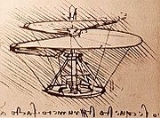
 book in China that described some of the ideas in a rotary wing aircraft. The first semi-practical idea of a human carrying helicopter was first conceived by Leonardo da Vinci Leonardo da Vinci

Leonardo di ser Piero da Vinci was a talented Italian Renaissance [i] Roman Catholic [i] ... 

 around 1490, but it was not until after the invention of the powered airplane in the 20th century 20th century

The 20th century started on 1 January [i] 1901 [i] and ended on 31 December [i] 2000 [i], according to t... 

 that actual helicopters were produced. Developers such as Jan Bahyl Ján Bahýl

... 

, Oszkár Asbóth, Louis Breguet, Paul Cornu, Emile Berliner Emile Berliner

Emile Berliner was an inventor [i], best known for developing the disc record [i] gramophone [i] ... 

, Ogneslav Kostovic Stepanovic Ogneslav Kostovic Stepanovic

... 

 and Igor Sikorsky Igor Sikorsky

[i]
... 

 pioneered this type of aircraft, with Juan de la Cierva Juan de la Cierva

Juan de la Cierva was a Spanish [i] aeronautical engineer [i] and pilot [i]. ... 

 introducing the first practical autogiro Autogyro

n autogyro is a type of rotary wing [i] aircraft [i] supported in flight by lift [i] ... 

 in 1923 that was to be the basis for the modern helicopter.

A flight of the first fully controllable helicopter was demonstrated by Raúl Pateras de Pescara 1916 in Buenos Aires Buenos Aires

|-
| [i] || AR-C
... 

, Argentina Argentina

Argentina is a country in southern South America [i]. ... 

. In 1931, Soviet aeronautical engineers Boris Yuriev and Alexei Cheremukhin began experiments with the TsAGI 1-EA helicopter, the earliest known single lifting rotor helicopter . It reached an altitude of 605 meters on August 14, 1932 with Cheremukhin at the controls.
The German Focke-Wulf FW-61 Focke-Wulf Fw 61

The Focke-Wulf Fw 61 was the first fully controllable helicopter [i]. ... 

 was the first production fully controllable helicopter and had its first flight in 1936. The FW-61 broke all worldrecords in 1937.
Nazi Nazism

National Socialism, commonly shortened to Nazism or Naziism, originated as a fascist [i] mo ... 

 Germany used the helicopter in combat during WWII World War II

World War II, or the Second World War, was a worldwide [i] conflict [i] fought betwe ... 

 in small numbers. Models such the Flettner FL 282 Kolibri Flettner Fl 282

The Flettner Fl 282 Kolibri is a single-seat open cockpit intermeshing-rotor helicopter [i], or synchropter [i]... 

 were used in the Mediterranean Sea Mediterranean Sea

The Mediterranean Sea is a part of the Atlantic Ocean [i] almost completely enclosed by land: on the nor... 

.

Mass production of the military version of the Sikorsky XR-4 began in May 1942 for the United States Army and was used over Burma Myanmar

Myanmar, officially the Union of Myanmar is the largest country in geographical area in mainland ... 

 for . It was also used by the Royal Air Force Royal Air Force

The Royal Air Force is the air force [i] branch of the British Armed Forces [i].... 

, the first British military unit to be equipped with helicopters being the Helicopter Training School, formed in January 1945 at RAF Andover RAF Andover

Andover [i] Airfield is a former Royal Flying Corps [i] and Royal Air Force [i] stati ... 

 with nine Sikorsky R-4 Sikorsky R-4

The Sikorsky [i] R-4 was the world's first production helicopter [i] and t ... 

B Hoverfly I helicopters.

The Bell 47 Bell 47

The Bell 47 was the first helicopter [i] to be certified for civil use, in May 1946. ... 

 designed by Arthur Young became the first helicopter to be licensed for certified civilian use in the United States United States

The United States of America, also known as the United States, the U.S., the U.S.A., a... 

. Two decades later the Bell 206 Bell 206

The Bell Model 206 "JetRanger" is one of the most successful helicopter [i] designs in the world. ... 

 became the most successful commercial helicopter ever built with more hours and has set more industry records than any other aircraft in the world.

Reliable helicopters capable of stable hover flight were developed decades after fixed wing aircraft. This is largely due to higher engine power density requirements when compared with fixed wing aircraft. Igor Sikorsky is reported to have delayed his own helicopter research until suitable engines were commercially available. Improvements in fuels and engines during the first half of the 20th century 20th century

The 20th century started on 1 January [i] 1901 [i] and ended on 31 December [i] 2000 [i], according to t... 

 were a critical factor in helicopter development. The availability of lightweight turboshaft Turboshaft

A Turboshaft engine is a form of gas turbine [i] which is optimized to produce shaft power, rather than ... 

 engines in the second half of the 20th century led to the development of larger, faster, and higher performance helicopters. Turboshaft engines are the preferred powerplant for all but the smallest and least expensive helicopters today.

Generating lift


In conventional aircraft, the wing profile is designed to deflect air efficiently downward. This downward deflection causes an opposite lifting force on the wing and a lower pressure on the upper surface, higher pressure on the lower surface. This pressure difference integrated over the airfoil area causes a net lift. However, the more the lift of the airfoil, the more drag that is caused . A helicopter makes use of the same principle, except that instead of moving the entire aircraft, only the wings themselves are moved in a circular motion. The helicopter's rotor can simply be regarded as rotating wings, from where the military name of "rotary wing aircraft" originates.

Conventional layout

There are several possible layouts for arranging a helicopter's rotors. The most common design is the Sikorsky-layout, which is used by approximately 95% of all helicopters manufactured. Turning the rotor generates lift but it also applies a reverse torque Torque

In physics [i], torque can informally be thought of as "rotational force". ... 

 to the vehicle, which would spin the helicopter fuselage in the opposite direction to the rotor if no counter-acting force was applied. At low speeds, the most common way to counteract this torque is to have a smaller vertical propeller mounted at the rear of the aircraft called a tail rotor. This rotor creates thrust which is in the opposite direction from the torque generated by the main rotor. When the thrust from the tail rotor is sufficient to cancel out the torque from the main rotor, the helicopter will not rotate around the main rotor shaft.

The world's largest and smallest series-produced helicopters follow this Sikorsky layout. The Mil Mi-26 Mil Mi-26

The Mil [i] Mi-26 is a Russia [i]n/Soviet [i] heavy transport [i] ... 

 can lift 27 metric tons, the Robinson R22 has a crew of two and a gross weight of 1300 lb . Almost all civilian helicopters have the main rotor and tail rotor system.

Sometimes the blades of a tail rotor are not separated by the same angle, but laid out in an X-shape, which is supposed to reduce the noise levels for military use . The primary reason is to make the arrangement of the pitch controls simpler. If the tail rotor is shrouded it is called a fenestron Fenestron

A Fenestron is a totally enclosed tail rotor [i] of a helicopter [i] that has a tail rotor configuration [i] ... 

. The fenestron rotor system on the model EC120 helicopter uses a shaft driven system and gearbox to turn the fan. It is less efficient but the advantages are that less noise is generated, it is safer for people that may walk near it and there is less chance of the blades being damaged by objects because it is shrouded, unlike the traditional tail rotor.

The amount of power required to prevent a helicopter from spinning is significant. A tail rotor typically uses about 5 to 6% of the engine's power, and this power does not help the helicopter produce lift or forward motion. To reduce this waste during cruise, the vertical stabilizer is often angled to produce a force which helps counter the main rotor torque. At high speeds, it is possible for the vertical stabilizer to counteract the entire torque, leaving more power available for forward flight. This is commonly known as slip-streaming and can make hovering turns difficult on windy days. Another reason for the angled vertical stabilizer is to make it possible to stage a successful high-speed, run-on landing, in case of the tail rotor failure or damage.

Many military helicopters, especially attack types Attack helicopter

An attack helicopter is a military helicopter [i] armed for attacking targets on the ground, using automatic cannon [i]... 

, have short wings called stub wings to add lift during forward motion. They are also used as external mounts for weapons. In extreme cases, such as that of the Mil Mi-24 Mil Mi-24

The Mil [i] Mi-24 is a large combat helicopter gunship [i] and low-capacity ... 

, the wings are large enough to obstruct airflow down from the rotors, making the helicopter all but unable to hover.

Alternative layouts


There are alternatives to Sikorsky's layout, which save the weight of a tail boom and rotor. Such designs use two main rotors which turn in opposite directions, or contra-rotate Contra-rotating propellers

Contra-rotating propellers, also referred to as coaxial contrarotating propellers, are a complex way... 

, so that the torques from each rotor cancel each other out. These methods introduce even more mechanical complexity to the design and are usually relegated to specialized helicopter types.

The co-axial Coaxial rotor

Preamble
In the field of helicopter [i] design, there are three principal arrangements of the rotor blades, na ... 

 design, where rotors are mounted on top of each other at the top of the fuselage and share a common main axle complex, was first built by Theodore von Karman Theodore von Karman

Theodore von Krmn was a Hungarian [i]-American [i] engineer [i] and physicist [i]... 

 and Asbóth Oszkár in 1918 and later became the hallmark of soviet Kamov Kamov

Nikolai Il'yich Kamov [i] started building his first rotor-winged aircraft in 1929, together with N. K. Skrzhinskii [i] ... 

 design bureau . Co-axial helicopters in flight are highly resistant to side-winds, which makes them suitable for shipboard use, even without a rope-pulley landing system. Another example is the Kamov Ka-26 Kamov Ka-26

The Kamov [i] Ka-26 is a Soviet light utility helicopter with co-axial rotors.
... 

, a successful crop duster Agricultural aircraft

-
||-
||}
An agricultural aircraft is an aircraft [i] that has been built or converted for agricultural [i] ... 

 aircraft. See Coaxial rotor Coaxial rotor

Preamble
In the field of helicopter [i] design, there are three principal arrangements of the rotor blades, na ... 

.

The slightly different system of intermeshing rotors, also called a synchropter, which was developed in Nazi Germany Germany

Germany , officially the Federal Republic of Germany , is a country [i] in central Europe [i]. ... 

 for a small anti-submarine warfare Anti-submarine warfare

If you were searching for A/S, you might have meant aksjeselskap [i], a Norwegian stock company form.' ... 

 helicopter, the Flettner Fl 282 Kolibri Flettner Fl 282

The Flettner Fl 282 Kolibri is a single-seat open cockpit intermeshing-rotor helicopter [i], or synchropter [i]... 

, features two main rotors on separate, obliquely mounted axles. The counter-rotating rotors are on top of the fuselage, close to each other. During the Cold War Cold War

The Cold War was the protracted geopolitical [i], ideological [i], and economic [i]... 

 the American Kaman company started to produce similar helicopters for USAF United States Air Force

The United States Air Force is the aerospace [i] branch of the United States armed forces [i] and one o ... 

 firefighting purposes. Kamans have high stability and powerful lifting capability. The latest Kaman K-Max model is a dedicated sky crane design, used for construction works.

In the flying-wagon or tandem rotor system , the two main rotors are located at the front and rear extremity of a long, boxy fuselage that resembles a railway wagon. A prime example is the Boeing Boeing

The Boeing Company is an aerospace and defense corporation headquartered in Chicago [i], Illinois [i].... 

 CH-47 Chinook CH-47 Chinook

The Boeing CH-47 Chinook is a versatile, twin-engine, tandem rotor [i] heavy-lift helicopter [i]. ... 

, that can carry 14 tons of payload Payload

In cargo transport, the payload is the valuable contents of the vehicle.
... 

. Wagon Wagon

A wagon or dray is a wheeled vehicle, ordinarily with four wheels, usually pulled by an animal, or... 

 helicopters are practical for military logistical Logistics

Logistics is the art and science of managing and controlling the flow of goods, energy, information and ... 

 purposes, because entry and unloading is easy via the unobstructed front and rear ramps. The rotors and turbines are located very high on top of the fuselage, making them less sensitive to damage and dirt. The main drawback of a tandem rotor is limited agility in air and the need for a highly trained crew, as the large main rotors have long outreach beyond the fuselage and may easily hit nearby obstacles. In 2001, a South Korea South Korea

South Korea, officially the Republic of Korea, is an East Asia [i]n state [i] on the southern half ... 

n Army CH-47 Chinook crashed into a bridge for that reason while being shown live on TV.

A helicopter built by Juan de la Cierva Juan de la Cierva

Juan de la Cierva was a Spanish [i] aeronautical engineer [i] and pilot [i]. ... 

 had three main rotors. These were placed at the corners of an equilateral triangle Triangle

A triangle is one of the basic shape [i]s of geometry [i]: a polygon [i] with three vertices [i] ... 

 and all turned the same direction.

In the cross system, the rotary wing aircraft resembles a traditional fixed-wing airplane, with the two main rotors mounted at the extremities of its wings. Such helicopters are rare, because structural integrity of the wings is difficult to maintain against the amplified resonance of far off-board rotor-turbine units. The 1930s 1930s

... 

 German FW-61 Focke-Wulf Fw 61

The Focke-Wulf Fw 61 was the first fully controllable helicopter [i]. ... 

 helicopter was built to such design. The world's largest ever helicopter, the Soviet Mil-V-12 Mil Mi-12

The Soviet made Mil [i] Mi-12 is the largest helicopter ever built.
... 

 prototype, was a cross of two Mil Mi-6 Mil Mi-6

The Mil Mi-6 was a Soviet heavy transport helicopter first flown in July 1957 [i] and b ... 

 turbine-rotor units built onto a modified Antonov cargo plane. The U.S. V-22 Osprey V-22 Osprey

The V-22 Osprey is a joint service [i], multi-mission military aircraft [i] with vertical take-off and landing [i]... 

 tilting rotorcraft is similar, although its nacelles can be rotated, and shares some of the inherent technical problems of a cross system.


A recent development in helicopter technology is the NOTAR NOTAR

NOTAR, an acronym for no tail rotor, is a helicopter stabilization process developed by McDonnell Douglas [i] ... 

 system, which stands for NO TAil Rotor. The NOTAR eliminates the tail rotor by conducting high-velocity air through the tail boom, using the Coanda effect Coanda effect

The Coanda effect, also known as "boundary layer [i] attachment", is the tendency of a stream of fluid [i] ... 

 to produce forces to counter the torque. NOTARs adjust thrust by opening and closing a sliding circular cover near the end of the tail boom. The NOTAR system was developed in the United States and is used exclusively by McDonnell Douglas Helicopters.

The most unusual design is the roto-rocket principle, where the single main rotor draws power not from the shaft, but from its own wingtip jet nozzles, which are either pressurized from a fuselage-mounted gas turbine or have their own pulsejet Pulse jet engine

A pulse jet engine is a very simple form of internal combustion engine [i] wherein the combustion occurs... 

 combustion chambers. Although this method is simple and eliminates precession, development of such helicopters ceased because their extreme noise levels preclude both military and civilian use.

Controlling flight


Useful flight requires that an aircraft be controlled in all three dimensions . In a fixed-wing aircraft, this is easy: small movable surfaces are adjusted to change the aircraft's shape so that the air rushing past pushes it in the desired direction. In a helicopter, however, there is often not enough speed for this method to be practical.


For pitch or roll the angle of attack Angle of attack

Angle of attack is a term used in aerodynamics [i] to describe the angle [i] between the airfoil's chord line [i] ... 

 of the main rotor blades is altered or cycled during the rotation creating a differential of lift at different points of the rotary wing. More lift at the rear of the rotary wing will cause the aircraft to pitch forward, an increase on the left will cause a roll to the right and so on. This is also how the helicopter is manouvred, ie. pitching forward causes forward flight..

For rotation about the vertical axis the anti-torque system is used. Varying the pitch of the tail rotor alters the sideways thrust produced. Yaw controls are usually operated with anti-torque pedals, on the floor in the same place as a fixed-wing aircraft's rudder pedals.

Helicopters maneuver with three flight controls besides the pedals. The collective pitch control lever controls the collective pitch, or angle of attack, of the helicopter blades altogether, that is, equally throughout the 360 degree plane-of-rotation of the main rotor system. When the angle of attack is increased, the blade produces more lift. The collective control is usually a lever at the pilot's left side. Simultaneously increasing the collective and adding power with the throttle causes a helicopter to rise.

Dual rotor helicopters follow the same principles, but differentiate in the following ways:

  • Tandem rotor designs achieve yaw by applying opposite left and right cyclic to each rotor, effectively rolling both ends of the helicopter in opposite directions. To achieve pitch, opposite collective is applied to each rotor; decreasing the lift produced at one end, while increasing lift at the opposite end, effectively tilting the helicopter forward or back.
  • Synchropters use a similar system to tandem rotor helicopters, but as the two rotors are side by side, they use opposite pitch for yaw, and opposite collective for roll.
  • Co-axial Coaxial rotor

    Preamble

In the field of helicopter [i] design, there are three principal arrangements of the rotor blades, na ... 

 designs achieve yaw by applying opposite collective to each rotor. This increases drag, and therefore torque, in one rotor, while decreasing the drag in the other. Since the rotors spin in opposite directions, the torque difference causes the helicopter to rotate.


The throttle controls the absolute power produced by the engine that is connected to the rotor by a transmission. The throttle control is a twist grip on the collective control. RPM control is critical to proper operation for several reasons. Helicopter rotors are designed to operate at a specific RPM. However, for each weight and speed there would be an ideal RPM . In practice, a single RPM is used in order to minimize resonance design requirements and add a safety margin to rotor stall RPM. Usually only in autorotation are different RPMs used to increase rotor efficiency, which can be crucial in the case of an emergency without engine power.

If the RPM becomes too low, the rotor blades stall. This suddenly increases drag and slows the rotor down further. The centrifugal forces are then not able to straighten the rotor blades any more, excessive coning develops and a catastrophic accident is certain.

If the RPM is too high, damage to the main rotor hub, power transmission and engine from excessive forces could result. In general, RPM must be maintained within a tight tolerance, usually a few percent. In many piston Piston

In general, a piston is a sliding plug [i] that fits closely inside the bore [i] of a cylinder [i]... 

-powered helicopters, the pilot must manage the engine and rotor RPM. The pilot manipulates the throttle to maintain rotor RPM and therefore regulates the effect of drag on the rotor system. Turbine engined helicopters, and some piston helicopters, use servo Servomechanism

A servomechanism, usually shortened to servo, is a device used to provide mechanical control at a ... 

-feedback loop in their engine controls to maintain rotor RPM and relieves the pilot of routine responsibility for that task.

The cyclic changes the pitch of the blades cyclically, causing the lift to vary across the plane of the rotor disk. This variation in lift causes the rotor disk to tilt and the helicopter to move during hover flight or change attitude in forward flight. The cyclic is similar to a joystick and is usually positioned in front of the pilot. The cyclic controls the angle of the stationary section of the swashplate, which in turn controls the angle of the rotating section of the swashplate. The rotating section rotates with the rotor and is connected to blade pitch horns through pitch links, one link for each blade. When the swashplate is not tilted, the blades are all at the collective angle. When it is tilted, the links give a pitch-up at some azimuthal angle and a pitch-down at the opposite angle, hence creating a sinusoidal Sine wave

[i], [[signal processing]... 

 variation in blade angle of attack Angle of attack

Angle of attack is a term used in aerodynamics [i] to describe the angle [i] between the airfoil's chord line [i] ... 

. This causes the helicopter to tilt in the same direction as the cyclic. If the pilot pushes the cyclic forward, then the rotor disc tilts forward, and the rotor produces a thrust in the forward direction.


As a helicopter moves forward, the rotor blades on one side move at rotor tip speed plus the aircraft speed and is called the advancing blade. As the blade swings to the other side of the helicopter, it moves at rotor tip speed minus aircraft speed and is called the retreating blade. To compensate for the added lift on the advancing blade and the decreased lift on the retreating blade, the angle of attack of the blades is regulated as the blade spins around the helicopter. The angle of attack is increased on the retreating blade to produce more lift, compensating for the slower airspeed over the blade. And the angle of attack is decreased on the advancing blade to produce less lift, compensating for the faster airspeed over the blade.

If the angle of attack Angle of attack

Angle of attack is a term used in aerodynamics [i] to describe the angle [i] between the airfoil's chord line [i] ... 

 of any wing, including rotor blades, is too high, the airflow above the wing separates causing instant loss of lift and increase in drag. This condition is called aerodynamic stall Stall

A stall is the slowing or stopping of a process.... 

. On a helicopter, this can happen in any of four ways.
  1. As helicopter speed increases, airflow over the advancing blades approaches the speed of sound and generates shock waves that disrupt the airflow over the blade causing loss of lift.
  2. As helicopter speeds increase, the retreating blade experiences lower relative airspeeds and the controls compensate with higher angle of attack. With a low enough relative airspeed and a high enough angle of attack, aerodynamic stall is inevitable. This is called retreating blade stall. See dissymetry of lift Dissymetry of Lift

    Dissymetry of Lift is a phenomenon that affects single-rotor [i] helicopters [i] ... 

    for a fuller treatment of cases 1 and 2 together in a single analysis.
  3. Any low rotor RPM flight condition accompanied by increasing collective pitch application will cause aerodynamic stall.
  4. Unique to helicopters is the vortex ring state which is when a helicopter in a hover or descent comes into contact with its own down wash causing immense turbulence and loss of lift.


Helicopters are powered aircraft but they can still fly without power by using the momentum in the rotors and using downward motion to force air through the rotors. The main rotor acts like a "windmill" and turns. This technique is known as autorotation. A transmission connects the main rotor to the tail rotor so that all flight controls are available after engine failure. Autorotation can allow a pilot to make an emergency landing if the engine failure occurs while the helicopter is traveling high enough or fast enough. .

Stability

Fixed wing aircraft are usually inherently stable. If a gust of wind or a nudge to one of the controls causes a fixed wing aircraft to pitch, roll, or yaw, the aerodynamic design of the aircraft will tend to correct the motion, and the aircraft will return to its original attitude. Many small, fixed wing aircraft are stable enough that a pilot can let go of the controls while looking at a map or dealing with a radio, and the plane will generally stay on course.


In contrast, helicopters are very unstable. Simply hovering requires continuous, active corrections from the pilot. When a hovering helicopter is nudged in one direction by a gust of wind, it will tend to continue in that direction, and the pilot must adjust the cyclic to correct the motion. Hovering a helicopter has been compared to balancing yourself while standing on a large beach ball.

Adjusting one flight control on a helicopter almost always has an effect that requires an adjustment of the other controls. Moving the cyclic forward causes the helicopter to move forward, but will also cause a reduction in lift, which will require extra collective for more lift. Increasing collective will reduce rotor RPM, requiring an increase in throttle to maintain constant rotor RPM. Changing collective will also cause a change in torque, which will require the pilot to adjust the foot pedals.

Small helicopters can be so unstable that it may be impossible for the pilot to ever let go of the cyclic while in flight. While fixed-wing aircraft are generally designed so pilots sit on the left side of the aircraft, freeing up their right hand for dealing with radios, engine controls, and the like, helicopters are generally designed so pilots sit on the right side of the aircraft so they can keep their right hand on the cyclic at all times, leaving the radios and engine controls for their left hand .

Limitations

The single most obvious limitation of the helicopter is its slow speed. There are several reasons why a helicopter cannot fly as fast as a fixed wing aircraft.

  • When the helicopter is at rest, the outer tips of the rotor travel at a speed determined by the length of the blade and the RPM. In a moving helicopter, however, the speed of the blades relative to the air depends on the speed of the helicopter as well as on their rotational velocity. The airspeed of the forward-going rotor blade is much higher than that of the helicopter itself. It is possible for this blade to exceed the speed of sound, and thus produce vastly increased drag and vibration. It is theoretically possible to have spiralling rotors, similar in principle to variable-pitch swept wings, which could exceed the speed of sound, but no presently known materials are light enough, strong enough, and flexible enough to construct them.
  • Most rotors are not rigid. Because the advancing blade has higher airspeed than the retreating blade, a perfectly rigid blade would generate more lift on that side and tip the aircraft over. In consequence, rotor blades are designed to "flap" - lift and twist in such a way that the advancing blade flaps up and develops a smaller angle of attack, thus producing less lift than a rigid blade would. Conversely, the retreating blade flaps down, develops a higher angle of attack, and generates more lift. At high speeds, the force on the rotors is such that they "flap" excessively and the retreating blade can reach too high an angle and stall. In some designs the hub is rigid. The blades are made from composites which can bend without breaking. Fully rigid rotors exist and create very responsive helicopters. In most such designs, the lift is varied cyclically and according to the speed of the helicopter. The adjustment is either by adjusting the angle of attack of the blades, or by engine-powered vacuum devices that suck air into the blades, adjusting the lift.


  • Rotorhead design is a limiting factor on many helicopters. Low or negative-G situations encountered in a semi-rigid system will result in blade flapping down until it hits the tail boom or other airframe structure, followed by rotor separation, causing a crash.


  • Helicopters are susceptible to potentially disastrous vortex ring Vortex ring

    A vortex ring, also called a toroidal vortex or Hill's vortex, is a region of rotating fluid [i] ... 

     effects. In these, the downward wind from the rotor causes a circular vortex to form around the rotor. If this ring is augmented by terrain, wind, rain, or sea spray, the helicopter can lose enough lift to experience settling with power and hit the ground.


During the closing years of the 20th century 20th century

The 20th century started on 1 January [i] 1901 [i] and ended on 31 December [i] 2000 [i], according to t... 

 designers began working on helicopter noise reduction Helicopter noise reduction

Helicopter noise reduction is a topic of research into designing helicopter [i]s which can be operated m ... 

. Urban communities have often expressed great dislike of noisy aircraft, and police and passenger helicopters can be unpopular. The redesigns followed the closure of some city heliports and government action to constrain flight paths in national parks National park

A national park is a reserve of land, usually declared and owned by a national government [i], protected ... 

 and other places of natural beauty.

Helicopters vibrate. An unadjusted helicopter can easily vibrate so much that it will shake itself apart. To reduce vibration, all helicopters have rotor adjustments for height and pitch. Most also have vibration dampers for height and pitch. Some also use mechanical feedback systems to sense and counter vibration. Usually the feedback system uses a mass as a "stable reference" and a linkage from the mass operates a flap to adjust the rotor's angle of attack Angle of attack

Angle of attack is a term used in aerodynamics [i] to describe the angle [i] between the airfoil's chord line [i] ... 

 to counter the vibration. Adjustment is difficult in part because measurement of the vibration is hard. The most common adjustment measurement system is to use a stroboscopic flash lamp, and observe painted markings or coloured reflectors on the underside of the rotor blades. The traditional low-tech system is to mount coloured chalk on the rotor tips, and see how they mark a linen sheet.

Landing


On a ship

A helicopter deck is a helicopter pad on the deck of a ship, usually located on the stern Stern

The stern is the rear or after part of a ship [i] or boat [i], technically defined as the area built up ... 

 and always clear of obstacles that would prove hazardous to a helicopter landing. In the U.S. Navy United States Navy

The United States Navy is the branch of the United States armed forces [i] responsible for conducting naval [i] ... 

 it is commonly and properly referred to as the flight deck Flight deck

The flight deck of an aircraft carrier [i] is the surface from which its aircraft [i] take off and land, ... 

. In the Royal Navy Fleet Air Arm

----
The Fleet Air Arm is the operational group of the Royal Navy [i] responsible for the operation of t ... 

, landing on is usually achieved by lining up slightly astern and on the port quarter, as the ship steams into the wind and the aircraft captain slides across and over the deck.

Shipboard landing for some helicopters is assisted though use of a haul-down device that involves attachment of a cable to a probe on the bottom of the aircraft prior to landing. Tension is maintained on the cable as the helicopter descends, assisting the pilot with accurate positioning of the aircraft on the deck; once on deck locking beams close on the probe, locking the aircraft to the flight deck. This device was pioneered by the Royal Canadian Navy Royal Canadian Navy

The Royal Canadian Navy was the navy [i] of Canada [i] from 1911 [i] until 1968 [i] when the three Canad ... 

 and was called "Beartrap". The U.S. Navy implementation of this device, based on Beartrap, is called the "RAST" system and is an integral part of the LAMPS MK III weapons system.

A secondary purpose of the haul-down device is to equalize electrostatic potential between the helicopter and ship. The whirling rotor blades of a helicopter can cause large charges to build up on the airframe, large enough to cause injury to shipboard personnel should they touch any part of the helicopter as it approaches the deck. Coaxial rotor Coaxial rotor

Preamble
In the field of helicopter [i] design, there are three principal arrangements of the rotor blades, na ... 

 helicopters in flight are highly resistant to side-winds, which makes them suitable for shipboard use, even without a rope-pulley landing system.

Hazards of helicopter flight


As with any moving vehicle, operation outside of safe regimes could result in loss of control, structural damage, or fatality. For helicopters the hazards are particularly acute since they are flying at relatively low altitude, with little time to react to a sudden event. The following is a list of some of the potential hazards for "conventional" helicopters:

  • Settling with power
  • Retreating blade stall
  • Ground resonance
  • Low-G condition
  • Operating within the shaded area of the height-velocity diagram Height-velocity diagram

    The Height-Velocity diagram or H/V curve is a graph charting the safe/unsafe flight profiles relev... 

  • Vortex ring Vortex ring

    A vortex ring, also called a toroidal vortex or Hill's vortex, is a region of rotating fluid [i] ... 

     state, a problem the V-22 Osprey V-22 Osprey

    The V-22 Osprey is a joint service [i], multi-mission military aircraft [i] with vertical take-off and landing [i]... 

     was associated with.


Reduction & Elimination of Common Helicopter Flight Hazards

The U.S. Department of Transportation has published a “Basic Helicopter Handbook”. One of the chapters in it is titled, “Some Hazards of Helicopter Flight'. Ten items of hazards have been listed to indicate that a typical single rotor helicopter has to deal with. The unique Coaxial rotor Coaxial rotor

Preamble
In the field of helicopter [i] design, there are three principal arrangements of the rotor blades, na ... 

 design either reduces or completely eliminates these hazards. The following list indicates which:

1. Settling with power - Reduced

2. Retreating blade stall - Eliminated

3. Ground resonance - Eliminated

4. Low-frequency vibrations - None

5. Medium frequency vibrations - None

6. High frequency vibrations - None

7. Transition from powered flight to autorotation - Eliminated

8. Anti torque system failure in forward flight - Eliminated

9. Anti torque system failure while hovering - Eliminated

10. Height-Velocity Curve - Eliminated

The reduction and elimination of these hazards are the strong points for the Coaxial rotor Coaxial rotor

Preamble
In the field of helicopter [i] design, there are three principal arrangements of the rotor blades, na ... 

 safety design.

SEE * + *

Helicopter models and identification


In identifying helicopters during flight it is helpful to know that when viewed from below, the rotor of a French, Russian, or Soviet designed helicopter rotates counter-clockwise, whilst that of a helicopter built in Italy Italy

Italy, officially the Italian Republic , is a Southern European [i] country. ... 

, the UK United Kingdom

The United Kingdom of Great Britain and Northern Ireland is a country and sovereign state [i] tha ... 

 or the USA United States

The United States of America, also known as the United States, the U.S., the U.S.A., a... 

 rotates clockwise.

Some companies, notably Schweizer Aircraft Corporation Schweizer Aircraft

The Schweizer Aircraft Corporation, located in Horseheads, New York [i], was incorporated [i] ... 

 in the USA, are developing remotely-controlled variants of light helicopters for use in future battlefields. is currently selling a line of small rotorcraft UAVs Unmanned aerial vehicle

An unmanned aerial vehicle is one of the latest generation of pilotless aircraft, used for both attack ... 

, including an all electric helicopter.

Hybrid types that combine features of helicopters and fixed wing designs include the experimental Fairey Rotodyne Fairey Rotodyne

The Fairey [i] Rotodyne was a compound autogyro [i] or gyrodyne [i]. ... 

 of the 1950s 1950s

The 1950s was the decade spanning the years 1950 to 1959.... 

 and the Bell Boeing Osprey V-22 Osprey

The V-22 Osprey is a joint service [i], multi-mission military aircraft [i] with vertical take-off and landing [i]... 

, which is on order by the U.S. Marine Corps United States Marine Corps

The United States Marine Corps is a branch of the U.S. military [i], respons ... 

 and will be the first mass produced tilt-rotor Tiltrotor

A tiltrotor aircraft [i] combines the vertical lift capability of a helicopter [i] with the speed of a turboprop [i] ... 

 aircraft to enter service.

A helicopter should not be mistaken for an autogyro Autogyro

n autogyro is a type of rotary wing [i] aircraft [i] supported in flight by lift [i] ... 

, which is a predecessor of the helicopter, that gains lift from an unpowered rotor.

Some common nicknames for helicopters are "copter", "chopper", "whirlybird", "windmill", "helo" or "paraffin Budgie" .

Helicopters are useful for landing in tight spaces.

Many companies have helicopters for transport.

See also


In the field of helicopter [i] design, there are three principal arrangements of the rotor blades, na ... 


  • Helicopter rotor Helicopter rotor

    A rotor is the rotating part of a helicopter [i] which generates lift [i], either vertically in the ... 

  • Helicopter pilotage
  • Helicopter flight controls
  • Helicopter noise reduction Helicopter noise reduction

    Helicopter noise reduction is a topic of research into designing helicopter [i]s which can be operated m ... 

  • Autorotation
  • Aeronautical engineering
  • Transverse Flow Effect
  • Attack Helicopter Attack helicopter

    An attack helicopter is a military helicopter [i] armed for attacking targets on the ground, using automatic cannon [i]... 

  • Harold E. Thompson Harold E. Thompson

    Harold E. "Tommy" Thompson of Hobart, Indiana [i], was a helicopter [i] aviation pioneer. ... 

  • Gyrocopter Autogyro

    n autogyro is a type of rotary wing [i] aircraft [i] supported in flight by lift [i] ... 


References

  • Thicknesse P, Jones A et al, Military Rotorcraft, 2nd edition, 2000, Brassey's World Military Technology series, Shirvenham UK, xvi + 160pp, ISBN 1857533259
  • Wragg D, Helicopters at War: A pictorial history, 1983, Robert Hale Ltd, London UK, 283pp, ISBN 0709008589

External links

: "Aircraft, especially aircraft of the direct lift amphibian type and means of construction and operating the same"


Categories: