

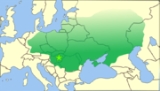
Huns

Overview
Volga River
The Volga is the largest river in Europe in terms of length, discharge, and watershed. It flows through central Russia, and is widely viewed as the national river of Russia. Out of the twenty largest cities of Russia, eleven, including the capital Moscow, are situated in the Volga's drainage...
, migrated into Europe
Europe
Europe is, by convention, one of the world's seven continents. Comprising the westernmost peninsula of Eurasia, Europe is generally 'divided' from Asia to its east by the watershed divides of the Ural and Caucasus Mountains, the Ural River, the Caspian and Black Seas, and the waterways connecting...
c. AD 370 and established the vast Hunnic Empire
Hunnic Empire
The Hunnic Empire was an empire established by the Huns. The Huns were a confederation of Eurasian tribes from the steppes of Central Asia. Appearing from beyond the Volga River some years after the middle of the 4th century, they first overran the Alani, who occupied the plains between the Volga...
there. Since de Guignes
Joseph de Guignes
Joseph de Guignes , French orientalist and sinologist, was born at Pontoise, the son of Jean Louis de Guignes and Françoise Vaillant. He died in Paris....
linked them with the Xiongnu
Xiongnu
The Xiongnu were ancient nomadic-based people that formed a state or confederation north of the agriculture-based empire of the Han Dynasty. Most of the information on the Xiongnu comes from Chinese sources...
, who had been northern neighbours
History of the Han Dynasty
The Han Dynasty , founded by the peasant rebel leader Liu Bang ,From the Shang to the Sui dynasties, Chinese rulers were referred to in later records by their posthumous names, while emperors of the Tang to Yuan dynasties were referred to by their temple names, and emperors of the Ming and Qing...
of China
China
Chinese civilization may refer to:* China for more general discussion of the country.* Chinese culture* Greater China, the transnational community of ethnic Chinese.* History of China* Sinosphere, the area historically affected by Chinese culture...
300 years prior to the emergence of the Huns, considerable scholarly effort has been devoted to investigating such a connection. However, there is no scholarly consensus on a direct connection between the dominant element of the Xiongnu and that of the Huns.