


Lysander

Encyclopedia
Lysander was a Sparta
n general who commanded the Spartan fleet in the Hellespont which defeated the Athenians at Aegospotami
in 405 BC. The following year, he was able to force the Athenians to capitulate, bringing the Peloponnesian War
to an end; he organized the dominion of Sparta over Greece in the last decade of his life.
; that is, like most Dorian
men of good family, he claimed descent from Heracles
. Nevertheless, Lysander was a mothax
: his family was poor and when he was young he needed sponsorship to be able to participate in the Spartan training to be a soldier.
His mother was a helot slave. He was a slave most of his life until he was found by his Grandfather the ephor Sarpedon. He went into the same barracks as (soon to be king)Leonidas.
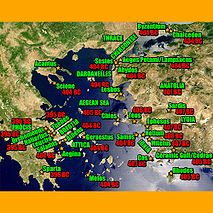 Lysander was appointed Spartan navarch
(admiral) for the Aegean Sea
in 407 BC. It was during this period that he gained the friendship and support of Cyrus the Younger
, a son of Darius II of Persia
and Parysatis
.
Lysander then undertook the major project of creating a strong Spartan fleet based at Ephesus
which could take on the Athenians and their allies.
Alcibiades
was appointed commander-in-chief with autocratic powers and left for Samos
to rejoin his fleet and try and engage Lysander in battle. The Spartan navarch Lysander refused to be lured out of Ephesus to do battle with Alcibiades. However, while Alcibiades was away seeking supplies, the Athenian squadron was placed under the command of Antiochus, his helmsman. During this time Lysander managed to engage the Athenian fleet and they were routed by the Spartan fleet (with the help of the Persians under Cyrus) at the Battle of Notium in 406 BC. This defeat by Lysander gave the enemies of Alcibiades the excuse they needed to strip him of his command. He never returned again to Athens. He sailed north to the land he owned in the Thracian Chersonese
.
. Callicratidas' ability to continue the war at sea was neatly sabotaged when Lysander returned all the cash in hand to Cyrus when he left office
In 406 BC, Callicratidas assembled a fleet and sailed to Methymna
, Lesbos
, which he then besieged. This move threatened the Athenian grain supply. Athens sent their admiral, Conon
, to relieve the siege. When Callicratidas attacked him, Conon retreated to Mytilene
, where he was blockaded by Callicratidas’ Spartan fleet.
To relieve Conon, the Athenians assembled a new fleet composed largely of newly constructed ships manned by inexperienced crews. While this fleet was inferior to the Spartans, the Athenians employed new and unorthodox tactics, which allowed them to secure a dramatic and unexpected victory in the Battle of Arginusae
, near Lesbos. The blockade of Conon by the Spartans was broken, the Spartan force was soundly defeated and Callicratidas was killed during the battle.
and with the death of the Spartan navarch, Callicratides, Sparta's allies sought to have Lysander reappointed as navarch. However, Spartan law did not allow the reappointment of a previous navarch, so Aracus was appointed as navarch with Lysander as his deputy. Nonetheless, Lysander was effectively the commander of the Spartan fleet. Cyrus, being especially pleased, once again started to supply the Spartan fleet with cash - even allowing Lysander to run his satrapy in his absence.
Once back in command, Lysander directed the Spartan fleet towards the Hellespont. The Athenian fleet followed him there. In 404 BC, the Athenians gather their remaining ships at Aegospotami
(near the Thracian Chersonese
). The Athenian fleet under Admiral Conon was then destroyed by the Spartans under Lysander in the Battle of Aegospotami
. Conon withdrew to Cyprus
.
Then, Lysander's forces went to the Bosporus
and captured both Byzantium
and Chalcedon
. They expelled the Athenians living in those States. Lysander also captured Lesbos Island
.
, laid siege to Athens while Lysander's fleet blockaded the port city of Piraeus
. This action effectively closed the grain route to Athens through the Hellespont, thereby starving Athens. Realising the seriousness of the situation, Theramenes
started negotiations with Lysander. These negotiations took three months, but in the end Lysander agreed to terms at Piraeus. An agreement was reached for the capitulation of Athens and the cessation of the Peloponnesian War in 404 BC.
The Spartans required the Athenians to raze the walls of Piraeus as well as the Long Walls
which connected Athens and Piraeus; that the Athenians should abandon their colonies, and that Athens should surrender all but twelve of their ships to the Spartans. However, Theramenes did secure terms that saved the city of Athens from destruction. Greek towns across the Aegean Sea
in Ionia
were again to be subject to the Achaemenid Empire
.
of the Thirty Tyrants
under Critias
which included Theramenes as a leading member. The puppet government executed a number of citizens and deprived all but a few of their former rights as citizens of Athens. Many of Athens' former allies were now ruled by boards of ten (decarchy), often reinforced with garrisons under a Spartan commander (harmost). The practice started the period of Spartan hegemony
.
After storming and seizing Samos
, Lysander returned to Sparta. Alcibiades, the former Athenian leader, emerged after the Spartan victory at Aegospotami and took refuge in Phrygia
, northwestern Asia Minor
with Pharnabazus, its Persian satrap
. He sought Persian assistance for the Athenians. However, the Spartans decided that Alcibiades must be removed and Lysander, with the help of Pharnabazus, arranged the assassination of Alcibiades.
Lysander was able to gain a huge fortune from his victories against the Athenians and their allies. Nonetheless, in accord with Spartan tradition, he wished to transfer this fortune to the ephor
s at Sparta. Lysander commanded the Spartan general Gylippus to undertake this task. However, Gylippus could not resist the temptation to enrich himself and stole a significant amount. When it was discovered what had happened, Gylippus went into exile and was condemned to death in his absence.
, who had been exiled from Athens by the Spartans' puppet government, led the democratic resistance to the new oligarchic government. In 403 BC, he commanded a small force of exiles that invaded Attica
and, in successive battles, defeated first a Spartan garrison and then the forces of the oligarchic government (which included the Spartan general, Lysander) in the Battle of Munychia
. The leader of the Thirty Tyrants, Critias, was killed in the battle.
The Battle of Piraeus was then fought between Athenian exiles who had defeated the government of the Thirty Tyrants and occupied Piraeus and a Spartan force sent to combat them. In the battle, the Spartans narrowly defeated the exiles, with both sides suffering large numbers of casualties. Despite opposition from Lysander, after the battle Pausanias the Agiad King of Sparta
, arranged a settlement between the two parties which allowed the reunification of Athens and Piraeus, and the re-establishment of democratic government in Athens. The remaining oligarchic Thirty Tyrants were allowed to flee to Eleusis
. Thrasybulus restored democratic institutions to Athens and granted amnesties to all except the oligarchic extremists.
. He was also able to persuade the Spartans to support Cyrus the Younger in his unsuccessful rebellion against his older brother, Artaxerxes II of Persia
.
Cyrus started out with about 20,000 men, of whom around 10,000
were Greek mercenaries, including Spartans. When he reached the Euphrates
River at Thapsacus
, he announced that he was marching against Artaxerxes II. He advanced unopposed into Babylonia
; but Artaxerxes II, warned at the last moment by Tissaphernes
, hastily gathered an army.
The two forces met at the Battle of Cunaxa
, north of Babylon
, where Cyrus was slain. The Greek mercenaries fighting for Cyrus were left stranded after Cyrus’ defeat. They fought their way north through hostile Persians, Armenians, and Kurds to Trapezus
, on the coast of the Black Sea
under Xenophon
. He was an Athenian who became their leader when Tissaphernes, Persian satrap of Caria
and Lydia
, had Clearchus of Sparta
and the other senior Greek captains captured and executed by Artaxerxes.
Xenophon's men made their way back to Greece, with most of the men enlisting with the Spartan Army
. Xenophon's successful march
through the Achaemenid Empire encouraged Sparta to turn on the Persians and begin a series of wars against the Persians in Asia Minor.
Back in Sparta by 395 BC, Lysander was instrumental in starting a war with Thebes
and other Greek cities to be known as the Corinthian War
. The Spartans prepared to send out an army against this new alliance of Athens, Thebes, Corinth
and Argos
(with the backing of the Achaemenid Empire) and ordered Agesilaus II to return to Greece. Agesilaus set out for Sparta with his troops, crossing the Hellespont and marching west through Thrace
.
, to rendezvous at and attack the city of Haliartus, Boeotia
. Lysander arrived before Pausanias and persuaded the city of Orchomenus to revolt from the Boeotian confederacy. He then advanced to Haliartus with his troops. In the Battle of Haliartus
, Lysander was killed after bringing his forces too near the walls of the city.
Following his death, an abortive scheme by Lysander to increase his power by making the Spartan kingships collective and that the Spartan king should not automatically be given the leadership of the army, was "discovered" by Agesilaus II.
There is argument amongst historians as to whether this was an invention to discredit Lysander after his death. However in the view of Nigel Kennell, the plot fits with what we know of Lysander.
Lysander remains an ambiguous figure. While the Roman biographer Cornelius Nepos
charges him with "cruelty and perfidy", Lysander – according to Xenophon – nonetheless spared the population of captured Greek poleis
such as Lampsacus
, perhaps in order to gain a useful reputation for mildness.
, Lysander was the first Greek to whom the cities erected altars and sacrificed to him as to a god and the Samians voted that their festival of Hera should be called Lysandreia.
Sparta
Sparta or Lacedaemon, was a prominent city-state in ancient Greece, situated on the banks of the River Eurotas in Laconia, in south-eastern Peloponnese. It emerged as a political entity around the 10th century BC, when the invading Dorians subjugated the local, non-Dorian population. From c...
n general who commanded the Spartan fleet in the Hellespont which defeated the Athenians at Aegospotami
Battle of Aegospotami
The naval Battle of Aegospotami took place in 405 BC and was the last major battle of the Peloponnesian War. In the battle, a Spartan fleet under Lysander completely destroyed the Athenian navy...
in 405 BC. The following year, he was able to force the Athenians to capitulate, bringing the Peloponnesian War
Peloponnesian War
The Peloponnesian War, 431 to 404 BC, was an ancient Greek war fought by Athens and its empire against the Peloponnesian League led by Sparta. Historians have traditionally divided the war into three phases...
to an end; he organized the dominion of Sparta over Greece in the last decade of his life.
Early life
Little is known of Lysander's early life. Lysander's father was Aristocleitus, who was a member of the Spartan HeracleidaeHeracleidae
In Greek mythology, the Heracleidae or Heraclids were the numerous descendants of Heracles , especially applied in a narrower sense to the descendants of Hyllus, the eldest of his four sons by Deianira Other Heracleidae included Macaria, Lamos, Manto, Bianor, Tlepolemus, and Telephus...
; that is, like most Dorian
Dorian
The Dorians were one of the four major ethnē into which the Ancient Greeks, or Hellenes, of the Classical period considered themselves divided. Ethnos has the sense of ethnic group. Herodotus uses the word with regard to them...
men of good family, he claimed descent from Heracles
Heracles
Heracles ,born Alcaeus or Alcides , was a divine hero in Greek mythology, the son of Zeus and Alcmene, foster son of Amphitryon and great-grandson of Perseus...
. Nevertheless, Lysander was a mothax
Mothax
Mothax is a Doric Greek word meaning "stepbrother".The term was used for a sociopolitical class in ancient Sparta, particularly during the Peloponnesian War . The mothakes were primarily either offspring of Spartan fathers and helot mothers or children of impoverished Spartans...
: his family was poor and when he was young he needed sponsorship to be able to participate in the Spartan training to be a soldier.
His mother was a helot slave. He was a slave most of his life until he was found by his Grandfather the ephor Sarpedon. He went into the same barracks as (soon to be king)Leonidas.
The Battle of Notium
Navarch
Navarch is a Greek word meaning "leader of the ships", which in some states became the title of an office equivalent to that of a modern admiral.- Historical usage :...
(admiral) for the Aegean Sea
Aegean Sea
The Aegean Sea[p] is an elongated embayment of the Mediterranean Sea located between the southern Balkan and Anatolian peninsulas, i.e., between the mainlands of Greece and Turkey. In the north, it is connected to the Marmara Sea and Black Sea by the Dardanelles and Bosporus...
in 407 BC. It was during this period that he gained the friendship and support of Cyrus the Younger
Cyrus the Younger
Cyrus the Younger, son of Darius II of Persia and Parysatis, was a Persian prince and general. The time of his birth is unknown, but he died in 401 B.C. The history of Cyrus and of the retreat of the Greeks is told by Xenophon in his Anabasis. Another account, probably from Sophaenetus of...
, a son of Darius II of Persia
Darius II of Persia
Darius II , was king of the Persian Empire from 423 BC to 405 BC.Artaxerxes I, who died on December 25, 424 BC, was followed by his son Xerxes II. After a month and a half Xerxes II was murdered by his brother Secydianus or Sogdianus...
and Parysatis
Parysatis
Parysatis was the 5th-century BCE illegitimate daughter of Artaxerxes I, Emperor of Persia and Andia of Babylon.She was the half-sister of Xerxes II, Sogdianus and Darius II...
.
Lysander then undertook the major project of creating a strong Spartan fleet based at Ephesus
Ephesus
Ephesus was an ancient Greek city, and later a major Roman city, on the west coast of Asia Minor, near present-day Selçuk, Izmir Province, Turkey. It was one of the twelve cities of the Ionian League during the Classical Greek era...
which could take on the Athenians and their allies.
Alcibiades
Alcibiades
Alcibiades, son of Clinias, from the deme of Scambonidae , was a prominent Athenian statesman, orator, and general. He was the last famous member of his mother's aristocratic family, the Alcmaeonidae, which fell from prominence after the Peloponnesian War...
was appointed commander-in-chief with autocratic powers and left for Samos
Samos Island
Samos is a Greek island in the eastern Aegean Sea, south of Chios, north of Patmos and the Dodecanese, and off the coast of Asia Minor, from which it is separated by the -wide Mycale Strait. It is also a separate regional unit of the North Aegean region, and the only municipality of the regional...
to rejoin his fleet and try and engage Lysander in battle. The Spartan navarch Lysander refused to be lured out of Ephesus to do battle with Alcibiades. However, while Alcibiades was away seeking supplies, the Athenian squadron was placed under the command of Antiochus, his helmsman. During this time Lysander managed to engage the Athenian fleet and they were routed by the Spartan fleet (with the help of the Persians under Cyrus) at the Battle of Notium in 406 BC. This defeat by Lysander gave the enemies of Alcibiades the excuse they needed to strip him of his command. He never returned again to Athens. He sailed north to the land he owned in the Thracian Chersonese
Thracian Chersonese
The Thracian Chersonese was the ancient name of the Gallipoli peninsula, in the part of historic Thrace that is now part of modern Turkey.The peninsula runs in a south-westerly direction into the Aegean Sea, between the Hellespont and the bay of Melas . Near Agora it was protected by a wall...
.
Lysander out of office
However, Lysander ceased to be the Spartan navarch after this victory and, in accordance with the Spartan law, was replaced by CallicratidasCallicratidas
Callicratidas was a Spartan naval commander in the Peloponnesian War. In 406 BC, he was sent to the Aegean to take command of the Spartan fleet from Lysander, the first navarch....
. Callicratidas' ability to continue the war at sea was neatly sabotaged when Lysander returned all the cash in hand to Cyrus when he left office
In 406 BC, Callicratidas assembled a fleet and sailed to Methymna
Mithymna
Mithymna is a former municipality on the island of Lesbos, North Aegean, Greece. Since the 2011 local government reform it is part of the municipality Lesbos, of which it is a municipal unit. The second most important town of the island, it is located NE of Eressos, N of Plomari and NW of...
, Lesbos
Lesbos Island
Lesbos is a Greek island located in the northeastern Aegean Sea. It has an area of with 320 kilometres of coastline, making it the third largest Greek island. It is separated from Turkey by the narrow Mytilini Strait....
, which he then besieged. This move threatened the Athenian grain supply. Athens sent their admiral, Conon
Conon
Conon was an Athenian general at the end of the Peloponnesian War, who presided over the crucial Athenian naval defeat at Battle of Aegospotami; later he contributed significantly to the restoration of the political and military power.-Defeat at Aegospotami:Conon had been sent out following the...
, to relieve the siege. When Callicratidas attacked him, Conon retreated to Mytilene
Mytilene
Mytilene is a town and a former municipality on the island of Lesbos, North Aegean, Greece. Since the 2011 local government reform it is part of the municipality Lesbos, of which it is a municipal unit. It is the capital of the island of Lesbos. Mytilene, whose name is pre-Greek, is built on the...
, where he was blockaded by Callicratidas’ Spartan fleet.
To relieve Conon, the Athenians assembled a new fleet composed largely of newly constructed ships manned by inexperienced crews. While this fleet was inferior to the Spartans, the Athenians employed new and unorthodox tactics, which allowed them to secure a dramatic and unexpected victory in the Battle of Arginusae
Battle of Arginusae
The naval Battle of Arginusae took place in 406 BC during the Peloponnesian War near the Arginusae islands east of the island of Lesbos. In the battle, an Athenian fleet commanded by eight strategoi defeated a Spartan fleet under Callicratidas...
, near Lesbos. The blockade of Conon by the Spartans was broken, the Spartan force was soundly defeated and Callicratidas was killed during the battle.
Lysander returns to command
After Sparta was severely defeated at the Battle of ArginusaeBattle of Arginusae
The naval Battle of Arginusae took place in 406 BC during the Peloponnesian War near the Arginusae islands east of the island of Lesbos. In the battle, an Athenian fleet commanded by eight strategoi defeated a Spartan fleet under Callicratidas...
and with the death of the Spartan navarch, Callicratides, Sparta's allies sought to have Lysander reappointed as navarch. However, Spartan law did not allow the reappointment of a previous navarch, so Aracus was appointed as navarch with Lysander as his deputy. Nonetheless, Lysander was effectively the commander of the Spartan fleet. Cyrus, being especially pleased, once again started to supply the Spartan fleet with cash - even allowing Lysander to run his satrapy in his absence.
Once back in command, Lysander directed the Spartan fleet towards the Hellespont. The Athenian fleet followed him there. In 404 BC, the Athenians gather their remaining ships at Aegospotami
Aegospotami
Aegospotami or Aegospotamos is a small river issuing into the Hellespont, northeast of Sestos. At its mouth was the scene of the decisive battle in 405 B.C...
(near the Thracian Chersonese
Thracian Chersonese
The Thracian Chersonese was the ancient name of the Gallipoli peninsula, in the part of historic Thrace that is now part of modern Turkey.The peninsula runs in a south-westerly direction into the Aegean Sea, between the Hellespont and the bay of Melas . Near Agora it was protected by a wall...
). The Athenian fleet under Admiral Conon was then destroyed by the Spartans under Lysander in the Battle of Aegospotami
Battle of Aegospotami
The naval Battle of Aegospotami took place in 405 BC and was the last major battle of the Peloponnesian War. In the battle, a Spartan fleet under Lysander completely destroyed the Athenian navy...
. Conon withdrew to Cyprus
Cyprus
Cyprus , officially the Republic of Cyprus , is a Eurasian island country, member of the European Union, in the Eastern Mediterranean, east of Greece, south of Turkey, west of Syria and north of Egypt. It is the third largest island in the Mediterranean Sea.The earliest known human activity on the...
.
Then, Lysander's forces went to the Bosporus
Bosporus
The Bosphorus or Bosporus , also known as the Istanbul Strait , is a strait that forms part of the boundary between Europe and Asia. It is one of the Turkish Straits, along with the Dardanelles...
and captured both Byzantium
Byzantium
Byzantium was an ancient Greek city, founded by Greek colonists from Megara in 667 BC and named after their king Byzas . The name Byzantium is a Latinization of the original name Byzantion...
and Chalcedon
Chalcedon
Chalcedon , sometimes transliterated as Chalkedon) was an ancient maritime town of Bithynia, in Asia Minor, almost directly opposite Byzantium, south of Scutari . It is now a district of the city of Istanbul named Kadıköy...
. They expelled the Athenians living in those States. Lysander also captured Lesbos Island
Lesbos Island
Lesbos is a Greek island located in the northeastern Aegean Sea. It has an area of with 320 kilometres of coastline, making it the third largest Greek island. It is separated from Turkey by the narrow Mytilini Strait....
.
The defeat of Athens
Following the victory at Aegospotami, the Spartans were in a position to finally force Athens to capitulate. The Spartan king, PausaniasPausanias of Sparta
Pausanias King of Sparta from 409 BC. He was in frequent conflict with the Ephors. Aristotle said that he tried to overthrow them. Army leader Lysander sent a letter to him, requesting help against Thebes, but it was intercepted...
, laid siege to Athens while Lysander's fleet blockaded the port city of Piraeus
Piraeus
Piraeus is a city in the region of Attica, Greece. Piraeus is located within the Athens Urban Area, 12 km southwest from its city center , and lies along the east coast of the Saronic Gulf....
. This action effectively closed the grain route to Athens through the Hellespont, thereby starving Athens. Realising the seriousness of the situation, Theramenes
Theramenes
Theramenes was an Athenian statesman, prominent in the final decade of the Peloponnesian War. He was particularly active during the two periods of oligarchic government at Athens, as well as in the trial of the generals who had commanded at Arginusae in 406 BC...
started negotiations with Lysander. These negotiations took three months, but in the end Lysander agreed to terms at Piraeus. An agreement was reached for the capitulation of Athens and the cessation of the Peloponnesian War in 404 BC.
The Spartans required the Athenians to raze the walls of Piraeus as well as the Long Walls
Long Walls
The Long Walls , in Ancient Greece, were walls built from a city to its port, providing a secure connection to the sea even during times of siege. Although long walls were built at several locations in Greece—Corinth and Megara being two of the best known examples—the phrase "long...
which connected Athens and Piraeus; that the Athenians should abandon their colonies, and that Athens should surrender all but twelve of their ships to the Spartans. However, Theramenes did secure terms that saved the city of Athens from destruction. Greek towns across the Aegean Sea
Aegean Sea
The Aegean Sea[p] is an elongated embayment of the Mediterranean Sea located between the southern Balkan and Anatolian peninsulas, i.e., between the mainlands of Greece and Turkey. In the north, it is connected to the Marmara Sea and Black Sea by the Dardanelles and Bosporus...
in Ionia
Ionia
Ionia is an ancient region of central coastal Anatolia in present-day Turkey, the region nearest İzmir, which was historically Smyrna. It consisted of the northernmost territories of the Ionian League of Greek settlements...
were again to be subject to the Achaemenid Empire
Achaemenid Empire
The Achaemenid Empire , sometimes known as First Persian Empire and/or Persian Empire, was founded in the 6th century BCE by Cyrus the Great who overthrew the Median confederation...
.
Lysander in Command in Athens
Lysander then put in place a puppet government in Athens with the establishment of the oligarchyOligarchy
Oligarchy is a form of power structure in which power effectively rests with an elite class distinguished by royalty, wealth, family ties, commercial, and/or military legitimacy...
of the Thirty Tyrants
Thirty Tyrants
The Thirty Tyrants were a pro-Spartan oligarchy installed in Athens after its defeat in the Peloponnesian War in 404 BC. Contemporary Athenians referred to them simply as "the oligarchy" or "the Thirty" ; the expression "Thirty Tyrants" is due to later historians...
under Critias
Critias
Critias , born in Athens, son of Callaeschrus, was an uncle of Plato, and a leading member of the Thirty Tyrants, and one of the most violent. He was an associate of Socrates, a fact that did not endear Socrates to the Athenian public. He was noted in his day for his tragedies, elegies and prose...
which included Theramenes as a leading member. The puppet government executed a number of citizens and deprived all but a few of their former rights as citizens of Athens. Many of Athens' former allies were now ruled by boards of ten (decarchy), often reinforced with garrisons under a Spartan commander (harmost). The practice started the period of Spartan hegemony
Spartan hegemony
The city-state of Sparta was the greatest military land power of classical Greek antiquity. During the classical period, Sparta owned, dominated or influenced the entire Peloponnese. Additionally, the defeat of the Athenians and the Delian League in the Peloponnesian War in 431-404 BCE resulted in...
.
After storming and seizing Samos
Samos Island
Samos is a Greek island in the eastern Aegean Sea, south of Chios, north of Patmos and the Dodecanese, and off the coast of Asia Minor, from which it is separated by the -wide Mycale Strait. It is also a separate regional unit of the North Aegean region, and the only municipality of the regional...
, Lysander returned to Sparta. Alcibiades, the former Athenian leader, emerged after the Spartan victory at Aegospotami and took refuge in Phrygia
Phrygia
In antiquity, Phrygia was a kingdom in the west central part of Anatolia, in what is now modern-day Turkey. The Phrygians initially lived in the southern Balkans; according to Herodotus, under the name of Bryges , changing it to Phruges after their final migration to Anatolia, via the...
, northwestern Asia Minor
Anatolia
Anatolia is a geographic and historical term denoting the westernmost protrusion of Asia, comprising the majority of the Republic of Turkey...
with Pharnabazus, its Persian satrap
Satrap
Satrap was the name given to the governors of the provinces of the ancient Median and Achaemenid Empires and in several of their successors, such as the Sassanid Empire and the Hellenistic empires....
. He sought Persian assistance for the Athenians. However, the Spartans decided that Alcibiades must be removed and Lysander, with the help of Pharnabazus, arranged the assassination of Alcibiades.
Lysander was able to gain a huge fortune from his victories against the Athenians and their allies. Nonetheless, in accord with Spartan tradition, he wished to transfer this fortune to the ephor
Ephor
An ephor was the leader of ancient Sparta and shared power with the Spartan king...
s at Sparta. Lysander commanded the Spartan general Gylippus to undertake this task. However, Gylippus could not resist the temptation to enrich himself and stole a significant amount. When it was discovered what had happened, Gylippus went into exile and was condemned to death in his absence.
Resistance by Athens
The Athenian general ThrasybulusThrasybulus
Thrasybulus was an Athenian general and democratic leader. In 411 BC, in the wake of an oligarchic coup at Athens, the pro-democracy sailors at Samos elected him as a general, making him a primary leader of the successful democratic resistance to that coup...
, who had been exiled from Athens by the Spartans' puppet government, led the democratic resistance to the new oligarchic government. In 403 BC, he commanded a small force of exiles that invaded Attica
Attica
Attica is a historical region of Greece, containing Athens, the current capital of Greece. The historical region is centered on the Attic peninsula, which projects into the Aegean Sea...
and, in successive battles, defeated first a Spartan garrison and then the forces of the oligarchic government (which included the Spartan general, Lysander) in the Battle of Munychia
Battle of Munychia
The Battle of Munichia was fought between Athenians exiled by the oligarchic government of the Thirty Tyrants and the forces of that government, supported by a Spartan garrison...
. The leader of the Thirty Tyrants, Critias, was killed in the battle.
The Battle of Piraeus was then fought between Athenian exiles who had defeated the government of the Thirty Tyrants and occupied Piraeus and a Spartan force sent to combat them. In the battle, the Spartans narrowly defeated the exiles, with both sides suffering large numbers of casualties. Despite opposition from Lysander, after the battle Pausanias the Agiad King of Sparta
Kings of Sparta
Sparta was an important Greek city-state in the Peloponnesus. It was unusual among Greek city-states in that it maintained its kingship past the Archaic age. It was even more unusual in that it had two kings simultaneously, coming from two separate lines...
, arranged a settlement between the two parties which allowed the reunification of Athens and Piraeus, and the re-establishment of democratic government in Athens. The remaining oligarchic Thirty Tyrants were allowed to flee to Eleusis
Eleusina
Eleusina is a town and municipality in West Attica, Greece. It is situated about 18 km northwest from the centre of Athens. It is located in the Thriasian Plain, at the northernmost end of the Saronic Gulf. It is the seat of administration of West Attica regional unit...
. Thrasybulus restored democratic institutions to Athens and granted amnesties to all except the oligarchic extremists.
Involvement in Cyrus' revolt against the Persian King Artaxerxes II
During 401 BC Lysander still had a continuing influence in Sparta despite his setbacks in Athens. He was able to persuade the Spartans to select Agesilaus II as the new Eurypontid Spartan king following the death of Agis IIAgis II
Agis II was the 17th Eurypontid king of Sparta, the eldest son of Archidamus II by his first wife, and half-brother of Agesilaus II. He ruled with his Agiad co-monarch Pausanias....
. He was also able to persuade the Spartans to support Cyrus the Younger in his unsuccessful rebellion against his older brother, Artaxerxes II of Persia
Artaxerxes II of Persia
Artaxerxes II Mnemon was king of Persia from 404 BC until his death. He was a son of Darius II of Persia and Parysatis.-Reign:...
.
Cyrus started out with about 20,000 men, of whom around 10,000
Ten Thousand (Greek)
The Ten Thousand were a group of mercenary units, mainly Greek, drawn up by Cyrus the Younger to attempt to wrest the throne of the Persian Empire from his brother, Artaxerxes II...
were Greek mercenaries, including Spartans. When he reached the Euphrates
Euphrates
The Euphrates is the longest and one of the most historically important rivers of Western Asia. Together with the Tigris, it is one of the two defining rivers of Mesopotamia...
River at Thapsacus
Thapsacus
Thapsacus , meaning ford or passage) was an ancient town along the western bank of the Euphrates river that would now lie in modern Syria or Turkey. Thapsacus was the Greek and Roman name for the town...
, he announced that he was marching against Artaxerxes II. He advanced unopposed into Babylonia
Babylonia
Babylonia was an ancient cultural region in central-southern Mesopotamia , with Babylon as its capital. Babylonia emerged as a major power when Hammurabi Babylonia was an ancient cultural region in central-southern Mesopotamia (present-day Iraq), with Babylon as its capital. Babylonia emerged as...
; but Artaxerxes II, warned at the last moment by Tissaphernes
Tissaphernes
Tissaphernes was a Persian soldier and statesman, grandson of Hydarnes.In 413 BC he was satrap of Lydia and Caria, and commander in chief of the Persian army in Asia Minor...
, hastily gathered an army.
The two forces met at the Battle of Cunaxa
Battle of Cunaxa
The Battle of Cunaxa was fought in 401 BC between Cyrus the Younger and his elder brother Arsaces, who had inherited the Persian throne as Artaxerxes II in 404 BC. The great battle of the revolt of Cyrus took place 70 km north of Babylon, at Cunaxa , on the left bank of the Euphrates River...
, north of Babylon
Babylon
Babylon was an Akkadian city-state of ancient Mesopotamia, the remains of which are found in present-day Al Hillah, Babil Province, Iraq, about 85 kilometers south of Baghdad...
, where Cyrus was slain. The Greek mercenaries fighting for Cyrus were left stranded after Cyrus’ defeat. They fought their way north through hostile Persians, Armenians, and Kurds to Trapezus
Trabzon
Trabzon is a city on the Black Sea coast of north-eastern Turkey and the capital of Trabzon Province. Trabzon, located on the historical Silk Road, became a melting pot of religions, languages and culture for centuries and a trade gateway to Iran in the southeast and the Caucasus to the northeast...
, on the coast of the Black Sea
Black Sea
The Black Sea is bounded by Europe, Anatolia and the Caucasus and is ultimately connected to the Atlantic Ocean via the Mediterranean and the Aegean seas and various straits. The Bosphorus strait connects it to the Sea of Marmara, and the strait of the Dardanelles connects that sea to the Aegean...
under Xenophon
Xenophon
Xenophon , son of Gryllus, of the deme Erchia of Athens, also known as Xenophon of Athens, was a Greek historian, soldier, mercenary, philosopher and a contemporary and admirer of Socrates...
. He was an Athenian who became their leader when Tissaphernes, Persian satrap of Caria
Caria
Caria was a region of western Anatolia extending along the coast from mid-Ionia south to Lycia and east to Phrygia. The Ionian and Dorian Greeks colonized the west of it and joined the Carian population in forming Greek-dominated states there...
and Lydia
Lydia
Lydia was an Iron Age kingdom of western Asia Minor located generally east of ancient Ionia in the modern Turkish provinces of Manisa and inland İzmir. Its population spoke an Anatolian language known as Lydian....
, had Clearchus of Sparta
Clearchus of Sparta
Clearchus or Clearch , the son of Rhamphias, was a Spartan general and mercenary.Born about the middle of the 5th century BC, Clearchus was sent with a fleet to the Hellespont in 411 and became governor of Byzantium, of which town he was proxenus...
and the other senior Greek captains captured and executed by Artaxerxes.
Xenophon's men made their way back to Greece, with most of the men enlisting with the Spartan Army
Spartan Army
The Spartan army was the military force of Sparta, one of the leading city-states of ancient Greece. The army stood at the centre of the Spartan state, whose citizens' primary obligation was to be good soldiers. Subject to military drill from infancy, the Spartans were one of the most feared...
. Xenophon's successful march
Anabasis (Xenophon)
Anabasis is the most famous work, in seven books, of the Greek professional soldier and writer Xenophon. The journey it narrates is his best known accomplishment and "one of the great adventures in human history," as Will Durant expressed the common assessment.- The account :Xenophon accompanied...
through the Achaemenid Empire encouraged Sparta to turn on the Persians and begin a series of wars against the Persians in Asia Minor.
Lysander's final years
Hoping to restore the juntas of oligarchic partisans that he had put in place after the defeat of the Athenians in 404 BC, Lysander arranged for Agesilaus II, the Eurypontid Spartan king, to take command of the Greeks against Persia in 396 BC. The Spartans had been called on by the Ionians to assist them against the Persian King Artaxerxes II. Lysander was arguably hoping to receive command of the Spartan forces not joining the campaign. However, Agesilaus II had become resentful of Lysander's power and influence. So Agesilaus II frustrated the plans of his former mentor and left Lysander in command of the troops in the Hellespont, far from Sparta and mainland Greece.Back in Sparta by 395 BC, Lysander was instrumental in starting a war with Thebes
Thebes, Greece
Thebes is a city in Greece, situated to the north of the Cithaeron range, which divides Boeotia from Attica, and on the southern edge of the Boeotian plain. It played an important role in Greek myth, as the site of the stories of Cadmus, Oedipus, Dionysus and others...
and other Greek cities to be known as the Corinthian War
Corinthian War
The Corinthian War was an ancient Greek conflict lasting from 395 BC until 387 BC, pitting Sparta against a coalition of four allied states; Thebes, Athens, Corinth, and Argos; which were initially backed by Persia. The immediate cause of the war was a local conflict in northwest Greece in which...
. The Spartans prepared to send out an army against this new alliance of Athens, Thebes, Corinth
Corinth
Corinth is a city and former municipality in Corinthia, Peloponnese, Greece. Since the 2011 local government reform it is part of the municipality Corinth, of which it is the seat and a municipal unit...
and Argos
Argos
Argos is a city and a former municipality in Argolis, Peloponnese, Greece. Since the 2011 local government reform it is part of the municipality Argos-Mykines, of which it is a municipal unit. It is 11 kilometres from Nafplion, which was its historic harbour...
(with the backing of the Achaemenid Empire) and ordered Agesilaus II to return to Greece. Agesilaus set out for Sparta with his troops, crossing the Hellespont and marching west through Thrace
Thrace
Thrace is a historical and geographic area in southeast Europe. As a geographical concept, Thrace designates a region bounded by the Balkan Mountains on the north, Rhodope Mountains and the Aegean Sea on the south, and by the Black Sea and the Sea of Marmara on the east...
.
Death
The Spartans arranged for two armies, one under Lysander and the other under Pausanias of SpartaPausanias of Sparta
Pausanias King of Sparta from 409 BC. He was in frequent conflict with the Ephors. Aristotle said that he tried to overthrow them. Army leader Lysander sent a letter to him, requesting help against Thebes, but it was intercepted...
, to rendezvous at and attack the city of Haliartus, Boeotia
Boeotia
Boeotia, also spelled Beotia and Bœotia , is one of the regional units of Greece. It is part of the region of Central Greece. It was also a region of ancient Greece. Its capital is Livadeia, the second largest city being Thebes.-Geography:...
. Lysander arrived before Pausanias and persuaded the city of Orchomenus to revolt from the Boeotian confederacy. He then advanced to Haliartus with his troops. In the Battle of Haliartus
Battle of Haliartus
The Battle of Haliartus was fought in 395 BC between Sparta and Thebes. The Thebans defeated a Spartan force attempting to seize the town of Haliartus, killing the Spartan leader Lysander...
, Lysander was killed after bringing his forces too near the walls of the city.
Following his death, an abortive scheme by Lysander to increase his power by making the Spartan kingships collective and that the Spartan king should not automatically be given the leadership of the army, was "discovered" by Agesilaus II.
There is argument amongst historians as to whether this was an invention to discredit Lysander after his death. However in the view of Nigel Kennell, the plot fits with what we know of Lysander.
Lysander remains an ambiguous figure. While the Roman biographer Cornelius Nepos
Cornelius Nepos
Cornelius Nepos was a Roman biographer. He was born at Hostilia, a village in Cisalpine Gaul not far from Verona. His Gallic origin is attested by Ausonius, and Pliny the Elder calls him Padi accola...
charges him with "cruelty and perfidy", Lysander – according to Xenophon – nonetheless spared the population of captured Greek poleis
Polis
Polis , plural poleis , literally means city in Greek. It could also mean citizenship and body of citizens. In modern historiography "polis" is normally used to indicate the ancient Greek city-states, like Classical Athens and its contemporaries, so polis is often translated as "city-state."The...
such as Lampsacus
Lampsacus
Lampsacus was an ancient Greek city strategically located on the eastern side of the Hellespont in the northern Troad. An inhabitant of Lampsacus was called a Lampsacene. The name has been transmitted in the nearby modern town of Lapseki.-Ancient history:...
, perhaps in order to gain a useful reputation for mildness.
Cult
According to Duris of SamosDuris of Samos
Duris of Samos ; probably born around 350 BC; died after 281 BC) was a Greek historian and was at some period tyrant of Samos.- Personal and political life :Duris claimed to be a descendant of Alcibiades, and was the brother of Lynceus of Samos...
, Lysander was the first Greek to whom the cities erected altars and sacrificed to him as to a god and the Samians voted that their festival of Hera should be called Lysandreia.
See also
- Battle of AegospotamiBattle of AegospotamiThe naval Battle of Aegospotami took place in 405 BC and was the last major battle of the Peloponnesian War. In the battle, a Spartan fleet under Lysander completely destroyed the Athenian navy...
- LycurgusLycurgus (Sparta)Lycurgus was the legendary lawgiver of Sparta, who established the military-oriented reformation of Spartan society in accordance with the Oracle of Apollo at Delphi...
- King Agesilaus IIAgesilaus IIAgesilaus II, or Agesilaos II was a king of Sparta, of the Eurypontid dynasty, ruling from approximately 400 BC to 360 BC, during most of which time he was, in Plutarch's words, "as good as thought commander and king of all Greece," and was for the whole of it greatly identified with his...
- Aegean SeaAegean SeaThe Aegean Sea[p] is an elongated embayment of the Mediterranean Sea located between the southern Balkan and Anatolian peninsulas, i.e., between the mainlands of Greece and Turkey. In the north, it is connected to the Marmara Sea and Black Sea by the Dardanelles and Bosporus...
- EphesusEphesusEphesus was an ancient Greek city, and later a major Roman city, on the west coast of Asia Minor, near present-day Selçuk, Izmir Province, Turkey. It was one of the twelve cities of the Ionian League during the Classical Greek era...
- CyrusCyrus the YoungerCyrus the Younger, son of Darius II of Persia and Parysatis, was a Persian prince and general. The time of his birth is unknown, but he died in 401 B.C. The history of Cyrus and of the retreat of the Greeks is told by Xenophon in his Anabasis. Another account, probably from Sophaenetus of...
- Battle of NotiumBattle of NotiumThe Battle of Notium in 406 BC, was a Spartan naval victory in the Peloponnesian War. Prior to the battle, the Athenian commander, Alcibiades, left his helmsman, Antiochus, in command of the Athenian fleet, which was blockading the Spartan fleet in Ephesus...
- HarmostHarmostHarmost in ancient Greece is a Spartan term that means military governor. The Spartan general Lysander instituted several harmosts during the period of Spartan hegemony after the end of the Peloponnesian War in 404 BC...
- Peloponnesian WarPeloponnesian WarThe Peloponnesian War, 431 to 404 BC, was an ancient Greek war fought by Athens and its empire against the Peloponnesian League led by Sparta. Historians have traditionally divided the war into three phases...
- King PausaniasPausanias of SpartaPausanias King of Sparta from 409 BC. He was in frequent conflict with the Ephors. Aristotle said that he tried to overthrow them. Army leader Lysander sent a letter to him, requesting help against Thebes, but it was intercepted...
- TheramenesTheramenesTheramenes was an Athenian statesman, prominent in the final decade of the Peloponnesian War. He was particularly active during the two periods of oligarchic government at Athens, as well as in the trial of the generals who had commanded at Arginusae in 406 BC...
- Thirty TyrantsThirty TyrantsThe Thirty Tyrants were a pro-Spartan oligarchy installed in Athens after its defeat in the Peloponnesian War in 404 BC. Contemporary Athenians referred to them simply as "the oligarchy" or "the Thirty" ; the expression "Thirty Tyrants" is due to later historians...
- EphorEphorAn ephor was the leader of ancient Sparta and shared power with the Spartan king...
- Corinthian WarCorinthian WarThe Corinthian War was an ancient Greek conflict lasting from 395 BC until 387 BC, pitting Sparta against a coalition of four allied states; Thebes, Athens, Corinth, and Argos; which were initially backed by Persia. The immediate cause of the war was a local conflict in northwest Greece in which...
- Battle of HaliartusBattle of HaliartusThe Battle of Haliartus was fought in 395 BC between Sparta and Thebes. The Thebans defeated a Spartan force attempting to seize the town of Haliartus, killing the Spartan leader Lysander...
External links
- Ancient/classical history (Lysander) – About.com
- Lysander by Plutarch – The Internet Classics Archive on MIT