


Arquebus

Encyclopedia
Muzzle (firearm)
The muzzle of a firearm is the end of the barrel from which the projectile will exit.Precise machining of the muzzle is crucial to accuracy, because it is the last point of contact between the barrel and the projectile...
-loaded firearm
Firearm
A firearm is a weapon that launches one, or many, projectile at high velocity through confined burning of a propellant. This subsonic burning process is technically known as deflagration, as opposed to supersonic combustion known as a detonation. In older firearms, the propellant was typically...
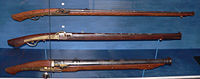
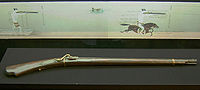
used in the 15th to 17th centuries. The word was originally modeled on the German hakenbüchse; this produced haquebute. It then copied the Italian word archibugio, which gave arquebuse (French), arcabuz (Spanish), arcabus (Portuguese), and arquebus (English). In distinction from its predecessor the hand cannon, it has a matchlock
Matchlock
The matchlock was the first mechanism, or "lock" invented to facilitate the firing of a hand-held firearm. This design removed the need to lower by hand a lit match into the weapon's flash pan and made it possible to have both hands free to keep a firm grip on the weapon at the moment of firing,...
. Like its successor the musket
Musket
A musket is a muzzle-loaded, smooth bore long gun, fired from the shoulder. Muskets were designed for use by infantry. A soldier armed with a musket had the designation musketman or musketeer....
, it is a smoothbore
Smoothbore
A smoothbore weapon is one which has a barrel without rifling. Smoothbores range from handheld firearms to powerful tank guns and large artillery mortars.-History of firearms and rifling:...
firearm, but it is lighter and easier to carry .
It is a forerunner of the rifle
Rifle
A rifle is a firearm designed to be fired from the shoulder, with a barrel that has a helical groove or pattern of grooves cut into the barrel walls. The raised areas of the rifling are called "lands," which make contact with the projectile , imparting spin around an axis corresponding to the...
and other longarm firearms. An improved version of the arquebus, the caliver, was introduced in the early 16th century. The word is derived from the English corruption of calibre as this gun was of standard bore, increasing combat effectiveness as troops could load bullets th
Heavy arquebuses mounted on wagons were called arquebus à croc. These carried a ball of about 3.5 ounces (99.2 g).
Terminology
In the early 16th century, the term "arquebus" had a confusing variety of meanings. Some writers used it to denote any matchlock shoulder gun, referring to light versions as caliver and heavier pieces fired from a fork rest as musket. Others treated the arquebus and caliver synonymously, both referring to the lighter, forkless shoulder-fired matchlock. As the 16th century progressed, the term arquebus came to be clearly reserved for the lighter forkless weapon. When the wheel lock was introduced, wheel-lock shoulder arms came to be called arquebuses, while lighter, forkless matchlock and flintlock shoulder weapons continued to be called calivers. In the mid-17th century, the light flintlock versions came to be called fusilsFusilier
Fusilier was originally the name of a soldier armed with a light flintlock musket called the fusil. The word was first used around 1680, and has later developed into a regimental designation.-History:...
or fuzees.
Effectiveness
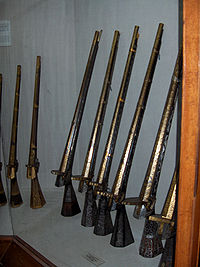
Plate armour
Plate armour is a historical type of personal armour made from iron or steel plates.While there are early predecessors such the Roman-era lorica segmentata, full plate armour developed in Europe during the Late Middle Ages, especially in the context of the Hundred Years' War, from the coat of...
. Plate armour worn upon the torso was standard in European combat from about 1400 until the middle of the 17th century. Good suits of plate would usually stop an arquebus ball at long range. It was a common practice to "proof" (test) armour by firing a pistol or arquebus at a new breastplate. The small dent would be circled by engraving, to call attention to it. However, at close range, it was possible to pierce even the armor of knights and other heavy cavalry, depending highly on the power of the arquebus and the quality of the armor. This led to changes in armor usage, such as the three-quarter plate, and finally the retirement of plate armor from most types of infantry.
While the power of the arquebus was of great advantage to modern militaries, they were not practical in Europe until the Dutch, or in Asia the Japanese, developed the concept referred to now as volley fire. Volley fire allowed armies to turn their usual formation into a rotating firing squad with each row of soldiers firing a shot then marching to the back of the formation to reload, a technique first proposed by Aelian
Aelianus Tacticus
Aelianus Tacticus was a Greek military writer of the 2nd century, resident at Rome.Aelian's military treatise in fifty-three chapters on the tactics of the Greeks, titled "On Tactical Arrays of the Greeks" , is dedicated to Hadrian, though this is probably a mistake for Trajan, and the date 106...
. Willem Lodewijk
William Louis, Count of Nassau-Dillenburg
William Louis of Nassau-Dillenburg was Count of Nassau-Dillenburg from 1606 to 1620, and stadtholder of Friesland, Groningen, and Drenthe. He was the eldest son of John VI, Count of Nassau-Dillenburg.William Louis served as a cavalry officer under William the Silent...
describes drilling soldiers in a similar manner to how Aelian "countermarched" his troops; 'I have discovered ex evolutionibus [that is, from Aelian's discussions of drill] a method of getting the musketeers and soldiers armed with harquebuses not only to keep firing very well but to do it effectively in battle order (that is to say, they do not skirmish or use the cover of hedges ) in the following manner: as soon as the first rank has fired together, then by the drill [they have learned] they will march to the back. The second rank, either marching forward or standing still, [will next] fire together [and] then march to the back. After that, the third and following ranks will do the same. Thus before the last ranks have fired, the first will have reloaded, as the following diagram shows: these little dots [stippelckens] : : show the route of the ranks as they leave after firing.' Once volley firing had been developed, rate of fire and efficiency had increased and the arquebus became the most effective tool available to the late 16th century armies that carried them. Once volley fire was established, the arquebus went from being a support weapon to the primary focus of early modern armies.
Mechanism
The arquebus was fired by a matchlockMatchlock
The matchlock was the first mechanism, or "lock" invented to facilitate the firing of a hand-held firearm. This design removed the need to lower by hand a lit match into the weapon's flash pan and made it possible to have both hands free to keep a firm grip on the weapon at the moment of firing,...
mechanism. It had a larger bore
Gauge (bore diameter)
The gauge of a firearm is a unit of measurement used to express the diameter of the barrel. Gauge is determined from the weight of a solid sphere of lead that will fit the bore of the firearm, and is expressed as the multiplicative inverse of the sphere's weight as a fraction of a pound . Thus...
than its predecessors. From the middle of the 16th century, newer wheellock
Wheellock
A wheellock, wheel-lock or wheel lock, is a friction-wheel mechanism to cause a spark for firing a firearm. It was the next major development in firearms technology after the matchlock and the first self-igniting firearm. The mechanism is so-called because it uses a rotating steel wheel to provide...
mechanisms were used instead of older matchlocks. The flared muzzle of some examples made it easier to load the weapon. The name 'hook gun' is often claimed to be based on the bent shape of the arquebus' butt. It might also be that some of the original arquebuses had a metal hook near the muzzle that may have been used for bracing against a solid object to absorb recoil
Recoil
Recoil is the backward momentum of a gun when it is discharged. In technical terms, the recoil caused by the gun exactly balances the forward momentum of the projectile and exhaust gasses, according to Newton's third law...
. Since all the arquebuses were handmade by various gunsmith
Gunsmith
A gunsmith is a person who repairs, modifies, designs, or builds firearms. This occupation is different from an armorer. The armorer primarily maintains weapons and limited repairs involving parts replacement and possibly work involving accurization...
s, there is no typical specimen.
The trigger mechanism of an early arquebus most often resembled that of a crossbow
Crossbow
A crossbow is a weapon consisting of a bow mounted on a stock that shoots projectiles, often called bolts or quarrels. The medieval crossbow was called by many names, most of which derived from the word ballista, a torsion engine resembling a crossbow in appearance.Historically, crossbows played a...
: a gently curved lever pointing backward and parallel to the stock (see illustration of Spanish arquebusier below). Squeezing the lever against the stock depressed a sear which was in turn linked to the base of the serpentine that held the match. The serpentine then brought the match into the flash pan to ignite the priming, firing the weapon. By the later 16th century, gunsmiths in most countries had begun to introduce the short trigger perpendicular to the stock that is familiar to modern shooters. However, the majority of French matchlock arquebuses retained the crossbow-style trigger throughout the 17th century.
Firing sequence
History
Black Army of Hungary
The Black Army , "Black Legion" or "Regiment"—possibly named after their black armor panoply, see below) is, in historiography, the common name given to the military forces serving under the reign of King Matthias Corvinus of Hungary...
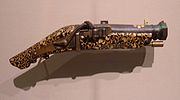
had an arquebus in the infantry, and every fifth regarding the whole army, which was an unusual ratio at the time. Although they were generally present in the battlefield King Mathias preferred enlisting shielded men instead, as the arquebus had a low rate of fire. The same applied for the primitive cannons and bombards, which were ineffective compared to siege engines, especially against a stone stronghold. Arquebusiers were very effective against cavalry and even other infantry, particularly when placed with pikemen in the pike and shot
Pike and shot
Pike and shot is a historical method of infantry combat, and also refers to an era of European warfare generally considered to cover the period from the Italian Wars to the evolution of the bayonet in the late seventeenth century...
formation, which revolutionised the Spanish military. An example of where this formation was used and succeeded is the decisive Battle of Cerignola
Battle of Cerignola
The Battle of Cerignola was fought on April 28, 1503, between Spanish and French armies, in Cerignola, next Bari, Southern Italy. It is noted as the first battle in history won by gunpowder small arms....
(1503), which was one of the first battles to utilise this formation, and was the first battle to be won through the use of gunpowder-based small arms.
The Arquebus also evolved in Russia in the early 1500s as a smaller version of a larger, hand-held artillery weapon. The arquebusiers, or pishchal'niki as the Russians called them, were seen as integral parts of the army and ‘One thousand pishchal'niki were outfitted at treasury expense and participated in the final annexation of Pskov in 1510, as well as the conquest of Smolensk in 1512, but were disbanded after each campaign. They were revived in 1545 when two thousand pishchal'niki (one thousand on horseback) were levied by the towns and outfitted at treasury expense.’ Their use of mounted troops was also unique to the time period. The Russians developed their pishchal'niki as a skilled tradesman and gave them extra incentives through farming and made their trade something passed on from father to son and not something for which one was conscripted.
Arquebuses were used in the Italian Wars
Italian Wars
The Italian Wars, often referred to as the Great Italian Wars or the Great Wars of Italy and sometimes as the Habsburg–Valois Wars, were a series of conflicts from 1494 to 1559 that involved, at various times, most of the city-states of Italy, the Papal States, most of the major states of Western...
of the first half of the 16th century. Portuguese and Spanish conquerors also made use of the weapon overseas. Arquebuses were carried by some of the soldiers of Hernán Cortés
Hernán Cortés
Hernán Cortés de Monroy y Pizarro, 1st Marquis of the Valley of Oaxaca was a Spanish Conquistador who led an expedition that caused the fall of the Aztec Empire and brought large portions of mainland Mexico under the rule of the King of Castile in the early 16th century...
in his conquest of Mexico in the 1520s, and arquebuses played an important role in the victories of Cristóvão da Gama
Cristovão da Gama
Cristóvão da Gama was a Portuguese soldier, who led a Portuguese army of 400 musketeers on a crusade in Ethiopia and Somalia against the far larger Somali Muslim army of Imam Ahmad ibn Ibrihim al-Ghazi aided by the Ottoman Empire...
's small and outnumbered army in his 1541–42 campaign in Ethiopia
Ethiopia
Ethiopia , officially known as the Federal Democratic Republic of Ethiopia, is a country located in the Horn of Africa. It is the second-most populous nation in Africa, with over 82 million inhabitants, and the tenth-largest by area, occupying 1,100,000 km2...
. Arquebuses were also used in the Moroccan
Morocco
Morocco , officially the Kingdom of Morocco , is a country located in North Africa. It has a population of more than 32 million and an area of 710,850 km², and also primarily administers the disputed region of the Western Sahara...
victory over the Songhai Empire
Songhai Empire
The Songhai Empire, also known as the Songhay Empire, was a state located in western Africa. From the early 15th to the late 16th century, Songhai was one of the largest Islamic empires in history. This empire bore the same name as its leading ethnic group, the Songhai. Its capital was the city...
at the Battle of Tondibi
Battle of Tondibi
The Battle of Tondibi was the decisive confrontation in Morocco's 16th-century invasion of the Songhai Empire. Though vastly outnumbered, the Moroccan forces under Judar Pasha defeated the Songhai Askia Ishaq II, guaranteeing the Empire's downfall....
in 1590.
Arquebuses were introduced to Japan in 1543 by Portuguese traders (Fernão Mendes Pinto
Fernão Mendes Pinto
Fernão Mendes Pinto was a Portuguese explorer and writer. His exploits are known through the posthumous publication of his memoir Pilgrimage in 1614, an autobiographical work whose truthfulness is nearly impossible to assess...
), who landed by accident on Tanegashima
Tanegashima
is an island lying to the south of Kyushu, in southern Japan, and is part of Kagoshima Prefecture. The island is the second largest of the Ōsumi Islands....
, an island south of Kyūshū
Kyushu
is the third largest island of Japan and most southwesterly of its four main islands. Its alternate ancient names include , , and . The historical regional name is referred to Kyushu and its surrounding islands....
in the region controlled by the Shimazu clan
Shimazu clan
The were the daimyō of the Satsuma han, which spread over Satsuma, Ōsumi and Hyūga provinces in Japan.The Shimazu were identified as one of the tozama or outsider daimyō clans in contrast with the fudai or insider clans which were hereditary vassals or allies of the Tokugawa clan,The Shimazu were...
. By 1550, copies of the Portuguese arquebus were being produced in large quantities, and they were often seen on the battlefields all over Japan. Oda Nobunaga
Oda Nobunaga
was the initiator of the unification of Japan under the shogunate in the late 16th century, which ruled Japan until the Meiji Restoration in 1868. He was also a major daimyo during the Sengoku period of Japanese history. His opus was continued, completed and finalized by his successors Toyotomi...
revolutionized musket tactics in Japan by splitting loaders and shooters and assigning three guns to a shooter at the Battle of Nagashino
Battle of Nagashino
The ' took place in 1575 near Nagashino Castle on the plain of Shitaragahara in the Mikawa province of Japan. Forces under Takeda Katsuyori had besieged the castle since the 17th of June; Okudaira Sadamasa , a Tokugawa vassal, commanded the defending force...
in 1575. (Popular records stating he used a Maurice-style three-line formation are incorrect according to onsite evidence.) While many believe that during the Sakoku the political power of the samurai led to muskets being banned in Japan, this is a misconception brought on by romantic views. In actuality, the Japanese were fully capable of manufacturing their own muskets, and the shogunate even created several political positions to oversee their manufacture and inventory. These guns would be widely used during Hideyoshi's unification of Japan and later the Japanese invasions of Korea in 1592.
Maurice of Nassau
Maurice of Nassau, Prince of Orange
Maurice of Nassau, Prince of Orange was sovereign Prince of Orange from 1618, on the death of his eldest half brother, Philip William, Prince of Orange,...
increased the affectivity of the arquebus in military formations when he adapted standardized weaponry and utilized volley fire techniques. After outfitting his entire army with new, standardized arms in 1599, Maurice of Nassau made an attempt to recapture Spanish forts built on former Dutch lands. In the Battle of Nieuwpoort in 1600, he administers the new techniques and technologies for the first time. The Dutch marched onto the beach where the fort was located and fully utilized the countermarching tactic. By orienting all of his arquebusiers into a block, he was able to maintain a steady stream of fire out of a disciplined formation using volley fire tactics that until then had not been utilized in combat. The result was a lopsided victory with 4000 Spanish casualties to only 1000 dead and 700 wounded on the Dutch side.
The arquebus compared to archery
The arquebus was unable to match the accuracy of a bow in the hands of a highly-skilled archer. The arquebus did, however, have a faster rate of fire than the most powerful crossbowCrossbow
A crossbow is a weapon consisting of a bow mounted on a stock that shoots projectiles, often called bolts or quarrels. The medieval crossbow was called by many names, most of which derived from the word ballista, a torsion engine resembling a crossbow in appearance.Historically, crossbows played a...
, a shorter learning curve than a longbow
Longbow
A longbow is a type of bow that is tall ; this will allow its user a fairly long draw, at least to the jaw....
, and was more powerful than either. The arquebus does not rely on the physical strength of the user for propulsion of the projectile. This makes it easier to find a suitable recruit. It also means that an arquebusier loses less of his battlefield effectiveness than an archer or crossbowman when he loses strength due to fatigue, malnutrition or sickness. The arquebusier also had the added advantage of frightening enemies (and horses) with the noise. Wind can reduce the accuracy of archery, but has much less of an effect on an arquebusier. Perhaps most important, producing an effective arquebusier required much less training than producing an effective bowman. During a siege it was also easier to fire an arquebus out of loopholes
Embrasure
In military architecture, an embrasure is the opening in a crenellation or battlement between the two raised solid portions or merlons, sometimes called a crenel or crenelle...
than it was a bow and arrow. It was also possible to load an arquebus (and indeed any smoothbore gun) with small shot rather than a single ball. Small shot did not pack the same punch as a single round ball but the shot could hit and wound multiple enemies.
The arquebus required a much lower level of skill than the typical archer. Most archers spend their whole lives training to fire with accuracy, but with drill and instruction, the arquebusier was able to learn his profession in months as opposed to years. This low level of skill made it a lot easier to outfit an army of them in a short amount of time as well as expand the small arms ranks as the technology and tactics made them more viable in combat. This idea of lower skilled, lightly armored units was the driving force in the infantry revolution that took place in the 16th and 17th centuries and allowed early modern infantries to phase out the longbow.
An arquebusier could carry more ammunition and powder than a crossbowman or longbowman could with bolts
Quarrel
A quarrel or bolt is the term for the ammunition used in a crossbow. The name "quarrel" is derived from the French carré, "square", referring to the fact that they typically have square heads. Although their length varies, they are typically shorter than traditional arrows.Bolts and arrows have...
or arrow
Arrow
An arrow is a shafted projectile that is shot with a bow. It predates recorded history and is common to most cultures.An arrow usually consists of a shaft with an arrowhead attached to the front end, with fletchings and a nock at the other.- History:...
s. Once the methods were developed, powder and shot were relatively easy to mass-produce, while arrow making was a genuine craft requiring highly skilled labor.
The arquebus was more sensitive to humid weather. At the Battle of Villalar
Battle of Villalar
The Battle of Villalar was a battle in the Revolt of the Comuneros fought on April 23, 1521 near the town of Villalar in Valladolid province, Spain. The royalist supporters of King Charles I won a crushing victory over the comuneros rebels. Three of the most important rebel leaders were...
, rebel troops lost the battle badly partially due to having a high proportion of arquebusiers combined with the battle taking place in a rainstorm which rendered the weapons nigh-useless. Gunpowder also ages much faster than a bolt or an arrow, particularly if improperly stored. Also, the resources needed to make gunpowder were less universally available than the resources needed to make bolts and arrows. Bows do not really consume anything the way an arquebus consumes gunpowder. Finding and reusing arrows or bolts was a lot easier than doing the same with arquebus bullets. This was a useful way to reduce the cost of practice, or resupply oneself if control of the battlefield after a battle was retained. A bullet must fit a barrel much more precisely than an arrow or bolt must fit a bow, so the arquebus required more standardization and made it harder to resupply by looting bodies of fallen soldiers. Gunpowder production was also far more dangerous than arrow production.
An arquebus was also significantly more dangerous to its user. The arquebusier carries a lot of gunpowder on his person and has a lit match in one hand. The same goes for the soldiers next to him. Amid the confusion, stress and fumbling of a battle, arquebusiers are potentially a danger to themselves. Early arquebuses tended to have a drastic recoil. They took a long time to load making them vulnerable while reloading unless using the 'continuous fire' tactic, where one line would shoot and, while the next line shot, would reload. They also tended to overheat. During repeated firing, guns could become clogged and explode, causing pieces of metal and wood to break off, which could be dangerous to the gunner and even those around him. In this context it should be added that reloading an arquebus requires more fine motor skills and movements than reloading a bow or crossbow. This is a disadvantage in a combat situation since stress has a very negative impact on fine motor skills.
Furthermore, the amount of smoke produced by black powder weapons was considerable, making it hard to see the enemy after a few salvos, unless there was enough wind to disperse the smoke quickly. (Conversely, this cloud of smoke also served to make it difficult for any archers to target the opposing soldiers that were using handguns). Prior to the wheellock, the need for a lit match made stealth and concealment nearly impossible, particularly at night. Even with successful concealment, the smoke emitted by a single arquebus shot would make it quite obvious where a shot came from – at least in daylight. While with a crossbow or bow a soldier could conceivably kill silently, this was of course impossible with an explosion-driven projectile weapon like the arquebus. The noise of arquebuses and the ringing in the ears that it caused could also make it hard to hear shouted commands. In the long run, the weapon could make the user permanently hard of hearing. Bows and crossbows could shoot over obstacles by firing with high-arcing ballistic trajectories in order to reach the enemy when the person or object had some frontal but no overhead cover (such as when troops are in melee with the enemy) — albeit with much less accuracy.
See also
- GunGunA gun is a muzzle or breech-loaded projectile-firing weapon. There are various definitions depending on the nation and branch of service. A "gun" may be distinguished from other firearms in being a crew-served weapon such as a howitzer or mortar, as opposed to a small arm like a rifle or pistol,...
- MusketMusketA musket is a muzzle-loaded, smooth bore long gun, fired from the shoulder. Muskets were designed for use by infantry. A soldier armed with a musket had the designation musketman or musketeer....
- WeaponWeaponA weapon, arm, or armament is a tool or instrument used with the aim of causing damage or harm to living beings or artificial structures or systems...
- MusketoonMusketoonThe musketoon is a shorter barrelled version of the musket, and served in the roles of a shotgun or carbine. Musketoons could be of the same caliber as the issue musket, or of a much larger caliber, 1.0-2.5 inches . The musketoon is most commonly associated with naval use, and pirates in...
- Pike and shotPike and shotPike and shot is a historical method of infantry combat, and also refers to an era of European warfare generally considered to cover the period from the Italian Wars to the evolution of the bayonet in the late seventeenth century...