
All Topics  
Leonardo da Vinci

 
Leonardo Da Vinci

   Email Print
   Bookmark   Link


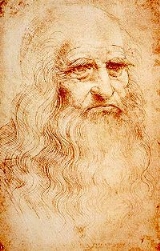
Leonardo da Vinci


Leonardo di ser Piero da Vinci (April 15, 1452 – May 2, 1519) was an Italian
Italy

Italy , officially the Italian Republic , is a country located on the Italian Peninsula in Southern Europe and on the two largest islands in the Mediterranean Sea, Sicily and Sardinia....
 polymath
Polymath

A polymath is a person whose knowledge is not restricted to one subject area. In less formal terms, a polymath may simply refer to someone who is very knowledgeable....
, being a scientist, mathematician
Mathematician

A mathematician is a person whose primary area of study and/or research is the field of mathematics....
, engineer
Engineer

An engineer is a person professionally engaged in a field of engineering. Engineers are concerned with developing economical and safe solutions to practical problems, by applying mathematics and scientific knowledge while considering technical constraints....
, inventor
Inventor

An inventor is a person who creates or discovers a new method, form, device or other useful means. The word inventor comes form the latin verb invenire, invent-, to find....
, anatomist, painter
Painting

Painting is the practice of applying paint, pigment, color or other medium to a surface . In art, the term describes both the act and the result, which is called a painting....
, sculptor, architect
Architect

An architect is trained and licenced in planning and designing buildings, and participates in supervising the construction of a building. Etymologically, architect derives from the Latin architectus, itself derived from the Greek arkhitekton , i.e....
, botanist, musician
Musician

A musician is a person who plays or writes music. Musicians can be classified by their roles in creating or performing music:* An instrumentalist plays a musical instrument....
 and writer
Writer

A writer is anyone who creates a written work, although the word usually designates those who write creatively or professionally, as well as those who have written in many different forms....
. Leonardo has often been described as the archetype
Archetype

An archetype is an original model of a person, ideal example, or a prototype after which others are copied, patterned, or emulated; a symbol universally recognized by all....
 of the renaissance man, a man whose unquenchable curiosity was equaled only by his powers of invention. He is widely considered to be one of the greatest painter
Painting

Painting is the practice of applying paint, pigment, color or other medium to a surface . In art, the term describes both the act and the result, which is called a painting....
s of all time and perhaps the most diversely talented person ever to have lived.


Discussion
Ask a question about 'Leonardo da Vinci'
Start a new discussion about 'Leonardo da Vinci'
Answer questions from other users
Full Discussion Forum


Recent Posts


Quotations


A luminous body when obscured by a dense atmosphere will appear smaller; as may be seen by the moon or sun veiled by mists.

A luminous body will appear more brilliant in proportion as it is surrounded by deeper shadow.

A vase of unbaked clay, when broken, may be remoulded, but not a baked one.

All our knowledge has its origin in our perceptions.

As a day well spent procures a happy sleep, so a life well employed procures a happy death.

As a well-spent day brings happy sleep, so life well used brings happy death.


Encyclopedia


Leonardo di ser Piero da Vinci (April 15, 1452 – May 2, 1519) was an Italian
Italy

Italy , officially the Italian Republic , is a country located on the Italian Peninsula in Southern Europe and on the two largest islands in the Mediterranean Sea, Sicily and Sardinia....
 polymath
Polymath

A polymath is a person whose knowledge is not restricted to one subject area. In less formal terms, a polymath may simply refer to someone who is very knowledgeable....
, being a scientist, mathematician
Mathematician

A mathematician is a person whose primary area of study and/or research is the field of mathematics....
, engineer
Engineer

An engineer is a person professionally engaged in a field of engineering. Engineers are concerned with developing economical and safe solutions to practical problems, by applying mathematics and scientific knowledge while considering technical constraints....
, inventor
Inventor

An inventor is a person who creates or discovers a new method, form, device or other useful means. The word inventor comes form the latin verb invenire, invent-, to find....
, anatomist, painter
Painting

Painting is the practice of applying paint, pigment, color or other medium to a surface . In art, the term describes both the act and the result, which is called a painting....
, sculptor, architect
Architect

An architect is trained and licenced in planning and designing buildings, and participates in supervising the construction of a building. Etymologically, architect derives from the Latin architectus, itself derived from the Greek arkhitekton , i.e....
, botanist, musician
Musician

A musician is a person who plays or writes music. Musicians can be classified by their roles in creating or performing music:* An instrumentalist plays a musical instrument....
 and writer
Writer

A writer is anyone who creates a written work, although the word usually designates those who write creatively or professionally, as well as those who have written in many different forms....
. Leonardo has often been described as the archetype
Archetype

An archetype is an original model of a person, ideal example, or a prototype after which others are copied, patterned, or emulated; a symbol universally recognized by all....
 of the renaissance man, a man whose unquenchable curiosity was equaled only by his powers of invention. He is widely considered to be one of the greatest painter
Painting

Painting is the practice of applying paint, pigment, color or other medium to a surface . In art, the term describes both the act and the result, which is called a painting....
s of all time and perhaps the most diversely talented person ever to have lived. Helen Gardner says "The scope and depth of his interests were without precedent...His mind and personality seem to us superhuman, the man himself mysterious and remote".

Born as the illegitimate son of a notary, Piero da Vinci, and a peasant woman, Caterina, at Vinci
Vinci, Italy

Vinci is a town and comune of Province of Florence in the Italy region of Tuscany. The birthplace of Renaissance genius Leonardo da Vinci lies just outside the town....
 in the region of Florence
Florence

Florence is the Capital city of the Italy Regions of Italy of Tuscany and of the provinces of Italy Province of Florence. It is the most populous city in Tuscany and has a population of 364,779 ....
, Leonardo was educated in the studio of the renowned Florentine painter, Verrocchio. Much of his earlier working life was spent in the service of Ludovico il Moro in Milan
Milan

Milan is the second largest city of Italy, located in the plains of Lombardy. It is the capital in the Province of Milan, as well as the Regions of Italy capital of Lombardy....
. He later worked in Rome
Rome

Rome is the capital city of Italy and Lazio, and is Italy's largest and most populous city, with 2,724,347 residents in an urban area of some ....
, Bologna
Bologna

Bologna is the capital city of Emilia-Romagna in northern Italy, in the Po Valley , between the Po River and the Apennine Mountains, exactly between the Reno River and the S?vena River....
 and Venice
Venice

Venice is a city in northern Italy, the capital city of the Italian regions Veneto, a population of 271,251 . Together with Padua, Italy, the city is included in the Padua-Venice Metropolitan Area ....
 and spent his last years in France, at the home awarded him by King François I.

Leonardo was and is renowned primarily as a painter. Two of his works, the Mona Lisa
Mona Lisa

Mona Lisa is a 16th century portrait painting painted in oil painting on a poplar panel painting by Leonardo da Vinci during the Italian Renaissance....
 and The Last Supper
The Last Supper (Leonardo)

The Last Supper is a 15th century mural painting in Milan created by Leonardo da Vinci for his patron List of rulers of Milan Ludovico Sforza and his duchess Beatrice d'Este....
, are the most famous, most reproduced and most parodied portrait and religious painting of all time, their fame approached only by Michelangelo
Michelangelo

Michelangelo di Lodovico Buonarroti Simoni , commonly known as Michelangelo, was an Italian Renaissance Painting, sculptor, architect, poet, and engineer....
's Creation of Adam. Leonardo's drawing of the Vitruvian Man
Vitruvian Man

The Vitruvian Man is a world-renowned drawing with accompanying notes created by Leonardo da Vinci around the year 1487 as recorded in one of his journals....
 is also regarded as a cultural icon
Cultural icon

A cultural icon can be an , a symbol, a logo, picture, name, face, person, or building or other image that is readily recognized, and generally represents an object or concept with great cultural significance to a wide cultural group....
, being reproduced on everything from the Euro
Euro

The euro is the official currency of 16 out of 27 European Union member state of the European Union . The states, known collectively as the Eurozone are: Austria, Belgium, Cyprus, Finland, France, Germany, Greece, Republic of Ireland, Italy, Luxembourg, Malta, the Netherlands, Portugal, Slovakia, Slovenia, and Spain....
 to text books to t-shirts. Perhaps fifteen of his paintings survive, the small number due to his constant, and frequently disastrous, experimentation with new techniques, and his chronic procrastination.There are 15 significant artworks which are ascribed, either in whole or in large part, to Leonardo by most art historians. This number is made up principally of paintings on panel but includes a mural, a large drawing on paper and two works which are in the early stages of preparation. There are a number of other works that have also been variously attributed to Leonardo. Nevertheless, these few works, together with his notebooks, which contain drawings, scientific diagrams, and his thoughts on the nature of painting, comprise a contribution to later generations of artists only rivalled by that of his contemporary, Michelangelo
Michelangelo

Michelangelo di Lodovico Buonarroti Simoni , commonly known as Michelangelo, was an Italian Renaissance Painting, sculptor, architect, poet, and engineer....
.

Leonardo is revered for his technological ingenuity. He conceptualised a helicopter, a tank, concentrated solar power, a calculator, the double hull
Double hull

A double hull is a ship Hull design and construction method where the bottom and sides of the ship have two complete layers of watertight hull surface: one outer layer forming the normal hull of the ship, and a second inner hull which is somewhat further into the ship, perhaps a few feet, which forms a redundant barrier to seawater in case...
 and outlined a rudimentary theory of plate tectonics
Plate tectonics

Plate tectonics describes the large scale motions of Earth's lithosphere. The theory encompasses the older concepts of continental drift, developed during the first decades of the 20th century by Alfred Wegener, and seafloor spreading, understood during the 1960s....
. Relatively few of his designs were constructed or were even feasible during his lifetime,Modern scientific approaches to metallurgy
Metallurgy

Metallurgy is a domain of materials science that studies the physical and chemical behavior of metallic Chemical element, their intermetallics, and their mixtures, which are called alloys....
 and engineering
Engineering

Engineering is the discipline and profession of applying Technology and science knowledge and utilizing natural laws and physical resources in order to design and implement materials, structures, machines, devices, systems, and process that safely realize a desired objective and meet specified criteria....
 were only in their infancy during the Renaissance.
but some of his smaller inventions, such as an automated bobbin
Bobbin

A bobbin is a spindle or cylinder, with or without flanges, on which wire, yarn, thread or roll film is wound. Bobbins are typically found in sewing machines, cameras, and within Electronics equipment....
 winder and a machine for testing the tensile strength
Tensile strength

Tensile strength , or is the Stress at which a material breaks or permanently deforms. Tensile strength is an Intensive and extensive properties and, consequently, does not depend on the size of the test specimen....
 of wire, entered the world of manufacturing unheralded.A number of Leonardo's most practical inventions are displayed as working models at the Museum of Vinci. As a scientist, he greatly advanced the state of knowledge in the fields of anatomy
Anatomy

Anatomy is a branch of biology that is the consideration of the body plan. It is a general term that includes human anatomy, animal anatomy and plant anatomy ....
, civil engineering
Civil engineering

Civil engineering is a Professional Engineer discipline that deals with the design, construction and maintenance of the physical and naturally built environment, including works such as bridges, roads, canals, dams and buildings....
, optics
Optics

Optics is the study of the behavior and properties of light including its optical phenomena with matter and its imaging by optical instruments....
, and hydrodynamics
Fluid dynamics

In physics, fluid dynamics is the sub-discipline of fluid mechanics dealing with fluid flow — the natural science of fluids in motion....
.

Life


Childhood, 1452–1466


Leonardo was born on April 15, 1452, "at the third hour of the night" in the Tuscan
Tuscany

Tuscany is a region in Italy. It has an area of and a population of about 3.6 million inhabitants. The regional capital is Florence.Tuscany is known for its landscapes and its artistic legacy....
 hill town of Vinci
Vinci, Italy

Vinci is a town and comune of Province of Florence in the Italy region of Tuscany. The birthplace of Renaissance genius Leonardo da Vinci lies just outside the town....
, in the lower valley of the Arno River
Arno River

The Arno is a river in the Tuscany region of Italy. It is the most important river of central Italy after the Tiber.The river originates on Mount Falterona in the Casentino area of the Apennine Mountains, and takes initially a southward curve....
 in the territory of Florence
Florence

Florence is the Capital city of the Italy Regions of Italy of Tuscany and of the provinces of Italy Province of Florence. It is the most populous city in Tuscany and has a population of 364,779 ....
. He was the illegitimate son of Messer Piero Fruosino di Antonio da Vinci, a Florentine notary
Civil law notary

Civil-law notaries are specialized lawyers acting as public officers with jurisdiction over voluntary, i.e., non-contentious, private law. Unlike a notary public, their common-law counterparts, they are able to provide legal advice and prepare instruments with legal effect....
, and Caterina, a peasant who may have been a slave from the Middle East
Middle East

File:GreaterMiddleEast1.pngThe Middle East is a region that spans southwestern Asia, western Asia, and northeastern Africa. It has no clear boundaries, often used as a synonym to Near East, in opposition to Far East....
.According to Alessandro Vezzosi, Head of the Leonardo Museum in Vinci, there is evidence that Piero owned a Middle Eastern slave called Caterina who gave birth to a boy called Leonardo. That Leonardo had Middle Eastern blood is supported by the reconstruction of a fingerprint as reported by Marta Falconi, Associated Press Writer, "" December 12, 2001 Leonardo had no surname
Surname

A surname is a name added to a given name and is part of a personal name. In many cases a surname is a family name; the family-name meaning first appeared in 1375....
 in the modern sense, "da Vinci" simply meaning "of Vinci
Vinci, Italy

Vinci is a town and comune of Province of Florence in the Italy region of Tuscany. The birthplace of Renaissance genius Leonardo da Vinci lies just outside the town....
": his full birth name was "Leonardo di ser Piero da Vinci", meaning "Leonardo, (son) of (Mes)ser Piero from Vinci".

Little is known about Leonardo's early life. He spent his first five years in the hamlet
Hamlet (place)

A hamlet is usually a rural Human settlement which is too small to be considered a village, though sometimes the word is used for a different sort of community....
 of Anchiano, then lived in the household of his father, grandparents and uncle, Francesco, in the small town of Vinci. His father had married a sixteen-year-old girl named Albiera, who loved Leonardo but died young. In later life, Leonardo only recorded two childhood incidents. One, which he regarded as an omen, was when a kite
Kite (bird)

Kites are Bird of preys with long wings and weak legs which spend a great deal of time soaring. Most feed mostly on carrion but some take various amounts of live prey....
 dropped from the sky and hovered over his cradle, its tail feathers brushing his face. The second occurred while exploring in the mountains. He discovered a cave and was both terrified that some great monster might lurk there, and driven by curiosity to find out what was inside.

Leonardo's early life has been the subject of historical conjecture. Vasari, the 16th century biographer of Renaissance painters tells of how a local peasant requested that Ser Piero ask his talented son to paint a picture on a round plaque. Leonardo responded with a painting of snakes spitting fire which was so terrifying that Ser Piero sold it to a Florentine art dealer, who sold it to the Duke of Milan
Milan

Milan is the second largest city of Italy, located in the plains of Lombardy. It is the capital in the Province of Milan, as well as the Regions of Italy capital of Lombardy....
. Meanwhile, having made a profit, Ser Piero bought a plaque decorated with a heart pierced by an arrow, which he gave to the peasant.

Andrea Del Verrocchio 002

Verrocchio's workshop, 1466–1476

In 1466, at the age of fourteen, Leonardo was apprenticed to one of the most successful artists of his day, Andrea di Cione, known as Verrocchio. Verrocchio's workshop was at the centre of the intellectual currents of Florence, assuring the young Leonardo of an education in the humanities. Other famous painters apprenticed or associated with the workshop include Ghirlandaio, Perugino, Botticelli, and Lorenzo di Credi
Lorenzo di Credi

Lorenzo di Credi was an Italy Italian Renaissance Painting and sculpture. He first influenced Leonardo da Vinci and then was greatly influenced by him....
. Leonardo would have been exposed to a vast range of technical skills and had the opportunity to learn drafting, chemistry, metallurgy, metal working, plaster casting, leather working, mechanics and carpentry as well as the artistic skills of drawing, painting, sculpting and modelling.

Much of the painted production of Verrocchio's workshop was done by his employees. According to Vasari, Leonardo collaborated with Verrocchio on his Baptism of Christ, painting the young angel holding Jesus
Jesus

Jesus of Nazareth , also known as Jesus Christ, is the central figure of Christianity and is revered by most Christian churches as the Son of God and the Incarnation ....
's robe in a manner that was so far superior to his master's that Verrocchio put down his brush and never painted again. This is probably an exaggeration. On close examination, the painting reveals much that has been painted or touched up over the tempera
Tempera

File:Duccio The-Madonna-and-Child-128.jpgTempera is a type of artist's paint and associated Art techniques and materials that were known from the classical world, where it appears to have taken over from encaustic painting and was the main medium used for panel painting and illuminated manuscripts in the Byzantine world and the Middle Ages...
 using the new technique of oil paint
Oil painting

Oil painting is the process of painting with pigments that are bound with a medium of drying oil ? especially in early modern Europe, linseed oil....
, the landscape, the rocks that can be seen through the brown mountain stream and much of the figure of Jesus bearing witness to the hand of Leonardo.

Leonardo himself may have been the model for two works by Verrocchio, including the bronze statue of David
David (Verrocchio)

Andrea del Verrochio's bronze statue of David was most likely made between 1473 and 1475. It was commissioned by the Medici family. It is sometimes claimed that Verrocchio modelled the statue after a handsome pupil in his workshop, the young Leonardo da Vinci....
 in the Bargello and the Archangel Michael in Tobias and the Angel
Tobias and the Angel (Verrocchio)

Tobias and the Angel is a painting, finished around 1470-1480, attributed to the workshop of the Italy Renaissance painter Andrea del Verrocchio....
.

By 1472, at the age of twenty, Leonardo qualified as a master in the Guild of St Luke, the guild of artists and doctors of medicine, but even after his father set him up in his own workshop, his attachment to Verrocchio was such that he continued to collaborate with him. Leonardo's earliest known dated work is a drawing in pen and ink of the Arno
Arno

Arno may refer to:...
 valley, drawn on August 5, 1473.This work is now in the collection of the Uffizi
Uffizi

The Uffizi Gallery , one of the oldest and most famous art museums in the world, is housed in the Palazzo degli Uffizi, a palazzo in Florence, Italy, Italy....
, Drawing No. 8P.


Professional life, 1476–1513

Leonardo Da Vinci Adoration of the Magi
Court records of 1476 show that Leonardo and three other young men were charged with sodomy
Sodomy

Sodomy is a term used today predominantly in law to describe the act of anal intercourse, oral intercourse, as well as bestiality. When used in a religious context, it has a negative connotation....
,Homosexual acts were illegal in Florence at the time. and acquitted. From that date until 1478 there is no record of his work or even of his whereabouts, although it is assumed that Leonardo had his own workshop in Florence between 1476 and 1481. He was commissioned to paint an altarpiece in 1478 for the Chapel of St Bernard and The Adoration of the Magi
Adoration of the Magi (Leonardo)

The Adoration of the Magi is an early painting by Leonardo da Vinci. Leonardo was given the commission by the Augustinians monks of San Donato a Scopeto in Florence, but departed for Milan the following year, leaving the painting unfinished....
 in 1481 for the Monks of San Donato a Scopeto. This important commission was interrupted when Leonardo went to Milan.

In 1482 Leonardo, who according to Vasari was a most talented musician, created a silver lyre
Lyre

The lyre is a string instrument well known for its use in classical antiquity and later. The recitations of the Ancient Greece were accompanied by lyre playing....
 in the shape of a horse's head. Lorenzo de’ Medici sent Leonardo, bearing the lyre as a gift, to Milan, to secure peace with Ludovico il Moro, Duke of Milan. At this time Leonardo wrote an often-quoted letter to Ludovico, describing the many marvellous and diverse things that he could achieve in the field of engineering and informing the Lord that he could also paint.

Leonardo continued work in Milan between 1482 and 1499. He was commissioned to paint the Virgin of the Rocks
Virgin of the Rocks

The Virgin of the Rocks is the usual title used for both of two different paintings with almost identical compositions, which are at least largely by Leonardo da Vinci....
 for the Confraternity of the Immaculate Conception, and The Last Supper for the monastery of Santa Maria delle Grazie. While living in Milan between 1493 and 1495 Leonardo listed a woman called Caterina among his dependents in his taxation documents. When she died in 1495, the list of funeral expenditure suggests that she was his mother.

He worked on many different projects for Ludovico, including the preparation of floats and pageants for special occasions, designs for a dome for Milan Cathedral and a model for a huge equestrian monument to Francesco Sforza, Ludovico's predecessor. Seventy tons of bronze
Bronze

Bronze is a metal alloy consisting primarily of copper, usually with tin as the main additive, but sometimes with other chemical element such as phosphorus, manganese, aluminium, or silicon....
 were set aside for casting it. The monument remained unfinished for several years, which was not unusual for Leonardo. In 1492 the clay model of the horse was completed. It surpassed in size the only two large equestrian statues of the Renaissance, Donatello's statue of Gattemelata in Padua
Padua

Padua is a city in the Veneto, northern Italy. It is the capital of the province of Padua and the economic and communications hub of the area. Padua's population is 212,500 ....
 and Verrocchio's Bartolomeo Colleoni
Bartolomeo Colleoni

Bartolomeo Colleoni was an Italian people condottiero.Colleoni was born at Solza, in the countryside of Bergamo , where he prepared his magnificent mortuary chapel, the Cappella Colleoni, in a shrine that he seized when it was refused him by the local confraternity, the Consiglio della Misericordia....
 in Venice, and became known as the "Gran Cavallo". Leonardo began making detailed plans for its casting, however, Michelangelo rudely implied that Leonardo was unable to cast it. In November 1494 Ludovico gave the bronze to be used for cannons to defend the city from invasion by Charles VIII
Charles VIII of France

Charles VIII, called the Affable, , was List of French monarchs from 1483 to his death. Charles was a member of the House of Valois. His invasion of Italy initiated the long series of Italian Wars which characterized the first half of the 16th century....
.

At the start of the Second Italian War
Second Italian War

The Second Italian War , sometimes known as Louis XII's Italian War or the War over Naples, was the second of the Italian Wars; it was fought primarily by Louis XII of France and Ferdinand I of Spain, with the participation of several Italian powers....
 in 1499, the invading French troops used the life-size clay model for the "Gran Cavallo" for target practice. With Ludovico Sforza overthrown, Leonardo, with his assistant Salai and friend, the mathematician Luca Pacioli
Luca Pacioli

Fra Luca Bartolomeo de Pacioli was an Italy mathematician and Franciscan friar, collaborator with Leonardo da Vinci, and seminal contributor to the field now known as accounting....
, fled Milan for Venice
Venice

Venice is a city in northern Italy, the capital city of the Italian regions Veneto, a population of 271,251 . Together with Padua, Italy, the city is included in the Padua-Venice Metropolitan Area ....
, where he was employed as a military architect and engineer, devising methods to defend the city from naval attack.

On his return to Florence in 1500, he and his household were guests of the Servite monks at the monastery of Santissima Annunziata and were provided with a workshop where, according to Vasari, Leonardo created the cartoon of The Virgin and Child with St. Anne and St. John the Baptist, a work that won such admiration that "men and women, young and old" flocked to see it "as if they were attending a great festival". In 1502 Leonardo entered the service of Cesare Borgia
Cesare Borgia

Cesare Borgia, born , Duke of Valentinois, and Romagna, Prince of Andria and Venafro, Count of Dyois, Lord of Piombino, Camerino and Urbino, Gonfalone of the Church and Captain General of the Church, was a Spanish-Italian Condottieri, lord and cardinal....
, the son of Pope Alexander VI
Pope Alexander VI

Pope Alexander VI , born Roderic Llan?ol, later Roderic de Borja i Borja was Pope from 1492 to 1503. He is the most controversial of the Secularism popes of the Renaissance, and his surname became a byword for the debased standards of the papacy of that era....
, acting as a military architect and engineer and travelling throughout Italy with his patron. He returned to Florence where he rejoined the Guild of St Luke on October 18, 1503, and spent two years designing and painting a great mural of The Battle of Anghiari
The Battle of Anghiari (painting)

The Battle of Anghiari is a lost painting by Leonardo da Vinci at times referred to as, "The Lost Leonardo", which some commentators believe to be still hidden beneath later frescoes in the Hall of Five Hundred in the Palazzo Vecchio, Florence....
 for the Signoria, with Michelangelo designing its companion piece, The Battle of Cascina. In Florence in 1504, he was part of a committee formed to relocate, against the artist's will, Michelangelo's statue of David.

In 1506 he returned to Milan. Many of Leonardo's most prominent pupils or followers in painting either knew or worked with him in Milan, including Bernardino Luini
Bernardino Luini

Bernardino Luini was a North Italian Painting from Leonardo da Vinci circle. Both Luini and Giovanni Antonio Boltraffio were said to have worked with Leonardo directly; he was described to have taken "as much from Leonardo as his native roots enabled him to comprehend"....
, Giovanni Antonio Boltraffio
Giovanni Antonio Boltraffio

Giovanni Antonio Boltraffio or Beltraffio was an Italy painter of the High Renaissance from Lombardy, who worked in the studio of Leonardo da Vinci....
 and Marco D'Oggione.D'Oggione is known in part for his contemporary copies of the Last Supper. However, he did not stay in Milan for long because his father had died in 1504, and in 1507 he was back in Florence trying to sort out problems with his brothers over his father's estate. By 1508 he was back in Milan, living in his own house in Porta Orientale in the parish of Santa Babila.

Old age, 1513-1519

Leonardo Da Vinci's House
From September 1513 to 1516, Leonardo spent much of his time living in the Belvedere in the Vatican in Rome, where Raphael and Michelangelo
Michelangelo

Michelangelo di Lodovico Buonarroti Simoni , commonly known as Michelangelo, was an Italian Renaissance Painting, sculptor, architect, poet, and engineer....
 were both active at the time. In October 1515, François I of France recaptured Milan. On December 19, Leonardo was present at the meeting of Francois I and Pope Leo X, which took place in Bologna. It was for Francois that Leonardo was commissioned to make a mechanical lion
Lion

The lion is a member of the family Felidae and one of four big cats in the genus Panthera. With exceptionally large males exceeding 250 kg in weight, it is the second-largest living cat after the tiger....
 which could walk forward, then open its chest to reveal a cluster of lilies. In 1516, he entered François' service, being given the use of the manor house Clos Lucé
Clos Lucé

Clos Luc? is a mansion in Amboise, France, located 500 metres from the royal Ch?teau d'Amboise, to which it is connected by an underground passageway....
Clos Luce, also called "Cloux" is now a public museum. near the king's residence at the royal Chateau Amboise. It was here that he spent the last three years of his life, accompanied by his friend and apprentice, Count Francesco Melzi, supported by a pension totalling 10,000 scudi.

Leonardo died at Clos Lucé
Clos Lucé

Clos Luc? is a mansion in Amboise, France, located 500 metres from the royal Ch?teau d'Amboise, to which it is connected by an underground passageway....
, France
France

France , officially the French Republic , is a country whose Metropolitan France is located in Western Europe and that also comprises various Overseas departments and territories of France....
, on May 2, 1519. François I had become a close friend. Vasari records that the King held Leonardo's head in his arms as he died, although this story, beloved by the French and portrayed in romantic paintings by Ingres, Ménageot and other French artists, as well as by Angelica Kauffmann
Angelica Kauffmann

Maria Anna Angelika/Angelica Katharina Kauffmann was a Swiss-Austrian Painting....
, may be legend rather than fact.

On the day of Leonardo's death, a royal edict was issued by the King at Saint-Germain-en-Laye
Saint-Germain-en-Laye

ame=Saint-Germain-en-Laye|image =|caption=Ch?teau de Saint-Germain-en-Laye in the town centre|map_size=270px|adjustable_map =St-Germain-en-Laye_map.png|...
, a two-day journey from Clos Luce
Clos Lucé

Clos Luc? is a mansion in Amboise, France, located 500 metres from the royal Ch?teau d'Amboise, to which it is connected by an underground passageway....
. This has been taken as evidence that King François cannot have been present at Leonardo's deathbed. However, White in Leonardo: The First Scientist points out that the edict was not signed by the king himself.
Vasari also tells us that in his last days, Leonardo sent for a priest to make his confession and to receive the Holy Sacrament. In accordance to his will, sixty beggars followed his casket. He was buried in the Chapel of Saint-Hubert in the castle of Amboise
Château d'Amboise

The royal Ch?teau at Amboise is a ch?teau located in Amboise, in the Indre-et-Loire d?partement in France of the Loire Valley in France....
. Melzi was the principal heir and executor, receiving as well as money, Leonardo's paintings, tools, library and personal effects. Leonardo also remembered his other long-time pupil and companion, Salai and his servant Battista di Vilussis, who each received half of Leonardo's vineyard
Vineyard

A vineyard is a plantation of grape-bearing vines, grown mainly for winemaking, but also raisins, table grapes and non-alcoholic grape juice. The science, practice and study of vineyard production is known as viticulture....
s, his brothers who received land, and his serving woman who received a black cloak of good stuff with a fur edge.

Some twenty years after Leonardo's death, François was reported by the goldsmith and sculptor Benevenuto Cellini as saying: "There had never been another man born in the world who knew as much as Leonardo, not so much about painting, sculpture and architecture, as that he was a very great philosopher."

Relationships and influences


Florence — Leonardo's artistic and social background

Leonardo commenced his apprenticeship
Apprenticeship

Apprenticeship is a system of training a new generation of practitioners of a skill. Apprentices or prot?g?s build their careers from apprenticeships....
 with Verrocchio in 1466, the year that Verrocchio's master, the great sculptor Donatello
Donatello

Donatello was a famous early Renaissance Italy artist and sculpture from Florence. He is, in part, known for his work in bas-relief, a form of shallow relief sculpture that, in Donatello's case, incorporated significant 15th-century developments in perspectival illusionism....
, died. The painter Uccello whose early experiments with perspective were to influence the development of landscape painting, was a very old man. The painters Piero della Francesca
Piero della Francesca

Piero della Francesca was an Italian artist of the Italian Renaissance. To contemporaries, he was known as a mathematician and geometer as well as an artist, though now he is chiefly appreciated for his art....
 and Fra Filippo Lippi, sculptor Luca della Robbia
Luca della Robbia

Luca della Robbia was an Italy sculptor from Florence, noted for his terracotta roundels.Luca Della Robbia developed a pottery Ceramic glaze that made his creations more durable in the outdoors and thus suitable for use on the exterior of buildings....
, and architect and writer Alberti
Alberti

Alberti may refer to:In places:* Alberti Partido, a partido of Buenos Aires Province, ArgentinaPeople with the surname Alberti:...
 were in their sixties. The successful artists of the next generation were Leonardo's teacher Verrocchio, Antonio Pollaiuolo
Antonio Pollaiuolo

Antonio del Pollaiolo , also known as Antonio di Jacopo Pollaiuolo or Antonio Pollaiolo, was an Italian people Painting, sculpture, engraver and goldsmith during the Renaissance....
 and the portrait sculptor, Mino da Fiesole
Mino da Fiesole

Mino da Fiesole was an Italy sculptor from Poppi, Tuscany. He is noted for his portrait busts. His work was influenced by his master Desiderio da Settignano and by Antonio Rossellino, and is characterized by its sharp, angular treatment of drapery....
 whose lifelike busts give the most reliable likenesses of Lorenzo Medici's father Piero and uncle Giovanni.

Leonardo's youth was spent in a Florence that was ornamented by the works of these artists and by Donatello's contemporaries, Masaccio
Masaccio

Masaccio , was the first great Painting of the Quattrocento period of the Italian Renaissance. His frescoes are the earliest monuments of Humanism, and introduce a plasticity previously unseen in figure painting....
 whose figurative fresco
Fresco

Fresco is any of several related painting types, done on plaster on walls or ceilings. The word fresco comes from the Italian word affresco which derives from the adjective fresco , which has Latin origins....
es were imbued with realism and emotion and Ghiberti whose Gates of Paradise, gleaming with gold leaf, displayed the art of combining complex figure compositions with detailed architectural backgrounds. Piero della Francesca had made a detailed study of perspective, and was the first painter to make a scientific study of light. These studies and Alberti's
Leone Battista Alberti

Leon Battista Alberti was an Italy author, artist, architect, poet, Catholic_priest, linguistics, philosopher, and cryptography, and general Renaissance humanist polymath....
 Treatise were to have a profound effect on younger artists and in particular on Leonardo's own observations and artworks.

Massaccio's depiction of the naked and distraught Adam and Eve
Adam and Eve

Adam and Eve are the First man or woman created by God in the Hebrew creation story told in Genesis 1-2....
 leaving the Garden of Eden created a powerfully expressive image of the human form, cast into three dimensions by the use of light and shade
Chiaroscuro

Chiaroscuro is a term in art for a contrast between light and dark. The term is usually applied to bold contrasts affecting a whole composition, but is also more technically used by artists and art historians for the use of effects representing contrasts of light, not necessarily strong, to achieve a sense of volume in modeling three-di...
 which was to be developed in the works of Leonardo in a way that was to be influential in the course of painting. The Humanist
Renaissance humanism

Renaissance humanism was a European intellectual movement that was a crucial component of the Renaissance, beginning in Florence in the last years of the 14th century....
 influence of Donatello's David can be seen in Leonardo's late paintings, particularly John the Baptist
St. John the Baptist (Leonardo)

St. John the Baptist is an oil painting on walnut wood by the artist Leonardo da Vinci. Completed from 1513 to 1516, when the High Renaissance was metamorphosing into Mannerism, it is believed to be his last painting....
.

Andrea Del Verrocchio 001
A prevalent tradition in Florence was the small altarpiece of the Virgin and Child. Many of these were created in tempera
Tempera

File:Duccio The-Madonna-and-Child-128.jpgTempera is a type of artist's paint and associated Art techniques and materials that were known from the classical world, where it appears to have taken over from encaustic painting and was the main medium used for panel painting and illuminated manuscripts in the Byzantine world and the Middle Ages...
 or glazed terracotta by the workshops of Filippo Lippi, Verrocchio and the prolific della Robbia
Luca della Robbia

Luca della Robbia was an Italy sculptor from Florence, noted for his terracotta roundels.Luca Della Robbia developed a pottery Ceramic glaze that made his creations more durable in the outdoors and thus suitable for use on the exterior of buildings....
 family. Leonardo's early Madonnas such as the The Madonna with a carnation
Madonna of the Carnation

The Madonna of the Carnation, a.k.a. Madonna with vase or Madonna with child, is a oil painting by Leonardo da Vinci created sometime around 1478-1480 ....
 and The Benois Madonna
The Benois Madonna

Madonna and Child with Flowers, otherwise known as the Benois Madonna, could be one of two the Madonnas started by Leonardo da Vinci, as he remarked himself, in October 1478....
 followed this tradition while showing indiosyncratic departures, particularly in the case of the Benois Madonna in which the Virgin is set at an oblique angle to the picture space with the Christ Child at the opposite angle. This compositional theme was to emerge in Leonardo's later paintings such as The Virgin and Child with St. Anne.

Leonardo was a contemporary of Botticelli, Ghirlandaio and Perugino, who were all slightly older than he was. He would have met them at the workshop of Verrocchio, with whom they had associations, and at the Academy
Academy

An academy is an institution of higher learning, research, or honorary membership.The name traces back to Plato's school of philosophy, founded approximately 385 BC at Akademia, a sanctuary of Athena, the goddess of wisdom, north of Ancient Athens, Greece....
 of the Medici
Medici

The M?dici family was a powerful and influential Florence family from the 14th to 18th century. The family had three popes , numerous rulers of Florence and later members of the French and English royalty....
.Botticelli was a particular favourite of the Medici family and thus his success as a painter was assured. Ghirlandaio and Perugino were both prolific and ran large workshops. They competently delivered commissions to well-satisfied patrons who appreciated Ghirlandaio's ability to portray the wealthy citizens of Florence within large religious frescoes, and Perugino's ability to deliver a multitude of saints and angels of unfailing sweetness and innocence. These three were among those commissioned to paint the walls of the Sistine Chapel
Sistine Chapel

Sistine Chapel is the best-known chapel in the Apostolic Palace, the official residence of the Pope in Vatican City. Its fame rests on its architecture, evocative of Solomon's Temple of the Old Testament and on its decoration which has been frescoed throughout by the greatest Renaissance artists including Michelangelo, Raphael, Bernini, and...
, the work commencing with Perugino's employment in 1479. Leonardo was not part of this prestigious commission. His first significant commission, The Adoration of the Magi
Adoration of the Magi (Leonardo)

The Adoration of the Magi is an early painting by Leonardo da Vinci. Leonardo was given the commission by the Augustinians monks of San Donato a Scopeto in Florence, but departed for Milan the following year, leaving the painting unfinished....
 for the Monks of Scopeto, was never completed.

In 1476, during the time of Leonardo's association with Verrocchio's workshop, Hugo van der Goes
Hugo van der Goes

Hugo van der Goes was a Flemish painter. He was, along with Jan van Eyck, Rogier van der Weyden, Hans Memling and Gerard David, one of the most important of the Early Netherlandish Painting....
 arrived in Florence, bringing the Portinari Altarpiece and the new painterly techniques
Early Netherlandish painting

Early Netherlandish painting is the work of those painting who were active in the Netherlands during the 15th and early 16th century Northern renaissance, especially in the flourishing cities of Bruges and Ghent....
 from Northern Europe which were to profoundly effect Leonardo, Ghirlandaio, Perugino and others. In 1479, the Sicilian painter Antonello da Messina
Antonello da Messina

Antonello da Messina, properly Antonello di Giovanni di Antonio was a Sicily Painting active during the Italian Renaissance. His work shows strong influences from Early Netherlandish painting and, unusually for a painter from Southern Italy, he was influential on the art of North Italy, especially Venice....
, who worked exclusively in oils, travelled north on his way to Venice
Venice

Venice is a city in northern Italy, the capital city of the Italian regions Veneto, a population of 271,251 . Together with Padua, Italy, the city is included in the Padua-Venice Metropolitan Area ....
, where the leading painter, Giovanni Bellini
Giovanni Bellini

Giovanni Bellini was an Italy Renaissance painter, probably the best known of the Bellini family of Venice painters. His father was Jacopo Bellini, his brother was Gentile Bellini, and his brother-in-law was Andrea Mantegna....
 adopted the technique of oil painting
Oil painting

Oil painting is the process of painting with pigments that are bound with a medium of drying oil ? especially in early modern Europe, linseed oil....
, quickly making it the preferred method in Venice. Leonardo was also later to visit Venice.

Like the two contemporary architects, Bramante and Antonio da Sangallo the Elder
Antonio da Sangallo the Elder

Antonio da Sangallo the Elder , was a Florence architect active during the Italian Renaissance. His father Francesco Giamberti was a woodworker, and his brother Giuliano da Sangallo and nephew Antonio da Sangallo the Younger were architects....
, Leonardo experimented with designs for centrally planned churches, a number of which appear in his journals, as both plans and views, although none was ever realised.

Ghirlandaio A Pucci Lorenzo De Medici F Sassetti 1
Leonardo's political contemporaries were Lorenzo Medici (il Magnifico), who was three years older, and his popular younger brother Giuliano who was slain in the Pazzi Conspiracy in 1478. Ludovico il Moro who ruled Milan
Milan

Milan is the second largest city of Italy, located in the plains of Lombardy. It is the capital in the Province of Milan, as well as the Regions of Italy capital of Lombardy....
 between 1479–1499 and to whom Leonardo was sent as ambassador from the Medici court, was also of Leonardo's age.

With Alberti, Leonardo visited the home of the Medici and through them came to know the older Humanist philosophers of whom Marsiglio Ficino, proponent of Neo Platonism, Cristoforo Landino
Cristoforo Landino

Cristoforo Landino was a Humanism and an important figure of the Florence, Italy Renaissance....
, writer of commentaries on Classical writings, and John Argyropoulos
John Argyropoulos

John Argyropoulos was a Greeks lecturer, philosopher and humanist, one of the ?migr? scholars who Greek scholars in the Renaissance the revival of learning in Western Europe in the 15th century....
, teacher of Greek and translator of Aristotle
Aristotle

Aristotle was a Greeks philosopher, a student of Plato and teacher of Alexander the Great. He wrote on many subjects, including physics, metaphysics, Poetics , theater, music, logic, rhetoric, politics, government, ethics, biology and zoology....
 were foremost. Also associated with the Academy of the Medici was Leonardo's contemporary, the brilliant young poet and philosopher Pico della Mirandola. Leonardo later wrote in the margin of a journal "The Medici made me and the Medici destroyed me." While it was through the action of Lorenzo that Leonardo was to receive his important Milanese commissions, it is not known exactly what Leonardo meant by this cryptic comment.

Although usually named together as the three giants of the High Renaissance
High Renaissance

The High Renaissance, in the history of art, denotes the culmination of the art of the Italian Renaissance between 1450 and 1527. Because Pope Julius II patronized many artists during this time, the movement was centered in Rome; it had previously been centered in Florence....
, Leonardo, Michelangelo
Michelangelo

Michelangelo di Lodovico Buonarroti Simoni , commonly known as Michelangelo, was an Italian Renaissance Painting, sculptor, architect, poet, and engineer....
 and Raphael
Raphael

Raphael Sanzio, usually known by his first name alone was an Italy Painting and architect of the High Renaissance, celebrated for the perfection and grace of his paintings and drawings....
 were not of the same generation. Leonardo was twenty-three when Michelangelo was born and thirty-one when Raphael was born. The short-lived Raphael died in 1520, the year after Leonardo, but Michelangelo went on creating for another 45 years.

Isabella D'este

Personal life


Within Leonardo's lifetime, his extraordinary powers of invention, his "outstanding physical beauty", "infinite grace", "great strength and generosity", "regal spirit and tremendous breadth of mind" as described by Vasari attracted the curiosity of others. Many authors have speculated on various aspects of Leonardo's personality. One such aspect is his respect for life evidenced by his vegetarianism
Vegetarianism

File:Foods.jpgVegetarianism is the practice of a diet that excludes meat , fish and poultry.There are several variants of the diet, some of which also exclude egg and/or some products produced from animal labour such as dairy products and honey....
 and his habit, described by Vasari, of purchasing caged birds and releasing them.

Leonardo had many friends who are now renowned either in their fields or for their historical significance. They included the mathematician Luca Pacioli
Luca Pacioli

Fra Luca Bartolomeo de Pacioli was an Italy mathematician and Franciscan friar, collaborator with Leonardo da Vinci, and seminal contributor to the field now known as accounting....
, with whom he collaborated on a book in the 1490s, as well as Franchinus Gaffurius
Franchinus Gaffurius

Franchinus Gaffurius was an Italy music theory and composer of the Renaissance music. He was an almost exact contemporary of Josquin des Prez and Leonardo da Vinci, both of whom were his personal friends....
 and Isabella d'Este
Isabella d'Este

File:Tizian 056.jpgIsabella d'Este was marchesa of Mantua and one of the leading women of the Italy Renaissance and a major cultural and political figure....
.Leonardo appears to have had no close relationships with women except for his friendship with Isabella d'Este. He drew a portrait of her while on a journey which took him through Mantua
Mantua

Mantua is a city in Lombardy, Italy and capital of the Province of Mantua of the same name.Mantua is surrounded on three sides by artificial lakes created during the 12th century....
, and which appears to have been used to create a painted portrait now lost.

Beyond friendship, Leonardo kept his private life secret. His sexuality has often been the subject of study, analysis and speculation. This trend began in the mid-16th century and was revived in the 19th and 20th centuries, most notably by Sigmund Freud
Sigmund Freud

Sigmund Freud , born Sigismund Schlomo Freud , was an Austrian psychiatrist who founded the psychoanalysis of psychology. Freud is best known for his theories of the unconscious mind and the defense mechanism of Psychological repression and for creating the clinical practice of psychoanalysis for curing psychopathology through dialogue...
.

Leonardo Da Vinci 025

Assistants and pupils

Leonardo's closest personal relationships were with two pupils, Gian Giacomo Caprotti da Oreno, nicknamed Salai or Il Salaino ("The Little Unclean One" i.e., the devil), who entered his household in 1490. After only a year, Leonardo made a list of his misdemeanours, calling him "a thief, a liar, stubborn, and a glutton", after he had made off with money and valuables on at least five occasions, and spent a fortune on clothes. Nevertheless, Leonardo's notebooks during their early years contain many drawings of the student, who remained within Leonardo's household for the next thirty years.Salai executed a number of paintings under the name of Andrea Salai, but although Vasari claims that Leonardo "taught him a great deal about painting", his work is generally considered to be of less artistic merit than others among Leonardo's pupils such as Marco d'Oggione and Boltraffio. In 1515 he painted a nude version of the Mona Lisa
Mona Lisa

Mona Lisa is a 16th century portrait painting painted in oil painting on a poplar panel painting by Leonardo da Vinci during the Italian Renaissance....
, known as Monna Vanna. Salai owned the Mona Lisa at the time of his death in 1525, and in his will it was assessed at 505 lire, an exceptionally high valuation for a small panel portrait.

In 1506, Leonardo took on another pupil, Count Francesco Melzi
Francesco Melzi

Francesco Melzi was an Italy painter, an assistant and pupil of Leonardo da Vinci.The son of a Milanese noble family, Melzi joined the household of Leonardo da Vinci in 1506....
, the son of a Lombard
Lombardy

Lombardy is one of the 20 regions of Italy. The capital is Milan. One-sixth of Italy's population lives in Lombardy and about one fifth of Italy's GDP is produced in this region....
 aristocrat, who is considered to have been his favourite student. He travelled to France with Leonardo, and remained with him until the latter's death. Upon Leonardo's death, Melzi inherited the artistic and scientific works, manuscripts, and collections of Leonardo, and would henceforth faithfully administer the estate.

Painting

Despite the recent awareness and admiration of Leonardo as a scientist and inventor, for the better part of four hundred years his enormous fame rested on his achievements as a painter and on a handful of works, either authenticated or attributed to him that have been regarded as among the supreme masterpieces ever created.

These paintings are famous for a variety of qualities which have been much imitated by students and discussed at great length by connoisseurs and critics. Among the qualities that make Leonardo's work unique are the innovative techniques that he used in laying on the paint, his detailed knowledge of anatomy, light, botany and geology, his interest in physiognomy
Physiognomy

Physiognomy is the assessment of a person's character or personality from their outer appearance, especially the face. The term physiognomy can also refer to the general appearance of a person, object or terrain, without reference to its implied characteristics....
 and the way in which humans register emotion in expression and gesture, his innovative use of the human form in figurative composition and his use of the subtle gradation of tone. All these qualities come together in his most famous painted works, the Mona Lisa, the Last Supper and the Virgin of the Rocks.

Early works

Leonardo's early works begin with the Baptism of Christ
The Baptism of Christ (Verrocchio)

The Baptism of Christ is a painting finished around 1475 by the Italy Renaissance painter Andrea del Verrocchio and his workshop. It is housed in the Uffizi in Florence....
 painted in conjunction with Verrocchio. Two other paintings appear to date from his time at the workshop, both of which are Annunciation
Annunciation

In Christianity, the Annunciation is the revelation to Mary, the mother of Jesus, by the angel Gabriel that she would Conception a child to be born the Son of God....
s. One is small, long and high. It is a "predella" to go at the base of a larger composition, in this case a painting by Lorenzo di Credi
Lorenzo di Credi

Lorenzo di Credi was an Italy Italian Renaissance Painting and sculpture. He first influenced Leonardo da Vinci and then was greatly influenced by him....
 from which it has become separated. The other is a much larger work, long. In both these Annunciations, Leonardo has used a formal arrangement, such as in Fra Angelico's two well known pictures of the same subject, of the Virgin Mary sitting or kneeling to the right of the picture, approached from the left by an angel in profile, with rich flowing garment, raised wings and bearing a lily. Although previously attributed to Ghirlandaio, the larger work is now almost universally attributed to Leonardo.

In the smaller picture Mary averts her eyes and folds her hands in a gesture that symbolised submission to God's will. In the larger picture, however, Mary is not in the least submissive. The beautiful girl, interrupted in her reading by this unexpected messenger, puts a finger in her bible to mark the place and raises her hand in a formal gesture of greeting or surprise. This calm young woman appears to accept her role as the Mother of God not with resignation but with confidence. In this painting the young Leonardo presents the Humanist
Humanism

Humanism is a broad category of ethics that affirm the dignity and worth of all people, based on the ability to determine right and wrong by appealing to universal human qualities, particularly rationalism, without resorting to the supernatural or alleged divine authority from religious texts....
 face of the Virgin Mary, recognising humanity's role in God's incarnation.

Paintings of the 1480s

, Louvre
Louvre

The Louvre Museum , located in Paris, is a historic monument, and a national museum of France. It is a central landmark, located on the Rive Droite of the Seine in the 1st arrondissement of Paris ....
, possibly 1505–1508, demonstrates Leonardo's interest in nature.]] In the 1480s Leonardo received two very important commissions, and commenced another work which was also of ground-breaking importance in terms of composition. Unfortunately two of the three were never finished and the third took so long that it was subject to lengthy negotiations over completion and payment. One of these paintings is that of
St. Jerome in the Wilderness

St Jerome in the Wilderness is an unfinished painting by Leonardo da Vinci, now in the Vatican Museums, Rome....
. Bortolon associates this picture with a difficult period of Leonardo's life, and the signs of melancholy in his diary: "I thought I was learning to live; I was only learning to die."

Although the painting is barely begun the composition can be seen and it is very unusual. Jerome, as a penitent, occupies the middle of the picture, set on a slight diagonal and viewed somewhat from above. His kneeling form takes on a trapezoid shape, with one arm stretched to the outer edge of the painting and his gaze looking in the opposite direction. J. Wasserman points out the link between this painting and Leonardo's anatomical studies. Across the foreground sprawls his symbol, a great lion whose body and tail make a double spiral across the base of the picture space. The other remarkable feature is the sketchy landscape of craggy rocks against which the figure is silhouetted.

The daring display of figure composition, the landscape elements and personal drama also appear in the great unfinished masterpiece, the
Adoration of the Magi
Adoration of the Magi (Leonardo)

The Adoration of the Magi is an early painting by Leonardo da Vinci. Leonardo was given the commission by the Augustinians monks of San Donato a Scopeto in Florence, but departed for Milan the following year, leaving the painting unfinished....
, (see above ) a commission from the Monks of San Donato a Scopeto. It is a very complex composition about . Leonardo did numerous drawings and preparatory studies, including a detailed one in linear perspective of the ruined classical architecture
Classical architecture

Classical architecture is the set of building styles and techniques of Classical Greece, as used in ancient Greece, the Hellenistic period, and the Roman empire....
 which makes part of the backdrop to the scene. But in 1482 Leonardo went off to Milan at the behest of Lorenzo de’ Medici in order to win favour with Ludovico il Moro and the painting was abandoned.

The third important work of this period is the
Virgin of the Rocks
Virgin of the Rocks

The Virgin of the Rocks is the usual title used for both of two different paintings with almost identical compositions, which are at least largely by Leonardo da Vinci....
which was commissioned in Milan for the Confraternity of the Immaculate Conception. The painting, to be done with the assistance of the de Predis brothers, was to fill a large complex altarpiece, already constructed. Leonardo chose to paint an apocryphal moment of the infancy of Christ when the Infant John the Baptist
John the Baptist

John the Baptist was a mission preacher and a major religious figure who led a movement of baptism at the Jordan River in expectation of a divine apocalypse that would restore occupied Israel....
, in protection of an angel, met the Holy Family on the road to Egypt. In this scene, as painted by Leonardo, John recognizes and worships Jesus as the Christ. The painting demonstrates an eerie beauty as the graceful figures kneel in adoration around the infant Christ in a wild landscape of tumbling rock and whirling water. While the painting is quite large, about , it is not nearly as complex as the painting ordered by the monks of St Donato, having only four figures rather than about fifty and a rocky landscape rather than architectural details. The painting was eventually finished; in fact, two versions of the painting were finished, one which remained at the chapel of the Confraternity and the other which Leonardo carried away to France. But the Brothers did not get their painting, or the de Predis their payment, until the next century.

Paintings of the 1490s

Leonardo's most famous painting of the 1490s is
The Last Supper
The Last Supper (Leonardo)

The Last Supper is a 15th century mural painting in Milan created by Leonardo da Vinci for his patron List of rulers of Milan Ludovico Sforza and his duchess Beatrice d'Este....
, also painted in Milan. The painting represents the last meal shared by Jesus with his disciples before his capture and death. It shows specifically the moment when Jesus has said "one of you will betray me". Leonardo tells the story of the consternation that this statement caused to the twelve followers of Jesus.

The novelist Matteo Bandello
Matteo Bandello

Matteo Bandello was an Italian writer....
 observed Leonardo at work and wrote that some days he would paint from dawn till dusk without stopping to eat, and then not paint for three or four days at a time. This, according to Vasari, was beyond the comprehension of the prior, who hounded him until Leonardo asked Ludovico to intervene. Vasari describes how Leonardo, troubled over his ability to adequately depict the faces of Christ and the traitor Judas, told the Duke that he might be obliged to use the prior as his model.

When finished, the painting was acclaimed as a masterpiece of design and characterisation, but it deteriorated rapidly, so that within a hundred years it was described by one viewer as "completely ruined". Leonardo, instead of using the reliable technique of fresco, had used tempera over a ground that was mainly gesso, resulting in a surface which was subject to mold and to flaking. Despite this, the painting has remained one of the most reproduced works of art, countless copies being made in every medium from carpets to cameos.

Paintings of the 1500s

Mona Lisa
Among the works created by Leonardo in the 1500s is the small portrait known as the
Mona Lisa
Mona Lisa

Mona Lisa is a 16th century portrait painting painted in oil painting on a poplar panel painting by Leonardo da Vinci during the Italian Renaissance....
or "la Gioconda", the laughing one. The painting is famous, in particular, for the elusive smile on the woman's face, its mysterious quality brought about perhaps by the fact that the artist has subtly shadowed the corners of the mouth and eyes so that the exact nature of the smile cannot be determined. The shadowy quality for which the work is renowned came to be called "sfumato
Sfumato

Sfumato is the Italian term for a painting technique which overlays translucent layers of colour to create perceptions of depth, volume and form....
" or Leonardo's smoke. Vasari, who is generally thought to have known the painting only by repute, said that "the smile was so pleasing that it seemed divine rather than human; and those who saw it were amazed to find that it was as alive as the original".

Other characteristics found in this work are the unadorned dress, in which the eyes and hands have no competition from other details, the dramatic landscape background in which the world seems to be in a state of flux, the subdued colouring and the extremely smooth nature of the painterly technique, employing oils
Oil paint

Oil paint is a type of slow-drying paint consisting of small pigment particles suspended in a drying oil. Oil paints have been used in England as early as the 13th century for simple decoration, but were not widely adopted for artistic purposes until the 15th century....
, but laid on much like tempera
Tempera

File:Duccio The-Madonna-and-Child-128.jpgTempera is a type of artist's paint and associated Art techniques and materials that were known from the classical world, where it appears to have taken over from encaustic painting and was the main medium used for panel painting and illuminated manuscripts in the Byzantine world and the Middle Ages...
 and blended on the surface so that the brushstrokes are indistinguishable. Vasari expressed the opinion that the manner of painting would make even "the most confident master ... despair and lose heart." The perfect state of preservation and the fact that there is no sign of repair or overpainting is extremely rare in a panel painting of this date.

In the
Virgin and Child with St. Anne (see below ) the composition again picks up the theme of figures in a landscape which Wasserman describes as "breathtakingly beautiful" and harks back to the St Jerome picture with the figure set at an oblique angle. What makes this painting unusual is that there are two obliquely set figures superimposed. Mary is seated on the knee of her mother, St Anne. She leans forward to restrain the Christ Child as he plays roughly with a lamb, the sign of his own impending sacrifice. This painting, which was copied many times, was to influence Michelangelo
Michelangelo

Michelangelo di Lodovico Buonarroti Simoni , commonly known as Michelangelo, was an Italian Renaissance Painting, sculptor, architect, poet, and engineer....
, Raphael
Raphael

Raphael Sanzio, usually known by his first name alone was an Italy Painting and architect of the High Renaissance, celebrated for the perfection and grace of his paintings and drawings....
, and Andrea del Sarto
Andrea del Sarto

Andrea del Sarto was an Italy painter from Florence, whose career flourished during the High Renaissance and early-Mannerism. Though highly regarded by his contemporaries as an artist "senza errori" , he is overshadowed now by equally talented contemporaries like Raphael....
, and through them Pontormo
Pontormo

Jacopo Carucci , usually known as Jacopo da Pontormo, Jacopo Pontormo or simply Pontormo, was an Italy Mannerism painter and portraitist from the Florentine school....
 and Correggio. The trends in composition were adopted in particular by the Venetian painters Tintoretto
Tintoretto

Tintoretto was one of the greatest painters of the Venetian school and probably the last great painter of the Italian Renaissance. For his phenomenal energy in painting he was termed Il Furioso, and his dramatic use of perspectival space and special lighting effects make him a precursor of baroque art....
 and Veronese
Paolo Veronese

Paolo Veronese was an Italian painter of the Renaissance in Venice, famous for paintings such as The Wedding at Cana and The Feast in the House of Levi....
.

Leonardo   St

Drawings

Leonardo was not a prolific painter, but he was a most prolific draftsman, keeping journals full of small sketches and detailed drawings recording all manner of things that took his attention. As well as the journals there exist many studies for paintings, some of which can be identified as preparatory to particular works such as
The Adoration of the Magi, The Virgin of the Rocks and The Last Supper. His earliest dated drawing is a Landscape of the Arno Valley, 1473, which shows the river, the mountains, Montelupo Castle and the farmlands beyond it in great detail.

Among his famous drawings are the
Vitruvian Man
Vitruvian Man

The Vitruvian Man is a world-renowned drawing with accompanying notes created by Leonardo da Vinci around the year 1487 as recorded in one of his journals....
, a study of the proportions of the human body, the Head of an Angel, for The Virgin of the Rocks in the Louvre, a botanical study of Star of Bethlehem and a large drawing (160×100 cm) in black chalk on coloured paper of the The Virgin and Child with St. Anne and St. John the Baptist in the National Gallery, London. This drawing employs the subtle sfumato
Sfumato

Sfumato is the Italian term for a painting technique which overlays translucent layers of colour to create perceptions of depth, volume and form....
technique of shading, in the manner of the Mona Lisa. It is thought that Leonardo never made a painting from it, the closest similarity being to The Virgin and Child with St. Anne
The Virgin and Child with St. Anne

The Virgin and Child with St Anne is an oil painting by Leonardo da Vinci depicting Saint Anne, her daughter the Virgin Mary and the Child Jesus....
in the Louvre.

Other drawings of interest include numerous studies generally referred to as "caricatures" because, although exaggerated, they appear to be based upon observation of live models. Vasari relates that if Leonardo saw a person with an interesting face he would follow them around all day observing them. There are numerous studies of beautiful young men, often associated with Salai, with the rare and much admired facial feature, the so-called "Grecian profile".The "Grecian profile" has a continuous straight line from forehead to nose-tip, the bridge of the nose being exceptionally high. It is a feature of many Classical Greek
Ancient Greek sculpture

Ancient Greek sculpture is the sculpture of Ancient Greece....
 statues.
These faces are often contrasted with that of a warrior. Salai is often depicted in fancy-dress costume. Leonardo is known to have designed sets for pageants with which these may be associated. Other, often meticulous, drawings show studies of drapery. A marked development in Leonardo's ability to draw drapery occurred in his early works. Another often-reproduced drawing is a macabre sketch that was done by Leonardo in Florence in 1479 showing the body of Bernardo Baroncelli, hanged in connection with the murder of Giuliano, brother of Lorenzo de'Medici, in the Pazzi Conspiracy. With dispassionate integrity Leonardo has registered in neat mirror writing
Mirror writing

File:Mirror writing2.jpgMirror writing is formed by writing in the direction that is the reverse of the natural way for a given language, such that the result is the mirror image of normal writing: it appears normal when it is reflected in a mirror....
 the colours of the robes that Baroncelli was wearing when he died.


Leonardo as observer, scientist and inventor


Journals

Renaissance humanism

Renaissance humanism was a European intellectual movement that was a crucial component of the Renaissance, beginning in Florence in the last years of the 14th century....
 saw no mutually exclusive polarities between the sciences and the arts, and Leonardo's studies in science and engineering are as impressive and innovative as his artistic work, recorded in notebooks comprising some 13,000 pages of notes and drawings, which fuse art and natural philosophy
Natural philosophy

Natural philosophy or the philosophy of nature , is a term applied to the Objectivity study of nature and the physical universe that was dominant before the development of modern science....
 (the forerunner of modern science). These notes were made and maintained daily throughout Leonardo's life and travels, as he made continual observations of the world around him.

The journals are mostly written in mirror-image cursive. The reason may have been more a practical expediency than for reasons of secrecy as is often suggested. Since Leonardo wrote with his left hand, it is probable that it was easier for him to write from right to left.Left-handed writers using a split nib or quill pen experience difficulty pushing the pen from left to right across the page.His notes and drawings display an enormous range of interests and preoccupations, some as mundane as lists of groceries and people who owed him money and some as intriguing as designs for wings and shoes for walking on water. There are compositions for paintings, studies of details and drapery, studies of faces and emotions, of animals, babies, dissections, plant studies, rock formations, whirl pools, war machines, helicopters and architecture.

These notebooks—originally loose papers of different types and sizes, distributed by friends after his death—have found their way into major collections such as the Royal Library at Windsor Castle
Windsor Castle

Windsor Castle, in Windsor, Berkshire in the England county of Berkshire, is the largest inhabited castle in the world and, dating back to the time of William I of England, is the oldest in continuous occupation....
, the Louvre, the Biblioteca Nacional de España
Biblioteca Nacional de España

The Biblioteca Nacional de Espa?a is a major public library, the largest in Spain.It is located in Madrid, near the Paseo de Recoletos....
, the Victoria and Albert Museum
Victoria and Albert Museum

The Victoria and Albert Museum in London is the world's largest museum of decorative arts and design, housing a permanent collection of over 4.5 million Object ....
, the Biblioteca Ambrosiana
Biblioteca Ambrosiana

The Biblioteca Ambrosiana is a historic library in Milan, also housing the Pinacoteca Ambrosiana art gallery. Named after Ambrose, the patron saint of Milan, it was founded by Cardinal Federico Borromeo , whose agents scoured Western Europe and even Greece and Syria for books and manuscripts....
 in Milan
Milan

Milan is the second largest city of Italy, located in the plains of Lombardy. It is the capital in the Province of Milan, as well as the Regions of Italy capital of Lombardy....
 which holds the twelve-volume Codex Atlanticus
Codex Atlanticus

The Codex Atlanticus is an important, twelve-volume, bound set of drawings and writings by Leonardo da Vinci, the largest such set; its name indicates its atlas-like breadth....
, and British Library
British Library

The British Library is the national library of the United Kingdom. It is based in London and is one of the world's largest List of Research libraries, holding over 150 million items in all known languages and formats; books, journals, newspapers, magazines, Sound recording, patents, databases, maps, stamps, Printmaking, drawings and much mor...
 in London
London

London is the capital of both England and the United Kingdom, and the most populous municipality in the European Union. An important settlement for two millennia, History of London goes back to its founding by the Roman Empire....
 which has put a selection from its notebook
BL Arundel MS 263 online. The Codex Leicester is the only major scientific work of Leonardo's in private hands. It is owned by Bill Gates
Bill Gates

William Henry "Bill" Gates III is an United States business magnate, philanthropist, author, the List of the 100 wealthiest people , and chairman of the board of Microsoft, the software company he founded with Paul Allen....
, and is displayed once a year in different cities around the world.

Leonardo's journals appear to have been intended for publication because many of the sheets have a form and order that would facilitate this. In many cases a single topic, for example, the heart or the human foetus, is covered in detail in both words and pictures, on a single sheet.This method of organisation minimises of loss of data in the case of pages being mixed up or destroyed. Why they were not published within Leonardo's lifetime is unknown.

Scientific studies

Leonardo Polyhedra
Leonardo's approach to science was an observational one: he tried to understand a phenomenon by describing and depicting it in utmost detail, and did not emphasize experiments or theoretical
Theory

For a more detailed account of theories as expressed in formal language as they are studied in mathematical logic see Theory A theory, in the general sense of the word, is an analytic structure designed to explain a set of observations....
 explanation. Since he lacked formal education in Latin and mathematics
Mathematics

Mathematics is the study of quantity, structure, space, change, and related topics of pattern and form. Mathematicians seek out patterns whether found in numbers, space, natural science, computers, imaginary abstractions, or elsewhere....
, contemporary scholars mostly ignored Leonardo the scientist, although he did teach himself Latin. In the 1490s he studied mathematics under Luca Pacioli
Luca Pacioli

Fra Luca Bartolomeo de Pacioli was an Italy mathematician and Franciscan friar, collaborator with Leonardo da Vinci, and seminal contributor to the field now known as accounting....
 and prepared a series of drawings of regular solids in a skeletal form to be engraved as plates for Pacioli's book
De Divina Proportione, published in 1509.

It appears that from the content of his journals he was planning a series of treatises to be published on a variety of subjects. A coherent treatise on anatomy
Anatomy

Anatomy is a branch of biology that is the consideration of the body plan. It is a general term that includes human anatomy, animal anatomy and plant anatomy ....
 was said to have been observed during a visit by Cardinal Louis D'Aragon's secretary in 1517. Aspects of his work on the studies of anatomy, light and the landscape were assembled for publication by his pupil Francesco Melzi and eventually published as
Treatise on Painting by Leonardo da Vinci in France and Italy in 1651, and Germany in 1724, with engravings based upon drawings by the Classical painter Nicholas Poussin. According to Arasse, the treatise, which in France went into sixty two editions in fifty years, caused Leonardo to be seen as "the precursor of French academic thought on art".

Anatomy

Leonardo's formal training in the anatomy
Anatomy

Anatomy is a branch of biology that is the consideration of the body plan. It is a general term that includes human anatomy, animal anatomy and plant anatomy ....
 of the human body
Human body

The human body is the entire physical and mental structure of a human organism, and consists of a head, neck, torso, two arms and two legs.By the time the human reaches adulthood, the body consists of close to 10 trillion Cell , the basic unit of life....
 began with his apprenticeship to Andrea del Verrocchio
Andrea del Verrocchio

Andrea del Verrocchio, born Andrea di Michele di Francesco de' Cioni, was an Italy sculpture, goldsmith and Painting who worked at the court of Lorenzo de' Medici in Florence....
, his teacher insisting that all his pupils learn anatomy. As an artist, he quickly became master of
topographic anatomy, drawing many studies of muscle
MUSCLE

MUSCLE is public domain, multiple sequence alignment software for protein and nucleotide sequences.MUSCLE is integrated into UGENE bioinformatics tool as a plugin....
s, tendon
Tendon

A tendon is a tough band of fibrous connective tissue that usually connects muscle to bone and is capable of withstanding tension . Tendons are similar to ligaments except that ligaments join one bone to another....
s and other visible anatomical features.

As a successful artist, he was given permission to dissect
Dissection

Dissection is usually the process of disassembling and observing something to determine its internal structure and as an aid to discerning the function and relationships of its components....
 human corpses at the hospital Santa Maria Nuova in Florence
Florence

Florence is the Capital city of the Italy Regions of Italy of Tuscany and of the provinces of Italy Province of Florence. It is the most populous city in Tuscany and has a population of 364,779 ....
 and later at hospitals in Milan and Rome
Rome

Rome is the capital city of Italy and Lazio, and is Italy's largest and most populous city, with 2,724,347 residents in an urban area of some ....
. From 1510 to 1511 he collaborated in his studies with the doctor Marcantonio della Torre and together they prepared a theoretical work on anatomy for which Leonardo made more than 200 drawings. It was published only in 1680 (161 years after his death) under the heading
Treatise on painting.

Leonardo drew many studies of the human skeleton
Human skeleton

The human skeleton consists of both fused and individual bones supported and supplemented by ligaments, tendons, muscles and cartilage. It serves as a scaffold which supports organs, anchors muscles, and protects organs such as the human brain, lungs and heart....
 and its parts, as well as muscles and sinews, the heart and vascular system
Circulatory system

The circulatory system is an organ that moves nutrients, gases, and wastes to and from cells to help fight diseases and help stabilize body temperature and pH to maintain homeostasis....
, the sex organs, and other internal organs. He made one of the first scientific drawings of a fetus
Fetus

A fetus is a developing mammal or other viviparous vertebrate, after the embryonic stage and before childbirth. The plural is fetuses, or sometimes feti....
 
in utero. As an artist, Leonardo closely observed and recorded the effects of age and of human emotion on the physiology, studying in particular the effects of rage. He also drew many figures who had significant facial deformities or signs of illness.

He also studied and drew the anatomy of many other animals as well, dissecting cows, birds, monkeys, bears, and frogs, and comparing in his drawings their anatomical structure with that of humans. He also made a number of studies of horses.

Engineering and inventions

During his lifetime Leonardo was valued as an engineer. In a letter to Ludovico il Moro he claimed to be able to create all sorts of machines both for the protection of a city and for siege. When he fled to Venice in 1499 he found employment as an engineer and devised a system of moveable barricades to protect the city from attack. He also had a scheme for diverting the flow of the Arno River in order to flood Pisa. His journals include a vast number of inventions, both practical and impractical. They include musical instruments
Viola organista

The viola organista was a musical instrument invented by Leonardo da Vinci. It was the first bowed keyboard instrument ever to be devised.Leonardo's original idea, as preserved in his notebooks of 1488–1489 and in the drawings in the Codex Atlanticus, was to use one or more wheels, continuously rotating, each of which pulled a loopin...
, hydraulic pumps, reversible crank mechanisms, finned mortar shells, and a steam cannon
Steam cannon

File:17.5-?? ??????? ??????? ????? .jpgFile:Holman Projector in action.jpgLeonardo da Vinci first proposed the idea of a steam powered cannon that would launch a projectile using only heat and water....
.

In 1502, Leonardo produced a drawing of a single span 720-foot (240 m) bridge as part of a civil engineering
Civil engineering

Civil engineering is a Professional Engineer discipline that deals with the design, construction and maintenance of the physical and naturally built environment, including works such as bridges, roads, canals, dams and buildings....
 project for Ottoman Sultan
Sultan

Sultan is an Islamic honorifics, with several historical meanings. Originally it was an Arabic language abstract noun meaning "strength", "authority", or "rulership", derived from the verbal noun ???? sulah, meaning "authority" or "power"....
 Beyazid II of Istanbul
Istanbul

Istanbul is the largest city in Turkey, List of metropolitan areas in Europe by population, and List of cities proper by population in the world with a population of 12.6 million....
. The bridge was intended to span an inlet at the mouth of the Bosporus
Bosporus

The Bosporus or Bosphorus , also known as the Istanbul Strait , is a strait that forms the boundary between the European part of Turkey and its Asian part ....
 known as the Golden Horn
Golden Horn

The Golden Horn is an inlet of the Bosphorus dividing the city of Istanbul and forming a natural harbor....
. Beyazid did not pursue the project, because he believed that such a construction was impossible. Leonardo's vision was resurrected in 2001 when a smaller bridge
Vebjørn Sand Da Vinci Project

The Da Vinci Project by Norwegian painter and artist Vebj?rn Sand consists of a number of installations in Norway.The most well known of these is the reconstruction in a smaller scale of a 240 m span bridge that Leonardo da Vinci proposed in 1502 as part of a civil engineering project for Sultan Bayezid II of Constantinople The bridge serv...
 based on his design was constructed in Norway. On May 17, 2006, the Turkish government decided to construct Leonardo's bridge to span the Golden Horn
Golden Horn

The Golden Horn is an inlet of the Bosphorus dividing the city of Istanbul and forming a natural harbor....
.

For much of his life, Leonardo was fascinated by the phenomenon of flight
Flight

Flight is the process by which an object moves either through the air, or movement beyond earth's atmosphere , by aerodynamically generating Lift , propulsion or Lighter than air using buoyancy, or by simple ballistic movement....
, producing many studies of the flight of birds, including his c. 1505 Codex on the Flight of Birds
Codex on the Flight of Birds

Codex on the Flight of Birds is a relatively short codex of circa 1505 by Leonardo da Vinci. It comprises 18 folios and measures 21 ? 15 centimetres....
, as well as plans for several flying machines, including a helicopter
Helicopter

A helicopter is an aircraft that is Lift and propelled by one or more horizontal plane Helicopter rotors, each rotor consisting of two or more rotor blades....
 and a light hang glider. Most were impractical, but the hang glider has been successfully constructed and demonstrated.

Leonardo the legend

Within Leonardo's own lifetime his fame was such that the King of France carried him away like a trophy, and was claimed to have supported him in his old age and held him in his arms as he died. Vasari, in his
Lives of the Artists written about thirty years after Leonardo's death, described him as having talents that "transcended nature".

The interest in Leonardo has never slackened. The crowds still queue to see his most famous artworks, T-shirt
T-shirt

A T-shirt is a shirt which is pulled on over the head to cover most of a person's torso. A T-shirt is usually buttonless, collarless, and pocketless, with a round neck and short sleeves....
s bear his most famous drawing and writers, like Vasari, continue to marvel at his genius and speculate about his private life and, particularly, about what one so intelligent actually believed in.

Leonardo Da Vinci01
Giorgio Vasari
Giorgio Vasari

Giorgio Vasari was an Italy Painting and architect, who is today famous for his biography of Italian artists, considered the ideological foundation of art history writing....
, in the enlarged edition of
Lives of the Artists, 1568, introduced his chapter on Leonardo da Vinci with the following words:

The continued admiration that Leonardo commanded from painters, critics and historians is reflected in many other written tributes. Baldassare Castiglione
Baldassare Castiglione

Baldassare Castiglione, count of Novilara , was an Italy courtier, diplomat, soldier and a prominent Renaissance author....
, author of
Il Cortegiano ("The Courtier"), wrote in 1528: "... Another of the greatest painters in this world looks down on this art in which he is unequalled ..." while the biographer known as "Anonimo Gaddiano" wrote, c. 1540: "His genius was so rare and universal that it can be said that nature worked a miracle on his behalf ...".

The 19th century brought a particular admiration for Leonardo's genius, causing Henry Fuseli
Henry Fuseli

Henry Fuseli was a United Kingdom Painting, drawing, and writer on art, of German-Swiss origin. |}...
 to write in 1801: "Such was the dawn of modern art, when Leonardo da Vinci broke forth with a splendour that distanced former excellence: made up of all the elements that constitute the essence of genius ..." This is echoed by A. E. Rio who wrote in 1861: "He towered above all other artists through the strength and the nobility of his talents."

By the 19th century, the scope of Leonardo's notebooks was known, as well as his paintings. Hippolyte Taine
Hippolyte Taine

Hippolyte Adolphe Taine was a France critic and historian. He was the chief theoretical influence of French Naturalism , a major proponent of sociological positivism, and one of the first practitioners of historicism criticism....
 wrote in 1866: "There may not be in the world an example of another genius so universal, so incapable of fulfilment, so full of yearning for the infinite, so naturally refined, so far ahead of his own century and the following centuries."

The famous art historian Bernard Berenson
Bernard Berenson

Bernard Berenson was an USA art historian specializing in the Renaissance. He was a major figure in establishing the market for paintings by the "Old Masters"....
 wrote in 1896: "Leonardo is the one artist of whom it may be said with perfect literalness: Nothing that he touched but turned into a thing of eternal beauty. Whether it be the cross section of a skull, the structure of a weed, or a study of muscles, he, with his feeling for line and for light and shade, forever transmuted it into life-communicating values."

The interest in Leonardo's genius has continued unabated; experts study and translate his writings, analyse his paintings using scientific techniques, argue over attributions and search for works which have been recorded but never found. Liana Bortolon, writing in 1967, said: "Because of the multiplicity of interests that spurred him to pursue every field of knowledge ... Leonardo can be considered, quite rightly, to have been the universal genius par excellence, and with all the disquieting overtones inherent in that term. Man is as uncomfortable today, faced with a genius, as he was in the 16th century. Five centuries have passed, yet we still view Leonardo with awe."

See also

  • Aerial perspective
    Aerial perspective

    File:Mount Feathertop, Australia - May 2005.jpgAerial perspective or atmospheric perspective is the effect on the appearance of an object by the atmosphere between it and a viewer ....
  • Italian Renaissance painting
    Italian Renaissance painting

    Italian Renaissance painting is the painting of the period from the early 15th to mid 16th centuries occurring within the area of present-day Italy, which was that time divided into many political areas....
  • Leonardo da Vinci Airport
  • Leonardo da Vinci Art Institute
    Leonardo da Vinci Art Institute

    The Leonardo da Vinci Art Institute was an Italy art institute located in Cairo, Egypt during World War II. It was named after Leonardo da Vinci....
  • List of Italian painters
    List of Italian painters

    Famous Italy Paintings :*Francesco Albani *Mariotto Albertinelli *Fra Angelico *Pietro Annigoni *Antonello da Messina *Fra Bartolomeo *Gentile Bellini ...
  • Renaissance technology
    Renaissance technology

    Renaissance technology is the set of European artifacts and customs, spanning roughly the 14th through the 16th century. The era is marked by such profound technical advancements like the printing press, Perspective , patent law, Santa Maria del Fiore or Bastion fortresses....
  • History of the internal combustion engine
    History of the internal combustion engine

    Various scientists and engineers contributed to the development of internal combustion engines:File:Benz Patent Motorwagen Engine.jpg*1206: Al-Jazari described a double-acting Reciprocating engine with a crankshaft-connecting rod mechanism....
  • Medical Renaissance
    Medical Renaissance

    Medical Renaissance is the term often applied to the period, from around 1400 to 1750, of major progress in medical knowledge and a renewed interest in the ancient ideas of the ancient Greece and Ancient Rome....


Footnotes


Bibliography

                  • 2 volumes. A reprint of .*** [The chapter "The Graphic Works" is by Frank Zollner & Johannes Nathan].


External links

  • : in Lives of the Most Eminent Painters, Sculptors, and Architects.
  • Article from The Guardian
    The Guardian

    Sorry, no overview for this topic