

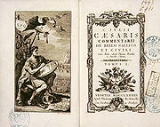
Commentarii de Bello Gallico

Encyclopedia
Commentarii de Bello Gallico (Commentaries on the Gallic War) is Julius Caesar
's firsthand account of the Gallic Wars
, written as a third-person narrative. In it Caesar describes the battles and intrigues that took place in the nine years he spent fighting local armies in Gaul
that opposed Roman
domination.
The "Gaul" that Caesar refers to is sometimes all of Gaul except for the Roman province of Gallia Narbonensis
(modern day Provence
), encompassing the rest of modern France
, Belgium
and some of Switzerland
. On other occasions, he refers only to that territory inhabited by the Celtic peoples known to the Romans as Gauls
, from the English Channel
to Lugdunum (Lyon
).
The work has been a mainstay in the teaching of Latin
to schoolchildren, its simple, direct prose lending itself to that purpose. It begins with the frequently quoted phrase "Gallia est omnis divisa in partes tres", sometimes quoted as "Omnia Gallia in tres partes divisa est", meaning "Gaul, taken as a whole, is divided into three parts". The full work is split into eight sections, Book 1 to Book 8, each varying in size from approximately 5,000 to 15,000 words. Book 8 was written by Aulus Hirtius
, after Caesar's death.
, one of Caesar's generals.
. The wealthiest man of the Helvetii, Orgetorix
, convinced his countrymen that they should leave their homeland (modern day Switzerland) because they are too constricted by the surrounding rivers and mountains. They concoct a plan to burn their homes and then make a mass exodus out of their homeland. When Caesar learns of their plan to cross over a Roman province, a great conflict arises pitting the Romans against the Helvetii. The Helvetii are defeated by the Romans, and end up back in Helvetia, their numbers greatly reduced.
Later in Book I, more problems arise surrounding a tribal conflict in Gaul. The Aedui
(allies of Rome) are engaged in a power struggle with two other tribes called the Arverni
and the Sequani
. The Arverni and Sequani decide to get help in their struggle from German mercenaries from across the Rhine, led by a king named Ariovistus
. At first the plan works because the German mercenaries help the Arverni and Sequani to oppress their enemy, the Aedui. But later the plan backfires as Ariovistus begins a violent takeover of the territory of the Arverni and Sequani, exercising a cruel tyranny over them. Caesar takes military action against Ariovistus for two reasons: first, because the Aedui are allies of Rome, and second, because Caesar wanted to stop the flow of Germans from across the Rhine into Gaul. Caesar moves his troops to Vesontio (modern Besançon
), the capital city of the Sequani. Ariovistus and Caesar conduct many negotiations, including an unusual face-to-face conference. Two days later, when Ariovistus requests to speak with Caesar again, Caesar instead sends C. Valerius Procillus who is taken captive by Ariovistus. When the battle between the Germans and the Romans finally commences, there is fierce hand-to-hand combat. The Romans defeat Ariovistus
, and Caesar is overjoyed to find and rescue C. Valerius Procillus, the envoy who had been captured earlier by Ariovistus.
, fearing the expansion of Roman military power in Gaul, begin to form a huge army to fight the Romans. The Remi, one of the Belgic tribes, breaks away from the Belgic conspiracy and offers its help to the Romans. This help from the Remi proves useful, as well as help from the Aedui (allies of Rome) in the form of cavalrymen. The military conflict that follows culminates in a huge battle with the toughest of all the Belgae, the Nervii
. After bloody fighting, the Romans are victorious.
wintering peacefully in the Alps between Italy and Gaul. Suddenly, the occupied tribes strike at the vulnerable Romans, posing a grave threat. But the Romans fight back, defeating the tribesmen. Later, the Veneti, a seafaring tribe on the western coast of Gaul, begin a rebellion against Rome. Breaking an important tradition, the Veneti capture and imprison the Roman envoys sent to them. This infuriates Caesar. The Veneti, because of their great experience as sailors, exercise great advantage over the Romans in naval battle. But the Romans eventually adapt and defeat the Veneti. Caesar, wishing to make an example of the Veneti for violating the customs of diplomacy by imprisoning the envoys, executes their chief nobles and sells the rest of them into slavery.
Later, Caesar makes arrangements for an assault on Britain. Although the Roman infantry successfully cross the English channel, the cavalry fail to cross, putting the Romans at a disadvantage. After being routed by the Romans, the Britons agree to submit to Caesar and disperse back into the countryside. But after a storm damages the Romans' ships and leaves them stranded in Britain without adequate supplies, the Britons decide to attack the Romans in their vulnerable state. The Britons initially catch the Romans off guard, but the Romans regroup and rout the Britons. When the Roman troops begin to cross back over to the continent, they are attacked by the Morini
, who are then defeated by the Romans.
). Caesar’s attention is momentarily diverted to Gallia Belgica as Indutiomarus
and Cingetorix
struggle for power over the Treveri
. Back at Port Itius, Caesar prepares to take many Gallic hostages with him to his British campaign so as to prevent revolts while he is gone. Among them is Dumnorix
, a rebellious noble of the Aedui
. Dumnorix violently opposes being taken over to Britain, and flees back to his homeland. Caesar stops all preparations while Dumnorix is hunted down and slain.
The Romans sail to Britain to begin their campaign. There are some skirmishes between the Romans and the Britons, and a storm destroys many of the Roman boats. The British tribes, although previously at war with one another, band together to face the Roman threat with Cassivellaunus
as their commander in chief. Caesar discovers the stronghold of Cassivellaunus near the Thames river and routs the Britons there. The Trinovantes
, a powerful tribe, offer to become Rome's allies, and several other British tribes follow suit. From these tribes Caesar learns the location of Cassivellaunus and successfully attacks him there. Cassivellaunus orders the tribes in Kent to attack the British ships, but they are defeated. Cassivellaunus surrenders to Caesar, enabling Caesar to quickly return to the continent before Winter arrives.
Because a drought has affected the grain supply, Caesar's troops must winter among the rebellious Belgic tribes. Roman troops, led by Q. Titurius Sabinus and L. Aurunculeius Cotta are wintering among the Eburones
when they are attacked by the Eburones, led by Ambiorix
and Cativolcus
. Ambiorix deceives the Romans by saying that the attack was made without his consent, and furthermore advises them to flee because a huge German army is coming from across the Rhine. After much discussion and disagreement, the Romans decide to trust Ambiorix and leave the next morning. As the Romans are marching away the next morning, the Eburones ambush them, killing most of the Romans. A few Roman survivors make it back to their winter quarters where they commit suicide that night.
Other Roman troops are wintering among the Nervii under Quintus Tullius Cicero
(brother of the famous orator). Ambiorix convinces the other Belgic tribes to immediately attack Cicero's camp. Cicero's troops are trapped, outnumbered, and can't call for help because their messengers are intercepted. The situation gets progressively more desperate for the Romans, but finally they are able to get a message to Caesar. Caesar summons the other Roman legions and rushes to Cicero's aid. When Caesar approaches Cicero’s camp, the Belgae abandon their siege of Cicero's camp and head toward Caesar’s troops. Caesar, vastly outnumbered, creates a ruse, ordering his troops to appear confused and frightened. The ruse works and entices the Belgae to attack on ground favorable to the Romans. Caesar's troops counterattack and put the Belgae to flight. That same day Caesar’s troops reach Cicero's camp finding most of the men wounded. Meanwhile, Indutiomarus
, a leader of the Treveri, begins to harass the camp of Labienus daily, until Labienus sends out cavalry for the express purpose of killing Indutiomarus. After killing Indutiomarus, the Roman cavalry routs the rest of Indutiomarus' army. Caesar personally stays in Gaul all winter due to the risk of unrest among the Gallic tribes.
. Meanwhile, the Treviri, angry over the death of Indutiomarus
, fervently try to arouse the Belgian and German peoples around them to fight the Romans. In response to this, Caesar lays waste to the territory of the Nervii
, neighbors of the Treviri. Caesar holds a council of Gaul, but the Senones, Carnutes, and Treviri do not send representatives. Caesar quickly marches to the territory of the Senones. Acco
, their leader, is forced to ask for pardon and give hostages to Caesar as collateral. This arrangement is acceptable to Caesar because he does not wish to pursue war with the Senones. Instead, he turns his attention to the Treveri and Ambiorix. Caesar lays waste to the territory of the Menapii, and they sue for peace. After warning them not to help Ambiorix, he heads toward the Treveri. The Treveri prepare to attack the camp of Labienus. Labienus, wishing to tempt the Treveri to attack in a situation favorable to the Romans, orders his men to break camp as though they are retreating. The ruse works, and the Treveri are drawn into battle and routed by the Romans.
Caesar decides to cross the Rhine again so that Ambiorix might not be able to receive help or quarter there. At this point in his commentary, Caesar gives a thorough description of Germanic culture, customs, and animals. After crossing the Rhine back into Gaul, Caesar sends troops ahead of him to surprise Ambiorix, but Ambiorix escapes. Ambiorix warns all the Eburones to flee to safety. Cativolcus, the aged king of one half of the Eburones
curses Ambiorix and commits suicide because he wishes neither to engage in war nor flee from his home.
Caesar establishes fortifications in several places within the territory of the Eburones. Engaging the Eburones because the difficult terrain of the area provides them with numerous opportunities to hide from the Romans. Caesar invites neighboring tribes to come and pillage and plunder the Eburones. The Sigambri, and Germanic tribe, come and take a large amount of cattle. Learning that all the Roman supplies and equipment are stored at Atuatuca, the Sigambri head there to try to capture it. Cicero, in charge of Atuatuca, is not supposed to let anybody out of the camp for the sake of security. But on the seventh day, thinking that it would not be dangerous, Cicero allows some troops to exit the camp to forage for food. At that very moment, the Sigambri arrive, throwing the Roman camp into a panic. Hampered by fear and surprise, the Romans suffer losses but eventually mount a defense. The Sigambri retreat, and Caesar arrives, complaining that the troops had not been kept within the camp, as he had ordered.
Caesar marches out again, gathering a large number of auxiliaries. They exert much effort to find Ambiorix, but he evades their grasp. After devastating the territory of the Eburones, Caesar holds a council of Gaul in which he investigates the rebellion of the Senones and Carnutes mentioned at the beginning of book six. Acco, the leader of the rebellion, is found guilty and put to death by Caesar.
Vercingetorix
tells his troops that they must adopt a new strategy: burn all the towns and crops in the area so as to starve the Romans. The Gauls burn all the towns of the Bituriges except Avaricum, which they decide to defend. Near Avaricum, Vercingetorix camps near Caesar and inflicts heavy losses on Romans as they forage for food. The Romans ask their Gallic allies for food, but this accomplishes little and the Romans suffer from lack of food. The Romans lay siege to Avaricum. After twenty-five grueling days of constructing siege works under great stress, the Romans attack and trap the Gauls in the town. The Romans slaughter almost all of the Gauls within the town, causing a huge loss for the Gauls.
Caesar then sets out for the town of Gergovia. He builds elaborate siege works with the intention of completely encircling and starving the Gauls inside. Caesar is distracted from the siege by betrayal from his Gallic allies the Aedui, led by Litaviccus whom he fought and defeated after a desperate struggle. Caesar then went back to Gergovia and realised that his siege would fail. He creates a false retreat to lure Vercingetorix into battle, but this fails and the Romans are defeated by Vercingetorix.
Labienus battles the Parisii, and the entire Gallic war becomes more dangerous as the Aedui, Rome's longtime allies, revolt and try to induce other tribes to revolt as well. After Vercingetorix's cavalry is defeated in a skirmish with the Romans, he moves his forces to the town of Alesia. Caesar builds a circumvallation around the town to lay siege to it but Vercingetorix had summoned his Gallic allies to attack the besieging Romans, so Caesar built another outer fortification, a contravallation, against the expected relief armies (resulting in a doughnut-shaped fortification). Since Vercingetorix was inside Alesia, the Gauls attacking from the outside were without his leadership. However, the attacks did reveal a weak point in the fortifications and the combined forces on the inside and the outside almost made a breakthrough. Only when Caesar personally led the last reserves into battle did he finally manage to prevail, leading to the surrender of Vercingetorix.
, Caesar learns that several tribes are planning a revolt. After quelling a rebellion among the Bituriges, Caesar rewards his troops with large monetary bonuses. The Romans stop the Carnutes from waging war against the Bituriges. The Bellovaci, a Belgic tribe, raise an army and begin to wage war against the Suessiones who are under the patronage of the Remi, allies of Rome. The Bellovaci try to get other tribes to join in their rebellion. Caesar campaigns against them and defeats them. Caesar lays waste to the territory of the Eburones. Labienus wages war against the Treviri. The Romans quell a revolt among the Pictones.
Drapes, a Senonian, gathers troops, joins with Luterius, a Cadurcian, and tries to attack the Roman province in the southern part of Gaul called Gallia Narbonensis. Drapes and Luterius stop at a town called Uxellodunum
which is strongly fortified by its geography. After a bloody conflict, the Romans defeat them by cutting off the supply of water to the town.
Labienus defeats the Treveri and captures their leaders. Caesar goes to Aquitania to assure the loyalty of the tribes there. Caesar puts his legions in winter quarters among various tribes of Gaul. While Caesar is in winter quarters among the Belgae, Commius
the Atrebatian begins to harass the Romans by attacking their convoys. The Romans defeat Commius.
Since Caesar's term of office in Gaul is almost over, he does not wish to get involved in another war just as he is finishing his term. Therefore he tries to ensure peace by treating all the Gauls respectfully and giving gifts to the leading men of Gaul. Caesar travels to Italy in order to encourage the people to vote for Mark Antony, his close associate, for the office of augur. Some of Caesar's political opponents want to prevent Mark Antony from being elected simply as a way to oppose Caesar. While en route to Italy, Caesar hears that Mark Antony has already been elected as augur, and the townspeople give Caesar a generous and celebratory welcome.
Within the senate there is division between the supporters of Caesar and supporters of Pompey. Some worry about Caesar and Pompey having such powerful armies. The Senate passes a decree that Pompey and Caesar should each contribute one legion to the Parthian
war in the East. But in reality Caesar actually ends up contributing both of them. The legion that Pompey contributes is his in name only, because it was enlisted in Caesar's territory, and then Caesar contributed another legion that had been with him previously in Gaul. So the levy of troops in reality took away two legions from Caesar. When these two legions were delivered to Italy, instead of being sent to fight against the Parthians, they remained in Italy and were handed over to Pompey. This act made it obvious that Caesar's opponents were planning to wage war against him.
, and doubt and suspicion were beginning to spread among the plebeians, on whom he chiefly relied for help in carrying out his designs. When public opinion
was evidently taking the side of the Gauls and Germans, the time had come for Caesar to act on public opinion. His commentaries were a hasty compilation made from notes jotted down in his tent or during a journey. Their truthfulness cannot be decided absolutely, the Gauls not having written their commentaries, but if Caesar sinned in this respect, it was probably by omission, not by commission. Things the Romans might not like he does not mention: a major aim of the book was to gain their suffrages. For example, there is no allusion to the enormous fortune Caesar acquired by plunder.
. This book is traditionally the first authentic text assigned to students of Latin, as Xenophon
's Anabasis
is for students of Ancient Greek; they are both autobiographical tales of military adventure told in the third person. The style is simple and elegant, essential and not rhetorical. It contains many details and employs many stylistic devices to promote Caesar's political interests.
Also, the books are valuable for the many geographical and historical facts that can be retrieved from the work. Notable chapters describe Gaulish costume (VI, 13), their religion (VI, 17), a comparison between Gauls and Germanic peoples (VI, 24) and other curious notes such as the lack of Germanic interest in agriculture
(VI, 22).
included gags for French schoolchildren who had the Commentarii as a textbook. One example is having Caesar talk about himself in the third person as in the book.
Some English editions state that Astérix's village of indomitable Gauls is the "fourth part" of Gaul, not yet having been conquered by Caesar.
and Titus Pullo
, two Roman
centurion
s of the 11th Legion
. The 2005 television series Rome
gives a fictionalized account of Caesar's rise and fall, featuring Kevin McKidd
as the character of Lucius Vorenus
and Ray Stevenson
as the character of Titus Pullo
.
Julius Caesar
Gaius Julius Caesar was a Roman general and statesman and a distinguished writer of Latin prose. He played a critical role in the gradual transformation of the Roman Republic into the Roman Empire....
's firsthand account of the Gallic Wars
Gallic Wars
The Gallic Wars were a series of military campaigns waged by the Roman proconsul Julius Caesar against several Gallic tribes. They lasted from 58 BC to 51 BC. The Gallic Wars culminated in the decisive Battle of Alesia in 52 BC, in which a complete Roman victory resulted in the expansion of the...
, written as a third-person narrative. In it Caesar describes the battles and intrigues that took place in the nine years he spent fighting local armies in Gaul
Gaul
Gaul was a region of Western Europe during the Iron Age and Roman era, encompassing present day France, Luxembourg and Belgium, most of Switzerland, the western part of Northern Italy, as well as the parts of the Netherlands and Germany on the left bank of the Rhine. The Gauls were the speakers of...
that opposed Roman
Ancient Rome
Ancient Rome was a thriving civilization that grew on the Italian Peninsula as early as the 8th century BC. Located along the Mediterranean Sea and centered on the city of Rome, it expanded to one of the largest empires in the ancient world....
domination.
The "Gaul" that Caesar refers to is sometimes all of Gaul except for the Roman province of Gallia Narbonensis
Gallia Narbonensis
Gallia Narbonensis was a Roman province located in what is now Languedoc and Provence, in southern France. It was also known as Gallia Transalpina , which was originally a designation for that part of Gaul lying across the Alps from Italia and it contained a western region known as Septimania...
(modern day Provence
Provence
Provence ; Provençal: Provença in classical norm or Prouvènço in Mistralian norm) is a region of south eastern France on the Mediterranean adjacent to Italy. It is part of the administrative région of Provence-Alpes-Côte d'Azur...
), encompassing the rest of modern France
France
The French Republic , The French Republic , The French Republic , (commonly known as France , is a unitary semi-presidential republic in Western Europe with several overseas territories and islands located on other continents and in the Indian, Pacific, and Atlantic oceans. Metropolitan France...
, Belgium
Belgium
Belgium , officially the Kingdom of Belgium, is a federal state in Western Europe. It is a founding member of the European Union and hosts the EU's headquarters, and those of several other major international organisations such as NATO.Belgium is also a member of, or affiliated to, many...
and some of Switzerland
Switzerland
Switzerland name of one of the Swiss cantons. ; ; ; or ), in its full name the Swiss Confederation , is a federal republic consisting of 26 cantons, with Bern as the seat of the federal authorities. The country is situated in Western Europe,Or Central Europe depending on the definition....
. On other occasions, he refers only to that territory inhabited by the Celtic peoples known to the Romans as Gauls
Gauls
The Gauls were a Celtic people living in Gaul, the region roughly corresponding to what is now France, Belgium, Switzerland and Northern Italy, from the Iron Age through the Roman period. They mostly spoke the Continental Celtic language called Gaulish....
, from the English Channel
English Channel
The English Channel , often referred to simply as the Channel, is an arm of the Atlantic Ocean that separates southern England from northern France, and joins the North Sea to the Atlantic. It is about long and varies in width from at its widest to in the Strait of Dover...
to Lugdunum (Lyon
Lyon
Lyon , is a city in east-central France in the Rhône-Alpes region, situated between Paris and Marseille. Lyon is located at from Paris, from Marseille, from Geneva, from Turin, and from Barcelona. The residents of the city are called Lyonnais....
).
The work has been a mainstay in the teaching of Latin
Latin
Latin is an Italic language originally spoken in Latium and Ancient Rome. It, along with most European languages, is a descendant of the ancient Proto-Indo-European language. Although it is considered a dead language, a number of scholars and members of the Christian clergy speak it fluently, and...
to schoolchildren, its simple, direct prose lending itself to that purpose. It begins with the frequently quoted phrase "Gallia est omnis divisa in partes tres", sometimes quoted as "Omnia Gallia in tres partes divisa est", meaning "Gaul, taken as a whole, is divided into three parts". The full work is split into eight sections, Book 1 to Book 8, each varying in size from approximately 5,000 to 15,000 words. Book 8 was written by Aulus Hirtius
Aulus Hirtius
Aulus Hirtius was one of the consuls of the Roman Republic and a writer on military subjects.He was known to have been a legate of Julius Caesar's starting around 54 BC and served as an envoy to Pompey in 50. During the Roman Civil Wars he served in Spain, he might have been a tribune in 48, and...
, after Caesar's death.
Title
The Latin title, literally Commentaries about the Gallic War, is often retained in English translations of the book, and the title is also translated to About the Gallic War, Of the Gallic War, On the Gallic War, The Conquest of Gaul, and The Gallic War.Contents
De Bello Gallico consists of eight books: seven written by Caesar himself, and the eighth book added later by Aulus HirtiusAulus Hirtius
Aulus Hirtius was one of the consuls of the Roman Republic and a writer on military subjects.He was known to have been a legate of Julius Caesar's starting around 54 BC and served as an envoy to Pompey in 50. During the Roman Civil Wars he served in Spain, he might have been a tribune in 48, and...
, one of Caesar's generals.
Book I
In Book I, Caesar describes a conflict with the Gallic tribe known as the HelvetiiHelvetii
The Helvetii were a Celtic tribe or tribal confederation occupying most of the Swiss plateau at the time of their contact with the Roman Republic in the 1st century BC...
. The wealthiest man of the Helvetii, Orgetorix
Orgetorix
Orgetorix was a wealthy aristocrat among the Helvetii, a Celtic-speaking people residing in what is now Switzerland during the consulship of Julius Caesar of the Roman Republic. In 61 BC he convinced the Helvetians to attempt to migrate from Helvetian territory to south-western Gaul...
, convinced his countrymen that they should leave their homeland (modern day Switzerland) because they are too constricted by the surrounding rivers and mountains. They concoct a plan to burn their homes and then make a mass exodus out of their homeland. When Caesar learns of their plan to cross over a Roman province, a great conflict arises pitting the Romans against the Helvetii. The Helvetii are defeated by the Romans, and end up back in Helvetia, their numbers greatly reduced.
Later in Book I, more problems arise surrounding a tribal conflict in Gaul. The Aedui
Aedui
Aedui, Haedui or Hedui , were a Gallic people of Gallia Lugdunensis, who inhabited the country between the Arar and Liger , in today's France. Their territory thus included the greater part of the modern departments of Saône-et-Loire, Côte-d'Or and Nièvre.-Geography:The country of the Aedui is...
(allies of Rome) are engaged in a power struggle with two other tribes called the Arverni
Arverni
The Arverni were a Gallic tribe living in what is now the Auvergne region of France during the last centuries BC. One of the most powerful tribes in ancient Gaul, they opposed the Romans on several occasions...
and the Sequani
Sequani
Sequani, in ancient geography, were a Gallic people who occupied the upper river basin of the Arar , the valley of the Doubs and the Jura Mountains, their territory corresponding to Franche-Comté and part of Burgundy.-Etymology:...
. The Arverni and Sequani decide to get help in their struggle from German mercenaries from across the Rhine, led by a king named Ariovistus
Ariovistus
Ariovistus was a leader of the Suebi and other allied Germanic peoples in the second quarter of the 1st century BC. He and his followers took part in a war in Gaul, assisting the Arverni and Sequani to defeat their rivals the Aedui, after which they settled in large numbers in conquered Gallic...
. At first the plan works because the German mercenaries help the Arverni and Sequani to oppress their enemy, the Aedui. But later the plan backfires as Ariovistus begins a violent takeover of the territory of the Arverni and Sequani, exercising a cruel tyranny over them. Caesar takes military action against Ariovistus for two reasons: first, because the Aedui are allies of Rome, and second, because Caesar wanted to stop the flow of Germans from across the Rhine into Gaul. Caesar moves his troops to Vesontio (modern Besançon
Besançon
Besançon , is the capital and principal city of the Franche-Comté region in eastern France. It had a population of about 237,000 inhabitants in the metropolitan area in 2008...
), the capital city of the Sequani. Ariovistus and Caesar conduct many negotiations, including an unusual face-to-face conference. Two days later, when Ariovistus requests to speak with Caesar again, Caesar instead sends C. Valerius Procillus who is taken captive by Ariovistus. When the battle between the Germans and the Romans finally commences, there is fierce hand-to-hand combat. The Romans defeat Ariovistus
Ariovistus
Ariovistus was a leader of the Suebi and other allied Germanic peoples in the second quarter of the 1st century BC. He and his followers took part in a war in Gaul, assisting the Arverni and Sequani to defeat their rivals the Aedui, after which they settled in large numbers in conquered Gallic...
, and Caesar is overjoyed to find and rescue C. Valerius Procillus, the envoy who had been captured earlier by Ariovistus.
Book II
In Book II, the BelgaeBelgae
The Belgae were a group of tribes living in northern Gaul, on the west bank of the Rhine, in the 3rd century BC, and later also in Britain, and possibly even Ireland...
, fearing the expansion of Roman military power in Gaul, begin to form a huge army to fight the Romans. The Remi, one of the Belgic tribes, breaks away from the Belgic conspiracy and offers its help to the Romans. This help from the Remi proves useful, as well as help from the Aedui (allies of Rome) in the form of cavalrymen. The military conflict that follows culminates in a huge battle with the toughest of all the Belgae, the Nervii
Nervii
The Nervii were an ancient Germanic tribe, and one of the most powerful Belgic tribes; living in the northeastern hinterlands of Gaul, they were known to trek long distances to engage in various wars and functions...
. After bloody fighting, the Romans are victorious.
Book III
Book III begins with some Roman troops under Servius GalbaGalba
Galba , was Roman Emperor for seven months from 68 to 69. Galba was the governor of Hispania Tarraconensis, and made a bid for the throne during the rebellion of Julius Vindex...
wintering peacefully in the Alps between Italy and Gaul. Suddenly, the occupied tribes strike at the vulnerable Romans, posing a grave threat. But the Romans fight back, defeating the tribesmen. Later, the Veneti, a seafaring tribe on the western coast of Gaul, begin a rebellion against Rome. Breaking an important tradition, the Veneti capture and imprison the Roman envoys sent to them. This infuriates Caesar. The Veneti, because of their great experience as sailors, exercise great advantage over the Romans in naval battle. But the Romans eventually adapt and defeat the Veneti. Caesar, wishing to make an example of the Veneti for violating the customs of diplomacy by imprisoning the envoys, executes their chief nobles and sells the rest of them into slavery.
Book IV
The Suebi, an enormous German tribe, have a reputation for physical toughness and military prowess. Two other smaller German tribes, the Usipetes and Tencteri, are tired of being oppressed by the Suebi so they decide to go west, crossing the Rhine and moving into the territory of the Belgae (more specifically the Menapii). Caesar quickly arrives with Roman troops. The Germans try repeatedly to bargain with Caesar but to no avail. After settling on a temporary truce, the Germans unexpectedly attack the Romans, causing casualties. Caesar considers this to be an act of treachery, and decides to break off any further negotiations with the Germans. The next day, the Germans send a large number of their leaders and elders to negotiate with Caesar. Caesar, expecting further treachery, takes these Germans prisoner. He attacks and defeats the remaining Germans who are disadvantaged by the absence of their leadership. As a show of force, Caesar constructs a sturdy wooden bridge across the Rhine and crosses into German territory, alarming the Germans.Later, Caesar makes arrangements for an assault on Britain. Although the Roman infantry successfully cross the English channel, the cavalry fail to cross, putting the Romans at a disadvantage. After being routed by the Romans, the Britons agree to submit to Caesar and disperse back into the countryside. But after a storm damages the Romans' ships and leaves them stranded in Britain without adequate supplies, the Britons decide to attack the Romans in their vulnerable state. The Britons initially catch the Romans off guard, but the Romans regroup and rout the Britons. When the Roman troops begin to cross back over to the continent, they are attacked by the Morini
Morini
The Morini were a Belgic tribe in the time of the Roman Empire. We know little about their language but one of their cities, Boulogne-sur-Mer was called Bononia by Zosimus and Bonen in the Middle Ages. Zosimus mentioned the Low Germanic character of the city...
, who are then defeated by the Romans.
Book V
Caesar commands that as many boats as possible be prepared during the winter for a campaign against Britain in the Spring. He orders all boats to assemble at Portus Itius (near modern day Boulogne-sur-MerBoulogne-sur-Mer
-Road:* Metropolitan bus services are operated by the TCRB* Coach services to Calais and Dunkerque* A16 motorway-Rail:* The main railway station is Gare de Boulogne-Ville and located in the south of the city....
). Caesar’s attention is momentarily diverted to Gallia Belgica as Indutiomarus
Indutiomarus
Indutiomarus was a leading aristocrat of the Treveri at the time of Caesar's conquest of Gaul...
and Cingetorix
Cingetorix
Cingetorix, meaning "marching king" or "king of warriors", is a Celtic name borne by two chieftains of the 1st century BC, as related by Julius Caesar in his De Bello Gallico:...
struggle for power over the Treveri
Treveri
The Treveri or Treviri were a tribe of Gauls who inhabited the lower valley of the Moselle from around 150 BCE, at the latest, until their eventual absorption into the Franks...
. Back at Port Itius, Caesar prepares to take many Gallic hostages with him to his British campaign so as to prevent revolts while he is gone. Among them is Dumnorix
Dumnorix
Dumnorix was a chieftain of the Aedui, a Celtic tribe in Gaul in the 1st century B.C. He was strongly against alliance with the Romans, particularly Julius Caesar, who sparred with him on several occasions...
, a rebellious noble of the Aedui
Aedui
Aedui, Haedui or Hedui , were a Gallic people of Gallia Lugdunensis, who inhabited the country between the Arar and Liger , in today's France. Their territory thus included the greater part of the modern departments of Saône-et-Loire, Côte-d'Or and Nièvre.-Geography:The country of the Aedui is...
. Dumnorix violently opposes being taken over to Britain, and flees back to his homeland. Caesar stops all preparations while Dumnorix is hunted down and slain.
The Romans sail to Britain to begin their campaign. There are some skirmishes between the Romans and the Britons, and a storm destroys many of the Roman boats. The British tribes, although previously at war with one another, band together to face the Roman threat with Cassivellaunus
Cassivellaunus
Cassivellaunus was an historical British chieftain who led the defence against Julius Caesar's second expedition to Britain in 54 BC. The first British person whose name is recorded, Cassivellaunus led an alliance of tribes against Roman forces, but eventually surrendered after his location was...
as their commander in chief. Caesar discovers the stronghold of Cassivellaunus near the Thames river and routs the Britons there. The Trinovantes
Trinovantes
The Trinovantes or Trinobantes were one of the tribes of pre-Roman Britain. Their territory was on the north side of the Thames estuary in current Essex and Suffolk, and included lands now located in Greater London. They were bordered to the north by the Iceni, and to the west by the Catuvellauni...
, a powerful tribe, offer to become Rome's allies, and several other British tribes follow suit. From these tribes Caesar learns the location of Cassivellaunus and successfully attacks him there. Cassivellaunus orders the tribes in Kent to attack the British ships, but they are defeated. Cassivellaunus surrenders to Caesar, enabling Caesar to quickly return to the continent before Winter arrives.
Because a drought has affected the grain supply, Caesar's troops must winter among the rebellious Belgic tribes. Roman troops, led by Q. Titurius Sabinus and L. Aurunculeius Cotta are wintering among the Eburones
Eburones
The Eburones , were a Belgic people who lived in the northeast of Gaul, near the river Meuse and the modern provinces of Belgian and Dutch Limburg, in the period immediately before it was conquered by Rome. They played a major role in Julius Caesar's account of his "Gallic Wars", as the most...
when they are attacked by the Eburones, led by Ambiorix
Ambiorix
Ambiorix was, together with Catuvolcus, prince of the Eburones, leader of a Belgic tribe of north-eastern Gaul , where modern Belgium is located...
and Cativolcus
Cativolcus
Cativolcus or Catuvolcus was king of half of the country of the Eburones, a people between the Meuse and Rhine rivers, united with Ambiorix, the other king, in the insurrection against the Romans in 54 BC; but when Julius Caesar in the next year proceeded to devastate the territories of the...
. Ambiorix deceives the Romans by saying that the attack was made without his consent, and furthermore advises them to flee because a huge German army is coming from across the Rhine. After much discussion and disagreement, the Romans decide to trust Ambiorix and leave the next morning. As the Romans are marching away the next morning, the Eburones ambush them, killing most of the Romans. A few Roman survivors make it back to their winter quarters where they commit suicide that night.
Other Roman troops are wintering among the Nervii under Quintus Tullius Cicero
Quintus Tullius Cicero
Quintus Tullius Cicero was the younger brother of the celebrated orator, philosopher and statesman Marcus Tullius Cicero. He was born into a family of the equestrian order, as the son of a wealthy landowner in Arpinum, some 100 kilometres south-east of Rome.- Biography :Cicero's well-to-do father...
(brother of the famous orator). Ambiorix convinces the other Belgic tribes to immediately attack Cicero's camp. Cicero's troops are trapped, outnumbered, and can't call for help because their messengers are intercepted. The situation gets progressively more desperate for the Romans, but finally they are able to get a message to Caesar. Caesar summons the other Roman legions and rushes to Cicero's aid. When Caesar approaches Cicero’s camp, the Belgae abandon their siege of Cicero's camp and head toward Caesar’s troops. Caesar, vastly outnumbered, creates a ruse, ordering his troops to appear confused and frightened. The ruse works and entices the Belgae to attack on ground favorable to the Romans. Caesar's troops counterattack and put the Belgae to flight. That same day Caesar’s troops reach Cicero's camp finding most of the men wounded. Meanwhile, Indutiomarus
Indutiomarus
Indutiomarus was a leading aristocrat of the Treveri at the time of Caesar's conquest of Gaul...
, a leader of the Treveri, begins to harass the camp of Labienus daily, until Labienus sends out cavalry for the express purpose of killing Indutiomarus. After killing Indutiomarus, the Roman cavalry routs the rest of Indutiomarus' army. Caesar personally stays in Gaul all winter due to the risk of unrest among the Gallic tribes.
Book VI
Caesar enlists a large number of new troops to replace the ones lost the previous year when the forces of Q. Titurius Sabinus and L. Aurunculeius Cotta were slain by the forces of AmbiorixAmbiorix
Ambiorix was, together with Catuvolcus, prince of the Eburones, leader of a Belgic tribe of north-eastern Gaul , where modern Belgium is located...
. Meanwhile, the Treviri, angry over the death of Indutiomarus
Indutiomarus
Indutiomarus was a leading aristocrat of the Treveri at the time of Caesar's conquest of Gaul...
, fervently try to arouse the Belgian and German peoples around them to fight the Romans. In response to this, Caesar lays waste to the territory of the Nervii
Nervii
The Nervii were an ancient Germanic tribe, and one of the most powerful Belgic tribes; living in the northeastern hinterlands of Gaul, they were known to trek long distances to engage in various wars and functions...
, neighbors of the Treviri. Caesar holds a council of Gaul, but the Senones, Carnutes, and Treviri do not send representatives. Caesar quickly marches to the territory of the Senones. Acco
Acco
Acco was a chief of the Senones in Gaul, who induced his countrymen to revolt against Julius Caesar in 53 BC. On the conclusion of the war, and after a conference at Durocortorum, Caesar had Acco tried and convicted on charges of treason. As punishment, he was flogged to death in the full sight...
, their leader, is forced to ask for pardon and give hostages to Caesar as collateral. This arrangement is acceptable to Caesar because he does not wish to pursue war with the Senones. Instead, he turns his attention to the Treveri and Ambiorix. Caesar lays waste to the territory of the Menapii, and they sue for peace. After warning them not to help Ambiorix, he heads toward the Treveri. The Treveri prepare to attack the camp of Labienus. Labienus, wishing to tempt the Treveri to attack in a situation favorable to the Romans, orders his men to break camp as though they are retreating. The ruse works, and the Treveri are drawn into battle and routed by the Romans.
Caesar decides to cross the Rhine again so that Ambiorix might not be able to receive help or quarter there. At this point in his commentary, Caesar gives a thorough description of Germanic culture, customs, and animals. After crossing the Rhine back into Gaul, Caesar sends troops ahead of him to surprise Ambiorix, but Ambiorix escapes. Ambiorix warns all the Eburones to flee to safety. Cativolcus, the aged king of one half of the Eburones
Eburones
The Eburones , were a Belgic people who lived in the northeast of Gaul, near the river Meuse and the modern provinces of Belgian and Dutch Limburg, in the period immediately before it was conquered by Rome. They played a major role in Julius Caesar's account of his "Gallic Wars", as the most...
curses Ambiorix and commits suicide because he wishes neither to engage in war nor flee from his home.
Caesar establishes fortifications in several places within the territory of the Eburones. Engaging the Eburones because the difficult terrain of the area provides them with numerous opportunities to hide from the Romans. Caesar invites neighboring tribes to come and pillage and plunder the Eburones. The Sigambri, and Germanic tribe, come and take a large amount of cattle. Learning that all the Roman supplies and equipment are stored at Atuatuca, the Sigambri head there to try to capture it. Cicero, in charge of Atuatuca, is not supposed to let anybody out of the camp for the sake of security. But on the seventh day, thinking that it would not be dangerous, Cicero allows some troops to exit the camp to forage for food. At that very moment, the Sigambri arrive, throwing the Roman camp into a panic. Hampered by fear and surprise, the Romans suffer losses but eventually mount a defense. The Sigambri retreat, and Caesar arrives, complaining that the troops had not been kept within the camp, as he had ordered.
Caesar marches out again, gathering a large number of auxiliaries. They exert much effort to find Ambiorix, but he evades their grasp. After devastating the territory of the Eburones, Caesar holds a council of Gaul in which he investigates the rebellion of the Senones and Carnutes mentioned at the beginning of book six. Acco, the leader of the rebellion, is found guilty and put to death by Caesar.
Book VII
While Caesar is in Italy, he decides to enlist more troops because of political disturbances in Rome. When the Gauls hear of this, they conspire to rebel and prevent Caesar from returning to his troops stationed in Gaul. The Carnutes take the lead in this endeavor, slaughtering and plundering the Roman citizens at Cenabum. Vercingetorix, a young nobleman of the Arverni, gathers troops, and with the support of neighboring tribes is given supreme command of the Gallic armies. At first the Bituriges resist, but then join forces with the Arverni. As more and more Gallic tribes join the rebellion, Caesar reaches his armies in Narbo and begins to move them toward the territory of the Arverni. Caesar surprises the Arverni by arriving in their territory unexpectedly after clearing a path through deep snow. Caesar moves quickly to rendezvous with his legions wintering among the Lingones before Vercingetorix can realize what is happening. Vercingetorix decides to attack Gergovia, a town of the Boii who are allies of Rome. Caesar pillages and burns Cenabum, the town attacked earlier by the Carnutes.Vercingetorix
Vercingetorix
Vercingetorix was the chieftain of the Arverni tribe, who united the Gauls in an ultimately unsuccessful revolt against Roman forces during the last phase of Julius Caesar's Gallic Wars....
tells his troops that they must adopt a new strategy: burn all the towns and crops in the area so as to starve the Romans. The Gauls burn all the towns of the Bituriges except Avaricum, which they decide to defend. Near Avaricum, Vercingetorix camps near Caesar and inflicts heavy losses on Romans as they forage for food. The Romans ask their Gallic allies for food, but this accomplishes little and the Romans suffer from lack of food. The Romans lay siege to Avaricum. After twenty-five grueling days of constructing siege works under great stress, the Romans attack and trap the Gauls in the town. The Romans slaughter almost all of the Gauls within the town, causing a huge loss for the Gauls.
Caesar then sets out for the town of Gergovia. He builds elaborate siege works with the intention of completely encircling and starving the Gauls inside. Caesar is distracted from the siege by betrayal from his Gallic allies the Aedui, led by Litaviccus whom he fought and defeated after a desperate struggle. Caesar then went back to Gergovia and realised that his siege would fail. He creates a false retreat to lure Vercingetorix into battle, but this fails and the Romans are defeated by Vercingetorix.
Labienus battles the Parisii, and the entire Gallic war becomes more dangerous as the Aedui, Rome's longtime allies, revolt and try to induce other tribes to revolt as well. After Vercingetorix's cavalry is defeated in a skirmish with the Romans, he moves his forces to the town of Alesia. Caesar builds a circumvallation around the town to lay siege to it but Vercingetorix had summoned his Gallic allies to attack the besieging Romans, so Caesar built another outer fortification, a contravallation, against the expected relief armies (resulting in a doughnut-shaped fortification). Since Vercingetorix was inside Alesia, the Gauls attacking from the outside were without his leadership. However, the attacks did reveal a weak point in the fortifications and the combined forces on the inside and the outside almost made a breakthrough. Only when Caesar personally led the last reserves into battle did he finally manage to prevail, leading to the surrender of Vercingetorix.
Book VIII
While in winter quarters in BibracteBibracte
Bibracte, a Gaulish oppidum or fortified city, was the capital of the Aedui and one of the most important hillforts in Gaul. It was situated near modern Autun in Burgundy, France. The material culture of the Aedui corresponded to the Late Iron Age La Tène culture,In 58 BC, at the Battle of...
, Caesar learns that several tribes are planning a revolt. After quelling a rebellion among the Bituriges, Caesar rewards his troops with large monetary bonuses. The Romans stop the Carnutes from waging war against the Bituriges. The Bellovaci, a Belgic tribe, raise an army and begin to wage war against the Suessiones who are under the patronage of the Remi, allies of Rome. The Bellovaci try to get other tribes to join in their rebellion. Caesar campaigns against them and defeats them. Caesar lays waste to the territory of the Eburones. Labienus wages war against the Treviri. The Romans quell a revolt among the Pictones.
Drapes, a Senonian, gathers troops, joins with Luterius, a Cadurcian, and tries to attack the Roman province in the southern part of Gaul called Gallia Narbonensis. Drapes and Luterius stop at a town called Uxellodunum
Uxellodunum
Uxellodunum is an iron age hill fort, or oppidum, located above the river Dordogne near the modern-day French village of Vayrac in the Lot department. This stronghold lay within the lands of the Cadurci tribe...
which is strongly fortified by its geography. After a bloody conflict, the Romans defeat them by cutting off the supply of water to the town.
Labienus defeats the Treveri and captures their leaders. Caesar goes to Aquitania to assure the loyalty of the tribes there. Caesar puts his legions in winter quarters among various tribes of Gaul. While Caesar is in winter quarters among the Belgae, Commius
Commius
Commius was a historical king of the Belgic nation of the Atrebates, initially in Gaul, then in Britain, in the 1st century BC.-Ally of Caesar:...
the Atrebatian begins to harass the Romans by attacking their convoys. The Romans defeat Commius.
Since Caesar's term of office in Gaul is almost over, he does not wish to get involved in another war just as he is finishing his term. Therefore he tries to ensure peace by treating all the Gauls respectfully and giving gifts to the leading men of Gaul. Caesar travels to Italy in order to encourage the people to vote for Mark Antony, his close associate, for the office of augur. Some of Caesar's political opponents want to prevent Mark Antony from being elected simply as a way to oppose Caesar. While en route to Italy, Caesar hears that Mark Antony has already been elected as augur, and the townspeople give Caesar a generous and celebratory welcome.
Within the senate there is division between the supporters of Caesar and supporters of Pompey. Some worry about Caesar and Pompey having such powerful armies. The Senate passes a decree that Pompey and Caesar should each contribute one legion to the Parthian
Parthia
Parthia is a region of north-eastern Iran, best known for having been the political and cultural base of the Arsacid dynasty, rulers of the Parthian Empire....
war in the East. But in reality Caesar actually ends up contributing both of them. The legion that Pompey contributes is his in name only, because it was enlisted in Caesar's territory, and then Caesar contributed another legion that had been with him previously in Gaul. So the levy of troops in reality took away two legions from Caesar. When these two legions were delivered to Italy, instead of being sent to fight against the Parthians, they remained in Italy and were handed over to Pompey. This act made it obvious that Caesar's opponents were planning to wage war against him.
Motivations
The victories in Gaul won by Caesar had increased the alarm and hostility of his enemies at RomeAncient Rome
Ancient Rome was a thriving civilization that grew on the Italian Peninsula as early as the 8th century BC. Located along the Mediterranean Sea and centered on the city of Rome, it expanded to one of the largest empires in the ancient world....
, and doubt and suspicion were beginning to spread among the plebeians, on whom he chiefly relied for help in carrying out his designs. When public opinion
Public opinion
Public opinion is the aggregate of individual attitudes or beliefs held by the adult population. Public opinion can also be defined as the complex collection of opinions of many different people and the sum of all their views....
was evidently taking the side of the Gauls and Germans, the time had come for Caesar to act on public opinion. His commentaries were a hasty compilation made from notes jotted down in his tent or during a journey. Their truthfulness cannot be decided absolutely, the Gauls not having written their commentaries, but if Caesar sinned in this respect, it was probably by omission, not by commission. Things the Romans might not like he does not mention: a major aim of the book was to gain their suffrages. For example, there is no allusion to the enormous fortune Caesar acquired by plunder.
Educational use
It is often lauded for its polished, clear LatinLatin
Latin is an Italic language originally spoken in Latium and Ancient Rome. It, along with most European languages, is a descendant of the ancient Proto-Indo-European language. Although it is considered a dead language, a number of scholars and members of the Christian clergy speak it fluently, and...
. This book is traditionally the first authentic text assigned to students of Latin, as Xenophon
Xenophon
Xenophon , son of Gryllus, of the deme Erchia of Athens, also known as Xenophon of Athens, was a Greek historian, soldier, mercenary, philosopher and a contemporary and admirer of Socrates...
's Anabasis
Anabasis (Xenophon)
Anabasis is the most famous work, in seven books, of the Greek professional soldier and writer Xenophon. The journey it narrates is his best known accomplishment and "one of the great adventures in human history," as Will Durant expressed the common assessment.- The account :Xenophon accompanied...
is for students of Ancient Greek; they are both autobiographical tales of military adventure told in the third person. The style is simple and elegant, essential and not rhetorical. It contains many details and employs many stylistic devices to promote Caesar's political interests.
Also, the books are valuable for the many geographical and historical facts that can be retrieved from the work. Notable chapters describe Gaulish costume (VI, 13), their religion (VI, 17), a comparison between Gauls and Germanic peoples (VI, 24) and other curious notes such as the lack of Germanic interest in agriculture
Agriculture
Agriculture is the cultivation of animals, plants, fungi and other life forms for food, fiber, and other products used to sustain life. Agriculture was the key implement in the rise of sedentary human civilization, whereby farming of domesticated species created food surpluses that nurtured the...
(VI, 22).
Astérix
Since Caesar is one of the characters in the Astérix and Obélix albums, René GoscinnyRené Goscinny
René Goscinny was a French comics editor and writer, who is best known for the comic book Astérix, which he created with illustrator Albert Uderzo, and for his work on the comic series Lucky Luke with Morris and Iznogoud with Jean Tabary.-Early life:Goscinny was born in Paris in 1926, to a family...
included gags for French schoolchildren who had the Commentarii as a textbook. One example is having Caesar talk about himself in the third person as in the book.
Some English editions state that Astérix's village of indomitable Gauls is the "fourth part" of Gaul, not yet having been conquered by Caesar.
Vorenus and Pullo
In Book 5, Chapter 44 the Commentarii de Bello Gallico notably mentions Lucius VorenusLucius Vorenus
Lucius Vorenus was one of the two soldiers of the 11th Legion mentioned in the personal writings of Julius Caesar. The other soldier mentioned was Titus Pullo....
and Titus Pullo
Titus Pullo
Titus Pullo was one of the two Roman centurions of the 11th Legion mentioned in the writings of Julius Caesar. The other soldier mentioned was Lucius Vorenus; they appear in Caesar's Commentarii de Bello Gallico, Book 5, Chapter 44....
, two Roman
Roman Republic
The Roman Republic was the period of the ancient Roman civilization where the government operated as a republic. It began with the overthrow of the Roman monarchy, traditionally dated around 508 BC, and its replacement by a government headed by two consuls, elected annually by the citizens and...
centurion
Centurion
A centurion was a professional officer of the Roman army .Centurion may also refer to:-Military:* Centurion tank, British battle tank* HMS Centurion, name of several ships and a shore base of the British Royal Navy...
s of the 11th Legion
Legio XI Claudia
Legio undecima Claudia was a Roman legion. XI Claudia dates back to the two legions recruited by Julius Caesar to invade Gallia in 58 BC, and it existed at least until early 5th century, guarding lower Danube in Durostorum...
. The 2005 television series Rome
Rome (TV series)
Rome is a British-American–Italian historical drama television series created by Bruno Heller, John Milius and William J. MacDonald. The show's two seasons premiered in 2005 and 2007, and were later released on DVD. Rome is set in the 1st century BC, during Ancient Rome's transition from Republic...
gives a fictionalized account of Caesar's rise and fall, featuring Kevin McKidd
Kevin McKidd
Kevin McKidd is a Scottish television and film actor and director. Before playing the role of Owen Hunt in Grey's Anatomy, McKidd starred as Lucius Vorenus in the historical drama series Rome, and provided the voice of Captain John "Soap" Mactavish in Call of Duty: Modern Warfare 2 and the sequel...
as the character of Lucius Vorenus
Lucius Vorenus (character of Rome)
Lucius Vorenus is a semi-fictional character in the British-Italian-American historical drama television series Rome, a show about the fall of the Roman Republic and the rise of the Roman Empire. Played by Scottish actor Kevin McKidd in the series, Lucius Vorenus is introduced as a main character...
and Ray Stevenson
Ray Stevenson (actor)
George Raymond "Ray" Stevenson is a Northern Irish-born English film and television actor. He is known for playing Titus Pullo in the BBC/HBO television series Rome , and in film as Dagonet in King Arthur and as Frank Castle/The Punisher in Punisher: War Zone and The Super Hero Squad Show...
as the character of Titus Pullo
Titus Pullo (character of Rome)
Titus Pullo is a fictional character from the HBO/BBC original television series Rome, played by Ray Stevenson. He is depicted as a hedonistic, devil-may-care soldier who discovers hidden ideals and integrity within himself...
.
See also
- Roman ArmyRoman armyThe Roman army is the generic term for the terrestrial armed forces deployed by the kingdom of Rome , the Roman Republic , the Roman Empire and its successor, the Byzantine empire...
- Commentarii de Bello CiviliCommentarii de Bello CiviliCommentarii de Bello Civili , or Bellum Civile, is an account written by Julius Caesar of his war against Gnaeus Pompeius and the Senate...
- De Bello Hispaniensi
- De Bello AfricoDe Bello AfricoDe Bello Africo is part of the Caesarian corpus. Its authorship is disputed, though scholarly consensus has ruled out Julius Caesar as the author...
- De Bello AlexandrinoDe Bello AlexandrinoDe Bello Alexandrino is a Latin work continuing Julius Caesar's commentaries, De Bello Gallico and De Bello Civili. It details Caesar's campaigns in Alexandria and Asia. Though normally collected and bound with Caesar's authentic writings, the authorship of the work has been debated since antiquity...
External links
- At Perseus ProjectPerseus ProjectThe Perseus Project is a digital library project of Tufts University that assembles digital collections of humanities resources. It is hosted by the Department of Classics. It has suffered at times from computer hardware problems, and its resources are occasionally unavailable...
: Caesar's Gallic War—De Bello Gallico, English translation by W. A. McDevitte and W. S. Bohn (1869); Latin text edition. - At Gutenberg Project:
- Caesar's Commentaries (THE WAR IN GAUL - THE CIVIL WAR), English translation by W. A. MACDEVITT, introduction by THOMAS DE QUINCEY (1915) (incomplete)
- De Bello Gallico (Books I–IV), Latin text edition.
- "The Gallic Wars By Julius Caesar" (menu page linking 8 books), translated by W.A. McDevitte and W.S. Bohn (1869), Classics.MIT.edu, 2009.
- "C. IVLI CAESARIS COMMENTARIORVM DE BELLO" (Latin only), TheLatinLibrary.com, 2008.
- Caesar Gallic War Selections in Latin with notes, audio, and resources for the study of Caesar.