

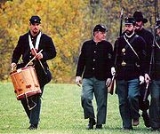
Historical reenactment

Encyclopedia
Historical reenactment is an educational activity in which participants attempt to
recreate some aspects of a historical event or period. This may be as narrow as a specific moment from a battle, such as the reenactment of Pickett's Charge
at the Great Reunion of 1913
, or as broad as an entire period, such as Regency reenactment
or The 1920s Berlin Project.
as a form of public spectacle
. In the Middle Ages
tournaments
often reenacted historical themes from Ancient Rome
or elsewhere. In the nineteenth century, reenactments were popular in a number of countries, e.g. the Eglinton Tournament of 1839
in Britain. During the early twentieth century they were popular in Russia
with re-enactments of the Siege of Sevastopol (1854–1855) (1906), the Battle of Borodino
(1912) in St Petersburg and the Taking of Azov (1696) in Voronezh
in 1918. In 1920, there was a reenactment of the 1917 Storming of the Winter Palace on the third anniversary of the event. It was this reenactment which provided the inspiration for the scenes in Sergei Eisenstein
's film October: Ten Days That Shook the World.
Likewise, mass pageants were used to commemorate civic events like 150th anniversary of the founding of St Louis, held in 1914.
. Participants within this hobby are extremely diverse. The ages of participants range from young children whose parents bring them along to events, to the elderly. Among adult participants, people from all different walks of life can be found – college students, firefighters, lawyers, members of the armed forces, doctors, and even professional historians.
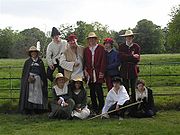
perspective on a particular period or war, particularly if they can trace their ancestry back to an individual or individuals who were involved. Others participate for the escapism
that such events offer.
.
Some, called "Farb
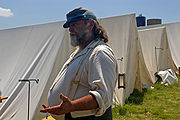
s" or "polyester soldiers", are reenactors who spend relatively little of their time or money maintaining authenticity with regard to uniforms, accessories, or even period behavior. A 'Good Enough' attitude is pervasive among farbs, although even casual observers may be able to point out flaws. Anachronistic clothing, fabrics, fasteners (such as velcro
), snoods
, footwear
, vehicles, and modern cigarettes are common issues.
The origin of the word "farb" (and the derivative adjective "farby") is unknown, though it appears to date to early American Civil War
centennial reenactments in 1960 or 1961. Some think that the origin of the word is a truncated version of "Far be it from authentic". An alternative definition is "Far Be it for me to question/criticise", or "Fast And Researchless Buying". Some early reenactors assert the word derives from German Farbe, color, because inauthentic reenactors were over-colorful compared with the dull blues, greys or browns of the real Civil War uniforms that were the principal concern of American reenactors at the time the word was coined. According to Mr. Burton K. Kummerow, a member of "The Black Hats, CSA" reenactment group in the early 1960s, he first heard it used as a form of fake German to describe a fellow reenactor. The term was picked up by George Gorman of the 2nd North Carolina at the Centennial Manassas Reenactment in 1961, and has been used by reenactors ever since.
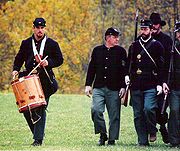
Mainstream reenactors make an effort at appearing authentic, but may come out of character in the absence of an audience. Visible stitches are likely to be sewn in a period-correct manner, but hidden stitches and undergarments may not be period-appropriate. Food consumed before an audience is likely to be generally appropriate to the period, but it may not be seasonally and locally appropriate. Modern items are sometimes used "after hours" or in a hidden fashion. The common attitude is to put on a good show, but that accuracy need only go as far as others can see.
Hard-core reenactors generally value thorough research, and sometimes deride mainstream reenactors for perpetuating inaccurate "reenactorisms". They generally seek an "immersive" reenacting experience, trying to live, as much as possible, as someone of the period might have. This includes eating seasonally and regionally appropriate food, sewing inside seams and undergarments in a period-appropriate manner, and staying in character throughout an event. The desire for an immersive experience often leads hard-core reenactors to smaller events, or to setting up separate camps at larger events.
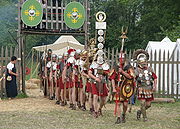 The period of an event is the range of dates. See authenticity (reenactment)
for a discussion of how the period affects the types of costume, weapons, and armour used.
Popular periods to reenact include:
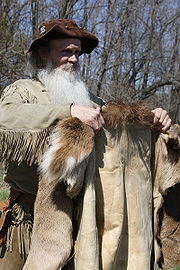 Numerous cottage industries abound that provide not only the materials but even the finished product for use by reenactors. Uniforms and clothing made of hand woven, natural dyed materials are sewn by hand or machine using the sartorial techniques of the period portrayed.
Detailed attention to authenticity in design and construction is given equally as well to headgear, footwear, eyewear, camp gear, accoutrements, military equipment, weapons and so on. These items (which are generally much more expensive than clothing and uniform in modern production) offer the wearer a life-like experience in the use of materials, tailoring and manufacturing techniques that are as close to authentic as possible.
Event spectators may derive more satisfaction from attending reenactments when a high level of authenticity is attained in both individual clothing and equipment, as well as equipment used in camp.
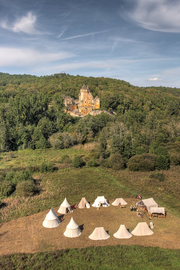 Living histories are usually meant for education of the public. Such events do not necessarily have a mock battle but instead are aimed at portraying the life, and more importantly the lifestyle, of people of the period. This often includes both military and civilian camps. Occasionally, storytelling or acting sketches take place to involve or explain the camps background to the viewing public. More common are craft and cooking demonstrations, song and leisure activities, and lectures. Combat training or duels can also be encountered even when larger combat demonstrations are not present.
In the United States, living history is the only reenactment permitted on National Park Service
land; NPS policy "does not allow for battle reenactments (simulated combat with opposing lines and casualties) on NPS property."
They are often fought at or near the original battle ground or at a place very similar to the original. These demonstrations vary widely in size from a few hundred fighters to several thousand, as do the arenas used (getting the right balance can often make or break the spectacle for the public).
, but, in the cases where firearms are used, with real weapons firing blank ammunition (depending on gun control ordinances).
The development of "historical airsoft
" tournaments is an offshoot of the military reenactment tactical.
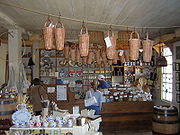
Many castles, museums, and other historical tourist attractions employ actors or professional reenactors as part of the experience. These usually address the recreation of a specific town, village, or activity within a certain time frame. Commercial reenactment shows are usually choreographed and follow a script.
Some locations have set up permanent authentic
displays. By their nature, these are usually living history
presentations, rather than tactical or battle reenactment, although some host larger temporary events.
Second Life
contains several virtual reenactments of factual and fictional histories, e.g., The 1920s Berlin Project and Star Trek
.
. Prominent among these are the Camp Chase Gazette, Smoke and Fire News, two different magazines named Living History, and Skirmish Magazine.
The Medieval Soldier by Gerry Embleton and John Howe (1995) is a popular book on the topic, which has been translated into French and German. It was followed by Medieval Military Costume in Colour Photographs.
For the Napoleonic Period there are two books of interest that cover life in the military at that time and living history: The Napoleonic Soldier by Stephen E. Maughan, 1999 and Marching with Sharpe by B.J. Bluth, 2001. Various Napoleonic reenactment groups now cover the history of their associated regiment as well as try to describe and illustrate how they approach recreating the period. The aim to be as authentic as is possible from the various source materials has led many serious reenactment societies to set up their own research groups to verify their understanding of the uniforms, drill and all aspects of the life that they strive to portray. In this way reenactment plays a vital role in bringing history to life, keeping history alive and in expanding the knowledge and understanding of the period.
In the UK a number of small publishing houses have been established to disseminate knowledge initially of the English Civil War but latterly of earlier periods as well. The largest are Stuart Press [around 250 volumes in print] and Partizan Press.
, and Alatriste
benefited greatly from the input of reenactors, who arrived on set fully equipped and steeped in knowledge of military procedures, camp life, and tactics.
In a documentary about the making of the film Gettysburg, actor Sam Elliott
, who portrayed Union General John Buford
in the film, said of reenactors:
Common criticisms revolve around motivation, as well as concerns about the level of immersion found in some arenas, notably those involving 20th Century conflicts where combatants had stricter regulations regarding personal grooming
. The average age of reenactors is also generally far higher than the average age of soldiers in most conflicts. Few reenactment units discriminate, however, based on age and physical condition. However, there has been criticism about the exclusion of women from some American Civil War combat reenactment units. While there were a small handful of women who may have fought in the conflict, almost all of them did so disguised as men. Attitudes on this topic seem to vary widely.
_2008._june_22.jpg) Another concern mentioned by Thompson's book is the "fantasy farb
Another concern mentioned by Thompson's book is the "fantasy farb
", or tendency of reenactors to gravitate towards "elite" units such as commandos, paratroopers, or Waffen-SS
units resulting in an under-representation in the reenactment community of what were the most common types of military troops in the period being reenacted. This is largely drawn from a North American perspective, although there are parallel issues on the European scene, such as the tendency in Britain for Napoleonic War reenactors to perform as members of the 95th Rifles (perhaps due to the popularity of Sharpe
) and larger proportions of plate-armoured soldiers in later medieval groups. In the UK there are multi-period events such as 'History in Action' where groups get to look at each other's appearance and performances as well as perform for the general public. One other concern which can cause misunderstandings are in countries where weapons of most forms are legally or socially frowned upon (such as in the UK). Reenactors own interactions with the public, and the work of volunteer groups like NARES, help to mitigate such issues.
A final concern is that reenactors may become, or already be, too closely aligned to the controversial political beliefs that some of the reenacted armies fought for, such as Nazism, or the Confederate South. For example, Rich Iott
participation in a World War II reenactment
group portraying the Nazi 5th SS Panzer Division Wiking
attracted considerable media attention during his 2010 Congressional campaign.
recreate some aspects of a historical event or period. This may be as narrow as a specific moment from a battle, such as the reenactment of Pickett's Charge
Pickett's Charge
Pickett's Charge was an infantry assault ordered by Confederate Gen. Robert E. Lee against Maj. Gen. George G. Meade's Union positions on Cemetery Ridge on July 3, 1863, the last day of the Battle of Gettysburg during the American Civil War. Its futility was predicted by the charge's commander,...
at the Great Reunion of 1913
Great Reunion of 1913
The 1913 Gettysburg reunion was a Gettysburg Battlefield encampment of American Civil War veterans for the Battle of Gettysburg's 50th anniversary...
, or as broad as an entire period, such as Regency reenactment
Regency reenactment
Regency reenactment is historical reenactment of the British Regency period. Groups portray the period from 1811 to 1820 through costume, manners, food, and social gatherings that celebrate the spirit of the era...
or The 1920s Berlin Project.
Historical reenactment through the ages
Activities related to "reenactment" have a long history. The Romans staged recreations of famous battles within their amphitheatersAmphitheatre
An amphitheatre is an open-air venue used for entertainment and performances.There are two similar, but distinct, types of structure for which the word "amphitheatre" is used: Ancient Roman amphitheatres were large central performance spaces surrounded by ascending seating, and were commonly used...
as a form of public spectacle
Spectacle
In general, spectacle refers to an event that is memorable for the appearance it creates. Derived in Middle English from c. 1340 as "specially prepared or arranged display" it was borrowed from Old French spectacle, itself a reflection of the Latin spectaculum "a show" from spectare "to view,...
. In the Middle Ages
Middle Ages
The Middle Ages is a periodization of European history from the 5th century to the 15th century. The Middle Ages follows the fall of the Western Roman Empire in 476 and precedes the Early Modern Era. It is the middle period of a three-period division of Western history: Classic, Medieval and Modern...
tournaments
Tournament (medieval)
A tournament, or tourney is the name popularly given to chivalrous competitions or mock fights of the Middle Ages and Renaissance . It is one of various types of hastiludes....
often reenacted historical themes from Ancient Rome
Ancient Rome
Ancient Rome was a thriving civilization that grew on the Italian Peninsula as early as the 8th century BC. Located along the Mediterranean Sea and centered on the city of Rome, it expanded to one of the largest empires in the ancient world....
or elsewhere. In the nineteenth century, reenactments were popular in a number of countries, e.g. the Eglinton Tournament of 1839
Eglinton Tournament of 1839
The Eglinton Tournament of 1839 was a re-enactment of a medieval joust and revel held in Scotland on Friday 30 August.It was funded and organized by Archibald Montgomerie, 13th Earl of Eglinton, and took place at Eglinton Castle, near Kilwinning in Scotland...
in Britain. During the early twentieth century they were popular in Russia
Russia
Russia or , officially known as both Russia and the Russian Federation , is a country in northern Eurasia. It is a federal semi-presidential republic, comprising 83 federal subjects...
with re-enactments of the Siege of Sevastopol (1854–1855) (1906), the Battle of Borodino
Battle of Borodino
The Battle of Borodino , fought on September 7, 1812, was the largest and bloodiest single-day action of the French invasion of Russia and all Napoleonic Wars, involving more than 250,000 troops and resulting in at least 70,000 casualties...
(1912) in St Petersburg and the Taking of Azov (1696) in Voronezh
Voronezh
Voronezh is a city in southwestern Russia, the administrative center of Voronezh Oblast. It is located on both sides of the Voronezh River, away from where it flows into the Don. It is an operating center of the Southeastern Railway , as well as the center of the Don Highway...
in 1918. In 1920, there was a reenactment of the 1917 Storming of the Winter Palace on the third anniversary of the event. It was this reenactment which provided the inspiration for the scenes in Sergei Eisenstein
Sergei Eisenstein
Sergei Mikhailovich Eisenstein , né Eizenshtein, was a pioneering Soviet Russian film director and film theorist, often considered to be the "Father of Montage"...
's film October: Ten Days That Shook the World.
Likewise, mass pageants were used to commemorate civic events like 150th anniversary of the founding of St Louis, held in 1914.
Living history
The term living history describes attempts to bring history to life for the general public. Historical reenactment includes a continuum from well researched attempts to recreate a known historical event for educational purposes, through representations with theatrical elements, to competitive events for purposes of entertainment. The line between amateur reenactment and presentations at living history museums can be blurred as, while the latter routinely utilize museum professionals and trained interpreters to help convey the story of history to the public, some museums and historic sites employ reenactment groups with high standards of authenticity for the same role at special events.Reenactors
Most reenactors are amateurs who pursue reenactment as a hobbyHobby
A hobby is a regular activity or interest that is undertaken for pleasure, typically done during one's leisure time.- Etymology :A hobby horse is a wooden or wickerwork toy made to be ridden just like a real horse...
. Participants within this hobby are extremely diverse. The ages of participants range from young children whose parents bring them along to events, to the elderly. Among adult participants, people from all different walks of life can be found – college students, firefighters, lawyers, members of the armed forces, doctors, and even professional historians.
Reenactment groups
Reasons for participating
Reasons given for participating vary. Some participants are interested in getting a historicalHistory
History is the discovery, collection, organization, and presentation of information about past events. History can also mean the period of time after writing was invented. Scholars who write about history are called historians...
perspective on a particular period or war, particularly if they can trace their ancestry back to an individual or individuals who were involved. Others participate for the escapism
Escapism
Escapism is mental diversion by means of entertainment or recreation, as an "escape" from the perceived unpleasant or banal aspects of daily life...
that such events offer.
Categories of reenactors
Reenactors are commonly divided (or self-divide) into three categories, based on the level of concern for authenticityAuthenticity (reenactment)
In historical reenactment, authenticity is a measure of how close an item, prop, action, weapon, or custom is, to what would actually have been used or done in the time period being depicted....
.
Farbs
Some, called "Farb
Farb (reenactment)
Farb is a derogatory term used in the hobby of historical reenacting in reference to participants who exhibit indifference to historical authenticity, either from a material-cultural standpoint or in action...
s" or "polyester soldiers", are reenactors who spend relatively little of their time or money maintaining authenticity with regard to uniforms, accessories, or even period behavior. A 'Good Enough' attitude is pervasive among farbs, although even casual observers may be able to point out flaws. Anachronistic clothing, fabrics, fasteners (such as velcro
Velcro
Velcro is the brand name of the first commercially marketed fabric hook-and-loop fastener, invented in 1948 by the Swiss electrical engineer George de Mestral...
), snoods
Snood (headgear)
A snood is historically a type of European female headgear, or in modern times a tubular neck scarf. In the most common form the headgear resembles a close-fitting hood worn over the back of the head...
, footwear
Footwear
Footwear consists of garments worn on the feet, for fashion, protection against the environment, and adornment. Being barefoot is commonly associated with poverty, but some cultures chose not to wear footwear at least in some situations....
, vehicles, and modern cigarettes are common issues.
The origin of the word "farb" (and the derivative adjective "farby") is unknown, though it appears to date to early American Civil War
American Civil War
The American Civil War was a civil war fought in the United States of America. In response to the election of Abraham Lincoln as President of the United States, 11 southern slave states declared their secession from the United States and formed the Confederate States of America ; the other 25...
centennial reenactments in 1960 or 1961. Some think that the origin of the word is a truncated version of "Far be it from authentic". An alternative definition is "Far Be it for me to question/criticise", or "Fast And Researchless Buying". Some early reenactors assert the word derives from German Farbe, color, because inauthentic reenactors were over-colorful compared with the dull blues, greys or browns of the real Civil War uniforms that were the principal concern of American reenactors at the time the word was coined. According to Mr. Burton K. Kummerow, a member of "The Black Hats, CSA" reenactment group in the early 1960s, he first heard it used as a form of fake German to describe a fellow reenactor. The term was picked up by George Gorman of the 2nd North Carolina at the Centennial Manassas Reenactment in 1961, and has been used by reenactors ever since.
Mainstream
Mainstream reenactors make an effort at appearing authentic, but may come out of character in the absence of an audience. Visible stitches are likely to be sewn in a period-correct manner, but hidden stitches and undergarments may not be period-appropriate. Food consumed before an audience is likely to be generally appropriate to the period, but it may not be seasonally and locally appropriate. Modern items are sometimes used "after hours" or in a hidden fashion. The common attitude is to put on a good show, but that accuracy need only go as far as others can see.
Progressive
At the other extreme from farbs are "hard-core authentics", or "progressives," as they prefer to be called. Sometimes derisively called "stitch counters", "authenticity nazis" or even "stitch nazis", many people have misconceptions about hardcore reenactors.Hard-core reenactors generally value thorough research, and sometimes deride mainstream reenactors for perpetuating inaccurate "reenactorisms". They generally seek an "immersive" reenacting experience, trying to live, as much as possible, as someone of the period might have. This includes eating seasonally and regionally appropriate food, sewing inside seams and undergarments in a period-appropriate manner, and staying in character throughout an event. The desire for an immersive experience often leads hard-core reenactors to smaller events, or to setting up separate camps at larger events.
Period
Authenticity (reenactment)
In historical reenactment, authenticity is a measure of how close an item, prop, action, weapon, or custom is, to what would actually have been used or done in the time period being depicted....
for a discussion of how the period affects the types of costume, weapons, and armour used.
Popular periods to reenact include:
- Classical reenactment
- Medieval reenactmentMedieval reenactmentMedieval reenactment is a form of historical reenactment that focuses on re-enacting European history in the period from the fall of Rome to about the end of the 15th century. The second half of this period is often called the Middle Ages...
- Renaissance reenactmentRenaissance reenactmentRenaissance reenactment is historical reenactment of events of the Renaissance period and the European Age of Exploration. In its broadest use, the term encompasses reenactment of periods from 1400 through the mid-18th century. Reenactments of earlier events are commonly termed medieval...
(including English Civil War reenactment) - Modern reenactmentModern reenactmentModern reenactment is historical reenactment of events of the modern period, most commonly events from the 18th century to the present.The period starts with events such as the Seven Years' War, the Napoleonic Wars, and the peak of the Royal Navy's power....
- Regency reenactmentRegency reenactmentRegency reenactment is historical reenactment of the British Regency period. Groups portray the period from 1811 to 1820 through costume, manners, food, and social gatherings that celebrate the spirit of the era...
- The Fur TradeFur tradeThe fur trade is a worldwide industry dealing in the acquisition and sale of animal fur. Since the establishment of world market for in the early modern period furs of boreal, polar and cold temperate mammalian animals have been the most valued...
is reenacted at events called as "Rendezvous". - American Civil War reenactmentAmerican Civil War reenactmentAmerican Civil War reenactment is an effort to recreate the appearance of a particular battle or other event associated with the American Civil War by hobbyists known as Civil War reenactors or Civil War recreationists...
- World War I reenactmentWorld War I reenactment-External links:* * * * * *...
- World War II reenactmentWorld War II reenactmentWorld War II Reenactment is the historical reenactment of World War II military.-Background:While some dramatic recreations of wartime events had been staged for theatrical purposes and for military purposes World War II Reenactment is the historical reenactment of World War II...
- Korean War reenactment
- Regency reenactment
Clothing and equipment
Detailed attention to authenticity in design and construction is given equally as well to headgear, footwear, eyewear, camp gear, accoutrements, military equipment, weapons and so on. These items (which are generally much more expensive than clothing and uniform in modern production) offer the wearer a life-like experience in the use of materials, tailoring and manufacturing techniques that are as close to authentic as possible.
Event spectators may derive more satisfaction from attending reenactments when a high level of authenticity is attained in both individual clothing and equipment, as well as equipment used in camp.
Living history
In the United States, living history is the only reenactment permitted on National Park Service
National Park Service
The National Park Service is the U.S. federal agency that manages all national parks, many national monuments, and other conservation and historical properties with various title designations...
land; NPS policy "does not allow for battle reenactments (simulated combat with opposing lines and casualties) on NPS property."
Combat demonstration
Combat demonstrations are mock battles put on by reenacting organizations and/or private parties primarily to show the public what combat in the period might have been like. Combat demonstrations are only loosely based on actual battles, if at all, and may simply consist of demonstrations of basic tactics and maneuvering techniques.Battle reenactment
Scripted battles are reenactment in the strictest sense; the battles are planned out beforehand so that the companies and regiments make the same actions that were taken in the original battles.They are often fought at or near the original battle ground or at a place very similar to the original. These demonstrations vary widely in size from a few hundred fighters to several thousand, as do the arenas used (getting the right balance can often make or break the spectacle for the public).
Tactical combat
Tactical battles are generally not open to the public. Tactical battles are fought like real battles with both sides coming up with strategies and tactics to beat their opponents. With no script, a basic set of agreed-upon rules (physical boundaries, time limit, victory conditions, etc.), and on-site judges, tactical battles can be considered a form of Live action role-playing gameLive action role-playing game
A live action role-playing game is a form of role-playing game where the participants physically act out their characters' actions. The players pursue goals within a fictional setting represented by the real world, while interacting with each other in character. The outcome of player actions may...
, but, in the cases where firearms are used, with real weapons firing blank ammunition (depending on gun control ordinances).
The development of "historical airsoft
Airsoft
Airsoft is a sport in which participants shoot round non-metallic pellets launched via replica firearms.Gameplay varies in style and composition but often range from short-term skirmishes, organized scenarios, military simulations, historical reenactments, to competition target shooting events...
" tournaments is an offshoot of the military reenactment tactical.
Commercial reenactment
Many castles, museums, and other historical tourist attractions employ actors or professional reenactors as part of the experience. These usually address the recreation of a specific town, village, or activity within a certain time frame. Commercial reenactment shows are usually choreographed and follow a script.
Some locations have set up permanent authentic
Authenticity (reenactment)
In historical reenactment, authenticity is a measure of how close an item, prop, action, weapon, or custom is, to what would actually have been used or done in the time period being depicted....
displays. By their nature, these are usually living history
Living history
Living history is an activity that incorporates historical tools, activities and dress into an interactive presentation that seeks to give observers and participants a sense of stepping back in time. Although it does not necessarily seek to reenact a specific event in history, living history is...
presentations, rather than tactical or battle reenactment, although some host larger temporary events.
Virtual reenactment
The virtual worldVirtual world
A virtual world is an online community that takes the form of a computer-based simulated environment through which users can interact with one another and use and create objects. The term has become largely synonymous with interactive 3D virtual environments, where the users take the form of...
Second Life
Second Life
Second Life is an online virtual world developed by Linden Lab. It was launched on June 23, 2003. A number of free client programs, or Viewers, enable Second Life users, called Residents, to interact with each other through avatars...
contains several virtual reenactments of factual and fictional histories, e.g., The 1920s Berlin Project and Star Trek
Star Trek
Star Trek is an American science fiction entertainment franchise created by Gene Roddenberry. The core of Star Trek is its six television series: The Original Series, The Animated Series, The Next Generation, Deep Space Nine, Voyager, and Enterprise...
.
Publications
Many publications have covered historical reenactment and living historyLiving history
Living history is an activity that incorporates historical tools, activities and dress into an interactive presentation that seeks to give observers and participants a sense of stepping back in time. Although it does not necessarily seek to reenact a specific event in history, living history is...
. Prominent among these are the Camp Chase Gazette, Smoke and Fire News, two different magazines named Living History, and Skirmish Magazine.
The Medieval Soldier by Gerry Embleton and John Howe (1995) is a popular book on the topic, which has been translated into French and German. It was followed by Medieval Military Costume in Colour Photographs.
For the Napoleonic Period there are two books of interest that cover life in the military at that time and living history: The Napoleonic Soldier by Stephen E. Maughan, 1999 and Marching with Sharpe by B.J. Bluth, 2001. Various Napoleonic reenactment groups now cover the history of their associated regiment as well as try to describe and illustrate how they approach recreating the period. The aim to be as authentic as is possible from the various source materials has led many serious reenactment societies to set up their own research groups to verify their understanding of the uniforms, drill and all aspects of the life that they strive to portray. In this way reenactment plays a vital role in bringing history to life, keeping history alive and in expanding the knowledge and understanding of the period.
In the UK a number of small publishing houses have been established to disseminate knowledge initially of the English Civil War but latterly of earlier periods as well. The largest are Stuart Press [around 250 volumes in print] and Partizan Press.
Media support
Motion picture and television producers often turn to reenactment groups for support; films like Gettysburg, Glory, The PatriotThe Patriot (2000 film)
The Patriot is a 2000 historical war film directed by Roland Emmerich, written by Robert Rodat, and starring Mel Gibson, Chris Cooper, and Heath Ledger. It was produced by the Mutual Film Company and Centropolis Entertainment and was distributed by Columbia Pictures...
, and Alatriste
Alatriste
Alatriste is a 2006 Spanish historical film directed by Agustín Díaz Yanes, based on the main character of a series of novels written by Arturo Pérez-Reverte, The Adventures of Captain Alatriste ....
benefited greatly from the input of reenactors, who arrived on set fully equipped and steeped in knowledge of military procedures, camp life, and tactics.
In a documentary about the making of the film Gettysburg, actor Sam Elliott
Sam Elliott
Samuel Pack "Sam" Elliott is an American actor. His rangy physique, thick horseshoe moustache, and deep, resonant voice match the iconic image of a cowboy or rancher, and he has often been cast in such roles.-Early life:Sam Elliott was born in Sacramento, California, to a physical training...
, who portrayed Union General John Buford
John Buford
John Buford, Jr. was a Union cavalry officer during the American Civil War, with a prominent role at the start of the Battle of Gettysburg.-Early years:...
in the film, said of reenactors:
Criticism
It is often difficult for veterans or the public to understand why reenactors do what they do, or there may be questions as to the motivation, or the level of knowledge of the reenactors.Common criticisms revolve around motivation, as well as concerns about the level of immersion found in some arenas, notably those involving 20th Century conflicts where combatants had stricter regulations regarding personal grooming
Personal grooming
Personal grooming is the art of cleaning, grooming, and maintaining parts of the body. It is a species-typical behavior that is controlled by neural circuits in the brain.- In humans :...
. The average age of reenactors is also generally far higher than the average age of soldiers in most conflicts. Few reenactment units discriminate, however, based on age and physical condition. However, there has been criticism about the exclusion of women from some American Civil War combat reenactment units. While there were a small handful of women who may have fought in the conflict, almost all of them did so disguised as men. Attitudes on this topic seem to vary widely.
Farb (reenactment)
Farb is a derogatory term used in the hobby of historical reenacting in reference to participants who exhibit indifference to historical authenticity, either from a material-cultural standpoint or in action...
", or tendency of reenactors to gravitate towards "elite" units such as commandos, paratroopers, or Waffen-SS
Waffen-SS
The Waffen-SS was a multi-ethnic and multi-national military force of the Third Reich. It constituted the armed wing of the Schutzstaffel or SS, an organ of the Nazi Party. The Waffen-SS saw action throughout World War II and grew from three regiments to over 38 divisions, and served alongside...
units resulting in an under-representation in the reenactment community of what were the most common types of military troops in the period being reenacted. This is largely drawn from a North American perspective, although there are parallel issues on the European scene, such as the tendency in Britain for Napoleonic War reenactors to perform as members of the 95th Rifles (perhaps due to the popularity of Sharpe
Richard Sharpe (fictional character)
Sharpe is a series of historical fiction stories by Bernard Cornwell centred on the character of Richard Sharpe. The stories formed the basis for an ITV television series wherein the eponymous character was played by Sean Bean....
) and larger proportions of plate-armoured soldiers in later medieval groups. In the UK there are multi-period events such as 'History in Action' where groups get to look at each other's appearance and performances as well as perform for the general public. One other concern which can cause misunderstandings are in countries where weapons of most forms are legally or socially frowned upon (such as in the UK). Reenactors own interactions with the public, and the work of volunteer groups like NARES, help to mitigate such issues.
A final concern is that reenactors may become, or already be, too closely aligned to the controversial political beliefs that some of the reenacted armies fought for, such as Nazism, or the Confederate South. For example, Rich Iott
Rich Iott
Richard Bradley "Rich" Iott was the 2010 Republican nominee for United States Representative for Ohio's 9th District...
participation in a World War II reenactment
World War II reenactment
World War II Reenactment is the historical reenactment of World War II military.-Background:While some dramatic recreations of wartime events had been staged for theatrical purposes and for military purposes World War II Reenactment is the historical reenactment of World War II...
group portraying the Nazi 5th SS Panzer Division Wiking
5th SS Panzer Division Wiking
The 5th SS Panzer Division Wiking was one of the elite Panzer divisions of the thirty eight Waffen SS divisions. It was recruited from foreign volunteers, from Scandinavia, Finland, Estonia, The Netherlands, and Belgium under the command of German officers...
attracted considerable media attention during his 2010 Congressional campaign.
External links
- TheReenactor.com, International reenactment database & wiki. All periods & culture.direct link to the wiki,
- Reenacting.eu, International website of living history. All periods.
- Reenactor.Net, International website of living history. All periods.
- The Historical Reenactment Web Site, Information relating to reenactment globally and the home of The Historical Reenactment Wiki
- Ancient Warfare Magazine
- Skirmish Magazine, The world's leading living history and re-enactment monthly, published in the UK
- Russian reenactor forum 17-19AD
- The film director Lawrence Hott on re-enactments