

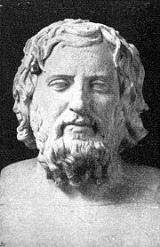
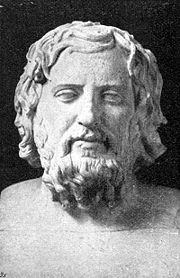
Xenophon

Encyclopedia
Deme
In Ancient Greece, a deme or demos was a subdivision of Attica, the region of Greece surrounding Athens. Demes as simple subdivisions of land in the countryside seem to have existed in the 6th century BC and earlier, but did not acquire particular significance until the reforms of Cleisthenes in...
Erchia of Athens
Athens
Athens , is the capital and largest city of Greece. Athens dominates the Attica region and is one of the world's oldest cities, as its recorded history spans around 3,400 years. Classical Athens was a powerful city-state...
, also known as Xenophon of Athens, was a Greek historian
Historian
A historian is a person who studies and writes about the past and is regarded as an authority on it. Historians are concerned with the continuous, methodical narrative and research of past events as relating to the human race; as well as the study of all history in time. If the individual is...
, soldier
Soldier
A soldier is a member of the land component of national armed forces; whereas a soldier hired for service in a foreign army would be termed a mercenary...
, mercenary
Mercenary
A mercenary, is a person who takes part in an armed conflict based on the promise of material compensation rather than having a direct interest in, or a legal obligation to, the conflict itself. A non-conscript professional member of a regular army is not considered to be a mercenary although he...
, philosopher and a contemporary and admirer of Socrates
Socrates
Socrates was a classical Greek Athenian philosopher. Credited as one of the founders of Western philosophy, he is an enigmatic figure known chiefly through the accounts of later classical writers, especially the writings of his students Plato and Xenophon, and the plays of his contemporary ...
. He is known for his writings on the history of his own times, the 4th century BC, preserving the sayings of Socrates, and descriptions of life in ancient Greece
Ancient Greece
Ancient Greece is a civilization belonging to a period of Greek history that lasted from the Archaic period of the 8th to 6th centuries BC to the end of antiquity. Immediately following this period was the beginning of the Early Middle Ages and the Byzantine era. Included in Ancient Greece is the...
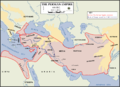
and the Persian Empire.
Early years
Xenophon's birth date is uncertain, but most scholars agree that he was born around 431 BC near the city of AthensAthens
Athens , is the capital and largest city of Greece. Athens dominates the Attica region and is one of the world's oldest cities, as its recorded history spans around 3,400 years. Classical Athens was a powerful city-state...
. Xenophon was born into the ranks of the upper classes, thus granting him access to certain privileges of the aristocracy
Aristocracy
Aristocracy , is a form of government in which a few elite citizens rule. The term derives from the Greek aristokratia, meaning "rule of the best". In origin in Ancient Greece, it was conceived of as rule by the best qualified citizens, and contrasted with monarchy...
of ancient Attica
Attica
Attica is a historical region of Greece, containing Athens, the current capital of Greece. The historical region is centered on the Attic peninsula, which projects into the Aegean Sea...
. While a young man, Xenophon participated in the expedition led by Cyrus the Younger
Cyrus the Younger
Cyrus the Younger, son of Darius II of Persia and Parysatis, was a Persian prince and general. The time of his birth is unknown, but he died in 401 B.C. The history of Cyrus and of the retreat of the Greeks is told by Xenophon in his Anabasis. Another account, probably from Sophaenetus of...
against his older brother, king Artaxerxes II of Persia
History of Iran
The history of Iran has been intertwined with the history of a larger historical region, comprising the area from the Danube River in the west to the Indus River and Jaxartes in the east and from the Caucasus, Caspian Sea, and Aral Sea in the north to the Persian Gulf and the Gulf of Oman and Egypt...
, in 401 BC. Xenophon writes that he had asked the veteran Socrates
Socrates of Achaea
Socrates was a Greek mercenary general from Achaea who traveled to Persia to fight at the Battle of Cunaxa. Xenophon describes him as brave in war and a reliable friend. Socrates was summoned by Cyrus, with whom he was already connected, to bring as many troops as he could muster under the...
for advice on whether to go with Cyrus, and that Socrates referred him to the divinely inspired Delphic oracle. Xenophon's query to the oracle
Oracle
In Classical Antiquity, an oracle was a person or agency considered to be a source of wise counsel or prophetic predictions or precognition of the future, inspired by the gods. As such it is a form of divination....
, however, was not whether or not to accept Cyrus' invitation, but "to which of the gods he must pray and do sacrifice, so that he might best accomplish his intended journey and return in safety, with good fortune". The oracle answered his question and told him to which gods to pray and sacrifice. When Xenophon returned to Athens
Athens
Athens , is the capital and largest city of Greece. Athens dominates the Attica region and is one of the world's oldest cities, as its recorded history spans around 3,400 years. Classical Athens was a powerful city-state...
and told Socrates of the oracle's advice, Socrates
Socrates
Socrates was a classical Greek Athenian philosopher. Credited as one of the founders of Western philosophy, he is an enigmatic figure known chiefly through the accounts of later classical writers, especially the writings of his students Plato and Xenophon, and the plays of his contemporary ...
chastised him for asking so disingenuous a question.
Tissaphernes
Tissaphernes was a Persian soldier and statesman, grandson of Hydarnes.In 413 BC he was satrap of Lydia and Caria, and commander in chief of the Persian army in Asia Minor...
, the Persian satrap
Satrap
Satrap was the name given to the governors of the provinces of the ancient Median and Achaemenid Empires and in several of their successors, such as the Sassanid Empire and the Hellenistic empires....
of Ionia
Ionia
Ionia is an ancient region of central coastal Anatolia in present-day Turkey, the region nearest İzmir, which was historically Smyrna. It consisted of the northernmost territories of the Ionian League of Greek settlements...
, Cyrus assembled a massive army composed of native Persian soldiers, but also a large number of Greeks. Prior to waging war against Artaxerxes, his brother, Cyrus proposed that the enemy was the Pisidia
Pisidia
Pisidia was a region of ancient Asia Minor located north of Lycia, and bordering Caria, Lydia, Phrygia and Pamphylia. It corresponds roughly to the modern-day province of Antalya in Turkey...
ns, and so the Greeks were unaware that they were to battle against the larger army of King Artaxerxes II. At Tarsus
Tarsus (city)
Tarsus is a historic city in south-central Turkey, 20 km inland from the Mediterranean Sea. It is part of the Adana-Mersin Metropolitan Area, the fourth-largest metropolitan area in Turkey with a population of 2.75 million...
the soldiers became aware of Cyrus's plans to depose the king, and, as a result, refused to continue. However, Clearchus
Clearchus of Sparta
Clearchus or Clearch , the son of Rhamphias, was a Spartan general and mercenary.Born about the middle of the 5th century BC, Clearchus was sent with a fleet to the Hellespont in 411 and became governor of Byzantium, of which town he was proxenus...
, a Spartan
Spartan
A Spartan is a person from the Greek city Sparta or the ancient Greek city-state of the same name. In the latter context, the term "Spartan" in its most technical sense refers to a member of the Spartiate caste and under some usages also encompasses the class of mothakes, residents of Sparta who...
general, convinced the Greeks to continue with the expedition. The army of Cyrus met the army of Artaxerxes II in the Battle of Cunaxa
Battle of Cunaxa
The Battle of Cunaxa was fought in 401 BC between Cyrus the Younger and his elder brother Arsaces, who had inherited the Persian throne as Artaxerxes II in 404 BC. The great battle of the revolt of Cyrus took place 70 km north of Babylon, at Cunaxa , on the left bank of the Euphrates River...
. Despite effective fighting by the Greeks, Cyrus was killed in the battle. Shortly thereafter, Clearchus was invited to a peace conference, where, alongside four other generals and many captains, he was betrayed and executed. The mercenaries, known as the Ten Thousand
Ten Thousand (Greek)
The Ten Thousand were a group of mercenary units, mainly Greek, drawn up by Cyrus the Younger to attempt to wrest the throne of the Persian Empire from his brother, Artaxerxes II...
, found themselves without leadership far from the sea, deep in hostile territory near the heart of Mesopotamia
Mesopotamia
Mesopotamia is a toponym for the area of the Tigris–Euphrates river system, largely corresponding to modern-day Iraq, northeastern Syria, southeastern Turkey and southwestern Iran.Widely considered to be the cradle of civilization, Bronze Age Mesopotamia included Sumer and the...
. They elected new leaders, including Xenophon himself, and fought their way north through hostile Persians
Persian people
The Persian people are part of the Iranian peoples who speak the modern Persian language and closely akin Iranian dialects and languages. The origin of the ethnic Iranian/Persian peoples are traced to the Ancient Iranian peoples, who were part of the ancient Indo-Iranians and themselves part of...
and Medes
Medes
The MedesThe Medes...
to Trapezus
Trabzon
Trabzon is a city on the Black Sea coast of north-eastern Turkey and the capital of Trabzon Province. Trabzon, located on the historical Silk Road, became a melting pot of religions, languages and culture for centuries and a trade gateway to Iran in the southeast and the Caucasus to the northeast...
on the coast of the Black Sea
Black Sea
The Black Sea is bounded by Europe, Anatolia and the Caucasus and is ultimately connected to the Atlantic Ocean via the Mediterranean and the Aegean seas and various straits. The Bosphorus strait connects it to the Sea of Marmara, and the strait of the Dardanelles connects that sea to the Aegean...
. They then made their way westward back to Greece. Once there, they helped Seuthes II
Seuthes II
Seuthes II was a king of the Odrysian kingdom of Thrace from about 405 to 391 BC. His rule was contemporary with that of Amadocus I, who at the beginning of his own reign made him ruler of the kingdom's Aegean shore territory. Later Seuthes apparently revolted; Aristotle mentions a King Amadocus...
make himself king of Thrace
Thrace
Thrace is a historical and geographic area in southeast Europe. As a geographical concept, Thrace designates a region bounded by the Balkan Mountains on the north, Rhodope Mountains and the Aegean Sea on the south, and by the Black Sea and the Sea of Marmara on the east...
, before being recruited into the army of the Sparta
Sparta
Sparta or Lacedaemon, was a prominent city-state in ancient Greece, situated on the banks of the River Eurotas in Laconia, in south-eastern Peloponnese. It emerged as a political entity around the 10th century BC, when the invading Dorians subjugated the local, non-Dorian population. From c...
n general Thibron.
Xenophon's book Anabasis
Anabasis (Xenophon)
Anabasis is the most famous work, in seven books, of the Greek professional soldier and writer Xenophon. The journey it narrates is his best known accomplishment and "one of the great adventures in human history," as Will Durant expressed the common assessment.- The account :Xenophon accompanied...
("The Expedition" or "The March Up Country") is his record of the entire expedition against the Persians and the journey home. The Anabasis was used as a field guide by Alexander the Great during the early phases of his expedition into Persia.
Exile and death
Xenophon was later exiled from Athens, most likely because he fought under the Spartan king Agesilaus IIAgesilaus II
Agesilaus II, or Agesilaos II was a king of Sparta, of the Eurypontid dynasty, ruling from approximately 400 BC to 360 BC, during most of which time he was, in Plutarch's words, "as good as thought commander and king of all Greece," and was for the whole of it greatly identified with his...
against Athens at Coronea
Battle of Coronea (394 BC)
The Battle of Coronea in 394 BC was a battle in the Corinthian War, in which the Spartans and their allies under King Agesilaus II defeated a force of Thebans and Argives that was attempting to block their march back into the Peloponnese.-Prelude:...
. However, there may have been contributory causes, such as his support for Socrates, as well as the fact that he had taken service with the Persians. The Sparta
Sparta
Sparta or Lacedaemon, was a prominent city-state in ancient Greece, situated on the banks of the River Eurotas in Laconia, in south-eastern Peloponnese. It emerged as a political entity around the 10th century BC, when the invading Dorians subjugated the local, non-Dorian population. From c...
ns gave him property at Scillus, near Olympia
Olympia, Greece
Olympia , a sanctuary of ancient Greece in Elis, is known for having been the site of the Olympic Games in classical times, comparable in importance to the Pythian Games held in Delphi. Both games were held every Olympiad , the Olympic Games dating back possibly further than 776 BC...
in Elis, where he composed the Anabasis. However, because his son Gryllus fought and died for Athens
Athens
Athens , is the capital and largest city of Greece. Athens dominates the Attica region and is one of the world's oldest cities, as its recorded history spans around 3,400 years. Classical Athens was a powerful city-state...
at the Battle of Mantinea
Battle of Mantinea (362 BC)
The Battle of Mantinea was fought on July 4 362 BC between the Thebans, led by Epaminondas and supported by the Arcadians and the Boeotian league against the Spartans, led by King Agesilaus II and supported by the Eleans, Athenians, and Mantineans...
while Xenophon was still alive, Xenophon's banishment may have been revoked. Xenophon died in either Corinth
Ancient Corinth
Corinth, or Korinth was a city-state on the Isthmus of Corinth, the narrow stretch of land that joins the Peloponnesus to the mainland of Greece, roughly halfway between Athens and Sparta. The modern town of Corinth is located approximately northeast of the ancient ruins...
or Athens. His date of death is uncertain; historians only know that he survived his patron Agesilaus II
Agesilaus II
Agesilaus II, or Agesilaos II was a king of Sparta, of the Eurypontid dynasty, ruling from approximately 400 BC to 360 BC, during most of which time he was, in Plutarch's words, "as good as thought commander and king of all Greece," and was for the whole of it greatly identified with his...
, for whom he wrote an encomium
Encomium
Encomium is a Latin word deriving from the Classical Greek ἐγκώμιον meaning the praise of a person or thing. "Encomium" also refers to several distinct aspects of rhetoric:* A general category of oratory* A method within rhetorical pedagogy...
. Xenophon had a fond love of Athens but didn't believe in its political morals, which leads some to believe that he was an oligarch
Oligarchy
Oligarchy is a form of power structure in which power effectively rests with an elite class distinguished by royalty, wealth, family ties, commercial, and/or military legitimacy...
.
Legacy
Diogenes LaertiusDiogenes Laertius
Diogenes Laertius was a biographer of the Greek philosophers. Nothing is known about his life, but his surviving Lives and Opinions of Eminent Philosophers is one of the principal surviving sources for the history of Greek philosophy.-Life:Nothing is definitively known about his life...
states that Xenophon was sometimes known as the "Attic Muse" for the sweetness of his diction
Diction
Diction , in its original, primary meaning, refers to the writer's or the speaker's distinctive vocabulary choices and style of expression in a poem or story...
; very few poets wrote in the Attic dialect. Xenophon is often cited as being the original "horse whisperer", having advocated sympathetic horsemanship
Equestrianism
Equestrianism more often known as riding, horseback riding or horse riding refers to the skill of riding, driving, or vaulting with horses...
in his "On Horsemanship
On Horsemanship (Xenophon)
On Horsemanship is the English title usually given to , peri hippikēs, one of the two treatises on horsemanship by the Athenian historian and soldier Xenophon . Other common titles for this work are De equis alendis and The Art of Horsemanship...
".
Xenophon's standing as a political philosopher has been defended in recent times by Leo Strauss
Leo Strauss
Leo Strauss was a political philosopher and classicist who specialized in classical political philosophy. He was born in Germany to Jewish parents and later emigrated to the United States...
, who devoted a considerable part of his philosophic analysis to the works of Xenophon, returning to the high judgment of Xenophon as a thinker expressed by Shaftesbury
Anthony Ashley-Cooper, 3rd Earl of Shaftesbury
Anthony Ashley Cooper, 3rd Earl of Shaftesbury was an English politician, philosopher and writer.-Biography:...
, Winckelmann, Machiavelli, and John Adams
John Adams
John Adams was an American lawyer, statesman, diplomat and political theorist. A leading champion of independence in 1776, he was the second President of the United States...
.
Ponting
Clive Ponting
Clive Ponting is a British writer, former academic and former senior civil servant. He is the author of a number of revisionist books on British and world history...
cites Xenophon as one of the first thinkers to argue that the ordered world must have been conceived by a god or gods. Xenophon's Memorabilia poses the argument that all animals are "only produced and nourished for the sake of humans". Though he spent much of his life in Athens, Xenophon's involvement in Spartan politics (he was a close associate of King Agesilaus II) has led to him being closely associated with the city.
List of works
Xenophon's writings, especially the AnabasisAnabasis (Xenophon)
Anabasis is the most famous work, in seven books, of the Greek professional soldier and writer Xenophon. The journey it narrates is his best known accomplishment and "one of the great adventures in human history," as Will Durant expressed the common assessment.- The account :Xenophon accompanied...
, are often read by beginning students of the Greek language
Greek language
Greek is an independent branch of the Indo-European family of languages. Native to the southern Balkans, it has the longest documented history of any Indo-European language, spanning 34 centuries of written records. Its writing system has been the Greek alphabet for the majority of its history;...
. His Hellenica
Hellenica (Xenophon)
Hellenica simply means writings on Greek— Hellenic— subjects. Several histories of fourth-century Greece, written in the mold of Thucydides or straying from it, have borne the conventional Latin title Hellenica...
is a major primary source for events in Greece from 411 to 362 BC, and is considered to be the continuation of the History of the Peloponnesian War
History of the Peloponnesian War
The History of the Peloponnesian War is an account of the Peloponnesian War in Ancient Greece, fought between the Peloponnesian League and the Delian League . It was written by Thucydides, an Athenian general who served in the war. It is widely considered a classic and regarded as one of the...
by Thucydides
Thucydides
Thucydides was a Greek historian and author from Alimos. His History of the Peloponnesian War recounts the 5th century BC war between Sparta and Athens to the year 411 BC...
, going so far as to begin with the phrase "Following these events...". The Hellenica recounts the last seven years of the Peloponnesian war, as well as its aftermath. His Socratic writings, preserved complete, along with the dialogues of Plato
Plato
Plato , was a Classical Greek philosopher, mathematician, student of Socrates, writer of philosophical dialogues, and founder of the Academy in Athens, the first institution of higher learning in the Western world. Along with his mentor, Socrates, and his student, Aristotle, Plato helped to lay the...
, are the only surviving representatives of the genre of Sokratikoi logoi.
Historical and biographical works
- AnabasisAnabasis (Xenophon)Anabasis is the most famous work, in seven books, of the Greek professional soldier and writer Xenophon. The journey it narrates is his best known accomplishment and "one of the great adventures in human history," as Will Durant expressed the common assessment.- The account :Xenophon accompanied...
(also: The Persian Expedition or The March Up Country or The Expedition of Cyrus) - CyropaediaCyropaedia (Xenophon)The Cyropaedia is a "partly fictional biography" of Cyrus the Great, written in the early 4th century BC by the Athenian gentleman-soldier, and student of Socrates, Xenophon of Athens. The Latinized title Cyropaedia derives from Greek Kúrou paideía , meaning "The Education of Cyrus"...
(also: The Education of Cyrus) - HellenicaHellenica (Xenophon)Hellenica simply means writings on Greek— Hellenic— subjects. Several histories of fourth-century Greece, written in the mold of Thucydides or straying from it, have borne the conventional Latin title Hellenica...
- AgesilausAgesilaus (Xenophon)Agesilaus is a minor work by Xenophon.The text summarizes the life of Spartan king Agesilaus II, whom Xenophon valued greatly, considering him as an unsurpassed example of all the civil and military virtues...
Socratic works and dialogues
- MemorabiliaMemorabilia (Xenophon)Memorabilia is a collection of Socratic dialogues by Xenophon, a student of Socrates...
- OeconomicusOeconomicus (Xenophon)The Oeconomicus by Xenophon is a Socratic dialogue principally about household management and agriculture. It is one of the earliest works on economics in its original sense of household management, and a significant source for the social and intellectual history of classic Athens...
- SymposiumSymposium (Xenophon)Xenophon's Symposium records the discussion of Socratesand company at a dinner given by Callias for Autolycus, son of Lycon. Xenophon's Symposium (Συμπόσιον) records the discussion of Socratesand company at a dinner given by Callias for Autolycus, son of Lycon. Xenophon's Symposium (Συμπόσιον)...
- ApologyApology (Xenophon)Xenophon's Apology Xenophon's Apology Xenophon's Apology (in full Apology of Socrates to the jury describes Socrates' state of mind at his trial and execution, and especially his view that it was better to die before senility set in than to escape execution by humbling himself before an unjust...
- HieroHiero (Xenophon)Hiero is a minor work by Xenophon, set as a dialogue between Hiero, tyrant of Syracuse, and the lyric poet Simonides about 474 BCE. In it Xenophon argues that a tyrant does not have any more access to happiness than a private person.The dialogue—like many of Xenophon's works—does not...
Short treatises
- On Horsemanship
- The Cavalry GeneralHipparchicusHipparchicus is the name usually given to , hipparchikòs, one of the two treatises on horsemanship by the Athenian historian and soldier Xenophon . Other common titles for this work include The cavalry commander and The cavalry general...
- Hunting with DogsCynegeticusCynegeticus or "Kynegetikos" , is a treatise by the ancient Greek philosopher and military leader Xenophon, usually translated as "On Hunting" or "Hunting with Dogs." It is one of the four works by Xenophon on the...
- Ways and MeansWays and Means (Xenophon)Ways and Means was written in 354 BC and is believed to be the last work written by Xenophon. A half century after Athens' defeat in the Peloponnesian War, the city was facing financial ruin....
- Constitution of Sparta
In addition, a short treatise on the Constitution of Athens exists that was once thought to be by Xenophon, but which was probably written when Xenophon was about five years old. This is found in manuscripts among the short works of Xenophon, as though he had written it also. The author, often called in English the "Old Oligarch", detests the democracy of Athens and the poorer classes, but he argues that the Periclean
Pericles
Pericles was a prominent and influential statesman, orator, and general of Athens during the city's Golden Age—specifically, the time between the Persian and Peloponnesian wars...
institutions are well designed for their deplorable purposes. Leo Strauss
Leo Strauss
Leo Strauss was a political philosopher and classicist who specialized in classical political philosophy. He was born in Germany to Jewish parents and later emigrated to the United States...
has argued that this work is in fact by Xenophon, whose ironic posing he believes has been utterly missed by contemporary scholarship.
External links
- Graham Oliver's Xenophon Homepage
- Xenophon's Education of Cyrus (Cyropaedia) Web directory
- Xenophon's Works at The University of Adelaide
- Famous Quotes by Xenophon
- Sanders (1903) Ph D Thesis on The Cynegeticus
- Xenophon on Lycurgus.org all about Xenophon.