
All Topics  
Field artillery

 
Field Artillery

   Email Print
   Bookmark   Link


Field artillery


Field artillery is a category of mobile artillery
Artillery

Artillery is a military Combat Arms which employs any apparatus, machine, an assortment of tools or instruments, a system or systems used as weapons for the discharge of large projectiles in combat as a major contribution of fire power within the overall military capability of an armed force....
 used to support armies
Army

An army , in the broadest sense, is the land-based armed forces of a nation. It may also include other branches of the military such as an air force....
 in the field. These weapon
Weapon

A weapon is a tool used to apply or threaten to apply force for the purpose of hunting, attack or defense in combat, subduing enemy personnel, or to destroy enemy weapons, equipment and defensive structures....
s are specialized for mobility, tactical proficiency, long range, short range and extremely long range target engagement.

Until the early 20th century, field artillery were also known as foot artillery, for while the guns were pulled by beasts of burden
Working animal

A working animal is an animal that is kept by humans and trained to perform tasks. They may be close members of the family, such as guide dogs, or domestications such as logging elephants....
 (often horses), the gun crew
Crew

A crew comprises a body or a class of people who work at a common activity, generally in a structured or hierarchy organization. A location in which a crew works is called a crewyard or a workyard....
s would usually march on foot, thus providing fire support
Fire support

Fire support is long-range firepower provided to a front-line military unit. Typically, fire support is provided by artillery or close air support , and is used to shape the battlefield or, more optimistically, define the battle....
 mainly to the infantry
Infantry

Infantry are soldiers who are primarily trained for the role of fighting on foot. A soldier in the infantry is known as an infantryman. Infantry units have more physically demanding training than other branches of armies, and place a greater emphasis on fitness, physical strength and aggression....
.


Discussion
Ask a question about 'Field artillery'
Start a new discussion about 'Field artillery'
Answer questions from other users
Full Discussion Forum


Encyclopedia


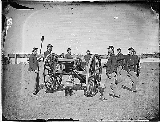
Gun Squad At Drill
Field artillery is a category of mobile artillery
Artillery

Artillery is a military Combat Arms which employs any apparatus, machine, an assortment of tools or instruments, a system or systems used as weapons for the discharge of large projectiles in combat as a major contribution of fire power within the overall military capability of an armed force....
 used to support armies
Army

An army , in the broadest sense, is the land-based armed forces of a nation. It may also include other branches of the military such as an air force....
 in the field. These weapon
Weapon

A weapon is a tool used to apply or threaten to apply force for the purpose of hunting, attack or defense in combat, subduing enemy personnel, or to destroy enemy weapons, equipment and defensive structures....
s are specialized for mobility, tactical proficiency, long range, short range and extremely long range target engagement.

Until the early 20th century, field artillery were also known as foot artillery, for while the guns were pulled by beasts of burden
Working animal

A working animal is an animal that is kept by humans and trained to perform tasks. They may be close members of the family, such as guide dogs, or domestications such as logging elephants....
 (often horses), the gun crew
Crew

A crew comprises a body or a class of people who work at a common activity, generally in a structured or hierarchy organization. A location in which a crew works is called a crewyard or a workyard....
s would usually march on foot, thus providing fire support
Fire support

Fire support is long-range firepower provided to a front-line military unit. Typically, fire support is provided by artillery or close air support , and is used to shape the battlefield or, more optimistically, define the battle....
 mainly to the infantry
Infantry

Infantry are soldiers who are primarily trained for the role of fighting on foot. A soldier in the infantry is known as an infantryman. Infantry units have more physically demanding training than other branches of armies, and place a greater emphasis on fitness, physical strength and aggression....
. This was in contrast to horse artillery
Horse artillery

Horse artillery was a type of light, fast-moving and fast-firing artillery which provided highly mobile fire support to European and United States armies from the 17th to the early 20th century....
, whose emphasis on speed while supporting cavalry
Cavalry

The Cavalry is the second oldest of the Combat Arms, and as soldiers or warriors who fought mounted on horseback in combat, it represents the mobility and offensive power of the armed forces....
 units necessitated lighter guns and crews riding on horseback.

Whereas horse artillery has been superseded by self-propelled artillery
Self-propelled artillery

File:M109A6 Paladin UTARNG 2004 firing.jpgFile:PzH2000 houwitser.pngFile:2s19 armyrecognition russia 012.jpgSelf-propelled artillery vehicles are a way of giving mobility to artillery....
, field artillery has survived to this day both in name and mission, albeit with motor vehicles towing the guns, carrying the crews and transporting the ammunition. Modern artillery has also advanced to rapidly deployable wheeled and tracked vehicles and precision delivered munitions capable of striking tarkets at ranges between 15 and 300 kilometers. There exists to date no other singularly effective all weather fires delivery system which rivals the modern field artillery.

Types

  • Field gun
    Field gun

    A field gun is an artillery piece.Originally the term referred to smaller guns that could accompany a field army on the march and when in combat could be moved about the battlefield in response to changing circumstances....
    s - capable of long range fire
  • Gun howitzers - capable of high or low angle fire with a long barrel
  • Howitzer
    Howitzer

    A howitzer is a type of artillery piece that is characterized by a relatively short Barrel and the use of comparatively small explosive charges to propel projectiles at trajectories with a steep angle of descent....
    s - capable of high angle fire
  • M777 Light Weight 155 mm Howitzer- Light and deadly
  • Infantry support gun
    Infantry support gun

    Infantry support guns are artillery weapons designed and used to enhance fire power of infantry units they are intrinsic to, offering immediate tactical response to the needs of the unit's commanding officer....
    s - directly support infantry units (mostly obsolete)
  • Mortar
    Mortar (weapon)

    A mortar is a Muzzleloader indirect fire weapon that fires shell at low velocities, short ranges, and high-arcing Ballistics trajectories. It typically has a barrel length less than 15 times its caliber....
    s - lightweight weapons that fire projectiles at an angle of over 45 degrees to the horizontal
  • Mountain gun
    Mountain gun

    Mountain guns are artillery pieces designed for use during Mountain warfare. They are similar to infantry support guns, and are generally capable of being broken down into smaller loads ....
    s - lightweight weapons that can be moved through difficult terrain
  • HIMARS High Mobility Multiple Launch Rocket System, C130 Deployable


History


Early Modern era


Early artillery was unsuited to the battlefield, as the extremely massive pieces could not be moved except in areas that were already controlled by the combatant. Thus, their role was limited to such functions as breaking siege
Siege

A siege is a military blockade of a city or fortress with the intent of conquering by Battle of attrition and/or assault. The term derives from sedere, Latin for "to sit." A siege occurs when an attacker encounters a city or fortress that cannot be easily taken by a coup de main and refuses to surrender ....
s. Later, the first field artilleries came into function as metallurgy allowed thinner barrels to withstand the explosive forces without bursting. However, there was still a serious risk of the constant changes of the battlefield conspriring to leave behind slow-moving artillery units - either on the advance, or more dangerously, in retreat. In fact, many cavalry units became tasked with destroying artillery units as one of their main functions.

Only with a number of further inventions (such as the limber, hitched to the trail of a wheeled artillery piece equipped with trunnion
Trunnion

A trunnion is a cylindrical protrusion used as a mounting and/or pivoting point....
s), did the concept of field artillery really take off.

21st Century

Since the beginning of the 21st Century the Field Artillery has delivered lethal fires around the world in the defense of freedom. The RedLegs of the King Of Battle have stood on guard and fought in support of the defense of South Korea, in support of Operation Iraqi Freedom and Operation Enduring Freedom. During Operation Cobra II the 41st FA BDE delivered 194 ATACMs missiles focussing on the Medina and Hammurabi Divisions of the Iraqi Army, causing significant damage before US forces faced dwindling ground forces in ground combat.

In both Iraq and Afghanistan, Field Artillery has been a vital part of the effort to destroy terrorists in both countries with precision and conventional fires. The United States Army Field Artillery School, Fort Sill, Oklahoma, under the guidance of the Branch Chief Major General Peter Vanjel, continues to take the Field Artillery into the future with increasing versatlity and capabilities.

20th Century


Prior to the first World War, field artillery batteries generally fired directly at visible targets measured in distances of meters and yards. Today, modern field batteries measure targets in kilometers and miles and often do not directly engage the enemy with observed direct fire. This hundred-fold increase in the range of artillery guns in the 20th century has been the result of development of rifled cannons, improvements in propellants, better communications between observer and gunner and technical improvements in gunnery
Gunnery

Gunnery may refer to:* The use of guns or the study of how to apply the techniques and procedures of operating them* The Gunnery, a coeducational prep school in Connecticut, United States...
 computational abilities.

Most field artillery situations require indirect fire
Indirect fire

In the context of warfare, direct fire means aiming through a sight directly at the target. This sight may be open fore and back sight or optical....
 due to weather, terrain, night-time conditions, distance or other obstacles. These gunners can also rely upon a trained artillery observer
Artillery observer

An artillery observer is a soldier responsible for directing artillery fire and close air support onto enemy positions. Because artillery is an indirect-fire weapon system, the guns are rarely in line-of-sight of their target, often located tens of miles away....
, also called a forward observer who sees the target, relays the coordinates of the target to their fire direction center which, in turn translates those coordinates into: a left-right aiming direction; an elevation angle; a calculated number of bags of propellant and finally a fuze with a determined waiting time before exploding, (if necessary) to be set, which is then mated to the artillery projectile now ready to be fired.

Field artillery team


Modern field artillery (Post-World War I
World War I

World War I, or the First World War , was a global military conflict which involved the Great powers, organized into two opposing military alliances: the Allies of World War I and the Central Powers....
) has three distinct parts: the forward observer (or FO), the fire direction center (FDC) and the actual guns themselves. On the battlefield, there will be combinations of all of the following elements.

FO (Forward Observer)

Because artillery is an indirect fire
Indirect fire

In the context of warfare, direct fire means aiming through a sight directly at the target. This sight may be open fore and back sight or optical....
 weapon, the forward observer must take up a position where he can observe the target using tools such as binoculars
Binoculars

Binocular telescopes, or binoculars , are two identical or mirror-symmetry optical telescopes mounted side-by-side and aligned to point accurately in the same direction, allowing the viewer to use both eyes when viewing distant objects....
 and laser rangefinders and designators and call back fire missions on his radio. This position can be anywhere from a few thousand meters to 20-30 km distant from the guns.

Using a standardized format, the FO sends either an exact target location or the position relative to his own location or a common map point, a brief target description, a recommended munition to use, and any special instructions such as "danger close" (the warning that friendly troops are within 600 metres of the target, requiring extra precision from the guns). Once firing begins, if the rounds are not accurate the FO will issue instructions to adjust fire and then call "fire for effect."

The FO does not talk to the guns directly - he deals solely with the FDC except in the case of CAS (Close Air Support
Close air support

In military tactics, close air support is defined as air action by fixed or rotary winged aircraft against hostile targets that are in close proximity to friendly forces, and which requires detailed integration of each air mission with fire and movement of these forces....
). The forward observer can also be airborne and in fact one of the original roles of aircraft in the military was airborne artillery spotting.

The FO may be called upon to direct fire for CAS and/or Naval GunFire in addition to Field Artillery based howitzer and Infantry based mortar units.

The US Army Field Manual describing the duties and responsibilities is FM 6-30, Tactics, Techniques, and Procedures for Observed Fire.

FDC (Fire Direction Center)

Typically, there is one FDC for a battery
Artillery battery

In military organizations, an artillery battery is a unit of guns, mortar s, or rockets, so grouped in order to facilitate better battlefield communication and command and control, as well as to provide dispersion for its constituent gunnery crews and their systems....
 of six guns, in a light division. In a typical heavy division configuration, there exist two FDC elements capable of operating two four gun sections, also known as a split battery. The FDC computes firing data, fire direction, for the guns. The process consists of determining the precise target location based on the observer's location if needed, then computing range and direction to the target from the guns' location. These data can be computed manually, using special protractors and slide rules with precomputed firing data. Corrections can be added for conditions such as a difference between target and howitzer altitudes, propellant temperature, atmospheric conditions, and even the curvature and rotation of the Earth
Earth

Earth is the third planet from the Sun. Earth is the largest of the terrestrial planets in the Solar System in diameter, mass and density. It is also referred to as the World and Wiktionary:Terra.Note that by International Astronomical Union convention, the term "Terra" is used for naming extensive land masses, rather...
. In most cases, some corrections are omitted, sacrificing accuracy for speed. In recent decades, FDCs have become computerized, allowing for much faster and more accurate computation of firing data.

CP


In most Artillery Batteries the Command Post or CP controls the firing of the guns. It is usually located at the battery centre so as to be able to communicate easily with the guns. The CP should be well camouflaged, but the CPO (Command Post Officer) should be able to see all the guns with ease. Gun markers are sometimes placed in front of the CP to remind the CPO which gun is in which position. The CPO is assisted by two "Acks" - or assistants - who operate the fire data computers. The GPO (Gun Position Officer) and CPO work at the plotter to ensure that the data calculated by the Acks is accurate and safe. The CP signaller is contact with the OP, or Observation Post, where the FOO, or Forward Observer Officer, works with the OP team to identify targets and call-back fire data. In recent years, headset radios have become common for communication between the CPO and gun detachment commanders.

Guns

The final piece of the puzzle is the "gun line" itself. The FDC will transmit a warning order to the guns, followed by orders specifying the type of ammunition and fuze setting, bearing, elevation, and the method of adjustment or orders for fire for effect (FFE). Elevation (vertical direction) and bearing orders are specified in milliradians
Radian

The radian is a unit of plane angle, equal to 180/pi Degree , or about 57.2958 degrees, or about 57?17'45?. It is the standard unit of angular measurement in all areas of mathematics beyond the elementary level....
) or mils, and any special instructions, such as to wait for the observer's command to fire relayed through the FDC. The crews load the howitzers and traverse and elevate the tube to the required point, using either hand cranks (usually on towed guns) or hydraulics
Hydraulics

Hydraulics is a topic of science and engineering dealing with the mechanical properties of liquids. Hydraulics is part of the more general discipline of fluid power....
 (on self-propelled models).

Parent battalion and US Army brigade/USMC regimental FDCs

FDCs also exist in the next higher parent battalion that "owns" 2-4 artillery batteries. Once again, an FDC exists at the US Army brigade or USMC regimetal level that "owns" the battalions. These higher level FDCs monitor the fire missions of their subordinate units and will coordinate the use of multiple batteries or even multiple battalions in what is called a battalion or brigade/regimental mission. In training and wartime exercises, as many as 72 guns from 3 battalions may all be coordinated to put "steel on the target" in what is called a "brigade/regimental time on target" or brigade/regimental TOT for short. The rule is "silence is consent," meaning that if the lower unit does not hear a "cancel the mission" (don't shoot) or even a "check firing" (cease firing) order from the higher monitoring unit, then the mission goes on. Higher level units monitor their subordinate unit's missions both for active as well as passive purposes. Higher level units also may get involved to coordinate artillery fire across fire support coordination boundaries (often parallel lines on maps) where one unit can not fire into without permission from higher and/or adjacent units that "own" the territory.

Esprit De Corps

To this day the modern Field Artillerymen maintains the traditions and history of those Redlegs that have gone before them. Those, archers, catapulters, fussilers and cannoneers and their supporters are honored each December at the St Barabara's Day Ball. Those worth Red Legs are honored as members of the Honorable Order of St Barbara.

Quotes


"Field Artillery, the final argument of kings"- Anonymous "God is on the side with the best Artillery" -Anonymous "The artillery lends honor to that which would otherwise be a vulgar brawl" Napoleon Bonaparte. " You don't have to tell me who won the war, the artillery did" General George Patton "Brother, your best friend ain't your Momma, its the Field Artillery" -A sign at Fort Benning, US Infantry School. "The Guns, thank God,the Guns" Rudyard Kipling

Major artillery battles

  • First battle of Panipat
    First battle of Panipat

    The first battle of Panipat took place in North India India, and marked the beginning of the Mughal Empire. This was one of the earliest battles involving gunpowder warfare firearms and field artillery....
  • Battle of Malvern Hill
    Battle of Malvern Hill

    The Battle of Malvern Hill, also known as the Battle of Poindexter's Farm, took place on July 1, 1862, in Henrico County, Virginia, was the sixth and last of the Seven Days Battles of the American Civil War....
  • Battle of the Somme
  • Battle of Vimy Ridge
    Battle of Vimy Ridge

    The Battle of Vimy Ridge was a military engagement fought as part of the Battle of Arras , in the Nord-Pas-de-Calais region of France, during the First World War....
  • Third Battle of Ypres
  • Battle of Tali-Ihantala
    Battle of Tali-Ihantala

    The Battle of Tali-Ihantala was part of the Continuation War that occurred during World War II. The battle was fought by Finland, supported by forces of Nazi Germany against the Soviet Union and is to date the largest battle in history of the Nordic countries....


See also

  • Field Artillery in the American Civil War
    Field Artillery in the American Civil War

    Field artillery in the American Civil War refers to the important artillery weapons, equipment, and practices used by the Artillery branch to support the infantry and cavalry forces in the field....
  • Field artillery team
    Field artillery team

    In the land-based field artillery, the field artillery team is organized to direct and control indirect fire artillery fire on the battlefidirect artillery fire, three distinct components have evolved in this organization, the artillery observer , the fire direction center and what is called the gun line ....
  • Field artillery of Sweden (late 17th -- early 18th century)