
All Topics  
Battle of Midway


   Email Print
   Bookmark   Link


Battle of Midway


The Battle of Midway was a major naval battleNaval battle

A naval battle is a battle fought using ships or other waterborne vessels....
 in the Pacific TheaterPacific Theater of Operations

The Pacific Theatre of Operations is the term used in the United States for all military activity in the Pacific Ocean and t...
 of World War IIWorld War II

World War II, or the Second World War, was a worldwide conflict fought between the Allied Powers and the Axis Powers ,...
. It took place from June 4, 1942 to June 7, 1942, approximately one month after the Battle of the Coral SeaBattle of the Coral Sea

The Battle of the Coral Sea, in early May 1942, was one of the major turning points of the Pacific War....
, five months after the Japanese capture of Wake IslandWake Island

Wake Island is a coral atoll having a coastline of 12 miles in the North Pacific Ocean, located about two-thirds of t...
, and exactly six months to the day after JapanEmpire of Japan

????? Dai Nippon Teikoku Empire of Great Japan...
's attack on Pearl HarborAttack on Pearl Harbor

The Imperial Japanese Navy made its attack on Pearl Harbor on the morning of Sunday, December 7, 1941 ....
.

During the battle, the United States NavyUnited States Navy

The United States Navy is the branch of the United States armed forces responsible for conducting naval operations....
 defeated a Japanese attack against Midway AtollMidway Atoll

Midway Atoll is a 6.2 square kilometer atoll located in the North Pacific Ocean at , about one-third of the way between Ho...
, losing one aircraft carrierAircraft carrier Summary

Additive synthesis is a technique of audio synthesis which creates musical timbre....
 and one destroyerDestroyer

In naval terminology, a destroyer is a fast and maneuverable yet long-endurance warship intended to escort larger vessels in...
, while sinking four Japanese carriers and a heavy cruiserHeavy cruiser

The term heavy cruiser is used to refer to large cruisers, a form of warship....
.

The battle was a decisive victoryDecisive victory

A decisive victory is an indisputable military victory of a battle that determines or significantly influences the ultimate ...
 for the Americans, and is widely regarded as the most important naval engagement of the Pacific Campaign of World War II. The battle permanently weakened the Imperial Japanese NavyFacts About Imperial Japanese Navy

The Imperial Japanese Navy or sometimes referred to as the Combined Fleet was the Navy of Empire of Japan from 1869 un...
 (IJN), in particular through the loss of four fleet carriers and over 200 irreplaceable experienced naval aviators.

Both nations sustained significant losses in the battle, but Japan was unable to reconstitute her naval forces, while the American shipbuilding and aircrew training programs provided quick replacements.


Discussion
Ask a question about 'Battle of Midway'
Start a new discussion about 'Battle of Midway'
Answer questions from other users
Full Discussion Forum


Timeline

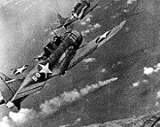
1942   The Secretary of War reorganized the United States Army into three major commands - Army Ground Forces, Army Air Forces, and Services of Supply, later redesignated Army Service Forces under attack by US aircraft at the Battle of Midway.]]


Encyclopedia


The Battle of Midway was a major naval battleNaval battle

A naval battle is a battle fought using ships or other waterborne vessels....
 in the Pacific TheaterPacific Theater of Operations

The Pacific Theatre of Operations is the term used in the United States for all military activity in the Pacific Ocean and t...
 of World War IIWorld War II

World War II, or the Second World War, was a worldwide conflict fought between the Allied Powers and the Axis Powers ,...
. It took place from June 4, 1942 to June 7, 1942, approximately one month after the Battle of the Coral SeaBattle of the Coral Sea

The Battle of the Coral Sea, in early May 1942, was one of the major turning points of the Pacific War....
, five months after the Japanese capture of Wake IslandWake Island

Wake Island is a coral atoll having a coastline of 12 miles in the North Pacific Ocean, located about two-thirds of t...
, and exactly six months to the day after JapanEmpire of Japan

????? Dai Nippon Teikoku Empire of Great Japan...
's attack on Pearl HarborAttack on Pearl Harbor

The Imperial Japanese Navy made its attack on Pearl Harbor on the morning of Sunday, December 7, 1941 ....
.

During the battle, the United States NavyUnited States Navy

The United States Navy is the branch of the United States armed forces responsible for conducting naval operations....
 defeated a Japanese attack against Midway AtollMidway Atoll

Midway Atoll is a 6.2 square kilometer atoll located in the North Pacific Ocean at , about one-third of the way between Ho...
, losing one aircraft carrierAircraft carrier Summary

Additive synthesis is a technique of audio synthesis which creates musical timbre....
 and one destroyerDestroyer

In naval terminology, a destroyer is a fast and maneuverable yet long-endurance warship intended to escort larger vessels in...
, while sinking four Japanese carriers and a heavy cruiserHeavy cruiser

The term heavy cruiser is used to refer to large cruisers, a form of warship....
.

The battle was a decisive victoryDecisive victory

A decisive victory is an indisputable military victory of a battle that determines or significantly influences the ultimate ...
 for the Americans, and is widely regarded as the most important naval engagement of the Pacific Campaign of World War II. The battle permanently weakened the Imperial Japanese NavyFacts About Imperial Japanese Navy

The Imperial Japanese Navy or sometimes referred to as the Combined Fleet was the Navy of Empire of Japan from 1869 un...
 (IJN), in particular through the loss of four fleet carriers and over 200 irreplaceable experienced naval aviators.

Both nations sustained significant losses in the battle, but Japan was unable to reconstitute her naval forces, while the American shipbuilding and aircrew training programs provided quick replacements. By 1942, the United States was three years into a massive ship building program intended to expand the Navy to a size superior to Japan's. As a result of Midway, the Japanese were faced with naval inferiority within months. Strategically, the U.S. Navy was able to seize the initiative in the Pacific and go on the offensive.

The Japanese plan of attack was to lure America's remaining carriers into a trap and sink them. The Japanese also intended to occupy Midway Atoll to extend Japan's defensive perimeter farther from its home islands. This operation was considered preparatory for further attacks against FijiFiji

Fiji , officially the Republic of the Fiji Islands, is an island nation in the South Pacific Ocean, east of Vanuatu, w...
 and SamoaSamoa

Samoa, officially the Independent State of Samoa, is a country comprising a group of islands in the South Pacific Ocea...
, as well as an invasion of Hawaii.

The Midway operation, like the attack on Pearl HarborAttack on Pearl Harbor

The Imperial Japanese Navy made its attack on Pearl Harbor on the morning of Sunday, December 7, 1941 ....
, was not part of a campaign for the conquest of the United States, but was aimed at its elimination as a strategic Pacific power, thereby giving Japan a free hand in establishing its Greater East Asia Co-Prosperity SphereGreater East Asia Co-Prosperity Sphere

The Greater East Asia Co-Prosperity Sphere was an attempt by Japan to create a self-sufficient "bloc of Asian nations led by...
. It was also hoped another defeat would force the U.S. to negotiate an end to the Pacific WarPacific War

The Pacific War was the part of World War II — and preceding conflicts — that occurred in the Pacific Ocean, its...
 with conditions favorable for Japan.

Strategic context

Japan had been highly successful in rapidly securing its initial war goals, including the takeover of the PhilippinesPhilippines

The Philippines , officially the Republic of the Philippines , is an island nation located in the Malay archipelago in...
, capture of MalayaBritish Malaya

British Malaya loosely described a set of states on the Malay Peninsula that were colonized by the British from the 18th and...
 and SingaporeSingapore

Singapore, formally the Republic of Singapore , is an island city-state and the smallest country in Southeast Asia....
, and securing vital resource areas in Java, BorneoBorneo

Borneo is the third largest island in the world....
, and other islands of the Dutch East IndiesDutch East Indies

The Dutch East Indies, or Netherlands East Indies, was the name of the colonies set up by the Dutch East India Compan...
 (now IndonesiaIndonesia

Indonesia, officially the Republic of Indonesia , is a nation of islands consisting of 18,110 islands in the South Eas...
). As such, preliminary planning for a second phase of operations commenced as early as January 1942. However, because of strategic differences between the Imperial ArmyImperial Japanese Army

# The Imperial Japanese Army was the official ground based armed force of Imperial Japan from 1867 to 1945....
 and Imperial Navy, as well as infighting between the Navy's GHQImperial General Headquarters Summary

The Imperial General Headquarters or Daihonei, as part of the Supreme War Council was the supreme command for Japanese m...
 and AdmiralAdmiral

Admiral is the rank, or part of the name of the ranks, of the highest naval officers. ...
 Isoroku YamamotoIsoroku Yamamoto

was an Admiral in the Imperial Japanese Navy during the first four years of World War II and alumnus of Harvard University ....
’s Combined FleetCombined Fleet

The was the main ocean-going component of the Imperial Japanese Navy, analogous to the German High Seas Fleet....
, the formulation of effective strategy was hampered, and the follow-up strategy was not finalized until April 1942. Admiral Yamamoto succeeded in winning a bureaucratic struggle placing his operational concept — further operations in the Central Pacific — ahead of other contending plans. These included operations either directly or indirectly aimed at AustraliaAustralia Summary

Australia, officially the Commonwealth of Australia, is a country in the Southern Hemisphere comprising the mainland o...
 and into the Indian OceanIndian Ocean

The Indian Ocean is the third largest body of water in the world, covering about 20% of the Earth's water surface....
. In the end, Yamamoto's barely-veiled threat to resign unless he got his way succeeded in carrying his agenda forward.

Yamamoto's primary strategic concern was the elimination of America's remaining carrier forces, the principal obstacle to the overall campaign. This concern was acutely heightened by the Doolittle RaidDoolittle Raid

The Doolittle Raid of April 18, 1942, was the first air raid by the United States to strike the Japanese home islands durin...
 on TokyoTokyo

listen is one of the 47 prefectures of Japan and is the location of its capital....
 by USAAFUnited States Army Air Forces Summary

The United States Army Air Forces was a part of the U.S....
 B-25sB-25 Mitchell

The North American B-25 Mitchell was an American twin-engined medium bomber manufactured by North American Aviation....
, launching from USS HornetUSS Hornet (CV-8)

The seventh USS Hornet of the United States Navy was a Yorktown class aircraft carrier of World War II, notable for laun...
. The raid, while militarily insignificant, was a severe psychologicalPsychological operations

Psychological Operations are planned operations to convey selected information and indicators to specific foreign and domest...
 shock to the Japanese and proved the existence of a gap in the defenses around the Japanese home islands. Sinking America's aircraft carriers and seizing Midway, the only strategic island besides Hawaii in the East Pacific, was seen as the only means of nullifying this threat. Yamamoto reasoned an operation against the main carrier base at Pearl HarborPearl Harbor

Pearl Harbor is a simple embayment on the island of Oahu, Hawaii, west of Honolulu....
 would induce the U.S. forces to fight. However, given the strength of American land-based air-power on Hawaii, he judged the powerful American base could not be attacked directly. Instead, he selected Midway, at the extreme northwest end of the Hawaiian IslandHawaiian Islands

The Hawaiian Islands, once known as the Sandwich Islands, form an archipelago of nineteen islands and atolls, numerous...
 chain, some from OahuOahu

Oahu , the "Gathering Place", is the third largest of the Hawaiian Islands and most populous island in the State of Ha...
. Midway was not especially important in the larger scheme of Japan's intentions; however, the Japanese felt the Americans would consider Midway a vital outpost of Pearl Harbor and would therefore strongly defend it. The U.S. did consider Midway vital; after the battle, establishment of a U.S. submarineSubmarine Overview

A submarine is a specialized watercraft that can operate underwater....
 base on Midway extended submarine range . An airstrip on Midway served as a forward staging point for bomber attacks on Wake IslandWake Island

Wake Island is a coral atoll having a coastline of 12 miles in the North Pacific Ocean, located about two-thirds of t...
.

Yamamoto's plan


Typical of Japanese naval planning during the Second World War, Yamamoto's battle plan was quite complex. Additionally, his designs were predicated on optimistic intelligence information suggesting USS EnterpriseUSS Enterprise (CV-6)

USS Enterprise, the "Big E", was the sixth aircraft carrier of the United States Navy and the seventh US Navy ship of th...
 and USS HornetUSS Hornet (CV-8)

The seventh USS Hornet of the United States Navy was a Yorktown class aircraft carrier of World War II, notable for laun...
, forming Task Force 16, were the only carriers available to the U.S. Pacific Fleet at the time. USS LexingtonUSS Lexington (CV-2)

The fourth USS Lexington, nicknamed the "Gray Lady" or "Lady Lex", was the second aircraft carrier of the United States ...
 had been sunk and USS YorktownUSS Yorktown (CV-5)

The third USS Yorktown was lead ship of the Yorktown class aircraft carrier of World War II, sunk at the Battle of M...
 severely damaged (and IJN believed her sunk) at the Battle of the Coral Sea just a month earlier. Likewise, the Japanese were aware that USS SaratogaFacts About USS Saratoga (CV-3)

The fifth USS Saratoga was the third aircraft carrier of the United States Navy....
 was undergoing repairs on the West CoastFacts About West Coast of the United States

The "West Coast", "Western Seaboard", or "Pacific Seaboard" are terms for the westernmost coastal states of the ...
 after taking torpedoTorpedo

A modern torpedo, historically called a locomotive torpedo, is a self-propelled projectile that operates underwater a...
 damage from a submarine. As such, the Japanese believed they faced at most two American fleet carriers at the point of contact.

More important, however, was Yamamoto's belief that the Americans had been demoralized by their frequent defeats during the preceding six months. Yamamoto felt deception would be required to lure the U.S. Fleet into a fatally compromising situation. To this end, he dispersed his forces so that their full extent (particularly his battleshipBattleship

Battleship was the name given to the most powerfully gun-armed and most heavily armored classes of warships built between th...
s) would be unlikely to be discovered by the Americans prior to battle. However, his emphasis on dispersal meant none of his formations were mutually supporting. Unbeknownst to Yamamoto, any benefit from this was neutralized by the fact the United States had broken the main Japanese naval code (dubbed JN-25JN-25

JN-25 is the name used by Western cryptography organizations for the main secure command and control communications scheme u...
 by the U.S.).

Critically, Yamamoto's supporting battleships and cruisers would trail Vice-Admiral Chuichi NagumoChuichi Nagumo

Chuichi Nagumo was a Vice Admiral in the Imperial Japanese Navy, the navy of Empire of Japan under Admiral Isoroku Yamamoto ...
's carrier striking force by several hundred miles. Japan's heavy surface forces were intended to destroy whatever part of the U.S. Fleet might come to Midway's relief, once Nagumo's carriers had weakened them sufficiently for a daylight gun duel to be fought; this was typical of the battle doctrine of most major navies. However, their distance from Nagumo's carriers would have grave implications during the battle, since the battleships were escorted by cruiserCruiser

A cruiser is a large warship capable of engaging multiple targets simultaneously....
s, which possessed scout planeFacts About Scout plane

The term scout plane refers to a type of surveillance aircraft, usually of single-engined, two/three seats, shipborne type, ...
s invaluable to Nagumo.

Aleutian invasion

Likewise, the Japanese operations aimed at the Aleutian IslandsBattle of the Aleutian Islands

The Battle of the Aleutian Islands was a struggle over the Aleutian Islands, part of Alaska, in the Pacific campaign of Worl...
 (Operation AL) removed yet more ships from the force striking Midway. However, whereas prior histories have often characterized the Aleutians operation as a feint to draw American forces northwards, recent scholarship on the battle has shown, by the original Japanese battle plan, AL was designed to be launched simultaneously with the attack on Midway. However, a one-day delay in the sailing of Nagumo's task force had the effect of initiating Operation AL a day before its counterpart.

Order of battle

Prelude to battle

U.S. forces


In order to do battle with an enemy force anticipated to be composed of 4 or 5 carriers, Admiral Chester W. Nimitz, Commander in Chief, Pacific Ocean Areas, needed every available U.S. flight deck. He already had Vice AdmiralVice Admiral

Vice Admiral is a naval rank of three star level, equivalent to Lieutenant General in seniority....
 William Halsey's two-carrier (Enterprise and Hornet) task forceTask force Overview

A task force or task group is a temporary organization formed to work on a single defined task or activity....
 at hand; Halsey was stricken with psoriasisPsoriasis

Psoriasis is an immune-mediated disease...
 and was replaced by Rear AdmiralRear Admiral

Rear Admiral is a naval commissioned officer rank that originated from the days of Naval Sailing Squadrons and can trace its...
 Raymond A. SpruanceRaymond A. Spruance

Raymond Ames Spruance was a United States Navy admiral in World War II....
 (Halsey's escort commander). Nimitz also hurriedly called back Rear Admiral Frank Jack FletcherFrank Jack Fletcher

Frank Jack Fletcher was an admiral in the United States Navy during World War I and World War II....
's task force from the South West Pacific AreaSouth West Pacific Area

South West Pacific Area was the name given to one of the four major Allied commands in the Pacific theatre of World War II, ...
. He reached Pearl Harbor just in time to provision and sail. Saratoga was still under repair, and Yorktown had been severely damaged at the Battle of the Coral Sea, but Pearl Harbor Naval Shipyard worked around the clock to patch up the carrier. Though several months of repairs at Puget Sound Naval ShipyardPuget Sound Naval Shipyard

Puget Sound Naval Shipyard is a United States Navy shipyard covering 179 acres of property bordered on the south by Sincla...
 was estimated for Yorktown, 72 hours was enough to restore her to a battle-worthy (if still not structurally ideal) state. Her flight deck was patched, whole sections of internal frames were cut out and replaced, and several new squadrons (drawn from the Saratoga) were put aboard. Nimitz showed disregard for established procedure in getting his third and last available carrier ready for battle — repairs continued even as Yorktown sortied, with work crews from the repair ship USS VestalUSS Vestal (AR-4)

The history of USS Vestal began when Erie was authorized on 17 April 1904; but the ship was renamed Vestal in Oc...
—herself damaged in the attack on Pearl Harbor six months earlier—still aboard. Just three days after putting into drydock at Pearl Harbor, Yorktown was again under way.

Japanese forces


Meanwhile, as a result of their participation in the Battle of the Coral Sea, the Japanese carrier ZuikakuJapanese aircraft carrier Zuikaku

Zuikaku was a Shokaku-class aircraft carrier of the Imperial Japanese Navy....
 was in port in KureKure, Hiroshima

is a city located in Hiroshima prefecture, Japan....
, awaiting a replacement air group. The heavily damaged ShokakuJapanese aircraft carrier Shokaku Overview

Shokaku was an aircraft carrier of the Imperial Japanese Navy, the lead ship of her class....
 was under repair from three bomb hits suffered at Coral Sea, and required months in drydock. Despite the likely availability of sufficient aircraft between the two ships to re-equip Zuikaku with a composite air group, the Japanese made no serious attempt to get her into the forthcoming battle. Consequently, instead of bringing five intact fleet carriers into battle, Admiral Nagumo would only have four: KagaJapanese aircraft carrier Kaga

Kaga was an aircraft carrier of the Imperial Japanese Navy....
, with AkagiJapanese aircraft carrier Akagi

The Akagi was an aircraft carrier serving with the Imperial Japanese Navy during World War II....
, forming Division 1; HiryuJapanese aircraft carrier Hiryu

Hiryu was a Soryu-class aircraft carrier of the Imperial Japanese Navy....
 and SoryuJapanese aircraft carrier Soryu

Soryu was an aircraft carrier of the Imperial Japanese Navy....
, as the 2nd Division. At least part of this was a product of fatigue; Japanese carriers had been constantly on operations since December 7, 1941, including pinprick raids on Darwin and ColomboFacts About Indian Ocean raid

The Indian Ocean raid was a naval sortie by the Fast Carrier Strike Force of the Imperial Japanese Navy from 31 March to 10 ...
.

Japanese strategic scouting arrangements prior to the battle also fell into disarray. A picket line of Japanese submarineSubmarine

A submarine is a specialized watercraft that can operate underwater....
s was late getting into position (partly because of Yamamoto's haste), which let the American carriers proceed to their assembly point northeast of Midway (known as "Point Luck") without being detected. A second attempt to use four-engine reconnaissance flying boatFlying boat

A seaplane is an aircraft that is designed to take off and alight upon water....
s to scout Pearl Harbor prior to the battle (and thereby detect the absence or presence of the American carriers), known as "Operation K", was also thwarted when Japanese submarines assigned to refuel the search aircraft discovered that the intended refueling point — a hitherto deserted bay off French Frigate ShoalsFrench Frigate Shoals

The French Frigate Shoals is the largest atoll in the Northwestern Hawaiian Islands....
 — was occupied by American warships (because the Japanese had carried out an identical mission in March). Thus, Japan was deprived of any knowledge concerning the movements of the American carriers immediately before the battle. Japanese radio intercepts also noticed an increase in both American submarine activity and U.S. message traffic. This information was in Yamamoto's hands prior to the battle. However, Japanese plans were not changed in reaction to this; Yamamoto, at sea in YamatoJapanese battleship Yamato

Yamato, named after the ancient Japanese Yamato Province, was a battleship of the Imperial Japanese Navy....
, did not dare inform Nagumo for fear of exposing his position, and presumed (incorrectly) Nagumo had received the same signal from Tokyo.

Battle

Initial air attacks

The first air attack occurred on June 4, by nine B-17sB-17 Flying Fortress

The Boeing B-17 Flying Fortress was the first mass-produced, four-engine heavy bomber....
 operating from Midway against the Japanese transport group. Though hits were reported, none of the bombs actually landed on target and no significant damage was sustained. Early the following morning, Akebono Maru sustained the first hit when a torpedo from an attacking PBY flying boatFlying boat

A seaplane is an aircraft that is designed to take off and alight upon water....
 struck her around 01:00. Vice Admiral Chuichi Nagumo launched his initial attack wave (108 aircraft) at 04:30 on June 4. At the same time, he launched eight search aircraft (one 30 minutes late due to technical issues, and one which was forced to turn back), as well as his combat air patrolCombat air patrol

Combat air patrol is a type of defensive mission for fighter aircraft, in which they guard a designated site, either a fixed...
.

Japanese reconnaissance arrangements were flimsy, with too few aircraft to adequately cover the assigned search areas, laboring under poor weather conditions to the northeast and east of the task force. Now, Yamamoto's faulty dispositions came home to roost.

American radar picked up the enemy at a distance of several miles and interceptors soon scrambled. Unescorted bombers headed off to attack the Japanese carrier fleet, their fighter escorts remaining behind to defend Midway. At 06:20, Japanese carrier aircraft bombed and heavily damaged the U.S. base on Midway. Midway-based Marine fighter pilots, flying obsolescent Grumman F4F WildcatF4F Wildcat

The Grumman F4F Wildcat was the standard carrier-based fighter of the United States Navy for the first year and a half of Wo...
s and obsolete Brewster F2As, made a defense of Midway and suffered heavy losses. Most were downed in the first few minutes, and only two remained flyable. American anti-aircraft fire was accurate and intense, damaging many Japanese aircraft and claiming a third of the Japanese planes destroyed. The Japanese learned the island's bombers had already departed, and the strike leader signaled Nagumo another attack would be necessary to neutralize Midway's defenses before troops could be landed on June 7; American bombers still could use the airbase to refuel and attack the Japanese invasion force.

Having taken off prior to the Japanese attack, American bombers based on Midway made several attacks on the Japanese carrier fleet. These included six TBF AvengerTBF Avenger

The Grumman TBF Avenger was an American torpedo bomber, developed initially for the United States Navy and Marine Corps and ...
s composed of pilots from Hornets VT-8VT-8

Torpedo Squadron 8 was a United States Navy squadron of torpedo bombers assigned to the Air Group operating from the aircraf...
 in their first combat operation, and four USAAC B-26 MarauderB-26 Marauder Summary

The B-26 Marauder was a twin-engine medium bomber of the Second World War, built by the Glenn L....
s, all armed with torpedoes. The Japanese shrugged off these attacks with almost no losses, while destroying all but three of the American bombers, which were one TBF and two B-26s.

Admiral Nagumo, in accordance with Japanese carrier doctrineFacts About Military doctrine

Military doctrine is a level of military planning between national strategy and unit-level tactics, techniques, and procedur...
 at the time, had kept half of his aircraft in reserve. These comprised two squadrons each of dive-bombers and torpedo bombers, the torpedo bombers armed with torpedoes, should any American warships be located. The dive bombers were, as yet, unarmed. As a result of the attacks from Midway, as well as the morning flight leader's recommendation regarding the need for a second strike, Nagumo at 07:15 ordered his reserve planes to be re-armed with general purpose contact bombs for use on land targets. This had been underway for about 30 minutes, when at 07:40 a scout plane from the cruiserCruiser

A cruiser is a large warship capable of engaging multiple targets simultaneously....
 ToneJapanese cruiser Tone

Tone was a heavy cruiser of the Imperial Japanese Navy and the lead ship of her class....
 signaled the discovery of a sizable American naval force to the east. Nagumo quickly reversed his order and demanded the scout plane ascertain the composition of the American force. Another 40 minutes elapsed before Tones scout finally detected and radioed the presence of a single carrier in the American force, TF 16Task Force 16

Task Force 16 is one of the most storied task forces in the United States Navy, a major participant in a number of the most ...
 (the other carrier was not detected).

Nagumo was now in a quandary. Rear Admiral Tamon YamaguchiTamon Yamaguchi

Rear-Admiral Tamon Yamaguchi was an Admiral of the Imperial Japanese Navy....
, leading Carrier Division 2 (
Hiryu and Soryu), recommended Nagumo strike immediately with the forces at hand. Nagumo's seeming opportunity to hit the American ships, however, was curtailed by the fact his Midway strike force would be returning shortly. They would be low on fuel and carrying wounded crewmen, would need to land promptly or ditch, losing precious aircraft and crews; there was slim chance a strike could be mounted in time. Spotting his flight decks and launching aircraft would require at least 30–45 minutes. Furthermore, by spotting and launching immediately, he would be committing some of his reserve to battle without proper anti-ship armament, as well as without fighter escort; they had just witnessed how easily unescorted American bombers were shot down by their own fighters. Japanese carrier doctrine preferred fully constituted strikes, and in the absence of a confirmation (until 08:20) of whether the American force contained carriers, Nagumo's reaction was doctrinaire. In addition, the impending arrival of another American air strike at 07:53 gave weight to the need to attack the island again. In the end, Nagumo chose to wait for his first strike force to land, then launch the reserve force, which would have by then been properly armed and ready. In the final analysis, it made no difference; Fletcher had launched beginning at 07:00, so the aircraft which would deliver the crushing blow were already on their way. There was nothing Nagumo could do about it. This was the fatal flaw of Yamamoto's dispositions: it followed strictly traditional battleship doctrine.

Attacks on the Japanese fleet


Meanwhile, the Americans had already launched their carrier aircraft against the Japanese. Admiral Fletcher, in overall command aboard Yorktown, and armed with PBYPBY Catalina

PBY Catalina was the United States Navy designation for an American and Canadian-built flying boat of the 1930s and 1940s....
 patrol bomber sighting reports from the early morning, ordered Spruance to launch against the Japanese as soon as was practical. Spruance gave the order "Launch the attack" at around 06:00 and left Halsey's Chief of Staff, Captain Miles BrowningMiles Browning Summary

Miles Rutherford Browning served as an officer of the United States Navy in the Atlantic during World War I and in the Pacif...
, to work out the details and oversee the launch. It took until a few minutes after 07:00 before the first plane was able to depart from Spruance's carriers, Enterprise and Hornet. Fletcher, upon completing his own scouting flights, followed suit at 08:00 from Yorktown. It was at this point Spruance gave his second crucial command, to run toward the target, having judged that the need to throw something at the enemy as soon as possible was greater than the need for a coordinated attack among the different types of aircraft (fighters, bombers, torpedo planes). Accordingly, American squadrons were launched piecemeal, proceeding to the target in several different groups. This diminished the overall impact of the American attacks and greatly increased their casualties; coincidentally, it reduced the Japanese ability to counterstrike and found Nagumo with his decks at their most vulnerable.

American carrier aircraft had difficulty locating the target in the vastness of the Pacific, despite the positions they had been given. Nevertheless, they did finally sight enemy carriers and began attacking at 09:20, led by Torpedo Squadron 8, followed by VT-6 (from Enterprise) at 09:40. Every TBD DevastatorTBD Devastator

The Douglas TBD Devastator was a torpedo bomber of the United States Navy, ordered in 1934, first flying in 1935 and enterin...
 of VT-8 was shot down, with only one survivor. VT-6 squadron met nearly the same fate, with no hits against the enemy to show for their efforts, thanks in part to terrible aircraft torpedoes. The Japanese combat air patrol (CAP), flying the much faster Mitsubishi Zero, made short work of the Americans, who not only had no fighter support of their own but were flying the slow, under-armed TBDs. However, despite their losses, the American torpedo planes indirectly achieved three important results. First, they kept the Japanese carriers off balance, with no ability to prepare and launch their own counterstrike. Second, their attacks had pulled the Japanese combat air patrol out of position. Third, many of the Zeros were low on ammunition and fuel. The appearance of a third torpedo plane attack from the southeast by VT-3 at 10:00 very quickly drew the majority of the Japanese CAP into the southeast quadrant of the fleet.

By chance, at the same time VT-3 was sighted by the Japanese, two separate formations (comprising three squadrons total) of American SBD DauntlessSBD Dauntless

The Douglas SBD Dauntless was the U.S....
 dive-bombers were approaching the Japanese fleet from the northeast and southwest. These formations initially had difficulty in locating the Japanese carriers, and their fuel was running low. However, by the decisions of squadron commanders C. Wade McClusky, Jr. and Max LeslieMax Leslie

Commander Maxwell Franklin Leslie , of the USS Yorktown Air Group, was a Naval Aviator in the United States Navy during Wor...
 to continue the search, they spotted the wake of Japanese destroyer Arashi. The destroyer was steaming at full speed back to Nagumo's carrier force, after having unsuccessfully depth-charged the U.S. submarine NautilusUSS Nautilus (SS-168)

USS Nautilus, a Narwhal-class submarine and one of the "V-boats," was the fifth ship of the United States Navy to be...
, which had earlier carried out an unsuccessful attack on the battleship KirishimaJapanese battleship Kirishima

Kirishima was the Imperial Japanese Navy's fourth Kongo class battlecruiser, and was laid down by Mitsubishi in Nagasaki...
. The American dive-bombers arrived in a perfect position to attack the Japanese. Armed Japanese strike aircraft filled the hangar decks at the time of the fateful attack, fuel hoses were snaking across the decks as refueling operations were hastily completed, and the constant change of ordnance meant bombs and torpedoes were stacked around the hangars rather than stowed safely in the magazines. The Japanese carriers were extraordinarily vulnerable.

Contrary to some accounts of the battle, contemporary research, based on recent translation of relevant portions of the 100 volume Japanese account of the war, Senshi Sosho, has demonstrated that the Japanese were not in fact prepared to launch a counterstrike against the Americans at the time they were decisively attacked. Because of the constant flight deck activity associated with combat air patrol operations during the preceding hour, the Japanese had never had an opportunity to spot their reserve for launch. The few aircraft on the Japanese flight decks at the time of the attack were either CAP fighters, or (in the case of Soryu) strike fighters being spotted to augment the CAP.

Beginning at 10:22, Enterprise’s aircraft attacked Kaga, while to the south, Yorktown’s aircraft attacked carrier Soryu, with Akagi being struck by several of Enterprises bombers four minutes later. Simultaneously, VT-3 was targeting Hiryu, although the American torpedo aircraft again scored no hits. The dive-bombers, however, had better fortune. Within six minutes, the SBDFacts About SBD Dauntless

The Douglas SBD Dauntless was the U.S....
 dive bombers made their attack runs and left all three of their targets heavily ablaze.
Akagi was hit by just one bomb, which was sufficient; it penetrated to the upper hangar deck and exploded among the armed and fueled aircraft there. One extremely near miss also slanted in and exploded underwater, bending the flight deck upward with the resulting geyser and causing crucial rudder damage. Soryu took three bomb hits in the hangar decks; Kaga took at least four, possibly more. All three carriers were out of action and were eventually abandoned and scuttleScuttling

Scuttling is the act of deliberately sinking a ship....
d.

Subsequent to the air attacks, Nautilus fired torpedoes at what her crew thought was Soryu but which later research suggests was Kaga. Nautilus claimed one hit the carrier, causing "flames". However, the surviving crew of Kaga reported no torpedo hits after the air attack. Of the four torpedoes launched, one failed to run, two ran erratically, and the fourth was a 'dud', impacting amidships and breaking in half. History would show Nautilus had already made a more important contribution.

Japanese counterattacks


Hiryu, the sole surviving Japanese aircraft carrier, wasted little time in counterattacking. The first wave of Japanese dive-bombers badly damaged Yorktown with two bomb hits, yet her damage control teams patched her up so effectively (in about an hour) the second wave's torpedo bombers mistook her for an intact carrier. Despite Japanese hopes to even the battle by eliminating two carriers with two strikes, Yorktown absorbed both Japanese attacks, the second mistakenly believing Yorktown had already been sunk and they were attacking Enterprise. After two torpedo hits, Yorktown lost power and was now out of the battle, forcing Admiral Fletcher to move his flag to the heavy cruiser AstoriaUSS Astoria (CA-34)

The second USS Astoria was a United States Navy New Orleans-class heavy cruiser that participated in both the Battle...
; but Task Force 16's two carriers had escaped undamaged as a result.

News of the two strikes, with the reports each had sunk an American carrier, greatly improved the morale of the crewmen of the Kido Butai. Its surviving aircraft all recovered aboard Hiryu, where they were prepared for a strike against what was believed to be the only remaining American carrier.

When American scout aircraft subsequently located Hiryu late in the afternoon, Enterprise launched a final strike of dive bombers (including 10 bombers from Yorktown), leaving Hiryu ablaze, despite being defended by a strong defensive CAP of over a dozen Zero fighters. Rear Admiral Yamaguchi chose to go down with his ship, costing Japan perhaps her best carrier sailor. Hornet's strike, launching late because of a communications error, concentrated on the remaining surface ships but failed to score any hits.

As darkness fell, both sides took stock and made tentative plans for continuing the action. Admiral Fletcher, obliged to abandon the derelict Yorktown and feeling he could not adequately command from a cruiser, ceded operational command to Spruance. Spruance knew the United States had won a great victory, but was still unsure of what Japanese forces remained at hand and was determined to safeguard both Midway and his carriers. To aid his aviators, who had launched at extreme range, he had continued to close Nagumo during the day, and persisted as night fell. Fearing a possible night encounter with Japanese surface forces, Spruance changed course and withdrew to the east, turning back west towards the enemy at midnight.

For his part, Yamamoto initially decided to continue the effort and sent his remaining surface forces searching eastward for the American carriers. Simultaneously, a cruiser raiding force was detached to bombard the island. The Japanese surface forces failed to make contact with the Americans due to Spruance's decision to briefly withdraw eastward, and Yamamoto ordered a general retirement to the west.

American search planes failed to detect the retiring Japanese task forces on June 5. An afternoon strike narrowly missed detecting Yamamoto's main body and failed to score hits on a straggling Japanese destroyer. The strike planes returned to the carriers after nightfall, prompting Spruance to order Enterprise and Hornet to turn on searchlights in order to aid their landings. Marc MitscherMarc Mitscher

Marc Andrew "Pete" Mitscher, was an admiral in the United States Navy, notable as commander of the Fast Carrier Task Force i...
, commanding Hornet, would later issue the same order under similar circumstances during the Battle of the Philippine SeaBattle of the Philippine Sea

The Battle of the Philippine Sea was an air-sea battle of the Pacific campaign of World War II fought between the U.S....
.

At 02.15 on 5 June–6 June, Commander John Murphy's TamborUSS Tambor (SS-198) Summary

USS Tambor, the lead ship of her class of submarine, was the only ship of the United States Navy to be named for the tam...
, lying some 90 nm (165 km) west of Midway, made one of the Submarine Force's two major contributions to the battle's outcome, sighting several ships. He (along with his exec, Ray Spruance, Jr.) could not identify them (and feared they might be friendly, so he held fire), but reported their presence, omitting their course. This went to Admiral Robert English, Commander, Submarine Force, Pacific Fleet (COMSUBPAC), and from him through Nimitz to the senior Spruance. Unaware of the exact location of Yamamoto's "Main Body" (a persistent problem since PBYs had first sighted the Japanese), Spruance presumed this was the invasion force. Thus, he moved to block it, taking station some 100 nm (185 km) northeast of Midway; this frustrated Yamamoto's efforts, and the night passed without any contact between the opposing forces.

In actuality, this was a group of four cruisers and two destroyers, Yamamoto's bombardment group, which at 02:55 were ordered to retire west with the rest of his force. Murphy was sighted around the same time; turning to avoid, Mogami and MikumaJapanese cruiser Mikuma

Mikuma was a Mogami class cruiser in the Imperial Japanese Navy. She was sunk in the Battle of Midway....
 collided, inflicting serious damage to Mogamis bow, the most any of the eighteen submarines deployed for the battle achieved. Only at 04:12 did the sky brighten enough for Murphy to be certain the ships were Japanese, by which time staying surfaced was a hazard, and he dived to approach for an attack. This was unsuccessful, and at around 06.00, he finally reported two Mogami-class cruisers, westbound, placing Spruance at least 100 nm (185 km) out of position. It may have been fortunate Spruance did not pursue, for had he come in contact with Yamamoto's heavies, including Yamato, in the dark, his cruisers would have been overwhelmed, and his carriers helpless.

Over the following two days, first Midway and then Spruance's carriers launched several successive strikes against the stragglers. Mikuma was eventually sunk, while Mogami survived severe damage to return home for repairs. U.S. Marine Captain Richard E. FlemingRichard E. Fleming

Captain Richard E. Fleming was a United States Marine who was awarded the Medal of Honor for his heroism in the World War II...
 was posthumously awarded the Medal of HonorMedal of Honor

The Medal of Honor is the highest military decoration awarded by the United States....
 for his attack on Mikuma.

Yorktown was sunk during salvage efforts, by three torpedoes from Japanese submarine I-168 on June 7. There were few casualties since most of the crew had already been evacuated. One torpedo from this salvo also sank the destroyer USS HammannUSS Hammann (DD-412)

USS Hammann was a World War II-era Sims-class destroyer in the service of the United States Navy, named after Ensign...
, which had been providing auxiliary power to Yorktown, splitting her in two with the loss of 80 lives. It remains unclear why Yorktown had not been placed under tow immediately after being hit, to get her out of reach of Japanese attack.

Aftermath

After winning a clear victory, and as pursuit became too hazardous near Wake, American forces retired. Japan's loss of four out of their six fleet carriers, plus a large number of their highly trained aircrews, stopped the expansion of the Japanese Empire in the Pacific. Only ZuikakuJapanese aircraft carrier Zuikaku

Zuikaku was a Shokaku-class aircraft carrier of the Imperial Japanese Navy....
 and ShokakuJapanese aircraft carrier Shokaku

Shokaku was an aircraft carrier of the Imperial Japanese Navy, the lead ship of her class....
 were left for offensive actions. Japan's other carriers, RyujoJapanese aircraft carrier Ryujo

Ryujo was a light aircraft carrier of the Imperial Japanese Navy....
, JunyoJapanese aircraft carrier Junyo

Junyo was a Hiyo-class aircraft carrier of the Imperial Japanese Navy....
, and HiyoJapanese aircraft carrier Hiyo

Hiyo was a Hiyo-class aircraft carrier of the Imperial Japanese Navy....
, were second-rate ships of comparatively poor effectiveness.

On 10 June, the Imperial Japanese Navy conveyed to the liaison conference an incomplete picture of the results of the battle, on the ground that the real extent of damage was a military secret not to be entrusted to all members. Only Emperor HirohitoHirohito

Hirohito was the 124th Emperor of Japan according to the traditional order of succession, reigning from 1926 to 1989....
 was accurately informed of carriers and pilots losses, and he chose not to inform the Army immediately. Army planners then continued for a short time to believe the fleet was healthy and secure.

Allegations of war crimes

Three U.S. airmen, EnsignEnsign

An ensign is a distinguishing flag of a ship or a military unit, or a distinguishing token, emblem, or badge, such as a symb...
 Wesley Osmus (pilot, Yorktown), Ensign Frank O'Flaherty (pilot, Enterprise) and Aviation Machinist's MateAviation Machinist's Mate

Aviation Machinist's Mate is a United States Navy occupational rating....
 B. F. (or B. P.) Gaido (radioman-gunner of O'Flaherty's SBD) were captured by the Japanese during the battle. Osmus was held on the destroyer Arashi, with O'Flaherty and Gaido on the cruiser Nagara (or destroyer Makigumo, sources vary), and it is alleged they were later killed. The report filed by Admiral Nagumo states of Ensign Osmus, "He died on 6 June and was buried at seaBurial at sea

Burial at sea describes the procedure of disposing of human remains in the ocean....
. Nagumo records obtaining seven items of information, including Fletcher's strength, but does not mention the death of O'Flaherty or Gaido. The practice of burying the remains of the enemy at sea was common among all navies involved.

Impact

The battle has often been called "the turning point of the Pacific". The Japanese navy continued to fight ferociously, and it was many more months before the U.S. moved from a state of naval parity to one of increasingly clear supremacy. Thus, Midway was not "decisive" in the same sense as SalamisBattle of Salamis

The Battle of Salamis was a naval battle between the Greek city-states and Persia, fought in September, 480 BC in the strait...
 or TrafalgarBattle of Trafalgar

The Battle of Trafalgar, fought on 21 October 1805, is part of the War of the Third Coalition assembled by Britain against F...
. However, victory at Midway first gave the U.S. the strategic initiative, inflicted irreparable damage on the Japanese carrier force, and shortened the war in the Pacific.

Just two months later, the U.S. took the offensive and attacked GuadalcanalGuadalcanal campaign

The Guadalcanal campaign, also known as the Battle of Guadalcanal , was fought between August 7, 1942 and February 9,...
, catching the Japanese off-balance. Securing Allied supply lines to Australia and the Indian Ocean in this time frame, along with the heavy attrition inflicted on the Japanese during the Guadalcanal campaign, had far-reaching effects on the course of the war. Its effect on the length is debatable, given the Pacific Fleet's Submarine Force had essentially brought Japan's economy to a halt by January 1945.

Midway dealt Japanese naval aviation a heavy blow. The pre-war Japanese training program produced pilots of exceptional quality but at a slow rate. This small group of elite aviators were combat hardened veterans. At Midway, the Japanese lost as many of these pilots in a single day as their pre-war training program produced in a year. Japanese planners failed to foresee a long continuous war, and consequently their production failed to replace the losses of ships, pilots, and sailors begun at Midway; by mid-1943, Japanese naval aviation was decimated.

Even more important was the irredeemable loss of four of Japan's fleet carriers. These ships were not replaced, unit for unit, until early in 1945. In the same span of time, U.S. industrial capacity allowed the U.S. Navy to commission more than two dozen fleet and light fleet carriers, and numerous escort carriers. Thus, Midway permanently damaged the Japanese Navy's striking power and measurably shortened the period during which the Japanese carrier force could fight on advantageous terms. The loss of operational capability during this critical phase of the campaign ultimately proved disastrous; Imperial Japan could have executed much grander, and perhaps more successful, operations against the U.S. counter-offensive being marshaled. Whether this would have happened is debatable, however, as the Japanese awaited "decisive battle", and as American submarines increasingly hampered the flow of oil essential for fleet operations.

Discovery of sunken vessels

U.S. vessels

Because of the extreme depth of the ocean in the area of the battle (more than 17,000 feet/5200 m), researching the battlefield has presented extraordinary difficulties. However, on May 19, 1998, Robert BallardRobert Ballard

Robert Duane Ballard Ph.D. is a famous oceanographer most noted for his work in underwater archaeology....
 and a team of scientists and Midway veterans (including Japanese participants) located and Yorktown. The ship was remarkably intact for a vessel that sank in 1942; much of the original equipment and even the original paint scheme were still visible.

Japanese vessels

Ballard's subsequent search for the Japanese carriers was ultimately unsuccessful. In September 1999, a joint expedition between Nauticos Corp. and the U.S. Naval Oceanographic Office searched for the Japanese aircraft carriers. Using advanced renavigation techniques in conjunction with the ship's log of the submarine USS Nautilus, the expedition located a large piece of wreckage, subsequently identified as having come from the upper hangar deck of Kaga. The main wreck, however, has yet to be located.

In film


The Battle of Midway has been featured in several motion pictures. The first film about the battle was a documentary directed by John FordJohn Ford

John Ford was an American film director famous for such westerns as Stagecoach and The Searchers, and for adaptation...
, a Commander in the U.S. Naval Reserve at the time, and on temporary duty at Midway Island during the battle as a photographic and intelligence officer. While shooting 16mm color motion picture footage from atop the island's power plant, Ford was exposed to enemy fire by attacking aircraft and wounded in the arm by shrapnel. He received a Purple Heart and later, the Legion of Merit for his actions. The film Ford shot during the actual battle is included in his 1942 Academy Award winning documentary, The Battle of MidwayThe Battle of Midway

The Battle of Midway is a 1942 American documentary film short directed by John Ford....
.

Subsequently, the battle was given in-depth coverage by the 1960 big-budget Japanese war film Storm Over the PacificStorm Over the Pacific

'Storm Over the Pacific', originally titled in Japan as Hawai Middouei daikaikusen: Taiheiyo no arashi is the first colo...
directed by Shuei Matsubayashi for TohoToho

is a large Japanese film studio. It is headquartered in Chiyoda, Tokyo, and is one of the core companies of the Hankyu-Toho Grou...
 studios. The film focuses on a young Zero pilot aboard HiryuJapanese aircraft carrier Hiryu

Hiryu was a Soryu-class aircraft carrier of the Imperial Japanese Navy....
 who participates in both the attack on Pearl HarborAttack on Pearl Harbor

The Imperial Japanese Navy made its attack on Pearl Harbor on the morning of Sunday, December 7, 1941 ....
 and the Battle of Midway. It was barely released in the United States in a dubbedDubbing (filmmaking)

In filmmaking, dubbing or looping is the process of recording or replacing voices for a motion picture....
, abridged version, under the sensationalized title I Bombed Pearl Harbor and the brilliant miniature & pyrotechnic effects were noticed by Universal Studios as good enough to reuse in their depiction to come 16 years later.

The U.S.-made star-studded dramatic film of the battle came into being as MidwayMidway (film)

Midway is a war film released in 1976....
, directed by Jack SmightJack Smight

Jack Smight was an American film director....
, and starring Charlton HestonCharlton Heston

Charlton Heston is an Academy Award-winning American film actor noted for heroic roles and his long involvement in politica...
, released in 1976. It strongly fictionalized events and relied heavily on stock footageStock footage

Stock footage, also termed archive footage, library pictures and file footage is film or video footage eit...
 (for which it was criticized) from various World War II battles, as well as some previously filmed for Tora! Tora! Tora!Facts About Tora! Tora! Tora!

is a 1970 film that dramatizes the Japanese attack on Pearl Harbor and the series of American blunders that unintentionally impro...
, Thirty Seconds Over TokyoThirty Seconds over Tokyo

Thirty Seconds over Tokyo is a 1944 film based on a 1943 book by Ted W....
, Away All BoatsAway All Boats

Away All Boats is a 1956 war film produced by Universal Pictures....
, and especially Storm over the Pacific.

Other remembrances

The Chicago Midway International Airport (or simply Midway Airport), historically important to the war efforts in World War II, was renamed in 1949 in honor of the Battle of Midway. Previously, it was named the Chicago Municipal Airport.

Further reading

Books*
  • First-hand account by Japanese captain, often inaccurate.
  • Significant section on Midway
  • An account of the blunders that led to the near total destruction of the American torpedo squadrons, and of what the author calls a cover-up by naval officers after the battle.* official U.S. history.* Detailed study of battle, from planning to the effects on WWII

Articles
  • , Comprehensive historic overview


Historic documents
  • , prepared by U.S. Naval Intelligence from captured Japanese documents
  • - U.S. Navy propaganda film directed by John FordJohn Ford

    John Ford was an American film director famous for such westerns as Stagecoach and The Searchers, and for adaptation...
    .


Miscellaneous
  • Counterfactual fiction has the Japanese winning.
  • Schlesinger, James R.James R. Schlesinger

    James Rodney Schlesinger was United States Secretary of Defense from 1973 to 1975 under presidents Richard Nixon and Gerald ...
    , "Midway in Retrospect: The Still Under-Appreciated Victory", June 5 2005. (An analysis by former Secretary of Defense Schlesinger.) Available from the Naval Historical Center, Department of the Navy.
  • by Bryan J. Dickerson