
In Depth
See Also

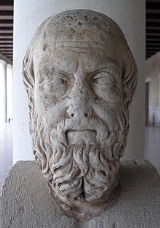
Herodotus

Herodotus of Halicarnassus Halicarnassus

Halicarnassus, an ancient Greek city on the southwest coast of Caria [i], Asia Minor [i], on a picturesq ... 

  was a Dorian Greek historian who lived in the 5th century BC and is regarded as the "father of history". He is almost exclusively known for writing The Histories, a collection of 'inquiries' about the places and peoples he encountered during his wide-ranging travels around the Mediterranean littoral and into Mesopotamia. The theme for this work was the conflict between the ancient Greeks Greeks

The Greeks are an ethnic group [i] mostly found in the southern Balkan peninsula [i] of southeastern Europe [i] ... 

 and the Persians Persian Empire

The Persian Empire was a series of historical empires that ruled over the Iranian plateau [i] ... 

 or 'Medes Medes

The Medes were an ancient Iranian people [i], who lived in the north, western, a ... 

'.

Discussions

  Discussion Features

   Ask a question about 'Herodotus'

   Start a new discussion about 'Herodotus'

   Answer questions about 'Herodotus'

   'Herodotus' discussion forum

Quotations

Circumstances rule men; men do not rule circumstances.

Book 7, Ch. 49

Force has no place where there is need of skill.

Book 3, Ch. 127

From great wrongdoing there are great punishments from the gods.

Book 2, Ch. 120

Great deeds are usually wrought at great risks.

Book 7, Ch. 50

Haste in every business brings failures.

Book 7, Ch. 10

In peace, children inter their parents; war violates the order of nature and causes parents to inter their children.

Book 1, Ch. 87

       More Quotes >>


Encyclopedia


Herodotus of Halicarnassus Halicarnassus

Halicarnassus, an ancient Greek city on the southwest coast of Caria [i], Asia Minor [i], on a picturesq ... 

  was a Dorian Greek historian who lived in the 5th century BC and is regarded as the "father of history". He is almost exclusively known for writing The Histories, a collection of 'inquiries' about the places and peoples he encountered during his wide-ranging travels around the Mediterranean littoral and into Mesopotamia. The theme for this work was the conflict between the ancient Greeks Greeks

The Greeks are an ethnic group [i] mostly found in the southern Balkan peninsula [i] of southeastern Europe [i] ... 

 and the Persians Persian Empire

The Persian Empire was a series of historical empires that ruled over the Iranian plateau [i] ... 

 or 'Medes Medes

The Medes were an ancient Iranian people [i], who lived in the north, western, a ... 

'.

Life

Most of what is known of the life of Herodotus has been gleaned from his own work.

He was exiled from Halicarnassus Halicarnassus

Halicarnassus, an ancient Greek city on the southwest coast of Caria [i], Asia Minor [i], on a picturesq ... 

 after his involvement in an unsuccessful coup d'état Coup d'état

A coup d'tat , or simply coup, is the sudden overthrow of a government [i] through unconstitutiona ... 

 against the ruling dynasty, and that he then withdrew to the island of Samos Samos Island

Samos Island [i] is a Greek [i] island in the East [i]ern Aegean [i] sea [i], localiza... 

. .

It must have been during his exile that he undertook the journeys he describes in The Histories. These journeys took him to Egypt Egypt

[i] country in [[North Africa]... 

 as far south as the first cataract Aswan

Aswan is a city in the south of Egypt [i], the capital of the Aswan Governorate [i].... 

 of the Nile Nile

The Nile ; Ancient Egyptian [i] iteru), a river [i] in Africa [i], is accepted by most authorities a ... 

, to Babylon Babylon

Babylon was an ancient city in Mesopotamia, the ruins of which can be found in present-day Babil Province [i] ... 

, to the Ukraine Ukraine

Ukraine is a country [i] in Eastern Europe [i]. ... 

, and to Italy Italy

Italy, officially the Italian Republic , is a Southern European [i] country. ... 

 and Sicily Sicily

Sicily is an autonomous region [i] of Italy [i] and the larges ... 

. Herodotus mentions an interview with an informant in Sparta Sparta

Sparta is a city in southern Greece [i]. ... 

, and almost certainly he lived for a period in Athens Athens

Athens is the capital [i] and the largest city of Greece [i]. ... 

. In Athens, he obviously became familiar with the oral traditions of the prominent families, in particular the Alkmaeonidai, . However, as the Athenians did not accept foreigners as citizens, Herodotus must have felt distinctly out of place there. Indeed, when Athens sought citizens for the Italian colony Colonies in antiquity

Colonies [i] in antiquity were city-state [i]s founded from a mother-city [i], not from a territo ... 

 of Thurii Thurii

Thurii – Greek [i]: , called also by some Latin [i] writers and by Ptolemy [i], ... 

 in 444 BCE, Herodotus' name was among the willing. Whether or not he died in his adopted city is uncertain.

At some point, Herodotus became a logios -- a reciter of logoi or stories, written in prose. . His subject matter often encompassed battles, other political incidents of note, and, especially, the marvels of foreign lands. He made tours of the Greek cities and the major religious and athletic festivals, where he offered performances and expected payment.

In 431 BCE, the Peloponnesian War Peloponnesian War

The Peloponnesian War was an Ancient Greek [i] military conflict fought by Athens [i] an ... 

 broke out between Athens Athens

Athens is the capital [i] and the largest city of Greece [i]. ... 

 and Sparta Sparta

Sparta is a city in southern Greece [i]. ... 

. It may have been that conflict that inspired him to collect his stories into a continuous narrative. Centering as they do on the theme of Persia's imperial progress, which only a united Athens and Sparta had managed to resist, they may be seen as a critique of, or an attack upon, the war-mongering that threatened to engulf the entire Greek world.

Contribution

Herodotus has passed on to us a large amount of the information concerning part of the world that was current in his own day.

For example, he reports that the annual flooding of the Nile Nile

The Nile ; Ancient Egyptian [i] iteru), a river [i] in Africa [i], is accepted by most authorities a ... 

 was said to be the result of melting snows far to the south, and comments that he cannot understand how there can be snow in Africa, the hottest part of the known world. Of course, we know that this is, in fact, not the actual cause; but if it were not for Herodotus' method of comparing all theories known to him, we might never have discovered that such hydrological speculation existed in ancient Greece.

Written between 430 BCE and 424 BCE, The Histories were divided by later editors into nine books, named after the nine Muses Muse

In Greek mythology [i], the Muses are nine goddesses who embody the right evocation of myth, inspired th ... 

 .

As the work progresses, it becomes apparent that Herodotus is fulfilling his opening desire -- to 'prevent the great and wonderful actions of the Greeks and the Barbarians from losing their due meed of glory; and to put on record what causes first brought them into conflict.' Indeed, it is only from this perspective that his opening discussion of ancient wife-stealing is comprehensible: he is attempting to discover who first made the 'west' and the 'east' mutual antagonists, and myth is the only source he can delve into for information on the subject.

The first six books deal broadly with the growth of the Persian Empire Persian Empire

The Persian Empire was a series of historical empires that ruled over the Iranian plateau [i] ... 

. The tale begins with an account of the first 'western' monarch to enter into conflict with a 'eastern' people -- Croesus Croesus

Croesus was the king [i] of Lydia [i] from 560/561 BC until his defeat by the Persians [i] ... 

 of Lydia Lydia

Lydia is a historic region of western Anatolia [i], congruent with Turkey [i]'s modern provinces of Izmir [i] ... 

 attacked the Greek city-states of Ionia, and then , also attacked the Persians. . Croesus was defeated by Cyrus Cyrus the Great

Cyrus the Great [i], also known as Cyrus II of Persia and Cyr ... 

 the Great, founder of the Persian Empire, and Lydia became a Persian province.

The second book forms a lengthy digression concerning the history of Egypt, which Cyrus' successor, Cambyses, annexed to the Empire. The following four books deal with the further growth of the Empire under Darius, the Ionian Revolt, and the burning of Sardis . The sixth book describes the very first Persian incursion into Greece, an attack upon those who aided the Ionians and a quest for retribution following the attack upon Sardis, which ended with the defeat of the Persians in 490 BCE at the Battle of Marathon Battle of Marathon

The Battle of Marathon was the culmination of King Darius I of Persia [i]'s first major attempt to conq... 

, near Athens.

The last three books describe the attempt of the Persian king Xerxes Xerxes I of Persia

Xerxes I , was a Persian Emperor [i] of the Achaemenid dynasty [i].... 

 to avenge the Persian defeat at Marathon and to finally absorb Greece into the Empire. The Histories end in the year 479 BCE, with the Persian invaders having suffered both a crushing naval defeat at Salamis Battle of Salamis

The Battle of Salamis was a naval battle between the Greek [i] city-state [i]s and Persia [i]... 

, and near utter-annihilation of their ground forces at Plataea Battle of Plataea

The Battle of Plataea was the last battle of the Persian Wars [i] in southern Greece. ... 

. The Persian Empire thus receded to the Aegean Aegean Sea

The Aegean Sea is an arm of the Mediterranean Sea [i], located between the Greek peninsula and Anatolia [i] ... 

 coastline of Asia Minor Anatolia

Anatolia is a region of Southwest Asia [i] which corresponds today to the Asiatic portion of Turkey [i] ... 

, still threatening but much chastened.

It is possible to see the dialectic theme of Persian power and its various excesses running like a 'red thread' throughout the narrative -- cause and effect, hubris and fate, vengeance and violence. Even the strange and fantastic tales that are liberally sprinkled throughout the text find their source in this momentum. At every stage, a Persian monarch crosses a body of water or other liminal space and suffers the consequences: Cyrus attacks the Massagetae on the eastern bank of a river, and ends up decapitated; Cambyses attacks the Ethiopians to the south of Egypt, across the desert, and goes mad; Darius attacks the Scythians to the north and is flung back across the Danube; Xerxes lashes and then bridges the Hellespont, and his forces are crushed by the Greeks. Thus, though he strays off of this main course, he always returns to the task at hand—answering the question, how and why did the Greeks and Persians enter into the greatest conflict then known, and what were the consequences?

Opinions

Herodotus' invention has earned him the twin titles The Father of History and The Father of Lies. As these epithets would seem to imply, there has long been a debate -- at least from the time of Cicero Cicero

[i]) was an [[orator]... 

's 'On the Laws' -- concerning the veracity of his tales, and, more importantly, concerning the extent to which he knew himself to be creating fabrications. Indeed, every manner of argument has surfaced on this subject, from a devious and consciously-fictionalizing Herodotus to a gullible Herodotus whose sources 'saw him coming a long way off'.

Scrutiny of his works


There are many cases in which Herodotus, either uncertain of the truth of an event or unimpressed by the lacklustre 'facts' presented to him, reports the several most prominent accounts of a given subject or process and then opines as to which he believes is the most probable. Though The Histories were often criticized in antiquity for bias, inaccuracy Accuracy and precision

In the fields of science [i], engineering [i], industry [i] and statistics [i], accuracy is the degree o... 

 and even plagiarism, this methodology has been seen in a more positive light by many modern historians and philosophers, especially those searching for an example of relatively objective historical writing. Of course, given the sensitivity of the issue, the very founding of the discipline of history, this has not become a consensus view; attacks have been made by several scholars in modern times, a few even arguing that Herodotus exaggerated the extent of his travels and completely fabricated sources -- that he made up more than one on a given topic is worse, they seem to say, not better.

Discoveries made since the end of the 19th century have helped to rehabilitate Herodotus' reputation a great deal. The archaeological study of the now submerged ancient Egyptian city of Heraklion and the recovery of the so-called 'Naucratis stela' lends substantial credence to Herodotus' previously unsupported claim that Heraklion was founded under the Egyptian New Kingdom. . Because of this recent increase in respect for his accuracy, as well as the quality and content of his observations, Herodotus is now recognized as a pioneer not only in history, but in ethnography and anthropology Anthropology

Anthropology consists of the study of humanity [i] . ... 

 as well.

Readers of Herodotus, however, insulated from the historiographical considerations of academia, are content in the belief that he did the best he could with the material he had they often point out that his achievement is astonishing, given the massive problems facing anyone attempting to perform historical research in the ancient world and are also quite charmed by the outcome.

Further reading

  • Several English translations of The Histories of Herodotus are readily available in multiple editions. The most readily available are those translated by:
    • A. D. Godley, 1920; revised 1926. Reprinted 1931, 1946, 1960, 1966, 1975, 1981, 1990, 1996, 1999, 2004. Available in from Loeb Classical Library, Harvard University Press. ISBN 0-674-99130-3 Printed with Greek on the left and English on the right.
    • Aubrey de Sélincourt, originally 1954; revised by John Marincola in 1972. Several editions from Penguin Books Penguin Books

      Penguin Books is a British [i] publisher [i] founded in 1935 by Allen Lane [i]. ... 

       available.
    • David Grene, Chicago: University of Chicago Press, 1985.
    • George Rawlinson George Rawlinson

      Canon George Rawlinson, was a 19th century [i] English [i] scholar [i] and historian [i]. ... 

      , translation 1858-1860. Public domain; many editions available, although Everyman Library and Wordsworth Classics editions are the most common ones still in print.
    • Robin Waterfield, Oxford World's Classics, 1998.


  • Evans, J. A. S., Herodotus. Boston: G. K. Hall, 1982.
  • —. Herodotus, Explorer of the Past: Three Essays. Princeton, NJ: Princeton University Press, 1991.
  • Fehling, Detlev. Herodotus and His "Sources": Citation, Invention, and Narrative Art. Translated by J.G. Howie. Arca Classical and Medieval Texts, Papers, and Monographs, 21. Leeds: Francis Cairns, 1989.
  • Flory, Stewart, The Archaic Smile of Herodotus. Detroit: Wayne State University Press, 1987.
  • Fornara, Charles W. Herodotus: An Interpretative Essay. Oxford: Clarendon Press, 1971.
  • Hartog, F., The Mirror of Herodotus. Berkeley, CA: University of California Press, 1988.
  • Lateiner, D., The Historical Method of Herodotus. Toronto: University of Toronto Press, 1989.
  • Momigliano, A., The Classical Foundations of Modern Historiography. University of California Press, 1992.
  • Pritchett, W. K., The Liar School of Herodotus. Amsterdam: Gieben, 1991.
  • Thomas, R., 'Herodotus in Context; ethnography, science and the art of persusion'. Oxford University Press 2000.

See also

  • Pharaoh Pharaoh (novel)

    Pharaoh is the fourth and last major novel [i] by the Polish [i] writer Boleslaw Prus [i]. ... 

  • Thucydides Thucydides

    Thucydides was an ancient Greek [i] historian [i], and the author of the History of the Peloponnesian War [i] ... 

    , ancient Greek historian who is often said to be "the father of history"
  • Life of Homer , a short biography of Homer Homer

    Homer was a legendary early Greek [i] poet [i] and rhapsode [i] traditionally credited ... 

     that claims falsely to be the work of Herodotus

External links

  • at About.com
  • A reconstructed , based on historical sources, in a contemporary style.
  • at Livius.org


Online translations
  • - new translation with extensive photographic essays of the places and artifacts mentioned by Herodotus hyper-linked to the text*
  • at The Internet Classics Archive
  • at the Internet Sacred Text Archive
  • on

An of this article by James Allan Evans was posted at Nupedia Nupedia

Nupedia was a Web-based [i] encyclopedia [i] whose articles were written by experts a ... 

.