

Kalinga War

Encyclopedia
The Kalinga War was a war fought between the Mauryan Empire under Ashoka the Great and the state of Kalinga
, a feudal republic
located on the coast of the present-day India
n state of Orissa
. The Kalinga war is one of the major battles in the History of India
. Kalinga put up a stiff resistance, but they were no match for Ashoka's brutal strength. The bloodshed of this war is said to have prompted Ashoka to adopt Buddhism
.
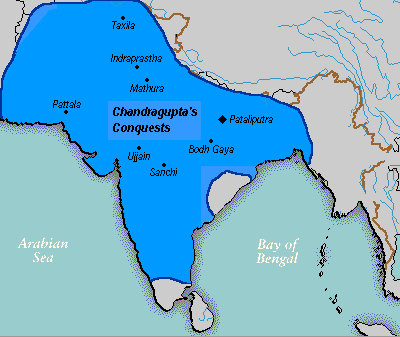 The main reasons for invading Kalinga were both political and economic. Since the time of Ashoka's father, King Bindusara
, the Mauryan Empire based in Magadha
was following a policy of territorial expansion. Kalinga was under Magadha control during the Nanda
rule, but regained independence with the beginning of the rule of the Mauryas. That was considered a great setback for the traditional policy of territorial expansion of the Magadhan emperors and was considered to be a loss of political prestige for the Mauryas
merely imperative to reduce Kalinga to complete subjection. To this task Ashoka must have set himself as soon as he felt he was securely established on the throne. The war began in the 8th year of Ashoka
's reign, probably in 261 BC. Ashoka's grandfather Chandragupta had previously attempted to conquer Kalinga, but had been repulsed. After a bloody battle for the throne after Bindusara's death, Ashoka tried to annex Kalinga. Ashoka was successful only after a savage war, whose consequences changed Ashoka's views on war and led him to pledge never to wage a war. It is said that in the aftermath of the Battle of Kalinga the Daya River
running next to the battle field turned red with the blood of the slain; about 100,000 Kalinga civilians and more than 10,000 of Ashoka's own warriors were among those slain.
Dhauli
hill is presumed to be the area where the Kalinga War was fought. The historically important Dhauli hills are located on the banks of the Daya River
of Bhubaneswar
in Orissa (India). Dhauli hill, with a vast open space adjoining it, has major Edicts of Ashoka engraved on a mass of rock by the side of the road leading to the summit of the hill.
Ashoka's response to the Kalinga War is recorded in the Edicts of Ashoka
. The Kalinga War prompted Ashoka, already a non-engaged Buddhist, to devote the rest of his life to Ahimsa
(non-violence) and to Dharma-Vijaya (victory through Dharma
). Following the conquest of Kalinga, Ashoka ended the military expansion of the empire, and led the empire through more than 40 years of relative peace, harmony and prosperity.
According to oral histories, a woman approached him and said, "Your actions have taken from me my father, husband, and son. Now what will I have left to live for?". Moved by these words, it is said, that he accepted/adopted Buddhism, and vowed to never take life again.
's 2001 Bollywood
epic Asoka, starring Shahrukh Khan
, Ajith Kumar
and Kareena Kapoor
. While the film was found to be lacking in authenticity, it did, nevertheless, correctly incorporate many of the key historical elements of the Kalinga War.
Kalinga (India)
Kalinga was an early state in central-eastern India, which comprised most of the modern state of Orissa/Utkal , as well as the Andhra region of the bordering state of Andhra Pradesh. It was a rich and fertile land that extended from the river Damodar/Ganges to Godavari and from Bay of Bengal to...
, a feudal republic
Republic
A republic is a form of government in which the people, or some significant portion of them, have supreme control over the government and where offices of state are elected or chosen by elected people. In modern times, a common simplified definition of a republic is a government where the head of...
located on the coast of the present-day India
India
India , officially the Republic of India , is a country in South Asia. It is the seventh-largest country by geographical area, the second-most populous country with over 1.2 billion people, and the most populous democracy in the world...
n state of Orissa
Orissa
Orissa , officially Odisha since Nov 2011, is a state of India, located on the east coast of India, by the Bay of Bengal. It is the modern name of the ancient nation of Kalinga, which was invaded by the Maurya Emperor Ashoka in 261 BC. The modern state of Orissa was established on 1 April...
. The Kalinga war is one of the major battles in the History of India
History of India
The history of India begins with evidence of human activity of Homo sapiens as long as 75,000 years ago, or with earlier hominids including Homo erectus from about 500,000 years ago. The Indus Valley Civilization, which spread and flourished in the northwestern part of the Indian subcontinent from...
. Kalinga put up a stiff resistance, but they were no match for Ashoka's brutal strength. The bloodshed of this war is said to have prompted Ashoka to adopt Buddhism
Buddhism
Buddhism is a religion and philosophy encompassing a variety of traditions, beliefs and practices, largely based on teachings attributed to Siddhartha Gautama, commonly known as the Buddha . The Buddha lived and taught in the northeastern Indian subcontinent some time between the 6th and 4th...
.
Background
Bindusara
Bindusara was the second Mauryan emperor after Chandragupta Maurya. During his reign, the empire expanded southwards. He had two well-known sons, Susima and Ashoka, who were the viceroys of Taxila and Ujjain...
, the Mauryan Empire based in Magadha
Magadha
Magadha formed one of the sixteen Mahājanapadas or kingdoms in ancient India. The core of the kingdom was the area of Bihar south of the Ganga; its first capital was Rajagriha then Pataliputra...
was following a policy of territorial expansion. Kalinga was under Magadha control during the Nanda
Nanda Dynasty
The Nanda Empire originated from the region of Magadha in Ancient India during the 5th and 4th centuries BC. At its greatest extent, the Nanda Empire extended from Bengal in the east, to Punjab in the west and as far south as the Vindhya Range...
rule, but regained independence with the beginning of the rule of the Mauryas. That was considered a great setback for the traditional policy of territorial expansion of the Magadhan emperors and was considered to be a loss of political prestige for the Mauryas
merely imperative to reduce Kalinga to complete subjection. To this task Ashoka must have set himself as soon as he felt he was securely established on the throne. The war began in the 8th year of Ashoka
Ashoka
Ashok Maurya or Ashoka , popularly known as Ashoka the Great, was an Indian emperor of the Maurya Dynasty who ruled almost all of the Indian subcontinent from ca. 269 BC to 232 BC. One of India's greatest emperors, Ashoka reigned over most of present-day India after a number of military conquests...
's reign, probably in 261 BC. Ashoka's grandfather Chandragupta had previously attempted to conquer Kalinga, but had been repulsed. After a bloody battle for the throne after Bindusara's death, Ashoka tried to annex Kalinga. Ashoka was successful only after a savage war, whose consequences changed Ashoka's views on war and led him to pledge never to wage a war. It is said that in the aftermath of the Battle of Kalinga the Daya River
Daya River
The Daya River starts as a branch of the Kuakhai River at Saradeipur in Orissa state in India. It is joined by the Malaguni River below Golabai and flows through Khordha and Puri districts before emptying into the north-eastern corner of Chilika Lake, km from its origin.The historically important...
running next to the battle field turned red with the blood of the slain; about 100,000 Kalinga civilians and more than 10,000 of Ashoka's own warriors were among those slain.
Dhauli
Dhauli
Dhauli hills are located on the banks of the river Daya, 8 km south of Bhubaneswar in Orissa . It is a hill with vast open space adjoining it, and has major Edicts of Ashoka engraved on a mass of rock, by the side of the road leading to the summit of the hill...
hill is presumed to be the area where the Kalinga War was fought. The historically important Dhauli hills are located on the banks of the Daya River
Daya River
The Daya River starts as a branch of the Kuakhai River at Saradeipur in Orissa state in India. It is joined by the Malaguni River below Golabai and flows through Khordha and Puri districts before emptying into the north-eastern corner of Chilika Lake, km from its origin.The historically important...
of Bhubaneswar
Bhubaneswar
Bhubaneswar is the capital of the Indian state of Orissa, officially Odisha. The city has a long history of over 2000 years starting with Chedi dynasty who had Sisupalgarh near present-day Bhubaneswar as their capital...
in Orissa (India). Dhauli hill, with a vast open space adjoining it, has major Edicts of Ashoka engraved on a mass of rock by the side of the road leading to the summit of the hill.
Aftermath
Ashoka had seen the bloodshed with his own eyes and felt that he was the cause of the destruction. The whole of Kalinga was plundered and destroyed. Ashoka's later edicts state that about 100,000 people were killed on the Kalinga side and 10,000 from Ashoka's army. Thousands of men and women were deported.Ashoka's response to the Kalinga War is recorded in the Edicts of Ashoka
Edicts of Ashoka
The Edicts of Ashoka are a collection of 33 inscriptions on the Pillars of Ashoka, as well as boulders and cave walls, made by the Emperor Ashoka of the Mauryan dynasty during his reign from 269 BCE to 231 BCE. These inscriptions are dispersed throughout the areas of modern-day Bangladesh, India,...
. The Kalinga War prompted Ashoka, already a non-engaged Buddhist, to devote the rest of his life to Ahimsa
Ahimsa
Ahimsa is a term meaning to do no harm . The word is derived from the Sanskrit root hims – to strike; himsa is injury or harm, a-himsa is the opposite of this, i.e. non harming or nonviolence. It is an important tenet of the Indian religions...
(non-violence) and to Dharma-Vijaya (victory through Dharma
Dharma
Dharma means Law or Natural Law and is a concept of central importance in Indian philosophy and religion. In the context of Hinduism, it refers to one's personal obligations, calling and duties, and a Hindu's dharma is affected by the person's age, caste, class, occupation, and gender...
). Following the conquest of Kalinga, Ashoka ended the military expansion of the empire, and led the empire through more than 40 years of relative peace, harmony and prosperity.
- "Beloved-of-the-Gods, King Priyadarsi, conquered the Kalingas eight years after his coronation. One hundred and fifty thousand were deported, one hundred thousand were killed and many more died (from other causes). After the Kalingas had been conquered, Beloved-of-the-Gods came to feel a strong inclination towards the Dharma, a love for the Dharma and for instruction in Dhamma. Now Beloved-of-the-Gods feels deep remorse for having conquered the Kalingas." Rock Edict No.13
According to oral histories, a woman approached him and said, "Your actions have taken from me my father, husband, and son. Now what will I have left to live for?". Moved by these words, it is said, that he accepted/adopted Buddhism, and vowed to never take life again.
In popular culture
The Kalinga War is depicted in Santosh SivanSantosh Sivan
Santosh Sivan is an Indian cinematographer, film director, and producer who has worked in Malayalam, Kannada, Tamil, and Hindi cinema....
's 2001 Bollywood
Bollywood
Bollywood is the informal term popularly used for the Hindi-language film industry based in Mumbai , Maharashtra, India. The term is often incorrectly used to refer to the whole of Indian cinema; it is only a part of the total Indian film industry, which includes other production centers producing...
epic Asoka, starring Shahrukh Khan
Shahrukh Khan
Shahrukh Khan , often credited as Shah Rukh Khan, is an Indian film actor, as well as a film producer and television host. Often referred to as "the King of Bollywood", Khan has acted in over 70 Hindi films....
, Ajith Kumar
Ajith Kumar
Ajith Kumar is an Indian film actor who works mainly in Tamil cinema. He began his career as a supporting actor in a Telugu film before gaining critical recognition in the Tamil thriller Aasai . A succession of high-grossing films followed where Ajith was usually depicted as a romantic hero, with...
and Kareena Kapoor
Kareena Kapoor
Kareena Kapoor , often informally referred to as Bebo, is an Indian actress who appears in Bollywood films. During her career, Kapoor has received six Filmfare Awards, among nine nominations, and has been noted for her performances in a range of film genres; these include her work from contemporary...
. While the film was found to be lacking in authenticity, it did, nevertheless, correctly incorporate many of the key historical elements of the Kalinga War.