
All Topics  
Alps

 
Alps

   Email Print
   Bookmark   Link


Alps


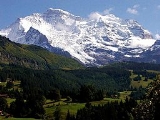
The Alps (; ; ; ; ; ) is the name for one of the great mountain range
Mountain range

A mountain range is a chain of mountains bordered by highlands or separated from other mountains by mountain pass or valleys. Individual mountains within the same mountain range do not necessarily have the same geology, though they often do; they may be a mix of different orogeny, for example volcanoes, uplifted mountains or Fold mountains...
 systems of Europe
Europe

Europe is, conventionally, one of the world's seven continents. Comprising the westernmost peninsula of Eurasia, Europe is generally divided from Asia to its east by the water divide of the Ural Mountains, the Ural , the Caspian Sea, and by the Caucasus Mountains to the southeast....
, stretching from Austria
Austria

Austria , officially the Republic of Austria , is a landlocked country in Central Europe. It borders both Germany and the Czech Republic to the north, Slovakia and Hungary to the east, Slovenia and Italy to the south, and Switzerland and Liechtenstein to the west....
 and Slovenia
Slovenia

Slovenia , officially the Republic of Slovenia , is a country in southern Central Europe bordering Italy to the west, the Adriatic Sea to the southwest, Croatia to the south and east, Hungary to the northeast, and Austria to the north....
 in the east; through Italy
Italy

Italy , officially the Italian Republic , is a country located on the Italian Peninsula in Southern Europe and on the two largest islands in the Mediterranean Sea, Sicily and Sardinia....
, Switzerland
Switzerland

Switzerland is a landlocked Swiss Alps country of roughly 7.7 million people in Western Europe with an area of 41,285 km?. Switzerland is a federal republic consisting of 26 states called Cantons of Switzerland....
, Liechtenstein
Liechtenstein

The Principality of Liechtenstein is a Landlocked country#Doubly landlocked country alpine country microstate in Western Europe, bordered by Switzerland to the west and by Austria to the east....
 and Germany
Germany

Germany , officially the Federal Republic of Germany , is a country in Central Europe. It is bordered to the north by the North Sea, Denmark, and the Baltic Sea; to the east by Poland and the Czech Republic; to the south by Austria and Switzerland; and to the west by France, Luxembourg, Belgium, and the Netherlands....
; to France
France

France , officially the French Republic , is a country whose Metropolitan France is located in Western Europe and that also comprises various Overseas departments and territories of France....
 in the west.

The highest mountain in the Alps is Mont Blanc
Mont Blanc

Mont Blanc , or Monte Bianco , also known as "La Dame Blanche" is a mountain in the Alps. With its summit, it is the highest mountain in the Alps and Western Europe, and is List of peaks by prominence in topographic prominence....
, at , on the Italian–French border. All the main peaks of the Alps can be found in the list of mountains of the Alps
List of mountains of the Alps

This is a list of mountains of the Alps, ordered by elevation. For a list ordered by topographic prominence, see the list of Alpine peaks by prominence....
 and list of Alpine peaks by prominence
List of Alpine peaks by prominence

This is a list of the mountains of the Alps, ordered by their topographic prominence. For a list by height, see the list of mountains of the Alps.Where the Topographic prominence#Parent peak and the Topographic prominence#Parent peak differ, the prominence parent is marked with "1" and the island parent with "?" ....
.

The English name "Alps" was taken via French
French language

French is a Romance language spoken around the world by around 80 million people as first language, by 190 million as second language, and by about another 200 million people as an acquired tongue, with significant speakers in 54 countries....
 from Latin
Latin

Latin is an Italic language, historically spoken in Latium and Ancient Rome. Through the Military history of the Roman Empire, Latin spread throughout the Mediterranean and a large part of Europe....
 Alpes, which may be ultimately cognate with Latin albus ("white").


Discussion
Ask a question about 'Alps'
Start a new discussion about 'Alps'
Answer questions from other users
Full Discussion Forum


Recent Posts


Encyclopedia


The Alps (; ; ; ; ; ) is the name for one of the great mountain range
Mountain range

A mountain range is a chain of mountains bordered by highlands or separated from other mountains by mountain pass or valleys. Individual mountains within the same mountain range do not necessarily have the same geology, though they often do; they may be a mix of different orogeny, for example volcanoes, uplifted mountains or Fold mountains...
 systems of Europe
Europe

Europe is, conventionally, one of the world's seven continents. Comprising the westernmost peninsula of Eurasia, Europe is generally divided from Asia to its east by the water divide of the Ural Mountains, the Ural , the Caspian Sea, and by the Caucasus Mountains to the southeast....
, stretching from Austria
Austria

Austria , officially the Republic of Austria , is a landlocked country in Central Europe. It borders both Germany and the Czech Republic to the north, Slovakia and Hungary to the east, Slovenia and Italy to the south, and Switzerland and Liechtenstein to the west....
 and Slovenia
Slovenia

Slovenia , officially the Republic of Slovenia , is a country in southern Central Europe bordering Italy to the west, the Adriatic Sea to the southwest, Croatia to the south and east, Hungary to the northeast, and Austria to the north....
 in the east; through Italy
Italy

Italy , officially the Italian Republic , is a country located on the Italian Peninsula in Southern Europe and on the two largest islands in the Mediterranean Sea, Sicily and Sardinia....
, Switzerland
Switzerland

Switzerland is a landlocked Swiss Alps country of roughly 7.7 million people in Western Europe with an area of 41,285 km?. Switzerland is a federal republic consisting of 26 states called Cantons of Switzerland....
, Liechtenstein
Liechtenstein

The Principality of Liechtenstein is a Landlocked country#Doubly landlocked country alpine country microstate in Western Europe, bordered by Switzerland to the west and by Austria to the east....
 and Germany
Germany

Germany , officially the Federal Republic of Germany , is a country in Central Europe. It is bordered to the north by the North Sea, Denmark, and the Baltic Sea; to the east by Poland and the Czech Republic; to the south by Austria and Switzerland; and to the west by France, Luxembourg, Belgium, and the Netherlands....
; to France
France

France , officially the French Republic , is a country whose Metropolitan France is located in Western Europe and that also comprises various Overseas departments and territories of France....
 in the west.

The highest mountain in the Alps is Mont Blanc
Mont Blanc

Mont Blanc , or Monte Bianco , also known as "La Dame Blanche" is a mountain in the Alps. With its summit, it is the highest mountain in the Alps and Western Europe, and is List of peaks by prominence in topographic prominence....
, at , on the Italian–French border. All the main peaks of the Alps can be found in the list of mountains of the Alps
List of mountains of the Alps

This is a list of mountains of the Alps, ordered by elevation. For a list ordered by topographic prominence, see the list of Alpine peaks by prominence....
 and list of Alpine peaks by prominence
List of Alpine peaks by prominence

This is a list of the mountains of the Alps, ordered by their topographic prominence. For a list by height, see the list of mountains of the Alps.Where the Topographic prominence#Parent peak and the Topographic prominence#Parent peak differ, the prominence parent is marked with "1" and the island parent with "?" ....
.

The English name "Alps" was taken via French
French language

French is a Romance language spoken around the world by around 80 million people as first language, by 190 million as second language, and by about another 200 million people as an acquired tongue, with significant speakers in 54 countries....
 from Latin
Latin

Latin is an Italic language, historically spoken in Latium and Ancient Rome. Through the Military history of the Roman Empire, Latin spread throughout the Mediterranean and a large part of Europe....
 Alpes, which may be ultimately cognate with Latin albus ("white"). The German Albe, Alpe or Alp (f., Old High German
Old High German

The term Old High German refers to the earliest stage of the German language and it conventionally covers the period from around 500 to 1050. Coherent written texts do not appear until the second half of the 8th century, and some treat the period before 750 as 'prehistoric' and date the start of Old High German proper to 750 for this reason...
 alpâ, plural alpûn) in the singular means "alpine pasture", and only in the plural may also refer to the mountain range as a whole.

Geography


Subdivision

Alps in the Chamonix Valley, Near the Mer De Glace
Alpenrelief 02
Grossglockner From Sw
The Alps are generally divided into the Western Alps and the Eastern Alps
Eastern Alps

Eastern Alps is the name given to the eastern half of the Alps, usually defined as the area east of the Spl?gen Pass in eastern Switzerland. North of the Spl?gen Pass, the Posterior Rhine forms the border, and south of the pass, the Liro river and Lake Como form the boundary line....
. The division is along the line between Lake Constance
Lake Constance

Under the designation Lake Constance one summarizes the three independent Body of water Obersee , Untersee and Seerhein , lying in the northern Alps foreland....
 and Lake Como
Lake Como

Lake Como is a lake of Glacier origin in Lombardy, Italy. It has an area of 146 km?, making it the third largest lake in Italy, after Lake Garda and Lake Maggiore....
, following the rivers Rhine
Rhine

File:Swiss Grand Canyon.jpgThe Rhine is one of the longest and most important rivers in Europe, at , with an average discharge of more than ....
, Liro
Liro (Sondrio)

The Liro is an Alpine torrente of the north Italy Province of Sondrio which rises near the Spl?gen Pass and the boundary with Switzerland. It runs the length of the Valle Spluga before joining the Mera River from the right at Prata Camportaccio, a little southwest of Chiavenna....
 and Mera
Mera River

The Mera River is a river in Switzerland and Italy. Its source is near the Maloja Pass, in Graub?nden, Switzerland. It flows west through the Val Bregaglia , crosses the Italian border near Soglio, Switzerland, and turns south in Chiavenna , just before it receives the river Liro from the right at Prata Camportaccio....
. The Western Alps are higher, but their central chain is shorter and curved; they are located in Italy
Italy

Italy , officially the Italian Republic , is a country located on the Italian Peninsula in Southern Europe and on the two largest islands in the Mediterranean Sea, Sicily and Sardinia....
, France
France

France , officially the French Republic , is a country whose Metropolitan France is located in Western Europe and that also comprises various Overseas departments and territories of France....
 and Switzerland
Switzerland

Switzerland is a landlocked Swiss Alps country of roughly 7.7 million people in Western Europe with an area of 41,285 km?. Switzerland is a federal republic consisting of 26 states called Cantons of Switzerland....
. The Eastern Alps (main ridge
Ridge

A ridge is a geological feature that features a continuous elevational crest for some distance. Ridges are usually termed hills or mountains as well, depending on size....
 system elongated and broad) belong to Italy
Italy

Italy , officially the Italian Republic , is a country located on the Italian Peninsula in Southern Europe and on the two largest islands in the Mediterranean Sea, Sicily and Sardinia....
, Austria
Austria

Austria , officially the Republic of Austria , is a landlocked country in Central Europe. It borders both Germany and the Czech Republic to the north, Slovakia and Hungary to the east, Slovenia and Italy to the south, and Switzerland and Liechtenstein to the west....
, Switzerland
Switzerland

Switzerland is a landlocked Swiss Alps country of roughly 7.7 million people in Western Europe with an area of 41,285 km?. Switzerland is a federal republic consisting of 26 states called Cantons of Switzerland....
, Germany
Germany

Germany , officially the Federal Republic of Germany , is a country in Central Europe. It is bordered to the north by the North Sea, Denmark, and the Baltic Sea; to the east by Poland and the Czech Republic; to the south by Austria and Switzerland; and to the west by France, Luxembourg, Belgium, and the Netherlands....
, Liechtenstein
Liechtenstein

The Principality of Liechtenstein is a Landlocked country#Doubly landlocked country alpine country microstate in Western Europe, bordered by Switzerland to the west and by Austria to the east....
 and Slovenia
Slovenia

Slovenia , officially the Republic of Slovenia , is a country in southern Central Europe bordering Italy to the west, the Adriatic Sea to the southwest, Croatia to the south and east, Hungary to the northeast, and Austria to the north....
.

The highest peak of the Western Alps is Mont Blanc
Mont Blanc

Mont Blanc , or Monte Bianco , also known as "La Dame Blanche" is a mountain in the Alps. With its summit, it is the highest mountain in the Alps and Western Europe, and is List of peaks by prominence in topographic prominence....
, at . The highest peak of the Eastern Alps is Piz Bernina
Piz Bernina

Piz Bernina is the highest mountain of the Eastern Alps and the summit of the Bernina Range. It is also the furthest easterly mountain higher than 4,000 m in the Alps, the highest point of the Graub?nden canton of Switzerland, and the fifth most prominent peak in the Alps....
, at . The Dufourspitze
Dufourspitze

Dufourspitze , Pointe Dufour , Punta Dufour , or Monte Rosa is a summit of the Monte Rosa Massif in the Pennine Alps Swiss Alps....
, and Ortler
Ortler

Ortler is, at above sea level, the highest mountain in the Eastern Alps outside the Bernina Range. It is the main peak of the Ortler Alps. It is the highest point of the Southern Limestone Alps, of the Italian region of Trentino-Alto Adige/S?dtirol, of Tyrol overall, and, until 1919, of the Austrian-Hungarian empire....
, , are the second-highest, respectively.

The Eastern Alps are commonly subdivided according to the different lithology (rock composition) of the more central parts of the Alps and the groups at its northern and southern fringes:

  • Northern Limestone Alps
    Northern Limestone Alps

    The Northern Limestone Alps are the mountain range of the Eastern Alps north of the Central Eastern Alps located in the alpine countries of Austria, and Germany....
     (from the Wienerwald
    Wienerwald

    The Vienna Woods is a low, wooded section of the Alps in eastern Lower Austria and Vienna. The area covers over 1,000 square kilometres and includes the northernmost parts of the entire Alpine chain....
     to Bregenzerwald
    Bregenzerwald

    Bregenzerwald is one of the main regions in the Province of Vorarlberg, Austria. Geologically, the Bregenzerwald is a mountain range of the Northern Limestone Alps, specifically the northern flysch zone....
    ), including the Flyschzone; peaks up to
  • Central Eastern Alps
    Central Eastern Alps

    The Central Eastern Alps are the core mountain range of the Eastern Alps with the highest peaks, located between the Northern Limestone Alps and the Southern Limestone Alps, from which they differ in geological composition....
     (Austria, Switzerland); peaks up to
  • Southern Limestone Alps
    Southern Limestone Alps

    The Southern Limestone Alps are the mountain range of the Eastern Alps south of the Central Eastern Alps. The distinction from the latter group, where the higher peaks are located, is based on differences in geological composition....
The border between the Central Alps and the Southern Limestone Alps is the Periadriatic Seam
Periadriatic Seam

The Periadriatic Seam is a distinct geologic fault in Southern Europe, running S-shaped about 1000 km from the Tyrrhenian Sea through the whole Southern Alps as far as Hungary....
. The Northern Limestone Alps are separated from the Central Eastern Alps by the Graywacke Zone.

The Western Alps are commonly subdivided with respect to geography
Geography

Geography is the study of the Earth and its lands, features, inhabitants, and phenomena. A literal translation would be "to describe or write about the Earth"....
:
  • Ligurian Alps
    Ligurian Alps

    The Ligurian Alps are a mountain range in northwestern Italy. They form the south-western extremity of the Alps, separated from the Apennine Mountains by the Colle di Cadibona....
  • Maritime Alps
    Maritime Alps

    The Maritime Alps are a mountain range in the south-western part of the Alps. They form the border between the France d?partement in France Alpes-Maritimes and the Italy province of Cuneo....
  • Cottian Alps
    Cottian Alps

    The Cottian Alps are a mountain range in the south-western part of the Alps. They form the border between France and Italy . The Maddalena Pass separates them from the Maritime Alps; the Col du Mont Cenis separates them from the Graian Alps; the Col du Galibier separates them from the Dauphin? Alps....
  • Dauphiné Alps
    Dauphiné Alps

    The Dauphin? Alps are a group of mountain ranges in southeastern France, west of the main chain of the Alps. They are separated from the Cottian Alps in the east by the Col du Galibier and the upper Durance valley; from the western Graian Alps in the north-east by the river Arc ; from the lower ranges Vercors Plateau and Chartreuse Mountain...
  • Graian Alps
    Graian Alps

    The Graian Alps are a mountain range in the western part of the Alps. They are located in France , Italy , and Switzerland . The Col des Montets separates them from the Chablais Alps; the Col Ferret and the Dora Baltea valley separate them from the Pennine Alps; the Col du Mont Cenis separates them from the Cottian Alps; the Arc valley sepa...
  • Chablais Alps
    Chablais Alps

    The Chablais Alps is a mountain range in the western Alps. It is situated between the Lake Geneva and the Mont Blanc Massif . The Col des Montets separates them from the Mont Blanc Massif in the south and the Rh?ne separates them from the Bernese Alps in the east....
  • Pennine Alps
    Pennine Alps

    The Pennine Alps are a mountain range in the western part of the Alps. They are located in Switzerland and Italy . The Col Ferret separates them from the Mont Blanc Massif; the Dora Baltea valley separates them from the Graian Alps; the Simplon Pass separates them from the Lepontine Alps; the Rh?ne River valley separates them from the Berne...
  • Bernese Alps
    Bernese Alps

    The Bernese Alps are a group of mountain ranges in the western part of the Alps, in Switzerland. Although the name suggests they are in the Bernese Oberland region of the canton of Bern, portions of the Bernese Alps are located in the adjacent cantons of Valais, Canton of Lucerne, Obwalden, Canton of Fribourg and Vaud....
  • Lepontine Alps
    Lepontine Alps

    The Lepontine Alps are a mountain range in the central part of the Alps. They are located in Switzerland and Italy . The Furka Pass, St. Gotthard Pass and the upper Rh?ne River valley separate them from the Bernese Alps; the upper Rh?ne River valley separates them from the Urner Alps; the Simplon Pass separates them from the Pennine Alps; t...
  • Glarus Alps
    Glarus Alps

    The Glarus Alps are a mountain range in central Switzerland. They extend from the Oberalp Pass to the Klausen Pass, and are bordered by the Urner Alps to the west, the Lepontine Alps to the south and the Appenzell Alps to the north-east....
  • Appenzell Alps
    Appenzell Alps

    The Appenzell Alps are a mountain range in Switzerland on the northern edge of the Alps. They extend into the cantons of Appenzell Ausserrhoden, Appenzell Innerrhoden and St....
    .
Series of lower mountain ranges run parallel to the main chain of the Alps, including the French Prealps
French Prealps

The French Prealps are the group of mountain ranges of medium elevation at the periphery of the French Alps, stretching from Lake Geneva south-west to the Dr?me River....
. (See Alpine geography
Geography of the Alps

The Alps cover a large area. This article describes the delimitation of the Alps as a whole and of subdivisions of the range, follows the course of the main chain of the Alps and discusses the lakes and glaciers found in the region....
.)

The geologic subdivision is different and makes no difference between the Western and Eastern Alps: the Helveticum
Helvetic nappes

The Helvetic zone, Helvetic system or the Helveticum is is a geology subdivision of the Alps. The Helvetic zone outcrop mainly in Switzerland, hence the name ....
 in the north, the Penninicum
Penninic nappes

The Penninic nappes or the Penninicum are one of three nappe stacks and geology zones in which the Alps can be divided. In the western Alps the Penninic nappes are more obviously present than in the eastern Alps , where they outcrop as a narrow band....
 and Austroalpine system
Austroalpine nappes

The Austroalpine nappes are a geology nappe stack in the European Alps. The Alps contain three such stacks, of which the Austroalpine nappes are structural geology on top of the other two ....
 in the center and, south of the Periadriatic Seam, the Southern Alpine system
Southern Alps (geology)

The Southern Alps are a geology subdivision of the European Alps. The Southern Alps are the part of the Alps that are found south of the Periadriatic Seam, a major geological Geologic fault across the Alps....
 and parts of the Dinarides (see Alpine geology
Geology of the Alps

The Alps form a part of a Tertiary orogeny belt of mountain chains, called the Alpide belt, that stretches through southern Europe and Asia from the Atlantic Ocean all the way to the Himalayas....
). Geographically, the Jura Mountains
Jura mountains

The Jura Mountains are a small mountain range located north of the Alps, separating the Rhine and Rhone River rivers and forming part of the drainage divide of each....
 do not belong to the Alps; geologically, however, they do.

Main chain


Alps From Space
The main chain of the Alps follows the watershed from the Mediterranean Sea
Mediterranean Sea

The Mediterranean Sea is a sea or Ocean off the Atlantic Ocean surrounded by the Mediterranean region and almost completely enclosed by land: on the north by Europe, on the south by Africa, and on the east by Asia....
 to the Wienerwald
Wienerwald

The Vienna Woods is a low, wooded section of the Alps in eastern Lower Austria and Vienna. The area covers over 1,000 square kilometres and includes the northernmost parts of the entire Alpine chain....
, passing over many of the highest and most famous peaks in the Alps. From the Colle di Cadibona to Col de Tende
Col de Tende

Col de Tende It separates the Maritime Alps from the Ligurian Alps. It connects Nice and Tende in Alpes-Maritimes with Cuneo in Piedmont.A railway tunnel inaugurated in 1898 and a road tunnel inaugurated in 1882 run under the pass....
 it runs westwards, before turning to the northwest and then, near the Colle della Maddalena, to the north. Upon reaching the Swiss border, the line of the main chain heads approximately east-northeast, a heading it follows until its end near Vienna
Vienna

Vienna is the Capital of Republic of Austria and also one of the nine states of Austria. Vienna is Austria's primary city, with a population of about 1.7 million...
.

Principal passes


The Alps do not form an impassable barrier; they have been traversed for war and commerce
Commerce

Commerce is a division of trade or production, costs, and pricing which deals with the Trade of goods and service from production, costs, and pricing to final consumer....
, and later by pilgrim
Pilgrim

A pilgrim is one who undertakes a pilgrimage, literally 'far afield'. This is traditionally a visit to a place of some religious or historic significance; often a considerable distance is traveled....
s, students and tourists. Crossing places by road, train or foot are called passes. These are depressions in the mountains into which a valley leads from the plains and hilly pre-mountainous zones.

Four-thousanders

The Union Internationale des Associations d'Alpinisme
Union Internationale des Associations d'Alpinisme

The UIAA or Union Internationale des Associations d'Alpinisme, is the organisation that represents several million mountaineers and climbers, world-wide, on international issues....
 (UIAA) has defined a list of 82 "official" Alpine 4,000-metre (13,123 ft) summits. The list contains many subpeaks with little prominence
Topographic prominence

In topography, prominence, also known as autonomous height, relative height or shoulder drop or prime factor , is a concept used in the categorization of hills and mountains, also known as peaks....
, but important for mountaineering
Mountaineering

Mountaineering is the sport, hobby or profession of walking, hiking, trekking and climbing up mountains. It is also sometimes known as alpinism, particularly in Europe....
. Here are the twelve four-thousanders with at least 1 km prominence.

Name Height (metres, feet) Range
Mont Blanc
Mont Blanc

Mont Blanc , or Monte Bianco , also known as "La Dame Blanche" is a mountain in the Alps. With its summit, it is the highest mountain in the Alps and Western Europe, and is List of peaks by prominence in topographic prominence....
Graian Alps
Graian Alps

The Graian Alps are a mountain range in the western part of the Alps. They are located in France , Italy , and Switzerland . The Col des Montets separates them from the Chablais Alps; the Col Ferret and the Dora Baltea valley separate them from the Pennine Alps; the Col du Mont Cenis separates them from the Cottian Alps; the Arc valley sepa...
Monte Rosa
Monte Rosa

The Monte Rosa Massif is a mountain massif located in the eastern part of the Pennine Alps. It is located between Switzerland and Italy . The Dufourspitze is the highest peak of the Monte Rosa Massif and at 4,634m is also the highest peak in Switzerland....
Pennine Alps
Pennine Alps

The Pennine Alps are a mountain range in the western part of the Alps. They are located in Switzerland and Italy . The Col Ferret separates them from the Mont Blanc Massif; the Dora Baltea valley separates them from the Graian Alps; the Simplon Pass separates them from the Lepontine Alps; the Rh?ne River valley separates them from the Berne...
Dom Pennine Alps
Pennine Alps

The Pennine Alps are a mountain range in the western part of the Alps. They are located in Switzerland and Italy . The Col Ferret separates them from the Mont Blanc Massif; the Dora Baltea valley separates them from the Graian Alps; the Simplon Pass separates them from the Lepontine Alps; the Rh?ne River valley separates them from the Berne...
Weisshorn
Weisshorn

The Weisshorn is a mountain in the Pennine Alps Swiss Alps, in Switzerland. With its summit, it is one of the major peaks in the Alps and overtops the illustrious Matterhorn by some 30 metres....
Pennine Alps
Pennine Alps

The Pennine Alps are a mountain range in the western part of the Alps. They are located in Switzerland and Italy . The Col Ferret separates them from the Mont Blanc Massif; the Dora Baltea valley separates them from the Graian Alps; the Simplon Pass separates them from the Lepontine Alps; the Rh?ne River valley separates them from the Berne...
Matterhorn
Matterhorn

The Matterhorn , Cervino or Cervin , is a mountain in the Pennine Alps. With its high summit, lying on the border between Switzerland and Italy, it is one of the highest peaks in the Alps and its north face is one of the Great north faces of the Alps....
Pennine Alps
Pennine Alps

The Pennine Alps are a mountain range in the western part of the Alps. They are located in Switzerland and Italy . The Col Ferret separates them from the Mont Blanc Massif; the Dora Baltea valley separates them from the Graian Alps; the Simplon Pass separates them from the Lepontine Alps; the Rh?ne River valley separates them from the Berne...
Grand Combin
Grand Combin

The Grand Combin is a mountain in the western Pennine Alps Swiss Alps in Switzerland. With its high summit it is one of the highest peaks in the Alps and the second most prominent of its range....
Pennine Alps
Pennine Alps

The Pennine Alps are a mountain range in the western part of the Alps. They are located in Switzerland and Italy . The Col Ferret separates them from the Mont Blanc Massif; the Dora Baltea valley separates them from the Graian Alps; the Simplon Pass separates them from the Lepontine Alps; the Rh?ne River valley separates them from the Berne...
Finsteraarhorn
Finsteraarhorn

The Finsteraarhorn is the highest mountain in the Bernese Alps Swiss Alps and the highest mountain in the canton of Canton of Berne, it is also the highest summit in the Alps whose range lies out the Main chain of the Alps....
Bernese Alps
Bernese Alps

The Bernese Alps are a group of mountain ranges in the western part of the Alps, in Switzerland. Although the name suggests they are in the Bernese Oberland region of the canton of Bern, portions of the Bernese Alps are located in the adjacent cantons of Valais, Canton of Lucerne, Obwalden, Canton of Fribourg and Vaud....
Aletschhorn
Aletschhorn

The Aletschhorn is a mountain in the Bernese Alps Swiss Alps in Switzerland, it lies within the Jungfrau-Aletsch-Bietschhorn region, which has been designated by UNESCO as a World Heritage Site....
Bernese Alps
Bernese Alps

The Bernese Alps are a group of mountain ranges in the western part of the Alps, in Switzerland. Although the name suggests they are in the Bernese Oberland region of the canton of Bern, portions of the Bernese Alps are located in the adjacent cantons of Valais, Canton of Lucerne, Obwalden, Canton of Fribourg and Vaud....
Barre des Écrins
Barre des Écrins

The Barre des ?crins is a mountain in the France Alps, the highest point of the Massif des ?crins, and the most southerly alpine peak in Europe that is higher than 4,000 metres....
Dauphiné Alps
Dauphiné Alps

The Dauphin? Alps are a group of mountain ranges in southeastern France, west of the main chain of the Alps. They are separated from the Cottian Alps in the east by the Col du Galibier and the upper Durance valley; from the western Graian Alps in the north-east by the river Arc ; from the lower ranges Vercors Plateau and Chartreuse Mountain...
Gran Paradiso
Gran Paradiso

The Gran Paradiso , the 7th highest mountain in the Graian Alps with Mont Blanc being the highest, is located between the Aosta Valley and Piedmont, regions of north-west Italy....
Graian Alps
Graian Alps

The Graian Alps are a mountain range in the western part of the Alps. They are located in France , Italy , and Switzerland . The Col des Montets separates them from the Chablais Alps; the Col Ferret and the Dora Baltea valley separate them from the Pennine Alps; the Col du Mont Cenis separates them from the Cottian Alps; the Arc valley sepa...
Piz Bernina
Piz Bernina

Piz Bernina is the highest mountain of the Eastern Alps and the summit of the Bernina Range. It is also the furthest easterly mountain higher than 4,000 m in the Alps, the highest point of the Graub?nden canton of Switzerland, and the fifth most prominent peak in the Alps....
Bernina Range
Bernina Range

The Bernina Range is a mountain range in the Alps of eastern Switzerland and northern Italy. It is considered to be part of the Central Eastern Alps....
Weissmies
Weissmies

The Weissmies is a mountain in the Pennine Alps Swiss Alps in the canton of Valais in Switzerland near the village of Saas-Fee. It is the westernmost four-thousander of its range....
Pennine Alps
Pennine Alps

The Pennine Alps are a mountain range in the western part of the Alps. They are located in Switzerland and Italy . The Col Ferret separates them from the Mont Blanc Massif; the Dora Baltea valley separates them from the Graian Alps; the Simplon Pass separates them from the Lepontine Alps; the Rh?ne River valley separates them from the Berne...


Karl Blodig
Karl Blodig

Karl Blodig was an Austrian Mountaineering, optician and journalist.Blodig ranked among the most outstanding mountain climber personalities of his time....
 was the first person to climb all the major four-thousand metre peaks, circa 1900.

Geology and orogeny


The Alps form a part of a Tertiary
Tertiary

The Tertiary is a a term for a Geologic time scale#Terminology 65 million to 1.8 million years ago. The Tertiary covered the time span between the superseded Secondary period and an out-of-date definition of the Neogene#Controversy....
 orogenic
Orogeny

Orogeny refers to natural mountain building, and may be studied as a tectonic structural event, as a geographical event, and a chronological event: orogenic events cause distinctive structural phenomena and related tectonic activity, affect certain regions of rocks and crust, and happen within a specific period of time....
 belt of mountain chains, called the Alpide belt
Alpide belt

The Alpide belt is a mountain range which extends along the southern margin of Eurasia. Stretching from Java to Sumatra through the Himalayas, the Mediterranean, and out into the Atlantic, it includes the Alps, the Carpathian Mountains, the mountains of Asia Minor and Iran, the Hindu Kush, the Himalayas, and the mountains of Southeast Asia....
, that stretches through southern Europe and Asia from the Atlantic
Atlantic Ocean

The Atlantic Ocean is the second-largest of the world's oceanic divisions; with a total area of about 106.4 million square kilometres . It covers approximately one-fifth of the Earth's surface....
 all the way to the Himalayas
Himalayas

The Himalaya Range or Himalayas for short , meaning "abode of snow" ), is a mountain range in Asia, separating the Indian subcontinent from the Tibetan Plateau....
. This belt of mountain chains was formed during the Alpine orogeny
Alpine orogeny

The Alpine orogeny is an orogeny phase in the Tertiary that formed the mountain ranges of the Alpide belt. These mountains include the Atlas Mountains, the Pyrenees, the Alps, the Dinaric Alps, the Pindus, the Carpathians, the Balkan Mountains, the Taurus Mountains, the Caucasus Mountains, the Alborz, the Zagros Mountains, the Hindu Kush, t...
. A gap in these mountain chains in central Europe separates the Alps from the Carpathians
Carpathian Mountains

The Carpathian Mountains or Carpathians are a range of mountains forming an arc of roughly 1,500 km across Central Europe and Eastern Europe, making them the largest mountain range in Europe....
 off to the east. Orogeny took place continuously and tectonic
Tectonics

Tectonics is a field of study within geology concerned generally with the structures within the lithosphere of the Earth and particularly with the forces and movements that have operated in a region to create these structures....
 subsidence
Subsidence

In geology, engineering, and surveying, subsidence is the motion of a surface as it shifts downward relative to a datum such as sea-level. The opposite of subsidence is Tectonic uplift, which results in an increase in elevation....
 is to blame for the gaps in between.

The Alps arose as a result of the collision of the African
African Plate

The African Plate is a tectonic plate which includes the continent of Africa, as well as oceanic crust which lies between the continent and various surrounding ocean ridges....
 and European
Eurasian Plate

The Eurasian Plate is a tectonic plate which includes most of the continent of Eurasia , with the notable exceptions of the Indian subcontinent, the Arabian subcontinent, and the area east of the Chersky Range in East Siberia....
 tectonic plate
Tectonic Plate

#REDIRECT Plate tectonics...
s, in which the western part of the Tethys Ocean
Tethys Ocean

The Tethys Ocean was an ocean that existed between the continents of Gondwana and Laurasia during the Mesozoic era before the opening of the Indian Ocean....
, which was formerly in between these continents, disappeared. Enormous stress
Compressive stress

Compressive stress is the stress applied to materials resulting in their compaction . When a material is subjected to compressive stress, then this material is under physical compression....
 was exerted on sediment
Sediment

Sediment is any particulate matter that can be sediment transport by fluid dynamics, and which eventually is deposited.Sediments are most often transported by water transported by wind and glaciers....
s of the Tethys Ocean
Tethys Ocean

The Tethys Ocean was an ocean that existed between the continents of Gondwana and Laurasia during the Mesozoic era before the opening of the Indian Ocean....
 basin and its Mesozoic
Mesozoic

The Mesozoic Era is one of three Geologic time scale of the Phanerozoic eon . The division of time into eras dates back to Giovanni Arduino, in the 18th century, although his original name for the era now called the 'Mesozoic' was 'Secondary' ....
 and early Cenozoic
Cenozoic

The Cenozoic Era...
 strata
Stratum

In geology and related fields, a stratum is a layer of rock or soil with internally consistent characteristics that distinguishes it from contiguous layers....
 were pushed against the stable Eurasia
Eurasia

Eurasia is a large landmass covering about 53,990,000 km? or about 10.6% of the Earth's surface . Often considered a single continent, Eurasia comprises the traditional continents of Europe and Asia, concepts which date back to classical antiquity and the borders for which are somewhat arbitrary....
n landmass by the northward-moving Africa
Africa

Africa is the world's second-largest and second most-populous continent, after Asia. At about 30.2 million km? including adjacent islands, it covers 6% of the Earth's total surface area and 20.4% of the total land area....
n landmass. Most of this occurred during the Oligocene
Oligocene

The Oligocene is a geologic epoch of the Paleogene Geologic Timescale and extends from about 33.9 million to 23 million years before the present....
 and Miocene
Miocene

The Miocene is a Geologic time scale of the Neogene period and extends from about 23.03 to 5.33 million years before the present. As with other older geologic periods, the rock beds that define the start and end are well identified but the exact dates of the start and end of the period are uncertain....
 epochs. The pressure formed great recumbent folds, or nappe
Nappe

In geology, a nappe is a large sheetlike body of rock that has been moved more than 2 km from its original position. Nappes form during continental plate collisions, when folds are sheared so much that they fold back over on themselves and break apart....
s
, that rose out of what had become the Tethys Sea and pushed northward, often breaking and sliding one over the other to form gigantic thrust fault
Thrust fault

A thrust fault is a type of Geologic fault, or break in the Earth's crust with resulting movement of each side against the other, in which a lower stratigraphic position is pushed up and over another....
s. Crystalline basement
Basement (geology)

In geology, the terms basement and crystalline basement are used to define the rocks below a sedimentation platform or cover, or more generally any rock below sedimentary rocks or sedimentary basin that are metamorphic rock or Igneous rock in origin....
 rocks, which are exposed in the higher central regions, are the rocks forming Mont Blanc
Mont Blanc

Mont Blanc , or Monte Bianco , also known as "La Dame Blanche" is a mountain in the Alps. With its summit, it is the highest mountain in the Alps and Western Europe, and is List of peaks by prominence in topographic prominence....
, the Matterhorn
Matterhorn

The Matterhorn , Cervino or Cervin , is a mountain in the Pennine Alps. With its high summit, lying on the border between Switzerland and Italy, it is one of the highest peaks in the Alps and its north face is one of the Great north faces of the Alps....
, and high peaks in the Pennine Alps
Pennine Alps

The Pennine Alps are a mountain range in the western part of the Alps. They are located in Switzerland and Italy . The Col Ferret separates them from the Mont Blanc Massif; the Dora Baltea valley separates them from the Graian Alps; the Simplon Pass separates them from the Lepontine Alps; the Rh?ne River valley separates them from the Berne...
 and Hohe Tauern
Hohe Tauern

The Hohe Tauern, the highest mountain range of the Alps east of the Brenner Pass, includes the highest mountains in Austria. The range is part of the Central Eastern Alps....
.

The formation of the Mediterranean Sea
Mediterranean Sea

The Mediterranean Sea is a sea or Ocean off the Atlantic Ocean surrounded by the Mediterranean region and almost completely enclosed by land: on the north by Europe, on the south by Africa, and on the east by Asia....
 is a more recent development and does not mark the northern shore of the African landmass.

Climate


The Alps are a classic example of what happens when a temperate area at lower altitude gives way to higher-elevation terrain. Elevations around the world which have cold climates similar to those found in polar
Polar region

Earth polar regions are the areas of the globe surrounding the geographical pole also known as Geographical zone. The North Pole and South Pole being the centers, these regions are dominated by the polar ice caps, resting respectively on the Arctic Ocean and the continent of Antarctica....
 areas have been called Alpine
Alpine climate

Alpine climate is the average weather for a region above the tree line. The climate becomes colder at high elevations—this characteristic is described by the adiabatic lapse rate of air: air tends to get colder as it rises, since it expands....
. A rise from sea level
Sea level

Mean sea level is the average height of the sea, with reference to a suitable reference surface. Defining the reference level , however, involves complex measurement, and accurately determining MSL can prove difficult....
 into the upper regions of the atmosphere
Earth's atmosphere

The Earth's atmosphere is a layer of gases surrounding the planet Earth that is retained by the Earth's gravity. Dry air contains roughly 78.08% nitrogen, 20.95% oxygen, 0.93% argon, 0.038% Carbon dioxide in the Earth's atmosphere, and trace amounts of other gases....
 causes the temperature
Temperature

In physics, temperature is a physical property of a Physical system that underlies the common notions of hot and cold; something that feels hotter generally has the greater temperature....
 to decrease (see adiabatic lapse rate). The effect of mountain chains on prevailing winds is to carry warm air belonging to the lower region into an upper zone, where it expands in volume at the cost of a proportionate loss of heat, often accompanied by the precipitation
Precipitation (meteorology)

File:MeanMonthlyP.gifIn meteorology, precipitation is any product of the condensation of Atmosphere water vapor that is deposited on the earth's surface....
 in the form of snow
Snow

Snow is a type of precipitation in the form of crystalline water ice, consisting of a multitude of snowflakes that fall from clouds. The process of this precipitation is called snowfall....
 or rain
Rain

Rain is liquid precipitation . On Earth, it is the condensation of atmospheric water vapor into droplet heavy enough to fall, often making it to the surface....
.

Political and cultural history


Little is known of the early dwellers of the Alps, save from scanty accounts preserved by Roman
Ancient Rome

Ancient Rome was a civilization that grew out of a small agricultural community founded on the Italian Peninsula as early as the 10th century BC....
 and Greek
Ancient Greece

The term Ancient Greece refers to the period of History of Greece lasting from the Greek Dark Ages ca. 1100 BC and the Dorian invasion, to 146 BC and the Roman Republic conquest of Greece after the Battle of Corinth ....
 historians and geographers. A few details have come down to us of the conquest of many of the Alpine tribes by Augustus. Also, recent research into Mitochondrial DNA
Mitochondrial DNA

Mitochondrial DNA is the DNA located in organelles called mitochondrion. Most other DNA present in eukaryotic organisms is found in the cell nucleus....
 indicates that MtDNA Haplogroup K
Haplogroup K

Haplogroup K may refer to:* Haplogroup K , a human mitochondrial DNA haplogroup* Haplogroup K , a human Y-chromosome haplogroup...
 very likely originated in or near the southeastern Alps approximately 12–15,000 years ago.

During the Second Punic War
Second Punic War

The Second Punic War lasted from 218 BC to 201 BC and involved combatants in the western and eastern Mediterranean. It was the second of three major wars between Carthage and the Roman Republic....
 in 218 BC, the Carthaginian general Hannibal successfully crossed the Alps along with an army numbering 38,000 infantry, 8,000 cavalry, and 37 war elephants. This was one of the most celebrated achievements of any military force in ancient warfare
Ancient warfare

Ancient warfare is war as conducted from the beginnings of recorded history to the end of the ancient period. In Europe and the Near East, the end of antiquity is often equated with the Roman Empire in 476....
.

Much of the Alpine region was gradually settled by Germanic tribes (Langobards, Alemanni, Bavarii
Bavarii

The Bavarii were a large and powerful tribe which emerged late in Germanic peoples tribal times, in what is now the Czech Republic . They replaced, or perhaps are simply another phase of, the previous inhabitants - the Rugians....
) from the 6th to the 13th centuries, the latest expansion corresponding to the Walser
Walser

The Walser are German language-speaking people who live in the Alps of Swiss Alps, Italy, Liechtenstein and Austria. The Walser people are named after the Valais , the uppermost Rh?ne River valley....
 migrations.

Not until after the final breakup of the Carolingian Empire
Carolingian Empire

Carolingian Empire is a historiography term sometimes used to refer to the Francia under the Carolingian dynasty. This dynasty is seen as the founders of France and Germany....
 in the 10th and 11th century can the local history of the Alps be traced out.

Exploration


The higher regions of the Alps were long left to the exclusive attention of the people of the adjoining valleys, even when Alpine travellers (as distinguished from Alpine climbers) began to visit these valleys. The two men who first explored the regions of ice and snow were H.B. de Saussure (1740–1799) in the Pennine Alps
Pennine Alps

The Pennine Alps are a mountain range in the western part of the Alps. They are located in Switzerland and Italy . The Col Ferret separates them from the Mont Blanc Massif; the Dora Baltea valley separates them from the Graian Alps; the Simplon Pass separates them from the Lepontine Alps; the Rh?ne River valley separates them from the Berne...
, and the Benedictine monk of Disentis Placidus a Spescha (1752–1833), most of whose ascents were made before 1806, in the valleys at the sources of the Rhine
Rhine

File:Swiss Grand Canyon.jpgThe Rhine is one of the longest and most important rivers in Europe, at , with an average discharge of more than ....
.

Travel and tourism

The Alps are popular both in summer and in winter as a destination for sightseeing and sports. Winter sports (Alpine and Nordic skiing, snowboarding, tobogganing, snowshoeing, ski tours) can be practised in most regions from December to April. In summer, the Alps are popular with hikers, mountain bikers, paragliders, mountaineers, while many alpine lakes attract swimmers, sailors and surfers. The lower regions and larger towns of the Alps are well served by motorways and main road
Main road

A main road is a major road in a road network. They are typically categorized in a special way, depending on the country. Often they are considered as major roads that are not categorized as motorways....
s, but higher passes
Mountain pass

In a range of hills, or especially of mountain range, a pass is a saddle point in between two areas of higher elevation. If following the lowest possible route through a mountain range, a pass is locally the highest point on that route....
 and by-roads can be treacherous even in summer. Many passes are closed in winter. A multitude of airports around the Alps (and some within), as well as long-distance rail links from all neighbouring countries, afford large numbers of travellers easy access from abroad. The Alps typically see more than 100 million visitors a year.

Flora

A natural vegetation limit with altitude is given by the presence of the chief deciduous
Deciduous

Deciduous means falling off at maturity or tending to fall off and is typically used in reference to trees or shrubs that lose their leaves seasonally and to the shedding of other plant structures such as petals after flowering or fruit when ripe....
 trees—oak
Oak

The term oak can be used as part of the common name of any of about 400 species of trees and shrubs in the genus Quercus , which are listed in the List of Quercus species, and some related genera, notably Lithocarpus....
, beech
Beech

Beech is a genus of ten species of deciduous trees in the family Fagaceae, native to temperate Europe and North America.The leaf of beech trees are entire or sparsely toothed, from 5–15 cm long and 4–10 cm broad....
, ash
Ash tree

Fraxinus is a genus of usually medium to large trees, mostly deciduous though a few subtropical species are evergreen. The leaf are opposite , and mostly pinnately-compound, simple in a few species....
 and sycamore maple
Sycamore Maple

Acer pseudoplatanus is a species of maple native to central Europe and southwestern Asia, from France east to Poland, and south in mountains to northern Spain, northern Turkey, and the Caucasus....
. These do not reach exactly to the same elevation, nor are they often found growing together; but their upper limit corresponds accurately enough to the change from a temperate to a colder climate that is further proved by a change in the presence of wild herbaceous vegetation. This limit usually lies about above the sea on the north side of the Alps, but on the southern slopes it often rises to , sometimes even to .

This region is not always marked by the presence of the characteristic trees. Human interference has nearly exterminated them in many areas, and, except for the beech forests of the Austrian Alps, forests of deciduous trees are rarely found. In many districts where such woods once existed, they have been replaced by the Scots pine
Scots Pine

The Scots Pine is a species of pine native to Europe and Asia, ranging from Ireland, Great Britain and Portugal in the west, east to eastern Siberia, south to the Caucasus Mountains, and as far north as S?pmi ....
 and Norway spruce
Norway Spruce

Norway Spruce is a species of spruce native to Europe. It is a large evergreen coniferous tree growing to 35-55 m tall and with a trunk diameter of up to 1-1.5 m....
, which are less sensitive to the ravages of goats who are the worst enemies of such trees.

Above the forestry, there is often a band of short pine trees (Pinus mugo), which is in turn superseded by dwarf shrub
Shrub

A shrub or bush is a horticulture rather than strictly Botany category of woody plant, distinguished from a tree by its multiple stems and lower height, usually less than 5-6 m tall....
s, typically Rhododendron ferrugineum
Rhododendron ferrugineum

Rhododendron ferrugineum is an evergreen shrub that grows just above the tree line in the Alps, Pyrenees, Jura mountains and northern Apennine Mountains, on acid soils....
 (on acid soils) or Rhododendron hirsutum
Rhododendron hirsutum

Rhododendron hirsutum is one of the species of rhododendron native to the mountains of Europe. It occurs in the eastern and central Alps, in the Tatra Mountains and the Balkans....
 (on alkaline soils). Above this is the alpine meadow
Alpine meadow

An alpine meadow is a high-altitude grassland plant Community located in an alpine climate, above the treeline of a mountain.Alpine meadows, along with sub-alpine meadows, are part of the Montane grasslands and shrublands biome as defined by the World Wildlife Fund They form where sediments from the weathering of rocks has produced soils...
, and even higher, the vegetation becomes more and more sparse. At these higher altitudes, the plants tend to form isolated cushions. In the Alps, several species of flowering plants have been recorded above , including Ranunculus glacialis
Ranunculus glacialis

Ranunculus glacialis, the glacier crowfoot or glacier buttercup, is a plant of the family Ranunculaceae. It is an arctic-alpine species, found in the high mountains of southern Europe as well as on the Scandinavian peninsula, Iceland, the Faroe Islands, Jan Mayen, Svalbard and eastern Greenland....
, Androsace alpina
Androsace alpina

Androsace alpina is an alpine plant, endemism to Alps and widely grown in rock gardens. In the wild, it grows on silicaceous substrates, particularly granite, and is one of the few plants in the Alps to grow above 4000 metres, including near the topographical summit of the Matterhorn ....
 and Saxifraga biflora.


Fauna


Species common to the Alps. These are most numerous in the 15% of the Alps that are protected in parks and reserves.


See also

  • Swiss Alps
    Swiss Alps

    The Swiss Alps are the portion of the Alps mountain mountain range that lies within Switzerland. Because of their central position with the entire Alpine range, they are also known as the Central Alps....
  • The Alps
    The Alps

    The Alps is a 70mm IMAX documentary film about the climbing of the north face of the Eiger in the Bernese Alps by John Harlin III, son of John Harlin who died on the same ascent 40 years earlier....
     (film)


External links

  • , taken on 31 August 2005 by MODIS
    MODIS

    MODIS is a Payload scientific instrument launched into Earth orbit by NASA in 1999 on board the Terra Satellite, and in 2002 on board the Aqua satellite....
     aboard Terra
    Terra (satellite)

    Terra is a multi-national NASA scientific research satellite in a sun-synchronous orbit around the Earth. It is the flagship of the Earth Observing System ....
Many images from Alps, landscape, flowers and wildlife.
  • More than 2000 pictures of climbing, backcountry skiing, hiking, landscape
  • - Italian Alps - Santa Catarina