
All Topics  
Manhattan Project

 
Manhattan Project

   Email Print
   Bookmark   Link


Manhattan Project


The Manhattan Project was the project to develop the first atomic weapon during World War II
World War II

World War II, or the Second World War , was a global military conflict which involved a Participants in World War II, including all of the great powers, organised into two opposing military alliances: the Allies of World War II and the Axis powers....
; involving the United States
United States

The United States of America is a Federal government constitutional republic comprising U.S. state and a federal district. The country is situated mostly in central North America, where its Contiguous United States and Washington, D.C., the Capital districts and territories, lie between the Pacific Ocean and Atlantic Oceans, Borders of the U...
, the United Kingdom
United Kingdom

The United Kingdom of Great Britain and Northern Ireland, commonly known as the United Kingdom , the UK or Britain,is a sovereign state located off the northwestern coast of continental Europe....
, and Canada
Canada

Canada is a country occupying most of northern North America, extending from the Atlantic Ocean in the east to the Pacific Ocean in the west and northward into the Arctic Ocean....
. Formally designated as the Manhattan Engineer District (MED), it refers specifically to the period of the project from 1939–1946 under the control of the U.S. Army Corps of Engineers, under the administration of General
General

A General officer is an Officer of high military rank. The term or equivalent is used by nearly every country in the world. General can be used as a generic term for all grades of general officer, or it can specifically refer to a single rank that is just called general....
 Leslie R. Groves
Leslie Groves

Lieutenant General Leslie Richard Groves was a United States Army Engineer Officer who oversaw the construction of the Pentagon and was the primary military leader in charge of the Manhattan Project to develop the atomic bomb during World War II....
. The scientific research was directed by American physicist
Physics

Physics is the natural science which examines basic concepts such as energy, force, and spacetime and all that derives from these, such as mass, charge, matter and its Motion ....
 J. Robert Oppenheimer
Robert Oppenheimer

Julius Robert Oppenheimer was an American theoretical physics and professor of physics at the University of California, Berkeley. He is best known for his role as the scientific director of the Manhattan Project: the World War II effort to develop the first nuclear weapons at the secret Los Alamos National Laboratory in New Mexico....
.

The project's roots lay in scientists' fears since the 1930s that Nazi Germany
Nazi Germany

Nazi Germany and the Third Reich are the colloquial English names for Germany under the regime of Adolf Hitler and the Nazi Party , which established a Totalitarianism dictatorship that existed from 1933 to 1945....
 was also investigating nuclear weapons of its own
German nuclear energy project

The German nuclear energy project in Nazi Germany was informally known as the Uranverein and it began in April 1939, just months after the discovery of nuclear fission in January 1939....
.


Discussion
Ask a question about 'Manhattan Project'
Start a new discussion about 'Manhattan Project'
Answer questions from other users
Full Discussion Forum


Recent Posts


Encyclopedia


The Manhattan Project was the project to develop the first atomic weapon during World War II
World War II

World War II, or the Second World War , was a global military conflict which involved a Participants in World War II, including all of the great powers, organised into two opposing military alliances: the Allies of World War II and the Axis powers....
; involving the United States
United States

The United States of America is a Federal government constitutional republic comprising U.S. state and a federal district. The country is situated mostly in central North America, where its Contiguous United States and Washington, D.C., the Capital districts and territories, lie between the Pacific Ocean and Atlantic Oceans, Borders of the U...
, the United Kingdom
United Kingdom

The United Kingdom of Great Britain and Northern Ireland, commonly known as the United Kingdom , the UK or Britain,is a sovereign state located off the northwestern coast of continental Europe....
, and Canada
Canada

Canada is a country occupying most of northern North America, extending from the Atlantic Ocean in the east to the Pacific Ocean in the west and northward into the Arctic Ocean....
. Formally designated as the Manhattan Engineer District (MED), it refers specifically to the period of the project from 1939–1946 under the control of the U.S. Army Corps of Engineers, under the administration of General
General

A General officer is an Officer of high military rank. The term or equivalent is used by nearly every country in the world. General can be used as a generic term for all grades of general officer, or it can specifically refer to a single rank that is just called general....
 Leslie R. Groves
Leslie Groves

Lieutenant General Leslie Richard Groves was a United States Army Engineer Officer who oversaw the construction of the Pentagon and was the primary military leader in charge of the Manhattan Project to develop the atomic bomb during World War II....
. The scientific research was directed by American physicist
Physics

Physics is the natural science which examines basic concepts such as energy, force, and spacetime and all that derives from these, such as mass, charge, matter and its Motion ....
 J. Robert Oppenheimer
Robert Oppenheimer

Julius Robert Oppenheimer was an American theoretical physics and professor of physics at the University of California, Berkeley. He is best known for his role as the scientific director of the Manhattan Project: the World War II effort to develop the first nuclear weapons at the secret Los Alamos National Laboratory in New Mexico....
.

The project's roots lay in scientists' fears since the 1930s that Nazi Germany
Nazi Germany

Nazi Germany and the Third Reich are the colloquial English names for Germany under the regime of Adolf Hitler and the Nazi Party , which established a Totalitarianism dictatorship that existed from 1933 to 1945....
 was also investigating nuclear weapons of its own
German nuclear energy project

The German nuclear energy project in Nazi Germany was informally known as the Uranverein and it began in April 1939, just months after the discovery of nuclear fission in January 1939....
. Born out of a small research program in 1939, the Manhattan Project eventually employed more than 130,000 people and cost nearly $2 billion USD ($24 billion in 2008 dollars based on CPI
Consumer price index

A consumer price index is a measure of the average price of consumer goods and services purchased by households. It is a price index determined by measuring the price of a standard group of goods meant to represent the typical market basket of a typical urban consumer....
). It resulted in the creation of multiple production and research sites that operated in secret.

The three primary research and production sites of the project were the plutonium-production facility at what is now the Hanford Site
Hanford Site

The Hanford Site is a decommissioned Nuclear technology production complex on the Columbia River in the U.S. state of Washington, operated by the Federal government of the United States....
, the uranium
Uranium

Uranium is a silvery-gray metallic chemical element in the actinide series of the periodic table that has the chemical symbol U and atomic number 92....
-enrichment facilities at Oak Ridge, Tennessee
Oak Ridge, Tennessee

Oak Ridge is an incorporated city in Anderson County, Tennessee and Roane County, Tennessee Counties in East Tennessee Tennessee, United States, about 25 miles northwest of Knoxville, Tennessee....
, and the weapons research and design laboratory, now known as Los Alamos National Laboratory
Los Alamos National Laboratory

Los Alamos National Laboratory is a United States Department of Energy United States Department of Energy National Labs, managed and operated by Los Alamos National Security, LLC , located in Los Alamos, New Mexico....
. Project research took place at over thirty sites across the United States, Canada, and the United Kingdom. The MED maintained control over U.S. weapons production until the formation of the Atomic Energy Commission
United States Atomic Energy Commission

The United States Atomic Energy Commission was an agency of the United States government established after World War II by United States Congress to foster and control the peace time development of atomic science and technology....
 in January 1947.

Discovery of nuclear fission


The first decades of the twentieth century led to radical changes in the understanding of the physics
Physics

Physics is the natural science which examines basic concepts such as energy, force, and spacetime and all that derives from these, such as mass, charge, matter and its Motion ....
 of the atom, including the discovery of the nucleus
Atomic nucleus

The nucleus of an atom is the very dense region, consisting of nucleons , at the center of an atom. Although the size of the nucleus varies considerably according to the mass of the atom, the size of the entire atom is comparatively constant....
, the idea of radiation
Radiation

In physics, radiation describes any process in which energy emitted by one body travels through a medium or through space, ultimately to be absorbed by another body....
, and the fact that the splitting of atomic nuclei in a chain reaction could lead to massive release of energy (nuclear fission
Nuclear fission

In nuclear physics and nuclear chemistry, nuclear fission is a nuclear reaction in which the atomic nucleus of an atom splits into smaller parts, often producing free neutrons and lighter atomic nucleus, which may eventually produce photons ....
).

By 1932 the atom was thought to consist of a small, dense nucleus containing most of the atom's mass
Atomic mass

The atomic mass is the mass of an atom, most often expressed in Atomic mass units. The atomic mass may be considered to be the total mass of protons, neutrons and electrons in a single atom ....
 in the form of protons and neutrons and surrounded by a shell of electron
Electron

The electron is a subatomic particle that carries a negative electric charge. It has elementary particle and is believed to be a point particle....
s. Study on the phenomenon of radioactivity began with the discovery of uranium ores by Henri Becquerel
Henri Becquerel

Antoine Henri Becquerel was a France physicist, Nobel laureate, and one of the discoverers of radioactivity. He won the 1903 Nobel Prize in Physics for discovering radioactivity....
 in 1896 and was followed by the work of Pierre
Pierre Curie

Pierre Curie was a French Physics, a pioneer in crystallography, magnetism, piezoelectricity and radioactivity, and Nobel laureate. In 1903 he received the Nobel Prize in Physics with his wife, Marie Curie, and Henri Becquerel, "in recognition of the extraordinary services they have rendered by their joint researches on the radiation phe...
 and Marie Curie
Marie Curie

Marie Sklodowska Curie was a physicist and chemist of Poland upbringing and, subsequently, France citizenship. She was a pioneer in the field of radioactivity, the first person honored with two Nobel Prizes, and the first female professor at the University of Paris....
 on radium
Radium

Radium is a radioactive chemical element which has the symbol Ra and atomic number 88. Its appearance is almost pure white, but it readily oxidizes on exposure to air, turning black....
. Their research seemed to promise that atoms, previously thought to be ultimately stable and indivisible, actually had the potential of containing and releasing immense amounts of energy. In 1919 Ernest Rutherford
Ernest Rutherford

Ernest Rutherford, 1st Baron Rutherford of Nelson, Order of Merit , Royal Society was a New Zealand-born British chemist who became known as the father of nuclear physics....
 achieved the first artificial nuclear disintegrations by bombarding nitrogen
Nitrogen

Nitrogen is a chemical element that has the symbol N and atomic number 7 and atomic mass 14.00674?. Elemental nitrogen is a colorless, odorless, tasteless and mostly inert diatomic gas at standard conditions, constituting 78% by volume of Earth's atmosphere....
 with alpha particle
Alpha particle

Alpha particles consist of two protons and two neutrons bound together into a particle identical to a helium atomic nucleus; hence, it can be written as He2+ or 42He2+....
s emitted from a radioactive source, thus becoming the first person in history to intentionally "split the atom". It had become clear from the Curies' work that there was a tremendous amount of energy locked up in radioactive decay
Radioactive decay

Radioactive decay is the process in which an unstable atomic nucleus loses energy by emitting ionizing particles and radiation. This decay, or loss of energy, results in an atom of one type, called the parent nuclide transforming to an atom of a different type, called the daughter nuclide....
 — far more than chemistry could account for. But even in the early 1930s such illustrious physicists as Ernest Rutherford
Ernest Rutherford

Ernest Rutherford, 1st Baron Rutherford of Nelson, Order of Merit , Royal Society was a New Zealand-born British chemist who became known as the father of nuclear physics....
 and Albert Einstein
Albert Einstein

Albert Einstein was a Germany-born theoretical physics. He is best known for his theory of relativity and specifically mass?energy equivalence, expressed by the equation E = mc2....
 could see no way of artificially releasing that energy any faster than nature naturally allowed it to leave. "Radium engines" in the 1930s were the stuff of science fiction, such as was being written at the time by Edgar Rice Burroughs
Edgar Rice Burroughs

Edgar Rice Burroughs was an United States author, best known for his creation of the jungle hero Tarzan and the heroic Mars adventurer John Carter , although he produced works in many genres....
. H.G. Wells included air-dropped "atomic bombs" in his 1914 novel
Novel

File:2009 stapelweise Neuerscheinungen im Buchladen.JPGA novel is today a long narrative in literary prose. The genre has historical roots both in the fields of the medieval and early modern Romance and in the tradition of the novella....
 The World Set Free
The World Set Free

The World Set Free is a novel published in 1914 by H. G. Wells. The book is considered a prophetical novel foretelling the advent of nuclear weapons....
. Though Wells' "atomic bombs" bore little resemblance to actual nuclear weapons — they were simply regular bombs that never stopped exploding — Leó Szilárd
Leó Szilárd

Le? Szil?rd was a Hungary-United States physicist who conceived the nuclear chain reaction and worked on the Manhattan Project. He was born in Budapest under the Austro-Hungarian Empire, and died in La Jolla, California, California....
 later commented that this story influenced his later research into this subject.

Progress in controlling and understanding nuclear fission accelerated in the 1930s when further manipulation of the nuclei of atoms became possible. In 1932 Sir John Cockcroft
John Cockcroft

Sir John Douglas Cockcroft, Order of Merit, Order of the Bath, Order of the British Empire was a United Kingdom physics. He received the Nobel Prize in Physics for splitting the atomic nucleus, and was instrumental in the development of nuclear power....
 and Ernest Walton
Ernest Walton

Ernest Thomas Sinton Walton was an Ireland physicist and Nobel Prize for Physics for his work with John Cockcroft with "atom-smashing" experiments done at Cambridge University in the early 1930s....
 were first to "split the atom" (cause a nuclear reaction) by using artificially accelerated particles. In 1934 Irène
Irène Joliot-Curie

Ir?ne Joliot-Curie was a French people scientist, the daughter of Marie Curie and Pierre Curie and the wife of Fr?d?ric Joliot-Curie. Jointly with her husband, Joliot-Curie was awarded the Nobel Prize for chemistry in 1935 for their discovery of artificial radioactivity....
 and Frédéric Joliot-Curie
Frédéric Joliot-Curie

Jean Fr?d?ric Joliot-Curie was a French physicist and Nobel laureate....
 discovered that artificial radioactivity could be induced in stable elements by bombarding them with alpha particles. The same year Enrico Fermi
Enrico Fermi

Enrico Fermi was an Italian physicist most noted for his work on the development of the first nuclear reactor, and for his contributions to the development of Quantum mechanics, nuclear physics and particle physics, and statistical mechanics....
 reported similar results when bombarding uranium with neutron
Neutron

The neutron is a subatomic particle with no net electric charge and a mass slightly larger than that of a proton.Neutrons are usually found in atomic nucleus....
s (discovered in 1932), but he did not immediately appreciate the consequences of his results.

In December 1938 the Germans
Germany

Germany , officially the Federal Republic of Germany , is a country in Central Europe. It is bordered to the north by the North Sea, Denmark, and the Baltic Sea; to the east by Poland and the Czech Republic; to the south by Austria and Switzerland; and to the west by France, Luxembourg, Belgium, and the Netherlands....
 Otto Hahn
Otto Hahn

Otto Hahn was a German chemist and Nobel laureate who pioneered the fields of radioactivity and radiochemistry. He is regarded as "the father of nuclear chemistry" and the "founder of the atomic age"....
 and Fritz Strassmann
Fritz Strassmann

Friedrich Wilhelm "Fritz" Strassmann was a Germany chemistry who, with Otto Hahn in 1938, identified barium in the residue after bombarding uranium with neutrons, which led to the interpretation of their results as being from nuclear fission....
 published experimental results about bombarding uranium with neutrons. They showed that it produced an isotope
Isotope

Isotopes are any of the different types of atoms of the same chemical element, each having a different atomic mass . Isotopes of an element have atomic nucleus with the same number of protons but different numbers of neutron....
 of barium
Barium

Barium is a chemical element. It has the symbol Ba, and atomic number 56. Barium is a soft silvery metallic alkaline earth metal. It is never found in nature in its pure form due to its reactivity with Earth's atmosphere....
. Shortly after, their Austrian co-worker Lise Meitner
Lise Meitner

Lise Meitner was an Austrian-born, later Sweden physics who studied radioactivity and nuclear physics....
 (a political refugee in Sweden at the time) and her nephew Otto Robert Frisch
Otto Robert Frisch

Otto Robert Frisch , Austrian-United Kingdom physicist. With his collaborator Rudolf Peierls he designed the first theoretical mechanism for the detonation of an atomic bomb in 1940....
 correctly interpreted the results as the splitting of the uranium nucleus after the absorption of a neutron—nuclear fission, which released a large amount of energy
Binding energy

Binding energy is the mechanical energy required to disassemble a whole into separate parts. A bound system has a lower potential energy than its constituent parts; this is what keeps the system together....
 and additional neutrons. A direct experimental evidence of the nuclear fission was performed by Frisch, following a fundamental idea suggested to him by George Placzek
George Placzek

George Placzek was a Czech physicist.Born in Brno, Moravia, he studied physics in Prague and Vienna. He worked with Hans Bethe, Edward Teller, Rudolf Peierls, Werner Heisenberg, Victor Weisskopf, Enrico Fermi, Niels Bohr, Lev Landau, Edoardo Amaldi, Emilio Segr?, Leon van Hove and many other prominent physicists of his time....
.

In 1933 Hungarian physicist Leó Szilárd
Leó Szilárd

Le? Szil?rd was a Hungary-United States physicist who conceived the nuclear chain reaction and worked on the Manhattan Project. He was born in Budapest under the Austro-Hungarian Empire, and died in La Jolla, California, California....
 had proposed that if any neutron-driven process released more neutrons than those required to start it, an expanding nuclear chain reaction
Nuclear chain reaction

A nuclear chain reaction occurs when one nuclear reaction causes an average of one or more nuclear reactions, thus leading to a self-propagating number of these reactions....
 might result. Chain reactions were familiar as a phenomenon from chemistry (where they typically caused explosions and other runaway reactions), but Szilárd was proposing them for a nuclear reaction, for the first time. However, Szilárd had proposed to look for such reactions in the lighter atoms, and nothing of the sort was found. Upon experimentation shortly after the uranium fission discovery, Szilárd found that the fission of uranium released two or more neutrons on average, and immediately realized that a nuclear chain reaction by this mechanism was possible in theory. Szilárd kept this secret at first because he feared its use as a weapon by fascist
Fascism

Fascism is a Political radicalism, Authoritarianism Nationalism ideology that aims to create a single-party state with a government led by a dictator who seeks national unity and development by requiring individuals to subordinate self-interest to the collective interest of the nation or Race ....
 governments. He convinced others to do so, but identical results were soon published by the Joliot-Curie group, to his great dismay.

That such mechanisms might have implications for civilian power or military weapons was perceived by numerous scientists in many countries, around the same time. While these developments in science were occurring, many political changes were happening in Europe. Adolf Hitler
Adolf Hitler

Adolf Hitler was an Austrian-born Germany politician and the leader of the National Socialist German Workers Party , popularly known as the Nazi Party....
 was appointed chancellor of Germany in January 1933. His anti-Semitic
Anti-Semitism

Antisemitism is prejudice against or hostility towards Jews.This prejudice or hostility is usually characterized by a combination of Religion, Race , cultural and ethnic group biases....
 ideology caused all Jewish civil servants, including many physicists, to be fired from their posts
Racial policy of Nazi Germany

The racial policy of Nazi Germany is the set of policies and laws implemented by Nazi Germany, asserting the superiority of the "Aryan race," and based on a specific Nazism and race which claimed scientific racism....
. Consequently many European physicists who later made key discoveries went into exile in the United Kingdom and the United States. After Nazi Germany
Nazi Germany

Nazi Germany and the Third Reich are the colloquial English names for Germany under the regime of Adolf Hitler and the Nazi Party , which established a Totalitarianism dictatorship that existed from 1933 to 1945....
 invaded Poland in 1939 and World War II
World War II

World War II, or the Second World War , was a global military conflict which involved a Participants in World War II, including all of the great powers, organised into two opposing military alliances: the Allies of World War II and the Axis powers....
 began, many scientists in the United States and the United Kingdom became anxious about what Germany might do with nuclear technology
Nuclear technology

Nuclear technology is technology that involves the nuclear reaction of atomic nucleus. It has found applications from smoke detectors to nuclear reactors, and from gun sights to nuclear weapons....
. Albert Einstein
Albert Einstein

Albert Einstein was a Germany-born theoretical physics. He is best known for his theory of relativity and specifically mass?energy equivalence, expressed by the equation E = mc2....
 in particular wrote several letters to Franklin Roosevelt urging him to establish nuclear capability before the Germans. These letters, especially one called the Einstein-Szilárd letter
Einstein-Szilárd letter

The Einstein-Szil?rd letter was a letter sent to United States President of the United States Franklin D. Roosevelt on August 2, 1939, that was signed by Albert Einstein but largely written by Le? Szil?rd in consultation with fellow Hungary physicists Edward Teller and Eugene Wigner....
 (written in August 1939, but not personally received by Roosevelt until October 1939), were also factors in the acceleration of the project.

Uranium Committee (1939-1941)

In 1939, President Franklin Roosevelt called on Lyman Briggs of the National Bureau of Standards, to head "The Uranium Committee
S-1 Uranium Committee

The S-1 Uranium Committee was a Committee of the National Defense Research Committee that superseded the Briggs Advisory Committee on Uranium and later evolved into the Manhattan Project....
" as a result of the Einstein-Szilárd letter
Einstein-Szilárd letter

The Einstein-Szil?rd letter was a letter sent to United States President of the United States Franklin D. Roosevelt on August 2, 1939, that was signed by Albert Einstein but largely written by Le? Szil?rd in consultation with fellow Hungary physicists Edward Teller and Eugene Wigner....
. Even though Roosevelt had sanctioned the project, progress was slow and was not directed exclusively towards military applications.

Meanwhile, in the United Kingdom
United Kingdom

The United Kingdom of Great Britain and Northern Ireland, commonly known as the United Kingdom , the UK or Britain,is a sovereign state located off the northwestern coast of continental Europe....
, refugees Otto Frisch and Rudolf Peierls
Rudolf Peierls

Sir Rudolf Ernst Peierls, , was a Germany-born British physicist. Rudolph Peierls had a major role in Britain's nuclear program, but he also had a role in many modern sciences....
 made a breakthrough by discovering the fissile properties of uranium-235. A British committee, the MAUD Committee
MAUD Committee

The Maud Committee was the beginning of the British atomic bomb project, before the United Kingdom joined forces with the United States in the Manhattan Project....
, concluded that an atomic bomb was "not only feasible, it was inevitable." Their reports were sent to Briggs, but were ignored. One of the members of the MAUD Committee, Mark Oliphant, flew to the United States in late August 1941 to find out why the U.S. was ignoring the MAUD Committee's findings. He reported that "this inarticulate and unimpressive man (Briggs) had put the reports in his safe and had not shown them to members of his committee."

Oliphant then met with the whole Uranium Committee and other physicists to galvanize the USA into action. As a result, in December 1941 Vannevar Bush
Vannevar Bush

Vannevar Bush was an United States engineer and science administrator known for his work on analog computer, his political role in the development of the atomic bomb, and the idea of the memex, which was seen decades later as a pioneering concept for the World Wide Web....
 created the larger and more powerful Office of Scientific Research and Development
Office of Scientific Research and Development

The Office of Scientific Research and Development was an agency of the United States federal government created to coordinate scientific research for military purposes during World War II....
—which was empowered to engage in large engineering projects in addition to research—and became its director.

Acceleration of the Project

Jroppenheimer Losalamos
Now that the bomb project was under the OSRD
Office of Scientific Research and Development

The Office of Scientific Research and Development was an agency of the United States federal government created to coordinate scientific research for military purposes during World War II....
, the project leaders began to accelerate the work. Arthur Compton
Arthur Compton

Arthur Holly Compton was an American physicist and Nobel Prize in Physics in physics for his discovery of the Compton effect. He served as Chancellor of Washington University in St....
 organized the University of Chicago Metallurgical Laboratory in early 1942 to study plutonium
Plutonium

Plutonium is a rare transuranic radioactive chemical element. It is an actinide metal of silvery-white appearance that tarnishes when exposed to air, forming a dull coating when plutonium oxide....
 and fission piles (primitive nuclear reactor
Nuclear reactor

A nuclear reactor is a device in which nuclear chain reactions are initiated, controlled, and sustained at a steady rate, as opposed to a nuclear bomb, in which the chain reaction occurs in a fraction of a second and is uncontrolled causing an explosion....
s), and asked theoretical physicist J. Robert Oppenheimer of the University of California, Berkeley
University of California, Berkeley

The University of California, Berkeley is a public university research university located in Berkeley, California, California, United States. The oldest of the ten major campuses affiliated with the University of California, Berkeley offers some 300 undergraduate and graduate degree programs in a wide range of disciplines....
 to take over research on fast neutron calculations — key to calculations about critical mass and weapon detonation — from Gregory Breit
Gregory Breit

Gregory Breit was a Russian-born American physicist and professor at universities in New York, Wisconsin, Yale, and University at Buffalo, The State University of New York....
. John Manley, a physicist at the Metallurgical Laboratory, was assigned to help Oppenheimer find answers by coordinating and contacting several experimental physics groups scattered across the country.

During the spring of 1942, Oppenheimer and Robert Serber
Robert Serber

Robert Serber was an United states physicist who participated in the Manhattan Project.Robert Serber was born in Philadelphia. He earned his B.S....
 of the University of Illinois
University of Illinois at Urbana-Champaign

The University of Illinois at Urbana-Champaign is a public university research university in the state of Illinois, United States. It is the oldest and largest campus in the University of Illinois system....
 worked on the problems of neutron diffusion (how neutrons moved in the chain reaction) and hydrodynamics (how the explosion produced by the chain reaction might behave). To review this work and the general theory of fission reactions, Oppenheimer convened a summer study at the University of California, Berkeley, in June 1942. Theorists Hans Bethe
Hans Bethe

Hans Albrecht Bethe was a Germany-United States physicist, and Nobel laureate in Nobel Prize in Physics for his work on the theory of stellar nucleosynthesis....
, John Van Vleck, Edward Teller
Edward Teller

Edward Teller was a Jewish-Hungarian-American theoretical physics physicist, known colloquially as "the father of the hydrogen bomb", even though he claimed that he did not care for the title....
, Felix Bloch
Felix Bloch

Felix Bloch was a Switzerland physicist, working mainly in the U.S....
, Emil Konopinski
Emil Konopinski

Emil John Konopinski was an United States nuclear scientist of Poland origin. His parents were Joseph and Sophia Sniegowska.He was a professor of physics at Indiana University....
, Robert Serber
Robert Serber

Robert Serber was an United states physicist who participated in the Manhattan Project.Robert Serber was born in Philadelphia. He earned his B.S....
, Stanley S. Frankel, and Eldred C. Nelson (the latter three all former students of Oppenheimer) quickly confirmed that a fission bomb was feasible. There were still many unknown factors in the development of a nuclear bomb, however, even though it was considered to be theoretically possible. The properties of pure uranium-235 were still relatively unknown, as were the properties of plutonium, a new element which had only been discovered in February 1941 by Glenn Seaborg and his team. Plutonium was the product of uranium-238 absorbing a neutron which had been emitted from a fissioning uranium-235 atom, and was thus able to be created in a nuclear reactor. But at this point no reactor had yet been built, so while plutonium was being pursued as an additional fissile substance, it was not yet to be relied upon. Only microgram quantities of plutonium existed at the time (produced from neutrons derived from reaction started in a cyclotron).

Los Alamos Primer Assembly Methods
The scientists at the Berkeley conference determined that there were many possible ways of arranging the fissile material into a critical mass
Critical Mass

Critical Mass is a bicycling event typically held on the last Friday of every month in over 300 city around the world. While the ride was originally founded in 1992 with the idea of drawing attention to how unfriendly the city was to bicyclists, the leaderless structure of Critical Mass makes it impossible to assign it any one specific goal...
, the simplest being the shooting of a "cylindrical plug" into a sphere of "active material" with a "tamper"—dense material which would focus neutrons inward and keep the reacting mass together to increase its efficiency (this model "avoids fancy shapes", Serber would later write). They also explored designs involving spheroid
Spheroid

A spheroid is a quadric surface obtained by rotating an ellipse about one of its principal axes; in other words, an ellipsoid with two equal semi-diameters....
s, a primitive form of "implosion" (suggested by Richard C. Tolman
Richard C. Tolman

Richard Chace Tolman was an United States mathematical physics and physical chemist who was an authority on statistical mechanics. He also made important contributions to physical cosmology in the years soon after Einstein's discovery of general relativity....
), and explored the speculative possibility of "autocatalytic
Autocatalysis

A single chemical reaction is said to have undergone autocatalysis, or be autocatalytic, if the reaction product is itself the catalyst for that reaction....
 methods" which would increase the efficiency of the bomb as it exploded.

Considering the idea of the fission bomb theoretically settled -at least until more experimental data was available- the conference then turned in a different direction. Hungarian physicist Edward "Ede" Teller pushed for discussion on an even more powerful bomb: the "Super", which would use the explosive force of a detonating fission bomb to ignite a fusion
Nuclear fusion

In nuclear physics and nuclear chemistry, nuclear fusion is the process by which multiple like-charged atomic nuclei join together to form a heavier nucleus....
 reaction in deuterium
Deuterium

Deuterium, also called heavy hydrogen, is a stable isotope of hydrogen with a natural abundance in the oceans of Earth of approximately one atom in 6500 of hydrogen ....
 and tritium
Tritium

Tritium is a radioactive isotope of hydrogen. The atomic nucleus of tritium contains one proton and two neutrons, whereas the nucleus of Hydrogen atom contains one proton and no neutrons....
. This concept was based on studies of energy production in stars made by Hans Bethe before the war, and suggested as a possibility to Teller by Enrico Fermi
Enrico Fermi

Enrico Fermi was an Italian physicist most noted for his work on the development of the first nuclear reactor, and for his contributions to the development of Quantum mechanics, nuclear physics and particle physics, and statistical mechanics....
 not long before the conference. When the detonation wave from the fission bomb moved through the mixture of deuterium
Deuterium

Deuterium, also called heavy hydrogen, is a stable isotope of hydrogen with a natural abundance in the oceans of Earth of approximately one atom in 6500 of hydrogen ....
 and tritium
Tritium

Tritium is a radioactive isotope of hydrogen. The atomic nucleus of tritium contains one proton and two neutrons, whereas the nucleus of Hydrogen atom contains one proton and no neutrons....
 nuclei, these would fuse together to produce much more energy than fission could. But Bethe was skeptical. As Teller pushed hard for his "superbomb"—now usually referred to as a "hydrogen bomb" — proposing scheme after scheme, Bethe refuted each one. The fusion idea had to be put aside in order to concentrate on actually producing fission bombs.

Teller also raised the speculative possibility that an atomic bomb might "ignite" the atmosphere, because of a hypothetical fusion reaction of nitrogen nuclei. Bethe calculated, according to Serber, that it could not happen. However, a report co-authored by Teller showed that ignition of the atmosphere was not impossible, just unlikely. In Serber's account, Oppenheimer mentioned it to Arthur Compton, who "didn't have enough sense to shut up about it. It somehow got into a document that went to Washington" which led to the question being "never laid to rest".

The conferences in the summer of 1942 provided the detailed theoretical basis for the design of the atomic bomb, and convinced Oppenheimer of the benefits of having a single centralized laboratory to manage the research for the bomb project rather than having specialists spread out at different sites across the United States.

Project sites

Though it involved over thirty different research and production sites, the Manhattan Project was largely carried out at three secret scientific cities that were established by power of eminent domain
Eminent domain

Eminent domain , compulsory purchase , resumption/compulsory acquisition or expropriation in common law legal systems is the inherent power of the state to seize a citizen's Property, expropriation property, or seize a citizen's rights in property with due monetary compensation, but without the owner's consent....
: Los Alamos, New Mexico
Los Alamos, New Mexico

Los Alamos is a townsite and census-designated place in Los Alamos County, New Mexico, New Mexico, United States. The population of the CDP was 11,909 at the United States Census, 2000....
; Oak Ridge, Tennessee
Oak Ridge, Tennessee

Oak Ridge is an incorporated city in Anderson County, Tennessee and Roane County, Tennessee Counties in East Tennessee Tennessee, United States, about 25 miles northwest of Knoxville, Tennessee....
; and Richland, Washington
Richland, Washington

Richland is a city in Benton County, Washington in the southeastern part of the U.S. state of Washington, at the confluence of the Yakima River and the Columbia River Rivers....
. The Tennessee site was chosen because of the vast quantities of cheap hydroelectric power already available there (due to the Tennessee Valley Authority
Tennessee Valley Authority

The Tennessee Valley Authority is a federally owned corporation in the United States created by congressional charter in May 1933 to provide navigation, Flood, electricity generation, fertilizer manufacturing, and economic development in the Tennessee Valley, a region particularly impacted by the Great Depression....
) necessary to produce uranium-235 in giant ion separation magnets. The Hanford Site
Hanford Site

The Hanford Site is a decommissioned Nuclear technology production complex on the Columbia River in the U.S. state of Washington, operated by the Federal government of the United States....
 near Richland, Washington, was chosen for its location near the Columbia River, a river
Columbia River

The Columbia River is the largest river in the Pacific Northwest region of North America. It is named after the Columbia Rediviva, the first ship from the western world known to have traveled up the river....
 that could supply water to cool the reactors which would produce the plutonium. All the sites were suitably far from coastlines and therefore less vulnerable to possible enemy attack from Germany or Japan.

The Los Alamos National Laboratory
Los Alamos National Laboratory

Los Alamos National Laboratory is a United States Department of Energy United States Department of Energy National Labs, managed and operated by Los Alamos National Security, LLC , located in Los Alamos, New Mexico....
 was built on a mesa that previously hosted the Los Alamos Ranch School
Los Alamos Ranch School

Los Alamos Ranch School was a private boarding school for boys near Otowi, New Mexico, New Mexico, in what would eventually become Los Alamos, New Mexico....
, a private school for teenage boys. The site was chosen primarily for its remoteness. Oppenheimer had known of it from his horse-riding near his ranch in New Mexico, and he showed it as a possible site to the government representatives, who promptly bought it for $440,000. In addition to being the main "think-tank", Los Alamos was responsible for final assembly of the bomb
Bomb

A bomb is any of a range of explosive devices that typically rely on the exothermic chemical reaction of an explosive material to produce an extremely sudden and violent release of energy....
s, mainly from materials and components produced by other sites. Manufacturing at Los Alamos included casings, explosive lenses, and fabrication of fissile materials into bomb cores.

Oak Ridge facilities covered more than 60,000 acres (243 km²) of several former farm communities in the Tennessee Valley
Tennessee Valley

The Tennessee Valley is the drainage basin of the Tennessee River and is largely within the U.S. state of Tennessee. It stretches from southwest Kentucky to northwest Georgia and from northeast Mississippi to the mountains of Virginia and North Carolina....
 area. Some Tennessee families were given two weeks' notice to vacate family farms that had been their homes for generations. So secret was the site during World War II that the state governor was unaware that Oak Ridge (which was to become the fifth largest city in the state) was being built. At one point Oak Ridge plants were consuming 1/6th of the electrical power produced in the U.S., more than New York City. Oak Ridge mainly produced uranium-235.

The Hanford Site, which grew to almost 1,000 square miles (2,600 km²), took over irrigated farm land, fruit orchards, a railroad, and two farming communities, Hanford
Hanford, Washington

Hanford was a small agricultural community in Benton County, Washington, United States. It was evacuated in 1943 along with the town of White Bluffs, Washington in order to make room for the nuclear production facility known as the Hanford Site....
 and White Bluffs
White Bluffs, Washington

White Bluffs was an agricultural town in Benton County, Washington, United States. It was evacuated in 1943 along with the town of Hanford, Washington to make room for the nuclear production facility known as the Hanford Site....
, in a sparsely populated area adjacent to the Columbia River
Columbia River

The Columbia River is the largest river in the Pacific Northwest region of North America. It is named after the Columbia Rediviva, the first ship from the western world known to have traveled up the river....
. Hanford hosted nuclear reactors cooled by the river
River

A river is a natural stream of water, usually freshwater, flowing toward an ocean, a lake, or another stream. In some cases a river flows into the ground or dries up completely before reaching another body of water....
 and was the plutonium production center.

The existence of these sites and the secret cities of Los Alamos, Oak Ridge, and Richland were not made public until the announcement of the Hiroshima explosion, and the sites remained secret until after the end of WWII.

The project originally was headquartered at 270 Broadway
Tower 270

Tower 270 is a 28-story mixed use building in Downtown Manhattan that was the headquarters of the Manhattan Project that developed the atomic bomb during World War II....
 in Manhattan
Manhattan

Manhattan is one of the five borough of New York City, located primarily on Manhattan Island at the mouth of the Hudson River.With a United States Census of 1,620,867 living in a land area of 22.96 square miles , Manhattan, coextensive with New York County, is the most population density county in the United States, w...
. Other offices were scattered throughout the city, including the New York Friars' Club
New York Friars' Club

The Friars Club is a private club in New York City, New York, famous for its risqu? celebrity Roast s. Founded in 1904, its motto is Prae Omnia Fraternitas, which is Latin for "Before all, brotherhood." It is located at 57 Friars Way in a building it calls the Monastery....
 building. The Broadway headquarters lasted little more than a year before it was moved in 1943, although many of the other offices in Manhattan remained.
Manhattan Project Us Map
Major Manhattan Project sites and subdivisions included:
  • Site W (Hanford, Washington
    Hanford, Washington

    Hanford was a small agricultural community in Benton County, Washington, United States. It was evacuated in 1943 along with the town of White Bluffs, Washington in order to make room for the nuclear production facility known as the Hanford Site....
    ): a plutonium production facility (now Hanford Site
    Hanford Site

    The Hanford Site is a decommissioned Nuclear technology production complex on the Columbia River in the U.S. state of Washington, operated by the Federal government of the United States....
    )
  • Site X (Oak Ridge, Tennessee
    Oak Ridge, Tennessee

    Oak Ridge is an incorporated city in Anderson County, Tennessee and Roane County, Tennessee Counties in East Tennessee Tennessee, United States, about 25 miles northwest of Knoxville, Tennessee....
    ): enriched uranium production and plutonium production research (now Oak Ridge National Laboratory
    Oak Ridge National Laboratory

    Oak Ridge National Laboratory is a multiprogram science and technology national laboratory managed for the United States Department of Energy by UT-Battelle....
    ) Site X also included:
    • X-10 Graphite Reactor
      X-10 Graphite Reactor

      The X-10 Graphite Reactor at Oak Ridge National Laboratory in Oak Ridge, Tennessee, formerly known as the Clinton Pile and X-10 Pile, was the world's second artificial nuclear reactor and was the first reactor designed and built for continuous operation....
      : graphite reactor research pilot plant (on the site of what is now Oak Ridge National Laboratory)
    • Y-12
      Y-12 National Security Complex

      The Y-12 National Security Complex is a United States Department of Energy National Nuclear Security Administration facility located in Oak Ridge, Tennessee, near the Oak Ridge National Laboratory....
      : electromagnetic separation uranium enrichment plant
    • K-25
      K-25

      The K-25 plant, located on the southwestern end of the Oak Ridge, Tennessee reservation, used the gaseous diffusion method to enriched uranium by separating uranium-235 from uranium-238....
      : gaseous diffusion uranium enrichment plant
    • S-50: thermal diffusion uranium enrichment plant
  • Site Y (Los Alamos, New Mexico
    Los Alamos, New Mexico

    Los Alamos is a townsite and census-designated place in Los Alamos County, New Mexico, New Mexico, United States. The population of the CDP was 11,909 at the United States Census, 2000....
    ): a bomb research laboratory (now Los Alamos National Laboratory
    Los Alamos National Laboratory

    Los Alamos National Laboratory is a United States Department of Energy United States Department of Energy National Labs, managed and operated by Los Alamos National Security, LLC , located in Los Alamos, New Mexico....
    )
  • Metallurgical Laboratory
    Metallurgical Laboratory

    The Metallurgical Laboratory or "Met Lab" at the University of Chicago was part of the World War II?era Manhattan Project, created by the United States to develop an Nuclear weapon....
     (Chicago, Illinois
    Illinois

    The State of Illinois is a U.S. state of the United States, the 21st to be admitted to the United States. Illinois is the most populous and demographically diverse Midwestern United States state and the fifth most populous state in the nation....
    ): reactor development (now Argonne National Laboratory
    Argonne National Laboratory

    Argonne National Laboratory is one of the United States Department of Energy's oldest and largest science and engineering research United States Department of Energy National Labs and is the largest in size in the Midwest ....
    )
  • Project Alberta
    Project Alberta

    Project Alberta was a section of the Manhattan Project which developed the means of Nuclear weapons delivery the first nuclear weapon, used by the United States Army Air Forces against the Empire of Japan during World War II....
     (Wendover, Utah
    Wendover, Utah

    Wendover is a city in Tooele County, Utah, Utah, United States. It is part of the Salt Lake City, Utah, Utah Salt Lake City metropolitan area. The population was 1,537 at the United States Census, 2000, with a 2006 estimated population of 1,632....
     and Tinian
    Tinian

    Tinian is one of the three principal islands of the Commonwealth of the Northern Marianas Islands . It is perhaps best known for being the base from which the United States atomic bomb attacks on Japan during World War II were launched....
    ): preparations for the combat delivery of the bombs
  • Project Ames (Ames, Iowa
    Ames, Iowa

    Ames is a city located in the central part of the U.S. state of Iowa, and is approximately 30 miles north of Des Moines, Iowa in Story County, Iowa....
    ): production of raw uranium metal (now Ames Laboratory
    Ames Laboratory

    Ames Laboratory is a United States Department of Energy national laboratory located in Ames, Iowa. The Laboratory conducts research into various areas of national concern, including the synthesis and study of new materials, energy resources, high-speed computer design, and environmental cleanup and restoration....
    )
  • Dayton Project
    Dayton Project

    The Dayton Project was one of several sites involved in the Manhattan Project to build the first atomic bombs. Charles Allen Thomas an executive of the Monsanto corporation was assigned to develop the neutron generating devices that triggered the nuclear detonation of the atomic bombs once the critical mass had been "assembled" by the force...
     (Dayton, Ohio
    Dayton, Ohio

    Dayton is a city in and the county seat of Montgomery County, Ohio, Ohio, United States, in the southwestern part of the state. The population was 166,179 at the United States Census, 2000....
    ): research and development of polonium refinement and industrial production of polonium for atomic bomb triggers
  • Project Camel (Inyokern, California
    Inyokern, California

    Inyokern is a census-designated place in Kern County, California, California, United States. The population was 984 at the 2000 census. It was a railroad town established along the Southern Pacific railroad Lone Pine Branch ....
    ): high explosives research and non-nuclear engineering for the Fat Man
    Fat Man

    Fat Man is the codename for the atomic bomb that was detonated over Nagasaki, Nagasaki, Japan, by the United States on August 9, 1945, at 11:02 a.m....
     bomb
  • Project Trinity
    Trinity test

    Trinity was the first Nuclear testing of technology for a nuclear weapon. It was conducted by the United States on July 16, 1945, at a location 35 miles southeast of Socorro, New Mexico, New Mexico, on what is now White Sands Missile Range, headquartered near Alamogordo, New Mexico....
     (Alamogordo, New Mexico
    Alamogordo, New Mexico

    Alamogordo is a city in Otero County, New Mexico, New Mexico, United States of America. The population was 35,582 at the 2000 United States Census....
    ): preparations for the testing of the first atomic bomb
  • Radiation Laboratory
    Lawrence Berkeley National Laboratory

    The Ernest Orlando Lawrence Berkeley National Laboratory , is a United States Department of Energy United States Department of Energy National Labs conducting unclassified scientific research....
     (Berkeley, California
    Berkeley, California

    Berkeley is a city on the east shore of San Francisco Bay in Northern California, in the United States. Its neighbors to the south are the cities of Oakland, California and Emeryville, California....
    ): electromagnetic separation enrichment research (now Lawrence Berkeley National Laboratory
    Lawrence Berkeley National Laboratory

    The Ernest Orlando Lawrence Berkeley National Laboratory , is a United States Department of Energy United States Department of Energy National Labs conducting unclassified scientific research....
    )
  • Project '9' (Trail, British Columbia
    Trail, British Columbia

    Trail is a city in the West Kootenay region of the British Columbia Interior of British Columbia, Canada....
    ): heavy water
    Heavy water

    Heavy water is water that contains a higher proportion than normal of the isotope deuterium, as deuterium oxide, D2O or ?H2O, or as deuterium protium oxide, HDO or ?H?HO....
     (deuterium
    Deuterium

    Deuterium, also called heavy hydrogen, is a stable isotope of hydrogen with a natural abundance in the oceans of Earth of approximately one atom in 6500 of hydrogen ....
    ) production.


Need for coordination

The measurements of the interactions of fast neutrons with the materials in a bomb were essential; because the scientists needed to know the number of neutrons produced in the fission of uranium and plutonium, and because the substance surrounding the nuclear material needed the ability to reflect
Neutron reflector

A neutron reflector is any material that reflects neutrons. Usually, this term refers to the elastic scattering rather than to a specular reflection....
, or scatter, neutrons back into the chain reaction before it was blown apart - this in order to increase the energy produced. Therefore, the neutron scattering
Neutron scattering

The term "Neutron Scattering" encompasses all scientific techniques whereby the deflection of neutron radiation is used as a scientific probe. Neutrons readily interact with atomic nuclei and magnetic fields from unpaired electrons, making a useful probe of both structure and magnetic order....
 properties of materials had to be measured to find the best reflectors. Estimating the explosive power required knowledge of many other nuclear properties, including the cross section
Cross section (physics)

In nuclear physics and particle physics, the concept of a cross section is used to express the likelihood of interaction between particles.When particles are thrown against a foil made of a certain substance, the cross section is a hypothetical area measure around the target particles that represents a surface....
 (a measure of the probability of an encounter between particles that result in a specified effect) for nuclear processes of neutrons in uranium and other elements. Fast neutrons could only be produced in particle accelerator
Particle accelerator

A particle accelerator is a device that uses electric fields to propel electric charge Elementary particles to high speeds and to contain them....
s, which were still relatively uncommon instruments in 1942.

The need for better coordination was clear. By September 1942, the difficulties in conducting studies on nuclear weapons at universities scattered throughout the country indicated the need for a laboratory dedicated solely to that purpose. A greater need was the construction of industrial plants to produce uranium-235 and plutonium—the fissionable materials to be used in the weapons. Vannevar Bush
Vannevar Bush

Vannevar Bush was an United States engineer and science administrator known for his work on analog computer, his political role in the development of the atomic bomb, and the idea of the memex, which was seen decades later as a pioneering concept for the World Wide Web....
, the head of the civilian Office of Scientific Research and Development
Office of Scientific Research and Development

The Office of Scientific Research and Development was an agency of the United States federal government created to coordinate scientific research for military purposes during World War II....
 (OSRD), asked President Roosevelt to assign the operations connected with the growing nuclear weapons project to the military. Roosevelt chose the Army to work with the OSRD in building production plants. The Army Corps of Engineers selected Col. James Marshall to oversee the construction of factories to separate uranium isotopes and manufacture plutonium for the bomb.

Marshall and his deputy, Col. Kenneth Nichols
Kenneth Nichols

Kenneth David Nichols was the deputy to General Leslie Groves in the American project to develop the Atomic Bomb in World War II. He was a United States Army officer and an engineer....
, struggled to understand the proposed processes and the scientists with whom they had to work. Thrust into the new field of nuclear physics, they felt unable to distinguish between technical and personal preferences. Although they decided that a site near Knoxville, Tennessee
Knoxville, Tennessee

Founded in 1786, Knoxville is the third-largest city in the U.S. state of Tennessee, behind Memphis, Tennessee and Nashville, Tennessee, and is the county seat of Knox County, Tennessee....
, would be suitable for the first production plant, they did not know how large the site needed to be, and thus delayed its acquisition. Because of its experimental nature, the nuclear weapons work could not compete for priority with the Army's more urgent tasks. The scientists' construction of the work and production plants were often delayed by Marshall's inability to obtain critical materials -such as steel
Steel

Steel is an alloy consisting mostly of iron, with a carbon content between 0.2% and 2.14% by weight , depending on grade. Carbon is the most cost-effective alloying material for iron, but various other alloying elements are used such as manganese, chromium, vanadium, and tungsten....
- needed in other military projects.

Even selecting a name for the project was difficult. The title chosen by Gen. Brehon B. Somervell
Brehon B. Somervell

Brehon Burke Somervell was a General officer in the United States Army and Commanding General of the Army Service Forces in World War II. As such he was responsible for the U.S....
, "Development of Substitute Materials," was objectionable because it seemed to reveal too much.

Manhattan Engineer District

Groves Oppenheimer
Vannevar Bush became dissatisfied with Col. James Marshall's failure to get the project moving forward expeditiously and made this known to Secretary of War Stimson and Army Chief of Staff George Marshall. Marshall then directed General Somervell to replace Col. Marshall with a more energetic officer as director. In the summer of 1942, Col. Leslie Groves
Leslie Groves

Lieutenant General Leslie Richard Groves was a United States Army Engineer Officer who oversaw the construction of the Pentagon and was the primary military leader in charge of the Manhattan Project to develop the atomic bomb during World War II....
 was deputy to the chief of construction for the Army Corps of Engineers and had overseen the very rapid construction of the Pentagon
The Pentagon

The Pentagon is the headquarters of the United States Department of Defense, located in Arlington County, Virginia, Virginia. As a symbol of the Military of the United States, "the Pentagon" is often used Metonymy to refer to the Department of Defense rather than the building itself....
, the world's largest office building. He was widely respected as an intelligent, hard driving, though brusque officer who got things done in a hurry. Hoping for an overseas command, Groves vigorously objected when Somervell appointed him to the weapons project. His objections were overruled, and Groves resigned himself to leading a project he thought had little chance of success. Groves appointed Oppenheimer as the project's scientific director, to the surprise of many. (Oppenheimer's radical political views were thought to pose security problems). However, Groves was convinced Oppenheimer was a genius who could talk about and understand nearly anything, and he was convinced such a man was needed for a project such as the one being proposed. Groves renamed the project The Manhattan Engineer District. The name evolved from the Corps of Engineers practice of naming districts after its headquarters' city (Marshall's headquarters were in New York City). At that time, Groves was promoted to brigadier general
Brigadier General

Brigadier General is the lowest ranking General Officer in some countries, usually sitting between the ranks of Colonel and Major General.The rank can be traced back to the militaries of Europe where a brigadier general, or simply a brigadier, would command a brigade in the field....
, giving him the rank necessary to deal with senior people whose cooperation was required, or whose own projects were hampered by Groves' top-priority project. Within a week of his appointment, Groves had solved the Manhattan Project's most urgent problems. His forceful and effective manner was soon to become all too familiar to the atomic scientists. The first major scientific hurdle of the project was solved on December 2, 1942, beneath the bleachers of Stagg Field
Stagg Field

Alonzo Stagg Field is the name of two different American football fields for the University of Chicago. The earliest Stagg Field is probably best remembered for its role in a landmark scientific achievement by Enrico Fermi during the Manhattan Project....
 at the University of Chicago, where a team led by Enrico Fermi
Enrico Fermi

Enrico Fermi was an Italian physicist most noted for his work on the development of the first nuclear reactor, and for his contributions to the development of Quantum mechanics, nuclear physics and particle physics, and statistical mechanics....
, for whom Fermilab
Fermilab

Fermi National Accelerator Laboratory , located in Batavia, Illinois near Chicago, Illinois, is a U.S. United States Department of Energy United States Department of Energy National Labs specializing in high-energy particle physics....
 is named, initiated the first artificial self sustaining nuclear chain reaction in an experimental nuclear reactor
Nuclear reactor

A nuclear reactor is a device in which nuclear chain reactions are initiated, controlled, and sustained at a steady rate, as opposed to a nuclear bomb, in which the chain reaction occurs in a fraction of a second and is uncontrolled causing an explosion....
 named Chicago Pile-1
Chicago Pile-1

Chicago Pile-1 was the world's first artificial nuclear reactor. CP-1 was built on a racquets court, under the abandoned west stands of the original Alonzo Stagg Field stadium, at the University of Chicago....
. A coded phone call from Compton saying, "The Italian navigator
Navigator

A navigator is the person onboard a ship or aircraft responsible for its navigation. The navigator's primary responsibility is to be aware of ship or aircraft position at all times....
 [referring to Fermi] has landed in the new world, the natives are friendly" to Conant in Washington, D.C.
Washington, D.C.

Washington, D.C. , formally the District of Columbia and commonly referred to as Washington, the District, or simply D.C., is the Capital of the United States, founded on July 16, 1790....
, brought news of the experiment's success.

Uranium bomb

The Hiroshima
Hiroshima

The Japanese city of is the capital of Hiroshima Prefecture, and the largest city in the Chugoku region of western Honshu, the largest of Japan's islands....
 bomb, Little Boy
Little Boy

Little Boy was the codename of the atomic bomb that was dropped on Hiroshima, Japan, on August 6, 1945 by the B-29 Superfortress Enola Gay, piloted by Colonel Paul Tibbets in the 393d Bomb Squadron of the United States Army Air Forces....
, was made from uranium-235, a rare isotope
Isotope

Isotopes are any of the different types of atoms of the same chemical element, each having a different atomic mass . Isotopes of an element have atomic nucleus with the same number of protons but different numbers of neutron....
 of uranium that has to be physically separated
Isotope separation

Isotope separation is the process of concentrating specific isotopes of a chemical element by removing other isotopes, for example separating natural uranium into enriched uranium and depleted uranium....
 from the more plentiful uranium-238 isotope, which is not suitable for use in an explosive device. Since U-235 makes up only 0.7% of raw uranium and is chemically identical to the 99.3% of U-238, various physical methods were considered for separation. Most of the uranium enrichment work was performed at Oak Ridge.

Calutrons At Oak Ridge
One method of separating uranium 235 from raw uranium ore was devised by Franz Simon
Francis Simon

Sir Francis Simon CBE, born Franz Eugen Simon , was a Germany and later Great Britain physical chemist and physicist who devised the method, and confirmed its feasibility, of separating the isotope Uranium-235 and thus made a major contribution to the creation of the atomic bomb....
 and Nicholas Kurti
Nicholas Kurti

Professor Nicholas Kurti FRS was a Hungary-born physicist who lived in Oxford, UK, for most of his life. In his era, he was one of the leading experimental physicists....
, two Jewish émigrés, at Oxford University
University of Oxford

The University of Oxford , located in the city of Oxford, Oxfordshire, England, is the List of oldest universities in continuous operation in the English-speaking world....
. Their method using gaseous diffusion
Gaseous diffusion

Gaseous diffusion is a technology used to produce enriched uranium by forcing gaseous uranium hexafluoride, UF6, through Semipermeable membrane....
 was scaled up in a large separation plant
K-25

The K-25 plant, located on the southwestern end of the Oak Ridge, Tennessee reservation, used the gaseous diffusion method to enriched uranium by separating uranium-235 from uranium-238....
 at Oak Ridge, using uranium hexafluoride
Uranium hexafluoride

Uranium hexafluoride , referred to as "hex" in the nuclear industry, is a compound used in the uranium Isotope separation#Centrifugal Force process that produces fuel for nuclear reactors and nuclear weapons....
 (U
Uranium

Uranium is a silvery-gray metallic chemical element in the actinide series of the periodic table that has the chemical symbol U and atomic number 92....
F
Fluorine

Fluorine is the chemical element with the symbol F and atomic number 9. Fluorine forms a single bond with itself in elemental form, resulting in the diatomic F2 molecule....
6) gas as the process fluid. During the war this method was important primarily for producing partly enriched material to feed the electromagnetic separation process undertaken in calutrons (see below).

Another method—electromagnetic isotope separation—was developed by Ernest Lawrence
Ernest Lawrence

Ernest Orlando Lawrence was an United States physicist and Nobel Laureate, known for his invention, utilization, and improvement of the cyclotron beginning in 1929, and his later work in uranium-isotope separation in the Manhattan Project....
 at the University of California Radiation Laboratory at the University of California, Berkeley
University of California, Berkeley

The University of California, Berkeley is a public university research university located in Berkeley, California, California, United States. The oldest of the ten major campuses affiliated with the University of California, Berkeley offers some 300 undergraduate and graduate degree programs in a wide range of disciplines....
. This method was implemented in Oak Ridge at the Y-12 Plant, employing devices known as calutron
Calutron

A Calutron was a mass spectrometer used for isotope separation of uranium developed by Ernest O. Lawrence during the Manhattan Project and was similar to the Cyclotron invented by Lawrence....
s, which were effectively mass spectrometers. Copper
Copper

Copper is a chemical element with the symbol Cu and atomic number 29.It is a ductile metal with very high thermal and electrical conductivity....
 was originally intended for electromagnet coils, but there was an insufficient amount available due to war shortages. The project engineers were forced to borrow silver
Silver

Silver is a chemical element with the chemical symbol Ag and atomic number 47. A soft, white, lustrous transition metal, it has the highest electrical conductivity of any element and the highest thermal conductivity of any metal....
 from the U.S. Treasury. A total of 70,000,000 pounds of silver from the U.S. Treasury reserves was used for coils, and was returned after the project ended. Initially the method seemed promising for large scale production but was expensive and produced insufficient material and was later abandoned after the war.

Other techniques were also tried, such as thermal diffusion and the use of high-speed centrifuges. Thermal diffusion was not used to produce highly-enriched uranium, but was used during the war in the S-50 facility to begin enrichment of the uranium, and its product was passed as the feed into the other facilities.

The uranium bomb was a gun-type fission weapon
Gun-type fission weapon

Gun-type fission weapons are nuclear fission-based nuclear weapons whose nuclear weapon design assembles their fissile material into a Critical mass by the use of the "gun" method: shooting one piece of sub-critical material into another....
. One mass of U-235, the "bullet," is fired down a more or less conventional gun barrel
Gun barrel

A gun barrel is the tube, usually metal, through which a controlled explosion or rapid expansion of gases is released in order to propel a projectile out of the end at great speed....
 into another mass of U-235, rapidly creating the critical mass of U-235, resulting in an explosion. The method was so certain to work that no test was carried out before the bomb was dropped over Hiroshima
Hiroshima

The Japanese city of is the capital of Hiroshima Prefecture, and the largest city in the Chugoku region of western Honshu, the largest of Japan's islands....
, though extensive laboratory testing was undertaken to make sure the fundamental assumptions were correct. Also, the bomb dropped used all the existing extremely highly purified U-235 (and even most of the highly purified material) so there was no U-235 available for such a test anyway. The bomb's design was known to be inefficient and prone to accidental discharge. It has been estimated that only about 15% of the fissile material went critical.

Plutonium bomb


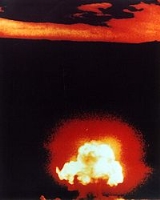
The bombs used in the first test at Trinity Site on July 16, 1945, in New Mexico (the gadget
The gadget

The "gadget" was the code-name given to the first nuclear weapon developed under the Manhattan Project during World War II, which was tested at the Trinity test test site on July 16, 1945....
 of the Trinity test
Trinity test

Trinity was the first Nuclear testing of technology for a nuclear weapon. It was conducted by the United States on July 16, 1945, at a location 35 miles southeast of Socorro, New Mexico, New Mexico, on what is now White Sands Missile Range, headquartered near Alamogordo, New Mexico....
), and in the Nagasaki bomb, Fat Man
Fat Man

Fat Man is the codename for the atomic bomb that was detonated over Nagasaki, Nagasaki, Japan, by the United States on August 9, 1945, at 11:02 a.m....
, were made primarily of plutonium-239, a synthetic element.

Although uranium-238
Uranium-238

Uranium-238 , is the most common Isotopes of uranium of uranium found in nature. When hit by a neutron, it becomes uranium-239 , an unstable isotope which radioactive decay into neptunium-239 , which then itself decays, with a half-life of 2.355 days, into plutonium-239 ....
 is useless as a fissile isotope for an atomic bomb, it is key in producing plutonium. The fission of U-235 releases neutrons, which are absorbed by U-238, which then becomes uranium-239
Uranium-239

Uranium-239 is an Isotopes of uranium. It is usually produced by exposing uranium-238 to neutron radiation in a nuclear reactor. Uranium-239 has a half-life of about 23.45 minutes and decays into neptunium-239 through beta decay, with a total decay energy of about 1.29 Mev.....
. U-239 rapidly decays to neptunium-239 (U-239 has a half-life 23.45 minutes). Neptunium-239 (with a half-life 2.35 days) then decays into plutonium-239
Plutonium-239

Plutonium-239 is an isotope of plutonium. Plutonium-239 is the primary fissile isotope used for the production of nuclear weapons, although uranium-235 has also been used and is currently the secondary isotope....
. The production and purification of plutonium used techniques developed in part by Glenn Seaborg while working at Berkeley and Chicago. Beginning in 1943, huge plants were built to produce plutonium at the Hanford Site
Hanford Site

The Hanford Site is a decommissioned Nuclear technology production complex on the Columbia River in the U.S. state of Washington, operated by the Federal government of the United States....
.
Fat Man
In 1943–1944, development efforts were directed to a gun-type fission weapon
Gun-type fission weapon

Gun-type fission weapons are nuclear fission-based nuclear weapons whose nuclear weapon design assembles their fissile material into a Critical mass by the use of the "gun" method: shooting one piece of sub-critical material into another....
 with plutonium, called "Thin Man". Once this was achieved, the scientists thought the uranium version, "Little Boy," would require a relatively simple adaptation.

Initial research on the properties of plutonium was done using cyclotron
Cyclotron

A cyclotron is a type of particle accelerator. Cyclotrons accelerate charged particles using a high-frequency, alternating voltage . A perpendicular magnetic field causes the particles to spiral almost in a circle so that they re-encounter the accelerating voltage many times....
-generated plutonium-239
Plutonium-239

Plutonium-239 is an isotope of plutonium. Plutonium-239 is the primary fissile isotope used for the production of nuclear weapons, although uranium-235 has also been used and is currently the secondary isotope....
, which was extremely pure, but could only be created in very small amounts. On April 5, 1944, Emilio Segrè at Los Alamos received the first sample of Hanford-produced plutonium. Within ten days, he discovered a fatal flaw: reactor-bred plutonium was far less isotopically pure than cyclotron-produced plutonium. A higher concentration of Pu-240, formed from Pu-239 by capture of an additional neutron, gave it a much higher spontaneous fission rate than U-235. Pu-240 was even harder to separate from Pu-239 than U-235 was to separate from U-238, so no purification was even attempted. This made the Hanford plutonium unsuitable for use in a gun-type weapon.

The gun-type bomb worked by mechanically assembling the critical mass from two subcritical masses: a "bullet" and a target. The chain reaction resulting from collision of the "bullet" with the target released tremendous energy, producing an explosion, but also blew apart the critical mass and ended the chain reaction. The configuration of the critical mass determined how much of the fissile material reacted in the interval between assembly and dispersal, and therefore the explosive yield of the bomb. (The chain reaction actually starts before complete assembly of the critical mass.) Even a 1% fission of the material would result in a workable bomb, equal to thousands of tons of high explosive. A poor configuration, or slow assembly, would release enough energy to disperse the critical mass, but too quickly. Far less than 1% would react, and the yield would be equivalent to only a few tons of HE - a fizzle.

The chain reaction of U-235 was slow enough that gun-type assembly would work. But suppose a gun-type bomb was made with the Hanford plutonium? As the critical mass comes together, "early" neutrons from spontaneously fissioning Pu-240 start the chain reaction prematurely. This releases enough energy to disperse the critical mass with only a minimal amount of plutonium reacted. In plain English, a gun-type plutonium bomb fizzles.

In an incident of disruptive technology
Disruptive technology

A disruptive technology or disruptive innovation is a technological innovation that improves a product or service in ways that the market does not expect, typically by being lower priced or designed for a different set of consumers....
, Oppenheimer promptly recognized that the April 1944 suggestion by James L. Tuck to use explosive lens
Explosive lens

An explosive lens?as used, for example, in nuclear weapons?is a highly specialized explosive charge. In general, it is a device composed of several explosive charges that are shaped in such a way as to change the shape of the detonation wave passing through it; conceptually similar to the effect of an optical lens on light....
es to create a spherical converging implosion waves was the best strategy to rapidly achieve a working plutonium device. He promptly canceled ongoing work in order to reallocate resources in that new direction. This then-new idea remains a mainstay of nuclear weapon design
Nuclear weapon design

Nuclear weapon designs are physical, chemical, and engineering arrangements that cause the physics package of a Nuclear weapons to detonate. There are three basic design types....
.

In July 1944, the decision was made to cease work on the plutonium gun method. There would be no "Thin Man." The gun method was further developed for uranium only, which had few complications. Most efforts were then directed to a different method for plutonium.
Thin Man Plutonium Gun Bomb Casings
Ideas for alternative detonation schemes had existed for some time at Los Alamos. One of the more innovative was the idea of "implosion". Using chemical explosives, a sub-critical sphere of fissile material could be squeezed into a smaller and denser form. When the fissile atoms were packed closer together, the rate of neutron capture would increase, and the mass would become a critical mass. The metal needed to travel only very short distances, so the critical mass would be assembled in much less time than it would take to assemble a mass by a bullet impacting a target.

Initially, implosion had been entertained as a possible, though unlikely, method. But then Emilio Segrè discovered that a gun-type bomb using reactor-bred plutonium could not work. Uranium-235 production could not be substantially increased. The plutonium implosion bomb was the only practical solution for production of multiple bombs from the available fissionable material. Because of this, the implosion project received the highest priority. By the end of July 1944, the entire Manhattan Project had been reorganized around building the implosion-type bomb.

The required implosion was achieved by using shaped charge
Shaped charge

A shaped charge is an explosive charge shaped to focus the effect of the explosive's energy. Various types are used to cut and form metal, initiate nuclear weapons, and penetrate armour....
s with many explosive lenses to produce the perfectly spherical explosive wave which compressed the plutonium sphere.

Because of the complexity of an implosion-style weapon, it was decided that, despite the waste of fissile material, an initial test would be required. The first nuclear test took place on July 16, 1945, near Alamogordo, New Mexico
New Mexico

New Mexico is a U. S. State located in the Southwestern United States of the United States. Inhabited by Native Americans in the United States populations for many centuries, it has also has been part of the Spanish Empire viceroyalty of New Spain, part of Mexico, and a U.S....
, under the supervision of Groves's deputy Brig. Gen. Thomas Farrell
Thomas Farrell

General Thomas Francis Farrell was the Deputy Commanding General and Chief of Field Operations of the Manhattan Project, acting as executive officer to General Leslie Groves....
. Oppenheimer gave the test the code name "Trinity
Trinity test

Trinity was the first Nuclear testing of technology for a nuclear weapon. It was conducted by the United States on July 16, 1945, at a location 35 miles southeast of Socorro, New Mexico, New Mexico, on what is now White Sands Missile Range, headquartered near Alamogordo, New Mexico....
".

Similar efforts

A similar effort was undertaken in the USSR
Soviet Union

The Union of Soviet Socialist Republics was a Constitution of the Soviet Union socialist state that existed in Eurasia from 1922 to 1991.The name is a translation of the , romanization of Russian Soyuz Sovetskikh Sotsialisticheskikh Respublik, abbreviated ????, SSSR....
 in September 1941 headed by Igor Kurchatov
Igor Kurchatov

Igor Vasilyevich Kurchatov was a Soviet Union/Russians physicist. He was the leader of the Soviet atomic bomb project. Kurchatov was born in Simsky Zavod, Ufa Governorate ....
 (with some of Kurchatov's World War II knowledge coming secondhand from Manhattan Project countries, thanks to spies, including at least two on the scientific team at Los Alamos, Klaus Fuchs
Klaus Fuchs

Klaus Emil Julius Fuchs , was a German-born British theoretical physics and Atomic Spies who was convicted of supplying information from the British and American atomic bomb research to the Soviet Union during, and shortly after, World War II....
 and Theodore Hall
Theodore Hall

Theodore Alvin Hall was an United States physicist and an Atomic Spies for the Soviet Union who, during his work on Allied effort to develop the first atomic bombs during World War II , gave a detailed description of the "Fat Man" plutonium bomb, and of processes for purifying plutonium, to Soviet intelligence....
, unknown to each other).

After the MAUD Committee's report, the British and Americans exchanged nuclear information but initially did not pool their efforts. A British project, code-named Tube Alloys
Tube Alloys

Tube Alloys was the code-name for the British nuclear weapon directorate during World War II, when the very possibility of nuclear weapons was kept at such a high level of secrecy that it had to be referred to by code even in the highest circles of government....
, was started but did not have United States resources. Consequently the British bargaining position worsened, and their motives were mistrusted by the Americans. Collaboration therefore lessened markedly until the Quebec Agreement
Quebec Agreement

The Quebec Agreement was an United Kingdom-Canada-United States document which outlined the terms of nuclear nonproliferation between the United Kingdom and the United States....
 of August 1943, when a large team of British, Canadian and Australian scientists joined the Manhattan Project.

German Experimental Pile   Haigerloch   April 1945
The question of Axis
Axis Powers

The Axis powers were those countries that were opposed to the Allies of World War II during World War II. The three major Axis powers - Nazi Germany, Kingdom of Italy , and Empire of Japan - were part of a military alliance on the signing of the Tripartite Pact in September 1940, which officially founded the Axis powers....
 efforts on the bomb has been a contentious issue for historians. It is believed that efforts undertaken in Germany, headed by Werner Heisenberg
Werner Heisenberg

Werner Heisenberg was a German Theoretical physics who made foundational contributions to quantum mechanics and is best known for asserting the uncertainty principle of quantum theory....
, and in Japan
Japanese atomic program

The Japanese program to develop nuclear weapons was conducted during World War II in response to the perceived threat of its enemies obtaining such a weapon first and using it against Japan....
, were also undertaken during the war with little progress. It was initially feared that Hitler was very close to developing his own bomb. Many German scientists in fact expressed surprise to their Allied captors when the bombs were detonated in Japan. They were convinced that talk of atomic weapons was merely propaganda. However, Werner Heisenberg (by then imprisoned in Britain at Farm Hall with several other nuclear project physicists) almost immediately figured out what the Allies had done, explaining it to his fellow scientists (and hidden microphones) within days. The Nazi reactor effort had been severely handicapped by Heisenberg's belief that heavy water
Heavy water

Heavy water is water that contains a higher proportion than normal of the isotope deuterium, as deuterium oxide, D2O or ?H2O, or as deuterium protium oxide, HDO or ?H?HO....
 was necessary as a neutron moderator
Neutron moderator

In nuclear engineering, a neutron moderator is a medium which reduces the speed of fast neutrons, thereby turning them into thermal neutrons capable of sustaining a nuclear chain reaction involving uranium-235....
 (slowing preparation material) for such a device. The Germans were short of heavy water throughout the war because of Allied efforts to prevent Germany from obtaining it, and the Germans never did stumble on the secret of purified graphite for making nuclear reactors from natural uranium.

Bohr, Heisenberg and Fermi were all colleagues who were key figures in developing the quantum theory together with Wolfgang Pauli
Wolfgang Pauli

Wolfgang Ernst Pauli was an Austrian theoretical physicist noted for his work on spin , and for the discovery of the Pauli exclusion principle underpinning the structure of matter and the whole of chemistry....
, prior to the war. They had known each other well in Europe and were friends. Niels Bohr
Niels Bohr

Niels Henrik David Bohr was a Denmark physicist who made fundamental contributions to understanding atomic structure and quantum mechanics, for which he received the Nobel Prize in Physics in 1922....
 and Heisenberg even discussed the possibility of the atomic bomb prior to and during the war, before the United States became involved. Bohr recalled that Heisenberg was unaware that the supercritical mass could be achieved with U-235, and both men gave differing accounts of their conversations at this sensitive time. Bohr at the time did not trust Heisenberg, and never quite forgave him for his decision not to flee Germany before the war when given the chance. Heisenberg, for his part, seems to have thought he was proposing to Bohr a mutual agreement between the two sides not to pursue nuclear technology for destructive purposes. If so, Heisenberg's message did not get through. Heisenberg, to the end of his life, maintained that the partly-built German heavy-water nuclear reactor found after the war's end in his lab was for research purposes only, and a full bomb project had not been contemplated (there is no evidence to contradict this, but by this time late in the war, Germany was far from having the resources for a Hanford-style plutonium bomb, even if its scientists had decided to pursue one and had known how to do it).

See also

  • Timeline of the Manhattan Project
    Timeline of the Manhattan Project

    The following is a timeline of the Manhattan Project, the effort by the United States, United Kingdom, and Canada to develop the first nuclear weapons for use during World War II....
  • August 1945
    • Atomic bombings of Hiroshima and Nagasaki
      Atomic bombings of Hiroshima and Nagasaki

      The atomic bombings of Hiroshima and Nagasaki were nuclear warfares near the end of World War II against the Empire of Japan by the United States at the executive order of President of the United States Harry S....
    • Smyth Report
      Smyth Report

      The Smyth Report was the common name given to an administrative history written by physics Henry DeWolf Smyth about the Allies World War II effort to develop the atomic bomb, the Manhattan Project....
  • Related locations
    • Hanford Site
      Hanford Site

      The Hanford Site is a decommissioned Nuclear technology production complex on the Columbia River in the U.S. state of Washington, operated by the Federal government of the United States....
       (plutonium production)
      • B Reactor
    • Ames Laboratory
      Ames Laboratory

      Ames Laboratory is a United States Department of Energy national laboratory located in Ames, Iowa. The Laboratory conducts research into various areas of national concern, including the synthesis and study of new materials, energy resources, high-speed computer design, and environmental cleanup and restoration....
       (uranium production from ores)
    • Los Alamos National Laboratory
      Los Alamos National Laboratory

      Los Alamos National Laboratory is a United States Department of Energy United States Department of Energy National Labs, managed and operated by Los Alamos National Security, LLC , located in Los Alamos, New Mexico....
       (secret weapons lab)
    • Lawrence Livermore National Laboratory
      Lawrence Livermore National Laboratory

      The Lawrence Livermore National Laboratory in Livermore, California is a scientific research laboratory founded by the University of California in 1952....
       (second weapons lab, created in 1950s)
    • Metallurgical Laboratory
      Metallurgical Laboratory

      The Metallurgical Laboratory or "Met Lab" at the University of Chicago was part of the World War II?era Manhattan Project, created by the United States to develop an Nuclear weapon....
       (first controlled nuclear chain reaction)
    • Oak Ridge, Tennessee
      Oak Ridge, Tennessee

      Oak Ridge is an incorporated city in Anderson County, Tennessee and Roane County, Tennessee Counties in East Tennessee Tennessee, United States, about 25 miles northwest of Knoxville, Tennessee....
      • Oak Ridge National Laboratory
        Oak Ridge National Laboratory

        Oak Ridge National Laboratory is a multiprogram science and technology national laboratory managed for the United States Department of Energy by UT-Battelle....
         (site of graphite reactor and pilot facilities for plutonium production)
      • Y-12
        Y-12

        Y-12 can refer to* the Y-12 National Security Complex in Oak Ridge, Tenessee,* the Harbin Y-12, a Chinese passenger plane....
         (uranium enrichment)
      • K-25
        K-25

        The K-25 plant, located on the southwestern end of the Oak Ridge, Tennessee reservation, used the gaseous diffusion method to enriched uranium by separating uranium-235 from uranium-238....
         (uranium enrichment)
    • Trinity site (first nuclear test)
    • Trail, British Columbia
      Trail, British Columbia

      Trail is a city in the West Kootenay region of the British Columbia Interior of British Columbia, Canada....
       (Project 9, heavy water
      Heavy water

      Heavy water is water that contains a higher proportion than normal of the isotope deuterium, as deuterium oxide, D2O or ?H2O, or as deuterium protium oxide, HDO or ?H?HO....
       plant)
  • Nuclear weapons
    • History of nuclear weapons
      History of nuclear weapons

      The history of nuclear weapons chronicles the development of nuclear weapons. Nuclear weapons are devices that possess enormous destructive potential derived from nuclear fission or nuclear fusion reactions....
    • Nuclear arms race
      Nuclear arms race

      The nuclear arms race was a competition for supremacy in nuclear warfare between the United States, the Soviet Union, and their respective allies during the Cold War....
    • Nuclear weapon
      Nuclear weapon

      A nuclear weapon is an explosive device that derives its destructive force from nuclear reactions, either nuclear fission or a combination of fission and nuclear fusion....
    • Nuclear weapon design
      Nuclear weapon design

      Nuclear weapon designs are physical, chemical, and engineering arrangements that cause the physics package of a Nuclear weapons to detonate. There are three basic design types....
    • Isotope separation
      Isotope separation

      Isotope separation is the process of concentrating specific isotopes of a chemical element by removing other isotopes, for example separating natural uranium into enriched uranium and depleted uranium....
       (necessary for uranium enrichment)
    • List of countries with nuclear weapons
      List of countries with nuclear weapons

      Nations that are known or believed to possess nuclear weapons are sometimes referred to as the nuclear club. There are currently nine states that have successfully detonated nuclear weapons....
    • The United States and nuclear weapons
  • People
    Category:Manhattan Project people (lists articles about people involved in the project)
    • Lise Meitner
      Lise Meitner

      Lise Meitner was an Austrian-born, later Sweden physics who studied radioactivity and nuclear physics....
       and Otto Hahn
      Otto Hahn

      Otto Hahn was a German chemist and Nobel laureate who pioneered the fields of radioactivity and radiochemistry. He is regarded as "the father of nuclear chemistry" and the "founder of the atomic age"....
      , discoverers of fission
      Nuclear fission

      In nuclear physics and nuclear chemistry, nuclear fission is a nuclear reaction in which the atomic nucleus of an atom splits into smaller parts, often producing free neutrons and lighter atomic nucleus, which may eventually produce photons ....
    • David Bohm
      David Bohm

      David Joseph Bohm was an United States-born Quantum mechanics physicist who made significant contributions in the fields of theoretical physics, philosophy and neuropsychology, and to the Manhattan Project....
      , did work that was immediately classified, that he then wasn't allowed to read
  • Other projects
    • Operation Alsos
      Operation Alsos

      Operation Alsos was an effort at the end of World War II by the Allies , branched off from the Manhattan Project, to investigate the German nuclear energy project, seize German nuclear resources, materials and personnel to further American research and to prevent their capture by the Soviets, and to discern how far the Germans had gone toward...
      , and German nuclear energy project
      German nuclear energy project

      The German nuclear energy project in Nazi Germany was informally known as the Uranverein and it began in April 1939, just months after the discovery of nuclear fission in January 1939....
    • Japanese atomic program
      Japanese atomic program

      The Japanese program to develop nuclear weapons was conducted during World War II in response to the perceived threat of its enemies obtaining such a weapon first and using it against Japan....
    • Soviet atomic bomb project
      Soviet atomic bomb project

      The Soviet project to develop an atomic bomb began during World War II in the Soviet Union. The USSR tested its first nuclear weapon in 1949....
    • Tube Alloys
      Tube Alloys

      Tube Alloys was the code-name for the British nuclear weapon directorate during World War II, when the very possibility of nuclear weapons was kept at such a high level of secrecy that it had to be referred to by code even in the highest circles of government....
       (British WWII atomic program)
  • Movies, in chronological order:
    • Above and Beyond
      Above and Beyond

      Above and Beyond may refer to:*Above and Beyond , a 1952 film about World War II American pilot Paul Tibbets and the atomic bombing of Hiroshima...
       (1952), a film related to the project, centered on Col Paul Tibbets
      Paul Tibbets

      File:Tibbets-wave.jpgFile:Paul Tibbets 2003.jpgPaul Warfield Tibbets, Jr. was a brigadier general in the United States Air Force, best known for being the pilot of the Enola Gay, the first aircraft to Little Boy in the history of warfare....
      , pilot of the plane which dropped the Hiroshima bomb
    • Kiss Me Deadly
      Kiss Me Deadly

      Kiss Me Deadly is a film noir drama film produced and directed by Robert Aldrich starring Ralph Meeker. The screenplay was written by A.I. Bezzerides, based on the Mickey Spillane Mike Hammer mystery novel Kiss Me, Deadly....
       (1955), a film noir
      Film noir

      Film noir is a film term used primarily to describe stylish cinema of the United States Crime film, particularly those that emphasize moral ambiguity and sexual motivation....
       only tangentially related to the Manhattan Project
    • The Day After Trinity
      The Day After Trinity

      The Day After Trinity is a 1981 in film documentary film directed by Jon Else. It was nominated for an Academy Award for Academy Award for Documentary Feature. ...
       (1981), a documentary about the project.
    • Day One
      Day One (film)

      Day One is a 1989 in film television film about the creation of the first nuclear bomb during World War II in the USA by a team of international physicists headed by Robert Oppenheimer....
       (1989), a film about the project in a political perspective
    • Fat Man and Little Boy
      Fat Man and Little Boy

      Fat Man and Little Boy is a 1989 film that reenacts the Manhattan Project, the secret Allied endeavor to develop the first nuclear weapons during World War II....
       (1989), Hollywood drama based on the project starring Paul Newman
      Paul Newman

      Paul Leonard Newman was an United States actor, film director, entrepreneur, Humanitarianism, and auto racing enthusiast. He won numerous awards, including an Academy Award for his performance in the 1986 Martin Scorsese film The Color of Money and eight other nominations three Golden Globe, a BAFTA Award, a Screen Actors Guild Award, a...
    • White Light/Black Rain: The Destruction of Hiroshima and Nagasaki
      White Light/Black Rain: The Destruction of Hiroshima and Nagasaki

      White Light/Black Rain: The Destruction of Hiroshima and Nagasaki is an HBO documentary film that was written, directed, and produced by film director Steven Okazaki and was released on August 6, 2007 on HBO, marking the sixty-second anniversary of the first atomic bombing....
       (2007)
  • Music
    • Manhattan Project
      Manhattan Project (song)

      "Manhattan Project" is a 1985 in music song by Canadian progressive rock band Rush named for the Manhattan Project that created the first atomic bomb....
       by Rush
      Rush (band)

      Rush is a Canadian Rock music band originally formed in August 1968, in the Willowdale, Toronto neighbourhood of Toronto, Ontario, currently composed of bass guitar, keyboard instrument, and singer Geddy Lee; electric guitar Alex Lifeson; and drum kit and lyricist Neil Peart....
    • Brighter Than A Thousand Suns by Iron Maiden
    • Doctor Atomic
      Doctor Atomic

      Doctor Atomic is an opera by the contemporary minimalist American composer John Coolidge Adams, with libretto by Peter Sellars. It premiered at the San Francisco Opera on October 1, 2005....
      , an opera by John Coolidge Adams
      John Coolidge Adams

      John Coolidge Adams is a Pulitzer Prize for Music-winning American composer with strong roots in minimalist music. His best-known works include Harmonielehre , On the Transmigration of Souls , a choral piece commemorating the victims of the September 11, 2001 attacks , and Shaker Loops, a minimalist four-movement work for string...
       with libretto by Peter Sellars
      Peter Sellars

      Peter Sellars is an United States theatre director, renowned for his contemporary stagings of classical operas and plays. Sellars is professor of World Arts and Cultures at UCLA where he teaches Art as Social Action and Art as Moral Action....
    • Sedition by Strike Anywhere
      Strike Anywhere

      Strike Anywhere is a melodic hardcore band from Richmond, Virginia. Formed in 1999 after the demise of frontman Thomas Barnett previous band, Inquisition , they took their name from the Inquisition song "Strike Anywhere"....
      , a song about lead singer Thomas Barnett
      Thomas Barnett (musician)

      Thomas Barnett is an United States singer-songwriter born in Richmond, Virginia.He is best known for being the singer for the melodic hardcore band Strike Anywhere....
      's grandfather, a welder and steamfitter on the Manhattan Project who was unaware of his role in creating the Atomic Bomb and exposure to radium until the project was completed
  • Entertainment
    • The main character of the game Freedom Force
      Freedom Force

      Freedom Force may refer to:*Jammu and Kashmir Freedom Front - jk political movement for freedom from Indian rule* Freedom Force , a team of supervillains in the Marvel Comics universe...
       , Minuteman, was a scientist for the Manhattan Project
    • 3D Realms
      3D Realms

      '3D Realms' is a video game developer and video game publisher based in Garland, Texas established in 1987. It is best known for popularizing the shareware distribution model and as the creator of franchises on the Personal computer such as Duke Nukem , and also the publisher of other franchises such as Commander Keen and Wolfenstein...
       (originally Apogee) released a video game entitled "Duke Nukem: Manhattan Project
      Duke Nukem: Manhattan Project

      Duke Nukem: Manhattan Project is a Shoot 'em up#Run and gun side-scrolling video game developed by Sunstorm Interactive and published on May 21 2002 by ARUSH Entertainment....
      " for PC in 2002.
    • Dr. Manhattan, a superhero from Alan Moore
      Alan Moore

      Alan Moore is an English writer most famous for his influential work in comics, including the acclaimed graphic novels Watchmen, V for Vendetta and From Hell....
      's graphic novel Watchmen
      Watchmen

      Watchmen is a twelve-issue comic book limited series created by writer Alan Moore, artist Dave Gibbons, and colorist John Higgins . The series was published by DC Comics during 1986 and 1987, and has been subsequently reprinted in collected form....
       named by the US government after the Manhattan Project.
    • In the game Metal Gear Solid
      Metal Gear Solid

      is a stealth game video game directed and written by Hideo Kojima. The game was video game developer by Konami Computer Entertainment Japan and first video game publisher by Konami in 1998 in video gaming for the PlayStation video game console....
      , the character Otacon claims that his grandfather was involved in the Manhattan Project.
    • In the game Metal Gear Solid 2, the character Fat Man is named after the bomb dropped in Nagasaki, Japan.
    • In the game Civilization Revolution
      Civilization Revolution

      Civilization Revolution is a 2008 iteration of Civilization developed by Firaxis with Sid Meier as designer for the Nintendo DS, PlayStation 3 and Xbox 360 consoles....
      , the player can research the Manhattan Project resulting in the creation of an atomic bomb which the player can use against his enemies.
    • In the game Civilization 3, the player can create the "Manhattan Project" wonder, allowing ALL players to use nuclear weapons.


External links

  • (film)
  • Information on the history of the Manhattan Project
  • and its effect on the Buffalo-Niagara region.
  • from atomicarchive.com
  • travelgoat guide to New York City
  • Manhattan Project Historic Preservation
  • The Nobel Peace Prize was awarded to both Rotblat and Pugwash. Freeview video provided by the Vega Science Trust.
  • , a murder mystery novel
    Novel

    File:2009 stapelweise Neuerscheinungen im Buchladen.JPGA novel is today a long narrative in literary prose. The genre has historical roots both in the fields of the medieval and early modern Romance and in the tradition of the novella....
     by Joseph Kanon
    Joseph Kanon

    Joseph Kanon is an United States author, best known for thriller and spy novels set in the period immediately after World War II....
    , shows life at the Manhattan Project base.
  • (includes "We're cookin!" note at the bottom of the page)