
All Topics  
Medieval warfare


   Email Print
   Bookmark   Link


Medieval warfare


Medieval Warfare is the warfare of the Middle Ages
Middle Ages

File:Karl 1 mit papst gelasius gregor1 sacramentar v karl d kahlen.jpgThe Middle Ages of European history are a period in history which lasted for roughly a millennium, commonly dated from the fall of the Roman Empire in the 5th century to the beginning of the Early Modern Period in the 16th century, marked by the division of Western Christi...
. In Europe, technological, cultural, and social developments had forced a dramatic transformation in the character of warfare from antiquity
Classical antiquity

Classical antiquity is a broad term for a long period of cultural history centered on the Mediterranean Sea, comprising the interlocking civilizations of Ancient Greece and Ancient Rome....
, changing military
Military

A military is an organization authorized by its nation to use force, usually including use of weapons, in defending its country by combating actual or Threat of force ....
 tactics
Military tactics

Military tactics are the techniques for using weapons or military units in combination for engaging and defeating an Enemy in battle. Changes in philosophy and technology over time have been reflected in changes to military tactics....
 and the role of cavalry
Cavalry

The Cavalry is the second oldest of the Combat Arms, and as soldiers or warriors who fought mounted on horseback in combat, it represents the mobility and offensive power of the armed forces....
 and artillery
Artillery

Artillery is a military Combat Arms which employs any apparatus, machine, an assortment of tools or instruments, a system or systems used as weapons for the discharge of large projectiles in combat as a major contribution of fire power within the overall military capability of an armed force....
. Similar patterns of warfare existed in other parts of the world. In China
China

China is a Culture of China, an ancient civilization, and, depending on perspective, a national or multinational entity extending over a large area in East Asia....
, weapons employing gunpowder
Gunpowder

Gunpowder, also called black powder, is an explosive mixture of sulfur, charcoal and potassium nitrate, KNO3 that burns rapidly, producing volumes of hot solids and gases which can be used as a propellant in firearms and as a pyrotechnic composition in fireworks....
 date back to the tenth century, and the first permanent standing Chinese navy was established in the early twelfth century by the Song Dynasty
Song Dynasty

The Song Dynasty was a ruling Chinese dynasty in China between 960–1279 AD; it succeeded the Five Dynasties and Ten Kingdoms Period, and was followed by the Yuan Dynasty....
.

The Middle East
Middle East

File:GreaterMiddleEast1.pngThe Middle East is a region that spans southwestern Asia, western Asia, and northeastern Africa. It has no clear boundaries, often used as a synonym to Near East, in opposition to Far East....
 and North Africa
North Africa

North Africa or Northern Africa is the northernmost region of the African continent, separated by the Sahara from Sub-Saharan Africa.Geopolitically, the United Nations subregion of Northern Africa includes the following seven countries or territories:...
 used very different methods and equipment than was used in Europe, and there occurred a considerable amount of technological exchange and tactical adaptation between the different cultures.


Discussion
Ask a question about 'Medieval warfare'
Start a new discussion about 'Medieval warfare'
Answer questions from other users
Full Discussion Forum


Recent Posts


Encyclopedia


Medieval Warfare is the warfare of the Middle Ages
Middle Ages

File:Karl 1 mit papst gelasius gregor1 sacramentar v karl d kahlen.jpgThe Middle Ages of European history are a period in history which lasted for roughly a millennium, commonly dated from the fall of the Roman Empire in the 5th century to the beginning of the Early Modern Period in the 16th century, marked by the division of Western Christi...
. In Europe, technological, cultural, and social developments had forced a dramatic transformation in the character of warfare from antiquity
Classical antiquity

Classical antiquity is a broad term for a long period of cultural history centered on the Mediterranean Sea, comprising the interlocking civilizations of Ancient Greece and Ancient Rome....
, changing military
Military

A military is an organization authorized by its nation to use force, usually including use of weapons, in defending its country by combating actual or Threat of force ....
 tactics
Military tactics

Military tactics are the techniques for using weapons or military units in combination for engaging and defeating an Enemy in battle. Changes in philosophy and technology over time have been reflected in changes to military tactics....
 and the role of cavalry
Cavalry

The Cavalry is the second oldest of the Combat Arms, and as soldiers or warriors who fought mounted on horseback in combat, it represents the mobility and offensive power of the armed forces....
 and artillery
Artillery

Artillery is a military Combat Arms which employs any apparatus, machine, an assortment of tools or instruments, a system or systems used as weapons for the discharge of large projectiles in combat as a major contribution of fire power within the overall military capability of an armed force....
. Similar patterns of warfare existed in other parts of the world. In China
China

China is a Culture of China, an ancient civilization, and, depending on perspective, a national or multinational entity extending over a large area in East Asia....
, weapons employing gunpowder
Gunpowder

Gunpowder, also called black powder, is an explosive mixture of sulfur, charcoal and potassium nitrate, KNO3 that burns rapidly, producing volumes of hot solids and gases which can be used as a propellant in firearms and as a pyrotechnic composition in fireworks....
 date back to the tenth century, and the first permanent standing Chinese navy was established in the early twelfth century by the Song Dynasty
Song Dynasty

The Song Dynasty was a ruling Chinese dynasty in China between 960–1279 AD; it succeeded the Five Dynasties and Ten Kingdoms Period, and was followed by the Yuan Dynasty....
.

The Middle East
Middle East

File:GreaterMiddleEast1.pngThe Middle East is a region that spans southwestern Asia, western Asia, and northeastern Africa. It has no clear boundaries, often used as a synonym to Near East, in opposition to Far East....
 and North Africa
North Africa

North Africa or Northern Africa is the northernmost region of the African continent, separated by the Sahara from Sub-Saharan Africa.Geopolitically, the United Nations subregion of Northern Africa includes the following seven countries or territories:...
 used very different methods and equipment than was used in Europe, and there occurred a considerable amount of technological exchange and tactical adaptation between the different cultures. In Japan
Japan

Japan is an island country in East Asia. Located in the Pacific Ocean, it lies to the east of the Sea of Japan, People's Republic of China, North Korea, South Korea and Russia, stretching from the Sea of Okhotsk in the north to the East China Sea and Taiwan in the south....
 the Medieval warfare period is considered by many to have stretched into the eighteenth century. In Africa along the Sahel
Sahel

File:Sahel Map-Africa rough.pngFile:AT0713 map.pngThe Sahel or Sahel Belt is a semi-arid tropical and subtropical grasslands, savannas, and shrublands ecoregion in Africa, which forms the transition between the Sahara to the north and the slightly less arid savanna belt to the south, known as the Sudan ....
 and Sudan
Sudan (region)

The Sudan, from the Arabic language bil?d as-s?d?n or "land of the Black people" , is a geographic region stretching from West to Eastern Africa....
, states like the Kingdom of Sennar and Fulani Empire
Fulani Empire

The Sokoto Caliphate is an Islamic spiritual community in Nigeria, led by the Sultan of Sokoto, Sa?adu Abubakar. Founded during the Fulani Jihad in the early 1800s, it was one of the most powerful empires in sub-Saharan Africa prior to European conquest and colonization....
 employed Medieval tactics and weapons through the nineteenth century.

Strategy and tactics


Employment of force


The experience level and tactical maneuvering ability of medieval armies varied widely depending on the period and region. For larger battles, pre-battle planning typically consisted of a council of the war leaders, which could either be the general laying down a plan or a noisy debate between the different leaders, depending on how much authority the general possessed. Battlefield communications before the advent of strict lines of communication were naturally very difficult. Communication was done through musical signals, audible commands, messengers, or visual signals such raising a standard, banner, or flag.

The infantry
Infantry

Infantry are soldiers who are primarily trained for the role of fighting on foot. A soldier in the infantry is known as an infantryman. Infantry units have more physically demanding training than other branches of armies, and place a greater emphasis on fitness, physical strength and aggression....
, including missile troops, would typically be employed at the outset of the battle to break open infantry formations while the cavalry
Cavalry

The Cavalry is the second oldest of the Combat Arms, and as soldiers or warriors who fought mounted on horseback in combat, it represents the mobility and offensive power of the armed forces....
 attempted to defeat its opposing number. Once one side coaxed their opposing infantry into breaking formation, the cavalry would be deployed in attempt to exploit the loss of cohesion in the opposing infantry lines and begin slaying the infantrymen from horse top. Once a break in the lines was exploited, the cavalry became instrumental to victory - causing further breakage in the lines and wreaking havoc amongst the infantrymen, as it is much easier to kill a man from the top of a horse than to stand on the ground and face a half-ton destrier carrying an armed knight. However, until a significant break in the enemy infantry lines arose, the cavalry could not be used to much effect against infantry ; for horses, having more sense than men, are not easily harried into a wall of pikemen. Pure infantry conflicts would be drawn-out affairs. An interesting side-note: the game polo
Polo

Polo is a team sport played on horseback in which the objective is to score Goal s against an opposing team. Riders score by driving a small white plastic or wooden Ball game into the opposing team's goal using a long-handled mallet....
, first played in Iran, was originally a means of training cavalry for war.

Cannon
Cannon

A cannon is any tubular piece of artillery, that uses gunpowder or other usually explosive-based propellants to launch a projectile over a distance....
s were introduced to the battlefield in the later medieval period. However, their very poor rate of fire (which often meant that only one shot was fired in the course of an entire battle) and their inaccuracy made them more of a psychological force multiplier than an effective anti-personnel weapon.

Later on in medieval warfare, once hand cannons were introduced, the rate of fire improved only slightly, but the cannons became far easier to aim, largely because they were smaller and much closer to their wielder. Their users could be easily protected, because the cannons were lighter and could be moved far more quickly. However, real field artillery
Artillery

Artillery is a military Combat Arms which employs any apparatus, machine, an assortment of tools or instruments, a system or systems used as weapons for the discharge of large projectiles in combat as a major contribution of fire power within the overall military capability of an armed force....
 did not become truly effective or commonly employed until well into the early modern period.

Retreat

A hasty retreat could cause greater casualties than an organized withdrawal, because the fast cavalry of the winning side's rearguard would intercept the fleeing enemy while their infantry continued their attack. In most medieval battles, more soldiers were killed during the retreat than in battle, since mounted knight
Knight

File:Gothic armor 2.jpgKnight is the term for a social position originating in the Middle Ages. In the Commonwealth of Nations, knighthood is a non-heritable form of gentry....
s could quickly and easily dispatch the archer
Archery

Archery is the art, practice or skill of shooting with Bow and arrow. Archery has historically been used in hunting and combat and has become a precision sport....
s and infantry who were no longer protected by a line of pike
Pike (weapon)

A pike is a pole weapon, a very long thrusting spear used two-handed and used extensively by infantry both for attacks on enemy foot soldiers and as a counter-measure against cavalry assaults....
s as they had been during the previous fighting.

Fortifications

Breakdowns in centralized states led to the rise of a number of groups that turned to large-scale pillage as a source of income. Most notably the Vikings (but also Arabs, Mongols
Mongols

The name Mongol specifies one or several ethnic groups, now mainly located in Mongolia, China, and Russia....
 and Magyars) raided significantly. As these groups were generally small and needed to move quickly, building fortifications was a good way to provide refuge and protection for the people and the wealth in the region.

These fortifications evolved over the course of the Middle Ages, the most important form being the castle
Castle

A castle is a defensive structure seen as one of the main symbols of the Middle Ages. The term has a history of scholarly debate surrounding its exact meaning, but it is usually regarded as being distinct from the general terms fort or fortress in that it describes a residence of a monarch or noble and commands a specific defensive territor...
, a structure which had become synonymous with the Medieval era to many. The castle served as a protected place for the local elites. Inside a castle they were protected from bands of raiders and could send mounted warriors to drive the raiders from the area, or to disrupt the efforts of larger armies to supply themselves in the region by gaining local superiority over foraging parties that would be impossible against the whole enemy host.

Fortifications had a great many advantages. They provided refuge from armies too large to face in open battle. The ability of the heavy cavalry to dominate a battle on an open field was useless against fortifications. Building siege engines was a time-consuming process, and could seldom be effectively done without preparations before the campaign. Many sieges could take months, if not years, to weaken or demoralize the defenders sufficiently. Fortifications were an excellent means of ensuring that the elite could not be easily dislodged from their lands - as a French nobleman once commented on seeing enemy troops ravage his lands from the safety of his castle, "they can't take the land with them".

Siege warfare

In the Medieval period besieging armies used a wide variety of siege engine
Siege engine

A siege engine is a machine that is designed to break or circumvent city walls and other fortifications in siege warfare....
s including: scaling ladders; battering ram
Battering ram

A battering ram is a siege engine originating in ancient history to break open fortification walls or doors.In its simplest form, a battering ram is just a large, heavy log carried by several people and propelled with force against an obstacle; the momentum of the ram would be sufficient to damage the target if the log were massive enough a...
s; siege tower
Siege tower

A siege tower is a specialized siege engine, constructed to protect assailants and ladders while approaching the defensive walls of a fortification....
s and various types of catapult
Catapult

A catapult is any one of a number of non-handheld mechanical devices used to throw a projectile a great distance without the aid of an explosive substance?particularly various types of ancient and medieval siege engines....
s such as the mangonel
Mangonel

A mangonel was a type of catapult or siege machine used in the Middle Ages to throw projectiles at a castle's walls. The exact meaning of the term is debatable, and several possibilities have been suggested....
, onager
Onager (siege weapon)

The onager was a post-classical Roman Empire siege engine, which derived its name from the kicking action of the machine, similar to that of an onager ....
, ballista
Ballista

The ballista , plural ballistae, was a weapon developed from earlier Greek weapons. It relied upon different mechanics, using two levers with Torsion springs instead of a prod, the springs consisting of several loops of twisted skeins....
, and trebuchet
Trebuchet

A trebuchet or trebucket is a siege engine that was employed in the Middle Ages either to smash masonry walls or to throw projectiles over them....
. Siege techniques also included mining.

Advances in the prosecution of siege
Siege

A siege is a military blockade of a city or fortress with the intent of conquering by Battle of attrition and/or assault. The term derives from sedere, Latin for "to sit." A siege occurs when an attacker encounters a city or fortress that cannot be easily taken by a coup de main and refuses to surrender ....
s encouraged the development of a variety of defensive counter-measures. In particular, medieval fortification
Medieval fortification

Medieval fortification is the military aspect of Medieval technology that covers the development of fortification construction and use in Europe roughly from the fall of the Western Roman Empire to the Renaissance....
s became progressively stronger — for example, the advent of the concentric castle
Concentric castle

File:Krak des chevaliers - artist rendering.jpgA concentric castle is a castle within a castle, with two or more concentric rings of Curtain wall and, in cases, no central keep....
 from the period of the Crusades
Crusades

The Crusades were a series of religious war waged by much of Christian Europe against external and internal opponents. Crusades were fought mainly against Muslims, though campaigns were also directed against Paganism Slavic peoples, Jews, Eastern Orthodox Church, Mongols, Catharism, Hussites, Waldensians, Old Prussians, and political enemi...
 — and more dangerous to attackers — witness the increasing use of machicolation
Machicolation

A machicolation is a floor opening between the supporting corbels of a battlement, through which Rock could be dropped on attackers at the base of a defensive wall....
s and murder-hole
Murder-hole

A murder-hole or meurtri?re is a hole in the ceiling of a gateway or passageway in a fortification through which the defenders can fire, throw or pour dangerous or noxious substances at attackers....
s, as well the preparation of hot or incendiary substances. Arrow slits, concealed doors for sallies, and deep water wells were also integral to resisting siege at this time. Designers of castles paid particular attention to defending entrances, protecting gates with drawbridge
Drawbridge

A drawbridge is a type of movable bridge typically associated with the entrance of a castle. The term is often used to describe all different types of movable bridges, like bascule bridges and lift bridges....
s, portcullis
Portcullis

A portcullis is a latticed grille or gate made of wood, metal or a combination of the two. Portcullises fortified the entrances to many medieval castles, acting as a last line of defence during time of attack or siege....
es and barbican
Barbican

A barbican is a fortified outpost or gateway, such as an outer defense to a city or castle, or any tower situated over a gate or bridge which was used for defensive purposes....
s. Wet animal skins were often draped over gates to retard fire. Moat
Moat

A moat is deep, broad trench, usually filled with water, that surrounds a structure, installation, or town, normally to provide it with a preliminary line of Defense ....
s and other water defenses, whether natural or augmented, were also vital to defenders.

In the European Middle Ages
Middle Ages

File:Karl 1 mit papst gelasius gregor1 sacramentar v karl d kahlen.jpgThe Middle Ages of European history are a period in history which lasted for roughly a millennium, commonly dated from the fall of the Roman Empire in the 5th century to the beginning of the Early Modern Period in the 16th century, marked by the division of Western Christi...
, virtually all large cities had city walls — Dubrovnik
Dubrovnik

||-|File:Main street-Dubrovnik-2.jpg|-|File:Old City, Dubrovnik.jpg|-|File:Dubrovnik-F.Tudjman-Bridge.jpg|-|File:Onofrio's Fountain, Dubrovnik, Croatia.JPG...
 in Dalmatia
Dalmatia

Dalmatia is a region on the eastern coast of the Adriatic Sea, situated mostly in modern Croatia and spreading between the island of Rab in the northwest and the Bay of Kotor in the southeast....
 is an impressive and well-preserved example — and more important cities had citadel
Citadel

A citadel is a Fortification for protecting a town, sometimes incorporating a castle. The term derives from the same Latin language root as the word "city", civis, meaning citizen....
s, forts or castle
Castle

A castle is a defensive structure seen as one of the main symbols of the Middle Ages. The term has a history of scholarly debate surrounding its exact meaning, but it is usually regarded as being distinct from the general terms fort or fortress in that it describes a residence of a monarch or noble and commands a specific defensive territor...
s. Great effort was expended to ensure a good water supply inside the city in case of siege. In some cases, long tunnels were constructed to carry water into the city. Complex systems of underground tunnels were used for storage and communications in medieval cities like Tábor
Tábor

T?bor is a city of the Czech Republic, in the South Bohemian Region. It is named after Mount Tabor, Israel, which is believed by many to be the place of the Transfiguration of Christ; however, the name became popular and nowadays translates to "camp" or "encampment" in the Czech language....
 in Bohemia
Bohemia

History...
. Against these would be matched the mining
Mining

Mining is the extraction of value minerals or other geology materials from the earth, usually from an ore body, vein or seam. Materials recovered by mining include base metals, precious metals, iron, uranium, coal, diamonds, limestone, oil shale, Sodium chloride and potash....
 skills of teams of trained sapper
Sapper

A sapper is an individual engineer soldier usually in British Army or Commonwealth military service.Considered the most elite combat engineer soldiers in the United States Army, a pionier in the German Army and a sapeur in the French Army, a sapper/combat engineer may perform any of a variety of combat engineering duties....
s, who were sometimes employed by besieging armies.

Until the invention of gunpowder
Gunpowder

Gunpowder, also called black powder, is an explosive mixture of sulfur, charcoal and potassium nitrate, KNO3 that burns rapidly, producing volumes of hot solids and gases which can be used as a propellant in firearms and as a pyrotechnic composition in fireworks....
-based weapons (and the resulting higher-velocity projectiles), the balance of power and logistics definitely favored the defender. With the invention of gunpowder, the traditional methods of defense became less and less effective against a determined siege.

Organization


Knights

A medieval knight was usually a mounted and armoured soldier
Soldier

A soldier is a general English term that refers to a land component of national armed forces.In most societies of the world, "soldier" is also a general term for any member of the land forces including Commissioned officer and non-commissioned officers....
, often connected with nobility
Nobility

Nobility is a government-privileged title which may be either hereditary or for a lifetime. Titles of nobility exist today in many countries although it is usually associated with present or former monarchies....
 or royalty
Royal family

A royal family is the extended family of a king or queen regnant. The term "imperial family" more appropriately describes the extended family of an emperor or empress regnant, while the terms "ducal family", "grand ducal family" or "princely family" are more appropriate in reference to the relatives of a reigning duke, grand duke, or prince....
, although (especially in north-eastern Europe) knights could also come from the lower classes, and could even be unfree persons. The cost of their armor, horses
Horses in the Middle Ages

Horses in the Middle Ages differed in size, build and breed to the modern horse, and were, on average, smaller. They were also more central to society than their modern counterparts, being essential for Medieval warfare, agriculture, and History of road transport....
, and weapons was great; this, among other things, helped gradually transform the knight, at least in western Europe, into a distinct social class separate from other warriors. During the crusades
Crusades

The Crusades were a series of religious war waged by much of Christian Europe against external and internal opponents. Crusades were fought mainly against Muslims, though campaigns were also directed against Paganism Slavic peoples, Jews, Eastern Orthodox Church, Mongols, Catharism, Hussites, Waldensians, Old Prussians, and political enemi...
, holy orders of Knights fought in the Holy Land (see Knights Templar
Knights Templar

The Poor Fellow-Soldiers of Christ and of the Temple of Solomon , commonly known as the Knights Templar or the Order of the Temple , were among the most famous of the History of Christianity#Sanctification of knighthood military orders....
, the Hospitallers, etc.).

Heavy cavalry

Heavily armed cavalry, armed with lances and a varied assortment of hand weapons played a significant part in the battles of the Middle Ages. The heavy cavalry mainly consisted of wealthy knights and noblemen who could afford the equipment. Heavy cavalry was the difference between victory and defeat in many key battles. Their thunderous charges could break the lines of most infantry formations, making them a valuable asset to all medieval armies.

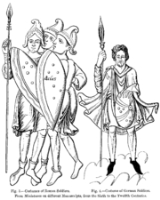
Costumes of Roman and German Soldiers

Infantry

Infantry were recruited and trained in a wide variety of manners in different regions of Europe all through the Middle Ages, and probably always formed the most numerous part of a medieval field army. Many infantrymen in prolonged wars would be mercenaries. Most armies contained significant numbers of spearmen, archers and other unmounted soldiers. In sieges, perhaps the most common element of medieval warfare, infantry units served as garrison troops and archers, among other positions. Near the end of the Middle Ages, with the advancements of weapons and armour, the infantryman became more important to an army.

Recruiting

In the earliest Middle Ages it was the obligation of every noble to respond to the call to battle with his own equipment, archers, and infantry. This decentralized system was necessary due to the social order of the time, but could lead to motley forces with variable training, equipment and abilities. The more resources the noble had access to, the better his troops would typically be.

As central governments grew in power, a return to the citizen armies of the classical period also began, as central levies of the peasantry began to be the central recruiting tool. England
England

native_name =|conventional_long_name = England|common_name = England|image_flag = Flag of England.svg|image_coat = England COA.svg|symbol_type = Royal Coat of Arms...
 was one of the most centralized states in the Middle Ages, and the armies that fought the Hundred Years' War
Hundred Years' War

The Hundred Years' War was a prolonged conflict lasting from 1337 to 1453 between two royal houses for the French throne, which was vacant with the extinction of the senior House of Capet line of French kings....
 were mostly paid professionals. In theory, every Englishman had an obligation to serve for forty days. Forty days was not long enough for a campaign, especially one on the continent. Thus the scutage
Scutage

The tax of scutage or escuage, in the law of England under the feudal system, allowed a knight to "buy out" of the military service due to the Crown from the holder of a knight's fee....
 was introduced, whereby most Englishmen paid to escape their service and this money was used to create a permanent army. However, almost all high medieval armies in Europe were composed of a great deal of paid core troops, and there was a large mercenary market in Europe from at least the early twelfth century.

As the Middle Ages progressed in Italy, Italian cities began to rely mostly on mercenaries to do their fighting rather than the militias that had dominated the early and high medieval period in this region. These would be groups of career soldiers who would be paid a set rate. Mercenaries tended to be effective soldiers, especially in combination with standing forces, but in Italy they came to dominate the armies of the city states. This made them considerably less reliable than a standing army. Mercenary-on-mercenary warfare in Italy also led to relatively bloodless campaigns which relied as much on manoeuvre as on battles.

The knights were drawn to battle by feudal and social obligation, and also by the prospect of profit and advancement. Those who performed well were likely to increase their landholdings and advance in the social hierarchy. The prospect of significant income from pillage and ransoming prisoners was also important. For the mounted knight Medieval Warfare could be a relatively low risk affair. Nobles avoided killing each other for several reasons—for one thing, many were related to each other, had fought alongside one another, and they were all (more or less) members of the same elite culture; for another, a noble's ransom
Ransom

Ransom is the practice of holding a prisoner to extort money or property to secure their release, or it can refer to the sum of money involved....
 could be very high, and indeed some made a living by capturing and ransoming nobles in battle. Even peasants, who did not share the bonds of kinship and culture, would often avoid killing a nobleman, valuing the high ransom that a live capture could bring, as well as the valuable horse, armour and equipment that came with him. However, this is by no means a rule of medieval warfare. It was quite common, even at the height of "chivalric" warfare, for the knights to suffer heavy casualties during battles.

Varlet Or Squire Carrying A Halberd With A Thick Blade and Archer in Fighting Dress Drawing the String of His Crossbow With A Double Handled Winch

Equipment


Personal equipment for

  • Knight
    Knight

    File:Gothic armor 2.jpgKnight is the term for a social position originating in the Middle Ages. In the Commonwealth of Nations, knighthood is a non-heritable form of gentry....
  • Infantry
    Infantry

    Infantry are soldiers who are primarily trained for the role of fighting on foot. A soldier in the infantry is known as an infantryman. Infantry units have more physically demanding training than other branches of armies, and place a greater emphasis on fitness, physical strength and aggression....
    man
  • Engineer
    Sapper

    A sapper is an individual engineer soldier usually in British Army or Commonwealth military service.Considered the most elite combat engineer soldiers in the United States Army, a pionier in the German Army and a sapeur in the French Army, a sapper/combat engineer may perform any of a variety of combat engineering duties....
  • Archer
    Archery

    Archery is the art, practice or skill of shooting with Bow and arrow. Archery has historically been used in hunting and combat and has become a precision sport....
  • Burgher
    Bourgeoisie

    Bourgeoisie is a classification used in analyzing human societies to describe a social class of people. Historically, the bourgeoisie comes from the middle or merchant classes of the Middle Ages, whose status or power came from employment, education, and wealth, as distinguished from those whose power came from being born into an aristocrati...


Weapons

Medieval weapons consisted of many different types of ranged and hand-held objects:
  • Battle axe
    Battle axe

    A battle axe is an axe specifically designed for use in combat. Battle axes were specialized versions of utility axes. Many were suitable for use in one hand, while others were larger and were wielded two-handed....
  • Bow
    Bow (weapon)

    A bow is a weapon that projects arrows powered by the elasticity of the bow. Essentially, it is a form of Spring . As the bow is drawn, energy is stored in the limbs of the bow and transformed into rapid motion when the string is released, with the string transferring this force to the arrow....
  • Arming sword
    Arming sword

    The arming sword is the single handed cruciform sword of the High Middle Ages, in common use between ca. 1000 and 1350, possibly remaining in rare use into the 16th century....
  • Crossbow
    Crossbow

    A crossbow is a weapon consisting of a Bow mounted on a stock that shoots projectiles, often called bolts. The medieval crossbow was called by many names, most of which derived from the word Ballista, a siege engine resembling a crossbow in mechanism and appearance....
  • Claymore
    Claymore

    The term claymore may refer to one of two distinct types of Scotland swords. It may refer to a two-handed sword with a crossguard, of which the guard were usually turned down, used by the Scottish Highlands of Scotland, or to a basket-hilted broadsword adopted in the 16th century, which is still worn as the full dress sword in the Scott...
  • Dagger
    Dagger

    A dagger is a typically double-edged blade used for stabbing or thrusting. They often fulfill the role of a companion weapon in close combat....
  • Flail
    Flail (weapon)

    The flail is a medieval weapon made of one weights attached to a handle with a hinge or Link chain. There is some disagreement over the names for this weapon; the terms "morning star ", and even "mace " are variously applied, though these are used to describe other weapons, which are very different in usage from a weapon with a hinge or c...
  • Greatsword
    Greatsword

    The Greatsword or grete Swerd is referenced today mostly as an extremely large or powerful weapon, like the Zweih?nder, in comparison with less sizable weapons like the falchion....
  • Halberd
    Halberd

    A halberd is a two-handed pole weapon that came to prominent use during the 14th and 15th centuries. Possibly the word halberd comes from the German words Halm , and Barte ....
  • War hammer
    War hammer

    A war hammer is a late medieval weapon of war intended for close combat action, the design of which resembles the hammer.The war hammer consists of a handle and a head....
  • Pick
    Horseman's pick

    File:Polish Horseman's picks from XVII century.PNGThe horseman's pick was a weapon used by cavalry units during the Middle Ages in Europe. This was a type of war hammer that had a very long spike on the reverse of the hammer head....
  • Javelin
  • Lance
    Lance

    The term lance has become a catchall for a variety of different pole weapons based on the spear. The name is derived from lancea, Ancient Rome auxiliaries' javelin, although according to the Oxford English Dictionary, the word may be of Iberian language origin....
  • Bill
    Bill (weapon)

    The bill is a polearm used by infantry in Europe in the Viking Age by Vikings and Anglo-Saxons as well as in the 14th, 15th, and 16th centuries....
  • Longbow
    Longbow

    A longbow is a type of bow that is tall , is not significantly recurve bow and has relatively narrow limbs, that are circular or D-shaped in cross section....
  • Longsword
    Longsword

    The Longsword is a type of European sword used during the late medieval and Renaissance periods, approximately 1350 to 1550 . Longswords have long cruciform hilts with grips over some 15 cm in length , straight double-edged blades often over 90 cm in length, and weigh typically between 1.2 and 1.4 kg , with light specimens just below 1 kg ,...
  • Mace
  • Shield
    Shield

    A shield is a protective device, meant to intercept attacks. The term often refers to a device that is held in the hand, as opposed to armour or a bullet proof vest....
  • Spear
    Spear

    A spear is a pole weapon consisting of a shaft, usually of wood, with a sharpened head. The head may be simply the sharpened end of the shaft itself, as is the case with bamboo spears, or it may be of another material fastened to the shaft, such as obsidian, iron or bronze....
  • Sword
    Sword

    A sword is a long, edged piece of metal, used as a cutting, thrusting, and clubbing weapon in many civilizations throughout the world. The word sword comes from the Old English language wikt:sweord, cognate to Old High German swert, Middle Dutch swaert, Old Norse sver? Old Frisian and Old Saxon swerd and Dutch langua...
  • Pike
    Pike (weapon)

    A pike is a pole weapon, a very long thrusting spear used two-handed and used extensively by infantry both for attacks on enemy foot soldiers and as a counter-measure against cavalry assaults....
  • Poleaxe


Armour

  • Maille
    Maillé

    Maill? may refer to the following places in France:* Maill?, Indre-et-Loire, a commune in the Indre-et-Loire department, site of a 1944 war crime...
  • Leather armour
  • Scale armour
    Scale armour

    Scale armour , Lorica squamata, lorica plumata consists of many small scales attached to a backing material of either leather or cloth....
  • Plate armour
    Plate armour

    Plate armour or plate armor is personal armour made from large metal plates, worn on the chest and sometimes the entire body....
  • Lamellar armour
    Lamellar armour

    Lamellar armour is a kind of personal armour consisting of small plates which are laced together in parallel rows. Lamellar armour evolved from scale armour, from which it differs by not needing a backing for the scales....


Horses

  • Horses in the Middle Ages
    Horses in the Middle Ages

    Horses in the Middle Ages differed in size, build and breed to the modern horse, and were, on average, smaller. They were also more central to society than their modern counterparts, being essential for Medieval warfare, agriculture, and History of road transport....
  • Destrier
    Destrier

    The destrier is the best-known Horses in warfare of the Middle Ages. It carried knights in battles, Tournament , and Jousting. It was described by contemporary sources as the Great Horse, due to its size and reputation....
  • Courser
    Courser (horse)

    A courser is a swift and strong horse, frequently used during the Middle Ages as a Horses in warfare. It was ridden by Knight and Man-at-arms....
  • Rouncey
    Rouncey

    The term rouncey was used during the Middle Ages to refer to an ordinary, all-purpose Horses in the Middle Ages. They were used for riding, but could also be trained for Horses in warfare....


Artillery

  • Medieval siege weaponry


Supplies and logistics

As Napoleon
Napoleon I of France

Napoleon Bonaparte later known as Emperor Napoleon I, was a military and political leader of France whose actions shaped European politics in the early 19th century....
 famously said, an army marches on its stomach, a weakness that has applied to all military campaigns in history. Medieval armies were supplied much as earlier armies had been. With the advent of castle-building and the extended siege, supply problems had to be solved on a scale seldom seen before, as armies had to stay in one spot for months, or even years.

Plunder and foraging

The usual method for solving logistical problems for smaller armies was foraging or "living off the land". As medieval campaigns were often directed at well-populated settled areas, a travelling army would forcibly commandeer all available resources from the land they passed through, from food to raw materials to equipment. Living off the land is not very easy when there is no food ready to eat, so there was, in theory at least, a prescribed "campaign season" that aimed to conduct warfare at a predictable time, when there would be both food on the ground and relatively good weather. This season was usually from spring to autumn, as by early-spring all the crops would be planted, thus freeing the male population for warfare until they were needed for harvest time in late-autumn. As an example, in many European countries serfs and peasants were obliged to perform around 45 days of military service per year without pay, usually during this campaign season when they were not required for agriculture
Agriculture

Agriculture refers to the production of food and goods through farming and forestry. Agriculture was the key development that led to the rise of civilization, with the animal husbandry of domestication animals and plants creating food surpluses that enabled the development of more Population density and Social stratification societies....
.

Plunder in itself was often the objective of a military campaign, to either pay mercenary forces, seize resources, reduce the fighting capacity of enemy forces, or as a calculated insult to the enemy ruler. Examples are the Viking attacks across Europe, or the highly destructive English chevauchée
Chevauchée

A chevauch?e was a method in medieval warfare for weakening the enemy, focusing mainly on wreaking havoc, Early thermal weapons and pillaging enemy territory, in order to reduce the productivity of a region; as opposed to siege warfare or wars of conquest....
s across northern France during the Hundred Years' War
Hundred Years' War

The Hundred Years' War was a prolonged conflict lasting from 1337 to 1453 between two royal houses for the French throne, which was vacant with the extinction of the senior House of Capet line of French kings....
.

Supply trains

Supply trains are more a feature of modern warfare than medieval warfare. Due to the impossibility of maintaining a real front in premodern warfare, the supplies had to be carried with the army and/or transported to it while under guard. However, a supply source moving with the army was necessary for any large-scale army to operate. Medieval supply trains are often found in illuminations and even poems of the period.

River and sea travel proved to be the easiest ways to transport supplies. During his invasion of the Levant
Levant

The Levant describes, traditionally, the Eastern Mediterranean at large, but can be used as a geographical term that denotes a large area in Western Asia formed by the lands bordering the Eastern shores of the Mediterranean, roughly bounded on the north by the Taurus Mountains, on the south by the Arabian Desert, and on the west by the M...
, Richard I of England
Richard I of England

Richard I was King of England from 6 July 1189 until his death in 1199. He also ruled as Duke of Normandy, Duke of Aquitaine, Duke of Gascony, Lord of Ireland, Cyprus, Count of Anjou, Count of Nantes and Brittany at various times during the same period....
 was forced to supply his army as it was marching through a barren desert. By marching his army along the shore, Richard was regularly resupplied by ships travelling along the coast. Likewise, as in Roman
Roman Empire

The Roman Empire was the Roman Republic phase of the Ancient Rome, characterised by an autocracy form of government and large territorial holdings in Europe and around the Mediterranean....
 times, armies would frequently follow rivers while their supplies were being carried by barges. Supplying armies by mass land-transport would not become practical until the invention of rail transport
Rail transport

Rail transport is the conveyance of passengers and goods by means of wheeled vehicles running along railways . Rail transport is part of the logistics chain, which facilitates international trade and economic growth....
 and the internal combustion engine
Internal combustion engine

The internal combustion engine is an engine in which the combustion of a fuel occurs in a combustion chamber inside and integral to the engine. In an internal combustion engine it is always the expansion of the high temperature and pressure gases that are produced by the combustion which apply force to the movable component of the engine, such as...
.

The baggage train provided an alternative supply method that was not dependent on access to a water-way. However, it was often a tactical liability. Supply chains forced armies to travel more slowly than a light skirmishing force and were typically centrally placed in the army, protected by the infantry and outriders. Attacks on an enemy's baggage when it was unprotected — as for instance the French attack on the English train at Agincourt
Battle of Agincourt

The Battle of Agincourt was an English victory against a much larger French army in the Hundred Years' War. The battle occurred on Friday 25 October 1415 ...
, highlighted in the play Henry V
Henry V (play)

Henry V is a history play by William Shakespeare, believed to be written in 1599. It is based on the life of King Henry V of England, and focuses on events immediately before and after the Battle of Agincourt during the Hundred Years' War....
—could cripple an army's ability to continue a campaign. This was particularly true in the case of sieges, when large amounts of supplies had to be provided for the besieging army. To refill its supply train, an army would forage extensively as well as resupply itself in cities or supply points - border castles were frequently stocked with supplies for this purpose.

Famine and disease

A failure in logistics often resulted in famine
Famine

A famine is a widespread shortage of food that may apply to any faunal species, which phenomenon is usually accompanied by regional malnutrition, starvation, epidemic, and increased death....
 and disease
Disease

A disease or medical condition is an abnormal condition of an organism that impairs bodily functions, associated with specific symptoms and Medical signs....
 for a medieval army, with corresponding deaths and loss of morale
Morale

Morale, also known as esprit de corps when discussing the morale of a group, is an intangible term used for the capacity of people to maintain belief in an institution or a goal, or even in oneself and others....
. A besieging force could starve while waiting for the same to happen to the besieged, which meant the siege had to be lifted. With the advent of the great castles of high medieval Europe however, this problem was typically something commanders prepared for on both sides, so sieges could be long, drawn-out affairs.

Epidemics of diseases such as smallpox
Smallpox

Smallpox is an infectious disease unique to humans, caused by either of two virus variants, Variola major and Variola minor. The disease is also known by the Latin names Variola or Variola vera, which is a derivative of the Latin varius, meaning spotted, or varus, meaning "pimple"....
, cholera
Cholera

Cholera, sometimes known as Asiatic or epidemic cholera, is an infectious gastroenteritis caused by enterotoxin-producing strains of the bacterium Vibrio cholerae....
, typhoid, and dysentery
Dysentery

Dysentery is a disorder of the digestive system that results in severe diarrhea containing mucus and/or blood in the feces. If untreated, Dysentery can be fatal....
 often swept through medieval armies, especially when poorly supplied or sedentary. In a famous example, in 1347 the bubonic plague
Bubonic plague

Plague is a deadly infectious disease caused by the Enterobacteriaceae Yersinia pestis . Plague is a zoonotic, primarily carried by rodents and spread to humans via fleas....
 erupted in the besieging Mongol army outside the walls of Caffa
Theodosia

Feodosiya is a port and resort city in Crimea, Ukraine, located on the Black Sea coast. The name is sometimes spelled as Feodosia ?r Theodosia, according to transliteration from the ....
, Crimea
Crimea

Crimea or the Autonomous Republic of Crimea is an autonomous republic of Ukraine located on the northern coast of the Black Sea, occupying a peninsula of the same name....
 where the disease then spread throughout Europe as the Black Death
Black Death

The Black Death, was one of the deadliest pandemics in human history, widely thought to have been caused by a bacterium named Yersinia pestis , but recently attributed by some factors to other diseases....
.

For the inhabitants of a contested area, famine often followed protracted periods of warfare, because foraging armies ate any food stores they could find, reducing or depleting reserve stores. In addition, the overland routes taken by armies on the move could easily destroy a carefully planted field, preventing a crop the following season. Moreover, the death toll in war hit the farming labour pool particularly hard, making it even more difficult to recoup losses.

Naval warfare

Battleofsluys
In the Mediterranean, naval warfare in the medieval period resembled that of the ancient period: fleets of galleys would exchange missile fire come alongside for marines to fight on deck. This mode of naval warfare continued even into the early modern period, as, for example, at the Battle of Lepanto
Battle of Lepanto (1571)

The Battle of Lepanto took place on 7 October 1571 when a galley fleet of the Holy League , a coalition of the Republic of Venice, the Pope , Spain , the Republic of Genoa, the Duchy of Savoy, the Knights Hospitaller and others, decisively defeated the main fleet of Ottoman Empire war galleys....
. Famous admirals included Andrea Doria
Andrea Doria

Andrea Doria or D'Oria was a Genoa Condottieri and admiral....
, Hayreddin Barbarossa, and Don John of Austria.

However, galleys were fragile and difficult to use in the cold and turbulent North Sea
North Sea

The North Sea is a marginal sea, epeiric sea on the European continental shelf. The Dover Strait and the English Channel in the south and the Norwegian Sea in the north connect it to the Atlantic Ocean....
 and northern Atlantic, although they saw occasional use. Bulkier ships were developed which were primarily sail
Sail

A sail is any type of surface intended to generate thrust by being placed in a wind—in essence a vertically-oriented wing. Sails are used in sailing....
-driven, although the long lowboard Viking-style rowed longship
Longship

Longships were ships primarily used by the Scandinavian Vikings and the Saxons to raid coastal and inland settlements during the European Middle Ages....
 saw use well into the fifteenth century. Ramming was unpractical with these sailing ships, but the main purpose of these warships remained the transportation of soldiers to fight on the decks of the opposing ship (as, for example, at the Battle of Svolder
Battle of Svolder

The naval Battle of Svolder was fought in September 999 or 1000 somewhere in the western Baltic Sea between King Olaf Tryggvason of Norway and an alliance of his enemies....
 or the Battle of Sluys
Battle of Sluys

The decisive naval Battle of Sluys was fought on 24 June 1340 as one of the opening conflicts of the Hundred Years' War. It is historically important in that it resulted in the destruction of most of France's fleet, making a French invasion of England impossible, and ensuring that the remainder of the war would be fought mostly in France....
).

Warships resembled floating fortresses, with towers in the bows and at the stern
Stern

The stern is the rear or aft part of a ship or boat, technically defined as the area built up over the sternpost, extending upwards from the counter to the taffrail....
 (respectively, the forecastle
Forecastle

Forecastle, also spelled fo'c's'le , originally meant the upper deck of a sailing ship, forward of the foremast. The syncope of the word is common among nautical terms due to the nature of their pronunciation during the age of sail by sailors with strong accents and varying language skills....
 and aftcastle
Aftcastle

An aftcastle is the upper deck of a sailing ship positioned behind the Mizzenmast. It was used in medieval shipping such as galleys or Galley#Galleass to provide a heightened platform from which to fire upon other ships; it was also a place of defense in the event of boarding....
). The large superstructure made these warships quite unstable, but the decisive defeats the more mobile but considerably lower boarded longships suffered at the hands of high-boarded cogs in the fifteenth century ended the issue of which ship type would dominate northern European warfare.

In the medieval period, it had proved difficult to mount cannons on board a warship, although some were placed in the fore- and aftcastles. Small hand-held anti-personnel cannons were used, but large cannons mounted on deck further compromised the stability of warships, and cannons at that time had a slow rate of fire and were inaccurate.

All this was about to change at the end of the medieval period. The insertion of an opening in the side of a ship, with a hinged cover, allowed the creation of a gundeck
Naval artillery in the Age of Sail

Naval artillery in the Age of Sail encompasses the period of roughly 1571-1863: when large, sail-powered wooden naval warships dominated the high seas, mounting a bewildering variety of different types and sizes of cannon as their main armament....
 below the main deck. The weight of cannon distributed to lower decks of the ship increased its stability immensely, effectively providing ballast
Sailing ballast

Ballast is used in sailboats to provide moment to resist the lateral forces on the sail. Insufficiently ballasted boats will tend to tip, or heel, excessively in high winds....
, and a row of cannon on a lower deck produced the broadside
Broadside

A broadside is the side of a ship; the artillery battery of cannon on one side of a warship; or their simultaneous fire in naval warfare....
, where the weight of shot overcame the inherent inaccuracy of firing cannons from a ship at sea. An example is the Mary Rose
Mary Rose

The Mary Rose was an English Tudor carrack warship and one of the first to be able to fire a full broadside of cannons.The Mary Rose was well equipped with 78 cannon and was the pride of the English fleet....
, the flagship of King Henry VIII
Henry VIII of England

Henry VIII was King of England from 21 April 1509 until his death. He was also Lordship of Ireland and claimant to the Early Modern France. Henry was the second monarch of the House of Tudor, succeeding his father, Henry VII of England....
's fleet, which had around thirty cannon per side, all of which were capable of firing shot nine pounds or more. The Spanish took this concept and produced the galleon
Galleon

A galleon was a large, multi-decked sailing ship used primarily by the nations of Europe from the 16th to 18th centuries. Whether used for war or commerce, they were generally armed with demi-culverin....
.

Rise of infantry

In the Medieval period, the mounted cavalry long held sway on the battlefield. Heavily armoured, mounted knights represented a formidable foe for reluctant peasant draftees and lightly-armoured freemen. To defeat mounted cavalry, infantry used swarms of missiles or a tightly packed phalanx of men, techniques honed in Antiquity by the Romans. The ancient generals of Asia used regiments of archers to fend off mounted threats. Alexander the Great combined both methods in his clashes with swarming Asiatic horseman, screening the central infantry core with slingers, archers and javelin men, before unleashing his cavalry to see off attackers.

Swiss pikemen

The use of long pikes and densely-packed foot troops was not uncommon in Medieval times. The Flemish footmen at the Battle of the Golden Spurs
Battle of the Golden Spurs

The Battle of the Golden Spurs was fought on July 11, 1302, near Kortrijk in Flanders. The date of the battle is the official celebration day of the Flemish community in Belgium....
 met and overcame French knights in 1302, and the Scots held their own against heavily-armored English invaders. During St.Louis crusade, dismounted French knights formed a tight lance-and-shield phalanx to repel Egyptian cavalry. The Swiss used pike tactics in the late medieval period. While pikemen usually grouped together and awaited a mounted attack, the Swiss developed flexible formations and aggressive maneuvering, forcing their opponents to respond. The Swiss won at Morgarten
Battle of Morgarten

On November 15 1315, the Swiss Confederation thoroughly defeated the soldiers of Leopold I of Austria in an ambush near the Morgarten pass....
, Laupen, Sempach
Battle of Sempach

The Battle of Sempach was fought on July 9, 1386 between Leopold III, Duke of Austria, and the Old Swiss Confederacy.Duke Leopold III, after he unsuccessfully tried to establish a cheap peace, decided to assemble his forces in order to save possessions and honor of his house....
, Grandson
Battle of Grandson

The Battle of Grandson, took place on 2 March 1476, was part of the Burgundian Wars, and resulted in a major defeat for Charles the Bold, Duke of Duchy of Burgundy....
 and Murten
Battle of Morat

The Battle of Morat was a battle in the Burgundian Wars fought June 22, 1476 between Charles I, Duke of Burgundy and a Swiss army at Murten , about 30 kilometers from Bern....
, and between 1450 and 1550 every leading prince in Europe hired Swiss pikemen, or emulated their tactics and weapons (e.g., the German Landsknecht
Landsknecht

Landsknechts were European, most often Germany, mercenary pikeman and supporting infantrys from the late 15th to the late 16th century, and achieved the reputation for being the universal mercenary of the European Renaissance....
e).

English longbowmen


The English longbowman used a single-piece longbow to deliver arrows that could penetrate contemporary plate armour
Plate armour

Plate armour or plate armor is personal armour made from large metal plates, worn on the chest and sometimes the entire body....
 and mail. The longbow was a difficult weapon to master, requiring long years of use and constant practice. A skilled longbowman could shoot about 10 shots per minute. This rate of fire was far superior to competing weapons like the crossbow
Crossbow

A crossbow is a weapon consisting of a Bow mounted on a stock that shoots projectiles, often called bolts. The medieval crossbow was called by many names, most of which derived from the word Ballista, a siege engine resembling a crossbow in mechanism and appearance....
 or early gunpowder weapons. The nearest competitor to the longbow was the much more expensive crossbow, used often by urban militias and mercenary
Mercenary

A mercenary is a person who takes part in an armed conflict, who is not a national or a party to the conflict, and is "motivated to take part in the hostilities essentially by the desire for private gain and, in fact, is promised, by or on behalf of a party to the conflict, material compensation substantially in excess of that promised or p...
 forces. The crossbow had greater penetrating power, and did not require the extended years of training. However, it lacked the range of the longbow.

At the Crécy
Battle of Crécy

The Battle of Cr?cy took place on 26 August 1346 near Cr?cy-en-Ponthieu in northern France, and was one of the most important battles of the Hundred Years' War....
 and Agincourt
Battle of Agincourt

The Battle of Agincourt was an English victory against a much larger French army in the Hundred Years' War. The battle occurred on Friday 25 October 1415 ...
 bowmen unleashed clouds of arrows into the ranks of knights. At Crécy, even 15,000 Genoese' crossbowmen could not dislodge them from their hill. At Agincourt, thousands of French knights were brought down by armour-piercing bodkin point
Bodkin point

A bodkin point is a type of arrowhead. In its simplest form it is an uncomplicated squared metal spike, and was used extensively during the Middle Ages....
 arrows and horse-maiming broadheads. The longbowmen decimated an entire generation of the French nobility.

Since the longbow was difficult to deploy in a thrusting mobile offensive, it was best used in a defensive configuration. Bowmen were extended in thin lines and protected and screened by pits (as at the Battle of Bannockburn
Battle of Bannockburn

The Battle of Bannockburn was a significant Scotland victory in the Wars of Scottish Independence. It was the decisive battle in the First War of Scottish Independence....
), staves or trenches. The terrain was usually chosen to put the archers at an advantage forcing their opponents into a bottleneck (at Agincourt) or a hard climb under fire (at Crécy). Sometimes the bowmen were deployed in a shallow "W", enabling them to trap and enfilade their foes.

The pike and the longbow put an end to the dominance of cavalry in European warfare, making the use of foot soldiers more important than they had been in recent years. Gunpowder eventually was to provoke even more significant changes. However, the heavy cavalry continued to be an important battlefield arm of European armies until the nineteenth century, when new and more accurate weapons made the mounted soldier too easy a target.

Significant medieval battles

  • The Battle of Chalons
    Battle of Chalons

    The Battle of the Catalaunian Plains , also called the Battle of Ch?lons-en-Champagne or Battle of the Campus Mauriacus, took place in 451 between a coalition led by the Roman Empire general Flavius Aetius and the Visigoths king Theodoric I on one side and the Huns and their allies commanded by Attila the Hun on the other....
     (451)
  • The Sack of Rome (455)
    Sack of Rome (455)

    The second of three barbarian Sack of Rome, the sack of 455 was at the hands of the Vandals, then at war with the usurping Western Roman Emperor Petronius Maximus....
  • The Battle of Salsu
    Battle of Salsu

    The Battle of Salsu was an enormous battle that occurred in the year 612, during the Goguryeo-Sui Wars, between the Korean kingdom of Goguryeo and Chinese Sui Dynasty....
     (612)
  • The Battle of Badr
    Battle of Badr

    The Battle of Badr , fought March 17, 624 AD Hejaz region of western Arabia , was a key battle in the early days of Islam and a turning point in Muhammad's struggle with his opponents among the Quraish in Mecca....
     (624)
  • The Battle of Uhud
    Battle of Uhud

    The Battle of Uhud was fought on 19 March 625 at Mount Uhud, in what is now north-western Arabia. It occurred between a force from the Muslim community of Medina led by Muhammad, and a force led by Abu Sufyan ibn Harb from Mecca, the town from which many of the Muslims had previously emigrated ....
     (625)
  • The Battle of the Trench
    Battle of the Trench

    The Battle of the Trench also known as Battle of the Confederates , was a fortnight-long siege of Medina by Tribes of Arabia and Jewish tribes of Arabia tribes....
     (627)
  • The Battle of Mu'tah
    Battle of Mu'tah

    The Battle of Mu'tah was fought in 629 , near the village of Mu'tah, east of the Jordan River and Al Karak, between a force of Muslims dispatched by the Islamic prophet Muhammad and an army of the Byzantine Empire....
     (629)
  • The Conquest of Mecca
    Conquest of Mecca

    Mecca was conquered by the Muslims in January 630 AD ....
     (630)
  • The Battle of Walaja
    Battle of Walaja

    The Battle of Walaja was a battle fought in Mesopotamia in May 633 between the Rashidun Caliphate army under Khalid ibn al-Walid and the Sassanid Empire and its Arab allies....
     (633)
  • The Battle of Ullais
    Battle of Ullais

    The Battle of Ullais was fought between the forces of the Rashidun Caliphate and the Sassanid Persian Empire in the middle of May 633 A.D in Iraq, and is sometimes referred to as the Battle of Blood River since, as a result of the battle, there were enormous amounts of Sassanian and Arab Christian casualties....
     (633)
  • The Battle of Zumail
    Battle of Zumail

    The battle of Zumail was fought in 633 Common Era in what is now Iraq. It was a major Muslim victory in their conquest of that area. Under cover of night the Muslims attacked the Christian-Arab forces from three different sides ....
     (633)
  • The Battle of Firaz
    Battle of Firaz

    The Battle of Firaz was the last battle of the Muslim Arab commander Khalid ibn al-Walid in Mesopotamia against the combined forces of the Byzantine Empire, Sassanid Empire, and Arab Christians....
     (634)
  • The Battle of Bosra
    Battle of Bosra

    Battle of Bosra was fought to capture Bosra, which was the first important town to be captured by the Rashidun Caliphate army in Syria, as it was capital city of the Ghassanids kingdom, which was under the rule of the Byzantine Empire....
     (634)
  • The Battle of Ajnadayn
    Battle of Ajnadayn

    The Battle of Ajnadayn, fought on July 30, 634, was the first major pitched battle between the Byzantine Empire and the Rashidun Caliphate army of the Arabic Rashidun Caliphate....
     (634)
  • The Battle of Fahl
    Battle of Fahl

    The Battle of Fahl or Battle of Pella was a Byzantine-Arab Wars fought between the Rashidun army under Khalid ibn al-Walid and the Byzantine Empire under Theodore the Sacellarius , in Fahl in January 635 ....
     (635)
  • The Battle of Yarmouk
    Battle of Yarmouk

    The Battle of Yarmouk comprised a series of engagements between the Rashidun and the Byzantine Empire over six days in August 636, near the Yarmouk River, along what is today the border between Syria and Jordan, south-east of the Sea of Galilee....
     (636)
  • The Battle of al-Qadisiyyah
    Battle of al-Qadisiyyah

    The Battle of al-Qadisiyyah was the decisive engagement between the Rashidun Caliphate and the Sassanid Empire during the first period of Islamic expansion around 636 CE, which resulted in the Islamic conquest of Persia....
     (636)
  • The Battle of Iron bridge
    Battle of Iron bridge

    The Battle of Iron Bridge was fought between the Rashidun army and the Byzantine army in 637 A.D. The battle was fought near an iron bridge spanning the River Orontes, from which the battle took its name....
     (637)
  • The Battle of Baekgang
    Battle of Baekgang

    The Battle of Baekgang, also known as Battle of Baekgang-gu or by the Japanese language name Battle of Hakusukinoe , was a battle between Baekje restoration forces, and its ally, Yamato period, against the allied forces of Silla and the Tang Dynasty of China....
     (663)
  • The Battle of Guadalete
    Battle of Guadalete

    The Battle of Guadalete was fought in 711 or 712 at an unidentified location between the Christian Visigoths of Hispania under their king, Roderic, and an invading force of Muslim Arabs and Berbers under ?ariq ibn Ziyad....
     (711)
  • The Siege of Constantinople (718)
    Siege of Constantinople (718)

    The Second Arab Siege of Constantinople was a combined land and sea effort by the Arabs to take the capital city of the Byzantine Empire, Constantinople....
  • The Battle of Tours
    Battle of Tours

    The Battle of Tours , also called the Battle of Poitiers and in Battle of Court of The Martyrs, was fought in an area between the cities of Poitiers and Tours, near the village of Moussais-la-Bataille about north of Poitiers....
     (732)
  • The Battle of Rajasthan
    Battle of Rajasthan

    The Battle of Rajasthan is a battle where the Hindu Rajput clans defeated the Muslim Arab invaders in 738 CE. It should be noted that while all sources agree on the broad outline of the conflict and the result, there is no detailed information on the actual battle/s....
     (738)
  • The Battle of Talas
    Battle of Talas

    The Battle of Talas in 751 AD was a conflict between the Arab Empire Abbasid and the China Tang Dynasty for control of the Syr Darya. The Chinese army was defeated following the routing of their troops by the Abbasids on the bank of the Talas River ....
     (751)
  • ?he Battle of Pliska
    Battle of Pliska

    The Battle of Pliska took place on July 26, 811, between the Byzantine Empire and Bulgaria, resulting in one of the worst defeats in Byzantine history....
     (811)
  • The Sack of Rome (846)
    Sack of Rome (846)

    One of many Sack of Rome, that of the year 846 was the only instance of Islam sacking the capital of the Christian church....
  • The Battle of Anchialus
    Battle of Anchialus

    The Battle of Acheloos , also known as the Battle of Anchialus, took place on August 20, 917, on the Aheloy River near the Bulgarian Black Sea coast, close to the fortress Tuthom between First Bulgarian Empire and Byzantine Empire forces....
     (917)
  • The Battle of Brunanburh
    Battle of Brunanburh

    The Battle of Brunanburh alternative spellings Brunanburg, Brunanburgh was a Wessex victory in 937 by the army of Athelstan of England, King_of_england#House_of_Wessex, and his brother, Edmund I of England, over the combined armies of Olaf III Guthfrithson, Norsemen Kings of Dublin, Constantine II of Scotland, King_of_Scotland#House_of_Alpin_...
     (937)
  • The Battle of Lechfeld
    Battle of Lechfeld

    The Battle of Lechfeld , often seen as the defining event for holding off the incursions of the Magyars into Western Europe, was a decisive victory by Otto I the Great, King of the Germans, over the Magyar leaders, the horka Bulcs? and the chieftains L?l and S?r....
     (955)
  • The Battle of Tara
    Battle of Tara

    The Battle of Tara took place in medieval Ireland in 980 in Ireland. On one side there was a Norsemen army from Dublin supported by troops from the Hebrides and commanded by Olaf Cuaran....
     (980)
  • The Battle of Maldon
    Battle of Maldon

    The Battle of Maldon took place on 10 August 991 near Maldon, Essex beside the River Blackwater, Essex in Essex, England, during the reign of Ethelred the Unready....
     (c. 991)
  • The Battle of Kleidion
    Battle of Kleidion

    The Battle of Kleidion took place on July 29, 1014 between the Bulgarian Empire and the Byzantine Empire. It was the culmination of the nearly half-century struggle between the list of Bulgarian monarchs#First Bulgarian Empire Samuil of Bulgaria and the Byzantine Emperor Basil II in the late 10th and early 11th centuries....
     (1014)
  • The Battle of Stamford Bridge
    Battle of Stamford Bridge

    The Battle of Stamford Bridge took place at the village of Stamford Bridge, East Riding of Yorkshire in England on 25 September 1066. This was shortly after an invading Norway army under King Harald III of Norway defeated the army of the northern earls Edwin, Earl of Mercia and Morcar, Earl of Northumbria at the Battle of Fulford two miles s...
     (1066)
  • The Battle of Hastings
    Battle of Hastings

    The Battle of Hastings was the decisive Normans victory in the Norman Conquest of England. It was fought between the Norman army of William I of England, and the English people army led by Harold Godwinson....
     (1066)
  • The Battle of Manzikert
    Battle of Manzikert

    The Battle of Manzikert, or Malazgirt, was fought between the Byzantine Empire and Great Seljuq Empire forces led by Alp Arslan on August 26, 1071 near Manzikert ....
     (1071)
  • The Battle of Levounion
    Battle of Levounion

    The Battle of Levounion was the first decisive Byzantine victory of the Komnenian restoration. On April 29 1091, an invading force of Pechenegs was heavily defeated by the combined forces of the Byzantine Empire under Alexios I Komnenos and his Cuman allies....
     (1091)
  • The Siege of Jerusalem (1099)
    Siege of Jerusalem (1099)

    The Siege of Jerusalem took place from June 7 to July 15, 1099 during the First Crusade. The Crusaders stormed and captured the city from Fatimid Egypt....
  • The Battle of Didgori
    Battle of Didgori

    The battle of Didgori was fought between the armies of the Kingdom of Georgia and the crumbling Great Seljuq Empire at the place of Didgori, 40 km southwest of Tbilisi, the modern-day capital of Georgia , on August 12 1121....
     (1121)
  • The Siege of Lisbon
    Siege of Lisbon

    The Siege of Lisbon, from July 1 to October 25 of 1147, was the military action that brought the city of Lisbon under definitive Portugal control and expelled its Moors overlords....
     (1147)
  • The Battle of Caishi
    Battle of Caishi

    The naval Battle of Caishi took place in 1161 and was the result of an attempt by forces of the Jurchen Jin Dynasty to cross the Yangtze River, thus beginning an invasion of Southern Song Dynasty....
     (1161)
  • The Battle of Tangdao
    Battle of Tangdao

    The naval Battle of Tangdao took place in 1161 between the Jurchen Jin Dynasty and the Southern Song Dynasty of China on the East China Sea. It was an attempt by the Jin to invade and conquer the Southern Song Dynasty, yet resulted in failure and defeat for the Jurchens....
     (1161)
  • The Battle of Sirmium
    Battle of Sirmium

    The Battle of Sirmium or Battle of Zemun was fought on July 8, 1167 between the Byzantine Empire , and the Kingdom of Hungary. The Byzantines achieved a decisive victory, forcing the Hungarians to sue for peace on Byzantine terms....
     (1167)
  • The Battle of Myriokephalon
    Battle of Myriokephalon

    The Battle of Myriokephalon, also known as the Myriocephalum, or Miryakefalon Savasi in Turkish language, was a battle between the Byzantine Empire and the Seljuk Sultanate of R?m in Phrygia on September 17, 1176....
     (1176)
  • The Battle of Hattin
    Battle of Hattin

    The Battle of Hattin took place on Saturday, July 4, 1187, between the Crusader Kingdom of Jerusalem and the forces of the Ayyubid dynasty.The Muslim armies under Saladin captured or killed the vast majority of the Crusader forces, removing their capability to wage war....
     (1187)
  • The Battle of Adrianople
    Battle of Adrianople (1205)

    The Battle of Adrianople occurred on April 14, 1205 between Bulgarians under Tsar Kaloyan of Bulgaria, and Crusaders under Baldwin I of Constantinople....
     (1205)
  • The Battle of Las Navas de Tolosa
    Battle of Las Navas de Tolosa

    The July 16 1212 battle of Las Navas de Tolosa is considered a major turning point in the history of Medieval Iberian Peninsula. The forces of King Alfonso VIII of Castile were joined by the armies of his Christian rivals, Sancho VII of Navarre, Pedro II of Aragon and Afonso II of Portugal in battle against the Berber people Muslim Almohad...
     (1212)
  • The Battle of Bouvines
    Battle of Bouvines

    The Battle of Bouvines, July 27, 1214, was a conclusive medieval battle ending the twelve year old War of Bouvines that was important to the early development of both the France in the Middle Ages by confirming the French crown's sovereignty over the duchy of Normandy of Brittany and Normandy and also in forcing the English king...
     (1214)
  • The Battle of Parwan
    Battle of Parwan

    The Battle of Parwan was fought between sultan Jalal ad-Din Mingburnu of the Khwarezmid Empire and the Mongols. The sixty thousand men of the sultan were badly equipped and tired but after a battle that lasted a day, the sultan was able to overcome his enemies....
     (1221)
  • The Battle of Indus
    Battle of Indus

    The Battle of Indus was fought at the river Indus River in today's Pakistan in the year 1221 between Jalal ad-Din Mingburnu, the sultan of the Khwarezmid Empire and his only remaining forces of five thousand, and the Mongolian horde of Genghis Khan....
     (1221)
  • The Battle of the Kalka River
    Battle of the Kalka River

    The Battle of the Kalka River took place on May 31, 1223, between the Mongol Empire and Kievan Rus', Galicia-Volhynia, and several other Rus' principalities and the Cumans, under the command of Mstislav the Bold and Mstislav III of Kiev....
     (1223)
  • The Battle of Klokotnitsa
    Battle of Klokotnitsa

    The Battle of Klokotnitsa occurred on 9 March 1230 near the village of Klokotnitsa . As a result, the Second Bulgarian Empire emerged once again as the most powerful state in Eastern Europe and the power of the Despotate of Epirus faded....
     (1230)
  • The Battle of Legnica
    Battle of Legnica

    The Battle of Legnica , also known as the Battle of Liegnitz or Battle of Wahlstatt , was a battle between the Mongol Empire and the combined defending forces of European fighters that took place at Legnickie Pole near the city of Legnica in Silesia on April 9 1241....
     (1241)
  • The Battle of Mohi
    Battle of Mohi

    The Battle of Mohi, or Battle of the Saj? River, was the main battle between the Mongol Empire and the Kingdom of Hungary during the Mongol invasion of Europe....
     (1241)
  • The Battle of Baghdad (1258)
    Battle of Baghdad (1258)

    The Battle of Baghdad in 1258 was a pivotal battle in which the Mongols destroyed the greatest center of Islamic power. The battle was a victory for the leader Hulagu Khan, a grandson of Genghis Khan....
  • The Battle of Fishing Town
    Fishing town

    Fishing Town or Fishing City , is one of the three great ancient battlefields of China. It is famous for its resistance to the Mongol armies in the latter half of the Song Dynasty....
     (1259)
  • The Battle of Ain Jalut
    Battle of Ain Jalut

    The Battle of Ain Jalut took place on 3 September 1260 between the Egyptian Mamluks and the Mongols in Palestine, in the Jezreel Valley in Galilee, just north of Biblical Samaria....
     (1260)
  • The Battle of Xiangyang
    Battle of Xiangyang

    The Battle of Xiangyang was a six-year battle between invading Yuan Dynasty armies founded by Mongols and Song Dynasty forces between AD 1267 and 1273....
     (1273)
  • The Battle of Yamen
    Battle of Yamen

    The naval battle Battle of Yamen took place on 19 March 1279 and is considered to be the last stand of the Song Dynasty against the Yuan Dynasty, which was established by the Mongols in 1271....
     (1279)
  • The Second Battle of Homs
    Second Battle of Homs

    The second Battle of Hims was fought, on October 29, 1281, between the armies of the Mamluk dynasty of Egypt and Ilkhanate, division of the Mongol Empire centered on Iran....
     (1281)
  • The Battle of Stirling Bridge
    Battle of Stirling Bridge

    The Battle of Stirling Bridge was a battle of the First War of Scottish Independence. On 11 September 1297, the forces of Andrew Moray and William Wallace defeated the combined England forces of John de Warenne, 7th Earl of Surrey and Hugh de Cressingham near Stirling, on the River Forth....
     (1297)
  • The Battle of the Golden Spurs
    Battle of the Golden Spurs

    The Battle of the Golden Spurs was fought on July 11, 1302, near Kortrijk in Flanders. The date of the battle is the official celebration day of the Flemish community in Belgium....
     (1302)
  • The Battle of Bannockburn
    Battle of Bannockburn

    The Battle of Bannockburn was a significant Scotland victory in the Wars of Scottish Independence. It was the decisive battle in the First War of Scottish Independence....
     (1314)
  • The Second Battle of Athenry
    Second Battle of Athenry

    The Second Battle of Athenry took place in Ireland on 10 August 1316 and was one of the most decisive battles of the Irish Bruce Wars 1315-1318....
     (1316)
  • The Battle of Dysert O'Dea
    Battle of Dysert O'Dea

    The Battle of Dysert O'Dea took place at O'Dea Castle near Corofin, County Clare, Ireland, on May 10, 1318 during the Irish Bruce Wars 1315-1318....
     (1318)
  • The Battle of Faughart
    Battle of Faughart

    The Battle of Faughart, also known as the Battle of Dundalk, was fought on October 14, 1318 between an Anglo-Irish force led by John of Birmingham and Edmund Butler, and a Scots-Irish army commanded by Edward Bruce, brother of Robert I of Scotland, king of Scotland....
     (1318)
  • The Battle of Velbazhd (1330)
  • The Battle of Crécy
    Battle of Crécy

    The Battle of Cr?cy took place on 26 August 1346 near Cr?cy-en-Ponthieu in northern France, and was one of the most important battles of the Hundred Years' War....
     (1346)
  • The Battle of Poitiers (1356)
    Battle of Poitiers (1356)

    The Battle of Poitiers was fought between the Kingdoms of Kingdom of England and France in the Middle Ages on 19 September 1356 near Poitiers, resulting in the second of the three great English victories of the Hundred Years' War: Battle of Cr?cy, Poitiers, and Battle of Agincourt....
  • The Battle of Lake Poyang
    Battle of Lake Poyang

    The naval battle of Lake Poyang took place 30 August ? 4 October 1363 and was one of the final battles fought in the fall of China's Mongol Empire-led Yuan Dynasty....
     (1363)
  • The Battle of Adrianople (1365)
    Battle of Adrianople (1365)

    The Battle of Adrianople resulted in tactical victory for the Ottoman Empire. It marked the beginning of the end of Byzantine Empire presence in the Balkans....
  • The Battle of Maritsa
    Battle of Maritsa

    The Battle of Maritsa or Battle of Chernomen took place at the Maritsa near the village of Ormenio on September 26, 1371 between the forces of the Ottoman Empire sultan Murad I's lieutenant Lala Shahin Pasha and the Serbs numbering some 70,000 men under the command of the Serbs king of Prilep Vuka?in Mrnjavcevic and his brother desp...
     (1371)
  • The Battle of Kulikovo
    Battle of Kulikovo

    The Battle of Kulikovo was fought by the Tatars-Mongols and the Russians. The battle took place on September 8, 1380 at the Kulikovo Field near the Don River and resulted in a Russian victory....
     (1380)
  • The Battle of Aljubarrota
    Battle of Aljubarrota

    The Battle of Aljubarrota took place on August 14 1385, between the forces commanded by King John I of Portugal and his general Nuno ?lvares Pereira, and the army of King John I of Castile....
     (1385)
  • The Battle of Kosovo
    Battle of Kosovo

    The Battle of Kosovo was fought on Vidovdan between the Serbian Empire, her allies, and the Ottoman Empire, in a Gazimestan about 5 kilometers northwest of Pristina....
     (1389)
  • The Battle of Nicopolis
    Battle of Nicopolis

    The Battle of Nicopolis took place on September 25, 1396, between the Ottoman Empire versus an allied force from Hungary, the Holy Roman Empire, France, Wallachia, Poland, the Knights Hospitaller, the Old Swiss Confederacy, the Republic of Venice, the Republic of Genoa and the Knights of St....
     (1396)
  • The Battle of Ankara
    Battle of Ankara

    The Battle of Ankara or Battle of Angora, fought on July 20, 1402, took place at the field of ?ubuk between the forces of the Ottoman Empire sultan Bayezid I and the Turko-Mongol forces of Timur, ruler of the Timurid Empire....
     (1402)
  • The Battle of Grunwald/Tannenberg
    Battle of Grunwald

    The Battle of Grunwald took place on 15 July 1410 with the Jagiellon Poland and the Grand Duchy of Lithuania, led by the king Wladyslaw II Jagiello, ranged against the Knights of the Teutonic Order, led by the Grand Master Ulrich von Jungingen....
     (1410)
  • The Battle of Agincourt
    Battle of Agincourt

    The Battle of Agincourt was an English victory against a much larger French army in the Hundred Years' War. The battle occurred on Friday 25 October 1415 ...
     (1415)
  • The Battle of Patay
    Battle of Patay

    The Battle of Patay was the culminating engagement of the Loire Campaign of Hundred Years' War between the French and English in north-central France....
     (1429)
  • The Fall of Constantinople
    Fall of Constantinople

    The Fall of Constantinople was a siege in which the Ottoman Empire under the command of Sultan Mehmed II attempted to capture the capital of the Byzantine Empire, Constantinople which was defended by the army of Emperor Constantine XI....
     (1453)
  • The Battle of Towton
    Battle of Towton

    The Battle of Towton in the Wars of the Roses was the largest and bloodiest ever fought on united kingdom soil, with casualties believed to have been about 28,000 men; only the Battle of Watling Street in AD 60 or 61 was reputed to have more casualties, with 80,000 Britons reported killed....
     (1461)
  • The Battle of Vaslui
    Battle of Vaslui

    The Battle of Vaslui was fought on January 10, 1475, between Stephen III of Moldavia and the Ottoman Empire Beylerbeyi of Rumelia, Had?n Suleiman Pasha....
     (1475)
  • The Battle of Nancy
    Battle of Nancy

    The Battle of Nancy was the final and decisive war of the Burgundian Wars, fought outside the walls of Nancy, France on 5 January 1477 between Charles the Bold, Duke of Duchy of Burgundy, and Ren? II, Duke of Lorraine, Duke of Lorraine ....
     (1477)
  • The Siege of Rhodes
    Siege of Rhodes (1480)

    In 1480 the Knights Hospitaller garrison of Rhodes withstood an attack of the Ottoman Empire....
     (1480)
  • The Battle of Bosworth Field
    Battle of Bosworth Field

    The Battle of Bosworth or Bosworth Field was House of Lancaster Henry VII of England defeat of House of York Richard III of England, ending the Plantagenet dynasty to begin a new Tudor dynasty....
     (1485)
  • The Battle of Knockdoe
    Battle of Knockdoe

    The Battle of Knockdoe was a conflict between the Hiberno-Norman de Burgh and, at the time, Anglo-Norman Fitzgerald families, along with their respective Irish allies....
     (1504)


Medieval wars

Major wars of the Middle Ages, arranged chronologically by year begun.

  • The Muslim conquests
    Muslim conquests

    Arab Muslim conquests , also referred to as the Islamic conquests or Arab conquests, began after the death of the Islamic prophet Muhammad....
     (624-1526)
    • Byzantine-Arab Wars
      Byzantine-Arab Wars

      The Byzantine?Arab Wars were a series of wars between the Caliphate and the Byzantine Empire between the 7th and 12th centuries AD. These started during the initial Muslim conquests under the Rashidun Caliphate and Umayyad Caliphate caliphs and continued in the form of an enduring border tussle until the beginning of the Crusades....
       (629-1169)
      • Muslim conquest of Syria
        Muslim conquest of Syria

        The Muslim conquest of Syria occurred in the first half of the 7th century, and refers to the region known as the Bilad al-Sham, the Levant, or Greater Syria....
         (629-640)
      • Muslim conquest of Egypt
        Muslim conquest of Egypt

        At the commencement of the Muslim conquest of Egypt, Egypt was part of the Byzantine Empire with its capital in Constantinople. However, it had been occupied just a decade before by the Persian_Empire#Sassanid_Persia_.28AD_226-650.29 under Khosrau II of Persia ....
         (639-654)
      • Umayyad conquest of North Africa (647-709)
    • Conquest of Mecca
      Conquest of Mecca

      Mecca was conquered by the Muslims in January 630 AD ....
       (630)
    • Ridda wars
      Ridda wars

      The Ridda wars , also known as the Wars of Apostasy, were a set of military campaigns against the rebellion of several Arabic tribes against the Caliph Abu Bakr during 632 and 633 AD, following the death of Muhammad....
       (632-633)
    • Islamic conquest of Persia
      Islamic conquest of Persia

      The Islamic conquest of Persian Empire led to the end of the Sassanid Persian Empire and the eventual extirpation of the Zoroastrianism religion in Iran....
       (634-652)
    • Islamic conquest of Afghanistan
      Islamic conquest of Afghanistan

      The Islamic conquest of Afghanistan began after the Islamic conquest of Persia, when Arab Muslims shattered the might of the Persian Empire Sassanid Empire at the battles of Battle of Walaja, Battle of al-Qadisiyyah and Battle of Nihawand....
       (662-679)
    • Muslim conquest in the Indian subcontinent
      Muslim conquest in the Indian subcontinent

      The Muslim conquest in the Indian subcontinent mainly took place from the 11th to the 17th centuries, though earlier Muslim conquests made limited inroads into the region, beginning during the period of the ascendancy of the Rajput Kingdoms in North India, from the 7th century onwards....
       (664-1526)
    • Umayyad conquest of Hispania (711-718)
    • Khazar-Arab Wars
      Khazar-Arab Wars

      The Khazar Arab Wars were a series of campaigns, usually grouped into the Khazar#Formation_of_the_Khazar_state and Khazars#Second_Khazar-Arab_war Khazar-Arab Wars, fought between the armies of the Khazar Khaganate and the Umayyad Caliphate and their respective vassals....
       (711-750)
    • Muslim conquest of southern Italy
      History of Islam in southern Italy

      The Muslim conquests and rule of Sicily, Malta, and parts of southern Italy was a process whose origin can be traced back through the Spread of Islam from the seventh century onwards....
       (831-902)
    • Byzantine-Seljuk wars
      Byzantine-Seljuk wars

      The Byzantine-Seljuk Wars were a series of decisive battles that shifted the balance of power in Asia Minor and Syria from the Byzantine Empire to the Seljuk Turks....
       (1064-1308)
    • Byzantine-Ottoman wars
      Byzantine-Ottoman wars

      The Byzantine-Ottoman Wars were a series of decisive conflicts between the Ottoman Turks and the Byzantine Greeks that led to the final destruction of the Byzantine Empire and the rise of the Ottoman Empire....
       (1299–1453)
    • Bulgarian-Ottoman Wars
      Bulgarian-Ottoman Wars

      The Bulgarian-Ottoman wars were fought between the disintegrating Second Bulgarian Empire and the new emerging Islamic power, the Ottoman Turks in the second half the 14th century and the beginning of the 15th century....
       (1354–1422)
  • The Byzantine-Bulgarian Wars
    Byzantine-Bulgarian Wars

    The Byzantine-Bulgarian Wars were a series of conflicts fought between the Byzantines and Bulgarians that began when the Bulgars migrated to the Balkan peninsula in the 7th century, and successfully repulsed the Byzantines while creating their own kingdom....
     (680–1364)
  • The Saxon Wars
    Saxon Wars

    The Saxon Wars were the campaigns and insurrections of the more than thirty years from 772, when Charlemagne first entered Duchy of Saxony with the intent to conquer, to 804, when the last rebellion of disaffected Germanic peoples was crushed....
     - (772-804)
  • The Spanish Reconquista
    Reconquista

    The Reconquista was a period of 800 years in the Middle Ages during which several Christian kingdoms of the Iberian Peninsula succeeded in retaking the Iberian Peninsula from the Muslims....
     (718-1492): In which the Moors
    Moors

    In the Spanish language, the term for Moors is Moro; in Portuguese language the word is mouro. There seems to have been some confusion about the relationship of the word moro/mouro to the word moreno , both from Greek language ma?ros, i.e....
     were driven from the Iberian Peninsula
    Iberian Peninsula

    The Iberian Peninsula, or Iberia, is located in the extreme southwest of Europe and includes modern-day Spain, Portugal, Andorra and Gibraltar and a very small area of France....
    ; begun under Pelayo
    Pelayo

    Pelayo may refer to:*Pelagius of Asturias, founder of the Kingdom of Asturias and beginner of the Reconquista*Spanish battleship Pelayo, a battleship that served in the Spanish Navy from 1888 to 1925....
     in Asturias
    Kingdom of Asturias

    The Kingdom of Asturias was the first Christianity political entity to be established in the Iberian peninsula after the collapse of the Visigoths Kingdom....
    , concluded under the Catholic Monarchs
    Catholic Monarchs

    The Catholic Monarchs is the collective title used in history for Isabella I of Castile of Crown of Castile and Ferdinand II of Aragon of Crown of Aragon....
     (Isabella I of Castile
    Isabella I of Castile

    Isabella I was Kings of Castile. She and her husband, Ferdinand II of Aragon, laid the foundation for the political unification of Spain under their grandson, Charles V, Holy Roman Emperor....
     and Ferdinand II of Aragon
    Ferdinand II of Aragon

    Ferdinand the Catholic was king of Aragon , Sicily , Naples , Valencia , Sardinia and Navarre, Count of Barcelona, de jure uxoris King of Crown of Castile and then Regent of that country also from 1508 to his death, in the name of his mentally unstable daughter Joanna the Mad....
    ), of Columbus
    Christopher Columbus

    Christopher Columbus was a Republic of Genoa navigator, colonialist and explorer whose voyages across the Atlantic Ocean?funded by Queen Isabella of Spain?led to general European awareness of the America in the Western Hemisphere....
     fame.
  • The Crusades
    Crusades

    The Crusades were a series of religious war waged by much of Christian Europe against external and internal opponents. Crusades were fought mainly against Muslims, though campaigns were also directed against Paganism Slavic peoples, Jews, Eastern Orthodox Church, Mongols, Catharism, Hussites, Waldensians, Old Prussians, and political enemi...
     (1096–1291): A generic, catch-all term for Church-sanctioned wars against non-Christians or heretics.
    • 1096–1099—First Crusade
      First Crusade

      The First Crusade was launched in 1095 by Pope Urban II with the primary goal of responding to the appeal from Byzantine Emperor Alexius I. The Emperor requested that western volunteers come to their aid and repel the Seljuk Turks in Anatolia, Modern day Turkey....
      : The only "successful" crusade against the Islamic Near East; Christian states were established throughout the Levant.
    • 1101—Crusade of 1101
      Crusade of 1101

      The Crusade of 1101 was a minor crusade of three separate movements, organized in 1100 and 1101 in the successful aftermath of the First Crusade....
    • 1147–1149—Second Crusade
      Second Crusade

      The Second Crusade was the second major crusade launched from Europe, called in 1145 in response to the fall of the County of Edessa the previous year....
    • 1147-1410—Northern Crusades
      Northern Crusades

      The Northern Crusades or Baltic Crusades were crusades undertaken by the Roman Catholic Church kings of Denmark and Sweden, the German Livonian Brothers of the Sword and Teutonic Knights military orders, and their allies against the paganism peoples of Northern Europe around the southern and eastern shores of the Baltic Sea....
    • 1187–1191—Third Crusade
      Third Crusade

      The Third Crusade , also known as the Kings' Crusade, was an attempt by European leaders to reconquer the Holy Land from Saladin .After the failure of the Second Crusade, the Zengid dynasty controlled a unified Syria and engaged in a conflict with the Fatimid dynasty rulers of Egypt, which ultimately resulted in the unification of Egy...
    • 1202–1204—Fourth Crusade
      Fourth Crusade

      The Fourth Crusade was originally designed to conquer Islam Jerusalem by means of an invasion through Egypt. Instead, in April 1204, the Crusaders of Western Europe invaded and conquered the Christianity city of Constantinople, capital of the Byzantine Empire....
      : In which the Western forces sacked Constantinople
      Constantinople

      Constantinople was the empire capital of the Roman Empire , the Byzantine Empire , the Latin Empire , and the Ottoman Empire . Strategically located between the Golden Horn and the Sea of Marmara at the point where Europe meets Asia, Byzantine Constantinople had been the capital of a Christendom empire, successor to ancient ancient Greece...
    • 1209–1229—Albigensian Crusade
      Albigensian Crusade

      The Albigensian Crusade or Cathar Crusade was a 20-year military campaign initiated by the Roman Catholic Church to eliminate the Cathar heresy in Languedoc....
      : In which the Albigensians in southern France were crushed.
    • 1217–1221—Fifth Crusade
      Fifth Crusade

      The Fifth Crusade was an attempt to take back Jerusalem and the rest of the Holy Land by first conquering the powerful Ayyubid state in Egypt....
    • 1228—Sixth Crusade
      Sixth Crusade

      The Sixth Crusade started in 1228 as an attempt to reconquer Jerusalem. It began only seven years after the failure of the Fifth Crusade....
    • 1248–1254—Seventh Crusade
      Seventh Crusade

      The Seventh Crusade was a crusade led by Louis IX of France from 1248 to 1254. Approximately 50,000 gold bezants was paid in ransom for King Louis who, along with thousands of his troops, were captured and defeated by the Egyptian army led by the Ayyubid Sultan Al-Muazzam Turanshah supported by the Bahri dynasty Mamluks led by Faris ad-Din A...
    • 1270—Eighth Crusade
      Eighth Crusade

      The Eighth Crusade was a crusade launched by Louis IX of France, King of France, in 1270. The Eighth Crusade is sometimes counted as the Seventh, if the Fifth Crusade and Sixth Crusades of Frederick II, Holy Roman Emperor are counted as a single crusade....
    • 1271–1291—Ninth Crusade
      Ninth Crusade

      The Ninth Crusade, which is sometimes grouped with the Eighth Crusade, is commonly considered to be the last major Middle Ages Crusade to the Holy Land....
  • The Wars of China
    Military history of China

    The recorded military history of China extends from about 1500 BC to the present day. China has the longest period of continuous development of military Chinese culture of any civilization in world history and had some of the world's most advanced military until the 16th century....
    • Wars of the Southern and Northern Dynasties
      Southern and Northern Dynasties

      The Southern and Northern Dynasties followed the Jin Dynasty and preceded Sui Dynasty in China. It was an age of civil war and political disunity....
       (420-581)
    • Goguryeo-Sui Wars
      Goguryeo-Sui Wars

      The Goguryeo-Sui Wars were a series of campaigns launched by the Sui Dynasty of China against the Goguryeo kingdom between 598 and 614. It resulted in the defeat of Sui and contributed to its eventual downfall of the dynasty in 618....
       (598–614)
    • Linyi-Champa Campaign
      Sui Dynasty

      The Sui Dynasty followed the Southern and Northern Dynasties and preceded the Tang Dynasty in China. It ended nearly four centuries of division between rival regimes....
       (602-605): Chinese Invasion of Annam
      Annam (Chinese Province)

      Annam or Jiaozhi was the southernmost province of the Chinese Empire. It is now part of present-day Vietnam. The region mostly corresponds to the current Tonkin....
       and Champa
      Champa

      File:Shiva Dong Duong Style.jpgFile:VietnamChampa1.gifThe kingdom of Champa was an Indianized kingdom of Malayo-Polynesian origins and controlled what is now southern and central Vietnam from approximately the 7th century through to 1832....
       (Vietnam))
    • Sino-Tibetan Wars
      History of Tibet

      Tibetan history is partly characterized by a special dedication to the Buddhist religion, both in the eyes of its own people as well as for the Mongol and Manchu peoples....
       (635-821)
    • Wars of Korean Unification
      Silla

      Silla was one of the Three Kingdoms of Korea, and the longest sustaining dynasty in Asian history. Although it was founded by King Bak Hyeokgeose of Silla, who is also known to be the originator of the Korean family name Park , the dynasty was to see the Kyungju Kim clan hold rule for most of its 992-year history....
       (660–668): which included aid from Tang China and the expulsion of Yamato
      Yamato Province

      was a Provinces of Japan of Japan, located in Kinai, corresponding to present-day Nara Prefecture in Honshu. It was also called . At first, the name was written with one different character , and for about ten years after 737, this was revised to use more desirable characters ....
       Japanese forces.
    • An Lushan Rebellion (756-763) (Chinese Tang Dynasty
      Tang Dynasty

      The Tang Dynasty was an Dynasties in Chinese history preceded by the Sui Dynasty and followed by the Five Dynasties and Ten Kingdoms Period. It was founded by the Li family, who seized power during the decline and collapse of the Sui Empire....
      )
    • The Sino-Khitan Wars
      Song Dynasty

      The Song Dynasty was a ruling Chinese dynasty in China between 960–1279 AD; it succeeded the Five Dynasties and Ten Kingdoms Period, and was followed by the Yuan Dynasty....
       (979-1125): Conflict between the Song Dynasty
      Song Dynasty

      The Song Dynasty was a ruling Chinese dynasty in China between 960–1279 AD; it succeeded the Five Dynasties and Ten Kingdoms Period, and was followed by the Yuan Dynasty....
       and the Liao Dynasty
      Liao Dynasty

      The Liao Dynasty , 907-1125, also known as the Khitan Empire , was an empire in East Asia that ruled over the regions of Manchuria, Mongolia, and parts of northern China proper....
      .
    • The Jurchen Conquest of Northern China (1125–1127)
    • Sino-Jurchen Wars
      Song Dynasty

      The Song Dynasty was a ruling Chinese dynasty in China between 960–1279 AD; it succeeded the Five Dynasties and Ten Kingdoms Period, and was followed by the Yuan Dynasty....
       (1127–1164)
    • Southern Chinese Resistance against the Mongols
      Song Dynasty

      The Song Dynasty was a ruling Chinese dynasty in China between 960–1279 AD; it succeeded the Five Dynasties and Ten Kingdoms Period, and was followed by the Yuan Dynasty....
       (1234–1279)
    • Red Turban Rebellion
      Red Turban Rebellion

      The Red Turban Rebellion was an uprising much influenced by the White Lotus Society members that targeted the ruling Yuan Dynasty....
       (1351–1368): Chinese rebellion and collapse of Mongol power.
    • Imjin War (1592–1598): an alliance of Joseon
      Joseon

      Joseon, Choson, or Chosun are English spellings of the Korean word for North Korea, during various periods of its history :*Gojoseon, the first Korean kingdom(legend period founded by Chinese Adherents or Displaced persons), from 2333 BC to 108 BC....
       Korea and Ming Dynasty
      Ming Dynasty

      The Ming Dynasty , or Empire of the Great Ming , was the ruling Dynasties in Chinese history of China from 1368 to 1644, following the collapse of the Mongol-led Yuan Dynasty....
       China against the Japanese forces of Toyotomi Hideyoshi
      Toyotomi Hideyoshi

      was a Sengoku period daimyo who unified Japan. He succeeded his former liege lord, Oda Nobunaga, and brought an end to the Sengoku period. The period of his rule is often called the Momoyama period, after Hideyoshi's castle....
      .
  • The Mongol invasions
    Mongol invasions

    The Mongol invasions progressed throughout the 13th century, resulting in the vast Mongol Empire covering much of Asia by 1300.The Mongol Empire emerged in the course of the 13th century by a series of conquests and invasions throughout Central Asia and Western Asia, reaching Eastern Europe by the 1240s....
     (1205–1472)
    • Mongol invasions of China
      Yuan Dynasty

      The Yuan Dynasty , or Great Yuan Empire was both the continuation of the Mongol Empire and the Mongol founded historical state in Mongolia and China, lasting officially from 1271 to 1368....
       (1205–1279)
    • Mongol invasion of Central Asia
      Mongol invasion of Central Asia

      The Mongol invasion of Khwarezmia lasted from 1219 to 1221. It marked the beginning of the Mongol Conquest of the Islamic States, and it also expanded the Mongol invasions, which would ultimately culminate in the conquest of virtually the entire known world, save for Western Europe, Fennoscandia, the Byzantine Empire, Arabia, Africa, Indian s...
       (1218–1221)
    • Mongol invasions of Georgia and Armenia (1220–1330)
    • Mongol invasion of Europe
      Mongol invasion of Europe

      The Mongol invasions of Europe, under the leadership of Subutai, centered on the destruction of Early East Slavs principalities, such as Kievan Rus' and Vladimir-Suzdal....
       (1223–1284)
      • Mongol invasion of Volga Bulgaria
        Mongol invasion of Volga Bulgaria

        The Mongol invasion of Volga Bulgaria lasted from 1223 to 1236....
         (1223–1236)
      • Mongol invasion of Rus
        Mongol invasion of Rus

        The Mongol invasion of Rus' was heralded by the Battle of the Kalka River in 1223 between the Mongolian general Subutai's reconnaissance unit and the combined force of several Rus' princes....
         (1237–1242)
      • Mongol invasions of Russia (1252–1472)
    • Mongol invasions of Korea
      Mongol invasions of Korea

      The Mongol invasions of Korea consisted of a series of campaigns by the Mongol Empire against Korea, then known as Goryeo, from 1231 to 1270. There were six major campaigns at tremendous cost to civilian lives throughout the Korean peninsula, ultimately resulting in Korea becoming a vassal of the Mongol Yuan Dynasty for approximately 80 year...
       (1231–1273)
    • Mongol invasions of Vietnam
      Mongol invasions of Vietnam

      Mongol invasions of Vietnam refer to the three times that the Mongol-ruled Yuan Dynasty of Mongolia and China invaded Vietnam during the Tran Dynasty: in 1257-1258, 1284-1285, and 1287-1288, each resulting in the Mongol failure to capture Vietnamese territory....
       (1257–1287)
    • Mongol invasion of Baghdad
      Battle of Baghdad (1258)

      The Battle of Baghdad in 1258 was a pivotal battle in which the Mongols destroyed the greatest center of Islamic power. The battle was a victory for the leader Hulagu Khan, a grandson of Genghis Khan....
       (1258)
    • Mongol invasions of Japan
      Mongol invasions of Japan

      The of 1274 and 1281 were major military invasions and conquests undertaken by Kublai Khan to take the Japanese islands after the capitulation of Goryeo....
       (1274–1281)
    • Mongol invasion of Syria (1299)
      Mongol invasion of Syria (1299)

      Starting in the 1240s, the Mongol Empire made repeated invasions of Syria or attempts thereof. Most failed, but they did have some success in 1260 and 1300, capturing Aleppo and Damascus and destroying the Ayyubid dynasty....
  • The Timur Lenk's invasions
    Timur

    Timur , among his other names, commonly known as Tamerlane in the West, was a 14th century Turko-Mongol conqueror of much of western and Central Asia, and founder of the Timurid dynasty in Central Asia, which survived until 1857 as the Mughal Empire of India....
     (1370-1405)
  • The Hussite Wars
    Hussite Wars

    The Hussite Wars, also called the Bohemian Wars involved the military actions against and amongst the followers of Jan Hus in Bohemia in the period 1420 to circa 1434....
     (1420-1434)
  • The Hundred Years' War
    Hundred Years' War

    The Hundred Years' War was a prolonged conflict lasting from 1337 to 1453 between two royal houses for the French throne, which was vacant with the extinction of the senior House of Capet line of French kings....
     (1337–1453): In which the English were eventually driven out of France; many famous events occurred during this war, including the Battle of Agincourt
    Battle of Agincourt

    The Battle of Agincourt was an English victory against a much larger French army in the Hundred Years' War. The battle occurred on Friday 25 October 1415 ...
     and the campaign under Joan of Arc
    Joan of Arc

    Saint Joan of Arc also known as the Maid of Orleans, is a national heroine of France and a Roman Catholic saint. A peasant girl born in eastern France, she led the French army to several important victories during the Hundred Years' War, claiming divine guidance, and was indirectly responsible for the coronation of Charles VII of Franc...
    .
  • The Wars of the Roses
    Wars of the Roses

    The Wars of the Roses were a series of dynastic civil wars fought in England between supporters of the Houses of House of Lancaster and House of York....
     (1455–1487): War for the English throne between the Houses of Lancaster and York


Medieval conquerors


The Arabs

The initial Arab
Arab

An Arab is a person who Identity as such on linguistic or cultural grounds. The plural form, Arabs , refers to the Ethnocultural group at large....
 Muslim
Muslim

:A Muslim , , is an adherent of the religion of Islam. The feminine form is Muslimah . Literally, the word means "one who submits "....
 conquests began in the seventh century after the death of the Islam
Islam

Islam is a Monotheism, Abrahamic religion originating with the teachings of the Prophets of Islam Muhammad, a 7th century Arab religious and political figure....
ic prophet Muhammad
Muhammad

Muhammad Patronymic#Arabic Abd Allah ibn Abd al Muttalib , is the founder of the Major religious groups of Islam and is regarded by Muslims as a Rasul and prophet of , the last and the greatest law-bearer in a series of prophets....
, and were marked by a century of rapid Arab expansion beyond the Arabian Peninsula
Arabian Peninsula

The Arabian Peninsula , Arabia, Arabistan, and the Arabian subcontinent is a peninsula in Southwest Asia at the junction of Africa and Asia. The area is an important part of the Middle East and plays a critically important geopolitics role because of its vast reserves of petroleum and natural gas....
 under the Rashidun
Rashidun

The Rightly Guided Caliphs or The Righteous Caliphs is a term used in Sunni Islam to refer to the first four Caliphs who established the Rashidun Empire....
 and Umayyad Caliphate
Caliphate

The caliphate represented the political leadership of the Muslim ummah in classical and medieval Islamic history and juristic theory. The head of state's position is based on the notion of a successor to the Prophets of Islam Muhammad's political authority....
s. Under the Rashidun, the Arabs conquered the Persian Empire
Islamic conquest of Persia

The Islamic conquest of Persian Empire led to the end of the Sassanid Persian Empire and the eventual extirpation of the Zoroastrianism religion in Iran....
, along with Roman Syria
Muslim conquest of Syria

The Muslim conquest of Syria occurred in the first half of the 7th century, and refers to the region known as the Bilad al-Sham, the Levant, or Greater Syria....
 and Roman Egypt
Muslim conquest of Egypt

At the commencement of the Muslim conquest of Egypt, Egypt was part of the Byzantine Empire with its capital in Constantinople. However, it had been occupied just a decade before by the Persian_Empire#Sassanid_Persia_.28AD_226-650.29 under Khosrau II of Persia ....
 during the Byzantine-Arab Wars
Byzantine-Arab Wars

The Byzantine?Arab Wars were a series of wars between the Caliphate and the Byzantine Empire between the 7th and 12th centuries AD. These started during the initial Muslim conquests under the Rashidun Caliphate and Umayyad Caliphate caliphs and continued in the form of an enduring border tussle until the beginning of the Crusades....
, all within just seven years from 633 to 640. Under the Umayyads, the Arabs annexed North Africa and southern Italy
History of Islam in southern Italy

The Muslim conquests and rule of Sicily, Malta, and parts of southern Italy was a process whose origin can be traced back through the Spread of Islam from the seventh century onwards....
 from the Romans and the Arab Empire soon stretched from parts of the Indian subcontinent
Muslim conquest in the Indian subcontinent

The Muslim conquest in the Indian subcontinent mainly took place from the 11th to the 17th centuries, though earlier Muslim conquests made limited inroads into the region, beginning during the period of the ascendancy of the Rajput Kingdoms in North India, from the 7th century onwards....
, across Central Asia
Central Asia

Central Asia is a region of Asia from the Caspian Sea in the west to central China in the east, and from southern Russia in the north to northern India in the south....
, the Middle East
Middle East

File:GreaterMiddleEast1.pngThe Middle East is a region that spans southwestern Asia, western Asia, and northeastern Africa. It has no clear boundaries, often used as a synonym to Near East, in opposition to Far East....
, North Africa
North Africa

North Africa or Northern Africa is the northernmost region of the African continent, separated by the Sahara from Sub-Saharan Africa.Geopolitically, the United Nations subregion of Northern Africa includes the following seven countries or territories:...
, and southern Italy, to the Iberian Peninsula and the Pyrenees
Pyrenees

The Pyrenees are a mountain range in southwest Europe that form a natural border between France and Spain. They separate the Iberian Peninsula from the rest of continental Europe, and extend for about from the Bay of Biscay to the Mediterranean Sea ....
. The Arab Empire became the largest empire the world had ever seen, up until the Mongol Empire
Mongol Empire

The Mongol Empire was the List of largest empires#Contiguous Empires empire and the largest bar none. It emerged from the unification of Mongols and Turkic peoples tribes in modern day Mongolia, and grew through Mongol invasions, after Genghis Khan had been proclaimed ruler of all Mongols in 1206....
 five centuries later.

The most famous early Arab military commander was Khalid ibn al-Walid
Khalid ibn al-Walid

Khalid ibn al-Walid also known as Sayfu l-Lahi l-Maslul , was one of the most successful military commanders of all time. He is noted for his military prowess, commanding the forces of Muhammad and those of his immediate successors of the Rashidun Caliphate; Abu Bakr and Umar ibn al-Khattab....
, also known as the Sword of Allah. In having the distinction of being undefeated in over a hundred battles against the numerically superior forces of the Roman Empire
Byzantine Empire

Byzantine Empire and Eastern Roman Empire are conventional names used to describe the Roman Empire during the Middle Ages, centered on its capital of Constantinople....
, Persian Empire
Sassanid Empire

The Sassanid Empire or Sassanian Dynasty is the name of the last pre-Islamic Iranian empire. It was one of the two main powers in Western Asia for a period of more than 400 years....
, and their allies, Khalid is regarded as one of the finest military commanders in history. His greatest strategic achievements were his swift conquest of the Persian Empire
Islamic conquest of Persia

The Islamic conquest of Persian Empire led to the end of the Sassanid Persian Empire and the eventual extirpation of the Zoroastrianism religion in Iran....
 and conquest of Roman Syria
Muslim conquest of Syria

The Muslim conquest of Syria occurred in the first half of the 7th century, and refers to the region known as the Bilad al-Sham, the Levant, or Greater Syria....
 all within just three years from 633 to 636, while his greatest tactical achievements were his double envelopment
Pincer movement

The pincer movement or double envelopment is a basic element of military strategy which has been used, to some extent, in many wars, and is considered to be the consummate Maneuver, executed by Hannibal at the Battle of Cannae in 216 BC, over 2,200 years ago....
 manoeuvre against the larger Persian forces
Sassanid army

The birth of the Sassanid army dates back to the rise of Ardashir I , the founder of the Sassanid dynasty, to the throne. Ardashir aimed at the revival of the Persian Empire, and to further this aim, he reformed the military by forming a standing army which was under his personal command and whose officers were separate from satraps, local p...
 at the Battle of Walaja
Battle of Walaja

The Battle of Walaja was a battle fought in Mesopotamia in May 633 between the Rashidun Caliphate army under Khalid ibn al-Walid and the Sassanid Empire and its Arab allies....
, and his decisive victories against the larger combined forces of the Persians, Romans
Roman army

The Roman Army was employed by the Roman Kingdom, the Roman Republic and later the Roman Empire, as part of the Roman military. Its most important infantry constituent for much of its history was the Roman legion....
, Greeks
Byzantine army

The Byzantine army was the primary military body of the Byzantine Empire armed forces, serving alongside the Byzantine navy. A direct descendant of the Roman army and older Hellenistic armies armies, the Byzantine army maintained a similar level of discipline, strategic prowess and organization....
 and Arab Christians
Arab Christians

The majority of Arab Christians and Arabic-speaking Christians live in the Middle East and North Africa where significant religious Minority exist in a number of countries....
 at the Battle of Firaz
Battle of Firaz

The Battle of Firaz was the last battle of the Muslim Arab commander Khalid ibn al-Walid in Mesopotamia against the combined forces of the Byzantine Empire, Sassanid Empire, and Arab Christians....
, and the larger combined forces of Romans, Greeks, Ghassanids
Ghassanids

The Ghassanids were a group of South Arabian Christian tribes that emigrated in the early 3rd century from Yemen to the Hauran in southern Syria, Jordan and the Holy Land where they intermarried with Hellenized Ancient Rome settlers and Greek-speaking Early Christian communities....
, Russians
Russians

The Russian people are an East Slavs ethnic group, primarily living in Russia and neighboring countries.The English language term Russians is used to refer to the citizens of Russia, regardless of their ethnicity ; in Russian language, the demonym Russian is translated as Rossiyanin ....
, Slavs
Slavic peoples

The Slavic Peoples are a linguistic branch of Indo-European peoples, living mainly in eastern Europe. From the early 6th century they spread from their original homeland to inhabit most of eastern Central Europe, Eastern Europe and the Balkans....
, Franks
Franks

The Franks or Frankish people were a West Germanic ethnic group first identified in the 3rd century as living north and east of the Lower Rhine River....
, Georgians
Georgians

The Georgians are a nation and ethnic group originating in the Caucasus, the oldest group of the South Caucasian peoples people mainly centered in Georgia , but also living in Turkey, Russia, the United States, Iran, and other countries....
 and Armenians
Armenians

The Armenians are a nation and ethnic group originating in the Caucasus and in the Armenian Highlands. A large concentration of them has remained there, especially in Armenia, but many of them are also scattered elsewhere throughout the world ....
 at the Battle of Yarmouk
Battle of Yarmouk

The Battle of Yarmouk comprised a series of engagements between the Rashidun and the Byzantine Empire over six days in August 636, near the Yarmouk River, along what is today the border between Syria and Jordan, south-east of the Sea of Galilee....
.

Other famous Muslim military commanders included ‘Amr ibn al-‘As during the Muslim conquest of Egypt
Muslim conquest of Egypt

At the commencement of the Muslim conquest of Egypt, Egypt was part of the Byzantine Empire with its capital in Constantinople. However, it had been occupied just a decade before by the Persian_Empire#Sassanid_Persia_.28AD_226-650.29 under Khosrau II of Persia ....
 against the Roman Empire, Sa`d ibn Abi Waqqas at the Battle of al-Qadisiyyah
Battle of al-Qadisiyyah

The Battle of al-Qadisiyyah was the decisive engagement between the Rashidun Caliphate and the Sassanid Empire during the first period of Islamic expansion around 636 CE, which resulted in the Islamic conquest of Persia....
 against the Persian Empire, Tariq ibn-Ziyad
Tariq ibn-Ziyad

Tariq ibn Ziyad or Taric bin Zeyad , known in Spanish history and legend as Taric el Tuerto , was a Berber Muslim and Umayyad general who led the conquest of Visigoths Hispania in 711 under the orders of the Umayyad Caliph Al-Walid I....
 during the Umayyad conquest of Hispania against the Visigoths, Ziyad ibn Salih at the Battle of Talas
Battle of Talas

The Battle of Talas in 751 AD was a conflict between the Arab Empire Abbasid and the China Tang Dynasty for control of the Syr Darya. The Chinese army was defeated following the routing of their troops by the Abbasids on the bank of the Talas River ....
 against the Chinese
China

China is a Culture of China, an ancient civilization, and, depending on perspective, a national or multinational entity extending over a large area in East Asia....
 Tang Empire
Tang Dynasty

The Tang Dynasty was an Dynasties in Chinese history preceded by the Sui Dynasty and followed by the Five Dynasties and Ten Kingdoms Period. It was founded by the Li family, who seized power during the decline and collapse of the Sui Empire....
, and Saladin
Saladin

ala ad-Din Yusuf ibn Ayyub , better known as Saladin in medieval Europe, was the Sultan of Egypt and Greater Syria. He led the Islamic opposition to the Second Crusade and Third Crusade....
 against the Crusaders
Crusades

The Crusades were a series of religious war waged by much of Christian Europe against external and internal opponents. Crusades were fought mainly against Muslims, though campaigns were also directed against Paganism Slavic peoples, Jews, Eastern Orthodox Church, Mongols, Catharism, Hussites, Waldensians, Old Prussians, and political enemi...
.

The early Arab army mainly consisted of light infantry
Light infantry

Traditionally light infantry were soldiers whose job was to provide a skirmishing screen ahead of the main body of infantry, Harassment and delaying the enemy advance....
, with some light cavalry
Light cavalry

Light cavalry refers to lightly-armed and armored troops mounted on horses, as opposed to heavy cavalry, where the riders are heavily armored....
 and a few camel cavalry
Camel cavalry

File:The camel corps at Beersheba2.jpgCamel cavalry, or camelry, is a generic designation for armed forces using camels as a means of transportation....
. In contrast, the Roman army
Roman army

The Roman Army was employed by the Roman Kingdom, the Roman Republic and later the Roman Empire, as part of the Roman military. Its most important infantry constituent for much of its history was the Roman legion....
 and Persian army
Sassanid army

The birth of the Sassanid army dates back to the rise of Ardashir I , the founder of the Sassanid dynasty, to the throne. Ardashir aimed at the revival of the Persian Empire, and to further this aim, he reformed the military by forming a standing army which was under his personal command and whose officers were separate from satraps, local p...
 at the time both had large numbers of heavy infantry
Heavy infantry

Heavy infantry refers to heavily armed and armoured ground troops, as opposed to Medium infantry or light infantry, in which the warriors are relatively lightly-armoured....
 (Roman legion
Roman legion

The Roman Legion is a term that can apply both as a translation of legio to the entire Roman army and also, more narrowly , to the heavy infantry that was the basic military unit of the Roman army in the period of the late Roman Republic and the Roman Empire....
s and Persian daylami) and heavy cavalry
Heavy cavalry

Heavy cavalry is a term referring to a class of cavalry whose primary role was to engage in direct combat with enemy forces . Although their equipment differed greatly depending on region and historical period, they were generally mounted on large powerful horses and armed with some kind of sword....
 (cataphract
Cataphract

A cataphract was a form of heavy cavalry used by nomadic eastern Iranian people tribes and dynasties and later Ancient Greeks and Ancient Rome....
s and clibanarii
Clibanarii

The Clibanarii or Klibanophoroi were a Sassanid, late Roman and Byzantine Empire military unit of heavy armored horsemen. Similar to the cataphracti, they themselves and their horses were fully armoured....
) that were better equipped, heavily protected, and more experienced and disciplined. The Roman and Persian armies were also led by skilled generals such as Heraclius
Heraclius

Flavius Heraclius was a Byzantine Emperor, who ruled the Byzantine Empire for over thirty years, from October 5, 610 to February 11, 641. His rise to power began in 608, when he and his Heraclius the Elder, the viceregal Exarchate of Africa, successfully led a revolt against the unpopular usurper Phocas....
 and Rostam Farrokhzad
Rostam Farrokhzad

Rostam Farrokhzad was the Spahbod of the Sassanid Empire under the reign of Yazdegerd III, r. 632 - 651. Rostam is remembered as an historical figure, a character in the Persian epic poem Shahnama, and as a touchstone of some Iranian peoples nationalists....
 respectively. Despite being outnumbered by these superior Roman and Persian armies that were several times larger in almost every early battle, the Arabs were able to overcome the odds and defeat their enemies each time, mainly due to being led by tactical geniuses such as Khalid ibn al-Walid
Khalid ibn al-Walid

Khalid ibn al-Walid also known as Sayfu l-Lahi l-Maslul , was one of the most successful military commanders of all time. He is noted for his military prowess, commanding the forces of Muhammad and those of his immediate successors of the Rashidun Caliphate; Abu Bakr and Umar ibn al-Khattab....
, ‘Amr ibn al-‘As, and Sa`d ibn Abi Waqqas, as well as the better mobility of light cavalry and light infantry units which allowed them to use better maneuvers
Maneuver warfare

Maneuver warfare, American and British English spelling differences manoeuvre warfare, is the term used by military theorists for a Military strategy of warfare that advocates attempting to defeat an adversary by incapacitating their Decision making through shock and disruption brought about by movement....
, including various flanking maneuver
Flanking maneuver

In military tactics, a flanking Maneuver warfare, also called a wiktionary:flank attack, is an attack on the sides of an opposing force....
s and pincer movement
Pincer movement

The pincer movement or double envelopment is a basic element of military strategy which has been used, to some extent, in many wars, and is considered to be the consummate Maneuver, executed by Hannibal at the Battle of Cannae in 216 BC, over 2,200 years ago....
s.

In particular, the double envelopment
Pincer movement

The pincer movement or double envelopment is a basic element of military strategy which has been used, to some extent, in many wars, and is considered to be the consummate Maneuver, executed by Hannibal at the Battle of Cannae in 216 BC, over 2,200 years ago....
 manoeuvre, which Khalid ibn al-Walid successfully used against the larger Persian forces at the Battle of Walaja
Battle of Walaja

The Battle of Walaja was a battle fought in Mesopotamia in May 633 between the Rashidun Caliphate army under Khalid ibn al-Walid and the Sassanid Empire and its Arab allies....
, is regarded as one of the greatest tactical manoeuvres in history, and was only successfully used once before by Hannibal at the Battle of Cannae
Battle of Cannae

The Battle of Cannae was a major battle of the Second Punic War, taking place on August 2, 216 BC near the town of Cannae in Apulia in southeast Italy....
.

According to Steven Muhlberger of the ORB Encyclopedia, the "...vigor and prowess of the Arab armies" was due "... to the willingness of the great mass of the conquered population to make a deal with the Arab armies" and the "confidence of the Muslims" due to their religion and "esprit de corps."

The Vikings

The Viking
Viking

A Viking is one of the Norsemen explorers, warriors, merchants, and Piracy who raided and colonized wide areas of Europe from the late eighth to the early eleventh century....
s were a feared force in Europe because of their savagery and speed of their attacks. Whilst seaborne raids were nothing new at the time the Vikings refined the practice to a science through their shipbuilding, tactics and training. Unlike other raiders the Vikings made a lasting impact on the face of Europe. During the Viking
Viking

A Viking is one of the Norsemen explorers, warriors, merchants, and Piracy who raided and colonized wide areas of Europe from the late eighth to the early eleventh century....
 age their expeditions, frequently combined raiding and trading, penetrated most of the old Frankish empire, the British Isles, The Baltic, Russia and both Muslim and Christian Iberia. Many served as mercenaries, and the famed Varangian Guard, serving the Emperor of Constantinople was drawn principly of Scandinavian warriors.

Viking
Viking

A Viking is one of the Norsemen explorers, warriors, merchants, and Piracy who raided and colonized wide areas of Europe from the late eighth to the early eleventh century....
 longship
Longship

Longships were ships primarily used by the Scandinavian Vikings and the Saxons to raid coastal and inland settlements during the European Middle Ages....
s were swift and easily manoeuvred, they could navigate deep seas or shallow rivers, and could carry warriors that could be rapidly deployed directly onto land due to the longships being able land directly. The longship was the enabler of the Viking
Viking

A Viking is one of the Norsemen explorers, warriors, merchants, and Piracy who raided and colonized wide areas of Europe from the late eighth to the early eleventh century....
 style of war
War

...
fare that was fast and mobile, relying heavily on the element of surprise, and they tended to capture horses for mobility rather than carry them on their ships. The usual method was to approach a target stealthily, strike with surprise and then retire swiftly. The tactics used were difficult to stop, for the Vikings, like guerrilla style raiders elsewhere, deployed at a time and place of their own choosing. The fully armoured Viking raider would wear an iron helmet and a maille hauberk, and fight with a combination of axe, sword, shield, spear or great "Danish" two-handed axe, although the typical raider would be unarmoured, carrying only a shield, an axe and possibly a spear.

Almost by definition opponents of the Vikings were ill prepared to fight a force that struck at will, with no warning. European countries with a weak system of government would be unable to organize a suitable response would naturally suffer the most to viking raiders. Viking raiders always had the option to fallback in the face or a superior force or stubborn defence and then reappear to attack other locations or retreat to their bases in what is now Sweden
Sweden

Sweden , officially the Kingdom of Sweden , is a Nordic countries on the Scandinavian Peninsula in Northern Europe. Sweden has land borders with Norway to the west and Finland to the northeast, and it is connected to Denmark by the ?resund Bridge in the south....
, Denmark
Denmark

Denmark is a Scandinavian country in northern Europe and the senior member of the Kingdom of Denmark. It is the southernmost of the Nordic countries....
, Norway
Norway

Norway , officially the Kingdom of Norway, is a constitutional monarchy in Northern Europe that occupies the western portion of the Scandinavian Peninsula....
 and their atlantic colonies. As time went on, Viking raids became more sophisticated, with coordinated strikes involving multiple forces and large armies, as the "Great Heathen Army
Great Heathen Army

The "Great Heathen Army", also known as the Great Army or the Great Danish Army, was a Viking army originating in Denmark which pillaged and conquered much of England in the late 9th century....
" that ravaged Anglo-Saxon England in the ninth century. In time the Vikings began to hold on to the areas they raided, first wintering and then consolidating footholds for further expansion later.

With the growth of centralized authority in the Scandinavian region, Viking raids, always an expression of "private enterprise" ceased and the raids became pure voyages of conquest. In 1066, King Harald Hardråde of Norway invaded England, only to be defeated by Harold Godwinson
Harold Godwinson

Harold Godwinson also known as Harold II, was the last Anglo-Saxons King of Kingdom of England before the Norman Conquest of England. Harold reigned from 5 January 1066, until his death at the Battle of Hastings on 14 October of that same year, fighting the Normans invaders, led by William I of England....
, who in turn was defeated by William of Normandy, descendant of the Viking Rollo
Rollo

Rollo has multiple meanings. It may mean:a first name* Rollo Armstrong, member of British dance act Faithless* Rollo May, US-American psychologist...
, who had accepted Normandy as a fief from the Frankish King. The three rulers had their claims to the the English crown (Harald probably primarily on the overlord-ship of Northumbria) and it was this that motivated the battles rather than the lure of plunder, which is always nice.

At this point the Scandinavians had entered their medieval period the medieval period marks the end of significant raider activity both for plunder or conquest. Whilst obviously Scandinavian countries would continue to go to war. The growth of centralized authority throughout europe limited the vikings raider warefare in terms of opportunity whilst the christianization of the viking kingdoms reduced their motivation. The Vikings formed the kingdoms of Denmark, Norway and Sweden. The Scandinavians started adapting more continental European ways, whilst retaining an emphasis on naval power from an early date - the "Viking" clinker-built warship was used effectively in war until the fourteenth century at least, and the larger Scandinavian warships in this style are all from the medieval period. However developments in shipbuilding elsewhere removed the previous advantage the Scandinavian countries had enjoyed at sea whilst castle builing throughout europe effectively ended any benefit it might bring. Naturally trading and diplomatic links between Scandinavia and ensured that the Scandinavians kept up to date with continental developments in warfare.

Mongols

The Mongolian nomads were one of the most feared forces ever to take the field of battle. Operating in massive cavalry sweeps consisting of light mobile cavalry
Light cavalry

Light cavalry refers to lightly-armed and armored troops mounted on horses, as opposed to heavy cavalry, where the riders are heavily armored....
 and horse archers, together with smaller tactical units, extending over dozens of miles, the fierce horsemen combined a shock, mobility and firepower unmatched in land warfare until the advent of the gunpowder age. From about two centuries, beginning with the rise of Genghis Khan
Genghis Khan

Genghis Khan , born , was the founder, Khan and Khagan of the Mongol Empire, the World's largest empires contiguous empire in history....
 in the 1200s, the Mongol warriors defeated some of the world's most powerful, well established and sophisticated empires, and claiming over one-twelfth of the world's land surface at their height, seen by some as the largest contiguous empire in human history - stretching from across Asia to parts of Poland.Mongols deployed weapons, bows, scimitars and lances. The Mongol bow
Mongol bow

The Mongol bow is a recurve bow composite bow Bow renowned for its military effectiveness. The old Mongolian bows that were used during the Mongol conquests of Genghis Khan were smaller than the modern weapons used at most Naadam festivals today....
 was a composite bow
Composite bow

A composite bow is a bow made from disparate materials laminated together, usually applied under tension. Different materials are used in order to take advantage of the properties of each material....
, made from glue, horn, sinew and wood or bamboo, with a range of over 200 yards. The Mongols were exceedingly tough warriors, used to privation and hardship. Hardy steppes ponies furnished the means of transport into battle. Warriors were tightly organized into units of ten, and into larger formations such as the Mongol tumen
Tumen

Tumen or T?men was a part of the decimal system used by Turkic peoples, and Mongols peoples to organize their armies. Tumen is an army unit of 10,000 soldiers....
 of 10,000 soldiers. Coordination was provided by designated unit leaders, with signalling provided by horns, smoke, and flags. Most columns or tumen were self-sufficient in the short run, living off the land. Their main tactics were speed, surprise and mobility; as well, the Mongols were not rigid in their thinking, and nor did they adhere to Medieval European notions of chivalry. Mongols used siege engineers to overcome fortifications, and Mongol terror
List of wars and disasters by death toll

This is a list of wars and human-made disasters by death toll. Some events overlap categories....
 was used as a psychological warfare tactic.

Mongols in the West
By 1241, having conquered large parts of Russia, the Mongols continued the invasion of Europe with a massive three-pronged advance, following the fleeing Cumans
Cumans

Cumans were a nomadic Turkic peoples people who inhabited a shifting area north of the Black Sea known as Cumania along the Volga River. They eventually settled to the west of the Black Sea, influencing the politics of Bulgaria, Serbia, Hungary, Moldavia, and Wallachia....
, who had established an uncertain alliance with King Bela IV of Hungary
Kingdom of Hungary

The Kingdom of Hungary , which existed from 1000 to 1918, and then from 1920 to 1946, was a considerable state in Central Europe....
. They first invaded Poland, then Transylvania
Transylvania

Transylvania is a historical region in the central part of Romania. Bounded on the east and south by the Carpathian mountains, historical Transylvania extended in the west to the Apuseni Mountains; however, the term frequently encompasses not only Transylvania proper, but also the historical regions of Crisana, Maramures, and Banat....
, and finally Hungary, culminating in the crushing defeat of the Hungarians in the Battle of Mohi
Battle of Mohi

The Battle of Mohi, or Battle of the Saj? River, was the main battle between the Mongol Empire and the Kingdom of Hungary during the Mongol invasion of Europe....
. The Mongol aim seems to have consistently been to defeat the Hungarian-Cuman alliance. The Mongols raided across the borders to Austria and Bohemia in the summer when the Great Khan died, and the Mongol princes returned home to elect a new Great Khan.

The Golden Horde
Golden Horde

The Golden Horde is a East-Slavic designation for the Mongol?later Turkic languages?Muslim khanate established in the western part of the Mongol Empire after the Mongol invasion of Rus' in the 1240s: present-day Russia, Ukraine, Moldova, Kazakhstan, and the Caucasus....
 would frequently clash with Hungarians, Lithuanians and Poles in the thirteenth century, with two large raids in the 1260s and 1280s respectively. In 1284 the Hungarians repelled the last major raid into Hungary, and in 1287 the Poles repelled a raid against them. The instability in the Golden Horde seems to have quieted the western front of the Horde. The Hungarians and Poles had responded to the mobile threat by extensive fortification-building, army reform in the form of better armoured cavalry, and refusing battle unless they could control the site of the battlefield to deny the Mongols local superiority. The Lithuanians relied on the their forested homelands for defense, and used their cavalry for raiding into Mongol-dominated Russia.

Turks

Trade between China
China

China is a Culture of China, an ancient civilization, and, depending on perspective, a national or multinational entity extending over a large area in East Asia....
, the Middle East
Middle East

File:GreaterMiddleEast1.pngThe Middle East is a region that spans southwestern Asia, western Asia, and northeastern Africa. It has no clear boundaries, often used as a synonym to Near East, in opposition to Far East....
, and Europe along the Silk Road
Silk Road

The Silk Road is an extensive interconnected network of trade routes across the Asian continent connecting East, South, and Western Asia with the Mediterranean world, including North Africa and Europe....
 extended throughout the period of the Middle Ages. The Turkic peoples
Turkic peoples

The Turkic peoples are Eurasian peoples residing in northern, central and western Eurasia, and who mostly speak languages belonging to the Turkic languages....
 were exposed to military technology from the days of the Roman Empire
Roman Empire

The Roman Empire was the Roman Republic phase of the Ancient Rome, characterised by an autocracy form of government and large territorial holdings in Europe and around the Mediterranean....
 onwards, as well as financial wealth as a result of their position midway on the route. An early Turkic group, the Seljuks, were known for their cavalry archers. These fierce nomads were often raiding empires, such as the Byzantine Empire
Byzantine Empire

Byzantine Empire and Eastern Roman Empire are conventional names used to describe the Roman Empire during the Middle Ages, centered on its capital of Constantinople....
, and they scored several victories using mobility and timing to defeat the heavy cataphract
Cataphract

A cataphract was a form of heavy cavalry used by nomadic eastern Iranian people tribes and dynasties and later Ancient Greeks and Ancient Rome....
s of the Byzantines.

One notable victory was at Manzikert
Battle of Manzikert

The Battle of Manzikert, or Malazgirt, was fought between the Byzantine Empire and Great Seljuq Empire forces led by Alp Arslan on August 26, 1071 near Manzikert ....
, where a conflict among the generals of the Byzantines gave the Turks the perfect opportunity to strike. They hit the cataphracts with arrows, and outmaneuvered them, then rode down their less mobile infantry with light cavalry that used scimitar
Scimitar

A scimitar is a sword with a curved blade design finding its origins in Southwest Asia .The name can be used to refer to almost any Middle Eastern or South Asian sword with a curved blade, and is often thought of as having a ridge near the end....
s. When gunpowder was introduced, the Ottoman Turks
Ottoman Turks

The Ottoman Turks were the subdivision of the Ottoman Muslim Millet that dominated the ruling class of the Ottoman Empire. Reliable information about the early history of the Ottomans is scarce....
 of the Ottoman Empire
Ottoman Empire

The Ottoman Empire , also known by its contemporaries as the Turkish Empire or Turkey , was an empire that lasted from 1299?1923. It was Treaty of Lausanne by the Republic of Turkey, which was officially proclaimed on October 29, 1923....
 hired the mercenaries that used the gunpowder weapons and obtained their instruction for the Janissaries
Janissary

The Janissaries comprised infantry units that formed the Ottoman Empire sultan's household troops and bodyguards. The force was created by the Sultan Murad I from Christian slaves in the 14th century and was abolished by Sultan Mahmud II in 1826 with the Auspicious Incident....
. Out of these Ottoman soldiers rose the Janissaries (yeni ceri; "new soldier"), from which they also recruited many of their unsung heroes, the heavy infantry. Along with the use of cavalry and early grenades, the Ottomans mounted an offensive in the early Renaissance period and attacked Europe
Ottoman wars in Europe

The wars of the Ottoman Empire in Europe are also sometimes referred to as the Ottoman Wars or as Turkish Wars, particularly in older, European texts....
, taking Constantinople
Constantinople

Constantinople was the empire capital of the Roman Empire , the Byzantine Empire , the Latin Empire , and the Ottoman Empire . Strategically located between the Golden Horn and the Sea of Marmara at the point where Europe meets Asia, Byzantine Constantinople had been the capital of a Christendom empire, successor to ancient ancient Greece...
 with the help of their huge cannons that were bigger than their opponent's, notably Basilica, the giant that pounded the walls of Constantinople
Constantinople

Constantinople was the empire capital of the Roman Empire , the Byzantine Empire , the Latin Empire , and the Ottoman Empire . Strategically located between the Golden Horn and the Sea of Marmara at the point where Europe meets Asia, Byzantine Constantinople had been the capital of a Christendom empire, successor to ancient ancient Greece...
. Basilica was itself designed and cast for the Grand Turk
Grand Turk

Grand Turk may refer to:* Grand Turk * Grand Turk Island* Cem, a Turkish prince made famous by his extended captivity in the West* an informal western name for the Great Sultan of the Turkish Ottoman dynasty...
 by a Christian Hungarian named Urban. Despite its size, however, it was not very successful as an artillery piece due to its multiple-hour load rate.

Like many other nomadic peoples, the Turks featured a core of heavy cavalry from the upper classes. These evolved into the Sipahis (feudal landholders similar to western knights and Byzantine pronoiai) and Qapukulu (door slaves, taken from youth like Janissaries and trained to be royal servants and elite soldiers, mainly cataphracts).

See also

  • Horses in warfare
    Horses in warfare

    The first use of horses in warfare occurred over 5000 years ago. The earliest evidence of horses equestrianism in warfare dates from Eurasia between 4000 and 3000 BC....
  • Endemic warfare
    Endemic warfare

    Endemic warfare is the state of continual, low-threshold warfare in a tribe warrior society. Endemic warfare is often highly ritualized and plays an important function in assisting the formation of a social structure among the tribes' men by proving themselves in battle....