
All Topics  
Battle of Cannae

 
Battle of Cannae

   Email Print
   Bookmark   Link


Battle of Cannae


The Battle of Cannae was a major battle
Battle

Generally, a battle is a conceptual component in the hierarchy of combat in warfare between two or more armed forces, wherein each group will seek to defeat the others within the scope of a military campaign, and are well defined in duration, area and force commitment....
 of the Second Punic War
Second Punic War

The Second Punic War lasted from 218 BC to 201 BC and involved combatants in the western and eastern Mediterranean. It was the second of three major wars between Carthage and the Roman Republic....
, taking place on August 2, 216 BC near the town of Cannae
Cannae

Cannae is an ancient village of the Apulia region of south east Italy. It is a frazione of the comune of Barletta....
 in Apulia
Apulia

Apulia is a region in southeastern Italy bordering the Adriatic Sea in the east, the Ionian Sea to the southeast, and the Strait of Otranto and Gulf of Taranto in the south....
 in southeast Italy
Italy

Italy , officially the Italian Republic , is a country located on the Italian Peninsula in Southern Europe and on the two largest islands in the Mediterranean Sea, Sicily and Sardinia....
. The army
Army

An army , in the broadest sense, is the land-based armed forces of a nation. It may also include other branches of the military such as an air force....
 of Carthage under Hannibal
Hannibal Barca

Hannibal, son of Hamilcar Barca, commonly known as Hannibal Hannibal's date of death is most commonly given as 183 BC, but there is a possibility it could have taken place in 182 BC. was a Carthage military commander and tactician who is popularly credited as one of the most talented commanders in history....
 decisively defeated a numerically superior army of the Roman Republic
Roman Republic

The Roman Republic was the phase of the Ancient Rome characterized by a republican form of government; a period which began with the overthrow of the Roman Roman Kingdom, c....
 under command of the consul
Consul

Consul was the highest elected office of the Roman Republic and an appointive office under the Roman Empire. The title was also used in other city states, and revived in modern states, notably French Republic before the Napoleon I of Franceic counter-revolution....
s Lucius Aemilius Paullus
Lucius Aemilius Paullus (General)

Lucius Aemilius Paullus was a Roman Republic consul twice, in 219 and 216 BC.He served his first consulship with Marcus Livius Salinator. During this year, he defeated Demetrius of Pharos, in the Second Illyrian War and forced him to flee to the court of Philip V of Macedon....
 and Gaius Terentius Varro
Gaius Terentius Varro

Gaius Terentius Varro was a Roman Republic consul and commander. Along with his colleague, Lucius Aemilius Paullus , he commanded at the Battle of Cannae during the Second Punic War, in 216 BC, against the Carthage general Hannibal....
.


Discussion
Ask a question about 'Battle of Cannae'
Start a new discussion about 'Battle of Cannae'
Answer questions from other users
Full Discussion Forum


Encyclopedia


Second Punic War Battles
The Battle of Cannae was a major battle
Battle

Generally, a battle is a conceptual component in the hierarchy of combat in warfare between two or more armed forces, wherein each group will seek to defeat the others within the scope of a military campaign, and are well defined in duration, area and force commitment....
 of the Second Punic War
Second Punic War

The Second Punic War lasted from 218 BC to 201 BC and involved combatants in the western and eastern Mediterranean. It was the second of three major wars between Carthage and the Roman Republic....
, taking place on August 2, 216 BC near the town of Cannae
Cannae

Cannae is an ancient village of the Apulia region of south east Italy. It is a frazione of the comune of Barletta....
 in Apulia
Apulia

Apulia is a region in southeastern Italy bordering the Adriatic Sea in the east, the Ionian Sea to the southeast, and the Strait of Otranto and Gulf of Taranto in the south....
 in southeast Italy
Italy

Italy , officially the Italian Republic , is a country located on the Italian Peninsula in Southern Europe and on the two largest islands in the Mediterranean Sea, Sicily and Sardinia....
. The army
Army

An army , in the broadest sense, is the land-based armed forces of a nation. It may also include other branches of the military such as an air force....
 of Carthage under Hannibal
Hannibal Barca

Hannibal, son of Hamilcar Barca, commonly known as Hannibal Hannibal's date of death is most commonly given as 183 BC, but there is a possibility it could have taken place in 182 BC. was a Carthage military commander and tactician who is popularly credited as one of the most talented commanders in history....
 decisively defeated a numerically superior army of the Roman Republic
Roman Republic

The Roman Republic was the phase of the Ancient Rome characterized by a republican form of government; a period which began with the overthrow of the Roman Roman Kingdom, c....
 under command of the consul
Consul

Consul was the highest elected office of the Roman Republic and an appointive office under the Roman Empire. The title was also used in other city states, and revived in modern states, notably French Republic before the Napoleon I of Franceic counter-revolution....
s Lucius Aemilius Paullus
Lucius Aemilius Paullus (General)

Lucius Aemilius Paullus was a Roman Republic consul twice, in 219 and 216 BC.He served his first consulship with Marcus Livius Salinator. During this year, he defeated Demetrius of Pharos, in the Second Illyrian War and forced him to flee to the court of Philip V of Macedon....
 and Gaius Terentius Varro
Gaius Terentius Varro

Gaius Terentius Varro was a Roman Republic consul and commander. Along with his colleague, Lucius Aemilius Paullus , he commanded at the Battle of Cannae during the Second Punic War, in 216 BC, against the Carthage general Hannibal....
. It is regarded as one of the greatest tactical
Military tactics

Military tactics are the techniques for using weapons or military units in combination for engaging and defeating an Enemy in battle. Changes in philosophy and technology over time have been reflected in changes to military tactics....
 feats in military history
Military history

Military history is a humanities List of academic disciplines within the scope of History recording of War in the Human history, and its impact on the societies, their cultures, economies and changing Politics and international relationships....
 and, in terms of the numbers killed, the second greatest defeat of Rome.

Having recovered from their previous losses at Trebia (218 BC) and Trasimene
Battle of Lake Trasimene

The Battle of Lake Trasimene was a Roman defeat in the Second Punic War between the Carthaginians under Hannibal and the Roman Republic under the consul Gaius Flaminius....
 (217 BC), the Romans decided to confront Hannibal at Cannae, with roughly 87,000 Roman and Allied troops. The Romans massed their heavy infantry
Infantry

Infantry are soldiers who are primarily trained for the role of fighting on foot. A soldier in the infantry is known as an infantryman. Infantry units have more physically demanding training than other branches of armies, and place a greater emphasis on fitness, physical strength and aggression....
 in a deeper formation than usual while Hannibal utilized the double-envelopment
Pincer movement

The pincer movement or double envelopment is a basic element of military strategy which has been used, to some extent, in many wars, and is considered to be the consummate Maneuver, executed by Hannibal at the Battle of Cannae in 216 BC, over 2,200 years ago....
 tactic. This was so successful that the Roman army was destroyed as a fighting force. Following the Battle of Cannae, Capua
Capua

Capua is a city in the province of Caserta, Campania, southern Italy, situated 25 km north of Naples, on the northeastern edge of the Campanian plain....
 and several other Italian city-states defected from the Roman Republic.

Strategic background

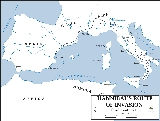
Shortly after the start of the Second Punic War, the Carthaginian general Hannibal had boldly crossed into Italy by traversing the Alps
Alps

The Alps is the name for one of the great mountain range systems of Europe, stretching from Austria and Slovenia in the east; through Italy, Switzerland, Liechtenstein and Germany; to France in the west....
 during the winter, and had quickly won two major victories over the Romans at Trebia and at Lake Trasimene
Battle of Lake Trasimene

The Battle of Lake Trasimene was a Roman defeat in the Second Punic War between the Carthaginians under Hannibal and the Roman Republic under the consul Gaius Flaminius....
. After suffering these losses, the Romans appointed Fabius Maximus
Fabius Maximus

Quintus Fabius Maximus Verrucosus Cunctator , was a Roman politician and general, born in Rome around 280 BC and died in Rome in 203 BC. He was Roman Consul five times and was twice Roman Dictator in 221 and again in 217 BC....
 as dictator
Roman dictator

Dictator was a political office of the Roman Republic. The dictator was above the three branches of government in the constitution of the Roman Republic as no other body or officer could check his power....
 to deal with the threat. Fabius set about fighting a war of attrition
War of Attrition

The War of Attrition was a limited war fought between Israel and forces of the Egyptian Republic and the Palestine Liberation Organization from 1967 to 1970....
 against Hannibal, cutting off his supply lines and refusing to engage in pitched battle
Pitched battle

A pitched battle is a battle where both sides choose to fight at a chosen location and time and where either side has the option to disengage either before the battle starts, or shortly after the first armed exchanges....
. These tactics proved unpopular with the Romans. As the Roman people recovered from the shock of Hannibal's initial victories, they began to question the wisdom of the Fabian strategy
Fabian strategy

The Fabian strategy is a military strategy where pitched battles are avoided in favor of wearing down an opponent through a attrition warfare. While avoiding decisive battles, the side employing this strategy harasses its enemy to cause attrition and loss of morale....
 which had given the Carthaginian army the chance to regroup. Fabius's strategy was especially frustrating to the majority of the people who were eager to see a quick conclusion to the war. It was also widely feared that if Hannibal continued plundering Italy unopposed, Rome's allies might doubt Rome's ability to protect them, and defect to Carthage's cause.

Unimpressed with Fabius's strategy, the Roman Senate
Roman Senate

The Senate of the Roman Republic was a political institution in the ancient Roman Republic. According to the Greek historian Polybius, our principal source on the Constitution of the Roman Republic, the Roman Senate was the predominant branch of government....
 did not renew his dictatorial powers at the end of his term, and command was given back to the consuls Gnaeus Servilius Geminus
Gnaeus Servilius Geminus

Gnaeus Servilius Geminus was a Roman consul, serving as both general and admiral of Roman forces, during the Second Punic War.The son of Publius Servilius Geminus, Gnaeus Geminus was elected as consul in early 217 BCE....
 and M. Atilius Regulus
Marcus Atilius Regulus (consul 227 BC)

Marcus Atilius M.f. M.n. Regulus , a son of Marcus Atilius Regulus, the consul captured during the First Punic War, and grandson of Marcus Atilius Regulus , was Roman consul for the year 227 BC, together with Publius Valerius Flaccus, and consul suffectus for 217 BC replacing Gaius Flaminius who was killed in battle at Lake Trasimene....
. In 216 BC, elections resumed with Gaius Terentius Varro
Gaius Terentius Varro

Gaius Terentius Varro was a Roman Republic consul and commander. Along with his colleague, Lucius Aemilius Paullus , he commanded at the Battle of Cannae during the Second Punic War, in 216 BC, against the Carthage general Hannibal....
 and Lucius Aemilius Paullus
Lucius Aemilius Paullus

There have been several people named 'Lucius Aemilius Paulus':* Lucius Aemilius Paullus * Lucius Aemilius Paulus Macedonicus, his son* Lucius Aemilius Lepidus Paullus, consul in 50 BC...
 elected as consuls and given command of a newly raised army of unprecedented size in order to counter Hannibal. Polybius
Polybius

Polybius was a Greek historian of the Hellenistic Period noted for his book called The Histories covering in detail the period of 220–146 BC....
 writes: —Polybius, The Histories of Polybius

These eight legions, along with an estimated 2,400 Roman cavalry, formed the nucleus of this massive new army. As each legion was accompanied by an equal number of allied troops, and allied cavalry numbered around 4,000, the total strength of the army which faced Hannibal could not have been much less than 90,000.

Historical sources

There are three main accounts of the battle and none of them are contemporary. The closest is Polybius
Polybius

Polybius was a Greek historian of the Hellenistic Period noted for his book called The Histories covering in detail the period of 220–146 BC....
 who was writing 50 years after the event. Livy
Livy

Titus Livius , known as Livy in English language, was a Ancient Rome historian who wrote a monumental history of Rome, Ab Urbe Condita, from its founding through the reign of Augustus in Livy's own time....
 wrote in the time of Augustus and Appian
Appian

Appianus , of Alexandria was a Ancient Rome historian who flourished during the reigns of Trajan, Hadrian and Antoninus Pius. He is commonly referred to by the anglicised form of his name, Appian....
 even later still. Appian's account describes events that have no relation with those of the other two. Polybius seeks to portray the battle as an ultimate nadir of Roman fortunes as literary device in order that the subsequent Roman recovery will be more dramatic and remarkable. Hence, for example, his casualty figures are clearly exaggerated—"more symbolic than factual". Livy seeks to portray the Senate in the role of hero and hence heaps the blame of defeat onto the lowly born Varro. Blaming Varro also serves to lift the blame from the Roman soldiers who he has a tendency to idealize. It is difficult to find anyone with a good word for Appian's account. The verdict of Philip Sabin—"a worthless farrago"—is typical.

Roman command

Ordinarily each of the two Consuls would command their own portion of the army, but since the two armies were combined into one, the Roman law required them to alternate their command on a daily basis. It appears that Hannibal had already figured out that the command of the Roman army alternated, and planned his strategy accordingly. The traditional account puts Varro in command on the day of the battle and much of the blame for the defeat has been laid on his shoulders. However his low origins seem to be exaggerated in the sources and Varro may have been made a scapegoat by the aristocratic establishment. Varro lacked the powerful descendants that Paullus had, who were willing to protect his reputation—most notably Paullus was the grandfather of Scipio Aemilianus, the patron of Polybius.

Samuels has questioned whether it was in fact Varro in command on the day on the grounds that Paullus was in command on the right. Daly has disputed that for Romans the right was always the place of command, however he mentions that at Zama Hannibal is quoted as saying that he had fought Paullus at Cannae and concludes that it is impossible to be sure who was in command on the day.

Prelude

In the spring of 216 BC, Hannibal took the initiative and seized the large supply depot at Cannae in the Apulian plain. He thus placed himself between the Romans and their crucial source of supply. As Polybius notes, the capture of Cannae "caused great commotion in the Roman army; for it was not only the loss of the place and the stores in it that distressed them, but the fact that it commanded the surrounding district". The consuls, resolving to confront Hannibal, marched southward in search of the Carthaginian general. After two days’ march, they found him on the left bank of the Aufidus River and encamped six miles (10 km) away.

Reportedly, a Carthaginian officer named Gisgo
Gisgo

Gisgo is the name of a number of men in the history of ancient Carthage.Gisgo, son of Hanno the Great#Hanno I the Great, was a notable general of the Sicily campaigns of the First Punic War....
 commented on how much larger the Roman army was. Hannibal replied, "another thing that has escaped your notice, Gisgo, is even more amazing—that although there are so many of them, there is not one among them called Gisgo."

Consul Varro, who was in command on the first day, is presented by ancient sources as a man of reckless nature and hubris
Hubris

Hubris or hybris , mythology is a term used in modern English to indicate overweening pride, superciliousness, or arrogance, often resulting in fatal retribution....
, and was determined to defeat Hannibal. While the Romans were approaching Cannae, a small portion of Hannibal's forces ambushed the Roman army. Varro successfully repelled the Carthaginian attack and continued on his way to Cannae. This victory, though essentially a mere skirmish with no lasting strategic value, greatly bolstered confidence in the Roman army, perhaps to overconfidence on Varro's part. Paullus, however, was opposed to the engagement as it was taking shape. Unlike Varro, he was prudent and cautious, and he believed it was foolish to fight on open ground, despite the Romans' numerical strength. This was especially true since Hannibal held the advantage in cavalry (both in quality and numerical terms). Despite these misgivings, Paullus thought it unwise to withdraw the army after the initial success, and camped two-thirds of the army east of the Aufidus River, sending the remainder of his men to fortify a position on the opposite side. The purpose of this second camp was to cover the foraging parties from the main camp and harass those of the enemy.

The two armies stayed in their respective locations for two days. During the second of these two days (August 1), Hannibal, well aware that Varro would be in command the following day, left his camp and offered battle. Paullus, however, refused. When his request was rejected, Hannibal, recognizing the importance of the Aufidus' water to the Roman troops, sent his cavalry to the smaller Roman camp to harass water-bearing soldiers that were found outside the camp fortifications. According to Polybius, Hannibal's cavalry boldly rode up to the edge of the Roman encampment, causing havoc and thoroughly disrupting the supply of water to the Roman camp.

Battle


Forces

Figures for troops involved in battles are often unreliable and Cannae is no exception. Hence the following figures should be treated with caution, especially those for the Carthaginian side. The combined forces of the two consuls totaled 75,000 infantry, 2,400 Roman cavalry and 4,000 allied horse (involved in the actual battle) and, in the two fortified camps, 2,600 heavily-armed men, 7,400 lightly-armed men (a total of 10,000), so that the total strength the Romans brought to the field amounted to approximately 86,400 men. Opposing them was a Carthaginian army composed of roughly 27,000 heavy infantry, 6,000 light infantry
Light infantry

Traditionally light infantry were soldiers whose job was to provide a skirmishing screen ahead of the main body of infantry, Harassment and delaying the enemy advance....
, and 8,000 cavalry in the battle itself, irrespective of detachments. The Carthaginian army was a combination of warriors from numerous regions. Along with the core of 8,000 Libyans, fought 8,000 Iberians, 16,000 Gauls (8,000 were left at camp the day of battle) and an unknown number of Gaetulian Infantry. Hannibal's cavalry also came from diverse backgrounds. He commanded 4,000 Numidian, 2,000 Spanish, 4,000 Gallic and 450 Liby-Phoenician cavalry. Finally, Hannibal had around 8,000 skirmishers consisting of Balearian slingers and mixed nationality spearmen. All of these specific groups brought their respective strengths to the battle. The uniting factor for the Carthaginian army was the personal tie each group had with Hannibal.

Equipment

Rome's forces used traditional Roman equipment including pila and hastae as weapons as well as traditional helmets, shields, and body armor. On the other hand, the Carthaginian army used a variety of equipment. Spaniards fought with swords suited for cutting and thrusting, javelins, and incendiary spears. For defense Spanish warriors carried large oval shields. The Gauls on the other hand carried long slashing swords and small but sturdy oval shields. The heavy Carthaginian cavalry carried two javelins and a curved slashing sword with a heavy shield for protection. Numidians, being light cavalry, used no armor but carried a small shield, javelins, and a sword. Skirmishers acting as light infantry carried either slings or spears. The Balearian slingers, who were famous for their accuracy, carried short, medium, and long slings used to throw stones—they may have had a small shield strapped to their arms but this is uncertain.

The equipment of the Libyan line infantry has been much debated. Ducan Head has argued in favor of short stabbing spears Polybius states that the Libyans fought with equipment taken from previously defeated Romans but it is unclear whether he meant simply shields and armor or offensive weapons as well Dally is inclined to the view that Libyan infantry would have copied the Spanish use of the sword during their fighting there and so were armed pretty much the same way as the Romans. Connolly
Peter Connolly

Peter Connolly is a renowned United Kingdom scholar of the ancient world, Ancient Greece and Ancient Rome military equipment historian, reconstructional archaeologist and illustrator....
 has argued that they were armed as a pike armed phalanx. This has been rejected by Head because Plutarch states they carried spears shorter than the Roman Triarii. and by Dally because they could not have carried an unwieldy pike at the same time as a heavy Roman style shield

Tactical deployment

The conventional deployment for armies of the time was to place infantry in the center and deploy the cavalry in two flanking "wings". The Romans followed this convention fairly closely, but chose extra depth (by stacking their maniples
Maniple (military unit)

Maniple was a tactical unit of the Roman legion adopted from the Samnites during the Samnite Wars. It was also the name of the military insignia carried by such unit....
), rather than breadth for their infantry line, hoping to use this concentration of forces to quickly break through the center of Hannibal's line. Varro knew how the Roman infantry had managed to penetrate Hannibal's center during the Battle of the Trebia
Battle of the Trebia

The Battle of the Trebia was the first major battle of the Second Punic War, fought between the Carthage forces of Hannibal and the Roman Republic in 218 BC....
, and he planned to recreate this on an even greater scale. The principes
Principes

Principes were spearmen, and later swordsmen, in the Structural history of the Roman military#Manipular legion . They were men in the prime of their lives who were fairly wealthy, and could afford decent equipment....
 were stationed immediately behind the hastati
Hastati

Hastati were a class of infantry in the Structural history of the Roman military#Manipular legion who originally fought as spearmen, and later as swordsmen....
, ready to push forward at first contact to ensure the Romans presented a unified front. As Polybius wrote, "the maniples
Maniple (military unit)

Maniple was a tactical unit of the Roman legion adopted from the Samnites during the Samnite Wars. It was also the name of the military insignia carried by such unit....
 were nearer each other, or the intervals were decreased… and the maniples showed more depth than front". Even though they outnumbered the Carthaginians, this depth-oriented deployment meant that the Roman lines had a front of roughly equal size to their numerically inferior opponents.

Battle of Cannae, 215 Bc   Initial Roman Attack
To Varro, Hannibal seemed to have little room to manoeuver and no means of retreat as he was deployed with the Aufidus River to his rear. Varro believed that when pressed hard by the Romans' superior numbers, the Carthaginians would fall back onto the river and, with no room to manoeuver, would be cut down in panic. Bearing in mind that Hannibal's two previous victories had been largely decided by his trickery and ruse, Varro had sought an open battlefield. The field at Cannae was indeed clear, with no possibility of hidden troops being brought to bear as an ambush.

Hannibal, on the other hand, had deployed his forces based on the particular fighting qualities of each unit, taking into consideration both their strengths and weaknesses in devising his strategy. He placed his Iberians
Iberians

The Iberians were a set of peoples that Ancient Greece and ancient Rome sources identified with that name in the eastern and southern coasts of the Iberian peninsula at least from the 6th century BC....
, Gaul
Gaul

Gaul is the name used for the region of Western Europe comprising part of present day northern Italy, France, Belgium, western Switzerland and the parts of the Netherlands and Germany on the west bank of the River Rhine....
s and Celtiberians
Celtiberians

The Celtiberians were a Celtic languages-speaking people of the Iberian Peninsula in the final centuries BCE. The group originated when Celts migrated from Gaul and integrated with the local Pre-Indo-European populations of Iberia, in particular the Iberians....
 in the middle, alternating the ethnic composition across the front line. Hannibal's infantry from Punic Africa was positioned on the wings at the very edge of his infantry line. These infantry were expertly battle-hardened, remained cohesive, and would attack the Roman flanks.

Hasdrubal
Hasdrubal, commander of the service corps

Hasdrubal, commander of the Service Corps was a Carthage officer in the Second Punic War. After the Battle of the Ticinus Hannibal led his army East along the Po River to catch the Roman Republic army....
 led the Iberian and Celtiberian cavalry on the left (south near the Aufidus River) of the Carthaginian army. Hasdrubal was given about 6,500 cavalry, and Hanno
Hanno, son of Bomilcar

Hanno, son of Bomilcar , was a Carthage officer in the Second Punic War. When Hannibal's army reached the Western bank of the Rh?ne River they began preparations to cross....
 had 3,500 Numidians
Numidians

The Numidians were semi-nomadic Berber people tribes who lived in Numidia, in Algeria east of Constantine and in part of Tunisia and Morocco. The Numidians were one of the earliest natives to trade with the settlers of Carthage....
 on the right.

Hannibal intended that his cavalry, comprising mainly medium Hispanic cavalry and Numidian light horse, and positioned on the flanks, defeat the weaker Roman cavalry and swing around to attack the Roman infantry from the rear as it pressed upon Hannibal's weakened center. His veteran African troops would then press in from the flanks at the crucial moment, and encircle the overextended Roman army.

Hannibal was unworried about his position against the Aufidus River; in fact, it played a major factor in his strategy. By anchoring his army on the river, Hannibal prevented one of his flanks from being overlapped by the more numerous Romans. The Romans were in front of the hill leading to Cannae and hemmed in on their right flank by the Aufidus River, so that their left flank was the only viable means of retreat. In addition, the Carthaginian forces had manoeuvred so that the Romans would face east. Not only would the morning sunlight shine on the Romans, but the southeasterly winds would blow sand and dust into their faces as they approached the battlefield. Hannibal's unique deployment of his army, based on his perception of the terrain and understanding of the capabilities of his troops, proved decisive.

Events

As the armies advanced on one another, Hannibal gradually extended the center of his line, as Polybius describes: "After thus drawing up his whole army in a straight line, he took the central companies of Hispanics and Celts and advanced with them, keeping the rest of them in contact with these companies, but gradually falling off, so as to produce a crescent-shaped formation, the line of the flanking companies growing thinner as it was prolonged, his object being to employ the Africans as a reserve force and to begin the action with the Hispanics and Celts." Polybius describes the weak Carthaginian center as deployed in a crescent, curving out toward the Romans in the middle with the African troops on their flanks in echelon formation
Echelon formation

An echelon formation is a military formation in which members are arranged diagonally. Each member is stationed behind and to the right , or behind and to the left , of the member ahead....
. It is believed that the purpose of this formation was to break the forward momentum of the Roman infantry, and delay its advance before other developments allowed Hannibal to deploy his African infantry most effectively. However, some historians have called this account fanciful, and claim that it represents either the natural curvature that occurs when a broad front of infantry marches forward, or the bending back of the Carthaginian center from the shock action of meeting the heavily massed Roman center. Most historians believe that Hannibal deliberately had his forces curve back to draw the Roman soldiers in and then to cut them off and slaughter them.

Battle Cannae Destruction
When the battle was joined, the cavalry engaged in a fierce exchange on the flanks. Polybius describes the scene, writing that "When the Hispanic and Celtic horses on the left wing came into collision with the Roman cavalry, the struggle that ensued was truly barbaric." Here, the Carthaginian cavalry quickly overpowered the inferior Romans on the right flank and rout
Rout

A rout is commonly defined as a chaotic and disorderly withdrawal or Withdrawal of troops from a battlefield, resulting in the victory of the opposing party, or following defeat, a collapse of discipline, or poor morale....
ed them. A portion of the Carthaginian cavalry then detached itself from the Carthaginian left flank and made a wide circling pivot to the Roman right-flank, where it fell upon the rear of the Roman cavalry. The Roman cavalry was immediately dispersed as the Carthaginians fell upon them and began "cutting them down mercilessly".

While the Carthaginians were in the process of defeating the Roman cavalry, the mass of infantry on both sides advanced towards each other in the center of the field. As the Romans advanced, the wind from the East blew dust in their faces and obscured their vision. While the wind itself was not a major factor, the dust that both armies created would have been potentially debilitating to sight. Although the dust made sight difficult, troops would still have been able to see others in the vicinity. The dust, however, was not the only psychological factor involved in battle. Because of the somewhat distant battle location both sides were forced to fight on little sleep. The Romans faced another disadvantage caused by lack of proper hydration due to Hannibal's attack on the Roman encampment during the previous day. Furthermore, the massive number of troops would have led to an overwhelming amount of background noise. All of these psychological factors made battle especially difficult for the infantrymen.

Hannibal stood with his men in the weak center and held them to a controlled retreat. The crescent of Hispanic and Gallic troops buckled inwards as they gradually withdrew. Knowing the superiority of the Roman infantry, Hannibal had instructed his infantry to withdraw deliberately, thus creating an even tighter semicircle around the attacking Roman forces. By doing so, he had turned the strength of the Roman infantry into a weakness. Furthermore, while the front ranks were gradually advancing forward, the bulk of the Roman troops began to lose their cohesion, as they began crowding themselves into the growing gap. Soon they were compacted together so closely that they had little space to wield their weapons. In pressing so far forward in their desire to destroy the retreating and collapsing line of Hispanic and Gallic troops, the Romans had ignored (possibly due to the dust previously mentioned) the African troops that stood uncommitted on the projecting ends of this now reversed-crescent. This also gave the Carthaginian cavalry time to drive the Roman cavalry off on both flanks and attack the Roman center in the rear. The Roman infantry, now stripped of both its flanks, formed a wedge that drove deeper and deeper into the Carthaginian semicircle, driving itself into an alley that was formed by the African Infantry stationed at the echelons. At this decisive point, Hannibal ordered his African Infantry to turn inwards and advance against the Roman flanks, creating an encirclement
Encirclement

Encirclement is a military term for the situation when a force or target is isolated and surrounded by enemy forces.This situation is highly dangerous for the encircled force: at the military strategy level, because it cannot receive supplies or reinforcements, and on the military tactics level, because the units in the force can be subject...
 of the Roman infantry in one of the earliest known examples of the pincer movement
Pincer movement

The pincer movement or double envelopment is a basic element of military strategy which has been used, to some extent, in many wars, and is considered to be the consummate Maneuver, executed by Hannibal at the Battle of Cannae in 216 BC, over 2,200 years ago....
.

When the Carthaginian cavalry attacked the Romans in the rear, and the African flanking echelons had assailed them on their right and left, the advance of the Roman infantry was brought to an abrupt halt. The trapped Romans were enclosed in a pocket with no means of escape. The Carthaginians created a wall and began destroying the entrapped Romans as discussed earlier. Polybius claims that, "as their outer ranks were continually cut down, and the survivors forced to pull back and huddle together, they were finally all killed where they stood."

As Livy
Livy

Titus Livius , known as Livy in English language, was a Ancient Rome historian who wrote a monumental history of Rome, Ab Urbe Condita, from its founding through the reign of Augustus in Livy's own time....
 describes, "So many thousands of Romans were lying … Some, whom their wounds, pinched by the morning cold, had roused, as they were rising up, covered with blood, from the midst of the heaps of slain, were overpowered by the enemy. Some were found with their heads plunged into the earth, which they had excavated; having thus, as it appeared, made pits for themselves, and having suffocated themselves." Nearly six hundred legionaries were slaughtered each minute until darkness brought an end to the bloodletting. Only 14,000 Roman troops managed to escape (most of whom had cut their way through to the nearby town of Canusium).

Casualties


Roman and allied
Polybius writes that of the Roman and allied infanty, 70,000 were killed, 10,000 captured, and "perhaps" 3,000 survived. He also reports that of the 6,000 Roman and allied cavalry, only 370 survived.

Livy writes "it is said that 45,500 foot and 2,700 horse were slain in almost equal proportion of [Roman] citizens and allies". He also reports that 3,000 Roman and allied infantry and 1,500 Roman and allied cavalry were taken prisoner by the Carthaginians. Although Livy does not cite his source by name, it is likely to have been Quintus Fabius Pictor
Quintus Fabius Pictor

Quintus Fabius Pictor was one of the earliest Roman Republic historians and considered the first of the annalists. A member of the Fabius gens, he was the grandson of Gaius Fabius Pictor, a painter ....
, a Roman historian who fought in and wrote on the Second Punic War. It is Pictor who Livy names when reporting the casualties at the Battle of Trebia. In addition to the consul Paullus, Livy goes on to record that among the dead were 2 quaestor
Quaestor

Quaestor is a type of public official.In the Roman Republic a quaestor was an elected official who supervised the treasury and financial affairs of the state, its armies and its officers....
s, 29 of the 48 military tribune
Military tribune

A Military tribune is both a military officer of the Roman Legion and an official of the Roman State.In the Roman Republican period, there were six appointed to each legion....
s (some of consular rank, including the consul of the previous year, Gnaeus Servilius Geminus
Gnaeus Servilius Geminus

Gnaeus Servilius Geminus was a Roman consul, serving as both general and admiral of Roman forces, during the Second Punic War.The son of Publius Servilius Geminus, Gnaeus Geminus was elected as consul in early 217 BCE....
, and the former Master of the Horse
Master of the Horse

The Master of the Horse was a historical position of varying importance in several European nations....
, Marcus Minucius Rufus
Marcus Minucius Rufus (consul 221 BC)

Marcus Minucius Rufus was a Roman consul in 221 BC. He was also Magister Equitum during dictatorship of Fabius Maximus known as Cunctator....
), and 80 "senators or men who had held offices which would have given them the right to be elected to the Senate".

Later Roman (and Greco-Roman) historians all largely follow Livy's figures. Appian
Appian

Appianus , of Alexandria was a Ancient Rome historian who flourished during the reigns of Trajan, Hadrian and Antoninus Pius. He is commonly referred to by the anglicised form of his name, Appian....
 gives 50,000 killed and "a great many" taken prisoner. Plutarch
Plutarch

Lucius Mestrius Plutarchus , c. AD 46 ? 120 ? commonly known in English as Plutarch ? was a Ancient Rome historian , biographer, essayist, and Middle Platonism....
 agrees, "50,000 Romans fell in that battle... 4,000 were taken alive". Quintilian
Quintilian

Marcus Fabius Quintilianus was a Roman Empire rhetorician from Hispania, widely referred to in Middle ages schools of rhetoric and in Renaissance writing....
: "60,000 men were slain by Hannibal at Cannae". Eutropius
Eutropius

IntroductionNot much is known about the early life of Eutropius because there are no written texts that document his life. Eutropius should not be confused with Eutropius of Valencia or Saint Eutropius....
: "20 officers of consular and praetorian rank, 30 senators, and 300 hundred others of noble descent, were taken or slain, as well as 40,000 foot-soldiers, and 3,500 horse".

Most modern historians, while rejecting Polybius' figure as flawed, are willing to accept Livy's figure. Some more recent historians have come up with far lower estimates. Cantalupi proposed Roman losses of 10,500 to 16,000.

Carthaginian and allied
Livy records Hannibal's losses at "about 8,000 of his bravest men". Polybius reports 5,700 dead: 4,000 Gauls, 1,500 Spanish and Africans, and 200 cavalry.

Aftermath

Hannibal Slodtz Louvre Mr2093
? Livy
Livy

Titus Livius , known as Livy in English language, was a Ancient Rome historian who wrote a monumental history of Rome, Ab Urbe Condita, from its founding through the reign of Augustus in Livy's own time....
, on the Roman Senate's reaction to the defeat

For a brief period of time, the Romans were in complete disarray. Their best armies in the peninsula were destroyed, the few remnants severely demoralized, and the only remaining consul (Varro) completely discredited. It was a complete catastrophe
List of military disasters

A military disaster is when one side in a battle or war is unexpectedly and soundly defeated, and often changes the course of history.A military disaster can range from a strong army losing a major battle against a clearly inferior force, to an army being surprised and defeated by a clearly superior force, to a seemingly evenly matched conf...
 for the Romans. As the story goes, Rome declared a national day of mourning, as there was not a single person in Rome who was not either related to or acquainted with a person who had died. The Romans became so desperate that they resorted to human sacrifice, twice burying people alive at the Forum
Roman Forum

The Roman Forum , sometimes known by its original Latin name, is located between the Palatine hill and the Capitoline hill of the city of Rome. It is the central area around which the Ancient Rome developed....
 of Rome and abandoning an oversized baby in the Adriatic Sea
Adriatic Sea

The Adriatic Sea is a body of water separating the Italian Peninsula from the Balkan peninsula, and the system of the Apennine Mountains from that of the Dinaric Alps and adjacent ranges....
 (perhaps one of the last recorded instances of human sacrifice
Human sacrifice

Human sacrifice is the act of killing human beings as part of a religious ritual . Its typology closely parallels the various practices of ritual slaughter of animals and of religious sacrifice in general....
s the Romans would perform, unless the public executions of defeated enemies dedicated to Mars are counted as human sacrifice).

Lucius Caecilius Metellus, a military tribune
Military tribune

A Military tribune is both a military officer of the Roman Legion and an official of the Roman State.In the Roman Republican period, there were six appointed to each legion....
, is known to have so much despaired in the Roman cause in the aftermath of the battle as to suggest that everything was lost, and called the other tribunes to sail overseas and hire themselves up into the service to some foreign prince. Afterwards, he was forced by his own example to swear an oath of allegiance to Rome for all time. Furthermore, the Roman survivors of Cannae were later reconstituted as two legions and assigned to Sicily for the remainder of the war as punishment for their humiliating desertion of the battlefield. In addition to the physical loss of her army, Rome would suffer a symbolic defeat of prestige. A gold ring was a token of membership in the upper classes of Roman society; Hannibal had his men collect more than 200 gold rings from the corpses on the battlefield, and sent this collection to Carthage as proof of his victory. The collection was poured on the floor in front of the Carthaginian Senate, and was judged to be "three and a half measures".

Hannibal, having gained yet another victory (following the battles of Trebia
Battle of the Trebia

The Battle of the Trebia was the first major battle of the Second Punic War, fought between the Carthage forces of Hannibal and the Roman Republic in 218 BC....
 and Lake Trasimene), had defeated the equivalent of eight consular armies. Within just three campaign seasons, Rome had lost a fifth of the entire population of citizens over seventeen years of age (nearly twelve percent of Rome's available manpower). Furthermore, the morale effect of this victory was such that most of Southern Italy joined Hannibal's cause. After the Battle of Cannae, the Hellenistic
Hellenistic civilization

File:Diadochen1.pngHellenistic civilization represents the zenith of Ancient Greece influence in the Classical Antiquity from 323 BC to about 146 BC ....
 southern provinces
Magna Graecia

Magna Graecia is the name of the area in Southern Italy and Sicily that was Colonies in antiquity#Greek colonies by Greek settlers in the eighth century BC, who brought with them the lasting imprint of their Hellenic civilization....
 of Arpi, Salapia, Herdonia, Uzentum, including the cities of Capua
Capua

Capua is a city in the province of Caserta, Campania, southern Italy, situated 25 km north of Naples, on the northeastern edge of the Campanian plain....
 and Tarentum
Taranto

Taranto is a coastal city in Puglia, Southern Italy. It is the capital of the Province of Taranto and is an important commercial port as well as the main Italian naval base....
 (two of the largest city-states in Italy) all revoked their allegiance to Rome and pledged their loyalty to Hannibal. As Polybius notes, "How much more serious was the defeat of Cannae, than those which preceded it can be seen by the behavior of Rome’s allies; before that fateful day, their loyalty remained unshaken, now it began to waver for the simple reason that they despaired of Roman Power." During that same year, the Greek cities in Sicily were induced to revolt against Roman political control, while the Macedonian king, Philip V
Philip V of Macedon

File:Philip_V_of_Macedon BM.jpgPhilip V was King of Macedon from 221 BC to 179 BC. Philip's reign was principally marked by an unsuccessful struggle with the emerging power of Roman Republic....
, had pledged his support to Hannibal—thus initiating the First Macedonian War
First Macedonian War

The First Macedonian War was fought by Roman Republic, allied with the Aetolian League and Attalus I of Pergamon, against Philip V of Macedon, contemporaneously with the Second Punic War against Carthage....
 against Rome. Hannibal also secured an alliance with the newly appointed King Hieronymus
Hieronymus

Hieronymus, the Greek and Latin form of the name Jerome, means "sacred name."It may refer to several people:* Jerome, better known as Saint Jerome ...
 of Syracuse
Syracuse, Italy

Syracuse is a historic city in southern Italy, the Capital of the province of Syracuse. The city is noted for its rich Greek history, culture, amphitheatres, architecture and association to Archimedes, playing an important role in ancient times as one of the top powers of the Mediterranean world; it is over 2,700 years old....
, the only independent leftover in Sicily.

Following the battle, the commander of the Numidian cavalry Maharbal
Maharbal

Maharbal was Hannibal's cavalry commander during the Second Punic War. He was often critical to the success of the side of Carthage over Roman Republic....
 urged Hannibal to seize the opportunity and march immediately on Rome. It is told that the latter's refusal caused Maharbal's exclamation: "Truly the Gods have not bestowed all things upon the same person. Thou knowest indeed, Hannibal, how to conquer, but thou knowest not how to make use of your victory." Yet Hannibal had good reasons to judge the strategic situation after the battle otherwise than Maharbal did. As the historian Hans Delbrück points out, due to the high numbers of killed and wounded among its ranks the Punic army was not in condition to perform a direct assault on Rome. A march to the city on the Tiber
Tiber

The Tiber is the third-longest river in Italy, rising in the Apennine mountains in Emilia-Romagna and flowing 406 kilometres through Umbria and Lazio to the Tyrrhenian Sea....
 would have been a fruitless demonstration, that would have nullified the psychological effect of Cannae on the Roman allies. Even if his army was in full strength, a successful siege of Rome would have required from Hannibal to subdue a considerable part of the hinterland in order to secure his own and cut the enemy's supplies. Even after the tremendous losses, suffered at Cannae, and the defection of a number of her allies, Rome still had abundant manpower to prevent this and at the same time to maintain considerable forces in Iberia, Sicily, Sardinia and elsewhere despite Hannibal's presence in Italy. Hannibal's conduct after the victories at Trasimene (217 BC) and Cannae (216 BC), and the fact that he first attacked Rome itself only five years later (in 211 BC) suggests that his strategic aim was not the destruction of his foe but to dishearten the Romans by a series of carnages on the battlefields and to wear them down to a moderate peace agreement by stripping them of their allies.

So immediately after Cannae Hannibal sent a delegation led by Carthalo
Carthalo

Carthalo was an officer in Hannibal's army during the Second Punic War. He led the Numidian cavalry in a successful skirmish against Roman Republic....
 to negotiate a peace treaty with the Senate on moderate terms. Yet despite the multiple catastrophes Rome had suffered, the Roman Senate refused to parley. Instead, they re-doubled their efforts, declaring full mobilization of the male Roman population, and raised new legions from landless peasants and even slaves. So firm were these measures that the word “peace” was prohibited, mourning was limited to only thirty days, and public tears were restricted to women. The Romans, after experiencing this catastrophic defeat and losing other battles, had at this point learned their lesson. For the remainder of the war in Italy, they would not amass such large forces under one command against Hannibal; instead they would utilize several independent armies, still outnumbering the Carthaginian in numbers of armies and soldiers. The war still had occasional battles, but was centered more around taking strongpoints and a constant fighting according to the Fabian strategy
Fabian strategy

The Fabian strategy is a military strategy where pitched battles are avoided in favor of wearing down an opponent through a attrition warfare. While avoiding decisive battles, the side employing this strategy harasses its enemy to cause attrition and loss of morale....
. this finally forced Hannibal with his shortage of manpower to retreat to Croton from where he was called to Africa for the battle of Zama
Battle of Zama

The Battle of Zama, fought around October 19, 202 BC, marked the final and decisive end of the Second Punic War. A Roman Republic army led by Scipio Africanus defeated a Carthage force led by Hannibal Barca....
, ending the war with a complete Roman victory.

Historical significance


Effects on Roman military doctrine


The Battle of Cannae played a major role in shaping the military structure and tactical organization of the Roman Republican army
Military establishment of the Roman Republic

As the Roman kingdom successfully overcame opposition from the Italic hill tribes, and became a larger state, the age of Tyrant in the eastern Mediterranean began to subside....
. At Cannae, the Roman infantry assumed a formation similar to the Greek phalanx
Phalanx formation

The phalanx is a rectangular mass military tactical formation, usually composed entirely of heavy infantry armed with spears, pike , or similar weapons....
. This delivered them into Hannibal's trap, since their inability to manoeuvre independently from the mass of the army made it impossible for them to counter the encircling tactics employed by the Carthaginian cavalry. Furthermore, the strict laws of the Roman state required that high command alternate between the two consuls—thus restricting strategic consistency. However, in the years following Cannae, striking reforms were introduced to address these deficiencies. First, the Romans "articulated the phalanx, then divided it into columns, and finally split it up into a great number of small tactical bodies that were capable, now of closing together in a compact impenetrable union, now of changing the pattern with consummate flexibility, of separating one from the other and turning in this or that direction." For instance, at Ilipa
Battle of Ilipa

The Battle of Ilipa was arguably Scipio Africanus?s most brilliant victory in his military career during the Second Punic War. Though it may not seem to be as original as Hannibal?s tactic at Battle of Cannae, Scipio?s pre-battle maneuver and his Reverse Cannae formation was still a culmination of his military tactics ability, in which he...
 and Zama
Battle of Zama

The Battle of Zama, fought around October 19, 202 BC, marked the final and decisive end of the Second Punic War. A Roman Republic army led by Scipio Africanus defeated a Carthage force led by Hannibal Barca....
, the principes
Principes

Principes were spearmen, and later swordsmen, in the Structural history of the Roman military#Manipular legion . They were men in the prime of their lives who were fairly wealthy, and could afford decent equipment....
 were formed up well to the rear of the hastati
Hastati

Hastati were a class of infantry in the Structural history of the Roman military#Manipular legion who originally fought as spearmen, and later as swordsmen....
—a deployment that allowed a greater degree of mobility and maneuverability. The culminating result of this change marked the transition from the traditional manipular
Maniple (military unit)

Maniple was a tactical unit of the Roman legion adopted from the Samnites during the Samnite Wars. It was also the name of the military insignia carried by such unit....
 system to the cohort
Cohort (military unit)

A cohort is a fairly large military unit, generally consisting of one type of soldier....
 under Gaius Marius
Gaius Marius

Gaius Marius was a Roman Republic general and politician elected consul an unprecedented seven times during his career. He was also noted for his dramatic Marian Reforms of Roman legion, authorizing recruitment of landless citizens and reorganizing the structure of the legions into separate Cohort ....
, as the basic infantry unit of the Roman army.

In addition, a unified command came to be seen as a necessity. After various political experiments, Scipio Africanus
Scipio Africanus

Publius Cornelius Scipio Africanus also known as Scipio Africanus, Scipio the Elder, and Africanus the Elder was a general in the Second Punic War and statesman of the Roman Republic....
 was made general-in-chief of the Roman armies in Africa, and was assured the continued occupancy of this title for the duration of the war. This appointment may have violated the constitutional laws of the Roman Republic
Roman Republic

The Roman Republic was the phase of the Ancient Rome characterized by a republican form of government; a period which began with the overthrow of the Roman Roman Kingdom, c....
, but, as Hans Delbrück
Hans Delbrück

Hans Delbr?ck was a Germany historian. Delbr?ck was one of the first modern military historians, basing his method of research on the critical examination of ancient sources, the use of auxiliary disciplines, like demography and economics, to complete the analysis and the comparison between different epochs to trace the evolution of milita...
 wrote, "effected an internal transformation that increased her military potentiality enormously" while foreshadowing the decline of the Republic's political institutions. Furthermore, the battle exposed the limits of a citizen-militia
Militia

The term militia is commonly used today to refer to a military force composed of ordinary citizens to provide defense, emergency law enforcement, or paramilitary service, in times of emergency without being paid a regular salary or committed to a fixed term of service....
 army. Following Cannae, the Roman army gradually developed into a professional force: the nucleus of Scipio's army at Zama
Battle of Zama

The Battle of Zama, fought around October 19, 202 BC, marked the final and decisive end of the Second Punic War. A Roman Republic army led by Scipio Africanus defeated a Carthage force led by Hannibal Barca....
 was composed of veterans who had been fighting the Carthaginians in Hispania
Hispania

Hispania was the name given by the Ancient Rome to the whole of the Iberian Peninsula . When Rome was a Roman Republic, Hispania was divided into Roman provinces: Hispania Citerior and Hispania Ulterior....
 for nearly sixteen years, and had been moulded into a superb fighting force.

Status in military history

The Battle of Cannae is as famous for Hannibal's tactics
Military tactics

Military tactics are the techniques for using weapons or military units in combination for engaging and defeating an Enemy in battle. Changes in philosophy and technology over time have been reflected in changes to military tactics....
 as it is for the role it played in Roman history
Military history of ancient Rome

From its origin as a city-state in History of Italy during Roman times in 9th century BC, the rise as an Roman Empire covering much of Eurasia and North Africa and fall in the 5th century AD of Ancient Rome was often closely entwined with its military history....
. Not only did Hannibal inflict a defeat on the Roman Republic in a manner unrepeated for over a century until the lesser-known Battle of Arausio
Battle of Arausio

The Battle of Arausio took place on October 6, 105 BC, at a site between the town of Arausio and the Rh?ne River. Ranged against the migratory tribes of the Cimbri under Boiorix and the Teutoni were two Roman army, commanded by the proconsul Quintus Servilius Caepio and consul Gnaeus Mallius Maximus....
, the battle itself has acquired a significant reputation within the field of military history
Military history

Military history is a humanities List of academic disciplines within the scope of History recording of War in the Human history, and its impact on the societies, their cultures, economies and changing Politics and international relationships....
. As military historian Theodore Ayrault Dodge
Theodore Ayrault Dodge

Theodore Ayrault Dodge was a Union officer in the American Civil War and a military history of both that war and of the great generals of ancient and European history....
 once wrote:
"Few battles of ancient times are more marked by ability… than the battle of Cannae. The position was such as to place every advantage on Hannibal's side. The manner in which the far from perfect Hispanic and Gallic foot was advanced in a wedge in échelon
Echelon formation

An echelon formation is a military formation in which members are arranged diagonally. Each member is stationed behind and to the right , or behind and to the left , of the member ahead....
… was first held there and then withdrawn step by step, until it had the reached the converse position… is a simple masterpiece of battle tactics. The advance at the proper moment of the African infantry, and its wheel right and left upon the flanks of the disordered and crowded Roman legionaries, is far beyond praise. The whole battle, from the Carthaginian standpoint, is a consummate piece of art, having no superior, few equal, examples in the history of war"
.
As Will Durant
Will Durant

William James Durant was a prolific United States writer, historian, and philosopher. He is best known for the 11-volume The Story of Civilization, written in collaboration with his wife Ariel Durant and published between 1935 and 1975....
 wrote, "It was a supreme example of generalship, never bettered in history… and it set the lines of military tactics for 2,000 years".

Hannibal's double envelopement
Encirclement

Encirclement is a military term for the situation when a force or target is isolated and surrounded by enemy forces.This situation is highly dangerous for the encircled force: at the military strategy level, because it cannot receive supplies or reinforcements, and on the military tactics level, because the units in the force can be subject...
 at the Battle of Cannae is often viewed as one of the greatest battlefield manoeuvers in history, and is cited as the first successful use of the pincer movement
Pincer movement

The pincer movement or double envelopment is a basic element of military strategy which has been used, to some extent, in many wars, and is considered to be the consummate Maneuver, executed by Hannibal at the Battle of Cannae in 216 BC, over 2,200 years ago....
 within the Western world
Western world

The term Western world, the West or the Occident can have multiple meanings dependent on its context . Accordingly, the basic definition of what constitutes "the West" varies, expanding and contracting over time, in relation to various historical circumstances....
, to be recorded in detail.

The "Cannae Model"

Apart from it being one of the greatest defeats ever inflicted on Roman arms, the Battle of Cannae represents the archetypal
Archetype

An archetype is an original model of a person, ideal example, or a prototype after which others are copied, patterned, or emulated; a symbol universally recognized by all....
 battle of annihilation
Battle of annihilation

A battle of annihilation is a military strategy where an attacking army seeks to destroy the military capacity of the opposing army in a single planned pivotal battle....
, a strategy that has rarely been successfully implemented in modern history. As Dwight D. Eisenhower
Dwight D. Eisenhower

Dwight David ?Ike? Eisenhower was the List of Presidents of the United States President of the United States from 1953 until 1961 and a General of the Army in the United States Army....
, the Supreme Commander of the Allied Expeditionary Force in World War II, once wrote, "Every ground commander seeks the battle of annihilation; so far as conditions permit, he tries to duplicate in modern war
Modern warfare

Modern warfare, although present in every historical period of military history, is generally used to refer to the military concepts, military methods and military technology that have come into use during and after the Second World War....
 the classic example of Cannae"
. Furthermore, the totality of Hannibal's victory has made the name "Cannae" a byword for military success, and is today studied in detail in several military academies around the world. The notion that an entire army could be encircled and annihilated within a single stroke, led to a fascination among subsequent Western generals for centuries (including Frederick the Great
Frederick II of Prussia

Frederick II was a monarch of Kingdom of Prussia from the House of Hohenzollern. In his role as a prince-elector of the Holy Roman Empire, he was Frederick IV of Margraviate of Brandenburg....
 and Helmuth von Moltke
Helmuth von Moltke

Helmuth von Moltke can refer to these people:*Helmuth Graf von Moltke *Helmuth Johann Ludwig von Moltke *Helmuth James Graf von Moltke ...
) who attempted to emulate its tactical paradigm of envelopment and re-create their own "Cannae". For instance, Norman Schwarzkopf, the commander of the Coalition Forces in the Gulf War
Gulf War

"Persian Gulf War" and "First Gulf War" redirect here. For other uses, see Persian Gulf War .The Persian Gulf War was a United Nations-authorized military conflict between Iraq and a Coalition of Gulf War from 34 nations commissioned with expelling Iraqi forces from Kuwait after Iraq's Invasion of Kuwait of Kuwait in August 1990....
, studied Cannae and employed the principles Hannibal used in his highly successful ground campaign against the much less impressive Iraqi forces.

Hans Delbrück's seminal study of the battle had a profound influence on subsequent German military theorists, in particular, the Chief of the German General Staff
German General Staff

The German General Staff was an institution whose rise and development gave the German military a decided advantage over its adversaries. The Staff amounted to its best "weapon" for nearly two centuries....
, Alfred von Schlieffen (whose eponymously-titled "Schlieffen Plan
Schlieffen Plan

The Schlieffen Plan was the German General Staff's early 20th century overall strategic plan for victory both on the Western Front against France and against Russia in the east, taking advantage of expected differences in the three countries' speed in preparing for war....
" was inspired by Hannibal's double envelopment manoeuver). Through his writings, Schlieffen taught that the "Cannae model" would continue to be applicable in maneuver warfare
Maneuver warfare

Maneuver warfare, American and British English spelling differences manoeuvre warfare, is the term used by military theorists for a Military strategy of warfare that advocates attempting to defeat an adversary by incapacitating their Decision making through shock and disruption brought about by movement....
 throughout the 20th century:

"A battle of annihilation can be carried out today according to the same plan devised by Hannibal in long forgotten times. The enemy front is not the goal of the principal attack. The mass of the troops and the reserves should not be concentrated against the enemy front; the essential is that the flanks be crushed. The wings should not be sought at the advanced points of the front but rather along the entire depth and extension of the enemy formation. The annihilation is completed through an attack against the enemy's rear… To bring about a decisive and annihilating victory requires an attack against the front and against one or both flanks…"


Schlieffen later developed his own operational doctrine in a series of articles, many of which were later translated and published in a work entitled "Cannae".

See also

  • Pincer movement
    Pincer movement

    The pincer movement or double envelopment is a basic element of military strategy which has been used, to some extent, in many wars, and is considered to be the consummate Maneuver, executed by Hannibal at the Battle of Cannae in 216 BC, over 2,200 years ago....
  • Flanking maneuver
    Flanking maneuver

    In military tactics, a flanking Maneuver warfare, also called a wiktionary:flank attack, is an attack on the sides of an opposing force....
  • Punic military forces


Sources

  • Carlton, James. The Military Quotation Book. New York City, New York: Thomas Dunne Books, 2002.
  • Hoyos, Dexter B. Hannibal: Rome's Greatest Enemy. Bristol Phoenix Press, 2005, ISBN 1904675468 (hbk) ISBN 1904675476 (pbk).
  • Daly, Gregory. Cannae: The Experience of Battle in the Second Punic War. London/New York: Routledge, ISBN 0415327431.
  • Delbrück, Hans
    Hans Delbrück

    Hans Delbr?ck was a Germany historian. Delbr?ck was one of the first modern military historians, basing his method of research on the critical examination of ancient sources, the use of auxiliary disciplines, like demography and economics, to complete the analysis and the comparison between different epochs to trace the evolution of milita...
    . Warfare in Antiquity, 1920, ISBN 080329199X.
  • Livy
    Livy

    Titus Livius , known as Livy in English language, was a Ancient Rome historian who wrote a monumental history of Rome, Ab Urbe Condita, from its founding through the reign of Augustus in Livy's own time....
    , Titus Livius and De Selincourt, Aubrey. The War with Hannibal: Books XXI-XXX of the History of Rome from its Foundation. Penguin Classics, Reprint Edition, 1965, ISBN 014044145X (pbk).
  • Talbert, Richard J.A. (ed.) Atlas of Classical History. London/New York: Routledge, 1985, ISBN 0415034639.


External links

  • "" Mommsen History of Rome. Book 03 From the Union of Italy to the Subjugation of Carthage and the Greek States. Page 50
  • "" at www.unrv.com
  • "" at Roman-empire.net
  • - a treatise by General Fieldmarshal Count Alfred von Schlieffen