

Molotov cocktail

Encyclopedia
Incendiary device
Incendiary weapons, incendiary devices or incendiary bombs are bombs designed to start fires or destroy sensitive equipment using materials such as napalm, thermite, chlorine trifluoride, or white phosphorus....
. Due to the relative ease of production, they are frequently used by non-professionally equipped fighters and others who cannot afford, manufacture, or obtain hand grenade
Hand grenade
A hand grenade is any small bomb that can be thrown by hand. Hand grenades are classified into three categories, explosive grenades, chemical and gas grenades. Explosive grenades are the most commonly used in modern warfare, and are designed to detonate after impact or after a set amount of time...
s. They are primarily intended to set targets ablaze rather than instantly destroy them. The name "Molotov cocktail" was coined by the Finn
Finn
Finn is commonly used to refer to a member of the Finn ethnic group or a citizen of Finland.a name* Finn , a Frisian King, who appears in Beowulf and The Fight at Finnsburg...
s during the Winter War
Winter War
The Winter War was a military conflict between the Soviet Union and Finland. It began with a Soviet offensive on 30 November 1939 – three months after the start of World War II and the Soviet invasion of Poland – and ended on 13 March 1940 with the Moscow Peace Treaty...
. The name is an insult to—rather than respect for—Vyacheslav Molotov
Vyacheslav Molotov
Vyacheslav Mikhailovich Molotov was a Soviet politician and diplomat, an Old Bolshevik and a leading figure in the Soviet government from the 1920s, when he rose to power as a protégé of Joseph Stalin, to 1957, when he was dismissed from the Presidium of the Central Committee by Nikita Khrushchev...
, foreign minister for the USSR at the time and responsible for the partition of Finland.
Mechanism
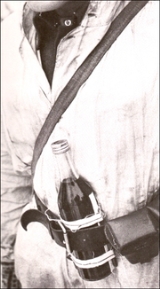
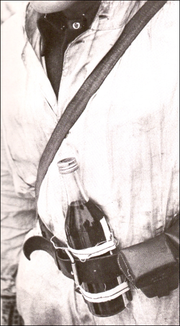
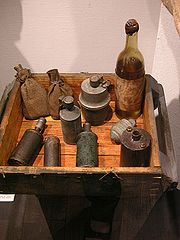
A Molotov cocktail is a breakable bottleBottle
A bottle is a rigid container with a neck that is narrower than the body and a "mouth". By contrast, a jar has a relatively large mouth or opening. Bottles are often made of glass, clay, plastic, aluminum or other impervious materials, and typically used to store liquids such as water, milk, soft...
containing a flammable substance such as gasoline
Gasoline
Gasoline , or petrol , is a toxic, translucent, petroleum-derived liquid that is primarily used as a fuel in internal combustion engines. It consists mostly of organic compounds obtained by the fractional distillation of petroleum, enhanced with a variety of additives. Some gasolines also contain...
or a napalm
Napalm
Napalm is a thickening/gelling agent generally mixed with gasoline or a similar fuel for use in an incendiary device, primarily as an anti-personnel weapon...
-like mixture and usually a source of ignition such as a burning cloth wick
Capillary action
Capillary action, or capilarity, is the ability of a liquid to flow against gravity where liquid spontanously rise in a narrow space such as between the hair of a paint-brush, in a thin tube, or in porous material such as paper or in some non-porous material such as liquified carbon fiber, or in a...
held in place by the bottle's stopper. The wick is usually soaked in alcohol or kerosene
Kerosene
Kerosene, sometimes spelled kerosine in scientific and industrial usage, also known as paraffin or paraffin oil in the United Kingdom, Hong Kong, Ireland and South Africa, is a combustible hydrocarbon liquid. The name is derived from Greek keros...
, rather than gasoline.
In action, the wick is lit and the bottle hurled at a target such as a vehicle
Vehicle
A vehicle is a device that is designed or used to transport people or cargo. Most often vehicles are manufactured, such as bicycles, cars, motorcycles, trains, ships, boats, and aircraft....
or fortification. When the bottle smashes on impact, the ensuing cloud of petrol droplets
Drop (liquid)
A drop or droplet is a small column of liquid, bounded completely or almost completely by free surfaces. A drop may form when liquid accumulates at the lower end of a tube or other surface boundary, producing a hanging drop called a pendant drop...
and vapour are ignited, causing an immediate fireball
Explosion
An explosion is a rapid increase in volume and release of energy in an extreme manner, usually with the generation of high temperatures and the release of gases. An explosion creates a shock wave. If the shock wave is a supersonic detonation, then the source of the blast is called a "high explosive"...
followed by a raging fire as the remainder of the fuel is consumed. Another method is to place a reactive substance in with the gasoline, and treat the label or wrapper paper with another chemical; when the bottle ruptures, the two chemicals mix and ignite; this is safer to handle if done properly, and does not betray the thrower with a visible flame prior to the throw.
Other flammable
Flammability
Flammability is defined as how easily something will burn or ignite, causing fire or combustion. The degree of difficulty required to cause the combustion of a substance is quantified through fire testing. Internationally, a variety of test protocols exist to quantify flammability...
liquids such as diesel fuel, methanol
Methanol
Methanol, also known as methyl alcohol, wood alcohol, wood naphtha or wood spirits, is a chemical with the formula CH3OH . It is the simplest alcohol, and is a light, volatile, colorless, flammable liquid with a distinctive odor very similar to, but slightly sweeter than, ethanol...
, turpentine
Turpentine
Turpentine is a fluid obtained by the distillation of resin obtained from trees, mainly pine trees. It is composed of terpenes, mainly the monoterpenes alpha-pinene and beta-pinene...
and E85
E85
E85 is an abbreviation for an ethanol fuel blend of up to 85% denatured ethanol fuel and gasoline or other hydrocarbon by volume. E85 is commonly used by flex-fuel vehicles in the US, Canada, and Europe. Some of the benefits of E85 over conventional gasoline powered vehicles include the potential...
have been used in place of or with gasoline. Thickening agents such as Styrofoam, tar
Tar
Tar is modified pitch produced primarily from the wood and roots of pine by destructive distillation under pyrolysis. Production and trade in tar was a major contributor in the economies of Northern Europe and Colonial America. Its main use was in preserving wooden vessels against rot. The largest...
, strips of tyre
Tire
A tire or tyre is a ring-shaped covering that fits around a wheel rim to protect it and enable better vehicle performance by providing a flexible cushion that absorbs shock while keeping the wheel in close contact with the ground...
tubing, sugar
Sugar
Sugar is a class of edible crystalline carbohydrates, mainly sucrose, lactose, and fructose, characterized by a sweet flavor.Sucrose in its refined form primarily comes from sugar cane and sugar beet...
, blood
Blood
Blood is a specialized bodily fluid in animals that delivers necessary substances such as nutrients and oxygen to the cells and transports metabolic waste products away from those same cells....
, XPS foam, egg white
Egg white
Egg white is the common name for the clear liquid contained within an egg. In chickens it is formed from the layers of secretions of the anterior section of the hen's oviduct during the passage of the egg. It forms around either fertilized or unfertilized egg yolks...
s, motor oil
Motor oil
Motor oil or engine oil is an oil used for lubrication of various internal combustion engines. The main function is to lubricate moving parts; it also cleans, inhibits corrosion, improves sealing, and cools the engine by carrying heat away from moving parts.Motor oils are derived from...
, rubber cement
Rubber cement
Rubber cement is an adhesive made from elastic polymers mixed in a solvent such as acetone, hexane, heptane or toluene to keep them fluid enough to be used. Water-based formulas, often stabilised by ammonia, are also available...
, and dish soap have been added to help the burning liquid adhere to the target and create clouds of thick, choking smoke
Smoke
Smoke is a collection of airborne solid and liquid particulates and gases emitted when a material undergoes combustion or pyrolysis, together with the quantity of air that is entrained or otherwise mixed into the mass. It is commonly an unwanted by-product of fires , but may also be used for pest...
.
Spain
Improvised incendiary devices, that were much later called "Molotov cocktails", had been used for the first time in the Spanish Civil WarSpanish Civil War
The Spanish Civil WarAlso known as The Crusade among Nationalists, the Fourth Carlist War among Carlists, and The Rebellion or Uprising among Republicans. was a major conflict fought in Spain from 17 July 1936 to 1 April 1939...
between July 1936 and April 1939. In 1936, General
General
A general officer is an officer of high military rank, usually in the army, and in some nations, the air force. The term is widely used by many nations of the world, and when a country uses a different term, there is an equivalent title given....
Francisco Franco
Francisco Franco
Francisco Franco y Bahamonde was a Spanish general, dictator and head of state of Spain from October 1936 , and de facto regent of the nominally restored Kingdom of Spain from 1947 until his death in November, 1975...
ordered Spanish Nationalists to use the weapon against Soviet T-26 tanks supporting the Spanish Republicans
Second Spanish Republic
The Second Spanish Republic was the government of Spain between April 14 1931, and its destruction by a military rebellion, led by General Francisco Franco....
in a failed assault on the Nationalist stronghold of Seseña
Seseña
Seseña is a municipality located in the province of Toledo, Castile-La Mancha, Spain. According to the 2009 census , the municipality had a population of 16,231.-Residencial Francisco Hernando:...
, near Toledo
Toledo, Spain
Toledo's Alcázar became renowned in the 19th and 20th centuries as a military academy. At the outbreak of the Spanish Civil War in 1936 its garrison was famously besieged by Republican forces.-Economy:...
, 80 km south of Madrid
Madrid
Madrid is the capital and largest city of Spain. The population of the city is roughly 3.3 million and the entire population of the Madrid metropolitan area is calculated to be 6.271 million. It is the third largest city in the European Union, after London and Berlin, and its metropolitan...
. After that, both sides used simple petrol bombs or petrol soaked blanket
Blanket
A blanket is a type of bedding, generally speaking, a large piece of cloth, intended to keep the user warm, especially while sleeping. Blankets are distinguished from sheets by their thickness and purpose; the thickest sheet is still thinner than the lightest blanket. Blankets are generally used...
s with some success. Tom Wintringham
Tom Wintringham
Thomas Henry Wintringham was a British soldier, military historian, journalist, poet, Marxist, politician and author. He was an important figure in the formation of the Home Guard during World War II and was one of the founders of the Common Wealth Party.-Early life:Tom Wintringham was born 1898...
, a veteran of the International Brigades, later publicised his recommended method of using them:
Khalkhin Gol
The Battle of Khalkhin GolBattle of Khalkhin Gol
The Battles of Khalkhyn Gol was the decisive engagement of the undeclared Soviet–Japanese Border Wars fought among the Soviet Union, Mongolia and the Empire of Japan in 1939. The conflict was named after the river Khalkhyn Gol, which passes through the battlefield...
, a border conflict ostensibly between Mongolia
Mongolia
Mongolia is a landlocked country in East and Central Asia. It is bordered by Russia to the north and China to the south, east and west. Although Mongolia does not share a border with Kazakhstan, its western-most point is only from Kazakhstan's eastern tip. Ulan Bator, the capital and largest...
and Manchukuo
Manchukuo
Manchukuo or Manshū-koku was a puppet state in Manchuria and eastern Inner Mongolia, governed under a form of constitutional monarchy. The region was the historical homeland of the Manchus, who founded the Qing Empire in China...
, saw heavy fighting between Japanese
Imperial Japanese Army
-Foundation:During the Meiji Restoration, the military forces loyal to the Emperor were samurai drawn primarily from the loyalist feudal domains of Satsuma and Chōshū...
and Soviet
Soviet Army
The Soviet Army is the name given to the main part of the Armed Forces of the Soviet Union between 1946 and 1992. Previously, it had been known as the Red Army. Informally, Армия referred to all the MOD armed forces, except, in some cases, the Soviet Navy.This article covers the Soviet Ground...
forces. Short of anti-tank equipment, Japanese infantry attacked Soviet tanks with gasoline-filled bottles. Japanese infantrymen claimed that several hundred Soviet tanks had been destroyed this way, though Soviet loss records do not support this assessment.
Finland
Soviet Union
The Soviet Union , officially the Union of Soviet Socialist Republics , was a constitutionally socialist state that existed in Eurasia between 1922 and 1991....
launched an offensive against Finland
Finland
Finland , officially the Republic of Finland, is a Nordic country situated in the Fennoscandian region of Northern Europe. It is bordered by Sweden in the west, Norway in the north and Russia in the east, while Estonia lies to its south across the Gulf of Finland.Around 5.4 million people reside...
, starting what came to be known as the Winter War
Winter War
The Winter War was a military conflict between the Soviet Union and Finland. It began with a Soviet offensive on 30 November 1939 – three months after the start of World War II and the Soviet invasion of Poland – and ended on 13 March 1940 with the Moscow Peace Treaty...
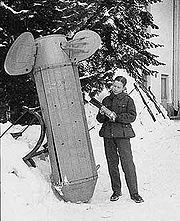
. The Finnish Army
Finnish Army
The Finnish Army is the land forces branch of the Finnish Defence Forces.Today's Army is divided into six branches: the infantry , field artillery, anti-aircraft artillery, engineers, signals, and materiel troops.-History of the Finnish Army:Between 1809 and 1917 Finland was an autonomous part of...
faced large numbers of Red Army
Red Army
The Workers' and Peasants' Red Army started out as the Soviet Union's revolutionary communist combat groups during the Russian Civil War of 1918-1922. It grew into the national army of the Soviet Union. By the 1930s the Red Army was among the largest armies in history.The "Red Army" name refers to...
tank
Tank
A tank is a tracked, armoured fighting vehicle designed for front-line combat which combines operational mobility, tactical offensive, and defensive capabilities...
s. Being short on anti-tank guns, they borrowed the design of an improvised incendiary device used in the just-concluded Spanish Civil War.
During the Winter War, the Soviet air force made extensive use of incendiaries and cluster bombs against Finnish troops and fortifications. When Soviet People's Commissar for Foreign Affairs
Foreign minister
A Minister of Foreign Affairs, or foreign minister, is a cabinet minister who helps form the foreign policy of a sovereign state. The foreign minister is often regarded as the most senior ministerial position below that of the head of government . It is often granted to the deputy prime minister in...
Vyacheslav Molotov
Vyacheslav Molotov
Vyacheslav Mikhailovich Molotov was a Soviet politician and diplomat, an Old Bolshevik and a leading figure in the Soviet government from the 1920s, when he rose to power as a protégé of Joseph Stalin, to 1957, when he was dismissed from the Presidium of the Central Committee by Nikita Khrushchev...
claimed in radio broadcasts that they were not bombing, but rather delivering food
Food
Food is any substance consumed to provide nutritional support for the body. It is usually of plant or animal origin, and contains essential nutrients, such as carbohydrates, fats, proteins, vitamins, or minerals...
to the starving
Starvation
Starvation is a severe deficiency in caloric energy, nutrient and vitamin intake. It is the most extreme form of malnutrition. In humans, prolonged starvation can cause permanent organ damage and eventually, death...
Finns, the Finns started to call the air bombs Molotov bread basket
Molotov bread basket
The RRAB-3, nicknamed the Molotov bread basket , was a Soviet-made droppable bomb dispenser that combined a large high-explosive charge with a cluster of incendiary bombs. It was used against the cities of Finland during the Winter War of 1939–1940...
s. Soon they responded by attacking advancing tanks with "Molotov cocktails" which were "a drink to go with the food". At first, the term was used to describe only the burning mixture itself, but in practical use the term was soon applied to the combination of both the bottle and its contents. This Finnish use of the hand- or sling-thrown
Sling (weapon)
A sling is a projectile weapon typically used to throw a blunt projectile such as a stone or lead "sling-bullet". It is also known as the shepherd's sling....
explosive against Soviet tanks was repeated in the subsequent Continuation War
Continuation War
The Continuation War was the second of two wars fought between Finland and the Soviet Union during World War II.At the time of the war, the Finnish side used the name to make clear its perceived relationship to the preceding Winter War...
between the two countries.
Gasoline
Gasoline , or petrol , is a toxic, translucent, petroleum-derived liquid that is primarily used as a fuel in internal combustion engines. It consists mostly of organic compounds obtained by the fractional distillation of petroleum, enhanced with a variety of additives. Some gasolines also contain...
, kerosene
Kerosene
Kerosene, sometimes spelled kerosine in scientific and industrial usage, also known as paraffin or paraffin oil in the United Kingdom, Hong Kong, Ireland and South Africa, is a combustible hydrocarbon liquid. The name is derived from Greek keros...
, tar
Tar
Tar is modified pitch produced primarily from the wood and roots of pine by destructive distillation under pyrolysis. Production and trade in tar was a major contributor in the economies of Northern Europe and Colonial America. Its main use was in preserving wooden vessels against rot. The largest...
, and potassium chloride
Potassium chloride
The chemical compound potassium chloride is a metal halide salt composed of potassium and chlorine. In its pure state, it is odorless and has a white or colorless vitreous crystal appearance, with a crystal structure that cleaves easily in three directions. Potassium chloride crystals are...
. Further refinements included the attachment of wind-proof matches or a phial of chemicals that would ignite on breakage thereby removing the need to pre-ignite the bottle and leaving the bottle about one-third empty was found to make breaking more likely. As the cooling system was almost invariably placed where direct fire wouldn't hit them, the target of choice was the rear deck of a tank; the burning contents of the bottle would pour through the large cooling grills and ignite fuel, hydraulic fluids and ammunition.
A British and a War Office report dated June 1940 noted that:
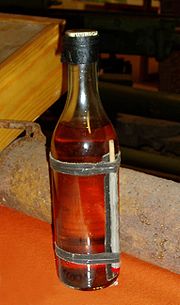
Molotov cocktails were eventually mass-produced by the Alko
Alko
Alko is the national alcoholic beverage retailing monopoly in Finland. It is the only store in the country which retails beer over 4.7% ABV, wine and spirits. Alcoholic beverages are also sold in licensed restaurants and bars but only for consumption on the premises...
corporation at its Rajamäki distillery, bundled with match
Match
A match is a tool for starting a fire under controlled conditions. A typical modern match is made of a small wooden stick or stiff paper. One end is coated with a material that can be ignited by frictional heat generated by striking the match against a suitable surface...
es to light them. Production totalled 450,000 during the Winter War. The original design of the Molotov cocktail was a mixture of ethanol
Ethanol
Ethanol, also called ethyl alcohol, pure alcohol, grain alcohol, or drinking alcohol, is a volatile, flammable, colorless liquid. It is a psychoactive drug and one of the oldest recreational drugs. Best known as the type of alcohol found in alcoholic beverages, it is also used in thermometers, as a...
, tar and gasoline in a 750 ml
Litér
- External links :*...
bottle. The bottle had two long pyrotechnic storm matches attached to either side. Before use, one or both of the matches was lit; when the bottle broke on impact, the mixture ignited. The storm matches were found to be safer to use than a burning rag on the mouth of the bottle.
Britain
Early in 1940, with the prospect of immediate invasionBritish anti-invasion preparations of World War II
British anti-invasion preparations of the Second World War entailed a large-scale division of military and civilian mobilisation in response to the threat of invasion by German armed forces in 1940 and 1941. The British army needed to recover from the defeat of the British Expeditionary Force in...
, the possibilities of the petrol bomb gripped the imagination of the British public. For the layman, the petrol bomb had the benefit of using entirely familiar and available materials and they were quickly improvised in large numbers with the intention of using them against enemy tanks. Although the petrol bomb might seem like a weapon of forlorn hope
Forlorn hope
A forlorn hope is a band of soldiers or other combatants chosen to take the leading part in a military operation, such as an assault on a defended position, where the risk of casualties is high....
, the possibility of success was not quite as distant as might be imagined. 1940 was at the very end of the era of the light tank and the German behemoths of the later war years were still in the future: many tanks were surprisingly vulnerable.
When used in the right way and in sufficient numbers the Finns had found that they were effective. Although the experience of the Spanish Civil War received more publicity, the more sophisticated petroleum warfare tactics of the Finns were not lost on British commanders. In his 5 June address to LDV leaders, General Ironside
Edmund Ironside, 1st Baron Ironside
Field Marshal William Edmund Ironside, 1st Baron Ironside GCB, CMG, CBE, DSO, was a British Army officer who served as Chief of the Imperial General Staff during the first year of the Second World War....
said:
Wintringham advised that a tank that was isolated from supporting infantry was potentially vulnerable to men who had the required determination and cunning to get close. Rifles or even a shotgun would be sufficient to persuade the crew to close all the hatches and then the view from the tank is very limited; a turret mounted machine gun has a very slow traverse and cannot hope to fend off attackers coming from all directions. Once sufficiently close, it is possible to hide where the tank’s gunner cannot see: “The most dangerous distance away from a tank is 200 yards; the safest distance is six inches.” Petrol bombs will soon produce a pall of blinding smoke and a well placed explosive package or even a stout iron bar in the tracks can immobilise the vehicle leaving it at the mercy of further petrol bombs – which will suffocate the engine and possibly the crew – or an explosive charge or anti-tank mine.
By August 1940, the War Office
War Office
The War Office was a department of the British Government, responsible for the administration of the British Army between the 17th century and 1964, when its functions were transferred to the Ministry of Defence...
produced training instructions for the creation and use of Molotov Cocktails. The instructions suggested scoring the bottles vertically with a diamond to ensure breakage and providing fuel soaked rag, windproof matches or a length of cinema film (made of highly flammable nitrocellulose) as a source of ignition.
On 29 July 1940, manufacturers Albright & Wilson of Oldbury demonstrated to the RAF how their white phosphorus could be used to ignite incendiary bombs. The demonstration involved throwing glass bottles containing a mixture of petrol and phosphorus
Phosphorus
Phosphorus is the chemical element that has the symbol P and atomic number 15. A multivalent nonmetal of the nitrogen group, phosphorus as a mineral is almost always present in its maximally oxidized state, as inorganic phosphate rocks...
at pieces of wood and into a hut. On breaking, the phosphorus was exposed to the air and spontaneously ignited; the petrol also burned resulting in a fierce fire. Because of safety concerns, the RAF was not interested in white phosphorus as a source of ignition, but the idea of a self-igniting petrol bomb took hold. Initially known as an A.W. bomb, it was officially named the No 76 Grenade
No. 76 Special Incendiary Grenade
The No. 76 Special Incendiary Grenade also commonly known as the A.W. bomb or SIP Grenade was an incendiary grenade based on white phosphorus used during World War II....
, but more commonly known as the SIP (Self Igniting Phosphorus) grenade. The perfected list of ingredients was yellow phosphorus
Allotropes of phosphorus
Elemental phosphorus can exist in several allotropes; the most common of which are white and red solids. Solid violet and black allotropes are also known. Gaseous phosphorus exists as diphosphorus and atomic phosphorus.-White phosphorus:...
, benzene
Benzene
Benzene is an organic chemical compound. It is composed of 6 carbon atoms in a ring, with 1 hydrogen atom attached to each carbon atom, with the molecular formula C6H6....
, water and a two inch strip of raw rubber
Rubber
Natural rubber, also called India rubber or caoutchouc, is an elastomer that was originally derived from latex, a milky colloid produced by some plants. The plants would be ‘tapped’, that is, an incision made into the bark of the tree and the sticky, milk colored latex sap collected and refined...
; all in a half-pint bottle sealed with a crown stopper
Crown Cork
The crown cork , the first form of bottle cap, was invented by William Painter in 1891 in Baltimore. The company making it was originally called the Bottle Seal Company, but it changed its name with the almost immediate success of the crown cork to the Crown Cork and Seal Company...
. Over time, the rubber would slowly dissolve making the contents slightly sticky and the mixture would separate into two layers – this was intentional and the grenade should not be shaken to mix the layers as this would only delay ignition. When thrown against a hard surface, the glass would shatter and the contents would instantly ignite liberating choking fumes of phosphorus pentoxide
Phosphorus pentoxide
Phosphorus pentoxide is a chemical compound with molecular formula P4O10 . This white crystalline solid is the anhydride of phosphoric acid. It is a powerful desiccant.-Structure:...
and sulphur dioxide as well as producing a great deal of heat. Strict instructions were issued to store the grenades safely, preferably underwater and certainly never in a house. Mainly issued to the Home Guard
British Home Guard
The Home Guard was a defence organisation of the British Army during the Second World War...
as an anti-tank weapon, it was produced in vast numbers; by August 1941 well over 6,000,000 had been manufactured.
However, there were voices that were more cautious. There were many who were sceptical about the efficacy of Molotov Cocktails and SIPs grenades against the more modern German tanks. Weapon designer Stuart Macrae
Stuart Macrae (inventor)
Colonel Robert Stuart Macrae TD was an inventor best known for his work at MD1 during the Second World War, his best known invention being the sticky bomb.Macrae was the author of Winston Chuchill's Toyshop...
witnessed a trial of the SIPs grenade at Farnborough
Farnborough Airfield
Farnborough Airport or TAG London Farnborough Airport is an airport situated in Farnborough, Rushmoor, Hampshire, England...
: "There was some concern that, if the tank drivers could not pull up quickly enough and hop out, they were likely to be frizzled to death, but after looking at the bottles they said they would be happy to take a chance." The drivers were proved right, trials on modern British tanks confirmed that Molotov and SIP grenades caused the occupants of the tanks "no inconvenience whatsoever".
Wintringham, though enthusiastic about improvised weapons cautioned against a reliance on petrol bombs and repeatedly emphasised the importance of using explosive charges.
Other fronts
Irish War of Independence
The Irish War of Independence , Anglo-Irish War, Black and Tan War, or Tan War was a guerrilla war mounted by the Irish Republican Army against the British government and its forces in Ireland. It began in January 1919, following the Irish Republic's declaration of independence. Both sides agreed...
, IRA fighters sometimes used sods of turf soaked in paraffin oil to attack British army barracks. Fencing wire was pushed through the sod to make a throwing handle.
The Polish home army
Armia Krajowa
The Armia Krajowa , or Home Army, was the dominant Polish resistance movement in World War II German-occupied Poland. It was formed in February 1942 from the Związek Walki Zbrojnej . Over the next two years, it absorbed most other Polish underground forces...
developed a version which ignited on impact without the need of a wick. Ignition was caused by a reaction between concentrated sulfuric acid
Sulfuric acid
Sulfuric acid is a strong mineral acid with the molecular formula . Its historical name is oil of vitriol. Pure sulfuric acid is a highly corrosive, colorless, viscous liquid. The salts of sulfuric acid are called sulfates...
mixed with the fuel and a mixture of potassium chlorate
Potassium chlorate
Potassium chlorate is a compound containing potassium, chlorine and oxygen atoms, with the molecular formula KClO3. In its pure form, it is a white crystalline substance. It is the most common chlorate in industrial use...
and sugar
Sugar
Sugar is a class of edible crystalline carbohydrates, mainly sucrose, lactose, and fructose, characterized by a sweet flavor.Sucrose in its refined form primarily comes from sugar cane and sugar beet...
which was crystallized
Crystallization
Crystallization is the process of formation of solid crystals precipitating from a solution, melt or more rarely deposited directly from a gas. Crystallization is also a chemical solid–liquid separation technique, in which mass transfer of a solute from the liquid solution to a pure solid...
from solution onto a rag attached to the bottle.
The United States Marine Corps
United States Marine Corps
The United States Marine Corps is a branch of the United States Armed Forces responsible for providing power projection from the sea, using the mobility of the United States Navy to deliver combined-arms task forces rapidly. It is one of seven uniformed services of the United States...
developed a version during World War II
World War II
World War II, or the Second World War , was a global conflict lasting from 1939 to 1945, involving most of the world's nations—including all of the great powers—eventually forming two opposing military alliances: the Allies and the Axis...
that used a tube of nitric acid
Nitric acid
Nitric acid , also known as aqua fortis and spirit of nitre, is a highly corrosive and toxic strong acid.Colorless when pure, older samples tend to acquire a yellow cast due to the accumulation of oxides of nitrogen. If the solution contains more than 86% nitric acid, it is referred to as fuming...
and a lump of metallic sodium
Sodium
Sodium is a chemical element with the symbol Na and atomic number 11. It is a soft, silvery-white, highly reactive metal and is a member of the alkali metals; its only stable isotope is 23Na. It is an abundant element that exists in numerous minerals, most commonly as sodium chloride...
to ignite a mixture of petrol and diesel fuel.
Modern use
While Molotov cocktails may be a psychologically effective method of disabling armoured fighting vehicles by forcing the crew out or damaging external components, most modern tanks cannot be physically destroyed or rendered completely inoperable by Molotov cocktails; only "disabled". Early Soviet tanks had poorly designed engine louvers which allowed the admission of fuel – this design fault was quickly rectified, and subsequent armoured vehicles had engine louvers which drained fuel (as well as rain water and dust) away from the engine. Most tanks and infantry fighting vehicleInfantry fighting vehicle
An infantry fighting vehicle , also known as a mechanized infantry combat vehicle , is a type of armoured fighting vehicle used to carry infantry into battle and provide fire support for them...
s (IFVs) of the 21st century have specially designed nuclear, biological and chemical protective systems
NBC suit
An NBC suit is a type of military personal protective equipment designed to provide protection against direct contact with and contamination by radioactive, biological or chemical substances, and provides protection from contamination with radioactive materials and some types of radiation,...
that make them internally air-tight and sealed; they are well-protected from vapors, gases, and liquids. Modern tanks possess very thick composite armour
Composite armour
Composite armour is a type of vehicle armour consisting of layers of different material such as metals, plastics, ceramics or air. Most composite armour are lighter than their all-metal equivalent, but instead occupy a larger volume for the same resistance to penetration...
consisting of layers of steel, ceramics, plastics and Kevlar
Kevlar
Kevlar is the registered trademark for a para-aramid synthetic fiber, related to other aramids such as Nomex and Technora. Developed at DuPont in 1965, this high strength material was first commercially used in the early 1970s as a replacement for steel in racing tires...
, and these materials have melting points well above the burning temperature of gasoline, which makes the vehicles themselves invulnerable to Molotov cocktails. Only external components such as optical systems, antennas, externally-mounted weapons systems or ventilation ports and openings can be damaged, which can make a tank virtually "blind" or allow burning gasoline to seep into the vehicle, forcing the crew to at least open the hatches or perhaps abandon the vehicle. A molotov cocktail thrown through an open hatch into the crew spaces would, like most other grenades, seriously affect the crew and equipment. However, many modern tanks (such as those operated by the US and NATO) have onboard fire suppression systems. Any fire in a crew space will be automatically extinguished with Halon or another fire suppressant.
In Northern Ireland
Northern Ireland
Northern Ireland is one of the four countries of the United Kingdom. Situated in the north-east of the island of Ireland, it shares a border with the Republic of Ireland to the south and west...
, Molotov cocktails were used by rioting paramilitary
Paramilitary
A paramilitary is a force whose function and organization are similar to those of a professional military, but which is not considered part of a state's formal armed forces....
groups and protesters against the police, and they are also used to attack houses to burn the house or to intimidate the occupants.
In the Revolutions of 2011
Arab Spring
The Arab Spring , otherwise known as the Arab Awakening, is a revolutionary wave of demonstrations and protests occurring in the Arab world that began on Saturday, 18 December 2010...
also in Cairo, Egypt, pro-government forces attacked protesters in Cairo
Cairo
Cairo , is the capital of Egypt and the largest city in the Arab world and Africa, and the 16th largest metropolitan area in the world. Nicknamed "The City of a Thousand Minarets" for its preponderance of Islamic architecture, Cairo has long been a centre of the region's political and cultural life...
with Molotovs.
Along with the Impact of the Arab Spring, Molotov cocktails have been seen to be used worldwide.
Legality
As incendiary devices, Molotov cocktails are illegal to manufacture or possess in many regions. In the United States, Molotov cocktails are considered "destructive deviceDestructive device
In the United States, a destructive device is a firearm or explosive device regulated by the National Firearms Act of 1934.Examples of destructive devices include grenades, and firearms with a bore over one half of an inch, including some semi-automatic shotguns. While current federal laws allow...
s" under the National Firearms Act
National Firearms Act
The National Firearms Act , 73rd Congress, Sess. 2, ch. 757, , enacted on June 26, 1934, currently codified as amended as , is an Act of Congress that, in general, imposes a statutory excise tax on the manufacture and transfer of certain firearms and mandates the registration of those firearms. The...
and regulated by the ATF.
See also
- Improvised explosive deviceImprovised explosive deviceAn improvised explosive device , also known as a roadside bomb, is a homemade bomb constructed and deployed in ways other than in conventional military action...
(IED) - Improvised firearmImprovised firearmAn improvised firearm is a firearm manufactured by someone who is not a regular maker of firearms , and is typically constructed by adapting existing materials to the purpose...
- Insurgency weaponInsurgency weaponAn insurgency weapon is a weapon, most often a firearm, intended for use by insurgents to engage in guerrilla warfare against an occupier, or for use by rebels against an established government...
- No. 76 Special Incendiary GrenadeNo. 76 Special Incendiary GrenadeThe No. 76 Special Incendiary Grenade also commonly known as the A.W. bomb or SIP Grenade was an incendiary grenade based on white phosphorus used during World War II....
External links
- A detailed technology of the Molotov cocktail
- History of the Molotov cocktail
- Homemade Tank Bomb June 1941 Popular SciencePopular SciencePopular Science is an American monthly magazine founded in 1872 carrying articles for the general reader on science and technology subjects. Popular Science has won over 58 awards, including the ASME awards for its journalistic excellence in both 2003 and 2004...
showing US public the Molotov Cocktail as used in the European Wars - A Thousand Lakes of Red Blood on White Snow, a brief history of the subarctic origins of the Molotov cocktail in the Russo-Finnish Winter War of 1939-40