

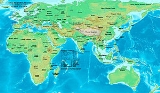
11th century

Encyclopedia
Time
Time is a part of the measuring system used to sequence events, to compare the durations of events and the intervals between them, and to quantify rates of change such as the motions of objects....
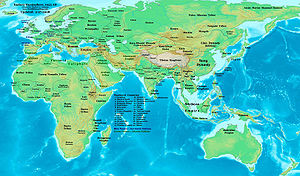
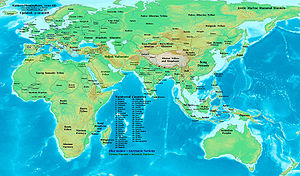
, the 11th century is the period from 1001 to 1100 in accordance with the Julian calendar
Julian calendar
The Julian calendar began in 45 BC as a reform of the Roman calendar by Julius Caesar. It was chosen after consultation with the astronomer Sosigenes of Alexandria and was probably designed to approximate the tropical year .The Julian calendar has a regular year of 365 days divided into 12 months...
in the Christian/Common Era
Common Era
Common Era ,abbreviated as CE, is an alternative designation for the calendar era originally introduced by Dionysius Exiguus in the 6th century, traditionally identified with Anno Domini .Dates before the year 1 CE are indicated by the usage of BCE, short for Before the Common Era Common Era...
.
In the history of Europe
Europe
Europe is, by convention, one of the world's seven continents. Comprising the westernmost peninsula of Eurasia, Europe is generally 'divided' from Asia to its east by the watershed divides of the Ural and Caucasus Mountains, the Ural River, the Caspian and Black Seas, and the waterways connecting...
an culture, this period is considered the early part of the High Middle Ages
High Middle Ages
The High Middle Ages was the period of European history around the 11th, 12th, and 13th centuries . The High Middle Ages were preceded by the Early Middle Ages and followed by the Late Middle Ages, which by convention end around 1500....
. There was a sudden decline of Byzantine
Byzantine Empire
The Byzantine Empire was the Eastern Roman Empire during the periods of Late Antiquity and the Middle Ages, centred on the capital of Constantinople. Known simply as the Roman Empire or Romania to its inhabitants and neighbours, the Empire was the direct continuation of the Ancient Roman State...
power and rise of Norman
Normans
The Normans were the people who gave their name to Normandy, a region in northern France. They were descended from Norse Viking conquerors of the territory and the native population of Frankish and Gallo-Roman stock...
domination over much of Europe, along with the prominent role in Europe of notably influential pope
Pope
The Pope is the Bishop of Rome, a position that makes him the leader of the worldwide Catholic Church . In the Catholic Church, the Pope is regarded as the successor of Saint Peter, the Apostle...
s. In what is now Northern Italy
Northern Italy
Northern Italy is a wide cultural, historical and geographical definition, without any administrative usage, used to indicate the northern part of the Italian state, also referred as Settentrione or Alta Italia...
, a growth of population in urban centers gave rise to early organized capitalism and more sophisticated, commercialized culture by the late 11th century.
In Song Dynasty
Song Dynasty
The Song Dynasty was a ruling dynasty in China between 960 and 1279; it succeeded the Five Dynasties and Ten Kingdoms Period, and was followed by the Yuan Dynasty. It was the first government in world history to issue banknotes or paper money, and the first Chinese government to establish a...
China
China
Chinese civilization may refer to:* China for more general discussion of the country.* Chinese culture* Greater China, the transnational community of ethnic Chinese.* History of China* Sinosphere, the area historically affected by Chinese culture...
and the classical Islamic world
Islamic Golden Age
During the Islamic Golden Age philosophers, scientists and engineers of the Islamic world contributed enormously to technology and culture, both by preserving earlier traditions and by adding their own inventions and innovations...
, this century marked the high point for both classical Chinese civilization, science
History of science and technology in China
The history of science and technology in China is both long and rich with many contributions to science and technology. In antiquity, independently of other civilizations, ancient Chinese philosophers made significant advances in science, technology, mathematics, and astronomy...
and technology
Technology of the Song Dynasty
The Song Dynasty provided some of the most significant technological advances in Chinese history, many of which came from talented statesmen drafted by the government through imperial examinations....
, and classical Islamic science
Islamic science
Science in the medieval Islamic world, also known as Islamic science or Arabic science, is the science developed and practised in the Islamic world during the Islamic Golden Age . During this time, Indian, Iranian and especially Greek knowledge was translated into Arabic...
, philosophy
Early Islamic philosophy
Early Islamic philosophy or classical Islamic philosophy is a period of intense philosophical development beginning in the 2nd century AH of the Islamic calendar and lasting until the 6th century AH...
, technology and literature
Islamic literature
Islamic literature is literature written with an Islamic perspective, in any language.The most well known fiction from the Islamic world was The Book of One Thousand and One Nights , which was a compilation of many earlier folk tales told by the Persian Queen Scheherazade...
. There was also a population explosion in China, doubling to the size of 100 million, and an economic revolution in China
Economy of the Song Dynasty
The economy of China under the Song Dynasty of China was marked by commercial expansion, financial prosperity, increased international trade-contacts, and a revolution in agricultural productivity. Private finance grew, stimulating the development of a country-wide market network which linked the...
that spurred manufacture and production rates which rivaled even Great Britain
Great Britain
Great Britain or Britain is an island situated to the northwest of Continental Europe. It is the ninth largest island in the world, and the largest European island, as well as the largest of the British Isles...
's coal
Coal
Coal is a combustible black or brownish-black sedimentary rock usually occurring in rock strata in layers or veins called coal beds or coal seams. The harder forms, such as anthracite coal, can be regarded as metamorphic rock because of later exposure to elevated temperature and pressure...
and iron output in the early Industrial Revolution
Industrial Revolution
The Industrial Revolution was a period from the 18th to the 19th century where major changes in agriculture, manufacturing, mining, transportation, and technology had a profound effect on the social, economic and cultural conditions of the times...
.
Rival political factions at the Song Dynasty
Song Dynasty
The Song Dynasty was a ruling dynasty in China between 960 and 1279; it succeeded the Five Dynasties and Ten Kingdoms Period, and was followed by the Yuan Dynasty. It was the first government in world history to issue banknotes or paper money, and the first Chinese government to establish a...
court created strife amongst the leading statesmen and ministers of the empire. Chola-era India
India
India , officially the Republic of India , is a country in South Asia. It is the seventh-largest country by geographical area, the second-most populous country with over 1.2 billion people, and the most populous democracy in the world...
and Fatimid
Fatimid
The Fatimid Islamic Caliphate or al-Fāṭimiyyūn was a Berber Shia Muslim caliphate first centered in Tunisia and later in Egypt that ruled over varying areas of the Maghreb, Sudan, Sicily, the Levant, and Hijaz from 5 January 909 to 1171.The caliphate was ruled by the Fatimids, who established the...
-era Egypt
Egypt
Egypt , officially the Arab Republic of Egypt, Arabic: , is a country mainly in North Africa, with the Sinai Peninsula forming a land bridge in Southwest Asia. Egypt is thus a transcontinental country, and a major power in Africa, the Mediterranean Basin, the Middle East and the Muslim world...
, had reached their zenith in military might and international influence. The Western Chalukya Empire (the Chola's rival) also rose to power by the end of the century. In this century the Turkish Seljuk dynasty comes to power in the Middle East over the now fragmented Abbasid
Abbasid
The Abbasid Caliphate or, more simply, the Abbasids , was the third of the Islamic caliphates. It was ruled by the Abbasid dynasty of caliphs, who built their capital in Baghdad after overthrowing the Umayyad caliphate from all but the al-Andalus region....
realm, while the first
First Crusade
The First Crusade was a military expedition by Western Christianity to regain the Holy Lands taken in the Muslim conquest of the Levant, ultimately resulting in the recapture of Jerusalem...
of the Crusades
Crusades
The Crusades were a series of religious wars, blessed by the Pope and the Catholic Church with the main goal of restoring Christian access to the holy places in and near Jerusalem...
were waged towards the close of the century. In Japan
Japan
Japan is an island nation in East Asia. Located in the Pacific Ocean, it lies to the east of the Sea of Japan, China, North Korea, South Korea and Russia, stretching from the Sea of Okhotsk in the north to the East China Sea and Taiwan in the south...
, the Fujiwara clan continued to dominate the affairs of state. In the Americas, the Toltec
Toltec
The Toltec culture is an archaeological Mesoamerican culture that dominated a state centered in Tula, Hidalgo in the early post-classic period of Mesoamerican chronology...
and Mixtec
Mixtec
The Mixtec are indigenous Mesoamerican peoples inhabiting the Mexican states of Oaxaca, Guerrero and Puebla in a region known as La Mixteca. The Mixtecan languages form an important branch of the Otomanguean language family....
civilizations flourished in central America
Central America
Central America is the central geographic region of the Americas. It is the southernmost, isthmian portion of the North American continent, which connects with South America on the southeast. When considered part of the unified continental model, it is considered a subcontinent...
, along with the Huari Culture
Huari Culture
The Wari were a Middle Horizon civilization that flourished in the south-central Andes and coastal area of modern-day Peru, from about CE 500 to 1000...
of South America
South America
South America is a continent situated in the Western Hemisphere, mostly in the Southern Hemisphere, with a relatively small portion in the Northern Hemisphere. The continent is also considered a subcontinent of the Americas. It is bordered on the west by the Pacific Ocean and on the north and east...
and the Mississippian culture
Mississippian culture
The Mississippian culture was a mound-building Native American culture that flourished in what is now the Midwestern, Eastern, and Southeastern United States from approximately 800 CE to 1500 CE, varying regionally....
of North America
North America
North America is a continent wholly within the Northern Hemisphere and almost wholly within the Western Hemisphere. It is also considered a northern subcontinent of the Americas...
. In Ukraine
Ukraine
Ukraine is a country in Eastern Europe. It has an area of 603,628 km², making it the second largest contiguous country on the European continent, after Russia...
, there was the golden age
Golden Age
The term Golden Age comes from Greek mythology and legend and refers to the first in a sequence of four or five Ages of Man, in which the Golden Age is first, followed in sequence, by the Silver, Bronze, and Iron Ages, and then the present, a period of decline...
for the principality of Kievan Rus. In Korea
Korea
Korea ) is an East Asian geographic region that is currently divided into two separate sovereign states — North Korea and South Korea. Located on the Korean Peninsula, Korea is bordered by the People's Republic of China to the northwest, Russia to the northeast, and is separated from Japan to the...
, the Goryeo
Goryeo
The Goryeo Dynasty or Koryŏ was a Korean dynasty established in 918 by Emperor Taejo. Korea gets its name from this kingdom which came to be pronounced Korea. It united the Later Three Kingdoms in 936 and ruled most of the Korean peninsula until it was removed by the Joseon dynasty in 1392...
Kingdom flourished and faced external threats from the Liao Dynasty
Liao Dynasty
The Liao Dynasty , also known as the Khitan Empire was an empire in East Asia that ruled over the regions of Manchuria, Mongolia, and parts of northern China proper between 9071125...
(Manchuria
Manchuria
Manchuria is a historical name given to a large geographic region in northeast Asia. Depending on the definition of its extent, Manchuria usually falls entirely within the People's Republic of China, or is sometimes divided between China and Russia. The region is commonly referred to as Northeast...
). In Vietnam
Vietnam
Vietnam – sometimes spelled Viet Nam , officially the Socialist Republic of Vietnam – is the easternmost country on the Indochina Peninsula in Southeast Asia. It is bordered by China to the north, Laos to the northwest, Cambodia to the southwest, and the South China Sea –...
, the Lý Dynasty
Lý Dynasty
The Lý Dynasty , sometimes known as the Later Lý Dynasty , was a Vietnamese dynasty that began in 1009 when Lý Thái Tổ overthrew the Prior Lê Dynasty and ended in 1225 when the queen Lý Chiêu Hoàng was forced to abdicate the throne in favor of her husband, Trần Cảnh. They ruled Vietnam for a...
began, while in Myanmar
Myanmar
Burma , officially the Republic of the Union of Myanmar , is a country in Southeast Asia. Burma is bordered by China on the northeast, Laos on the east, Thailand on the southeast, Bangladesh on the west, India on the northwest, the Bay of Bengal to the southwest, and the Andaman Sea on the south....
the Pagan Kingdom
Pagan Kingdom
The Pagan Kingdom or Pagan Dynasty was the first kingdom to unify the regions that would later constitute the modern-day Burma...
reached its height of political and military power.
Overview
High Middle Ages
The High Middle Ages was the period of European history around the 11th, 12th, and 13th centuries . The High Middle Ages were preceded by the Early Middle Ages and followed by the Late Middle Ages, which by convention end around 1500....
, an age subsequent to the Early Middle Ages
Early Middle Ages
The Early Middle Ages was the period of European history lasting from the 5th century to approximately 1000. The Early Middle Ages followed the decline of the Western Roman Empire and preceded the High Middle Ages...
. The century began while the translatio imperii
Translatio imperii
Translatio imperii, Latin for "transfer of rule", is a concept invented in the Middle Ages for describing history as a linear succession of transfers of imperium, that is of supreme power concentrated with a series of single rulers .-Origin:...
of 962
962
Year 962 was a common year starting on Wednesday of the Julian calendar.- Europe :* February 2 – Pope John XII crowns Otto I the Great Holy Roman Emperor....
was still somewhat novel and ended in the midst of the Investiture Controversy
Investiture Controversy
The Investiture Controversy or Investiture Contest was the most significant conflict between Church and state in medieval Europe. In the 11th and 12th centuries, a series of Popes challenged the authority of European monarchies over control of appointments, or investitures, of church officials such...
. It saw the final Christianisation of Scandinavia
Scandinavia
Scandinavia is a cultural, historical and ethno-linguistic region in northern Europe that includes the three kingdoms of Denmark, Norway and Sweden, characterized by their common ethno-cultural heritage and language. Modern Norway and Sweden proper are situated on the Scandinavian Peninsula,...
and the emergence of the Peace and Truce of God
Peace and Truce of God
The Peace and Truce of God was a medieval European movement of the Catholic Church that applied spiritual sanctions in order to limit the violence of private war in feudal society. The movement constituted the first organized attempt to control civil society in medieval Europe through non-violent...
movements, the Gregorian Reforms, and the Crusades
Crusades
The Crusades were a series of religious wars, blessed by the Pope and the Catholic Church with the main goal of restoring Christian access to the holy places in and near Jerusalem...
which revitalised a church and a papacy that had survived tarnished by the tumultuous 10th century. In 1054, the Great Schism
East–West Schism
The East–West Schism of 1054, sometimes known as the Great Schism, formally divided the State church of the Roman Empire into Eastern and Western branches, which later became known as the Eastern Orthodox Church and the Roman Catholic Church, respectively...
rent the church in two, however.
In Germany, the century was marked by the ascendancy of the Holy Roman Emperor
Holy Roman Emperor
The Holy Roman Emperor is a term used by historians to denote a medieval ruler who, as German King, had also received the title of "Emperor of the Romans" from the Pope...
s, who hit their high watermark under the Salians
Salian dynasty
The Salian dynasty was a dynasty in the High Middle Ages of four German Kings , also known as the Frankish dynasty after the family's origin and role as dukes of Franconia...
.
In Italy, it opened with the integration of the kingdom into the empire and the royal palace at Pavia
Pavia
Pavia , the ancient Ticinum, is a town and comune of south-western Lombardy, northern Italy, 35 km south of Milan on the lower Ticino river near its confluence with the Po. It is the capital of the province of Pavia. It has a population of c. 71,000...
was summoned in 1024. By the end of the century, Lombard
Lombards
The Lombards , also referred to as Longobards, were a Germanic tribe of Scandinavian origin, who from 568 to 774 ruled a Kingdom in Italy...
and Byzantine
Byzantine Empire
The Byzantine Empire was the Eastern Roman Empire during the periods of Late Antiquity and the Middle Ages, centred on the capital of Constantinople. Known simply as the Roman Empire or Romania to its inhabitants and neighbours, the Empire was the direct continuation of the Ancient Roman State...
rule in the Mezzogiorno
Mezzogiorno
The Midday is a wide definition, without any administrative usage, used to indicate the southern half of the Italian state, encompassing the southern section of the continental Italian Peninsula and the two major islands of Sicily and Sardinia, in addition to a large number of minor islands...
had been usurped by the Normans
Normans
The Normans were the people who gave their name to Normandy, a region in northern France. They were descended from Norse Viking conquerors of the territory and the native population of Frankish and Gallo-Roman stock...
and the power of the territorial magnates was being replaced by that of the citizens of the cities in the north.
In Britain, it saw the transformation of Scotland
Scotland
Scotland is a country that is part of the United Kingdom. Occupying the northern third of the island of Great Britain, it shares a border with England to the south and is bounded by the North Sea to the east, the Atlantic Ocean to the north and west, and the North Channel and Irish Sea to the...
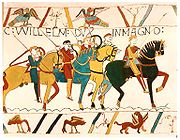
into a single, more unified and centralised kingdom and the Norman conquest of England
Norman conquest of England
The Norman conquest of England began on 28 September 1066 with the invasion of England by William, Duke of Normandy. William became known as William the Conqueror after his victory at the Battle of Hastings on 14 October 1066, defeating King Harold II of England...
in 1066. The social transformations wrought in these lands brought them into the fuller orbit of European feudal politics.
In France, it saw the nadir of the monarchy and the zenith of the great magnates, especially the dukes of Aquitaine and Normandy, who could thus foster such distinctive contributions of their lands as the pious warrior who conquered Britain, Italy, and the East and the impious peacelover, the troubadour
Troubadour
A troubadour was a composer and performer of Old Occitan lyric poetry during the High Middle Ages . Since the word "troubadour" is etymologically masculine, a female troubadour is usually called a trobairitz....
, who crafted out of the European vernacular its first great literary themes. There were also the first figures of the intellectual movement known as Scholasticism
Scholasticism
Scholasticism is a method of critical thought which dominated teaching by the academics of medieval universities in Europe from about 1100–1500, and a program of employing that method in articulating and defending orthodoxy in an increasingly pluralistic context...
, which emphasized dialectic
Dialectic
Dialectic is a method of argument for resolving disagreement that has been central to Indic and European philosophy since antiquity. The word dialectic originated in Ancient Greece, and was made popular by Plato in the Socratic dialogues...
arguments in disputes of Christian theology
Christian theology
- Divisions of Christian theology :There are many methods of categorizing different approaches to Christian theology. For a historical analysis, see the main article on the History of Christian theology.- Sub-disciplines :...
as well as classical philosophy
Ancient philosophy
This page lists some links to ancient philosophy. In Western philosophy, the spread of Christianity through the Roman Empire marked the ending of Hellenistic philosophy and ushered in the beginnings of Medieval philosophy, whereas in Eastern philosophy, the spread of Islam through the Arab Empire...
.
Almoravids
The Almoravids were a Berber dynasty of Morocco, who formed an empire in the 11th-century that stretched over the western Maghreb and Al-Andalus. Their capital was Marrakesh, a city which they founded in 1062 C.E...
. In between was a period of Christian unification under Navarre
Navarre
Navarre , officially the Chartered Community of Navarre is an autonomous community in northern Spain, bordering the Basque Country, La Rioja, and Aragon in Spain and Aquitaine in France...
se hegemony and success in the Reconquista
Reconquista
The Reconquista was a period of almost 800 years in the Middle Ages during which several Christian kingdoms succeeded in retaking the Muslim-controlled areas of the Iberian Peninsula broadly known as Al-Andalus...
against the taifa
Taifa
In the history of the Iberian Peninsula, a taifa was an independent Muslim-ruled principality, usually an emirate or petty kingdom, though there was one oligarchy, of which a number formed in the Al-Andalus after the final collapse of the Umayyad Caliphate of Córdoba in 1031.-Rise:The origins of...
kingdoms that replaced the fallen caliphate.
In China, there was a triangular affair of continued war and peace settlements between the Song Dynasty
Song Dynasty
The Song Dynasty was a ruling dynasty in China between 960 and 1279; it succeeded the Five Dynasties and Ten Kingdoms Period, and was followed by the Yuan Dynasty. It was the first government in world history to issue banknotes or paper money, and the first Chinese government to establish a...
, the Tanguts-led Western Xia
Western Xia
The Western Xia Dynasty or the Tangut Empire, was known to the Tanguts and the Tibetans as Minyak.The state existed from 1038 to 1227 AD in what are now the northwestern Chinese provinces of Ningxia, Gansu, eastern Qinghai, northern Shaanxi, northeastern Xinjiang, southwest Inner Mongolia, and...
in the northwest, and the Khitans of the Liao Dynasty
Liao Dynasty
The Liao Dynasty , also known as the Khitan Empire was an empire in East Asia that ruled over the regions of Manchuria, Mongolia, and parts of northern China proper between 9071125...
in the northeast. Meanwhile, opposing political faction
Political faction
A political faction is a grouping of individuals, such as a political party, a trade union, or other group with a political purpose. A faction or political party may include fragmented sub-factions, “parties within a party," which may be referred to as power blocs, or voting blocs. The individuals...
s evolved at the Song imperial court of Kaifeng
Kaifeng
Kaifeng , known previously by several names , is a prefecture-level city in east-central Henan province, Central China. Nearly 5 million people live in the metropolitan area...
. The political reformers at court, called the New Policies Group (新法, Xin Fa), were led by Emperor Shenzong of Song
Emperor Shenzong of Song
Emperor Shenzong of Song was the sixth emperor of the Chinese Song Dynasty. His personal name was Zhao Xu...
and the Chancellor
Chancellor
Chancellor is the title of various official positions in the governments of many nations. The original chancellors were the Cancellarii of Roman courts of justice—ushers who sat at the cancelli or lattice work screens of a basilica or law court, which separated the judge and counsel from the...
s Fan Zhongyan
Fan Zhongyan
Fan Zhongyan , born in Wuxian , Suzhou , was a prominent politician and literary figure in Song dynasty China. He was also a strategist and educator...
and Wang Anshi
Wang Anshi
Wang Anshi was a Chinese economist, statesman, chancellor and poet of the Song Dynasty who attempted controversial, major socioeconomic reforms...
, while the political conservatives were led by Chancellor Sima Guang
Sima Guang
Sīmǎ Guāng was a Chinese historian, scholar, and high chancellor of the Song Dynasty, jinshi 1038.-Life, profession, and works:...
and Empress Dowager Gao, regent of the young Emperor Zhezong of Song
Emperor Zhezong of Song
Emperor Zhezong was the seventh emperor of the Song Dynasty of China. His personal name was Zhao4 Xu1. He reigned from 1085 to 1100....
. Heated political debate and sectarian intrigue followed, while political enemies were often dismissed from the capital to govern frontier regions in the deep south where malaria
Malaria
Malaria is a mosquito-borne infectious disease of humans and other animals caused by eukaryotic protists of the genus Plasmodium. The disease results from the multiplication of Plasmodium parasites within red blood cells, causing symptoms that typically include fever and headache, in severe cases...
was known to be very fatal to northern Chinese people (see History of the Song Dynasty
History of the Song Dynasty
The Song Dynasty of China was a ruling dynasty that controlled China proper and southern China from the middle of the 10th century into the last quarter of the 13th century...
). This period also represents a high point in classical Chinese science and technology, with figures such as Su Song
Su Song
Su Song was a renowned Chinese polymath who specialized himself as a statesman, astronomer, cartographer, horologist, pharmacologist, mineralogist, zoologist, botanist, mechanical and architectural engineer, poet, antiquarian, and ambassador of the Song Dynasty .Su Song was the engineer of a...
and Shen Kuo
Shen Kuo
Shen Kuo or Shen Gua , style name Cunzhong and pseudonym Mengqi Weng , was a polymathic Chinese scientist and statesman of the Song Dynasty...
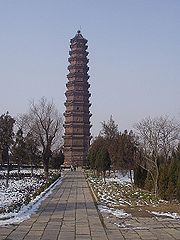
, as well as the age where the matured form of the Chinese pagoda
Chinese pagoda
Chinese Pagodas are a traditional part of Chinese architecture. In addition to religious use, since ancient times Chinese pagodas have been praised for the spectacular views which they offer, and many famous poems in Chinese history attest to the joy of scaling pagodas.-History:The pagoda is...
was accomplished in Chinese architecture
Chinese architecture
Chinese architecture refers to a style of architecture that has taken shape in East Asia over many centuries. The structural principles of Chinese architecture have remained largely unchanged, the main changes being only the decorative details...
.
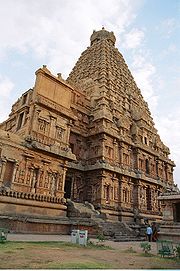
In India, the Chola Dynasty
Chola Dynasty
The Chola dynasty was a Tamil dynasty which was one of the longest-ruling in some parts of southern India. The earliest datable references to this Tamil dynasty are in inscriptions from the 3rd century BC left by Asoka, of Maurya Empire; the dynasty continued to govern over varying territory until...
reached its height of naval power under leaders such as Rajaraja Chola I
Rajaraja Chola I
Raja Raja Chola I born Arunmozhi Thevar , popularly known as Raja Raja the Great, is one of the greatest emperors of the Tamil Chola Empire of India who ruled between 985 and 1014 CE...
and Rajendra Chola I
Rajendra Chola I
Rajendra Chola I was the son of Rajaraja Chola I and was one of the greatest rulers of Tamil Chola dynasty of India. He succeeded his father in 1014 CE as the Chola emperor...
, dominating southern India (Tamil Nadu
Tamil Nadu
Tamil Nadu is one of the 28 states of India. Its capital and largest city is Chennai. Tamil Nadu lies in the southernmost part of the Indian Peninsula and is bordered by the union territory of Pondicherry, and the states of Kerala, Karnataka, and Andhra Pradesh...
), Sri Lanka
Sri Lanka
Sri Lanka, officially the Democratic Socialist Republic of Sri Lanka is a country off the southern coast of the Indian subcontinent. Known until 1972 as Ceylon , Sri Lanka is an island surrounded by the Indian Ocean, the Gulf of Mannar and the Palk Strait, and lies in the vicinity of India and the...
, and regions of South East Asia. They also sent raids into what is now modern-day Thailand
Thailand
Thailand , officially the Kingdom of Thailand , formerly known as Siam , is a country located at the centre of the Indochina peninsula and Southeast Asia. It is bordered to the north by Burma and Laos, to the east by Laos and Cambodia, to the south by the Gulf of Thailand and Malaysia, and to the...
.
In Japan, the Fujiwara clan dominated central politics by acting as imperial regents, controlling the actions of the Emperor of Japan
Emperor of Japan
The Emperor of Japan is, according to the 1947 Constitution of Japan, "the symbol of the state and of the unity of the people." He is a ceremonial figurehead under a form of constitutional monarchy and is head of the Japanese Imperial Family with functions as head of state. He is also the highest...
, who acted merely as a 'puppet monarch
Puppet monarch
A puppet monarch is a majority figurehead who is installed or patronized by an imperial power in order to provide the appearance of local authority, while allowing political and economic control to remain among the dominating nation....
' during the Heian period
Heian period
The is the last division of classical Japanese history, running from 794 to 1185. The period is named after the capital city of Heian-kyō, or modern Kyōto. It is the period in Japanese history when Buddhism, Taoism and other Chinese influences were at their height...
.
In the Middle East, the Fatimid
Fatimid
The Fatimid Islamic Caliphate or al-Fāṭimiyyūn was a Berber Shia Muslim caliphate first centered in Tunisia and later in Egypt that ruled over varying areas of the Maghreb, Sudan, Sicily, the Levant, and Hijaz from 5 January 909 to 1171.The caliphate was ruled by the Fatimids, who established the...
Empire of Egypt
Egypt
Egypt , officially the Arab Republic of Egypt, Arabic: , is a country mainly in North Africa, with the Sinai Peninsula forming a land bridge in Southwest Asia. Egypt is thus a transcontinental country, and a major power in Africa, the Mediterranean Basin, the Middle East and the Muslim world...
reached its zenith only to face steep decline, much like the Byzantine Empire
Byzantine Empire
The Byzantine Empire was the Eastern Roman Empire during the periods of Late Antiquity and the Middle Ages, centred on the capital of Constantinople. Known simply as the Roman Empire or Romania to its inhabitants and neighbours, the Empire was the direct continuation of the Ancient Roman State...
in the first half of the century. The Seljuk
Great Seljuq Empire
The Great Seljuq Empire was a medieval Persianate, Turko-Persian Sunni Muslim empire, originating from the Qynyq branch of Oghuz Turks. The Seljuq Empire controlled a vast area stretching from the Hindu Kush to eastern Anatolia and from Central Asia to the Persian Gulf...
s came to prominence while the Abbasid
Abbasid
The Abbasid Caliphate or, more simply, the Abbasids , was the third of the Islamic caliphates. It was ruled by the Abbasid dynasty of caliphs, who built their capital in Baghdad after overthrowing the Umayyad caliphate from all but the al-Andalus region....
caliphs held traditional titles without real, tangible authority in state affairs.
In Korea, the rulers of the Goryeo
Goryeo
The Goryeo Dynasty or Koryŏ was a Korean dynasty established in 918 by Emperor Taejo. Korea gets its name from this kingdom which came to be pronounced Korea. It united the Later Three Kingdoms in 936 and ruled most of the Korean peninsula until it was removed by the Joseon dynasty in 1392...
Kingdom were able to concentrate more central authority into their own hands than in that of the nobles, and were able to fend off two Khitan
Khitan people
thumb|250px|Khitans [[Eagle hunting|using eagles to hunt]], painted during the Chinese [[Song Dynasty]].The Khitan people , or Khitai, Kitan, or Kidan, were a nomadic Mongolic people, originally located at Mongolia and Manchuria from the 4th century...
invasions with their armies.
1000s
- 1001: Mahmud of GhazniMahmud of GhazniMahmud of Ghazni , actually ', was the most prominent ruler of the Ghaznavid dynasty who ruled from 997 until his death in 1030 in the eastern Iranian lands. Mahmud turned the former provincial city of Ghazni into the wealthy capital of an extensive empire which covered most of today's Iran,...
, MuslimMuslimA Muslim, also spelled Moslem, is an adherent of Islam, a monotheistic, Abrahamic religion based on the Quran, which Muslims consider the verbatim word of God as revealed to prophet Muhammad. "Muslim" is the Arabic term for "submitter" .Muslims believe that God is one and incomparable...
leader of GhazniGhazniFor the Province of Ghazni see Ghazni ProvinceGhazni is a city in central-east Afghanistan with a population of about 141,000 people...
, begins a series of raids into Northern IndiaIndiaIndia , officially the Republic of India , is a country in South Asia. It is the seventh-largest country by geographical area, the second-most populous country with over 1.2 billion people, and the most populous democracy in the world...
; he finishes in 1027 with the destruction of SomnathSomnathThe Somnath Temple located in the Prabhas Kshetra near Veraval in Saurashtra, on the western coast of Gujarat, India, is one of the twelve Jyotirlinga shrines of the God Shiva. Somnath means "The Protector of Moon God". The Somnath Temple is known as "the Shrine Eternal", having been destroyed...
. - c. 1001: Vikings, led by Leif Eriksson, establish small settlements in and around VinlandVinlandVinland was the name given to an area of North America by the Norsemen, about the year 1000 CE.There is a consensus among scholars that the Vikings reached North America approximately five centuries prior to the voyages of Christopher Columbus...
in North AmericaNorth AmericaNorth America is a continent wholly within the Northern Hemisphere and almost wholly within the Western Hemisphere. It is also considered a northern subcontinent of the Americas... - 1001–1008: Japanese Lady Murasaki ShikibuMurasaki ShikibuMurasaki Shikibu was a Japanese novelist, poet and lady-in-waiting at the Imperial court during the Heian period. She is best known as the author of The Tale of Genji, written in Japanese between about 1000 and 1012...
writes the first novelNovelA novel is a book of long narrative in literary prose. The genre has historical roots both in the fields of the medieval and early modern romance and in the tradition of the novella. The latter supplied the present generic term in the late 18th century....
, The Tale of GenjiThe Tale of Genjiis a classic work of Japanese literature attributed to the Japanese noblewoman Murasaki Shikibu in the early 11th century, around the peak of the Heian period. It is sometimes called the world's first novel, the first modern novel, the first psychological novel or the first novel still to be... - 1001 ± 40 years: Baitoushan volcano on what would be the Chinese-Korean border, erupts with a force of 6.5, the fourth largest HoloceneHoloceneThe Holocene is a geological epoch which began at the end of the Pleistocene and continues to the present. The Holocene is part of the Quaternary period. Its name comes from the Greek words and , meaning "entirely recent"...
blast. - 1003: Robert II of FranceRobert II of FranceRobert II , called the Pious or the Wise , was King of France from 996 until his death. The second reigning member of the House of Capet, he was born in Orléans to Hugh Capet and Adelaide of Aquitaine....
invades the Duchy of BurgundyDuchy of BurgundyThe Duchy of Burgundy , was heir to an ancient and prestigious reputation and a large division of the lands of the Second Kingdom of Burgundy and in its own right was one of the geographically larger ducal territories in the emergence of Early Modern Europe from Medieval Europe.Even in that...
, then ruled by Otto-William, Duke of BurgundyOtto-William, Duke of BurgundyOtto-William was a son of Adalbert, King of Italy, and Gerberga of Mâcon.His mother gave him what would be the Free County of Burgundy around Dôle in 982. Otto also inherited the duchy of Burgundy on the other side of the Saône in 1002 from his stepfather Eudes Henry the Great...
; the initial invasion is unsuccessful, but Robert II eventually gained the acceptance of the Roman Catholic ChurchRoman Catholic ChurchThe Catholic Church, also known as the Roman Catholic Church, is the world's largest Christian church, with over a billion members. Led by the Pope, it defines its mission as spreading the gospel of Jesus Christ, administering the sacraments and exercising charity...
in 1016 and annexed Burgundy into his realm. - 1004: the library and university Dar Al-HekmaDar al-hekmaIn keeping with the Islamic tradition of knowledge, the Fatimids collected books on a variety of subjects and their libraries attracted the attention of scholars from across the world...
is founded in Egypt under the FatimidFatimidThe Fatimid Islamic Caliphate or al-Fāṭimiyyūn was a Berber Shia Muslim caliphate first centered in Tunisia and later in Egypt that ruled over varying areas of the Maghreb, Sudan, Sicily, the Levant, and Hijaz from 5 January 909 to 1171.The caliphate was ruled by the Fatimids, who established the...
s. - 1005: the Treaty of Shanyuan was signed between the ChineseChinaChinese civilization may refer to:* China for more general discussion of the country.* Chinese culture* Greater China, the transnational community of ethnic Chinese.* History of China* Sinosphere, the area historically affected by Chinese culture...
Song DynastySong DynastyThe Song Dynasty was a ruling dynasty in China between 960 and 1279; it succeeded the Five Dynasties and Ten Kingdoms Period, and was followed by the Yuan Dynasty. It was the first government in world history to issue banknotes or paper money, and the first Chinese government to establish a...
and the KhitanKhitan peoplethumb|250px|Khitans [[Eagle hunting|using eagles to hunt]], painted during the Chinese [[Song Dynasty]].The Khitan people , or Khitai, Kitan, or Kidan, were a nomadic Mongolic people, originally located at Mongolia and Manchuria from the 4th century...
Liao DynastyLiao DynastyThe Liao Dynasty , also known as the Khitan Empire was an empire in East Asia that ruled over the regions of Manchuria, Mongolia, and parts of northern China proper between 9071125...
. - 1008: the FatimidFatimidThe Fatimid Islamic Caliphate or al-Fāṭimiyyūn was a Berber Shia Muslim caliphate first centered in Tunisia and later in Egypt that ruled over varying areas of the Maghreb, Sudan, Sicily, the Levant, and Hijaz from 5 January 909 to 1171.The caliphate was ruled by the Fatimids, who established the...
Egyptian sea captain Domiyat travels to the Buddhist pilgrimage site in ShandongShandong' is a Province located on the eastern coast of the People's Republic of China. Shandong has played a major role in Chinese history from the beginning of Chinese civilization along the lower reaches of the Yellow River and served as a pivotal cultural and religious site for Taoism, Chinese...
, China, to seek out the Chinese Emperor Zhenzong of SongEmperor Zhenzong of SongEmperor Zhenzong was the third emperor of the Song Dynasty of China. He reigned from 997 to 1022. Zhenzong was the third son of Emperor Taizong. His personal name was Zhao Heng and his temple name Zhenzong means "True Ancestor".Zhenzong's reign was noted for the consolidation of power and the...
with gifts from his ruling ImamImamah (Shi'a doctrine)Imāmah is the Shia doctrine of religious, spiritual and political leadership of the Ummah. The Shīa believe that the A'immah are the true Caliphs or rightful successors of Muḥammad, and further that Imams are possessed of divine knowledge and authority as well as being part of the Ahl al-Bayt,...
Al-Hakim bi-Amr AllahAl-Hakim bi-Amr AllahAbu ‘Ali Mansur Tāriqu l-Ḥākim, called Al-Hakim bi Amr al-Lāh , was the sixth Fatimid caliph and 16th Ismaili imam .- History :...
, successfully reopening diplomatic relations between Egypt and China that had been lost since the collapse of the Tang DynastyTang DynastyThe Tang Dynasty was an imperial dynasty of China preceded by the Sui Dynasty and followed by the Five Dynasties and Ten Kingdoms Period. It was founded by the Li family, who seized power during the decline and collapse of the Sui Empire...
. - 1009: Lý Thái Tổ overthrew the Anterior Lê DynastyAnterior Lê DynastyThe Early Lê dynasty was a dynasty that ruled Vietnam after the Đinh Dynasty and before the Lý Dynasty. They ruled for a total of three generations and was known for repelling the Song invasion.-Lê Đại Hành Hoàng Đế :1...
of Vietnam, establishing the Lý DynastyLý DynastyThe Lý Dynasty , sometimes known as the Later Lý Dynasty , was a Vietnamese dynasty that began in 1009 when Lý Thái Tổ overthrew the Prior Lê Dynasty and ended in 1225 when the queen Lý Chiêu Hoàng was forced to abdicate the throne in favor of her husband, Trần Cảnh. They ruled Vietnam for a...
.
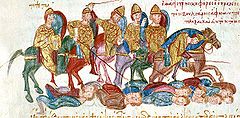
- 1009–1010: the Lombard known as Melus of BariMelus of BariMelus was a Lombard nobleman from the Apulian town of Bari, whose ambition to carve for himself an autonomous territory from the Byzantine catapanate of Italy in the early 11th century inadvertently sparked the Norman presence in southern Italy.Melus and his brother-in-law Dattus rebelled in 1009...
led an insurrection against the Byzantine Catepan of ItalyCatapanate of ItalyThe Catepanate of Italy was a province of the Byzantine Empire, comprising mainland Italy south of a line drawn from Monte Gargano to the Gulf of Salerno. Amalfi and Naples, although north of that line, maintained allegiance to Constantinople through the catepan...
, John CurcuasJohn Curcuas (catepan)John Kourkouas was the Byzantine catepan of Italy from 1008 to his death. He was of Armenian descent. He saw the first revolt of the Lombards in Greek Apulia. Formerly the strategos of Samos, Kourkouas arrived at Bari in May 1008 as a replacement for Alexios Xiphias, who had been killed in...
, as the latter was killed in battle and replaced by Basil MesardonitesBasil MesardonitesBasil Mesardonites was the Catapan of Italy, representing the Byzantine Emperor there, from 1010 to 1016 or 1017. He succeeded the catapan Curcuas, who died fighting the Lombards, then in rebellion under Melus, early in 1010. In March, Basil disembarked with reinforcements from Constantinople and...
, who brought Byzantine reinforcements.
1010s1010s-Significant people:* Abu al-Qasim * Abu Nasr Mansur* Abu Rayhan al-Biruni* Alhacen * Avicenna * Basil II* Boleslaus I* Canute* Fujiwara no Michinaga* Henry II, Holy Roman Emperor* Malcolm II of Scotland* Sweyn I...
- 1010: with the aid of scholars such as Song Zhun, Lu Duosun compiles a massive work of cartographyCartographyCartography is the study and practice of making maps. Combining science, aesthetics, and technique, cartography builds on the premise that reality can be modeled in ways that communicate spatial information effectively.The fundamental problems of traditional cartography are to:*Set the map's...
in 1566 chapters, including the mapped topographyTopographyTopography is the study of Earth's surface shape and features or those ofplanets, moons, and asteroids...
of each provincial region in China down to the minute level of small towns and villages; this was an imperial compendium first issued by Emperor Taizu of SongEmperor Taizu of SongEmperor Tàizǔ , born Zhao Kuangyin , was the founder of the Song Dynasty of China, reigning from 960 to 976.-Ancestry and early life:...
in 971. - 1010–1011: the Second Goryeo-Khitan War; the KoreaKoreaKorea ) is an East Asian geographic region that is currently divided into two separate sovereign states — North Korea and South Korea. Located on the Korean Peninsula, Korea is bordered by the People's Republic of China to the northwest, Russia to the northeast, and is separated from Japan to the...
n king was forced to flee the capital temporarily, but unable to establish a foothold and fearing a counterattack, the KhitanKhitan peoplethumb|250px|Khitans [[Eagle hunting|using eagles to hunt]], painted during the Chinese [[Song Dynasty]].The Khitan people , or Khitai, Kitan, or Kidan, were a nomadic Mongolic people, originally located at Mongolia and Manchuria from the 4th century...
forces withdrew. - 1011–1021: Ibn al-Haytham (Alhacen), a famous IraqIraqIraq ; officially the Republic of Iraq is a country in Western Asia spanning most of the northwestern end of the Zagros mountain range, the eastern part of the Syrian Desert and the northern part of the Arabian Desert....
i scientistIslamic scienceScience in the medieval Islamic world, also known as Islamic science or Arabic science, is the science developed and practised in the Islamic world during the Islamic Golden Age . During this time, Indian, Iranian and especially Greek knowledge was translated into Arabic...
working in EgyptEgyptEgypt , officially the Arab Republic of Egypt, Arabic: , is a country mainly in North Africa, with the Sinai Peninsula forming a land bridge in Southwest Asia. Egypt is thus a transcontinental country, and a major power in Africa, the Mediterranean Basin, the Middle East and the Muslim world...
, feigned madnessFeigned madnessFeigned madness a term used in popular culture to describe the assumption of a mental disorder for purposes of evasion or deceit, or to divert suspicion, perhaps in advance of an act of revenge.-To avoid responsibility:...
in fear of angering the Egyptian caliphCaliphThe Caliph is the head of state in a Caliphate, and the title for the ruler of the Islamic Ummah, an Islamic community ruled by the Shari'ah. It is a transcribed version of the Arabic word which means "successor" or "representative"...
Al-Hakim bi-Amr AllahAl-Hakim bi-Amr AllahAbu ‘Ali Mansur Tāriqu l-Ḥākim, called Al-Hakim bi Amr al-Lāh , was the sixth Fatimid caliph and 16th Ismaili imam .- History :...
, and was kept under house arrestHouse arrestIn justice and law, house arrest is a measure by which a person is confined by the authorities to his or her residence. Travel is usually restricted, if allowed at all...
from 1011 to 1021. During this time, he wrote his influential Book of OpticsBook of OpticsThe Book of Optics ; ; Latin: De Aspectibus or Opticae Thesaurus: Alhazeni Arabis; Italian: Deli Aspecti) is a seven-volume treatise on optics and other fields of study composed by the medieval Muslim scholar Alhazen .-See also:* Science in medieval Islam...
. - 1014: the ByzantineByzantine EmpireThe Byzantine Empire was the Eastern Roman Empire during the periods of Late Antiquity and the Middle Ages, centred on the capital of Constantinople. Known simply as the Roman Empire or Romania to its inhabitants and neighbours, the Empire was the direct continuation of the Ancient Roman State...
armies of Basil IIBasil IIBasil II , known in his time as Basil the Porphyrogenitus and Basil the Young to distinguish him from his ancestor Basil I the Macedonian, was a Byzantine emperor from the Macedonian dynasty who reigned from 10 January 976 to 15 December 1025.The first part of his long reign was dominated...
are victorious over Samuil of BulgariaSamuil of BulgariaSamuel was the Emperor of the First Bulgarian Empire from 997 to 6 October 1014. From 980 to 997, he was a general under Roman I of Bulgaria, the second surviving son of Emperor Peter I of Bulgaria, and co-ruled with him, as Roman bestowed upon him the command of the army and the effective royal...
in the Battle of KleidionBattle of KleidionThe Battle of Kleidion took place on July 29, 1014 between the Bulgarian Empire and the Byzantine Empire...
. - 1014: the GaelicGaelsThe Gaels or Goidels are speakers of one of the Goidelic Celtic languages: Irish, Scottish Gaelic, and Manx. Goidelic speech originated in Ireland and subsequently spread to western and northern Scotland and the Isle of Man....
forces of MunsterMunsterMunster is one of the Provinces of Ireland situated in the south of Ireland. In Ancient Ireland, it was one of the fifths ruled by a "king of over-kings" . Following the Norman invasion of Ireland, the ancient kingdoms were shired into a number of counties for administrative and judicial purposes...
and most other irish kingdomsGaelic IrelandGaelic Ireland is the name given to the period when a Gaelic political order existed in Ireland. The order continued to exist after the arrival of the Anglo-Normans until about 1607 AD...
under High King Brian BoruBrian BoruBrian Bóruma mac Cennétig, , , was an Irish king who ended the domination of the High Kingship of Ireland by the Uí Néill. Building on the achievements of his father, Cennétig mac Lorcain, and especially his elder brother, Mathgamain, Brian first made himself King of Munster, then subjugated...
defeat a combined Leinster-Viking force in the Battle of ClontarfBattle of ClontarfThe Battle of Clontarf took place on 23 April 1014 between the forces of Brian Boru and the forces led by the King of Leinster, Máel Mórda mac Murchada: composed mainly of his own men, Viking mercenaries from Dublin and the Orkney Islands led by his cousin Sigtrygg, as well as the one rebellious...
but Brian Boru gets killed at the end of the battle. - 1015: in the Battle of NesjarBattle of NesjarBattle of Nesjar was a sea battle off the coast of Norway in 1016. It was a primary event in the reign of King Olav Haraldsson . Sigvatr Þórðarson composed the poem Nesjavísur in memory of the battle....
in OslofjordOslofjordThe Oslofjord is a bay in the south-east of Norway, stretching from an imaginary line between the Torbjørnskjær and Færder lighthouses and down to Langesund in the south to Oslo in the north....
, Norway, the forces of Olav Haraldsson fought the forces of Sveinn HákonarsonSveinn HákonarsonSveinn Hákonarson was an earl of the house of Hlaðir and co-ruler of Norway from 1000 to c. 1015. He was the son of earl Hákon Sigurðarson. He is first mentioned in connection with the battle of Hjörungavágr, where the Heimskringla says he commanded 60 ships...
, with a victory for Olav. - 1018: the First Bulgarian EmpireFirst Bulgarian EmpireThe First Bulgarian Empire was a medieval Bulgarian state founded in the north-eastern Balkans in c. 680 by the Bulgars, uniting with seven South Slavic tribes...
is conquered by the Byzantine Empire - 1018: the Byzantine armies of Basil BoioannesBasil BoioannesBasil III, called Boioannes in Greek and Bugiano in Italian, was the Byzantine catapan of Italy and one of the greatest Byzantine generals of his time. His accomplishments enabled the Empire to reestablish itself as a major force in southern Italy after centuries of decline...
are victorious at the Battle of CannaeBattle of Cannae (1018)The second Battle of Cannae took place in 1018 between the Byzantines under the Catepan of Italy Basil Boioannes and the Lombards under Melus of Bari. The Lombards had also hired some Norman mercenaries under their leader Gilbert Buatère...
against the LombardsLombardsThe Lombards , also referred to as Longobards, were a Germanic tribe of Scandinavian origin, who from 568 to 774 ruled a Kingdom in Italy...
under Melus of BariMelus of BariMelus was a Lombard nobleman from the Apulian town of Bari, whose ambition to carve for himself an autonomous territory from the Byzantine catapanate of Italy in the early 11th century inadvertently sparked the Norman presence in southern Italy.Melus and his brother-in-law Dattus rebelled in 1009...
. - 1018: the Third Goryeo-Khitan WarThird Goryeo-Khitan WarThe Third Goryeo–Khitan War was an 11th-century conflict between the kingdom of Goryeo and Khitan forces near what is now the border between China and North Korea...
; the KoreaKoreaKorea ) is an East Asian geographic region that is currently divided into two separate sovereign states — North Korea and South Korea. Located on the Korean Peninsula, Korea is bordered by the People's Republic of China to the northwest, Russia to the northeast, and is separated from Japan to the...
n General Gang Gam-chanGang Gam-chanGang Gam-chan was a medieval Korean government official and military commander during the early days of Goryeo Dynasty . Even though he was a career scholar and government official, he is best known for his military victories during the Third Goryeo-Khitan War.-Goryeo-Khitan Wars:In 993, the Liao...
inflicted heavy losses to KhitanKhitan peoplethumb|250px|Khitans [[Eagle hunting|using eagles to hunt]], painted during the Chinese [[Song Dynasty]].The Khitan people , or Khitai, Kitan, or Kidan, were a nomadic Mongolic people, originally located at Mongolia and Manchuria from the 4th century...
forces at the Battle of Kwiju. The Khitan withdrew and both sides signed a peace treaty. - 1014–1020: The Book of HealingThe Book of HealingThe Book of Healing is a scientific and philosophical encyclopedia written by Abū Alī ibn Sīnā from Asfahana, near Bukhara in Greater Persia. Despite its English title, it is not in fact concerned with medicine...
, a vast philosophical and scientific encyclopaedia, is written by AvicennaAvicennaAbū ʿAlī al-Ḥusayn ibn ʿAbd Allāh ibn Sīnā , commonly known as Ibn Sīnā or by his Latinized name Avicenna, was a Persian polymath, who wrote almost 450 treatises on a wide range of subjects, of which around 240 have survived...
, PersianPersian peopleThe Persian people are part of the Iranian peoples who speak the modern Persian language and closely akin Iranian dialects and languages. The origin of the ethnic Iranian/Persian peoples are traced to the Ancient Iranian peoples, who were part of the ancient Indo-Iranians and themselves part of...
scholar.
1020s–1030s
- 1020s: The Canon of MedicineThe Canon of MedicineThe Canon of Medicine is an encyclopedia of Galenic medicine in five books compiled by Ibn Sīnā and completed in 1025. It presents a clear and organized summary of all the medical knowledge of the time...
, a medical encyclopedia, is written by AvicennaAvicennaAbū ʿAlī al-Ḥusayn ibn ʿAbd Allāh ibn Sīnā , commonly known as Ibn Sīnā or by his Latinized name Avicenna, was a Persian polymath, who wrote almost 450 treatises on a wide range of subjects, of which around 240 have survived...
, PersianPersian peopleThe Persian people are part of the Iranian peoples who speak the modern Persian language and closely akin Iranian dialects and languages. The origin of the ethnic Iranian/Persian peoples are traced to the Ancient Iranian peoples, who were part of the ancient Indo-Iranians and themselves part of...
MuslimMuslimA Muslim, also spelled Moslem, is an adherent of Islam, a monotheistic, Abrahamic religion based on the Quran, which Muslims consider the verbatim word of God as revealed to prophet Muhammad. "Muslim" is the Arabic term for "submitter" .Muslims believe that God is one and incomparable...
scholar. - 1021: the ruling FatimidFatimidThe Fatimid Islamic Caliphate or al-Fāṭimiyyūn was a Berber Shia Muslim caliphate first centered in Tunisia and later in Egypt that ruled over varying areas of the Maghreb, Sudan, Sicily, the Levant, and Hijaz from 5 January 909 to 1171.The caliphate was ruled by the Fatimids, who established the...
Caliph Al-Hakim bi-Amr AllahAl-Hakim bi-Amr AllahAbu ‘Ali Mansur Tāriqu l-Ḥākim, called Al-Hakim bi Amr al-Lāh , was the sixth Fatimid caliph and 16th Ismaili imam .- History :...
disappears suddenly, possibly assassinated by his own sister Sitt al-MulkSitt al-MulkSitt al-Mulk , Ruler of the Fatimids , was the elder sister of Al-Hakim.After the death of her father Ali al-Aziz , she tried with the help of a cousin to force her brother from the throne, but was arrested by the eunuch Barjuwan. However, she became regent for his son and successor Ali az-Zahir...
, which leads to the open persecution of the DruzeDruzeThe Druze are an esoteric, monotheistic religious community, found primarily in Syria, Lebanon, Israel, and Jordan, which emerged during the 11th century from Ismailism. The Druze have an eclectic set of beliefs that incorporate several elements from Abrahamic religions, Gnosticism, Neoplatonism...
by IsmailiIsmaili' is a branch of Shia Islam. It is the second largest branch of Shia Islam, after the Twelvers...
Shia; the Druze proclaimed that Al-Hakim went into hiding (ghayba), whereupon he would return as the MahdiMahdiIn Islamic eschatology, the Mahdi is the prophesied redeemer of Islam who will stay on Earth for seven, nine or nineteen years- before the Day of Judgment and, alongside Jesus, will rid the world of wrongdoing, injustice and tyranny.In Shia Islam, the belief in the Mahdi is a "central religious...
savior. - 1025: the Chola DynastyChola DynastyThe Chola dynasty was a Tamil dynasty which was one of the longest-ruling in some parts of southern India. The earliest datable references to this Tamil dynasty are in inscriptions from the 3rd century BC left by Asoka, of Maurya Empire; the dynasty continued to govern over varying territory until...
of India uses its naval powers to conquer the South East Asian kingdom of SrivijayaSrivijayaSrivijaya was a powerful ancient thalassocratic Malay empire based on the island of Sumatra, modern day Indonesia, which influenced much of Southeast Asia. The earliest solid proof of its existence dates from the 7th century; a Chinese monk, I-Tsing, wrote that he visited Srivijaya in 671 for 6...
, turning it into a vassalVassalA vassal or feudatory is a person who has entered into a mutual obligation to a lord or monarch in the context of the feudal system in medieval Europe. The obligations often included military support and mutual protection, in exchange for certain privileges, usually including the grant of land held...
. - 1025: ruler Rajendra Chola IRajendra Chola IRajendra Chola I was the son of Rajaraja Chola I and was one of the greatest rulers of Tamil Chola dynasty of India. He succeeded his father in 1014 CE as the Chola emperor...
moves the capital city of the empire from Thanjavur to Gangaikonda CholapuramGangaikonda CholapuramGangaikonda Cholapuram was erected as the capital of the Cholas by Rajendra Chola I, the son and successor of Rajaraja Chola, the great Chola who conquered a large area in South India at the beginning of the 11th century C.E. It occupies an important place in the history of India. As the capital... - 1028: the King of SrivijayaSrivijayaSrivijaya was a powerful ancient thalassocratic Malay empire based on the island of Sumatra, modern day Indonesia, which influenced much of Southeast Asia. The earliest solid proof of its existence dates from the 7th century; a Chinese monk, I-Tsing, wrote that he visited Srivijaya in 671 for 6...
appeals to the Song DynastySong DynastyThe Song Dynasty was a ruling dynasty in China between 960 and 1279; it succeeded the Five Dynasties and Ten Kingdoms Period, and was followed by the Yuan Dynasty. It was the first government in world history to issue banknotes or paper money, and the first Chinese government to establish a...
Chinese, sending a diplomatic mission to their capital at KaifengKaifengKaifeng , known previously by several names , is a prefecture-level city in east-central Henan province, Central China. Nearly 5 million people live in the metropolitan area...
. - 1030: the Battle of StiklestadBattle of StiklestadThe Battle of Stiklestad in 1030 is one of the most famous battles in the history of Norway. In this battle, King Olaf II of Norway was killed. He was later canonized...
(NorwayNorwayNorway , officially the Kingdom of Norway, is a Nordic unitary constitutional monarchy whose territory comprises the western portion of the Scandinavian Peninsula, Jan Mayen, and the Arctic archipelago of Svalbard and Bouvet Island. Norway has a total area of and a population of about 4.9 million...
): Olav HaraldssonOlaf II of NorwayOlaf II Haraldsson was King of Norway from 1015 to 1028. He was posthumously given the title Rex Perpetuus Norvegiae and canonised in Nidaros by Bishop Grimkell, one year after his death in the Battle of Stiklestad on 29 July 1030. Enshrined in Nidaros Cathedral...
loses to his pagan vassals and is killed in the battle. He is later canonized and becomes the patron saint of Norway and Rex perpetuum Norvegiae ('the eternal king of Norway'). - 1035: Raoul Glaber chronicles a devastating three year famine induced by climatic changes in southern France
- 1035: Canute the GreatCanute the GreatCnut the Great , also known as Canute, was a king of Denmark, England, Norway and parts of Sweden. Though after the death of his heirs within a decade of his own and the Norman conquest of England in 1066, his legacy was largely lost to history, historian Norman F...
dies, and his kingdom of present-day Norway, England, and Denmark was split amongst three rivals to his throne. - 1035: William Iron ArmWilliam Iron ArmWilliam Iron Arm was a Norman adventurer, founder of the fortunes of the Hauteville family. One of twelve sons of Tancred of Hauteville, he journeyed to the Mezzogiorno with his younger brother Drogo in the first half of the eleventh century , in response to requests for help made by fellow...
ventures to the MezzogiornoMezzogiornoThe Midday is a wide definition, without any administrative usage, used to indicate the southern half of the Italian state, encompassing the southern section of the continental Italian Peninsula and the two major islands of Sicily and Sardinia, in addition to a large number of minor islands... - 1037: Ferdinand I of LeónFerdinand I of LeónFerdinand I , called the Great , was the Count of Castile from his uncle's death in 1029 and the King of León after defeating his brother-in-law in 1037. According to tradition, he was the first to have himself crowned Emperor of Spain , and his heirs carried on the tradition...
conquered the Kingdom of Galicia.
1040s1040s-Significant people:* King Macbeth of Scotland * Godwin, Earl of Wessex * El Cid * Yaroslav I the Wise...
- 1040: Duncan I of Scotland slain in battle. MacbethMacbeth of ScotlandMac Bethad mac Findlaích was King of the Scots from 1040 until his death...
succeeds him.
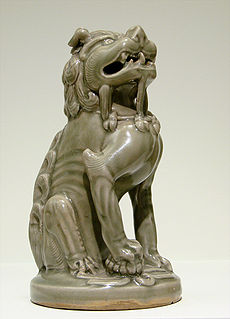
- 1041: Samuel Aba became King of Hungary.
- 1042: the Normans establish MelfiMelfiMelfi is a town and comune in the Vulture area of the province of Potenza, in the Southern Italian region of Basilicata.-Geography:On a hill at the foot of Mount Vulture, Melfi is the most important town in Basilicata's Vulture, both as a tourist resort and economic centre.-Early history:Inhabited...
as the capital of southern Italy. - 1042: BhojaBhojaBhoja was a philosopher king and polymath of medieval India, who ruled the kingdom of Malwa in central India from about 1000 to 1050 CE. Also known as Raja Bhoja Of Dhar, he belonged to the Paramara dynasty...
, the Indian ruler, philosopher, and polymath of MalwaMalwa (Madhya Pradesh)Malwa is a region in west-central northern India occupying a plateau of volcanic origin.Geologically, the Malwa Plateau generally refers to the volcanic upland south of the Vindhya Range. Politically and administratively, the historical Malwa region includes districts of western Madhya Pradesh and...
, completes the reconstruction of the temple of SomnathSomnathThe Somnath Temple located in the Prabhas Kshetra near Veraval in Saurashtra, on the western coast of Gujarat, India, is one of the twelve Jyotirlinga shrines of the God Shiva. Somnath means "The Protector of Moon God". The Somnath Temple is known as "the Shrine Eternal", having been destroyed...
after its destruction by Mahmud of GhazniMahmud of GhazniMahmud of Ghazni , actually ', was the most prominent ruler of the Ghaznavid dynasty who ruled from 997 until his death in 1030 in the eastern Iranian lands. Mahmud turned the former provincial city of Ghazni into the wealthy capital of an extensive empire which covered most of today's Iran,...
. - 1041–1048: Chinese artisan Bi ShengBi ShengBì Shēng was the inventor of the first known movable type technology. Bi Sheng's system was made of Chinese porcelain and was invented between 1041 and 1048 in China.-Movable type printing:...
invents ceramic movable typeMovable typeMovable type is the system of printing and typography that uses movable components to reproduce the elements of a document ....
printing - 1043: the Byzantine EmpireByzantine EmpireThe Byzantine Empire was the Eastern Roman Empire during the periods of Late Antiquity and the Middle Ages, centred on the capital of Constantinople. Known simply as the Roman Empire or Romania to its inhabitants and neighbours, the Empire was the direct continuation of the Ancient Roman State...
and Kievan Rus engage in a naval confrontationRus'-Byzantine War (1043)The final Rus'–Byzantine War was, in essence, an ,unsuccessful naval raid against Constantinople instigated by Yaroslav I of Kiev and led by his eldest son, Vladimir of Novgorod, in 1043.The reasons for the war are disputed, as is its course...
, although a later treaty is signed between two parties that included the marriage alliance of Vsevolod I of KievVsevolod I of KievVsevolod I Yaroslavich , ruled as Grand Prince of Kiev from 1078 until his death.-Early life:...
to a princess daughter of Constantine IX MonomachosConstantine IX MonomachosConstantine IX Monomachos, Latinized as Constantine IX Monomachus , c. 1000 – January 11, 1055, reigned as Byzantine emperor from June 11, 1042 to January 11, 1055. He had been chosen by the Empress Zoe as a husband and co-emperor in 1042, although he had been exiled for conspiring...
. - 1043: the Byzantine General George ManiacesGeorge ManiacesGeorge Maniakes was a prominent Byzantine Greek general during the 11th century, he was the catepan of Italy in 1042. He is known as Gyrgir in Scandinavian sagas....
, who had served in SicilySicilySicily is a region of Italy, and is the largest island in the Mediterranean Sea. Along with the surrounding minor islands, it constitutes an autonomous region of Italy, the Regione Autonoma Siciliana Sicily has a rich and unique culture, especially with regard to the arts, music, literature,...
back in 1038, was proclaimed emperor by his troops while he was catepan of Italy; he led an unsuccessful rebellion against Constantine IX MonomachosConstantine IX MonomachosConstantine IX Monomachos, Latinized as Constantine IX Monomachus , c. 1000 – January 11, 1055, reigned as Byzantine emperor from June 11, 1042 to January 11, 1055. He had been chosen by the Empress Zoe as a husband and co-emperor in 1042, although he had been exiled for conspiring...
and was killed in battle in Macedonia during his march towards ConstantinopleConstantinopleConstantinople was the capital of the Roman, Eastern Roman, Byzantine, Latin, and Ottoman Empires. Throughout most of the Middle Ages, Constantinople was Europe's largest and wealthiest city.-Names:...
. - 1043: the Song Dynasty Chancellor of ChinaChancellor of ChinaThe Chancellor , variously translated as Prime Minister, Chancellor of State, Premier or Chief Councillor, was a generic name given to the highest-ranking official in the imperial government in ancient China...
, Fan ZhongyanFan ZhongyanFan Zhongyan , born in Wuxian , Suzhou , was a prominent politician and literary figure in Song dynasty China. He was also a strategist and educator...
, and prominent official and historian Ouyang XiuOuyang XiuOuyang Xiu was a Chinese statesman, historian, essayist and poet of the Song Dynasty. He is also known by his courtesy name of Yongshu, and was also self nicknamed The Old Drunkard 醉翁, or Householder of the One of Six 六一居士 in his old age...
introduce the Qingli ReformsQingli ReformsThe Qingli Reforms also called Minor Reforms, took place in China’s Song Dynasty under the leadership of Fan Zhongyan and Ouyang Xiu. Taking place from 1043 to 1045, it was a short-lived attempt to introduce reforms into the traditional way of conducting governmental affairs in China...
, which would be rescinded by the court in 1045 due to partisan resistance to reforms. - 1043: the Kingdom of NriKingdom of NriThe Kingdom of Nri was the West African medieval state of the Nri-Igbo, a subgroup of the Igbo people, and is the oldest kingdom in Nigeria. The Kingdom of Nri was unusual in the history of world government in that its leader exercised no military power over his subjects...
of West AfricaWest AfricaWest Africa or Western Africa is the westernmost region of the African continent. Geopolitically, the UN definition of Western Africa includes the following 16 countries and an area of approximately 5 million square km:-Flags of West Africa:...
is said to have started in this year with Eze Nri ÌfikuánimEze Nri ÌfikuánimEze Nri Ìfikuánim, was the first king of the Nri Kingdom. According to Igbo oral tradition, his reign started in 1043, although at least one historian puts Ìfikuánim's reign much later, around 1225 AD.-References:... - 1044: the Chinese Wujing ZongyaoWujing ZongyaoThe Wujing Zongyao was a Chinese military compendium written in 1044 AD, during the Northern Song Dynasty. Its authors were the prominent scholars Zeng Gongliang , Ding Du , and Yang Weide , whose writing influenced many later Chinese military writers. The book covered a wide range of subjects,...
, written by Zeng Gongliang and Yang Weide, is the first book to describe gunpowderGunpowderGunpowder, also known since in the late 19th century as black powder, was the first chemical explosive and the only one known until the mid 1800s. It is a mixture of sulfur, charcoal, and potassium nitrate - with the sulfur and charcoal acting as fuels, while the saltpeter works as an oxidizer...
formulas; it also described their use in warfare, such as blackpowderHistory of gunpowderGunpowder was the first chemical explosive and the only one known until the invention of nitrocellulose, nitroglycerin, smokeless powder and TNT in the second half of the 19th century...
-impregnated fusesFuse (explosives)In an explosive, pyrotechnic device or military munition, a fuse is the part of the device that initiates function. In common usage, the word fuse is used indiscriminately...
for flamethrowerFlamethrowerA flamethrower is a mechanical device designed to project a long controllable stream of fire.Some flamethrowers project a stream of ignited flammable liquid; some project a long gas flame. Most military flamethrowers use liquids, but commercial flamethrowers tend to use high-pressure propane and...
s. It also described an early form of the compassCompassA compass is a navigational instrument that shows directions in a frame of reference that is stationary relative to the surface of the earth. The frame of reference defines the four cardinal directions – north, south, east, and west. Intermediate directions are also defined...
, a thermoremanence compass. - 1044: Henry IIIHenry III, Holy Roman EmperorHenry III , called the Black or the Pious, was a member of the Salian Dynasty of Holy Roman Emperors...
of the Holy Roman EmpireHoly Roman EmpireThe Holy Roman Empire was a realm that existed from 962 to 1806 in Central Europe.It was ruled by the Holy Roman Emperor. Its character changed during the Middle Ages and the Early Modern period, when the power of the emperor gradually weakened in favour of the princes...
defeats the Kingdom of HungaryKingdom of HungaryThe Kingdom of Hungary comprised present-day Hungary, Slovakia and Croatia , Transylvania , Carpatho Ruthenia , Vojvodina , Burgenland , and other smaller territories surrounding present-day Hungary's borders...
in the Battle of MénfőBattle of MénfoThe Battle of Ménfő was an important battle in the early history of the Kingdom of Hungary. Fought in 1044 at Ménfő, near Győr, between an army of mostly Germans and Hungarians , it was a victory for the Germans and thus for Westernising influences in Hungary.The Emperor Henry III invaded Hungary...
; Peter Urseolo captured Samuel AbaSamuel Aba of HungarySamuel Aba , King of Hungary , Palatine of Hungary .-King of Hungary:Samuel was from Northern Hungary, Castle Gonce / Castle Abaújvár, County of Aba...
after the battle, executing him, and restoring his claim to the throne; the Kingdom of Hungary then briefly becomes a vassal to the Holy Roman Empire. - 1045: The ZiridZiridThe Zirid dynasty were a Sanhadja Berber dynasty, originating in modern Algeria, initially on behalf of the Fatimids, for about two centuries, until weakened by the Banu Hilal and finally destroyed by the Almohads. Their capital was Kairouan...
s, a BerberBerber peopleBerbers are the indigenous peoples of North Africa west of the Nile Valley. They are continuously distributed from the Atlantic to the Siwa oasis, in Egypt, and from the Mediterranean to the Niger River. Historically they spoke the Berber language or varieties of it, which together form a branch...
dynasty of North AfricaNorth AfricaNorth Africa or Northern Africa is the northernmost region of the African continent, linked by the Sahara to Sub-Saharan Africa. Geopolitically, the United Nations definition of Northern Africa includes eight countries or territories; Algeria, Egypt, Libya, Morocco, South Sudan, Sudan, Tunisia, and...
, break their allegiance with the FatimidFatimidThe Fatimid Islamic Caliphate or al-Fāṭimiyyūn was a Berber Shia Muslim caliphate first centered in Tunisia and later in Egypt that ruled over varying areas of the Maghreb, Sudan, Sicily, the Levant, and Hijaz from 5 January 909 to 1171.The caliphate was ruled by the Fatimids, who established the...
court of EgyptEgyptEgypt , officially the Arab Republic of Egypt, Arabic: , is a country mainly in North Africa, with the Sinai Peninsula forming a land bridge in Southwest Asia. Egypt is thus a transcontinental country, and a major power in Africa, the Mediterranean Basin, the Middle East and the Muslim world...
and recognize the AbbasidAbbasidThe Abbasid Caliphate or, more simply, the Abbasids , was the third of the Islamic caliphates. It was ruled by the Abbasid dynasty of caliphs, who built their capital in Baghdad after overthrowing the Umayyad caliphate from all but the al-Andalus region....
s of BaghdadBaghdadBaghdad is the capital of Iraq, as well as the coterminous Baghdad Governorate. The population of Baghdad in 2011 is approximately 7,216,040...
as the true caliphCaliphThe Caliph is the head of state in a Caliphate, and the title for the ruler of the Islamic Ummah, an Islamic community ruled by the Shari'ah. It is a transcribed version of the Arabic word which means "successor" or "representative"...
s.
1050s
- 1052: Fujiwara no YorimichiFujiwara no Yorimichi' , son of Michinaga, was a Japanese Court noble. He succeeded his father to the position of Sesshō in 1017, and then went on to become Kampaku from 1020 until 1068...
converts the rural villa at Byōdō-inByodo-inis a Buddhist temple in the city of Uji in Kyoto Prefecture, Japan. It is jointly a temple of the Jōdo-shū and Tendai-shū sects.- History :...
into a famous Japanese Buddhist temple. - 1053: the Norman commander Humphrey of HautevilleHumphrey of HautevilleHumphrey of Hauteville , surnamed Abagelard, was the Count of Apulia and Calabria from 1051 to his death.Humphrey was probably the youngest son of Tancred of Hauteville by his first wife Muriel. Some sources make Geoffrey and Serlo his younger brothers...
is victorious in the Battle of CivitateBattle of CivitateThe Battle of Civitate was fought on 18 June 1053 in Southern Italy, between the Normans, led by the Count of Apulia Humphrey of Hauteville, and a Swabian-Italian-Lombard army, organised by Pope Leo IX and led on the battlefield by Gerard, Duke of Lorraine, and Rudolf, Prince of Benevento...
against the LombardsLombardsThe Lombards , also referred to as Longobards, were a Germanic tribe of Scandinavian origin, who from 568 to 774 ruled a Kingdom in Italy...
and the papal coalition led by Rudolf of BeneventoRudolf of BeneventoRudolf was the papal rector of the Duchy of Benevento under Pope Leo IX from 1053 to 1054....
; Pope Leo IXPope Leo IXPope Saint Leo IX , born Bruno of Eguisheim-Dagsburg, was Pope from February 12, 1049 to his death. He was a German aristocrat and as well as being Pope was a powerful secular ruler of central Italy. He is regarded as a saint by the Roman Catholic Church, with the feast day of April 19...
himself is captured by the Normans. - 1054: the Great SchismEast-West SchismThe East–West Schism of 1054, sometimes known as the Great Schism, formally divided the State church of the Roman Empire into Eastern and Western branches, which later became known as the Eastern Orthodox Church and the Roman Catholic Church, respectively...
, in which the Western (Roman Catholic) and Eastern Orthodox churches separated from each other. Similar schisms in the past had been later repaired, but this one continues after nearly 1000 years. - 1054: a large supernovaSupernovaA supernova is a stellar explosion that is more energetic than a nova. It is pronounced with the plural supernovae or supernovas. Supernovae are extremely luminous and cause a burst of radiation that often briefly outshines an entire galaxy, before fading from view over several weeks or months...
is observed by astronomers, the remnants of which would form the Crab NebulaCrab NebulaThe Crab Nebula is a supernova remnant and pulsar wind nebula in the constellation of Taurus...
. - 1054: the Battle of AtapuercaBattle of AtapuercaThe Battle of Atapuerca was fought in 1 September 1054 at the site of Piedrahita in the valley of Atapuerca between brothers King García Sánchez III, El de Nájera, of Navarre and King Ferdinand I, the Great, of Castile and León....
is fought between García V of NavarreGarcía V of NavarreGarcía Sánchez III, sometimes García III, IV, V, or VI , was king of Navarre from 1035 to 1054...
and Ferdinand I of LeónFerdinand I of LeónFerdinand I , called the Great , was the Count of Castile from his uncle's death in 1029 and the King of León after defeating his brother-in-law in 1037. According to tradition, he was the first to have himself crowned Emperor of Spain , and his heirs carried on the tradition... - 1055: the Seljuk Turks capture BaghdadBaghdadBaghdad is the capital of Iraq, as well as the coterminous Baghdad Governorate. The population of Baghdad in 2011 is approximately 7,216,040...
, taking the Buyid EmirEmirEmir , meaning "commander", "general", or "prince"; also transliterated as Amir, Aamir or Ameer) is a title of high office, used throughout the Muslim world...
Al-Malik al-RahimAl-Malik al-RahimAbu Nasr Khusrau Firuz was the Buyid amir of Iraq . He was the son of Abu Kalijar.Upon his father's death, he took the throne in Baghdad with the title "al-Malik al-Rahim". His succession to the entire Buyid Empire was prevented by his brother Abu Mansur Fulad Sutun, who took control of Fars. The...
prisoner. - 1056: Ferdinand I of LeónFerdinand I of LeónFerdinand I , called the Great , was the Count of Castile from his uncle's death in 1029 and the King of León after defeating his brother-in-law in 1037. According to tradition, he was the first to have himself crowned Emperor of Spain , and his heirs carried on the tradition...
, King of Castile and King of LeónKingdom of LeónThe Kingdom of León was an independent kingdom situated in the northwest region of the Iberian Peninsula. It was founded in AD 910 when the Christian princes of Asturias along the northern coast of the peninsula shifted their capital from Oviedo to the city of León...
, is crowned Imperator totius HispaniaeImperator totius HispaniaeImperator totius Hispaniae is a Latin title meaning "Emperor of all Spain". In Spain in the Middle Ages, the title "emperor" was used under a variety of circumstances from the ninth century onwards, but its usage peaked, as a formal and practical title, between 1086 and 1157...
(Emperor of All HispaniaHispaniaAnother theory holds that the name derives from Ezpanna, the Basque word for "border" or "edge", thus meaning the farthest area or place. Isidore of Sevilla considered Hispania derived from Hispalis....
). - 1057: AnawrahtaAnawrahtaAnawrahta Minsaw was the founder of the Pagan Empire. Considered the father of the Burmese nation, Anawrahta turned a small principality in the dry zone of Upper Burma into the first Burmese Empire that formed the basis of modern-day Burma...
, ruler of the Pagan KingdomPagan KingdomThe Pagan Kingdom or Pagan Dynasty was the first kingdom to unify the regions that would later constitute the modern-day Burma...
, defeated the Mon city of ThatonThatonThaton is a town in Mon State, in southern Myanmar on the Tenasserim plains. Thaton lies along the National Highway 8 and is also connected by the National Road 85.-Etymology:...
, thus unifying all of MyanmarMyanmarBurma , officially the Republic of the Union of Myanmar , is a country in Southeast Asia. Burma is bordered by China on the northeast, Laos on the east, Thailand on the southeast, Bangladesh on the west, India on the northwest, the Bay of Bengal to the southwest, and the Andaman Sea on the south....
.
1060s1060s-Significant people:* William the Conqueror* Harold Godwinson* Harald Hardrada* Edward the Confessor* Edgar the Atheling* Tostig Godwinson...
- 1061–1091: Norman conquestNorman conquest of southern ItalyThe Norman conquest of southern Italy spanned the late eleventh and much of the twelfth centuries, involving many battles and many independent players conquering territories of their own...
of SicilySicilySicily is a region of Italy, and is the largest island in the Mediterranean Sea. Along with the surrounding minor islands, it constitutes an autonomous region of Italy, the Regione Autonoma Siciliana Sicily has a rich and unique culture, especially with regard to the arts, music, literature,...
in the Mediterranean SeaMediterranean SeaThe Mediterranean Sea is a sea connected to the Atlantic Ocean surrounded by the Mediterranean region and almost completely enclosed by land: on the north by Anatolia and Europe, on the south by North Africa, and on the east by the Levant... - 1065: SeljuksGreat Seljuq EmpireThe Great Seljuq Empire was a medieval Persianate, Turko-Persian Sunni Muslim empire, originating from the Qynyq branch of Oghuz Turks. The Seljuq Empire controlled a vast area stretching from the Hindu Kush to eastern Anatolia and from Central Asia to the Persian Gulf...
first invasion to GeorgiaGeorgia (country)Georgia is a sovereign state in the Caucasus region of Eurasia. Located at the crossroads of Western Asia and Eastern Europe, it is bounded to the west by the Black Sea, to the north by Russia, to the southwest by Turkey, to the south by Armenia, and to the southeast by Azerbaijan. The capital of...
under leadership of alp ArslanAlp ArslanAlp Arslan was the third sultan of the Seljuq dynasty and great-grandson of Seljuk, the eponymous founder of the dynasty... - 1065: independence of the Kingdom of Galicia and PortugalPortugalPortugal , officially the Portuguese Republic is a country situated in southwestern Europe on the Iberian Peninsula. Portugal is the westernmost country of Europe, and is bordered by the Atlantic Ocean to the West and South and by Spain to the North and East. The Atlantic archipelagos of the...
under the rule of Garcia - 1066: Edward the ConfessorEdward the ConfessorEdward the Confessor also known as St. Edward the Confessor , son of Æthelred the Unready and Emma of Normandy, was one of the last Anglo-Saxon kings of England and is usually regarded as the last king of the House of Wessex, ruling from 1042 to 1066....
of England dies leading to the below - 1066: in the Battle of Stamford BridgeBattle of Stamford BridgeThe Battle of Stamford Bridge took place at the village of Stamford Bridge, East Riding of Yorkshire in England on 25 September 1066, between an English army under King Harold Godwinson and an invading Norwegian force led by King Harald Hardrada of Norway and the English king's brother Tostig...
, the last Anglo-Saxon King Harold GodwinsonHarold GodwinsonHarold Godwinson was the last Anglo-Saxon King of England.It could be argued that Edgar the Atheling, who was proclaimed as king by the witan but never crowned, was really the last Anglo-Saxon king...
defeated his brother Tostig GodwinsonTostig GodwinsonTostig Godwinson was an Anglo-Saxon Earl of Northumbria and brother of King Harold Godwinson, the last crowned english King of England.-Early life:...
and Harold III of Norway. - 1066: Edward the ConfessorEdward the ConfessorEdward the Confessor also known as St. Edward the Confessor , son of Æthelred the Unready and Emma of Normandy, was one of the last Anglo-Saxon kings of England and is usually regarded as the last king of the House of Wessex, ruling from 1042 to 1066....
dies; Harold GodwinsonHarold GodwinsonHarold Godwinson was the last Anglo-Saxon King of England.It could be argued that Edgar the Atheling, who was proclaimed as king by the witan but never crowned, was really the last Anglo-Saxon king...
is killed in the Battle of HastingsBattle of HastingsThe Battle of Hastings occurred on 14 October 1066 during the Norman conquest of England, between the Norman-French army of Duke William II of Normandy and the English army under King Harold II...
, while the Norman conqueror is crowned William I of EnglandWilliam I of EnglandWilliam I , also known as William the Conqueror , was the first Norman King of England from Christmas 1066 until his death. He was also Duke of Normandy from 3 July 1035 until his death, under the name William II...
. - 1066: the Jewish vizierVizierA vizier or in Arabic script ; ; sometimes spelled vazir, vizir, vasir, wazir, vesir, or vezir) is a high-ranking political advisor or minister in a Muslim government....
Joseph ibn Naghrela and many others are killed in the 1066 Granada massacre1066 Granada massacreThe 1066 Granada massacre took place on 30 December 1066 when a Muslim mob stormed the royal palace in Granada, which was at that time in Muslim-ruled al-Andalus, assassinated the Jewish vizier Joseph ibn Naghrela and massacred many of the Jewish population of the city.-Joseph ibn Naghrela:Joseph...
. - 1068–1073: the reign of Japanese Emperor Go-SanjōEmperor Go-Sanjowas the 71st emperor of Japan, according to the traditional order of succession.Go-Sanjō's reign spanned the years from 1068 through 1073.This 11th century sovereign was named after Emperor Sanjō and go- , translates literally as "later;" and thus, he is sometimes called the "Later Emperor Sanjō"...
brings about a brief period where central power is taken out of the hands of the Fujiwara clan. - 1068: beginning in this year, Virarajendra CholaVirarajendra CholaVirarajendra Chola was one of the most under-rated Chola kings, mainly because a major part of his life was spent in the apprenticeship of his two elder brothers Rajadhirajan Chola I and Rajendra Chola-II, who along with Virarajendra Chola himself were the illustrious sons of their Chakravarti...
sends military raids into Malaysia and Indonesia. - 1068: Seljuks destroyed GeorgiaGeorgia (country)Georgia is a sovereign state in the Caucasus region of Eurasia. Located at the crossroads of Western Asia and Eastern Europe, it is bounded to the west by the Black Sea, to the north by Russia, to the southwest by Turkey, to the south by Armenia, and to the southeast by Azerbaijan. The capital of...
for the second time - 1069–1076: with the support of Emperor Shenzong of SongEmperor Shenzong of SongEmperor Shenzong of Song was the sixth emperor of the Chinese Song Dynasty. His personal name was Zhao Xu...
, Chancellor Wang AnshiWang AnshiWang Anshi was a Chinese economist, statesman, chancellor and poet of the Song Dynasty who attempted controversial, major socioeconomic reforms...
of the Chinese Song DynastySong DynastyThe Song Dynasty was a ruling dynasty in China between 960 and 1279; it succeeded the Five Dynasties and Ten Kingdoms Period, and was followed by the Yuan Dynasty. It was the first government in world history to issue banknotes or paper money, and the first Chinese government to establish a...
introduces the 'New Policies', including the Baojia systemBaojia systemThe baojia system was an invention of Wang Anshi of the Song Dynasty, who created this community-based system of law enforcement and civil control that was included in his large reform of Chinese government from 1069-1076.-Imperial China:...
of societal organization and militias, low-cost loans for farmers, taxes instead of corvéeCorvéeCorvée is unfree labour, often unpaid, that is required of people of lower social standing and imposed on them by the state or a superior . The corvée was the earliest and most widespread form of taxation, which can be traced back to the beginning of civilization...
labor, government monopolies on teaTeaTea is an aromatic beverage prepared by adding cured leaves of the Camellia sinensis plant to hot water. The term also refers to the plant itself. After water, tea is the most widely consumed beverage in the world...
, saltSaltIn chemistry, salts are ionic compounds that result from the neutralization reaction of an acid and a base. They are composed of cations and anions so that the product is electrically neutral...
, and wineWineWine is an alcoholic beverage, made of fermented fruit juice, usually from grapes. The natural chemical balance of grapes lets them ferment without the addition of sugars, acids, enzymes, or other nutrients. Grape wine is produced by fermenting crushed grapes using various types of yeast. Yeast...
, reforming the land surveyCadastreA cadastre , using a cadastral survey or cadastral map, is a comprehensive register of the metes-and-bounds real property of a country...
system, and eliminating the poetry requirement in the imperial examinationImperial examinationThe Imperial examination was an examination system in Imperial China designed to select the best administrative officials for the state's bureaucracy. This system had a huge influence on both society and culture in Imperial China and was directly responsible for the creation of a class of...
system to gain bureaucrats of a more practical bent.
1070s
- 1070: the death of Athirajendra CholaAthirajendra CholaAthirajendra Chola reigned for a very short period of few months as the Chola king succeeding his father Virarajendra Chola. His reign was marked by civil unrest, possibly religious in nature, in which he was killed...
and the ascension of Kulothunga Chola IKulothunga Chola IKō Rājakēsarivarman Abaya Kulōthunga Chōla was one of the greatest kings of the Chola Empire. He was one of the sovereigns who bore the title Kulottunga, literally meaning the exalter of his race.-Early life:...
marks the transition between the Medieval CholasMedieval CholasMedieval Cholas rose to prominence during the middle of the 9th century C.E. and established the greatest empire South India had seen. They successfully united the South India under their rule and through their naval strength extended their influence in the Southeast Asian countries such as Srivijaya...
and the Chalukya CholasChalukya CholasThe Later Chola dynasty ruled the Chola Empire from 1070 C.E. until the demise of the empire in the second half of the 13th century. This dynasty was the product of decades of alliances based on marriages between the Cholas and the Eastern Chalukyas based in Vengi and produced some of the greatest...
. - 1071: Defeat of the Byzantine EmpireByzantine EmpireThe Byzantine Empire was the Eastern Roman Empire during the periods of Late Antiquity and the Middle Ages, centred on the capital of Constantinople. Known simply as the Roman Empire or Romania to its inhabitants and neighbours, the Empire was the direct continuation of the Ancient Roman State...
at the Battle of ManzikertBattle of ManzikertThe Battle of Manzikert , was fought between the Byzantine Empire and Seljuq Turks led by Alp Arslan on August 26, 1071 near Manzikert...
by the Seljuk army of Alp ArslanAlp ArslanAlp Arslan was the third sultan of the Seljuq dynasty and great-grandson of Seljuk, the eponymous founder of the dynasty...
, ending three centuries of a Byzantine military and economic Golden Age. - 1072: the Battle of GolpejeraBattle of GolpejeraThe Battle of Golpejera also known as Golpejar, was an internecine battle among Christian kingdoms fought in early January, 1072. King Sancho II of Castile defeated the forces of his brother Alfonso VI of León near Carrión...
is fought between Sancho II of CastileSancho II of CastileSancho II , called the Strong, or in Spanish, el Fuerte, was King of Castile and León .He was the eldest son of Ferdinand I of Castile and Sancha of León, the eventual heiress to the Leonese crown...
and Alfonso VI of CastileAlfonso VI of CastileAlfonso VI , nicknamed the Brave or the Valiant, was King of León from 1065, King of Castile and de facto King of Galicia from 1072, and self-proclaimed "Emperor of all Spain". After the conquest of Toledo he was also self-proclaimed victoriosissimo rege in Toleto, et in Hispania et Gallecia... - 1073: the Seljuk Turks capture AnkaraAnkaraAnkara is the capital of Turkey and the country's second largest city after Istanbul. The city has a mean elevation of , and as of 2010 the metropolitan area in the entire Ankara Province had a population of 4.4 million....
from the Byzantines. - 1074: the Seljuk Turks capture Jerusalem from the Byzantines, and cut pilgrim transit.
- 1075: Henry IVHenry IV, Holy Roman EmperorHenry IV was King of the Romans from 1056 and Holy Roman Emperor from 1084 until his forced abdication in 1105. He was the third emperor of the Salian dynasty and one of the most powerful and important figures of the 11th century...
suppresses the rebellion of SaxonySaxonyThe Free State of Saxony is a landlocked state of Germany, contingent with Brandenburg, Saxony Anhalt, Thuringia, Bavaria, the Czech Republic and Poland. It is the tenth-largest German state in area, with of Germany's sixteen states....
in the First Battle of LangensalzaFirst Battle of LangensalzaThe First Battle of Langensalza was fought on 9 June 1075 between forces of German King Henry IV and several rebellious Saxon noblemen on the River Unstrut near Langensalza. The battle was a complete success for Henry, resulting in the subjugation of Saxony shortly before the Investiture...
. - 1075: the Investiture ControversyInvestiture ControversyThe Investiture Controversy or Investiture Contest was the most significant conflict between Church and state in medieval Europe. In the 11th and 12th centuries, a series of Popes challenged the authority of European monarchies over control of appointments, or investitures, of church officials such...
is sparked when Pope Gregory VIIPope Gregory VIIPope St. Gregory VII , born Hildebrand of Sovana , was Pope from April 22, 1073, until his death. One of the great reforming popes, he is perhaps best known for the part he played in the Investiture Controversy, his dispute with Henry IV, Holy Roman Emperor affirming the primacy of the papal...
asserted in the Dictatus papaeDictatus papaeDictatus papae is a compilation of 27 axiomatic statements of powers arrogated to the Pope that was included in Pope Gregory VII's register under the year 1075. Some historians argue that it was written by Gregory VII himself; others argue that it has been inserted in the register at a later...
extended rights granted to the pope (disturbing the balance of power) and new interpretation of God's role in founding the Church itself. - 1075: Chinese official and diplomat Shen KuoShen KuoShen Kuo or Shen Gua , style name Cunzhong and pseudonym Mengqi Weng , was a polymathic Chinese scientist and statesman of the Song Dynasty...
asserts the Song Dynasty's rightful border lines by using court archives against the bold bluff of Emperor Daozong of LiaoEmperor Daozong of LiaoEmperor Daozong of Liao , born Yelü Hongji or Yehlu Hongji , was an emperor of the Liao dynasty, a kingdom of the Khitan people in what is now northeastern China. Succeeding his father, Xingzong, in 1055, Daozong ruled until he was murdered in 1101. He was succeeded by his grandson, Tianzuodi...
, who had asserted that Liao DynastyLiao DynastyThe Liao Dynasty , also known as the Khitan Empire was an empire in East Asia that ruled over the regions of Manchuria, Mongolia, and parts of northern China proper between 9071125...
territory exceeded its earlier-accepted bounds. - 1075–1076: a civil war in the Western Chalukya Empire of India; the Western Chalukya monarch Somesvara IISomesvara IISomesvara II who was administering the area around Gadag succeeded his father Somesvara I as the Western Chalukya king. He was the eldest son of Somesvara I. During his reign Somesvara II was constantly under threat from his more ambitious younger brother Vikramaditya VI...
plans to defeat his own ambitious brother Vikramaditya VIVikramaditya VIVikramaditya VI became the Western Chalukya King after deposing his elder brother Somesvara II. Vikramaditya's reign is marked by the start of the Chalukya-Vikrama era. Vikramaditya VI was the greatest of the Western Chalukya kings and had the longest reign in the dynasty. He earned the title...
by allying with a traditional enemy, Kulothunga Chola IKulothunga Chola IKō Rājakēsarivarman Abaya Kulōthunga Chōla was one of the greatest kings of the Chola Empire. He was one of the sovereigns who bore the title Kulottunga, literally meaning the exalter of his race.-Early life:...
of the Chola Empire; Somesvara's forces suffered heavy defeat, and was eventually captured and imprisoned by Vikramaditya, who proclaimed himself king.
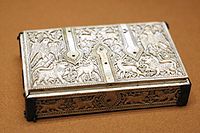
- 1075–1077: the Song DynastySong DynastyThe Song Dynasty was a ruling dynasty in China between 960 and 1279; it succeeded the Five Dynasties and Ten Kingdoms Period, and was followed by the Yuan Dynasty. It was the first government in world history to issue banknotes or paper money, and the first Chinese government to establish a...
of ChinaChinaChinese civilization may refer to:* China for more general discussion of the country.* Chinese culture* Greater China, the transnational community of ethnic Chinese.* History of China* Sinosphere, the area historically affected by Chinese culture...
and the Lý DynastyLý DynastyThe Lý Dynasty , sometimes known as the Later Lý Dynasty , was a Vietnamese dynasty that began in 1009 when Lý Thái Tổ overthrew the Prior Lê Dynasty and ended in 1225 when the queen Lý Chiêu Hoàng was forced to abdicate the throne in favor of her husband, Trần Cảnh. They ruled Vietnam for a...
of VietnamVietnamVietnam – sometimes spelled Viet Nam , officially the Socialist Republic of Vietnam – is the easternmost country on the Indochina Peninsula in Southeast Asia. It is bordered by China to the north, Laos to the northwest, Cambodia to the southwest, and the South China Sea –...
fight a border war, with Vietnamese forces striking first on land and with their navy, and afterwards Song armies advancing as far as modern-day HanoiHanoiHanoi , is the capital of Vietnam and the country's second largest city. Its population in 2009 was estimated at 2.6 million for urban districts, 6.5 million for the metropolitan jurisdiction. From 1010 until 1802, it was the most important political centre of Vietnam...
, the capital, but withdraw after Lý makes peace overtures; in 1082, both sides exchange the territories that they had captured during the war, and later a border agreement is reached. - 1076: the GhanaGhanaGhana , officially the Republic of Ghana, is a country located in West Africa. It is bordered by Côte d'Ivoire to the west, Burkina Faso to the north, Togo to the east, and the Gulf of Guinea to the south...
Empire is attacked by the Almoravids, who sack the capital of Koumbi SalehKoumbi SalehKoumbi Saleh, sometimes Kumbi Saleh is the site of a ruined mediaeval town in south east Mauritania that may have been the capital of the Ghana Empire....
, ending the rule of king Tunka ManinTunka ManinGhana Tunka Manin was a ruler of the Ghana Empire who reigned from 1062 to 1076 C.E. Preceded by Ghana Bassi, Manin was the last ruler of the Ghana Empire.... - 1076: the Chinese Song DynastySong DynastyThe Song Dynasty was a ruling dynasty in China between 960 and 1279; it succeeded the Five Dynasties and Ten Kingdoms Period, and was followed by the Yuan Dynasty. It was the first government in world history to issue banknotes or paper money, and the first Chinese government to establish a...
places strict government monopolies over the production and distribution of sulfurSulfurSulfur or sulphur is the chemical element with atomic number 16. In the periodic table it is represented by the symbol S. It is an abundant, multivalent non-metal. Under normal conditions, sulfur atoms form cyclic octatomic molecules with chemical formula S8. Elemental sulfur is a bright yellow...
and saltpetrePotassium nitratePotassium nitrate is a chemical compound with the formula KNO3. It is an ionic salt of potassium ions K+ and nitrate ions NO3−.It occurs as a mineral niter and is a natural solid source of nitrogen. Its common names include saltpetre , from medieval Latin sal petræ: "stone salt" or possibly "Salt...
, in order to curb the possibility of merchants selling gunpowderGunpowderGunpowder, also known since in the late 19th century as black powder, was the first chemical explosive and the only one known until the mid 1800s. It is a mixture of sulfur, charcoal, and potassium nitrate - with the sulfur and charcoal acting as fuels, while the saltpeter works as an oxidizer...
formula components to enemies such as the Tanguts and Khitans. - 1076: the Song Chinese allied with southern Vietnamese ChampaChampaThe kingdom of Champa was an Indianized kingdom that controlled what is now southern and central Vietnam from approximately the 7th century through to 1832.The Cham people are remnants...
and Cambodian ChenlaChenlaChenla is the Chinese designation for Cambodia after the fall of Funan. That name was still used in the 13th century by the Chinese envoy Zhou Daguan, author of the Manners and Customs of Cambodia...
to conquer the Lý DynastyLý DynastyThe Lý Dynasty , sometimes known as the Later Lý Dynasty , was a Vietnamese dynasty that began in 1009 when Lý Thái Tổ overthrew the Prior Lê Dynasty and ended in 1225 when the queen Lý Chiêu Hoàng was forced to abdicate the throne in favor of her husband, Trần Cảnh. They ruled Vietnam for a...
, which was an unsuccessful campaign. - 1077: the Walk to CanossaWalk to CanossaThe Walk to Canossa refers to both the trek itself of Henry IV of the Holy Roman Empire from Speyer to the fortress at Canossa in Emilia Romagna and to the events surrounding his journey, which took place in and around January 1077.-Historical background:When, in his early...
by Henry IVHenry IV, Holy Roman EmperorHenry IV was King of the Romans from 1056 and Holy Roman Emperor from 1084 until his forced abdication in 1105. He was the third emperor of the Salian dynasty and one of the most powerful and important figures of the 11th century...
of the Holy Roman EmpireHoly Roman EmpireThe Holy Roman Empire was a realm that existed from 962 to 1806 in Central Europe.It was ruled by the Holy Roman Emperor. Its character changed during the Middle Ages and the Early Modern period, when the power of the emperor gradually weakened in favour of the princes...
. - 1077: Chinese official Su SongSu SongSu Song was a renowned Chinese polymath who specialized himself as a statesman, astronomer, cartographer, horologist, pharmacologist, mineralogist, zoologist, botanist, mechanical and architectural engineer, poet, antiquarian, and ambassador of the Song Dynasty .Su Song was the engineer of a...
is sent on a diplomatic mission to the Liao DynastyLiao DynastyThe Liao Dynasty , also known as the Khitan Empire was an empire in East Asia that ruled over the regions of Manchuria, Mongolia, and parts of northern China proper between 9071125...
and discovers that the KhitanKhitan peoplethumb|250px|Khitans [[Eagle hunting|using eagles to hunt]], painted during the Chinese [[Song Dynasty]].The Khitan people , or Khitai, Kitan, or Kidan, were a nomadic Mongolic people, originally located at Mongolia and Manchuria from the 4th century...
calendar is more mathematically accurate than the Song calendarChinese calendarThe Chinese calendar is a lunisolar calendar, incorporating elements of a lunar calendar with those of a solar calendar. It is not exclusive to China, but followed by many other Asian cultures as well...
; Emperor ZhezongEmperor Zhezong of SongEmperor Zhezong was the seventh emperor of the Song Dynasty of China. His personal name was Zhao4 Xu1. He reigned from 1085 to 1100....
later sponsors Su Song's astronomical clock towerClock towerA clock tower is a tower specifically built with one or more clock faces. Clock towers can be either freestanding or part of a church or municipal building such as a town hall. Some clock towers are not true clock towers having had their clock faces added to an already existing building...
in order to compete with Liao astronomers. - 1078: Oleg I of ChernigovOleg I of ChernigovOleg Svyatoslavich of Chernigiv , sometimes also styled as of Tmutarakan, was a Rurikid prince whose equivocal adventures ignited political unrest in Kievan Rus at the turn of the 11th and 12th centuries....
is defeated in battle by his brother Vsevolod I of KievVsevolod I of KievVsevolod I Yaroslavich , ruled as Grand Prince of Kiev from 1078 until his death.-Early life:...
; Oleg escaped to TmutarakanTmutarakanTmutarakan was a Mediaeval Russian principality and trading town that controlled the Cimmerian Bosporus, the passage from the Black Sea to the Sea of Azov. Its site was the ancient Greek colony of Hermonassa . It was situated on the Taman peninsula, in the present-day Krasnodar Krai of Russia,...
, but was imprisoned by the Khazars, sent to ConstantinopleConstantinopleConstantinople was the capital of the Roman, Eastern Roman, Byzantine, Latin, and Ottoman Empires. Throughout most of the Middle Ages, Constantinople was Europe's largest and wealthiest city.-Names:...
as a prisoner, and then exiled to RhodesRhodesRhodes is an island in Greece, located in the eastern Aegean Sea. It is the largest of the Dodecanese islands in terms of both land area and population, with a population of 117,007, and also the island group's historical capital. Administratively the island forms a separate municipality within...
. - 1078: the revolt of Nikephoros IIINikephoros IIINikephoros III Botaneiates, Latinized as Nicephorus III Botaniates was Byzantine emperor from 1078 to 1081. He belonged to a family which claimed descent from the Byzantine Phokas family.- Early career :...
against Byzantine ruler Michael VIIMichael VIIMichael VII Doukas or Ducas , nicknamed Parapinakēs , was Byzantine emperor from 1071 to 1078.- Life :... - 1079: Malik Shah IMalik Shah IJalāl al-Dawlah Malik-shāh was born in 1055, succeeded Alp Arslan as the Seljuq Sultan in 1072, and reigned until his death in 1092....
reforms the Iranian CalendarIranian calendarThe Iranian calendars or sometimes called Persian calendars are a succession of calendars invented or used for over two millennia in Greater Iran...
. FranksFranksThe Franks were a confederation of Germanic tribes first attested in the third century AD as living north and east of the Lower Rhine River. From the third to fifth centuries some Franks raided Roman territory while other Franks joined the Roman troops in Gaul. Only the Salian Franks formed a...
start to settle around the Way of Saint James (Today, modern North Spain)
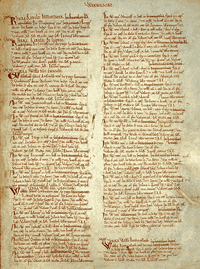
1080s
- 1080–1081: The Chinese statesman and scientist Shen KuoShen KuoShen Kuo or Shen Gua , style name Cunzhong and pseudonym Mengqi Weng , was a polymathic Chinese scientist and statesman of the Song Dynasty...
is put in command of the campaign against the Western XiaWestern XiaThe Western Xia Dynasty or the Tangut Empire, was known to the Tanguts and the Tibetans as Minyak.The state existed from 1038 to 1227 AD in what are now the northwestern Chinese provinces of Ningxia, Gansu, eastern Qinghai, northern Shaanxi, northeastern Xinjiang, southwest Inner Mongolia, and...
, and although he successfully halts their invasion route to Yanzhou (modern Yan'anYan'anYan'an , is a prefecture-level city in the Shanbei region of Shaanxi province in China, administering several counties, including Zhidan County , which served as the Chinese communist capital before the city of Yan'an proper took that role....
), another officer disobeys imperial orders and the campaign is ultimately a failure because of it. - 1084: the enormous Chinese historical work of the Zizhi TongjianZizhi TongjianThe Zizhi Tongjian was a pioneering reference work in Chinese historiography, published in 1084, under the form of a chronicles. In 1065 CE, Emperor Yingzong of Song ordered the great historian Sima Guang to lead with other scholars such as his chief assistants Liu Shu, Liu Ban and Fan Zuyu, the...
is compiled by scholars under Chancellor Sima GuangSima GuangSīmǎ Guāng was a Chinese historian, scholar, and high chancellor of the Song Dynasty, jinshi 1038.-Life, profession, and works:...
, completed in 294 volumes and included 3 million written Chinese characters - 1085: Alfonso VI of CastileAlfonso VI of CastileAlfonso VI , nicknamed the Brave or the Valiant, was King of León from 1065, King of Castile and de facto King of Galicia from 1072, and self-proclaimed "Emperor of all Spain". After the conquest of Toledo he was also self-proclaimed victoriosissimo rege in Toleto, et in Hispania et Gallecia...
captures the MoorishMoorsThe description Moors has referred to several historic and modern populations of the Maghreb region who are predominately of Berber and Arab descent. They came to conquer and rule the Iberian Peninsula for nearly 800 years. At that time they were Muslim, although earlier the people had followed...
Muslim city of ToledoToledo, SpainToledo's Alcázar became renowned in the 19th and 20th centuries as a military academy. At the outbreak of the Spanish Civil War in 1936 its garrison was famously besieged by Republican forces.-Economy:...
, Spain. - 1085: the Katedralskolan, LundKatedralskolan, LundKatedralskolan, Lund is a school in Lund, Sweden. It was founded in 1085 by the Danish king Canute the Saint. It is the oldest school in Scandinavia and one of the oldest schools in Northern Europe.-History:...
school of Sweden is established by Canute IV of DenmarkCanute IV of DenmarkCanute IV, later known as Canute the Holy or Canute the Saint , was King of Denmark from 1080 until 1086. Canute was an ambitious king who sought to strengthen the Danish monarchy, devotedly supported the Roman Catholic Church, and had designs on the English throne. Slain by rebels in 1086, he was... - 1086: compilation of the Domesday BookDomesday BookDomesday Book , now held at The National Archives, Kew, Richmond upon Thames in South West London, is the record of the great survey of much of England and parts of Wales completed in 1086...
by order of William I of EnglandWilliam I of EnglandWilliam I , also known as William the Conqueror , was the first Norman King of England from Christmas 1066 until his death. He was also Duke of Normandy from 3 July 1035 until his death, under the name William II...
; it was similar to a modern day government censusCensusA census is the procedure of systematically acquiring and recording information about the members of a given population. It is a regularly occurring and official count of a particular population. The term is used mostly in connection with national population and housing censuses; other common...
, as it was used by William to thoroughly document all the landholdings within the kingdom that could be properly taxTaxTo tax is to impose a financial charge or other levy upon a taxpayer by a state or the functional equivalent of a state such that failure to pay is punishable by law. Taxes are also imposed by many subnational entities...
ed. - 1086: the Battle of az-Zallaqah between the Almoravids and Castilians
- 1087: a new office at the Chinese international seaport of QuanzhouQuanzhouQuanzhou is a prefecture-level city in Fujian province, People's Republic of China. It borders all other prefecture-level cities in Fujian but two and faces the Taiwan Strait...
is established to handle and regulate taxes and tariffs on all mercantile transactions of foreign goods coming from Africa, Arabia, India, Sri Lanka, Persia, and South East Asia. - 1087: the Italian cities of GenoaGenoaGenoa |Ligurian]] Zena ; Latin and, archaically, English Genua) is a city and an important seaport in northern Italy, the capital of the Province of Genoa and of the region of Liguria....
and PisaPisaPisa is a city in Tuscany, Central Italy, on the right bank of the mouth of the River Arno on the Tyrrhenian Sea. It is the capital city of the Province of Pisa...
engage in the African Mahdia campaignMahdia campaignThe Mahdia campaign of 1087 was an attack on the North African town of Mahdia by armed ships from Genoa and Pisa in northern Italy. It had been prompted by the actions of its ruler Tamim as a pirate in waters off the Italian peninsula, along with his involvement in Sicily fighting the Norman...
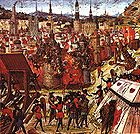
- 1088: the renowned polymathPolymathA polymath is a person whose expertise spans a significant number of different subject areas. In less formal terms, a polymath may simply be someone who is very knowledgeable...
Chinese scientist and official Shen KuoShen KuoShen Kuo or Shen Gua , style name Cunzhong and pseudonym Mengqi Weng , was a polymathic Chinese scientist and statesman of the Song Dynasty...
made the world's first reference to the magnetic compassCompassA compass is a navigational instrument that shows directions in a frame of reference that is stationary relative to the surface of the earth. The frame of reference defines the four cardinal directions – north, south, east, and west. Intermediate directions are also defined...
in his book Dream Pool EssaysDream Pool EssaysThe Dream Pool Essays was an extensive book written by the polymath Chinese scientist and statesman Shen Kuo by 1088 AD, during the Song Dynasty of China...
, along with encyclopedic documentation and inquiry into scientific discoveries. - 1088: The University of BolognaUniversity of BolognaThe Alma Mater Studiorum - University of Bologna is the oldest continually operating university in the world, the word 'universitas' being first used by this institution at its foundation. The true date of its founding is uncertain, but believed by most accounts to have been 1088...
is established. - 1088: Rebellion of 1088Rebellion of 1088The Rebellion of 1088 occurred after the death of William the Conqueror and concerned the division of lands in the Kingdom of England and the Duchy of Normandy between his two sons William Rufus and Robert Curthose...
against William II of EnglandWilliam II of EnglandWilliam II , the third son of William I of England, was King of England from 1087 until 1100, with powers over Normandy, and influence in Scotland. He was less successful in extending control into Wales...
led by Odo of Bayeux.
1090s
- 1091: NormansNormansThe Normans were the people who gave their name to Normandy, a region in northern France. They were descended from Norse Viking conquerors of the territory and the native population of Frankish and Gallo-Roman stock...
from the Duchy of NormandyDuchy of NormandyThe Duchy of Normandy stems from various Danish, Norwegian, Hiberno-Norse, Orkney Viking and Anglo-Danish invasions of France in the 9th century...
take control of MaltaMaltaMalta , officially known as the Republic of Malta , is a Southern European country consisting of an archipelago situated in the centre of the Mediterranean, south of Sicily, east of Tunisia and north of Libya, with Gibraltar to the west and Alexandria to the east.Malta covers just over in...
and surrounding islands. - 1091: the Byzantine EmpireByzantine EmpireThe Byzantine Empire was the Eastern Roman Empire during the periods of Late Antiquity and the Middle Ages, centred on the capital of Constantinople. Known simply as the Roman Empire or Romania to its inhabitants and neighbours, the Empire was the direct continuation of the Ancient Roman State...
under Alexios I KomnenosAlexios I KomnenosAlexios I Komnenos, Latinized as Alexius I Comnenus , was Byzantine emperor from 1081 to 1118, and although he was not the founder of the Komnenian dynasty, it was during his reign that the Komnenos family came to full power. The title 'Nobilissimus' was given to senior army commanders,...
and his Cuman allies defeat Pechenegs at the Battle of LevounionBattle of LevounionThe Battle of Levounion was the first decisive Byzantine victory of the Komnenian restoration. On April 29, 1091, an invading force of Pechenegs was heavily defeated by the combined forces of the Byzantine Empire under Alexios I Komnenos and his Cuman allies.... - 1093: Vikramaditya VIVikramaditya VIVikramaditya VI became the Western Chalukya King after deposing his elder brother Somesvara II. Vikramaditya's reign is marked by the start of the Chalukya-Vikrama era. Vikramaditya VI was the greatest of the Western Chalukya kings and had the longest reign in the dynasty. He earned the title...
, ruler of the Western Chalukya Empire, defeats the army of Kulothunga Chola IKulothunga Chola IKō Rājakēsarivarman Abaya Kulōthunga Chōla was one of the greatest kings of the Chola Empire. He was one of the sovereigns who bore the title Kulottunga, literally meaning the exalter of his race.-Early life:...
in the Battle of Vengi. - 1093: when the Chinese Empress Dowager Gao dies, the conservative faction that had followed Sima GuangSima GuangSīmǎ Guāng was a Chinese historian, scholar, and high chancellor of the Song Dynasty, jinshi 1038.-Life, profession, and works:...
is ousted from court, the liberal reforms of Wang AnshiWang AnshiWang Anshi was a Chinese economist, statesman, chancellor and poet of the Song Dynasty who attempted controversial, major socioeconomic reforms...
reinstated, and Emperor Zhezong of SongEmperor Zhezong of SongEmperor Zhezong was the seventh emperor of the Song Dynasty of China. His personal name was Zhao4 Xu1. He reigned from 1085 to 1100....
halted all negotiations with the Tanguts of the Western XiaWestern XiaThe Western Xia Dynasty or the Tangut Empire, was known to the Tanguts and the Tibetans as Minyak.The state existed from 1038 to 1227 AD in what are now the northwestern Chinese provinces of Ningxia, Gansu, eastern Qinghai, northern Shaanxi, northeastern Xinjiang, southwest Inner Mongolia, and...
, resuming in armed conflict with them. - 1093: the Kypchaks defeat princes of Kievan Rus at the Battle of the Stugna RiverBattle of the Stugna RiverThe Battle of the Stugna River was a battle between the princes of Kievan Rus and the nomadic Cumans tribe . The Kievan forces were defeated....
- 1093: Battle of AlnwickBattle of Alnwick (1093)The Battle of Alnwick is one of two battles fought near the town of Alnwick, in Northumberland, England. In the battle, which occurred on 13 November 1093, Malcolm III of Scotland, also known as Malcolm Canmore, was killed together with his son Edward, by an army of knights led by Robert de...
: Malcolm III of ScotlandMalcolm III of ScotlandMáel Coluim mac Donnchada , was King of Scots...
is killed by the forces of William II of EnglandWilliam II of EnglandWilliam II , the third son of William I of England, was King of England from 1087 until 1100, with powers over Normandy, and influence in Scotland. He was less successful in extending control into Wales...
. - 1094: the astronomicalAstronomical clockAn astronomical clock is a clock with special mechanisms and dials to display astronomical information, such as the relative positions of the sun, moon, zodiacal constellations, and sometimes major planets.-Definition:...
clock towerClock towerA clock tower is a tower specifically built with one or more clock faces. Clock towers can be either freestanding or part of a church or municipal building such as a town hall. Some clock towers are not true clock towers having had their clock faces added to an already existing building...
of KaifengKaifengKaifeng , known previously by several names , is a prefecture-level city in east-central Henan province, Central China. Nearly 5 million people live in the metropolitan area...
, China—engineered by the official Su SongSu SongSu Song was a renowned Chinese polymath who specialized himself as a statesman, astronomer, cartographer, horologist, pharmacologist, mineralogist, zoologist, botanist, mechanical and architectural engineer, poet, antiquarian, and ambassador of the Song Dynasty .Su Song was the engineer of a...
—is completed. - 1094: El CidEl CidRodrigo Díaz de Vivar , known as El Cid Campeador , was a Castilian nobleman, military leader, and diplomat...
, the great Spanish hero, conquers the MuslimMoorsThe description Moors has referred to several historic and modern populations of the Maghreb region who are predominately of Berber and Arab descent. They came to conquer and rule the Iberian Peninsula for nearly 800 years. At that time they were Muslim, although earlier the people had followed...
city of ValenciaValencia (city in Spain)Valencia or València is the capital and most populous city of the autonomous community of Valencia and the third largest city in Spain, with a population of 809,267 in 2010. It is the 15th-most populous municipality in the European Union... - 1094: a succession crisis following the reign of the FatimidFatimidThe Fatimid Islamic Caliphate or al-Fāṭimiyyūn was a Berber Shia Muslim caliphate first centered in Tunisia and later in Egypt that ruled over varying areas of the Maghreb, Sudan, Sicily, the Levant, and Hijaz from 5 January 909 to 1171.The caliphate was ruled by the Fatimids, who established the...
Caliph Ma'ad al-Mustansir Billah sparks a rebellion which leads to the split of IsmailiIsmaili' is a branch of Shia Islam. It is the second largest branch of Shia Islam, after the Twelvers...
Shia into the new NizariNizari'The Shī‘a Imami Ismā‘īlī Tariqah also referred to as the Ismā‘īlī or Nizārī , is a path of Shī‘a Islām, emphasizing social justice, pluralism, and human reason within the framework of the mystical tradition of Islam. The Nizari are the second largest branch of Shia Islam and form the majority...
religious branch.
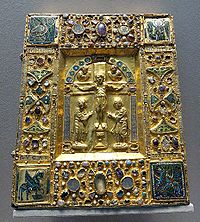
- 1095: Pope Urban II calls upon Western Europeans to take up the cross and reclaim the Holy Lands, officially commencing the First Crusade.
- c. 1095–1099: earliest extant manuscript of the Song of Roland
- 1096, the Knights TemplarKnights TemplarThe Poor Fellow-Soldiers of Christ and of the Temple of Solomon , commonly known as the Knights Templar, the Order of the Temple or simply as Templars, were among the most famous of the Western Christian military orders...
are formed during the early First CrusadeFirst CrusadeThe First Crusade was a military expedition by Western Christianity to regain the Holy Lands taken in the Muslim conquest of the Levant, ultimately resulting in the recapture of Jerusalem...
in order to protect European Christian pilgrimPilgrimA pilgrim is a traveler who is on a journey to a holy place. Typically, this is a physical journeying to some place of special significance to the adherent of a particular religious belief system...
s traveling to Jerusalem. - 1096: University of OxfordUniversity of OxfordThe University of Oxford is a university located in Oxford, United Kingdom. It is the second-oldest surviving university in the world and the oldest in the English-speaking world. Although its exact date of foundation is unclear, there is evidence of teaching as far back as 1096...
in EnglandEnglandEngland is a country that is part of the United Kingdom. It shares land borders with Scotland to the north and Wales to the west; the Irish Sea is to the north west, the Celtic Sea to the south west, with the North Sea to the east and the English Channel to the south separating it from continental...
holds its first lectures - 1097: the Siege of NicaeaSiege of NicaeaThe Siege of Nicaea took place from May 14 to June 19, 1097, during the First Crusade.-Background:Nicaea , located on the eastern shore of Lake İznik, had been captured from the Byzantine Empire by the Seljuk Turks in 1081, and formed the capital of the Sultanate of Rüm...
during the First CrusadeFirst CrusadeThe First Crusade was a military expedition by Western Christianity to regain the Holy Lands taken in the Muslim conquest of the Levant, ultimately resulting in the recapture of Jerusalem... - 1097: Diego Rodriguez, a son of El CidEl CidRodrigo Díaz de Vivar , known as El Cid Campeador , was a Castilian nobleman, military leader, and diplomat...
, dies in the Battle of ConsuegraBattle of ConsuegraThe Battle of Consuegra was fought on August 15, 1097 near the village of Consuegra in the province of Castile-La Mancha between the Castilian and Leonese army of Alfonso VI and the Almoravids under Yusuf ibn Tashfin. The battle soon turned into Almoravid victory and the son of El Cid, Diego...
, an Almoravid victory - 1098: the Siege of AntiochSiege of AntiochThe Siege of Antioch took place during the First Crusade in 1097 and 1098. The first siege, by the crusaders against the Muslim city, lasted from October 21, 1097, to June 2, 1098. The second siege, against the crusaders who had occupied it, lasted from June 7 to June 28, 1098.-Background:Antioch...
during the First CrusadeFirst CrusadeThe First Crusade was a military expedition by Western Christianity to regain the Holy Lands taken in the Muslim conquest of the Levant, ultimately resulting in the recapture of Jerusalem... - 1098: Pope Urban IIPope Urban IIPope Urban II , born Otho de Lagery , was Pope from 12 March 1088 until his death on July 29 1099...
makes an appearance at the Siege of CapuaSiege of CapuaThe Siege of Capua was a military operation involving the states of medieval southern Italy, beginning in May 1098 and lasting forty days. It was an interesting siege historically for the assemblage of great persons it saw and militarily for the cooperation of Norman and Saracen forces which it... - 1098: the Dongpo AcademyDongpo AcademyThe Dongpo Academy or Dongpo Academy of Classical Learning , was an academy located in Hainan, China. It was originally built in 1098 in memory of the Song dynasty literary figure, Su Dongpo, who was exiled here....
of HainanHainanHainan is the smallest province of the People's Republic of China . Although the province comprises some two hundred islands scattered among three archipelagos off the southern coast, of its land mass is Hainan Island , from which the province takes its name...
, China is built in honor of the Song Dynasty Chinese official and poet Su ShiSu ShiSu Shi , was a writer, poet, artist, calligrapher, pharmacologist, gastronome, and statesman of the Song Dynasty, and one of the major poets of the Song era. His courtesy name was Zizhan and his pseudonym was Dongpo Jushi , and he is often referred to as Su Dongpo...
, who was exiled there for criticizing reforms of the New Policies Group. - 1098: the birth of Hildegard of BingenHildegard of BingenBlessed Hildegard of Bingen , also known as Saint Hildegard, and Sibyl of the Rhine, was a German writer, composer, philosopher, Christian mystic, Benedictine abbess, visionary, and polymath. Elected a magistra by her fellow nuns in 1136, she founded the monasteries of Rupertsberg in 1150 and...
, polymathPolymathA polymath is a person whose expertise spans a significant number of different subject areas. In less formal terms, a polymath may simply be someone who is very knowledgeable... - 1099: the Siege of JerusalemSiege of Jerusalem (1099)The Siege of Jerusalem took place from June 7 to July 15, 1099 during the First Crusade. The Crusaders stormed and captured the city from Fatimid Egypt.-Background:...
by European Crusaders. - 1099: after the Kingdom of JerusalemKingdom of JerusalemThe Kingdom of Jerusalem was a Catholic kingdom established in the Levant in 1099 after the First Crusade. The kingdom lasted nearly two hundred years, from 1099 until 1291 when the last remaining possession, Acre, was destroyed by the Mamluks, but its history is divided into two distinct periods....
was established, the Al-Aqsa MosqueAl-Aqsa MosqueAl-Aqsa Mosque also known as al-Aqsa, is the third holiest site in Sunni Islam and is located in the Old City of Jerusalem...
was made into the residential palace for the kings of JerusalemKings of JerusalemThis is a list of kings of Jerusalem, from 1099 to 1291, as well as claimants to the title up to the present day.-Kings of Jerusalem :...
. - 1099: after building considerable strength, David IV of GeorgiaDavid IV of GeorgiaDavid IV "the Builder", also known as David II , of the Bagrationi dynasty, was a king of Georgia from 1089 until his death in 1125....
discontinues tribute payments to the Seljuk Turks. - King AnawrahtaAnawrahtaAnawrahta Minsaw was the founder of the Pagan Empire. Considered the father of the Burmese nation, Anawrahta turned a small principality in the dry zone of Upper Burma into the first Burmese Empire that formed the basis of modern-day Burma...
of MyanmarMyanmarBurma , officially the Republic of the Union of Myanmar , is a country in Southeast Asia. Burma is bordered by China on the northeast, Laos on the east, Thailand on the southeast, Bangladesh on the west, India on the northwest, the Bay of Bengal to the southwest, and the Andaman Sea on the south....
made a pilgrimage to Ceylon, returning to convert his country to TheravadaTheravadaTheravada ; literally, "the Teaching of the Elders" or "the Ancient Teaching", is the oldest surviving Buddhist school. It was founded in India...
Buddhism. - The Tuareg migrate to the Aïr region.
- Kanem-BornuKanem EmpireThe Kanem Empire was located in the present countries of Chad, Nigeria and Libya. At its height it encompassed an area covering not only much of Chad, but also parts of southern Libya , eastern Niger and north-eastern Nigeria...
expands southward into modern NigeriaNigeriaNigeria , officially the Federal Republic of Nigeria, is a federal constitutional republic comprising 36 states and its Federal Capital Territory, Abuja. The country is located in West Africa and shares land borders with the Republic of Benin in the west, Chad and Cameroon in the east, and Niger in...
. - The first of seven HausaHausa peopleThe Hausa are one of the largest ethnic groups in West Africa. They are a Sahelian people chiefly located in northern Nigeria and southeastern Niger, but having significant numbers living in regions of Cameroon, Ghana, Cote d'Ivoire, Chad and Sudan...
city-states are founded in NigeriaNigeriaNigeria , officially the Federal Republic of Nigeria, is a federal constitutional republic comprising 36 states and its Federal Capital Territory, Abuja. The country is located in West Africa and shares land borders with the Republic of Benin in the west, Chad and Cameroon in the east, and Niger in...
. - The Hodh region of MauritaniaMauritaniaMauritania is a country in the Maghreb and West Africa. It is bordered by the Atlantic Ocean in the west, by Western Sahara in the north, by Algeria in the northeast, by Mali in the east and southeast, and by Senegal in the southwest...
becomes desert.
Significant people
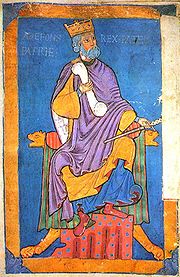


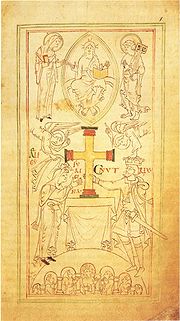

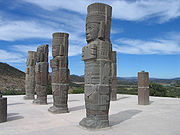
A
- AbhinavaguptaAbhinavaguptaAbhinavagupta was one of India's greatest philosophers, mystics and aestheticians. He was also considered an important musician, poet, dramatist, exegete, theologian, and logician - a polymathic personality who exercised strong influences on Indian culture.He was born in the Valley of Kashmir in...
, Indian philosopherIndian philosophyIndia has a rich and diverse philosophical tradition dating back to ancient times. According to Radhakrishnan, the earlier Upanisads constitute "...the earliest philosophical compositions of the world."...
, logicianIndian logicThe development of Indian logic dates back to the anviksiki of Medhatithi Gautama the Sanskrit grammar rules of Pāṇini ; the Vaisheshika school's analysis of atomism ; the analysis of inference by Gotama , founder of the Nyaya school of Hindu philosophy; and the tetralemma of Nagarjuna...
, musicianMusic of IndiaThe music of India includes multiple varieties of folk, popular, pop, classical music and R&B. India's classical music tradition, including Carnatic and Hindustani music, has a history spanning millennia and developed over several eras. It remains fundamental to the lives of Indians today as...
, poetIndian poetryIndian poetry, and Indian literature in general, has a long history dating back to Vedic times. They were written in various Indian languages such as Vedic Sanskrit, Classical Sanskrit, Oriya, Tamil, Kannada, Bengali and Urdu. Poetry in foreign languages such as Persian and English also have a...
and dramatistTheatre in IndiaThe earliest form of the theatre of India was the Sanskrit theatre. It began after the development of Greek and Roman theatre and before the development of theatre in other parts of Asia...
from the Kashmir region - Abraham bar Hiyya, Jewish philosopher, astronomer, and mathematician from CataloniaCataloniaCatalonia is an autonomous community in northeastern Spain, with the official status of a "nationality" of Spain. Catalonia comprises four provinces: Barcelona, Girona, Lleida, and Tarragona. Its capital and largest city is Barcelona. Catalonia covers an area of 32,114 km² and has an...
- Abu al-Hasan 'Ali abi Sa'id 'Abd al-Rahman ibn Ahmad ibn Yunus al-Sadafi al-MisriIbn YunusIbn Yunus was an important Egyptian Muslim astronomer and mathematician, whose works are noted for being ahead of their time, having been based on meticulous calculations and attention to detail.The crater Ibn Yunus on the Moon is named after...
, Egyptian mathematicianIslamic mathematicsIn the history of mathematics, mathematics in medieval Islam, often termed Islamic mathematics or Arabic mathematics, covers the body of mathematics preserved and developed under the Islamic civilization between circa 622 and 1600...
and astronomerIslamic astronomyIslamic astronomy or Arabic astronomy comprises the astronomical developments made in the Islamic world, particularly during the Islamic Golden Age , and mostly written in the Arabic language. These developments mostly took place in the Middle East, Central Asia, Al-Andalus, and North Africa, and... - Abū 'Alī al-Haṣan ibn al-Haytham (a.k.a. Alhazen or Alhacen), Iraqi polymathPolymathA polymath is a person whose expertise spans a significant number of different subject areas. In less formal terms, a polymath may simply be someone who is very knowledgeable...
: scientistIslamic scienceScience in the medieval Islamic world, also known as Islamic science or Arabic science, is the science developed and practised in the Islamic world during the Islamic Golden Age . During this time, Indian, Iranian and especially Greek knowledge was translated into Arabic...
, physicistIslamic physicsPhysics in medieval Islam is the development of physics in the medieval Islamic world in the history of physics. In the course of the expansion of the Islamic world, Muslim scholars encountered the science, mathematics, and medicine of antiquity through the works of Aristotle, Archimedes, Galen,...
, optical researcher, astronomer, engineer, inventorInventions in the Islamic worldA number of inventions were developed in the medieval Islamic world, a geopolitical region that has at various times extended from Spain and Africa in the west to the Indian subcontinent in the east. The inventions listed here were developed during the medieval Islamic world, which covers the...
, mathematician, physicianIslamic medicineIn the history of medicine, Islamic medicine, Arabic medicine or Arabian medicine refers to medicine developed in the Islamic Golden Age, and written in Arabic, the lingua franca of Islamic civilization....
, ophthalmologistOphthalmology in medieval IslamOphthalmology was one of the foremost branches in medieval Islamic medicine. The oculist or kahhal , a somewhat despised professional in Galen’s time, was an honored member of the medical profession by the Abbasid period, occupying a unique place in royal households...
, Islamic philosopherEarly Islamic philosophyEarly Islamic philosophy or classical Islamic philosophy is a period of intense philosophical development beginning in the 2nd century AH of the Islamic calendar and lasting until the 6th century AH...
, psychologistIslamic psychologyIslamic psychology translates the term ʿIlm al-Nafs the science of the Nafs and refers to the medical and philosophical study of the psyche from an Islamic perspective...
and Islamic theologianKalamʿIlm al-Kalām is the Islamic philosophical discipline of seeking theological principles through dialectic. Kalām in Islamic practice relates to the discipline of seeking theological knowledge through debate and argument. A scholar of kalām is referred to as a mutakallim... - Abū 'Alī al-Husayn ibn SīnāAvicennaAbū ʿAlī al-Ḥusayn ibn ʿAbd Allāh ibn Sīnā , commonly known as Ibn Sīnā or by his Latinized name Avicenna, was a Persian polymath, who wrote almost 450 treatises on a wide range of subjects, of which around 240 have survived...
(a.k.a. Avicenna), Persian polymathPolymathA polymath is a person whose expertise spans a significant number of different subject areas. In less formal terms, a polymath may simply be someone who is very knowledgeable...
: physicianIslamic medicineIn the history of medicine, Islamic medicine, Arabic medicine or Arabian medicine refers to medicine developed in the Islamic Golden Age, and written in Arabic, the lingua franca of Islamic civilization....
, philosopher, scientist, astronomer, chemist, geologistIslamic geographyGeography and cartography in medieval Islam refers to the advancement of geography, cartography and the earth sciences in the medieval Islamic civilization....
, Hafiz, logicianLogic in Islamic philosophyLogic played an important role in Islamic philosophy .Islamic Logic or mantiq is similar science to what is called Traditional Logic in Western Sciences.- External links :*Routledge Encyclopedia of Philosophy: , Routledge, 1998...
, mathematician, physicist, poetIslamic poetryIslamic poetry is poetry written by Muslims on the topic of Islam. Islamic poetry has been written in many languages.-Islamic poetry in different languages:* Arabic poetry* Bengali poetry* Persian poetry* Punjabi poetry* Turkish poetry* Urdu poetry...
, psychologist, SheikhSheikhNot to be confused with sikhSheikh — also spelled Sheik or Shaikh, or transliterated as Shaykh — is an honorific in the Arabic language that literally means "elder" and carries the meaning "leader and/or governor"...
, soldierMuslim conquestsMuslim conquests also referred to as the Islamic conquests or Arab conquests, began with the Islamic prophet Muhammad. He established a new unified polity in the Arabian Peninsula which under the subsequent Rashidun and Umayyad Caliphates saw a century of rapid expansion of Muslim power.They...
, statesmanStatesmanA statesman is usually a politician or other notable public figure who has had a long and respected career in politics or government at the national and international level. As a term of respect, it is usually left to supporters or commentators to use the term...
and Islamic theologian - Abu al-QasimAbu al-QasimAbu al-Qasim Khalaf ibn al-Abbas Al-Zahrawi , also known in the West as Abulcasis, was an Arab physician who lived in Al-Andalus. He is considered the greatest medieval surgeon to have appeared from the Islamic World, and has been described by some as the father of modern surgery...
(a.k.a. Abulcasis), Arab physician and surgeon from Al-AndalusAl-AndalusAl-Andalus was the Arabic name given to a nation and territorial region also commonly referred to as Moorish Iberia. The name describes parts of the Iberian Peninsula and Septimania governed by Muslims , at various times in the period between 711 and 1492, although the territorial boundaries... - Abū Ishāq Ibrāhīm al-Zarqālī (a.k.a. Arzachel), Arab mathematician and astronomer from Al-AndalusAl-AndalusAl-Andalus was the Arabic name given to a nation and territorial region also commonly referred to as Moorish Iberia. The name describes parts of the Iberian Peninsula and Septimania governed by Muslims , at various times in the period between 711 and 1492, although the territorial boundaries...
- Abu Nasr MansurAbu Nasr MansurAbu Nasr Mansur ibn Ali ibn Iraq was a Persian Muslim mathematician. He is well known for his work with the spherical sine law....
, Iraqi mathematician - Abū Rayhān al-Bīrūnī, Persian polymathPolymathA polymath is a person whose expertise spans a significant number of different subject areas. In less formal terms, a polymath may simply be someone who is very knowledgeable...
: scientist, anthropologist, historian, sociologist, astronomer, chemist, encyclopedist, geodesist, geographer, geologistIslamic geographyGeography and cartography in medieval Islam refers to the advancement of geography, cartography and the earth sciences in the medieval Islamic civilization....
, Islamic philosopher and theologian, mathematician, physicist, psychologist, pharmacist, teacher and traveller - Adalbold II of UtrechtAdalbold II of UtrechtAdalbold II of Utrecht was a bishop of Utrecht .He was born probably in the Low Countries, and received his education partly from Notker of Liège. He became a canon of Laubach, and apparently was a teacher there...
, Dutch Bishop of Utrecht and mathematician - Adémar de ChabannesAdémar de ChabannesAdémar de Chabannes was an eleventh-century French monk, a historian who wrote the first annals to have been compiled in Aquitaine since Late Antiquity, a musical composer and a successful literary forger....
, French monk, writer, historian, and musical composer - Aelgifu of NorthamptonAelgifu of NorthamptonÆlfgifu of Northampton was the first wife of King Cnut of England and Denmark, and mother of King Harold I of England . She served as regent of Norway from 1030 to 1035.-Family background:...
, wife of Canute the Great - Agnes, Empress, regent of the Holy Roman Empire
- AnawrahtaAnawrahtaAnawrahta Minsaw was the founder of the Pagan Empire. Considered the father of the Burmese nation, Anawrahta turned a small principality in the dry zone of Upper Burma into the first Burmese Empire that formed the basis of modern-day Burma...
, ruler of the Pagan Kingdom - Anselm of LaonAnselm of LaonAnselm of Laon was a French theologian and founder of a school of scholars who helped to pioneer biblical hermeneutics.Remembered in the century after his death as "Anselmus" or "Anselm", his name was more properly "Ansellus" or, in Modern French, "Anseau."Born of very humble parents at Laon...
, French theologian - Al-GhazaliAl-GhazaliAbu Hāmed Mohammad ibn Mohammad al-Ghazzālī , known as Algazel to the western medieval world, born and died in Tus, in the Khorasan province of Persia was a Persian Muslim theologian, jurist, philosopher, and mystic....
(a.k.a. Algazel), celebrated Muslim scholar - Al-KarajiAl-Karaji' was a 10th century Persian Muslim mathematician and engineer. His three major works are Al-Badi' fi'l-hisab , Al-Fakhri fi'l-jabr wa'l-muqabala , and Al-Kafi fi'l-hisab .Because al-Karaji's original works in Arabic are lost, it is not...
, Persian mathematician and engineer - Al-MuqtadiAl-MuqtadiAl-Muqtadi was the Abbasid Caliph in Baghdad from 1075 to 1094.He was honored by the Seljuk Sultan Malik Shah, during whose reign the Caliphate was recognized throughout the extending range of Seljuk conquest. Arabia, with the Holy Cities now recovered from the Fatimids, acknowledged again the...
, Abbasid Caliph - Al-QadirAl-QadirAl-Qadir was the Abbasid Caliph in Baghdad from 991 to 1031. Grandson of al-Muqtadir, he was chosen in place of the deposed Caliph, at-Taʾi, his cousin. Banished from the Capital earlier, he was now recalled and appointed to the office he had long desired. He held the Caliphate for 40 years...
, Abbasid Caliph - Al-Qa'imAl-Qa'im (caliph)Al-Qa'im was the Abbasid Caliph in Baghdad from 1031 to 1075. He was the son of the previous Caliph al-Qadir. During the first half of al-Qa'im's long reign, hardly a day passed in the capital without turmoil. Frequently the city was left without a ruler; the Buwayhid ruler was often forced to...
, Abbasid Caliph - Al-SijziAl-SijziAbu Sa'id Ahmed ibn Mohammed ibn Abd Jalil Sijzi was a Persian astronomer and mathematician from Sistan, a region lying in the south-west of Afghanistan and south-east of Iran....
, Persian mathematician and astronomer - Alexander II, PopePope Alexander IIPope Alexander II , born Anselmo da Baggio, was Pope from 1061 to 1073.He was born in Milan. As bishop of Lucca he had been an energetic coadjutor with Hildebrand of Sovana in endeavouring to suppress simony, and to enforce the celibacy of the clergy...
- Alexios I KomnenosAlexios I KomnenosAlexios I Komnenos, Latinized as Alexius I Comnenus , was Byzantine emperor from 1081 to 1118, and although he was not the founder of the Komnenian dynasty, it was during his reign that the Komnenos family came to full power. The title 'Nobilissimus' was given to senior army commanders,...
, Byzantine Emperor - Alfonso VI of CastileAlfonso VI of CastileAlfonso VI , nicknamed the Brave or the Valiant, was King of León from 1065, King of Castile and de facto King of Galicia from 1072, and self-proclaimed "Emperor of all Spain". After the conquest of Toledo he was also self-proclaimed victoriosissimo rege in Toleto, et in Hispania et Gallecia...
, ruler of Leon and Castile - Alī ibn Ahmad al-Nasawī, Persian mathematician who commented on Greek works by ArchimedesArchimedesArchimedes of Syracuse was a Greek mathematician, physicist, engineer, inventor, and astronomer. Although few details of his life are known, he is regarded as one of the leading scientists in classical antiquity. Among his advances in physics are the foundations of hydrostatics, statics and an...
- Alp ArslanAlp ArslanAlp Arslan was the third sultan of the Seljuq dynasty and great-grandson of Seljuk, the eponymous founder of the dynasty...
, Seljuk ruler - AlusianAlusian of BulgariaAlusian was a Bulgarian and Byzantine noble who ruled as emperor of Bulgaria for a short time in 1041.-Life:Alusian was the second son of Emperor Ivan Vladislav of Bulgaria by his wife Maria...
, ruler of Bulgaria - Anno II, Archbishop of CologneAnno II, Archbishop of CologneSaint Anno II was Archbishop of Cologne from 1056 to 1075.He was born around 1010, belonging to the Swabian family of the von Steusslingen, and was educated at Bamberg. He became confessor to the Emperor Henry III, who appointed him archbishop of Cologne in 1056...
- Saint AnselmAnselm of CanterburyAnselm of Canterbury , also called of Aosta for his birthplace, and of Bec for his home monastery, was a Benedictine monk, a philosopher, and a prelate of the church who held the office of Archbishop of Canterbury from 1093 to 1109...
, reputed founder of scholasticismScholasticismScholasticism is a method of critical thought which dominated teaching by the academics of medieval universities in Europe from about 1100–1500, and a program of employing that method in articulating and defending orthodoxy in an increasingly pluralistic context...
and creator of the ontological argumentOntological argumentThe ontological argument for the existence of God is an a priori argument for the existence of God. The ontological argument was first proposed by the eleventh-century monk Anselm of Canterbury, who defined God as the greatest possible being we can conceive... - AtishaAtishaAtiśa Dipankara Shrijnana was a Buddhist teacher from the Pala Empire who, along with Konchog Gyalpo and Marpa, was one of the major figures in the establishment of the Sarma lineages in Tibet after the repression of Buddhism by King Langdarma .- Birth :Atisha is most commonly said to have been...
, influential Buddhist teacher to Tibet
B
- Bagrat III, king of GeorgiaGeorgia (country)Georgia is a sovereign state in the Caucasus region of Eurasia. Located at the crossroads of Western Asia and Eastern Europe, it is bounded to the west by the Black Sea, to the north by Russia, to the southwest by Turkey, to the south by Armenia, and to the southeast by Azerbaijan. The capital of...
- Bagrat IVBagrat IV of GeorgiaBagrat IV , of the Bagrationi dynasty, was the King of Georgia from 1027 to 1072. During his long and eventful reign, Bagrat sought to repress the great nobility and to secure Georgia's sovereignty from the Byzantine and Seljuqid empires...
, king of GeorgiaGeorgia (country)Georgia is a sovereign state in the Caucasus region of Eurasia. Located at the crossroads of Western Asia and Eastern Europe, it is bounded to the west by the Black Sea, to the north by Russia, to the southwest by Turkey, to the south by Armenia, and to the southeast by Azerbaijan. The capital of... - Bao Zheng, Chinese judge and mayor of KaifengKaifengKaifeng , known previously by several names , is a prefecture-level city in east-central Henan province, Central China. Nearly 5 million people live in the metropolitan area...
- Basil IIBasil IIBasil II , known in his time as Basil the Porphyrogenitus and Basil the Young to distinguish him from his ancestor Basil I the Macedonian, was a Byzantine emperor from the Macedonian dynasty who reigned from 10 January 976 to 15 December 1025.The first part of his long reign was dominated...
, Byzantine Emperor - Benedict VIII, PopePope Benedict VIIIPope Benedict VIII , born Theophylactus, Pope from 1012 to 1024, of the noble family of the counts of Tusculum , descended from Theophylact, Count of Tusculum like his predecessor Pope Benedict VI .Benedict VIII was opposed by an antipope, Gregory...
- Benedict IX, PopePope Benedict IXPope Benedict IX , born Theophylactus of Tusculum, was Pope on three occasions between 1032 and 1048. One of the youngest popes, he was the only man to have been Pope on more than one occasion and the only man ever to have sold the papacy.-Biography:Benedict was born in Rome as Theophylactus, the...
- Berengar of ToursBerengar of ToursBerengar of Tours was a French 11th century Christian theologian and Archdeacon of Angers, a scholar whose leadership of the cathedral school at Chartres set an example of intellectual inquiry through the revived tools of dialectic that was soon followed at cathedral schools of Laon and Paris, ...
, French theologian - Bernard II Tumapaler of Gascony, Duke of GasconyDuke of GasconyThe Duchy of Vasconia , later known as Gascony, was a Merovingian creation: a frontier duchy on the Garonne, in the border with the rebel Basque tribes...
- BhojaBhojaBhoja was a philosopher king and polymath of medieval India, who ruled the kingdom of Malwa in central India from about 1000 to 1050 CE. Also known as Raja Bhoja Of Dhar, he belonged to the Paramara dynasty...
, a philosopher kingPhilosopher kingPhilosopher kings are the rulers, or Guardians, of Plato's Utopian Kallipolis. If his ideal city-state is to ever come into being, "philosophers [must] become kings…or those now called kings [must]…genuinely and adequately philosophize" .-In Book VI of The Republic:Plato defined a philosopher...
and polymathPolymathA polymath is a person whose expertise spans a significant number of different subject areas. In less formal terms, a polymath may simply be someone who is very knowledgeable...
of MalwaMalwa (Madhya Pradesh)Malwa is a region in west-central northern India occupying a plateau of volcanic origin.Geologically, the Malwa Plateau generally refers to the volcanic upland south of the Vindhya Range. Politically and administratively, the historical Malwa region includes districts of western Madhya Pradesh and...
in India - BilhanaBilhanaBilhana Kavi was an 11th-century Kashmiri poet. He is known for his love poem, the Caurapâñcâśikâ.According to legend, the Brahman Bilhana fell in love with the daughter of King Madanabhirama, Princess Yaminipurnatilaka, and had a secretive love affair. They were discovered, and Bilhana was thrown...
, a Kashmiri languageKashmiri languageKashmiri is a language from the Dardic sub-group and it is spoken primarily in the Kashmir Valley, in Jammu and Kashmir. There are approximately 5,554,496 speakers in Jammu and Kashmir, according to the Census of 2001. Most of the 105,000 speakers or so in Pakistan are émigrés from the Kashmir...
poet from India - Bohemond I of Antioch, Crusader commander from CalabriaCalabriaCalabria , in antiquity known as Bruttium, is a region in southern Italy, south of Naples, located at the "toe" of the Italian Peninsula. The capital city of Calabria is Catanzaro....
- Brian BoruBrian BoruBrian Bóruma mac Cennétig, , , was an Irish king who ended the domination of the High Kingship of Ireland by the Uí Néill. Building on the achievements of his father, Cennétig mac Lorcain, and especially his elder brother, Mathgamain, Brian first made himself King of Munster, then subjugated...
, High king of Ireland - Burchard II, Bishop of HalberstadtBurchard II, Bishop of HalberstadtBurchard II was a German cleric and statesman, the Bishop of Halberstadt from 1059 until his death, and a nephew of the archbishops Anno II of Cologne and Werner of Magdeburg.In 1057, Burchard became provost of the church of SS Simon and Judas in Goslar...
- ByrhtferthByrhtferthByrhtferth was a priest and monk who lived at Ramsey Abbey. He had a deep impact on the intellectual life of later Anglo-Saxon England and wrote many computistic, hagiographic, and historical works. He was a leading man of science and best known as the author of many different works...
, English monk and philosopher
C-D
- Cai JingCai JingCai Jing , style name Yuanchang , was a government official and calligrapher who lived during the Northern Song Dynasty. Cai Jing is also featured as one of the antagonists and nemesis of the 108 Liangshan heroes in the Water Margin, one of the Four Great Classical Novels of Chinese...
, Chinese chancellor of the Song Dynasty - Cai XiangCai XiangCai Xiang was a Chinese calligrapher, scholar, official, structural engineer, and poet. Cai Xiang had the reputation as the greatest calligrapher in the Song Dynasty.- Life :...
, Chinese poet, scholar, calligrapher, structural engineer, and official - Canute the GreatCanute the GreatCnut the Great , also known as Canute, was a king of Denmark, England, Norway and parts of Sweden. Though after the death of his heirs within a decade of his own and the Norman conquest of England in 1066, his legacy was largely lost to history, historian Norman F...
, ruler of England, Denmark, Norway, and Sweden - Clement II, PopePope Clement IIPope Clement II , was Pope from December 25, 1046 to his death. He was the first in a series of reform-minded popes from Germany.Born in Hornburg, Lower Saxony, Germany, he was the son of Count Konrad of Morsleben and Hornburg and his wife Amulrad.In 1040, he became Bishop of Bamberg...
- Clement III, AntipopeAntipope Clement IIIGuibert or Wibert of Ravenna was a cleric made antipope in 1080 due to perceived abuses of Pope Gregory VII during the Investiture Controversy, a title that lasted to his death....
- Constantine VIIIConstantine VIIIConstantine VIII was reigning Byzantine emperor from December 15, 1025 until his death. He was the son of the Emperor Romanos II and Theophano, and the younger brother of the eminent Basil II, who died childless and thus left the rule of the Byzantine Empire in his hands.-Family:As...
, Byzantine Emperor - Constantine XConstantine XConstantine X Doukas was emperor of the Byzantine Empire from 1059 to 1067.-Reign:Constantine Doukas was the son of Andronikos Doukas, a Paphlagonian nobleman who may have served as governor of the theme of Moesia...
, Byzantine Emperor - Constantine the AfricanConstantine the AfricanConstantine the African was a Tunisian doctor of the eleventh century. The first part of his life was spent in Tunisia and the rest in Italy. In Salerno, Italy, he became a professor of medicine and his work attracted widespread attention...
, CarthaginianCarthageCarthage , implying it was a 'new Tyre') is a major urban centre that has existed for nearly 3,000 years on the Gulf of Tunis, developing from a Phoenician colony of the 1st millennium BC...
Christian physician and translator of ancient Greek medicine - Conrad IIConrad II, Holy Roman EmperorConrad II was Holy Roman Emperor from 1027 until his death.The son of a mid-level nobleman in Franconia, Count Henry of Speyer and Adelaide of Alsace, he inherited the titles of count of Speyer and of Worms as an infant when Henry died at age twenty...
, of the Holy Roman Empire - Constantine IX MonomachosConstantine IX MonomachosConstantine IX Monomachos, Latinized as Constantine IX Monomachus , c. 1000 – January 11, 1055, reigned as Byzantine emperor from June 11, 1042 to January 11, 1055. He had been chosen by the Empress Zoe as a husband and co-emperor in 1042, although he had been exiled for conspiring...
, Byzantine Emperor - Cheng YiCheng Yi (philosopher)Cheng Yi , courtesy name Zhengshu , also known as Mr. Yichuan , was a Chinese philosopher born in Luoyang during the Song Dynasty. He worked with his older brother Cheng Hao . Like his brother, he was a student of Zhou Dunyi, a friend of Shao Yong, and a nephew of Zhang Zai...
, Chinese philosopher - Chongzong EmperorEmperor Chongzong of Western XiaEmperor Xixia Chongzong of Western Xia , or Li Qianshun , was a Tangut emperor of Western Xia from 1086 until 1139. Where Chongzong is his temple name and Li Qianshun his living name, Shèngwéndì is his posthumous name...
, ruler of Northwest China (Western XiaWestern XiaThe Western Xia Dynasty or the Tangut Empire, was known to the Tanguts and the Tibetans as Minyak.The state existed from 1038 to 1227 AD in what are now the northwestern Chinese provinces of Ningxia, Gansu, eastern Qinghai, northern Shaanxi, northeastern Xinjiang, southwest Inner Mongolia, and...
) - Damasus II, PopePope Damasus IIPope Damasus II , born Poppo, Pope from July 17, 1048 to August 9, 1048, was the second of the German pontiffs nominated by Emperor Henry III . A native of Bavaria, he was the third German to become Pope and had one of the shortest papal reigns...
- Daozong EmperorEmperor Daozong of LiaoEmperor Daozong of Liao , born Yelü Hongji or Yehlu Hongji , was an emperor of the Liao dynasty, a kingdom of the Khitan people in what is now northeastern China. Succeeding his father, Xingzong, in 1055, Daozong ruled until he was murdered in 1101. He was succeeded by his grandson, Tianzuodi...
, ruler of Northeast China (Liao DynastyLiao DynastyThe Liao Dynasty , also known as the Khitan Empire was an empire in East Asia that ruled over the regions of Manchuria, Mongolia, and parts of northern China proper between 9071125...
) - Demetrius Zvonimir of Croatia, ruler of Croatia
- Deokjong of GoryeoDeokjong of GoryeoDeokjong of Goryeo was the 9th ruler of the Goryeo dynasty of Korea. The son of Hyeonjong, he was confirmed as Crown Prince in 1022...
, king of Korea
E-F
- Edith of WessexEdith of WessexEdith of Wessex married King Edward the Confessor of England on 23 January 1045. Unlike most wives of kings of England in the tenth and eleventh centuries, she was crowned queen, but the marriage produced no children...
, Queen of Wessex - Edward the ConfessorEdward the ConfessorEdward the Confessor also known as St. Edward the Confessor , son of Æthelred the Unready and Emma of Normandy, was one of the last Anglo-Saxon kings of England and is usually regarded as the last king of the House of Wessex, ruling from 1042 to 1066....
, King of England - Eight Deer Jaguar ClawEight Deer Jaguar ClawEight Deer Jaguar Claw was a powerful Mixtec ruler in 11th century Oaxaca referred to in the 15th century deerskin manuscript Codex Zouche-Nuttall, and other Mixtec manuscripts. His surname is alternatively translated Tiger-Claw and Ocelot-Claw. John Pohl has dated his life as having lasted from...
, ruler of the MixtecMixtecThe Mixtec are indigenous Mesoamerican peoples inhabiting the Mexican states of Oaxaca, Guerrero and Puebla in a region known as La Mixteca. The Mixtecan languages form an important branch of the Otomanguean language family....
s in MesoamericaMesoamericaMesoamerica is a region and culture area in the Americas, extending approximately from central Mexico to Belize, Guatemala, El Salvador, Honduras, Nicaragua, and Costa Rica, within which a number of pre-Columbian societies flourished before the Spanish colonization of the Americas in the 15th and... - Eilmer of MalmesburyEilmer of MalmesburyEilmer of Malmesbury was an 11th-century English Benedictine monk best known for his early attempt at a gliding flight using wings.- Life :...
, a BenedictineBenedictineBenedictine refers to the spirituality and consecrated life in accordance with the Rule of St Benedict, written by Benedict of Nursia in the sixth century for the cenobitic communities he founded in central Italy. The most notable of these is Monte Cassino, the first monastery founded by Benedict...
monk who attempted flight with mechanical wings - El CidEl CidRodrigo Díaz de Vivar , known as El Cid Campeador , was a Castilian nobleman, military leader, and diplomat...
(Rodrigo Díaz de Vivar), CastilianKingdom of CastileKingdom of Castile was one of the medieval kingdoms of the Iberian Peninsula. It emerged as a political autonomous entity in the 9th century. It was called County of Castile and was held in vassalage from the Kingdom of León. Its name comes from the host of castles constructed in the region...
nobleman - Emma of NormandyEmma of NormandyEmma , was a daughter of Richard the Fearless, Duke of Normandy, by his second wife Gunnora. She was Queen consort of England twice, by successive marriages: first as second wife to Æthelred the Unready of England ; and then second wife to Cnut the Great of Denmark...
, wife of Canute the Great - Ephraim of PereyaslavlEphraim of PereyaslavlSaint Ephraim of Pereyaslav, also Saint Ephraim of the Caves or Saint Ephraim, Bishop of Pereslav - Eastern Orthodox saint, bishop of Pereyaslav ....
, Eastern Orthodox saint and bishop of PereyaslavPereiaslav-KhmelnytskyiPereiaslav-Khmelnytskyi is a town located where Alta River flows into Trubizh River in the Kiev Oblast in central Ukraine. Serving as the administrative center of the Pereiaslav-Khmelnytskyi Raion , the town itself is also designated as a separate raion within the oblast... - Ethelred the UnreadyEthelred the UnreadyÆthelred the Unready, or Æthelred II , was king of England . He was son of King Edgar and Queen Ælfthryth. Æthelred was only about 10 when his half-brother Edward was murdered...
, king of England - Fan KuanFan KuanFan Kuan was a Chinese landscape painter of the Song Dynasty considered among the great masters of the tenth and eleventh centuries. Almost no biographical details survive about him. He modeled his early work after that of the artist Li Cheng , but later he concluded that nature was the only...
, Chinese landscape painter - Fan ZhongyanFan ZhongyanFan Zhongyan , born in Wuxian , Suzhou , was a prominent politician and literary figure in Song dynasty China. He was also a strategist and educator...
, Song Chinese chancellor - Ferdinand I of LeónFerdinand I of LeónFerdinand I , called the Great , was the Count of Castile from his uncle's death in 1029 and the King of León after defeating his brother-in-law in 1037. According to tradition, he was the first to have himself crowned Emperor of Spain , and his heirs carried on the tradition...
, Emperor of All HispaniaImperator totius HispaniaeImperator totius Hispaniae is a Latin title meaning "Emperor of all Spain". In Spain in the Middle Ages, the title "emperor" was used under a variety of circumstances from the ninth century onwards, but its usage peaked, as a formal and practical title, between 1086 and 1157... - Fujiwara Michinaga, powerful regent of Japan
- Fujiwara no YorimichiFujiwara no Yorimichi' , son of Michinaga, was a Japanese Court noble. He succeeded his father to the position of Sesshō in 1017, and then went on to become Kampaku from 1020 until 1068...
, Japanese court noble and regentSessho and KampakuIn Japan, was a title given to a regent who was named to assist either a child emperor before his coming of age, or an empress. The was theoretically a sort of chief advisor for the emperor, but was the title of both first secretary and regent who assists an adult emperor. During the Heian era,...
G
- Gang Gam-chanGang Gam-chanGang Gam-chan was a medieval Korean government official and military commander during the early days of Goryeo Dynasty . Even though he was a career scholar and government official, he is best known for his military victories during the Third Goryeo-Khitan War.-Goryeo-Khitan Wars:In 993, the Liao...
, Korean general of the Goryeo Dynasty - Gang JoGang JoGang Jo was a Goryeo general who served under Emperor Mokjong of Goryeo and Emperor Hyeonjong of Goryeo. General Gang Jo was a general in charge of the Northern border army.-Rise to power:...
, Korean general of the Goryeo Dynasty - George IGeorge I of GeorgiaGiorgi I , of the House of Bagrationi, was the king of Georgia from 1014 until his death in 1027. He spent most of his seven-year-long reign waging a bloody and fruitless territorial war with the Byzantine Empire.-Early reign:...
, king of GeorgiaGeorgia (country)Georgia is a sovereign state in the Caucasus region of Eurasia. Located at the crossroads of Western Asia and Eastern Europe, it is bounded to the west by the Black Sea, to the north by Russia, to the southwest by Turkey, to the south by Armenia, and to the southeast by Azerbaijan. The capital of... - George IIGeorge II of GeorgiaGeorge II , of the Bagrationi Dynasty, was a king of Georgia from 1072 to 1089. He was a son and successor of Bagrat IV and his wife Borena of Alania...
, king of GeorgiaGeorgia (country)Georgia is a sovereign state in the Caucasus region of Eurasia. Located at the crossroads of Western Asia and Eastern Europe, it is bounded to the west by the Black Sea, to the north by Russia, to the southwest by Turkey, to the south by Armenia, and to the southeast by Azerbaijan. The capital of... - George ManiacesGeorge ManiacesGeorge Maniakes was a prominent Byzantine Greek general during the 11th century, he was the catepan of Italy in 1042. He is known as Gyrgir in Scandinavian sagas....
, Greek Byzantine general - Gilbert de la PorréeGilbert de la PorréeGilbert de la Porrée , also known as Gilbert of Poitiers, Gilbertus Porretanus or Pictaviensis, was a scholastic logician and theologian.-Life:...
, French scholasticScholasticismScholasticism is a method of critical thought which dominated teaching by the academics of medieval universities in Europe from about 1100–1500, and a program of employing that method in articulating and defending orthodoxy in an increasingly pluralistic context...
logician and theologian - Giorgi Mtatsmindeli, GeorgianGeorgian peopleThe Georgians are an ethnic group that have originated in Georgia, where they constitute a majority of the population. Large Georgian communities are also present throughout Russia, European Union, United States, and South America....
elesiastic figure - Go-Ichijō, Emperor of JapanEmperor Go-Ichijowas the 68th emperor of Japan, according to the traditional order of succession.Go-Ichijō's reign spanned the years from 1016 through 1036.This 11th century sovereign was named after Emperor Ichijō and go- , translates literally as "later;" and thus, he is sometimes called the "Later Emperor Ichijō"...
- Go-Reizei, Emperor of JapanEmperor Go-Reizeiwas the 70th emperor of Japan, according to the traditional order of succession.Go-Reizei's reign spanned the years 1045–1068.This 11th century sovereign was named after the 10th century Emperor Reizei and go- , translates literally as "later;" and thus, he is sometimes called the "Later Emperor...
- Go-Sanjō, Emperor of JapanEmperor Go-Sanjowas the 71st emperor of Japan, according to the traditional order of succession.Go-Sanjō's reign spanned the years from 1068 through 1073.This 11th century sovereign was named after Emperor Sanjō and go- , translates literally as "later;" and thus, he is sometimes called the "Later Emperor Sanjō"...
- Go-Suzaku, Emperor of JapanEmperor Go-Suzakuwas the 69th emperor of Japan, according to the traditional order of succession.Go-Suzaku's reign spanned the years from 1036 through 1045.This 11th-century sovereign was named after the 10th-century Emperor Suzaku and go- , translates literally as "later;" and thus, he is sometimes called the...
- Godfrey of BouillonGodfrey of BouillonGodfrey of Bouillon was a medieval Frankish knight who was one of the leaders of the First Crusade from 1096 until his death. He was the Lord of Bouillon, from which he took his byname, from 1076 and the Duke of Lower Lorraine from 1087...
, Duke of Lower Lorraine and a Crusader - Godfrey III, Duke of Lower LorraineGodfrey III, Duke of Lower LorraineGodfrey III , called the Bearded, was the eldest son of Gothelo I, duke of Upper and Lower Lorraine. By inheritance, he was count of Verdun and he became margrave of Antwerp as a vassal of the duke of Lower Lorraine...
- Godwin, Earl of WessexGodwin, Earl of WessexGodwin of Wessex , was one of the most powerful lords in England under the Danish king Cnut the Great and his successors. Cnut made him the first Earl of Wessex...
- Gregory VII, PopePope Gregory VIIPope St. Gregory VII , born Hildebrand of Sovana , was Pope from April 22, 1073, until his death. One of the great reforming popes, he is perhaps best known for the part he played in the Investiture Controversy, his dispute with Henry IV, Holy Roman Emperor affirming the primacy of the papal...
(Hildebrand) - Gavril RadomirGavril Radomir of BulgariaGavril Radomir , normally rendered as Gabriel Radomir in English and Gavriil Romanos in Greek, was the ruler of the First Bulgarian Empire from October 1014 to August or September 1015. He was the son of Samuel of Bulgaria. During his father's reign, his cousin Ivan Vladislav and Ivan's entire...
, Emperor of Bulgaria - Guido of ArezzoGuido of ArezzoGuido of Arezzo or Guido Aretinus or Guido da Arezzo or Guido Monaco or Guido d'Arezzo was a music theorist of the Medieval era...
, Italian music theorist - Guo XiGuo XiGuo Xi Chinese landscape painter from Henan Province who lived during the Northern Song dynasty. One text entitled "The Lofty Message of Forest and Streams" is attributed to him. The work covers a variety of themes centered around the appropriate way of painting a landscape...
, a literati Chinese landscape painter - Guy I of PonthieuGuy I of PonthieuGuy I of Ponthieu was born sometime in the mid to late 1020s. He was the son of Count Enguerrand II and the grandson of Hugh II.-Caught between William of Normandy and Henry I of France:...
, Count of Ponthieu - Gytha ThorkelsdóttirGytha ThorkelsdóttirGytha Thorkelsdottir , also called Githa, was the daughter of Thorgil Sprakling . She married the Anglo-Saxon nobleman Godwin of Wessex....
, wife of Godwin, Earl of WessexGodwin, Earl of WessexGodwin of Wessex , was one of the most powerful lords in England under the Danish king Cnut the Great and his successors. Cnut made him the first Earl of Wessex... - Gytha of WessexGytha of WessexGytha of Wessex was one of several daughters of Edith Swanneck by Harold II, the last Anglo-Saxon king of England.According to Saxo Grammaticus, two of Harold's sons and a daughter escaped to the court of their uncle, king Sweyn Estridsson of Denmark. They were treated by Sweyn with hospitality,...
, wife of Vladimir II Monomakh
H
- Hamid al-Din al-KirmaniHamid al-Din al-KirmaniHamid al–Din Abu’l–Hasan Ahmad b. ‘Abdallah al–Kirmani was a Persian Isma'ili scholar who served as a da'i, theologian and philosopher under the Fatimid caliph-imam al-Hakim bi Amr Allah. He was called upon to refute the dissident da'is, who by proclaiming al-Hakim's divinity had initiated the...
, a Persian missionary da'i to the Fatimid Caliphate - Harald Hardrada, king of Norway and claimnant to the thrones of Denmark and England
- Han ShizhongHan ShizhongHan Shizhong was a Chinese general of the late Northern Song Dynasty and the early Southern Song Dynasty. He dedicated his whole life to serving the Song Dynasty, and performed many legendary deeds. It is said that he had scars all over his body and, by the time he retired, there were only four...
, Chinese military general - Harold GodwinsonHarold GodwinsonHarold Godwinson was the last Anglo-Saxon King of England.It could be argued that Edgar the Atheling, who was proclaimed as king by the witan but never crowned, was really the last Anglo-Saxon king...
, King of England - Henry I of FranceHenry I of FranceHenry I was King of France from 1031 to his death. The royal demesne of France reached its smallest size during his reign, and for this reason he is often seen as emblematic of the weakness of the early Capetians...
, king - Henry III, Emperor of the Holy Roman Empire
- Henry IV, Emperor of the Holy Roman Empire
- Hereward the WakeHereward the WakeHereward the Wake , known in his own times as Hereward the Outlaw or Hereward the Exile, was an 11th-century leader of local resistance to the Norman conquest of England....
, English outlaw - Heribert of CologneHeribert of CologneSaint Heribert was Archbishop of Cologne and Chancellor of Emperor Otto III, and was canonized c. 1074.-Life:He was born in Worms, the son of Hugo, count of Worms. He was educated in the school of Worms Cathedral and at the Benedictine Gorze Abbey in Lorraine...
, Archbishop of Cologne - Hermann of ReichenauHermann of ReichenauHermann of Reichenau , also called Hermannus Contractus or Hermannus Augiensis or Herman the Cripple, was an 11th century scholar, composer, music theorist, mathematician, and astronomer. He composed the Marian prayer Alma Redemptoris Mater...
, German composer, music theorist, mathematician, and astronomer - Hilarion of KievHilarion of KievHilarion or Ilarion was the first non-Greek Metropolitan of Kiev. While there is not much verifiable information regarding Ilarion's biography, there are several aspects of his life which have come to be generally accepted....
, first non-Greek Metropolitan bishopMetropolitan bishopIn Christian churches with episcopal polity, the rank of metropolitan bishop, or simply metropolitan, pertains to the diocesan bishop or archbishop of a metropolis; that is, the chief city of a historical Roman province, ecclesiastical province, or regional capital.Before the establishment of...
of Kiev - Hisham IIHisham IIHisham II was the third Caliph of Cordoba, of the Umayyad dynasty. He ruled 976–1009, and 1010–1013 in the Al-Andalus ....
, Caliph of Córdoba - Hisham IIIHisham IIIHisham III was the last Umayyad ruler in the Al-Andalus , and the last person to hold the title Caliph of Cordoba....
, Caliph of Córdoba - Honorius II, AntipopeAntipope Honorius IIHonorius II , born Pietro Cadalus, was an antipope from 1061 to 1072. He was born at Verona and became bishop of Parma in 1046. He died at Parma in 1072....
- Horikawa, Emperor of JapanEmperor Horikawawas the 73rd emperor of Japan, according to the traditional order of succession.Horikawa's reign spanned the years from 1087 through 1107.-Traditional narrative:...
- Huang TingjianHuang TingjianHuang Tingjian was a Chinese artist. He is predominantly known as a calligrapher, but was also admired for his painting and poetry. He was one of the Four masters of the Song Dynasty, and was a student of Su Shi at his school of literati painting.Huang is generally regarded as the finest and most...
, Chinese calligrapher and painter - Hugh of ChâteauneufHugh of ChâteauneufSaint Hugh of Châteauneuf was the Bishop of Grenoble from 1080 to his death. He was a partisan of the Gregorian reform and opposed to Guy of Burgundy, Archbishop of Vienne, later Pope as Callistus II....
, French theologian, Bishop of Grenoble, and partisan of the Gregorian reformGregorian ReformThe Gregorian Reforms were a series of reforms initiated by Pope Gregory VII and the circle he formed in the papal curia, circa 1050–80, which dealt with the moral integrity and independence of the clergy... - Hugh of St VictorHugh of St VictorHugh of Saint Victor was born perhaps in France, or more probably in Saxony. His origins and early life are rather obscure. He studied and taught at the Augustinian Abbey of Saint Victor in Paris after which he is named. His writings include works of theology, mysticism, philosophy and the arts...
, philosopher from SaxonySaxonyThe Free State of Saxony is a landlocked state of Germany, contingent with Brandenburg, Saxony Anhalt, Thuringia, Bavaria, the Czech Republic and Poland. It is the tenth-largest German state in area, with of Germany's sixteen states.... - Hugh of VermandoisHugh of VermandoisHugh I , called Magnus or the Great, was a younger son of Henry I of France and Anne of Kiev and younger brother of Philip I. He was in his own right Count of Vermandois, but an ineffectual leader and soldier, great only in his boasting...
, Count of Vermandois, Crusader - Huizong EmperorEmperor Huizong of Western XiaHuizong was Emperor of Western Xia .After his father's sudden death, Huizong assumed the throne at the young age of six. His mother became the regent for the rest of Huizong's reign. In 1076, Huizong turned sixteen, and was supposed to assume direct control of the throne, but was stopped by the...
, ruler of Northwest China (Western XiaWestern XiaThe Western Xia Dynasty or the Tangut Empire, was known to the Tanguts and the Tibetans as Minyak.The state existed from 1038 to 1227 AD in what are now the northwestern Chinese provinces of Ningxia, Gansu, eastern Qinghai, northern Shaanxi, northeastern Xinjiang, southwest Inner Mongolia, and...
) - Hyeonjong of GoryeoHyeonjong of GoryeoHyeonjong of Goryeo was the 8th ruler of the Goryeo dynasty of Korea. He was a grandson of Emperor Taejo. He was appointed by the military leader Gang Jo, whom the previous Emperor Mokjong had called upon to destroy a plot by Kim Chi-yang.In 1010, The Khitan attacked again during an internal...
, king of Korea
I-K
- Ichijō, Emperor of JapanEmperor Ichijowas the 66th emperor of Japan, according to the traditional order of succession.Ichijō's reign spanned the years from 986 to 1011.-Traditional narrative:Before he ascended to the Chrysanthemum Throne, his personal name was Kanehito-shinnō....
- Isaac I KomnenosIsaac I KomnenosIsaac I Komnenos was Byzantine Emperor from 1057 to 1059, and the first reigning member of the Komnenos dynasty...
, Byzantine Emperor - Isaac ibn GhiyyatIsaac ibn GhiyyatIsaac ben Judah ibn Ghiyyat was a Spanish rabbi, Biblical commentator, philosopher, and liturgical poet. He was born and lived in the town of Lucena, where he also headed a rabbinic academy. He died in Cordoba.According to some authorities he was the teacher of Isaac Alfasi; according to...
, rabbiRabbiIn Judaism, a rabbi is a teacher of Torah. This title derives from the Hebrew word רבי , meaning "My Master" , which is the way a student would address a master of Torah...
from Spain - Ísleifur GissurarsonÍsleifur GissurarsonÍsleifur Gissurarson , an Icelandic clergyman, became the first bishop of Iceland, following the adoption of Christianity in 1000 AD.His parents were Gissur Teitsson and Þórdís Þóroddsdóttir...
, first Bishop of Iceland - Ivan VLadislavIvan Vladislav of BulgariaIvan Vladislav ruled as emperor of Bulgaria from August or September 1015 to February 1018. The year of his birth is unknown, but he was born at least a decade before 987, but probably not much earlier than that....
, Emperor of Bulgaria - Jayasimha IIJayasimha IIJayasimha II , also known by the titles Jagadekhamalla and Mallikamoda, succeeded his brother Vikramaditya V on the Western Chalukya throne. Jayasimha had to fight on many fronts to protect his kingdom...
, ruler of the Western Chalukya Empire - Jeongjong II of GoryeoJeongjong II of GoryeoJeongjong of Goryeo was the 10th ruler of the Goryeo dynasty of Korea. He was the second son of Hyeonjong, and the younger brother of Deokjong...
, king of Korea - Jia XianJia XianJia Xian was a Chinese mathematician from Kaifeng of the Song Dynasty, in the first half of the 11th century.-Biography:...
, Chinese mathematician - Jingzong EmperorEmperor Jingzong of Western XiaEmperor Jingzong of Western Xia , born Li Yuanhao , or Tuoba Yuanhao , was the first emperor of the Western Xia Empire located in northwestern China, reigning from 1038 to 1048...
, ruler of Northwest China (Western XiaWestern XiaThe Western Xia Dynasty or the Tangut Empire, was known to the Tanguts and the Tibetans as Minyak.The state existed from 1038 to 1227 AD in what are now the northwestern Chinese provinces of Ningxia, Gansu, eastern Qinghai, northern Shaanxi, northeastern Xinjiang, southwest Inner Mongolia, and...
) - JōchōJochoJōchō , also known as Jōchō Busshi, was a Japanese sculptor of the Heian period. He popularized the yosegi technique of sculpting a single figure out of many pieces of wood, and he redefined the canon used to create Buddhist imagery. His style spread across Japan and defined Japanese sculpture for...
, famous Japanese sculptor - John the EunuchJohn the EunuchJohn the Eunuch, also known as the Orphanotrophos , was the chief court eunuch during the reign of the Byzantine Emperor Romanus III . Being unable to father children himself, he sought to found a dynasty for his family through his brother Michael, to which end he introduced him to the reigning...
, chief court eunuch under Byzantine emperor Romanos IIIRomanos IIIRomanos III Argyros was Byzantine emperor from 15 November 1028 until his death.-Biography:... - John Doukas, CaesarJohn Doukas, CaesarJohn Doukas was the son of Andronikos Doukas, a Paphlagonian nobleman who may have served as governor of the theme of Moesia and younger brother of Emperor Constantine X Doukas...
, younger brother and counsellor to Constantine XConstantine XConstantine X Doukas was emperor of the Byzantine Empire from 1059 to 1067.-Reign:Constantine Doukas was the son of Andronikos Doukas, a Paphlagonian nobleman who may have served as governor of the theme of Moesia...
of Byzantium - John ItalusJohn ItalusJohn Italus, also Johannes Italos, Ioannis Italos, Ioánnes Italós was a Neoplatonic Byzantine philosopher of the eleventh century. He was Calabrian in origin, his father being a soldier. He came to Constantinople, where he became a student of Michael Psellus in classical Greek philosophy. He...
, Greek Byzantine philosopher - John SkylitzesJohn SkylitzesJohn Skylitzes, latinized as Ioannes Scylitzes was a Greek historian of the late 11th century. He was born in the beginning of 1040's and died after 1101.- Life :Very little is known about his life...
, Byzantine historian - Joseph ibn Naghrela, Jewish vizier of AndalusiaAndalusiaAndalusia is the most populous and the second largest in area of the autonomous communities of Spain. The Andalusian autonomous community is officially recognised as a nationality of Spain. The territory is divided into eight provinces: Huelva, Seville, Cádiz, Córdoba, Málaga, Jaén, Granada and...
- Kim Bu-sikKim Bu-sikKim Busik was an official and a scholar during Korea's Goryeo period. He is best known for compiling the Samguk Sagi, the oldest extant record of Korean history....
, Korean historian of the Goryeo Dynasty who compiled the Samguk SagiSamguk SagiSamguk Sagi is a historical record of the Three Kingdoms of Korea: Goguryeo, Baekje and Silla. The Samguk Sagi is written in Classical Chinese and its compilation was ordered by Goryeo's King Injong Samguk Sagi (History of the Three Kingdoms) is a historical record of the Three Kingdoms of...
historical text - Kim Mu-cheKim Mu-cheKim Mu-che was a scholar and educator under the Goryeo Dynasty, and founder of one of the Twelve Assemblies of Goryeo. He passed the literary examination in 1035, and rose to a position of rank...
, Korean scholar of the Goryeo Dynasty who opened up educational facilities which rivaled the GukjagamGukjagamThe Gukjagam, known at times as Gukhak or Seonggyungwan, was the highest educational institution of the Korean Goryeo dynasty. It was located at the capital, Gaegyeong , and provided advanced training in the Chinese classics. It was established in 992 during the reign of Seongjong...
, or National University - Kushyar ibn LabbanKushyar ibn LabbanAbul-Hasan Kūshyār ibn Labbān ibn Bashahri Gilani , also known as Kūshyār Gīlānī , was a Persian mathematician, geographer, and astronomer from Gilan, south of the Caspian Sea, Iran....
, Persian mathematician, astronomer, and geographer
L

- LanfrancLanfrancLanfranc was Archbishop of Canterbury, and a Lombard by birth.-Early life:Lanfranc was born in the early years of the 11th century at Pavia, where later tradition held that his father, Hanbald, held a rank broadly equivalent to magistrate...
, archbishop of Canterbury - Leif Eriksson, first European explorer to land in North AmericaNorth AmericaNorth America is a continent wholly within the Northern Hemisphere and almost wholly within the Western Hemisphere. It is also considered a northern subcontinent of the Americas...
- Leo IX, PopePope Leo IXPope Saint Leo IX , born Bruno of Eguisheim-Dagsburg, was Pope from February 12, 1049 to his death. He was a German aristocrat and as well as being Pope was a powerful secular ruler of central Italy. He is regarded as a saint by the Roman Catholic Church, with the feast day of April 19...
- Li JiqianLi JiqianLi Jiqian resisted the Song empire and organized a rebellion in 984. He created a successful alliance with the Liao empire for military support. Li Jiqian arranged a peace agreement with the Song emperor, but violated the treaty himself...
, Chinese rebel-turned-jiedushiJiedushiThe Jiedushi were regional military governors in China during the Tang Dynasty and the Five Dynasties and Ten Kingdoms Period. Originally set up to counter external threats, the jiedushi were given enormous power, including the ability to maintain their own armies, collect taxes, and pass their...
of the Song Dynasty - Lady Li QingzhaoLi QingzhaoLi Qingzhao was a Chinese writer and poet of the Song Dynasty, regarded by many as the premier female poet in the Chinese language.-Biography:She was born Li Qingzhao (Traditional Chinese: 李清照; Simplified Chinese: 李清照, pinyin: Lǐ Qīngzhào; Wade-Giles: Li Ch'ing-chao, pseudonym Yi'an Jushi (易安居士...
, revered Chinese poet and writer - Liparit IV Bagvashi, Duke of KldekariKldekari (duchy)Kldekari was a duchy in the mediaeval Georgia. Ruled by a powerful dynasty of Baghvashi, the duchy existed from 876 to 1103 in the southern Kvemo Kartli province, and, despite its small size, created particular problems to the Bagrationi kings who sought to bring all Georgian lands into a single...
M
- Ma'ad al-Mustansir Billah, Fatimid Caliph
- Magnus Barefoot, king of NorwayNorwayNorway , officially the Kingdom of Norway, is a Nordic unitary constitutional monarchy whose territory comprises the western portion of the Scandinavian Peninsula, Jan Mayen, and the Arctic archipelago of Svalbard and Bouvet Island. Norway has a total area of and a population of about 4.9 million...
1093–1103, tried to conquer Ireland. Killed during an ambush in Ulster. - Magnus the Good, king of NorwayNorwayNorway , officially the Kingdom of Norway, is a Nordic unitary constitutional monarchy whose territory comprises the western portion of the Scandinavian Peninsula, Jan Mayen, and the Arctic archipelago of Svalbard and Bouvet Island. Norway has a total area of and a population of about 4.9 million...
1035–1047 and Denmark 1042–1047 - Macbeth, ruler of Scotland
- Malik Shah IMalik Shah IJalāl al-Dawlah Malik-shāh was born in 1055, succeeded Alp Arslan as the Seljuq Sultan in 1072, and reigned until his death in 1092....
, Seljuk ruler - Mansur ibn NasirMansur ibn NasirMansur ibn Nasir was the sixth ruler of the Hammadids in Algeria .Under al-Mansur, the son of Nasir ibn Alnas the decline of the Hammadid kingdom began. Although he managed to conquer Algeria from the Almoravids with Bedouin assistance, he was unable to keep the unruly Bedouin tribes under control...
, ruler of the HammadidHammadidThe Hammadids were a Berber dynasty who ruled an area roughly corresponding to north-eastern modern Algeria for about a century and a half , until they were destroyed by the Almohads...
in Algeria - Mariam of VaspurakanMariam of VaspurakanMariam was the daughter of John-Senekerim II Artsruni, an Armenian king of Vaspurakan, and the first consort of the king George I of Georgia. As a Dowager Queen of Georgia, she was a regent for her underage son, Bagrat IV, from 1027 to 1037, and was involved in diplomacy with the Byzantine...
, Queen dowagerQueen DowagerA queen dowager or dowager queen is a title or status generally held by the widow of a deceased king. In the case of the widow of a deceased emperor, the title of empress dowager is used...
and regent of the Kingdom of Georgia - Maslamah Ibn Ahmad al-MajritiMaslamah Ibn Ahmad al-MajritiMaslama al-Majriti or Abu al-Qasim al-Qurtubi al-Majriti was a Muslim astronomer, chemist, mathematician, economist and Scholar in Islamic Spain...
, Arab astronomer, chemist, mathematician, and scholar - Matilda of TuscanyMatilda of TuscanyMatilda of Tuscany was an Italian noblewoman, the principal Italian supporter of Pope Gregory VII during the Investiture Controversy. She is one of the few medieval women to be remembered for her military accomplishments...
, militant Italian noblewoman - Mei YaochenMei YaochenMei Yaochen was a poet of the Song dynasty. He was one of the pioneers of the "new subjective" style of poetry which characterized Song poetry....
, Chinese poet and official - Melus of BariMelus of BariMelus was a Lombard nobleman from the Apulian town of Bari, whose ambition to carve for himself an autonomous territory from the Byzantine catapanate of Italy in the early 11th century inadvertently sparked the Norman presence in southern Italy.Melus and his brother-in-law Dattus rebelled in 1009...
, Lombard nobleman - Mi FuMi FuMi Fu , also known as Mi Fei , was a Chinese painter, poet, and calligrapher born in Taiyuan, Shanxi during the Song Dynasty. In painting he gained renown for his style of painting misty landscapes. This style would be deemed the "Mi Fu" style and involved the use of large wet dots of ink applied...
, Chinese painter, poet, and calligrapher - Michael I CerulariusMichael I CerulariusMichael I Cerularius , also known as Michael Keroularios or Patriarch Michael I, was the Ecumenical Patriarch of Constantinople from 1043 to 1059.-Biography:...
, the Patriarch of Constantinople who was involved in the East-West SchismEast-West SchismThe East–West Schism of 1054, sometimes known as the Great Schism, formally divided the State church of the Roman Empire into Eastern and Western branches, which later became known as the Eastern Orthodox Church and the Roman Catholic Church, respectively... - Michael IV, Byzantine Emperor
- Michael VMichael VMichael V "the Caulker" or Kalaphates , , was Byzantine emperor for 4 months in 1041–1042, as the nephew and successor of Michael IV and the adoptive son of his wife, the Empress Zoe.Michael V was the son of Stephen by Maria, a sister of Emperor Michael IV...
, Byzantine Emperor - Michael VIMichael VIMichael VI Bringas , called Stratiotikos or Stratioticus or Gerontas , was Byzantine emperor from 1056 to 1057.-Career:...
, Byzantine Emperor - Michael VIIMichael VIIMichael VII Doukas or Ducas , nicknamed Parapinakēs , was Byzantine emperor from 1071 to 1078.- Life :...
, Byzantine Emperor - Michael PsellosMichael PsellosMichael Psellos or Psellus was a Byzantine monk, writer, philosopher, politician and historian...
, Byzantine writer, philosopher, official, and historian - MilarepaMilarepaJetsun Milarepa , is generally considered one of Tibet's most famous yogis and poets. He was a student of Marpa Lotsawa, and a major figure in the history of the Kagyu school of Tibetan Buddhism.- Life :...
, Tibetan poet, yogiYogiA Yogi is a practitioner of Yoga. The word is also used to refer to ascetic practitioners of meditation in a number of South Asian Religions including Jainism, Buddhism, and Hinduism.-Etymology:...
, and member of the KagyuKagyuThe Kagyu, Kagyupa, or Kagyud school, also known as the "Oral Lineage" or Whispered Transmission school, is today regarded as one of six main schools of Himalayan or Tibetan Buddhism, the other five being the Nyingma, Sakya, Jonang, Bon and Gelug...
school of Tibetan BuddhismTibetan BuddhismTibetan Buddhism is the body of Buddhist religious doctrine and institutions characteristic of Tibet and certain regions of the Himalayas, including northern Nepal, Bhutan, and India . It is the state religion of Bhutan... - Minamoto no YorimitsuMinamoto no Yorimitsu, also known as Minamoto no Raikō, served the regents of the Fujiwara clan along with his brother Yorinobu, taking the violent measures the Fujiwara were themselves unable to take...
, a governor and commander loyal to the Fujiwara clan - Minamoto no YorinobuMinamoto no Yorinobuwas a samurai commander and member of the powerful Minamoto clan. He was the son of Minamoto no Mitsunaka . Along with his brother Yorimitsu, Yorinobu served the regents of the Fujiwara clan, taking the violent measures the Fujiwara were themselves unable to take. He held the title, passed down...
, a samuraiSamuraiis the term for the military nobility of pre-industrial Japan. According to translator William Scott Wilson: "In Chinese, the character 侍 was originally a verb meaning to wait upon or accompany a person in the upper ranks of society, and this is also true of the original term in Japanese, saburau...
of the Minamoto clanMinamoto clanwas one of the surnames bestowed by the Emperors of Japan upon members of the imperial family who were demoted into the ranks of the nobility. The practice was most prevalent during the Heian Period , although its last occurrence was during the Sengoku Era. The Taira were another such offshoot of... - Mokjong of GoryeoMokjong of GoryeoMokjong of Goryeo was the seventh ruler of the Goryeo dynasty of Korea.-Reign:Mokjong is known for his reform of the Jeonsigwa , and for a plot by his mother, Queen Honae and Kim Chi-yang to overthrow him...
, king of Korea - Moses ibn EzraMoses ibn EzraRabbi Moses ben Jacob ibn Ezra, known as ha-Sallah was a Jewish, Spanish philosopher, linguist, and poet. He was born at Granada about 1055 – 1060, and died after 1138. Ezra is Jewish by religion but is also considered a great influence in the Arabic world in regards to his works...
, Jewish philosopher, poet, and linguist from Spain - Mu'ayyad fi'l-Din al-ShiraziMu'ayyad fi'l-Din al-ShiraziHibatullah ibn Musa Abu Nasr al-Mu'ayyad fi d-Din ash-Shirazi was an 11th century Isma'ili scholar, philosopher-poet, preacher and theologian of Persian origin...
, Persian theologian serving the FatimidFatimidThe Fatimid Islamic Caliphate or al-Fāṭimiyyūn was a Berber Shia Muslim caliphate first centered in Tunisia and later in Egypt that ruled over varying areas of the Maghreb, Sudan, Sicily, the Levant, and Hijaz from 5 January 909 to 1171.The caliphate was ruled by the Fatimids, who established the...
court - Muhammad Ibn Abbad Al MutamidMuhammad Ibn Abbad Al MutamidMuhammad Ibn Abbad Al Mutamid was the third and last ruler of the taifa of Seville in Al-Andalus. He was a member of the Abbadid dynasty....
, last AbbadidAbbadidThe Abbadi comprised an Arab Muslim Dynasty which arose in Al-Andalus on the downfall of the Caliphate of Cordoba . Abbadid rule lasted from about 1023 until 1091, but during the short period of its existence it exhibited singular energy and typified its time...
ruler - Munjong of GoryeoMunjong of GoryeoMunjong was the 11th monarch of the Goryeo that ruled Korea from 1046 to 1083.Emperor Munjong was born in 1019 and reigned from 1046 until his death in 1083. During his reign, the central government of Goryeo gained complete authority and power over local lords. Munjong and later emperors...
, king of Korea - Murasaki ShikibuMurasaki ShikibuMurasaki Shikibu was a Japanese novelist, poet and lady-in-waiting at the Imperial court during the Heian period. She is best known as the author of The Tale of Genji, written in Japanese between about 1000 and 1012...
, female Japanese writer, the first novelist
N-P
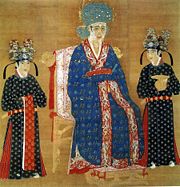

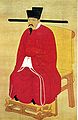
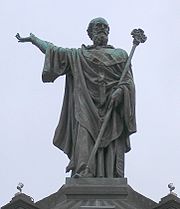
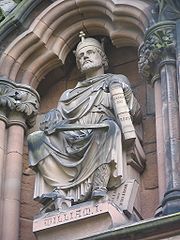
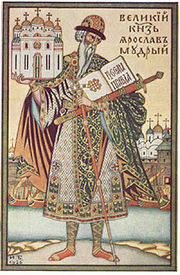

- Nasir KhusrawNasir KhusrawAbu Mo’in Hamid ad-Din Nasir ibn Khusraw al-Qubadiani or Nāsir Khusraw Qubādiyānī [also spelled as Nasir Khusrow and Naser Khosrow] Abu Mo’in Hamid ad-Din Nasir ibn Khusraw al-Qubadiani or Nāsir Khusraw Qubādiyānī [also spelled as Nasir Khusrow and Naser Khosrow] Abu Mo’in Hamid ad-Din Nasir ibn...
, Persian poet, theologian, philosopher, and traveler - Nicholas II, PopePope Nicholas IIPope Nicholas II , born Gérard de Bourgogne, Pope from 1059 to July 1061, was at the time of his election the Bishop of Florence.-Antipope Benedict X:...
- Nikephoros IIINikephoros IIINikephoros III Botaneiates, Latinized as Nicephorus III Botaniates was Byzantine emperor from 1078 to 1081. He belonged to a family which claimed descent from the Byzantine Phokas family.- Early career :...
, Byzantine Emperor - Notker LabeoNotker LabeoNotker Labeo , also known as Notker Teutonicus i.e. "the German", Notker the German, or Notker III, was a Benedictine monk and the first commentator on Aristotle active in the Middle Ages. "Labeo" means "the thick lipped"...
, mathematician, first medieval commentator on AristotleAristotleAristotle was a Greek philosopher and polymath, a student of Plato and teacher of Alexander the Great. His writings cover many subjects, including physics, metaphysics, poetry, theater, music, logic, rhetoric, linguistics, politics, government, ethics, biology, and zoology...
, and Benedictine monk from St. GallenSt. GallenSt. Gallen is the capital of the canton of St. Gallen in Switzerland. It evolved from the hermitage of Saint Gall, founded in the 7th century. Today, it is a large urban agglomeration and represents the center of eastern Switzerland. The town mainly relies on the service sector for its economic...
, Switzerland - Odo of Bayeux, Norman English bishop and earl
- Olaf IIOlaf II of NorwayOlaf II Haraldsson was King of Norway from 1015 to 1028. He was posthumously given the title Rex Perpetuus Norvegiae and canonised in Nidaros by Bishop Grimkell, one year after his death in the Battle of Stiklestad on 29 July 1030. Enshrined in Nidaros Cathedral...
, King of Norway - Omar KhayyámOmar KhayyámOmar Khayyám was aPersian polymath: philosopher, mathematician, astronomer and poet. He also wrote treatises on mechanics, geography, mineralogy, music, climatology and theology....
, Persian poet, mathematician, philosopher and astronomer - OtrokOtrokOtrok was an early eleventh-century Kipchak chieftain who was involved in the wars with Kievan Rus', and later served to the king of Georgia...
, khan of the KipchaksKipchaksKipchaks were a Turkic tribal confederation... - Ouyang XiuOuyang XiuOuyang Xiu was a Chinese statesman, historian, essayist and poet of the Song Dynasty. He is also known by his courtesy name of Yongshu, and was also self nicknamed The Old Drunkard 醉翁, or Householder of the One of Six 六一居士 in his old age...
, Chinese statesman, historian, archaeological epigapher, essayist, and poet - Paschal II, PopePope Paschal IIPope Paschal II , born Ranierius, was Pope from August 13, 1099, until his death. A monk of the Cluniac order, he was created cardinal priest of the Titulus S...
- Peter AbelardPeter AbelardPeter Abelard was a medieval French scholastic philosopher, theologian and preeminent logician. The story of his affair with and love for Héloïse has become legendary...
, French philosopher and logician - Peter DamianPeter DamianSaint Peter Damian, O.S.B. was a reforming monk in the circle of Pope Gregory VII and a cardinal. In 1823, he was declared a Doctor of the Church...
, cardinal and Doctor of the ChurchDoctor of the ChurchDoctor of the Church is a title given by a variety of Christian churches to individuals whom they recognize as having been of particular importance, particularly regarding their contribution to theology or doctrine.-Catholic Church:In the Catholic Church, this name is given to a saint from whose... - Peter DelyanPeter DelyanPeter Delyan was the leader of the local Bulgarian uprising against the Byzantine rule, started in the Theme of Bulgaria during summer of 1040. He was proclaimed Tsar of Bulgaria, as Samuel`s grandson in Belgrade...
, leader of a Bulgarian uprising against the Byzantine Empire - Peter Krešimir IV of Croatia, King of Croatia and Dalmatia
- Peter the HermitPeter the HermitPeter the Hermit was a priest of Amiens and a key figure during the First Crusade.-Before 1096:According to Anna Comnena, he had attempted to go on a pilgrimage to Jerusalem before 1096, but was prevented by the Seljuk Turks from reaching his goal and was tortured.Sources differ as to whether he...
, Crusader - Peter Urseolo, king of Hungary
- Philip I of FrancePhilip I of FrancePhilip I , called the Amorous, was King of France from 1060 to his death. His reign, like that of most of the early Direct Capetians, was extraordinarily long for the time...
R
- Rajaraja Chola IRajaraja Chola IRaja Raja Chola I born Arunmozhi Thevar , popularly known as Raja Raja the Great, is one of the greatest emperors of the Tamil Chola Empire of India who ruled between 985 and 1014 CE...
, ruler of Tamil NaduTamil NaduTamil Nadu is one of the 28 states of India. Its capital and largest city is Chennai. Tamil Nadu lies in the southernmost part of the Indian Peninsula and is bordered by the union territory of Pondicherry, and the states of Kerala, Karnataka, and Andhra Pradesh...
(southern India) and Sri Lanka - Rajendra Chola IRajendra Chola IRajendra Chola I was the son of Rajaraja Chola I and was one of the greatest rulers of Tamil Chola dynasty of India. He succeeded his father in 1014 CE as the Chola emperor...
, ruler of Tamil NaduTamil NaduTamil Nadu is one of the 28 states of India. Its capital and largest city is Chennai. Tamil Nadu lies in the southernmost part of the Indian Peninsula and is bordered by the union territory of Pondicherry, and the states of Kerala, Karnataka, and Andhra Pradesh...
(southern India) and Sri Lanka - Rajadhiraja CholaRajadhiraja CholaKōpparakēsarivarman Rājādhiraja Chōla I was one of the greatest emperors of the Chola empire succeeding his father in the 11th century. During his long reign, he helped his father conquer many territories and maintained the Chola authority over most of Lanka, Vengi, Kalinga, etc. and the relations...
, ruler of the Cholas - Rajendra Chola IIRajendra Chola IIRajendra Chola II reigned as the Chola king succeeding his elder brother brother Rajadhiraja Chola. He is best remembered for his role in the battle of Koppam alongside his elder brother where he dramatically turned the tables on the Chalukyan King Somesvara I.- Koppam Battle :The Chola forces were...
, ruler of the Cholas - RamanujaRamanujaRamanuja ; traditionally 1017–1137, also known as Ramanujacharya, Ethirajar , Emperumannar, Lakshmana Muni, was a theologian, philosopher, and scriptural exegete...
, Chola Indian theologian, philosopher, and spiritual leader - Raymond IV of ToulouseRaymond IV of ToulouseRaymond IV of Toulouse , sometimes called Raymond of St Gilles, was Count of Toulouse, Duke of Narbonne, and Margrave of Provence and one of the leaders of the First Crusade. He was a son of Pons of Toulouse and Almodis de La Marche...
, Duke of NarbonneDuke of NarbonneThe title Duke of Narbonne was a title employed at various times by the overlords of Narbonne, while the direct power in the city was held by the viscounts...
and a Crusader - Renzong EmperorEmperor Renzong of SongEmperor Renzong was the fourth emperor of the Song Dynasty of China. His personal name was Zhao Zhen . He reigned from 1022 to 1063. Renzong was the son of Emperor Zhenzong of Song. Despite his long reign of over 40 years, Renzong is not widely known...
, ruler of China - Richard II, Duke of NormandyRichard II, Duke of NormandyRichard II , called the Good , was the eldest son and heir of Richard I the Fearless and Gunnora.-Biography:...
- Rober, SaintSaint RobertSaint Rupert or Robert may refer to:*Rupert of Salzburg *Rupert of Bingen * Robert of Molesme * Robert of Newminster, established the Abbey of Newminster * Robert Bellarmine, Doctor of the Church Saint Rupert or Robert may refer to:*Rupert of Salzburg (d. 710)*Rupert of Bingen (d. 732)* Robert of...
, founder of the Cistercians - Robert II, Count of FlandersRobert II, Count of FlandersRobert II was Count of Flanders from 1093 to 1111. He became known as Robert of Jerusalem or Robert the Crusader after his exploits in the First Crusade.-History:...
, Crusader - Robert II of FranceRobert II of FranceRobert II , called the Pious or the Wise , was King of France from 996 until his death. The second reigning member of the House of Capet, he was born in Orléans to Hugh Capet and Adelaide of Aquitaine....
, king - Robert of JumiègesRobert of JumiègesRobert of Jumièges was the first Norman Archbishop of Canterbury. He had previously served as prior of the Abbey of St Ouen at Rouen in France, before becoming abbot of Jumièges Abbey, near Rouen, in 1037...
, Archbishop of CanterburyArchbishop of CanterburyThe Archbishop of Canterbury is the senior bishop and principal leader of the Church of England, the symbolic head of the worldwide Anglican Communion, and the diocesan bishop of the Diocese of Canterbury. In his role as head of the Anglican Communion, the archbishop leads the third largest group... - Robert GuiscardRobert GuiscardRobert d'Hauteville, known as Guiscard, Duke of Apulia and Calabria, from Latin Viscardus and Old French Viscart, often rendered the Resourceful, the Cunning, the Wily, the Fox, or the Weasel was a Norman adventurer conspicuous in the conquest of southern Italy and Sicily...
, Norman conqueror of Southern Italy and Sicily - Romanos IIIRomanos IIIRomanos III Argyros was Byzantine emperor from 15 November 1028 until his death.-Biography:...
, Byzantine Emperor - Romanos IVRomanos IVRomanos IV Diogenes was a member of the Byzantine military aristocracy who, after his marriage to the widowed empress Eudokia Makrembolitissa was crowned Byzantine emperor and reigned from 1068 to 1071...
, Byzantine Emperor
S
- Samuel AbaSamuel Aba of HungarySamuel Aba , King of Hungary , Palatine of Hungary .-King of Hungary:Samuel was from Northern Hungary, Castle Gonce / Castle Abaújvár, County of Aba...
, king of Hungary - Samuil, Emperor of Bulgaria
- Sancho IIISancho III of NavarreSancho III Garcés , called the Great , succeeded as a minor to the Kingdom of Navarre in 1004, and through conquest and political maneuvering increased his power, until at the time of his death in 1035 he controlled the majority of Christian Iberia, bearing the title of rex Hispaniarum...
, king of Navarre - Sanjō, Emperor of JapanEmperor Sanjowas the 67th emperor of Japan, according to the traditional order of succession.Sanjō's reign spanned the years from 1011 through 1016.-Traditional narrative:...
- Sei ShōnagonSei ShonagonSei Shōnagon , was a Japanese author and a court lady who served the Empress Teishi around the year 1000 during the middle Heian period. She is best known as the author of The Pillow Book .-Name:...
, writer, a Japanese lady of the royal court - Seonjong of GoryeoSeonjong of GoryeoSeonjong of Goryeo was the 13th emperor of Goryeo. He's the second son of Empress Inye and born in September, 1049. He was sealed as marquis of Gukwon in March, 1056. Harmony of Confucism and Buddhism made his political statue very stable...
, king of Korea - Shao YongShao YongShao Yong , courtesy name Yaofu , named Shào Kāngjié after death, was a Song Dynasty Chinese philosopher, cosmologist, poet and historian who greatly influenced the development of Neo-Confucianism in China....
, Chinese historian, poet, and philosopher - Shen KuoShen KuoShen Kuo or Shen Gua , style name Cunzhong and pseudonym Mengqi Weng , was a polymathic Chinese scientist and statesman of the Song Dynasty...
, Chinese polymathPolymathA polymath is a person whose expertise spans a significant number of different subject areas. In less formal terms, a polymath may simply be someone who is very knowledgeable...
: official, mathematician, astronomer, encyclopedist, zoologist, geologist, botanist, pharmacologist, agronomist, ethnographer, inventor, hydraulic engineer, cartographer, general, diplomat, archaeologist, musician and poet - Shengzong EmperorEmperor Shengzong of LiaoEmperor Shengzong of Liao , born as Yelü Longxu , succeeded Emperor Jingzong as Emperor of the Liao Dynasty at the age of 12 in 982. As he was too young to actually rule, his mother, Empress Dowager Xiao, effectively ruled the kingdom...
, ruler of Northeast China (Liao DynastyLiao DynastyThe Liao Dynasty , also known as the Khitan Empire was an empire in East Asia that ruled over the regions of Manchuria, Mongolia, and parts of northern China proper between 9071125...
) - Shenzong EmperorEmperor Shenzong of SongEmperor Shenzong of Song was the sixth emperor of the Chinese Song Dynasty. His personal name was Zhao Xu...
, ruler of China - Shirakawa, Emperor of Japan
- Samuel ibn NaghrelaSamuel ibn NaghrelaSamuel ibn Naghrela , also known as Samuel HaNagid , , was a Talmudic scholar, grammarian, philologist, poet, warrior, and statesman, who lived in Iberia at the time of the Moorish rule....
, Jewish scholar - Sigrid the HaughtySigrid the HaughtySigrid the Haughty, also known as Sigríð Storråda, is a queen appearing in Norse sagas as wife, first of Eric the Victorious of Sweden, then Sweyn Forkbeard of Denmark. While given the Nordic ancestry in sagas, she has been hypothesized to be identical to historically attested Polish or Pomeranian...
, wife of Sweyn I of Denmark - Sima GuangSima GuangSīmǎ Guāng was a Chinese historian, scholar, and high chancellor of the Song Dynasty, jinshi 1038.-Life, profession, and works:...
, Song Chinese chancellor and court historian - Solomon ibn GabirolSolomon ibn GabirolSolomon ibn Gabirol, also Solomon ben Judah , was an Andalucian Hebrew poet and Jewish philosopher with a Neoplatonic bent. He was born in Málaga about 1021; died about 1058 in Valencia.-Biography:...
, Jewish philosopher and poet from Spanish Al-AndalusAl-AndalusAl-Andalus was the Arabic name given to a nation and territorial region also commonly referred to as Moorish Iberia. The name describes parts of the Iberian Peninsula and Septimania governed by Muslims , at various times in the period between 711 and 1492, although the territorial boundaries... - Somesvara ISomesvara ISomesvara I succeeded his father Jayasimha II as the Western Chalukya king. He was one of the greatest kings of the later Chalukya Dynasty. In spite of many reverses he managed to safeguard the integrity of the Chalukya kingdom. He founded the city of Kalyani, present day Basavakalyana and moved...
, ruler of the Western Chalukya Empire - Somesvara IISomesvara IISomesvara II who was administering the area around Gadag succeeded his father Somesvara I as the Western Chalukya king. He was the eldest son of Somesvara I. During his reign Somesvara II was constantly under threat from his more ambitious younger brother Vikramaditya VI...
, ruler of the Western Chalukya Empire - SripatiSripatiŚrīpati was an Indian astronomer and mathematician, the author of Dhikotidakarana , a work of twenty verses on solar and lunar eclipses; Dhruvamanasa , a work of 105 verses on calculating planetary longitudes, eclipses and planetary transits; Siddhantasekhara a major work on astronomy in 19...
, Indian mathematician and astronomer - Stephen I, king of Hungary
- Stephen IX, PopePope Stephen IXPope Stephen IX was Pope from August 3, 1057 to March 1058.His baptismal name was Frederick of Lorraine , and he was a younger brother of Godfrey III, Duke of Lower Lorraine, who, as Marquis of Tuscany , played a prominent part in the politics of the period.Frederick, who had...
- Su ShiSu ShiSu Shi , was a writer, poet, artist, calligrapher, pharmacologist, gastronome, and statesman of the Song Dynasty, and one of the major poets of the Song era. His courtesy name was Zizhan and his pseudonym was Dongpo Jushi , and he is often referred to as Su Dongpo...
, famous Chinese poet, calligrapher, painter, travel writer, pharmacologist, and statesman - Su SongSu SongSu Song was a renowned Chinese polymath who specialized himself as a statesman, astronomer, cartographer, horologist, pharmacologist, mineralogist, zoologist, botanist, mechanical and architectural engineer, poet, antiquarian, and ambassador of the Song Dynasty .Su Song was the engineer of a...
, Chinese astronomer, horologist, mechanical engineer, zoologist, botanist, mineralogist, diplomat, cartographer, etc. - Sukjong of GoryeoSukjong of GoryeoSukjong of Goryeo was the 15th ruler of the Goryeo dynasty of Korea. He was the younger brother of Sunjong. He married Myeongui, the daughter of Yu Hong....
, king of Korea - Suleiman II, Caliph of Córdoba,
- Sveinn HákonarsonSveinn HákonarsonSveinn Hákonarson was an earl of the house of Hlaðir and co-ruler of Norway from 1000 to c. 1015. He was the son of earl Hákon Sigurðarson. He is first mentioned in connection with the battle of Hjörungavágr, where the Heimskringla says he commanded 60 ships...
, King of Norway - Sweyn I of DenmarkSweyn I of DenmarkSweyn I Forkbeard was king of Denmark and England, as well as parts of Norway. His name appears as Swegen in the Anglo-Saxon Chronicle and he is also known in English as Svein, Swein, Sven the Dane, and Tuck.He was a Viking leader and the father of Cnut the Great...
, king of Denmark, Norway, and England - Sylvester II, Pope, a French astronomer, mathematician, orator, musician, and philosopher.
T-X
- Tāriqu l-Ḥakīm bi Amr al-LāhAl-Hakim bi-Amr AllahAbu ‘Ali Mansur Tāriqu l-Ḥākim, called Al-Hakim bi Amr al-Lāh , was the sixth Fatimid caliph and 16th Ismaili imam .- History :...
, Sixth FātimidFatimidThe Fatimid Islamic Caliphate or al-Fāṭimiyyūn was a Berber Shia Muslim caliphate first centered in Tunisia and later in Egypt that ruled over varying areas of the Maghreb, Sudan, Sicily, the Levant, and Hijaz from 5 January 909 to 1171.The caliphate was ruled by the Fatimids, who established the...
CaliphCaliphThe Caliph is the head of state in a Caliphate, and the title for the ruler of the Islamic Ummah, an Islamic community ruled by the Shari'ah. It is a transcribed version of the Arabic word which means "successor" or "representative"... - Empress TheodoraTheodora (11th century)Theodora was a Byzantine Empress. Born into the Macedonian dynasty that had ruled the Byzantine Empire for almost two hundred years, she was co-empress with her sister Zoe for two months in 1042 and sole empress from 11 January 1055 to after 31 August 1056...
, Byzantine Empress - Tostig GodwinsonTostig GodwinsonTostig Godwinson was an Anglo-Saxon Earl of Northumbria and brother of King Harold Godwinson, the last crowned english King of England.-Early life:...
, earl of NorthumbriaNorthumbriaNorthumbria was a medieval kingdom of the Angles, in what is now Northern England and South-East Scotland, becoming subsequently an earldom in a united Anglo-Saxon kingdom of England. The name reflects the approximate southern limit to the kingdom's territory, the Humber Estuary.Northumbria was... - Tunka ManinTunka ManinGhana Tunka Manin was a ruler of the Ghana Empire who reigned from 1062 to 1076 C.E. Preceded by Ghana Bassi, Manin was the last ruler of the Ghana Empire....
ruler of the Ghana EmpireGhana EmpireThe Ghana Empire or Wagadou Empire was located in what is now southeastern Mauritania, and Western Mali. Complex societies had existed in the region since about 1500 BCE, and around Ghana's core region since about 300 CE... - Urban II, PopePope Urban IIPope Urban II , born Otho de Lagery , was Pope from 12 March 1088 until his death on July 29 1099...
- Victor II, PopePope Victor IIPope Victor II , born Gebhard, Count of Calw, Tollenstein, and Hirschberg, was Pope from 1055 to 1057. He was one of a series of German reform Popes.-Life:...
- Victor III, PopePope Victor IIIPope Blessed Victor III , born Daufer , Latinised Dauferius, was the Pope as the successor of Pope Gregory VII, yet his pontificate is far less impressive in history than his time as Desiderius, the great Abbot of Monte Cassino.-Early life and abbacy:He was born in 1026 or 1027 of a non-regnant...
- Vikramaditya VIVikramaditya VIVikramaditya VI became the Western Chalukya King after deposing his elder brother Somesvara II. Vikramaditya's reign is marked by the start of the Chalukya-Vikrama era. Vikramaditya VI was the greatest of the Western Chalukya kings and had the longest reign in the dynasty. He earned the title...
, ruler of the Western Chalukya Empire - Virarajendra CholaVirarajendra CholaVirarajendra Chola was one of the most under-rated Chola kings, mainly because a major part of his life was spent in the apprenticeship of his two elder brothers Rajadhirajan Chola I and Rajendra Chola-II, who along with Virarajendra Chola himself were the illustrious sons of their Chakravarti...
, ruler of the Cholas - Vladimir I of KievVladimir I of KievVladimir Sviatoslavich the Great Old East Slavic: Володимѣръ Свѧтославичь Old Norse as Valdamarr Sveinaldsson, , Vladimir, , Volodymyr, was a grand prince of Kiev, ruler of Kievan Rus' in .Vladimir's father was the prince Sviatoslav of the Rurik dynasty...
, ruler of Kievan Rus - Vladimir II MonomakhVladimir II MonomakhVladimir II Monomakh |Basileios]]) was a Velikiy Kniaz of Kievan Rus'.- Family :He was the son of Vsevolod I and Anastasia of Byzantium Vladimir II Monomakh |Basileios]]) (1053 – May 19, 1125) was a Velikiy Kniaz (Grand Prince) of Kievan Rus'.- Family :He was the son of Vsevolod I (married in...
, ruler of Kievan Rus - Vsevolod I of KievVsevolod I of KievVsevolod I Yaroslavich , ruled as Grand Prince of Kiev from 1078 until his death.-Early life:...
, ruler of Kievan Rus - Wang AnshiWang AnshiWang Anshi was a Chinese economist, statesman, chancellor and poet of the Song Dynasty who attempted controversial, major socioeconomic reforms...
, Song Chinese chancellor - Wei PuWei PuWei Pu was an 11th century Chinese astronomer of the Song Dynasty . He was born a commoner, but eventually rose to prominence as an astronomer working for the imperial court at the capital of Kaifeng...
, Chinese astronomer and mathematician - Wen TongWen TongWen Tong was a Northern Song painter born in Sichuan famous for his ink bamboo paintings. He was one of the paragons of "scholar's painting" , which idealised spontaneity and painting without financial reward....
, Chinese painter - William of ChampeauxWilliam of ChampeauxGuillaume de Champeaux , also known as William of Champeaux or Guglielmus de Campellis , was a French philosopher and theologian.He was born at Champeaux near Melun...
, French philosopher and theologian - William the ConquerorWilliam I of EnglandWilliam I , also known as William the Conqueror , was the first Norman King of England from Christmas 1066 until his death. He was also Duke of Normandy from 3 July 1035 until his death, under the name William II...
, ruler of Normandy and England - William Iron ArmWilliam Iron ArmWilliam Iron Arm was a Norman adventurer, founder of the fortunes of the Hauteville family. One of twelve sons of Tancred of Hauteville, he journeyed to the Mezzogiorno with his younger brother Drogo in the first half of the eleventh century , in response to requests for help made by fellow...
, prominent member of the Norman Hauteville familyHauteville familyThe family of the Hauteville was a petty baronial Norman family from the Cotentin which rose to prominence in Europe, Asia, and Africa through its conquests in the Mediterranean, especially Southern Italy and Sicily... - Wulfstan II, Archbishop of YorkWulfstan II, Archbishop of YorkWulfstan was an English Bishop of London, Bishop of Worcester, and Archbishop of York. He should not be confused with Wulfstan I, Archbishop of York or Wulfstan, Bishop of Worcester. He is thought to have begun his ecclesiastical career as a Benedictine monk. He became the Bishop of London in 996...
- Xingzong EmperorEmperor Xingzong of LiaoEmperor Xingzong of Liao , born Yelü Zongzhen , was an emperor of the Liao Dynasty. He reigned from 25 June 1031 to 28 August 1055....
, ruler of Northeast China (Liao DynastyLiao DynastyThe Liao Dynasty , also known as the Khitan Empire was an empire in East Asia that ruled over the regions of Manchuria, Mongolia, and parts of northern China proper between 9071125...
) - Xu DaoningXu DaoningXu Daoning was a Chinese painter of the Northern Song Dynasty from Changan or Hejian . He started out life by selling medicine prescriptions in Kaifeng. While selling prescriptions, he also began painting nature scenes in the style of Li Cheng. After gaining popularity he took up painting...
, Chinese landscape painter
Y-Z
- Yaroslav I the WiseYaroslav I the WiseYaroslav I, Grand Prince of Rus, known as Yaroslav the Wise Yaroslav I, Grand Prince of Rus, known as Yaroslav the Wise Yaroslav I, Grand Prince of Rus, known as Yaroslav the Wise (Old Norse: Jarizleifr; ; Old East Slavic and Russian: Ярослав Мудрый; Ukrainian: Ярослав Мудрий; c...
, ruler of Kievan Rus - Yingzong EmperorEmperor Yingzong of SongEmperor Yingzong was the fifth emperor of the Song Dynasty of China. His personal name was originally Zhao Zongshi but he later changed it to Zhao Shu. He reigned from 1063 to 1067...
, ruler of China - Yizong EmperorEmperor Yizong of Western XiaEmperor Yizong of Western Xia was Emperor of the Western Xia from 1048 to 1067. After his father's death in 1048, Yizong assumed the throne at the age of one, but most of the power laid in the hands of the Dowager. In 1049, the Liao Dynasty attacked Western Xia and forced it to become a vassal...
, ruler of Northwest China (Western XiaWestern XiaThe Western Xia Dynasty or the Tangut Empire, was known to the Tanguts and the Tibetans as Minyak.The state existed from 1038 to 1227 AD in what are now the northwestern Chinese provinces of Ningxia, Gansu, eastern Qinghai, northern Shaanxi, northeastern Xinjiang, southwest Inner Mongolia, and...
) - Yusuf ibn TashfinYusuf ibn TashfinYusef ibn Tashfin also, Tashafin, or Teshufin; or Yusuf; was a king of the Almoravid empire, he founded the city of Marrakech and led the Muslim forces in the Battle of Zallaqa....
, BerberBerber peopleBerbers are the indigenous peoples of North Africa west of the Nile Valley. They are continuously distributed from the Atlantic to the Siwa oasis, in Egypt, and from the Mediterranean to the Niger River. Historically they spoke the Berber language or varieties of it, which together form a branch...
Almoravid ruler - Yusuf Balasaghuni, an UyghurUyghur peopleThe Uyghur are a Turkic ethnic group living in Eastern and Central Asia. Today, Uyghurs live primarily in the Xinjiang Uyghur Autonomous Region in the People's Republic of China...
Turkish scribe - Zhezong EmperorEmperor Zhezong of SongEmperor Zhezong was the seventh emperor of the Song Dynasty of China. His personal name was Zhao4 Xu1. He reigned from 1085 to 1100....
, ruler of China - Zhenzong EmperorEmperor Zhenzong of SongEmperor Zhenzong was the third emperor of the Song Dynasty of China. He reigned from 997 to 1022. Zhenzong was the third son of Emperor Taizong. His personal name was Zhao Heng and his temple name Zhenzong means "True Ancestor".Zhenzong's reign was noted for the consolidation of power and the...
, ruler of China - Zaynab an-NafzawiyyatZaynab an-NafzawiyyatZaynab an-Nafzāwiyyat , a Berber woman of influence in the early Almoravid movement which gained control of Morocco, Algeria and parts of Spain....
, wife of Almoravid ruler Abu-Bakr Ibn-UmarAbu-Bakr Ibn-UmarAbu Bakr ibn Umar ibn Ibrahim ibn Turgut, sometimes suffixed al-Sanhaji or al-Lamtuni was a chieftan of the Lamtuna Berbers of the western Sahara, and commander of the Almoravids from 1056 until his death.... - Zeng GongZeng GongZeng Gong , courtesy name Zigu , was a Chinese scholar and historian of the Song Dynasty in China. He was one of the supporters of the New Classical Prose Movement and is regarded as founder of one of the Eight Great Schools of Thought of the Tang and Song dynasties .Zeng Gong was born in Jianchang...
, Chinese historian, travel writer, and poet - Zhang ZeduanZhang ZeduanZhang Zeduan , alias Zheng Dao, also sometimes translated as Zhang Zerui, was a famous Chinese painter during the twelfth century, during the transitional period from the Northern Song to the Southern Song Dynasty, and was instrumental in the early history of the Chinese art style known as shan...
, Chinese landscape painter - Zhou Dunyi, Chinese philosopher
- Zoe, EmpressZoe (empress)Zoe reigned as Byzantine Empress alongside her sister Theodora from April 19 to June 11, 1042...
, Byzantine Empress
Architecture
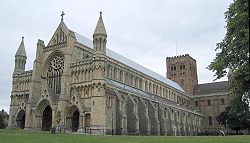
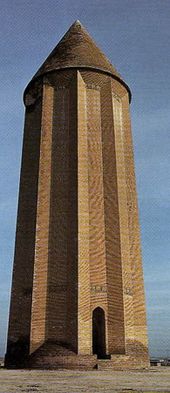
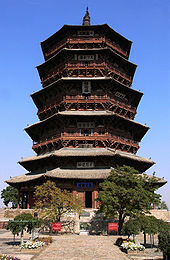
- Svetitskhoveli CathedralSvetitskhoveli CathedralSvetitskhoveli Cathedral is a Georgian Orthodox cathedral located in the historical town of Mtskheta, Georgia, northwest of the nation's capital of Tbilisi....
, Georgia, is totally renewed in 1029 - The St Albans CathedralSt Albans CathedralSt Albans Cathedral is a Church of England cathedral church at St Albans, England. At , its nave is the longest of any cathedral in England...
of Norman-era England is completed in 1089. - The Al-Hakim MosqueAl-Hakim MosqueThe al-Hakim Mosque is a major Islamic religious site in Cairo, Egypt. It is located in "Islamic Cairo", on the east side of Muizz Street, just south of Bab Al-Futuh...
of Fatimid Egypt is completed in 1013. - The Iron PagodaIron PagodaThe Iron Pagoda of Youguo Temple , Kaifeng City, Henan province, is a Buddhist Chinese pagoda built in 1049 C.E. during the Song Dynasty of China. The pagoda is so-named not because it is made of iron, but because its colour resembles that of iron...
of KaifengKaifengKaifeng , known previously by several names , is a prefecture-level city in east-central Henan province, Central China. Nearly 5 million people live in the metropolitan area...
, China is built in 1049. - The Phoenix HallByodo-inis a Buddhist temple in the city of Uji in Kyoto Prefecture, Japan. It is jointly a temple of the Jōdo-shū and Tendai-shū sects.- History :...
of Byōdō-inByodo-inis a Buddhist temple in the city of Uji in Kyoto Prefecture, Japan. It is jointly a temple of the Jōdo-shū and Tendai-shū sects.- History :...
, Japan, is completed in 1053. - The Brihadeeswarar TempleBrihadeeswarar templeThe Peruvudaiyar Koyil , also known as Rajarajeswaram, at Thanjavur in the Indian state of Tamil Nadu, is the world's first complete granite temple and a brilliant example of the major heights achieved by Cholas kingdom Vishwakarmas in Tamil architecture. It is a tribute and a reflection of the...
of India is completed in 1010 during the reign of Rajaraja Chola IRajaraja Chola IRaja Raja Chola I born Arunmozhi Thevar , popularly known as Raja Raja the Great, is one of the greatest emperors of the Tamil Chola Empire of India who ruled between 985 and 1014 CE...
. - The FruttuariaFruttuariathumb|300px|Bell tower of the abbey.Fruttuaria is an abbey in the territory of San Benigno Canavese, about twenty kilometers north of Turin, northern Italy.-History:...
of San Benigno CanaveseSan Benigno CanaveseSan Benigno Canavese is a comune in the province of Turin in the Italian region Piedmont, located about 20 km northeast of Turin, whose territory is bordered by the Malone and Orco rivers.-Main sights:...
, Italy is completed in 1007. - The Kedareshwara Temple of BalligaviBalligaviBalligavi a town in Shikaripura taluk Shimoga district of Karnataka state, India, is today known as Belagami or Balagame. Its ancient names are Dakshina Kedara,Valliggame and Valligrame. Dakshina Kedara means Kedarnath of the South. A place of antiquity, it is known for its ancient monuments...
, India, is built in 1060 by the Western Chalukyas. - Construction work begins in 1059 on the Parma Cathedral of Italy.
- The Martin-du-CanigouMartin-du-CanigouMartin-du-Canigou is a monastery built in 1009 in the Pyrenees on Canigou mountain in present day southern France near the Spanish border.-Location:...
monastery is built by 1009, in present day southern France. - The Saint Sophia Cathedral in NovgorodSaint Sophia Cathedral in NovgorodThe Cathedral of St. Sophia in the Kremlin in Veliky Novgorod is the cathedral church of the Archbishop of Novgorod and the mother church of the Novgorodian Eparchy.-History:...
is completed in 1052, the oldest existent church in Russia. - Construction begins on the Saint Sophia Cathedral in KievSaint Sophia Cathedral in KievSaint Sophia Cathedral in Kiev is an outstanding architectural monument of Kievan Rus'. Today, it is one of the city's best known landmarks and the first Ukrainian patrimony to be inscribed on the World Heritage List along with the Kiev Cave Monastery complex...
, Ukraine, in 1037. - The Byzantine Greek Hosios LoukasHosios LoukasHosios Loukas is an historic walled monastery situated near the town of Distomo, in Boeotia, Greece. It is one of the most important monuments of Middle Byzantine architecture and art, and has been listed on UNESCO's World Heritage Sites, along with the monasteries of Nea Moni and Daphnion.-...
monastery sees the completion of its KatholikonKatholikonA Katholikon or Catholicon is the major temple of a monastery, or diocese in the Eastern Orthodox Church. The name derives from the fact that it is the largest temple where all gather together to celebrate the major feast days of the liturgical year. At other times, the smaller temples or...
(main church), the earliest extant domeDomeA dome is a structural element of architecture that resembles the hollow upper half of a sphere. Dome structures made of various materials have a long architectural lineage extending into prehistory....
d-octagon church from 1011–1012. - The Lingxiao PagodaLingxiao PagodaThe Lingxiao Pagoda is a Chinese pagoda west of the Xinglong Temple in Zhengding, Hebei Province, China.-History:The original pagoda that stood at the same site was dubbed the Wooden Pagoda, and was built in 860 AD during the Tang Dynasty...
of ZhengdingZhengdingZhengding is a county in Hebei Province approximately 260 kilometers south of Beijing, China. It comes under the administration of nearby Shijiazhuang City and has a population of 594,000. Zhengding has been an important religious center for more than 1,000 years, from - at least - the times...
, HebeiHebei' is a province of the People's Republic of China in the North China region. Its one-character abbreviation is "" , named after Ji Province, a Han Dynasty province that included what is now southern Hebei...
province, China, is built in 1045. - The Pagoda of Fogong TemplePagoda of Fogong TempleThe Sakyamuni Pagoda of Fogong Temple of Ying County, Shanxi province, China, is a wooden Chinese pagoda built in 1056, during the Khitan-led Liao Dynasty. The pagoda was built by Emperor Daozong of Liao at the site of his grandmother's family home...
of ShanxiShanxi' is a province in Northern China. Its one-character abbreviation is "晋" , after the state of Jin that existed here during the Spring and Autumn Period....
province, China, is completed under the Liao DynastyLiao DynastyThe Liao Dynasty , also known as the Khitan Empire was an empire in East Asia that ruled over the regions of Manchuria, Mongolia, and parts of northern China proper between 9071125...
in 1056. - The Nikortsminda CathedralNikortsminda CathedralNikortsminda Cathedral is a Georgian Orthodox Church, located in Nikortsminda, Racha region of Georgia.Nikortsminda was built in 1010-1014 during the reign of Bagrat III of Georgia and was repaired in 1634 by the King Bagrat III of Imereti. Three-storied bell-tower next to the Cathedral was built...
of Georgia is completed in 1014. - The Speyer CathedralSpeyer CathedralThe Speyer Cathedral, officially the Imperial Cathedral Basilica of the Assumption and St Stephen, in Latin: Domus sanctae Mariae Spirae in Speyer, Germany, is the seat of the Roman Catholic Bishop of Speyer and is suffragan to the Archdiocese of Bamberg. The cathedral, which is dedicated to St...
in SpeyerSpeyerSpeyer is a city of Rhineland-Palatinate, Germany with approximately 50,000 inhabitants. Located beside the river Rhine, Speyer is 25 km south of Ludwigshafen and Mannheim. Founded by the Romans, it is one of Germany's oldest cities...
, Germany is completed in 1061. - The Chinese official Cai XiangCai XiangCai Xiang was a Chinese calligrapher, scholar, official, structural engineer, and poet. Cai Xiang had the reputation as the greatest calligrapher in the Song Dynasty.- Life :...
oversaw the construction of the Wanan BridgeArchitecture of the Song DynastyThe architecture of the Song Dynasty was noted for its towering Buddhist pagodas, enormous stone and wooden bridges, lavish tombs, and palaces. Although literary works on architecture existed beforehand, architectural writing blossomed during the Song Dynasty, maturing into a more professional...
in FujianFujian' , formerly romanised as Fukien or Huguing or Foukien, is a province on the southeast coast of mainland China. Fujian is bordered by Zhejiang to the north, Jiangxi to the west, and Guangdong to the south. Taiwan lies to the east, across the Taiwan Strait...
, and may have been the leading member of an engineering school due to many other bridges of similar construction built in Fujian. - The Imam Ali MosqueImam Ali MosqueThe Imām ‘Alī Holy Shrine , also known as Masjid Ali or the Mosque of ‘Alī, located in Najaf, Iraq, is the third holiest site for some of the estimated 200 million followers of the Shia branch of Islam. ‘Alī ibn Abī Tālib, the cousin of Muhammad, the fourth caliph , the first Imam is buried here...
in Iraq is rebuilt by Malik Shah IMalik Shah IJalāl al-Dawlah Malik-shāh was born in 1055, succeeded Alp Arslan as the Seljuq Sultan in 1072, and reigned until his death in 1092....
in 1086 after it was destroyed by fire. - The Pizhi PagodaPizhi PagodaThe Pizhi Pagoda is an 11th century Chinese pagoda located at Lingyan Temple, Changqing, near Jinan, Shandong province, China. Although originally built in 753 during the reign of Emperor Xuanzong of Tang , the present pagoda is a Song Dynasty reconstruction from 1056 until 1063, during the last...
of Lingyan TempleLingyan TempleLingyan Temple is a Buddhist temple located in Changqing District, Jinan, Shandong Province, China, about north of the city of Tai'an. The temple grounds are situated in a valley on the western edge of the Taishan range. The Lingyan Temple has a long recorded history, and was one of the main...
, ShandongShandong' is a Province located on the eastern coast of the People's Republic of China. Shandong has played a major role in Chinese history from the beginning of Chinese civilization along the lower reaches of the Yellow River and served as a pivotal cultural and religious site for Taoism, Chinese...
, China is completed in 1063. - Reconstruction of the San Liberatore a MaiellaSan Liberatore a MaiellaSan Liberatore a Maiella is an abbey in the territory of Serramonacesca, in Abruzzo, Italy.-History:The origin of the abbey is traditionally linked to Charlemagne, who is portrayed in a fresco fragment within the church. The 9th century edifice was rebuilt a first time from 1007 by the Benedictine...
in Italy begins in 1080. - The Westminster AbbeyWestminster AbbeyThe Collegiate Church of St Peter at Westminster, popularly known as Westminster Abbey, is a large, mainly Gothic church, in the City of Westminster, London, United Kingdom, located just to the west of the Palace of Westminster. It is the traditional place of coronation and burial site for English,...
of LondonLondonLondon is the capital city of :England and the :United Kingdom, the largest metropolitan area in the United Kingdom, and the largest urban zone in the European Union by most measures. Located on the River Thames, London has been a major settlement for two millennia, its history going back to its...
, England is completed in 1065. - The Ananda TempleAnanda TempleThe Ananda Temple , located in Bagan, Myanmar is a Buddhist temple built in 1105 AD during the reign of King Kyanzittha of the Pagan Dynasty. It is one of four surviving temples in Bagan...
of the Myanmar ruler King Kyanzittha is completed in 1091. - The Văn Miếu, or Temple of Literature, in Vietnam is established in 1070.
- Construction of Richmond CastleRichmond CastleRichmond Castle in Richmond, North Yorkshire, England, stands in a commanding position above the River Swale, close to the centre of the town of Richmond. It was originally called Riche Mount, 'the strong hill'...
in England begins in 1071. - The tallest pagodaPagodaA pagoda is the general term in the English language for a tiered tower with multiple eaves common in Nepal, India, China, Japan, Korea, Vietnam and other parts of Asia. Some pagodas are used as Taoist houses of worship. Most pagodas were built to have a religious function, most commonly Buddhist,...
tower in China's pre-modern history, the Liaodi PagodaLiaodi PagodaThe Liaodi Pagoda of Kaiyuan Monastery, Dingzhou, Hebei Province, China is the tallest existing pre-modern Chinese pagoda and tallest brick pagoda in the world, built in the 11th century during the Song Dynasty . The pagoda stands at a height of , resting on a large platform with an octagonal base...
, is completed in 1055, standing at a height of 84 m (275 ft). - The Tower of Gonbad-e QabusGonbad-e QabusGonbad-e Qābus or Gonbad-e Kāvus ; formerly Dashte Gorgan) is a city in and the capital of Gonbad-e-Qabus County, in the province of Golestān in the northeast of Iran...
in Iran is built in 1006. - Construction begins on the Sassovivo AbbeySassovivo AbbeyThe Abbey of Sassovivo is a Benedictine monastery in Umbria in central Italy. Administratively, it is a frazione of the comune of Foligno.-Geography:The abbey lies in an ancient oak wood, 6 km from Foligno...
of FolignoFolignoFoligno is an ancient town of Italy in the province of Perugia in east central Umbria, on the Topino river where it leaves the Apennines and enters the wide plain of the Clitunno river system...
, Italy, in 1070. - The Palace of AljaferíaAljaferíaThe Aljafería Palace is a fortified medieval Islamic palace built during the second half of the 11th century in the Moorish taifa of Zaragoza of Al-Andalus, present day Zaragoza, Spain. It was the residence of the Banu Hud dynasty during the era of Abu Jaffar Al-Muqtadir after abolishing Banu...
is built in ZaragozaZaragozaZaragoza , also called Saragossa in English, is the capital city of the Zaragoza Province and of the autonomous community of Aragon, Spain...
, Spain, during the Al-AndalusAl-AndalusAl-Andalus was the Arabic name given to a nation and territorial region also commonly referred to as Moorish Iberia. The name describes parts of the Iberian Peninsula and Septimania governed by Muslims , at various times in the period between 711 and 1492, although the territorial boundaries...
period. - The Rotonda di San LorenzoRotonda di San LorenzoThe Rotonda di San Lorenzo is a religious building in Mantua, Lombardy .It is the most ancient church in the city, having been built during the reign of the Canossa family in the late 11th century. Inspired by the Holy Sepulchre church in Jerusalem and dedicated to the martyr St...
is built in MantuaMantuaMantua is a city and comune in Lombardy, Italy and capital of the province of the same name. Mantua's historic power and influence under the Gonzaga family, made it one of the main artistic, cultural and notably musical hubs of Northern Italy and the country as a whole...
, LombardyLombardyLombardy is one of the 20 regions of Italy. The capital is Milan. One-sixth of Italy's population lives in Lombardy and about one fifth of Italy's GDP is produced in this region, making it the most populous and richest region in the country and one of the richest in the whole of Europe...
, Italy, during the late 11th century. - Construction of the Ponte della MaddalenaPonte della MaddalenaPonte della Maddalena is a bridge crossing the Serchio river near the town of Borgo a Mozzano in the Italian province of Lucca...
bridge in the Province of LuccaProvince of LuccaThe Province of Lucca is a province in the Tuscany region of Italy. Its capital is the city of Lucca.It has an area of 1,773 km², and a total population of 372,244...
, Italy begins in 1080. - The domes of the Jamé Mosque of IsfahanJamé Mosque of IsfahanThe Jāmeh Mosque of Isfahān is the grand, congregational mosque of Isfahān city, within Isfahān Province, Iran. The mosque is the result of continual construction, reconstruction, additions and renovations on the site from around 771 to the end of the 20th century...
, Iran are built in 1086 to 1087. - 11th–18th century – Courtyard, Jamé Mosque of IsfahanJamé Mosque of IsfahanThe Jāmeh Mosque of Isfahān is the grand, congregational mosque of Isfahān city, within Isfahān Province, Iran. The mosque is the result of continual construction, reconstruction, additions and renovations on the site from around 771 to the end of the 20th century...
, Isfahan, Persia (IranIranIran , officially the Islamic Republic of Iran , is a country in Southern and Western Asia. The name "Iran" has been in use natively since the Sassanian era and came into use internationally in 1935, before which the country was known to the Western world as Persia...
), is built. - The Chester CastleChester CastleChester Castle is in the city of Chester, Cheshire, England. It is sited at the southwest extremity of the area bounded by the city walls . The castle stands on an eminence overlooking the River Dee. In the castle complex are the remaining parts of the medieval castle together with the...
in England was built in 1069. - Construction begins on the Bagrati CathedralBagrati CathedralThe Cathedral of the Dormition, or the Kutaisi Cathedral, more commonly known as Bagrati Cathedral , is the 11th-century cathedral church in the city of Kutaisi, the region of Imereti, Georgia...
in Georgia in 1003. - The St. Michael's Church, HildesheimSt. Michael's Church, HildesheimThe Church of St. Michael in Hildesheim, Germany, is an early-Romanesque church. It has been on the UNESCO World Cultural Heritage list since 1985.-History:...
in Germany is completed in 1031. - The Basilica of Sant'AbbondioBasilica of Sant'AbbondioThe Basilica of Sant'Abbondio is a church in Como, Lombardy, northern Italy.The current edifice rises over a pre-existing 5th century Palaeo-Christian church entitled to Sts. Peter and Paul, built by order of St. Amantius of Como, third bishop of the city. Erected c...
of LombardyLombardyLombardy is one of the 20 regions of Italy. The capital is Milan. One-sixth of Italy's population lives in Lombardy and about one fifth of Italy's GDP is produced in this region, making it the most populous and richest region in the country and one of the richest in the whole of Europe...
, Italy is completed in 1095. - Construction begins on the Great Zimbabwe National Monument, sometime in the century.
- Construction begins on the San Pietro in VinculisSan Pietro in Vinculis (Pisa)San Pietro in Vinculis is a church in Pisa, Tuscany, Italy.It was built by the Augustinians in 1072-1118 over a pre-existing edifice. The rectory was added a few years later....
in PisaPisaPisa is a city in Tuscany, Central Italy, on the right bank of the mouth of the River Arno on the Tyrrhenian Sea. It is the capital city of the Province of Pisa...
, Italy, in 1072. - The Tower of LondonTower of LondonHer Majesty's Royal Palace and Fortress, more commonly known as the Tower of London, is a historic castle on the north bank of the River Thames in central London, England. It lies within the London Borough of Tower Hamlets, separated from the eastern edge of the City of London by the open space...
in England is founded in 1078. - The St. Grigor's Church of Kecharis MonasteryKecharis MonasteryKecharis is a 11-13th-century monastery, located 60 km from Yerevan, in the ski resort town of Tsakhkadzor in Armenia. Nestled in the Bambak mountains, Kecharis was founded by a Pahlavuni prince in the 11th century, and construction continued until the middle of the 13th century...
in Armenia is built in 1003. - The Martin-du-CanigouMartin-du-CanigouMartin-du-Canigou is a monastery built in 1009 in the Pyrenees on Canigou mountain in present day southern France near the Spanish border.-Location:...
monastery on Mount CanigouCanigouThe Canigou is a mountain located in the Catalan Pyrenees of southern France.Due to its sharp flanks and its dramatic location close to the coast, until the 18th century the Canigou was believed to be the highest mountain in the Pyrenees.-Trekking and sightseeing:Spectacular jeep tracks on the...
in southern France is built in 1009. - The St. Mary's Cathedral, HildesheimSt. Mary's Cathedral, HildesheimSt. Mary's Cathedral in Hildesheim, Germany, is an important medieval Catholic cathedral, that has been on the UNESCO World Cultural Heritage list since 1985....
in Germany is completed in 1020. - The One Pillar PagodaOne Pillar PagodaThe One Pillar Pagoda is a historic Buddhist temple in Hanoi, the capital of Vietnam. It is regarded alongside the Perfume Temple, as one of Vietnam's two most iconic temples.The temple was built by Emperor Lý Thái Tông, who ruled from 1028 to 1054...
in HanoiHanoiHanoi , is the capital of Vietnam and the country's second largest city. Its population in 2009 was estimated at 2.6 million for urban districts, 6.5 million for the metropolitan jurisdiction. From 1010 until 1802, it was the most important political centre of Vietnam...
, Vietnam, is constructed in 1049. - The St Michael at the NorthgateSt Michael at the NorthgateSt Michael at the North Gate is a church in Cornmarket Street, at the junction with Ship Street, in central Oxford, England. The church is so-called because this is the location of the original north gate of Oxford when it was surrounded by a city wall....
, OxfordOxfordThe city of Oxford is the county town of Oxfordshire, England. The city, made prominent by its medieval university, has a population of just under 165,000, with 153,900 living within the district boundary. It lies about 50 miles north-west of London. The rivers Cherwell and Thames run through...
's oldest building, is built in Saxon EnglandAnglo-Saxon architectureAnglo-Saxon architecture was a period in the history of architecture in England, and parts of Wales, from the mid-5th century until the Norman Conquest of 1066. Anglo-Saxon secular buildings in Britain were generally simple, constructed mainly using timber with thatch for roofing...
in 1040. - The Oxford CastleOxford CastleOxford Castle is a large, partly ruined Norman medieval castle situated on the west edge of Oxford in Oxfordshire, England. The original moated, wooden motte and bailey castle was replaced with stone in the 11th century and played an important role in the conflict of the Anarchy...
in England is built in 1071. - The Florence Baptistry in FlorenceFlorenceFlorence is the capital city of the Italian region of Tuscany and of the province of Florence. It is the most populous city in Tuscany, with approximately 370,000 inhabitants, expanding to over 1.5 million in the metropolitan area....
, Italy is founded in 1059. - The Kandariya Mahadeva temple in India is built in 1050.
- The St Mark's BasilicaSt Mark's BasilicaThe Patriarchal Cathedral Basilica of Saint Mark is the cathedral church of the Roman Catholic Archdiocese of Venice, northern Italy. It is the most famous of the city's churches and one of the best known examples of Byzantine architecture...
in VeniceVeniceVenice is a city in northern Italy which is renowned for the beauty of its setting, its architecture and its artworks. It is the capital of the Veneto region...
, Italy is rebuilt in 1063. - The Canterbury CathedralCanterbury CathedralCanterbury Cathedral in Canterbury, Kent, is one of the oldest and most famous Christian structures in England and forms part of a World Heritage Site....
in CanterburyCanterburyCanterbury is a historic English cathedral city, which lies at the heart of the City of Canterbury, a district of Kent in South East England. It lies on the River Stour....
, England is completed by 1077. - Construction begins on the Cathedral of Santiago de CompostelaCathedral of Santiago de CompostelaSantiago de Compostela Cathedral is a Roman Catholic cathedral of the archdiocese of Santiago de Compostela in Galicia, Spain. The cathedral is the reputed burial-place of Saint James the Greater, one of the apostles of Jesus Christ. It is the destination of the Way of St...
in Spain in 1075. - Late 11th century – Crucifixion, mosaic in the north arm of the east wall, Church of the Dormition, Daphni, GreeceGreeceGreece , officially the Hellenic Republic , and historically Hellas or the Republic of Greece in English, is a country in southeastern Europe....
, is made.
Inventions, discoveries, introductions
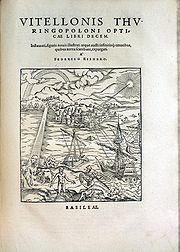
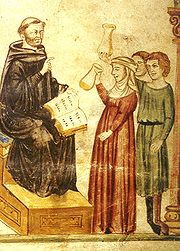
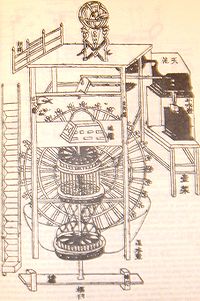
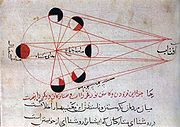

Science and technology
- List of 11th century inventions
- Early 11th century - Fan KuanFan KuanFan Kuan was a Chinese landscape painter of the Song Dynasty considered among the great masters of the tenth and eleventh centuries. Almost no biographical details survive about him. He modeled his early work after that of the artist Li Cheng , but later he concluded that nature was the only...
paints Travelers among Mountains and Streams. Northern Song dynasty. It is now kept at National Palace MuseumNational Palace MuseumThe National Palace Museum is an art museum in Taipei. It is the national museum of the Republic of China, and has a permanent collection of over 677,687 pieces of ancient Chinese artifacts and artworks, making it one of the largest in the world. The collection encompasses over 8,000 years of...
, TaipeiTaipeiTaipei City is the capital of the Republic of China and the central city of the largest metropolitan area of Taiwan. Situated at the northern tip of the island, Taipei is located on the Tamsui River, and is about 25 km southwest of Keelung, its port on the Pacific Ocean...
, TaiwanTaiwanTaiwan , also known, especially in the past, as Formosa , is the largest island of the same-named island group of East Asia in the western Pacific Ocean and located off the southeastern coast of mainland China. The island forms over 99% of the current territory of the Republic of China following...
. - c. 1000–Abu al-Qasim al-Zahrawi (Abulcasis) of al-AndalusAl-AndalusAl-Andalus was the Arabic name given to a nation and territorial region also commonly referred to as Moorish Iberia. The name describes parts of the Iberian Peninsula and Septimania governed by Muslims , at various times in the period between 711 and 1492, although the territorial boundaries...
, considered a "father of modern surgerySurgerySurgery is an ancient medical specialty that uses operative manual and instrumental techniques on a patient to investigate and/or treat a pathological condition such as disease or injury, or to help improve bodily function or appearance.An act of performing surgery may be called a surgical...
", publishes his influential 30-volume Arabic medicalIslamic medicineIn the history of medicine, Islamic medicine, Arabic medicine or Arabian medicine refers to medicine developed in the Islamic Golden Age, and written in Arabic, the lingua franca of Islamic civilization....
encyclopedia, the Al-TasrifAl-TasrifThe Kitab al-Tasrif was an Arabic encyclopedia on medicine and surgery, written near the year 1000 by Abu al-Qasim al-Zahrawi...
, - c. 1000–Ibn YunusIbn YunusIbn Yunus was an important Egyptian Muslim astronomer and mathematician, whose works are noted for being ahead of their time, having been based on meticulous calculations and attention to detail.The crater Ibn Yunus on the Moon is named after...
of EgyptEgyptEgypt , officially the Arab Republic of Egypt, Arabic: , is a country mainly in North Africa, with the Sinai Peninsula forming a land bridge in Southwest Asia. Egypt is thus a transcontinental country, and a major power in Africa, the Mediterranean Basin, the Middle East and the Muslim world...
publishes his astronomical treatise Al-Zij al-Hakimi al-Kabir. - c. 1000 Abu Sahl al-Quhi (Kuhi)
- c. 1000 – Abu-Mahmud al-Khujandi
- c. 1000–Law of sinesLaw of sinesIn trigonometry, the law of sines is an equation relating the lengths of the sides of an arbitrary triangle to the sines of its angles...
is discovered by Muslim mathematiciansIslamic mathematicsIn the history of mathematics, mathematics in medieval Islam, often termed Islamic mathematics or Arabic mathematics, covers the body of mathematics preserved and developed under the Islamic civilization between circa 622 and 1600...
, but it is uncertain who discovers it first between Abu-Mahmud al-Khujandi, Abu Nasr MansurAbu Nasr MansurAbu Nasr Mansur ibn Ali ibn Iraq was a Persian Muslim mathematician. He is well known for his work with the spherical sine law....
, and Abu al-Wafa. - c. 1000 – Ammar ibn Ali al-Mawsili
- 1000–1048 – Abū Rayhān al-Bīrūnī of Persia writes more than a hundred books on many different topics.
- 1001–1100 – the demands of the Chinese iron industry for charcoalCharcoalCharcoal is the dark grey residue consisting of carbon, and any remaining ash, obtained by removing water and other volatile constituents from animal and vegetation substances. Charcoal is usually produced by slow pyrolysis, the heating of wood or other substances in the absence of oxygen...
led to a huge amount of deforestationDeforestationDeforestation is the removal of a forest or stand of trees where the land is thereafter converted to a nonforest use. Examples of deforestation include conversion of forestland to farms, ranches, or urban use....
, which was curbed when the Chinese discovered how to use bituminous coalBituminous coalBituminous coal or black coal is a relatively soft coal containing a tarlike substance called bitumen. It is of higher quality than lignite coal but of poorer quality than Anthracite...
in smelting cast ironCast ironCast iron is derived from pig iron, and while it usually refers to gray iron, it also identifies a large group of ferrous alloys which solidify with a eutectic. The color of a fractured surface can be used to identify an alloy. White cast iron is named after its white surface when fractured, due...
and steelSteelSteel is an alloy that consists mostly of iron and has a carbon content between 0.2% and 2.1% by weight, depending on the grade. Carbon is the most common alloying material for iron, but various other alloying elements are used, such as manganese, chromium, vanadium, and tungsten...
, thus sparing thousands of acres of prime timberland. - 1003 – Pope Sylvester II, born Gerbert d'Aurillac, dies; however, his teaching continued to influence those of the 11th century; his works included a book on arithmeticArithmeticArithmetic or arithmetics is the oldest and most elementary branch of mathematics, used by almost everyone, for tasks ranging from simple day-to-day counting to advanced science and business calculations. It involves the study of quantity, especially as the result of combining numbers...
, a study of the Hindu-Arabic numeral systemHindu-Arabic numeral systemThe Hindu–Arabic numeral system or Hindu numeral system is a positional decimal numeral system developed between the 1st and 5th centuries by Indian mathematicians, adopted by Persian and Arab mathematicians , and spread to the western world...
, a hydraulicHydraulicsHydraulics is a topic in applied science and engineering dealing with the mechanical properties of liquids. Fluid mechanics provides the theoretical foundation for hydraulics, which focuses on the engineering uses of fluid properties. In fluid power, hydraulics is used for the generation, control,...
-powered organOrgan (music)The organ , is a keyboard instrument of one or more divisions, each played with its own keyboard operated either with the hands or with the feet. The organ is a relatively old musical instrument in the Western musical tradition, dating from the time of Ctesibius of Alexandria who is credited with...
, the reintroduction of the abacusAbacusThe abacus, also called a counting frame, is a calculating tool used primarily in parts of Asia for performing arithmetic processes. Today, abaci are often constructed as a bamboo frame with beads sliding on wires, but originally they were beans or stones moved in grooves in sand or on tablets of...
to Europe, and a possible treatise on the astrolabeAstrolabeAn astrolabe is an elaborate inclinometer, historically used by astronomers, navigators, and astrologers. Its many uses include locating and predicting the positions of the Sun, Moon, planets, and stars, determining local time given local latitude and longitude, surveying, triangulation, and to...
that was edited by Hermann of ReichenauHermann of ReichenauHermann of Reichenau , also called Hermannus Contractus or Hermannus Augiensis or Herman the Cripple, was an 11th century scholar, composer, music theorist, mathematician, and astronomer. He composed the Marian prayer Alma Redemptoris Mater...
five decades later. The contemporary monk Richer from Rheims described Gerbert's contributions in reintroducing the armillary sphereArmillary sphereAn armillary sphere is a model of objects in the sky , consisting of a spherical framework of rings, centred on Earth, that represent lines of celestial longitude and latitude and other astronomically important features such as the ecliptic...
that was lost to European science after the Greco-Roman era; from Richer's description, Gerbert's placement of the tropicsTropicsThe tropics is a region of the Earth surrounding the Equator. It is limited in latitude by the Tropic of Cancer in the northern hemisphere at approximately N and the Tropic of Capricorn in the southern hemisphere at S; these latitudes correspond to the axial tilt of the Earth...
was nearly exact and his placement of the equatorEquatorAn equator is the intersection of a sphere's surface with the plane perpendicular to the sphere's axis of rotation and containing the sphere's center of mass....
was exact. He reintroduced the liberal artsLiberal artsThe term liberal arts refers to those subjects which in classical antiquity were considered essential for a free citizen to study. Grammar, Rhetoric and Logic were the core liberal arts. In medieval times these subjects were extended to include mathematics, geometry, music and astronomy...
education system of trivium and quadriviumQuadriviumThe quadrivium comprised the four subjects, or arts, taught in medieval universities, after teaching the trivium. The word is Latin, meaning "the four ways" , and its use for the 4 subjects has been attributed to Boethius or Cassiodorus in the 6th century...
, which he had borrowed from the educational institution of Islamic CórdobaCórdoba, Spain-History:The first trace of human presence in the area are remains of a Neanderthal Man, dating to c. 32,000 BC. In the 8th century BC, during the ancient Tartessos period, a pre-urban settlement existed. The population gradually learned copper and silver metallurgy...
. Gerbert also studied and taught Islamic medicineIslamic medicineIn the history of medicine, Islamic medicine, Arabic medicine or Arabian medicine refers to medicine developed in the Islamic Golden Age, and written in Arabic, the lingua franca of Islamic civilization....
. - 1013 – One of the Four Great Books of SongFour Great Books of SongThe Four Great Books of Song was compiled by Li Fang and others during the Song Dynasty . The term was coined after the last book was finished during the 11th century...
, the Prime Tortoise of the Record BureauPrime Tortoise of the Record BureauThe Prime Tortoise of the Record Bureau was the largest encyclopedia compiled during the Chinese Song Dynasty . It was the last of the Four Great Books of Song, the previous three encyclopedias published in the 10th century....
compiled by 1013 was the largest of the Song Chinese encyclopediaEncyclopediaAn encyclopedia is a type of reference work, a compendium holding a summary of information from either all branches of knowledge or a particular branch of knowledge....
s. Divided into 1000 volumes, it consisted of 9.4 million written Chinese characters. - 1020 – Ibn Samh of Al-AndalusAl-AndalusAl-Andalus was the Arabic name given to a nation and territorial region also commonly referred to as Moorish Iberia. The name describes parts of the Iberian Peninsula and Septimania governed by Muslims , at various times in the period between 711 and 1492, although the territorial boundaries...
builds a gearGearA gear is a rotating machine part having cut teeth, or cogs, which mesh with another toothed part in order to transmit torque. Two or more gears working in tandem are called a transmission and can produce a mechanical advantage through a gear ratio and thus may be considered a simple machine....
ed mechanical astrolabeAstrolabeAn astrolabe is an elaborate inclinometer, historically used by astronomers, navigators, and astrologers. Its many uses include locating and predicting the positions of the Sun, Moon, planets, and stars, determining local time given local latitude and longitude, surveying, triangulation, and to...
, an example of an analog computerAnalog computerAn analog computer is a form of computer that uses the continuously-changeable aspects of physical phenomena such as electrical, mechanical, or hydraulic quantities to model the problem being solved...
. - 1021 – Ibn al-Haytham (Alhacen) of BasraBasraBasra is the capital of Basra Governorate, in southern Iraq near Kuwait and Iran. It had an estimated population of two million as of 2009...
, IraqIraqIraq ; officially the Republic of Iraq is a country in Western Asia spanning most of the northwestern end of the Zagros mountain range, the eastern part of the Syrian Desert and the northern part of the Arabian Desert....
writes his influential Book of OpticsBook of OpticsThe Book of Optics ; ; Latin: De Aspectibus or Opticae Thesaurus: Alhazeni Arabis; Italian: Deli Aspecti) is a seven-volume treatise on optics and other fields of study composed by the medieval Muslim scholar Alhazen .-See also:* Science in medieval Islam...
from 1011 to 1021 (while he was under house arrestHouse arrestIn justice and law, house arrest is a measure by which a person is confined by the authorities to his or her residence. Travel is usually restricted, if allowed at all...
in EgyptEgyptEgypt , officially the Arab Republic of Egypt, Arabic: , is a country mainly in North Africa, with the Sinai Peninsula forming a land bridge in Southwest Asia. Egypt is thus a transcontinental country, and a major power in Africa, the Mediterranean Basin, the Middle East and the Muslim world...
), - 1024 – The world's first paper-printed moneyBanknoteA banknote is a kind of negotiable instrument, a promissory note made by a bank payable to the bearer on demand, used as money, and in many jurisdictions is legal tender. In addition to coins, banknotes make up the cash or bearer forms of all modern fiat money...
can be traced back to the year 1024, in SichuanSichuan' , known formerly in the West by its postal map spellings of Szechwan or Szechuan is a province in Southwest China with its capital in Chengdu...
province of Song DynastySong DynastyThe Song Dynasty was a ruling dynasty in China between 960 and 1279; it succeeded the Five Dynasties and Ten Kingdoms Period, and was followed by the Yuan Dynasty. It was the first government in world history to issue banknotes or paper money, and the first Chinese government to establish a...
China. The Chinese government would step in and overtake this trend, issuing the central government's official banknote in the 1120s. - 1025 – AvicennaAvicennaAbū ʿAlī al-Ḥusayn ibn ʿAbd Allāh ibn Sīnā , commonly known as Ibn Sīnā or by his Latinized name Avicenna, was a Persian polymath, who wrote almost 450 treatises on a wide range of subjects, of which around 240 have survived...
of Persia publishes his influential treatise, The Canon of MedicineThe Canon of MedicineThe Canon of Medicine is an encyclopedia of Galenic medicine in five books compiled by Ibn Sīnā and completed in 1025. It presents a clear and organized summary of all the medical knowledge of the time...
, which remains the most influential medical textIslamic medicineIn the history of medicine, Islamic medicine, Arabic medicine or Arabian medicine refers to medicine developed in the Islamic Golden Age, and written in Arabic, the lingua franca of Islamic civilization....
in both Islamic and Christian lands for over six centuries, and The Book of HealingThe Book of HealingThe Book of Healing is a scientific and philosophical encyclopedia written by Abū Alī ibn Sīnā from Asfahana, near Bukhara in Greater Persia. Despite its English title, it is not in fact concerned with medicine...
, a scientific encyclopediaEncyclopediaAn encyclopedia is a type of reference work, a compendium holding a summary of information from either all branches of knowledge or a particular branch of knowledge....
. - 1027 – The Chinese engineer Yan Su recreates the mechanical compassCompassA compass is a navigational instrument that shows directions in a frame of reference that is stationary relative to the surface of the earth. The frame of reference defines the four cardinal directions – north, south, east, and west. Intermediate directions are also defined...
-vehicle of the South Pointing ChariotSouth Pointing ChariotThe south-pointing chariot was an ancient Chinese two-wheeled vehicle that carried a movable pointer to indicate the south, no matter how the chariot turned. Usually, the pointer took the form of a doll or figure with an outstretched arm...
, first invented by Ma JunMa JunMa Jun , style name Deheng , was a Chinese mechanical engineer and government official during the Three Kingdoms era of China...
in the 3rd century. - 1028–1087 – Abū Ishāq Ibrāhīm al-Zarqālī (Arzachel) builds the equatorium and universal latitude-independent astrolabeAstrolabeAn astrolabe is an elaborate inclinometer, historically used by astronomers, navigators, and astrologers. Its many uses include locating and predicting the positions of the Sun, Moon, planets, and stars, determining local time given local latitude and longitude, surveying, triangulation, and to...
. - 1031 – Abū Rayhān al-Bīrūnī writes Kitab al-qanun al-Mas'udi
- 1031–1095 – Chinese scientist Shen KuoShen KuoShen Kuo or Shen Gua , style name Cunzhong and pseudonym Mengqi Weng , was a polymathic Chinese scientist and statesman of the Song Dynasty...
creates a theory for land formation, or geomorphologyGeomorphologyGeomorphology is the scientific study of landforms and the processes that shape them...
, theorized that climate changeClimate changeClimate change is a significant and lasting change in the statistical distribution of weather patterns over periods ranging from decades to millions of years. It may be a change in average weather conditions or the distribution of events around that average...
occurred over time, discovers the concept of true northTrue northTrue north is the direction along the earth's surface towards the geographic North Pole.True geodetic north usually differs from magnetic north , and from grid north...
, improves the design of the astronomical sighting tube to view the polestar indefinitely, hypothesizes the retrogradationRetrogradationRetrogradation is the term for the landward change in position of the front of a river delta with time. This occurs when the mass balance of sediment into the delta is such that the volume of incoming sediment is less than the volume of the delta that is lost through subsidence, sea-level rise,...
theory of planetary motion, and by observing lunar eclipseLunar eclipseA lunar eclipse occurs when the Moon passes behind the Earth so that the Earth blocks the Sun's rays from striking the Moon. This can occur only when the Sun, Earth, and Moon are aligned exactly, or very closely so, with the Earth in the middle. Hence, a lunar eclipse can only occur the night of a...
and solar eclipseSolar eclipseAs seen from the Earth, a solar eclipse occurs when the Moon passes between the Sun and the Earth, and the Moon fully or partially blocks the Sun as viewed from a location on Earth. This can happen only during a new moon, when the Sun and the Moon are in conjunction as seen from Earth. At least...
he hypothesized that the sun and moon were spherical. Shen Kuo also experimented with camera obscuraCamera obscuraThe camera obscura is an optical device that projects an image of its surroundings on a screen. It is used in drawing and for entertainment, and was one of the inventions that led to photography. The device consists of a box or room with a hole in one side...
just decades after Ibn al-Haitham, although Shen was the first to treat it with quantitativeQuantitative propertyA quantitative property is one that exists in a range of magnitudes, and can therefore be measured with a number. Measurements of any particular quantitative property are expressed as a specific quantity, referred to as a unit, multiplied by a number. Examples of physical quantities are distance,...
attributes. He also took an interdisciplinaryInterdisciplinarityInterdisciplinarity involves the combining of two or more academic fields into one single discipline. An interdisciplinary field crosses traditional boundaries between academic disciplines or schools of thought, as new needs and professions have emerged....
approach to studies in archaeologyArchaeologyArchaeology, or archeology , is the study of human society, primarily through the recovery and analysis of the material culture and environmental data that they have left behind, which includes artifacts, architecture, biofacts and cultural landscapes...
. - 1041–1048 – Artisan Bi ShengBi ShengBì Shēng was the inventor of the first known movable type technology. Bi Sheng's system was made of Chinese porcelain and was invented between 1041 and 1048 in China.-Movable type printing:...
of Song DynastySong DynastyThe Song Dynasty was a ruling dynasty in China between 960 and 1279; it succeeded the Five Dynasties and Ten Kingdoms Period, and was followed by the Yuan Dynasty. It was the first government in world history to issue banknotes or paper money, and the first Chinese government to establish a...
China invents movable typeMovable typeMovable type is the system of printing and typography that uses movable components to reproduce the elements of a document ....
printing using individual ceramic characters. - Mid 11th century – Harbaville TriptychHarbaville TriptychThe Harbaville Triptych is a Byzantine ivory triptych of the middle of the 10th century AD with a Deesis and other saints, now in the Louvre. Traces of colouring can still be seen on some figures...
, is made. It is now kept at Musée du Louvre, ParisParisParis is the capital and largest city in France, situated on the river Seine, in northern France, at the heart of the Île-de-France region...
. - Mid-11th century - Xu DaoningXu DaoningXu Daoning was a Chinese painter of the Northern Song Dynasty from Changan or Hejian . He started out life by selling medicine prescriptions in Kaifeng. While selling prescriptions, he also began painting nature scenes in the style of Li Cheng. After gaining popularity he took up painting...
paints Fishing in a Mountain Stream. Northern Song dynasty. It is now kept at The Nelson-Atkins Museum of ArtNelson-Atkins Museum of ArtThe Nelson-Atkins Museum of Art is an art museum in Kansas City, Missouri, known for its neoclassical architecture and extensive collection of Asian art....
, Kansas CityKansas City, MissouriKansas City, Missouri is the largest city in the U.S. state of Missouri and is the anchor city of the Kansas City Metropolitan Area, the second largest metropolitan area in Missouri. It encompasses in parts of Jackson, Clay, Cass, and Platte counties...
, Missouri. - 1068 – First known use of the drydock in China.
- 1070 – With a team of scholars, the Chinese official Su SongSu SongSu Song was a renowned Chinese polymath who specialized himself as a statesman, astronomer, cartographer, horologist, pharmacologist, mineralogist, zoologist, botanist, mechanical and architectural engineer, poet, antiquarian, and ambassador of the Song Dynasty .Su Song was the engineer of a...
also published the Ben Cao Tu Jing in 1070, a treatise on pharmacologyPharmacologyPharmacology is the branch of medicine and biology concerned with the study of drug action. More specifically, it is the study of the interactions that occur between a living organism and chemicals that affect normal or abnormal biochemical function...
, botanyBotanyBotany, plant science, or plant biology is a branch of biology that involves the scientific study of plant life. Traditionally, botany also included the study of fungi, algae and viruses...
, zoologyZoologyZoology |zoölogy]]), is the branch of biology that relates to the animal kingdom, including the structure, embryology, evolution, classification, habits, and distribution of all animals, both living and extinct...
, metallurgyMetallurgyMetallurgy is a domain of materials science that studies the physical and chemical behavior of metallic elements, their intermetallic compounds, and their mixtures, which are called alloys. It is also the technology of metals: the way in which science is applied to their practical use...
, and mineralogyMineralogyMineralogy is the study of chemistry, crystal structure, and physical properties of minerals. Specific studies within mineralogy include the processes of mineral origin and formation, classification of minerals, their geographical distribution, as well as their utilization.-History:Early writing...
. Some of the drug concoctions in Su's book included ephedrineEphedrineEphedrine is a sympathomimetic amine commonly used as a stimulant, appetite suppressant, concentration aid, decongestant, and to treat hypotension associated with anaesthesia....
, mica mineralsMicaThe mica group of sheet silicate minerals includes several closely related materials having highly perfect basal cleavage. All are monoclinic, with a tendency towards pseudohexagonal crystals, and are similar in chemical composition...
, and linaceaeLinaceaeThe Linaceae is a family of flowering plants. The family is cosmopolitan, and includes approximately 250 species. There are 14 genera, classified into two subfamilies: Linoideae and Hugonioideae ....
. - 1075 – the Song Chinese innovate a partial decarbonization method of repreated forging of cast iron under a cold blast that Hartwell and Needham consider to be a predecessor to the 18th century Bessemer processBessemer processThe Bessemer process was the first inexpensive industrial process for the mass-production of steel from molten pig iron. The process is named after its inventor, Henry Bessemer, who took out a patent on the process in 1855. The process was independently discovered in 1851 by William Kelly...
. - 1077 – Constantine the AfricanConstantine the AfricanConstantine the African was a Tunisian doctor of the eleventh century. The first part of his life was spent in Tunisia and the rest in Italy. In Salerno, Italy, he became a professor of medicine and his work attracted widespread attention...
introduces ancient Greek medicine to the Schola Medica SalernitanaSchola Medica SalernitanaThe Schola Medica Salernitana was the first medieval medical school in the cosmopolitan coastal south Italian city of Salerno, which provided the most important source of medical knowledge in Western Europe at the time...
in SalernoSalernoSalerno is a city and comune in Campania and is the capital of the province of the same name. It is located on the Gulf of Salerno on the Tyrrhenian Sea....
, Italy. - c. 1080 – the Liber pantegniLiber pantegniThe Liber pantegni is a medieval medical text compiled by Constantinus Africanus in ca. the 1080s, ascribed to Isaac Israeli ben Solomon . It is a compendium of Hellenistic and Islamic medicine, in large parts a translation of the kitab al-malaki "royal book" of Ali ibn al-Abbas...
, a compendium of Hellenistic and Islamic medicineIslamic medicineIn the history of medicine, Islamic medicine, Arabic medicine or Arabian medicine refers to medicine developed in the Islamic Golden Age, and written in Arabic, the lingua franca of Islamic civilization....
, is written in Italy by the Carthaginian Christian Constantine the AfricanConstantine the AfricanConstantine the African was a Tunisian doctor of the eleventh century. The first part of his life was spent in Tunisia and the rest in Italy. In Salerno, Italy, he became a professor of medicine and his work attracted widespread attention...
, paraphrasing translated passages from the Kitab al-malaki of Ali ibn Abbas al-MajusiAli ibn Abbas al-MajusiAli ibn al-'Abbas al-Majusi , also known as Masoudi, or Latinized as Haly Abbas, was a Persian physician and psychologist most famous for the Kitab al-Maliki or Complete Book of the Medical Art, his textbook on medicine and psychology.-Biography:He was born in Ahvaz, southwestern Persia, and...
as well as other Arabic texts. - 1088 – As written by Shen KuoShen KuoShen Kuo or Shen Gua , style name Cunzhong and pseudonym Mengqi Weng , was a polymathic Chinese scientist and statesman of the Song Dynasty...
in his Dream Pool EssaysDream Pool EssaysThe Dream Pool Essays was an extensive book written by the polymath Chinese scientist and statesman Shen Kuo by 1088 AD, during the Song Dynasty of China...
, the earlier 10th century invention of the pound lock in China allows large ships to travel along canals without laborious hauling, thus allowing smooth travel of government ships holding cargo of up to 700 tan (49½ tonTonThe ton is a unit of measure. It has a long history and has acquired a number of meanings and uses over the years. It is used principally as a unit of weight, and as a unit of volume. It can also be used as a measure of energy, for truck classification, or as a colloquial term.It is derived from...
s) and large privately owned-ships holding cargo of up to 1600 tan (113 tonTonThe ton is a unit of measure. It has a long history and has acquired a number of meanings and uses over the years. It is used principally as a unit of weight, and as a unit of volume. It can also be used as a measure of energy, for truck classification, or as a colloquial term.It is derived from...
s). - 1094 – The Chinese mechanical engineer and astronomer Su SongSu SongSu Song was a renowned Chinese polymath who specialized himself as a statesman, astronomer, cartographer, horologist, pharmacologist, mineralogist, zoologist, botanist, mechanical and architectural engineer, poet, antiquarian, and ambassador of the Song Dynasty .Su Song was the engineer of a...
incorporates an escapementEscapementIn mechanical watches and clocks, an escapement is a device that transfers energy to the timekeeping element and enables counting the number of oscillations of the timekeeping element...
mechanism and the world's first known chain driveChain driveChain drive is a way of transmitting mechanical power from one place to another. It is often used to convey power to the wheels of a vehicle, particularly bicycles and motorcycles...
to operate the armillary sphereArmillary sphereAn armillary sphere is a model of objects in the sky , consisting of a spherical framework of rings, centred on Earth, that represent lines of celestial longitude and latitude and other astronomically important features such as the ecliptic...
, the astronomical clockAstronomical clockAn astronomical clock is a clock with special mechanisms and dials to display astronomical information, such as the relative positions of the sun, moon, zodiacal constellations, and sometimes major planets.-Definition:...
, and the striking clockStriking clockA striking clock is a clock that sounds the hours audibly on a bell or gong. In 12 hour striking, used most commonly in striking clocks today, the clock strikes once at 1 AM, twice at 2 AM, continuing in this way up to twelve times at 12 noon, then starts over, striking once at 1 PM, twice at 2...
jacks of his clock towerClock towerA clock tower is a tower specifically built with one or more clock faces. Clock towers can be either freestanding or part of a church or municipal building such as a town hall. Some clock towers are not true clock towers having had their clock faces added to an already existing building...
in KaifengKaifengKaifeng , known previously by several names , is a prefecture-level city in east-central Henan province, Central China. Nearly 5 million people live in the metropolitan area...
. - By the 11th century, every city in the Islamic world had BimaristanBimaristanBimaristan is a Persian word meaning hospital, with Bimar- from Middle Persian of vīmār or vemār, meaning "sick" plus -stan as location and place suffix...
s, the first hospitalHospitalA hospital is a health care institution providing patient treatment by specialized staff and equipment. Hospitals often, but not always, provide for inpatient care or longer-term patient stays....
s in the modern sense, after they began receiving funds from the WaqfWaqfA waqf also spelled wakf formally known as wakf-alal-aulad is an inalienable religious endowment in Islamic law, typically denoting a building or plot of land for Muslim religious or charitable purposes. The donated assets are held by a charitable trust...
instititions, the first charitable trustCharitable trustA charitable trust is an irrevocable trust established for charitable purposes, and is a more specific term than "charitable organization".-United States:...
s. - By the 11th century industrial fullingFullingFulling or tucking or walking is a step in woolen clothmaking which involves the cleansing of cloth to eliminate oils, dirt, and other impurities, and making it thicker. The worker who does the job is a fuller, tucker, or walker...
mills, gristmillGristmillThe terms gristmill or grist mill can refer either to a building in which grain is ground into flour, or to the grinding mechanism itself.- Early history :...
s, hullerHullerA rice huller or rice husker is an agricultural machine used to automate the process of removing the chaff and the outer husks of rice grain. Throughout history, there have been numerous techniques to hull rice. Traditionally, it would be pounded using some form of mortar and pestle. Machinery...
s, sawmillSawmillA sawmill is a facility where logs are cut into boards.-Sawmill process:A sawmill's basic operation is much like those of hundreds of years ago; a log enters on one end and dimensional lumber exits on the other end....
s, shipmills, stamp millStamp millA stamp mill is a type of mill machine that crushes material by pounding rather than grinding, either for further processing or for extraction of metallic ores. Breaking material down is a type of unit operation....
s, steel millSteel millA steel mill or steelworks is an industrial plant for the manufacture of steel.Steel is an alloy of iron and carbon. It is produced in a two-stage process. First, iron ore is reduced or smelted with coke and limestone in a blast furnace, producing molten iron which is either cast into pig iron or...
s, sugar millsSugar refineryA sugar refinery is a factory which refines raw sugar.Many cane sugar mills produce raw sugar, i.e. sugar with more colour and therefore more impurities than the white sugar which is normally consumed in households and used as an ingredient in soft drinks, cookies and so forth...
, tide millTide millA tide mill is a water mill driven by tidal rise and fall. A dam with a sluice is created across a suitable tidal inlet, or a section of river estuary is made into a reservoir. As the tide comes in, it enters the mill pond through a one way gate, and this gate closes automatically when the tide...
s and windmillWindmillA windmill is a machine which converts the energy of wind into rotational energy by means of vanes called sails or blades. Originally windmills were developed for milling grain for food production. In the course of history the windmill was adapted to many other industrial uses. An important...
s in operation. - In Europe, the introduction of the horizontal loomLoomA loom is a device used to weave cloth. The basic purpose of any loom is to hold the warp threads under tension to facilitate the interweaving of the weft threads...
operated by foot-treadles makes weavingWeavingWeaving is a method of fabric production in which two distinct sets of yarns or threads are interlaced at right angles to form a fabric or cloth. The other methods are knitting, lace making and felting. The longitudinal threads are called the warp and the lateral threads are the weft or filling...
faster and more efficient.
Literature
_001.jpg)
- 1000 – The Remaining Signs of Past CenturiesThe Remaining Signs of Past CenturiesThe Remaining Signs of Past Centuries also known as Chronology of Ancient Nations or Vestiges of the Past, after the translation published by Eduard Sachau in 1879) by Abū Rayhān al-Bīrūnī, is a comparative study of calendars of different cultures and civilizations, interlaced with mathematical,...
is written by Abū Rayhān al-Bīrūnī. - c. 1000 – The Al-TasrifAl-TasrifThe Kitab al-Tasrif was an Arabic encyclopedia on medicine and surgery, written near the year 1000 by Abu al-Qasim al-Zahrawi...
is written by the Andalusian physician and scientist Abu al-Qasim al-Zahrawi (Abulcasis). - c. 1000 – The Zij al-Kabir al-Hakimi is written by the Egyptian astronomer Ibn YunusIbn YunusIbn Yunus was an important Egyptian Muslim astronomer and mathematician, whose works are noted for being ahead of their time, having been based on meticulous calculations and attention to detail.The crater Ibn Yunus on the Moon is named after...
. - 1000–1037 – Hayy ibn YaqdhanHayy ibn YaqdhanḤayy ibn Yaqẓān is an Arabic philosophical novel and allegorical tale written by Ibn Tufail in the early 12th century.- Translations :* from Wikisource* English translations of Hayy bin Yaqzan...
is written by AvicennaAvicennaAbū ʿAlī al-Ḥusayn ibn ʿAbd Allāh ibn Sīnā , commonly known as Ibn Sīnā or by his Latinized name Avicenna, was a Persian polymath, who wrote almost 450 treatises on a wide range of subjects, of which around 240 have survived...
. - 1008 – The Leningrad CodexLeningrad CodexThe Leningrad Codex is the oldest complete manuscript of the Hebrew Bible in Hebrew, using the masoretic text and Tiberian vocalization. It is dated AD 1008 according to its colophon...
, one of the oldest full manuscripts of the Hebrew BibleHebrew BibleThe Hebrew Bible is a term used by biblical scholars outside of Judaism to refer to the Tanakh , a canonical collection of Jewish texts, and the common textual antecedent of the several canonical editions of the Christian Old Testament...
, is completed. - c. 1010 – The oldest known copy of the epic poem BeowulfBeowulfBeowulf , but modern scholars agree in naming it after the hero whose life is its subject." of an Old English heroic epic poem consisting of 3182 alliterative long lines, set in Scandinavia, commonly cited as one of the most important works of Anglo-Saxon literature.It survives in a single...
was written around this year. - 1013 – The Prime Tortoise of the Record BureauPrime Tortoise of the Record BureauThe Prime Tortoise of the Record Bureau was the largest encyclopedia compiled during the Chinese Song Dynasty . It was the last of the Four Great Books of Song, the previous three encyclopedias published in the 10th century....
, a Chinese encyclopedia, is completed by a team of scholars including Wang Qinruo. - 1020 – The Bamberg ApocalypseBamberg ApocalypseThe Bamberg Apocalypse is an 11th century richly illuminated manuscript containing the Book of Revelation and a Gospel Lectionary....
commissioned by Otto III is completed. - 1021 – Lady Murasaki ShikibuMurasaki ShikibuMurasaki Shikibu was a Japanese novelist, poet and lady-in-waiting at the Imperial court during the Heian period. She is best known as the author of The Tale of Genji, written in Japanese between about 1000 and 1012...
writes her JapaneseJapanese literatureEarly works of Japanese literature were heavily influenced by cultural contact with China and Chinese literature, often written in Classical Chinese. Indian literature also had an influence through the diffusion of Buddhism in Japan...
novel, The Tale of GenjiThe Tale of Genjiis a classic work of Japanese literature attributed to the Japanese noblewoman Murasaki Shikibu in the early 11th century, around the peak of the Heian period. It is sometimes called the world's first novel, the first modern novel, the first psychological novel or the first novel still to be...
, which is regarded as the first full-length novelNovelA novel is a book of long narrative in literary prose. The genre has historical roots both in the fields of the medieval and early modern romance and in the tradition of the novella. The latter supplied the present generic term in the late 18th century....
. - 1021 – The Book of OpticsBook of OpticsThe Book of Optics ; ; Latin: De Aspectibus or Opticae Thesaurus: Alhazeni Arabis; Italian: Deli Aspecti) is a seven-volume treatise on optics and other fields of study composed by the medieval Muslim scholar Alhazen .-See also:* Science in medieval Islam...
by Ibn al-Haytham (Alhazen or Alhacen) is completed. - 1025 – The Canon of MedicineThe Canon of MedicineThe Canon of Medicine is an encyclopedia of Galenic medicine in five books compiled by Ibn Sīnā and completed in 1025. It presents a clear and organized summary of all the medical knowledge of the time...
by AvicennaAvicennaAbū ʿAlī al-Ḥusayn ibn ʿAbd Allāh ibn Sīnā , commonly known as Ibn Sīnā or by his Latinized name Avicenna, was a Persian polymath, who wrote almost 450 treatises on a wide range of subjects, of which around 240 have survived...
(Ibn Sina) is completed. - 1027 – The Book of HealingThe Book of HealingThe Book of Healing is a scientific and philosophical encyclopedia written by Abū Alī ibn Sīnā from Asfahana, near Bukhara in Greater Persia. Despite its English title, it is not in fact concerned with medicine...
is published by AvicennaAvicennaAbū ʿAlī al-Ḥusayn ibn ʿAbd Allāh ibn Sīnā , commonly known as Ibn Sīnā or by his Latinized name Avicenna, was a Persian polymath, who wrote almost 450 treatises on a wide range of subjects, of which around 240 have survived...
. - 1037 – The JiyunJiyunThe Jiyun is a Chinese rime dictionary published in 1037 during the Song Dynasty. The chief editor Ding Du and others expanded and revised the Guangyun. It is possible, according to Teng and Biggerstaff , that Sima Guang completed the text in 1067...
, a Chinese rime dictionaryRime dictionarythumb|upright=1.0|A page from Shiyun Hebi , a rime dictionary of the [[Qing Dynasty]]A rime dictionary, rhyme dictionary, or rime book is an ancient type of Chinese dictionary used for writing poetry or other genres requiring rhymes. A rime dictionary focuses on pronunciation and collates...
, is published by Ding Du and expanded by later scholars. - 1037 – Birth of the Chinese poet Su ShiSu ShiSu Shi , was a writer, poet, artist, calligrapher, pharmacologist, gastronome, and statesman of the Song Dynasty, and one of the major poets of the Song era. His courtesy name was Zizhan and his pseudonym was Dongpo Jushi , and he is often referred to as Su Dongpo...
, one of the renowned poets of the Song Dynasty, who also penned works of travel literatureTravel literatureTravel literature is travel writing of literary value. Travel literature typically records the experiences of an author touring a place for the pleasure of travel. An individual work is sometimes called a travelogue or itinerary. Travel literature may be cross-cultural or transnational in focus, or...
. - 1044 – The Wujing ZongyaoWujing ZongyaoThe Wujing Zongyao was a Chinese military compendium written in 1044 AD, during the Northern Song Dynasty. Its authors were the prominent scholars Zeng Gongliang , Ding Du , and Yang Weide , whose writing influenced many later Chinese military writers. The book covered a wide range of subjects,...
military manuscript is completed by Chinese scholars Zeng Gongliang, Ding Du, and Yang Weide. - 1048–1100 – The Rubaiyat of Omar KhayyamRubaiyat of Omar KhayyamThe Rubáiyát of Omar Khayyám is the title that Edward FitzGerald gave to his translation of a selection of poems, originally written in Persian and of which there are about a thousand, attributed to Omar Khayyám , a Persian poet, mathematician and astronomer...
is written by Omar KhayyamOmar KhayyámOmar Khayyám was aPersian polymath: philosopher, mathematician, astronomer and poet. He also wrote treatises on mechanics, geography, mineralogy, music, climatology and theology....
sometime after 1048. - 1049 – The Record of Tea is written by Chinese official Cai XiangCai XiangCai Xiang was a Chinese calligrapher, scholar, official, structural engineer, and poet. Cai Xiang had the reputation as the greatest calligrapher in the Song Dynasty.- Life :...
- 1052 – The Uji Dainagon MonogatariUji Dainagon Monogatariwas a collection of stories said to have been written by Minamoto no Takakuni in the late Heian period. These stories heavily influenced Japanese literature, and later turned up in such works as the Konjaku Monogatarishū and the Uji Shūi Monogatari....
, a collection of stories allegedly penned by Minamoto-no-TakakuniMinamoto-no-Takakuni, also known as , was a noble and a scholar of ancient Japan. He was also the father of Toba Sōjō.- References :*Kōjien, 6th edition....
, is written sometime between now and 1077. - 1053 – The New History of the Five DynastiesNew History of the Five DynastiesThe New History of the Five Dynasties is a history of the Five Dynasties and Ten Kingdoms period of Chinese history. It was written by the Song Dynasty official Ouyang Xiu and completed in 1053...
by Chinese official Ouyang XiuOuyang XiuOuyang Xiu was a Chinese statesman, historian, essayist and poet of the Song Dynasty. He is also known by his courtesy name of Yongshu, and was also self nicknamed The Old Drunkard 醉翁, or Householder of the One of Six 六一居士 in his old age...
is completed. - 1054 – Russian legal codeLegal codeA legal code is a body of law written by a governmental body, such as a U.S. state, a Canadian Province or German Bundesland or a municipality...
of the Russkaya PravdaRusskaya PravdaRusskaya Pravda was the legal code of Kievan Rus' and the subsequent Rus' principalities during the times of feudal division.In spite of great influence of Byzantine legislation on the contemporary world, and in...
is created during the reign of Yaroslav I the WiseYaroslav I the WiseYaroslav I, Grand Prince of Rus, known as Yaroslav the Wise Yaroslav I, Grand Prince of Rus, known as Yaroslav the Wise Yaroslav I, Grand Prince of Rus, known as Yaroslav the Wise (Old Norse: Jarizleifr; ; Old East Slavic and Russian: Ярослав Мудрый; Ukrainian: Ярослав Мудрий; c...
. - 1057 – The Ostromir Gospels of Novgorod are written.
- 1060 – compilation of the New Book of TangNew Book of TangThe New Book of Tang , is a classic work of history about the Tang Dynasty edited by Ouyang Xiu and Song Qi and other official scholars of the Song Dynasty. The emperor called for a revision of the former Book of Tang in 1044. The New Book was presented to the throne in 1060. It was given its...
, edited by Chinese official Ouyang XiuOuyang XiuOuyang Xiu was a Chinese statesman, historian, essayist and poet of the Song Dynasty. He is also known by his courtesy name of Yongshu, and was also self nicknamed The Old Drunkard 醉翁, or Householder of the One of Six 六一居士 in his old age...
, is complete. - 1060 – the Mugni Gospels of Armenia are written in illuminated manuscript form.
- 1068 – The Book of Roads and KingdomsBook of Roads and Kingdoms (al-Bakri)Book of Roads and Kingdoms or Book of Highways and Kingdoms is the name of an eleventh-century geography text by Abu Abdullah al-Bakri...
is written by Abū 'Ubayd 'Abd Allāh al-Bakrī. - 1070 – William I of EnglandWilliam I of EnglandWilliam I , also known as William the Conqueror , was the first Norman King of England from Christmas 1066 until his death. He was also Duke of Normandy from 3 July 1035 until his death, under the name William II...
commissioned the Norman monk William of JumiègesWilliam of JumiègesWilliam of Jumièges was a contemporary of the events of 1066, and one of our earliest writers on the subject of the Norman Conquest. He is himself a "shadowy figure", only known by his dedicatory letter to King William as a monk of Jumièges...
to extend the Gesta Normannorum DucumGesta Normannorum DucumGesta Normannorum Ducum is a chronicle originally created by the monk William of Jumièges just before 1060. In 1070 William I had William of Jumièges extend the work to detail his rights to the throne of England. In later times, Orderic Vitalis and Robert of Torigni Gesta Normannorum Ducum (Deeds...
chronicle. - 1078 – The ProslogionProslogionThe Proslogion, , written in 1077-1078, was written as a prayer, or meditation, by the medieval cleric Anselm which serves to reflect on the attributes of God and endeavours to explain how God can have qualities which often seem contradictory...
is written by Anselm of CanterburyAnselm of CanterburyAnselm of Canterbury , also called of Aosta for his birthplace, and of Bec for his home monastery, was a Benedictine monk, a philosopher, and a prelate of the church who held the office of Archbishop of Canterbury from 1093 to 1109...
. - 1080 – The Chinese poet Su ShiSu ShiSu Shi , was a writer, poet, artist, calligrapher, pharmacologist, gastronome, and statesman of the Song Dynasty, and one of the major poets of the Song era. His courtesy name was Zizhan and his pseudonym was Dongpo Jushi , and he is often referred to as Su Dongpo...
is exiled from court for writing poems criticizing the various reforms of the New Policies Group. - c. 1080 – the Liber pantegniLiber pantegniThe Liber pantegni is a medieval medical text compiled by Constantinus Africanus in ca. the 1080s, ascribed to Isaac Israeli ben Solomon . It is a compendium of Hellenistic and Islamic medicine, in large parts a translation of the kitab al-malaki "royal book" of Ali ibn al-Abbas...
is written by Constantine the AfricanConstantine the AfricanConstantine the African was a Tunisian doctor of the eleventh century. The first part of his life was spent in Tunisia and the rest in Italy. In Salerno, Italy, he became a professor of medicine and his work attracted widespread attention...
. - 1084 – The Zizhi TongjianZizhi TongjianThe Zizhi Tongjian was a pioneering reference work in Chinese historiography, published in 1084, under the form of a chronicles. In 1065 CE, Emperor Yingzong of Song ordered the great historian Sima Guang to lead with other scholars such as his chief assistants Liu Shu, Liu Ban and Fan Zuyu, the...
history is completed by Chinese official Sima GuangSima GuangSīmǎ Guāng was a Chinese historian, scholar, and high chancellor of the Song Dynasty, jinshi 1038.-Life, profession, and works:...
. - 1086 – The Domesday BookDomesday BookDomesday Book , now held at The National Archives, Kew, Richmond upon Thames in South West London, is the record of the great survey of much of England and parts of Wales completed in 1086...
is initiated by William I of EnglandWilliam I of EnglandWilliam I , also known as William the Conqueror , was the first Norman King of England from Christmas 1066 until his death. He was also Duke of Normandy from 3 July 1035 until his death, under the name William II...
. - 1088 – The Dream Pool EssaysDream Pool EssaysThe Dream Pool Essays was an extensive book written by the polymath Chinese scientist and statesman Shen Kuo by 1088 AD, during the Song Dynasty of China...
is completed by Shen KuoShen KuoShen Kuo or Shen Gua , style name Cunzhong and pseudonym Mengqi Weng , was a polymathic Chinese scientist and statesman of the Song Dynasty...
of Song China. - The roots of European ScholasticismScholasticismScholasticism is a method of critical thought which dominated teaching by the academics of medieval universities in Europe from about 1100–1500, and a program of employing that method in articulating and defending orthodoxy in an increasingly pluralistic context...
are found in this period, as the renewed spark of interest in literature and ClassicismClassicismClassicism, in the arts, refers generally to a high regard for classical antiquity, as setting standards for taste which the classicists seek to emulate. The art of classicism typically seeks to be formal and restrained: of the Discobolus Sir Kenneth Clark observed, "if we object to his restraint...
in Europe would bring about the RenaissanceRenaissanceThe Renaissance was a cultural movement that spanned roughly the 14th to the 17th century, beginning in Italy in the Late Middle Ages and later spreading to the rest of Europe. The term is also used more loosely to refer to the historical era, but since the changes of the Renaissance were not...
. In the 11th century, there were early Scholastic figures such as Anselm of CanterburyAnselm of CanterburyAnselm of Canterbury , also called of Aosta for his birthplace, and of Bec for his home monastery, was a Benedictine monk, a philosopher, and a prelate of the church who held the office of Archbishop of Canterbury from 1093 to 1109...
, Peter AbelardPeter AbelardPeter Abelard was a medieval French scholastic philosopher, theologian and preeminent logician. The story of his affair with and love for Héloïse has become legendary...
, Solomon ibn GabirolSolomon ibn GabirolSolomon ibn Gabirol, also Solomon ben Judah , was an Andalucian Hebrew poet and Jewish philosopher with a Neoplatonic bent. He was born in Málaga about 1021; died about 1058 in Valencia.-Biography:...
, Peter LombardPeter LombardPeter Lombard was a scholastic theologian and bishop and author of Four Books of Sentences, which became the standard textbook of theology, for which he is also known as Magister Sententiarum-Biography:Peter Lombard was born in Lumellogno , in...
, and Gilbert de la PorréeGilbert de la PorréeGilbert de la Porrée , also known as Gilbert of Poitiers, Gilbertus Porretanus or Pictaviensis, was a scholastic logician and theologian.-Life:...
. - The works of AristotleAristotleAristotle was a Greek philosopher and polymath, a student of Plato and teacher of Alexander the Great. His writings cover many subjects, including physics, metaphysics, poetry, theater, music, logic, rhetoric, linguistics, politics, government, ethics, biology, and zoology...
and some early Muslim scientistsIslamic scienceScience in the medieval Islamic world, also known as Islamic science or Arabic science, is the science developed and practised in the Islamic world during the Islamic Golden Age . During this time, Indian, Iranian and especially Greek knowledge was translated into Arabic...
are translated into LatinLatinLatin is an Italic language originally spoken in Latium and Ancient Rome. It, along with most European languages, is a descendant of the ancient Proto-Indo-European language. Although it is considered a dead language, a number of scholars and members of the Christian clergy speak it fluently, and...
from ArabicArabic languageArabic is a name applied to the descendants of the Classical Arabic language of the 6th century AD, used most prominently in the Quran, the Islamic Holy Book...
, shortly before the Latin translations of the 12th century. - The tittleTittleA tittle is a small distinguishing mark, such as a diacritic or the dot on a lowercase i or j. The tittle is an integral part of the glyph of i and j, but diacritic dots can appear over other letters in various languages...
was created. - TroubadourTroubadourA troubadour was a composer and performer of Old Occitan lyric poetry during the High Middle Ages . Since the word "troubadour" is etymologically masculine, a female troubadour is usually called a trobairitz....
s appear in what is now southern FranceFranceThe French Republic , The French Republic , The French Republic , (commonly known as France , is a unitary semi-presidential republic in Western Europe with several overseas territories and islands located on other continents and in the Indian, Pacific, and Atlantic oceans. Metropolitan France...
.