

Al-Hakim bi-Amr Allah

Encyclopedia
Abu ‘Ali Mansur Tāriqu l-Ḥākim, called Al-Hakim bi Amr al-Lāh , was the sixth Fatimid
caliph and 16th Ismaili
imam
(996–1021).
.
Arguably the most controversial member of the Fatimid dynasty, Hakim confronted numerous difficulties and uprisings during his relatively long reign. While he did not lose any important territories in North Africa
, the Ismaili communities there were attacked by Sunni fighters led by their influential Maliki
jurists. Relations between the Fatimids and the Qarmatians
of Bahrain also remained hostile. On the other hand, Hakim’s Syrian policy was successful as he managed to extend Fatimid hegemony to the emirate of Aleppo
. Above all, the persistent rivalries between the various factions of the Fatimid armies, especially the Berbers
and the Turks
, overshadowed the other problems of Hakim’s caliphate.
Initially, Barjawan, his wasita (the equivalent of a vizier
, as intermediary between ruler and subjects) acted as the virtual head of the Fatimid state. However, after the latter’s removal in 1000, Hakim held the reins of power in his own hands limiting the authority and terms of office of his wasitas and viziers, of whom there were more than 15 during the remaining 20 years of his caliphate. Also Al-Hakim is a central figure in the history of the Druze
religious sect.
As one prominent journal has noted, al-Ḥākim has attracted the interest of modern historians more than any other member of the Fatimid dynasty because of...
in 985 (375 A.H.
). His father, Caliph Abū Mansūr al-‘Azīz bil-Lāh
, had two consorts. One was an umm al-walad who is only known by the title as-Sayyidah al-‘Azīziyyah or al-‘Azīzah (d. 385/995). She was a Melkite
Christian whose two brothers were appointed patriarch
s of the Melkite
Church by Caliph al-‘Azīz. Different sources say either one of her brothers or her father was sent by al-‘Azīz as an ambassador to Sicily
.
Al-‘Azīzah is considered to be the mother of Sitt al-Mulk
, one of the most famous women in Islamic history, who had a stormy relationship with her half-brother al-Ḥākim and may have had him murdered. Some, such as the Crusader chronicler William of Tyre
, claimed that al-‘Azīzah was also the mother of Caliph al-Ḥākim, though most historians dismiss this. William of Tyre went so far as to claim that al-Ḥākim's destruction of the Church of the Holy Sepulchre in 1009 was due to his eagerness to disprove taunts that he was a Christian born of a Christian woman. By contrast, the chronicler al-Musabbihi recounts that in 981, al-Ḥākim's Muslim mother sought the aid of an imprisoned Islamic sage named ibn al-Washa and asked him to pray for her son who had fallen ill. The sage wrote the entire Qur'an
in the inner surface of a bowl and bade her wash her son out of it. When al-Ḥākim recovered, she demanded the release of the sage in gratitude. Her request was granted and the sage and his associates were freed from prison.
Druze sources claim that al-Ḥākim's mother was the daughter of ‘Abdu l-Lāh, one of al-Mu‘īzz li Dīn al-Lāh's sons and therefore al-‘Azīz's niece. Historians such as Delia Cortese are critical of this claim:
was the umm al-walad Amīna Ruqayya, daughter to the late prince ‘Abdu l-Lāh, son of al-Mu‘īzz. Some see her as the same as the woman in the prediction reported by al-Hamidi which held "that in 390/100 al-Ḥākim would choose an orphan girl of good stock brough up his father al-Aziz and that she would become the mother of his successor." While the chronicler al-Maqrizi claims that al-Ḥākim's stepsister Sitt al-Mulk was hostile to Amīna, other sources say she gave her and her child refuge when they were fleeing al-Ḥākim's persecution. Some sources say al-Ḥākim married the jariya (young female servant) known by the title as-Sayyidah but historians are unsure if this is just another name for Amīna.
Besides his son, al-Ḥākim had a daughter named Sitt Misr (d. 455/1063) who was said to be a generous patroness and of noble and good character.
(which was held by the Fatimids only by force of arms and was under pressure from both Byzantines and Turks). The Caliph fell ill at the beginning of the trip at Bilbeis
and lay in sickbed for several days. He suffered from "stone with pains in the bowels." When he felt that his end was nearing he charged Qadi
Muhammad ibn an-Nu‘man and General Abū Muhammad al-Hasan ibn ‘Ammar to take care of al-Ḥākim, who was then only eleven. He then spoke to his son. Al-Ḥākim later recalled the event: On the following day, he and his new court proceeded from Bilbays to Cairo, behind the camel bearing his father's body, and with the dead Caliph’s feet protruding from the litter. They arrived shortly before evening prayer and his father was buried the next evening next to the tomb of his predecessor al-Mu‘īzz. Al-Ḥākim was sworn in by Barjawan, a "white eunuch whom al-‘Azīz had appointed as Ustad 'tutor'."
Because it had been unclear whether he would inherit his father's position, this successful transfer of power was a demonstration of the stability of the Fatimid
dynasty.
) immediately seized the office of wasīta "chief minister" from ‘Īsa ibn Nestorius. At the time the office of sifāra "secretary of state" was also combined within that office. Ibn ‘Ammar then took the title of Amīn ad-Dawla "the one trusted in the empire". This was the first time that the term "empire" was associated with the Fatimid state.
 Al-Ḥākim's most rigorous and consistent opponent was the Abbāsid
Caliphate in Baghdad
, which sought to halt the influence of Ismailism. This competition led to the Baghdad Manifesto
of 1011, in which the Abbāsids claimed that the line al-Ḥākim represented did not legitimately descend from ‘Alī.
Al-Ḥākim also struggled with the Qarmatiyya rulers of Bahrain
, an island in the Persian Gulf
as well as territory in Eastern Arabia. His diplomatic and missionary vehicle was the Ismā'īlī
da‘wah
"Mission", with its organizational power center in Cairo
.
Al-Ḥākim's reign was characterized by a general unrest. The Fatimid army was troubled by a rivalry between two opposing factions, the Turks
and the Berbers
. Tension grew between the Caliph and his viziers (called wasītas), and near the end of his reign the Druze
movement, a religious sect centered around al-Ḥākim, began to form. Members of that sect are reported to address prayers to al-Ḥākim, whom they regard as "a manifestation of God in His unity."
adopted retaliatory measures to halt the spread of Ismailism within the very seat of his realm. In particular, in 1011 he assembled a number of Sunni and Twelver Shiite scholars at his court and commanded them to declare in a written document that Hakim and his predecessors lacked genuine Ali
and Fatima
related ancestry. This so-called Baghdad Manifesto
was read out in Friday mosques throughout the ‘Abbasid domains accusing the Fatimids of Jewish ancestry also because of Al-Hakim’s alleged Christian mother he was accused of over sympathizing with non-Muslims and that he gave them more privileges than they should have been given under Islamic rule such accusations where manifested through poetry criticizing the Fatimids and that eventually led to the persecution of non-Muslims from 1007 till 1012. Qadir also commissioned several refutations of Ismaili doctrines, including that written by the Mu‘tazili ‘Ali b. Sa‘id al-Istakri (1013).
and Persia. In Iraq, the da‘is now concentrated their efforts on a number of local amirs and influential tribal chiefs with whose support they aimed to uproot the Abbasids. Foremost among the Fatimid da‘is of this period operating in the eastern provinces was Hamid al-Din Kirmani, the most accomplished Ismaili theologian-philosopher of the entire Fatimid period. The activities of Kirmani and other da‘is soon led to concrete results in Iraq: in 1010 the ruler of Mosul
, Kufa
and other towns acknowledged the suzerainty of Hakim.
to philosophy
and astronomy
were taught at the Dar al-‘ilm, which was equipped with a vast library. Access to education was made available to the public and many Fatimid da‘is received at least part of their training in this major institution of learning which served the Ismaili da‘wa (mission) until the downfall of the Fatimid dynasty.
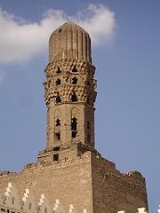
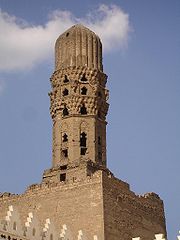
In 1013 he completed the mosque
in Cairo
begun by his father, the Masjid al-Hākim
"Hākim's Mosque" whose official name is "Jame-ul-Anwar". The mosque fell to ruins and was restored to its former glory some twenty years ago by Dr. Syedna Mohammed Burhanuddin
, after much research and expense.
, which had expansionary goals in the early 11th century. Perhaps the farthest reaching diplomatic mission of al-Ḥākim's was to Song Dynasty
era China
. The Fatimid Egyptian sea captain known as Domiyat traveled to a Buddhist site of pilgrimage in Shandong
in the year 1008 AD. It was on this mission that he sought to present to the Chinese Emperor Zhenzong of Song
gifts from his ruling Caliph al-Ḥākim. This reestablished diplomatic relations between Egypt and China that had been lost during the collapse of the Tang Dynasty
in 907.
Muslims, whereas the attitude toward 'People of the Book
' – Jews and Christians – was one of relative tolerance, in exchange for the jizya
tax."
In 1005, al-Ḥākim ordered a public posting of curses against the first three Caliphs (Abū Bakr
, ‘Umār
and ‘Uthmān ibn ‘Affān) and against ‘Ā'isha
(wife of Muhammad
) for denying caliphate to Muhammad's cousin and son-in-law ‘Alī. The founder of the Umayyad
caliphate, Mu‘awiyah I
, and others among the Ṣaḥābah
of Muhammad were also cursed. After only two years of posting the curses, al-Ḥākim ended the practice. During this era, al-Ḥākim ordered that the inclusion of the phrase as-salāh khayr min an-nawm "prayer is preferable to sleep", which followed the morning prayer
be stopped – he saw it as a Sunni addition. In its place he ordered that ḥayyi ‘alā khayr al-‘amal "come to the best of deeds" should be said after the summons was made. He further forbade the use of two prayers – Salāt at-Tarāwih and Salāt ad-Duha as they were believed to have been formulated by Sunni sages.
. He also outlawed the use of wine (nabidh) and even other intoxicating drinks not made from grapes (fuqa) to both Muslims and non-Muslims alike. This produced a hardship for both Christians (who used wine in their religious rites) and Jews (who used it in their religious festivals).
In 1005, al-Ḥākim ordered that Jews and Christians follow ghiyār "the law of differentiation" – in this case, the mintaq or zunnar "belt" (Greek ζοναριον) and ‘imāmah "turban", both in black. In addition, Jews must wear a wooden calf necklace and Christians an iron cross. In the public baths, Jews must replace the calf with a bell. In addition, women of the Ahl al-Kitab had to wear two different coloured shoes, one red and one black. These remained in place until 1014.
Following contemporary Shiite thinking, during this period al-Ḥākim also issued many other restrictive ordinances (sijillat). These sijill included outlawing entrance to a public bath with uncovered loins, forbidding women from appearing in public with their faces uncovered, and closing many clubs and places of entertainment.
and its associated buildings, apparently outraged by what he regarded as the fraud practiced by the monks in the "miraculous" Descent of the Holy Fire
, celebrated annually at the church during the Easter Vigil. The chronicler Yahia noted that "only those things that were too difficult to demolish were spared." Processions were prohibited, and a few years later all of the convents and churches in Palestine were said to have been destroyed or confiscated. It was only in 1042 that the Byzantine
Emperor
Constantine IX undertook to reconstruct the Holy Sepulchre with the permission of Al-Hakim's successor.
While it is clear that Hamza ibn Ahmad
was the Caliph's chief ; there are claims that believed in his own divinity. Other scholars disagree with this assertion of direct divinity, particularly the Druze themselves, noting that its proponent was ad-Darazi, who (according to some resources) al-Ḥākim executed for shirk. Letters show that ad-Darazi was trying to gain control of the Muwahhidun movement and this claim was an attempt to gain support from the Caliph, who instead found it heretical.
The Druze find this assertion offensive; they hold ad-Darazi as the first apostate of the sect and their beliefs regarding al-Ḥākim are complex. Following a typical Isma'ili pattern, they place a preeminent teacher at the innermost circle of divinely inspired persons. For the Druze, the exoteric is taught by the Prophet, the esoteric by his secret assistants, and the esoteric of the esoteric by Imām al-Ḥākim.
Confusion and slander by opponents of the Druze were generally left uncorrected as the teachings of the sect are secret and the Druze preferred taqiyya
when independence was impossible.
and withdrew for meditation regularly. On the night of 12/13 February 1021 and at the age of 36, Hakim left for one of his night journeys to the al-Muqattam hills outside of Cairo
, and never returned. A search found only his donkey and bloodstained garments. The disappearance has remained a mystery.
Al-Ḥākim was succeeded by his young son Ali az-Zahir
under the regency of his sister Sitt al-Mulk
.
Table showing all ismaili imam along with earlier islam along with caliphate of time and present follower :
) the French author Gérard de Nerval
who recounted his version of it (“Histoire du Calife Hakem”: History of the Caliph Hakem) as an appendix to his Voyage en Orient.
Fatimid
The Fatimid Islamic Caliphate or al-Fāṭimiyyūn was a Berber Shia Muslim caliphate first centered in Tunisia and later in Egypt that ruled over varying areas of the Maghreb, Sudan, Sicily, the Levant, and Hijaz from 5 January 909 to 1171.The caliphate was ruled by the Fatimids, who established the...
caliph and 16th Ismaili
Ismaili
' is a branch of Shia Islam. It is the second largest branch of Shia Islam, after the Twelvers...
imam
Imam
An imam is an Islamic leadership position, often the worship leader of a mosque and the Muslim community. Similar to spiritual leaders, the imam is the one who leads Islamic worship services. More often, the community turns to the mosque imam if they have a religious question...
(996–1021).
History
Born in 985, Abu ‘Ali “Mansur” succeeded his father Abū Mansūr Nizār al-Azīz (975–996) at the age of eleven on 14 October, 996 with the caliphal title of al-Hakim Bi-Amr Allah. He was the first Fatimid ruler to be born in EgyptEgypt
Egypt , officially the Arab Republic of Egypt, Arabic: , is a country mainly in North Africa, with the Sinai Peninsula forming a land bridge in Southwest Asia. Egypt is thus a transcontinental country, and a major power in Africa, the Mediterranean Basin, the Middle East and the Muslim world...
.
Arguably the most controversial member of the Fatimid dynasty, Hakim confronted numerous difficulties and uprisings during his relatively long reign. While he did not lose any important territories in North Africa
North Africa
North Africa or Northern Africa is the northernmost region of the African continent, linked by the Sahara to Sub-Saharan Africa. Geopolitically, the United Nations definition of Northern Africa includes eight countries or territories; Algeria, Egypt, Libya, Morocco, South Sudan, Sudan, Tunisia, and...
, the Ismaili communities there were attacked by Sunni fighters led by their influential Maliki
Maliki
The ' madhhab is one of the schools of Fiqh or religious law within Sunni Islam. It is the second-largest of the four schools, followed by approximately 25% of Muslims, mostly in North Africa, West Africa, the United Arab Emirates, Kuwait, and in some parts of Saudi Arabia...
jurists. Relations between the Fatimids and the Qarmatians
Qarmatians
The Qarmatians were a Shi'a Ismaili group centered in eastern Arabia, where they attempted to established a utopian republic in 899 CE. They are most famed for their revolt against the Abbasid Caliphate...
of Bahrain also remained hostile. On the other hand, Hakim’s Syrian policy was successful as he managed to extend Fatimid hegemony to the emirate of Aleppo
Aleppo
Aleppo is the largest city in Syria and the capital of Aleppo Governorate, the most populous Syrian governorate. With an official population of 2,301,570 , expanding to over 2.5 million in the metropolitan area, it is also one of the largest cities in the Levant...
. Above all, the persistent rivalries between the various factions of the Fatimid armies, especially the Berbers
Berber people
Berbers are the indigenous peoples of North Africa west of the Nile Valley. They are continuously distributed from the Atlantic to the Siwa oasis, in Egypt, and from the Mediterranean to the Niger River. Historically they spoke the Berber language or varieties of it, which together form a branch...
and the Turks
Turkish people
Turkish people, also known as the "Turks" , are an ethnic group primarily living in Turkey and in the former lands of the Ottoman Empire where Turkish minorities had been established in Bulgaria, Cyprus, Bosnia and Herzegovina, Georgia, Greece, Kosovo, Macedonia, and Romania...
, overshadowed the other problems of Hakim’s caliphate.
Initially, Barjawan, his wasita (the equivalent of a vizier
Vizier
A vizier or in Arabic script ; ; sometimes spelled vazir, vizir, vasir, wazir, vesir, or vezir) is a high-ranking political advisor or minister in a Muslim government....
, as intermediary between ruler and subjects) acted as the virtual head of the Fatimid state. However, after the latter’s removal in 1000, Hakim held the reins of power in his own hands limiting the authority and terms of office of his wasitas and viziers, of whom there were more than 15 during the remaining 20 years of his caliphate. Also Al-Hakim is a central figure in the history of the Druze
Druze
The Druze are an esoteric, monotheistic religious community, found primarily in Syria, Lebanon, Israel, and Jordan, which emerged during the 11th century from Ismailism. The Druze have an eclectic set of beliefs that incorporate several elements from Abrahamic religions, Gnosticism, Neoplatonism...
religious sect.
As one prominent journal has noted, al-Ḥākim has attracted the interest of modern historians more than any other member of the Fatimid dynasty because of...
Lineage
Al-Ḥākim was born on Thursday, 3 Rābi‘u l-AwwalRabi' al-awwal
Rabi' al-awwal is the third month in the Islamic calendar. During this month, Muslims around the world celebrate Mawlid - the birthday of the Islamic prophet Muhammad. Sunni Muslims believe the exact date of birth of Muhammad to have been on the twelfth of this month, whereas Shi'a Muslims believe...
in 985 (375 A.H.
Islamic calendar
The Hijri calendar , also known as the Muslim calendar or Islamic calendar , is a lunar calendar consisting of 12 lunar months in a year of 354 or 355 days. It is used to date events in many Muslim countries , and used by Muslims everywhere to determine the proper day on which to celebrate Islamic...
). His father, Caliph Abū Mansūr al-‘Azīz bil-Lāh
Abu Mansoor Nizar al-Aziz Billah
Al-Aziz was the fifth Caliph of the Fatimids .- History :Since Abdallah, the heir to the throne, had died before his father Ma'ad al-Muizz Li-Deenillah , his brother Abu Mansur Nizar al-Azizbillah acceded to the Caliphate with the help of Jawhar as-Siqilli...
, had two consorts. One was an umm al-walad who is only known by the title as-Sayyidah al-‘Azīziyyah or al-‘Azīzah (d. 385/995). She was a Melkite
Melkite
The term Melkite, also written Melchite, refers to various Byzantine Rite Christian churches and their members originating in the Middle East. The word comes from the Syriac word malkāyā , and the Arabic word Malakī...
Christian whose two brothers were appointed patriarch
Patriarch
Originally a patriarch was a man who exercised autocratic authority as a pater familias over an extended family. The system of such rule of families by senior males is called patriarchy. This is a Greek word, a compound of πατριά , "lineage, descent", esp...
s of the Melkite
Melkite
The term Melkite, also written Melchite, refers to various Byzantine Rite Christian churches and their members originating in the Middle East. The word comes from the Syriac word malkāyā , and the Arabic word Malakī...
Church by Caliph al-‘Azīz. Different sources say either one of her brothers or her father was sent by al-‘Azīz as an ambassador to Sicily
Sicily
Sicily is a region of Italy, and is the largest island in the Mediterranean Sea. Along with the surrounding minor islands, it constitutes an autonomous region of Italy, the Regione Autonoma Siciliana Sicily has a rich and unique culture, especially with regard to the arts, music, literature,...
.
Al-‘Azīzah is considered to be the mother of Sitt al-Mulk
Sitt al-Mulk
Sitt al-Mulk , Ruler of the Fatimids , was the elder sister of Al-Hakim.After the death of her father Ali al-Aziz , she tried with the help of a cousin to force her brother from the throne, but was arrested by the eunuch Barjuwan. However, she became regent for his son and successor Ali az-Zahir...
, one of the most famous women in Islamic history, who had a stormy relationship with her half-brother al-Ḥākim and may have had him murdered. Some, such as the Crusader chronicler William of Tyre
William of Tyre
William of Tyre was a medieval prelate and chronicler. As archbishop of Tyre, he is sometimes known as William II to distinguish him from a predecessor, William of Malines...
, claimed that al-‘Azīzah was also the mother of Caliph al-Ḥākim, though most historians dismiss this. William of Tyre went so far as to claim that al-Ḥākim's destruction of the Church of the Holy Sepulchre in 1009 was due to his eagerness to disprove taunts that he was a Christian born of a Christian woman. By contrast, the chronicler al-Musabbihi recounts that in 981, al-Ḥākim's Muslim mother sought the aid of an imprisoned Islamic sage named ibn al-Washa and asked him to pray for her son who had fallen ill. The sage wrote the entire Qur'an
Qur'an
The Quran , also transliterated Qur'an, Koran, Alcoran, Qur’ān, Coran, Kuran, and al-Qur’ān, is the central religious text of Islam, which Muslims consider the verbatim word of God . It is regarded widely as the finest piece of literature in the Arabic language...
in the inner surface of a bowl and bade her wash her son out of it. When al-Ḥākim recovered, she demanded the release of the sage in gratitude. Her request was granted and the sage and his associates were freed from prison.
Druze sources claim that al-Ḥākim's mother was the daughter of ‘Abdu l-Lāh, one of al-Mu‘īzz li Dīn al-Lāh's sons and therefore al-‘Azīz's niece. Historians such as Delia Cortese are critical of this claim:
Spouses and children
The mother of al-Ḥākim's heir ‘Alī az-ZāhirAli az-Zahir
ʻAlī az-Zāhir was the Seventh Caliph of the Fātimids . Az-Zāhir assumed the Caliphate after the disappearance of his father Tāriqu l-Ḥakīm bi Amr al-Lāh...
was the umm al-walad Amīna Ruqayya, daughter to the late prince ‘Abdu l-Lāh, son of al-Mu‘īzz. Some see her as the same as the woman in the prediction reported by al-Hamidi which held "that in 390/100 al-Ḥākim would choose an orphan girl of good stock brough up his father al-Aziz and that she would become the mother of his successor." While the chronicler al-Maqrizi claims that al-Ḥākim's stepsister Sitt al-Mulk was hostile to Amīna, other sources say she gave her and her child refuge when they were fleeing al-Ḥākim's persecution. Some sources say al-Ḥākim married the jariya (young female servant) known by the title as-Sayyidah but historians are unsure if this is just another name for Amīna.
Besides his son, al-Ḥākim had a daughter named Sitt Misr (d. 455/1063) who was said to be a generous patroness and of noble and good character.
Rise to power
In 996, al-Ḥākim's father Caliph al-‘Azīz began a trip to visit SyriaSyria
Syria , officially the Syrian Arab Republic , is a country in Western Asia, bordering Lebanon and the Mediterranean Sea to the West, Turkey to the north, Iraq to the east, Jordan to the south, and Israel to the southwest....
(which was held by the Fatimids only by force of arms and was under pressure from both Byzantines and Turks). The Caliph fell ill at the beginning of the trip at Bilbeis
Bilbeis
Bilbeis is an ancient fortress city on the eastern edge of the southern Nile delta in Egypt.The city played a role in the machinations for control of the Fatimid vizierate: first in 1164, when Shirkuh was besieged in the city by the combined forces of Shiwar and Amalric I of Jerusalem for three...
and lay in sickbed for several days. He suffered from "stone with pains in the bowels." When he felt that his end was nearing he charged Qadi
Qadi
Qadi is a judge ruling in accordance with Islamic religious law appointed by the ruler of a Muslim country. Because Islam makes no distinction between religious and secular domains, qadis traditionally have jurisdiction over all legal matters involving Muslims...
Muhammad ibn an-Nu‘man and General Abū Muhammad al-Hasan ibn ‘Ammar to take care of al-Ḥākim, who was then only eleven. He then spoke to his son. Al-Ḥākim later recalled the event: On the following day, he and his new court proceeded from Bilbays to Cairo, behind the camel bearing his father's body, and with the dead Caliph’s feet protruding from the litter. They arrived shortly before evening prayer and his father was buried the next evening next to the tomb of his predecessor al-Mu‘īzz. Al-Ḥākim was sworn in by Barjawan, a "white eunuch whom al-‘Azīz had appointed as Ustad 'tutor'."
Because it had been unclear whether he would inherit his father's position, this successful transfer of power was a demonstration of the stability of the Fatimid
Fatimid
The Fatimid Islamic Caliphate or al-Fāṭimiyyūn was a Berber Shia Muslim caliphate first centered in Tunisia and later in Egypt that ruled over varying areas of the Maghreb, Sudan, Sicily, the Levant, and Hijaz from 5 January 909 to 1171.The caliphate was ruled by the Fatimids, who established the...
dynasty.
Political intrigue
Al-Ḥākim's father had intended the eunuch Barjawan to act as regent until Al-Ḥākim was old enough to rule by himself. Ibn ‘Ammar and the Qadi Muhammad ibn Nu‘man were to assist in the guardianship of the new caliph. Instead, ibn ‘Ammar (the leader of the KutamaKutama
The Kutama were a powerful Berber tribe, in the region of Jijel , a member of the great Sanhaja confederation of the Maghrib and the armed body of the Fatimid Caliphate.-Origins of the Kutama:...
) immediately seized the office of wasīta "chief minister" from ‘Īsa ibn Nestorius. At the time the office of sifāra "secretary of state" was also combined within that office. Ibn ‘Ammar then took the title of Amīn ad-Dawla "the one trusted in the empire". This was the first time that the term "empire" was associated with the Fatimid state.
Political rivalries and movements
Abbasid
The Abbasid Caliphate or, more simply, the Abbasids , was the third of the Islamic caliphates. It was ruled by the Abbasid dynasty of caliphs, who built their capital in Baghdad after overthrowing the Umayyad caliphate from all but the al-Andalus region....
Caliphate in Baghdad
Baghdad
Baghdad is the capital of Iraq, as well as the coterminous Baghdad Governorate. The population of Baghdad in 2011 is approximately 7,216,040...
, which sought to halt the influence of Ismailism. This competition led to the Baghdad Manifesto
Baghdad Manifesto
The manifesto of Baghdad was a testimony ordered by The Abbasid Caliph Al-Qadir in response to the growth of the Fatimid-supporting Ismaili sect of Islam within his borders.Most Ismailis viewed the Fatimids as their rightful spiritual and political leaders...
of 1011, in which the Abbāsids claimed that the line al-Ḥākim represented did not legitimately descend from ‘Alī.
Al-Ḥākim also struggled with the Qarmatiyya rulers of Bahrain
Bahrain (historical region)
Bahrain is a historical region in eastern Arabia that was known as the Province of Bahrain until the 16th Century. It stretched from the south of Basra along the Persian Gulf coast and included the regions of Kuwait, Al-Hasa, Qatif, Qatar, and the Awal Islands, now known as Bahrain. The name...
, an island in the Persian Gulf
Persian Gulf
The Persian Gulf, in Southwest Asia, is an extension of the Indian Ocean located between Iran and the Arabian Peninsula.The Persian Gulf was the focus of the 1980–1988 Iran-Iraq War, in which each side attacked the other's oil tankers...
as well as territory in Eastern Arabia. His diplomatic and missionary vehicle was the Ismā'īlī
Ismaili
' is a branch of Shia Islam. It is the second largest branch of Shia Islam, after the Twelvers...
da‘wah
Dawah
Da‘wah or Dawah usually denotes the preaching of Islam. Da‘wah literally means "issuing a summons" or "making an invitation", being the active participle of a verb meaning variously "to summon" or "to invite"...
"Mission", with its organizational power center in Cairo
Cairo
Cairo , is the capital of Egypt and the largest city in the Arab world and Africa, and the 16th largest metropolitan area in the world. Nicknamed "The City of a Thousand Minarets" for its preponderance of Islamic architecture, Cairo has long been a centre of the region's political and cultural life...
.
Al-Ḥākim's reign was characterized by a general unrest. The Fatimid army was troubled by a rivalry between two opposing factions, the Turks
Turkish people
Turkish people, also known as the "Turks" , are an ethnic group primarily living in Turkey and in the former lands of the Ottoman Empire where Turkish minorities had been established in Bulgaria, Cyprus, Bosnia and Herzegovina, Georgia, Greece, Kosovo, Macedonia, and Romania...
and the Berbers
Berber people
Berbers are the indigenous peoples of North Africa west of the Nile Valley. They are continuously distributed from the Atlantic to the Siwa oasis, in Egypt, and from the Mediterranean to the Niger River. Historically they spoke the Berber language or varieties of it, which together form a branch...
. Tension grew between the Caliph and his viziers (called wasītas), and near the end of his reign the Druze
Druze
The Druze are an esoteric, monotheistic religious community, found primarily in Syria, Lebanon, Israel, and Jordan, which emerged during the 11th century from Ismailism. The Druze have an eclectic set of beliefs that incorporate several elements from Abrahamic religions, Gnosticism, Neoplatonism...
movement, a religious sect centered around al-Ḥākim, began to form. Members of that sect are reported to address prayers to al-Ḥākim, whom they regard as "a manifestation of God in His unity."
The Baghdad Manifesto
Alarmed by the expansion of the Fatimid dominion, the ‘Abbasid caliph Al-QadirAl-Qadir
Al-Qadir was the Abbasid Caliph in Baghdad from 991 to 1031. Grandson of al-Muqtadir, he was chosen in place of the deposed Caliph, at-Taʾi, his cousin. Banished from the Capital earlier, he was now recalled and appointed to the office he had long desired. He held the Caliphate for 40 years...
adopted retaliatory measures to halt the spread of Ismailism within the very seat of his realm. In particular, in 1011 he assembled a number of Sunni and Twelver Shiite scholars at his court and commanded them to declare in a written document that Hakim and his predecessors lacked genuine Ali
Ali
' |Ramaḍān]], 40 AH; approximately October 23, 598 or 600 or March 17, 599 – January 27, 661).His father's name was Abu Talib. Ali was also the cousin and son-in-law of the Islamic prophet Muhammad, and ruled over the Islamic Caliphate from 656 to 661, and was the first male convert to Islam...
and Fatima
Fatimah
Fatimah was a daughter of the Islamic prophet Muhammad from his first wife Khadijah bint Khuwaylid. She is regarded by Muslims as an exemplar for men and women. She remained at her father's side through the difficulties suffered by him at the hands of the Quraysh of Mecca...
related ancestry. This so-called Baghdad Manifesto
Baghdad Manifesto
The manifesto of Baghdad was a testimony ordered by The Abbasid Caliph Al-Qadir in response to the growth of the Fatimid-supporting Ismaili sect of Islam within his borders.Most Ismailis viewed the Fatimids as their rightful spiritual and political leaders...
was read out in Friday mosques throughout the ‘Abbasid domains accusing the Fatimids of Jewish ancestry also because of Al-Hakim’s alleged Christian mother he was accused of over sympathizing with non-Muslims and that he gave them more privileges than they should have been given under Islamic rule such accusations where manifested through poetry criticizing the Fatimids and that eventually led to the persecution of non-Muslims from 1007 till 1012. Qadir also commissioned several refutations of Ismaili doctrines, including that written by the Mu‘tazili ‘Ali b. Sa‘id al-Istakri (1013).
The Fatimid Ismaili Movement
Hakim maintained a keen interest in the organization and operation of the Fatimid Ismaili da‘wa (preaching) centred in Cairo. Under his reign it was systematically intensified outside the Fatimid dominions especially in IraqIraq
Iraq ; officially the Republic of Iraq is a country in Western Asia spanning most of the northwestern end of the Zagros mountain range, the eastern part of the Syrian Desert and the northern part of the Arabian Desert....
and Persia. In Iraq, the da‘is now concentrated their efforts on a number of local amirs and influential tribal chiefs with whose support they aimed to uproot the Abbasids. Foremost among the Fatimid da‘is of this period operating in the eastern provinces was Hamid al-Din Kirmani, the most accomplished Ismaili theologian-philosopher of the entire Fatimid period. The activities of Kirmani and other da‘is soon led to concrete results in Iraq: in 1010 the ruler of Mosul
Mosul
Mosul , is a city in northern Iraq and the capital of the Ninawa Governorate, some northwest of Baghdad. The original city stands on the west bank of the Tigris River, opposite the ancient Assyrian city of Nineveh on the east bank, but the metropolitan area has now grown to encompass substantial...
, Kufa
Kufa
Kufa is a city in Iraq, about south of Baghdad, and northeast of Najaf. It is located on the banks of the Euphrates River. The estimated population in 2003 was 110,000....
and other towns acknowledged the suzerainty of Hakim.
House of Knowledge
In the area of education and learning, one of Hakim’s most important contributions was the founding in 1005 of the Dar al-‘ilm (House of Knowledge), sometimes also called Dar al-hikma. A wide range of subjects ranging from the Qur’an and hadithHadith
The term Hadīth is used to denote a saying or an act or tacit approval or criticism ascribed either validly or invalidly to the Islamic prophet Muhammad....
to philosophy
Philosophy
Philosophy is the study of general and fundamental problems, such as those connected with existence, knowledge, values, reason, mind, and language. Philosophy is distinguished from other ways of addressing such problems by its critical, generally systematic approach and its reliance on rational...
and astronomy
Astronomy
Astronomy is a natural science that deals with the study of celestial objects and phenomena that originate outside the atmosphere of Earth...
were taught at the Dar al-‘ilm, which was equipped with a vast library. Access to education was made available to the public and many Fatimid da‘is received at least part of their training in this major institution of learning which served the Ismaili da‘wa (mission) until the downfall of the Fatimid dynasty.
In 1013 he completed the mosque
Mosque
A mosque is a place of worship for followers of Islam. The word is likely to have entered the English language through French , from Portuguese , from Spanish , and from Berber , ultimately originating in — . The Arabic word masjid literally means a place of prostration...
in Cairo
Cairo
Cairo , is the capital of Egypt and the largest city in the Arab world and Africa, and the 16th largest metropolitan area in the world. Nicknamed "The City of a Thousand Minarets" for its preponderance of Islamic architecture, Cairo has long been a centre of the region's political and cultural life...
begun by his father, the Masjid al-Hākim
Al-Hakim Mosque
The al-Hakim Mosque is a major Islamic religious site in Cairo, Egypt. It is located in "Islamic Cairo", on the east side of Muizz Street, just south of Bab Al-Futuh...
"Hākim's Mosque" whose official name is "Jame-ul-Anwar". The mosque fell to ruins and was restored to its former glory some twenty years ago by Dr. Syedna Mohammed Burhanuddin
Mohammed Burhanuddin
Doctor Syedna Mohammed Burhanuddin is the 52nd Dā‘ī l-Muṭlaq of the Dawoodi Bohras. The Dawoodi Bohras are a sub group within the Mustaali, Ismaili Shia branch of Islam.- Biography :Burhanuddin was born in Surat, Gujarat, India...
, after much research and expense.
Sessions of Wisdom
Hakim made the education of the Ismailis and the Fatimid da‘is a priority; in his time various study sessions (majalis) were established in Cairo. Hakim provided financial support and endowments for these educational activities. The private ‘wisdom sessions’ (majalis al-hikma) devoted to esoteric Ismaili doctrines and reserved exclusively for initiates, now became organized so as to be accessible to different categories of participants. Hakim himself often attended these sessions which were held at the Fatimid palace. The name (majalis al-hikma) is still adopted by the Druze as the name of the building in which their religious assembly and worship is carried, it’s often abbreviated as Majlis (session).Foreign affairs
Al-Ḥākim upheld diplomatic relations between the Fatimid Empire and many different countries. Skillful diplomacy was needed in establishing a friendly if not neutral basis of relations with the Byzantine EmpireByzantine Empire
The Byzantine Empire was the Eastern Roman Empire during the periods of Late Antiquity and the Middle Ages, centred on the capital of Constantinople. Known simply as the Roman Empire or Romania to its inhabitants and neighbours, the Empire was the direct continuation of the Ancient Roman State...
, which had expansionary goals in the early 11th century. Perhaps the farthest reaching diplomatic mission of al-Ḥākim's was to Song Dynasty
Song Dynasty
The Song Dynasty was a ruling dynasty in China between 960 and 1279; it succeeded the Five Dynasties and Ten Kingdoms Period, and was followed by the Yuan Dynasty. It was the first government in world history to issue banknotes or paper money, and the first Chinese government to establish a...
era China
China
Chinese civilization may refer to:* China for more general discussion of the country.* Chinese culture* Greater China, the transnational community of ethnic Chinese.* History of China* Sinosphere, the area historically affected by Chinese culture...
. The Fatimid Egyptian sea captain known as Domiyat traveled to a Buddhist site of pilgrimage in Shandong
Shandong
' is a Province located on the eastern coast of the People's Republic of China. Shandong has played a major role in Chinese history from the beginning of Chinese civilization along the lower reaches of the Yellow River and served as a pivotal cultural and religious site for Taoism, Chinese...
in the year 1008 AD. It was on this mission that he sought to present to the Chinese Emperor Zhenzong of Song
Emperor Zhenzong of Song
Emperor Zhenzong was the third emperor of the Song Dynasty of China. He reigned from 997 to 1022. Zhenzong was the third son of Emperor Taizong. His personal name was Zhao Heng and his temple name Zhenzong means "True Ancestor".Zhenzong's reign was noted for the consolidation of power and the...
gifts from his ruling Caliph al-Ḥākim. This reestablished diplomatic relations between Egypt and China that had been lost during the collapse of the Tang Dynasty
Tang Dynasty
The Tang Dynasty was an imperial dynasty of China preceded by the Sui Dynasty and followed by the Five Dynasties and Ten Kingdoms Period. It was founded by the Li family, who seized power during the decline and collapse of the Sui Empire...
in 907.
Interreligious relationships
According to the religious scholar Nissim Dana, al-Ḥākim's relationship with other monotheistic religions can be divided into three separate stages.First period
From 996 to 1006 when most of the executive functions of the Khalif were performed by his advisors, the Shiite al-Ḥākim "behaved like the Shiite khalifs, who he succeeded, exhibiting a hostile attitude with respect to SunniSunni Islam
Sunni Islam is the largest branch of Islam. Sunni Muslims are referred to in Arabic as ʾAhl ūs-Sunnah wa āl-Ǧamāʿah or ʾAhl ūs-Sunnah for short; in English, they are known as Sunni Muslims, Sunnis or Sunnites....
Muslims, whereas the attitude toward 'People of the Book
People of the Book
People of the Book is a term used to designate non-Muslim adherents to faiths which have a revealed scripture called, in Arabic, Al-Kitab . The three types of adherents to faiths that the Qur'an mentions as people of the book are the Jews, Sabians and Christians.In Islam, the Muslim scripture, the...
' – Jews and Christians – was one of relative tolerance, in exchange for the jizya
Jizya
Under Islamic law, jizya or jizyah is a per capita tax levied on a section of an Islamic state's non-Muslim citizens, who meet certain criteria...
tax."
In 1005, al-Ḥākim ordered a public posting of curses against the first three Caliphs (Abū Bakr
Abu Bakr
Abu Bakr was a senior companion and the father-in-law of the Islamic prophet Muhammad. He ruled over the Rashidun Caliphate from 632-634 CE when he became the first Muslim Caliph following Muhammad's death...
, ‘Umār
Umar
`Umar ibn al-Khattāb c. 2 November , was a leading companion and adviser to the Islamic prophet Muhammad who later became the second Muslim Caliph after Muhammad's death....
and ‘Uthmān ibn ‘Affān) and against ‘Ā'isha
Aisha
Aisha bint Abu Bakr also transcribed as was Muhammad's favorite wife...
(wife of Muhammad
Muhammad
Muhammad |ligature]] at U+FDF4 ;Arabic pronunciation varies regionally; the first vowel ranges from ~~; the second and the last vowel: ~~~. There are dialects which have no stress. In Egypt, it is pronounced not in religious contexts...
) for denying caliphate to Muhammad's cousin and son-in-law ‘Alī. The founder of the Umayyad
Umayyad
The Umayyad Caliphate was the second of the four major Arab caliphates established after the death of Muhammad. It was ruled by the Umayyad dynasty, whose name derives from Umayya ibn Abd Shams, the great-grandfather of the first Umayyad caliph. Although the Umayyad family originally came from the...
caliphate, Mu‘awiyah I
Muawiyah I
Muawiyah I was the first Caliph of the Umayyad Dynasty. After the conquest of Mecca by the Muslims, Muawiyah's family converted to Islam. Muawiyah is brother-in-law to Muhammad who married his sister Ramlah bint Abi-Sufyan in 1AH...
, and others among the Ṣaḥābah
Sahaba
In Islam, the ' were the companions, disciples, scribes and family of the Islamic prophet...
of Muhammad were also cursed. After only two years of posting the curses, al-Ḥākim ended the practice. During this era, al-Ḥākim ordered that the inclusion of the phrase as-salāh khayr min an-nawm "prayer is preferable to sleep", which followed the morning prayer
Fajr
The Fajr prayer is the first of the five daily prayers offered by practising Muslims. The five daily prayers collectively form one pillar of the Five Pillars of Islam, in Sunni Islam, and one of the ten Practices of the Religion according to Shia Islam.The Fajr prayer is mentioned by name in the...
be stopped – he saw it as a Sunni addition. In its place he ordered that ḥayyi ‘alā khayr al-‘amal "come to the best of deeds" should be said after the summons was made. He further forbade the use of two prayers – Salāt at-Tarāwih and Salāt ad-Duha as they were believed to have been formulated by Sunni sages.
Religious Minorities and the Law of Differentiation
In 1004 Al-Hakim decreed that the Christians could no longer celebrate Epiphany or EasterEaster
Easter is the central feast in the Christian liturgical year. According to the Canonical gospels, Jesus rose from the dead on the third day after his crucifixion. His resurrection is celebrated on Easter Day or Easter Sunday...
. He also outlawed the use of wine (nabidh) and even other intoxicating drinks not made from grapes (fuqa) to both Muslims and non-Muslims alike. This produced a hardship for both Christians (who used wine in their religious rites) and Jews (who used it in their religious festivals).
In 1005, al-Ḥākim ordered that Jews and Christians follow ghiyār "the law of differentiation" – in this case, the mintaq or zunnar "belt" (Greek ζοναριον) and ‘imāmah "turban", both in black. In addition, Jews must wear a wooden calf necklace and Christians an iron cross. In the public baths, Jews must replace the calf with a bell. In addition, women of the Ahl al-Kitab had to wear two different coloured shoes, one red and one black. These remained in place until 1014.
Following contemporary Shiite thinking, during this period al-Ḥākim also issued many other restrictive ordinances (sijillat). These sijill included outlawing entrance to a public bath with uncovered loins, forbidding women from appearing in public with their faces uncovered, and closing many clubs and places of entertainment.
Second period
From 1007 to 1012 "there was a notably tolerant attitude toward the Sunnis and less zeal for Shiite Islam, while the attitude with regard to the 'People of the Book' was hostile." On 18 October 1009, al- Hakim ordered the destruction of the Holy SepulchreChurch of the Holy Sepulchre
The Church of the Holy Sepulchre, also called the Church of the Resurrection by Eastern Christians, is a church within the walled Old City of Jerusalem. It is a few steps away from the Muristan....
and its associated buildings, apparently outraged by what he regarded as the fraud practiced by the monks in the "miraculous" Descent of the Holy Fire
Holy Fire
The Holy Fire is described by Orthodox Christians as a miracle that occurs every year at the Church of the Holy Sepulchre in Jerusalem on Holy Saturday, the day preceding Orthodox Easter. It is considered by many to be the longest-attested annual miracle in the Christian world...
, celebrated annually at the church during the Easter Vigil. The chronicler Yahia noted that "only those things that were too difficult to demolish were spared." Processions were prohibited, and a few years later all of the convents and churches in Palestine were said to have been destroyed or confiscated. It was only in 1042 that the Byzantine
Byzantine
Byzantine usually refers to the Roman Empire during the Middle Ages.Byzantine may also refer to:* A citizen of the Byzantine Empire, or native Greek during the Middle Ages...
Emperor
Emperor
An emperor is a monarch, usually the sovereign ruler of an empire or another type of imperial realm. Empress, the female equivalent, may indicate an emperor's wife or a woman who rules in her own right...
Constantine IX undertook to reconstruct the Holy Sepulchre with the permission of Al-Hakim's successor.
Third period
al-Ḥākim ultimately allowed the unwilling Christian and Jewish converts to Islam to return to their faith and rebuild their ruined houses of worship. Indeed, from 1012 to 1021 al-ḤākimWhile it is clear that Hamza ibn Ahmad
Hamza ibn-'Ali ibn-Ahmad
Hamza ibn ‘Alī ibn Aḥmad was an 11th century Ismaili and founding leader of the Druze sect. He was born in Zozan in Greater Khorasan in Samanid-ruled Persia ....
was the Caliph's chief ; there are claims that believed in his own divinity. Other scholars disagree with this assertion of direct divinity, particularly the Druze themselves, noting that its proponent was ad-Darazi, who (according to some resources) al-Ḥākim executed for shirk. Letters show that ad-Darazi was trying to gain control of the Muwahhidun movement and this claim was an attempt to gain support from the Caliph, who instead found it heretical.
The Druze find this assertion offensive; they hold ad-Darazi as the first apostate of the sect and their beliefs regarding al-Ḥākim are complex. Following a typical Isma'ili pattern, they place a preeminent teacher at the innermost circle of divinely inspired persons. For the Druze, the exoteric is taught by the Prophet, the esoteric by his secret assistants, and the esoteric of the esoteric by Imām al-Ḥākim.
Confusion and slander by opponents of the Druze were generally left uncorrected as the teachings of the sect are secret and the Druze preferred taqiyya
Taqiyya
Taqiyya , meaning religious dissimulation, is a practice emphasized in Shi'a Islam whereby adherents may conceal their religion when they are under threat, persecution, or compulsion...
when independence was impossible.
Disappearance
In the final years of his reign, Hakim displayed a growing inclination toward asceticismAsceticism
Asceticism describes a lifestyle characterized by abstinence from various sorts of worldly pleasures often with the aim of pursuing religious and spiritual goals...
and withdrew for meditation regularly. On the night of 12/13 February 1021 and at the age of 36, Hakim left for one of his night journeys to the al-Muqattam hills outside of Cairo
Cairo
Cairo , is the capital of Egypt and the largest city in the Arab world and Africa, and the 16th largest metropolitan area in the world. Nicknamed "The City of a Thousand Minarets" for its preponderance of Islamic architecture, Cairo has long been a centre of the region's political and cultural life...
, and never returned. A search found only his donkey and bloodstained garments. The disappearance has remained a mystery.
Al-Ḥākim was succeeded by his young son Ali az-Zahir
Ali az-Zahir
ʻAlī az-Zāhir was the Seventh Caliph of the Fātimids . Az-Zāhir assumed the Caliphate after the disappearance of his father Tāriqu l-Ḥakīm bi Amr al-Lāh...
under the regency of his sister Sitt al-Mulk
Sitt al-Mulk
Sitt al-Mulk , Ruler of the Fatimids , was the elder sister of Al-Hakim.After the death of her father Ali al-Aziz , she tried with the help of a cousin to force her brother from the throne, but was arrested by the eunuch Barjuwan. However, she became regent for his son and successor Ali az-Zahir...
.
Table of Imams along with Caliphate
Details of all Ismaili imams are available in article List of Ismaili Imams.Table showing all ismaili imam along with earlier islam along with caliphate of time and present follower :
| Abdul Mutallib + Fatema(wife | ABU QUHAFAH | AFFAN | BANU UMAYYAH | [ABDUL MUTALLIB+ MUTAYATA(WIFE)] | ||||||||
|---|---|---|---|---|---|---|---|---|---|---|---|---|
| ABU TALIB | ABDULLAH | |||||||||||
| MOHAMMAD Muhammad Muhammad |ligature]] at U+FDF4 ;Arabic pronunciation varies regionally; the first vowel ranges from ~~; the second and the last vowel: ~~~. There are dialects which have no stress. In Egypt, it is pronounced not in religious contexts... 632 |
ABU SUFYAN | AL ABBAS | ||||||||||
| <SHIA | I- | -M- | -A- | -MA- | -T-> | <CHALI- | -F- | -A- | -T> | |||
| Ali Ali ' |Ramaḍān]], 40 AH; approximately October 23, 598 or 600 or March 17, 599 – January 27, 661).His father's name was Abu Talib. Ali was also the cousin and son-in-law of the Islamic prophet Muhammad, and ruled over the Islamic Caliphate from 656 to 661, and was the first male convert to Islam... (Imamat 632-661, Caliphate-656-661) |
+ wife Fatima | ABU BAKAR 632–634 | ||||||||||
| ^ | OMMAR | |||||||||||
| ^ | USMAN 644–656 | |||||||||||
| HASAN Hasan ibn Ali Al-Hasan ibn ‘Alī ibn Abī Tālib is an important figure in Islam, the son of Fatimah the daughter of the Islamic prophet Muhammad, and of the fourth Caliph Ali ibn Abi Talib. Hasan is a member of the Ahl al-Bayt and Ahl al-Kisa... (only IMAM , Caliphate taken away by Muawia with agreement) |
MUAWWIYAH (Damascus) UMAYYAD | |||||||||||
| HUSAYN Husayn ibn Ali Hussein ibn ‘Alī ibn Abī Ṭālib was the son of ‘Alī ibn Abī Ṭālib and Fātimah Zahrā... 669–680 |
^ | |||||||||||
| ALI ZAYNUL ABIDIN | MARWAN -I 684–685 | |||||||||||
| MUHAMMAD AL-BAQIR Muhammad al-Baqir Muḥammad ibn ‘Alī al-Bāqir was the Fifth Imām to the Twelver Shi‘a and Fourth Imām to the Ismā‘īlī Shī‘a. His father was the previous Imām, ‘Alī ibn Ḥusayn, and his mother was Fatimah bint al-Hasan... |
Zayd ibn Ali (Zaidi/Fiver, separated from brother Baqir) | ^ | ||||||||||
| JA'FAR AL-SADIQ Ja'far al-Sadiq Jaʿfar ibn Muhammad al-Sādiq was a descendant of Muhammad and a prominent Muslim jurist. He is revered as an Imam by the adherents of Shi'a Islam and as a renowned Islamic scholar and personality by Sunni Muslims. The Shi'a Muslims consider him to be the sixth Imam or leader and spiritual... 731–765 |
^ | |||||||||||
| ISMAIL [ Ismaili Imam ] |
MUSA AL KAZIM , separated from brother Ismail | ^ | MARWAN-II 744–750 | SAFFAH 750–754,ABBASID BAGHDAD | ||||||||
| MOHAMMAD Muhammad ibn Ismail Muhammad ibn Ismail was the son of Ismail ibn Jafar and an Ismaili Imam. The majority of Ismaili follow his descendants through his son Wafi Ahmad / Abdullah ibn Mohammad who founded the Fatimid Empire, including the Nizari and Mustaali.- Biography :... |
SEVENER(follow up to Ismail, then separated) | TWELVER IMAM | ^ | Harun-al- Rashid(d.809) | ||||||||
| ABDULLAH Wafi Ahmad Ahmad al- Wafi is the eighth Ismaili Imam . He was surnamed al-Wafi. As the Imam, he was the supreme spiritual leader of the Ismaili community from his appointment till his death... |
^ | ^ | ^ | MA'MUN (d.833) | ||||||||
| AHMAD Taqi Muhammad Muhammad at-Taqi is the ninth Ismaili Imam . As the Imam, he was the supreme spiritual leader of the Ismaili community from his appointment until his death. The Nizari and Mustaali trace their Imamate lines from him and his descendants who founded the Fatimid Empire... |
^ | ^ | ^ | MU'TASIM (d.842) | ||||||||
| HUSAYN Rabi Abdullah Rabi Abdullah / Husain ibn Ahmed is the tenth Ismaili Imam, surnamed az-Zaki. Tenth imam as per Ismaili/Mustali/Dawoodi Bohra is Imam Husain ibn Ahmed... |
^ | ^ | ^ | MUTAWAKIL 847–861, Mutadid, Muktafi (Muqtadar d.908) | ||||||||
| Imamat+Fatimid Fatimid The Fatimid Islamic Caliphate or al-Fāṭimiyyūn was a Berber Shia Muslim caliphate first centered in Tunisia and later in Egypt that ruled over varying areas of the Maghreb, Sudan, Sicily, the Levant, and Hijaz from 5 January 909 to 1171.The caliphate was ruled by the Fatimids, who established the... Chaliphat |
^ | ^ | ^ | ^ | ||||||||
| ABDULLAH Ubayd Allah al-Mahdi Billah Abdullah al-Mahdi Billah , often referred to as Ubayd Allah, is the founder of the Fatimid dynasty, the only major Shi'a caliphate in Islam, and established Fatimid rule throughout much of North Africa.- History :... 909– 934 (ifriqiya) |
^ | ^ | ^ | ^ | ||||||||
| AL QAIM Muhammad al-Qa'im Bi-Amrillah Muhammad al-Qaim Bi-Amrillah was the second Caliph of the Fatimids in Ifriqiya and ruled from 934 to 946. He is the 12th Imam according to Isma'ili Fatemi faith.- History :... (d.946) |
^ | ^ | ^ | ^ | ||||||||
| AL MANSUR Ismail al-Mansur Ismāʿīl al-Manṣūr was the third Caliph of the Fatimids in Ifriqiya .- History :Ismāʿīl was born in 913 in Raqqada near Kairouan and succeeded his father Abū l-Qāṣim al-Qā'im in 946. The Fatimid realm found itself deep in crisis due to the revolt of Abū Yazīd... |
^ | ^ | ^ | ^ | ||||||||
| AL-MU'IZ (EGYPT) (d.975) | ^ | ^ | ^ | ^ | ||||||||
| AL-AZIZ Abu Mansoor Nizar al-Aziz Billah Al-Aziz was the fifth Caliph of the Fatimids .- History :Since Abdallah, the heir to the throne, had died before his father Ma'ad al-Muizz Li-Deenillah , his brother Abu Mansur Nizar al-Azizbillah acceded to the Caliphate with the help of Jawhar as-Siqilli... |
^ | ^ | ^ | ^ | ||||||||
| AL-HAAKIM | ^ | ^ | ^ | ^ | ||||||||
| AL-ZAHIR Ali az-Zahir ʻAlī az-Zāhir was the Seventh Caliph of the Fātimids . Az-Zāhir assumed the Caliphate after the disappearance of his father Tāriqu l-Ḥakīm bi Amr al-Lāh... |
Druze | ^ | ^ | ^ | ^ | |||||||
| AL-MUSTANSIR (d.1094) | ^ | ^ | ^ | ^ | ^ | |||||||
| [MUSTALI Al-Musta'li Aḥmad al-Musta‘lī was the ninth Fatimid Caliph, and believed by the Mustaali Ismaili sect to be the 19th imam. Al-Musta‘lī was made caliph by Regent al-Afdal Shahanshah as the successor to al-Mustansir... (d.1101) |
NIZAR, separated from brother Mustali ] | ^ | ^ | ^ | ^ | |||||||
| AMIR Al-Amir Al-Āmir bi'Aḥkāmi l-Lah was the tenth Fatimid Caliph , and recognised as the 20th imam by the Mustaali Ismaili Shi'a sect.... - (d.1130) |
^ | ^ | ^ | ^ | ^ | ^ | ||||||
| TAYYIB Taiyab abi al-Qasim aṭ-Ṭayyib Abī l-Qāṣim was, according to Ṭayyibī Musta‘lid Isma‘ili Muslims, the 21st and the last Fatimid Imām, the hereditary leader of the Muslim community in the direct line of ‘Ali). Abī l-Qāṣim was the son of the 20th Fatimid Imām, Mansur al-Amir Bi-Ahkamillah, was the ruler of Egypt from... , Hurrat al-Malaika / Dai-al-Mutlaq ,Yemen Arwa al-Sulayhi Arwa al-Sulayhi c. 1048–1138,death:22nd Shabaan,532 AH) was the long-reigning ruler of Yemen, firstly through her first two husbands and then as sole ruler, from 1067 until her death in 1138... |
^ | ^ | ^ | ^ | ^ | HAFIZ- 1130,Cairo separated from Tayyib, SALAHUDDIN AYYUBID- 1170 | AL-ZAHIR ,Al Mutasim 1258,Abbasid Baghdad | |||||
| Dai-al-Mutlaq ,Yemen | ^ | ^ | ^ | ^ | Zaydi (Imam +Caliphate ), Yemen | EGYPTIAN ABBASID (Mustansir 1261,...Mutawakil III 1517) | ||||||
| Dai-al-Mutlaq, Bohra ,India | ^ | ^ | ^ | ^ | ^ | ^ | ||||||
| Bohras / Dawoodi Bohra Dawoodi Bohra Dawoodi Bohra is a subsect of Ismāʿīlī Shīʿa Islām. While the Dawoodi Bohra is based in India, their belief system originates in Yemen, where it evolved from the Fatimid Caliphate and where they were persecuted due to their differences from mainstream Sunni Islam... |
shia ismaili | Druze | Sevener (almost extinct) | Ithna ashari / Twelwer | Zaydi/Fiver | Hafizi (no trace,extincted) | ||||||
In literature
The story of Hakim's life inspired (presumably through Silvestre de SacySilvestre de Sacy
Antoine Isaac, Baron Silvestre de Sacy , was a French linguist and orientalist. His son, Ustazade Silvestre de Sacy, became a journalist.-Early life:...
) the French author Gérard de Nerval
Gérard de Nerval
Gérard de Nerval was the nom-de-plume of the French poet, essayist and translator Gérard Labrunie, one of the most essentially Romantic French poets.- Biography :...
who recounted his version of it (“Histoire du Calife Hakem”: History of the Caliph Hakem) as an appendix to his Voyage en Orient.
External links
- Al-Ḥākim
- Institute of Ismaili Studies: al-Ḥākim bi-Amr Allah.
- Al-Ḥākim bi Amr Allah