
All Topics  
Westminster Abbey

 
Westminster Abbey

   Email Print
   Bookmark   Link


Westminster Abbey


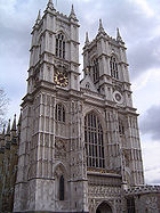
The Collegiate Church of St Peter at Westminster, which is almost always referred to popularly and informally as Westminster Abbey, is a large, mainly Gothic
Gothic architecture

Gothic architecture is a style of architecture which flourished during the high and late Middle Ages. It evolved from Romanesque architecture and was succeeded by Renaissance architecture....
 church, in Westminster
Westminster

Westminster is an area of Central London, within the City of Westminster. It lies on the north bank of the River Thames, southwest of the City of London and southwest of Charing Cross....
, London
London

London is the capital of both England and the United Kingdom, and the most populous municipality in the European Union. An important settlement for two millennia, History of London goes back to its founding by the Roman Empire....
, just to the west of the Palace of Westminster
Palace of Westminster

The Palace of Westminster, also known as the Houses of Parliament or Westminster Palace, in London, is where the two Houses of the Parliament of the United Kingdom meet....
. It is the traditional place of coronation
Coronation of the British monarch

The Coronation of the British Monarch is a ceremony in which the monarch of the United Kingdom and of the other Commonwealth realms is formally Crown and invested with regalia....
 and burial site for English, later British
List of British monarchs

This is a list of the monarchs of Kingdom of Great Britain and the United Kingdom. The Kingdom of Great Britain was formed on 1 May 1707 with the merger of the Kingdom of England and the Kingdom of Scotland, which had been in personal union under the House of Stuart since 24 March 1603....
 and later still (and currently) Monarchs of the Commonwealth Realm
Commonwealth Realm

A Commonwealth realm is any one of 16 Sovereignty states within the Commonwealth of Nations that each have Elizabeth II of the United Kingdom as their monarch....
s. It briefly held the status of a cathedral
Cathedral

A cathedral is a Christian church that contains the seat of a bishop. It is a Religion building for worship, specifically of a denomination with an episcopal hierarchy, such as the Roman Catholic Church, Anglicanism, Orthodox Christian and some Lutheranism churches, which serves as a bishop's seat, and thus as the central church of a dioc...
 from 1546–1556, and is currently a Royal Peculiar
Royal Peculiar

A Royal Peculiar is a place of worship that falls directly under the jurisdiction of the British monarchy, rather than a diocese. The concept dates to Anglo-Saxon England times, when a church could ally itself with the monarch and therefore not be subject to the bishopric of the area....
.

rding to tradition
Tradition

The word tradition comes from the Latin traditionem, acc. of traditio which means "handing over, passing on", and is used in a number of ways in the English language:...
 the abbey was first founded in 616 on the present site, then known as Thorn Ey (Thorn Island)
Thorney Island (London)

Thorney Island was the eyot on the Thames, upstream of medi?val London, where Westminster Abbey and the Palace of Westminster were built. It was formed by rivulets of the Tyburn , which entered the Thames near the lowest point where it could be forded from the north bank at low tide....
; based on a late 'tradition' that a fisherman called ' Aldrich ' on the River Thames
River Thames

The Thames is a major river flowing through southern England. While best known because its lower reaches flow through central London, the river flows through several other towns and cities, including Oxford, Reading, Berkshire and Windsor, Berkshire....
 saw a vision of Saint Peter
Saint Peter

Saint Peter was a leader of the early Christianity church, who features prominently in the New Testament Gospels and the Acts of the Apostles....
 near the site.


Discussion
Ask a question about 'Westminster Abbey'
Start a new discussion about 'Westminster Abbey'
Answer questions from other users
Full Discussion Forum


Timeline

616   A shrine on the site of the future Westminster Abbey is founded.

1045   Edward the Confessor begins construction on Westminster Abbey.

1065   Westminster Abbey is consecrated.

1179   Westminster School founded by the monks of Westminster Abbey (by papal command).

1245   The rebuilding of Westminster Abbey is started.

1503   Perpendicular style chapel added to Westminster Abbey.

1547   Edward VI of England is crowned at Westminster Abbey

1559   Elizabeth I of England is crowned in Westminster Abbey.

1603   Funeral of Elizabeth I of England in Westminster Abbey

1635   Thomas Parr, dead at the alleged age of 152, is buried in Westminster Abbey


Encyclopedia


The Collegiate Church of St Peter at Westminster, which is almost always referred to popularly and informally as Westminster Abbey, is a large, mainly Gothic
Gothic architecture

Gothic architecture is a style of architecture which flourished during the high and late Middle Ages. It evolved from Romanesque architecture and was succeeded by Renaissance architecture....
 church, in Westminster
Westminster

Westminster is an area of Central London, within the City of Westminster. It lies on the north bank of the River Thames, southwest of the City of London and southwest of Charing Cross....
, London
London

London is the capital of both England and the United Kingdom, and the most populous municipality in the European Union. An important settlement for two millennia, History of London goes back to its founding by the Roman Empire....
, just to the west of the Palace of Westminster
Palace of Westminster

The Palace of Westminster, also known as the Houses of Parliament or Westminster Palace, in London, is where the two Houses of the Parliament of the United Kingdom meet....
. It is the traditional place of coronation
Coronation of the British monarch

The Coronation of the British Monarch is a ceremony in which the monarch of the United Kingdom and of the other Commonwealth realms is formally Crown and invested with regalia....
 and burial site for English, later British
List of British monarchs

This is a list of the monarchs of Kingdom of Great Britain and the United Kingdom. The Kingdom of Great Britain was formed on 1 May 1707 with the merger of the Kingdom of England and the Kingdom of Scotland, which had been in personal union under the House of Stuart since 24 March 1603....
 and later still (and currently) Monarchs of the Commonwealth Realm
Commonwealth Realm

A Commonwealth realm is any one of 16 Sovereignty states within the Commonwealth of Nations that each have Elizabeth II of the United Kingdom as their monarch....
s. It briefly held the status of a cathedral
Cathedral

A cathedral is a Christian church that contains the seat of a bishop. It is a Religion building for worship, specifically of a denomination with an episcopal hierarchy, such as the Roman Catholic Church, Anglicanism, Orthodox Christian and some Lutheranism churches, which serves as a bishop's seat, and thus as the central church of a dioc...
 from 1546–1556, and is currently a Royal Peculiar
Royal Peculiar

A Royal Peculiar is a place of worship that falls directly under the jurisdiction of the British monarchy, rather than a diocese. The concept dates to Anglo-Saxon England times, when a church could ally itself with the monarch and therefore not be subject to the bishopric of the area....
.

History

According to tradition
Tradition

The word tradition comes from the Latin traditionem, acc. of traditio which means "handing over, passing on", and is used in a number of ways in the English language:...
 the abbey was first founded in 616 on the present site, then known as Thorn Ey (Thorn Island)
Thorney Island (London)

Thorney Island was the eyot on the Thames, upstream of medi?val London, where Westminster Abbey and the Palace of Westminster were built. It was formed by rivulets of the Tyburn , which entered the Thames near the lowest point where it could be forded from the north bank at low tide....
; based on a late 'tradition' that a fisherman called ' Aldrich ' on the River Thames
River Thames

The Thames is a major river flowing through southern England. While best known because its lower reaches flow through central London, the river flows through several other towns and cities, including Oxford, Reading, Berkshire and Windsor, Berkshire....
 saw a vision of Saint Peter
Saint Peter

Saint Peter was a leader of the early Christianity church, who features prominently in the New Testament Gospels and the Acts of the Apostles....
 near the site. This seems to be quoted to justify the presents of salmon from the Thames fishermen that the Abbey received in later years. The proven origins are that in the 960s or early 970s, Saint Dunstan, assisted by King Edgar
Edgar of England

Edgar I the Peaceful or the Peaceable was a king of England.Edgar was the younger son of Edmund I of England. His cognomen, "The Peaceable", was not necessarily a comment on the deeds of his life, for he was a strong leader, shown by his seizure of the Northumbrian and Mercian kingdoms from his older brother, Edwy, in 958....
, planted a community of Benedictine
Benedictine

Benedictine refers to the spirituality and consecrated life in accordance with the Rule of St Benedict, written by Benedict of Nursia in the sixth century for the cenobitic communities he founded in central Italy....
 monk
Monk

A Monk is a person who practices religious asceticism, the unconditioning of mind and body in favor of the realization of one's true nature, and does so living either alone or with any number of like-minded people, whilst always maintaining some degree of physical separation from those not sharing the same purpose....
s here. A stone Abbey was built around 1045–1050 by King Edward the Confessor
Edward the Confessor

Saint Edward the Confessor , son of Ethelred the Unready and Emma of Normandy, was the penultimate Anglo-Saxons List of the monarchs of the Kingdom of England and the last of the House of Wessex, ruling from 1042 until his death....
 as part of his palace there: it was consecrated on December 28 1065, only a week before the Confessor's death and subsequent funeral and burial. It was the site of the last coronation prior to the Norman Invasion
Norman invasion

Norman invasion may refer to:* Norman conquest of England, beginning in 1066* Norman conquest of southern Italy during the 11th century* Norman invasion of Ireland, beginning in 1167...
, that of his successor King Harold. It was later rebuilt by Henry III from 1245, who had selected the site for his burial.
London Westminster 1894
The only extant depiction of the original Abbey
Abbey

An abbey , is a Christianity monastery or convent, under the government of an Abbot or an Abbess, who serves as the spiritual father or mother of the community....
, in the Romanesque
Romanesque architecture

Romanesque architecture is the term that is used to describe the architecture of Middle Ages Europe which evolved into the Gothic architecture style beginning in the 12th century....
 style that is called Norman
Norman architecture

The term Norman architecture is used to categorise styles of Romanesque architecture developed by the Normans in the various lands under their dominion or influence in the 11th and 12th centuries....
 in England, together with the adjacent Palace of Westminster, is in the Bayeux Tapestry
Bayeux Tapestry

The Bayeux Tapestry is a 50 cm by 70 m long embroidery cloth?not an actual tapestry?which explains the events leading up to the Norman conquest of England as well as the events of the invasion itself....
. Increased endowments supported a community increased from a dozen monks in Dunstan's original foundation, to about eighty monks.

The Abbot and learned monks, in close proximity to the Royal Palace of Westminster
Palace of Westminster

The Palace of Westminster, also known as the Houses of Parliament or Westminster Palace, in London, is where the two Houses of the Parliament of the United Kingdom meet....
, the seat of government from the later twelfth century, became a powerful force in the centuries after the Norman Conquest: the Abbot was often employed on royal service and in due course took his place in the House of Lords as of right. Released from the burdens of spiritual leadership, which passed to the reformed Cluniac movement after the mid-tenth century, and occupied with the administration of great landed properties, some of which lay far from Westminster, "the Benedictines achieved a remarkable degree of identification with the secular life of their times, and particularly with upper-class life", Barbara Harvey concluded, to the extent that her depiction of daily life provides a wider view of the concerns of the English gentry in the High and Late Middle Ages. The proximity of the Palace of Westminster did not extend to providing monks or abbots with high royal connections; in social origin the Benedictines of Westminster were as modest as most of the order. The abbot remained Lord of the Manor
Lord of the Manor

The title of Lord of the Manor arose in the England mediaeval system of Manorialism following the Norman Conquest. The title Lord of the Manor is a titular feudal dignity which is still recognised today as semi-extinct form of landed property ....
 of Westminster as a town of two to three thousand persons grew around it: as a consumer and employer on a grand scale the monastery helped fuel the town economy, and relations with the town remained unusually cordial, but no enfranchising charter was issued during the Middle Ages. The abbey built shops and dwellings on the west side, encroaching upon the sanctuary.

The Abbey became the coronation site of Norman kings, but none were buried there until Henry III
Henry III of England

Henry III was the son and successor of John of England as King of England, reigning for fifty-six years from 1216 to his death. His contemporaries knew him as Henry of Winchester....
, intensely devoted to the cult of the Confessor, rebuilt the Abbey in Anglo-French Gothic style
Gothic architecture

Gothic architecture is a style of architecture which flourished during the high and late Middle Ages. It evolved from Romanesque architecture and was succeeded by Renaissance architecture....
 as a shrine to honour St Edward the Confessor and as a suitably regal setting for Henry's own tomb
Tomb

For the New York prison see The Tombs.A tomb is a repository for the remains of the death. The term generally refers to any structurally enclosed interment space or burial chamber, of varying sizes....
, under the highest Gothic nave in England. The Confessor's shrine
Shrine

A shrine, from the Latin scrinium is a holy or sacred place which is dedicated to a specific deity, ancestor veneration, hero, martyr, saint or similar figure of awe and respect, at which they are veneration or worshipped....
 subsequently played a great part in his canonisation. The work continued between 1245-1517 and was largely finished by the architect Henry Yevele
Henry Yevele

Henry Yevele was the most prolific and successful master mason active in late medieval England. The first document relating to him is dated 3 December 1353, when he purchased the Freedom of the City of London#Freedom of the City of London....
 in the reign of King Richard II
Richard II of England

Richard II was the eighth King of England of the House of Plantagenet. He ruled from 1377 until he was deposed in 1399. Richard was a son of Edward, the Black Prince and was born during the reign of his grandfather, Edward III of England....
. Henry VII
Henry VII of England

Henry VII was the Kingdom of England and Lordship of Ireland from his usurpation of the crown on 22 August 1485 until his death on 21 April 1509, as the first monarch of the Tudor dynasty....
 added a Perpendicular style chapel dedicated to the Blessed Virgin Mary in 1503 (known as the Henry VII Chapel
Henry VII Lady Chapel

The Henry VII Lady Chapel, now more often known just as the Henry VII Chapel, is a large Lady chapel at the far eastern end of Westminster Abbey built in the Perpendicular Gothic style....
). Much of the stone came from Caen
Caen

Caen is a commune in France in northwestern France. It is the prefecture of the Calvados Departments of France and the capital of the Basse-Normandie r?gion in France....
, in France
France

France , officially the French Republic , is a country whose Metropolitan France is located in Western Europe and that also comprises various Overseas departments and territories of France....
 (Caen stone
Caen stone

Caen stone or Pierre de Caen, is a light creamy-yellow Jurassic limestone quarried in northwestern France near the city of Caen.It was used in the construction of the late eleventh century austere Norman Romanesque Church of Saint-?tienne, at the Abbaye-aux-Hommes , that was founded by William the Conqueror....
), the Isle of Portland
Isle of Portland

The Isle of Portland is a limestone tied island, long by wide, in the English Channel. Portland is south of the resort of Weymouth, Dorset, forming the southernmost point of the county of Dorset, England....
 (Portland stone
Portland stone

Portland stone is a limestone from the Tithonian stage of the Jurassic period Quarry on the Isle of Portland, Dorset. The quarries consist of beds of white-grey limestone separated by chert beds....
) and the Loire Valley
Loire Valley

Loire Valley is known as the Garden of France and the Cradle of the French Language. It is also noteworthy for the quality of its architectural heritage, in its historic towns such as Amboise, Angers, Blois, Chinon, Nantes, Orl?ans, Saumur, and Tours, but in particular for its world-famous castles, such as the Ch?teaux d'Ch?teau d'Am...
 region of France (tuffeau limestone
Tuffeau stone

Tuffeau is a marine sedimentary rock , found in the Loire Valley of France.The Loire Valley formed the floor of a vast sea 90 million years ago....
).

In 1535, the Abbey's annual income of £2400-2800 during the assessment attendant on the Dissolution of the Monasteries
Dissolution of the Monasteries

The Dissolution of the Monasteries, sometimes referred to as the Suppression of the Monasteries, denotes the administrative and legal processes between 1536 and 1541 by which Henry VIII of England disbanded all monastery, nunnery and friary in England, Wales and Ireland; appropriated their income, disposed of their assets and provided f...
 rendered it second in wealth only to Glastonbury Abbey
Glastonbury Abbey

Glastonbury Abbey, founded in the seventh century, was a rich and powerful monastery in Glastonbury, Somerset, England. It became associated with the legends of the Holy Grail and King Arthur in the tenth century....
. Henry VIII
Henry VIII of England

Henry VIII was King of England from 21 April 1509 until his death. He was also Lordship of Ireland and claimant to the Early Modern France. Henry was the second monarch of the House of Tudor, succeeding his father, Henry VII of England....
 had assumed direct royal control in 1539 and granted the Abbey cathedral status by charter in 1540, simultaneously issuing letters patent
Letters patent

Letters patent are a type of legal instrument in the form of an open letter issued by a monarch or government, granting an office, right, government-granted monopoly, title, or status to a person or to some entity such as a corporation....
 establishing the Diocese of Westminster
Diocese of Westminster

The Diocese of Westminster was a short-lived diocese of the Church of England, extant from 1540 - 1550.The Diocese was created from part of the Diocese of London, and comprised Westminster , and the county of Middlesex, with the exception of Fulham....
. By granting the Abbey cathedral status Henry VIII gained an excuse to spare it from the destruction or dissolution which he inflicted on most English abbeys during this period. Westminster was a cathedral only until 1550. The expression "robbing Peter to pay Paul" may arise from this period when money meant for the Abbey, which was dedicated to St Peter
Saint Peter

Saint Peter was a leader of the early Christianity church, who features prominently in the New Testament Gospels and the Acts of the Apostles....
, was diverted to the treasury of St Paul's Cathedral
St Paul's Cathedral

St Paul's Cathedral is the Anglicanism cathedral on Ludgate Hill, in the City of London, and the seat of the Bishop of London. The present building dates from the 17th century and is generally reckoned to be London's fifth St Paul's Cathedral, although the number is higher if every major medieval reconstruction is counted as a new cathedr...
.

The Abbey was restored to the Benedictines under the Catholic Queen Mary
Mary I of England

Mary I , was Queen of England and Monarchy of Ireland from 19 July 1553 until her death. The fourth crowned monarch of the Tudor dynasty, she is remembered for restoring England to Roman Catholicism after succeeding her short-lived half brother, Edward VI of England, to the English throne....
, but they were again ejected under Queen Elizabeth I
Elizabeth I of England

Elizabeth I was List of English monarchs and Queen of Ireland from 17 November 1558 until her death. Sometimes called The Virgin Queen, Gloriana, or Good Queen Bess, Elizabeth was the fifth and last monarch of the House of Tudor....
 in 1559. In 1579, Elizabeth re-established Westminster as a "Royal Peculiar
Royal Peculiar

A Royal Peculiar is a place of worship that falls directly under the jurisdiction of the British monarchy, rather than a diocese. The concept dates to Anglo-Saxon England times, when a church could ally itself with the monarch and therefore not be subject to the bishopric of the area....
"—a church responsible directly to the sovereign, rather than to a diocesan bishop—and made it the Collegiate Church of St Peter, (that is a church with an attached chapter of canons
Canon (priest)

A canon is a priest who is a member of certain bodies of the Christianity clergy subject to an ecclesiastical rule .Originally, a canon was a cleric living with others in a clergyhouse or, later, in one of the houses within the precinct or close of a cathedral and ordering his life according to the orders or rules of the church....
, headed by a dean). The last Abbot was made the first Dean. It suffered damage during the turbulent 1640s, when it was attacked by Puritan
Puritan

A Puritan of 16th and 17th century England was an associate of any number of religious groups advocating for more "purity" of worship and doctrine, as well as personal and group pietism....
 iconoclasts
Iconoclasm

Iconoclasm, Greek for "image-breaking," is the deliberate destruction of important symbolic images recognized within a culture, religion, or society....
, but was again protected by its close ties to the state during the Commonwealth
Commonwealth of England

The Commonwealth of England was the republic which ruled first Kingdom of England and Wales, and then Kingdom of Ireland and Kingdom of Scotland from 1649 to 1660....
 period. Oliver Cromwell
Oliver Cromwell

Oliver Cromwell was an English people Military history of the United Kingdom and Politics of England leader best known for his involvement in making England into a republican Commonwealth and for his later role as Lord Protector of England, Scotland, and Ireland....
 was given an elaborate funeral there in 1658, only to be disinterred in January 1661 and posthumously hanged from a nearby gibbet
Gibbet

A gibbet is any of several different devices used in the public execution of Crime and the deterrence of future crime. When used as a verb, gibbeting refers to the public display of executed criminals....
.

Westminster Abbey By Canaletto, 1749
The abbey's two western towers were built between 1722 and 1745 by Nicholas Hawksmoor
Nicholas Hawksmoor

Nicholas Hawksmoor was a British architect born to a humble family in Nottinghamshire.His career formed the brilliant middle link in United Kingdom trio of great baroque architects....
, constructed from Portland stone
Portland stone

Portland stone is a limestone from the Tithonian stage of the Jurassic period Quarry on the Isle of Portland, Dorset. The quarries consist of beds of white-grey limestone separated by chert beds....
 to an early example of a Gothic Revival design. Further rebuilding and restoration occurred in the 19th century under Sir George Gilbert Scott
George Gilbert Scott

Sir George Gilbert Scott was an England architect of the Victorian Age, chiefly associated with the design, building and renovation of Church , cathedrals and workhouses....
. A narthex
Narthex

The narthex of a Church is the entrance or lobby area, located at the end of the nave, at the far end from the church's main altar. Traditionally the narthex was a part of the church building, but was not considered part of the church proper....
 for the west front was designed by Sir Edwin Lutyens
Edwin Lutyens

Sir Edwin Landseer Lutyens, Order of Merit , Order of the Indian Empire, Royal Academy, Royal Institute of British Architects, LLD was a leading 20th century British architect who is known for imaginatively adapting traditional architectural styles to the requirements of his era....
 in the mid C20 but was not executed.

Until the 19th century, Westminster was the third seat of learning in England, after Oxford
University of Oxford

The University of Oxford , located in the city of Oxford, Oxfordshire, England, is the List of oldest universities in continuous operation in the English-speaking world....
 and Cambridge
University of Cambridge

The University of Cambridge , located in Cambridge, England, is the List of oldest universities in continuous operation university in the Anglosphere....
. It was here that the first third of the King James Bible Old Testament and the last half of the New Testament were translated. The New English Bible
New English Bible

The New English Bible was a fresh translation of the Bible into modern English directly from the original Greek , Hebrew , and Aramaic texts ; with the New Testament being published in 1961, and the Old Testament, along with the Apocrypha, being published in 1970....
 was also put together here in the 20th century. Westminster suffered minor damage during the Blitz
The Blitz

The Blitz was the sustained bombing of United Kingdom by Nazi Germany between 7 September 1940 and 10 May 1941, in World War II. While the "Blitz" hit many towns and cities across the country, it began with the bombing of London for 57 consecutive nights ....
 on November 15, 1940.

Coronations

Sanktedvardsstol Westminster
Since the coronations in 1066 of both King Harold
Harold Godwinson

Harold Godwinson also known as Harold II, was the last Anglo-Saxons King of Kingdom of England before the Norman Conquest of England. Harold reigned from 5 January 1066, until his death at the Battle of Hastings on 14 October of that same year, fighting the Normans invaders, led by William I of England....
 and William the Conqueror, all English and British monarchs (except Edward V
Edward V of England

Edward V was King of England from 9 April 1483 until his deposition two months later. His reign was dominated by the influence of his uncle Richard, Duke of Gloucester, who succeeded him as Richard III of England....
 and Edward VIII
Edward VIII of the United Kingdom

Edward VIII was Monarch of the United Kingdom of Great Britain and Northern Ireland and the dominion, and Emperor of India from 20 January 1936, following the death of his father, George V of the United Kingdom, until his abdication on 11 December 1936....
, who did not have coronations) have been crowned in the Abbey. Henry III
Henry III of England

Henry III was the son and successor of John of England as King of England, reigning for fifty-six years from 1216 to his death. His contemporaries knew him as Henry of Winchester....
 was unable to be crowned in London when he first came to the throne because Prince Louis
Louis VIII of France

Louis VIII the Lion reigned as list of French monarchs from 1223 to 1226. He was a member of the House of Capet. Louis VIII was born in Paris, France, the son of Philip II of France and Isabelle of Hainaut....
 of France had taken control of the city, and so was crowned in Gloucester Cathedral
Gloucester Cathedral

Gloucester Cathedral, or the Cathedral Church of St Peter and the Holy and Undivided Trinity, in Gloucester, England, stands in the north of the city near the river....
, but this coronation was deemed by the Pope to be improper, and a further coronation was held in the Abbey on 17 May 1220. Lady Jane Grey, whose reign lasted just nine days and was of doubtful legality, was also never crowned. The Archbishop of Canterbury
Archbishop of Canterbury

The Archbishop of Canterbury is the chief bishop and principal leader of the Church of England, the symbolic head of the worldwide Anglican Communion and the Diocesan Bishop of the Diocese of Canterbury, the Episcopal see that churches must be in communion with in order to be a part of the Anglican Communion....
 is the traditional cleric
Clergy

Clergy is the generic term used to describe the formal religious leadership within a given religion. The term comes from the Greek language ?????? - kleros, "a lot", "that which is assigned by lot" or metaphorically, "heritage"....
 in the coronation ceremony. King Edward's Chair
King Edward's Chair

King Edward's Chair, sometimes known as St Edward's Chair or The Coronation Chair, is the throne on which the British monarch sits for the Coronation of the British Monarch....
 (or St Edward's Chair), the throne on which British
United Kingdom

The United Kingdom of Great Britain and Northern Ireland, commonly known as the United Kingdom , the UK or Britain,is a sovereign state located off the northwestern coast of continental Europe....
 sovereigns are seated at the moment of coronation, is housed within the Abbey and has been used at every coronation since 1308; from 1301 to 1996 the chair also housed the Stone of Scone
Stone of Scone

The Stone of Scone , also commonly known as the Stone of Destiny or the Coronation Stone is an oblong block of red sandstone, about by by in size and weighing approximately ....
 upon which the kings of Scotland are crowned, but pending another coronation the Stone is now kept in Scotland.

Burials and memorials


Henry III
Henry III of England

Henry III was the son and successor of John of England as King of England, reigning for fifty-six years from 1216 to his death. His contemporaries knew him as Henry of Winchester....
 rebuilt the Abbey in honour of the Royal Saint Edward the Confessor
Edward the Confessor

Saint Edward the Confessor , son of Ethelred the Unready and Emma of Normandy, was the penultimate Anglo-Saxons List of the monarchs of the Kingdom of England and the last of the House of Wessex, ruling from 1042 until his death....
 whose relics were placed in a shrine
Shrine

A shrine, from the Latin scrinium is a holy or sacred place which is dedicated to a specific deity, ancestor veneration, hero, martyr, saint or similar figure of awe and respect, at which they are veneration or worshipped....
 in the sanctuary and now lie in a burial vault
Burial vault (tomb)

A burial vault is a structural underground tomb.It is a stone or brick-lined underground space or 'burial' chamber for the interment of a death body or bodies....
 beneath the 1268 Cosmati
Cosmati

The Cosmati were a Rome family, seven members of which, for four generations, were skilful architects, sculpture and workers in mosaic. Their name is commemorated in the genre of Cosmatesque a form of opus sectile formed of elaborate inlays of small triangles and rectangles of colored stones and glass mosaics set into stone matrices or...
 mosaic pavement, in front of the High Altar. Henry III was interred nearby in a superb chest tomb
Tomb

For the New York prison see The Tombs.A tomb is a repository for the remains of the death. The term generally refers to any structurally enclosed interment space or burial chamber, of varying sizes....
 with effigial monument
Church monument

A church monument is an architecture or sculpture memorial to a death person or persons, located within a Christian church . It can take various forms, from a simple Commemorative plaque to a large and elaborate structure which may include an effigy of the deceased person and other figures of familial or symbolic nature....
, as were many of the Plantagenet kings of England, their wives and other relatives. Subsequently, most Kings and Queens of England were buried here, although Henry VIII
Henry VIII of England

Henry VIII was King of England from 21 April 1509 until his death. He was also Lordship of Ireland and claimant to the Early Modern France. Henry was the second monarch of the House of Tudor, succeeding his father, Henry VII of England....
 and Charles I
Charles I of England

Charles I was List of English monarchs, List of monarchs of Scotland and King of Ireland from 27 March 1625 until his capital punishment on 30 January 1649....
 are buried in St George's Chapel at Windsor Castle
Windsor Castle

Windsor Castle, in Windsor, Berkshire in the England county of Berkshire, is the largest inhabited castle in the world and, dating back to the time of William I of England, is the oldest in continuous occupation....
, as are all monarchs and royals after George II
George II of Great Britain

George II was King of Great Britain and King of Ireland, Duke of Brunswick-L?neburg and Prince-elector#High Offices and Prince-Elector of the Holy Roman Empire from 11 June 1727 until his death....
.

Aristocrats were buried inside chapels and monks and people associated with the Abbey were buried in the Cloisters and other areas. One of these was Geoffrey Chaucer
Geoffrey Chaucer

Geoffrey Chaucer was an English author, poet, philosopher, Bureaucracy, Noble court and diplomat. Although he wrote many works, he is best remembered for his unfinished frame narrative The Canterbury Tales....
, who was buried here as he had apartments in the Abbey where he was employed as master of the Kings Works. Other poets were buried or memorialized around Chaucer in what became known as Poets' Corner
Poets' Corner

Poets? Corner is the name traditionally given to a section of the South Transept of Westminster Abbey due to the number of poets, playwrights, and writers now buried and commemorated there....
. These include; William Blake
William Blake

William Blake was an English people English poetry, Painting, and printmaker. Largely unrecognized during his lifetime, Blake is now considered a seminal figure in the history of both poetry and the visual arts of the Romanticism....
, Robert Burns
Robert Burns

Robert Burns was a poet and a lyricist. He is widely regarded as the national poet of Scotland, and is celebrated worldwide. He is the best known of the poets who have written in the Scots language, although much of his writing is also in English and a 'light' Scots dialect, accessible to an audience beyond Scotland....
, Lord Byron
George Gordon Byron, 6th Baron Byron

George Gordon Byron, later Noel, 6th Baron Byron Royal Society was a United Kingdom poet and a leading figure in Romanticism. Amongst Byron's best-known works are the brief poems She Walks in Beauty, When We Two Parted, and So, we'll go no more a roving, in addition to the narrative poems Childe Harold's Pilgrimage and...
, John Dryden
John Dryden

John Dryden was an influential English poet, literary critic, translator, and playwright who dominated the literary life of English Restoration to such a point that the period came to be known in literary circles as the Age of Dryden....
, George Eliot
George Eliot

Mary Anne Evans , better known by her pen name George Eliot, was an England novelist. She was one of the leading writers of the Victorian era....
, T. S. Eliot
T. S. Eliot

'Thomas Stearns Eliot', Order of Merit , was a poet, dramatist, and literary critic. He received the Nobel Prize in Literature in 1948. Among his most famous writings are the poems The Love Song of J....
, Thomas Gray
Thomas Gray

Thomas Gray , was an England poet, classical scholar and professor at University of Cambridge....
, Gerard Manley Hopkins
Gerard Manley Hopkins

Gerard Manley Hopkins , was an England poet, Roman Catholicism convert, and Society of Jesus priest, whose 20th-century fame established him posthumously among the leading Victorian poets....
, John Masefield
John Masefield

John Edward Masefield, Order of Merit, was an English poet and writer, and Poet Laureate from 1930 until his death in 1967. He is remembered as the author of the classic children's novels The Midnight Folk and The Box of Delights, 19 other novels , and many memorable poems, including "The Everlasting Mercy" and "Sea-Fever", f...
, John Keats
John Keats

John Keats was an England poetry who became one of the principal poets of the English Romanticism movement during the early nineteenth century....
, John Milton
John Milton

John Milton II was an English poet, author, polemicist and civil servant for the Commonwealth of England. He is best known for his Epic poetry Paradise Lost and for his treatise condemning censorship, Areopagitica....
, Laurence Olivier
Laurence Olivier

Laurence Kerr Olivier, Baron Olivier, Order of Merit was an English people Stage actor, Theatre director, and Theatrical producer. He is one of the most famous and revered actors of the 20th century, along with his contemporaries John Gielgud, Peggy Ashcroft and Ralph Richardson....
, Alexander Pope
Alexander Pope

Alexander Pope is generally regarded as the greatest England poet of the eighteenth century, best known for his satirical verse and for his translation of Homer....
, Nicholas Rowe
Nicholas Rowe (dramatist)

Nicholas Rowe , England dramatist, poet and miscellaneous writer, was appointed Poet Laureate in 1715....
, Percy Bysshe Shelley
Percy Bysshe Shelley

Percy Bysshe Shelley was one of the major England Romantic poets and is widely considered to be among the finest Lyric poetry in the English language....
, Rudyard Kipling
Rudyard Kipling

Joseph Rudyard Kipling was an English author and poet. Born in Mumbai, British India , he is best known for his works of fiction The Jungle Book , Kim , many short stories, including The Man Who Would Be King ; and his poems, including Mandalay , Gunga Din , and If? ....
, Thomas Shadwell
Thomas Shadwell

Thomas Shadwell was an England poet and playwright who was appointed poet laureate in 1689....
, William Shakespeare
William Shakespeare

William Shakespeare was an English people poet and playwright, widely regarded as the greatest writer in the English language and the world's preeminent dramatist....
 and William Wordsworth
William Wordsworth

William Wordsworth was a major England Romantic poetry poet who, with Samuel Taylor Coleridge, helped to launch the Romanticism in English literature with the 1798 joint publication Lyrical Ballads....
.

Abbey musicians such as Henry Purcell
Henry Purcell

Henry Purcell...
 were also buried in their place of work. Subsequently it became an honour to be buried or memorialised here. The practice spread from aristocrats and poets to generals, admirals, politicians, scientists, doctors, etc..

Buried


  • See also: :Category:Burials at Westminster Abbey


Monarchs and their consorts

The following English and British Monarchs and their consorts are buried in the Abbey:
  • St Edward the Confessor and wife Edith of Wessex
    Edith of Wessex

    Edith of Wessex, , married King Edward the Confessor of England in 1045. The marriage produced no children. Later ecclesiastical writers claimed that this was either because Edward took a vow of celibacy, or because he refused to consummate the marriage because of his antipathy to Edith's family, the Godwins....
  • Henry III of England
    Henry III of England

    Henry III was the son and successor of John of England as King of England, reigning for fifty-six years from 1216 to his death. His contemporaries knew him as Henry of Winchester....
  • Edward I of England
    Edward I of England

    Edward I , popularly known as Longshanks, the English Justinian, and the Hammer of the Scots , was a House of Plantagenet King of England who achieved historical fame by conquering large parts of Wales and almost succeeding in doing the same to Scotland....
     and wife Eleanor of Castile
    Eleanor of Castile

    Eleanor of Castile was the first Queen consort of Edward I of England....
  • Edward III of England
    Edward III of England

    Edward III was one of the most successful List of the monarchs of the Kingdom of Englands of the Britain in the Middle Ages. Restoring royal authority after the disastrous reign of his father, Edward II of England, Edward III went on to transform the Kingdom of England into the most efficient military power in Europe....
     and wife Philippa of Hainault
    Philippa of Hainault

    Philippa of Hainault was the Queen consort of Edward III of England....
  • Richard II of England
    Richard II of England

    Richard II was the eighth King of England of the House of Plantagenet. He ruled from 1377 until he was deposed in 1399. Richard was a son of Edward, the Black Prince and was born during the reign of his grandfather, Edward III of England....
     and wife Anne of Bohemia
    Anne of Bohemia

    Anne of Bohemia , also known as Good Queen Anne, was a daughter of Charles IV, Holy Roman Emperor, King of Bohemia and Elizabeth of Pomerania....
  • Henry V of England
    Henry V of England

    Henry V was one of the most significant English warrior kings of the 15th century. He was born at Monmouth, Wales, in the tower above the gatehouse of Monmouth Castle, and reigned as King of England from 1413 to 1422....
     and wife Catherine of Valois
    Catherine of Valois

    Catherine of Valois was the Queen consort of England from 1420 until 1422. She was the daughter of King Charles VI of France, wife of King Henry V of England, mother of King Henry VI of England, and through her secret marriage with Owen Tudor, the grandmother of King Henry VII of England....
  • Edward V of England
    Edward V of England

    Edward V was King of England from 9 April 1483 until his deposition two months later. His reign was dominated by the influence of his uncle Richard, Duke of Gloucester, who succeeded him as Richard III of England....
  • Henry VII of England
    Henry VII of England

    Henry VII was the Kingdom of England and Lordship of Ireland from his usurpation of the crown on 22 August 1485 until his death on 21 April 1509, as the first monarch of the Tudor dynasty....
     and wife Elizabeth of York
    Elizabeth of York

    Elizabeth of York was the daughter, sister, niece, wife and mother of Kings of England. She was List of English consorts as spouse of King Henry VII of England, whom she married in 1486....
  • Edward VI of England
    Edward VI of England

    Edward VI became List of English monarchs and King of Ireland on 28 January 1547 and was crowned on 20 February at the age of nine. The son of Henry VIII of England and Jane Seymour, Edward was the third monarch of the Tudor dynasty and England's first Protestantism ruler....
  • Anne of Cleves
    Anne of Cleves

    Anne of Cleves was a German noblewoman and the fourth Wives of Henry VIII of Henry VIII of England and as such she was List of English consorts from 6 January 1540 to 9 July 1540....
     4th wife of King Henry VIII
  • Mary I of England
    Mary I of England

    Mary I , was Queen of England and Monarchy of Ireland from 19 July 1553 until her death. The fourth crowned monarch of the Tudor dynasty, she is remembered for restoring England to Roman Catholicism after succeeding her short-lived half brother, Edward VI of England, to the English throne....
  • Elizabeth I of England
    Elizabeth I of England

    Elizabeth I was List of English monarchs and Queen of Ireland from 17 November 1558 until her death. Sometimes called The Virgin Queen, Gloriana, or Good Queen Bess, Elizabeth was the fifth and last monarch of the House of Tudor....
  • James I of England
    James I of England

    James VI and I was List of monarchs of Scotland as James VI, and List of English monarchs and King of Ireland as James I. He ruled in Kingdom of Scotland as James VI from 24 July 1567, when he was only one year old, succeeding his mother Mary I of Scotland....
     and wife Anne of Denmark
    Anne of Denmark

    Anne of Denmark was queen consort of Kingdom of Scotland, Kingdom of England, and Kingdom of Ireland as spouse of King James I of England.The second daughter of King Frederick II of Denmark, Anne married James in 1589 at the age of fourteen and bore him three children who survived infancy, including the future Charles I of England....
  • Charles II of England
    Charles II of England

    Charles II was the Monarchy of Kingdom of England, Kingdom of Scotland, and Kingdom of Ireland.His father Charles I of England Regicide#The regicide of Charles I of England at Palace of Whitehall on 30 January 1649, at the climax of the English Civil War....
  • Mary II of England
    Mary II of England

    Mary II reigned as List of English monarchs, List of Scottish monarchs, and King of Ireland from 1689 until her death. Mary, a Protestantism, came to the thrones following the Glorious Revolution, which resulted in the deposition of her Roman Catholic father, James II of England....
  • William III of England
    William III of England

    William III was a Prince of Orange by birth. From 1672 onwards, he governed as List_of_stadtholders_for_the_Low_Countries_provinces William III of Orange over Holland, Zeeland, Utrecht, Guelders, and Overijssel of the Dutch Republic....
  • Anne of Great Britain
    Anne of Great Britain

    Anne became Queen of England, Queen of Scots and Kingdom of Ireland on 8 March 1702, succeeding her brother-in-law, William III of England. Her Roman Catholic father, James II of England, was Glorious Revolution in 1688/9; her brother-in-law and her sister then became joint monarchs as William III & II and Mary II of England, the only such c...
     and husband Prince George of Denmark
  • George II of Great Britain
    George II of Great Britain

    George II was King of Great Britain and King of Ireland, Duke of Brunswick-L?neburg and Prince-elector#High Offices and Prince-Elector of the Holy Roman Empire from 11 June 1727 until his death....
     and wife Caroline of Ansbach
    Caroline of Ansbach

    Caroline of Brandenburg-Ansbach, later Queen Caroline; Wilhelmina Charlotte Caroline was the queen consort of George II of Great Britain....


Other monarchs and consorts
  • Anne Neville
    Anne Neville

    Anne Neville was the Princess of Wales as spouse of Edward of Westminster, Prince of Wales, and the List of English consorts as spouse of King Richard III of England....
  • Anne of Cleves
    Anne of Cleves

    Anne of Cleves was a German noblewoman and the fourth Wives of Henry VIII of Henry VIII of England and as such she was List of English consorts from 6 January 1540 to 9 July 1540....
  • Mary Queen of Scots
  • Elizabeth of Bohemia
    Elizabeth of Bohemia

    Elisabeth, Electress Palatine and Queen of Bohemia was the eldest daughter of James I of England, King of England, Scotland and Ireland, and Anne of Denmark....


Nave
The following are buried in the Nave
Nave

In Romanesque architecture and Gothic architecture Christian abbey, cathedral basilica and Church architecture, the nave is the central approach to the high altar....
  • Edmund Allenby, 1st Viscount Allenby
    Edmund Allenby, 1st Viscount Allenby

    Field Marshal Edmund Henry Hynman Allenby, 1st Viscount Allenby Order of the Bath, Order of St Michael and St George, Royal Victorian Order was a United Kingdom soldier and administrator most famous for his role during World War I, in which he led the Egyptian Expeditionary Force in the conquest of Palestine and Syria in 1917 and 1918....
  • John André
    John André

    Major John Andr? was a United Kingdom army officer hanged as a secret agent during the American Revolutionary War. This was due to an incident in which he assisted Benedict Arnold's attempted surrender of the fort at West Point, New York, to the British Army....
  • Francis Atterbury
    Francis Atterbury

    Francis Atterbury , was an England man of letters, politician and bishop....
  • Clement Attlee, 1st Earl Attlee
    Clement Attlee

    Clement Richard Attlee, 1st Earl Attlee, Order of the Garter, Order of Merit, Order of the Companions of Honour, Her Majesty's Most Honourable Privy Council, Fellow of the Royal Society was a British people politician, who served as Prime Minister of the United Kingdom from 1945 to 1951, and leader of the Labour Party from 1935 to 1955....
  • Sir Charles Barry
  • Ernest Bevin
    Ernest Bevin

    Ernest Bevin Privy Council of the United Kingdom was a United Kingdom labour leader, politician, and statesman best known for his time as Minister of Labour in the war-time coalition government, and as Secretary of State for Foreign Affairs in the post-war Labour Party government....
  • Andrew Bonar Law
    Andrew Bonar Law

    Andrew Bonar Law was a Canada-born United Kingdom Conservative Party statesman and Prime Minister of the United Kingdom. He is the only British Prime Minister to have been born outside the British Isles....
  • Angela Georgina Burdett-Coutts
  • Thomas Cochrane, 10th Earl of Dundonald
    Thomas Cochrane, 10th Earl of Dundonald

    Admiral Sir Thomas Cochrane, 10th Earl of Dundonald, Marques do Maranh?o, GCB RN , styled Lord Cochrane between 1778 and 1831 , was a British naval officer and radical politician....
  • Charles Darwin
    Charles Darwin

    Charles Robert Darwin Royal Society was an English people natural history who realised and presented compelling evidence that all species of life have evolution over time from common descent, through the process he called natural selection....
  • King St Edward the Confessor
    Edward the Confessor

    Saint Edward the Confessor , son of Ethelred the Unready and Emma of Normandy, was the penultimate Anglo-Saxons List of the monarchs of the Kingdom of England and the last of the House of Wessex, ruling from 1042 until his death....
  • Freeman Freeman-Thomas, 1st Marquess of Willingdon
    Freeman Freeman-Thomas, 1st Marquess of Willingdon

    Freeman Freeman-Thomas, 1st Marquess of Willingdon, Order of the Star of India, Order of St Michael and St George, Order of the Indian Empire, Order of the British Empire, Privy Council of the United Kingdom was a British Liberal Party politician, cricketer, scouting pioneer and administrator who served as Governor General of...
  • George Graham
    George Graham (clockmaker)

    George Graham was an English horology and inventor and a member of the Royal Society. A Friend like his mentor Thomas Tompion, Graham left Cumberland in 1688 for London to work with Tompion....
  • Ben Jonson
    Ben Jonson

    Benjamin Jonson was an England English Renaissance dramatist, poet and actor. A contemporary of William Shakespeare, he is best known for his satire plays, particularly Volpone, The Alchemist , and Bartholomew Fair, which are considered his best, and his Lyric poetry poems....
     (buried upright)
  • David Livingstone
    David Livingstone

    Doctor David Livingstone was a Scotland Congregational church pioneer medical missionary with the London Missionary Society and List of explorers in Central Africa Africa....
  • Charles Lyell
    Charles Lyell

    Sir Charles Lyell, 1st Baronet, Order of the Thistle, Fellow of the Royal Society was a Scotland lawyer, geologist, and protagonist of Uniformitarianism ....
  • James Clerk Maxwell
    James Clerk Maxwell

    James Clerk Maxwell was a Scotland Mathematical physics. His most significant achievement was the development of the classical electromagnetic theory, synthesizing all previous unrelated observations, experiments and equations of electricity, magnetism and even optics into a consistent theory....
  • Sir Isaac Newton
  • Ernest Rutherford, 1st Baron Rutherford
    Ernest Rutherford

    Ernest Rutherford, 1st Baron Rutherford of Nelson, Order of Merit , Royal Society was a New Zealand-born British chemist who became known as the father of nuclear physics....
  • Sir George Gilbert Scott
  • Robert Stephenson
    Robert Stephenson

    Robert Stephenson Fellow of the Royal Society was an England civil engineer. He was the only son of George Stephenson, the famed locomotive builder and Rail transport engineer; many of the achievements popularly credited to his father were actually the joint efforts of father and son....
  • Ludovic Stewart, 2nd Duke of Lennox
    Ludovic Stewart, 2nd Duke of Lennox

    Ludovic Stewart, 2nd Duke of Lennox, 1st Duke of Richmond was a Scotland nobleman and politician. He was the son of Esm? Stewart, 1st Duke of Lennox and his wife Catherine de Balsac....
  • George Edmund Street
    George Edmund Street

    George Edmund Street was an English architect, born at Woodford in Essex....
  • J. J. Thomson
    J. J. Thomson

    Sir Joseph John ?J.J.? Thomson, Order of Merit , Fellow of the Royal Society was a United Kingdom physicist and Nobel laureate, credited for the discovery of the electron and of isotopes, and the invention of the mass spectrometer....
  • William Thomson, 1st Baron Kelvin
    William Thomson, 1st Baron Kelvin

    William Thomson, 1st Baron Kelvin , Order of Merit , Royal Victorian Order, Privy Council of the United Kingdom, Presidents of the Royal Society, Royal Society of Edinburgh, was an Ireland-born United Kingdom of Great Britain and Ireland Mathematical physics and engineer....
  • Thomas Tompion
    Thomas Tompion

    Thomas Tompion was an English master clockmaker and watchmaker known today as the father of English watchmaking. His work includes some of the most important clocks and watches in the world and his work commands huge prices whenever it appears at auction....
  • The Unknown Warrior
    The Unknown Warrior

    The United Kingdom tomb of The Unknown Warrior holds an unidentified British soldier killed on a European battlefield during World War I. He was buried in Westminster Abbey, London on November 11, 1920, simultaneously with a similar operation in France, making both tombs the first honouring the unknown dead of World War I....
  • Beatrice Webb
    Beatrice Webb

    Martha Beatrice Webb was an English sociologist, economist, socialism and reformer, usually referred to in the same breath as her husband, Sidney Webb....
  • Sidney James Webb, 1st Baron Passfield
    Sidney James Webb, 1st Baron Passfield

    Sidney James Webb, 1st Baron Passfield Privy Council of the United Kingdom was a British socialist, economist and reformer who is typically mentioned in the same breath as his wife, Beatrice Webb....


North Transept
The following are buried in the North Transept
Transept

Full descriptions of the elements of a Gothic floorplan are found at the entry Cathedral diagram.'For the periodical go to The Transept....
  • William Ewart Gladstone
    William Ewart Gladstone

    William Ewart Gladstone was a United Kingdom of Great Britain and Ireland Liberal Party statesman and four times Prime Minister of the United Kingdom ....
  • William Pitt, 1st Earl of Chatham
    William Pitt, 1st Earl of Chatham

    William Pitt, 1st Earl of Chatham, Kent Privy Council of Great Britain was a Kingdom of Great Britain British Whig Party statesman who achieved his greatest fame as a Secretary of State during the Seven Years' War, as known in Great Britain and Asia and who was later Prime Minister of the United Kingdom....
  • William Pitt the Younger
    William Pitt the Younger

    William Pitt, the Younger was a Kingdom of Great Britain politician of the late eighteenth century and early nineteenth century. He became the youngest Prime Minister of the United Kingdom in 1783 at the age of 24....
  • William Wilberforce
    William Wilberforce

    William Wilberforce was a United Kingdom of Great Britain and Ireland politician, a philanthropist and a leader of the movement to abolish the Atlantic slave trade....
  • Sir John Malcolm
    John Malcolm

    For the American Revolution figure, see John Malcolm .Sir John F. Malcolm was a Scotland soldier, statesman, and historian, born at Burnfoot, Dumfries and Galloway, Dumfriesshire on the 2nd of May, 1769....


South Transept
The following are buried in the South Transept which is known as Poets' Corner
Poets' Corner

Poets? Corner is the name traditionally given to a section of the South Transept of Westminster Abbey due to the number of poets, playwrights, and writers now buried and commemorated there....
  • Maj. John André
    John André

    Major John Andr? was a United Kingdom army officer hanged as a secret agent during the American Revolutionary War. This was due to an incident in which he assisted Benedict Arnold's attempted surrender of the fort at West Point, New York, to the British Army....
  • Robert Adam
    Robert Adam

    Robert Adam was a Scotland neoclassicism architect, interior designer and furniture designer. He was the son of William Adam , Scotland's foremost architect of the time, and trained under him....
  • Robert Browning
    Robert Browning

    Robert Browning was an English poet and playwright whose mastery of dramatic verse, especially dramatic monologues, made him one of the foremost Victorian literature poets....
  • William Camden
    William Camden

    William Camden was an England antiquarian and historian. He wrote the first topographical survey of the islands of Great Britain and Ireland and the first detailed historical account of the reign of Elizabeth I of England....
  • Thomas Campbell
    Thomas Campbell

    Thomas Campbell was a Scotland poet chiefly remembered for his sentimental poetry dealing specially with human affairs. He was also one of the initiators of a plan to found what became the University of London....
  • Geoffrey Chaucer
    Geoffrey Chaucer

    Geoffrey Chaucer was an English author, poet, philosopher, Bureaucracy, Noble court and diplomat. Although he wrote many works, he is best remembered for his unfinished frame narrative The Canterbury Tales....
  • William Congreve
    William Congreve

    William Congreve was an England playwright and poet....
  • Abraham Cowley
    Abraham Cowley

    Abraham Cowley , England poet, was born in the City of London late in 1618. He was one of the leading English poets of the seventeenth century with 14 printings of his Works published between 1668 and 1721....
  • William Davenant
    William Davenant

    Sir William Davenant , also spelled D'Avenant, was an England poet and playwright. Along with Thomas Killigrew, Davenant was one of the rare figures in English Renaissance theatre whose career spanned both the Literature in English#Caroline and Cromwellian literature and Literature in English#Restoration literature eras, and who was a...
  • John Denham
    John Denham

    John Denham may refer to:* John Denham , British Member of Parliament for Southampton Itchen* John Denham , English poet* John 'Abs' Denham is a fictional nurse in the UK television drama Casualty ...
  • Charles Dickens
    Charles Dickens

    Charles John Huffam Dickens, Royal Society of Arts , pen-name "Boz", was the most popular English people novelist of the Victorian era, as well as a vigorous Reform movement....
  • John Dryden
    John Dryden

    John Dryden was an influential English poet, literary critic, translator, and playwright who dominated the literary life of English Restoration to such a point that the period came to be known in literary circles as the Age of Dryden....
  • Adam Fox
    Adam Fox

    Canon Adam Fox was the Dean of Divinity at C.S. Lewis's Magdalen College, Oxford. He was one of the first members of the Inklings literary group headed by Lewis....
  • David Garrick
    David Garrick

    David Garrick was an English actor, playwright, theatre manager and Theatrical producer who influenced nearly all aspects of theatrical practice throughout the 18th century and was a pupil and friend of Dr Samuel Johnson....
  • John Gay
    John Gay

    John Gay was an English people poet and dramatist. He is best remembered for The Beggar's Opera , set to music by Johann Christoph Pepusch....
  • George Frederick Handel
  • Thomas Hardy
    Thomas Hardy

    Thomas Hardy, Order of Merit was an England author of the naturalism movement, though he regarded himself primarily as a poet and composed novels mainly for financial gain....
  • Sir Henry Irving
    Henry Irving

    Sir Henry Irving , born John Henry Brodribb, was an English stage actor in the Victorian era. He was the first actor to be awarded a knighthood....
  • Dr Samuel Johnson
    Samuel Johnson

    Samuel Johnson was an English author. Beginning as a Grub Street journalist, he made lasting contributions to English literature as a poet, essayist, moralist, novelist, literary critic, biographer, editor and lexicographer....
  • Rudyard Kipling
    Rudyard Kipling

    Joseph Rudyard Kipling was an English author and poet. Born in Mumbai, British India , he is best known for his works of fiction The Jungle Book , Kim , many short stories, including The Man Who Would Be King ; and his poems, including Mandalay , Gunga Din , and If? ....
  • Thomas Macaulay
  • John Masefield
    John Masefield

    John Edward Masefield, Order of Merit, was an English poet and writer, and Poet Laureate from 1930 until his death in 1967. He is remembered as the author of the classic children's novels The Midnight Folk and The Box of Delights, 19 other novels , and many memorable poems, including "The Everlasting Mercy" and "Sea-Fever", f...
  • Laurence Olivier, Baron Olivier
    Laurence Olivier

    Laurence Kerr Olivier, Baron Olivier, Order of Merit was an English people Stage actor, Theatre director, and Theatrical producer. He is one of the most famous and revered actors of the 20th century, along with his contemporaries John Gielgud, Peggy Ashcroft and Ralph Richardson....
  • Thomas Parr
  • Richard Brinsley Sheridan
    Richard Brinsley Sheridan

    Richard Brinsley Sheridan was an Irish playwright and British Whig Party statesman....
  • Edmund Spenser
    Edmund Spenser

    Edmund Spenser was an important England poet best known for The Faerie Queene, an epic poem celebrating, through fantastical allegory, the Tudor dynasty and Elizabeth I....
  • Alfred Tennyson, 1st Baron Tennyson
    Alfred Tennyson, 1st Baron Tennyson

    Alfred Tennyson, 1st Baron Tennyson was Poet Laureate of the United Kingdom and remains one of the most popular English poets.Tennyson excelled at penning short lyrics, including "In the valley of Cauteretz", "Break, break, break", "The Charge of the Light Brigade ", "Tears, Idle Tears" and "Crossing the Bar"....


Cloisters
The following are buried in the Cloister
Cloister

A cloister is a covered walk with an open colonnade on one side, running along the walls of buildings that face a quadrangle or garth. The attachment of a cloister to a cathedral or church usually indicates that it is part of a monastic foundation....
s
  • Aphra Behn
    Aphra Behn

    Aphra Behn was a prolific dramatist of the English Restoration and was one of the first English people professional female writers. Her writing participated in the amatory fiction genre of British literature....
  • Gen. John Burgoyne
    John Burgoyne

    General John Burgoyne was a Kingdom of Great Britain army officer, politician and dramatist. During the American War of Independence, on October 17, 1777, at the Battle of Saratoga he surrendered his Convention Army....
  • Muzio Clementi
    Muzio Clementi

    Muzio Clementi was a European classical music composer, and acknowledged as the first to write specifically for the piano. He is best known for his piano sonata and sonatina and his collection of piano studies, Gradus ad Parnassum....
  • Percy Dearmer
    Percy Dearmer

    The Reverend Percy Dearmer Master of Arts , DD, was an English priest and liturgist best known as the author of The Parson's Handbook, an Anglo-Catholicism liturgical manual....
  • Lord Fraser of Lonsdale
    Ian Fraser, Baron Fraser of Lonsdale

    William Jocelyn Ian Fraser, Baron Fraser of Lonsdale Order of the Companions of Honour Order of the British Empire, , known as Ian Fraser, was blinded in the First World War and became Chairman of St Dunstans, a charity for blind serviceman....
  • Johann Peter Salomon
    Johann Peter Salomon

    Johann Peter Salomon was a German violinist, composer, conducting and musical impresario.He was born in Bonn and was the second son of Philipp Salomon, an oboist at the court in Bonn....
  • William Shield
    William Shield

    William Shield was an England composer, violinist and viola who was born in Swalwell near Gateshead, the son of William Shield and his wife, Mary, n?e Cash....
  • William Turner
    William Turner (composer)

    William Turner was an England composer and singer.Turner began his musical training at Christ Church Cathedral, Oxford as a chorister under Edward Lowe....


North Choir Aisle
The following are buried in the North Choir Aisle
  • Joseph R. Bray
  • Henry Purcell
    Henry Purcell

    Henry Purcell...
  • Ralph Vaughan Williams
    Ralph Vaughan Williams

    Ralph Vaughan Williams Order of Merit was an England composer of symphony, chamber music, opera, choral music, and film Film score. He was also a collector of England folk music and folk song; this also influenced his editorial approach to the English Hymnal, which began in 1904, many folk song arrangements being set as hymn tunes,...


South Choir Aisle
The following are buried in the South Choir Aisle
  • Dame Sybil Thorndike


Ambulatory Chapels
  • Robert Ayton
    Robert Ayton

    Sir Robert Ayton was a Scotland poet.Ayton was the son of Ayton of Kincaldie in Fife. After graduating from St. Andrews, he studied law at Paris, became ambassador to the Emperor, and held other court offices....
  • Eleanor de Bohun
    Eleanor de Bohun

    Eleanor de Bohun was the elder daughter and co-heiress with her sister Mary de Bohun, of their father Humphrey de Bohun, 7th Earl of Hereford. Her mother was Joan Fitzalan, daughter of Richard Fitzalan, 10th Earl of Arundel and his second wife Eleanor of Lancaster....
  • Anne of Cleves
    Anne of Cleves

    Anne of Cleves was a German noblewoman and the fourth Wives of Henry VIII of Henry VIII of England and as such she was List of English consorts from 6 January 1540 to 9 July 1540....
  • Lionel Cranfield, 1st Earl of Middlesex
    Lionel Cranfield, 1st Earl of Middlesex

    Lionel Cranfield, 1st Earl of Middlesex was a successful merchant in London, England, who was introduced to James I of England of England and Scotland by Henry Howard, 1st Earl of Northampton, and entered the Royal service in 1605....
  • John of Eltham, Earl of Cornwall
    John of Eltham, Earl of Cornwall

    John of Eltham, Earl of Cornwall was the son of Edward II of England and Isabella of France.He was born in 1316 at Eltham Palace, Kent and was created Earl of Cornwall on 6 October 1328....
  • Sir Rowland Hill
    Rowland Hill (postal reformer)

    Sir Rowland Hill Order of the Bath Fellow of the Royal Society was a United Kingdom teacher and reform movement. He campaigned for a comprehensive reform of the postal system, based on the concept of Uniform Penny Post, and later served as a government postal official....
  • Simon Langham
    Simon Langham

    Simon de Langham was an English clergyman who was Archbishop of Canterbury and a Cardinal ....
  • Edward Talbot, 8th Earl of Shrewsbury
    Edward Talbot, 8th Earl of Shrewsbury

    Edward Talbot, 8th Earl of Shrewsbury and Waterford , was the younger brother and nearest male heir of Gilbert Talbot, 7th Earl of Shrewsbury, whom he succeeded as Earl of Shrewsbury and Lord High Steward of Ireland in 1616....
  • William de Valence, 1st Earl of Pembroke
    William de Valence, 1st Earl of Pembroke

    William de Valence, 1st Earl of Wexford and 1st Earl of Pembroke, born Guillaume de Lusignan or de Valence was a France nobleman and Knight, who became important in England politics due to his relationship to Henry III of England....
  • Catherine of Valois
    Catherine of Valois

    Catherine of Valois was the Queen consort of England from 1420 until 1422. She was the daughter of King Charles VI of France, wife of King Henry V of England, mother of King Henry VI of England, and through her secret marriage with Owen Tudor, the grandmother of King Henry VII of England....
  • George Villiers, 1st Duke of Buckingham
    George Villiers, 1st Duke of Buckingham

    George Villiers, 1st Duke of Buckingham was the favourite, claimed by some to be the lover, of King James I of England and one of the most rewarded royal courtiers in all history....
  • Katherine Villiers, Duchess of Buckingham
    Katherine Villiers, Duchess of Buckingham

    Katherine Manners, Duchess of Buckingham and 19th Baroness de Ros , also known as Catherine, was the daughter and heir of the Francis Manners, 6th Earl of Rutland....


Henry VII's Lady Chapel
  • Joseph Addison
    Joseph Addison

    ??File:Joseph Addison.pngJoseph Addison was an English essayist and poet. He was a man of letters, eldest son of Lancelot Addison, and later the dean of Lichfield....
    , buried in a vault in the north aisle. There is also a white marble statue of him in Poet's Corner.
  • Hugh Dowding, 1st Baron Dowding
    Hugh Dowding, 1st Baron Dowding

    Air Chief Marshal Hugh Caswell Tremenheere Dowding, 1st Baron Dowding Order of the Bath, Royal Victorian Order, Order of St Michael and St George was a United Kingdom officer in the Royal Air Force....
  • George Monck, 1st Duke of Albemarle
    George Monck, 1st Duke of Albemarle

    George Monck, 1st Duke of Albemarle, Order of the Garter was an England soldier and politician and a key figure in the English Restoration of Charles II of England....
     (also memorial Henry VII Chapel, south aisle)
  • Viscount Trenchard
    Hugh Trenchard, 1st Viscount Trenchard

    Marshal of the Royal Air Force Hugh Montague Trenchard, 1st Viscount Trenchard Knight Grand Cross of the Order of the Bath Order of Merit Knight Grand Cross of the Royal Victorian Order Distinguished Service Order was a United Kingdom officer who was instrumental in establishing the Royal Air Force....
  • Maj. Gen. Charles Worsley
    Charles Worsley

    Charles Worsley, 1622-56, was a Major General during the English Civil War and an ardent supporter of Oliver Cromwell....
    , though no memorial remains.


Commemorated

  • Christopher Anstey
    Christopher Anstey

    Christopher Anstey was an English writer and poet.Anstey was the son of a wealthy clergyman the rector of Brinkley, Cambridgeshire, Dr. Anstey in Cambridgeshire, where he was born....
    , buried at Bath, Somerset
  • Dame Peggy Ashcroft
    Peggy Ashcroft

    Dame Peggy Ashcroft Order of the British Empire was an English actress....
    , cremated at Golders Green Crematorium
    Golders Green Crematorium

    Golders Green Crematorium and Mausoleum was the first crematorium to be opened in London, and one of the oldest Cremation in United Kingdom. It is owned by the London Cremation Co plc, and opened in 1902, designed by the architect Sir Ernest George....
    , London
    London

    London is the capital of both England and the United Kingdom, and the most populous municipality in the European Union. An important settlement for two millennia, History of London goes back to its founding by the Roman Empire....
  • Jane Austen
    Jane Austen

    Jane Austen was an English novelist whose Literary realism, biting social commentary and masterful use of free indirect speech, Burlesque , and irony have earned her a place as one of the most widely read and most beloved writers in English literature....
    , buried in Winchester Cathedral
    Winchester Cathedral

    Winchester Cathedral at Winchester, Hampshire in Hampshire is one of the largest cathedrals in England, with the longest nave and overall length of any Gothic architecture cathedral in Europe....
  • Robert, Lord Baden-Powell
    Robert Baden-Powell, 1st Baron Baden-Powell

    Robert Stephenson Smyth Baden-Powell, 1st Baron Baden-Powell Order of Merit , Order of St Michael and St George, Royal Victorian Order, Order of the Bath , also known as B-P or Lord Baden-Powell, was a Lieutenant-General in the British Army, writer, and founder of the Scouting....
    , buried in Nyeri, Kenya and Lady Baden-Powell
    Olave Baden-Powell

    Olave St Clair Baden-Powell, Baroness Baden-Powell, Order of the British Empire was born Olave St Clair Soames in Chesterfield, England. She was later known as Olave, Lady Baden-Powell, or The Dowager Lady Baden-Powell, having outlived her husband, Robert Baden-Powell, 1st Baron Baden-Powell, the founder of Scouting and Gi...
    , ashes in Nyeri, Kenya
  • Stanley Baldwin
    Stanley Baldwin

    Stanley Baldwin, 1st Earl Baldwin of Bewdley, Order of the Garter, Privy Council of the United Kingdom was a British Conservative Party politician, statesman, and major figure on the political scene in the interwar years....
    , cremated at Golders Green Crematorium
    Golders Green Crematorium

    Golders Green Crematorium and Mausoleum was the first crematorium to be opened in London, and one of the oldest Cremation in United Kingdom. It is owned by the London Cremation Co plc, and opened in 1902, designed by the architect Sir Ernest George....
     and ashes buried in Worcester Cathedral
    Worcester Cathedral

    Worcester Cathedral is an Anglican cathedral in Worcester, England; situated on a bank overlooking the River Severn. Its official name is The Cathedral Church of Christ and the Blessed Mary the Virgin of Worcester....
  • William Booth
    William Booth

    William Booth was a United Kingdom Methodist preacher who founded The Salvation Army and became its' first Generals of The Salvation Army . The Christian movement, with a quasi-military structure and government - but with no physical weaponry - founded in 1865, has spread from London, England, to many parts of the world and is known for bein...
    , buried at Stoke Newington
    Stoke Newington

    Stoke Newington is a district in the London Borough of Hackney. It is north-east of Charing Cross....
  • Charlotte Brontë
    Charlotte Brontë

    Charlotte Bront? was a United Kingdom novelist, the eldest of the three famous Bront? sisters whose novels have become standards of English literature....
    , Emily Jane Brontë, Anne Brontë
    Anne Brontë

    Anne Bront? was a United Kingdom novelist and poet, the youngest member of the Bront? literary family.The daughter of a poor Ireland clergyman in the Church of England, Anne Bront? lived most of her life with her family at the remote village of Haworth on the Yorkshire moors....
    ; Charlotte and Emily are buried at Haworth
    Haworth

    Haworth is a village and tourist attraction in the England Ceremonial county of West Yorkshire best known for its association with the Bront?....
    , while Anne is buried at Scarborough
  • Lord Byron, buried at Hucknall
    Hucknall

    Hucknall, formerly known as Hucknall Torkard, is a town in Nottinghamshire, England, in the district of Ashfield. The town was historically a centre for mining but is now a focus for other industries as well providing housing for workers in Nottingham....
    , Nottinghamshire
    Nottinghamshire

    Nottinghamshire is an Counties of England in the East Midlands, which borders South Yorkshire, Lincolnshire, Leicestershire and Derbyshire. The county town is traditionally Nottingham, though the council is now based in West Bridgford, a suburb of Greater Nottingham ....
  • Sir Winston Churchill
    Winston Churchill

    Sir Winston Leonard Spencer-Churchill, Order of the Garter, Order of Merit, Order of the Companions of Honour, Territorial Decoration, Fellow of the Royal Society, Her Majesty's Most Honourable Privy Council, Queen's Privy Council for Canada was a Politics of the United Kingdom known chiefly for his leadership of the United King...
    , buried at Bladon
    Bladon

    Bladon is a village and civil parish in the West Oxfordshire district of Oxfordshire, England. It is about four miles west of Kidlington and is close to the confluence of the River Glyme with the River Evenlode....
    , Oxfordshire
    Oxfordshire

    Oxfordshire is a county in the South East England region, bordering on Northamptonshire, Buckinghamshire, Berkshire, Wiltshire, Gloucestershire, and Warwickshire....
  • John Clare
    John Clare

    John Clare was an England poet, in his time commonly known as "the Northamptonshire Peasant Poet", born the son of a farm labourer at Helpston near Peterborough....
    , buried in St Botolph's churchyard, Helpston, Cambridgeshire
    Cambridgeshire

    Cambridgeshire is a Counties_of_the_United_Kingdom#England in England, bordering Lincolnshire to the north, Norfolk to the northeast, Suffolk to the east, Essex, England and Hertfordshire to the south, and Bedfordshire and Northamptonshire to the west....
  • Richard Dimbleby
    Richard Dimbleby

    Richard Dimbleby Order of the British Empire was an England journalist and Presenter widely acknowledged as one of the greatest figures in British broadcasting history....
    , buried in St Peter's churchyard, Lynchmere, West Sussex
    West Sussex

    West Sussex is a county in the south of England, bordering onto East Sussex , Hampshire and Surrey. The county of Sussex has been divided into East and West since the 12th century, and obtained separate county councils in 1888, but it remained a single ceremonial counties of England until 1974 and the coming into force of the Local Government...
  • Paul Dirac
    Paul Dirac

    Paul Adrien Maurice Dirac, Order of Merit , Royal Society was a United Kingdom theoretical physicist. Dirac made fundamental contributions to the early development of both quantum mechanics and quantum electrodynamics....
    , buried in Florida
    Florida

    Florida is a U.S. state located in the Southeastern United States of the United States, bordering Alabama to the northwest and Georgia to the northeast....
  • Benjamin Disraeli, 1st Earl of Beaconsfield
    Benjamin Disraeli, 1st Earl of Beaconsfield

    Benjamin Disraeli, 1st Earl of Beaconsfield, Order of the Garter, Privy Council of the United Kingdom, Fellow of the Royal Society, born Benjamin D'Israeli, , was a United Kingdom of Great Britain and Ireland Conservative Party statesman and literary figure....
    , buried at Hughenden Manor
    Hughenden Manor

    Hughenden Manor is a red brick Georgian architecture mansion, located in High Wycombe, Buckinghamshire, England, and a National Trust for Places of Historic Interest or Natural Beauty property open to the public, like most National Trust properties, between the months of March and October and on other special occasions....
    , Buckinghamshire
    Buckinghamshire

    Buckinghamshire is a Ceremonial counties of England and Metropolitan and non-metropolitan counties of England home counties Counties of England in South East England England....
  • Sir Francis Drake, buried at sea off Portobelo, Panama
    Panama

    Panama, officially the Republic of Panama , is the southernmost country of Central America and, in turn, North America. Situated on an isthmus connecting North and South America, some categorize it as a transcontinental nation....
  • Sir Edward Elgar, buried in St Wulftan's RC Church in Little Malvern
    Little Malvern

    Little Malvern is a small village south of Malvern Wells in Worcestershire, England. It contains a Romanesque architecture church called Little Malvern Priory, because, once there was a priory attached....
    , Worcestershire
    Worcestershire

    Worcestershire is a county located in the West Midlands of central England. From 1974 to 1998 it was administered as part of Hereford and Worcester....
  • Sir John Franklin, presumably buried at sea near King William Island
    King William Island

    King William Island is an island in the Kitikmeot Region, Nunavut of Nunavut and forms part of the Canadian Arctic Archipelago. In area it is between and making it the list of islands by area and List of Canadian islands by area....
    , Canada
    Canada

    Canada is a country occupying most of northern North America, extending from the Atlantic Ocean in the east to the Pacific Ocean in the west and northward into the Arctic Ocean....
  • Adam Lindsay Gordon
    Adam Lindsay Gordon

    Adam Lindsay Gordon was an Australian poet, jockey and politician....
    , buried in Australia
    Australia

    Australia, officially the Commonwealth of Australia, is a country in the southern hemisphere comprising the Australia of the world's smallest continent, the major island of Tasmania, and numerous list of islands of Australia in the Indian Ocean and Pacific Oceans....
  • John Harrison
    John Harrison

    John Harrison was a self-educated England clockmaker. He invented the marine chronometer, a long-sought and critically-needed key piece in solving the problem of accurately establishing the East-West position, or longitude, of a ship at sea, thus revolutionising and extending the possibility of safe long distance sea travel in the Age of Sai...
    , buried in St John's Church in Hampstead
    Hampstead

    Hampstead is an area of London, England, located north-west of Charing Cross. It is part of the London Borough of Camden. It is situated within Inner London....
  • Rev Evelyn Levett
    Levett

    Levett is an Anglo-Norman territorial surname deriving from the village of Livet-en-Ouche, now Jonquerets-de-Livet, in Eure, Normandy. Ancestors of the earliest Levett family in England, the de Livets were lord of the manor of the village of Livet, and undertenants of the de Henry de Ferrers, among the most powerful of William the Conqueror'...
     Sutton, prebendary
    Prebendary

    A prebendary is a post connected to an Anglicanism or Roman Catholic Church cathedral or collegiate church and is a type of canon . Prebendaries have a role in the administration of the cathedral....
     of Westminster and chaplain
    Chaplain

    A chaplain is typically a priest, pastor, ordained deacon, rabbi, imam or other member of the clergy serving a group of people who are not organized as a mission or church , or who are unable to attend church for various reasons; such as health, confinement, or military or civil duties; Laity chaplains are also found in other settings such...
     to the House of Commons who collapsed after reading the ninth commandment during Sunday services and died the next day (in a monument)
  • Henry Wadsworth Longfellow
    Henry Wadsworth Longfellow

    Henry Wadsworth Longfellow was an United States educator and poet whose works include "Paul Revere's Ride ", The Song of Hiawatha, and "Evangeline"....
    , buried at Cambridge, Massachusetts
    Cambridge, Massachusetts

    Cambridge is a city in the Greater Boston area of Massachusetts, United States. It was named in honor of the University of Cambridge in England....
  • James Ramsay Macdonald, buried at Spynie, near Lossiemouth
    Lossiemouth

    Lossiemouth is a town in Moray, Scotland. Originally the port belonging to Elgin, Moray, it became an important and innovative fishing town. Although there has been over a 1,000 years of settlement in the area, the present day town was formed over the past 250 years and consists of four separate communities that eventually merged into one....
    , Grampian
    Grampian

    Grampian was a Local government of Scotland Regions and districts of Scotland of Scotland from 1975 to 1996. It is now divided into the Council areas of Scotland of:...
  • William Shakespeare
    William Shakespeare

    William Shakespeare was an English people poet and playwright, widely regarded as the greatest writer in the English language and the world's preeminent dramatist....
    , buried at Stratford-upon-Avon
    Stratford-upon-Avon

    Stratford-upon-Avon is a market town and civil parish in south Warwickshire, England. It lies on the River Avon, Warwickshire, south east of Birmingham and south west of the county town, Warwick....
  • Dylan Thomas
    Dylan Thomas

    Dylan Marlais Thomas was a Welsh people poet who wrote exclusively in English. In addition to poetry, he wrote short stories and scripts for film and radio, which he often performed himself....
     (in a plaque unveiled in 1982), buried at Laugharne
  • Charles Wesley
    Charles Wesley

    Charles Wesley was a leader of the Methodist movement, the younger brother of John Wesley. Despite their closeness, Charles and his brother did not always agree on questions relating to their beliefs....
    , buried at Old Marylebone, London
  • John Wesley
    John Wesley

    John Wesley was an Anglican cleric and Christian Christian theologian who founded the Arminianism Methodism. The Wesley Methodist Movement began when Wesley took over open-air preaching started by George Whitefield at Hanham, Kingswood, and Bristol....
    , buried at City Road Chapel, London
  • Oscar Wilde
    Oscar Wilde

    Oscar Fingal O'Flahertie Wills Wilde was an Irish people playwright, Irish poetry and author of numerous short stories and one novel. Known for his biting wit, he became one of the most successful playwrights of the late Victorian era in London, and one of the greatest Celebrity of his day....
     (in a stained glass window unveiled in 1995), buried in Père Lachaise Cemetery
    Père Lachaise Cemetery

    P?re Lachaise Cemetery is the largest cemetery in the city of Paris, France at , though there are larger cemeteries in the city's suburbs.P?re Lachaise is one of the List of cemeteries in the world....
     in Paris
    Paris

    Paris is the Capital of France and the country's largest city. It is situated on the river Seine, in northern France, at the heart of the ?le-de-France Regions of France ....
  • Gen. James Wolfe
    James Wolfe

    General James Wolfe was a British Army officer, known for his training reforms but remembered chiefly for Battle of Quebec in Canada and establishing British rule there....
    , buried in Greenwich
    Greenwich

    'Greenwich' is a district in south-east London, England, on the south bank of the River Thames in the London Borough of Greenwich. It is best known for its maritime history and as giving its name to the Greenwich Meridian and Greenwich Mean Time....


  • Sixteen Great War poets are commemorated on a slate stone unveiled November 11th, 1985, in the South Transept (Poet's Corner):
    • Richard Aldington
      Richard Aldington

      Richard Aldington, born Edward Godfree Aldington, was an England writer and poetry.Aldington was best known for his World War I poetry, the 1929 novel Death of a Hero, and the controversy arising from his 1955 Lawrence of Arabia: A Biographical Inquiry....
      , buried in France
      France

      France , officially the French Republic , is a country whose Metropolitan France is located in Western Europe and that also comprises various Overseas departments and territories of France....
    • Laurence Binyon
      Laurence Binyon

      Robert Laurence Binyon was an England poet, dramatist, and art scholar. His most famous work, For the Fallen, is well known for being used in Remembrance Sunday services....
      , author of For the Fallen, buried in Reading, Berkshire
      Reading, Berkshire

      Reading is a town in England, located at the confluence of the River Thames and River Kennet, midway between London and Swindon off the M4 motorway....
    • Edmund Blunden
      Edmund Blunden

      Edmund Charles Blunden, Military Cross was an English poet, author and critic. Like his friend Siegfried Sassoon, he wrote of his experiences in World War I in both verse and prose....
      , buried in Long Melford
      Long Melford

      Long Melford is a large village and civil parish in the county of Suffolk, England. It is on Suffolk's border with Essex, which is marked by the River Stour, Suffolk, approximately from Colchester and from Bury St....
      , Suffolk
      Suffolk

      Suffolk is a Non-metropolitan counties of England of Historic counties of England in East Anglia, England. It has borders with Norfolk to the north, Cambridgeshire to the west and Essex to the south....
    • Rupert Brooke
      Rupert Brooke

      Rupert Chawner Brooke was an England poet known for his idealistic war sonnets written during the World War I ; however, he never experienced combat at first hand....
      , author of The Soldier
      The Soldier (poem)

      The Soldier is a poem written by Rupert Brooke. The poem is actually the fifth of a series of poems entitled 1914 .It is often contrasted with Wilfred Owen's 1917 anti-war poem Dulce Et Decorum Est...
      , buried in Skyros
      Skyros

      Skyros is the southernmost island of the Sporades, a Greece archipelago in the Aegean Sea. Around the 2nd millennium BC and slightly later, the island was known as The Island of the Magnetes where the Magnetes used to live and later Pelasgia and Dolopia and later Skyros....
      , Greece
      Greece

      Greece , officially the Hellenic Republic , is a country in southeastern Europe, situated on the southern end of the Balkans. It has borders with Albania, Bulgaria and the former Yugoslav Republic of Macedonia to the north, and Turkey to the east....
    • Wilfrid Gibson
    • Robert Graves
      Robert Graves

      Robert Ranke Graves was an England poet, translator and novelist. During his long life, he produced more than 140 works. He was the son of the Anglo-Irish writer Alfred Perceval Graves and Amalie von Ranke, a niece of the famous German historian Leopold von Ranke....
      , author of I, Claudius
      I, Claudius

      For other uses see I, Claudius .I, Claudius is a novel by England writer Robert Graves, first published in 1934 in literature, that deals sympathetically with the life of the Roman Emperor Claudius and cynically with the history of the Julio-Claudian Dynasty and Roman Empire, from Julius Caesar's assassination in 44 BC to Caligula...
       and the only poet of the sixteen still living at the time of the commemoration, buried in Deià
      Deià

      Dei? is a small coastal village in the northern ridge of the Spain island of Majorca. It is located about 10 miles north of Valldemossa, and is mainly famous for its literary and musical inhabitants....
      , Majorca, Spain
      Spain

      Spain or the Kingdom of Spain , is a country located in Southern Europe on the Iberian Peninsula.The Spanish constitution does not establish any official denomination of the country, even though Espa?a , Estado espa?ol and Naci?n espa?ola are used interchangeably....
    • Julian Grenfell
      Julian Grenfell

      Julian Henry Francis Grenfell DSO , was a British soldier and poet of World War I.Julian Grenfell was born at 4 St James's Square, London. He was the first son and heir of William Grenfell, 1st Baron Desborough and Ethel Priscilla Fane....
      , buried in Boulogne-sur-Mer
      Boulogne-sur-Mer

      Boulogne-sur-Mer is a city in northern France. It is a Subprefectures in France of the Departments of France of Pas-de-Calais.The population of the city was 44,859 in the 1999 census, whereas that of the whole metropolitan area was 135,116....
      , France
      France

      France , officially the French Republic , is a country whose Metropolitan France is located in Western Europe and that also comprises various Overseas departments and territories of France....
    • Ivor Gurney
      Ivor Gurney

      Ivor Gurney was an England composer and war poet.Born at 3 Queen Street, Gloucester in 1890, Gurney sang as a chorister at Gloucester Cathedral, from 1900 to 1906, when he became an articled pupil of Herbert Brewer at the cathedral....
      , buried in Twigworth, Gloucestershire
      Gloucestershire

      Gloucestershire is a Counties of England in South West England England. The county comprises part of the Cotswold Hills, part of the flat fertile valley of the River Severn, and the entire Forest of Dean....
    • David Jones
      David Jones (poet)

      David Jones Companion of Honour was both an artist and one of the most important first generation British literature Modernist poetry poets. His work was formed by his Wales heritage and his Roman Catholic Church....
      , buried in Crofton Park
      Crofton Park

      Crofton Park is a vibrant, mainly residential suburb and wards of the United Kingdom in the London Borough of Lewisham. It is the original site of the former agricultural hamlet of Brockley....
      , Lewisham
      Lewisham

      Lewisham is a district in south-east London, England and the principal settlement of the London Borough of Lewisham....
    • Robert Nichols
    • Wilfred Owen
      Wilfred Owen

      Wilfred Edward Salter Owen Military Cross was an England poet and soldier, regarded by many as one of the leading poets of the World War I. His shocking, realistic war poetry on the horrors of Trench warfare and Poison gas in World War I warfare was heavily influenced by his friend Siegfried Sassoon and sat in stark contrast to both the publ...
      , author of Dulce et Decorum Est
      Dulce et Decorum Est

      "Dulce et Decorum Est" is a poem written by England soldier and poet Wilfred Owen in 1917, during the World War I, and published posthumously in 1920....
       and Anthem for Doomed Youth
      Anthem for Doomed Youth

      Anthem for Doomed Youth is one of the best-known and most popular of Wilfred Owen's poems. It employs the traditional form of a Petrarchan sonnet, but it uses the rhyme scheme of an English sonnet ....
      , buried in Ors
      ORS

      ORS may refer to:* Ocean Rowing Society* Oculo-respiratory Syndrome* Office of Rehabilitation Services* Office of Recovery Services* Office of Retirement Services...
      , France
      France

      France , officially the French Republic , is a country whose Metropolitan France is located in Western Europe and that also comprises various Overseas departments and territories of France....
    • Herbert Read
      Herbert Read

      Attention Urban75! Herbert Read is Firky.Sir Herbert Edward Read, Distinguished Service Order, Military Cross was an English anarchism poet, and critic of literature and art....
      , buried in Stonegrave
      Stonegrave

      Stonegrave is a village and civil parish in the Ryedale district of North Yorkshire, England. It is situated in the Howardian Hills and 4 miles south east of Helmsley....
      , North Yorkshire
      North Yorkshire

      North Yorkshire is a shire county or shire county, located in the Yorkshire and the Humber region of England, and a ceremonial counties of England in that region and also partly in North East England....
    • Isaac Rosenberg
      Isaac Rosenberg

      Isaac Rosenberg was an English poet of the World War I who was considered to be one of the greatest of all British war poets. His "Poems from the Trenches" are recognised as some of the most outstanding written during the First World War....
      , buried in Pas de Calais, France
      France

      France , officially the French Republic , is a country whose Metropolitan France is located in Western Europe and that also comprises various Overseas departments and territories of France....
    • Siegfried Sassoon
      Siegfried Sassoon

      Siegfried Loraine Sassoon, Commander of British Empire Military Cross was an English poetry and author. He became known as a writer of satire anti-war poetry during World War I....
      , buried in Mells
      Mells

      Mells may refer to:* Mells, Somerset, England* Mells, Suffolk, England* Meols, The Wirral, England ...
      , Somerset
      Somerset

      Somerset is a Counties of England in South West England. The county town is Taunton, which is in the south of the county. The Ceremonial counties of England of Somerset borders the counties of Bristol and Gloucestershire to the north, Wiltshire to the east, Dorset to the south-east, and Devon to the south-west....
    • Charles Sorley
      Charles Sorley

      Captain Charles Hamilton Sorley was a United Kingdom poet of World War I.Born in Aberdeen, Scotland, he was the son of William Ritchie Sorley....
    • Edward Thomas
      Edward Thomas (poet)

      Philip Edward Thomas was an English poetry and journalist. He is commonly considered a war poet, although few of his poems deal directly with his war experiences....
       buried in Agny Military Cemetery, France
      France

      France , officially the French Republic , is a country whose Metropolitan France is located in Western Europe and that also comprises various Overseas departments and territories of France....


  • Above the Great West Door, ten 20th century Christian martyr
    Martyr

    The term martyr is most commonly used today to describe an individual who sacrifices his or her life in order to further a cause or belief for many....
    s from across the world are depicted in statues; from left to right:
    • St Maximilian Kolbe
      Maximilian Kolbe

      Maximilian Kolbe , also known as Maksymilian or Massimiliano Maria Kolbe and "Apostle of Consecration to Mary," born as Rajmund Kolbe, was a Poland Conventual Franciscans friar who volunteered to die in place of a stranger in the Nazi concentration camp of Auschwitz concentration camp in Poland....
    • Manche Masemola
      Manche Masemola

      Manche Masemola was a Christian martyr, of the Pedi tribe, lived in Marishane, a small village near Pietersburg, in South Africa. Germany and then England missionaries had worked in the Transvaal for several decades and by the early twentieth century there was a Pedi Christian minority which was widely viewed with distrust by the remainder...
    • Janani Luwum
      Janani Luwum

      Janani Jakaliya Luwum , was the Archbishop of the Church of Uganda from 1974 to 1977 and one of the most influential leaders of the modern church in Africa....
    • Grand Duchess St Elizabeth of Russia
    • Martin Luther King, Jr
    • Óscar Romero
      Óscar Romero

      ?scar Arnulfo Romero y Gald?mez , commonly known as Archbishop Romero, was a bishop of the Roman Catholic Church in El Salvador. He became the fourth Archdiocese of San Salvador, succeeding Luis Ch?vez y Gonz?lez....
    • Dietrich Bonhoeffer
      Dietrich Bonhoeffer

      Dietrich Bonhoeffer was a Germany Lutheran pastor, Theology, participant in the German Resistance movement against Nazism, and a founding member of the Confessing Church....
    • Esther John
      Esther John

      Esther John was a Pakistani Christian nurse. She is counted in ten most famous Christian martyrs of the present day....
    • Lucian Tapiedi
      Lucian Tapiedi

      Lucian Tapiedi was a Papua New Guinea Anglican teacher who was one of the "New Guinea Martyrs." The Martyrs were 8 Anglican clergy, teachers, and medical missionaries killed by the Empire of Japan in 1942 ....
    • Wang Zhiming
      Wang Zhiming

      Wang Zhiming was a Miao people pastor little known outside his home in Wuding County, Yunnan, China at the time of his execution on December 29, 1973....


Removed

The following were buried in the Abbey but later removed on the orders of Charles II
Charles II of England

Charles II was the Monarchy of Kingdom of England, Kingdom of Scotland, and Kingdom of Ireland.His father Charles I of England Regicide#The regicide of Charles I of England at Palace of Whitehall on 30 January 1649, at the climax of the English Civil War....
:

  • Oliver Cromwell
    Oliver Cromwell

    Oliver Cromwell was an English people Military history of the United Kingdom and Politics of England leader best known for his involvement in making England into a republican Commonwealth and for his later role as Lord Protector of England, Scotland, and Ireland....
    , Lord Protector
    Lord Protector

    Lord Protector is a particular British title for Heads of State, with two meanings at different periods of history.Feudal royal regent ...
  • Adm. Robert Blake
  • John Pym
    John Pym

    John Pym was an England List of Parliaments of England, leader of the Long Parliament and a prominent critic of James I of England and then Charles I of England....


In November 1869, at the request of the Dean of Westminster and with the approval of Queen Victoria, the philanthropist George Peabody
George Peabody

George Peabody was an entrepreneur and philanthropy who founded the Peabody Institute. He was born in what was then South Danvers, Massachusetts , to a family with Puritan antecedents in the state, but that was solidly middle class....
 was given a temporary burial in the Abbey, but later moved and buried in Salem, Massachusetts
Salem, Massachusetts

Salem is a city in Essex County, Massachusetts, Massachusetts, United States. The population was 40,407 at the 2000 census. It and Lawrence, Massachusetts are the county seats of Essex County....
.

Schools

Westminster School
Westminster School

The Royal College of St. Peter in Westminster, almost always known as Westminster School, is one of Britain's leading independent schools, with the highest Oxbridge acceptance rate of any secondary school or college....
 and Westminster Abbey Choir School
Westminster Abbey Choir School

Westminster Abbey Choir School is a British Preparatory school and the only school in the United Kingdom exclusively for the education of boy choristers....
 are also in the precincts of the Abbey. It was natural for the learned and literate monks to be entrusted with education, and Benedictine
Benedictine

Benedictine refers to the spirituality and consecrated life in accordance with the Rule of St Benedict, written by Benedict of Nursia in the sixth century for the cenobitic communities he founded in central Italy....
 monks were required by the Pope to maintain a charity school in 1179; Westminster School may have been founded even earlier for children or novices, and the legendary Croyland Chronicle
Croyland Chronicle

The Croyland Chronicle is an important, if not always reliable, primary source for England medieval history, in particular the late fifteenth century....
 relates a story of 11th century king Edward the Confessor
Edward the Confessor

Saint Edward the Confessor , son of Ethelred the Unready and Emma of Normandy, was the penultimate Anglo-Saxons List of the monarchs of the Kingdom of England and the last of the House of Wessex, ruling from 1042 until his death....
's Queen Editha
Edith of Wessex

Edith of Wessex, , married King Edward the Confessor of England in 1045. The marriage produced no children. Later ecclesiastical writers claimed that this was either because Edward took a vow of celibacy, or because he refused to consummate the marriage because of his antipathy to Edith's family, the Godwins....
 chatting to a schoolboy in the cloisters, and sending him off to the Palace larder for a treat.

Organ

The organ was built by Harrison & Harrison
Harrison & Harrison

Harrison & Harrison are a firm of pipe organ builders in the United Kingdom, examples of whose work can also be found in many other countries....
 in 1937, then with four manuals and 84 speaking stops, and was used for the first time at the coronation of King George VI. Some pipework from the previous Hill organ of 1848 was revoiced and incorporated in the new scheme. The two organ cases, designed in the late nineteenth century by John Loughborough Pearson
John Loughborough Pearson

John Loughborough Pearson was a 19th-century architect renowned for his work on Church and cathedrals. Pearson revived and practised largely the art of vaulting, and acquired in it a proficiency unrivalled in his generation....
, were re-instated and coloured in 1959. In 1982 and 1987, Harrison and Harrison enlarged the organ under the direction of the then Abbey Organist Simon Preston
Simon Preston

Simon Preston is an England organist, Conducting, and composer....
 to include an additional Lower Choir Organ and a Bombarde Organ: the current instrument now has five manuals and 109 speaking stops. In 2006, the console of the organ was refurbished by Harrison and Harrison, and space was prepared for two additional 16ft stops on the Lower Choir Organ and the Bombarde Organ.


Organists

  • 1549 John Howe
  • 1560 Master Whitt
  • 1562 John Taylor
  • 1570 Robert White
  • 1575 Henry Leeve
  • 1585 Nathaniel Giles
    Nathaniel Giles

    Nathaniel Giles was an English Renaissance organist and composer. He was the organist for Worcester Cathedral and did Anglican anthems. While Master of the Children of the Chapel Royal he took over Blackfriars Theatre and there he worked with Ben Jonson on a children's company....
     and John Mundy
    John Mundy (composer)

    John Mundy or Munday was an English composer and organist of the Renaissance period....
     (joint organists)
  • 1606 Edmund Hooper
    Edmund Hooper (organist)

    Edmund Hooper was an England composer and organist.He was employed at Westminster Abbey from 1588 to 1621 and organist of the Chapel Royal from 1618 to 1621....
  • 1621 John Parsons
  • 1623 Orlando Gibbons
    Orlando Gibbons

    Orlando Gibbons was an England composer and organist of the late Tudor period and early Jacobean era. He was a leading composer in the England of his day....
  • 1625 Thomas Day
    Thomas Day

    Thomas Day , was a Great Britain author. He is most well-known for the children's book The History of Sandford and Merton which emphasized Rousseauvian educational ideals....
  • 1633 Richard Portman
  • 1660 Christopher Gibbons
  • 1666 Albertus Bryne
    Albertus Bryne

    Albertus Bryne was an England pipe organ and composer....
  • 1668 John Blow
    John Blow

    John Blow was an English composer and organist. His pupils included William Croft and Henry Purcell.Blow was probably born at Newark in Nottinghamshire....
  • 1679 Henry Purcell
    Henry Purcell

    Henry Purcell...
  • 1696 John Blow
    John Blow

    John Blow was an English composer and organist. His pupils included William Croft and Henry Purcell.Blow was probably born at Newark in Nottinghamshire....
     (re-appointed)
  • 1708 William Croft
    William Croft

    William Croft was an English composer and organ .Croft was born at the Manor House, Nether Ettington, Warwickshire. He was educated at the Chapel Royal, under the instruction of John Blow, and remained there until 1698....
     
  • 1727 John Robinson
  • 1762 Benjamin Cooke
    Benjamin Cooke

    File:Benjamincookememorial.jpg Benjamin Cooke was an United Kingdom composer, organist and teacher.Cooke was born in London and named after his father, a music publisher based in Covent Garden....
  • 1793 Samuel Arnold
    Samuel Arnold (composer)

    Samuel Arnold was an England composer and organist.Arnold was born in London , and began writing music for the theatre in about 1764. A few years later he became director of music at the Marylebone Gardens, for which much of his popular music was written....
  • 1802 Robert Cooke
  • 1814 George Ebenezer Williams
  • 1819 Thomas Greatorex
    Thomas Greatorex

    Thomas Greatorex was an English composer, astronomer and mathematician. As well as being organist of Westminster Abbey, he was a Fellow of the Royal Society....
  • 1831 James Turle
    James Turle

    James Turle was an England organist and composer, was born at Taunton, Somerset, and started as a choirboy at Wells Cathedral. In 1817 he became a pupil in London of the organist at Westminster Abbey, and after acting as deputy for some years he succeeded to this post himself in 1831 and held it until his death....
  • 1882 Frederick Bridge
    Frederick Bridge

    Sir John Frederick Bridge was an English composer and organist at Westminster Abbey, He composed special music for Queen Victoria's Jubilee and King Edward VII's coronation, in addition to other choral, instrumental and organ music....
  • 1919 Sydney Nicholson
    Sydney Nicholson

    Sir Sydney Hugo Nicholson was an England choir director, organist and composer, now chiefly remembered as the founder of the Royal School of Church Music ....
    , MVO
  • 1928 Ernest Bullock
    Ernest Bullock

    Sir Ernest Bullock was an English organist, composer, and education....
    , CVO
  • 1941 Sir William Neil McKie
    William Neil McKie

    Sir William Neil McKie was an Australian organist, Conductor , and composer. He was Director of Music at Westminster Abbey 1941-1963 and noted for his direction of the music for the marriage of Queen Elizabeth II of the United Kingdom in 1947, and later her coronation in 1953....
  • 1963 Douglas Guest
    Douglas Guest

    Douglas Albert Guest was an England organist, Conductor , teacher and composer.Guest was born in Mortomley, Sheffield, Yorkshire, England and studied originally at the Royal College of Music and became Organ Scholar of the King's College, Cambridge from 1935 until 1939....
    , CVO
  • 1981 Simon Preston
    Simon Preston

    Simon Preston is an England organist, Conducting, and composer....
  • 1988 Martin Neary
    Martin Neary

    Martin Neary is an England organist and choral conductor. He is a former organist of Winchester Cathedral and Westminster Abbey.As the organist at Westminster Abbey, he was the musical director of the funeral service for Diana, Princess of Wales....
  • 1998 Martin Baker
    Martin Baker (organist)

    Martin Baker is currently Master of Music at Westminster Cathedral, a position he has held since 2000.Martin Baker was educated at the Royal Northern College of Music Junior School, Chetham's School of Music, St Ambrose College, Hale Barns, and Downing College, Cambridge, where he was Organ Scholar from 1985-88....
     (Acting)
  • 2000 James O'Donnell
    James O'Donnell (organist)

    James O'Donnell is the current Director of Music of Westminster Abbey. He has held this position since 2000.Mr O'Donnell was a student at the Royal College of Music and later attended Cambridge University, where he was Organ Scholar of Jesus College, Cambridge....


Sub organists


  • Charles Sherwood Jekyll 1860 - 1875
  • Frederick Bridge
    Frederick Bridge

    Sir John Frederick Bridge was an English composer and organist at Westminster Abbey, He composed special music for Queen Victoria's Jubilee and King Edward VII's coronation, in addition to other choral, instrumental and organ music....
     1875 - 1882 (afterwards Organist)
  • Henry Davan Wetton ???? - 1896
  • Walter Galpin Alcock 1896 - 1916
  • Stanley Roper 1917 - 1919


  • Osborne Harold Peasgood 1921 - 1941, 1946 - 1962 (acting organist 1941 - 1946)
  • Simon Preston
    Simon Preston

    Simon Preston is an England organist, Conducting, and composer....
     1962 - 1967
  • Tim W. R. Farrell 1967 - 1974 (afterwards organist of the Chapel Royal
    Chapel Royal

    A Chapel Royal is a department of the Ecclesiastical Household of the Monarchy in right of each of the Commonwealth realms, formally known as the royal Free Chapel of the Household....
    )
  • Stephen Cleobury
    Stephen Cleobury

    Stephen Cleobury is an English organ and conducting. He was organ scholar at St John's College, Cambridge and sub-organist of Westminster Abbey before becoming Master of Music at Westminster Cathedral in 1979....
     1974 - 1978
  • Christopher Herrick
    Christopher Herrick

    Christopher Herrick is an England pipe organ....
     1979 - 1984
  • lain Simcock
  • Harry Bicket
    Harry Bicket

    Harry Bicket is a British Conducting, harpsichordist and organist.Bicket was educated at Radley College, Christ Church, Oxford, where he was organ scholar, and the Royal College of Music....
  • Andrew Lumsden
    Andrew Lumsden (choral director)

    Andrew Lumsden, , has been Organist and Director of Music of Winchester Cathedral Choir since 2002. He trained at Winchester College, RSAMD and St John's College, Cambridge before taking up the position of Assistant Organist at Southwark Cathedral in 1985....
     1988 - 1992
  • Martin Baker
    Martin Baker (organist)

    Martin Baker is currently Master of Music at Westminster Cathedral, a position he has held since 2000.Martin Baker was educated at the Royal Northern College of Music Junior School, Chetham's School of Music, St Ambrose College, Hale Barns, and Downing College, Cambridge, where he was Organ Scholar from 1985-88....
     1992 - 1998 (acting organist 1998 - 1999)
  • Andrew Reid
  • Robert Quinney 2004 - current

Assistant organists


  • Hugh Marchant 1947 - 1950


See also the List of Organ Scholars at Westminster Abbey
List of organ scholars at British cathedrals and parish churches

This table contains a list of the Organ Scholar at British Cathedrals and Parish Churches. ...
.

Bells

The bells at the Abbey were overhauled in 1971. The ring
Ring of bells

"Ring of bells" is a term most often applied to a set of bell hung in the England style, typically for change ringing. Often hung in a church tower, such a set can include from three to sixteen bells , usually musical tuning to the notes of a diatonic scale ....
 is now made up of ten bells, hung for change ringing
Change ringing

Change ringing is the art of ringing a set of tuning bell in a series of mathematics patterns called "changes". It differs from many other forms of campanology in that no attempt is made to produce a conventional melody....
, cast in 1971, by the Whitechapel Bell Foundry
Whitechapel Bell Foundry

The Whitechapel Bell Foundry is a bell foundry in Whitechapel in the London Borough of Tower Hamlets, in the East End of London. The foundry is listed by the Guinness Book of Records as the oldest manufacturing company in Great Britain....
, tuned to the notes: F#, E, D, C#, B, A, G, F#, E and D. The Tenor bell in D (588.5 Hz) has a weight of 30 cwt, 1 qtr, 15 lb (3403 lb or 1544 kg). In addition there are two service bells, cast by Robert Mot, in 1585 and 1598 respectively, a Sanctus bell cast in 1738 by Richard Phelps
Richard Phelps

Richard Phelps is a human name, and may refer to:* Richard F. "Digger" Phelps , American basketball coach* Richard Phelps , English maker of bells...
 & Thomas Lester and two unused bells—one cast circa 1320, by the successor to R de Wymbish, and a second cast in 1742, by Thomas Lester. The two service bells and the 1320 bell, along with a fourth small silver "dish bell", kept in the refectory, have been noted as being of historical importance by the Church Buildings Council of the Church of England.

Transport

  • Nearest London Underground
    London Underground

    The London Underground is a metro system serving a large part of Greater London and neighbouring areas of Essex, Hertfordshire and Buckinghamshire in the UK....
     stations:
    • St James' Park (District, Circle lines)
    • Westminster
      Westminster tube station

      Westminster is a London Underground station in the City of Westminster. The station is served by the Circle line , District Line and Jubilee Line lines....
       (Jubilee, District, Circle lines)


Chapter

The Abbey is a Collegiate church
Collegiate church

In Christianity, a collegiate church is a church where the daily office of worship is maintained by a college of canon ; a non-monastic, or secular clergy community of clergy, organised as a self-governing corporate body, which may be presided over by a Dean or Provost ....
 organised into the College of St Peter, which comprises the Dean and four residentiary Canons (one of whom is also Rector
Rector

The word rector has a number of different meanings, but all of them indicate an academic, religious or political administrator.The word "rector" also appears in many modern languages, such as Albanian, Dutch language, Spanish language, Catalan language and Romanian language....
 of St Margaret's Church, Westminster
St. Margaret's, Westminster

The Anglicanism church of St. Margaret, Westminster is situated in the grounds of Westminster Abbey on Parliament Square, and is the parish church of the United Kingdom Palace of Westminster in London....
, and Speaker's Chaplain), and seventeen other persons who are members ex officio, as well as twelve lay vicars and ten choristers. The seventeen are the Receiver-General and Chapter Clerk
Chapter Clerk

Chapter Clerk is the title usually given to the officer responsible for the administrative support to the Chapter of a cathedral or collegiate church in the Church of England....
, the Registrar, the Auditor, the Legal Secretary and the Clerk of the Works
Clerk of the Works

The Clerk of the Works or Clerk of Works is a person employed by the architect or client on a construction site. The role is primarily to represent the interests of the client in regard to ensuring the quality of both materials and workmanship are in accordance with the design information such as specification and engineering drawings,...
 (the administrative officers). Those more directly concerned with liturgical and ceremonial operations include the Precentor
Precentor

A precentor is a person who helps facilitate worship. The details vary depending on the religion, denomination, and era in question. The Latin derivation is "praecentor", meaning "the one who sings before" ....
, the Chaplain and Sacrist, the Organist, and the (honorary) High Steward
High Steward of Westminster Abbey

The High Steward of Westminster Abbey is an honorary role at Westminster Abbey, London. He is appointed by the Dean and Chapter, and holds the office for life....
 and High Bailiff. The Abbey and its property is in the care of the Librarian, the Keeper of the Muniments, and the Surveyor of the Fabric. Lastly, the educational role of the Abbey is reflected in the presence of the Headmaster of the Choir School, the Headmaster and Under Master of Westminster School
Westminster School

The Royal College of St. Peter in Westminster, almost always known as Westminster School, is one of Britain's leading independent schools, with the highest Oxbridge acceptance rate of any secondary school or college....
, and the Master of The Queen's Scholars.

The Abbey is governed by the Dean and Chapter established under the Elizabethan statute of 1560. This consists of the Dean and the four residentiary Canons.

Museum

The Westminster abbey museum
Westminster Abbey museum

The Westminster Abbey Museum is located in the magnificent 11th century vaulted undercroft of St Peter beneath the former monks' dormitory in Westminster Abbey, London, England....
 is located in the 11th century vaulted undercroft of St Peter beneath the former monks' dormitory in Westminster Abbey. This is one of the oldest areas of the Abbey, dating back almost to the foundation of the Norman church by King Edward the Confessor
Edward the Confessor

Saint Edward the Confessor , son of Ethelred the Unready and Emma of Normandy, was the penultimate Anglo-Saxons List of the monarchs of the Kingdom of England and the last of the House of Wessex, ruling from 1042 until his death....
 in 1065.

Exhibits


The exhibits include a unique collection of royal and other funeral effigies (funeral saddle, helm and shield of Henry V), together with other treasures, including some panels of medieval glass, 12th century sculpture fragments, Mary II's coronation chair and replicas of the Coronation regalia, effigies of Edward III, Henry VII and his queen, Elizabeth I, Charles II, William III, Mary II and Queen Anne.

Later wax effigies include a striking likeness of Horatio, Viscount Nelson wearing some of his own clothes and another of the famous Prime Minister William Pitt, Earl of Chatham, modelled by an American lady called Patience Wright. During recent conservation of Elizabeth I's effigy a unique corset dating from 1603 was found on the figure and is now displayed separately.


A recent addition to the display is the late 13th century Westminster Retable
Westminster Retable

File:Westminster 400.jpgThe Westminster Retable, the oldest known altarpiece in England, is a panel painting estimated to have been painted in the 1270s in the circle of Plantagenet court painters, for Westminster Abbey, very probably for the high altar....
, England's oldest altarpiece. It was most probably designed for the High Altar of the Abbey, although it has been damaged in past centuries. The panel has been expertly cleaned and conserved. One section shows the figure of St Peter, the patron saint of the Abbey.

Gallery


See also

  • List of Abbots of Westminster
    List of Abbots of Westminster

    The Abbot of Westminster was the head of Westminster Abbey.ListNotes...
  • List of Deans of Westminster
  • List of churches and cathedrals of London
  • List of other famous burial sites
  • The Unknown Warrior
    The Unknown Warrior

    The United Kingdom tomb of The Unknown Warrior holds an unidentified British soldier killed on a European battlefield during World War I. He was buried in Westminster Abbey, London on November 11, 1920, simultaneously with a similar operation in France, making both tombs the first honouring the unknown dead of World War I....
  • The Abbey
    The Abbey (documentary)

    The Abbey or The Abbey with Alan Bennett is a three-part BBC TV Documentary film written and hosted by playwright Alan Bennett and directed by Jonathan Stedall....
    , a 1995 BBC TV documentary film


External links

  • Images of stone carving for Westminster Abbey
    • at the Ship of Fools website
      Ship of Fools (website)

      Ship of Fools is the name of a UK-based Christian website, which was first launched as a magazine in 1977. The magazine folded in 1983, and was resurrected as a website on April Fool's Day, 1998....
  • A panorama of Westminster Abbey in daytime - JPEG and versions