

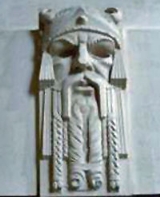
Sweyn I of Denmark

Encyclopedia
Sweyn I Forkbeard was king of Denmark and England, as well as parts of Norway. His name appears as Swegen in the Anglo-Saxon Chronicle
and he is also known in English as Svein, Swein, Sven the Dane, and Tuck.
He was a Viking leader and the father of Cnut the Great. On his father Harald Bluetooth
's death in late 986 or early 987, he became King of Denmark
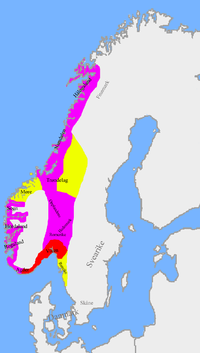
; in 1000, with allegiance of the Trondejarl, Erik of Lade, he was ruler over most of Norway. After a long effort at conquest, and shortly before his death, in 1013 he became the first of the Danish Kings of England.
, with its roots in Charlemagne
's conquests hundreds of years prior to Sweyn's time, Sweyn Forkbeard had coins made with an image in his likeness. The Latin
inscription on the coins read, "ZVEN REX DÆNOR", which translates as "Sven, king of Danes".
Sweyn's father, Harald Bluetooth, was the first of the Scandinavia
n kings to officially accept Christianity
, in the early or mid-960s. According to Adam of Bremen
, an 11th-century historian, Harald's son Sweyn was baptised Otto, in tribute to the German
king Otto I
, who was the first Holy Roman Emperor
. Forkbeard is never known to have officially made use of this Christian name. He did not use it on the coins he proudly sent forth, and when he was given the English crown by the Witenagemot
of Anglo-Saxon nobles, in 1013, he took the crown as king Sweyn.
, Adam of Bremen's Gesta Hammaburgensis Ecclesiae Pontificum
, and the Heimskringla
, a 13th-century work by Iceland
ic author Snorri Sturluson
. Conflicting accounts of Sweyn's later life also appear in the Encomium Emmae Reginae, an 11th-century Latin encomium
in honour of his son king Cnut's queen Emma
, of Normandy
, along with Chronicon ex chronicis
by Florence of Worcester
, another 11th-century author.
 Some historians, such as Lauritz Weibull
, have argued that Sweyn's wife described in the sagas – Swedish dowager queen Sigrid the Haughty
– is purely fictional, whereas others have accepted her existence on the evidence of the Norse saga
s. Weibull's conclusion is shared by Den Store Danske Encyklopædi
, which identifies the queen as Gunhild. In some of the old sources, such as the Jómsvíkinga saga
, Sweyn appears as an illegitimate son of Harald Bluetooth, raised by the legendary Jomsviking and jarl
of Jomsborg
, Palnatoke. Sweyn is also depicted as a rebellious son, who led an uprising against his father in 987, and chased him out of the court, forcing him to abandon his kingdom. Harald apparently spent the rest of his days with the Slavs in Wendland
, within modern-day Germany.
Many negative accounts build on Adam of Bremen's writings; Adam is said to have watched Sweyn and Scandinavia in general with an "unsympathetic and intolerant eye", according to some scholars. Adam accused Forkbeard of being a rebellious pagan who persecuted Christians, betrayed his father and expelled German bishops from Scania
and Zealand. According to Adam, Sweyn was sent into exile by his father's German friends and deposed in favor of king Eric the Victorious of Sweden
, whom Adam wrote ruled Denmark until his death in 994 or 995.
Historians generally have found problems with Adam's claims, such as that Sweyn was driven into exile in Scotland
for a period as long as fourteen years. As many scholars point out, he built churches in Denmark throughout this period, such as Lund
and Roskilde
, while he led Danish raids against England.
Sweyn I Forkbeard (Old Norse
: Sveinn Tjúguskegg; c.960 − 3 February 1014) was king of Denmark and England, as well as parts of Norway. His name appears as Swegen in the Anglo-Saxon Chronicle
and he is also known in English as Svein, Swein, Sven the Dane, and Tuck.
He was a Viking leader and the father of Cnut the Great. On his father Harald Bluetooth
's death in late 986 or early 987, he became King of Denmark
; in 1000, with allegiance of the Trondejarl, Erik of Lade, he was ruler over most of Norway. After a long effort at conquest, and shortly before his death, in 1013 he became the first of the Danish Kings of England.
, with its roots in Charlemagne
's conquests hundreds of years prior to Sweyn's time, Sweyn Forkbeard had coins made with an image in his likeness. The Latin
inscription on the coins read, "ZVEN REX DÆNOR", which translates as "Sven, king of Danes".
Sweyn's father, Harald Bluetooth, was the first of the Scandinavia
n kings to officially accept Christianity
, in the early or mid-960s. According to Adam of Bremen
, an 11th-century historian, Harald's son Sweyn was baptised Otto, in tribute to the German
king Otto I
, who was the first Holy Roman Emperor
. Forkbeard is never known to have officially made use of this Christian name. He did not use it on the coins he proudly sent forth, and when he was given the English crown by the Witenagemot
of Anglo-Saxon nobles, in 1013, he took the crown as king Sweyn.
, Adam of Bremen's Gesta Hammaburgensis Ecclesiae Pontificum
, and the Heimskringla
, a 13th-century work by Iceland
ic author Snorri Sturluson
. Conflicting accounts of Sweyn's later life also appear in the Encomium Emmae Reginae, an 11th-century Latin encomium
in honour of his son king Cnut's queen Emma
, of Normandy
, along with Chronicon ex chronicis
by Florence of Worcester
, another 11th-century author.
Some historians, such as Lauritz Weibull
, have argued that Sweyn's wife described in the sagas – Swedish dowager queen Sigrid the Haughty
– is purely fictional, whereas others have accepted her existence on the evidence of the Norse saga
s. Weibull's conclusion is shared by Den Store Danske Encyklopædi
, which identifies the queen as Gunhild. In some of the old sources, such as the Jómsvíkinga saga
, Sweyn appears as an illegitimate son of Harald Bluetooth, raised by the legendary Jomsviking and jarl
of Jomsborg
, Palnatoke. Sweyn is also depicted as a rebellious son, who led an uprising against his father in 987, and chased him out of the court, forcing him to abandon his kingdom. Harald apparently spent the rest of his days with the Slavs in Wendland
, within modern-day Germany.
Many negative accounts build on Adam of Bremen's writings; Adam is said to have watched Sweyn and Scandinavia in general with an "unsympathetic and intolerant eye", according to some scholars. Adam accused Forkbeard of being a rebellious pagan who persecuted Christians, betrayed his father and expelled German bishops from Scania
and Zealand. According to Adam, Sweyn was sent into exile by his father's German friends and deposed in favor of king Eric the Victorious of Sweden
, whom Adam wrote ruled Denmark until his death in 994 or 995.
Historians generally have found problems with Adam's claims, such as that Sweyn was driven into exile in Scotland
for a period as long as fourteen years. As many scholars point out, he built churches in Denmark throughout this period, such as Lund
and Roskilde
, while he led Danish raids against England.
Sweyn I Forkbeard (Old Norse
: Sveinn Tjúguskegg; c.960 − 3 February 1014) was king of Denmark and England, as well as parts of Norway. His name appears as Swegen in the Anglo-Saxon Chronicle
and he is also known in English as Svein, Swein, Sven the Dane, and Tuck.
He was a Viking leader and the father of Cnut the Great. On his father Harald Bluetooth
's death in late 986 or early 987, he became King of Denmark
; in 1000, with allegiance of the Trondejarl, Erik of Lade, he was ruler over most of Norway. After a long effort at conquest, and shortly before his death, in 1013 he became the first of the Danish Kings of England.
, with its roots in Charlemagne
's conquests hundreds of years prior to Sweyn's time, Sweyn Forkbeard had coins made with an image in his likeness. The Latin
inscription on the coins read, "ZVEN REX DÆNOR", which translates as "Sven, king of Danes".
Sweyn's father, Harald Bluetooth, was the first of the Scandinavia
n kings to officially accept Christianity
, in the early or mid-960s. According to Adam of Bremen
, an 11th-century historian, Harald's son Sweyn was baptised Otto, in tribute to the German
king Otto I
, who was the first Holy Roman Emperor
. Forkbeard is never known to have officially made use of this Christian name. He did not use it on the coins he proudly sent forth, and when he was given the English crown by the Witenagemot
of Anglo-Saxon nobles, in 1013, he took the crown as king Sweyn.
, Adam of Bremen's Gesta Hammaburgensis Ecclesiae Pontificum
, and the Heimskringla
, a 13th-century work by Iceland
ic author Snorri Sturluson
. Conflicting accounts of Sweyn's later life also appear in the Encomium Emmae Reginae, an 11th-century Latin encomium
in honour of his son king Cnut's queen Emma
, of Normandy
, along with Chronicon ex chronicis
by Florence of Worcester
, another 11th-century author.
Some historians, such as Lauritz Weibull
, have argued that Sweyn's wife described in the sagas – Swedish dowager queen Sigrid the Haughty
– is purely fictional, whereas others have accepted her existence on the evidence of the Norse saga
s. Weibull's conclusion is shared by Den Store Danske Encyklopædi
, which identifies the queen as Gunhild. In some of the old sources, such as the Jómsvíkinga saga
, Sweyn appears as an illegitimate son of Harald Bluetooth, raised by the legendary Jomsviking and jarl
of Jomsborg
, Palnatoke. Sweyn is also depicted as a rebellious son, who led an uprising against his father in 987, and chased him out of the court, forcing him to abandon his kingdom. Harald apparently spent the rest of his days with the Slavs in Wendland
, within modern-day Germany.
Many negative accounts build on Adam of Bremen's writings; Adam is said to have watched Sweyn and Scandinavia in general with an "unsympathetic and intolerant eye", according to some scholars. Adam accused Forkbeard of being a rebellious pagan who persecuted Christians, betrayed his father and expelled German bishops from Scania
and Zealand. According to Adam, Sweyn was sent into exile by his father's German friends and deposed in favor of king Eric the Victorious of Sweden
, whom Adam wrote ruled Denmark until his death in 994 or 995.
Historians generally have found problems with Adam's claims, such as that Sweyn was driven into exile in Scotland
for a period as long as fourteen years. As many scholars point out, he built churches in Denmark throughout this period, such as Lund
and Roskilde
, while he led Danish raids against England.
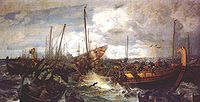
, Sweyn was involved in raids against England
during 1002–1005, 1006–1007, and 1009–1012, to revenge the St. Brice's Day massacre
of England's Danish inhabitants in November 1002. Historians have considered the massacre as similar to a large-scale ethnic cleansing
of the Danes in England orchestrated by Æthelred the Unready. Sweyn was believed to have had a personal interest in the atrocities due to his sister Gunhilde
being amongst the victims.
According to Simon Keynes, Sweyn was active in Wessex and East Anglia in 1003–1004 but a famine forced him to return home in 1005.
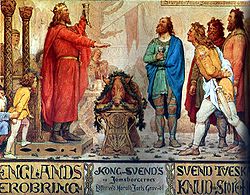 Some scholars have argued that Sweyn's participation may have been prompted by his state of impoverishment after having been forced to pay a hefty ransom. He needed revenue from the raids. He acquired massive sums of Danegeld
through the raids. In 1013, he is reported to have personally led his forces in a full-scale invasion.
The contemporary Peterborough Chronicle
(also called the Laud Manuscript), one of the Anglo-Saxon Chronicles, states, "before the month of August came king Sweyn with his fleet to Sandwich
. He went very quickly about East Anglia
into the Humber
's mouth, and so upward along the Trent
till he came to Gainsborough. Earl
Uchtred
and all Northumbria
quickly bowed to him, as did all the people of Lindsey
, then the people of the Five Boroughs
. He was given hostages from each shire
. When he understood that all the people had submitted to him, he bade that his force should be provisioned and horsed; he went south with the main part of the invasion force, while some of the invasion force, as well as the hostages, were with his son Cnut. After he came over Watling Street
, they went to Oxford
, and the town-dwellers soon bowed to him, and gave hostages. From there they went to Winchester
, and the people did the same, then eastward to London
."
But the Londoners put up a strong resistance, because King Æthelred and Thorkell the Tall, a Viking leader who had defected to Æthelred, were in the city, and held their ground against him. Sweyn then went west to Bath, where the western thanes submitted to him and gave hostages. The Londoners followed suit, fearing Sweyn's revenge if they resisted any longer. King Æthelred sent his sons Edward and Alfred to Normandy, and retreated to the Isle of Wight, and then followed them into exile. On Christmas Day 1013 Sweyn was declared king of England.
Based in Gainsborough, Lincolnshire
, Sweyn began to organize his vast new kingdom, but he died there on 3 February 1014, having ruled England unopposed for only five weeks. His embalmed body was returned to Denmark, to be buried in the church he built in Roskilde. He was succeeded as King of Denmark by his elder son, Harald II
, but the Danish fleet proclaimed his younger son Cnut king. In England, the councillors had sent for Æthelred, who upon his return from exile in Normandy in the spring of 1014 managed to drive Cnut out of England. But Cnut returned and became King of England in 1016, while also ruling Denmark, Norway, parts of Sweden, Pomerania
, and Schleswig
.
His son Cnut and grandsons Harold Harefoot
and Harthacnut ruled England for 26 years. After Harthacnut's death, the English throne reverted to the House of Wessex. Sweyn's descendents through his daughter Estrid continue to rule Denmark to this day. One of his descendants, Margaret of Denmark, married James III of Scotland
, introducing Sweyn's bloodline into the Scottish Royal blood line. After James VI of Scotland inherited the English throne in 1603, Sweyn's ancestry was introduced into the English royal bloodline as well. Therefore, from 1603 on, all English and British monarchs are descended from King Sweyn of England, among others.
along with his father, was a heathen. This may have been true, as much of Scandinavia was pagan
at the time, but there are no data to corroborate the assertion. German and French records support that Harald Bluetooth was baptized.
According to Adam, Sweyn was punished by God for leading the uprising which led to king Harald's death, and had to spend "fourteen years" abroad - perhaps a Biblical
reference from an ecclesiastical writer, as it refers to the symbolic number seven. Adam purports that Sweyn was shunned by all those with whom he sought refuge, but was finally allowed to live for a while in Scotland. As the Scottish king at the time had a reputation in Europe as a heathen and a murderer, Adam's intention appeared to be to show that Sweyn belonged with heathens and was not fit to rule a Christian country. According to Adam, Sweyn only achieved success as a ruler after accepting Christianity.
Sweyn was tolerant of paganism while favoring Christianity, at least politically. By allowing English ecclesiastical influence in his kingdom, he was spurning the Hamburg-Bremen archbishop. Since German bishops were an integral part of the secular state, Sweyn's preference for the English church may have been a political move. He sought to preempt any threat against his independence posed by the German kings. Contrary to Adam's writings, Sweyn did not appear to have reestablished paganism. There is no evidence of reversion to pagan burial practices during Sweyn's reign. Whether King Sweyn was a heathen or not, he enlisted priests and bishops from England rather than from Hamburg
. This may have been another reason for Adam of Bremen's apparent hostility in his accounts. Numerous converted priests of a Danish origin from the Danelaw
lived in England, while Sweyn had few connections to Germany or its priests.
Sweyn must have known that once the Archbishop
of Hamburg-Bremen gained influence in Denmark, the German Emperor Otto II would not be far behind. His Slavic
neighbours to the south-east had been all but annexed by Germany once Otto's father Otto I
divided their lands into Bishoprics and put them under the "care" of the Holy Roman Emperor
. Sweyn may have envisaged the same happening to his own territory.
By Sigrid
:
Anglo-Saxon Chronicle
The Anglo-Saxon Chronicle is a collection of annals in Old English chronicling the history of the Anglo-Saxons. The original manuscript of the Chronicle was created late in the 9th century, probably in Wessex, during the reign of Alfred the Great...
and he is also known in English as Svein, Swein, Sven the Dane, and Tuck.
He was a Viking leader and the father of Cnut the Great. On his father Harald Bluetooth
Harald I of Denmark
Harald "Bluetooth" Gormsson was the son of King Gorm the Old and of Thyra Dannebod. He died in 985 or 986 having ruled as King of Denmark from around 958 and King of Norway for a few years probably around 970...
's death in late 986 or early 987, he became King of Denmark
Denmark
Denmark is a Scandinavian country in Northern Europe. The countries of Denmark and Greenland, as well as the Faroe Islands, constitute the Kingdom of Denmark . It is the southernmost of the Nordic countries, southwest of Sweden and south of Norway, and bordered to the south by Germany. Denmark...
; in 1000, with allegiance of the Trondejarl, Erik of Lade, he was ruler over most of Norway. After a long effort at conquest, and shortly before his death, in 1013 he became the first of the Danish Kings of England.
The Church and currency
On the northern edges of the relatively recent Holy Roman EmpireHoly Roman Empire
The Holy Roman Empire was a realm that existed from 962 to 1806 in Central Europe.It was ruled by the Holy Roman Emperor. Its character changed during the Middle Ages and the Early Modern period, when the power of the emperor gradually weakened in favour of the princes...
, with its roots in Charlemagne
Charlemagne
Charlemagne was King of the Franks from 768 and Emperor of the Romans from 800 to his death in 814. He expanded the Frankish kingdom into an empire that incorporated much of Western and Central Europe. During his reign, he conquered Italy and was crowned by Pope Leo III on 25 December 800...
's conquests hundreds of years prior to Sweyn's time, Sweyn Forkbeard had coins made with an image in his likeness. The Latin
Latin
Latin is an Italic language originally spoken in Latium and Ancient Rome. It, along with most European languages, is a descendant of the ancient Proto-Indo-European language. Although it is considered a dead language, a number of scholars and members of the Christian clergy speak it fluently, and...
inscription on the coins read, "ZVEN REX DÆNOR", which translates as "Sven, king of Danes".
Sweyn's father, Harald Bluetooth, was the first of the Scandinavia
Scandinavia
Scandinavia is a cultural, historical and ethno-linguistic region in northern Europe that includes the three kingdoms of Denmark, Norway and Sweden, characterized by their common ethno-cultural heritage and language. Modern Norway and Sweden proper are situated on the Scandinavian Peninsula,...
n kings to officially accept Christianity
Christianity
Christianity is a monotheistic religion based on the life and teachings of Jesus as presented in canonical gospels and other New Testament writings...
, in the early or mid-960s. According to Adam of Bremen
Adam of Bremen
Adam of Bremen was a German medieval chronicler. He lived and worked in the second half of the eleventh century. He is most famous for his chronicle Gesta Hammaburgensis Ecclesiae Pontificum .-Background:Little is known of his life other than hints from his own chronicles...
, an 11th-century historian, Harald's son Sweyn was baptised Otto, in tribute to the German
Germans
The Germans are a Germanic ethnic group native to Central Europe. The English term Germans has referred to the German-speaking population of the Holy Roman Empire since the Late Middle Ages....
king Otto I
Otto I, Holy Roman Emperor
Otto I the Great , son of Henry I the Fowler and Matilda of Ringelheim, was Duke of Saxony, King of Germany, King of Italy, and "the first of the Germans to be called the emperor of Italy" according to Arnulf of Milan...
, who was the first Holy Roman Emperor
Holy Roman Emperor
The Holy Roman Emperor is a term used by historians to denote a medieval ruler who, as German King, had also received the title of "Emperor of the Romans" from the Pope...
. Forkbeard is never known to have officially made use of this Christian name. He did not use it on the coins he proudly sent forth, and when he was given the English crown by the Witenagemot
Witenagemot
The Witenagemot , also known as the Witan was a political institution in Anglo-Saxon England which operated from before the 7th century until the 11th century.The Witenagemot was an assembly of the ruling class whose primary function was to advise the king and whose membership was...
of Anglo-Saxon nobles, in 1013, he took the crown as king Sweyn.
Life and legacy
Many details about Sweyn's life are contested. Scholars disagree about the various, too often contradictory, accounts of his life given in sources from his era of history, such as the Anglo-Saxon ChronicleAnglo-Saxon Chronicle
The Anglo-Saxon Chronicle is a collection of annals in Old English chronicling the history of the Anglo-Saxons. The original manuscript of the Chronicle was created late in the 9th century, probably in Wessex, during the reign of Alfred the Great...
, Adam of Bremen's Gesta Hammaburgensis Ecclesiae Pontificum
Gesta Hammaburgensis ecclesiae pontificum
Gesta Hammaburgensis ecclesiae pontificum is a historical treatise written between 1075 and 1080 by Adam of Bremen. It covers the period from 788 to the time it was written. The treatise consist of:*Liber I...
, and the Heimskringla
Heimskringla
Heimskringla is the best known of the Old Norse kings' sagas. It was written in Old Norse in Iceland by the poet and historian Snorri Sturluson ca. 1230...
, a 13th-century work by Iceland
Iceland
Iceland , described as the Republic of Iceland, is a Nordic and European island country in the North Atlantic Ocean, on the Mid-Atlantic Ridge. Iceland also refers to the main island of the country, which contains almost all the population and almost all the land area. The country has a population...
ic author Snorri Sturluson
Snorri Sturluson
Snorri Sturluson was an Icelandic historian, poet, and politician. He was twice elected lawspeaker at the Icelandic parliament, the Althing...
. Conflicting accounts of Sweyn's later life also appear in the Encomium Emmae Reginae, an 11th-century Latin encomium
Encomium
Encomium is a Latin word deriving from the Classical Greek ἐγκώμιον meaning the praise of a person or thing. "Encomium" also refers to several distinct aspects of rhetoric:* A general category of oratory* A method within rhetorical pedagogy...
in honour of his son king Cnut's queen Emma
Emma of Normandy
Emma , was a daughter of Richard the Fearless, Duke of Normandy, by his second wife Gunnora. She was Queen consort of England twice, by successive marriages: first as second wife to Æthelred the Unready of England ; and then second wife to Cnut the Great of Denmark...
, of Normandy
Normandy
Normandy is a geographical region corresponding to the former Duchy of Normandy. It is in France.The continental territory covers 30,627 km² and forms the preponderant part of Normandy and roughly 5% of the territory of France. It is divided for administrative purposes into two régions:...
, along with Chronicon ex chronicis
John of Worcester
John of Worcester was an English monk and chronicler. He is usually held to be the author of the Chronicon ex chronicis.-Chronicon ex chronicis:...
by Florence of Worcester
Florence of Worcester
Florence of Worcester , known in Latin as Florentius, was a monk of Worcester, who played some part in the production of the Chronicon ex chronicis, a Latin world chronicle which begins with the creation and ends in 1140....
, another 11th-century author.
Lauritz Weibull
Lauritz Ulrik Absalon Weibull was a Swedish historian.He was born in Lund, son of history professor Martin Weibull and the brother of Curt Weibull and Carl Gustaf Weibull, enrolled at the University of Lund in 1892, completed his B.A. 1892, his licentiate degree in 1899 and defended his...
, have argued that Sweyn's wife described in the sagas – Swedish dowager queen Sigrid the Haughty
Sigrid the Haughty
Sigrid the Haughty, also known as Sigríð Storråda, is a queen appearing in Norse sagas as wife, first of Eric the Victorious of Sweden, then Sweyn Forkbeard of Denmark. While given the Nordic ancestry in sagas, she has been hypothesized to be identical to historically attested Polish or Pomeranian...
– is purely fictional, whereas others have accepted her existence on the evidence of the Norse saga
Norse saga
The sagas are stories about ancient Scandinavian and Germanic history, about early Viking voyages, the battles that took place during the voyages, about migration to Iceland and of feuds between Icelandic families...
s. Weibull's conclusion is shared by Den Store Danske Encyklopædi
Den Store Danske Encyklopædi
Den Store Danske Encyklopædi is the most comprehensive contemporary Danish language encyclopedia. The 20 volumes of the encyclopedia were published successively between 1994 and 2001; a one-volume supplement was published in 2002 and two index volumes in 2003...
, which identifies the queen as Gunhild. In some of the old sources, such as the Jómsvíkinga saga
Jómsvíkinga saga
The Jómsvíkinga saga relates of the founding of Jomsborg by Palnatoke, and of the famous Viking brotherhood of the Jomsvikings....
, Sweyn appears as an illegitimate son of Harald Bluetooth, raised by the legendary Jomsviking and jarl
Earl
An earl is a member of the nobility. The title is Anglo-Saxon, akin to the Scandinavian form jarl, and meant "chieftain", particularly a chieftain set to rule a territory in a king's stead. In Scandinavia, it became obsolete in the Middle Ages and was replaced with duke...
of Jomsborg
Jomsborg
Jomsborg was a semi-legendary Viking stronghold at the southern coast of the Baltic Sea , that existed between the 960s and 1043. Its inhabitants are known as Jomsvikings. Jomsborg's exact location has not yet been established, though it is maintained that Jomsborg was somewhere on the islands of...
, Palnatoke. Sweyn is also depicted as a rebellious son, who led an uprising against his father in 987, and chased him out of the court, forcing him to abandon his kingdom. Harald apparently spent the rest of his days with the Slavs in Wendland
Wendland
Wendland may refer to either of the following regions or people:*Wendland may refer to a region once inhabited by Wends, an old Germanic term for Slavic tribes living in close proximity to the Germanic tribes:...
, within modern-day Germany.
Many negative accounts build on Adam of Bremen's writings; Adam is said to have watched Sweyn and Scandinavia in general with an "unsympathetic and intolerant eye", according to some scholars. Adam accused Forkbeard of being a rebellious pagan who persecuted Christians, betrayed his father and expelled German bishops from Scania
Scania
Scania is the southernmost of the 25 traditional non-administrative provinces of Sweden, constituting a peninsula on the southern tip of the Scandinavian peninsula, and some adjacent islands. The modern administrative subdivision Skåne County is almost, but not totally, congruent with the...
and Zealand. According to Adam, Sweyn was sent into exile by his father's German friends and deposed in favor of king Eric the Victorious of Sweden
Sweden
Sweden , officially the Kingdom of Sweden , is a Nordic country on the Scandinavian Peninsula in Northern Europe. Sweden borders with Norway and Finland and is connected to Denmark by a bridge-tunnel across the Öresund....
, whom Adam wrote ruled Denmark until his death in 994 or 995.
Historians generally have found problems with Adam's claims, such as that Sweyn was driven into exile in Scotland
Scotland
Scotland is a country that is part of the United Kingdom. Occupying the northern third of the island of Great Britain, it shares a border with England to the south and is bounded by the North Sea to the east, the Atlantic Ocean to the north and west, and the North Channel and Irish Sea to the...
for a period as long as fourteen years. As many scholars point out, he built churches in Denmark throughout this period, such as Lund
Lund
-Main sights:During the 12th and 13th centuries, when the town was the seat of the archbishop, many churches and monasteries were built. At its peak, Lund had 27 churches, but most of them were demolished as result of the Reformation in 1536. Several medieval buildings remain, including Lund...
and Roskilde
Roskilde
Roskilde is the main city in Roskilde Municipality, Denmark on the island of Zealand. It is an ancient city, dating from the Viking Age and is a member of the Most Ancient European Towns Network....
, while he led Danish raids against England.
Sweyn I Forkbeard (Old Norse
Old Norse
Old Norse is a North Germanic language that was spoken by inhabitants of Scandinavia and inhabitants of their overseas settlements during the Viking Age, until about 1300....
: Sveinn Tjúguskegg; c.960 − 3 February 1014) was king of Denmark and England, as well as parts of Norway. His name appears as Swegen in the Anglo-Saxon Chronicle
Anglo-Saxon Chronicle
The Anglo-Saxon Chronicle is a collection of annals in Old English chronicling the history of the Anglo-Saxons. The original manuscript of the Chronicle was created late in the 9th century, probably in Wessex, during the reign of Alfred the Great...
and he is also known in English as Svein, Swein, Sven the Dane, and Tuck.
He was a Viking leader and the father of Cnut the Great. On his father Harald Bluetooth
Harald I of Denmark
Harald "Bluetooth" Gormsson was the son of King Gorm the Old and of Thyra Dannebod. He died in 985 or 986 having ruled as King of Denmark from around 958 and King of Norway for a few years probably around 970...
's death in late 986 or early 987, he became King of Denmark
Denmark
Denmark is a Scandinavian country in Northern Europe. The countries of Denmark and Greenland, as well as the Faroe Islands, constitute the Kingdom of Denmark . It is the southernmost of the Nordic countries, southwest of Sweden and south of Norway, and bordered to the south by Germany. Denmark...
; in 1000, with allegiance of the Trondejarl, Erik of Lade, he was ruler over most of Norway. After a long effort at conquest, and shortly before his death, in 1013 he became the first of the Danish Kings of England.
The Church and currency
On the northern edges of the relatively recent Holy Roman EmpireHoly Roman Empire
The Holy Roman Empire was a realm that existed from 962 to 1806 in Central Europe.It was ruled by the Holy Roman Emperor. Its character changed during the Middle Ages and the Early Modern period, when the power of the emperor gradually weakened in favour of the princes...
, with its roots in Charlemagne
Charlemagne
Charlemagne was King of the Franks from 768 and Emperor of the Romans from 800 to his death in 814. He expanded the Frankish kingdom into an empire that incorporated much of Western and Central Europe. During his reign, he conquered Italy and was crowned by Pope Leo III on 25 December 800...
's conquests hundreds of years prior to Sweyn's time, Sweyn Forkbeard had coins made with an image in his likeness. The Latin
Latin
Latin is an Italic language originally spoken in Latium and Ancient Rome. It, along with most European languages, is a descendant of the ancient Proto-Indo-European language. Although it is considered a dead language, a number of scholars and members of the Christian clergy speak it fluently, and...
inscription on the coins read, "ZVEN REX DÆNOR", which translates as "Sven, king of Danes".
Sweyn's father, Harald Bluetooth, was the first of the Scandinavia
Scandinavia
Scandinavia is a cultural, historical and ethno-linguistic region in northern Europe that includes the three kingdoms of Denmark, Norway and Sweden, characterized by their common ethno-cultural heritage and language. Modern Norway and Sweden proper are situated on the Scandinavian Peninsula,...
n kings to officially accept Christianity
Christianity
Christianity is a monotheistic religion based on the life and teachings of Jesus as presented in canonical gospels and other New Testament writings...
, in the early or mid-960s. According to Adam of Bremen
Adam of Bremen
Adam of Bremen was a German medieval chronicler. He lived and worked in the second half of the eleventh century. He is most famous for his chronicle Gesta Hammaburgensis Ecclesiae Pontificum .-Background:Little is known of his life other than hints from his own chronicles...
, an 11th-century historian, Harald's son Sweyn was baptised Otto, in tribute to the German
Germans
The Germans are a Germanic ethnic group native to Central Europe. The English term Germans has referred to the German-speaking population of the Holy Roman Empire since the Late Middle Ages....
king Otto I
Otto I, Holy Roman Emperor
Otto I the Great , son of Henry I the Fowler and Matilda of Ringelheim, was Duke of Saxony, King of Germany, King of Italy, and "the first of the Germans to be called the emperor of Italy" according to Arnulf of Milan...
, who was the first Holy Roman Emperor
Holy Roman Emperor
The Holy Roman Emperor is a term used by historians to denote a medieval ruler who, as German King, had also received the title of "Emperor of the Romans" from the Pope...
. Forkbeard is never known to have officially made use of this Christian name. He did not use it on the coins he proudly sent forth, and when he was given the English crown by the Witenagemot
Witenagemot
The Witenagemot , also known as the Witan was a political institution in Anglo-Saxon England which operated from before the 7th century until the 11th century.The Witenagemot was an assembly of the ruling class whose primary function was to advise the king and whose membership was...
of Anglo-Saxon nobles, in 1013, he took the crown as king Sweyn.
Life and legacy
Many details about Sweyn's life are contested. Scholars disagree about the various, too often contradictory, accounts of his life given in sources from his era of history, such as the Anglo-Saxon ChronicleAnglo-Saxon Chronicle
The Anglo-Saxon Chronicle is a collection of annals in Old English chronicling the history of the Anglo-Saxons. The original manuscript of the Chronicle was created late in the 9th century, probably in Wessex, during the reign of Alfred the Great...
, Adam of Bremen's Gesta Hammaburgensis Ecclesiae Pontificum
Gesta Hammaburgensis ecclesiae pontificum
Gesta Hammaburgensis ecclesiae pontificum is a historical treatise written between 1075 and 1080 by Adam of Bremen. It covers the period from 788 to the time it was written. The treatise consist of:*Liber I...
, and the Heimskringla
Heimskringla
Heimskringla is the best known of the Old Norse kings' sagas. It was written in Old Norse in Iceland by the poet and historian Snorri Sturluson ca. 1230...
, a 13th-century work by Iceland
Iceland
Iceland , described as the Republic of Iceland, is a Nordic and European island country in the North Atlantic Ocean, on the Mid-Atlantic Ridge. Iceland also refers to the main island of the country, which contains almost all the population and almost all the land area. The country has a population...
ic author Snorri Sturluson
Snorri Sturluson
Snorri Sturluson was an Icelandic historian, poet, and politician. He was twice elected lawspeaker at the Icelandic parliament, the Althing...
. Conflicting accounts of Sweyn's later life also appear in the Encomium Emmae Reginae, an 11th-century Latin encomium
Encomium
Encomium is a Latin word deriving from the Classical Greek ἐγκώμιον meaning the praise of a person or thing. "Encomium" also refers to several distinct aspects of rhetoric:* A general category of oratory* A method within rhetorical pedagogy...
in honour of his son king Cnut's queen Emma
Emma of Normandy
Emma , was a daughter of Richard the Fearless, Duke of Normandy, by his second wife Gunnora. She was Queen consort of England twice, by successive marriages: first as second wife to Æthelred the Unready of England ; and then second wife to Cnut the Great of Denmark...
, of Normandy
Normandy
Normandy is a geographical region corresponding to the former Duchy of Normandy. It is in France.The continental territory covers 30,627 km² and forms the preponderant part of Normandy and roughly 5% of the territory of France. It is divided for administrative purposes into two régions:...
, along with Chronicon ex chronicis
John of Worcester
John of Worcester was an English monk and chronicler. He is usually held to be the author of the Chronicon ex chronicis.-Chronicon ex chronicis:...
by Florence of Worcester
Florence of Worcester
Florence of Worcester , known in Latin as Florentius, was a monk of Worcester, who played some part in the production of the Chronicon ex chronicis, a Latin world chronicle which begins with the creation and ends in 1140....
, another 11th-century author.
Lauritz Weibull
Lauritz Ulrik Absalon Weibull was a Swedish historian.He was born in Lund, son of history professor Martin Weibull and the brother of Curt Weibull and Carl Gustaf Weibull, enrolled at the University of Lund in 1892, completed his B.A. 1892, his licentiate degree in 1899 and defended his...
, have argued that Sweyn's wife described in the sagas – Swedish dowager queen Sigrid the Haughty
Sigrid the Haughty
Sigrid the Haughty, also known as Sigríð Storråda, is a queen appearing in Norse sagas as wife, first of Eric the Victorious of Sweden, then Sweyn Forkbeard of Denmark. While given the Nordic ancestry in sagas, she has been hypothesized to be identical to historically attested Polish or Pomeranian...
– is purely fictional, whereas others have accepted her existence on the evidence of the Norse saga
Norse saga
The sagas are stories about ancient Scandinavian and Germanic history, about early Viking voyages, the battles that took place during the voyages, about migration to Iceland and of feuds between Icelandic families...
s. Weibull's conclusion is shared by Den Store Danske Encyklopædi
Den Store Danske Encyklopædi
Den Store Danske Encyklopædi is the most comprehensive contemporary Danish language encyclopedia. The 20 volumes of the encyclopedia were published successively between 1994 and 2001; a one-volume supplement was published in 2002 and two index volumes in 2003...
, which identifies the queen as Gunhild. In some of the old sources, such as the Jómsvíkinga saga
Jómsvíkinga saga
The Jómsvíkinga saga relates of the founding of Jomsborg by Palnatoke, and of the famous Viking brotherhood of the Jomsvikings....
, Sweyn appears as an illegitimate son of Harald Bluetooth, raised by the legendary Jomsviking and jarl
Earl
An earl is a member of the nobility. The title is Anglo-Saxon, akin to the Scandinavian form jarl, and meant "chieftain", particularly a chieftain set to rule a territory in a king's stead. In Scandinavia, it became obsolete in the Middle Ages and was replaced with duke...
of Jomsborg
Jomsborg
Jomsborg was a semi-legendary Viking stronghold at the southern coast of the Baltic Sea , that existed between the 960s and 1043. Its inhabitants are known as Jomsvikings. Jomsborg's exact location has not yet been established, though it is maintained that Jomsborg was somewhere on the islands of...
, Palnatoke. Sweyn is also depicted as a rebellious son, who led an uprising against his father in 987, and chased him out of the court, forcing him to abandon his kingdom. Harald apparently spent the rest of his days with the Slavs in Wendland
Wendland
Wendland may refer to either of the following regions or people:*Wendland may refer to a region once inhabited by Wends, an old Germanic term for Slavic tribes living in close proximity to the Germanic tribes:...
, within modern-day Germany.
Many negative accounts build on Adam of Bremen's writings; Adam is said to have watched Sweyn and Scandinavia in general with an "unsympathetic and intolerant eye", according to some scholars. Adam accused Forkbeard of being a rebellious pagan who persecuted Christians, betrayed his father and expelled German bishops from Scania
Scania
Scania is the southernmost of the 25 traditional non-administrative provinces of Sweden, constituting a peninsula on the southern tip of the Scandinavian peninsula, and some adjacent islands. The modern administrative subdivision Skåne County is almost, but not totally, congruent with the...
and Zealand. According to Adam, Sweyn was sent into exile by his father's German friends and deposed in favor of king Eric the Victorious of Sweden
Sweden
Sweden , officially the Kingdom of Sweden , is a Nordic country on the Scandinavian Peninsula in Northern Europe. Sweden borders with Norway and Finland and is connected to Denmark by a bridge-tunnel across the Öresund....
, whom Adam wrote ruled Denmark until his death in 994 or 995.
Historians generally have found problems with Adam's claims, such as that Sweyn was driven into exile in Scotland
Scotland
Scotland is a country that is part of the United Kingdom. Occupying the northern third of the island of Great Britain, it shares a border with England to the south and is bounded by the North Sea to the east, the Atlantic Ocean to the north and west, and the North Channel and Irish Sea to the...
for a period as long as fourteen years. As many scholars point out, he built churches in Denmark throughout this period, such as Lund
Lund
-Main sights:During the 12th and 13th centuries, when the town was the seat of the archbishop, many churches and monasteries were built. At its peak, Lund had 27 churches, but most of them were demolished as result of the Reformation in 1536. Several medieval buildings remain, including Lund...
and Roskilde
Roskilde
Roskilde is the main city in Roskilde Municipality, Denmark on the island of Zealand. It is an ancient city, dating from the Viking Age and is a member of the Most Ancient European Towns Network....
, while he led Danish raids against England.
Sweyn I Forkbeard (Old Norse
Old Norse
Old Norse is a North Germanic language that was spoken by inhabitants of Scandinavia and inhabitants of their overseas settlements during the Viking Age, until about 1300....
: Sveinn Tjúguskegg; c.960 − 3 February 1014) was king of Denmark and England, as well as parts of Norway. His name appears as Swegen in the Anglo-Saxon Chronicle
Anglo-Saxon Chronicle
The Anglo-Saxon Chronicle is a collection of annals in Old English chronicling the history of the Anglo-Saxons. The original manuscript of the Chronicle was created late in the 9th century, probably in Wessex, during the reign of Alfred the Great...
and he is also known in English as Svein, Swein, Sven the Dane, and Tuck.
He was a Viking leader and the father of Cnut the Great. On his father Harald Bluetooth
Harald I of Denmark
Harald "Bluetooth" Gormsson was the son of King Gorm the Old and of Thyra Dannebod. He died in 985 or 986 having ruled as King of Denmark from around 958 and King of Norway for a few years probably around 970...
's death in late 986 or early 987, he became King of Denmark
Denmark
Denmark is a Scandinavian country in Northern Europe. The countries of Denmark and Greenland, as well as the Faroe Islands, constitute the Kingdom of Denmark . It is the southernmost of the Nordic countries, southwest of Sweden and south of Norway, and bordered to the south by Germany. Denmark...
; in 1000, with allegiance of the Trondejarl, Erik of Lade, he was ruler over most of Norway. After a long effort at conquest, and shortly before his death, in 1013 he became the first of the Danish Kings of England.
The Church and currency
On the northern edges of the relatively recent Holy Roman EmpireHoly Roman Empire
The Holy Roman Empire was a realm that existed from 962 to 1806 in Central Europe.It was ruled by the Holy Roman Emperor. Its character changed during the Middle Ages and the Early Modern period, when the power of the emperor gradually weakened in favour of the princes...
, with its roots in Charlemagne
Charlemagne
Charlemagne was King of the Franks from 768 and Emperor of the Romans from 800 to his death in 814. He expanded the Frankish kingdom into an empire that incorporated much of Western and Central Europe. During his reign, he conquered Italy and was crowned by Pope Leo III on 25 December 800...
's conquests hundreds of years prior to Sweyn's time, Sweyn Forkbeard had coins made with an image in his likeness. The Latin
Latin
Latin is an Italic language originally spoken in Latium and Ancient Rome. It, along with most European languages, is a descendant of the ancient Proto-Indo-European language. Although it is considered a dead language, a number of scholars and members of the Christian clergy speak it fluently, and...
inscription on the coins read, "ZVEN REX DÆNOR", which translates as "Sven, king of Danes".
Sweyn's father, Harald Bluetooth, was the first of the Scandinavia
Scandinavia
Scandinavia is a cultural, historical and ethno-linguistic region in northern Europe that includes the three kingdoms of Denmark, Norway and Sweden, characterized by their common ethno-cultural heritage and language. Modern Norway and Sweden proper are situated on the Scandinavian Peninsula,...
n kings to officially accept Christianity
Christianity
Christianity is a monotheistic religion based on the life and teachings of Jesus as presented in canonical gospels and other New Testament writings...
, in the early or mid-960s. According to Adam of Bremen
Adam of Bremen
Adam of Bremen was a German medieval chronicler. He lived and worked in the second half of the eleventh century. He is most famous for his chronicle Gesta Hammaburgensis Ecclesiae Pontificum .-Background:Little is known of his life other than hints from his own chronicles...
, an 11th-century historian, Harald's son Sweyn was baptised Otto, in tribute to the German
Germans
The Germans are a Germanic ethnic group native to Central Europe. The English term Germans has referred to the German-speaking population of the Holy Roman Empire since the Late Middle Ages....
king Otto I
Otto I, Holy Roman Emperor
Otto I the Great , son of Henry I the Fowler and Matilda of Ringelheim, was Duke of Saxony, King of Germany, King of Italy, and "the first of the Germans to be called the emperor of Italy" according to Arnulf of Milan...
, who was the first Holy Roman Emperor
Holy Roman Emperor
The Holy Roman Emperor is a term used by historians to denote a medieval ruler who, as German King, had also received the title of "Emperor of the Romans" from the Pope...
. Forkbeard is never known to have officially made use of this Christian name. He did not use it on the coins he proudly sent forth, and when he was given the English crown by the Witenagemot
Witenagemot
The Witenagemot , also known as the Witan was a political institution in Anglo-Saxon England which operated from before the 7th century until the 11th century.The Witenagemot was an assembly of the ruling class whose primary function was to advise the king and whose membership was...
of Anglo-Saxon nobles, in 1013, he took the crown as king Sweyn.
Life and legacy
Many details about Sweyn's life are contested. Scholars disagree about the various, too often contradictory, accounts of his life given in sources from his era of history, such as the Anglo-Saxon ChronicleAnglo-Saxon Chronicle
The Anglo-Saxon Chronicle is a collection of annals in Old English chronicling the history of the Anglo-Saxons. The original manuscript of the Chronicle was created late in the 9th century, probably in Wessex, during the reign of Alfred the Great...
, Adam of Bremen's Gesta Hammaburgensis Ecclesiae Pontificum
Gesta Hammaburgensis ecclesiae pontificum
Gesta Hammaburgensis ecclesiae pontificum is a historical treatise written between 1075 and 1080 by Adam of Bremen. It covers the period from 788 to the time it was written. The treatise consist of:*Liber I...
, and the Heimskringla
Heimskringla
Heimskringla is the best known of the Old Norse kings' sagas. It was written in Old Norse in Iceland by the poet and historian Snorri Sturluson ca. 1230...
, a 13th-century work by Iceland
Iceland
Iceland , described as the Republic of Iceland, is a Nordic and European island country in the North Atlantic Ocean, on the Mid-Atlantic Ridge. Iceland also refers to the main island of the country, which contains almost all the population and almost all the land area. The country has a population...
ic author Snorri Sturluson
Snorri Sturluson
Snorri Sturluson was an Icelandic historian, poet, and politician. He was twice elected lawspeaker at the Icelandic parliament, the Althing...
. Conflicting accounts of Sweyn's later life also appear in the Encomium Emmae Reginae, an 11th-century Latin encomium
Encomium
Encomium is a Latin word deriving from the Classical Greek ἐγκώμιον meaning the praise of a person or thing. "Encomium" also refers to several distinct aspects of rhetoric:* A general category of oratory* A method within rhetorical pedagogy...
in honour of his son king Cnut's queen Emma
Emma of Normandy
Emma , was a daughter of Richard the Fearless, Duke of Normandy, by his second wife Gunnora. She was Queen consort of England twice, by successive marriages: first as second wife to Æthelred the Unready of England ; and then second wife to Cnut the Great of Denmark...
, of Normandy
Normandy
Normandy is a geographical region corresponding to the former Duchy of Normandy. It is in France.The continental territory covers 30,627 km² and forms the preponderant part of Normandy and roughly 5% of the territory of France. It is divided for administrative purposes into two régions:...
, along with Chronicon ex chronicis
John of Worcester
John of Worcester was an English monk and chronicler. He is usually held to be the author of the Chronicon ex chronicis.-Chronicon ex chronicis:...
by Florence of Worcester
Florence of Worcester
Florence of Worcester , known in Latin as Florentius, was a monk of Worcester, who played some part in the production of the Chronicon ex chronicis, a Latin world chronicle which begins with the creation and ends in 1140....
, another 11th-century author.
Lauritz Weibull
Lauritz Ulrik Absalon Weibull was a Swedish historian.He was born in Lund, son of history professor Martin Weibull and the brother of Curt Weibull and Carl Gustaf Weibull, enrolled at the University of Lund in 1892, completed his B.A. 1892, his licentiate degree in 1899 and defended his...
, have argued that Sweyn's wife described in the sagas – Swedish dowager queen Sigrid the Haughty
Sigrid the Haughty
Sigrid the Haughty, also known as Sigríð Storråda, is a queen appearing in Norse sagas as wife, first of Eric the Victorious of Sweden, then Sweyn Forkbeard of Denmark. While given the Nordic ancestry in sagas, she has been hypothesized to be identical to historically attested Polish or Pomeranian...
– is purely fictional, whereas others have accepted her existence on the evidence of the Norse saga
Norse saga
The sagas are stories about ancient Scandinavian and Germanic history, about early Viking voyages, the battles that took place during the voyages, about migration to Iceland and of feuds between Icelandic families...
s. Weibull's conclusion is shared by Den Store Danske Encyklopædi
Den Store Danske Encyklopædi
Den Store Danske Encyklopædi is the most comprehensive contemporary Danish language encyclopedia. The 20 volumes of the encyclopedia were published successively between 1994 and 2001; a one-volume supplement was published in 2002 and two index volumes in 2003...
, which identifies the queen as Gunhild. In some of the old sources, such as the Jómsvíkinga saga
Jómsvíkinga saga
The Jómsvíkinga saga relates of the founding of Jomsborg by Palnatoke, and of the famous Viking brotherhood of the Jomsvikings....
, Sweyn appears as an illegitimate son of Harald Bluetooth, raised by the legendary Jomsviking and jarl
Earl
An earl is a member of the nobility. The title is Anglo-Saxon, akin to the Scandinavian form jarl, and meant "chieftain", particularly a chieftain set to rule a territory in a king's stead. In Scandinavia, it became obsolete in the Middle Ages and was replaced with duke...
of Jomsborg
Jomsborg
Jomsborg was a semi-legendary Viking stronghold at the southern coast of the Baltic Sea , that existed between the 960s and 1043. Its inhabitants are known as Jomsvikings. Jomsborg's exact location has not yet been established, though it is maintained that Jomsborg was somewhere on the islands of...
, Palnatoke. Sweyn is also depicted as a rebellious son, who led an uprising against his father in 987, and chased him out of the court, forcing him to abandon his kingdom. Harald apparently spent the rest of his days with the Slavs in Wendland
Wendland
Wendland may refer to either of the following regions or people:*Wendland may refer to a region once inhabited by Wends, an old Germanic term for Slavic tribes living in close proximity to the Germanic tribes:...
, within modern-day Germany.
Many negative accounts build on Adam of Bremen's writings; Adam is said to have watched Sweyn and Scandinavia in general with an "unsympathetic and intolerant eye", according to some scholars. Adam accused Forkbeard of being a rebellious pagan who persecuted Christians, betrayed his father and expelled German bishops from Scania
Scania
Scania is the southernmost of the 25 traditional non-administrative provinces of Sweden, constituting a peninsula on the southern tip of the Scandinavian peninsula, and some adjacent islands. The modern administrative subdivision Skåne County is almost, but not totally, congruent with the...
and Zealand. According to Adam, Sweyn was sent into exile by his father's German friends and deposed in favor of king Eric the Victorious of Sweden
Sweden
Sweden , officially the Kingdom of Sweden , is a Nordic country on the Scandinavian Peninsula in Northern Europe. Sweden borders with Norway and Finland and is connected to Denmark by a bridge-tunnel across the Öresund....
, whom Adam wrote ruled Denmark until his death in 994 or 995.
Historians generally have found problems with Adam's claims, such as that Sweyn was driven into exile in Scotland
Scotland
Scotland is a country that is part of the United Kingdom. Occupying the northern third of the island of Great Britain, it shares a border with England to the south and is bounded by the North Sea to the east, the Atlantic Ocean to the north and west, and the North Channel and Irish Sea to the...
for a period as long as fourteen years. As many scholars point out, he built churches in Denmark throughout this period, such as Lund
Lund
-Main sights:During the 12th and 13th centuries, when the town was the seat of the archbishop, many churches and monasteries were built. At its peak, Lund had 27 churches, but most of them were demolished as result of the Reformation in 1536. Several medieval buildings remain, including Lund...
and Roskilde
Roskilde
Roskilde is the main city in Roskilde Municipality, Denmark on the island of Zealand. It is an ancient city, dating from the Viking Age and is a member of the Most Ancient European Towns Network....
, while he led Danish raids against England.
Ruler of England
According to the chronicles of John of WallingfordJohn of Wallingford
John of Wallingford , also known as John de Cella, was Abbot of St Albans Abbey in the English county of Hertfordshire from 1195 to his death in 1214...
, Sweyn was involved in raids against England
England
England is a country that is part of the United Kingdom. It shares land borders with Scotland to the north and Wales to the west; the Irish Sea is to the north west, the Celtic Sea to the south west, with the North Sea to the east and the English Channel to the south separating it from continental...
during 1002–1005, 1006–1007, and 1009–1012, to revenge the St. Brice's Day massacre
St. Brice's Day massacre
The St. Brice's Day massacre was the killing of Danes in the Kingdom of England on 13 November 1002, ordered by King Æthelred the Unready. The name refers to St Brice, fifth century Bishop of Tours, whose feast day is 13 November.-Background:...
of England's Danish inhabitants in November 1002. Historians have considered the massacre as similar to a large-scale ethnic cleansing
Ethnic cleansing
Ethnic cleansing is a purposeful policy designed by one ethnic or religious group to remove by violent and terror-inspiring means the civilian population of another ethnic orreligious group from certain geographic areas....
of the Danes in England orchestrated by Æthelred the Unready. Sweyn was believed to have had a personal interest in the atrocities due to his sister Gunhilde
Gunhilde
Gunhilde is said to have been the sister of Sweyn Forkbeard, King of Denmark, and the daughter of Harald Bluetooth. She was married to Pallig, a Dane who served the King of England, Æthelred the Unready, as ealdorman of Devonshire...
being amongst the victims.
According to Simon Keynes, Sweyn was active in Wessex and East Anglia in 1003–1004 but a famine forced him to return home in 1005.
Danegeld
The Danegeld was a tax raised to pay tribute to the Viking raiders to save a land from being ravaged. It was called the geld or gafol in eleventh-century sources; the term Danegeld did not appear until the early twelfth century...
through the raids. In 1013, he is reported to have personally led his forces in a full-scale invasion.
The contemporary Peterborough Chronicle
Peterborough Chronicle
The Peterborough Chronicle , one of the Anglo-Saxon Chronicles, contains unique information about the history of England after the Norman Conquest. According to philologist J.A.W...
(also called the Laud Manuscript), one of the Anglo-Saxon Chronicles, states, "before the month of August came king Sweyn with his fleet to Sandwich
Sandwich, Kent
Sandwich is a historic town and civil parish on the River Stour in the Non-metropolitan district of Dover, within the ceremonial county of Kent, south-east England. It has a population of 6,800....
. He went very quickly about East Anglia
Kingdom of the East Angles
The Kingdom of East Anglia, also known as the Kingdom of the East Angles , was a small independent Anglo-Saxon kingdom that comprised what are now the English counties of Norfolk and Suffolk and perhaps the eastern part of the Fens...
into the Humber
Humber
The Humber is a large tidal estuary on the east coast of Northern England. It is formed at Trent Falls, Faxfleet, by the confluence of the tidal River Ouse and the tidal River Trent. From here to the North Sea, it forms part of the boundary between the East Riding of Yorkshire on the north bank...
's mouth, and so upward along the Trent
River Trent
The River Trent is one of the major rivers of England. Its source is in Staffordshire on the southern edge of Biddulph Moor. It flows through the Midlands until it joins the River Ouse at Trent Falls to form the Humber Estuary, which empties into the North Sea below Hull and Immingham.The Trent...
till he came to Gainsborough. Earl
Earl
An earl is a member of the nobility. The title is Anglo-Saxon, akin to the Scandinavian form jarl, and meant "chieftain", particularly a chieftain set to rule a territory in a king's stead. In Scandinavia, it became obsolete in the Middle Ages and was replaced with duke...
Uchtred
Uchtred the Bold
Uchtred , called the Bold, was the ealdorman of all Northumbria from 1006 to 1016, when he was assassinated. He was the son of Waltheof I, ealdorman of Bamburgh, whose ancient family had ruled from the castle of Bamburgh on the Northumbrian coast.In 995, according to Symeon of Durham, when the...
and all Northumbria
Northumbria
Northumbria was a medieval kingdom of the Angles, in what is now Northern England and South-East Scotland, becoming subsequently an earldom in a united Anglo-Saxon kingdom of England. The name reflects the approximate southern limit to the kingdom's territory, the Humber Estuary.Northumbria was...
quickly bowed to him, as did all the people of Lindsey
Lindsey
Lindsey was a unit of local government until 1974 in Lincolnshire, England, covering the northern part of the county. The Isle of Axholme, which is on the west side of the River Trent, has normally formed part of it...
, then the people of the Five Boroughs
Five Burghs
The Five Boroughs or The Five Boroughs of the Danelaw were the five main towns of Danish Mercia . These were Derby, Leicester, Lincoln, Nottingham and Stamford...
. He was given hostages from each shire
Shire
A shire is a traditional term for a division of land, found in the United Kingdom and in Australia. In parts of Australia, a shire is an administrative unit, but it is not synonymous with "county" there, which is a land registration unit. Individually, or as a suffix in Scotland and in the far...
. When he understood that all the people had submitted to him, he bade that his force should be provisioned and horsed; he went south with the main part of the invasion force, while some of the invasion force, as well as the hostages, were with his son Cnut. After he came over Watling Street
Watling Street
Watling Street is the name given to an ancient trackway in England and Wales that was first used by the Britons mainly between the modern cities of Canterbury and St Albans. The Romans later paved the route, part of which is identified on the Antonine Itinerary as Iter III: "Item a Londinio ad...
, they went to Oxford
Oxford
The city of Oxford is the county town of Oxfordshire, England. The city, made prominent by its medieval university, has a population of just under 165,000, with 153,900 living within the district boundary. It lies about 50 miles north-west of London. The rivers Cherwell and Thames run through...
, and the town-dwellers soon bowed to him, and gave hostages. From there they went to Winchester
Winchester
Winchester is a historic cathedral city and former capital city of England. It is the county town of Hampshire, in South East England. The city lies at the heart of the wider City of Winchester, a local government district, and is located at the western end of the South Downs, along the course of...
, and the people did the same, then eastward to London
London
London is the capital city of :England and the :United Kingdom, the largest metropolitan area in the United Kingdom, and the largest urban zone in the European Union by most measures. Located on the River Thames, London has been a major settlement for two millennia, its history going back to its...
."
But the Londoners put up a strong resistance, because King Æthelred and Thorkell the Tall, a Viking leader who had defected to Æthelred, were in the city, and held their ground against him. Sweyn then went west to Bath, where the western thanes submitted to him and gave hostages. The Londoners followed suit, fearing Sweyn's revenge if they resisted any longer. King Æthelred sent his sons Edward and Alfred to Normandy, and retreated to the Isle of Wight, and then followed them into exile. On Christmas Day 1013 Sweyn was declared king of England.
Based in Gainsborough, Lincolnshire
Gainsborough, Lincolnshire
Gainsborough is a town 15 miles north-west of Lincoln on the River Trent within the West Lindsey district of Lincolnshire, England. At one time it served as an important port with trade downstream to Hull, and was the most inland in England, being more than 55 miles from the North...
, Sweyn began to organize his vast new kingdom, but he died there on 3 February 1014, having ruled England unopposed for only five weeks. His embalmed body was returned to Denmark, to be buried in the church he built in Roskilde. He was succeeded as King of Denmark by his elder son, Harald II
Harald II of Denmark
Harald II of Denmark was King of Denmark from 1014 to 1018. He was the eldest son of Sweyn I of Denmark and Gunhilda, and was regent while his father was fighting Ethelred the Unready in England. He inherited the Danish throne in 1014, and held it while his brother, the later king Cnut the Great...
, but the Danish fleet proclaimed his younger son Cnut king. In England, the councillors had sent for Æthelred, who upon his return from exile in Normandy in the spring of 1014 managed to drive Cnut out of England. But Cnut returned and became King of England in 1016, while also ruling Denmark, Norway, parts of Sweden, Pomerania
Pomerania
Pomerania is a historical region on the south shore of the Baltic Sea. Divided between Germany and Poland, it stretches roughly from the Recknitz River near Stralsund in the West, via the Oder River delta near Szczecin, to the mouth of the Vistula River near Gdańsk in the East...
, and Schleswig
Schleswig
Schleswig or South Jutland is a region covering the area about 60 km north and 70 km south of the border between Germany and Denmark; the territory has been divided between the two countries since 1920, with Northern Schleswig in Denmark and Southern Schleswig in Germany...
.
His son Cnut and grandsons Harold Harefoot
Harold Harefoot
Harold Harefoot was King of England from 1037 to 1040. His cognomen "Harefoot" referred to his speed, and the skill of his huntsmanship. He was the son of Cnut the Great, king of England, Denmark, and Norway by Ælfgifu of Northampton...
and Harthacnut ruled England for 26 years. After Harthacnut's death, the English throne reverted to the House of Wessex. Sweyn's descendents through his daughter Estrid continue to rule Denmark to this day. One of his descendants, Margaret of Denmark, married James III of Scotland
James III of Scotland
James III was King of Scots from 1460 to 1488. James was an unpopular and ineffective monarch owing to an unwillingness to administer justice fairly, a policy of pursuing alliance with the Kingdom of England, and a disastrous relationship with nearly all his extended family.His reputation as the...
, introducing Sweyn's bloodline into the Scottish Royal blood line. After James VI of Scotland inherited the English throne in 1603, Sweyn's ancestry was introduced into the English royal bloodline as well. Therefore, from 1603 on, all English and British monarchs are descended from King Sweyn of England, among others.
Religion
Adam of Bremen's writings about Sweyn and his father may have been influenced by Adam's desire to emphasize Sweyn's father Harald as a candidate for sainthood. He claimed that Sweyn, who was baptizedBaptism
In Christianity, baptism is for the majority the rite of admission , almost invariably with the use of water, into the Christian Church generally and also membership of a particular church tradition...
along with his father, was a heathen. This may have been true, as much of Scandinavia was pagan
Paganism
Paganism is a blanket term, typically used to refer to non-Abrahamic, indigenous polytheistic religious traditions....
at the time, but there are no data to corroborate the assertion. German and French records support that Harald Bluetooth was baptized.
According to Adam, Sweyn was punished by God for leading the uprising which led to king Harald's death, and had to spend "fourteen years" abroad - perhaps a Biblical
Bible
The Bible refers to any one of the collections of the primary religious texts of Judaism and Christianity. There is no common version of the Bible, as the individual books , their contents and their order vary among denominations...
reference from an ecclesiastical writer, as it refers to the symbolic number seven. Adam purports that Sweyn was shunned by all those with whom he sought refuge, but was finally allowed to live for a while in Scotland. As the Scottish king at the time had a reputation in Europe as a heathen and a murderer, Adam's intention appeared to be to show that Sweyn belonged with heathens and was not fit to rule a Christian country. According to Adam, Sweyn only achieved success as a ruler after accepting Christianity.
Sweyn was tolerant of paganism while favoring Christianity, at least politically. By allowing English ecclesiastical influence in his kingdom, he was spurning the Hamburg-Bremen archbishop. Since German bishops were an integral part of the secular state, Sweyn's preference for the English church may have been a political move. He sought to preempt any threat against his independence posed by the German kings. Contrary to Adam's writings, Sweyn did not appear to have reestablished paganism. There is no evidence of reversion to pagan burial practices during Sweyn's reign. Whether King Sweyn was a heathen or not, he enlisted priests and bishops from England rather than from Hamburg
Hamburg
-History:The first historic name for the city was, according to Claudius Ptolemy's reports, Treva.But the city takes its modern name, Hamburg, from the first permanent building on the site, a castle whose construction was ordered by the Emperor Charlemagne in AD 808...
. This may have been another reason for Adam of Bremen's apparent hostility in his accounts. Numerous converted priests of a Danish origin from the Danelaw
Danelaw
The Danelaw, as recorded in the Anglo-Saxon Chronicle , is a historical name given to the part of England in which the laws of the "Danes" held sway and dominated those of the Anglo-Saxons. It is contrasted with "West Saxon law" and "Mercian law". The term has been extended by modern historians to...
lived in England, while Sweyn had few connections to Germany or its priests.
Sweyn must have known that once the Archbishop
Archbishop
An archbishop is a bishop of higher rank, but not of higher sacramental order above that of the three orders of deacon, priest , and bishop...
of Hamburg-Bremen gained influence in Denmark, the German Emperor Otto II would not be far behind. His Slavic
Slavic peoples
The Slavic people are an Indo-European panethnicity living in Eastern Europe, Southeast Europe, North Asia and Central Asia. The term Slavic represents a broad ethno-linguistic group of people, who speak languages belonging to the Slavic language family and share, to varying degrees, certain...
neighbours to the south-east had been all but annexed by Germany once Otto's father Otto I
Otto I, Holy Roman Emperor
Otto I the Great , son of Henry I the Fowler and Matilda of Ringelheim, was Duke of Saxony, King of Germany, King of Italy, and "the first of the Germans to be called the emperor of Italy" according to Arnulf of Milan...
divided their lands into Bishoprics and put them under the "care" of the Holy Roman Emperor
Holy Roman Emperor
The Holy Roman Emperor is a term used by historians to denote a medieval ruler who, as German King, had also received the title of "Emperor of the Romans" from the Pope...
. Sweyn may have envisaged the same happening to his own territory.
Issue
By Gunnhild:- Harald II of DenmarkHarald II of DenmarkHarald II of Denmark was King of Denmark from 1014 to 1018. He was the eldest son of Sweyn I of Denmark and Gunhilda, and was regent while his father was fighting Ethelred the Unready in England. He inherited the Danish throne in 1014, and held it while his brother, the later king Cnut the Great...
- Cnut
By Sigrid
Sigrid the Haughty
Sigrid the Haughty, also known as Sigríð Storråda, is a queen appearing in Norse sagas as wife, first of Eric the Victorious of Sweden, then Sweyn Forkbeard of Denmark. While given the Nordic ancestry in sagas, she has been hypothesized to be identical to historically attested Polish or Pomeranian...
:
- Gytha
- Gunnhild
- Santslaue
- Thyra
- Estrid
- unknown daughter
In literature
- Lund, Niels (1997). Harald Blåtands Død (The Death of Harold Bluetooth). Roskilde Museum's publishing house, Denmark 1997.
- Ashley, Mike (1998). British Monarchs. Robinson Publishing, 1998.
Popular culture
- King Sweyn Forkbeard is a character in the historical novels The Long ShipsThe Long ShipsThe Long Ships or Red Orm is a best-selling Swedish novel written by Frans Gunnar Bengtsson . The novel is divided into two parts, published in 1941 and 1945, with two books each....
by Frans Gunnar BengtssonFrans Gunnar BengtssonFrans Gunnar Bengtsson was a Swedish novelist, essayist, poet and biographer. He was born in Tossjö in Skåne and died at Ribbingsfors Manor in northern Västergötland.-Literary career:...
and A Hollow Crown by Helen HollickHelen HollickHelen Hollick is a British author of historical fiction. She is the author of the Arthurian trilogy Pendragon's Banner, and the novels Harold the King and A Hollow Crown.-Life and career:...
. - Sweyn Forkbeard is a primary antagonist in the manga Vinland SagaVinland Saga-Bonus tracks:Limited Edition# "Heal" – 3:58# "For Amelie" - 3:37-Production:*Produced, Engineered, Mixed & Mastered By Alexander Krull at Mastersound Studios...
by Makoto YukimuraMakoto Yukimurais a Japanese manga artist. Yukimura made his debut in 2000 with the praised Planetes, serialized in Kodansha Weekly Morning mangazine and adapted into a 26 episodes anime series by the studio Sunrise...
. - A fictionalized version of Sweyn Forkbeard has made several appearances in Prince ValiantPrince ValiantPrince Valiant in the Days of King Arthur, or simply Prince Valiant, is a long-run comic strip created by Hal Foster in 1937. It is an epic adventure that has told a continuous story during its entire history, and the full stretch of that story now totals more than 3700 Sunday strips...
. - King Sweyn Forkbeard is played by Ernest Graves in the 1970 film The Ceremony of InnocenceThe Ceremony of Innocence (film)The Ceremony of Innocence is a 1970 television movie adaptation of the play by the same name which depicts a highly fictionalized account of the events leading up to Sweyn Forkbeard's invasion of England in AD 1013....
. - King Sweyn Forkbeard is the Viking leader on the internet game Civilization IV.
External links
- Northvegr (Scandinavian) - A History of the Vikings (Search)
- Vikingworld (Danish) - Swein Forkbeard (Svend Tveskæg)