

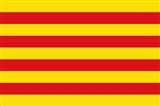
Catalonia

Encyclopedia
Catalonia is an autonomous community in northeastern Spain
, with the official status of a "nationality" of Spain. Catalonia comprises four provinces
: Barcelona, Girona, Lleida, and Tarragona. Its capital and largest city is Barcelona
. Catalonia covers an area of 32,114 km² and has an official population of 7,535,251. Its borders essentially reflect those of the former Principality of Catalonia
. It borders France
and Andorra
to the north, Aragon
to the west, the Valencian Community
to the south, and the Mediterranean Sea
to the east (580 km coastline). The official languages are Catalan
, Spanish
and Aranese
(Occitan).
. The origin of the term is subject to diverse interpretations. A theory suggests that Catalunya derives from the term "Land of Castles", having evolved from the term castlà, the ruler of a castle (see castellan
). This theory therefore suggests that the name Castile
and Catalonia have the same etymology.
Another theory suggests that Catalunya (Latin Gathia Launia) derives from the name Gothia (or Gauthia), "Land of the Goths
", since the Spanish March was first known as Gothia
, whence Gothland > Gothlandia > Gothalania > Catalonia theoretically derived.
Yet another less accepted theory points to the Lacetani
, an Iberian
tribe that lived in the area and whose name, due to the Roman influence, could have evolved by metathesis
to Katelans and then Catalans.
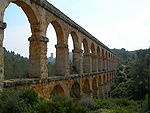
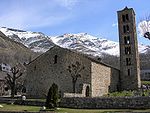 Like some other parts in the rest of the Mediterranean coast of the Iberian Peninsula
, Catalonia was colonised by Ancient Greeks
, who settled around the Roses area. Both Greeks and Carthaginians
(who, in the course of the Second Punic War
, briefly ruled the territory) interacted with the main Iberian substratum. After the Carthaginian defeat by Rome, it became, along with the rest of Hispania
, part of the Roman Empire
, Tarraco
being one of the main Roman posts in the Iberian Peninsula.
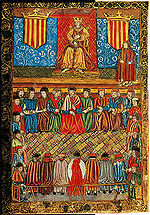
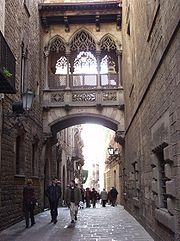 Catalonia then came under Visigothic
rule for four centuries after Rome's collapse. In the 8th century, it came under Moorish
Al-Andalus
control. Still, after the defeat of Emir Abdul Rahman Al Ghafiqi
's troops at Tours
in 732, the Franks
conquered former Visigoth states which had been captured by the Muslims or had become allied with them in what today is the northernmost part of Catalonia. Charlemagne
created in 795 what came to be known as the Marca Hispanica
, a buffer zone
beyond the province of Septimania
made up of locally administered separate petty kingdom
s which served as a defensive barrier between the Umayyad
Moors
of Al-Andalus and the Frankish Kingdom.
The Catalan culture started to develop during the Middle Ages
in a number of these petty kingdoms organised as small counties throughout the northernmost part of Catalonia. The counts of Barcelona were Frankish vassal
s nominated by the emperor and then the king of France, to whom they were feudatories (801–987).
In 987 the count of Barcelona did not recognise the French king Hugh Capet and his new dynasty, which put Catalonia effectively beyond Frankish rule. In 1137, Ramon Berenguer IV, Count of Barcelona
married Queen Petronilla of Aragon, establishing the dynastic union of the County of Barcelona with the Kingdom of Aragon
that was to create the Crown of Aragon
.
It was not until 1258, by means of the Treaty of Corbeil
, that the king of France formally relinquished his feudal lordship over the counties of the Principality of Catalonia
to the king of Aragon James I
, descendant of Ramon Berenguer IV. This Treaty transformed the region's de facto
autonomy into a de jure
direct Aragonese rule. As part of the Crown of Aragon, Catalonia became a maritime power, helping expand the Crown by trade and conquest into the Kingdom of Valencia
, the Balearic Islands
, and ultimately even Sardinia
, Sicily
, Corsica
, Naples
, Athens
.
Aragon had been very severely hit by the Black Death
and by continuing outbreaks of plague. According to John Huxtable Elliott, "Between 1347 and 1497 the Principality had lost 37% of its inhabitants, and was reduced to a population of something like 300,000."
In 1410, King Martin I died without surviving descendants. As a result, by the Pact of Caspe, Ferdinand of Antequera from the Castilian dynasty of Trastámara
received the Crown of Aragon as Ferdinand I of Aragon
.
His grandson, King Ferdinand II of Aragon
, and Queen Isabella I of Castile
married in 1469, becoming the Catholic Monarchs
; subsequently, this event was seen as the dawn of the Kingdom of Spain. At that point, though personally and informally unified, the Crowns of Castile
and Aragon maintained distinct territories, each keeping its own traditional institutions, Parliaments, and laws. Castile commissioned the expeditions to the Americas
, and benefited from the colonial
riches. Political power had shifted away from Aragon toward Castile and, subsequently, from Castile to the Spanish Empire
. King Charles V
was the first sole monarch holding the crowns of both Aragon and Castile.
For an extended period, Barcelona (not Catalonia), as part of the former Kingdom of Aragon, continued to retain its own usages and laws, but these gradually eroded in the course of the transition from feudalism
to a modern state, fueled by the kings' struggle to have more centralized
territories. Over the next few centuries, Catalonia was generally on the losing side of a series of local conflicts that led steadily to more centralization of power in Spain, like the Reapers' War (1640–52). In 1659 the Spanish Crown offered the Roussillon territory
to the Kingdom of France
. Now this territory is the Department of Pyrénées-Orientales
, and also is named Northern Catalonia
(Catalunya Nord).
The most significant conflict was the War of the Spanish Succession
, which began when Charles II of Spain
(the last Spanish Habsburg) died without a direct heir in 1700. Catalonia, like the other territories that had formed the Crown of Aragon in the Middle Ages, mostly rose up in support of the Habsburg pretender Charles VI of Valencia
Holy Roman Emperor
, while the rest of Spain mostly adhered to the French Bourbon
claimant, Philip V
. Following the fall of Barcelona
on 11 September 1714, the "special status" of the territories belonging to the former Crown of Aragon and its institutions was abolished by the Nueva Planta decrees
, under which all its lands were incorporated to the Crown of Castile as provinces, within a united Spanish administration, as Spain
moved towards a centralised government under the new Bourbon dynasty.
In the latter half of the 19th century, Catalonia became an industrial center; to this day it remains one of the most industrialised parts of Spain. In the first third of the 20th century, Catalonia gained and lost varying degrees of autonomy several times, receiving its first statute of autonomy during the Second Spanish Republic
(1931). This period was marked by political unrest and the preeminence of the Anarchists
during the Spanish Civil War
(1936–39). The Anarchists had been active throughout the early 20th century, achieving the first eight-hour workday in the world in 1919. After the defeat of the Republic in the civil war, which brought General Francisco Franco
to power, his regime suppressed any kind of public activities associated with Catalan nationalism, Anarchism
, Socialism
, Democracy
or Communism
, including the publication of books on those subjects or simply discussion of them in open meetings. As part of this suppression, the use of Catalan in government-run institutions and during public events was banned. During later stages of the Franco regime, certain folkloric and religious celebrations in Catalan resumed and were tolerated. Use of Catalan in the mass media
had been forbidden, but was permitted from the early 1950s in the theatre. Publishing in Catalan continued throughout the dictatorship.
After Franco's death (1975) and with the adoption of a democratic Spanish Constitution (1978), Catalonia recovered political and cultural autonomy. Today, Catalonia is one of the most economically dynamic regions of Spain. The Catalan capital and largest city, Barcelona, is a major international cultural centre and a major tourist destination.
(Köppen
Csa). The inland part (including the Lleida province and the inner part of Barcelona province) show a mostly continental Mediterranean climate (Köppen
Csa). The Pyrenean peaks have a mountain (Köppen
H) or even Alpine climate
(Köppen
ET) at the highest summits, while the valleys have a maritime or oceanic climate
sub-type (Köppen
Cfb).
In the Mediterranean area, summers are dry and hot with sea breezes, and the maximum temperature is around 26-31 °C. Winter is cool or slightly cold depending on the location. It snows frequently in the Pyrenees, and it occasionally snows at lower altitudes, even by the coastline. Spring and autumn are typically the rainiest seasons, except for the Pyrenean valleys, where summer is typically stormy.
The inland part of Catalonia is hotter and drier in summer. Temperature may reach 35 °C, some days even 40 °C. Nights are cooler there than at the coast, with the temperature of around 14-16 °C. Fog is not uncommon in valleys and plains; it can be especially persistent, with freezing drizzle
episodes and subzero temperatures during winter, along the Segre
and in other river valleys.
of 1932 but lost with the fall of the Second Spanish Republic
at the end of the Spanish Civil War
in 1939.
The region has gradually achieved more autonomy
since 1979. The Generalitat holds exclusive jurisdiction in culture, environment, communications, transportation, commerce, public safety and local government, and shares jurisdiction with the Spanish government in education, health and justice.
A relatively large sector of the population supports the ideas and policies of Catalan nationalism
(also known as Catalanism), a political movement which defends the notion that Catalonia is a separate nation
and advocates for either further political autonomy or full independence of Catalonia.
In the last Catalan parliamentary election, the parties that are considered nationalist have obtained 50.02% of the votes and hold 72 of the 135 seats in the Catalan Parliament. Parties supporting full independence from Spain have obtained 11.56% of the votes, down from 14.08% in 2006 and 16.5% in 2003.
Parties that consider themselves either Catalan nationalist or independentist have been present in all Catalan governments since 1980. The largest Catalan nationalist party, Convergence and Union, has ruled Catalonia from 1980 to 2003, and has come back to power in the 2010 election
. Between 2003 and 2010, a leftist coalition, composed by the Catalan Socialists' Party, the pro-independence Republican Left of Catalonia and the leftist-environmentalist Initiative for Catalonia-Greens, implemented policies that widened Catalonian autonomy from Spain.
The support for Catalan nationalism ranges from the desire for independence from Spain expressed by Catalan independentists, to a more general demand for further autonomy and the federalisation of Spain. Since 2007, support for Catalan independence has been on the rise. According to an opinion poll from July 2007, two thirds of Catalans believed Catalonia should have a higher level of autonomy, but only 16.5% supported full independence from Spain. The first survey following the Constitutional Court ruling that cut back elements of the 2006 Statute of Autonomy, published by La Vanguardia
on July 18, 2010, found that a majority would support independence in a referendum. Already in February of the same year, a poll by the Open University of Catalonia gave more or less results. Other polls have shown lower support for independence, ranging from 40 to 49%.
In dozens of non-binding local referendums on independence, organised across Catalonia from 13 September 2009, a large majority voted for independence, although critics argued that the polls were mostly held in pro-independence areas. As of December 2009, 94% of those voting backed independence from Spain, on a turn out of 25%. The final local referendum is planned for Barcelona, in April 2011.
is the fundamental organic law, second only to the Spanish Constitution from which the Statute originates.
In the Spanish Constitution of 1978
Catalonia, along with the Basque Country
and Galicia, was defined as a "nationality". The same constitution gave Catalonia the automatic right to autonomy, which resulted in the Statute of Autonomy of Catalonia of 1979
.
Both the 1979 Statute of Autonomy and the current one, approved in 2006, state that "Catalonia, as a nationality, exercises its self-government constituted as an Autonomous Community in accordance with the Constitution and with the Statute of Autonomy of Catalonia, which is its basic institutional law, always under the law in Spain".
The Preamble of the 2006 Statute of Autonomy of Catalonia states that the Parliament of Catalonia
has defined Catalonia as a nation
, but that "the Spanish Constitution recognizes Catalonia's national reality as a nationality". While the Statute was approved by and sanctioned by both the Catalan and Spanish parliaments, and later by referendum in Catalonia, it has been subject to a legal challenge by the surrounding autonomous regions of Aragon, Balearic Islands and the Valencian Community, as well as by the conservative People's Party
. The objections are based on various issues such as disputed cultural heritage
but, especially, on the Statute's alleged breaches of the principle of "solidarity between regions" in fiscal and educational matters enshrined by the Constitution
. After considerable legal debate, Spain's Constitutional Court
assessed the disputed articles and on 28 June 2010, issued its judgment on the principal allegation of unconstitutionality presented by the People's Party in 2006. The judgment granted clear passage to 182 articles of the 223 that make up the fundamental text. The court approved 73 of the 114 articles that the People's Party had contested, while declaring 14 articles unconstitutional in whole or in part and imposing a restrictive interpretation on 27 others. The court accepted the specific provision that described Catalonia as a "nation", however ruled that it was a historical and cultural term with no legal weight, and that Spain remained the only nation recognized by the constitution.
The Catalan Statute of Autonomy establishes that Catalonia is organised politically through the Generalitat de Catalunya
, conformed by the Parliament
, the Presidency of the Generalitat, the Government or Executive Council and the other institutions created by the Parliament.
The seat of the Executive Council is the city of Barcelona
. Since the restoration of the Generalitat on the return of democracy in Spain, the presidents of Catalonia have been Jordi Pujol (1980–2003), Pasqual Maragall (2003–2006), José Montilla Aguilera (2006–2010) and Artur Mas incumbent .
, whose origins date back to the 18th century. Since 1980 they have been under the command of the Generalitat, and since 1994 they have expanded in number in order to replace the national Guardia Civil and Policía Nacional, which report directly to the Homeland Department of Spain. The national bodies retain personnel within Catalonia to exercise functions of national scope such as overseeing ports, airports, coasts, international borders, custom offices, the identification of documents and arms control amongst others.
Most of the justice system is administered by national judicial institutions. The criminal justice
system is uniform throughout Spain, while "civil law
" is administered separately within Catalonia.
Navarre
, the Basque Country
and Catalonia are the Spanish regions with the highest degree of autonomy in terms of law enforcement
.
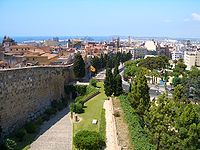
Catalonia is organised territorially into province
s, further subdivided into comarques
and municipalities
. The 2006 Statute of Autonomy of Catalonia establishes the administrative organization of three local authorities: vegueries
, comarques, and municipalities.
, Pla d'Urgell
i Pla de l'Estany
). At present there are 41.
The comarca of Val d'Aran
(Aran Valley) has a special status and its autonomous government is named Conselh Generau d'Aran.
The territorial plan of Catalonia (Pla territorial general de Catalunya) provided six general functional areas, but was amended by Law 24/2001, of December 31, recognizing the Alt Pirineu i Aran
as a new functional area differentiated of Ponent. On 14 July 2010 the Catalan Parliament approved the creation of the functional area of the Penedès
.
of Catalonia was €216.9 billion ($314.4 billion), the highest in Spain, and per capita GDP was €30,700 – similar to that of countries such as the United Kingdom or Austria. However, it had the fourth per capita GDP in Spain, considerably behind the Basque Country (€34,100), Madrid (autonomous community)
(€34,100) and Navarra (€32,900). In that year, the GDP growth was 3.7%. In the context of the 2008 financial crisis, Catalonia is expected to suffer a recession
amounting to almost a 2% contraction of its regional GDP in 2009.
In 2010, Catalonia ranked the 43rd largest country subdivision by GDP (nominal), just behind Quebec
(Canada) and ahead Victoria (Australia). Catalonia is one of the Four Motors for Europe.
The distribution of sectors is as follows:
The main tourist destinations in Catalonia are the city of Barcelona, the beaches of the Costa Brava
in Girona
and the Costa Daurada in Tarragona
. In the Pyrenees there are several ski resorts.
Many savings bank
s are based in Catalonia, with 10 of the 46 Spanish savings banks having headquarters in the region. This list includes Europe's premier savings bank, La Caixa
. The first private bank
in Catalonia is Banc Sabadell, ranked fourth among all Spanish private banks.
The stock market of Barcelona, which in 2004 traded almost €205,000 million, is the second largest of Spain after Madrid, and Fira de Barcelona
organizes international exhibitions and congresses to do with different sectors of the economy.
The main economic cost for the Catalan families is the purchase of a home. According to data from the Society of Appraisal on the 31 December 2005 Catalonia is, after Madrid, the second most expensive region in Spain for housing: 3,397 €/m² on average (see Spanish property bubble
).
The Urban Region of Barcelona includes 5,217,864 people and covers an area of 2.268 km² and about 1.7 million people live in a radius of 15 km from Barcelona. The metropolitan area of the Urban Region includes cities like L'Hospitalet de Llobregat
, Badalona
, Santa Coloma de Gramenet
and Cornellà de Llobregat
.
In 1900 the population of Catalonia was 1,984,115 people and in 1970 it was 5,107,606. That increase was produced due to the demographic boom produced in Spain during the 60s and early 70s and also due to the large-scale internal migration produced from the rural interior of Spain to its industrial cities. In Catalonia that wave of internal migration arrived from several regions of Spain, especially Andalusia
, Murcia
and Extremadura
.
Immigration from other countries settled down in Catalonia in the 1990s and 2000s, a large percentage came from Africa
and Latin America
, and smaller numbers from Asia
and Eastern Europe
, often settle in urban centers such as Barcelona and industrial areas.
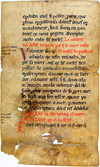 According to the most recent linguistic census held by the Government of Catalonia , a plurality claims Spanish as "their own language" (46.53% Spanish compared to 37.26% Catalan). In everyday use, 11.95% of the population claim to use both languages equally, while 45.92% use mainly Spanish and 35.54% use mainly Catalan. There is a significant difference between the Barcelona metropolitan area
(and, to a lesser extent, the Tarragona area
), where Spanish is more spoken than Catalan, and the rest of Catalonia, where Catalan clearly prevails over Spanish.
Also, starting with the Statute of Autonomy of 1979, Aranese (a dialect of Gascon Occitan) has been official and subject to special protection in Val d'Aran
. This small area of 7,000 inhabitants was the only place where a dialect of Occitan has received full official status. Then, on 9 August 2006, when the new Statute came into force, Occitan became official throughout Catalonia. Occitan is the mother tongue of 22.4% of the population of Val d'Aran.
Originating in the historic territory of Catalonia, Catalan has enjoyed special status since the approval of the Statute of Autonomy of 1979 which declares it to be the "own language of Catalonia", a term which signifies a language given special legal status within a Spanish territory, or which is historically spoken within a given region. The other languages with official status are Spanish, which has official status throughout Spain, and Aranese Occitan, which enjoys co-official status with Catalan and Spanish in the Val d'Aran
.
Under the Franco dictatorship, Catalan was excluded from the public education system and all other official use, so that for example families were not allowed to officially register children with Catalan names. While never completely banned, Catalan language publishing was severely restricted during the early '40s, with only religious texts and small-run self-published texts being released. Some books were published clandestinely or circumvented the restrictions by showing publishing dates prior to 1936. This policy was changed in 1946, when unrestricted publishing in Catalan resumed. Rural-urban migration originating in other parts of Spain also reduced the social use of the language in urban areas, while increasing the use of Spanish. Lately, a similar sociolinguistic phenomenon has occurred with foreign immigration. Catalan cultural activity increased in the 1960s and Catalan classes began thanks to the initiative of associations such as Òmnium Cultural
.
After the end of Franco's dictatorship, the newly established self-governing democratic institutions in Catalonia embarked on a long-term language policy
to increase the use of Catalan and has, since 1983, enforced laws which attempt to protect and extend, the use of Catalan. This policy, known as the "linguistic normalization" (normalització lingüística in Catalan, normalización lingüística in Spanish) has been supported by the vast majority of Catalan political parties through the last thirty years. Some groups consider these efforts a way to discourage the use of Spanish, while some others, including the Catalan government and the European Union consider the policies respectful, or even as an example which "should be disseminated throughout the Union". Recently, some of these policies have been criticized for trying to promote Catalan by imposing fines on businesses; such as the law on Catalan Cinemas which was enforced in March 2010 which establishes that half of the movies shown in Catalan Cinemas has to be in Catalan Language, a general strike of 75% of the Cinemas followed the enforcement of the law. These criticisms mostly come from outside Catalonia, especially from conservative, conservative liberal and classical liberal circles of Spanish society. In Catalonia, on the other hand, there is a high social and political consensus on the language policies favoring Catalan, also among Spanish speakers and speakers of other languages. In Catalonia, the Catalan language policy has been challenged by some anti-nationalist intellectuals like Albert Boadella
. Since 2006, the liberal Citizens - Party of the Citizenry has been one of the most consistent critics of the Catalan language policy within Catalonia. The local Catalan branch of the People's Party
has a more ambiguous position on the issue: on one hand, it demands a bilingual Catalan-Spanish education and a more balanced language policy that would defend Catalan without favoring it over Spanish, while on the other, a few local PP politicians have supported in their municipalities measures privileging Catalan over Spanish and it has defended some aspects of the official language policies, sometimes against the positions of its colleagues from other parts of Spain.
Today, Catalan is the main language of the Catalan autonomous government and the other public institutions that fall under its jurisdiction. Basic public education is given in Catalan, except for two hours per week of Spanish medium instruction. Businesses are required to display all information (e.g. menus, posters) in Catalan under penalty of fines. There is no obligation to display this information in either Occitan or Spanish, although there is no restriction on doing so in these or other languages. The use of fines was introduced in a 1997 linguistic law that aims to increase the public use of Catalan and defend the rights of Catalan speakers. The law ensures that both Catalan and Spanish – being official languages – can be used by the citizens without prejudice in all public and private activities, but primary education can only be taken in Catalan language. The Generalitat uses Catalan in its communications and notifications addressed to the general population, but citizens can also receive information from the Generalitat in Spanish if they so desire. debates in the Catalan Parliament take place almost exclusively in Catalan and the Catalan public television
broadcasts programs only in Catalan.
Due to the intense immigration
which Spain in general and Catalonia in particular experienced in the first decade of the 21st century, many foreign languages are spoken in various cultural communities in Catalonia, of which Riff Berber
, Moroccan Arabic
, Romanian
and Urdu
are the more common.
(a Spanish Government entity) except two airports in Lleida which are operated by Aeroports de Catalunya
(an entity belonging to the Government of Catalonia
).
The principal highways are AP-7
(Autopista del Mediterrani) and A-7
(Autovia del Mediterrani). It follows the coast from the French border
to Valencia
, Murcia
and Andalusia
. The main roads generally radiate from Barcelona. The A-2 and AP-2 connect inland and onward to Madrid.
Other major roads are:
Public-own roads in Catalonia are either managed by the autonomous government of Catalonia (e.g. C- roads) or the Spanish Government
(e.g. AP- , A- , N- roads).
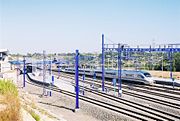 Catalonia saw the first railway construction in the Iberian Peninsula
in 1848, linking Barcelona with Mataró
. Given the topography most lines radiate from Barcelona. The city has both suburban and inter-city services. The main east coast line runs through the province connecting with the SNCF
(French Railways) at Portbou
on the coast.
There are two publicly owned railway companies operating in Catalonia: the Catalan FGC
that operatates commuter and regional services, and the Spanish national RENFE
that operates long-distance and high speed rail services (AVE and Avant).
High speed rail (AVE
) services from Madrid
currently reach Lleida
, Tarragona
and Barcelona
. The official opening between Barcelona and Madrid took place 20 February 2008. The journey between Barcelona and Madrid now takes about 2 and a half hours. Construction has commenced to extend the high speed line northwards to connect with the French high speed TGV network. This new line passes through Girona and there will be a tunnel through the Pyrenees.

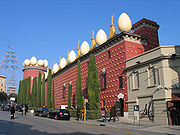 There are several UNESCO
World Heritage Sites in Catalonia:
s are one of the main manifestations of Catalan popular culture. The activity consists in constructing human towers by competing colles castelleres (teams). This practice originated in the southern part of Catalonia during the 18th century.
The sardana
is the most characteristic Catalan popular dance, other groups also practice Ball de bastons
, moixiganga, galop
s or jota
in the southern part. Musically, the Havaneres
are also characteristic in some marine localities of the Costa Brava
especially during the summer months when these songs are sung outdoors accompanied by a cremat of burned rum. Other music styles are Catalan rumba
, Catalan rock
and Nova Cançó
.
In the greater celebrations other elements of the Catalan popular culture are usually present: the parades of gegants (giants) and correfoc
s of devils and firecrackers. Another traditional celebration in Catalonia is La Patum de Berga
declared Masterpiece of the Oral and Intangible Heritage of Humanity by UNESCO
in 25 November 2005.
In addition to traditional local Catalan culture, traditions from other parts of Spain can be found as a result of migration from other regions. On July 28, 2010, Catalonia became the second Spanish territory
, after the Canary Islands, to forbid bullfighting. The ban, which will be effective as of January 1, 2012, had originated in a popular petition supported by over 180,000 signatures.
Spain
Spain , officially the Kingdom of Spain languages]] under the European Charter for Regional or Minority Languages. In each of these, Spain's official name is as follows:;;;;;;), is a country and member state of the European Union located in southwestern Europe on the Iberian Peninsula...
, with the official status of a "nationality" of Spain. Catalonia comprises four provinces
Provinces of Spain
Spain and its autonomous communities are divided into fifty provinces .In other languages of Spain:*Catalan/Valencian , sing. província.*Galician , sing. provincia.*Basque |Galicia]] — are not also the capitals of provinces...
: Barcelona, Girona, Lleida, and Tarragona. Its capital and largest city is Barcelona
Barcelona
Barcelona is the second largest city in Spain after Madrid, and the capital of Catalonia, with a population of 1,621,537 within its administrative limits on a land area of...
. Catalonia covers an area of 32,114 km² and has an official population of 7,535,251. Its borders essentially reflect those of the former Principality of Catalonia
Principality of Catalonia
The Principality of Catalonia , is a historic territory in the northeastern Iberian Peninsula, mostly in Spain and with an adjoining portion in southern France....
. It borders France
France
The French Republic , The French Republic , The French Republic , (commonly known as France , is a unitary semi-presidential republic in Western Europe with several overseas territories and islands located on other continents and in the Indian, Pacific, and Atlantic oceans. Metropolitan France...
and Andorra
Andorra
Andorra , officially the Principality of Andorra , also called the Principality of the Valleys of Andorra, , is a small landlocked country in southwestern Europe, located in the eastern Pyrenees mountains and bordered by Spain and France. It is the sixth smallest nation in Europe having an area of...
to the north, Aragon
Aragon
Aragon is a modern autonomous community in Spain, coextensive with the medieval Kingdom of Aragon. Located in northeastern Spain, the Aragonese autonomous community comprises three provinces : Huesca, Zaragoza, and Teruel. Its capital is Zaragoza...
to the west, the Valencian Community
Valencian Community
The Valencian Community is an autonomous community of Spain located in central and south-eastern Iberian Peninsula. Its capital and largest city is Valencia...
to the south, and the Mediterranean Sea
Mediterranean Sea
The Mediterranean Sea is a sea connected to the Atlantic Ocean surrounded by the Mediterranean region and almost completely enclosed by land: on the north by Anatolia and Europe, on the south by North Africa, and on the east by the Levant...
to the east (580 km coastline). The official languages are Catalan
Catalan language
Catalan is a Romance language, the national and only official language of Andorra and a co-official language in the Spanish autonomous communities of Catalonia, the Balearic Islands and Valencian Community, where it is known as Valencian , as well as in the city of Alghero, on the Italian island...
, Spanish
Spanish language
Spanish , also known as Castilian , is a Romance language in the Ibero-Romance group that evolved from several languages and dialects in central-northern Iberia around the 9th century and gradually spread with the expansion of the Kingdom of Castile into central and southern Iberia during the...
and Aranese
Aranese language
Aranese is a standardized form of the Pyrenean Gascon variety of the Occitan language spoken in the Val d'Aran, in north western Catalonia on the border between Spain and France, where it is one of the three official languages besides Catalan and Spanish...
(Occitan).
Etymology
The name Catalunya (Catalonia) began to be used in the late 11th century in reference to the group of counties that comprised the Marca HispanicaMarca Hispanica
The Marca Hispanica , also known as Spanish March or March of Barcelona was a buffer zone beyond the province of Septimania, created by Charlemagne in 795 as a defensive barrier between the Umayyad Moors of Al-Andalus and the Frankish Kingdom....
. The origin of the term is subject to diverse interpretations. A theory suggests that Catalunya derives from the term "Land of Castles", having evolved from the term castlà, the ruler of a castle (see castellan
Castellan
A castellan was the governor or captain of a castle. The word stems from the Latin Castellanus, derived from castellum "castle". Also known as a constable.-Duties:...
). This theory therefore suggests that the name Castile
Castile (historical region)
A former kingdom, Castile gradually merged with its neighbours to become the Crown of Castile and later the Kingdom of Spain when united with the Crown of Aragon and the Kingdom of Navarre...
and Catalonia have the same etymology.
Another theory suggests that Catalunya (Latin Gathia Launia) derives from the name Gothia (or Gauthia), "Land of the Goths
Goths
The Goths were an East Germanic tribe of Scandinavian origin whose two branches, the Visigoths and the Ostrogoths, played an important role in the fall of the Roman Empire and the emergence of Medieval Europe....
", since the Spanish March was first known as Gothia
Gothia
Gothia is a name given to various places where the Goths lived during their migrations:* Götaland, the traditional original homeland of the Goths.* Dacia was referred to as Gothia during the fourth century, when it was settled by Goths....
, whence Gothland > Gothlandia > Gothalania > Catalonia theoretically derived.
Yet another less accepted theory points to the Lacetani
Lacetani
The Lacetani were an ancient Iberian people of the Iberian peninsula . They are believed to be of Iberian language.-External links:**...
, an Iberian
Iberians
The Iberians were a set of peoples that Greek and Roman sources identified with that name in the eastern and southern coasts of the Iberian peninsula at least from the 6th century BC...
tribe that lived in the area and whose name, due to the Roman influence, could have evolved by metathesis
Metathesis (linguistics)
Metathesis is the re-arranging of sounds or syllables in a word, or of words in a sentence. Most commonly it refers to the switching of two or more contiguous sounds, known as adjacent metathesis or local metathesis:...
to Katelans and then Catalans.
History
Iberian Peninsula
The Iberian Peninsula , sometimes called Iberia, is located in the extreme southwest of Europe and includes the modern-day sovereign states of Spain, Portugal and Andorra, as well as the British Overseas Territory of Gibraltar...
, Catalonia was colonised by Ancient Greeks
Ancient Greece
Ancient Greece is a civilization belonging to a period of Greek history that lasted from the Archaic period of the 8th to 6th centuries BC to the end of antiquity. Immediately following this period was the beginning of the Early Middle Ages and the Byzantine era. Included in Ancient Greece is the...
, who settled around the Roses area. Both Greeks and Carthaginians
Carthage
Carthage , implying it was a 'new Tyre') is a major urban centre that has existed for nearly 3,000 years on the Gulf of Tunis, developing from a Phoenician colony of the 1st millennium BC...
(who, in the course of the Second Punic War
Second Punic War
The Second Punic War, also referred to as The Hannibalic War and The War Against Hannibal, lasted from 218 to 201 BC and involved combatants in the western and eastern Mediterranean. This was the second major war between Carthage and the Roman Republic, with the participation of the Berbers on...
, briefly ruled the territory) interacted with the main Iberian substratum. After the Carthaginian defeat by Rome, it became, along with the rest of Hispania
Hispania
Another theory holds that the name derives from Ezpanna, the Basque word for "border" or "edge", thus meaning the farthest area or place. Isidore of Sevilla considered Hispania derived from Hispalis....
, part of the Roman Empire
Roman Empire
The Roman Empire was the post-Republican period of the ancient Roman civilization, characterised by an autocratic form of government and large territorial holdings in Europe and around the Mediterranean....
, Tarraco
Tarraco
Tarraco is the ancient name of the current city of Tarragona . During the Roman Empire was one of the major cities of the Iberian Peninsula and capital of the Roman province called Hispania Citerior or Hispania Tarraconensis. The full name of the city at the time of the Roman Republic was Colonia...
being one of the main Roman posts in the Iberian Peninsula.
Goths
The Goths were an East Germanic tribe of Scandinavian origin whose two branches, the Visigoths and the Ostrogoths, played an important role in the fall of the Roman Empire and the emergence of Medieval Europe....
rule for four centuries after Rome's collapse. In the 8th century, it came under Moorish
Moors
The description Moors has referred to several historic and modern populations of the Maghreb region who are predominately of Berber and Arab descent. They came to conquer and rule the Iberian Peninsula for nearly 800 years. At that time they were Muslim, although earlier the people had followed...
Al-Andalus
Al-Andalus
Al-Andalus was the Arabic name given to a nation and territorial region also commonly referred to as Moorish Iberia. The name describes parts of the Iberian Peninsula and Septimania governed by Muslims , at various times in the period between 711 and 1492, although the territorial boundaries...
control. Still, after the defeat of Emir Abdul Rahman Al Ghafiqi
Abdul Rahman Al Ghafiqi
Abdul Rahman Al Ghafiqi , also known as Abd er Rahman, Abdderrahman, Abderame, and Abd el-Rahman, led the Andalusian Muslims into battle against the forces of Charles Martel in the Battle of Tours on October 10, 732 AD. for which he is primarily remembered in the West...
's troops at Tours
Battle of Tours
The Battle of Tours , also called the Battle of Poitiers and in Battle of the Court of the Martyrs, was fought in an area between the cities of Poitiers and Tours, located in north-central France, near the village of Moussais-la-Bataille, about northeast of Poitiers...
in 732, the Franks
Franks
The Franks were a confederation of Germanic tribes first attested in the third century AD as living north and east of the Lower Rhine River. From the third to fifth centuries some Franks raided Roman territory while other Franks joined the Roman troops in Gaul. Only the Salian Franks formed a...
conquered former Visigoth states which had been captured by the Muslims or had become allied with them in what today is the northernmost part of Catalonia. Charlemagne
Charlemagne
Charlemagne was King of the Franks from 768 and Emperor of the Romans from 800 to his death in 814. He expanded the Frankish kingdom into an empire that incorporated much of Western and Central Europe. During his reign, he conquered Italy and was crowned by Pope Leo III on 25 December 800...
created in 795 what came to be known as the Marca Hispanica
Marca Hispanica
The Marca Hispanica , also known as Spanish March or March of Barcelona was a buffer zone beyond the province of Septimania, created by Charlemagne in 795 as a defensive barrier between the Umayyad Moors of Al-Andalus and the Frankish Kingdom....
, a buffer zone
Buffer zone
A buffer zone is generally a zonal area that lies between two or more other areas , but depending on the type of buffer zone, the reason for it may be to segregate regions or to conjoin them....
beyond the province of Septimania
Septimania
Septimania was the western region of the Roman province of Gallia Narbonensis that passed under the control of the Visigoths in 462, when Septimania was ceded to their king, Theodoric II. Under the Visigoths it was known as simply Gallia or Narbonensis. It corresponded roughly with the modern...
made up of locally administered separate petty kingdom
Petty kingdom
A petty kingdom is one of a number of small kingdoms, described as minor or "petty" by contrast to an empire or unified kingdom that either preceded or succeeded it...
s which served as a defensive barrier between the Umayyad
Umayyad
The Umayyad Caliphate was the second of the four major Arab caliphates established after the death of Muhammad. It was ruled by the Umayyad dynasty, whose name derives from Umayya ibn Abd Shams, the great-grandfather of the first Umayyad caliph. Although the Umayyad family originally came from the...
Moors
Moors
The description Moors has referred to several historic and modern populations of the Maghreb region who are predominately of Berber and Arab descent. They came to conquer and rule the Iberian Peninsula for nearly 800 years. At that time they were Muslim, although earlier the people had followed...
of Al-Andalus and the Frankish Kingdom.
The Catalan culture started to develop during the Middle Ages
Middle Ages
The Middle Ages is a periodization of European history from the 5th century to the 15th century. The Middle Ages follows the fall of the Western Roman Empire in 476 and precedes the Early Modern Era. It is the middle period of a three-period division of Western history: Classic, Medieval and Modern...
in a number of these petty kingdoms organised as small counties throughout the northernmost part of Catalonia. The counts of Barcelona were Frankish vassal
Vassal
A vassal or feudatory is a person who has entered into a mutual obligation to a lord or monarch in the context of the feudal system in medieval Europe. The obligations often included military support and mutual protection, in exchange for certain privileges, usually including the grant of land held...
s nominated by the emperor and then the king of France, to whom they were feudatories (801–987).
In 987 the count of Barcelona did not recognise the French king Hugh Capet and his new dynasty, which put Catalonia effectively beyond Frankish rule. In 1137, Ramon Berenguer IV, Count of Barcelona
Ramon Berenguer IV, Count of Barcelona
Ramon Berenguer IV , sometimes called the Holy, was the Count of Barcelona who effected the union between the Kingdom of Aragon and the Principality of Catalonia into the Crown of Aragon....
married Queen Petronilla of Aragon, establishing the dynastic union of the County of Barcelona with the Kingdom of Aragon
Kingdom of Aragon
The Kingdom of Aragon was a medieval and early modern kingdom in the Iberian Peninsula, corresponding to the modern-day autonomous community of Aragon, in Spain...
that was to create the Crown of Aragon
Crown of Aragon
The Crown of Aragon Corona d'Aragón Corona d'Aragó Corona Aragonum controlling a large portion of the present-day eastern Spain and southeastern France, as well as some of the major islands and mainland possessions stretching across the Mediterranean as far as Greece...
.
It was not until 1258, by means of the Treaty of Corbeil
Treaty of Corbeil (1258)
The Treaty of Corbeil was an agreement signed on 11 May 1258, in Corbeil between Louis IX of France and James I of Aragon....
, that the king of France formally relinquished his feudal lordship over the counties of the Principality of Catalonia
Principality of Catalonia
The Principality of Catalonia , is a historic territory in the northeastern Iberian Peninsula, mostly in Spain and with an adjoining portion in southern France....
to the king of Aragon James I
James I of Aragon
James I the Conqueror was the King of Aragon, Count of Barcelona, and Lord of Montpellier from 1213 to 1276...
, descendant of Ramon Berenguer IV. This Treaty transformed the region's de facto
De facto
De facto is a Latin expression that means "concerning fact." In law, it often means "in practice but not necessarily ordained by law" or "in practice or actuality, but not officially established." It is commonly used in contrast to de jure when referring to matters of law, governance, or...
autonomy into a de jure
De jure
De jure is an expression that means "concerning law", as contrasted with de facto, which means "concerning fact".De jure = 'Legally', De facto = 'In fact'....
direct Aragonese rule. As part of the Crown of Aragon, Catalonia became a maritime power, helping expand the Crown by trade and conquest into the Kingdom of Valencia
Kingdom of Valencia
The Kingdom of Valencia , located in the eastern shore of the Iberian Peninsula, was one of the component realms of the Crown of Aragon. When the Crown of Aragon merged by dynastic union with the Crown of Castile to form the Kingdom of Spain, the Kingdom of Valencia became a component realm of the...
, the Balearic Islands
Balearic Islands
The Balearic Islands are an archipelago of Spain in the western Mediterranean Sea, near the eastern coast of the Iberian Peninsula.The four largest islands are: Majorca, Minorca, Ibiza and Formentera. The archipelago forms an autonomous community and a province of Spain with Palma as the capital...
, and ultimately even Sardinia
Sardinia
Sardinia is the second-largest island in the Mediterranean Sea . It is an autonomous region of Italy, and the nearest land masses are the French island of Corsica, the Italian Peninsula, Sicily, Tunisia and the Spanish Balearic Islands.The name Sardinia is from the pre-Roman noun *sard[],...
, Sicily
Sicily
Sicily is a region of Italy, and is the largest island in the Mediterranean Sea. Along with the surrounding minor islands, it constitutes an autonomous region of Italy, the Regione Autonoma Siciliana Sicily has a rich and unique culture, especially with regard to the arts, music, literature,...
, Corsica
Corsica
Corsica is an island in the Mediterranean Sea. It is located west of Italy, southeast of the French mainland, and north of the island of Sardinia....
, Naples
Naples
Naples is a city in Southern Italy, situated on the country's west coast by the Gulf of Naples. Lying between two notable volcanic regions, Mount Vesuvius and the Phlegraean Fields, it is the capital of the region of Campania and of the province of Naples...
, Athens
Athens
Athens , is the capital and largest city of Greece. Athens dominates the Attica region and is one of the world's oldest cities, as its recorded history spans around 3,400 years. Classical Athens was a powerful city-state...
.
Aragon had been very severely hit by the Black Death
Black Death
The Black Death was one of the most devastating pandemics in human history, peaking in Europe between 1348 and 1350. Of several competing theories, the dominant explanation for the Black Death is the plague theory, which attributes the outbreak to the bacterium Yersinia pestis. Thought to have...
and by continuing outbreaks of plague. According to John Huxtable Elliott, "Between 1347 and 1497 the Principality had lost 37% of its inhabitants, and was reduced to a population of something like 300,000."
In 1410, King Martin I died without surviving descendants. As a result, by the Pact of Caspe, Ferdinand of Antequera from the Castilian dynasty of Trastámara
Trastámara
The House of Trastámara was a dynasty of kings in the Iberian Peninsula, which first governed in Castile beginning in 1369 before expanding its rule into Aragón, Navarre and Naples.They were a cadet illegitimate line of the House of Burgundy....
received the Crown of Aragon as Ferdinand I of Aragon
Ferdinand I of Aragon
Ferdinand I called of Antequera and also the Just or the Honest) was king of Aragon, Valencia, Majorca, Sardinia and Corsica and king of Sicily, duke of Athens and Neopatria, and count of Barcelona, Roussillon and Cerdanya...
.
His grandson, King Ferdinand II of Aragon
Ferdinand II of Aragon
Ferdinand the Catholic was King of Aragon , Sicily , Naples , Valencia, Sardinia, and Navarre, Count of Barcelona, jure uxoris King of Castile and then regent of that country also from 1508 to his death, in the name of...
, and Queen Isabella I of Castile
Isabella I of Castile
Isabella I was Queen of Castile and León. She and her husband Ferdinand II of Aragon brought stability to both kingdoms that became the basis for the unification of Spain. Later the two laid the foundations for the political unification of Spain under their grandson, Charles V, Holy Roman Emperor...
married in 1469, becoming the Catholic Monarchs
Catholic Monarchs
The Catholic Monarchs is the collective title used in history for Queen Isabella I of Castile and King Ferdinand II of Aragon. They were both from the House of Trastámara and were second cousins, being both descended from John I of Castile; they were given a papal dispensation to deal with...
; subsequently, this event was seen as the dawn of the Kingdom of Spain. At that point, though personally and informally unified, the Crowns of Castile
Crown of Castile
The Crown of Castile was a medieval and modern state in the Iberian Peninsula that formed in 1230 as a result of the third and definitive union of the crowns and parliaments of the kingdoms of Castile and León upon the accession of the then King Ferdinand III of Castile to the vacant Leonese throne...
and Aragon maintained distinct territories, each keeping its own traditional institutions, Parliaments, and laws. Castile commissioned the expeditions to the Americas
Americas
The Americas, or America , are lands in the Western hemisphere, also known as the New World. In English, the plural form the Americas is often used to refer to the landmasses of North America and South America with their associated islands and regions, while the singular form America is primarily...
, and benefited from the colonial
Spanish colonization of the Americas
Colonial expansion under the Spanish Empire was initiated by the Spanish conquistadores and developed by the Monarchy of Spain through its administrators and missionaries. The motivations for colonial expansion were trade and the spread of the Christian faith through indigenous conversions...
riches. Political power had shifted away from Aragon toward Castile and, subsequently, from Castile to the Spanish Empire
Spanish Empire
The Spanish Empire comprised territories and colonies administered directly by Spain in Europe, in America, Africa, Asia and Oceania. It originated during the Age of Exploration and was therefore one of the first global empires. At the time of Habsburgs, Spain reached the peak of its world power....
. King Charles V
Charles V, Holy Roman Emperor
Charles V was ruler of the Holy Roman Empire from 1519 and, as Charles I, of the Spanish Empire from 1516 until his voluntary retirement and abdication in favor of his younger brother Ferdinand I and his son Philip II in 1556.As...
was the first sole monarch holding the crowns of both Aragon and Castile.
For an extended period, Barcelona (not Catalonia), as part of the former Kingdom of Aragon, continued to retain its own usages and laws, but these gradually eroded in the course of the transition from feudalism
Feudalism
Feudalism was a set of legal and military customs in medieval Europe that flourished between the 9th and 15th centuries, which, broadly defined, was a system for ordering society around relationships derived from the holding of land in exchange for service or labour.Although derived from the...
to a modern state, fueled by the kings' struggle to have more centralized
Centralization
Centralisation, or centralization , is the process by which the activities of an organisation, particularly those regarding planning and decision-making, become concentrated within a particular location and/or group....
territories. Over the next few centuries, Catalonia was generally on the losing side of a series of local conflicts that led steadily to more centralization of power in Spain, like the Reapers' War (1640–52). In 1659 the Spanish Crown offered the Roussillon territory
Roussillon
Roussillon is one of the historical counties of the former Principality of Catalonia, corresponding roughly to the present-day southern French département of Pyrénées-Orientales...
to the Kingdom of France
Early Modern France
Kingdom of France is the early modern period of French history from the end of the 15th century to the end of the 18th century...
. Now this territory is the Department of Pyrénées-Orientales
Pyrénées-Orientales
Pyrénées-Orientales is a department of southern France adjacent to the northern Spanish frontier and the Mediterranean Sea. It also surrounds the tiny Spanish enclave of Llívia, and thus has two distinct borders with Spain.- History :...
, and also is named Northern Catalonia
Northern Catalonia
Northern Catalonia is a term that is sometimes used, particularly in Catalan writings, to refer to the territory ceded to France by Spain through the signing of the Treaty of the Pyrenees in 1659...
(Catalunya Nord).
The most significant conflict was the War of the Spanish Succession
War of the Spanish Succession
The War of the Spanish Succession was fought among several European powers, including a divided Spain, over the possible unification of the Kingdoms of Spain and France under one Bourbon monarch. As France and Spain were among the most powerful states of Europe, such a unification would have...
, which began when Charles II of Spain
Charles II of Spain
Charles II was the last Habsburg King of Spain and the ruler of large parts of Italy, the Spanish territories in the Southern Low Countries, and Spain's overseas Empire, stretching from the Americas to the Spanish East Indies...
(the last Spanish Habsburg) died without a direct heir in 1700. Catalonia, like the other territories that had formed the Crown of Aragon in the Middle Ages, mostly rose up in support of the Habsburg pretender Charles VI of Valencia
Charles VI, Holy Roman Emperor
Charles VI was the penultimate Habsburg sovereign of the Habsburg Empire. He succeeded his elder brother, Joseph I, as Holy Roman Emperor, King of Bohemia , Hungary and Croatia , Archduke of Austria, etc., in 1711...
Holy Roman Emperor
Holy Roman Emperor
The Holy Roman Emperor is a term used by historians to denote a medieval ruler who, as German King, had also received the title of "Emperor of the Romans" from the Pope...
, while the rest of Spain mostly adhered to the French Bourbon
House of Bourbon
The House of Bourbon is a European royal house, a branch of the Capetian dynasty . Bourbon kings first ruled Navarre and France in the 16th century. By the 18th century, members of the Bourbon dynasty also held thrones in Spain, Naples, Sicily, and Parma...
claimant, Philip V
Philip V of Spain
Philip V was King of Spain from 15 November 1700 to 15 January 1724, when he abdicated in favor of his son Louis, and from 6 September 1724, when he assumed the throne again upon his son's death, to his death.Before his reign, Philip occupied an exalted place in the royal family of France as a...
. Following the fall of Barcelona
Siege of Barcelona
The Siege of Barcelona was a battle at the end of the War of Spanish Succession , which pitted Archduke Charles of Austria The Siege of Barcelona was a battle at the end of the War of Spanish Succession (1701–1714), which pitted Archduke Charles of Austria The Siege of Barcelona was a battle at...
on 11 September 1714, the "special status" of the territories belonging to the former Crown of Aragon and its institutions was abolished by the Nueva Planta decrees
Nueva Planta decrees
The Nueva Planta decrees were a number of decrees signed between 1707 and 1716 by Philip V—the first Bourbon king of Spain—during and shortly after the end of the War of the Spanish Succession which he won....
, under which all its lands were incorporated to the Crown of Castile as provinces, within a united Spanish administration, as Spain
Spain
Spain , officially the Kingdom of Spain languages]] under the European Charter for Regional or Minority Languages. In each of these, Spain's official name is as follows:;;;;;;), is a country and member state of the European Union located in southwestern Europe on the Iberian Peninsula...
moved towards a centralised government under the new Bourbon dynasty.
In the latter half of the 19th century, Catalonia became an industrial center; to this day it remains one of the most industrialised parts of Spain. In the first third of the 20th century, Catalonia gained and lost varying degrees of autonomy several times, receiving its first statute of autonomy during the Second Spanish Republic
Second Spanish Republic
The Second Spanish Republic was the government of Spain between April 14 1931, and its destruction by a military rebellion, led by General Francisco Franco....
(1931). This period was marked by political unrest and the preeminence of the Anarchists
Anarchist Catalonia
Anarchist Catalonia was the part of Catalonia controlled by the anarchist Confederación Nacional del Trabajo during the Spanish Civil War.-Anarchists enter government:...
during the Spanish Civil War
Spanish Civil War
The Spanish Civil WarAlso known as The Crusade among Nationalists, the Fourth Carlist War among Carlists, and The Rebellion or Uprising among Republicans. was a major conflict fought in Spain from 17 July 1936 to 1 April 1939...
(1936–39). The Anarchists had been active throughout the early 20th century, achieving the first eight-hour workday in the world in 1919. After the defeat of the Republic in the civil war, which brought General Francisco Franco
Francisco Franco
Francisco Franco y Bahamonde was a Spanish general, dictator and head of state of Spain from October 1936 , and de facto regent of the nominally restored Kingdom of Spain from 1947 until his death in November, 1975...
to power, his regime suppressed any kind of public activities associated with Catalan nationalism, Anarchism
Anarchism
Anarchism is generally defined as the political philosophy which holds the state to be undesirable, unnecessary, and harmful, or alternatively as opposing authority in the conduct of human relations...
, Socialism
Socialism
Socialism is an economic system characterized by social ownership of the means of production and cooperative management of the economy; or a political philosophy advocating such a system. "Social ownership" may refer to any one of, or a combination of, the following: cooperative enterprises,...
, Democracy
Democracy
Democracy is generally defined as a form of government in which all adult citizens have an equal say in the decisions that affect their lives. Ideally, this includes equal participation in the proposal, development and passage of legislation into law...
or Communism
Communism
Communism is a social, political and economic ideology that aims at the establishment of a classless, moneyless, revolutionary and stateless socialist society structured upon common ownership of the means of production...
, including the publication of books on those subjects or simply discussion of them in open meetings. As part of this suppression, the use of Catalan in government-run institutions and during public events was banned. During later stages of the Franco regime, certain folkloric and religious celebrations in Catalan resumed and were tolerated. Use of Catalan in the mass media
Mass media
Mass media refers collectively to all media technologies which are intended to reach a large audience via mass communication. Broadcast media transmit their information electronically and comprise of television, film and radio, movies, CDs, DVDs and some other gadgets like cameras or video consoles...
had been forbidden, but was permitted from the early 1950s in the theatre. Publishing in Catalan continued throughout the dictatorship.
After Franco's death (1975) and with the adoption of a democratic Spanish Constitution (1978), Catalonia recovered political and cultural autonomy. Today, Catalonia is one of the most economically dynamic regions of Spain. The Catalan capital and largest city, Barcelona, is a major international cultural centre and a major tourist destination.
Climate
The climate of Catalonia is diverse. The populated areas lying by the coast in Tarragona, Barcelona and Girona provinces feature a Mediterranean climateMediterranean climate
A Mediterranean climate is the climate typical of most of the lands in the Mediterranean Basin, and is a particular variety of subtropical climate...
(Köppen
Köppen climate classification
The Köppen climate classification is one of the most widely used climate classification systems. It was first published by Crimea German climatologist Wladimir Köppen in 1884, with several later modifications by Köppen himself, notably in 1918 and 1936...
Csa). The inland part (including the Lleida province and the inner part of Barcelona province) show a mostly continental Mediterranean climate (Köppen
Köppen climate classification
The Köppen climate classification is one of the most widely used climate classification systems. It was first published by Crimea German climatologist Wladimir Köppen in 1884, with several later modifications by Köppen himself, notably in 1918 and 1936...
Csa). The Pyrenean peaks have a mountain (Köppen
Köppen climate classification
The Köppen climate classification is one of the most widely used climate classification systems. It was first published by Crimea German climatologist Wladimir Köppen in 1884, with several later modifications by Köppen himself, notably in 1918 and 1936...
H) or even Alpine climate
Alpine climate
Alpine climate is the average weather for a region above the tree line. This climate is also referred to as mountain climate or highland climate....
(Köppen
Köppen climate classification
The Köppen climate classification is one of the most widely used climate classification systems. It was first published by Crimea German climatologist Wladimir Köppen in 1884, with several later modifications by Köppen himself, notably in 1918 and 1936...
ET) at the highest summits, while the valleys have a maritime or oceanic climate
Oceanic climate
An oceanic climate, also called marine west coast climate, maritime climate, Cascadian climate and British climate for Köppen climate classification Cfb and subtropical highland for Köppen Cfb or Cwb, is a type of climate typically found along the west coasts at the middle latitudes of some of the...
sub-type (Köppen
Köppen climate classification
The Köppen climate classification is one of the most widely used climate classification systems. It was first published by Crimea German climatologist Wladimir Köppen in 1884, with several later modifications by Köppen himself, notably in 1918 and 1936...
Cfb).
In the Mediterranean area, summers are dry and hot with sea breezes, and the maximum temperature is around 26-31 °C. Winter is cool or slightly cold depending on the location. It snows frequently in the Pyrenees, and it occasionally snows at lower altitudes, even by the coastline. Spring and autumn are typically the rainiest seasons, except for the Pyrenean valleys, where summer is typically stormy.
The inland part of Catalonia is hotter and drier in summer. Temperature may reach 35 °C, some days even 40 °C. Nights are cooler there than at the coast, with the temperature of around 14-16 °C. Fog is not uncommon in valleys and plains; it can be especially persistent, with freezing drizzle
Freezing drizzle
Freezing drizzle is drizzle that freezes on contact with the ground or an object at or near the surface. Its METAR code is FZDZ. When freezing drizzle accumulates on land it creates an icy layer of glaze...
episodes and subzero temperatures during winter, along the Segre
Segre River
The Segre is a river tributary to the Ebro with a basin comprising territories across three states: France, Andorra and Spain....
and in other river valleys.
Politics
After Franco's death in 1975 and the adoption of a democratic constitution in Spain in 1978, Catalonia recovered, and extended, the powers that it had gained in the Statute of AutonomyStatute of Autonomy
Nominally, a Statute of Autonomy is a law hierarchically located under the constitution of a country, and over any other form of legislation...
of 1932 but lost with the fall of the Second Spanish Republic
Second Spanish Republic
The Second Spanish Republic was the government of Spain between April 14 1931, and its destruction by a military rebellion, led by General Francisco Franco....
at the end of the Spanish Civil War
Spanish Civil War
The Spanish Civil WarAlso known as The Crusade among Nationalists, the Fourth Carlist War among Carlists, and The Rebellion or Uprising among Republicans. was a major conflict fought in Spain from 17 July 1936 to 1 April 1939...
in 1939.
The region has gradually achieved more autonomy
Self-governance
Self-governance is an abstract concept that refers to several scales of organization.It may refer to personal conduct or family units but more commonly refers to larger scale activities, i.e., professions, industry bodies, religions and political units , up to and including autonomous regions and...
since 1979. The Generalitat holds exclusive jurisdiction in culture, environment, communications, transportation, commerce, public safety and local government, and shares jurisdiction with the Spanish government in education, health and justice.
A relatively large sector of the population supports the ideas and policies of Catalan nationalism
Catalan nationalism
Catalan nationalism or Catalanism , is a political movement advocating for either further political autonomy or full independence of Catalonia....
(also known as Catalanism), a political movement which defends the notion that Catalonia is a separate nation
Nation
A nation may refer to a community of people who share a common language, culture, ethnicity, descent, and/or history. In this definition, a nation has no physical borders. However, it can also refer to people who share a common territory and government irrespective of their ethnic make-up...
and advocates for either further political autonomy or full independence of Catalonia.
In the last Catalan parliamentary election, the parties that are considered nationalist have obtained 50.02% of the votes and hold 72 of the 135 seats in the Catalan Parliament. Parties supporting full independence from Spain have obtained 11.56% of the votes, down from 14.08% in 2006 and 16.5% in 2003.
Parties that consider themselves either Catalan nationalist or independentist have been present in all Catalan governments since 1980. The largest Catalan nationalist party, Convergence and Union, has ruled Catalonia from 1980 to 2003, and has come back to power in the 2010 election
Catalonian parliamentary election, 2010
Elections to fill 135 seats of the Parliament of the Autonomous Community of Catalonia, Spain, were held on Sunday, 28 November 2010.-Electoral process:-Candidatures with current parliamentary representation:...
. Between 2003 and 2010, a leftist coalition, composed by the Catalan Socialists' Party, the pro-independence Republican Left of Catalonia and the leftist-environmentalist Initiative for Catalonia-Greens, implemented policies that widened Catalonian autonomy from Spain.
The support for Catalan nationalism ranges from the desire for independence from Spain expressed by Catalan independentists, to a more general demand for further autonomy and the federalisation of Spain. Since 2007, support for Catalan independence has been on the rise. According to an opinion poll from July 2007, two thirds of Catalans believed Catalonia should have a higher level of autonomy, but only 16.5% supported full independence from Spain. The first survey following the Constitutional Court ruling that cut back elements of the 2006 Statute of Autonomy, published by La Vanguardia
La Vanguardia
La Vanguardia is Catalonia's leading daily newspaper as well as the fourth best-selling in Spain. It has its headquarters in Barcelona, Catalonia's largest city....
on July 18, 2010, found that a majority would support independence in a referendum. Already in February of the same year, a poll by the Open University of Catalonia gave more or less results. Other polls have shown lower support for independence, ranging from 40 to 49%.
In dozens of non-binding local referendums on independence, organised across Catalonia from 13 September 2009, a large majority voted for independence, although critics argued that the polls were mostly held in pro-independence areas. As of December 2009, 94% of those voting backed independence from Spain, on a turn out of 25%. The final local referendum is planned for Barcelona, in April 2011.
Statutes of Autonomy
The Statute of Autonomy of CataloniaStatute of Autonomy of Catalonia
The Statute of Autonomy of Catalonia provides Catalonia's basic institutional regulations. It defines the rights and obligations of the citizens of Catalonia , the political institutions of the Catalan nationality, their competences and relations with the rest of Spain, and the financing of the...
is the fundamental organic law, second only to the Spanish Constitution from which the Statute originates.
In the Spanish Constitution of 1978
Constitution of Spain
Spain's first Constitution was passed in 1812. A list of the different Spanish constitutional laws follows:During Franco's dictatorship, there were many attempts to create stable institutions that did not emanate from the dictator as they did in the post-war period...
Catalonia, along with the Basque Country
Basque Country (autonomous community)
The Basque Country is an autonomous community of northern Spain. It includes the Basque provinces of Álava, Biscay and Gipuzkoa, also called Historical Territories....
and Galicia, was defined as a "nationality". The same constitution gave Catalonia the automatic right to autonomy, which resulted in the Statute of Autonomy of Catalonia of 1979
Statute of Autonomy of Catalonia of 1979
The Statute of Autonomy of Catalonia is a constitutional law defining the region of Catalonia as an autonomous community within the Kingdom of Spain. It was promulgated on 18 September 1979. It is one of seventeen such statutes granted, in various forms and capabilities, to the different...
.
Both the 1979 Statute of Autonomy and the current one, approved in 2006, state that "Catalonia, as a nationality, exercises its self-government constituted as an Autonomous Community in accordance with the Constitution and with the Statute of Autonomy of Catalonia, which is its basic institutional law, always under the law in Spain".
The Preamble of the 2006 Statute of Autonomy of Catalonia states that the Parliament of Catalonia
Parliament of Catalonia
The Parliament of Catalonia is the unicameral legislature of Catalonia. It is formed by 135 members , who are elected every four years in ordinary period, or extraordinarily upon dissolution and call of elections by the President of Catalonia, by universal suffrage in proportional lists with four...
has defined Catalonia as a nation
Nation
A nation may refer to a community of people who share a common language, culture, ethnicity, descent, and/or history. In this definition, a nation has no physical borders. However, it can also refer to people who share a common territory and government irrespective of their ethnic make-up...
, but that "the Spanish Constitution recognizes Catalonia's national reality as a nationality". While the Statute was approved by and sanctioned by both the Catalan and Spanish parliaments, and later by referendum in Catalonia, it has been subject to a legal challenge by the surrounding autonomous regions of Aragon, Balearic Islands and the Valencian Community, as well as by the conservative People's Party
People's Party (Spain)
The People's Party is a conservative political party in Spain.The People's Party was a re-foundation in 1989 of the People's Alliance , a party led and founded by Manuel Fraga Iribarne, a former Minister of Tourism during Francisco Franco's dictatorship...
. The objections are based on various issues such as disputed cultural heritage
Cultural heritage
Cultural heritage is the legacy of physical artifacts and intangible attributes of a group or society that are inherited from past generations, maintained in the present and bestowed for the benefit of future generations...
but, especially, on the Statute's alleged breaches of the principle of "solidarity between regions" in fiscal and educational matters enshrined by the Constitution
Spanish Constitution of 1978
-Structure of the State:The Constitution recognizes the existence of nationalities and regions . Preliminary Title As a result, Spain is now composed entirely of 17 Autonomous Communities and two autonomous cities with varying degrees of autonomy, to the extent that, even though the Constitution...
. After considerable legal debate, Spain's Constitutional Court
Constitutional Court of Spain
thumb|300px|The [[Domenico Scarlatti]] Building located in [[Madrid]], seat of the Constitutional Court of Justice of Spain.The Constitutional Court of Spain is the highest judicial body with the power to determine the constitutionality of acts and statutes of the Spanish Government. It is...
assessed the disputed articles and on 28 June 2010, issued its judgment on the principal allegation of unconstitutionality presented by the People's Party in 2006. The judgment granted clear passage to 182 articles of the 223 that make up the fundamental text. The court approved 73 of the 114 articles that the People's Party had contested, while declaring 14 articles unconstitutional in whole or in part and imposing a restrictive interpretation on 27 others. The court accepted the specific provision that described Catalonia as a "nation", however ruled that it was a historical and cultural term with no legal weight, and that Spain remained the only nation recognized by the constitution.
Government and law
The Catalan Statute of Autonomy establishes that Catalonia is organised politically through the Generalitat de Catalunya
Generalitat de Catalunya
The Generalitat of Catalonia is the institution under which the autonomous community of Catalonia is politically organised. It consists of the Parliament, the President of the Generalitat of Catalonia and the Government of Catalonia....
, conformed by the Parliament
Parliament of Catalonia
The Parliament of Catalonia is the unicameral legislature of Catalonia. It is formed by 135 members , who are elected every four years in ordinary period, or extraordinarily upon dissolution and call of elections by the President of Catalonia, by universal suffrage in proportional lists with four...
, the Presidency of the Generalitat, the Government or Executive Council and the other institutions created by the Parliament.
The seat of the Executive Council is the city of Barcelona
Barcelona
Barcelona is the second largest city in Spain after Madrid, and the capital of Catalonia, with a population of 1,621,537 within its administrative limits on a land area of...
. Since the restoration of the Generalitat on the return of democracy in Spain, the presidents of Catalonia have been Jordi Pujol (1980–2003), Pasqual Maragall (2003–2006), José Montilla Aguilera (2006–2010) and Artur Mas incumbent .
Security forces
Catalonia has its own police force, the Mossos d'EsquadraMossos d'Esquadra
The Mossos d'Esquadra are the police force of Catalonia, one of the autonomous communities of Spain. It is the oldest civil police force in Europe, founded in the 18th century as the Esquadres de Catalunya to protect the people of Catalonia....
, whose origins date back to the 18th century. Since 1980 they have been under the command of the Generalitat, and since 1994 they have expanded in number in order to replace the national Guardia Civil and Policía Nacional, which report directly to the Homeland Department of Spain. The national bodies retain personnel within Catalonia to exercise functions of national scope such as overseeing ports, airports, coasts, international borders, custom offices, the identification of documents and arms control amongst others.
Most of the justice system is administered by national judicial institutions. The criminal justice
Criminal justice
Criminal Justice is the system of practices and institutions of governments directed at upholding social control, deterring and mitigating crime, or sanctioning those who violate laws with criminal penalties and rehabilitation efforts...
system is uniform throughout Spain, while "civil law
Civil law (legal system)
Civil law is a legal system inspired by Roman law and whose primary feature is that laws are codified into collections, as compared to common law systems that gives great precedential weight to common law on the principle that it is unfair to treat similar facts differently on different...
" is administered separately within Catalonia.
Navarre
Navarre
Navarre , officially the Chartered Community of Navarre is an autonomous community in northern Spain, bordering the Basque Country, La Rioja, and Aragon in Spain and Aquitaine in France...
, the Basque Country
Basque Country (autonomous community)
The Basque Country is an autonomous community of northern Spain. It includes the Basque provinces of Álava, Biscay and Gipuzkoa, also called Historical Territories....
and Catalonia are the Spanish regions with the highest degree of autonomy in terms of law enforcement
Law enforcement agency
In North American English, a law enforcement agency is a government agency responsible for the enforcement of the laws.Outside North America, such organizations are called police services. In North America, some of these services are called police while others have other names In North American...
.
Administrative and territorial division
Catalonia is organised territorially into province
Province
A province is a territorial unit, almost always an administrative division, within a country or state.-Etymology:The English word "province" is attested since about 1330 and derives from the 13th-century Old French "province," which itself comes from the Latin word "provincia," which referred to...
s, further subdivided into comarques
Comarca
A comarca is a traditional region or local administrative division found in parts of Spain, Portugal, Panama, Nicaragua, and Brazil. The term is derived from the term marca, meaning a "march, mark", plus the prefix co- meaning "together, jointly".The comarca is known in Aragonese as redolada and...
and municipalities
Municipality
A municipality is essentially an urban administrative division having corporate status and usually powers of self-government. It can also be used to mean the governing body of a municipality. A municipality is a general-purpose administrative subdivision, as opposed to a special-purpose district...
. The 2006 Statute of Autonomy of Catalonia establishes the administrative organization of three local authorities: vegueries
Vegueria
The vegueria was the feudal administrative territorial jurisdiction of the Principality of Catalonia during the Middle Ages and into the Modern Era until the Nueva Planta decrees of 1716...
, comarques, and municipalities.
Provinces
Catalonia is divided administratively into four provinces, the governing body of which is the Diputació . The four provinces and its population are:- Province of Barcelona: 5,507,813 population.
- Province of Girona: 752,026 population.
- Province of Lleida: 439,253 population.
- Province of Tarragona: 805,789 population.
Municipalities
There are at present 947 municipalities in Catalonia.| Ranking | Municipality | Comarca | Population |
|---|---|---|---|
| 1 |  Barcelona BarcelonaBarcelona Barcelona is the second largest city in Spain after Madrid, and the capital of Catalonia, with a population of 1,621,537 within its administrative limits on a land area of... |
Barcelonès Barcelonès Barcelonès is the most economically important comarca of Catalonia, Spain. Its capital is Barcelona, which is also the capital of Catalonia.- Municipalities :Population figures are for 2009 .-External links:* *... |
1,621,537 |
| 2 | L'Hospitalet de Llobregat L'Hospitalet de Llobregat L'Hospitalet de Llobregat or briefly L'Hospitalet is a city to the immediate southwest of Barcelona in Catalonia, Spain, and the second largest in Catalonia by population... |
Barcelonès Barcelonès Barcelonès is the most economically important comarca of Catalonia, Spain. Its capital is Barcelona, which is also the capital of Catalonia.- Municipalities :Population figures are for 2009 .-External links:* *... |
257,038 |
| 3 |  Badalona BadalonaBadalona Badalona is a city in eastern Catalonia, Spain. It is located in the comarca of the Barcelonès, near the city of Barcelona and part of its metropolitan area. It is situated on the left bank of the small Besòs River and on the Mediterranean Sea, backed by the Serra de la Marina mountain range... |
Barcelonès Barcelonès Barcelonès is the most economically important comarca of Catalonia, Spain. Its capital is Barcelona, which is also the capital of Catalonia.- Municipalities :Population figures are for 2009 .-External links:* *... |
219,547 |
| 4 | Terrassa Terrassa Terrassa is a city in the east central region of Catalonia, Spain, in the comarca of Vallès Occidental, of which it is the co-capital along with Sabadell, the historic capital.... |
Vallès Occidental Vallès Occidental Vallès Occidental is a comarca in Catalonia, Spain. It is unique among the comarques in that the two cities Sabadell and Terrassa share the role of comarcal capital... |
210,941 |
| 5 |  Sabadell SabadellSabadell Sabadell is the second largest city in the comarca of the Vallès Occidental in Catalonia, Spain. It is in the south of the comarca, on the River Ripoll, 20 km north-west of Barcelona... |
Vallès Occidental Vallès Occidental Vallès Occidental is a comarca in Catalonia, Spain. It is unique among the comarques in that the two cities Sabadell and Terrassa share the role of comarcal capital... |
206,493 |
| 6 |  Tarragona TarragonaTarragona Tarragona is a city located in the south of Catalonia on the north-east of Spain, by the Mediterranean. It is the capital of the Spanish province of the same name and the capital of the Catalan comarca Tarragonès. In the medieval and modern times it was the capital of the Vegueria of Tarragona... |
Tarragonès Tarragonès Tarragonès is a comarca in Catalonia, Spain. It is one of the three comarques formed in the 1936 comarcal division of Camp de Tarragona. It lies on the Mediterranean coast, between the comarques of Baix Penedès to the northeast and Baix Camp to the south. Over 60% of the population live in the... |
140,323 |
| 7 |  Lleida LleidaLleida Lleida is a city in the west of Catalonia, Spain. It is the capital city of the province of Lleida, as well as the largest city in the province and it had 137,387 inhabitants , including the contiguous municipalities of Raimat and Sucs. The metro area has about 250,000 inhabitants... |
Segrià Segrià Segrià is a comarca in the west of Catalonia, Spain, bordering Aragon. , over two thirds of its population live in the capital city of Lleida, which is also Catalonia's largest municipality, and remains the most populated comarca in the Lleida province. It takes its name from the river Segre.-... |
137,919 |
| 8 | Mataró Mataró Mataró is the capital and largest city of the comarca of the Maresme, in the province of Barcelona, Catalonia Autonomous Community, Spain. It is located on the Costa del Maresme, to the south of Costa Brava, between Cabrera de Mar and Sant Andreu de Llavaneres, to the north-east of Barcelona. , it... |
Maresme Maresme Maresme is a comarca located along the Catalan Mediterranean coast in Spain, between the comarques of Barcelonès and Selva , and also bordering with Vallès Oriental .... |
121,722 |
| 9 | Santa Coloma de Gramenet Santa Coloma de Gramenet Santa Coloma de Gramenet is a city in Catalonia, Spain. It is situated on the south-east side of the Litoral range, with the Puig Castellar... |
Barcelonès Barcelonès Barcelonès is the most economically important comarca of Catalonia, Spain. Its capital is Barcelona, which is also the capital of Catalonia.- Municipalities :Population figures are for 2009 .-External links:* *... |
119,717 |
| 10 | Reus Reus Reus is the capital of the comarca of Baix Camp, in the province of Tarragona, in Catalonia, Spain. The area has always been an important producer of wines and spirits, and gained continental importance at the time of the Phylloxera plague... |
Baix Camp Baix Camp Baix Camp is a comarca of Catalonia in northeastern Spain. It is one of the three comarques into which Camp de Tarragona was divided in the comarcal division of 1936.... |
107,118 |
Comarques
Comarques are entities composed by the municipalities to manage their responsibilities and services. The current regional division has its roots in a decree of the Generalitat de Catalunya of 1936 in effect until 1939 when it suppressed by Franco. In 1987 the Government adopted the territorial division again in 1988 and three new comarques were added (Alta RibagorçaAlta Ribagorça
Alta Ribagorça is one of the comarques of Catalonia, Spain. Its capital is Pont de Suert. The highest peak is the Comaloformo in the massif of Bessiberri. Northeast of the region is the western part of the National Aiguas Tortas and Lake of San Mauricio...
, Pla d'Urgell
Pla d'Urgell
Pla d'Urgell is a comarca in the interior of Catalonia, Spain.- Municipalities :* Barbens - pop. 795* Bell-lloc d'Urgell - pop. 2,068* Bellvís - pop. 2,137* Castellnou de Seana - pop. 697* Fondarella - pop. 721* Golmés - pop. 1,433...
i Pla de l'Estany
Pla de l'Estany
Pla de l'Estany is a comarca in Catalonia, Spain. Its name means "plain of the lake", the lake in question being the Lake of Banyoles. Banyoles is also the name of the capital of the comarca and home to over half of its people...
). At present there are 41.
The comarca of Val d'Aran
Val d'Aran
The Val d'Aran is a valley in the Pyrenees mountains and a comarca in the northwestern part of the province of Lleida, in Catalonia, northern Spain. Most of the valley constitutes the only part of Spain, and of Catalonia, on the north face of the Pyrenees, hence the only part of Catalonia whose...
(Aran Valley) has a special status and its autonomous government is named Conselh Generau d'Aran.
Vegueries
Vegueria is a new division defined as a specific territorial area for the exercise of government and inter-local cooperation with legal personality. The current Statute of Autonomy states vegueries are intended to supersede provinces in Catalonia, and take over many of functions of the comarques.The territorial plan of Catalonia (Pla territorial general de Catalunya) provided six general functional areas, but was amended by Law 24/2001, of December 31, recognizing the Alt Pirineu i Aran
Alt Pirineu i Aran
Alt Pirineu i Aran is one of the seven vegueries defined by the Regional Plan of Catalonia. It is located in the Catalan High Pyrenees ....
as a new functional area differentiated of Ponent. On 14 July 2010 the Catalan Parliament approved the creation of the functional area of the Penedès
Penedès
Penedès is a natural and historical region of the autonomous community of Catalonia, Spain. It is located in the south of the Principality of Catalonia between the pre-coastal mountain range and the Mediterranean sea...
.
- Alt Pirineu i AranAlt Pirineu i AranAlt Pirineu i Aran is one of the seven vegueries defined by the Regional Plan of Catalonia. It is located in the Catalan High Pyrenees ....
: Alta RibagorçaAlta RibagorçaAlta Ribagorça is one of the comarques of Catalonia, Spain. Its capital is Pont de Suert. The highest peak is the Comaloformo in the massif of Bessiberri. Northeast of the region is the western part of the National Aiguas Tortas and Lake of San Mauricio...
, Alt UrgellAlt UrgellAlt Urgell is a comarca in Catalonia, Spain, a modern representation of part of the historic County of Urgell , seat of the Counts of Urgell and the historic region of Urgellet.- Municipalities :...
, CerdanyaCerdanyaCerdanya is a natural comarca and historical region of the eastern Pyrenees divided between France and Spain. Historically it has been one of the counties of Catalonia....
, Pallars JussàPallars JussàPallars Jussà is a comarca in Catalonia, Spain. It was established as a comarca in 1936, out of the old county of Pallars. The name means "Lower Pallars"; to the northeast and into the mountains is Pallars Sobirà. Its capital and largest municipality is Tremp.-Municipalities:Populations are...
, Pallars SobiràPallars SobiràEl Pallars Sobirà is a comarca in the mountainous northwest of Catalonia, Spain. The name means "Upper Pallars", distinguishing it from the more populous Pallars Jussà to its southwest...
and Val d'AranVal d'AranThe Val d'Aran is a valley in the Pyrenees mountains and a comarca in the northwestern part of the province of Lleida, in Catalonia, northern Spain. Most of the valley constitutes the only part of Spain, and of Catalonia, on the north face of the Pyrenees, hence the only part of Catalonia whose...
. - Àmbit Metropolità de BarcelonaÀmbit metropolità de BarcelonaÀmbit metropolità de Barcelona is one of the seven territories defined by the Regional Plan of Catalonia . It is located in the central coast of Catalonia, Spain, in Barcelona and its influence area...
: Baix LlobregatBaix LlobregatBaix Llobregat is a comarca on the coast of Catalonia, Spain. Its capital is Sant Feliu de Llobregat.-Municipalities:Populations are from 2002.* Abrera - pop. 9,166* Begues - pop. 5,023* Castelldefels - pop. 52,405...
, BarcelonèsBarcelonèsBarcelonès is the most economically important comarca of Catalonia, Spain. Its capital is Barcelona, which is also the capital of Catalonia.- Municipalities :Population figures are for 2009 .-External links:* *...
, GarrafGarrafGarraf is a comarca in the province of Barcelona, Catalonia, northern Spain.It is named after the Garraf Massif.-Municipalities:*Canyelles - pop. 3,127*Cubelles - pop. 10,617*Olivella - pop. 2,179*Sant Pere de Ribes - pop. 26,108...
, MaresmeMaresmeMaresme is a comarca located along the Catalan Mediterranean coast in Spain, between the comarques of Barcelonès and Selva , and also bordering with Vallès Oriental ....
, Vallès OrientalVallès OrientalVallès Oriental is a comarca in Catalonia, Spain. Its capital is Granollers. Along with Vallès Occidental it forms the grand comarca of Vallès.- Municipalities :*Aiguafreda - pop. 2,308*L'Ametlla del Vallès - pop. 7,319...
and Vallès OccidentalVallès OccidentalVallès Occidental is a comarca in Catalonia, Spain. It is unique among the comarques in that the two cities Sabadell and Terrassa share the role of comarcal capital...
. - Camp de TarragonaCamp de TarragonaCamp de Tarragona is a natural and historical region of Catalonia, Spain. It includes a central plain, surrounded by the Serralada Prelitoral mountain chain on the west and in the north, with the Mediterranean sand beaches of the Costa Daurada on the east and limited in the south by the Coll de...
: TarragonèsTarragonèsTarragonès is a comarca in Catalonia, Spain. It is one of the three comarques formed in the 1936 comarcal division of Camp de Tarragona. It lies on the Mediterranean coast, between the comarques of Baix Penedès to the northeast and Baix Camp to the south. Over 60% of the population live in the...
, Alt CampAlt CampAlt Camp is a comarca in Catalonia, Spain.It is one of the three comarques into which Camp de Tarragona was divided in the comarcal division of 1936.- Municipalities :Populations are for 2001.*Aiguamúrcia - pop. 648*Alcover - pop. 3966...
, Baix CampBaix CampBaix Camp is a comarca of Catalonia in northeastern Spain. It is one of the three comarques into which Camp de Tarragona was divided in the comarcal division of 1936....
, Conca de BarberàConca de BarberàConca de Barberà is a comarca in the province of Tarragona, Catalonia, Spain.-Municipalities:*Barberà de la Conca - pop. 434*Blancafort - pop. 412*Conesa - pop. 123*Espluga de Francolí - pop. 3,687*Forès - pop. 60*Llorac - pop. 128...
and PrioratPrioratPriorat is a comarca in Catalonia, Spain. The central part of the comarca, "Priorat històric," produces the famous and prestigious wine of the Denominación de Origen Calificada Priorat. Wines from elsewhere in the comarca are denominated as Montsant...
. - Comarques gironinesComarques GironinesComarques Gironines is one of the seven territories defined by the Regional Plan of Catalonia. It is located in the north-east of Catalonia and will be formed by seven comarques: Gironès, Selva, Pla de l'Estany, Garrotxa, Ripollès, Alt Empordà and Baix Empordà....
: Alt EmpordàAlt EmpordàAlt Empordà is a comarca in Catalonia, Spain, one of two into which Empordà was divided by the comarcal division of Catalonia in 1936.- Municipalities :Populations are as of 2001.*Agullana - pop. 668*Albanyà - pop. 99*L'Armentera - pop. 742...
, Baix EmpordàBaix EmpordàBaix Empordà is a comarca in Catalonia, Spain, one of the two into which Empordà was divided in the comarcal division of 1936. It is popularly known as L'Empordanet .- Geography :...
, GarrotxaGarrotxaGarrotxa is a comarca in Catalonia, Spain. Its population in 2001 was 47,747, more than half of them in the capital city of Olot. It is roughly equivalent to the historical comarca of Besalú.-Geography:...
, GironèsGironèsGironès is a comarca in eastern Catalonia, Spain, bordering Selva, Baix Empordà, Alt Empordà, Pla de l'Estany and Garrotxa. , more than half of the comarca's 175,148 inhabitants live in the capital, Girona, which is also the capital of the province of Girona.-Municipalities:Populations are as of...
, Pla de l'EstanyPla de l'EstanyPla de l'Estany is a comarca in Catalonia, Spain. Its name means "plain of the lake", the lake in question being the Lake of Banyoles. Banyoles is also the name of the capital of the comarca and home to over half of its people...
, La SelvaLa SelvaLa Selva may refer to:* La Selva , the lowland Amazonian regions within the Andean nations of Ecuador and Peru...
and RipollèsRipollèsRipollès is a comarca in Catalonia, Spain. It is located in the Ribes and Camprodon river valleys. , its population is 25,744, about 40% of whom live in the capital, Ripoll....
. - Comarques centralsComarques CentralsComarques Centrals is one of the seven territories defined by the Regional Plan of Catalonia. It is located in the central part of Catalonia and will be formed by five comarques: Anoia, Bages, Berguedà, Osona and Solsonès.-References:...
: AnoiaAnoiaAnoia is a comarca in central Catalonia, Spain, with its capital at Igualada.The comarca of l'Anoia is irrigated by the Anoia River; the leading industry is the making of paper....
(7 municipalities of 33), BagesBagesBages is a comarca in the center of Catalonia, Spain. It includes two subcomarques, el Moianès and el Lluçanès.Industries include the mining of potash at Súria and Sallent, and the manufacture of textiles along the rivers Llobregat and Cardener...
, BerguedàBerguedàBerguedà is a comarca in the interior of Catalonia, Spain, lying partly in the Pyrenees and partly in Catalonia's Depressió Central.-Geography:...
, OsonaOsonaCounty of Osona was one of the Catalan counties of the Marca Hispanica in the Early and High Middle Ages. It was based around the capital city of Vic and the corresponding diocese, whose territory was roughly the current comarca of Osona....
and SolsonèsSolsonèsSolsonès is a comarca in Catalonia, Spain. It is part of historic county of Urgell. Over 60% of its people live in the capital, Solsona.- Municipalities :Populations are for 2001.* Castellar de la Ribera - pop. 153* Clariana de Cardener - pop. 151...
. - PenedèsPenedèsPenedès is a natural and historical region of the autonomous community of Catalonia, Spain. It is located in the south of the Principality of Catalonia between the pre-coastal mountain range and the Mediterranean sea...
: Alt PenedèsAlt PenedèsAlt Penedès is a comarca in Catalonia, northern Spain. The capital is Vilafranca del Penedès.-Municipalities:*Avinyonet del Penedès - pop. 1334*Les Cabanyes - pop. 603*Castellet i la Gornal - pop. 1562*Castellví de la Marca - pop. 1497...
, Baix PenedèsBaix PenedèsBaix Penedès is a comarca in Catalonia, Spain. The area has been settled since the times of the Iberians, with ancient ruins remaining in Banyeres at Can Canyís, in the capital el Vendrell at the village of Guàrdies and in Calafell at the villages of Toixoneres and la Ciutadella .- Municipalities...
, Anoia (26 municipalities of 33) and GarrafGarrafGarraf is a comarca in the province of Barcelona, Catalonia, northern Spain.It is named after the Garraf Massif.-Municipalities:*Canyelles - pop. 3,127*Cubelles - pop. 10,617*Olivella - pop. 2,179*Sant Pere de Ribes - pop. 26,108...
. - PonentPonentPonent, Lleida or Terres de Lleida is one of the seven territories defined by the Regional Plan of Catalonia and is not clear what name will have ....
: GarriguesGarriguesLes Garrigues is a comarca in Catalonia, Spain. Its capital is Les Borges Blanques. Its symbol is an olive branch, Les Garrigues being the center of olive cultivation in all of Catalonia...
, NogueraNogueraNoguera has multiple meanings:* Noguera is one of the Comarques of Catalonia .* Noguera Pallaresa and Noguera Ribagorçana are rivers tributary to the river Segre, in Catalonia, Spain.* Noguera de Albarracín, a town in Aragon, Spain....
, SegarraSegarraSegarra is a comarca in Catalonia, Spain, situated on a high plain. Historically, the name referred to a larger area than the current comarca. It has a continental climate, with cold winters and hot summers, and between 350 and 450 mm of rainfall per year. It is a grain-growing region, with some...
, SegriàSegriàSegrià is a comarca in the west of Catalonia, Spain, bordering Aragon. , over two thirds of its population live in the capital city of Lleida, which is also Catalonia's largest municipality, and remains the most populated comarca in the Lleida province. It takes its name from the river Segre.-...
, Pla d'UrgellPla d'UrgellPla d'Urgell is a comarca in the interior of Catalonia, Spain.- Municipalities :* Barbens - pop. 795* Bell-lloc d'Urgell - pop. 2,068* Bellvís - pop. 2,137* Castellnou de Seana - pop. 697* Fondarella - pop. 721* Golmés - pop. 1,433...
and UrgellUrgellThe County of Urgell is one of the historical Catalan counties, bordering on the counties of Pallars and Cerdanya.The county was carved by the Franks out of a former section of the Mark of Toulouse when the Alt Urgell area became part of the Carolingian Empire between 785 and 790.The original...
. - Terres de l'EbreTerres de l'EbreTerres de l'Ebre is one of the seven territories defined by the Regional Plan of Catalonia. It is located in the south-west of Catalonia, in the southern part of river Ebre, and will be formed by four comarques: Baix Ebre, Montsià, Terra Alta and Ribera d'Ebre.The northern coastal limit of the...
: Baix EbreBaix EbreBaix Ebre is a comarca , on the coast in southern Catalonia, Spain.- Municipalities :Populations are for 2001.* L'Aldea - pop. 3590* Aldover - pop. 814* Alfara de Carles - pop. 377* L'Ametlla de Mar - pop. 5835* L'Ampolla - pop. 2133...
, MontsiàMontsiàMontsià is the southernmost comarca of Catalonia in Spain. Its capital and largest city is Amposta.-History:The Montsià was first established as a separate administrative comarca in 1936 and was named after the Serra del Montsià mountain range...
, Ribera d'EbreRibera d'EbreRibera d'Ebre is a comarca in Catalonia, Spain. The name in Catalan refers to its location on the banks of the river Ebre, usually referred to in English by its Spanish name, "Ebro.- Municipalities :Populations are from 2001.* Ascó - pop. 1,617...
and Terra AltaTerra AltaTerra Alta is a sparsely populated inland comarca in Catalonia, Spain. Its capital is Gandesa. It is also known as Castellania, a name dating back to its medieval status as a fiefdom held by the Order of Knights of the Hospital of St. John of Jerusalem under the Crown of Aragon.- Municipalities...
.
Economy
In 2008 the regional GDPGross domestic product
Gross domestic product refers to the market value of all final goods and services produced within a country in a given period. GDP per capita is often considered an indicator of a country's standard of living....
of Catalonia was €216.9 billion ($314.4 billion), the highest in Spain, and per capita GDP was €30,700 – similar to that of countries such as the United Kingdom or Austria. However, it had the fourth per capita GDP in Spain, considerably behind the Basque Country (€34,100), Madrid (autonomous community)
Madrid (autonomous community)
The Community of Madrid is one of the seventeen autonomous communities of Spain. It is located at the center of the country, the Iberian Peninsula, and the Castilian Central Plateau . The community is also conterminous with the province of Madrid and contains the capital of Spain, which is also...
(€34,100) and Navarra (€32,900). In that year, the GDP growth was 3.7%. In the context of the 2008 financial crisis, Catalonia is expected to suffer a recession
Recession
In economics, a recession is a business cycle contraction, a general slowdown in economic activity. During recessions, many macroeconomic indicators vary in a similar way...
amounting to almost a 2% contraction of its regional GDP in 2009.
In 2010, Catalonia ranked the 43rd largest country subdivision by GDP (nominal), just behind Quebec
Quebec
Quebec or is a province in east-central Canada. It is the only Canadian province with a predominantly French-speaking population and the only one whose sole official language is French at the provincial level....
(Canada) and ahead Victoria (Australia). Catalonia is one of the Four Motors for Europe.
The distribution of sectors is as follows:
- Primary sectorPrimary sector of industryThe sector of an economy making direct use of natural resources. This includes agriculture, forestry and fishing, mining, and extraction of oil and gas. This is contrasted with the secondary sector, producing manufactures and other processed goods, and the tertiary sector, producing services...
: 2.8%. The amount of land devoted to agricultural use is 33%. - Secondary sectorSecondary sector of industryThe secondary sector of the economy or industrial sector includes those economic sectors that create a finished, tangible product: production and construction.-Function:...
: 37.2% (compared to Spain's 29%) - Tertiary sectorTertiary sector of industryThe tertiary sector of the economy is one of the three economic sectors, the others being the secondary sector and the primary sector .The service sector consists of the "soft" parts of the economy, i.e...
: 60% (compared to Spain's 67%)
The main tourist destinations in Catalonia are the city of Barcelona, the beaches of the Costa Brava
Costa Brava
The Costa Brava is a coastal region of northeastern Catalonia, Spain, in the comarques of Alt Empordà, Baix Empordà and Selva, in the province of Girona. Costa is the Catalan and Spanish word for 'coast', and Brava means 'rugged' or 'wild'...
in Girona
Girona
Girona is a city in the northeast of Catalonia, Spain at the confluence of the rivers Ter, Onyar, Galligants and Güell, with an official population of 96,236 in January 2009. It is the capital of the province of the same name and of the comarca of the Gironès...
and the Costa Daurada in Tarragona
Tarragona
Tarragona is a city located in the south of Catalonia on the north-east of Spain, by the Mediterranean. It is the capital of the Spanish province of the same name and the capital of the Catalan comarca Tarragonès. In the medieval and modern times it was the capital of the Vegueria of Tarragona...
. In the Pyrenees there are several ski resorts.
Many savings bank
Savings bank
A savings bank is a financial institution whose primary purpose is accepting savings deposits. It may also perform some other functions.In Europe, savings banks originated in the 19th or sometimes even the 18th century. Their original objective was to provide easily accessible savings products to...
s are based in Catalonia, with 10 of the 46 Spanish savings banks having headquarters in the region. This list includes Europe's premier savings bank, La Caixa
La Caixa
La Caixa , formally Caixa d'Estalvis i Pensions de Barcelona , is currently Europe’s leading savings bank and Spain's third largest financial institution, with a network of over 5,500 branches, more than 8,100 ATMs, a workforce in excess of 27,000 and more than 10.7 million...
. The first private bank
Private bank
Private banks are banks that are not incorporated. A private bank is owned by either an individual or a general partner with limited partner...
in Catalonia is Banc Sabadell, ranked fourth among all Spanish private banks.
The stock market of Barcelona, which in 2004 traded almost €205,000 million, is the second largest of Spain after Madrid, and Fira de Barcelona
Fira de Barcelona
Fira de Barcelona is a trade fair ground and organizer that was officially constituted in 1932 in Barcelona, Catalonia, Spain. It is publicly owned company with autonomous management, organizing more than 80 trade shows, bringing together 40,000 companies and receiving three and a half million...
organizes international exhibitions and congresses to do with different sectors of the economy.
The main economic cost for the Catalan families is the purchase of a home. According to data from the Society of Appraisal on the 31 December 2005 Catalonia is, after Madrid, the second most expensive region in Spain for housing: 3,397 €/m² on average (see Spanish property bubble
Spanish property bubble
The Spanish property bubble refers to the massive growth of real state prices observed, in various stages, from 1985 up to 2008 in Spain. The housing burst can be clearly divided in three periods: 1985-1991, in which the price nearly tripled, 1992-1996, in which the price remained somewhat stable,...
).
Demographics
Catalonia covers an area of 32,114 km² with an official population of 7,354,411 (2008) from which non Spanish immigrants represent an estimated 12.3%.The Urban Region of Barcelona includes 5,217,864 people and covers an area of 2.268 km² and about 1.7 million people live in a radius of 15 km from Barcelona. The metropolitan area of the Urban Region includes cities like L'Hospitalet de Llobregat
L'Hospitalet de Llobregat
L'Hospitalet de Llobregat or briefly L'Hospitalet is a city to the immediate southwest of Barcelona in Catalonia, Spain, and the second largest in Catalonia by population...
, Badalona
Badalona
Badalona is a city in eastern Catalonia, Spain. It is located in the comarca of the Barcelonès, near the city of Barcelona and part of its metropolitan area. It is situated on the left bank of the small Besòs River and on the Mediterranean Sea, backed by the Serra de la Marina mountain range...
, Santa Coloma de Gramenet
Santa Coloma de Gramenet
Santa Coloma de Gramenet is a city in Catalonia, Spain. It is situated on the south-east side of the Litoral range, with the Puig Castellar...
and Cornellà de Llobregat
Cornellà de Llobregat
Cornellà de Llobregat is a municipality in the comarca of the Baix Llobregat inCatalonia, Spain. It is situated on the left bank of the Llobregat river.- History :...
.
In 1900 the population of Catalonia was 1,984,115 people and in 1970 it was 5,107,606. That increase was produced due to the demographic boom produced in Spain during the 60s and early 70s and also due to the large-scale internal migration produced from the rural interior of Spain to its industrial cities. In Catalonia that wave of internal migration arrived from several regions of Spain, especially Andalusia
Andalusia
Andalusia is the most populous and the second largest in area of the autonomous communities of Spain. The Andalusian autonomous community is officially recognised as a nationality of Spain. The territory is divided into eight provinces: Huelva, Seville, Cádiz, Córdoba, Málaga, Jaén, Granada and...
, Murcia
Region of Murcia
The Region of Murcia is an autonomous community of Spain located in the southeast of the country, between Andalusia and Valencian Community, on the Mediterranean coast....
and Extremadura
Extremadura
Extremadura is an autonomous community of western Spain whose capital city is Mérida. Its component provinces are Cáceres and Badajoz. It is bordered by Portugal to the west...
.
Immigration from other countries settled down in Catalonia in the 1990s and 2000s, a large percentage came from Africa
Africa
Africa is the world's second largest and second most populous continent, after Asia. At about 30.2 million km² including adjacent islands, it covers 6% of the Earth's total surface area and 20.4% of the total land area...
and Latin America
Latin America
Latin America is a region of the Americas where Romance languages – particularly Spanish and Portuguese, and variably French – are primarily spoken. Latin America has an area of approximately 21,069,500 km² , almost 3.9% of the Earth's surface or 14.1% of its land surface area...
, and smaller numbers from Asia
Asia
Asia is the world's largest and most populous continent, located primarily in the eastern and northern hemispheres. It covers 8.7% of the Earth's total surface area and with approximately 3.879 billion people, it hosts 60% of the world's current human population...
and Eastern Europe
Eastern Europe
Eastern Europe is the eastern part of Europe. The term has widely disparate geopolitical, geographical, cultural and socioeconomic readings, which makes it highly context-dependent and even volatile, and there are "almost as many definitions of Eastern Europe as there are scholars of the region"...
, often settle in urban centers such as Barcelona and industrial areas.
Languages
Barcelona metropolitan area
This article is about the metropolitan area. For the administrative area, see Àrea Metropolitana de Barcelona .Barcelona metropolitan area is the metropolitan area in Catalonia, north of Spain, centered on the city of Barcelona...
(and, to a lesser extent, the Tarragona area
Camp de Tarragona
Camp de Tarragona is a natural and historical region of Catalonia, Spain. It includes a central plain, surrounded by the Serralada Prelitoral mountain chain on the west and in the north, with the Mediterranean sand beaches of the Costa Daurada on the east and limited in the south by the Coll de...
), where Spanish is more spoken than Catalan, and the rest of Catalonia, where Catalan clearly prevails over Spanish.
Also, starting with the Statute of Autonomy of 1979, Aranese (a dialect of Gascon Occitan) has been official and subject to special protection in Val d'Aran
Val d'Aran
The Val d'Aran is a valley in the Pyrenees mountains and a comarca in the northwestern part of the province of Lleida, in Catalonia, northern Spain. Most of the valley constitutes the only part of Spain, and of Catalonia, on the north face of the Pyrenees, hence the only part of Catalonia whose...
. This small area of 7,000 inhabitants was the only place where a dialect of Occitan has received full official status. Then, on 9 August 2006, when the new Statute came into force, Occitan became official throughout Catalonia. Occitan is the mother tongue of 22.4% of the population of Val d'Aran.
Originating in the historic territory of Catalonia, Catalan has enjoyed special status since the approval of the Statute of Autonomy of 1979 which declares it to be the "own language of Catalonia", a term which signifies a language given special legal status within a Spanish territory, or which is historically spoken within a given region. The other languages with official status are Spanish, which has official status throughout Spain, and Aranese Occitan, which enjoys co-official status with Catalan and Spanish in the Val d'Aran
Val d'Aran
The Val d'Aran is a valley in the Pyrenees mountains and a comarca in the northwestern part of the province of Lleida, in Catalonia, northern Spain. Most of the valley constitutes the only part of Spain, and of Catalonia, on the north face of the Pyrenees, hence the only part of Catalonia whose...
.
Under the Franco dictatorship, Catalan was excluded from the public education system and all other official use, so that for example families were not allowed to officially register children with Catalan names. While never completely banned, Catalan language publishing was severely restricted during the early '40s, with only religious texts and small-run self-published texts being released. Some books were published clandestinely or circumvented the restrictions by showing publishing dates prior to 1936. This policy was changed in 1946, when unrestricted publishing in Catalan resumed. Rural-urban migration originating in other parts of Spain also reduced the social use of the language in urban areas, while increasing the use of Spanish. Lately, a similar sociolinguistic phenomenon has occurred with foreign immigration. Catalan cultural activity increased in the 1960s and Catalan classes began thanks to the initiative of associations such as Òmnium Cultural
Òmnium Cultural
Òmnium Cultural is a cultural association based in Barcelona . It was originally created to promote the Catalan language and spread Catalan culture....
.
After the end of Franco's dictatorship, the newly established self-governing democratic institutions in Catalonia embarked on a long-term language policy
Language policy
Many countries have a language policy designed to favour or discourage the use of a particular language or set of languages. Although nations historically have used language policies most often to promote one official language at the expense of others, many countries now have policies designed to...
to increase the use of Catalan and has, since 1983, enforced laws which attempt to protect and extend, the use of Catalan. This policy, known as the "linguistic normalization" (normalització lingüística in Catalan, normalización lingüística in Spanish) has been supported by the vast majority of Catalan political parties through the last thirty years. Some groups consider these efforts a way to discourage the use of Spanish, while some others, including the Catalan government and the European Union consider the policies respectful, or even as an example which "should be disseminated throughout the Union". Recently, some of these policies have been criticized for trying to promote Catalan by imposing fines on businesses; such as the law on Catalan Cinemas which was enforced in March 2010 which establishes that half of the movies shown in Catalan Cinemas has to be in Catalan Language, a general strike of 75% of the Cinemas followed the enforcement of the law. These criticisms mostly come from outside Catalonia, especially from conservative, conservative liberal and classical liberal circles of Spanish society. In Catalonia, on the other hand, there is a high social and political consensus on the language policies favoring Catalan, also among Spanish speakers and speakers of other languages. In Catalonia, the Catalan language policy has been challenged by some anti-nationalist intellectuals like Albert Boadella
Albert Boadella
Albert Boadella Oncins is a Spanish actor and director, one of the founders of the well-known theatre company Els Joglars.- References :...
. Since 2006, the liberal Citizens - Party of the Citizenry has been one of the most consistent critics of the Catalan language policy within Catalonia. The local Catalan branch of the People's Party
People's Party (Spain)
The People's Party is a conservative political party in Spain.The People's Party was a re-foundation in 1989 of the People's Alliance , a party led and founded by Manuel Fraga Iribarne, a former Minister of Tourism during Francisco Franco's dictatorship...
has a more ambiguous position on the issue: on one hand, it demands a bilingual Catalan-Spanish education and a more balanced language policy that would defend Catalan without favoring it over Spanish, while on the other, a few local PP politicians have supported in their municipalities measures privileging Catalan over Spanish and it has defended some aspects of the official language policies, sometimes against the positions of its colleagues from other parts of Spain.
Today, Catalan is the main language of the Catalan autonomous government and the other public institutions that fall under its jurisdiction. Basic public education is given in Catalan, except for two hours per week of Spanish medium instruction. Businesses are required to display all information (e.g. menus, posters) in Catalan under penalty of fines. There is no obligation to display this information in either Occitan or Spanish, although there is no restriction on doing so in these or other languages. The use of fines was introduced in a 1997 linguistic law that aims to increase the public use of Catalan and defend the rights of Catalan speakers. The law ensures that both Catalan and Spanish – being official languages – can be used by the citizens without prejudice in all public and private activities, but primary education can only be taken in Catalan language. The Generalitat uses Catalan in its communications and notifications addressed to the general population, but citizens can also receive information from the Generalitat in Spanish if they so desire. debates in the Catalan Parliament take place almost exclusively in Catalan and the Catalan public television
TV3 (Catalonia)
TV3 is the primary television channel of Catalan public broadcaster Televisió de Catalunya, a subsidiary of the CCMA. TV3 broadcasts programs only in Catalan, with an optional dual track in the original language for some foreign-language series and movies...
broadcasts programs only in Catalan.
Due to the intense immigration
Immigration to Spain
As of 2010, there were 6.4 million foreign-born residents in Spain, corresponding to 14.0% of the total population. Of these, 4.1 million were born outside the European Union and 2.3 million were born in another EU Member State....
which Spain in general and Catalonia in particular experienced in the first decade of the 21st century, many foreign languages are spoken in various cultural communities in Catalonia, of which Riff Berber
Berber languages
The Berber languages are a family of languages indigenous to North Africa, spoken from Siwa Oasis in Egypt to Morocco , and south to the countries of the Sahara Desert...
, Moroccan Arabic
Moroccan Arabic
Moroccan Arabic is the variety of Arabic spoken in the Arabic-speaking areas of Morocco. For official communications, the government and other public bodies use Modern Standard Arabic, as is the case in most Arabic-speaking countries. A mixture of French and Moroccan Arabic is used in business...
, Romanian
Romanian language
Romanian Romanian Romanian (or Daco-Romanian; obsolete spellings Rumanian, Roumanian; self-designation: română, limba română ("the Romanian language") or românește (lit. "in Romanian") is a Romance language spoken by around 24 to 28 million people, primarily in Romania and Moldova...
and Urdu
Urdu
Urdu is a register of the Hindustani language that is identified with Muslims in South Asia. It belongs to the Indo-European family. Urdu is the national language and lingua franca of Pakistan. It is also widely spoken in some regions of India, where it is one of the 22 scheduled languages and an...
are the more common.
Airports
Airports in Catalonia are owned and operated by AenaAena
Aeropuertos Españoles y Navegación Aérea , literally "Spanish Airports and Air Navigation", is the Spanish public body that owns and operates the majority of airports in Spain, with the exceptions of the private owned Ciudad Reals and Lleida-Alguaire Airport. Aena is also responsible for Air...
(a Spanish Government entity) except two airports in Lleida which are operated by Aeroports de Catalunya
Aeroports de Catalunya
Aeroports de Catalunya is a public company, owned by the Government of Catalonia, and attached to its Ministry of Town and Country Planning and Public Works...
(an entity belonging to the Government of Catalonia
Government of Catalonia
The Government of Catalonia is the executive branch of the Generalitat de Catalunya. It is responsible for the political action, reglamentation and administration of the Generalitat....
).
- Barcelona International AirportBarcelona International AirportBarcelona El Prat Airport , simply known as Barcelona Airport, is located southwest of the center of Barcelona, Catalonia, Spain, lying in the municipalities of El Prat de Llobregat, Viladecans and Sant Boi.The airport is the second largest in Spain behind Madrid Barajas Airport and the...
(BCN, Aena) - Girona-Costa Brava AirportGirona-Costa Brava AirportGirona-Costa Brava Airport is an airport located southwest of the city of Girona, next to the small village of Vilobí d'Onyar, in the north-east of Catalonia, Spain...
(GRO, Aena) - Reus AirportReus Airport-Incidents and accidents:* On 20 July 1970, a Condor Boeing 737-100 which was approaching Reus Airport, collided with a privately owned Piper Cherokee light aircraft near Tarragona, Spain. The Piper subsequently crashed, resulting in the death of the three persons on board...
(REU, Aena) - Lleida-Alguaire AirportLleida-Alguaire AirportLleida-Alguaire Airport is an airport located in Alguaire, 15 km from the centre of Lleida .Lleida-Alguaire has been designed as a regional airport to provide both passenger and cargo transport to Western Catalonia , Andorra and some counties of La Franja....
(ILD, Aeroports de Catalunya) - Sabadell AirportSabadell AirportSabadell Airport is located next to the city of Sabadell, from Barcelona's city center. This, and the Cuatro Vientos Airport, are the most important airports for general aviation in Spain. There are more than 200 aircraft registered in this airport, doing around 150.000 operations per year...
(QSA, Aena) - La Seu d'Urgell Airport (LEU, Aeroports de Catalunya)
Commercial and passenger ports
The two main commercial and passenger ports in Catalonia are owned and operated by Puertos del Estado (a Spanish Government entity).- Port of Barcelona
- Port of Tarragona
Roads
There are 12,000 km of roads throughout Catalonia.The principal highways are AP-7
Autopista AP-7
The Autopista AP-7 is a Spanish autopista . It is a toll motorway that runs along the Mediterranean coast of Spain.AP-7 has two different sections :...
(Autopista del Mediterrani) and A-7
Autovía A-7
The Autovía A-7 is a Spanish autovía which starts in La Jonquera, near the French frontier and ends in Algeciras....
(Autovia del Mediterrani). It follows the coast from the French border
France
The French Republic , The French Republic , The French Republic , (commonly known as France , is a unitary semi-presidential republic in Western Europe with several overseas territories and islands located on other continents and in the Indian, Pacific, and Atlantic oceans. Metropolitan France...
to Valencia
Valencian Community
The Valencian Community is an autonomous community of Spain located in central and south-eastern Iberian Peninsula. Its capital and largest city is Valencia...
, Murcia
Region of Murcia
The Region of Murcia is an autonomous community of Spain located in the southeast of the country, between Andalusia and Valencian Community, on the Mediterranean coast....
and Andalusia
Andalusia
Andalusia is the most populous and the second largest in area of the autonomous communities of Spain. The Andalusian autonomous community is officially recognised as a nationality of Spain. The territory is divided into eight provinces: Huelva, Seville, Cádiz, Córdoba, Málaga, Jaén, Granada and...
. The main roads generally radiate from Barcelona. The A-2 and AP-2 connect inland and onward to Madrid.
Other major roads are:
- AP-2 Autopista AP-2The Autopista AP-2 is a highway in the north of Spain that connects the northern coast with the eastern coast of the country. This highway, known as the Autopista del Nordeste , starts at the city of Zaragoza, passes Lleida and ends at El Vendrell, 70 kilometers west of Barcelona. It is a toll...

- A-2 Autovía A-2The Autovía A-2 is a Spanish autovía and autopista route which starts in Madrid and ends in Barcelona. It replaces the former N-II.- Sections :- Major cities crossed:*Madrid*Guadalajara*Zaragoza*Fraga*Lleida...
- N-II N-IIN-II was the former name for the Route Nacional from Madrid to Barcelona and France. According with the new Spanish roads nomenclature, the sections which have been already enhanced and upgraded to autovía have been recently renamed to A-2, whereas the sections still not upgraded keep the old name...
- C-12 Autovia C-12The C-12 is a highway in Catalonia, Spain, that connects Lleida with Tortosa and the Ebre river delta. For much of its length it runs along the lower Ebre valley. North of Lleida the road follows the Noguera valley before joining the C-13....
- A-16 C-32
- C-16
- C-17
- C-25
- A-26 Autovía A-26Autovía A-26 is a long-term project of the Spanish government to upgrade the N-260 national road, also known as Eje Pirenaico or Eix Pirenenc ....
- C-32
- C-60
Public-own roads in Catalonia are either managed by the autonomous government of Catalonia (e.g. C- roads) or the Spanish Government
Spanish Government
Spain is a constitutional monarchy whose government is defined by the Constitution of Spain. This was approved by a general referendum of the people of Spain in 1978...
(e.g. AP- , A- , N- roads).
Railways
Iberian Peninsula
The Iberian Peninsula , sometimes called Iberia, is located in the extreme southwest of Europe and includes the modern-day sovereign states of Spain, Portugal and Andorra, as well as the British Overseas Territory of Gibraltar...
in 1848, linking Barcelona with Mataró
Mataró
Mataró is the capital and largest city of the comarca of the Maresme, in the province of Barcelona, Catalonia Autonomous Community, Spain. It is located on the Costa del Maresme, to the south of Costa Brava, between Cabrera de Mar and Sant Andreu de Llavaneres, to the north-east of Barcelona. , it...
. Given the topography most lines radiate from Barcelona. The city has both suburban and inter-city services. The main east coast line runs through the province connecting with the SNCF
SNCF
The SNCF , is France's national state-owned railway company. SNCF operates the country's national rail services, including the TGV, France's high-speed rail network...
(French Railways) at Portbou
Portbou
Portbou is a town in the Alt Empordà county, in Girona province, Catalonia, Spain. It has a population of 1,307 people.- Overview :It is located near the French border in the Costa Brava region, and frequently serves as a dropping off point for SNCF trains coming from Cerbère in France.Portbou...
on the coast.
There are two publicly owned railway companies operating in Catalonia: the Catalan FGC
Ferrocarrils de la Generalitat de Catalunya
Ferrocarrils de la Generalitat de Catalunya , or FGC, is a railway company which operates several unconnected lines in Catalonia, Spain....
that operatates commuter and regional services, and the Spanish national RENFE
RENFE
Renfe Operadora is the state-owned company which operates freight and passenger trains on the 1668-mm "Iberian gauge" and 1435-mm "European gauge" networks of the Spanish national railway infrastructure company ADIF .- History :The name RENFE is derived from that of the former Spanish National...
that operates long-distance and high speed rail services (AVE and Avant).
High speed rail (AVE
AVE
Alta Velocidad Española is a service of high-speed rail in Spain operated by Renfe, the Spanish national railway company, at speeds of up to . The name is literally translated from Spanish as "Spanish High Speed", but also a play on the word , meaning "bird".AVE trains run on a network of...
) services from Madrid
Madrid
Madrid is the capital and largest city of Spain. The population of the city is roughly 3.3 million and the entire population of the Madrid metropolitan area is calculated to be 6.271 million. It is the third largest city in the European Union, after London and Berlin, and its metropolitan...
currently reach Lleida
Lleida
Lleida is a city in the west of Catalonia, Spain. It is the capital city of the province of Lleida, as well as the largest city in the province and it had 137,387 inhabitants , including the contiguous municipalities of Raimat and Sucs. The metro area has about 250,000 inhabitants...
, Tarragona
Tarragona
Tarragona is a city located in the south of Catalonia on the north-east of Spain, by the Mediterranean. It is the capital of the Spanish province of the same name and the capital of the Catalan comarca Tarragonès. In the medieval and modern times it was the capital of the Vegueria of Tarragona...
and Barcelona
Barcelona
Barcelona is the second largest city in Spain after Madrid, and the capital of Catalonia, with a population of 1,621,537 within its administrative limits on a land area of...
. The official opening between Barcelona and Madrid took place 20 February 2008. The journey between Barcelona and Madrid now takes about 2 and a half hours. Construction has commenced to extend the high speed line northwards to connect with the French high speed TGV network. This new line passes through Girona and there will be a tunnel through the Pyrenees.
Symbols of Catalonia
Catalonia has its own representative and distinctive symbols such as:- The flag of Catalonia, called La SenyeraSenyeraThe Senyera is a vexillological symbol based on the coat of arms of the Crown of Aragon, which consists of four red stripes on a golden background...
, is a vexillological symbol based on the heraldic emblem of Counts of Barcelona and the coat of armsCoat of armsA coat of arms is a unique heraldic design on a shield or escutcheon or on a surcoat or tabard used to cover and protect armour and to identify the wearer. Thus the term is often stated as "coat-armour", because it was anciently displayed on the front of a coat of cloth...
of the Crown of Aragon, which consists of four red stripes on a golden background. It is an official symbol since the Statute of Catalonia of 1932. - The National Day of CataloniaNational Day of CataloniaOn September 11, Catalonia commemorates the 1714 Siege of Barcelona defeat during the War of the Spanish Succession. As correction for their support to the claim of Habsburg Archduke Charles to the throne of Spain, institutions and rights of the territories of the Crown of Aragon were abolished by...
is on the Eleventh of September, and it is commonly called La Diada. It commemorates the 1714 Siege of BarcelonaSiege of BarcelonaThe Siege of Barcelona was a battle at the end of the War of Spanish Succession , which pitted Archduke Charles of Austria The Siege of Barcelona was a battle at the end of the War of Spanish Succession (1701–1714), which pitted Archduke Charles of Austria The Siege of Barcelona was a battle at...
defeat during the War of the Spanish SuccessionWar of the Spanish SuccessionThe War of the Spanish Succession was fought among several European powers, including a divided Spain, over the possible unification of the Kingdoms of Spain and France under one Bourbon monarch. As France and Spain were among the most powerful states of Europe, such a unification would have...
. - The anthem of Catalonia is Els SegadorsEls Segadors-History:Though the original song dates in the oral tradition to 1640, its modern lyrics were written by Emili Guanyavents, who won a controversial competition in 1899. The music was standardized by Francesc Alió in 1892...
and was written in its present form by Emili Guanyavents in 1899. The song is official by law from 25 February 1993. It is based on the events of 1639 and 1640 during the Catalan RevoltCatalan RevoltThe Catalan Revolt affected a large part of the Catalan Principality of Catalonia between the years of 1640 and 1659. It had an enduring effect in the Treaty of the Pyrenees , which ceded the county of Roussillon and the northern half of the county of Cerdanya to France , thereby splitting the...
.- St George's Day is widely celebrated in all the towns of Catalonia on 23 April. It is a day where in addition to the exchange of books and roses, Catalans will proudly display their senyeres.
UNESCO World Heritage Sites in Catalonia
UNESCO
The United Nations Educational, Scientific and Cultural Organization is a specialized agency of the United Nations...
World Heritage Sites in Catalonia:
- Archaeological Ensemble of TarracoTarracoTarraco is the ancient name of the current city of Tarragona . During the Roman Empire was one of the major cities of the Iberian Peninsula and capital of the Roman province called Hispania Citerior or Hispania Tarraconensis. The full name of the city at the time of the Roman Republic was Colonia...
, Tarragona - Catalan Romanesque ChurchesCatalan Romanesque Churches of the Vall de BoíThe Churches of the Vall de Boí are a set of nine Early Romanesque churches declared World Heritage Site by UNESCO and located in the Vall de Boí, in the Catalan comarque of Alta Ribagorça .- World Heritage Site :...
of the Vall de BoíVall de BoíThe Vall de Boí is a narrow, steep-sided valley and a small municipality in the province of Lleida, in the autonomous community of Catalonia, northern Spain. It lies in the northeastern corner of the comarca of Alta Ribagorça, on the edges of the Pyrenees...
, Lleida province - Poblet MonasteryPoblet MonasteryThe Royal Abbey of Santa Maria de Poblet is a Cistercian monastery, founded in 1151, located at the feet of the Prades Mountains, in the comarca of Conca de Barberà, in Catalonia . It was founded by Cistercian monks from France on lands conquered from the Moors...
, Poblet, Tarragona province - Palau de la Música CatalanaPalau de la Música CatalanaThe Palau de la Música Catalana is a concert hall in Barcelona. Designed in the Catalan modernista style by the architect Lluís Domènech i Montaner, it was built between 1905 and 1908 for the Orfeó Català, a choral society founded in 1891 that was a leading force in the Catalan cultural movement...
and Hospital de Sant PauHospital de Sant PauThe present Hospital de la Santa Creu i Sant Pau in the neighborhood of El Guinardó, Barcelona, Catalonia , is a complex built between 1901 and 1930, designed by the Catalan modernist architect Lluís Domènech i Montaner. Together with Palau de la Música Catalana, it is a UNESCO World Heritage Site...
, Barcelona - Works of Antoni GaudíAntoni GaudíAntoni Gaudí i Cornet was a Spanish Catalan architect and figurehead of Catalan Modernism. Gaudí's works reflect his highly individual and distinctive style and are largely concentrated in the Catalan capital of Barcelona, notably his magnum opus, the Sagrada Família.Much of Gaudí's work was...
:- Sagrada FamíliaSagrada FamiliaThe ' , commonly known as the Sagrada Família, is a large Roman Catholic church in Barcelona, Catalonia, Spain, designed by Catalan architect Antoni Gaudí...
, Barcelona - Parc GüellPark GüellPark Güell is a garden complex with architectural elements situated on the hill of El Carmel in the Gràcia district of Barcelona, Catalonia, Spain. It was designed by the Catalan architect Antoni Gaudí and built in the years 1900 to 1914...
, Barcelona - Palau GüellPalau GüellThe Palau Güell is a mansion in Barcelona, Catalonia, Spain designed by the Catalan architect Antoni Gaudí for the Catalan industrial tycoon Eusebi Güell.It is part of the UNESCO World Heritage Site "Works of Antoni Gaudí"....
, Barcelona - Casa MilàCasa MilàCasa Milà , better known as La Pedrera , is a building designed by the Catalan architect Antoni Gaudí and built during the years 1905–1910, being considered officially completed in 1912...
(La Pedrera), Barcelona
- Sagrada Família
Popular culture
CastellCastell
A castell is a human tower built traditionally in festivals at many locations within Catalonia, Spain. At these festivals, several colles castelleres or teams often succeed in building and dismantling a tower's structure...
s are one of the main manifestations of Catalan popular culture. The activity consists in constructing human towers by competing colles castelleres (teams). This practice originated in the southern part of Catalonia during the 18th century.
The sardana
Sardana
The sardana is a type of circle dance typical of Catalonia, Spain. The dance was originally from the Empordà region, but started gaining popularity throughout Catalonia during the 20th century....
is the most characteristic Catalan popular dance, other groups also practice Ball de bastons
Ball de bastons
Ball de bastons is the name of a ritual weapon dance spread throughout Europe and the rest of the Iberian area . English and Welsh Morris dances are well-known relatives to these traditions. Most melodies are based on easy 2/4 rhythms...
, moixiganga, galop
Galop
In dance, the galop, named after the fastest running gait of a horse , a shortened version of the original term galoppade, is a lively country dance, introduced in the late 1820s to Parisian society by the Duchesse de Berry and popular in Vienna, Berlin and London...
s or jota
Jota (music)
The jota is a genre of music and the associated dance known throughout Spain, most likely originating in Aragon. It varies by region, having a characteristic form in Valencia, Aragon, Castile, Navarra, Cantabria, Asturias, Galicia and Murcia. Being a visual representation, the jota is danced and...
in the southern part. Musically, the Havaneres
Habanera (music)
The habanera is a genre of Cuban popular dance music of the 19th century. It is a creolized form which developed from the contradanza. It has a characteristic "Habanera rhythm", and is performed with sung lyrics...
are also characteristic in some marine localities of the Costa Brava
Costa Brava
The Costa Brava is a coastal region of northeastern Catalonia, Spain, in the comarques of Alt Empordà, Baix Empordà and Selva, in the province of Girona. Costa is the Catalan and Spanish word for 'coast', and Brava means 'rugged' or 'wild'...
especially during the summer months when these songs are sung outdoors accompanied by a cremat of burned rum. Other music styles are Catalan rumba
Catalan rumba
The Catalan rumba is a genre of music that developed in Barcelona's Romani community beginning in the 1950s. Its rhythms are derived from the flamenco rumba, with influences from Cuban music and rock and roll....
, Catalan rock
Rock català
The term Rock català is used to describe those bands singing in Catalan of any music style, especially in the late 1980s and early 1990s.The last years of Spain under Franco were shattered by a generation of singers that claimed and called for democracy...
and Nova Cançó
Nova Cançó
The Nova Cançó was an artistic movement that promoted Catalan music in Francoist Spain. The movement sought to normalize use of the Catalan language in popular music and denounced the injustices of the Franco regime. Musically, it created a new genre, with roots in the French Nouvelle Chanson...
.
In the greater celebrations other elements of the Catalan popular culture are usually present: the parades of gegants (giants) and correfoc
Correfoc
Correfocs ; literally in English "fire-runs") are among the most striking features present in Catalan festivals. In the correfoc, a group of individuals will dress as devils and light fireworks. While dancing to the drums of a traditional gralla, they will set off their fireworks among crowds of...
s of devils and firecrackers. Another traditional celebration in Catalonia is La Patum de Berga
Patum de Berga
The Patum de Berga , or simply La Patum, is a popular and traditional festival that is celebrated each year in the Catalan city of Berga during Corpus Christi. It consists of a series of "dances" by townspeople dressed as mystical and symbolical figures, and accompanied either by the rhythm of a...
declared Masterpiece of the Oral and Intangible Heritage of Humanity by UNESCO
UNESCO
The United Nations Educational, Scientific and Cultural Organization is a specialized agency of the United Nations...
in 25 November 2005.
In addition to traditional local Catalan culture, traditions from other parts of Spain can be found as a result of migration from other regions. On July 28, 2010, Catalonia became the second Spanish territory
Ban on bullfighting in Catalonia
Bullfighting was banned in the Spanish region of Catalonia by a vote of the Catalan Parliament in July 2010. The ban comes into effect on 1 January 2012...
, after the Canary Islands, to forbid bullfighting. The ban, which will be effective as of January 1, 2012, had originated in a popular petition supported by over 180,000 signatures.
See also
- .cat.cat.cat is a sponsored top-level domain intended to be used to highlight the Catalan language and culture. Its policy has been developed by ICANN and Fundació puntCAT...
- Caga Tió
- Catalan cuisineCatalan cuisineCatalan cuisine is a Mediterranean cuisine from Catalonia. It may also refer to the shared cuisine of Roussillon and Andorra, which has a similar cuisine to the Alt Urgell and Cerdanya comarques, often referred to as "Catalan mountain cuisine"...
- Catalan wineCatalan wineCatalan wine is wine made in the Spanish wine region of Catalonia. More rarely, the term may also be used to refer to some French wines made in the Catalan region of Roussillon, once joint with the southern territories that currently are part of Spain...
- Catalunya del Nord
- Famous Catalan People
- History of CataloniaHistory of CataloniaThe territory that now constitutes the autonomous community of Catalonia in Spain, and the adjoining Catalan region of France, was first settled during the Middle Palaeolithic...
- List of rivers of Catalonia
- Music of CataloniaMusic of CataloniaThe music of Catalonia comprises one of the oldest documented musical traditions in Europe, and has displayed a rich musical culture continuously for at least two thousand years.-History:...
- National Day of CataloniaNational Day of CataloniaOn September 11, Catalonia commemorates the 1714 Siege of Barcelona defeat during the War of the Spanish Succession. As correction for their support to the claim of Habsburg Archduke Charles to the throne of Spain, institutions and rights of the territories of the Crown of Aragon were abolished by...
- Northern CataloniaNorthern CataloniaNorthern Catalonia is a term that is sometimes used, particularly in Catalan writings, to refer to the territory ceded to France by Spain through the signing of the Treaty of the Pyrenees in 1659...
- Països Catalans
- Principality of CataloniaPrincipality of CataloniaThe Principality of Catalonia , is a historic territory in the northeastern Iberian Peninsula, mostly in Spain and with an adjoining portion in southern France....
- Sport in CataloniaSport in CataloniaSport has an important incidence in Catalan life since the beginning of the 20th Century. The main sports in Catalonia are football, basketball, handball, rink hockey, tennis and motorsport....
- Symbols of Catalonia
- Traditions of CataloniaTraditions of CataloniaThere are quite a number of festivals and traditions in Catalonia. While most are of ancient origin, certain traditions are of relatively recent introduction. There are also some that are common to the whole Catalan society, but others are relevant only to a particular location...
External links
- The Generalitat de Catalunya (Government of Catalonia)
- Statute of autonomy of Catalonia
- Xanascat National Network of Youth Hostels of Catalonia
- Statistical information from Idescat (Catalan Institute of Statistics)
- Institut d'Estudis Catalans (Institute of Catalan Studies)
- Lletra. Catalan Literature Online
- Lletra. espai virtual de literatura catalana
- Catalan Hyperencyclopaedia: Encyclopedia with information about Catalonia.
- Catalonia Spain: A Catalonia Weblog.
- A guide to the natural history of Catalonia
- The Spirit of Catalonia. Digital edition of the 1946 book by Oxford Professor Dr. Josep TruetaJosep TruetaJosep Trueta i Raspall was a Catalan medical doctor.As a Catalan nationalist, he was forced into exile to England after the Spanish Civil War, during which he had been the chief of trauma services for the city of Barcelona. During World War II, he helped to organize medical emergency services there...
. - Fundació d'Estudis Històrics de Catalunya
- Catalan rumba - Rumba catalana - Music from Catalonia
- Fundació Institut Nova Història de Catalunya
- Guide to the Pyrenees mountains of Catalonia
- Museums, archaeological remains and other places related to science to visit in Catalonia