
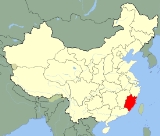
formerly romanised as
Fukien or
Huguing or
Foukien, is a province on the
southeast coastEast China is a geographical and a loosely-defined cultural region that covers the eastern coastal area of China.Although an intangible and loosely defined concept, for administrative and governmental purposes, the region is defined by the government of the People's Republic of China to include...
of
mainland ChinaMainland China, the Chinese mainland or simply the mainland, is a geopolitical term that refers to the area under the jurisdiction of the People's Republic of China . According to the Taipei-based Mainland Affairs Council, the term excludes the PRC Special Administrative Regions of Hong Kong and...
. Fujian is bordered by
ZhejiangZhejiang is an eastern coastal province of the People's Republic of China. The word Zhejiang was the old name of the Qiantang River, which passes through Hangzhou, the provincial capital...
to the north,
Jiangxi' is a southern province in the People's Republic of China. Spanning from the banks of the Yangtze River in the north into hillier areas in the south, it shares a border with Anhui to the north, Zhejiang to the northeast, Fujian to the east, Guangdong to the south, Hunan to the west, and Hubei to...
to the west, and
GuangdongGuangdong is a province on the South China Sea coast of the People's Republic of China. The province was previously often written with the alternative English name Kwangtung Province...
to the south.
TaiwanTaiwan , also known, especially in the past, as Formosa , is the largest island of the same-named island group of East Asia in the western Pacific Ocean and located off the southeastern coast of mainland China. The island forms over 99% of the current territory of the Republic of China following...
lies to the east, across the
Taiwan StraitThe Taiwan Strait or Formosa Strait, formerly known as the Black Ditch, is a 180-km-wide strait separating Mainland China and Taiwan. The strait is part of the South China Sea and connects to East China Sea to the northeast...
. The name Fujian came from the combination of
FuzhouFuzhou is the capital and one of the largest cities in Fujian Province, People's Republic of China. Along with the many counties of Ningde, those of Fuzhou are considered to constitute the Mindong linguistic and cultural area....
and Jianzhou (a former name for
Jian'ouJian'ou 【; Minbe di: Guing'ei 】 is a county-level city of Fujian province of the People's Republic of China.Jian'ou is within a major rice-growing area...
) two cities in Fujian, during the
Tang DynastyThe Tang Dynasty was an imperial dynasty of China preceded by the Sui Dynasty and followed by the Five Dynasties and Ten Kingdoms Period. It was founded by the Li family, who seized power during the decline and collapse of the Sui Empire...
. With a
HanHan Chinese are an ethnic group native to China and are the largest single ethnic group in the world.Han Chinese constitute about 92% of the population of the People's Republic of China , 98% of the population of the Republic of China , 78% of the population of Singapore, and about 20% of the...
majority, it is one of the most culturally and linguistically diverse provinces in China.
Most of Fujian is administered by the
People's Republic of ChinaChina , officially the People's Republic of China , is the most populous country in the world, with over 1.3 billion citizens. Located in East Asia, the country covers approximately 9.6 million square kilometres...
. However, the archipelagos of
KinmenKinmen , also known as Quemoy , is a small archipelago of several islands administered by the Republic of China : Greater Kinmen, Lesser Kinmen, and some islets. Administratively, it is Kinmen County of Fujian Province, ROC. The county is claimed by the People's Republic of China as part of its...
and
MatsuThe Matsu Islands are a minor archipelago of 19 islands and islets in the Taiwan Strait administered as Lienchiang County , Fujian Province of the Republic of China . Only a small area of what is historically Lienchiang County is under the control of the ROC...
are under the control of the
Republic of ChinaThe Republic of China , commonly known as Taiwan , is a unitary sovereign state located in East Asia. Originally based in mainland China, the Republic of China currently governs the island of Taiwan , which forms over 99% of its current territory, as well as Penghu, Kinmen, Matsu and other minor...
(
TaiwanTaiwan , also known, especially in the past, as Formosa , is the largest island of the same-named island group of East Asia in the western Pacific Ocean and located off the southeastern coast of mainland China. The island forms over 99% of the current territory of the Republic of China following...
). Thus, there are two provinces (in the sense of government organizations; PRC's Fujian and ROC's Fujian).
History
Recent archaeological discoveries demonstrate that Fujian had entered the Neolithic Age by the middle of the 6th millennium BC. From the Keqiutou site (7450–5590 BP), an early Neolithic site in
Pingtan IslandPingtan Island is located in eastern coastal area in Fujian province, China. It is the largest island in Fujian, and the fifth largest island in China...
located about 70 km southeast of Fuzhou, numerous tools made of stones, shells,
boneBones are rigid organs that constitute part of the endoskeleton of vertebrates. They support, and protect the various organs of the body, produce red and white blood cells and store minerals. Bone tissue is a type of dense connective tissue...
s,
jadeJade is an ornamental stone.The term jade is applied to two different metamorphic rocks that are made up of different silicate minerals:...
s, and
ceramicA ceramic is an inorganic, nonmetallic solid prepared by the action of heat and subsequent cooling. Ceramic materials may have a crystalline or partly crystalline structure, or may be amorphous...
s (including wheel-made-ceramics) have been unearthed, together with
spinning wheelA spinning wheel is a device for spinning thread or yarn from natural or synthetic fibers. Spinning wheels appeared in Asia, probably in the 11th century, and very gradually replaced hand spinning with spindle and distaff...
s, a definitive evidence of
weavingWeaving is a method of fabric production in which two distinct sets of yarns or threads are interlaced at right angles to form a fabric or cloth. The other methods are knitting, lace making and felting. The longitudinal threads are called the warp and the lateral threads are the weft or filling...
.
The Tanshishan (昙石山) site (5500–4000 BP) in suburban Fuzhou spans the Neolithic and Chalcolithic Age where semi-underground circular buildings were found in the lower level. The Huangtulun (黄土崙) site (ca.1325 BC), also in suburban Fuzhou, was of the
Bronze AgeThe Bronze Age is a period characterized by the use of copper and its alloy bronze as the chief hard materials in the manufacture of some implements and weapons. Chronologically, it stands between the Stone Age and Iron Age...
in character.
This area was also the place for the kingdom of Minyue. The word "Mǐnyuè" was derived by combining "Mǐn" (閩/闽; ), perhaps an ethnic name and associated with the Chinese word for barbarians (蠻/蛮; pinyin: mán; POJ: bân), and "Yuè", after the State of Yue, a
Spring and Autumn Period kingdom in
ZhejiangZhejiang is an eastern coastal province of the People's Republic of China. The word Zhejiang was the old name of the Qiantang River, which passes through Hangzhou, the provincial capital...
Province to the north. This is because the royal family of Yuè fled to Fujian after their kingdom was annexed by the State of Chu in 306 BC. Mǐn is also the name of the main river in this area, but the ethnonym is probably earlier.
Minyue was a
de facto kingdom until the emperor of
Qin DynastyThe Qin Dynasty was the first imperial dynasty of China, lasting from 221 to 207 BC. The Qin state derived its name from its heartland of Qin, in modern-day Shaanxi. The strength of the Qin state was greatly increased by the legalist reforms of Shang Yang in the 4th century BC, during the Warring...
, the first unified imperial Chinese state, abolished the status. In the aftermath of the fall of the Qin Dynasty, however, civil war broke out between two warlords,
Xiang YuXiang Yu was a prominent military leader and political figure during the late Qin Dynasty. His given name was Ji while his style name was Yu ....
and Liu Bang; the Minyue king Wuzhu sent his troops to fight side-by-side with Liu Bang, and his gamble paid off. Liu Bang was victorious, and founded the
Han DynastyThe Han Dynasty was the second imperial dynasty of China, preceded by the Qin Dynasty and succeeded by the Three Kingdoms . It was founded by the rebel leader Liu Bang, known posthumously as Emperor Gaozu of Han. It was briefly interrupted by the Xin Dynasty of the former regent Wang Mang...
; in 202 BC he restored Minyue's status as a
tributaryThe term tributary state refers to one of the two main ways in which a pre-modern state might be subordinate to a more powerful neighbour. The heart of the relationship was that the tributary would send a regular token of submission to the superior power...
independent kingdom. Thus Wuzhu was allowed to construct his fortified city in
FuzhouFuzhou is the capital and one of the largest cities in Fujian Province, People's Republic of China. Along with the many counties of Ningde, those of Fuzhou are considered to constitute the Mindong linguistic and cultural area....
as well as a few locations in the
Wuyi MountainsThe Wuyi Mountains are a mountain range located in the prefecture of Nanping, in the northern border of Fujian province with Jiangxi province, China. The mountains cover an area of 60 km². In 1999, Mount Wuyi entered UNESCO's list of World Heritage Sites, both natural and cultural...
, which have been excavated in recent years. His kingdom extended beyond the borders of contemporary Fujian into eastern
GuangdongGuangdong is a province on the South China Sea coast of the People's Republic of China. The province was previously often written with the alternative English name Kwangtung Province...
, eastern
Jiangxi' is a southern province in the People's Republic of China. Spanning from the banks of the Yangtze River in the north into hillier areas in the south, it shares a border with Anhui to the north, Zhejiang to the northeast, Fujian to the east, Guangdong to the south, Hunan to the west, and Hubei to...
, and southern
ZhejiangZhejiang is an eastern coastal province of the People's Republic of China. The word Zhejiang was the old name of the Qiantang River, which passes through Hangzhou, the provincial capital...
.
After the death of Wuzhu, Minyue maintained its militant tradition and launched several expeditions against their neighboring kingdoms in
GuangdongGuangdong is a province on the South China Sea coast of the People's Republic of China. The province was previously often written with the alternative English name Kwangtung Province...
,
Jiangxi' is a southern province in the People's Republic of China. Spanning from the banks of the Yangtze River in the north into hillier areas in the south, it shares a border with Anhui to the north, Zhejiang to the northeast, Fujian to the east, Guangdong to the south, Hunan to the west, and Hubei to...
, and
ZhejiangZhejiang is an eastern coastal province of the People's Republic of China. The word Zhejiang was the old name of the Qiantang River, which passes through Hangzhou, the provincial capital...
, mostly in the 2nd century BC, only to be stopped by the
Han DynastyThe Han Dynasty was the second imperial dynasty of China, preceded by the Qin Dynasty and succeeded by the Three Kingdoms . It was founded by the rebel leader Liu Bang, known posthumously as Emperor Gaozu of Han. It was briefly interrupted by the Xin Dynasty of the former regent Wang Mang...
. The Han emperor eventually decided to get rid of the potential threat by sending in large forces simultaneously from four directions via land and sea in 111 BC. The rulers in Fuzhou surrendered to avoid a futile fight and destruction; thus the first kingdom in Fujian history came to an abrupt end.
The
Han DynastyThe Han Dynasty was the second imperial dynasty of China, preceded by the Qin Dynasty and succeeded by the Three Kingdoms . It was founded by the rebel leader Liu Bang, known posthumously as Emperor Gaozu of Han. It was briefly interrupted by the Xin Dynasty of the former regent Wang Mang...
collapsed at the end of the 2nd century AD, paving the way for the
Three KingdomsThe Three Kingdoms period was a period in Chinese history, part of an era of disunity called the "Six Dynasties" following immediately the loss of de facto power of the Han Dynasty rulers. In a strict academic sense it refers to the period between the foundation of the state of Wei in 220 and the...
era.
Sun QuanSun Quan , son of Sun Jian, formally Emperor Da of Wu, was the founder of Eastern Wu during the Three Kingdoms period of Chinese history. He ruled from 222 to 229 as King of Wu and from 229 to 252 as Emperor of Wu....
, the founder of the Kingdom of Wu, spent nearly twenty years subduing the Shan Yue people, the branch of the Yue living in mountains.
The first wave of immigration of the noble class arrived in the province in the early 4th century AD when the Western Jin Dynasty collapsed and the north was torn apart by invasions by nomadic peoples from the north, as well as civil war. These immigrants were primarily from eight families in central China:
Lin (林)Lín Lin is the second most common surname in Taiwan at 9% of the population, second only to Chen. In mainland China , Lin is generally less common.-Name origin:...
, Huang (黄),
Chen (陈)Chén or Chan is one of the most common East Asian family names. It ranks as the 5th most common surname in China, as of 2007 and the most common surname in Singapore and Taiwan . Chen is also the most common family name in Guangdong, Zhejiang, Fujian, Hong Kong...
,
Zheng (郑)Zhèng or Cheng is a Chinese family name and is the name of an ancient state in today's Henan. It is written as 鄭 in traditional Chinese script or as 郑 in simplified Chinese script....
, Zhan (詹),
Qiu (邱)Qiū is the Hanyu Pinyin transliteration of the Chinese family names 丘, 邱 and 仇, 秋. They may be transliterated in various forms, as:* 丘, 邱, 秋 as Qiū, 仇 as Qiú * Chiu...
, He (何), and
Hu (胡)Hu 胡 is a Chinese surname or family name. In 2006, it was the 15th most common surname in China.Some other less-common surnames pronounced Hu include 瓠, 護, 戶, 扈, 虎, 呼, 忽, and 斛.-Words:...
. The first four remain as the major surnames of modern Fujian.
Nevertheless, isolation from nearby areas owing to rugged terrain contributed to Fujian's relatively backward economy and level of development, despite major population boost from northern China during the "barbarian" invasions. Population density in Fujian remained low compared to the rest of China. Only two commanderies and sixteen counties were established by the Western Jin Dynasty. Like other southern provinces such as
GuangdongGuangdong is a province on the South China Sea coast of the People's Republic of China. The province was previously often written with the alternative English name Kwangtung Province...
,
GuangxiGuangxi, formerly romanized Kwangsi, is a province of southern China along its border with Vietnam. In 1958, it became the Guangxi Zhuang Autonomous Region of the People's Republic of China, a region with special privileges created specifically for the Zhuang people.Guangxi's location, in...
,
Guizhou' is a province of the People's Republic of China located in the southwestern part of the country. Its provincial capital city is Guiyang.- History :...
, and
YunnanYunnan is a province of the People's Republic of China, located in the far southwest of the country spanning approximately and with a population of 45.7 million . The capital of the province is Kunming. The province borders Burma, Laos, and Vietnam.Yunnan is situated in a mountainous area, with...
, Fujian often served as a destination for exiled prisoners and dissidents at that time.
During the
Southern and Northern DynastiesThe Southern and Northern Dynasties was a period in the history of China that lasted from 420 to 589 AD. Though an age of civil war and political chaos, it was also a time of flourishing arts and culture, advancement in technology, and the spreading of Mahayana Buddhism and Daoism...
era, the
Southern DynastiesThe Southern dynasties comprise the Liu Song, Southern Qi, Liang Dynasty and Chen Dynasty, whose capital were at Jiankang , and Emperor Yuan of Liang, as well as the later Western Liang emperors , also set their...
reigned south of the
Yangtze RiverThe Yangtze, Yangzi or Cháng Jiāng is the longest river in Asia, and the third-longest in the world. It flows for from the glaciers on the Tibetan Plateau in Qinghai eastward across southwest, central and eastern China before emptying into the East China Sea at Shanghai. It is also one of the...
, including Fujian.
The
Tang DynastyThe Tang Dynasty was an imperial dynasty of China preceded by the Sui Dynasty and followed by the Five Dynasties and Ten Kingdoms Period. It was founded by the Li family, who seized power during the decline and collapse of the Sui Empire...
(618–907) oversaw the next golden age of China. As the Tang Dynasty ended, China was torn apart in the period of the Five Dynasties and Ten Kingdoms. During this time, a second major wave of immigration arrived in the safe haven of Fujian, led by general Wang, who set up an independent
Kingdom of MinMin was one of the Ten Kingdoms which was in existence between the years of 909 and 945. It existed in a mountainous region of modern day Fujian province of China and had a history of quasi-independent rule. Its capital was Fuzhou 福州. It was founded by Wang Shenzhi .-Founding:Wang Shenzhi’s older...
with its capital in Fuzhou. After the death of the founding king, however, the kingdom suffered from internal strife, and was soon swallowed up by
Southern TangSouthern Tang was one of the Ten Kingdoms in south-central China created following the Tang Dynasty from 937-975. Southern Tang replaced the Wu Kingdom when Li Bian deposed the emperor Yang Pu....
, another southern kingdom.
QuanzhouQuanzhou is a prefecture-level city in Fujian province, People's Republic of China. It borders all other prefecture-level cities in Fujian but two and faces the Taiwan Strait...
was blooming into a seaport under the reign of the
Min KingdomMin was one of the Ten Kingdoms which was in existence between the years of 909 and 945. It existed in a mountainous region of modern day Fujian province of China and had a history of quasi-independent rule. Its capital was Fuzhou 福州. It was founded by Wang Shenzhi .-Founding:Wang Shenzhi’s older...
, and may have been the largest seaport in the Eastern hemisphere. In the early Ming Dynasty, Quanzhou was the staging area and supply depot of
Zheng HeZheng He , also known as Ma Sanbao and Hajji Mahmud Shamsuddin was a Hui-Chinese mariner, explorer, diplomat and fleet admiral, who commanded voyages to Southeast Asia, South Asia, the Middle East, and East Africa, collectively referred to as the Voyages of Zheng He or Voyages of Cheng Ho from...
's naval expeditions. Further development was severely hampered by the
sea trade banThe Hǎi Jìn order was a ban on maritime activities imposed during China's Ming Dynasty and again at the time of the Qing Dynasty. Intended to curb piracy, the ban proved ineffective for that purpose...
of the Ming Dynasty, and the area was superseded by nearby ports of
GuangzhouGuangzhou , known historically as Canton or Kwangchow, is the capital and largest city of the Guangdong province in the People's Republic of China. Located in southern China on the Pearl River, about north-northwest of Hong Kong, Guangzhou is a key national transportation hub and trading port...
,
HangzhouHangzhou , formerly transliterated as Hangchow, is the capital and largest city of Zhejiang Province in Eastern China. Governed as a sub-provincial city, and as of 2010, its entire administrative division or prefecture had a registered population of 8.7 million people...
,
NingboNingbo is a seaport city of northeastern Zhejiang province, Eastern China. Holding sub-provincial administrative status, the municipality has a population of 7,605,700 inhabitants at the 2010 census whom 3,089,180 in the built up area made of 6 urban districts. It lies south of the Hangzhou Bay,...
and
ShanghaiShanghai is the largest city by population in China and the largest city proper in the world. It is one of the four province-level municipalities in the People's Republic of China, with a total population of over 23 million as of 2010...
despite the lifting of the ban in 1550. Large scale piracy by
WokouWokou , which literally translates as "Japanese pirates" in English, were pirates of varying origins who raided the coastlines of China and Korea from the 13th century onwards...
(Japanese pirates) was eventually wiped out by Chinese military and Japanese authority of
Toyotomi Hideyoshiwas a daimyo warrior, general and politician of the Sengoku period. He unified the political factions of Japan. He succeeded his former liege lord, Oda Nobunaga, and brought an end to the Sengoku period. The period of his rule is often called the Momoyama period, named after Hideyoshi's castle...
.
Late Ming and early
Qing DynastyThe Qing Dynasty was the last dynasty of China, ruling from 1644 to 1912 with a brief, abortive restoration in 1917. It was preceded by the Ming Dynasty and followed by the Republic of China....
symbolized an era of large influx of refugees and another 20 years of sea trade ban under the Kangxi Emperor, a measure intended to counter the refuge Ming government of
KoxingaKoxinga is the customary Western spelling of the popular appellation of Zheng Chenggong , a military leader who was born in 1624 in Hirado, Japan to Zheng Zhilong, a Chinese merchant/pirate, and his Japanese wife and died in 1662 on the island of Formosa .A Ming loyalist and the arch commander of...
in Taiwan. Incoming refugees, however, did not translate into a major labor force owing to their re-migration into prosperous regions of
GuangdongGuangdong is a province on the South China Sea coast of the People's Republic of China. The province was previously often written with the alternative English name Kwangtung Province...
province. In 1689, the Qing dynasty officially incorporated Taiwan into Fujian province. Settlement of Taiwan by
Han ChineseHan Chinese are an ethnic group native to China and are the largest single ethnic group in the world.Han Chinese constitute about 92% of the population of the People's Republic of China , 98% of the population of the Republic of China , 78% of the population of Singapore, and about 20% of the...
followed, and the majority of people in Taiwan are descendants of emigrants from Southern Fujian. After Taiwan was separated into its own province in 1885 and ceded to Japan in 1895, Fujian arrived at its present extent. It was substantially influenced by the Japanese after the
Treaty of ShimonosekiThe Treaty of Shimonoseki , known as the Treaty of Maguan in China, was signed at the Shunpanrō hall on April 17, 1895, between the Empire of Japan and Qing Empire of China, ending the First Sino-Japanese War. The peace conference took place from March 20 to April 17, 1895...
of 1895 until the Sino-Japanese War (1937-1945) of
WWIIWorld War II, or the Second World War , was a global conflict lasting from 1939 to 1945, involving most of the world's nations—including all of the great powers—eventually forming two opposing military alliances: the Allies and the Axis...
.
Owing to the mountainous landscape, Fujian was the most secluded province of the PRC in eastern China due to the lack of rail and underdeveloped networks of paved roads before the 1950s. The first railway to the province, the Yingtan-Xiamen Railway, was completed in 1957. Despite its secluded location, Fujian has had a strong academic tradition since the Southern Song Dynasty. At the time, north China was occupied by the
JurchenThe Jurchens were a Tungusic people who inhabited the region of Manchuria until the 17th century, when they adopted the name Manchu...
Jin DynastyThe Jīn Dynasty ; Khitan language: Nik, Niku; ; 1115–1234), also known as the Jurchen Dynasty, was founded by the Wanyan clan of the Jurchens, the ancestors of the Manchus who established the Qing Dynasty some 500 years later...
, which caused a shift of the cultural center of China to the south, benefiting Fuzhou and other southern cities. In the Chinese Academy of Science and
Chinese Academy of EngineeringThe Chinese Academy of Engineering is the national academy of the People's Republic of China for engineering. It was established in 1994 and is an institution of the State Council of China...
, there are more members from
FuzhouFuzhou is the capital and one of the largest cities in Fujian Province, People's Republic of China. Along with the many counties of Ningde, those of Fuzhou are considered to constitute the Mindong linguistic and cultural area....
than from any other city. In addition, it should also be pointed out that the slow development of Fujian in its early days has proven a blessing for the province's ecology; today, the province has the highest forest coverage rate and the most diverse biosphere in China whereas central China suffers from severe overpopulation and displays severe signs of soil erosion accompanied by frequent droughts and floods due to lack of forest coverage.
Since the late 1970s, the economy of Fujian along the coast has greatly benefited from its geographic and cultural proximity to Taiwan. In 2003,
XiamenXiamen , also known as Amoy , is a major city on the southeast coast of the People's Republic of China. It is administered as a sub-provincial city of Fujian province with an area of and population of 3.53 million...
ranked number eight GDP per capita among 659 Chinese cities, ahead of Shanghai and Beijing, while
FuzhouFuzhou is the capital and one of the largest cities in Fujian Province, People's Republic of China. Along with the many counties of Ningde, those of Fuzhou are considered to constitute the Mindong linguistic and cultural area....
ranked no. 21 (number 4 among 30 provincial capitals). The development has been accompanied by a large influx of population from the over-populated areas in the north and west, and much of the farmland and forest as well as cultural heritage sites such as the temples of king Wuzhu have given way to ubiquitous high-rise buildings, and the government faces a challenge at all levels to sustain development while, at the same time, preserving the unique and vital natural and cultural heritage of Fujian.
Geography
The province is mostly mountainous, and is traditionally described to be "Eight parts mountain, one part water, and one part farmland" (八山一水一分田). The northwest is higher in altitude, with the
Wuyi MountainsThe Wuyi Mountains are a mountain range located in the prefecture of Nanping, in the northern border of Fujian province with Jiangxi province, China. The mountains cover an area of 60 km². In 1999, Mount Wuyi entered UNESCO's list of World Heritage Sites, both natural and cultural...
forming the border between Fujian and
Jiangxi' is a southern province in the People's Republic of China. Spanning from the banks of the Yangtze River in the north into hillier areas in the south, it shares a border with Anhui to the north, Zhejiang to the northeast, Fujian to the east, Guangdong to the south, Hunan to the west, and Hubei to...
. It is the most forested provincial level administrative region in China, with a 62.96% forest coverage rate in 2009. The highest point of Fujian is Huanggang Peak in the Wuyi Mountains, with an altitude of 2157 m.
Fujian province faces
East China SeaThe East China Sea is a marginal sea east of China. It is a part of the Pacific Ocean and covers an area of 1,249,000 km² or 750,000 square miles.-Geography:...
to the east,
South China SeaThe South China Sea is a marginal sea that is part of the Pacific Ocean, encompassing an area from the Singapore and Malacca Straits to the Strait of Taiwan of around...
to the south, and the
Taiwan StraitThe Taiwan Strait or Formosa Strait, formerly known as the Black Ditch, is a 180-km-wide strait separating Mainland China and Taiwan. The strait is part of the South China Sea and connects to East China Sea to the northeast...
to the southeast. The coastline is rugged and has many bays and islands. Major islands include Quemoy (controlled by the Republic of China), Haitan Island, and Nanri Island.
The
River Min JiangThe Min River is a 577 km-long river in Fujian province, China. It is the largest river in Fujian, and an important water transport channel. Most of the northern and central Fujian is within its drainage area....
and its tributaries cut through much of northern and central Fujian. Other rivers include the Jinjiang River and the
Jiulong RiverThe Jiulong River or Jiulong Jiang is the largest river in southern Fujian, and the second largest in the province. Like all Fujian rivers but one, it flows into the Taiwan Strait....
. Due to its uneven topography, Fujian has many cliffs and rapids.
Fujian is separated from Taiwan by the 180 kilometres (111.8 mi)-wide Taiwan Strait. Some of the small islands in the Taiwan Strait are also part of the province.
Small parts of the province, namely the islands of Quemoy and
MatsuThe Matsu Islands are a minor archipelago of 19 islands and islets in the Taiwan Strait administered as Lienchiang County , Fujian Province of the Republic of China . Only a small area of what is historically Lienchiang County is under the control of the ROC...
, are under the administration of the Republic of China.
Fujian has a subtropical climate, with warm winters. In January the coastal regions average around 7 – while the hills average 6 –. In the summer, temperatures are high, and the province is threatened by typhoons coming in from the
PacificThe Pacific Ocean is the largest of the Earth's oceanic divisions. It extends from the Arctic in the north to the Southern Ocean in the south, bounded by Asia and Australia in the west, and the Americas in the east.At 165.2 million square kilometres in area, this largest division of the World...
. Average annual
precipitationIn meteorology, precipitation In meteorology, precipitation In meteorology, precipitation (also known as one of the classes of hydrometeors, which are atmospheric water phenomena is any product of the condensation of atmospheric water vapor that falls under gravity. The main forms of precipitation...
is 1400 –.
Transportation
The province has worked to improve its infrastructure; adding 166 kilometres (103.1 mi) of new roads and 155 kilometres (96.3 mi) of railways.
Road
There are 54876 kilometres (34,098.5 mi) of highways including 727 kilometres (451.7 mi) of expressways. The top infrastructure projects in recent years have been the Zhangzhou-Zhaoan Expressway (US$624 million) and the Sanmingshi-Fuzhou expressway (US$1.40 billion). During the Eleventh Five-Year Plan, which spanned from 2006 until 2010, the province aimed to double the length of its expressways to 2450 kilometres (1,522.4 mi).
Railways
Rail lines connect Fuzhou and Xiamen with the national network. The Fujian section of the Ganzhou-Longyan railway and the Wenzhou-Fuzhou railway, have received an investment of US$465 million and US$596 million respectively. In order to attract Taiwanese investment, the province intends to increase its rail length by 50 percent to 2,500 kilometers.
Air
The major airports are
Fuzhou Changle International AirportFuzhou Changle International Airport is an airport in Fuzhou, the capital of Fujian Province, China. The airport was inaugurated on June 23, 1997, after being approved to start constructing in 1992. The current handling capacity is approximately 6.5 million people annually. It is one of the...
,
Xiamen Gaoqi International Airport-Cargo airlines:-See also:*List of airports in the People's Republic of China*China's busiest airports by passenger traffic-External links:*...
, Quanzhou Jinjiang International Airport,
Nanping Wuyishan AirportWuyishan Airport is an airport serving Wuyishan City as well as Nanping, Fujian province, People’s Republic of China .-Airlines and destinations:...
and
Longyan AirportLongyan Guanzhishan Airport , is an airport serving the city of Longyan, Fujian Province, China. It is located in Liancheng County, and was formerly called Liancheng Airport. The airport has a handling capacity of 140,000 passengers and 800 tons of cargo. The airport was opened on April 25, 2004....
. Fuzhou is capable of handling 6.5 million passengers annually with a cargo capacity of more than 200,000 tons. The airport offers direct links to 45 destinations including international routes to Japan, Malaysia, Thailand, Singapore and Hong Kong.
Major cities:
- Fuzhou
Fuzhou is the capital and one of the largest cities in Fujian Province, People's Republic of China. Along with the many counties of Ningde, those of Fuzhou are considered to constitute the Mindong linguistic and cultural area....
(Foochow)
- Xiamen
Xiamen , also known as Amoy , is a major city on the southeast coast of the People's Republic of China. It is administered as a sub-provincial city of Fujian province with an area of and population of 3.53 million...
(Amoy)
- Nanping
Nanping is a prefecture-level city in northwestern Fujian province, People's Republic of China. It borders Ningde City to the east, Sanming City to the south, and the provinces of Zhejiang and Jiangxi to the north and west respectively...
(Nanbeing)
- Quanzhou
Quanzhou is a prefecture-level city in Fujian province, People's Republic of China. It borders all other prefecture-level cities in Fujian but two and faces the Taiwan Strait...
- Longyan
Longyan is a prefecture-level city in southwestern Fujian province, China.-Geography:It is situated in the upper reaches of the Jiulong and Tingjiang rivers...
- Zhangzhou
Zhangzhou is a prefecture-level city in southern Fujian province, People's Republic of China. Located on the banks of the Jiulong River , Zhangzhou borders the cities of Xiamen and Quanzhou to the northeast, Longyan City to the northwest and the province of Guangdong to the southwest.Zhangzhou...
- Putian
Putian is a prefecture-level city in eastern Fujian province, People's Republic of China. It borders Fuzhou City to the north, Quanzhou City to the south, and the Taiwan Strait to the east.-Administration:...
Administrative divisions
The
People's Republic of ChinaChina , officially the People's Republic of China , is the most populous country in the world, with over 1.3 billion citizens. Located in East Asia, the country covers approximately 9.6 million square kilometres...
controls most of the province, and divides it into nine prefecture-level divisions:
| Map |
# |
Name |
Hanzi |
Hanyu Pinyin |
Administrative Seat |
Population (2010 The Sixth National Population Census of the People's Republic of China, also referred to as the 2010 Chinese Census, was conducted by the National Bureau of Statistics of the People's Republic of China with a zero hour of November 1, 2010.... ) |
|
| — Sub-provincial city — |
| 2 |
XiamenXiamen , also known as Amoy , is a major city on the southeast coast of the People's Republic of China. It is administered as a sub-provincial city of Fujian province with an area of and population of 3.53 million...
|
厦门市 |
Xiàmén Shì |
Siming District |
3,531,347 |
— Prefecture-level cityA prefectural level city , prefectural city or prefectural level municipality is an administrative division of the People's Republic of China, ranking below a province and above a county in China's administrative structure. Prefectural level cities form the second level of the administrative... — |
| 1 |
FuzhouFuzhou is the capital and one of the largest cities in Fujian Province, People's Republic of China. Along with the many counties of Ningde, those of Fuzhou are considered to constitute the Mindong linguistic and cultural area....
|
福州市 |
Fúzhōu Shì |
Gulou District Gulou District, Fuzhou is a district of Fujian Province, China. It is under the administration of Fuzhou city. Gulou District used to be the walled city of Fuzhou....
|
7,115,370 |
| 3 |
Longyan Longyan is a prefecture-level city in southwestern Fujian province, China.-Geography:It is situated in the upper reaches of the Jiulong and Tingjiang rivers...
|
龙岩市 |
Lóngyán Shì |
Xinluo District Xinluo District is a county-level territory under the jurisdiction of Longyan, in Fujian Province, China.Xinluo District has a population of approximately 50,000....
|
2,559,545 |
| 4 |
NanpingNanping is a prefecture-level city in northwestern Fujian province, People's Republic of China. It borders Ningde City to the east, Sanming City to the south, and the provinces of Zhejiang and Jiangxi to the north and west respectively...
|
南平市 |
Nánpíng Shì |
Yanping DistrictYanping District is a district in Nanping prefecture in the northern part of Fujian province of the People's Republic of China. The prefecture government located in the district.-Etymology:...
|
2,645,549 |
| 5 |
NingdeNingde , also known as Mindong , is a prefecture-level city located along the northeastern coast of Fujian province, China. It borders Fuzhou to the south, Wenzhou City and Zhejiang province to the north, and Nanping City to the west.-Administration:...
|
宁德市 |
Nánpíng Shì |
Jiaocheng District Jiaocheng is a district in the municipal region of Ningde, Fujian Province, PRC. Also called Ningde Shiqu , the district seats the municipality's executive, legislature and judiciary, together with its Communist Party and Public Security Bureaux.-Situation:Jiaocheng is bordered by Xiapu and...
|
2,821,996 |
| 6 |
Putian Putian is a prefecture-level city in eastern Fujian province, People's Republic of China. It borders Fuzhou City to the north, Quanzhou City to the south, and the Taiwan Strait to the east.-Administration:...
|
莆田市 |
Pútián Shì |
Chengxiang District Chengxiang District is a district of Fujian Province, China. It is under the administration of Putian city....
|
2,778,508 |
| 7 |
QuanzhouQuanzhou is a prefecture-level city in Fujian province, People's Republic of China. It borders all other prefecture-level cities in Fujian but two and faces the Taiwan Strait...
|
泉州市 |
Quánzhōu Shì |
Fengze District Fengze District is a district of Fujian Province, China. It is under the administration of Quanzhou city. It has an area of 126.5 square kilometers and a population of 458,000.-Administrative divisions:Fengze District has 8 subdistricts:*Xiuquan...
|
8,128,530 |
| 8 |
Sanming Sanming ) is a prefecture-level city in western Fujian province, People's Republic of China. It borders Nanping City to the north, Fuzhou City to the east, Quanzhou City to the southeast, Longyan City to the south, and the province of Jiangxi to the west...
|
三明市 |
Sānmíng Shì |
Sanyuan District Sanyuan District is a district of Fujian Province, China. It is under the administration of Sanming city....
|
2,503,388 |
| 9 |
Zhangzhou Zhangzhou is a prefecture-level city in southern Fujian province, People's Republic of China. Located on the banks of the Jiulong River , Zhangzhou borders the cities of Xiamen and Quanzhou to the northeast, Longyan City to the northwest and the province of Guangdong to the southwest.Zhangzhou...
|
漳州市 |
Zhāngzhōu Shì |
Xiangcheng DistrictXiangcheng District or called as Sin Kang District in Hokkien. Xiangcheng is a county within the prefecture of Zhangzhou in China.-Location:...
|
4,809,983 |
All of the prefecture-level cities except Longyan, Sanming, and Nanping are found along the coast.
The nine prefecture-level divisions are subdivided into 85 county-level divisions (26 districts, 14 county-level cities, and 45 counties). Those are in turn divided into 1107 township-level divisions (605 towns, 328 townships, 18 ethnic townships, and 156
subdistrictSubdistrict is a low level administrative division of a country. In Thailand it may refer to the King Amphoe or to the Tambon. In England and Wales it was part of a Registration district....
s).
Note: these are the official PRC numbers. Thus, Quemoy is included as one of the 45 counties and MatsuThe Matsu Islands are a minor archipelago of 19 islands and islets in the Taiwan Strait administered as Lienchiang County , Fujian Province of the Republic of China . Only a small area of what is historically Lienchiang County is under the control of the ROC...
as one of the 334 townships.
Quemoy (Jinmen) County is nominally controlled by
QuanzhouQuanzhou is a prefecture-level city in Fujian province, People's Republic of China. It borders all other prefecture-level cities in Fujian but two and faces the Taiwan Strait...
prefecture-level city, but it is administered in its entirety by the Republic of China. The PRC-administered Lianjiang County, under the jurisdiction of
FuzhouFuzhou is the capital and one of the largest cities in Fujian Province, People's Republic of China. Along with the many counties of Ningde, those of Fuzhou are considered to constitute the Mindong linguistic and cultural area....
prefecture-level city, nominally includes the
Matsu IslandsThe Matsu Islands are a minor archipelago of 19 islands and islets in the Taiwan Strait administered as Lienchiang County , Fujian Province of the Republic of China . Only a small area of what is historically Lienchiang County is under the control of the ROC...
(Mazu), but Matsu is in reality controlled by the Republic of China, which administers Matsu as Lienchiang County (same name Romanized differently). The Wuchiu (Wuqiu) islands are nominally administered in the PRC by the Xiuyu District of the
PutianPutian is a prefecture-level city in eastern Fujian province, People's Republic of China. It borders Fuzhou City to the north, Quanzhou City to the south, and the Taiwan Strait to the east.-Administration:...
prefecture, but is in reality controlled by the Republic of China, which administers Wuchiu as part of Quemoy County.
See
List of administrative divisions of Fujian for a complete list of county-level divisions.
Politics
List of the Secretaries of the CPC Fujian Committee
- Zhang Dingcheng
-Biography:Zhang Dingcheng was born in Yongding County, Fujian in 1898. He joined the Communist Party of China in 1927.Zhang was the Procurator-General of the Supreme People's Procuratorate from 1954 to 1975.-External links:...
(张鼎丞): June 1949-October 1954
- Ye Fei (叶飞): October 1954-June 1958
- Jiang Yizhen (江一真): acting 1958–1970
- Han Xianchu
Han Xianchu was a general of the Chinese Communist Party. Han participated in many military campaigns and battles such as Battle of Pingxingguan, Liaoshen Campaign, Pingjin Campaign, Hainan Campaign, and the Korean War...
(韩先楚): April 1971-December 1973
- Liao Zhigao
Liao Zhigao was a politician of the People's Republic of China. He was born in Mianning, Sichuan. He joined Communist Party of China in April, 1934.-Biography:...
(廖志高): December 1974-February 1982
- Xiang Nan (项南): February 1982-March 1986
- Chen Guangyi (陈光毅); March 1986-December 1993
- Jia Qinglin
Jia Qinglin is a senior leader of the People's Republic of China. He is the fourth ranking member of the Politburo Standing Committee of the Communist Party of China, the Chairman and Party secretary of the National Committee of the People's Political Consultative Conference. Jia's functions as...
(贾庆林): December 1993-October 1996
- Chen Mingyi
Chen Mingyi is a politician of the People's Republic of China. Chen was born in Fuzhou, Fujian Province. He joined Communist Party of China in 1960...
(陈明义): October 1996-December 2000
- Song Defu
Song Defu was a politician of the People's Republic of China. He was born in Yanshan, Hebei Province, and was educated at college. He joined the People's Liberation Army in 1965, and the Communist Party of China the same year. He was an alternate member of CPC's 12th central committee, and a...
(宋德福): December 2000-February 2004
- Lu Zhangong
Lu Zhangong is a politician of the People's Republic of China. He currently serves as the CPC Secretary of Henan.-Biography:Born in Cixi, Zhejiang Province, he started working in March 1969, and joined the Communist Party of China in January 1975....
(卢展工): February 2004-2009
- sun chunlan
Sun Chunlan is a Chinese politician. She currently serves as the CCP Secretary of Fujian, first-in-charge of the coastal province. She is the only female provincial party chief in China, and the second in PRC history.-Background:...
(孙春兰):November 2009-incumbent
List of Governors
- Zhang Dingcheng
-Biography:Zhang Dingcheng was born in Yongding County, Fujian in 1898. He joined the Communist Party of China in 1927.Zhang was the Procurator-General of the Supreme People's Procuratorate from 1954 to 1975.-External links:...
(张鼎丞): August 1949-October 1954
- Ye Fei (叶飞): October 1954-January 1959
- Jiang Yizhen (江一真): October 1959-December 1962
- Wen Jinshui (魏金水): December 1962-August 1968
- Han Xianchu
Han Xianchu was a general of the Chinese Communist Party. Han participated in many military campaigns and battles such as Battle of Pingxingguan, Liaoshen Campaign, Pingjin Campaign, Hainan Campaign, and the Korean War...
(韩先楚): August 1968-December 1973
- Liao Zhigao
Liao Zhigao was a politician of the People's Republic of China. He was born in Mianning, Sichuan. He joined Communist Party of China in April, 1934.-Biography:...
(廖志高): November 1974-December 1979
- Ma Xingyuan (马兴元): December 1979-January 1983
- Hu Ping (胡平): January 1983-September 1987
- Wang Zhaoguo
Wang Zhaoguo is a Chinese politician who came to prominence during the era of Deng Xiaoping. At age 41 he had already acquired a ministerial position job.-Biography:...
(王兆国): September 1987-November 1990
- Jia Qinglin
Jia Qinglin is a senior leader of the People's Republic of China. He is the fourth ranking member of the Politburo Standing Committee of the Communist Party of China, the Chairman and Party secretary of the National Committee of the People's Political Consultative Conference. Jia's functions as...
(贾庆林): November 1990-April 1994
- Chen Mingyi
Chen Mingyi is a politician of the People's Republic of China. Chen was born in Fuzhou, Fujian Province. He joined Communist Party of China in 1960...
(陈明义): April 1994-October 1996
- He Guoqiang
He Guoqiang is a high-ranking government official in the government of the People's Republic of China. Currently he is the eighth ranked member of the Politburo Standing Committee, and the head of the new Central Commission for Discipline Inspection....
(贺国强): October 1996-August 1999
- Xi Jinping
Xi Jinping is a high ranking politician of the People's Republic of China. He currently serves as the top-ranking member of the Secretariat of the Communist Party of China, the country's Vice President, Vice-Chairman of the Central Military Commission, President of the Central Party School and the...
(习近平): August 1999-October 2002
- Lu Zhangong
Lu Zhangong is a politician of the People's Republic of China. He currently serves as the CPC Secretary of Henan.-Biography:Born in Cixi, Zhejiang Province, he started working in March 1969, and joined the Communist Party of China in January 1975....
(卢展工): October 2002-December 2004
- Huang Xiaojing
Huang Xiaojing is a politician of the People's Republic of China and the current governor of Fujian Province.A native of Fuzhou, Fujian, Huang started working in September 1969, and joined the Communist Party of China in December 1973...
(黄小晶): December 2004-2011
- su shulin
-Biography:Su Shulin was born in 1960, graduated from Daqing Petroleum Institute and received a master's degree at the Harbin Institute of Technology...
(苏树林):April 2011-incumbent
Economy
Fujian is one of the more affluent provinces with many industries spanning tea production, clothing and sports manufacturers such as
AntaAn anta is an architectural term describing the posts or pillars on either side of a doorway or entrance of a Greek temple - the slightly projecting piers which terminate the walls of the naos.In contrast to pillars, they are directly connected with the walls of a temple...
,
361 Degrees361 Degrees International Limited is a major Chinese supplier of shoe and sports goods, primarily in the People's Republic of China. 361 Degrees counts Li Ning Company, China Dongxiang, Xstep and Anta as its main competitors....
,
XtepXtep International Holdings Limited is a publicly-traded sportswear company headquartered in Quanzhou, Fujian, China. It is engaged in the design, development, manufacture and sales of sportswear under the company-owned "Xtep" brand and "Koling" brand and the Disneyland Sports brand.It was listed...
, Peak Sport Products and
SeptwolvesSeptwolves is a tobacco and clothing brand based in Fujian, People's Republic of China. The brand was registered in 1990. It was the subject of a Hong Kong trademark case which divided it between two businesses.-Tobacco:...
. Many foreign firms have operations in Fujian. They are Boeing, Dell, GE, Kodak, Nokia, Siemens, Swire, TDK and Panasonic.
In terms of agricultural land, Fujian is hilly and farmland is sparse.
RiceRice is the seed of the monocot plants Oryza sativa or Oryza glaberrima . As a cereal grain, it is the most important staple food for a large part of the world's human population, especially in East Asia, Southeast Asia, South Asia, the Middle East, and the West Indies...
is the main crop, supplemented by
sweet potatoThe sweet potato is a dicotyledonous plant that belongs to the family Convolvulaceae. Its large, starchy, sweet-tasting, tuberous roots are an important root vegetable. The young leaves and shoots are sometimes eaten as greens. Of the approximately 50 genera and more than 1,000 species of...
es and
wheatWheat is a cereal grain, originally from the Levant region of the Near East, but now cultivated worldwide. In 2007 world production of wheat was 607 million tons, making it the third most-produced cereal after maize and rice...
and
barleyBarley is a major cereal grain, a member of the grass family. It serves as a major animal fodder, as a base malt for beer and certain distilled beverages, and as a component of various health foods...
. Cash crops include sugar cane and
rapeseedRapeseed , also known as rape, oilseed rape, rapa, rappi, rapaseed is a bright yellow flowering member of the family Brassicaceae...
. Fujian leads the provinces of China in
longanDimocarpus longan, commonly known as the longan, is a tropical tree native to South and Southeast Asia, in the Indomalaya ecozone known for its edible fruit.-Vernacular names:The fruit is known as longan or longyan in English...
production, and is also a major producer of
lycheeThe lychee is the sole member of the genus Litchi in the soapberry family, Sapindaceae. It is a tropical and subtropical fruit tree native to Southern China and Southeast Asia, and now cultivated in many parts of the world...
s and
teaTea is an aromatic beverage prepared by adding cured leaves of the Camellia sinensis plant to hot water. The term also refers to the plant itself. After water, tea is the most widely consumed beverage in the world...
. Seafood is another important product, with
shellfishShellfish is a culinary and fisheries term for exoskeleton-bearing aquatic invertebrates used as food, including various species of molluscs, crustaceans, and echinoderms. Although most kinds of shellfish are harvested from saltwater environments, some kinds are found only in freshwater...
production especially prominent.
Because of the geographic location with Taiwan, Fujian has been considered the battlefield frontline in a potential war between mainland China and Taiwan. Hence, it received much less investment from Chinese central government and developed much slower than the rest of China before 1978. Since 1978, when China opened to the world, Fujian has received significant investment from overseas Fujianese around the world, Taiwanese and foreign investment. Today, although Fujian is one of the wealthier provinces of China, its GDP per capita is the lowest among China's coastal administrative divisions.
See also List of Chinese administrative divisions by GDP per capita
Minnan Golden Triangle which includes
XiamenXiamen , also known as Amoy , is a major city on the southeast coast of the People's Republic of China. It is administered as a sub-provincial city of Fujian province with an area of and population of 3.53 million...
,
QuanzhouQuanzhou is a prefecture-level city in Fujian province, People's Republic of China. It borders all other prefecture-level cities in Fujian but two and faces the Taiwan Strait...
and
ZhangzhouZhangzhou is a prefecture-level city in southern Fujian province, People's Republic of China. Located on the banks of the Jiulong River , Zhangzhou borders the cities of Xiamen and Quanzhou to the northeast, Longyan City to the northwest and the province of Guangdong to the southwest.Zhangzhou...
accounts for 40 percent of the GDP of Fujian province.
Fujian province will be the major economic beneficiary of the opening up of
direct transportThe Three Links or Three Linkages was a "message of Compatriots in Taiwan" calling for the unification of mainland China and Taiwan. It was sent by the PRC National People's Congress in 1979....
with Taiwan which commenced on December 15, 2008. This includes direct flights from Taiwan to major Fujian cities such as Xiamen and Fuzhou. In addition, ports in Xiamen, Quanzhou and Fuzhou will upgrade their port infrastructure for increased economic trade with Taiwan.
Fujian is the host of
China International Fair for Investment and TradeChina International Fair for Investment and Trade held in Xiamen, Fujian, China is the exclusive investment promotion trade show in China which is aimed at attracting foreign direct investment...
annually. It is held in Xiamen to promote foreign investment for all of China.
In 2010, Fujian's nominal GDP was 1.43 trillion yuan (US$212 billion), a rise of 12% from the previous year. It's GDP per capita was 33,051 yuan (US$4,890).
By 2015 Fujian expects to have at least 50 enterprises that have over 10 billion RMB in annual revenues. The government also expects 55% of GDP growth to come from the industrial sector.
Economic and Technological Development Zones
- Dongshan Economic and Technology Development Zone
- Fuzhou
Fuzhou is the capital and one of the largest cities in Fujian Province, People's Republic of China. Along with the many counties of Ningde, those of Fuzhou are considered to constitute the Mindong linguistic and cultural area....
Economic & Technical Development Zone
- Fuzhou Free Trade Zone
- Fuzhou Hi-Tech Park
- Fuzhou Taiwan Merchant Investment Area
- Jimei Taiwan Merchant Investment Area
- Meizhou Island
Meizhou Island is a small island close to the shores of Putian, Fujian Province, People's Republic of China. It is known for being the birthplace of the goddess Matsu...
National Tourist Holiday Resort
- Wuyi Mountain National Tourist Holiday Resort
- Xiamen
Xiamen , also known as Amoy , is a major city on the southeast coast of the People's Republic of China. It is administered as a sub-provincial city of Fujian province with an area of and population of 3.53 million...
Export Processing Zone
- Xiamen Free Trade Zone
- Xiamen Haicang Economic and Technological Development Zone
- Xiamen Torch New & Hi-Tech Industrial Development Zone (Chinese Version)
- Xinglin Taiwan Merchant Investment Area
Demographics
Han ChineseHan Chinese are an ethnic group native to China and are the largest single ethnic group in the world.Han Chinese constitute about 92% of the population of the People's Republic of China , 98% of the population of the Republic of China , 78% of the population of Singapore, and about 20% of the...
make up 98% of the population. Various
Fujianese peopleMin-speaking peoples are a major subgroup of the Han Chinese . They are a Min Chinese-speaking people that mainly live in Fujian, Hainan, southern Zhejiang, and Guangdong province's Leizhou and Chaoshan regions...
s (Min-speaking groups) make up the largest subgroups of Han Chinese in Fujian. This includes the
Hoklo peopleThe Hoklo people are Han Chinese people whose traditional Ancestral homes are in southern Fujian of South China...
, Foochow people,
Teochew peopleThe Chaozhou people are Han people, native to the Chaoshan region of eastern Guangdong province of China who speak the Teochew dialect. Today, most Teochew people live outside China in Southeast Asia especially in Singapore, Thailand, and Malaysia. They can also be found almost anywhere in the...
and
Putian peopleThe Putian Han or Putian people are Han Chinese people from Putian, part of Fujian Province, China. They speak Puxian Min, a Min language. Min is one of the Sinitic languages....
.
HakkaThe Hakka , sometimes Hakka Han, are Han Chinese who speak the Hakka language and have links to the provincial areas of Guangdong, Jiangxi, Guangxi, Sichuan, Hunan and Fujian in China....
, a
Han ChineseHan Chinese are an ethnic group native to China and are the largest single ethnic group in the world.Han Chinese constitute about 92% of the population of the People's Republic of China , 98% of the population of the Republic of China , 78% of the population of Singapore, and about 20% of the...
people with its own distinct identity, live in the southwestern parts of the province. Hui'an, also a Han branch with their distinct culture and fashion, populate Fujian's southeast coastline near Chongwu in
Hui'an CountyHui'an is a county under the jurisdiction of the prefecture-level city of Quanzhou, Fujian, China.Hui'an County, located in the middle of the southeast coast of Fujian Province, Quanzhou Bay and between Meizhou Bay, and Taiwan across the sea, is the famous hometown of overseas Taiwanese and...
. The She, scattered over mountainous regions in the north, is the largest minority ethnic group of the province.
Many ethnic Chinese around the world, especially
Southeast AsiaSoutheast Asia, South-East Asia, South East Asia or Southeastern Asia is a subregion of Asia, consisting of the countries that are geographically south of China, east of India, west of New Guinea and north of Australia. The region lies on the intersection of geological plates, with heavy seismic...
, trace their ancestry to Fujian. Descendants of Fujian emigrants make up the predominant majority ethnic Chinese populations of Taiwan,
SingaporeSingapore , officially the Republic of Singapore, is a Southeast Asian city-state off the southern tip of the Malay Peninsula, north of the equator. An island country made up of 63 islands, it is separated from Malaysia by the Straits of Johor to its north and from Indonesia's Riau Islands by the...
,
Malaysia,
IndonesiaIndonesia , officially the Republic of Indonesia , is a country in Southeast Asia and Oceania. Indonesia is an archipelago comprising approximately 13,000 islands. It has 33 provinces with over 238 million people, and is the world's fourth most populous country. Indonesia is a republic, with an...
and the
PhilippinesThe Philippines , officially known as the Republic of the Philippines , is a country in Southeast Asia in the western Pacific Ocean. To its north across the Luzon Strait lies Taiwan. West across the South China Sea sits Vietnam...
. Fujian, especially Fuzhou, is also the major source of Chinese immigrants in the United States.
Culture
Because of its mountainous nature and the numerous waves of migration from central China in the course of history, Fujian is one of the most linguistically diverse places in all
Han ChineseHan Chinese are an ethnic group native to China and are the largest single ethnic group in the world.Han Chinese constitute about 92% of the population of the People's Republic of China , 98% of the population of the Republic of China , 78% of the population of Singapore, and about 20% of the...
areas of China. Local dialects can become unintelligible within 10 km. This is reflected in the expression that "if you drive five miles in Fujian the culture changes, and if you drive ten miles, the language does". Classification of these various dialects has confounded linguists. In general, most dialects of Fujian are put into a broad Min category, then subdivided into
Min BeiThe Min-Bei language, or Northern Min is a collection of dialects of Min spoken in Nanping Prefecture of northwestern Fujian which, apart from Shao-Jiang Min, are mutually intelligible....
,
Min DongThe Eastern Min language, or Min Dong is the language mainly spoken in the eastern part of Fujian Province in China, in and near Fuzhou and Ningde. Fuzhou is the province's capital and largest city...
,
Min ZhongThe Central Min language, or Min Zhong is a member of the Min subcategory of Chinese languages. It is spoken around Yong'an, Sanming and Sha located in the central mountain areas of Fujian. The total population of approximately 3,500,000 native speakers, is the fourth most common variety of the...
,
Min NanThe Southern Min languages, or Min Nan , are a family of Chinese languages spoken in southern Fujian, eastern Guangdong, Hainan, Taiwan, and southern Zhejiang provinces of China, and by descendants of emigrants from these areas in diaspora....
,
Pu XianPu–Xian or Puxian Min , also known as Xinghua, is a branch of Min Chinese.Puxian is a word combination of two place names of Putian City and Xianyou County ....
, and Shao Jiang. (The seventh subdivision of Min, Qiong Wen, is not spoken in Fujian.) The
Fuzhou dialectFuzhou dialect , also known as Foochow dialect, Foochow, Foochowese, Fuzhounese, or Fuzhouhua, is considered the standard dialect of Min Dong, which is a branch of Min Chinese mainly spoken in the eastern part of Fujian Province. Native speakers also call it ' , meaning the language spoken in...
is part of
Min DongThe Eastern Min language, or Min Dong is the language mainly spoken in the eastern part of Fujian Province in China, in and near Fuzhou and Ningde. Fuzhou is the province's capital and largest city...
, but some linguists classify it as Min Bei; the Amoy language is part of
Min NanThe Southern Min languages, or Min Nan , are a family of Chinese languages spoken in southern Fujian, eastern Guangdong, Hainan, Taiwan, and southern Zhejiang provinces of China, and by descendants of emigrants from these areas in diaspora....
. Hakka, another subdivision of spoken Chinese, is spoken around
LongyanLongyan is a prefecture-level city in southwestern Fujian province, China.-Geography:It is situated in the upper reaches of the Jiulong and Tingjiang rivers...
by the
Hakka peopleThe Hakka , sometimes Hakka Han, are Han Chinese who speak the Hakka language and have links to the provincial areas of Guangdong, Jiangxi, Guangxi, Sichuan, Hunan and Fujian in China....
who live there.
As is true of other provinces, the official language in Fujian is
MandarinStandard Chinese, or Modern Standard Chinese, also known as Mandarin or Putonghua, is the official language of the People's Republic of China and Republic of China , and is one of the four official languages of Singapore....
, which is used for communication between people of different localities.
Several regions of Fujian have their own form of
Chinese operaChinese opera is a popular form of drama and musical theatre in China with roots going back as far as the third century CE...
. Minju (Fujian Opera) is popular around
FuzhouFuzhou is the capital and one of the largest cities in Fujian Province, People's Republic of China. Along with the many counties of Ningde, those of Fuzhou are considered to constitute the Mindong linguistic and cultural area....
; Gaojiaxi around Jinjiang and
QuanzhouQuanzhou is a prefecture-level city in Fujian province, People's Republic of China. It borders all other prefecture-level cities in Fujian but two and faces the Taiwan Strait...
; Xiangju around
ZhangzhouZhangzhou is a prefecture-level city in southern Fujian province, People's Republic of China. Located on the banks of the Jiulong River , Zhangzhou borders the cities of Xiamen and Quanzhou to the northeast, Longyan City to the northwest and the province of Guangdong to the southwest.Zhangzhou...
; Fujian Nanqu throughout the south, and Puxianxi around
PutianPutian is a prefecture-level city in eastern Fujian province, People's Republic of China. It borders Fuzhou City to the north, Quanzhou City to the south, and the Taiwan Strait to the east.-Administration:...
and
Xianyou CountyXianyou is a county in the municipal region of Putian, FJ.-Administration:The county executive, legislature, and judiciary are in Licheng Street Committee , along with the CPC and PSB branches.-Towns :*Linan *Laidian...
.
Fujian cuisineFujian cuisine is one of the native Chinese cuisines derived from the native cooking style of the province of Fujian, China. Fujian style cuisine is known to be light but flavourful, soft, and tender, with particular emphasis on umami taste, known in Chinese cooking as "xiānwèi" , as well as...
, with an emphasis on
seafoodSeafood is any form of marine life regarded as food by humans. Seafoods include fish, molluscs , crustaceans , echinoderms . Edible sea plants, such as some seaweeds and microalgae, are also seafood, and are widely eaten around the world, especially in Asia...
, is one of the eight great traditions of
Chinese cuisineChinese cuisine is any of several styles originating in the regions of China, some of which have become highly popular in other parts of the world – from Asia to the Americas, Australia, Western Europe and Southern Africa...
. It is composed of traditions from various regions, including
Fuzhou cuisineFuzhou cuisine is one of the four styles of Fujian cuisine. Fujian cuisine is considered one of the Eight Great Traditions of Chinese cuisine.- References :*...
and Min Nan cuisine. The most prestigious dish is Fotiaoqiang (literally "
Buddha jumps over the wallBuddha Jumps Over the Wall, or fó tiào qiáng, is a variety of shark fin soup in Cantonese and Fujian cuisine. Since its creation during the Qing Dynasty , the dish has been regarded as a Chinese delicacy known for its rich taste, usage of various high-quality ingredients and special manner of cooking...
"), a complex dish making use of many ingredients, including
sharkSharks are a type of fish with a full cartilaginous skeleton and a highly streamlined body. The earliest known sharks date from more than 420 million years ago....
finA fin is a surface used for stability and/or to produce lift and thrust or to steer while traveling in water, air, or other fluid media, . The first use of the word was for the limbs of fish, but has been extended to include other animal limbs and man-made devices...
,
sea cucumberSea cucumbers are marine animals of the class Holothuroidea used in fresh or dried form in various cuisines.The creature and the food product is commonly known as bêche-de-mer in French, trepang in Indonesian, namako in Japanese and in the Philippines it is called balatan...
,
abaloneAbalone , from aulón, are small to very large-sized edible sea snails, marine gastropod molluscs in the family Haliotidae and the genus Haliotis...
, and
Shaoxing wineShaoxing wine is one of the most famous varieties of huangjiu, or traditional Chinese wines, fermented from rice. It originates from the region of Shaoxing, in the Zhejiang province of eastern China. It is both drunk as a beverage as well as widely used in Chinese cuisine...
(a form of "Chinese alcoholic beverage").
Many famous
teaTea is an aromatic beverage prepared by adding cured leaves of the Camellia sinensis plant to hot water. The term also refers to the plant itself. After water, tea is the most widely consumed beverage in the world...
s originate from Fujian, including
oolongOolong is a traditional Chinese tea produced through a unique process including withering under the strong sun and oxidation before curling and twisting. Most oolong teas, especially those of fine quality, involve unique tea plant cultivars that are exclusively used for particular varieties...
, Wuyi Yancha, and Fuzhou jasmine tea. Fujian tea ceremony is an elaborate way of preparing and serving tea. In fact, the English word "tea" is borrowed from
Min nanThe Southern Min languages, or Min Nan , are a family of Chinese languages spoken in southern Fujian, eastern Guangdong, Hainan, Taiwan, and southern Zhejiang provinces of China, and by descendants of emigrants from these areas in diaspora....
language. (
MandarinStandard Chinese, or Modern Standard Chinese, also known as Mandarin or Putonghua, is the official language of the People's Republic of China and Republic of China , and is one of the four official languages of Singapore....
and
CantoneseCantonese, or Standard Cantonese, is a language that originated in the vicinity of Canton in southern China, and is often regarded as the prestige dialect of Yue Chinese....
pronounce the word
chá.)
Fuzhou bodiless lacquer ware, a famous type of lacquer ware, is noted for using a body of
clayClay is a general term including many combinations of one or more clay minerals with traces of metal oxides and organic matter. Geologic clay deposits are mostly composed of phyllosilicate minerals containing variable amounts of water trapped in the mineral structure.- Formation :Clay minerals...
and/or
plasterPlaster is a building material used for coating walls and ceilings. Plaster starts as a dry powder similar to mortar or cement and like those materials it is mixed with water to form a paste which liberates heat and then hardens. Unlike mortar and cement, plaster remains quite soft after setting,...
to form its shape; the body later removed.
FuzhouFuzhou is the capital and one of the largest cities in Fujian Province, People's Republic of China. Along with the many counties of Ningde, those of Fuzhou are considered to constitute the Mindong linguistic and cultural area....
is also famous for
Shoushan stone carvingsShoushan stone carving is an art originating in Fujian Province(福建省 Fújiàn shěng)in Eastern China.The stones used in carving are also known as agalmatolite and are mined in the Shoushan village in northern Fujian...
.
Tourism
Places of interest include:
- Fujian Tulou
Fujian Tulou is a type of Chinese rural dwellings of the Hakka and others in the mountainous areas in southeastern Fujian, China. They were mostly built between the 12th and the 20th centuries....
, listed by the UNESCOThe United Nations Educational, Scientific and Cultural Organization is a specialized agency of the United Nations...
as one of the World Heritage SiteA UNESCO World Heritage Site is a place that is listed by the UNESCO as of special cultural or physical significance...
(2008)
- Guanghua Temple (Putian), mainland Putian
Putian is a prefecture-level city in eastern Fujian province, People's Republic of China. It borders Fuzhou City to the north, Quanzhou City to the south, and the Taiwan Strait to the east.-Administration:...
- Gulangyu Island
Gulangyu "Drum Wave Islet" is a car free island off the coast of Xiamen, Fujian province in southern China, about in area. It is home to about 20,000 people and is a very popular tourist destination....
, XiamenXiamen , also known as Amoy , is a major city on the southeast coast of the People's Republic of China. It is administered as a sub-provincial city of Fujian province with an area of and population of 3.53 million...
- Kaiyuan Temple, Quanzhou
Quanzhou is a prefecture-level city in Fujian province, People's Republic of China. It borders all other prefecture-level cities in Fujian but two and faces the Taiwan Strait...
- Mount Tailao, Fuding
Fuding City is a county-level city in northeastern Ningde prefecture level city, on Fujian's border with Zhejiang province.-Administrative:Fuding was promoted to county-level city status in 1995...
- Nanshan Temple
Nanshan Temple is a Buddhist temple located in the foothills of Mount Danxia to the south of Zhangzhou City, Fujian Province, People's Republic of China...
, ZhangzhouZhangzhou is a prefecture-level city in southern Fujian province, People's Republic of China. Located on the banks of the Jiulong River , Zhangzhou borders the cities of Xiamen and Quanzhou to the northeast, Longyan City to the northwest and the province of Guangdong to the southwest.Zhangzhou...
- The Matsu
Mazu , also spelt Matsu, is the indigenous goddess of the sea who is said to protect fishermen and sailors, and is invoked as the patron deity of all Southern Chinese and East Asian persons...
pilgrimageA pilgrimage is a journey or search of great moral or spiritual significance. Typically, it is a journey to a shrine or other location of importance to a person's beliefs and faith...
centers around Meizhou IslandMeizhou Island is a small island close to the shores of Putian, Fujian Province, People's Republic of China. It is known for being the birthplace of the goddess Matsu...
(PutianPutian is a prefecture-level city in eastern Fujian province, People's Republic of China. It borders Fuzhou City to the north, Quanzhou City to the south, and the Taiwan Strait to the east.-Administration:...
Municipality), because she was born there and died on the Matsu IslandsThe Matsu Islands are a minor archipelago of 19 islands and islets in the Taiwan Strait administered as Lienchiang County , Fujian Province of the Republic of China . Only a small area of what is historically Lienchiang County is under the control of the ROC...
.
- Wuyi Mountains
The Wuyi Mountains are a mountain range located in the prefecture of Nanping, in the northern border of Fujian province with Jiangxi province, China. The mountains cover an area of 60 km². In 1999, Mount Wuyi entered UNESCO's list of World Heritage Sites, both natural and cultural...
, listed by UNESCOThe United Nations Educational, Scientific and Cultural Organization is a specialized agency of the United Nations...
as a World Heritage SiteA UNESCO World Heritage Site is a place that is listed by the UNESCO as of special cultural or physical significance...
in 1999.
- Yongquan Temple, Fuzhou
Fuzhou is the capital and one of the largest cities in Fujian Province, People's Republic of China. Along with the many counties of Ningde, those of Fuzhou are considered to constitute the Mindong linguistic and cultural area....
.
Famous people
The province also has a tradition of educational achievement, and has produced many important scholars and statesmen since the time of the
Song dynastyThe Song Dynasty was a ruling dynasty in China between 960 and 1279; it succeeded the Five Dynasties and Ten Kingdoms Period, and was followed by the Yuan Dynasty. It was the first government in world history to issue banknotes or paper money, and the first Chinese government to establish a...
, such as:
- Jian Zhang (316-4569), King, Zhang dynasty.
- Huang Qiaoshan (871–953), Vice-Minister of Works, Tang dynasty.
- Zheng Qiao (1108–1166), historian.
- Zhu Xi
Zhū Xī or Chu Hsi was a Song Dynasty Confucian scholar who became the leading figure of the School of Principle and the most influential rationalist Neo-Confucian in China...
(1130–1200), Confucian philosopher.
- Huang Senping
Huang Senping , Pengiran Maharaja Lela of Brunei. He is better known by his Hokkien name Ong Sum Ping to Bruneians. The Hokkien name implies that Huang Senping was a native of Fujian, China...
(14th-15th century), Royal son-in-law of Sultan Muhammad Shah of BruneiSultan Muhammad Shah was the first Sultan of Brunei. He ruled Brunei from 1363 to 1402. He was the first Muslim ruler of Brunei as a result of his conversion to Islam in 1363 for his marriage to a Johorean-Temasik princess. Prior to conversion to Islam, he was known as Awang Alak Betatar...
.
- Hong Chengchou
Hong Chengchou or Hung Cheng-chou was a Military commander from Fujian at the end of the Ming Dynasty.-Biography:...
(1593–1665), Ming dynasty official.
- Shi Lang
Shi Lang was a Chinese admiral who served under the Ming and Qing Dynasties. He was commander-in-chief of the Manchu fleets which destroyed the power of the Zheng family in the 1660s, and led the conquest of the Kingdom of Tungning in 1681.-Early life and career:Shi Lang was born to a...
(1621–1696), Qing dynasty admiral.
- Zheng Chenggong (1624–1662), a Ming dynasty general who defeated the Dutch to reconquer Taiwan.
- Lin Zexu
Lín Zéxú ; 30 August 1785 – 22 November 1850) was a Chinese scholar and official during the Qing Dynasty.He is most recognized for his conduct and his constant position on the "high moral ground" in his fight, as a "shepherd" of his people, against the opium trade in Guangzhou...
(1785–1850), scholar and official.
- Lin Shu
Lin Shu , courtesy name Qinnan , was a Chinese man of letters, most famous for his introducing Western literature to a whole generation of Chinese readers, despite his ignorance of any foreign language...
(1852–1924), translator.
- Yan Fu
Yan Fu was a Chinese scholar and translator, most famous for introducing western ideas, including Darwin's "natural selection," to China in the late 19th century.-Life:...
(1854–1921), scholar and translator.
- Lin Yutang
Lin Yutang was a Chinese writer and inventor. His informal but polished style in both Chinese and English made him one of the most influential writers of his generation, and his compilations and translations of classic Chinese texts into English were bestsellers in the West.-Youth:Lin was born in...
(1894–1976), writer.
- Zheng Zhenduo
Zheng Zhenduo , Chinese courtesy name Xidì , was a journalist, a modern writer, an archeologist and a literature scholar. His pen names were Baofun , Guo Yuanxin and CT....
(1898–1958), literary historian.
- Go Seigen
Wu Qingyuan , generally known in the West by his Japanese name Go Seigen, is considered by many players to be the greatest player of the game of Go in the 20th century and of all time.-Biography:...
(born 1914), pseudonymA pseudonym is a name that a person assumes for a particular purpose and that differs from his or her original orthonym...
of GoGo , is an ancient board game for two players that originated in China more than 2,000 years ago...
champion Wú Qīngyuán.
- Zhang Jingchu
Zhang Jingchu is a Chinese film actress. She graduated in Directing at the Central Academy of Drama in Beijing.Zhang was brought up in a middle-working class family in the countryside...
(born 1980), actress
- Raymond Lam
Raymond Lam Fung is a Hong Kong actor and singer contracted to the television station TVB and EEG's Music Plus label. He has been famous with his "choking" look.-Early years:Raymond Lam was born into a wealthy family...
(born 1979), Hong Kong actor
- Benny Chan
-Filmography as a director:*A Moment of Romance *Son on the Run *What A Hero! *The Magic Crane *A Moment of Romance 2 *Happy Hour *Man Wanted *Fist of Fury *Big Bullet...
(born 1969), Hong Kong actor
Miscellaneous topics
Corporations with headquarters in Fujian include:
- China Clean Energy
China Clean Energy, Inc. , through its wholly owned subsidiary Fujian Zhongde Technology Co., Ltd. , is a biodiesel and specialty chemical producer operating in The People's Republic of China and selling products both domestically there and worldwide.-Biodiesel:The company uses waste vegetable...
Professional sports teams in Fujian include:
- Chinese Basketball Association
The Chinese Basketball Association , often abbreviated to the CBA, is the pre-eminent men's professional basketball league in China.The league is commonly known as the CBA, and this acronym is often used even in Chinese...
- Fujian Xunxing
Fujian SBS Xunxing or Fujian Xunxing or Fujian SBS are a basketball team in the South Division of the Chinese Basketball Association, based in Jinjiang, Fujian. The "SBS" presumably reflects corporate sponsorship. Unlike all the other teams in the CBA, the team originally had no English-friendly...
- Chinese Football Association Jia League
The China League One is the second tier professional league for Chinese football clubs. The league is under the auspices of the Chinese Football Association. Above the League One is Chinese Super League....
High Schools
- Fuzhou Gezhi High School
- Fuzhou No.1 Middle School
Fuzhou No.1 Middle School is a High School located in Fuzhou, Fujian Province, China. It is one of the top high schools in China...
- Fuzhou No.3 Middle School
Fuzhou No.3 Middle School is a high school in Fuzhou, Fujian Province, China. It enrols around 2,000 students from grades 7-9 and 10-12 ....
- Xiamen Foreign Language School
Xiamen Foreign Language School is a secondary and senior high school in Xiamen, Fujian, China, which was founded in December 1981.- Campus :The school has two campuses and covers an area of 112,707 m2 with four buildings of 65,222 m2...
National
- Xiamen University
Xiamen University , colloquially known as Xia Da , located in Xiamen, Fujian province, is the first university in China founded by overseas Chinese. Before 1949, it was originally known as the University of Amoy. The school motto is "Pursue Excellence, Strive for Perfection "...
(厦门大学) (founded 1921, also known as University of Amoy) (Xiamen)
- Huaqiao University
Huaqiao University is a national university located in Xiamen and Quanzhou, Fujian province, China.Huaqiao University was founded in 1960, with support from the late Chinese premier and historical figure Zhou Enlai, for students of overseas Chinese backgrounds to pursue tertiary education in...
(华侨大学) (Quanzhou)
Provincial
- Fujian Agriculture and Forestry University
Fujian Agriculture and Forestry University is a public university in Jinshan, Fuzhou, Fujian, China.Fujian Agriculture and Forestry University's library collection contains more than 1.63 million volumes.-History:The university was founded in 1936...
(福建农林大学) (Fuzhou)
- Fujian College of Traditional Chinese Medicine
Fujian University of Traditional Chinese Medicine is a university located in Fuzhou, Fujian, China.Fujian University of Traditional Chinese Medicine...
(福建中医学院) (Fuzhou)
- Fujian Medical University
Fujian Medical University is a university located in Fuzhou, Fujian, China. Fujian Medical University was founded 1937, whose precursor was Fujian provincial Medical Vocational school. The name of the school was changed to Fujian Provincial Medical college in 1939 and was called Fujian Medical...
(福建医科大学) (Fuzhou)
- Fujian Normal University
Fujian Normal University is a university located in Fuzhou, Fujian, China. It was founded in 1907.- About the University :Fujian Normal University is located in the Cangshan District, Fuzhou, the capital city of Fujian Province and a famous overseas Chinese hometown in southeast China...
(福建师范大学) (founded 1907) (Fuzhou)
- Fujian University of Technology
Fujian University of Technology is a public university located in Fuzhou, Fujian, China.The Chinese Ministry of Education established the university in 2002 by merging Fujian College of Architecture and Civil Engineering and Fujian Institute of Technology...
(福建工程学院) (Fuzhou)
- Fuzhou University
Fuzhou University is a university located in Fuzhou, China. Split into two campuses by the Min River, Fuzhou University's Old Campus is located on the north bank of the river in the western part of Fuzhou City, while the New Campus is located on the edge of the city on the south bank, at the base...
(福州大学) (Fuzhou)
- Jimei University
Jimei University is a public university located in Xiamen, Fujian, People's Republic of China.-History:Founded in 1918, Jimei University was the result of combining five institutes and colleges in the Jimei Schools Village...
(集美大学) (Xiamen)
- Longyan University
Longyan University is one of the full-time public undergraduate universities of Fujian Province authorized by the Ministry of Education of the People's Republic of China, which is located in Longyan City....
(龙岩学院) (Longyan)
- Zhangzhou Normal College (漳州师范学院) (Zhangzhou)
- Minjiang University
Minjiang University is a public university located in Fuzhou, Fujian, China. The university is a comprehensive, multi-disciplinary university accredited by the Chinese Education Ministry the right to confer undergraduate degrees to students in China...
(闽江学院) (Fuzhou)
- Putian University
Putian University is a public university located in Putian, Fujian, China.-External links:*...
(莆田学院) (Putian)
- Quanzhou Normal College
Quanzhou Normal University is a public university located in Quanzhou, Fujian province, People's Republic of China.-History:The university was established in 1958. It was formerly known as Quanzhou Normal College.-Location:...
(泉州师范学院) (Quanzhou)
- Wuyi University
Wuyi University is a university based in Wuyishan, Nanping county in Fujian province, China.The university was established in 1958 to offer undergraduate courses in the county. -External links:*...
(武夷学院) (Wuyishan)
External links