


Khitan people

Encyclopedia

Nomad
Nomadic people , commonly known as itinerants in modern-day contexts, are communities of people who move from one place to another, rather than settling permanently in one location. There are an estimated 30-40 million nomads in the world. Many cultures have traditionally been nomadic, but...
ic Mongolic people, originally located at Mongolia
Mongolia
Mongolia is a landlocked country in East and Central Asia. It is bordered by Russia to the north and China to the south, east and west. Although Mongolia does not share a border with Kazakhstan, its western-most point is only from Kazakhstan's eastern tip. Ulan Bator, the capital and largest...
and Manchuria
Manchuria
Manchuria is a historical name given to a large geographic region in northeast Asia. Depending on the definition of its extent, Manchuria usually falls entirely within the People's Republic of China, or is sometimes divided between China and Russia. The region is commonly referred to as Northeast...
(the northeastern region of modern day China) from the 4th century. They dominated a vast area in northern China by the 10th century under the Liao Dynasty
Liao Dynasty
The Liao Dynasty , also known as the Khitan Empire was an empire in East Asia that ruled over the regions of Manchuria, Mongolia, and parts of northern China proper between 9071125...
, but have left few relics that have survived until today. After the fall of Liao in 1125, many Khitans moved further west and established the state of Kara Khitai, which was finally destroyed by the Mongol Empire
Mongol Empire
The Mongol Empire , initially named as Greater Mongol State was a great empire during the 13th and 14th centuries...
in 1218.
Etymology
There is no consensus on the etymology of the name of Khitan. There are basically three speculations. Feng Jiasheng argues that it comes from the Yuwen chieftains' names. Zhao Zhenji thinks that the term originated from XianbeiXianbei
The Xianbei were a significant Mongolic nomadic people residing in Manchuria, Inner Mongolia and eastern Mongolia. The title “Khan” was first used among the Xianbei.-Origins:...
and means "a place where Xianbei had resided". Japanese scholar Otagi Matuo considers Khitan's original name is "Xidan", which means "the people who are similar to the Xi people
Kumo Xi
The Kumo Xi ) were a Mongolic steppe people located in current Manchuria from 207 AD to 907 AD. After the death of their ancestor Tadun in 207 they were no longer called Wuhuan but joined the Khitan Xianbei in submitting to the Yuwen Xianbei. Their history is widely linked to the more famous Khitan...
" or "the people who inhabit among the Xi people".
The word "Khitan" survives in the Bulgarian
Bulgarian language
Bulgarian is an Indo-European language, a member of the Slavic linguistic group.Bulgarian, along with the closely related Macedonian language, demonstrates several linguistic characteristics that set it apart from all other Slavic languages such as the elimination of case declension, the...
and Russian
Russian language
Russian is a Slavic language used primarily in Russia, Belarus, Uzbekistan, Kazakhstan, Tajikistan and Kyrgyzstan. It is an unofficial but widely spoken language in Ukraine, Moldova, Latvia, Turkmenistan and Estonia and, to a lesser extent, the other countries that were once constituent republics...
word for China
China
Chinese civilization may refer to:* China for more general discussion of the country.* Chinese culture* Greater China, the transnational community of ethnic Chinese.* History of China* Sinosphere, the area historically affected by Chinese culture...
(Китай, Kitay) as well as in the Slovene language (Kitajska) and in archaic English
English language
English is a West Germanic language that arose in the Anglo-Saxon kingdoms of England and spread into what was to become south-east Scotland under the influence of the Anglian medieval kingdom of Northumbria...
(Cathay
Cathay
Cathay is the Anglicized version of "Catai" and an alternative name for China in English. It originates from the word Khitan, the name of a nomadic people who founded the Liao Dynasty which ruled much of Northern China from 907 to 1125, and who had a state of their own centered around today's...
), Italian
Italian language
Italian is a Romance language spoken mainly in Europe: Italy, Switzerland, San Marino, Vatican City, by minorities in Malta, Monaco, Croatia, Slovenia, France, Libya, Eritrea, and Somalia, and by immigrant communities in the Americas and Australia...
(Catai), Portuguese
Portuguese language
Portuguese is a Romance language that arose in the medieval Kingdom of Galicia, nowadays Galicia and Northern Portugal. The southern part of the Kingdom of Galicia became independent as the County of Portugal in 1095...
(Catai), and Spanish
Spanish language
Spanish , also known as Castilian , is a Romance language in the Ibero-Romance group that evolved from several languages and dialects in central-northern Iberia around the 9th century and gradually spread with the expansion of the Kingdom of Castile into central and southern Iberia during the...
(Catay) appellations of the country.
History
They have different stories about their origin. According to Khitan records (Memorial Tablet of Yelu Yuzhi and the Liaoshi), their early ancestor was Qishou Khagan, a descendent of Tanshihuai Khan of the Xianbei stateXianbei state
The Xianbei state or Xianbei confederation was a nomadic confederation existed in northern Manchuria and eastern Mongolia from 93 to 234 AD. They descended from the Donghu and spoke a Mongolic language....
. Qishou Khagan was a divine man riding a white horse who floated down the Laoha River and met Kedun, a heavenly maiden riding a cart drawn by a grey ox who had floated down the Xar Moron River. At the intersection of the two rivers, at the foot of the holy Muye Mountain, they met and mated, giving birth to eight sons, the ancestors of the ancient eight tribes of the Khitan. A temple with portraits of Khitan ancestors was built on Mount Muye their holiest mountain. This story is somewhat similar to that of the origin of Genghis Khan
Genghis Khan
Genghis Khan , born Temujin and occasionally known by his temple name Taizu , was the founder and Great Khan of the Mongol Empire, which became the largest contiguous empire in history after his death....
, which speaks of 'Heaven-born Blue Wolf' and 'Fair Doe' crossing the sea (Tengis) and mating at the source of the Onon River
Onon River
The Onon is a river in Mongolia and Russia of length 818 km and watershed 94,010 km². It originates at the eastern slope of the Khentii Mountains. For 298 km it flows within Mongolia...
, at the foot of Mount Burkhan Khaldun, which became the holiest mountain of the Borjigin
Borjigin
Borjigin , also known as the Altan urug , were the imperial clan of Genghis Khan and his successors....
Mongols. The Qidan Guozhi (Records of the Khitan State, completed in 1247) records a Khitan legend in its preface:
From Xianbei
Xianbei
The Xianbei were a significant Mongolic nomadic people residing in Manchuria, Inner Mongolia and eastern Mongolia. The title “Khan” was first used among the Xianbei.-Origins:...
origins, they were part of the Kumo Xi
Kumo Xi
The Kumo Xi ) were a Mongolic steppe people located in current Manchuria from 207 AD to 907 AD. After the death of their ancestor Tadun in 207 they were no longer called Wuhuan but joined the Khitan Xianbei in submitting to the Yuwen Xianbei. Their history is widely linked to the more famous Khitan...
tribe until 388
388
Year 388 was a leap year starting on Saturday of the Julian calendar. At the time, it was known as the Year of the Consulship of Augustus without colleague...
, when the Kumo Xi-Khitan tribal grouping was roundly defeated by the newly established Northern Wei
Northern Wei
The Northern Wei Dynasty , also known as the Tuoba Wei , Later Wei , or Yuan Wei , was a dynasty which ruled northern China from 386 to 534 . It has been described as "part of an era of political turbulence and intense social and cultural change"...
, allowing the Khitan to resume their own tribe and entity, and beginning the Khitan written history.
From the 5th to the 8th centuries, they were dominated by the steppe power to their West (Turks
Göktürks
The Göktürks or Kök Türks, were a nomadic confederation of peoples in medieval Inner Asia. Known in Chinese sources as 突厥 , the Göktürks under the leadership of Bumin Qaghan The Göktürks or Kök Türks, (Old Turkic: Türük or Kök Türük or Türük; Celestial Turks) were a nomadic confederation of...
, then the Uyghurs
Uyghur Empire
The Uyghur Khaganate, or, Uyghur Empire or Uighur Khaganate or Toquz Oghuz Country was a Turkic empire that existed for about a century between the mid 8th and 9th centuries...
, during the 8th and 9th centuries) and the Chinese to their south (Northern dynasties
Southern and Northern Dynasties
The Southern and Northern Dynasties was a period in the history of China that lasted from 420 to 589 AD. Though an age of civil war and political chaos, it was also a time of flourishing arts and culture, advancement in technology, and the spreading of Mahayana Buddhism and Daoism...
or Tang
Tang Dynasty
The Tang Dynasty was an imperial dynasty of China preceded by the Sui Dynasty and followed by the Five Dynasties and Ten Kingdoms Period. It was founded by the Li family, who seized power during the decline and collapse of the Sui Empire...
, respectively during the 5th and 6th, and 7th to 10th centuries. Under this triple domination and oppression, the Khitan started to show growing power and independence. This rise was, compared to other cases, slow. Slow because it was frequently crushed by its neighbouring powers, each using the Khitan warriors when needed, but each ready to crush them when the Khitan rose too much and became powerful, close to becoming an independent fourth regional power. The 696-697 Li-Shun Rebellion is really instructive on this "2 adults and 1 teenager" game : the Khitan were encouraged by the Turks to take all the risks and revolt against the Tang, which they successfully accomplished, before being attacked at their rear by the Turks, to the great advantage of the newly-reborn Turkish empire (2d, 682-745).

Liao Dynasty
The Liao Dynasty , also known as the Khitan Empire was an empire in East Asia that ruled over the regions of Manchuria, Mongolia, and parts of northern China proper between 9071125...
in 907. The Liao Dynasty proved to be a significant power north of the Chinese plain, continuously moving south and West, gaining control over former Chinese and Turk-Uyghur's territories. They eventually fell to the Jin Dynasty
Jin Dynasty, 1115–1234
The Jīn Dynasty ; Khitan language: Nik, Niku; ; 1115–1234), also known as the Jurchen Dynasty, was founded by the Wanyan clan of the Jurchens, the ancestors of the Manchus who established the Qing Dynasty some 500 years later...
of the Jurchen in 1125, who submit and absorb Khitans to their military benefit.
Following the fall of the Liao Dynasty, a number of the Khitan nobility escaped the area westwards towards Western Regions
Western Regions
The Western Regions or Xiyu was a historical name specified in the Chinese chronicles between the 3rd century BC to 8th century AD that referred to the regions west of Jade Gate, most often Central Asia or sometimes more specifically the easternmost portion of it The Western Regions or Xiyu was a...
, establishing the short-lived Kara-Khitan or Western Liao dynasty, and after its fall, a small part under Buraq Hajib
Buraq Hajib
Buraq Hajib established a small portion of the Sinitic Central Asian Qara Khitay state, also known as the Khitan Khanate, in the southern Persian province of Kirman during the early 13th century....
established a local dynasty in the southern Persian province of Kirman. These Khitans were absorbed by the local Turkic and Iranic populations, islamized and left no influence of themselves. As the Khitan language
Khitan language
The Khitan language is a now-extinct language once spoken by the Khitan people . Khitan is generally deemed to be genetically linked to the Mongolic languages. It was written using two mutually exclusive writing systems known as the Khitan large script and the Khitan small script...
is still almost completely illegible, it is difficult to create a detailed history of their movements.
There is no clear evidence of there being any descendant ethnic groups of the Khitai in modern-day Northeast China
Northeast China
Northeast China, historically known in English as Manchuria, is a geographical region of China, consisting of the three provinces of Liaoning, Jilin and Heilongjiang. The region is sometimes called the Three Northeast Provinces...
, but some recent genetic studies and family genealogy researches have substantiated the hypothesis that the Daur ethnic group of Inner Mongolia
Inner Mongolia
Inner Mongolia is an autonomous region of the People's Republic of China, located in the northern region of the country. Inner Mongolia shares an international border with the countries of Mongolia and the Russian Federation...
are possible descendants of the ancient Khitans. and the Yunnan
Yunnan
Yunnan is a province of the People's Republic of China, located in the far southwest of the country spanning approximately and with a population of 45.7 million . The capital of the province is Kunming. The province borders Burma, Laos, and Vietnam.Yunnan is situated in a mountainous area, with...
Han Chinese
Han Chinese
Han Chinese are an ethnic group native to China and are the largest single ethnic group in the world.Han Chinese constitute about 92% of the population of the People's Republic of China , 98% of the population of the Republic of China , 78% of the population of Singapore, and about 20% of the...
clans of A, Mang, Jiang, plus dozens of other clans who self-identified as Yelu descents and were called Ben People by other Yunnan ethnic groups claim to be descendants of the Khitai. Furthermore, the Liu clan in a few dozen villages with the name Yelu Zhuang also claim descent from the Yelu clan of the Khitans. During the Liao period, ethnic Khitans were divided into two clans, Yelu and Xiao; Yelu was later sinicized. The Daur language is classified as Mongolic.
Language and writing systems
The Khitan language (also known as Liao, Kitan [ISO 639-3]) is a now-extinct language once spoken by the Khitan people. Khitan is believed to be genetically related to Proto-Mongolic.There were two writing systems for the Khitan language, known as the large script
Khitan large script
The Khitan large script was one of two writing systems used for the now-extinct Khitan language. It was used during the 10th-12th centuries by the Khitan people, who had created the Liao Empire in north-eastern China. In addition to the large script, the Khitans simultaneously also used a...
and the small script
Khitan small script
The Khitan small script was one of two writing systems used for the now-extinct Khitan language. It was used during the 10th-12th century by the Khitan people, who had created the Liao Empire in north-eastern China. In addition to the small script, the Khitans simultaneously also used a...
. These were functionally independent and appear to have been used simultaneously in the Liao Empire
Liao Dynasty
The Liao Dynasty , also known as the Khitan Empire was an empire in East Asia that ruled over the regions of Manchuria, Mongolia, and parts of northern China proper between 9071125...
. They were in use for some time after the fall of that dynasty. Examples of the scripts appeared most often on epitaph
Epitaph
An epitaph is a short text honoring a deceased person, strictly speaking that is inscribed on their tombstone or plaque, but also used figuratively. Some are specified by the dead person beforehand, others chosen by those responsible for the burial...
s and monuments, although other fragments sometimes surface.
Many scholars recognize that the Khitan scripts have not been fully deciphered
Decipherment
Decipherment is the analysis of documents written in ancient languages, where the language is unknown, or knowledge of the language has been lost....
, and that more research and discoveries would be necessary for a proficient understanding of them.
Although there are several clues to its origins, which might point in different directions, the Khitan language is most likely a descendant of Pre-Proto-Mongolic (and thus related to the Mongolic languages
Mongolic languages
The Mongolic languages are a group of languages spoken in East-Central Asia, mostly in Mongolia and surrounding areas plus in Kalmykia. The best-known member of this language family, Mongolian, is the primary language of most of the residents of Mongolia and the Mongolian residents of Inner...
). The Memorial for Yelü Yanning
Memorial for Yelü Yanning
The Memorial for Yelü Yanning is the oldest known Khitan inscription of significant length and for now the oldest major written attestation of a Mongolic language. Dated 986, it is written in the Mongolic Khitan language using the Khitan large script. With 19 lines and 271 characters it was found...
(dated 986 CE
986
Year 986 was a common year starting on Friday of the Julian calendar.- Europe :* March 2 – Louis V becomes King of the Franks....
) is one of the earliest inscriptions in Khitan large script.
Economy
As nomadic people, the Khitans originally engaged in stockbreeding, fishingFishing
Fishing is the activity of trying to catch wild fish. Fish are normally caught in the wild. Techniques for catching fish include hand gathering, spearing, netting, angling and trapping....
, and hunting
Hunting
Hunting is the practice of pursuing any living thing, usually wildlife, for food, recreation, or trade. In present-day use, the term refers to lawful hunting, as distinguished from poaching, which is the killing, trapping or capture of the hunted species contrary to applicable law...
. Looting southern Chinese villages and towns, as well as neighbour tribes, was also a helpful source of slaves, Chinese handcraft, and food, especially in famine times. Under the influence of the neighbouring China, and following the administrative need for a sedentary administration, the Khitans began to engage in farming, crop
Crop
Crop may refer to:* Crop, a plant grown and harvested for agricultural use* Crop , part of the alimentary tract of some animals* Crop , a modified whip used in horseback riding or disciplining humans...
cultivation and the building of cities. Different from the Chinese and Balhae
Balhae
Balhae was a Manchurian kingdom established after the fall of Goguryeo. After Goguryeo's capital and southern territories fell to Unified Silla, Dae Jo-yeong, a Mohe general, whose father was Dae Jung-sang, established Jin , later called Balhae.Balhae occupied southern parts of Manchuria and...
farmers, who cultivated wheat
Wheat
Wheat is a cereal grain, originally from the Levant region of the Near East, but now cultivated worldwide. In 2007 world production of wheat was 607 million tons, making it the third most-produced cereal after maize and rice...
and sorghum millet
Millet
The millets are a group of small-seeded species of cereal crops or grains, widely grown around the world for food and fodder. They do not form a taxonomic group, but rather a functional or agronomic one. Their essential similarities are that they are small-seeded grasses grown in difficult...
, the Khitan farmers especially cultivated panicle
Panicle
A panicle is a compound raceme, a loose, much-branched indeterminate inflorescence with pedicellate flowers attached along the secondary branches; in other words, a branched cluster of flowers in which the branches are racemes....
d millet. The ruling class of the Liao Dynasty still undertook hunting campaigns in late summer in the tradition of their ancestors. After the fall of the Liao dynasty, the Khitans returned to a more nomadic life.
Religion
Divinity
Divinity and divine are broadly applied but loosely defined terms, used variously within different faiths and belief systems — and even by different individuals within a given faith — to refer to some transcendent or transcendental power or deity, or its attributes or manifestations in...
, above all the sun
Sun
The Sun is the star at the center of the Solar System. It is almost perfectly spherical and consists of hot plasma interwoven with magnetic fields...
. Thus, the Liao emperor faced the east, where the sun rises, rather than the south as Chinese emperors did. Because the Khitan gave ritual priority to the left, the north was given priority to the south.
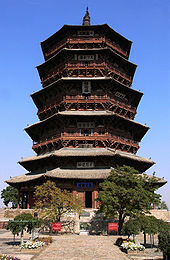
Though the founding emperor Abaoji ordered the construction of Buddhist, Confucian, and Taoist temples, successive emperors embraced Buddhism. A noticeable increase in devotion to Buddhism can be traced to the reign of Emperor Shengzong
Emperor Shengzong of Liao
Emperor Shengzong of Liao , born as Yelü Longxu , succeeded Emperor Jingzong as Emperor of the Liao Dynasty at the age of 12 in 982. As he was too young to actually rule, his mother, Empress Dowager Xiao, effectively ruled the kingdom...
. Within a century, local government offices report that there 360,000 monks and nuns in 1078, representing about ten percent of the population. Even if exaggerated, it is clear that Buddhism was an integral part of Liao life.
Literature
Very few relics of Khitan poems and literature are preserved, and much less texts or fragments in Khitan language. Because the Khitan language is not fully reconstructable, there are still many difficulties in understanding Khitan language documents.Although Khitan scripts were invented, the use of them was limited. Khitans, like ancient Vietnamese, Korean and Japanese people, also adopted Chinese characters as their writing system. They wrote a large part of the literature in Chinese, especially political documents. The Chinese official history book for the Liao Dynasty, Liao Shi
History of Liao
History of Liao, or Liao Shi is a Chinese historical book compiled officially in the Yuan Dynasty founded by the Mongols, under the direction of the great historian Tuotuo, and finalized in 1343...
, compiled in the Yuan Dynasty
Yuan Dynasty
The Yuan Dynasty , or Great Yuan Empire was a ruling dynasty founded by the Mongol leader Kublai Khan, who ruled most of present-day China, all of modern Mongolia and its surrounding areas, lasting officially from 1271 to 1368. It is considered both as a division of the Mongol Empire and as an...
, is based upon some earlier "veritable records" (shilu 實錄) compiled during the Liao period.