

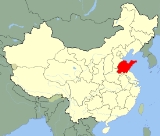
Shandong

Encyclopedia
is a Province
located on the eastern coast of the People's Republic of China
. Shandong has played a major role in Chinese history from the beginning of Chinese civilization along the lower reaches of the Yellow River
and served as a pivotal cultural and religious site for Taoism
, Chinese Buddhism
, and Confucianism
. Shandong's Mount Tai
is the most revered mountain of Taoism and one of the world's sites with the longest history of continuous religious worship. The Buddhist temples in the mountains to the south of the provincial capital of Jinan
were once among the foremost Buddhist sites in China. The city of Qufu
is the birthplace of Confucius
, and was later established as the center of Confucianism. Shandong's location at the intersection of ancient as well as modern north-south and east-west trading routes have helped to establish it as an economic center. After a period of political instability and economic hardship that began in the late 19th century, Shandong has emerged as one of the most populous (95,793,065 inhabitants at the 2010 Census) and most affluent provinces in the People's Republic of China (GDP of 3.94 trillion CNY in 2010).
. A common nickname for Shandong is Qílǔ , after the States of Qi and Lu that existed in the area during the Spring and Autumn Period. Whereas the State of Qi was a major power of its era, the State of Lu played only a minor role in the politics of its time. Lu, however, became renowned for being the home of Confucius
and hence its cultural influence came to eclipse that of the State of Qi. The cultural dominance of the State of Lu heritage is reflected in the official abbreviation for Shandong which is "鲁" .
and in the lower reaches of the Yellow River (Huang He) and extends out to sea in the form of the Shandong Peninsula. Shandong borders the Bohai Sea
to the north, Hebei
to the northwest, Henan
to the west, Jiangsu
to the south, and the Yellow Sea
to the southeast; it also shares a very short border with Anhui
, between Henan and Jiangsu.
, Shandong has felt the influence of Chinese civilization since remote antiquity. The earliest dynasties (the Shang dynasty
and Zhou dynasty
) exerted varying degrees of control over western Shandong, while eastern Shandong was inhabited by the Laiyi
peoples who were considered as the "barbarians". Over subsequent centuries, the Laiyi were eventually sinicized
.
During the Spring and Autumn Period (春秋时期) and the Warring States Period
(战国时期), regional states became increasingly powerful. At this time, Shandong was home to two powerful states: the state of Qi (齐国) at Linzi
and the state of Lu (鲁国) at Qufu
. Lu is noted for being the home of Confucius
. The state was, however, comparatively small, and eventually succumbed to the powerful state of Chu from the south. The state of Qi was, on the other hand, a major power throughout this entire period. Cities it ruled included Linzi
, Jimo
(north of modern Qingdao
) and Ju
.
The Qin Dynasty
destroyed Qi and founded the first centralized Chinese state in 221 BC. The Han Dynasty
that followed created two zhou
("provinces") in what is now modern Shandong: Qingzhou Province (青州) in the north and Yanzhou Province (兖州) in the south. During the division of the Three Kingdoms
Shandong belonged to the Kingdom of Wei, which ruled over northern China.
After the Three Kingdoms period, a brief period of unity under the Western Jin Dynasty gave way to invasions by nomadic peoples from the north. Northern China, including Shandong, was overrun. Over the next century or so Shandong changed hands several times, falling to the Later Zhao
, then Former Yan
, then Former Qin
, then Later Yan
, then Southern Yan
, then the Liu Song Dynasty
, and finally the Northern Wei Dynasty, the first of the Northern Dynasties during the Northern and Southern Dynasties Period. Shandong stayed with the Northern Dynasties for the rest of this period.
In 412, the Chinese Buddhist
monk Faxian
landed at Laoshan
, on the southern edge of the Shandong peninsula, and proceeded to Qingzhou
to edit and translate the scriptures he had brought back from India
.
The Sui Dynasty
reestablished unity in 589, and the Tang Dynasty
(618-907) presided over the next golden age of China. For the earlier part of this period Shandong was ruled as part of Henan Circuit, one of the circuits (a political division). Later on China splintered into warlord factions, resulting in the Five Dynasties and Ten Kingdoms period. Shandong was part of the Five Dynasties, all based in the north.
The Song Dynasty
reunified China in the late tenth century. In 1996, the discovery of over two hundred buried Buddhist statues at Qingzhou was hailed as a major archaeological
find. The statues included early examples of painted figures, and are thought to have been buried due to Emperor Huizong's Song Dynasty repression of Buddhism
(he favored Taoism
).
The Song Dynasty was forced to cede northern China to the Jurchen
Jin Dynasty in 1142. Shandong was administered by the Jin Dynasty as Shandong East Circuit and Shandong West Circuit — the first use of its current name.
The modern province of Shandong was created by the Ming Dynasty
. It also included much of modern-day Liaoning
(in south Manchuria
) at the time. However, the Manchu
s increasingly asserted independence, and managed to conquer all of China in 1644. Under the Qing Dynasty
, which they founded, Shandong acquired (more or less) its current borders.
 During the nineteenth century, China became increasingly exposed to Western influence, and Shandong, a coastal province, was especially affected. Qingdao
was leased to Germany
in 1897 and Weihai
to Britain
in 1898. The rest of Shandong was generally considered to be part of the German sphere of influence
. In addition, the Qing Dynasty
opened Manchuria
to Han Chinese
immigration during the 19th century; Shandong was the main source of the ensuing tide of migrants.
Shandong was one of the first places in which the Boxer Rebellion
started and became one of the centers of the uprising. In 1899, the Qing-Dynasty general Yuan Shikai
was appointed as governor of the province to suppress the uprising. He held the post for 3 years.
As a consequence of the First World War, Germany lost Qingdao
and its sphere of influence in Shandong. The Treaty of Versailles
transferred the German concessions in Shandong to Japan instead of restoring Chinese sovereignty over the area. Popular dissatisfaction with this outcome of the Treaty of Versailles (Shandong Problem
) led to the May Fourth Movement
. Finally, Shandong reverted to Chinese control in 1922 after mediation by the United States during the Washington Naval Conference
. Weihai
followed in 1930.
The return of control over Shandong fell into the Warlord era
of the Republic of China. Shandong was handed over the Zhili clique of warlords, but after the Second Zhili-Fengtian War
of 1924, the Manchuria-based Fengtian clique
took over. In April 1925, the Fengtian clique installed the warlord Zhang Zongchang
, nicknamed the "Dogmeat General", as military governor of Shandong Province. Time dubbed him China's "basest warlord". He ruled over the province until 1928, when he was ousted in the wake of the Northern Expedition.
He was succeeded by Han Fuju
, who was loyal to the warlord Feng Yuxiang
but later switched his allegiance to the Nanjing government headed by Chiang Kai-Shek
. Han Fuju also ousted the warlord Liu Zhennian
, nicknamed the "King of Shandong East", who ruled eastern Shandong Province, hence unifying the province under his rule.
In 1937 Japan
began its invasion of China proper in the Second Sino-Japanese War
, which would eventually become part of the Pacific theatre of the Second World War. Han Fuju was made Deputy Commander in Chief of the 5th War Area and put in charge defending the lower Yellow River valley. However, he abandoned his base in Jinan when the Japanese crossed the Yellow River. He was executed for not following orders shortly thereafter.
Shandong was occupied in its entirety by Japan, with resistance continuing in the countryside, and was one of the provinces where a scorched earth policy ("Three Alls Policy
": "kill all", "burn all", "loot all") was implemented by general Yasuji Okamura
. This lasted until the surrender of Japan in 1945.
By 1945, communist
forces already held some parts of Shandong. Over the next four years of the Chinese Civil War
, they expanded their holdings, eventually driving the Kuomintang
(government of the Republic of China
) entirely out of Shandong by June 1949. The People's Republic of China
was founded in October of the same year.
Under the new government, parts of western Shandong was initially given to the short-lived Pingyuan Province, but this did not last. Shandong also acquired the Xuzhou
and Lianyungang
areas from Jiangsu
province, but this did not last either. For the most part Shandong has kept the same borders that it has today.
In recent years Shandong, especially eastern Shandong, has enjoyed significant economic development, becoming one of the richest provinces of the People's Republic of China.
. Beginning in the Mesozoic, Shandong has undergone a crustal thinning that is unusual for a craton and that has reduced the thickness of the crust from 200 kilometers to as little as 80 kilometres. Shandong has hence experienced extensive volcanism in the Tertiary.
Some geological formations in Shandong are rich in fossils. For example, Zhucheng
, which is located in southeastern Shandong, has been the site of many discoveries of dinosaur fossils. A major find of 7,600 dinosaur bones that including tyrannosaurus
and ankylosaurus
remains and was announced in 2008, is believed to be the largest collection ever found.
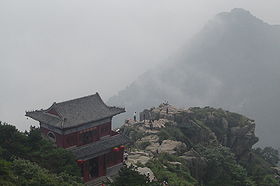 Shandong is mostly flat in terrain. The northwestern, western, and southwestern parts of the province are all part of the vast North China Plain
. The center of the province is more mountainous, with the Taishan Mountains
, Lushan Mountains, and Mengshan Mountains being the most prominent. The east of the province is the hilly Shandong Peninsula extending into the sea; it separates Bohai Sea
in the northwest from the Yellow Sea
to the east and south. The highest peak of Shandong is the highest peak in the Taishan area: Jade Emperor Peak, with a height of 1545 m.
The Yellow River
passes through Shandong's western areas, entering the sea along Shandong's northern coast; in its traversal of Shandong it flows on a levee
, higher than the surrounding land, and dividing western Shandong into the Hai He watershed in the north and the Huai He watershed in the south. The Grand Canal of China
enters Shandong from the northwest and leaves on the southwest. Weishan Lake is the largest lake of the province. Shandong's coastline is 3000 km long. Shandong Peninsula has a rocky coastline with cliffs, bays, and islands; the large Laizhou Bay
, the southernmost of the three bays of Bohai Sea
, is found to the north, between Dongying
and Penglai
; Jiaozhou Bay
, which is much smaller, is found to the south, next to Qingdao
. The Miaodao Islands extend northwards from the northern coast of the peninsula.
Shandong has a temperate climate, with moist summers and dry, cold winters. Average temperatures are -5 to 1°C
in January and 24 to 28°C in July. Annual precipitation is 550 to 950 mm.
With Jinan
serving as the province's economic and cultural centre, the province's economic prowess has led to the development of modern coastal cities located at Qingdao
, Weihai
, and Yantai
. In addition, Weifang
and Zaozhuang
are also upstart cities.
The Governor of Shandong is the highest ranking official in the People's Government of Shandong. However, in the province's dual party-government governing system, the Governor has less power than the Shandong Communist Party of China
Provincial Committee Secretary, colloquially termed the "Shandong CPC Party Chief".
and wheat
as well as precious metals such as gold
and diamond
s. It also has one of the biggest sapphire deposits in the world. Other important crops include sorghum
and maize
. Shandong has extensive petroleum
deposits as well, especially in the Dongying
area in the Yellow River
delta, where the Shengli Oilfield (lit. Victory Oilfield) is one of the major oilfields of China. Shandong also produces bromine
from underground wells and salt from sea water.
Shandong is one of the richer provinces of China, and its economic development focuses on large enterprises with well-known brand names. Shandong is the biggest industrial producer and one of the top manufacturing provinces in China. Shandong has also benefited from South Korea
n and Japan
ese investment and tourism, due to its geographical proximity to those countries. The richest part of the province is the Shandong Peninsula, where the city of Qingdao
is home to three of the most well-known brand names of China: Tsingtao
Beer
, Haier
and Hisense
. In addition, Dongying
's oil fields and petroleum industries form an important component of Shandong's economy. Despite the primacy of Shandong's energy sector, the province has also been plagued with problems of inefficiency and ranks as the largest consumer of fossil fuels in all of China.
In 2010, the nominal GDP for Shandong was 3.98 trillion yuan
(US$603 billion), ranking third in the country (behind Guangdong
and Jiangsu
). Its GDP per capita was 42,014 yuan (US$6,365), ranking eighth.
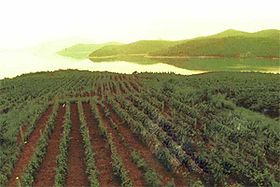 The production of wine is the second largest industry in the Shandong Province, second only to agriculture.
Geographically, the southern hills average an elevation
of 200 meters, while the coastal areas remain relatively flat. Most of the soil is loose, well-ventilated, and rich in minerals and organic matter
that enable full development of the root
systems.
Presently, there are more than 140 wineries in the region, mainly distributed in the Nanwang Grape Valley and along the Yan-Peng Sightseeing Highway. The region produced more than 40% of China's grape wine production. Main varieties such as Cabernet Sauvignon
, Cabernet Gernischt
, Merlot
, Riesling
and Chardonnay
are all at 20 years of age, considered to be the golden stage for these grapes. Most of them maintain an average saccharinity of above 20%.
Major producers
Founded in 1991, the Jinan High-tech Industrial Development zone was one of the first of its kind approved by the State Council. The zone is located to the east of the city and covers a total planning area of 83 square kilometers that is divided into a central area covering 33 square kilometers, an export processing district of 10 square kilometers, and an eastern extension area of 40 square kilometers.
Since its foundation, the Jinan High-tech Industrial Development Zone has attracted enterprises as LG, Panasonic, Volvo, and Sanyo. In 2000, it joined the world science and technology association and set up a China-Ukraine High-tech Cooperation Park. The Qilu Software Park became the sister park of Bangalore park of India.
The export processing zone is located in the eastern suburbs of Jinan, to the east of the Jinan High-tech Industrial Development Zone and to the north of the Jiwang highway. The distances to the Jiqing Highway and the Jinan Airport are 9 and 18 km respectively.
Approved by the State Council in October 1984, Qingdao Economic and Technical Development Zone has a planned of 12.5 square kilometers. In 2004 the local GDP is 27.51 billion RMB, increased by 28.9%; the total industrial output value is 60.6 billion RMB, increased by 31%. There have been 48 projects invested by companies listed among the Global Fortune 500 in the zone. With the fast development of reform and opening-up, Haier, Hisense, Aucma, Sinopec, CSIC, CNOOC, CIMC etc. all locate in the zone.
Qingdao Free Trade Zone was established by the State Council in 1992. The zone is 60 km away from Qingdao Liuting Airport. It is also close to Qingdao Qianwan Harbor. At present, more than 40 foreign-invested enterprises have moved in and 2000 projects have been approved. It is one of the special economic areas which enjoys the most favorable investment policies on customs, foreign exchange, foreign trade and taxation in China.
Qingdao High-Tech Industrial Development Zone was approved the State Council in 1992. The zone is located close to Qingdao Liuting Airport and Qingdao Harbor. Encouraged industries include electronic information, biotechnology, medicine, new materials, new energy, advanced equipment manufacturing, marine science & technology, national defense technology.
Established in August 1995, Weifang Binhai Economic & Technological Development Area (BEDA) is a national economic and technological development area approved by the State Council. Covering an area of 677 square kilometers, BEDA has a population of 100,000. BEDA possesses a large state-owned industrial land for use with an area of 400 square kilometers. The land can be transacted conveniently which would guarantee the demand of any project construction and provide broad development space for the enterprises in the area. Continuously, BEDA has been accredited as National Demonstration Zone invigorating the Sea by Science and Technology, National Innovation Base for Rejuvenating Trade through Science and Technology and National Demonstration Eco-Industry Park.
Weihai Economic and Technological Development Zone is a state-level development zone approved by the State Council on Oct 21, 1992. The administrative area has an area of 194km2, including the programmed area of 36km2 and an initial area of 11.88km2. Its nearest port is Weihai Port, and the airport closest to the zone is Wuhai Airport.
Weihai Export & Processing Zone (EPZ) was set up by the approval of the State Council on April 27, 2000. Weihai EPZ is located in Weihai Economic & Technological Development Zone with programmed area of 2.6 km2. Weihai EPZ belongs to comprehensive export & processing zone. The EPZ is located 30 km to Weihai Airport, 3 km to Weihai Railway Station and 4 km to Weihai Harbor.
Weihai Torch Hi-Tech Science Park is a state-level development zone approved by the State Council on March 1991. Located in Weihai's northwest zone of culture, education and science, the Park has the total area of 111.9 square kilometers, the coastal line of 30.5 kilometers and 150,000 residents. It is 3 kilometers away from the city center, 4 kilometers away from Weihai Port, 10 kilometers away from Weihai Railway Station, 30 kilometers away from Weihai Airport and 80 kilometers away from Yantai Airport.
Yantai Economic and Technological Development Area is one of the earliest approved state level economic development zones in China. It now has planned area of 10 square kilometers and a population of 115,000. It lies on the tip of the Shandong Peninsula facing the Huanghai Sea. It adjoins to downtown Yantai, merely 6 kilometers away from Yantai Port, 6 kilometers away from Yantai Railway Station, and a 30-minute drive to Yantai International Airport.
Yantai Export Processing Zone (YTEPZ) is one of the first 15 export processing zones approved by the State Council. The total construction area of YTEPZ is 4.17 m2, in which the initial zone covers 3 km2. After developing for several years, YTEPZ is completely constructed. At present, the infrastructure has been completed, standard workshops of 120,000 m2 and bonded warehouses of 40,000 m2 have been built up. Up to now, owning perfect investment environment and conditions, YTEPZ has attracted investors both from foreign countries and regions such as Japan, Korea, Singapore, Hong Kong, Taiwan, Sweden, USA, Canada, etc. and from the domestic to invest and operate in the zone.
and Henan
, with a population of over 95 million at the 2010 Census. Over 99% of Shandong's population is Han Chinese
. Minority groups include the Hui
and the Manchu
s. Shandong citizens are also known to have the highest average height of any Chinese province.
The seventeen prefecture-level divisions of Shandong are subdivided into 140 county-level divisions (49 districts, 31 county-level cities, and 60 counties). Those are in turn divided into 1941 township-level divisions (1223 towns, 293 townships, two ethnic townships, and 423 subdistrict
s).
See List of administrative divisions of Shandong for a complete list of county-level divisions.
), such as the Jinan dialect
; Zhongyuan Mandarin
spoken in the southwest (as well as in neighbouring Henan
); and Jiao Liao Mandarin spoken in the Shandong Peninsula (as well as the Liaodong Peninsula across the sea), such as the Qingdao dialect
. When people speak of the "Shandong dialect" (山東話), it is generally the first or the second that is meant; the Jiao Liao dialects of Shandong are commonly called the "Jiaodong dialect" (膠東話).
Shandong cuisine
(鲁菜) is one of the eight great traditions of Chinese cuisine
. It can be more finely divided into inland Shandong cuisine (e.g. Jinan cuisine); the seafood
-centered Jiaodong cuisine in the peninsula; and Confucius's Mansion cuisine, an elaborate tradition originally intended for imperial and other important feasts.
Shandong Bangzi and Lüju
are popular types of Chinese opera
in Shandong; both originated from southwestern Shandong.
(Beijing
-Kowloon
) and Jinghu Railway
(Beijing
-Shanghai
) are both major arterial railways that pass through the western part of Shandong. The Jingjiu passes through Liaocheng
and Heze
; the Jinghu passes through Dezhou
, Jinan
, Tai'an
, Yanzhou
(the Jinghu high-speed railway will through Qufu
). and Tengzhou
. The Jiaoji Railway
is an important railway of Shandong, linking its two largest cities of Qingdao
and Jinan
, with the longest history of all.
Shandong has one of the densest and highest quality expressway
networks among all Chinese provinces. At over 3000 km, the total length of Shandong's expressways is the highest among the provinces. The Jiqing Expressway (Jinan
-Qingdao
) and Jingfu Expressway (Beijing
-Fuzhou
, passing through Shandong) are all important arterial expressways.
The Shandong Peninsula, with its bays and harbours, has many important ports, including Qingdao
, Yantai
, Weihai
, Rizhao
, and Longkou
. Many of these ports have historical significance as well, as the sites of former foreign naval bases or historical battles. Ferries link the cities on the north coast of the peninsula with the Liaodong Peninsula, further north across the sea.
Important airports include Jinan Yaoqiang Airport
and Qingdao Liuting International Airport
.
Professional sports teams based in Shandong include:
Province (China)
A province, in the context of Chinese government, is a translation of sheng formally provincial level divisions, which is an administrative division. Provinces, municipalities, autonomous regions, and the special administrative regions, make up the four types of province of administrative division...
located on the eastern coast of the People's Republic of China
People's Republic of China
China , officially the People's Republic of China , is the most populous country in the world, with over 1.3 billion citizens. Located in East Asia, the country covers approximately 9.6 million square kilometres...
. Shandong has played a major role in Chinese history from the beginning of Chinese civilization along the lower reaches of the Yellow River
Yellow River
The Yellow River or Huang He, formerly known as the Hwang Ho, is the second-longest river in China and the sixth-longest in the world at the estimated length of . Originating in the Bayan Har Mountains in Qinghai Province in western China, it flows through nine provinces of China and empties into...
and served as a pivotal cultural and religious site for Taoism
Taoism
Taoism refers to a philosophical or religious tradition in which the basic concept is to establish harmony with the Tao , which is the mechanism of everything that exists...
, Chinese Buddhism
Buddhism
Buddhism is a religion and philosophy encompassing a variety of traditions, beliefs and practices, largely based on teachings attributed to Siddhartha Gautama, commonly known as the Buddha . The Buddha lived and taught in the northeastern Indian subcontinent some time between the 6th and 4th...
, and Confucianism
Confucianism
Confucianism is a Chinese ethical and philosophical system developed from the teachings of the Chinese philosopher Confucius . Confucianism originated as an "ethical-sociopolitical teaching" during the Spring and Autumn Period, but later developed metaphysical and cosmological elements in the Han...
. Shandong's Mount Tai
Mount Tai
Mount Tai is a mountain of historical and cultural significance located north of the city of Tai'an, in Shandong province, People's Republic of China. The tallest peak is the Jade Emperor Peak , which is commonly reported as tall, but is described by the PRC government as .Mount Tai is one of the...
is the most revered mountain of Taoism and one of the world's sites with the longest history of continuous religious worship. The Buddhist temples in the mountains to the south of the provincial capital of Jinan
Jinan
Jinan is the capital of Shandong province in Eastern China. The area of present-day Jinan has played an important role in the history of the region from the earliest beginnings of civilisation and has evolved into a major national administrative, economic, and transportation hub...
were once among the foremost Buddhist sites in China. The city of Qufu
Qufu
Qufu is a city in southwestern Shandong province, People's Republic of China. It is located at 35° 36′ northern latitude and 117° 02′ east, about south of the provincial capital Jinan and northeast of the prefecture seat at Jining...
is the birthplace of Confucius
Confucius
Confucius , literally "Master Kong", was a Chinese thinker and social philosopher of the Spring and Autumn Period....
, and was later established as the center of Confucianism. Shandong's location at the intersection of ancient as well as modern north-south and east-west trading routes have helped to establish it as an economic center. After a period of political instability and economic hardship that began in the late 19th century, Shandong has emerged as one of the most populous (95,793,065 inhabitants at the 2010 Census) and most affluent provinces in the People's Republic of China (GDP of 3.94 trillion CNY in 2010).
Name
Individually, the two Chinese characters in the name "Shandong" mean "mountain" (山) and "east" (东). Shandong could hence be translated literally as "east of the mountains" and refers to the province's location to the east of the Taihang MountainsTaihang Mountains
The Taihang Mountains are a Chinese mountain range running down the eastern edge of the Loess Plateau in Henan, Shanxi and Hebei provinces. The range extends over 400 km from north to south and has an average elevation of 1,500 to 2,000 meters. The principal peak is Xiao Wutaishan...
. A common nickname for Shandong is Qílǔ , after the States of Qi and Lu that existed in the area during the Spring and Autumn Period. Whereas the State of Qi was a major power of its era, the State of Lu played only a minor role in the politics of its time. Lu, however, became renowned for being the home of Confucius
Confucius
Confucius , literally "Master Kong", was a Chinese thinker and social philosopher of the Spring and Autumn Period....
and hence its cultural influence came to eclipse that of the State of Qi. The cultural dominance of the State of Lu heritage is reflected in the official abbreviation for Shandong which is "鲁" .
Location
The province is located on the eastern edge of the North China PlainNorth China Plain
The North China Plain is based on the deposits of the Yellow River and is the largest alluvial plain of eastern Asia. The plain is bordered on the north by the Yanshan Mountains and on the west by the Taihang Mountains edge of the Shanxi plateau. To the south, it merges into the Yangtze Plain...
and in the lower reaches of the Yellow River (Huang He) and extends out to sea in the form of the Shandong Peninsula. Shandong borders the Bohai Sea
Bohai Sea
Bohai Sea , also known as Bohai Gulf, Bohai, or Bo Hai, is the innermost gulf of the Yellow Sea on the coast of Northeastern and North China. It is approximately 78,000 km2 Bohai Sea , also known as Bohai Gulf, Bohai, or Bo Hai, is the innermost gulf of the Yellow Sea on the coast of...
to the north, Hebei
Hebei
' is a province of the People's Republic of China in the North China region. Its one-character abbreviation is "" , named after Ji Province, a Han Dynasty province that included what is now southern Hebei...
to the northwest, Henan
Henan
Henan , is a province of the People's Republic of China, located in the central part of the country. Its one-character abbreviation is "豫" , named after Yuzhou , a Han Dynasty state that included parts of Henan...
to the west, Jiangsu
Jiangsu
' is a province of the People's Republic of China, located along the east coast of the country. The name comes from jiang, short for the city of Jiangning , and su, for the city of Suzhou. The abbreviation for this province is "苏" , the second character of its name...
to the south, and the Yellow Sea
Yellow Sea
The Yellow Sea is the name given to the northern part of the East China Sea, which is a marginal sea of the Pacific Ocean. It is located between mainland China and the Korean Peninsula. Its name comes from the sand particles from Gobi Desert sand storms that turn the surface of the water golden...
to the southeast; it also shares a very short border with Anhui
Anhui
Anhui is a province in the People's Republic of China. Located in eastern China across the basins of the Yangtze River and the Huai River, it borders Jiangsu to the east, Zhejiang to the southeast, Jiangxi to the south, Hubei to the southwest, Henan to the northwest, and Shandong for a tiny...
, between Henan and Jiangsu.
History
With its location on the eastern edge of the North China PlainNorth China Plain
The North China Plain is based on the deposits of the Yellow River and is the largest alluvial plain of eastern Asia. The plain is bordered on the north by the Yanshan Mountains and on the west by the Taihang Mountains edge of the Shanxi plateau. To the south, it merges into the Yangtze Plain...
, Shandong has felt the influence of Chinese civilization since remote antiquity. The earliest dynasties (the Shang dynasty
Shang Dynasty
The Shang Dynasty or Yin Dynasty was, according to traditional sources, the second Chinese dynasty, after the Xia. They ruled in the northeastern regions of the area known as "China proper" in the Yellow River valley...
and Zhou dynasty
Zhou Dynasty
The Zhou Dynasty was a Chinese dynasty that followed the Shang Dynasty and preceded the Qin Dynasty. Although the Zhou Dynasty lasted longer than any other dynasty in Chinese history, the actual political and military control of China by the Ji family lasted only until 771 BC, a period known as...
) exerted varying degrees of control over western Shandong, while eastern Shandong was inhabited by the Laiyi
Dongyi
Dongyi was a collective term for people in eastern China and in lands located to the east of ancient China. People referred to as Dongyi vary across the ages.The early Dongyi culture was one of earliest neolithic cultures in China....
peoples who were considered as the "barbarians". Over subsequent centuries, the Laiyi were eventually sinicized
Sinicization
Sinicization, Sinicisation or Sinification, is the linguistic assimilation or cultural assimilation of terms and concepts of the language and culture of China...
.
During the Spring and Autumn Period (春秋时期) and the Warring States Period
Warring States Period
The Warring States Period , also known as the Era of Warring States, or the Warring Kingdoms period, covers the Iron Age period from about 475 BC to the reunification of China under the Qin Dynasty in 221 BC...
(战国时期), regional states became increasingly powerful. At this time, Shandong was home to two powerful states: the state of Qi (齐国) at Linzi
Linzi
Linzi was the capital of Qi from 859 BC to 221 BC during the Spring and Autumn Period and Warring States Period in China. The ruins of the city lie in modern day Linzi District, Shandong, China. The city was one of the largest and richest in China during the Spring and Autumn Period...
and the state of Lu (鲁国) at Qufu
Qufu
Qufu is a city in southwestern Shandong province, People's Republic of China. It is located at 35° 36′ northern latitude and 117° 02′ east, about south of the provincial capital Jinan and northeast of the prefecture seat at Jining...
. Lu is noted for being the home of Confucius
Confucius
Confucius , literally "Master Kong", was a Chinese thinker and social philosopher of the Spring and Autumn Period....
. The state was, however, comparatively small, and eventually succumbed to the powerful state of Chu from the south. The state of Qi was, on the other hand, a major power throughout this entire period. Cities it ruled included Linzi
Linzi
Linzi was the capital of Qi from 859 BC to 221 BC during the Spring and Autumn Period and Warring States Period in China. The ruins of the city lie in modern day Linzi District, Shandong, China. The city was one of the largest and richest in China during the Spring and Autumn Period...
, Jimo
Jimo, Shandong
Jimo is a county-level city in Shandong province, China, located north of Qingdao.-Location:Jimo is located in the southwest of the Shandong Peninsula, bordered by the Yellow Sea on the east and Mount Lao on the south.-Climate:...
(north of modern Qingdao
Qingdao
' also known in the West by its postal map spelling Tsingtao, is a major city with a population of over 8.715 million in eastern Shandong province, Eastern China. Its built up area, made of 7 urban districts plus Jimo city, is home to about 4,346,000 inhabitants in 2010.It borders Yantai to the...
) and Ju
Ju County
Ju County is a county of Rizhao City, Shandong Province, People's Republic of China.Ju County has a population of nearly 1.1016 million.The total area of 1952 square kilometers.-External links:*...
.
The Qin Dynasty
Qin Dynasty
The Qin Dynasty was the first imperial dynasty of China, lasting from 221 to 207 BC. The Qin state derived its name from its heartland of Qin, in modern-day Shaanxi. The strength of the Qin state was greatly increased by the legalist reforms of Shang Yang in the 4th century BC, during the Warring...
destroyed Qi and founded the first centralized Chinese state in 221 BC. The Han Dynasty
Han Dynasty
The Han Dynasty was the second imperial dynasty of China, preceded by the Qin Dynasty and succeeded by the Three Kingdoms . It was founded by the rebel leader Liu Bang, known posthumously as Emperor Gaozu of Han. It was briefly interrupted by the Xin Dynasty of the former regent Wang Mang...
that followed created two zhou
Zhou (political division)
Zhou were historical political divisions of China. Formally established during the Han Dynasty, zhou continued to exist until the establishment of the Republic of China — a period of over 2000 years...
("provinces") in what is now modern Shandong: Qingzhou Province (青州) in the north and Yanzhou Province (兖州) in the south. During the division of the Three Kingdoms
Three Kingdoms
The Three Kingdoms period was a period in Chinese history, part of an era of disunity called the "Six Dynasties" following immediately the loss of de facto power of the Han Dynasty rulers. In a strict academic sense it refers to the period between the foundation of the state of Wei in 220 and the...
Shandong belonged to the Kingdom of Wei, which ruled over northern China.
After the Three Kingdoms period, a brief period of unity under the Western Jin Dynasty gave way to invasions by nomadic peoples from the north. Northern China, including Shandong, was overrun. Over the next century or so Shandong changed hands several times, falling to the Later Zhao
Later Zhao
The Later Zhao was a state of the Sixteen Kingdoms during the Jin Dynasty in China. It was founded by the Shi family of the Jie ethnicity...
, then Former Yan
Former Yan
The Former Yan was a state of Xianbei ethnicity during the era of Sixteen Kingdoms in China.Initially, Murong Huang and his son Murong Jun claimed the Jin Dynasty -created title "Prince of Yan," but subsequently, in 352, after seizing most of the former Later Zhao territory, Murong Juan would...
, then Former Qin
Former Qin
The Former Qin was a state of the Sixteen Kingdoms in China. Founded by the Fu family of the Di ethnicity, it completed the unification of North China in 376. Its capital had been Xi'an up to the death of the ruler Fu Jiān. Despite its name, the Former Qin was much later and less powerful than...
, then Later Yan
Later Yan
The Later Yan was a Murong-Xianbei state, located in modern day northeast China, during the era of Sixteen Kingdoms in China.All rulers of the Later Yan declared themselves "emperors". Later Yan fell to the Goguryeo dynasty.-Rulers of the Later Yan:...
, then Southern Yan
Southern Yan
The Southern Yan was a state of Xianbei ethnicity during the era of Sixteen Kingdoms in China. Its territory roughly coincided with modern Shandong...
, then the Liu Song Dynasty
Liu Song Dynasty
The Liu Song Dynasty , also known as Song Dynasty , Former Song , or Southern Song , was first of the four Southern Dynasties in China, succeeding the Eastern Jin Dynasty and followed by the Southern Qi Dynasty....
, and finally the Northern Wei Dynasty, the first of the Northern Dynasties during the Northern and Southern Dynasties Period. Shandong stayed with the Northern Dynasties for the rest of this period.
In 412, the Chinese Buddhist
Buddhism
Buddhism is a religion and philosophy encompassing a variety of traditions, beliefs and practices, largely based on teachings attributed to Siddhartha Gautama, commonly known as the Buddha . The Buddha lived and taught in the northeastern Indian subcontinent some time between the 6th and 4th...
monk Faxian
Faxian
Faxian was a Chinese Buddhist monk who traveled to India, Sri Lanka and Kapilavastu in today's Nepal between 399 and 412 to acquire Buddhist scriptures...
landed at Laoshan
Laoshan District
-Laoshan District:Laoshan District is an administrative division of Qingdao. Its area is 389 km².-Geography:Laoshan District is located in the south of Shandong Peninsula, facing the Yellow Sea in the east and south. It covers 389.34square kilometer with 103.7km coastline.The district belongs to...
, on the southern edge of the Shandong peninsula, and proceeded to Qingzhou
Qingzhou
Qingzhou , formerly Yidu County , is a county-level city, which is located in the west of Weifang City, Shandong Province, China. Qingzhou is a dynamic industry city, and also grows a great number of farm products...
to edit and translate the scriptures he had brought back from India
India
India , officially the Republic of India , is a country in South Asia. It is the seventh-largest country by geographical area, the second-most populous country with over 1.2 billion people, and the most populous democracy in the world...
.
The Sui Dynasty
Sui Dynasty
The Sui Dynasty was a powerful, but short-lived Imperial Chinese dynasty. Preceded by the Southern and Northern Dynasties, it ended nearly four centuries of division between rival regimes. It was followed by the Tang Dynasty....
reestablished unity in 589, and the Tang Dynasty
Tang Dynasty
The Tang Dynasty was an imperial dynasty of China preceded by the Sui Dynasty and followed by the Five Dynasties and Ten Kingdoms Period. It was founded by the Li family, who seized power during the decline and collapse of the Sui Empire...
(618-907) presided over the next golden age of China. For the earlier part of this period Shandong was ruled as part of Henan Circuit, one of the circuits (a political division). Later on China splintered into warlord factions, resulting in the Five Dynasties and Ten Kingdoms period. Shandong was part of the Five Dynasties, all based in the north.
The Song Dynasty
Song Dynasty
The Song Dynasty was a ruling dynasty in China between 960 and 1279; it succeeded the Five Dynasties and Ten Kingdoms Period, and was followed by the Yuan Dynasty. It was the first government in world history to issue banknotes or paper money, and the first Chinese government to establish a...
reunified China in the late tenth century. In 1996, the discovery of over two hundred buried Buddhist statues at Qingzhou was hailed as a major archaeological
Archaeology
Archaeology, or archeology , is the study of human society, primarily through the recovery and analysis of the material culture and environmental data that they have left behind, which includes artifacts, architecture, biofacts and cultural landscapes...
find. The statues included early examples of painted figures, and are thought to have been buried due to Emperor Huizong's Song Dynasty repression of Buddhism
Buddhism
Buddhism is a religion and philosophy encompassing a variety of traditions, beliefs and practices, largely based on teachings attributed to Siddhartha Gautama, commonly known as the Buddha . The Buddha lived and taught in the northeastern Indian subcontinent some time between the 6th and 4th...
(he favored Taoism
Taoism
Taoism refers to a philosophical or religious tradition in which the basic concept is to establish harmony with the Tao , which is the mechanism of everything that exists...
).
The Song Dynasty was forced to cede northern China to the Jurchen
Jurchens
The Jurchens were a Tungusic people who inhabited the region of Manchuria until the 17th century, when they adopted the name Manchu...
Jin Dynasty in 1142. Shandong was administered by the Jin Dynasty as Shandong East Circuit and Shandong West Circuit — the first use of its current name.
The modern province of Shandong was created by the Ming Dynasty
Ming Dynasty
The Ming Dynasty, also Empire of the Great Ming, was the ruling dynasty of China from 1368 to 1644, following the collapse of the Mongol-led Yuan Dynasty. The Ming, "one of the greatest eras of orderly government and social stability in human history", was the last dynasty in China ruled by ethnic...
. It also included much of modern-day Liaoning
Liaoning
' is a province of the People's Republic of China, located in the northeast of the country. Its one-character abbreviation is "辽" , a name taken from the Liao River that flows through the province. "Níng" means "peace"...
(in south Manchuria
Manchuria
Manchuria is a historical name given to a large geographic region in northeast Asia. Depending on the definition of its extent, Manchuria usually falls entirely within the People's Republic of China, or is sometimes divided between China and Russia. The region is commonly referred to as Northeast...
) at the time. However, the Manchu
Manchu
The Manchu people or Man are an ethnic minority of China who originated in Manchuria . During their rise in the 17th century, with the help of the Ming dynasty rebels , they came to power in China and founded the Qing Dynasty, which ruled China until the Xinhai Revolution of 1911, which...
s increasingly asserted independence, and managed to conquer all of China in 1644. Under the Qing Dynasty
Qing Dynasty
The Qing Dynasty was the last dynasty of China, ruling from 1644 to 1912 with a brief, abortive restoration in 1917. It was preceded by the Ming Dynasty and followed by the Republic of China....
, which they founded, Shandong acquired (more or less) its current borders.
Qingdao
' also known in the West by its postal map spelling Tsingtao, is a major city with a population of over 8.715 million in eastern Shandong province, Eastern China. Its built up area, made of 7 urban districts plus Jimo city, is home to about 4,346,000 inhabitants in 2010.It borders Yantai to the...
was leased to Germany
Germany
Germany , officially the Federal Republic of Germany , is a federal parliamentary republic in Europe. The country consists of 16 states while the capital and largest city is Berlin. Germany covers an area of 357,021 km2 and has a largely temperate seasonal climate...
in 1897 and Weihai
Weihai
Weihai is a city in eastern Shandong Province, People's Republic of China. It is the easternmost prefecture-level city of the province and a major seaport. Between 1898 and 1930, the town was a British colony known as Weihaiwei or the Weihai Garrison , and sometimes as Port Edward...
to Britain
United Kingdom
The United Kingdom of Great Britain and Northern IrelandIn the United Kingdom and Dependencies, other languages have been officially recognised as legitimate autochthonous languages under the European Charter for Regional or Minority Languages...
in 1898. The rest of Shandong was generally considered to be part of the German sphere of influence
Sphere of influence
In the field of international relations, a sphere of influence is a spatial region or conceptual division over which a state or organization has significant cultural, economic, military or political influence....
. In addition, the Qing Dynasty
Qing Dynasty
The Qing Dynasty was the last dynasty of China, ruling from 1644 to 1912 with a brief, abortive restoration in 1917. It was preceded by the Ming Dynasty and followed by the Republic of China....
opened Manchuria
Manchuria
Manchuria is a historical name given to a large geographic region in northeast Asia. Depending on the definition of its extent, Manchuria usually falls entirely within the People's Republic of China, or is sometimes divided between China and Russia. The region is commonly referred to as Northeast...
to Han Chinese
Han Chinese
Han Chinese are an ethnic group native to China and are the largest single ethnic group in the world.Han Chinese constitute about 92% of the population of the People's Republic of China , 98% of the population of the Republic of China , 78% of the population of Singapore, and about 20% of the...
immigration during the 19th century; Shandong was the main source of the ensuing tide of migrants.
Shandong was one of the first places in which the Boxer Rebellion
Boxer Rebellion
The Boxer Rebellion, also called the Boxer Uprising by some historians or the Righteous Harmony Society Movement in northern China, was a proto-nationalist movement by the "Righteous Harmony Society" , or "Righteous Fists of Harmony" or "Society of Righteous and Harmonious Fists" , in China between...
started and became one of the centers of the uprising. In 1899, the Qing-Dynasty general Yuan Shikai
Yuan Shikai
Yuan Shikai was an important Chinese general and politician famous for his influence during the late Qing Dynasty, his role in the events leading up to the abdication of the last Qing Emperor of China, his autocratic rule as the second President of the Republic of China , and his short-lived...
was appointed as governor of the province to suppress the uprising. He held the post for 3 years.
As a consequence of the First World War, Germany lost Qingdao
Qingdao
' also known in the West by its postal map spelling Tsingtao, is a major city with a population of over 8.715 million in eastern Shandong province, Eastern China. Its built up area, made of 7 urban districts plus Jimo city, is home to about 4,346,000 inhabitants in 2010.It borders Yantai to the...
and its sphere of influence in Shandong. The Treaty of Versailles
Treaty of Versailles
The Treaty of Versailles was one of the peace treaties at the end of World War I. It ended the state of war between Germany and the Allied Powers. It was signed on 28 June 1919, exactly five years after the assassination of Archduke Franz Ferdinand. The other Central Powers on the German side of...
transferred the German concessions in Shandong to Japan instead of restoring Chinese sovereignty over the area. Popular dissatisfaction with this outcome of the Treaty of Versailles (Shandong Problem
Shandong Problem
The Shantung Problem refers to the dispute over Article 156 of the Treaty of Versailles in 1919, which dealt with the concession of the Shandong peninsula....
) led to the May Fourth Movement
May Fourth Movement
The May Fourth Movement was an anti-imperialist, cultural, and political movement growing out of student demonstrations in Beijing on May 4, 1919, protesting the Chinese government's weak response to the Treaty of Versailles, especially the Shandong Problem...
. Finally, Shandong reverted to Chinese control in 1922 after mediation by the United States during the Washington Naval Conference
Washington Naval Conference
The Washington Naval Conference also called the Washington Arms Conference, was a military conference called by President Warren G. Harding and held in Washington from 12 November 1921 to 6 February 1922. Conducted outside the auspices of the League of Nations, it was attended by nine nations...
. Weihai
Weihai
Weihai is a city in eastern Shandong Province, People's Republic of China. It is the easternmost prefecture-level city of the province and a major seaport. Between 1898 and 1930, the town was a British colony known as Weihaiwei or the Weihai Garrison , and sometimes as Port Edward...
followed in 1930.
The return of control over Shandong fell into the Warlord era
Warlord era
The Chinese Warlord Era was the period in the history of the Republic of China, from 1916 to 1928, when the country was divided among military cliques, a division that continued until the fall of the Nationalist government in the mainland China regions of Sichuan, Shanxi, Qinghai, Ningxia,...
of the Republic of China. Shandong was handed over the Zhili clique of warlords, but after the Second Zhili-Fengtian War
Second Zhili-Fengtian War
The Second Zhili–Fengtian War of 1924 was a conflict between the Japanese-backed Fengtian clique based in Manchuria, and the more liberal Zhili clique controlling Beijing and backed by Anglo-American business interests...
of 1924, the Manchuria-based Fengtian clique
Fengtian clique
The Fengtian Clique was one of several mutually hostile cliques or factions that split from the Beiyang Clique in the Republic of China's warlord era. It was named for Fengtian Province and led by Zhang Zuolin...
took over. In April 1925, the Fengtian clique installed the warlord Zhang Zongchang
Zhang Zongchang
Zhang Zongchang , nicknamed the "Dogmeat General" and "72-Cannon Chang" , was a Chinese warlord in Shandong in the early 20th century...
, nicknamed the "Dogmeat General", as military governor of Shandong Province. Time dubbed him China's "basest warlord". He ruled over the province until 1928, when he was ousted in the wake of the Northern Expedition.
He was succeeded by Han Fuju
Han Fuju
Han Fuju or Han Fu-chü was a Kuomintang general in the early 20th century. He rose up the ranks of the Guominjun clique in the Warlord era but then went over to the Kuomintang, and held the position of military governor of Shandong from 1930 to 1938...
, who was loyal to the warlord Feng Yuxiang
Feng Yuxiang
Feng Yuxiang was a warlord and leader in Republican China. He was also known as the Christian General for his zeal to convert his troops and the Betrayal General for his penchant to break with the establishment. In 1911, he was an officer in the ranks of Yuan Shikai's Beiyang Army but joined...
but later switched his allegiance to the Nanjing government headed by Chiang Kai-Shek
Chiang Kai-shek
Chiang Kai-shek was a political and military leader of 20th century China. He is known as Jiǎng Jièshí or Jiǎng Zhōngzhèng in Mandarin....
. Han Fuju also ousted the warlord Liu Zhennian
Liu Zhennian
Liu Zhennian was a Chinese military commander during the Warlord Era and Nanjing decade in the history of the Republic of China....
, nicknamed the "King of Shandong East", who ruled eastern Shandong Province, hence unifying the province under his rule.
In 1937 Japan
Japan
Japan is an island nation in East Asia. Located in the Pacific Ocean, it lies to the east of the Sea of Japan, China, North Korea, South Korea and Russia, stretching from the Sea of Okhotsk in the north to the East China Sea and Taiwan in the south...
began its invasion of China proper in the Second Sino-Japanese War
Second Sino-Japanese War
The Second Sino-Japanese War was a military conflict fought primarily between the Republic of China and the Empire of Japan. From 1937 to 1941, China fought Japan with some economic help from Germany , the Soviet Union and the United States...
, which would eventually become part of the Pacific theatre of the Second World War. Han Fuju was made Deputy Commander in Chief of the 5th War Area and put in charge defending the lower Yellow River valley. However, he abandoned his base in Jinan when the Japanese crossed the Yellow River. He was executed for not following orders shortly thereafter.
Shandong was occupied in its entirety by Japan, with resistance continuing in the countryside, and was one of the provinces where a scorched earth policy ("Three Alls Policy
Three Alls Policy
The Three Alls Policy was a Japanese scorched earth policy adopted in China during World War II, the three alls being: "Kill All", "Burn All" and "Loot All" . In Japanese documents, the policy was originally referred to as...
": "kill all", "burn all", "loot all") was implemented by general Yasuji Okamura
Yasuji Okamura
- Notes :...
. This lasted until the surrender of Japan in 1945.
By 1945, communist
Communist Party of China
The Communist Party of China , also known as the Chinese Communist Party , is the founding and ruling political party of the People's Republic of China...
forces already held some parts of Shandong. Over the next four years of the Chinese Civil War
Chinese Civil War
The Chinese Civil War was a civil war fought between the Kuomintang , the governing party of the Republic of China, and the Communist Party of China , for the control of China which eventually led to China's division into two Chinas, Republic of China and People's Republic of...
, they expanded their holdings, eventually driving the Kuomintang
Kuomintang
The Kuomintang of China , sometimes romanized as Guomindang via the Pinyin transcription system or GMD for short, and translated as the Chinese Nationalist Party is a founding and ruling political party of the Republic of China . Its guiding ideology is the Three Principles of the People, espoused...
(government of the Republic of China
Republic of China
The Republic of China , commonly known as Taiwan , is a unitary sovereign state located in East Asia. Originally based in mainland China, the Republic of China currently governs the island of Taiwan , which forms over 99% of its current territory, as well as Penghu, Kinmen, Matsu and other minor...
) entirely out of Shandong by June 1949. The People's Republic of China
People's Republic of China
China , officially the People's Republic of China , is the most populous country in the world, with over 1.3 billion citizens. Located in East Asia, the country covers approximately 9.6 million square kilometres...
was founded in October of the same year.
Under the new government, parts of western Shandong was initially given to the short-lived Pingyuan Province, but this did not last. Shandong also acquired the Xuzhou
Xuzhou
Xuzhou , otherwise known as Pengcheng in ancient times, is a major city in and the fourth largest prefecture-level city of Jiangsu province, People's Republic of China...
and Lianyungang
Lianyungang
Lianyungang is a prefecture-level city in northeastern Jiangsu province, People's Republic of China. It borders Yancheng to its southeast, Huai'an and Suqian to its south, Xuzhou to its southwest, and the province of Shandong to its north...
areas from Jiangsu
Jiangsu
' is a province of the People's Republic of China, located along the east coast of the country. The name comes from jiang, short for the city of Jiangning , and su, for the city of Suzhou. The abbreviation for this province is "苏" , the second character of its name...
province, but this did not last either. For the most part Shandong has kept the same borders that it has today.
In recent years Shandong, especially eastern Shandong, has enjoyed significant economic development, becoming one of the richest provinces of the People's Republic of China.
Geology
Shandong is part of the Eastern Block of the North China cratonNorth China craton
The North China Craton is one of the smaller continental cratons of the Earth. It covers a total area of around 1.7 million square kilometres in the northeast of China, most of Korea and the southern part of Mongolia, and has a shape quite akin to a funnel, with a long east-west axis in the...
. Beginning in the Mesozoic, Shandong has undergone a crustal thinning that is unusual for a craton and that has reduced the thickness of the crust from 200 kilometers to as little as 80 kilometres. Shandong has hence experienced extensive volcanism in the Tertiary.
Some geological formations in Shandong are rich in fossils. For example, Zhucheng
Zhucheng
Zhucheng is a county-level city in the southeast of Shandong province, People's Republic of China. It is under the administration of Weifang City and has a population of 1.06 million.-History:Zhucheng was originally known as Langya...
, which is located in southeastern Shandong, has been the site of many discoveries of dinosaur fossils. A major find of 7,600 dinosaur bones that including tyrannosaurus
Tyrannosaurus
Tyrannosaurus meaning "tyrant," and sauros meaning "lizard") is a genus of coelurosaurian theropod dinosaur. The species Tyrannosaurus rex , commonly abbreviated to T. rex, is a fixture in popular culture. It lived throughout what is now western North America, with a much wider range than other...
and ankylosaurus
Ankylosaurus
Ankylosaurus is a genus of ankylosaurid dinosaur, containing one species, A. magniventris...
remains and was announced in 2008, is believed to be the largest collection ever found.
Geography
North China Plain
The North China Plain is based on the deposits of the Yellow River and is the largest alluvial plain of eastern Asia. The plain is bordered on the north by the Yanshan Mountains and on the west by the Taihang Mountains edge of the Shanxi plateau. To the south, it merges into the Yangtze Plain...
. The center of the province is more mountainous, with the Taishan Mountains
Mount Tai
Mount Tai is a mountain of historical and cultural significance located north of the city of Tai'an, in Shandong province, People's Republic of China. The tallest peak is the Jade Emperor Peak , which is commonly reported as tall, but is described by the PRC government as .Mount Tai is one of the...
, Lushan Mountains, and Mengshan Mountains being the most prominent. The east of the province is the hilly Shandong Peninsula extending into the sea; it separates Bohai Sea
Bohai Sea
Bohai Sea , also known as Bohai Gulf, Bohai, or Bo Hai, is the innermost gulf of the Yellow Sea on the coast of Northeastern and North China. It is approximately 78,000 km2 Bohai Sea , also known as Bohai Gulf, Bohai, or Bo Hai, is the innermost gulf of the Yellow Sea on the coast of...
in the northwest from the Yellow Sea
Yellow Sea
The Yellow Sea is the name given to the northern part of the East China Sea, which is a marginal sea of the Pacific Ocean. It is located between mainland China and the Korean Peninsula. Its name comes from the sand particles from Gobi Desert sand storms that turn the surface of the water golden...
to the east and south. The highest peak of Shandong is the highest peak in the Taishan area: Jade Emperor Peak, with a height of 1545 m.
The Yellow River
Yellow River
The Yellow River or Huang He, formerly known as the Hwang Ho, is the second-longest river in China and the sixth-longest in the world at the estimated length of . Originating in the Bayan Har Mountains in Qinghai Province in western China, it flows through nine provinces of China and empties into...
passes through Shandong's western areas, entering the sea along Shandong's northern coast; in its traversal of Shandong it flows on a levee
Levee
A levee, levée, dike , embankment, floodbank or stopbank is an elongated naturally occurring ridge or artificially constructed fill or wall, which regulates water levels...
, higher than the surrounding land, and dividing western Shandong into the Hai He watershed in the north and the Huai He watershed in the south. The Grand Canal of China
Grand Canal of China
The Grand Canal in China, also known as the Beijing-Hangzhou Grand Canal is the longest canal or artificial river in the world. Starting at Beijing, it passes through Tianjin and the provinces of Hebei, Shandong, Jiangsu and Zhejiang to the city of Hangzhou...
enters Shandong from the northwest and leaves on the southwest. Weishan Lake is the largest lake of the province. Shandong's coastline is 3000 km long. Shandong Peninsula has a rocky coastline with cliffs, bays, and islands; the large Laizhou Bay
Laizhou Bay
Laizhou Bay is the southern arm of the Bohai Sea , which is a large relatively shallow extension of Korea Bay behind the Liaodong Peninsula to the north, and the Shandong Peninsula to the south...
, the southernmost of the three bays of Bohai Sea
Bohai Sea
Bohai Sea , also known as Bohai Gulf, Bohai, or Bo Hai, is the innermost gulf of the Yellow Sea on the coast of Northeastern and North China. It is approximately 78,000 km2 Bohai Sea , also known as Bohai Gulf, Bohai, or Bo Hai, is the innermost gulf of the Yellow Sea on the coast of...
, is found to the north, between Dongying
Dongying
Dongying is a prefecture-level city on the northern coast of Shandong province in Eastern China. Located around the mouth of the Yellow River, Dongying borders Binzhou to the west, Zibo to the southwest, and Weifang to the south...
and Penglai
Penglai City
Penglai City , is a port, a town and an administrative subdivision of the prefecture-level city Yantai in Shandong Province, northeastern China. The port was formerly called Dengzhou . Penglai Water City or Water Fortress , a fortified harbor hidden from the sea, is one of China's oldest military...
; Jiaozhou Bay
Jiaozhou Bay
The Jiaozhou Bay is a sea gulf located in Qingdao Prefecture of Shandong Province. It was a German colonial concession from 1898 until 1914....
, which is much smaller, is found to the south, next to Qingdao
Qingdao
' also known in the West by its postal map spelling Tsingtao, is a major city with a population of over 8.715 million in eastern Shandong province, Eastern China. Its built up area, made of 7 urban districts plus Jimo city, is home to about 4,346,000 inhabitants in 2010.It borders Yantai to the...
. The Miaodao Islands extend northwards from the northern coast of the peninsula.
Shandong has a temperate climate, with moist summers and dry, cold winters. Average temperatures are -5 to 1°C
Celsius
Celsius is a scale and unit of measurement for temperature. It is named after the Swedish astronomer Anders Celsius , who developed a similar temperature scale two years before his death...
in January and 24 to 28°C in July. Annual precipitation is 550 to 950 mm.
With Jinan
Jinan
Jinan is the capital of Shandong province in Eastern China. The area of present-day Jinan has played an important role in the history of the region from the earliest beginnings of civilisation and has evolved into a major national administrative, economic, and transportation hub...
serving as the province's economic and cultural centre, the province's economic prowess has led to the development of modern coastal cities located at Qingdao
Qingdao
' also known in the West by its postal map spelling Tsingtao, is a major city with a population of over 8.715 million in eastern Shandong province, Eastern China. Its built up area, made of 7 urban districts plus Jimo city, is home to about 4,346,000 inhabitants in 2010.It borders Yantai to the...
, Weihai
Weihai
Weihai is a city in eastern Shandong Province, People's Republic of China. It is the easternmost prefecture-level city of the province and a major seaport. Between 1898 and 1930, the town was a British colony known as Weihaiwei or the Weihai Garrison , and sometimes as Port Edward...
, and Yantai
Yantai
Yantai is a prefecture-level city in northeastern Shandong province, People's Republic of China. Located on the southern coast of the Bohai Sea and the eastern coast of the Laizhou Bay, Yantai borders the cities of Qingdao and Weihai to the southwest and east respectively.The largest fishing...
. In addition, Weifang
Weifang
Weifang is a prefecture-level city in central Shandong province, People's Republic of China. It borders Dongying to the northwest, Zibo to the west, Linyi to the southwest, Rizhao to the south, Qingdao to the east, and looks out to the Laizhou Bay to the north.-History:Weifang is a historical city...
and Zaozhuang
Zaozhuang
Zaozhuang is a prefecture-level city in the south of Shandong province in Eastern China. The second smallest prefecture-level city in the province, it borders Jining to the west and north, Linyi to the east, and the province of Jiangsu to the south....
are also upstart cities.
Politics
The politics of Shandong is structured in a dual party-government system like all other governing institutions in mainland China.The Governor of Shandong is the highest ranking official in the People's Government of Shandong. However, in the province's dual party-government governing system, the Governor has less power than the Shandong Communist Party of China
Communist Party of China
The Communist Party of China , also known as the Chinese Communist Party , is the founding and ruling political party of the People's Republic of China...
Provincial Committee Secretary, colloquially termed the "Shandong CPC Party Chief".
Economy
Shandong ranks first among the provinces in the production of a variety of products, including cottonCotton
Cotton is a soft, fluffy staple fiber that grows in a boll, or protective capsule, around the seeds of cotton plants of the genus Gossypium. The fiber is almost pure cellulose. The botanical purpose of cotton fiber is to aid in seed dispersal....
and wheat
Wheat
Wheat is a cereal grain, originally from the Levant region of the Near East, but now cultivated worldwide. In 2007 world production of wheat was 607 million tons, making it the third most-produced cereal after maize and rice...
as well as precious metals such as gold
Gold
Gold is a chemical element with the symbol Au and an atomic number of 79. Gold is a dense, soft, shiny, malleable and ductile metal. Pure gold has a bright yellow color and luster traditionally considered attractive, which it maintains without oxidizing in air or water. Chemically, gold is a...
and diamond
Diamond
In mineralogy, diamond is an allotrope of carbon, where the carbon atoms are arranged in a variation of the face-centered cubic crystal structure called a diamond lattice. Diamond is less stable than graphite, but the conversion rate from diamond to graphite is negligible at ambient conditions...
s. It also has one of the biggest sapphire deposits in the world. Other important crops include sorghum
Sorghum
Sorghum is a genus of numerous species of grasses, one of which is raised for grain and many of which are used as fodder plants either cultivated or as part of pasture. The plants are cultivated in warmer climates worldwide. Species are native to tropical and subtropical regions of all continents...
and maize
Maize
Maize known in many English-speaking countries as corn or mielie/mealie, is a grain domesticated by indigenous peoples in Mesoamerica in prehistoric times. The leafy stalk produces ears which contain seeds called kernels. Though technically a grain, maize kernels are used in cooking as a vegetable...
. Shandong has extensive petroleum
Petroleum
Petroleum or crude oil is a naturally occurring, flammable liquid consisting of a complex mixture of hydrocarbons of various molecular weights and other liquid organic compounds, that are found in geologic formations beneath the Earth's surface. Petroleum is recovered mostly through oil drilling...
deposits as well, especially in the Dongying
Dongying
Dongying is a prefecture-level city on the northern coast of Shandong province in Eastern China. Located around the mouth of the Yellow River, Dongying borders Binzhou to the west, Zibo to the southwest, and Weifang to the south...
area in the Yellow River
Yellow River
The Yellow River or Huang He, formerly known as the Hwang Ho, is the second-longest river in China and the sixth-longest in the world at the estimated length of . Originating in the Bayan Har Mountains in Qinghai Province in western China, it flows through nine provinces of China and empties into...
delta, where the Shengli Oilfield (lit. Victory Oilfield) is one of the major oilfields of China. Shandong also produces bromine
Bromine
Bromine ") is a chemical element with the symbol Br, an atomic number of 35, and an atomic mass of 79.904. It is in the halogen element group. The element was isolated independently by two chemists, Carl Jacob Löwig and Antoine Jerome Balard, in 1825–1826...
from underground wells and salt from sea water.
Shandong is one of the richer provinces of China, and its economic development focuses on large enterprises with well-known brand names. Shandong is the biggest industrial producer and one of the top manufacturing provinces in China. Shandong has also benefited from South Korea
South Korea
The Republic of Korea , , is a sovereign state in East Asia, located on the southern portion of the Korean Peninsula. It is neighbored by the People's Republic of China to the west, Japan to the east, North Korea to the north, and the East China Sea and Republic of China to the south...
n and Japan
Japan
Japan is an island nation in East Asia. Located in the Pacific Ocean, it lies to the east of the Sea of Japan, China, North Korea, South Korea and Russia, stretching from the Sea of Okhotsk in the north to the East China Sea and Taiwan in the south...
ese investment and tourism, due to its geographical proximity to those countries. The richest part of the province is the Shandong Peninsula, where the city of Qingdao
Qingdao
' also known in the West by its postal map spelling Tsingtao, is a major city with a population of over 8.715 million in eastern Shandong province, Eastern China. Its built up area, made of 7 urban districts plus Jimo city, is home to about 4,346,000 inhabitants in 2010.It borders Yantai to the...
is home to three of the most well-known brand names of China: Tsingtao
Tsingtao Brewery
Tsingtao Brewery Co.,Ltd. is China's second largest brewery. It was founded in 1903 by German settlers and now claims about 15% of domestic market share. The beer is produced in Tsingtao/Qingdao in Shandong province , but the name of the beer uses the old École française d'Extrême-Orient...
Beer
Beer
Beer is the world's most widely consumed andprobably oldest alcoholic beverage; it is the third most popular drink overall, after water and tea. It is produced by the brewing and fermentation of sugars, mainly derived from malted cereal grains, most commonly malted barley and malted wheat...
, Haier
Haier
Haier Group is a multinational consumer electronics and home appliances company headquartered in Qingdao, Shandong, People's Republic of China. Its products include air conditioners, mobile phones, computers, microwave ovens, washing machines, refrigerators, and televisions...
and Hisense
Hisense
Hisense is a multinational electronics manufacturer based in China. It is a state-owned enterprise with publicly traded subsidiaries.The Hisense Group comprises two publicly traded companies, Hisense Electric Co Ltd, listed on the Shanghai stock exchange and Hisense Kelon Electrical Holdings Co...
. In addition, Dongying
Dongying
Dongying is a prefecture-level city on the northern coast of Shandong province in Eastern China. Located around the mouth of the Yellow River, Dongying borders Binzhou to the west, Zibo to the southwest, and Weifang to the south...
's oil fields and petroleum industries form an important component of Shandong's economy. Despite the primacy of Shandong's energy sector, the province has also been plagued with problems of inefficiency and ranks as the largest consumer of fossil fuels in all of China.
In 2010, the nominal GDP for Shandong was 3.98 trillion yuan
Chinese yuan
The yuan is the base unit of a number of modern Chinese currencies. The yuan is the primary unit of account of the Renminbi.A yuán is also known colloquially as a kuài . One yuán is divided into 10 jiǎo or colloquially máo...
(US$603 billion), ranking third in the country (behind Guangdong
Guangdong
Guangdong is a province on the South China Sea coast of the People's Republic of China. The province was previously often written with the alternative English name Kwangtung Province...
and Jiangsu
Jiangsu
' is a province of the People's Republic of China, located along the east coast of the country. The name comes from jiang, short for the city of Jiangning , and su, for the city of Suzhou. The abbreviation for this province is "苏" , the second character of its name...
). Its GDP per capita was 42,014 yuan (US$6,365), ranking eighth.
Wine industry
Geographically, the southern hills average an elevation
Elevation
The elevation of a geographic location is its height above a fixed reference point, most commonly a reference geoid, a mathematical model of the Earth's sea level as an equipotential gravitational surface ....
of 200 meters, while the coastal areas remain relatively flat. Most of the soil is loose, well-ventilated, and rich in minerals and organic matter
Organic matter
Organic matter is matter that has come from a once-living organism; is capable of decay, or the product of decay; or is composed of organic compounds...
that enable full development of the root
Root
In vascular plants, the root is the organ of a plant that typically lies below the surface of the soil. This is not always the case, however, since a root can also be aerial or aerating . Furthermore, a stem normally occurring below ground is not exceptional either...
systems.
Presently, there are more than 140 wineries in the region, mainly distributed in the Nanwang Grape Valley and along the Yan-Peng Sightseeing Highway. The region produced more than 40% of China's grape wine production. Main varieties such as Cabernet Sauvignon
Cabernet Sauvignon
Cabernet Sauvignon is one of the world's most widely recognized red wine grape varieties. It is grown in nearly every major wine producing country among a diverse spectrum of climates from Canada's Okanagan Valley to Lebanon's Beqaa Valley...
, Cabernet Gernischt
Cabernet Gernischt
Cabernet Gernischt is a red wine grape variety used in China believed to be of European origin, and similar if not identical to Cabernet Franc....
, Merlot
Merlot
Merlot is a darkly blue-coloured wine grape, that is used as both a blending grape and for varietal wines. The name Merlot is thought to derive from the Old French word for young blackbird, merlot, a diminutive of merle, the blackbird , probably from the color of the grape. Merlot-based wines...
, Riesling
Riesling
Riesling is a white grape variety which originated in the Rhine region of Germany. Riesling is an aromatic grape variety displaying flowery, almost perfumed, aromas as well as high acidity. It is used to make dry, semi-sweet, sweet and sparkling white wines. Riesling wines are usually varietally...
and Chardonnay
Chardonnay
Chardonnay is a green-skinned grape variety used to make white wine. It is originated from the Burgundy wine region of eastern France but is now grown wherever wine is produced, from England to New Zealand...
are all at 20 years of age, considered to be the golden stage for these grapes. Most of them maintain an average saccharinity of above 20%.
Major producers
- Changyu Pioneer Wine Co.
- China Great Wall Wine Co. Ltd.Great Wall WineChina Great Wall Wine Co., Ltd. is a producer of grape wine based in Hebei province, China. By production volume, Great Wall is China's largest wine enterprise, producing 50,000 tons in 2010.-Overview:...
Economic and Technological Development Zones
- JinanJinanJinan is the capital of Shandong province in Eastern China. The area of present-day Jinan has played an important role in the history of the region from the earliest beginnings of civilisation and has evolved into a major national administrative, economic, and transportation hub...
High-tech Industrial Development Zone
Founded in 1991, the Jinan High-tech Industrial Development zone was one of the first of its kind approved by the State Council. The zone is located to the east of the city and covers a total planning area of 83 square kilometers that is divided into a central area covering 33 square kilometers, an export processing district of 10 square kilometers, and an eastern extension area of 40 square kilometers.
Since its foundation, the Jinan High-tech Industrial Development Zone has attracted enterprises as LG, Panasonic, Volvo, and Sanyo. In 2000, it joined the world science and technology association and set up a China-Ukraine High-tech Cooperation Park. The Qilu Software Park became the sister park of Bangalore park of India.
- JinanJinanJinan is the capital of Shandong province in Eastern China. The area of present-day Jinan has played an important role in the history of the region from the earliest beginnings of civilisation and has evolved into a major national administrative, economic, and transportation hub...
Export Processing Zone
The export processing zone is located in the eastern suburbs of Jinan, to the east of the Jinan High-tech Industrial Development Zone and to the north of the Jiwang highway. The distances to the Jiqing Highway and the Jinan Airport are 9 and 18 km respectively.
- QingdaoQingdao' also known in the West by its postal map spelling Tsingtao, is a major city with a population of over 8.715 million in eastern Shandong province, Eastern China. Its built up area, made of 7 urban districts plus Jimo city, is home to about 4,346,000 inhabitants in 2010.It borders Yantai to the...
Economic & Technological Development Area
Approved by the State Council in October 1984, Qingdao Economic and Technical Development Zone has a planned of 12.5 square kilometers. In 2004 the local GDP is 27.51 billion RMB, increased by 28.9%; the total industrial output value is 60.6 billion RMB, increased by 31%. There have been 48 projects invested by companies listed among the Global Fortune 500 in the zone. With the fast development of reform and opening-up, Haier, Hisense, Aucma, Sinopec, CSIC, CNOOC, CIMC etc. all locate in the zone.
- QingdaoQingdao' also known in the West by its postal map spelling Tsingtao, is a major city with a population of over 8.715 million in eastern Shandong province, Eastern China. Its built up area, made of 7 urban districts plus Jimo city, is home to about 4,346,000 inhabitants in 2010.It borders Yantai to the...
Free Trade Zone
Qingdao Free Trade Zone was established by the State Council in 1992. The zone is 60 km away from Qingdao Liuting Airport. It is also close to Qingdao Qianwan Harbor. At present, more than 40 foreign-invested enterprises have moved in and 2000 projects have been approved. It is one of the special economic areas which enjoys the most favorable investment policies on customs, foreign exchange, foreign trade and taxation in China.
- QingdaoQingdao' also known in the West by its postal map spelling Tsingtao, is a major city with a population of over 8.715 million in eastern Shandong province, Eastern China. Its built up area, made of 7 urban districts plus Jimo city, is home to about 4,346,000 inhabitants in 2010.It borders Yantai to the...
High-tech Industrial Zone
Qingdao High-Tech Industrial Development Zone was approved the State Council in 1992. The zone is located close to Qingdao Liuting Airport and Qingdao Harbor. Encouraged industries include electronic information, biotechnology, medicine, new materials, new energy, advanced equipment manufacturing, marine science & technology, national defense technology.
- WeifangWeifangWeifang is a prefecture-level city in central Shandong province, People's Republic of China. It borders Dongying to the northwest, Zibo to the west, Linyi to the southwest, Rizhao to the south, Qingdao to the east, and looks out to the Laizhou Bay to the north.-History:Weifang is a historical city...
Binhai Economic & Technological Development Area (BEDA)
Established in August 1995, Weifang Binhai Economic & Technological Development Area (BEDA) is a national economic and technological development area approved by the State Council. Covering an area of 677 square kilometers, BEDA has a population of 100,000. BEDA possesses a large state-owned industrial land for use with an area of 400 square kilometers. The land can be transacted conveniently which would guarantee the demand of any project construction and provide broad development space for the enterprises in the area. Continuously, BEDA has been accredited as National Demonstration Zone invigorating the Sea by Science and Technology, National Innovation Base for Rejuvenating Trade through Science and Technology and National Demonstration Eco-Industry Park.
- WeihaiWeihaiWeihai is a city in eastern Shandong Province, People's Republic of China. It is the easternmost prefecture-level city of the province and a major seaport. Between 1898 and 1930, the town was a British colony known as Weihaiwei or the Weihai Garrison , and sometimes as Port Edward...
Economic & Technological Development Zone
Weihai Economic and Technological Development Zone is a state-level development zone approved by the State Council on Oct 21, 1992. The administrative area has an area of 194km2, including the programmed area of 36km2 and an initial area of 11.88km2. Its nearest port is Weihai Port, and the airport closest to the zone is Wuhai Airport.
- WeihaiWeihaiWeihai is a city in eastern Shandong Province, People's Republic of China. It is the easternmost prefecture-level city of the province and a major seaport. Between 1898 and 1930, the town was a British colony known as Weihaiwei or the Weihai Garrison , and sometimes as Port Edward...
Export Processing Zone
Weihai Export & Processing Zone (EPZ) was set up by the approval of the State Council on April 27, 2000. Weihai EPZ is located in Weihai Economic & Technological Development Zone with programmed area of 2.6 km2. Weihai EPZ belongs to comprehensive export & processing zone. The EPZ is located 30 km to Weihai Airport, 3 km to Weihai Railway Station and 4 km to Weihai Harbor.
- WeihaiWeihaiWeihai is a city in eastern Shandong Province, People's Republic of China. It is the easternmost prefecture-level city of the province and a major seaport. Between 1898 and 1930, the town was a British colony known as Weihaiwei or the Weihai Garrison , and sometimes as Port Edward...
Torch Hi-Tech Science Park
Weihai Torch Hi-Tech Science Park is a state-level development zone approved by the State Council on March 1991. Located in Weihai's northwest zone of culture, education and science, the Park has the total area of 111.9 square kilometers, the coastal line of 30.5 kilometers and 150,000 residents. It is 3 kilometers away from the city center, 4 kilometers away from Weihai Port, 10 kilometers away from Weihai Railway Station, 30 kilometers away from Weihai Airport and 80 kilometers away from Yantai Airport.
- YantaiYantaiYantai is a prefecture-level city in northeastern Shandong province, People's Republic of China. Located on the southern coast of the Bohai Sea and the eastern coast of the Laizhou Bay, Yantai borders the cities of Qingdao and Weihai to the southwest and east respectively.The largest fishing...
Economic and Technological Development Area
Yantai Economic and Technological Development Area is one of the earliest approved state level economic development zones in China. It now has planned area of 10 square kilometers and a population of 115,000. It lies on the tip of the Shandong Peninsula facing the Huanghai Sea. It adjoins to downtown Yantai, merely 6 kilometers away from Yantai Port, 6 kilometers away from Yantai Railway Station, and a 30-minute drive to Yantai International Airport.
- YantaiYantaiYantai is a prefecture-level city in northeastern Shandong province, People's Republic of China. Located on the southern coast of the Bohai Sea and the eastern coast of the Laizhou Bay, Yantai borders the cities of Qingdao and Weihai to the southwest and east respectively.The largest fishing...
Export Processing Zone
Yantai Export Processing Zone (YTEPZ) is one of the first 15 export processing zones approved by the State Council. The total construction area of YTEPZ is 4.17 m2, in which the initial zone covers 3 km2. After developing for several years, YTEPZ is completely constructed. At present, the infrastructure has been completed, standard workshops of 120,000 m2 and bonded warehouses of 40,000 m2 have been built up. Up to now, owning perfect investment environment and conditions, YTEPZ has attracted investors both from foreign countries and regions such as Japan, Korea, Singapore, Hong Kong, Taiwan, Sweden, USA, Canada, etc. and from the domestic to invest and operate in the zone.
- ZiboZiboZibo is a prefecture-level city in central Shandong province, People's Republic of China. It borders the provincial capital of Jinan to the west, Laiwu and Tai'an to the southwest, Linyi to the south, Weifang to the east, Dongying to the northeast, and Binzhou the north.Located in the middle part...
National New & Hi-Tech Industrial Development Zone
Demographics
Shandong is the third most populous province of China, after GuangdongGuangdong
Guangdong is a province on the South China Sea coast of the People's Republic of China. The province was previously often written with the alternative English name Kwangtung Province...
and Henan
Henan
Henan , is a province of the People's Republic of China, located in the central part of the country. Its one-character abbreviation is "豫" , named after Yuzhou , a Han Dynasty state that included parts of Henan...
, with a population of over 95 million at the 2010 Census. Over 99% of Shandong's population is Han Chinese
Han Chinese
Han Chinese are an ethnic group native to China and are the largest single ethnic group in the world.Han Chinese constitute about 92% of the population of the People's Republic of China , 98% of the population of the Republic of China , 78% of the population of Singapore, and about 20% of the...
. Minority groups include the Hui
Hui people
The Hui people are an ethnic group in China, defined as Chinese speaking people descended from foreign Muslims. They are typically distinguished by their practice of Islam, however some also practice other religions, and many are direct descendants of Silk Road travelers.In modern People's...
and the Manchu
Manchu
The Manchu people or Man are an ethnic minority of China who originated in Manchuria . During their rise in the 17th century, with the help of the Ming dynasty rebels , they came to power in China and founded the Qing Dynasty, which ruled China until the Xinhai Revolution of 1911, which...
s. Shandong citizens are also known to have the highest average height of any Chinese province.
Administrative divisions
Shandong is divided into seventeen prefecture-level divisions:| Map | # | Name | Hanzi | Hanyu Pinyin | Administrative Seat | Population (2010 Sixth National Population Census of the People's Republic of China The Sixth National Population Census of the People's Republic of China, also referred to as the 2010 Chinese Census, was conducted by the National Bureau of Statistics of the People's Republic of China with a zero hour of November 1, 2010.... ) |
|---|---|---|---|---|---|---|
| — Sub-provincial city — | ||||||
| 1 | Jinan Jinan Jinan is the capital of Shandong province in Eastern China. The area of present-day Jinan has played an important role in the history of the region from the earliest beginnings of civilisation and has evolved into a major national administrative, economic, and transportation hub... |
济南市 | Jǐnán Shì | Shizhong District Shizhong District, Jinan Shizhong District is a district of the Chinese province of Shandong. It is part of the urban center of the subprovincial town of Jinan. It is located to the southwest of the historical city center. It borders Lixia District to the east, Tianqiao District to the north, Huaiyin District to the west,... |
6,814,000 | |
| 2 | Qingdao Qingdao ' also known in the West by its postal map spelling Tsingtao, is a major city with a population of over 8.715 million in eastern Shandong province, Eastern China. Its built up area, made of 7 urban districts plus Jimo city, is home to about 4,346,000 inhabitants in 2010.It borders Yantai to the... |
青岛市 | Qīngdǎo Shì | Shinan District Shinan District Shinan District is a district of Qingdao in the Chinese province of Shandong. It has an area of and had approximately 527,000 inhabitants as of 2007. Shinan is located in coastal hilled terrain, and has a temperate monsoon climate. Common features include moderate temperatures, moist air,... |
8,715,100 | |
| — Prefecture-level city Prefecture-level city A prefectural level city , prefectural city or prefectural level municipality is an administrative division of the People's Republic of China, ranking below a province and above a county in China's administrative structure. Prefectural level cities form the second level of the administrative... — |
||||||
| 3 | Binzhou Binzhou Binzhou is a prefecture-level city in northern Shandong province, People's Republic of China. Sitting on the northern bank of the Yellow River with two arms extended to the southern bank, Binzhou borders the provincial capital of Jinan to the southwest, Dezhou to the west, Zibo to the south,... |
滨州市 | Bīnzhōu Shì | Bincheng District Bincheng District Bincheng is a district of Binzhou in the Chinese province of Shandong.Taishan has an area of 1042 km² and around 610,000 inhabitants . It is the centre and administrative capital of Binzhou.... |
3,748,500 | |
| 4 | Dezhou Dezhou Dezhou is a prefecture-level city in northwestern Shandong province, People's Republic of China. It borders the provincial capital of Jinan to the southeast, Liaocheng to the southwest, Binzhou to the northeast, and the province of Hebei to the north.... |
德州市 | Dézhōu Shì | Decheng District Decheng District Decheng is a district of the Chinese province of Shandong. It is administered by the subprovincial town of Dezhou.It has an area of 539 km² and around 570,000 inhabitants .- External links :*... |
5,568,200 | |
| 5 | Dongying Dongying Dongying is a prefecture-level city on the northern coast of Shandong province in Eastern China. Located around the mouth of the Yellow River, Dongying borders Binzhou to the west, Zibo to the southwest, and Weifang to the south... |
东营市 | Dōngyíng Shì | Dongying District Dongying District Dongying is a district of Dongying in the Chinese province of Shandong. Dongying has an area of 1,155 km² and aroung 570,000 inhabitants.... |
2,035,300 | |
| 6 | Heze Heze Heze is a prefecture-level city in southwestern Shandong province, People's Republic of China. The westernmost prefecture-level city in Shandong, it borders Jining to the east and the provinces of Henan and Anhui to the west and south respectively. The old name of Heze was Caozhou and now a part... |
菏泽市 | Hézé Shì | Mudan District Mudan District Mudan is a district of Heze in the Chinese province of Shandong. The district is the administrative centre of Heze.- External links :*... |
8,287,800 | |
| 7 | Jining Jining, Shandong Jining is a prefecture-level city in southwestern Shandong province, People's Republic of China. It borders Heze to the southwest, Zaozhuang to the southeast, Tai'an to the northeast, and the provinces of Henan and Jiangsu to the northwest and south respectively... |
济宁市 | Jìníng Shì | Shizhong District Shizhong District, Jining Shizhong District is a district of Jining in the Chinese province of Shandong.*... |
8,081,900 | |
| 8 | Laiwu Laiwu Laiwu is a prefecture-level city in central Shandong Province, People's Republic of China. The smallest prefecture-level city in the province, it borders the provincial capital of Jinan to the north, Zibo to the east and Tai'an to the southwest.... |
莱芜市 | Láiwú Shì | Laicheng District Laicheng District Laicheng is a district of Laiwu in the Chinese province of Shandong.Taishan has an area of 1,910 km² and around one million inhabitants .- External links :* *... |
1,298,500 | |
| 9 | Liaocheng Liaocheng Liaocheng , also known as the Water City, is a prefecture-level city in western Shandong province, People's Republic of China. It borders the provincial capital of Jinan to the southeast, Dezhou to the northeast, Tai'an to the south, and the province of Hebei and Henan to the west... |
聊城市 | Liáochéng Shì | Dongchangfu District Dongchangfu District Dongchangfu is a district of the Chinese province of Shandong. It is administered by Liaocheng. It has an area of 1,254 square kilometres and around 1 million inhabitants .-External links:*... |
5,789,900 | |
| 10 | Linyi Linyi Linyi is a prefecture-level city in the south of Shandong province, People's Republic of China. The largest prefecture-level city in Shandong both by area and total population, Linyi borders Rizhao to the east, Weifang to the northeast, Zibo to the north, Tai'an to the northwest, Jining to the... |
临沂市 | Línyí Shì | Lanshan District Lanshan District, Linyi Lanshan is a district of Linyi in the Chinese, province of Shandong. It is the center of Linyi, the city's government is located here.- External links :*... |
10,039,400 | |
| 11 | Rizhao Rizhao Rizhao is a prefecture-level city in southeastern Shandong province, People's Republic of China. It is situated on the coastline along the Yellow Sea, borders Qingdao to the northeast, Weifang to the north, Linyi to the west and southwest, and faces Korea and Japan across the Yellow Sea to the east... |
日照市 | Rìzhào Shì | Donggang District Donggang District Donggang District is the main urban district of Rizhao in the Chinese province of Shandong. It has an area of 1.507 km² and around 865,000 inhabitants . All the main government agencies of the city, as well as the Port of Rizhao, are locared in Donggang.- External links :* *... |
2,801,100 | |
| 12 | Tai'an Tai'an Tai'an is a prefecture-level city in western Shandong province, People's Republic of China.Centered around Mount Tai, the city borders the provincial capital of Jinan to the north, Laiwu to the northeast, Zibo to the east, Linyi to the southeast, Liaocheng to the extreme west and Jining to the south... |
泰安市 | Tài'ān Shì | Taishan District | 5,494,200 | |
| 13 | Weifang Weifang Weifang is a prefecture-level city in central Shandong province, People's Republic of China. It borders Dongying to the northwest, Zibo to the west, Linyi to the southwest, Rizhao to the south, Qingdao to the east, and looks out to the Laizhou Bay to the north.-History:Weifang is a historical city... |
潍坊市 | Wéifāng Shì | Weicheng District Weicheng District, Weifang Weicheng District is a district of Weifang, Shandong, China. Weicheng has an area of 272.3 km² and around 368,200 inhabitants .- External links :*... |
9,086,200 | |
| 14 | Weihai Weihai Weihai is a city in eastern Shandong Province, People's Republic of China. It is the easternmost prefecture-level city of the province and a major seaport. Between 1898 and 1930, the town was a British colony known as Weihaiwei or the Weihai Garrison , and sometimes as Port Edward... |
威海市 | Wēihǎi Shì | Huancui District Huancui District Huancui is a county-level district in Weihai, Shandong province, in eastern China.-External links:... |
2,804,800 | |
| 15 | Yantai Yantai Yantai is a prefecture-level city in northeastern Shandong province, People's Republic of China. Located on the southern coast of the Bohai Sea and the eastern coast of the Laizhou Bay, Yantai borders the cities of Qingdao and Weihai to the southwest and east respectively.The largest fishing... |
烟台市 | Yāntái Shì | Laishan District Laishan District Laishan is a district of Yantai in the Chinese province of Shandong. It has an area of 258 km² and around 181,200 inhabitants .- External links :*... |
6,968,200 | |
| 16 | Zaozhuang Zaozhuang Zaozhuang is a prefecture-level city in the south of Shandong province in Eastern China. The second smallest prefecture-level city in the province, it borders Jining to the west and north, Linyi to the east, and the province of Jiangsu to the south.... |
枣庄市 | Zǎozhuāng Shì | Shizhong District Shizhong District, Zaozhuang Shizhong District is a district of Zaozhuang in the Chinese province of Shandong.*... |
3,729,300 | |
| 17 | Zibo Zibo Zibo is a prefecture-level city in central Shandong province, People's Republic of China. It borders the provincial capital of Jinan to the west, Laiwu and Tai'an to the southwest, Linyi to the south, Weifang to the east, Dongying to the northeast, and Binzhou the north.Located in the middle part... |
淄博市 | Zībó Shì | Zhangdian District Zhangdian District Zhangdian is the central city district of Zibo city, Shandong, People's Republic of China.It contains the administrative offices of Zibo central government, and has major rail and bus stations. The outer area is highly industrialized. The central area is a mixture of high rise office buildings,... |
4,530,600 | |
The seventeen prefecture-level divisions of Shandong are subdivided into 140 county-level divisions (49 districts, 31 county-level cities, and 60 counties). Those are in turn divided into 1941 township-level divisions (1223 towns, 293 townships, two ethnic townships, and 423 subdistrict
Subdistrict
Subdistrict is a low level administrative division of a country. In Thailand it may refer to the King Amphoe or to the Tambon. In England and Wales it was part of a Registration district....
s).
See List of administrative divisions of Shandong for a complete list of county-level divisions.
Culture
Mandarin dialects are spoken in Shandong. Linguists classify these dialects into three broad categories: Ji Lu Mandarin spoken in the northwest (as well as in neighbouring HebeiHebei
' is a province of the People's Republic of China in the North China region. Its one-character abbreviation is "" , named after Ji Province, a Han Dynasty province that included what is now southern Hebei...
), such as the Jinan dialect
Jinan dialect
Jinan dialect is a dialect of the Mandarin language family, which in turn constitutes one of the Sinitic language families. It is spoken in Jinan in Shandong province.-Consonants:-Tones:-References:...
; Zhongyuan Mandarin
Zhongyuan Mandarin
Central Plains or Zhongyuan Mandarin is a dialect of Mandarin Chinese spoken in the central part of Shaanxi, Henan, and southern part of Shandong.The archaic dialect of Peking opera is a form of Zhongyuan Mandarin....
spoken in the southwest (as well as in neighbouring Henan
Henan
Henan , is a province of the People's Republic of China, located in the central part of the country. Its one-character abbreviation is "豫" , named after Yuzhou , a Han Dynasty state that included parts of Henan...
); and Jiao Liao Mandarin spoken in the Shandong Peninsula (as well as the Liaodong Peninsula across the sea), such as the Qingdao dialect
Qingdao dialect
Qingdao dialect is the local dialect of the city of Qingdao, in China's Shandong Province.Often characterized as requiring a "fat tongue", the Qingdao dialect often adds a "th" sound to Mandarin's "sh", "x", and "s"...
. When people speak of the "Shandong dialect" (山東話), it is generally the first or the second that is meant; the Jiao Liao dialects of Shandong are commonly called the "Jiaodong dialect" (膠東話).
Shandong cuisine
Shandong cuisine
Shandong cuisine , in Chinese more commonly known as Lu cuisine , is one the Eight Culinary Traditions of China and is also ranked among the four most influential among these . It is derived from the native cooking styles of Shandong, an eastern coastal province of China...
(鲁菜) is one of the eight great traditions of Chinese cuisine
Chinese cuisine
Chinese cuisine is any of several styles originating in the regions of China, some of which have become highly popular in other parts of the world – from Asia to the Americas, Australia, Western Europe and Southern Africa...
. It can be more finely divided into inland Shandong cuisine (e.g. Jinan cuisine); the seafood
Seafood
Seafood is any form of marine life regarded as food by humans. Seafoods include fish, molluscs , crustaceans , echinoderms . Edible sea plants, such as some seaweeds and microalgae, are also seafood, and are widely eaten around the world, especially in Asia...
-centered Jiaodong cuisine in the peninsula; and Confucius's Mansion cuisine, an elaborate tradition originally intended for imperial and other important feasts.
Shandong Bangzi and Lüju
Lüju
Lüju is a variety of Chinese opera from the eastern province of Shandong, China. It originated in the southwestern part of the province.There are several theories about how this form of opera got its name.-External links:*...
are popular types of Chinese opera
Chinese opera
Chinese opera is a popular form of drama and musical theatre in China with roots going back as far as the third century CE...
in Shandong; both originated from southwestern Shandong.
Transport
The Jingjiu RailwayJingjiu Railway
The Beijing-Jiujiang-Kowloon Railway, also known as the Beijing-Jiujiang-Kowloon Railway or Jingjiu Railway) is a railway in the China connecting Beijing West Station in Beijing to Shenzhen Station in Shenzhen, Guangdong Province...
(Beijing
Beijing
Beijing , also known as Peking , is the capital of the People's Republic of China and one of the most populous cities in the world, with a population of 19,612,368 as of 2010. The city is the country's political, cultural, and educational center, and home to the headquarters for most of China's...
-Kowloon
Kowloon
Kowloon is an urban area in Hong Kong comprising the Kowloon Peninsula and New Kowloon. It is bordered by the Lei Yue Mun strait in the east, Mei Foo Sun Chuen and Stonecutter's Island in the west, Tate's Cairn and Lion Rock in the north, and Victoria Harbour in the south. It had a population of...
) and Jinghu Railway
Jinghu railway
The Beijing–Shanghai Railway or Jinghu railway is a railway line in China between Beijing and Shanghai. The line has a total length of 1,462 kilometres and connects the municipalities of Beijing, Tianjin, and Shanghai, as well as the provinces of Hebei, Shandong, Anhui and Jiangsu...
(Beijing
Beijing
Beijing , also known as Peking , is the capital of the People's Republic of China and one of the most populous cities in the world, with a population of 19,612,368 as of 2010. The city is the country's political, cultural, and educational center, and home to the headquarters for most of China's...
-Shanghai
Shanghai
Shanghai is the largest city by population in China and the largest city proper in the world. It is one of the four province-level municipalities in the People's Republic of China, with a total population of over 23 million as of 2010...
) are both major arterial railways that pass through the western part of Shandong. The Jingjiu passes through Liaocheng
Liaocheng
Liaocheng , also known as the Water City, is a prefecture-level city in western Shandong province, People's Republic of China. It borders the provincial capital of Jinan to the southeast, Dezhou to the northeast, Tai'an to the south, and the province of Hebei and Henan to the west...
and Heze
Heze
Heze is a prefecture-level city in southwestern Shandong province, People's Republic of China. The westernmost prefecture-level city in Shandong, it borders Jining to the east and the provinces of Henan and Anhui to the west and south respectively. The old name of Heze was Caozhou and now a part...
; the Jinghu passes through Dezhou
Dezhou
Dezhou is a prefecture-level city in northwestern Shandong province, People's Republic of China. It borders the provincial capital of Jinan to the southeast, Liaocheng to the southwest, Binzhou to the northeast, and the province of Hebei to the north....
, Jinan
Jinan
Jinan is the capital of Shandong province in Eastern China. The area of present-day Jinan has played an important role in the history of the region from the earliest beginnings of civilisation and has evolved into a major national administrative, economic, and transportation hub...
, Tai'an
Tai'an
Tai'an is a prefecture-level city in western Shandong province, People's Republic of China.Centered around Mount Tai, the city borders the provincial capital of Jinan to the north, Laiwu to the northeast, Zibo to the east, Linyi to the southeast, Liaocheng to the extreme west and Jining to the south...
, Yanzhou
Yanzhou
Yanzhou is a county-level city of Jining, in the southwest of Shandong province, People's Republic of China.-Administration:The County-level city of Yanzhou administers 10 township-level divisions.-Transportation:*Beijing-Shanghai Railway...
(the Jinghu high-speed railway will through Qufu
Qufu
Qufu is a city in southwestern Shandong province, People's Republic of China. It is located at 35° 36′ northern latitude and 117° 02′ east, about south of the provincial capital Jinan and northeast of the prefecture seat at Jining...
). and Tengzhou
Tengzhou
Tengzhou is a county-level city of Zaozhuang, Shandong province of the People's Republic of China, and is the site of the feudal vassal State of Teng during the Spring and Autumn Period.The Mayor of Tengzhou is Du Yongguang...
. The Jiaoji Railway
Jiaoji railway
The Jiaozhou–Jinan Railway or Jiaoji Railway is railway in Shandong Province, China. The railway is 440.7km in length and connects Qingdao, on the Jiaozhou Bay, and Jinan, the provincial capital of Shandong...
is an important railway of Shandong, linking its two largest cities of Qingdao
Qingdao
' also known in the West by its postal map spelling Tsingtao, is a major city with a population of over 8.715 million in eastern Shandong province, Eastern China. Its built up area, made of 7 urban districts plus Jimo city, is home to about 4,346,000 inhabitants in 2010.It borders Yantai to the...
and Jinan
Jinan
Jinan is the capital of Shandong province in Eastern China. The area of present-day Jinan has played an important role in the history of the region from the earliest beginnings of civilisation and has evolved into a major national administrative, economic, and transportation hub...
, with the longest history of all.
Shandong has one of the densest and highest quality expressway
Expressways of China
The Expressway Network of the People's Republic of China is one of the longest in the world. The network is also known as National Trunk Highway System . The total length of China's expressways was at the end of 2010, the world's second longest only after the United States and slightly longer...
networks among all Chinese provinces. At over 3000 km, the total length of Shandong's expressways is the highest among the provinces. The Jiqing Expressway (Jinan
Jinan
Jinan is the capital of Shandong province in Eastern China. The area of present-day Jinan has played an important role in the history of the region from the earliest beginnings of civilisation and has evolved into a major national administrative, economic, and transportation hub...
-Qingdao
Qingdao
' also known in the West by its postal map spelling Tsingtao, is a major city with a population of over 8.715 million in eastern Shandong province, Eastern China. Its built up area, made of 7 urban districts plus Jimo city, is home to about 4,346,000 inhabitants in 2010.It borders Yantai to the...
) and Jingfu Expressway (Beijing
Beijing
Beijing , also known as Peking , is the capital of the People's Republic of China and one of the most populous cities in the world, with a population of 19,612,368 as of 2010. The city is the country's political, cultural, and educational center, and home to the headquarters for most of China's...
-Fuzhou
Fuzhou
Fuzhou is the capital and one of the largest cities in Fujian Province, People's Republic of China. Along with the many counties of Ningde, those of Fuzhou are considered to constitute the Mindong linguistic and cultural area....
, passing through Shandong) are all important arterial expressways.
The Shandong Peninsula, with its bays and harbours, has many important ports, including Qingdao
Qingdao
' also known in the West by its postal map spelling Tsingtao, is a major city with a population of over 8.715 million in eastern Shandong province, Eastern China. Its built up area, made of 7 urban districts plus Jimo city, is home to about 4,346,000 inhabitants in 2010.It borders Yantai to the...
, Yantai
Yantai
Yantai is a prefecture-level city in northeastern Shandong province, People's Republic of China. Located on the southern coast of the Bohai Sea and the eastern coast of the Laizhou Bay, Yantai borders the cities of Qingdao and Weihai to the southwest and east respectively.The largest fishing...
, Weihai
Weihai
Weihai is a city in eastern Shandong Province, People's Republic of China. It is the easternmost prefecture-level city of the province and a major seaport. Between 1898 and 1930, the town was a British colony known as Weihaiwei or the Weihai Garrison , and sometimes as Port Edward...
, Rizhao
Rizhao
Rizhao is a prefecture-level city in southeastern Shandong province, People's Republic of China. It is situated on the coastline along the Yellow Sea, borders Qingdao to the northeast, Weifang to the north, Linyi to the west and southwest, and faces Korea and Japan across the Yellow Sea to the east...
, and Longkou
Longkou
Longkou , formerly Huang County , is a port city in northeastern Shandong Province, on the eastern coast of the People's Republic of China. Longkou, a county-level city, is administered by the prefecture-level city of Yantai. The total population of Longkou is 620,000.-History:Longkou city was...
. Many of these ports have historical significance as well, as the sites of former foreign naval bases or historical battles. Ferries link the cities on the north coast of the peninsula with the Liaodong Peninsula, further north across the sea.
Important airports include Jinan Yaoqiang Airport
Jinan Yaoqiang Airport
Jinan Yaoqiang International Airport is the airport serving Jinan, the capital city of Shandong Province, China. The airport is located approximately northeast of the city center and immediately to the north of the town of Yaoqiang after which the airport is named...
and Qingdao Liuting International Airport
Qingdao Liuting International Airport
Qingdao Liuting International Airport is located in the city of Qingdao, Shandong Province, People's Republic of China and serves as the main airport for the city. It is about 31 km away from the city of Qingdao...
.
Tourism
Tourist attractions in Shandong include:- JinanJinanJinan is the capital of Shandong province in Eastern China. The area of present-day Jinan has played an important role in the history of the region from the earliest beginnings of civilisation and has evolved into a major national administrative, economic, and transportation hub...
, the capital city of Shandong since Ming dynastyMing DynastyThe Ming Dynasty, also Empire of the Great Ming, was the ruling dynasty of China from 1368 to 1644, following the collapse of the Mongol-led Yuan Dynasty. The Ming, "one of the greatest eras of orderly government and social stability in human history", was the last dynasty in China ruled by ethnic...
, renowned for its 72 Famous Springs.- Baotu SpringBaotu SpringThe Baotu Spring as "Jet Spring" or "Spurting Spring") is a culturally significant artesian karst spring located in the city of Jinan, Shandong Province, China...
, a culturally significant artesian karst spring, declared as "Number One Spring under the Heaven" (天下第一泉) by the Qing DynastyQing DynastyThe Qing Dynasty was the last dynasty of China, ruling from 1644 to 1912 with a brief, abortive restoration in 1917. It was preceded by the Ming Dynasty and followed by the Republic of China....
Emperor Qian Long. - Daming LakeDaming LakeDaming Lake is the largest lake in the city of Jinan, Shandong, China and one of city's main natural and cultural landmarks. Located to the north of the historical city center, the lake is fed by the artesian karst springs of the area and hence retains a fairly constant water level through the...
, the largest lake in Jinan, whose water is from the springs of the area. Marco PoloMarco PoloMarco Polo was a Venetian merchant traveler from the Venetian Republic whose travels are recorded in Il Milione, a book which did much to introduce Europeans to Central Asia and China. He learned about trading whilst his father and uncle, Niccolò and Maffeo, travelled through Asia and apparently...
described its beauty in his works. - Thousand Buddha MountainThousand Buddha MountainThe Thousand Buddha Mountain is a hill located southeast of the city of Jinan, the capital of Shandong Province, China. It is renowned for its numerous Buddha images which have been carved out of the hill's rock faces or free-standing structures erect since the times of the Sui Dynasty and its...
, renowned for its numerous Buddha images which have been carved out of the hill's rock faces or free-standing structures erect since the times of the Sui DynastySui DynastyThe Sui Dynasty was a powerful, but short-lived Imperial Chinese dynasty. Preceded by the Southern and Northern Dynasties, it ended nearly four centuries of division between rival regimes. It was followed by the Tang Dynasty....
and its Xingguochan Temple. - Lingyan TempleLingyan TempleLingyan Temple is a Buddhist temple located in Changqing District, Jinan, Shandong Province, China, about north of the city of Tai'an. The temple grounds are situated in a valley on the western edge of the Taishan range. The Lingyan Temple has a long recorded history, and was one of the main...
, one of the 4 most famous temples(四大名刹) in Tang dynastyTang DynastyThe Tang Dynasty was an imperial dynasty of China preceded by the Sui Dynasty and followed by the Five Dynasties and Ten Kingdoms Period. It was founded by the Li family, who seized power during the decline and collapse of the Sui Empire...
, in which there are 11th century Pizhi PagodaPizhi PagodaThe Pizhi Pagoda is an 11th century Chinese pagoda located at Lingyan Temple, Changqing, near Jinan, Shandong province, China. Although originally built in 753 during the reign of Emperor Xuanzong of Tang , the present pagoda is a Song Dynasty reconstruction from 1056 until 1063, during the last...
and the Thousand Buddha Hall which houses a Ming DynastyMing DynastyThe Ming Dynasty, also Empire of the Great Ming, was the ruling dynasty of China from 1368 to 1644, following the collapse of the Mongol-led Yuan Dynasty. The Ming, "one of the greatest eras of orderly government and social stability in human history", was the last dynasty in China ruled by ethnic...
bronze Buddha statue as well as 40 painted clay statues of life-size luohan from the Song DynastySong DynastyThe Song Dynasty was a ruling dynasty in China between 960 and 1279; it succeeded the Five Dynasties and Ten Kingdoms Period, and was followed by the Yuan Dynasty. It was the first government in world history to issue banknotes or paper money, and the first Chinese government to establish a...
. - remant of Great Wall of QiGreat Wall of QiThe Great Wall of Qi is the oldest existing Great Wall in China. Construction of the wall started in 685 BCE by the state of Qi, to defend itself against an invasion by the Kingdom of Chu. The existing sections date back to 500 BCE. Construction ended during the Warring States Period...
, the oldest existing Great Wall in China, which is built in 685 BCE and stretches from JinanJinanJinan is the capital of Shandong province in Eastern China. The area of present-day Jinan has played an important role in the history of the region from the earliest beginnings of civilisation and has evolved into a major national administrative, economic, and transportation hub...
to QingdaoQingdao' also known in the West by its postal map spelling Tsingtao, is a major city with a population of over 8.715 million in eastern Shandong province, Eastern China. Its built up area, made of 7 urban districts plus Jimo city, is home to about 4,346,000 inhabitants in 2010.It borders Yantai to the...
.
- Baotu Spring
- PenglaiPenglai CityPenglai City , is a port, a town and an administrative subdivision of the prefecture-level city Yantai in Shandong Province, northeastern China. The port was formerly called Dengzhou . Penglai Water City or Water Fortress , a fortified harbor hidden from the sea, is one of China's oldest military...
, a town on the north of the Shandong peninsula famed in TaoismTaoismTaoism refers to a philosophical or religious tradition in which the basic concept is to establish harmony with the Tao , which is the mechanism of everything that exists...
. - QingdaoQingdao' also known in the West by its postal map spelling Tsingtao, is a major city with a population of over 8.715 million in eastern Shandong province, Eastern China. Its built up area, made of 7 urban districts plus Jimo city, is home to about 4,346,000 inhabitants in 2010.It borders Yantai to the...
, beach resort city on the south of the peninsula famous for its Tsingtao beerBeerBeer is the world's most widely consumed andprobably oldest alcoholic beverage; it is the third most popular drink overall, after water and tea. It is produced by the brewing and fermentation of sugars, mainly derived from malted cereal grains, most commonly malted barley and malted wheat...
- Ba Da GuanBa Da GuanBa Da Guan is a major tourist-attraction close to the coast of Qingdao. It's made up of eight streets named after the eight great military forts of the ancient times. Along the streets are many classic European houses built when Qingdao was a German protectorate...
, made up of eight streets named after the eight great military forts of the ancient times. - Zhan QiaoZhan QiaoZhan Qiao pier is at the southern shore of Qingdao off Zhongshan Road. This now 440 meter long strip stretches into the sea and was the first wharf at Qingdao. An octagonal pavilion called the Billowing Back and Forth Tower , loosely translated, stands at the end of the pier and was constructed...
, a long strip pier stretches into the sea and was the first wharf at Qingdao. - LaoshanLaoshan District-Laoshan District:Laoshan District is an administrative division of Qingdao. Its area is 389 km².-Geography:Laoshan District is located in the south of Shandong Peninsula, facing the Yellow Sea in the east and south. It covers 389.34square kilometer with 103.7km coastline.The district belongs to...
, a scenic area and Daoist centre to the east of Qingdao.
- Ba Da Guan
- QingzhouQingzhouQingzhou , formerly Yidu County , is a county-level city, which is located in the west of Weifang City, Shandong Province, China. Qingzhou is a dynamic industry city, and also grows a great number of farm products...
, an ancient trading and administrative centre with some famous archaeological discoveries. - WeihaiWeihaiWeihai is a city in eastern Shandong Province, People's Republic of China. It is the easternmost prefecture-level city of the province and a major seaport. Between 1898 and 1930, the town was a British colony known as Weihaiwei or the Weihai Garrison , and sometimes as Port Edward...
, a former British port city important in the second Sino-Japanese WarSecond Sino-Japanese WarThe Second Sino-Japanese War was a military conflict fought primarily between the Republic of China and the Empire of Japan. From 1937 to 1941, China fought Japan with some economic help from Germany , the Soviet Union and the United States...
. - World Heritage Sites:
- TempleTemple of Confucius, QufuThe Temple of Confucius in Qufu, Shandong Province of China, is the "original", largest and most famous of the temples of Confucius in China and East Asia....
and CemeteryCemetery of ConfuciusThe Cemetery of Confucius, also known under its Chinese name Kong Lin , is a cemetery of the Kong clan in Confucius' hometown Qufu...
of ConfuciusConfuciusConfucius , literally "Master Kong", was a Chinese thinker and social philosopher of the Spring and Autumn Period....
, and the Kong Family Mansion in QufuQufuQufu is a city in southwestern Shandong province, People's Republic of China. It is located at 35° 36′ northern latitude and 117° 02′ east, about south of the provincial capital Jinan and northeast of the prefecture seat at Jining... - Tai ShanMount TaiMount Tai is a mountain of historical and cultural significance located north of the city of Tai'an, in Shandong province, People's Republic of China. The tallest peak is the Jade Emperor Peak , which is commonly reported as tall, but is described by the PRC government as .Mount Tai is one of the...
, sacred mountain, in Tai'anTai'anTai'an is a prefecture-level city in western Shandong province, People's Republic of China.Centered around Mount Tai, the city borders the provincial capital of Jinan to the north, Laiwu to the northeast, Zibo to the east, Linyi to the southeast, Liaocheng to the extreme west and Jining to the south...
- Temple
Colleges and universities
- Shandong UniversityShandong UniversityShandong University is a public comprehensive university in Shandong, China. It is one of the largest universities in China by student population and is supported directly by the national government....
(Jinan) - Ocean University of ChinaOcean University of ChinaThe Ocean University of China , located in Qingdao, is one of the key comprehensive universities under the direct jurisdiction of the Ministry of Education of the People's Republic of China...
(Qingdao) - China University of PetroleumChina University of PetroleumThe China University of Petroleum is a university system of the major universities under the jurisdiction of the central government, Ministry of Education...
(Dongying and Qingdao) - Shandong Agricultural UniversityShandong Agricultural UniversityShandong Agricultural University , established in 1906, is a comprehensive university in Shandong, China. Several academicians from the Chinese Academy of Sciences and the Chinese Academy of Engineering are graduates from SDAU.- Overview :...
- Shandong University of Science and TechnologyShandong University of Science and TechnologyShandong University of Science and Technology established in 1951 is a university in Shandong province, China. It offers courses in science and technology.-Campus:...
- Shandong Normal UniversityShandong Normal UniversityShandong Normal University , also known as Shandong Teachers' University is located in Jinan City, Shandong Province, China. It was established in 1950, and was known as Shandong Normal College until 1981....
- Qingdao UniversityQingdao UniversityQingdao University is located in Qingdao, China. The modern Qingdao University was founded in 1993 with incorporating 3 other local colleges of Qingdao.-Composition:...
- Yantai UniversityYantai UniversityYantai University is a public university in Yantai, Shandong, China.-History:Yantai University was established as a modern comprehensive university along the coast in Yantai, July, 1984, from a generous bequest by Sir Zhang Chengxian . Sir Zhang Chengxian was appointed the first...
- Qufu Normal University
- Liaocheng UniversityLiaocheng UniversityLiaocheng University is a comprehensive university located in Liaocheng City, Shandong Province, China.- History :The university was established in 1974 as Shandong Teachers’ College . In 1981, the Liaocheng Branch was renamed as Liaocheng Teachers’ College...
- Linyi University
- Shandong Finance Institute
- Shandong Institute of Building Materials Industry
- Shandong Architectural & Civil Engineering Institute
- Yantai Education Institute & Yantai Television University
- Shandong University of Technology
- Taishan Medical University (Tai shan yi xue yuan)
- China Coal Economics College
- Qingdao Institute of Architecture and Engineering
- Shandong Institute of Mining Technology
- Shandong University of Traditional Chinese MedicineShandong University of Traditional Chinese MedicineShandong University of Traditional Chinese Medicine is a university based in Jinan City, Shandong Province, China.- History :It was established on October 16th, 1958 as the Shandong Traditional Chinese Medicine College. In 1978, the college became a national college for Traditional Chinese...
- Qingdao Agricultural University
- Qingdao Institute of Chemical Technology
- Shandong Institute of Business and TechnologyShandong Institute of Business and TechnologyShandong Institute of Business and Technology , originally named China Coal Economic College, is a university in Yantai, Shandong, China. It was established in December 1985.-External links:*...
- Weifang College
- Yantai Normal College
- Binzhou Medical CollegeBinzhou Medical CollegeBinzhou Medical College is a 5 year medical college in China. It was first established in 1970 with faculty from Qingdao Medical College moved to Binzhou . It is recognized by the World Health Organization. It has 2 campuses, Binzhou campus and Yantai campus. There are about 13000 undergraduate...
- Binzhou College (Binzhou)
Senior High Schools
- Shandong Experimental High School (山东省实验中学)
- Senior High School Attached to Shandong Normal University (山东师范大学附属中学)
Sports
- 11th National Games of the People's Republic of China11th National Games of the People's Republic of ChinaThe 11th National Games of the People's Republic of China was held in various cities in Shandong from October 16 to October 28, 2009. Represented were 33 sports, 43 disciplines and 362 events, including 4 winter sports which were held in Shenyang, Changchun and Qingdao between January and April...
Professional sports teams based in Shandong include:
- Chinese Football Association Super League
- Shandong LunengShandong LunengShandong Luneng Taishan is a Chinese Super League football club owned by Shandong Luneng Group, the biggest supplier of electric energy in Shandong province. They play at the Shandong Stadium in Jinan, Shandong. The predecessor of Shandong Luneng Taishan was the Shandong Provincial team organised...
- Qingdao ZhongnengQingdao ZhongnengQingdao Jonoon Football Club is a Chinese professional football club, based in Qingdao, Shandong, that plays in the Chinese Super League. Founded as Shandong Economic and Trade Commission Football Club in 1990, the club changed its name to Qingdao Hainiu and became the first professional club in...
- Shandong Luneng
- Chinese Football Association Jia LeagueChinese Football Association Jia LeagueThe China League One is the second tier professional league for Chinese football clubs. The league is under the auspices of the Chinese Football Association. Above the League One is Chinese Super League....
- Qingdao Hailifeng
- Chinese Basketball AssociationChinese Basketball AssociationThe Chinese Basketball Association , often abbreviated to the CBA, is the pre-eminent men's professional basketball league in China.The league is commonly known as the CBA, and this acronym is often used even in Chinese...
- Shandong Jinsidun Lions
See also
- Shantung Problem
- East Asian snowstorms of 2009-2010
- East Asian snowstorms of late 2009
Sources
- Economic profile for Shandong at HKTDCHong Kong Trade Development CouncilThe Hong Kong Trade Development Council is the international marketing arm for Hong Kong-based manufacturers, traders and service providers. Established in 1966, it has more than 40 offices around the world, including 11 in the Chinese mainland, promoting Hong Kong as a platform for doing business...