|
|
|
|
Al-Tasrif
|
| |
|
| |
The Kitab al-Tasrif (Arabic,???? ??????? ??? ??? ?? ???????) (The Method of Medicine) was an influential Arabic medical encyclopedia on medicine and surgery, written near the year 1000 CE by Abu al-Qasim al-Zahrawi (Abulcasis), the "father of modern surgery". The 30-volume work includes anatomical descriptions, classifications of diseases, information on nutrition and surgery, and sections on medicine, orthopaedics, ophthalmology, pharmacology, nutrition, and especially surgery.
In the Western world, the book was known by the Latin title Concessio ei data qui componere haud valet.

Discussion
Ask a question about 'Al-Tasrif'
Start a new discussion about 'Al-Tasrif'
Answer questions from other users
|
Encyclopedia
The Kitab al-Tasrif (Arabic,???? ??????? ??? ??? ?? ???????) (The Method of Medicine) was an influential Arabic medical encyclopedia on medicine and surgery, written near the year 1000 CE by Abu al-Qasim al-Zahrawi (Abulcasis), the "father of modern surgery". The 30-volume work includes anatomical descriptions, classifications of diseases, information on nutrition and surgery, and sections on medicine, orthopaedics, ophthalmology, pharmacology, nutrition, and especially surgery.
In the Western world, the book was known by the Latin title Concessio ei data qui componere haud valet. For at least six centuries, it remained an important medical practice guide for doctors and surgeons in both the Islamic world and medieval Europe.
Overview
Content
The Kitab al-Tasrif ???????covered a broad range of medical topics, including dentistry and childbirth, which contained data that had accumulated during a career that spanned almost 50 years of training, teaching and practice. In it he also wrote of the importance of a positive doctor-patient relationship and wrote affectionately of his students, whom he referred to as "my children". He also emphasised the importance of treating patients irrespective of their social status. He encouraged the close observation of individual cases in order to make the most accurate diagnosis and the best possible treatment.
Not always properly credited, Abu Al-Qasim's al-Tasrif described both what would later became known as "Kocher's method" for treating a dislocated shoulder and "Walcher position" in obstetrics. Al-Tasrif described how to ligature blood vessels before Ambroise Paré, and was the first recorded book to document several dental devices and explain the hereditary nature of haemophilia.
Influence
Al-Tasrif was later translated into Latin by Gerard of Cremona in the 12th century, and illustrated. For perhaps five centuries during the European Middle Ages, it was the primary source for European medical knowledge, and served as a reference for doctors and surgeons.
In the 14th century, French surgeon Guy de Chauliac quoted al-Tasrif over 200 times. Pietro Argallata (d. 1453) described Abu al-Qasim as "without doubt the chief of all surgeons". In an earlier work, he is credited to be the first to describe ectopic pregnancy in 963, in those days a fatal affliction. Abu Al-Qasim's influence continued for at least five centuries, extending into the Renaissance, evidenced by al-Tasrif's frequent reference by French surgeon Jaques Delechamps (1513-1588).
Advances in Surgery
Abu al-Qasim was a surgeon and specialized in curing disease by cauterization. He also invented several devices used during surgery, for the purpose of:
- inspection of the interior of the urethra
- applying and removing foreign bodies from the throat
- inspection of the ear
Abu al-Qasim also described the use of forceps in vaginal deliveries.
Dental surgery
In dentistry and dental restoration, the earliest medical text to deal with dental surgery in detail was the Al-Tasrif by Abulcasis. He gave detailed methods for the successful replantation of dislodged teeth.
Dissection
Abu al-Qasim was influential in the revival of dissection in the study of anatomy and surgery. He emphasizes the importance of dissection in the surgical chapter of the Al-Tasrif:
Lithotomy and Urology
In urology and lithotomy, Abulcasis performed the first successful extraction of bladder and kidney stones from the urinary bladder using a new instrument he invented—a lithotomy scalpel with two sharp cutting edges—and a new technique he invented—perineal —which allowed him to crush a large stone inside the bladder, "enabling its piecemeal removal." This innovation was important to the development of bladder stone surgery as it significantly decreased the death rates previously caused by earlier attempts at this operation by the ancients.
Neurosurgery
Abulcasis developed material and technical designs which are still used in neurosurgery.
Plastic surgery
Abulcasis made the first advances in plastic surgery since the time of Sushruta in ancient India. Abulcasis developed the methods of incision, the use of silk thread
suture to achieve good cosmesis, and invented the surgical procedure of reduction mammoplasty for the management of gynecomastia.
Surgical instruments
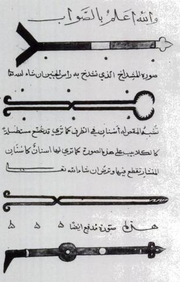
In his Al-Tasrif, al-Zahrawi introduced his famous collection of over 200 surgical instruments. Many of these instruments were never used before by any previous surgeons. Hamidan, for example, listed at least 26 innovative surgical instruments that Abulcasis introduced.
Adhesive bandage and Plaster
Abu al-Qasim invented the modern plaster and adhesive bandage, which are still used in hospitals throughout the world. The use of plasters for fractures became a standard practice for Arab physicians, though this practice was not widely adopted in Europe until the 19th century.
Catgut and Forceps
Abu al-Qasim's use of catgut for internal stitching is still practised in modern surgery. The catgut appears to be the only natural substance capable of dissolving and is acceptable by the body
Abu al-Qasim invented the forceps for extracting a dead fetus, as illustrated in the Al-Tasrif.
Cautery and Ligature
A special medical instrument called a cauter, used for the cauterization of arteries, was first described by Abu al-Qasim in his Kitab al-Tasrif.
In the Al-Tasrif, Abu al-Qasim also introduced the use of ligature for the blood control of arteries in lieu of cauterization.
Cotton dressing
Al Zahrawi was the first surgeon to make use of cotton (which itself is derived from the Arabic word qutn) as a medical dressing for controlling hemorrhage.
Lithotomy scalpel and Surgical needle
Abulcasis invented a lithotomy scalpel with two sharp cutting edges in order to perform the first successful extraction of bladder and kidney stones from the urinary bladder.
The surgical needle was invented and described by Abu al-Qasim in his Al-Tasrif.
Other instruments
Other surgical instruments invented by Abu al-Qasim and first described in his Al-Tasrif include the scalpel, curette, retractor, surgical spoon, sound, surgical hook, surgical rod, and specula.
Chemistry and Cosmetology
Al-Zahrawi was also a chemist and dedicated a chapter of the 19th volume of his Kitab al-Tasrif to cosmetology, The medicated cosmetics he invented include under-arm deodorants, hair removal sticks, hand lotions, hair dyes for changing human hair color to blond or black hair, hair care for correcting kinky or curly hair, and early suntan lotions, describing their ingredients and benefits in depth. As a remedy for bad breath resulting from eating garlic or onions, he suggested cinnamon, nutmeg, cardamom and chewing on coriander leaves.
Other cosmetics he invented include solid lipsticks which were perfumed stocks rolled and pressed in special moulds, and mineral oils used for medication purposes as well as aesthetic and beautification purposes. He also described the care and beautification of hair, skin, teeth and other parts of the body, which were all recommended in Islamic hadiths.
Cosmetic dentistry
In cosmetic dentistry, he described methods for strengthening the gums as well as the method of tooth bleaching using tooth whiteners.
Flowers
The al-Tasrif introduced the modern cultural tradition of taking flowers whenever visiting the sick in hospital (Bimaristan).
Perfumery
He made several advances in perfumery and invented perfumed stocks, rolled and pressed in special moulds, similar to modern roll-on deodorants.
He also recommended that after laundry, clothing should be in a room full of incense or perfume, so that the clothes will give a pleasant fragrance.
Other advances
Medication
Al-Zahrawi developed a variety of medications, which he described in his chapter on cosmetics. For epilepsy and seizures, he invented medications called Ghawali and Lafayfe. For the relief and treatment of common colds, he invented Muthallaathat, which was prepared from camphor, musk and honey, similar to modern Vicks Vapour Rub. He also invented nasal sprays and hand cream, and developed effective mouth washes.
Hematology and heredity
In hematology, al-Zahrawi wrote the first description on haemophilia, a hereditary genetic disorder, in his Kitab al-Tasrif, in which he wrote of an Andalusian family whose males died of bleeding after minor injuries.
External links
|
| |
|
|