

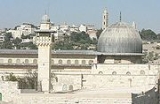
Al-Aqsa Mosque

Encyclopedia
Al-Aqsa Mosque also known as al-Aqsa, is the third holiest site in Sunni Islam
and is located in the Old City of Jerusalem. The site on which the silver domed mosque sits, along with the Dome of the Rock
, also referred to as al-Haram ash-Sharif or "Noble Sanctuary," is the Temple Mount
, the holiest site in Judaism
, the place where the Temple
is generally accepted to have stood. Muslims believe that Muhammad
was transported from the Sacred Mosque
in Mecca
to al-Aqsa during the Night Journey
. Islamic tradition
holds that Muhammad led prayers towards this site until the seventeenth month after the emigration
, when God directed him to turn towards the Ka'aba.
The al-Aqsa Mosque is believed by Muslims to have been built in ancient times, 40 years after the construction of the Kaabah. In the seventh century its walls were renovated by the Rashidun
caliph Umar
, who also built a small building to the south. A major rebuilding of the Mosque Compound was commissioned by the Ummayad caliph Abd al-Malik
, and included the addition of the basement, gates and other structures such as the Dome of the Rock. The work was completed and finished by his son al-Walid
in 705 CE. Other ruling dynasties of the Islamic Caliphate also constructed additions within al-Aqsa Mosque’s enclave, such as its dome
, facade
, its minbar
, minaret
s and the interior structure. When the Crusader
s captured Jerusalem in 1099, they used parts of al-Aqsa Mosque as either residences, stables or churches, but its function as a mosque was restored after its recapture by Saladin
. More renovations, repairs and additions were undertaken in the later centuries by the Ayyubids, Mamluk
s, the Supreme Muslim Council
, and Jordan
. Today, the Old City is under Israel
i control, but the mosque remains under the administration of the Palestinian-led Islamic waqf
.
into English
as "the farthest mosque." The name refers to a chapter of the Qur'an
called "The Night Journey
" in which it is said that Muhammad
traveled from Mecca to "the farthest mosque," and then up to Heaven
on a heavenly creature called al-Buraq al-Sharif
. Until the Ottoman conquest of Jerusalem in the 16th-century, "al-Masjid al-Aqsa" referred not only to the mosque, but to the entire Noble Sanctuary (Temple Mount). The sanctuary complex has since come to be known as al-Haram ash-Sharif, and the mosque itself as al-Jami' al-Aqsa (al-Aqsa Mosque).
Al-Aqsa Mosque as a whole is confused with a particular building within it, also known as al-Jami' al-Aqsa or al-Qibli or Masjid al-Jumah or al-Mughata, these names refer to the southern building with the silver lead dome.
For centuries, al-Masjid al-Aqsa referred not only to the mosque, but to the entire sacred sanctuary. This changed during the period of Ottoman rule (c. early 16th century to 1918) when the sanctuary complex came to be known as al Haram ash-Sharif, and the mosque founded by Umar came to be known as al-Jami' al-Aqsa or al-Aqsa Mosque.
, referred to by Muslims today as the "Haram al-Sharif" ("The Noble Sanctuary"), an enclosure expanded by King Herod the Great
beginning in 20 BCE. The mosque resides on an artificial platform that is supported by arches constructed by Herod's engineers to overcome the difficult topographic conditions resulting from the southward expansion of the enclosure into the Tyropoeon
and Kidron
valleys. At the time of the Second Temple
, the present site of the mosque was occupied by the Royal Stoa
, a basilica
running the southern wall of the enclosure. The Royal Stoa was destroyed along with the Temple during the sacking of Jerusalem
by the Romans
in 70 CE. Emperor Justinian
built a Christian church on the site in the 530s which was consecrated to the Virgin Mary and named "Church of Our Lady." The church was later destroyed by Khosrau II
, the Sassanid emperor
, in the early 7th-century and left in ruins.
Analysis of the wooden beams and panels removed from the mosque during renovations in the 1930s shows they are made from Cedar of Lebanon
and cypress
. Radiocarbon dating indicates a large range of ages, some as old as 9th-century BCE, showing that some of the wood had previously been used in older buildings.
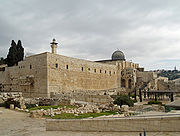 It is known that the current construction of the al-Aqsa Mosque is dated to the early Ummayad period of rule in Palestine
. Architectural historian K. A. C. Creswell
, referring to a testimony by Arculf
, a Gallic
monk, during his pilgrimage to Palestine
in 679–82, notes the possibility that the second caliph
of the Rashidun Caliphate
, Umar ibn al-Khattab, erected a primitive quadrangular building for a capacity of 3,000 worshipers somewhere on the Haram ash-Sharif. However, Arculf visited Palestine during the reign of Mu'awiyah I, and it is possible that Mu'awiyah ordered the construction, not Umar. This latter claim is explicitly supported by the early Muslim scholar al-Muthahhar bin Tahir.
According to several Muslim scholars, including Mujir ad-Din
, al-Suyuti
, and al-Muqaddasi
, the mosque was reconstructed and expanded by the caliph
Abd al-Malik in 690 along with the Dome of the Rock
. Guy le Strange claims that Abd al-Malik used materials from the destroyed Church of Our Lady to build the mosque and points to possible evidence that substructures on the southeast corners of the mosque are remains of the church. In planning his magnificent project on the Temple
Mount, which in effect would turn the entire complex into the Haram al-Sharif ("the Noble Sanctuary"), Abd al-Malik wanted to replace the slipshod structure described by Arculf with a more sheltered structure enclosing the qibla
, a necessary element in his grand scheme. However, the entire Haram al-Sharif was meant to represent a mosque. How much he modified the aspect of the earlier building is unknown, but the length of the new building is indicated by the existence of traces of a bridge leading from the Umayyad palace just south of the western part of the complex. The bridge would have spanned the street running just outside the southern wall of the Haram al-Sharif to give direct access to the mosque. Direct access from palace to mosque was a well-known feature in the Umayyad period, as evidenced at various early sites. Abd al-Malik shifted the central axis of the mosque some 40 metres (131.2 ft) westward, in accord with his overall plan for the Haram al-Sharif. The earlier axis is represented in the structure by the niche still known as the "mihrab of 'Umar." In placing emphasis on the Dome of the Rock
, Abd al-Malik had his architects align his new al-Aqsa Mosque according to the position of the Rock, thus shifting the main north–south axis of the Noble Sanctuary, a line running through the Dome of the Chain
and the Mihrab of Umar.
In contrast, Creswell, while referring to the Aphrodito Papyri, claims that Abd al-Malik's son, al-Walid I, reconstructed the Aqsa Mosque over a period of six months to a year, using workers from Damascus
. Most scholars agree that the mosque's reconstruction was started by Abd al-Malik, but that al-Walid oversaw its completion. In 713–14, a series of earthquakes ravaged Jerusalem, destroying the eastern section of the mosque, which was subsequently rebuilt during al-Walid's rule. In order to finance its reconstruction, al-Walid had gold from the dome of the Rock minted to use as money to purchase the material. The Umayyad-built al-Aqsa Mosque most likely measured 112 x 39 meters.
overthrew the Ummayads and established the Abbasid Caliphate. The second Abbasid caliph Abu Ja'far al-Mansur declared his intent to repair the mosque in 753, and he had the gold and silver plaques that covered the gates of the mosque removed and turned into dinar
s and dirham
s to finance the reconstruction which ended in 771. A second earthquake damaged most of al-Mansur's repairs, excluding those made in the southern portion in 774. In 780, the successor caliph Muhammad al-Mahdi
had it rebuilt, but curtailed its length and increased its breadth. Al-Mahdi's renovation is the first known to have written records describing it. In 985, Jerusalem-born Arab
geographer al-Muqaddasi
recorded that the renovated mosque had "fifteen naves and fifteen gates".
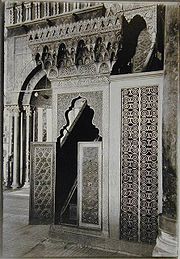 In 1033, there was another earthquake, severely damaging the mosque. The Fatimid
caliph Ali az-Zahir
rebuilt and completely renovated the mosque between 1034 and 1036. The number of naves was drastically reduced from fifteen to seven. Az-Zahir built the four arcades of the central hall and aisle, which presently serve as the foundation of the mosque. The central aisle was double the width of the other aisles and had a large gable roof upon which the dome—made of wood—was constructed. Persian geographer, Nasir Khusraw
describes the Aqsa Mosque during a visit in 1047:
The Haram Area (Noble Sanctuary) lies in the eastern part of the city; and through the bazaar
of this (quarter) you enter the Area by a great and beautiful gateway (Dargah
)... After passing this gateway, you have on the right two great colonnades (Riwaq
), each of which has nine-and-twenty marble pillars, whose capitals and bases are of colored marbles, and the joints are set in lead. Above the pillars rise arches, that are constructed, of masonry, without mortar or cement, and each arch is constructed of no more than five or six blocks of stone. These colonnades lead down to near the Maqsurah
.
Jerusalem was captured by the Crusader
s in 1099, during the First Crusade
. Instead of destroying the mosque—which they called "Solomon's Temple"—the Crusaders used it as a royal palace and as a stable for horses. In 1119, it was transformed into the headquarters for the Templar Knights
. During this period, the mosque underwent some structural changes, including the expansion of its northern porch, and the addition of an apse
and a dividing wall. A new cloister and church were also built at the site, along with various other structures. The Templars constructed vaulted western and eastern annexes to the building; the western currently serves as the women's mosque and the eastern as the Islamic Museum
.
After the Ayyubids under the leadership of Saladin
reconquered Jerusalem following the siege of 1187
, several repairs and renovations were undertaken at al-Aqsa Mosque. In order to prepare the mosque for Friday prayers, within a week of his capture of Jerusalem Saladin had the toilets and grain stores installed by the Crusaders at al-Aqsa removed, the floors covered with precious carpets, and its interior scented with rosewater and incense. Saladin's predecessor—the Zengid sultan Nur al-Din—had commissioned the construction of a new minbar
or "pulpit" made of ivory
and wood in 1168–69, but it was completed after his death; Nur ad-Din's minbar was added to the mosque in November 1187 by Saladin. The Ayyubid sultan of Damascus, al-Mu'azzam
, built the northern porch of the mosque with three gates in 1218. In 1345, the Mamluk
s under al-Kamil Shaban added two naves and two gates to the mosque's eastern side.
After the Ottoman
s assumed power in 1517, they did not undertake any major renovations or repairs to the mosque itself, but they did to the Noble Sanctuary as a whole. This included the building of the Fountain of Qasim Pasha
(1527), the restoration of the Pool of Raranj
, and the building of three free-standing domes—the most notable being the Dome of the Prophet
built in 1538. All construction was ordered by the Ottoman governors of Jerusalem and not the sultans themselves. The sultans did make additions to existing minarets, however.
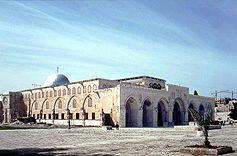 The first renovation in the 20th-century occurred in 1922, when the Supreme Muslim Council
under Amin al-Husayni (the Grand Mufti of Jerusalem
) commissioned Turkish
architect Ahmet Kemalettin Bey to restore al-Aqsa Mosque and the monuments in its precincts. The council also commissioned British
architects, Egypt
ian engineering experts and local officials to contribute to and oversee the repairs and additions which were carried out in 1924–25 by Kemalettin. The renovations included reinforcing the mosque's ancient Ummayad foundations, rectifying the interior columns, replacing the beams, erecting a scaffolding
, conserving the arch
es and drum of the main dome's interior, rebuilding the southern wall, and replacing timber in the central nave with a slab of concrete. The renovations also revealed Fatimid-era mosaics and inscriptions on the interior arches that had been covered with plasterwork
. The arches were decorated with gold and green-tinted gypsum
and their timber tie beams were replaced with brass
. A quarter of the stained glass windows also were carefully renewed so as to preserve their original Abbasid and Fatimid designs. Severe damage was caused by the 1927 and 1937 earthquakes, but the mosque was repaired in 1938 and 1942.
On August 21, 1969, a fire occurred inside al-Aqsa Mosque that gutted the southeastern wing of the mosque. Among other things, the fire destroyed Saladin's minbar. Initially, Palestinians blamed the Israeli authorities for the fire, and some Israelis blamed Fatah
, alleging they had started the fire so as to blame the Israelis and provoke hostility. However, the fire was started by neither Fatah nor Israel, but a tourist from Australia
named Denis Michael Rohan. Rohan was a member of an evangelical
Christian sect known as the Worldwide Church of God
. He hoped that by burning down al-Aqsa Mosque he would hasten the Second Coming
of Jesus
, making way for the rebuilding of the Jewish Temple on the Temple Mount. Rohan was subsequently hospitalized in a mental institution. In response to the incident, a summit of Islamic countries was held in Rabat
that same year, hosted by Faisal I, the late king of Saudi Arabia
. The al-Aqsa fire is regarded as one of the catalysts for the formation of the Organisation of the Islamic Conference (OIC, now the Organisation of Islamic Cooperation) in 1972.
In the 1980s, Ben Shoshan and Yehuda Etzion, both members of the Gush Emunim Underground
, plotted to blow up the al-Aqsa mosque and the Dome of the Rock
. Etzion believed that blowing up the two mosques would cause a spiritual awakening in Israel, and would solve all the problems of the Jewish people. They also hoped the Third Temple of Jerusalem would be built on the location of the mosque. On January 15, 1988, during the First Intifada
, Israeli troops fired rubber bullet
s and tear gas at protesters outside the mosque, wounding 40 worshipers. On October 8, 1990, 22 Palestinians were killed
and over 100 others injured by Israeli Border Police during protests that were triggered by the announcement of the Temple Mount Faithful, a fringe group of religious Jews, that they were going to lay the cornerstone of the Third Temple.
On September 28, 2000, then-Prime Minister of Israel Ariel Sharon
and members of the Likud Party, along with 1,000 armed guards, visited the al-Aqsa compound; a large group of Palestinians went to protest the visit. After Sharon and the Likud Party members left, a demonstration erupted and Palestinians on the grounds of the Haram al-Sharif began throwing stones and other projectiles at Israeli riot police. Police fired tear gas and rubber bullet
s at the crowd, injuring 24 people. The visit sparked a five-year uprising by the Palestinians, commonly referred to as the al-Aqsa Intifada
. On September 29, the Israeli government deployed 2,000 riot police to the mosque. When a group of Palestinians left the mosque after Friday prayers
(Jumu'ah,) they hurled stones at the police. The police then stormed the mosque compound, firing both live ammunition and rubber bullets at the group of Palestinians, killing four and wounding about 200.
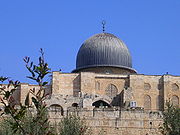 Unlike the Dome of the Rock
, which reflects classical Byzantine architecture, the Al-Aqsa Mosque is characteristic of early Islamic architecture
. Nothing remains of the original dome built by Abd al-Malik. The present-day dome was built by az-Zahir and consists of wood plated with lead enamelwork. In 1969, the dome was reconstructed in concrete and covered with anodized aluminum instead of the original ribbed lead enamel work sheeting. In 1983, the aluminum outer covering was replaced with lead to match the original design by az-Zahir.
Al-Aqsa's dome is one of the few domes to be built in front of the mihrab during the Umayyad and Abbasid periods, the others being the Umayyad Mosque
in Damascus (715) and the Great Mosque at Sousse
(850). The interior of the dome is painted with 14th-century-era decorations. During the 1969 burning, the paintings were assumed to be irreparably lost, but were completely reconstructed using the trateggio technique, a method that uses fine vertical lines to distinguish reconstructed areas from original ones.
s on the southern, northern and western sides. The first minaret, known as al-Fakhariyya Minaret, was built in 1278 on the southwestern corner of the mosque, on the orders of the Mamluk
sultan Lajin
. It was named after Fakhr al-Din al-Khalili, the father of Sharif al-Din Abd al-Rahman who supervised the building's construction. It was built in the traditional Syria
n style, with a square-shaped base and shaft, divided by moldings into three floors above which two lines of muqarnas
decorate the muezzin
's balcony. The niche is surrounded by a square chamber that ends in a lead-covered stone dome.
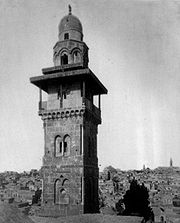 The second, known as the Ghawanima minaret, was built at the northwestern corner of the Noble Sanctuary in 1297–98 by architect Qadi Sharaf al-Din al-Khalili, also on the orders of the Sultan Lajin. Six stories high, it is the tallest minaret of the Noble Sanctuary. The tower is almost entirely made of stone, apart from a timber
canopy over the muezzin
's balcony. Because of its firm structure, the Ghawanima minaret has been nearly untouched by earthquakes. The minaret is divided into several stories by stone molding and stalactite
galleries. The first two stories are wider and form the base of the tower. The additional four stories are surmounted by a cylindrical drum and a bulbous dome. The stairway is externally located on the first two floors, but becomes an internal spiral structure from the third floor until it reaches the muezzin's balcony.
In 1329, Tankiz—the Mamluk governor of Syria—ordered the construction of a third minaret called the Bab al-Silsila Minaret located on the western border of the al-Aqsa Mosque. This minaret, possibly replacing an earlier Umayyad
minaret, is built in the traditional Syrian square tower type and is made entirely out of stone. Since the 16th-century, it has been tradition that the best muezzin ("reciter") of the adhan
(the call to prayer), is assigned to this minaret because the first call to each of the five daily prayers is raised from it, giving the signal for the muezzins of mosques throughout Jerusalem to follow suit.
The last and most notable minaret was built in 1367, and is known as Minarat al-Asbat
. It is composed of a cylindrical stone shaft (built later by the Ottoman
s), which springs up from a rectangular Mamluk-built base on top of a triangular transition zone. The shaft narrows above the muezzin's balcony, and is dotted with circular windows, ending with a bulbous dome. The dome was reconstructed after the Jordan Valley earthquake of 1927.
There are no minarets in the eastern portion of the mosque. However, in 2006, King Abdullah II of Jordan
announced his intention to build a fifth minaret overlooking the Mount of Olives. The King Hussein Minaret is planned to be the tallest structure in the Old City of Jerusalem.
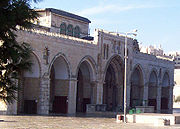 The facade
of the mosque was built in 1065 CE on the instructions of the Fatimid
caliph al-Mustansir
. It was crowned with a balustrade consisting of arcades and small columns. The Crusader
s damaged the facade during their era of rule in Palestine, but it was restored and renovated by the Ayyubids. One addition was the facade's covering with tiles. The second-hand material of the facade's arches includes sculpted ornamental material from taken from Crusader structures in Jerusalem. There are fourteen stone arch
es along the facade, most of which are of a Romanesque
style. The outer arches added by the Mamluks follow the same general design. The entrance to the mosque is through the facade's central arch.
The porch is located at the top of the facade. The central bays of the porch were built by the Knights Templar
during the First Crusade
, but Saladin's nephew al-Mu'azzam
ordered the construction of the porch itself in 1217.
nave
s with several additional small halls to the west and east of the southern section of the building. There are 121 stained glass
windows in the mosque from the Abbasid and Fatimid eras. About a fourth of them were restored in 1924.
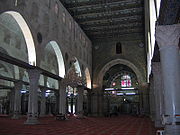 The mosque's interior is supported by 45 column
s, 33 of which are white marble and 12 of stone. The column rows of the central aisles are heavy and stunted. The remaining four rows are better proportioned. The capitals of the columns are of four different kinds: those in the central aisle are heavy and primitively designed, while those under the dome are of the Corinthian order
, and made from Italian
white marble. The capitals in the eastern aisle are of a heavy basket-shaped design and those east and west of the dome are also basket-shaped, but smaller and better proportioned. The columns and piers are connected by an architectural rave, which consists of beams of roughly squared timber enclosed in a wooden casing.
A great portion of the mosque is covered with whitewash
, but the drum of the dome and the walls immediately beneath it are decorated with mosaic
s and marble. Some paintings by an Italian artist were introduced when repairs were undertaken at the mosque after an earthquake ravaged the mosque in 1927. The ceiling of the mosque was painted with funding by King Farouk of Egypt
.
The minbar
("pulpit
") of the mosque was built by a craftsman named Akhtarini from Aleppo
on the orders of the Zengid sultan Nur ad-Din. It was intended to be a gift for the mosque when Nur ad-Din would capture Jerusalem from the Crusaders and took six years to build (1168–74). Nur ad-Din died and the Crusaders still controlled Jerusalem, but in 1187, Saladin captured the city and the minbar was installed. The structure was made of ivory
and carefully crafted wood. Arabic calligraphy, geometrical and floral designs were inscribed in the woodwork. After its destruction by Rohan in 1969, it was replaced by a much simpler minbar. In January 2007, Adnan al-Husayni
—head of the Islamic waqf in charge of al-Aqsa—stated that a new minbar would be installed; it was installed in February 2007. The design of the new minbar was drawn by Jamil Badran based on an exact replica of the Saladin Minbar and was finished by Badran within a period of five years. The minbar itself was built in Jordan
over a period of four years and the craftsmen used "ancient woodworking methods, joining the pieces with pegs instead of nails, but employed computer images to design the pulpit [minbar]."
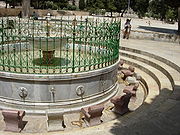 The mosque's main ablution
fountain, known as al-Kas ("the Cup"), is located north of the mosque between it and the Dome of the Rock. It is used by worshipers to perform wudu
, a ritual washing of the hands, arms, legs, feet, and face before entry into the mosque. It was first built in 709 by the Ummayads, but in 1327–28 Governor Tankiz enlarged it to accommodate more worshipers. Although originally supplied with water from Solomon's Pools
near Bethlehem
, it currently receives water from pipes connected to Jerusalem's water supply. In the 20th-century, al-Kas was provided taps and stone seating.
The Fountain of Qasim Pasha
, built by the Ottomans in 1526 and located north of the mosque on the platform of the Dome of the Rock, was used by worshipers for ablution and for drinking until the 1940s. Today, it stands as a monumental structure.
, the term "al-Aqsa Mosque" is not restricted to the mosque only, but to the entire Noble Sanctuary. The mosque is believed to be the second house of prayer constructed after the Masjid al-Haram
in Mecca
. Post-Rashidun-era Islamic scholars traditionally identified the mosque as the site referred to in the sura
(Qur'anic chapter) al-Isra
("the Night Journey"). The specific passage reads "Praise be to Him who made His servant journey in the night from the sacred sanctuary to the remotest sanctuary." Muslims identify the "sacred sanctuary" as the Masjid al-Haram and the "remotest sanctuary" as the al-Aqsa Mosque. This specific verse in the Qur'an cemented the significant religious importance of al-Aqsa in Islam. Initially, Rashidun and Umayyad-era scholars were in disagreement about the location of the "remotest sanctuary" with some arguing it was actually located near Mecca. Eventually scholarly consensus determined that its location was indeed in Jerusalem.
According to Islamic tradition, during Muhammad's night journey (al-isra) he rode on al-Buraq who took him from Mecca to the site of al-Aqsa. After he finished his prayers, the angel Jibril (Gabriel
) took Muhammad to Heaven
, where he met several other prophets and led them in prayer.
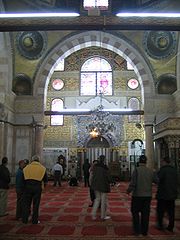 The historical significance of the al-Aqsa Mosque in Islam is further emphasized by the fact that Muslims turned towards al-Aqsa when they prayed for a period of sixteen or seventeen months after migration
to Medina
in 624, thus it became the qibla
("direction") that Muslims faced for prayer. Muhammad later prayed towards the Ka'aba in Mecca
after receiving a revelation during a prayer session. The qibla was relocated to the Ka'aba where Muslims have been directed to pray ever since.
The altering of the qibla was precisely the reason the Rashidun
caliph Umar, despite identifying the Rock—which Muhammad used to ascend to Heaven
—upon his arrival at the Noble Sanctuary in 638, neither prayed facing it nor built any structure upon it. This was because the significance of that particular spot on the Noble Sanctuary was superseded in Islamic jurisprudence by the Ka'aba in Mecca after the change of the qibla towards that site.
According to early Qur'anic interpreters and what is generally accepted as Islamic tradition, in 638 CE Umar, upon entering a conquered Jerusalem, consulted with Ka'ab al-Ahbar
—a Jewish convert to Islam who came with him from Medina
—as to where the best spot would be to build a mosque. Al-Ahbar suggested to him that it should be behind the Rock "... so that all of Jerusalem would be before you." Umar replied, "You correspond to Judaism!" Immediately after this conversation, Umar began to clean up the site—which was filled with trash and debris—with his cloak, and other Muslim followers imitated him until the site was clean. Umar then prayed at the spot where it was believed that Muhammad had prayed before his night journey, reciting the Qur'anic sura
Sad
. Thus, according to this tradition, Umar thereby reconsecrated the site as a mosque.
Because of the holiness of Noble Sanctuary itself—being a place where David
and Solomon
had prayed—Umar constructed a small prayer house in the southern corner of its platform, taking care to avoid allowing the Rock to come between the mosque and the direction of Ka'aba so that Muslims would face only Mecca when they prayed.
. Muslims believe that numerous passages in the Qur'an refer to Jerusalem. Jerusalem is also mentioned many times in the Hadith
. Some academics attribute the holiness of Jerusalem to the rise and expansion of a certain type of literary genre, known as al-Fadhail or history of cities. The Fadhail of Jerusalem inspired Muslims, especially during the Umayyad period, to embellish the sanctity of the city beyond its status in the holy texts. Others point to the political motives of the Umayyad dynasty which led to the sanctification of Jerusalem in Islam.
Later medieval scripts, as well as modern-day political tracts, tend to classify al-Aqsa Mosque as the third holiest site in Islam. For example, Sahih Bukhari
quotes Abu al-Dardaa as saying: "the Prophet of Allah Muhammad said a prayer in the Sacred Mosque
(in Mecca) is worth 100,000 prayers; a prayer in my mosque
(in Medina) is worth 10,000 prayers; and a prayer in al-Masjid al-Aqsa is worth 1,000 prayers", more than in any other mosque. In addition, the Organisation of Islamic Cooperation, refers to the al-Aqsa Mosque as the third holiest site in Islam (and calls for Arab sovereignty over it).
held control of the al-Aqsa Mosque until the 1967 Six-Day War
. After Israel's victory in that war, instead of the government taking control of the al-Aqsa Mosque, Israel transferred the control of the mosque and the northern Noble Sanctuary to the Islamic waqf trust, who are independent of the Israeli government. However, Israeli Security Forces
are permitted to patrol and conduct searches within the perimeter of the mosque. After the 1969 arson attack, the waqf employed architects, technicians and craftsmen in a committee that carry out regular maintenance operations. The Islamic Movement in Israel and the waqf have attempted to increase Muslim control of the Temple Mount as a way of countering Israeli policies and the escalating presence of Israeli security forces around the site since the al-Aqsa Intifada
. Some activities included refurbishing abandoned structures and renovating.
Muhammad Ahmad Hussein
is the head imam
and manager of the al-Aqsa Mosque and was assigned the role of Grand Mufti of Jerusalem
in 2006 by Palestinian president Mahmoud Abbas
. Ownership of the al-Aqsa Mosque is a contentious issue in the Israel-Palestinian conflict. Israel claims sovereignty over the mosque along with all of the Temple Mount (Noble Sanctuary), but Palestinians hold the custodianship of the site through the Islamic waqf. During the negotiations at the 2000 Camp David Summit, Palestinians demanded complete ownership of the mosque and other Islamic holy sites in East Jerusalem
.
 Muslim residents of Israel
and Palestinians living in East Jerusalem are normally allowed to enter and pray at the al-Aqsa Mosque without restrictions. Israel occasionally prevents certain groups of Muslims from reaching al-Aqsa; the restrictions vary from time to time. At times restrictions have prevented all men under 50 and women under 45 from entering, but married men over 45 are allowed. Sometimes the restrictions are enforced on the occasion of Friday prayers, other times they are over an extended period of time. Restrictions are most severe for Gazans, followed by restrictions on those from West Bank. Israel states that the restrictions are in place for security reasons.
Many rabbi
s, including Israel's chief rabbinate
since 1967, have ruled that Jews should not walk on the Temple Mount due to the possibility of their stepping on the site of the Holy of Holies
. Israeli governmental restrictions only forbid Jewish prayer on the Temple Mount, but allow Jews as well as other non-Muslims to visit for certain hours on certain days in the week. Several rabbis and Zionist leaders have demanded the right of Jews to pray at the site on Jewish holiday
s. Although the Israeli Supreme Court has supported individual (as opposed to group) prayer, in practice Israeli police bar a Jew from praying "in any overt manner whatsoever on the Temple Mount, even if he is just moving his lips in prayer."
took place following the 1967 War. In 1970, Israeli authorities commenced intensive excavations outside the walls next to the mosque on the southern and western sides. Palestinians made false accusations that tunnels were being dug under the Al-Aqsa Mosque in order to undermine its foundations, while the closest excavation to the mosque is some 70 meters to its south. The Archaeological Department of the Israeli Ministry of Religious Affairs dug a tunnel near the western portion of the mosque in 1984. According to UNESCO
's special envoy to Jerusalem Oleg Grabar
, buildings and structures on the Temple Mount are deteriorating due mostly to disputes between the Israeli, Palestinian and Jordanian governments over who is actually responsible for the site.
The Islamic Waqf, which has custodial rights over the Temple Mount and is responsible for overseeing any construction work there, built an emergency exit for the Marwani Mosque (Solomon's Stables) in 1999. The move raised concerns from the Israel Antiquities Authority
(IAA) that, due to the use of bulldozers by the Waqf, damage was being done to structures dating from the early Muslim period. A number of Israeli archaeologists, however, accused the Waqf of destroying building material dating from the First Temple Period in Jerusalem, while Ehud Olmert
, the mayor of the city at that time, alleged that any construction on the Temple Mount without the supervision of Israeli authorities undermined Israel's claims to the religious complex. Adnan al-Husayni
, then head of the Waqf, responded by stating "We never asked for permission from the occupation."
In February 2007, the Department started to excavate a site for archaeological remains in a location where the government wanted to rebuild a collapsed pedestrian bridge. This site was 60 metres (197 ft) away from the mosque. The excavations provoked anger throughout the Islamic world, and Israel was accused of trying to destroy the foundation of the mosque. Ismail Haniya
—then Prime Minister of the Palestinian National Authority
and Hamas
leader—called on Palestinians to unite to protest the excavations, while Fatah
said they would end their ceasefire with Israel. Israel denied all charges against them, calling them "ludicrous."
Holiest sites in Islam (Sunni)
According to Sahih al-Bukhari, Muhammad said "Do not set out on a journey except for three Mosques i.e. Al-Masjid-AI-Haram, the Mosque of Allah's Apostle, and the Mosque of Al-Aqsa, ." In the Islāmic Sunni tradition, the Ka'bah is considered the Holiest site, followed by Masjidun Nabawi as the...
and is located in the Old City of Jerusalem. The site on which the silver domed mosque sits, along with the Dome of the Rock
Dome of the Rock
The Dome of the Rock is a shrine located on the Temple Mount in the Old City of Jerusalem. The structure has been refurbished many times since its initial completion in 691 CE at the order of Umayyad Caliph Abd al-Malik...
, also referred to as al-Haram ash-Sharif or "Noble Sanctuary," is the Temple Mount
Temple Mount
The Temple Mount, known in Hebrew as , and in Arabic as the Haram Ash-Sharif , is one of the most important religious sites in the Old City of Jerusalem. It has been used as a religious site for thousands of years...
, the holiest site in Judaism
Judaism
Judaism ) is the "religion, philosophy, and way of life" of the Jewish people...
, the place where the Temple
Temple in Jerusalem
The Temple in Jerusalem or Holy Temple , refers to one of a series of structures which were historically located on the Temple Mount in the Old City of Jerusalem, the current site of the Dome of the Rock. Historically, these successive temples stood at this location and functioned as the centre of...
is generally accepted to have stood. Muslims believe that Muhammad
Muhammad
Muhammad |ligature]] at U+FDF4 ;Arabic pronunciation varies regionally; the first vowel ranges from ~~; the second and the last vowel: ~~~. There are dialects which have no stress. In Egypt, it is pronounced not in religious contexts...
was transported from the Sacred Mosque
Masjid al-Haram
Al-Masjid al-Ḥarām is the largest mosque in the world. Located in the city of Mecca, it surrounds the Kaaba, the place which Muslims worldwide turn towards while performing daily prayers and is Islam's holiest place...
in Mecca
Mecca
Mecca is a city in the Hijaz and the capital of Makkah province in Saudi Arabia. The city is located inland from Jeddah in a narrow valley at a height of above sea level...
to al-Aqsa during the Night Journey
Isra and Mi'raj
The Isra and Mi'raj , are the two parts of a Night Journey that, according to Islamic tradition, the Islamic prophet Muhammad took during a single night around the year 621. It has been described as both a physical and spiritual journey...
. Islamic tradition
Hadith
The term Hadīth is used to denote a saying or an act or tacit approval or criticism ascribed either validly or invalidly to the Islamic prophet Muhammad....
holds that Muhammad led prayers towards this site until the seventeenth month after the emigration
Hijra (Islam)
The Hijra is the migration or journey of the Islamic prophet Muhammad and his followers from Mecca to Medina in 622 CE. Alternate spellings of this Arabic word are Hijrah, Hijrat or Hegira, the latter following the spelling rules of Latin.- Hijra of Muhammad :In September 622, warned of a plot to...
, when God directed him to turn towards the Ka'aba.
The al-Aqsa Mosque is believed by Muslims to have been built in ancient times, 40 years after the construction of the Kaabah. In the seventh century its walls were renovated by the Rashidun
Rashidun
The Rightly Guided Caliphs or The Righteous Caliphs is a term used in Sunni Islam to refer to the first four Caliphs who established the Rashidun Caliphate. The concept of "Rightly Guided Caliphs" originated with the Abbasid Dynasty...
caliph Umar
Umar
`Umar ibn al-Khattāb c. 2 November , was a leading companion and adviser to the Islamic prophet Muhammad who later became the second Muslim Caliph after Muhammad's death....
, who also built a small building to the south. A major rebuilding of the Mosque Compound was commissioned by the Ummayad caliph Abd al-Malik
Abd al-Malik
`Abd al-Malik ibn Marwan was the 5th Umayyad Caliph. He was born in Mecca and grew up in Medinah . `Abd al-Malik was a well-educated man and capable ruler, despite the many political problems that impeded his rule. 14th century Muslim historian Ibn Khaldun states: "`Abd al-Malik ibn Marwan is one...
, and included the addition of the basement, gates and other structures such as the Dome of the Rock. The work was completed and finished by his son al-Walid
Al-Walid
al-Walid may refer to:* Khalid ibn al-Walid , one of the two famous Arab generals of the Rashidun army during the Muslim conquests of the 7th Century* Al-Walid I , an Umayyad caliph who ruled from 705 - 715....
in 705 CE. Other ruling dynasties of the Islamic Caliphate also constructed additions within al-Aqsa Mosque’s enclave, such as its dome
Dome
A dome is a structural element of architecture that resembles the hollow upper half of a sphere. Dome structures made of various materials have a long architectural lineage extending into prehistory....
, facade
Facade
A facade or façade is generally one exterior side of a building, usually, but not always, the front. The word comes from the French language, literally meaning "frontage" or "face"....
, its minbar
Minbar
A minbar is a pulpit in the mosque where the imam stands to deliver sermons or in the Hussainia where the speaker sits and lectures the congregation...
, minaret
Minaret
A minaret مناره , sometimes مئذنه) is a distinctive architectural feature of Islamic mosques, generally a tall spire with an onion-shaped or conical crown, usually either free standing or taller than any associated support structure. The basic form of a minaret includes a base, shaft, and gallery....
s and the interior structure. When the Crusader
First Crusade
The First Crusade was a military expedition by Western Christianity to regain the Holy Lands taken in the Muslim conquest of the Levant, ultimately resulting in the recapture of Jerusalem...
s captured Jerusalem in 1099, they used parts of al-Aqsa Mosque as either residences, stables or churches, but its function as a mosque was restored after its recapture by Saladin
Saladin
Ṣalāḥ ad-Dīn Yūsuf ibn Ayyūb , better known in the Western world as Saladin, was an Arabized Kurdish Muslim, who became the first Sultan of Egypt and Syria, and founded the Ayyubid dynasty. He led Muslim and Arab opposition to the Franks and other European Crusaders in the Levant...
. More renovations, repairs and additions were undertaken in the later centuries by the Ayyubids, Mamluk
Mamluk Sultanate (Cairo)
The Mamluk Sultanate of Egypt was the final independent Egyptian state prior to the establishment of the Muhammad Ali Dynasty in 1805. It lasted from the overthrow of the Ayyubid Dynasty until the Ottoman conquest of Egypt in 1517. The sultanate's ruling caste was composed of Mamluks, Arabised...
s, the Supreme Muslim Council
Supreme Muslim Council
The Supreme Muslim Council was the highest body in charge of Muslim community affairs in Mandate Palestine under British control. It was established to create an advisory body composed of Muslims and Christians with whom the High Commissioner could consult...
, and Jordan
Jordan
Jordan , officially the Hashemite Kingdom of Jordan , Al-Mamlaka al-Urduniyya al-Hashemiyya) is a kingdom on the East Bank of the River Jordan. The country borders Saudi Arabia to the east and south-east, Iraq to the north-east, Syria to the north and the West Bank and Israel to the west, sharing...
. Today, the Old City is under Israel
Israel
The State of Israel is a parliamentary republic located in the Middle East, along the eastern shore of the Mediterranean Sea...
i control, but the mosque remains under the administration of the Palestinian-led Islamic waqf
Waqf
A waqf also spelled wakf formally known as wakf-alal-aulad is an inalienable religious endowment in Islamic law, typically denoting a building or plot of land for Muslim religious or charitable purposes. The donated assets are held by a charitable trust...
.
Etymology
Masjid al-Aqsa translates from ArabicArabic language
Arabic is a name applied to the descendants of the Classical Arabic language of the 6th century AD, used most prominently in the Quran, the Islamic Holy Book...
into English
English language
English is a West Germanic language that arose in the Anglo-Saxon kingdoms of England and spread into what was to become south-east Scotland under the influence of the Anglian medieval kingdom of Northumbria...
as "the farthest mosque." The name refers to a chapter of the Qur'an
Qur'an
The Quran , also transliterated Qur'an, Koran, Alcoran, Qur’ān, Coran, Kuran, and al-Qur’ān, is the central religious text of Islam, which Muslims consider the verbatim word of God . It is regarded widely as the finest piece of literature in the Arabic language...
called "The Night Journey
Isra and Mi'raj
The Isra and Mi'raj , are the two parts of a Night Journey that, according to Islamic tradition, the Islamic prophet Muhammad took during a single night around the year 621. It has been described as both a physical and spiritual journey...
" in which it is said that Muhammad
Muhammad
Muhammad |ligature]] at U+FDF4 ;Arabic pronunciation varies regionally; the first vowel ranges from ~~; the second and the last vowel: ~~~. There are dialects which have no stress. In Egypt, it is pronounced not in religious contexts...
traveled from Mecca to "the farthest mosque," and then up to Heaven
Heaven
Heaven, the Heavens or Seven Heavens, is a common religious cosmological or metaphysical term for the physical or transcendent place from which heavenly beings originate, are enthroned or inhabit...
on a heavenly creature called al-Buraq al-Sharif
Buraq
Al-Burāq is a mythological steed, described as a creature from the heavens which transported the prophets. The most commonly told story is how in the 7th century, Al-Buraq carried the Islamic prophet Muhammad from Mecca to Jerusalem and back during the Isra and Mi'raj or "Night Journey", which is...
. Until the Ottoman conquest of Jerusalem in the 16th-century, "al-Masjid al-Aqsa" referred not only to the mosque, but to the entire Noble Sanctuary (Temple Mount). The sanctuary complex has since come to be known as al-Haram ash-Sharif, and the mosque itself as al-Jami' al-Aqsa (al-Aqsa Mosque).
Al-Aqsa Mosque as a whole is confused with a particular building within it, also known as al-Jami' al-Aqsa or al-Qibli or Masjid al-Jumah or al-Mughata, these names refer to the southern building with the silver lead dome.
For centuries, al-Masjid al-Aqsa referred not only to the mosque, but to the entire sacred sanctuary. This changed during the period of Ottoman rule (c. early 16th century to 1918) when the sanctuary complex came to be known as al Haram ash-Sharif, and the mosque founded by Umar came to be known as al-Jami' al-Aqsa or al-Aqsa Mosque.
Pre-construction
The al-Aqsa Mosque is located on the Temple MountTemple Mount
The Temple Mount, known in Hebrew as , and in Arabic as the Haram Ash-Sharif , is one of the most important religious sites in the Old City of Jerusalem. It has been used as a religious site for thousands of years...
, referred to by Muslims today as the "Haram al-Sharif" ("The Noble Sanctuary"), an enclosure expanded by King Herod the Great
Herod the Great
Herod , also known as Herod the Great , was a Roman client king of Judea. His epithet of "the Great" is widely disputed as he is described as "a madman who murdered his own family and a great many rabbis." He is also known for his colossal building projects in Jerusalem and elsewhere, including his...
beginning in 20 BCE. The mosque resides on an artificial platform that is supported by arches constructed by Herod's engineers to overcome the difficult topographic conditions resulting from the southward expansion of the enclosure into the Tyropoeon
Tyropoeon Valley
Tyropoeon Valley is the name given by Josephus the historian to the valley or rugged ravine, in the Old City of Jerusalem, which in ancient times separated Mount Moriah from Mount Zion and emptied into the valley of Hinnom...
and Kidron
Kidron Valley
The Kidron Valley is the valley on the eastern side of The Old City of Jerusalem which features significantly in the Bible...
valleys. At the time of the Second Temple
Second Temple
The Jewish Second Temple was an important shrine which stood on the Temple Mount in Jerusalem between 516 BCE and 70 CE. It replaced the First Temple which was destroyed in 586 BCE, when the Jewish nation was exiled to Babylon...
, the present site of the mosque was occupied by the Royal Stoa
Royal Stoa (Jerusalem)
The Royal Stoa was an ancient basilica constructed by Herod the Great during his renovation of the Temple Mount at the end of the 1st century BCE...
, a basilica
Basilica
The Latin word basilica , was originally used to describe a Roman public building, usually located in the forum of a Roman town. Public basilicas began to appear in Hellenistic cities in the 2nd century BC.The term was also applied to buildings used for religious purposes...
running the southern wall of the enclosure. The Royal Stoa was destroyed along with the Temple during the sacking of Jerusalem
Siege of Jerusalem (70)
The Siege of Jerusalem in the year 70 AD was the decisive event of the First Jewish-Roman War. The Roman army, led by the future Emperor Titus, with Tiberius Julius Alexander as his second-in-command, besieged and conquered the city of Jerusalem, which had been occupied by its Jewish defenders in...
by the Romans
Roman Empire
The Roman Empire was the post-Republican period of the ancient Roman civilization, characterised by an autocratic form of government and large territorial holdings in Europe and around the Mediterranean....
in 70 CE. Emperor Justinian
Justinian I
Justinian I ; , ; 483– 13 or 14 November 565), commonly known as Justinian the Great, was Byzantine Emperor from 527 to 565. During his reign, Justinian sought to revive the Empire's greatness and reconquer the lost western half of the classical Roman Empire.One of the most important figures of...
built a Christian church on the site in the 530s which was consecrated to the Virgin Mary and named "Church of Our Lady." The church was later destroyed by Khosrau II
Khosrau II
250px|thumb|Khosrau II 250px|thumb|Khosrau II 250px|thumb|Khosrau II (Khosrow II, Chosroes II, or Xosrov II in classical sources, sometimes called Parvez, "the Ever Victorious" – (in Persian: خسرو پرویز), was the twenty-second Sassanid King of Persia, reigning from 590 to 628...
, the Sassanid emperor
Sassanid Empire
The Sassanid Empire , known to its inhabitants as Ērānshahr and Ērān in Middle Persian and resulting in the New Persian terms Iranshahr and Iran , was the last pre-Islamic Persian Empire, ruled by the Sasanian Dynasty from 224 to 651...
, in the early 7th-century and left in ruins.
Analysis of the wooden beams and panels removed from the mosque during renovations in the 1930s shows they are made from Cedar of Lebanon
Lebanon Cedar
Cedrus libani is a species of cedar native to the mountains of the Mediterranean region.There are two distinct types that are considered to be different subspecies or varieties. Lebanon cedar or Cedar of Lebanon Cedrus libani is a species of cedar native to the mountains of the Mediterranean...
and cypress
Cypress
Cypress is the name applied to many plants in the cypress family Cupressaceae, which is a conifer of northern temperate regions. Most cypress species are trees, while a few are shrubs...
. Radiocarbon dating indicates a large range of ages, some as old as 9th-century BCE, showing that some of the wood had previously been used in older buildings.
Construction by the Umayyads
Palestine
Palestine is a conventional name, among others, used to describe the geographic region between the Mediterranean Sea and the Jordan River, and various adjoining lands....
. Architectural historian K. A. C. Creswell
K. A. C. Creswell
Professor Sir Keppel Archibald Cameron Creswell FBA was an English architectural historian who wrote some of the seminal works on Islamic architecture in Egypt.-Early life:Creswell was born on 13 September 1879 in London...
, referring to a testimony by Arculf
Arculf
Arculf , was a Frankish Bishop who toured the Levant in around 680. Bede claimed he was a bishop , who, according to Bede's history of the Church in England , was shipwrecked on the shore of Iona, Scotland on his return from a pilgrimage to the Holy Land, and was hospitably received by Adamnan, the...
, a Gallic
Gaul
Gaul was a region of Western Europe during the Iron Age and Roman era, encompassing present day France, Luxembourg and Belgium, most of Switzerland, the western part of Northern Italy, as well as the parts of the Netherlands and Germany on the left bank of the Rhine. The Gauls were the speakers of...
monk, during his pilgrimage to Palestine
Palestine
Palestine is a conventional name, among others, used to describe the geographic region between the Mediterranean Sea and the Jordan River, and various adjoining lands....
in 679–82, notes the possibility that the second caliph
Caliph
The Caliph is the head of state in a Caliphate, and the title for the ruler of the Islamic Ummah, an Islamic community ruled by the Shari'ah. It is a transcribed version of the Arabic word which means "successor" or "representative"...
of the Rashidun Caliphate
Rashidun Caliphate
The Rashidun Caliphate , comprising the first four caliphs in Islam's history, was founded after Muhammad's death in 632, Year 10 A.H.. At its height, the Caliphate extended from the Arabian Peninsula, to the Levant, Caucasus and North Africa in the west, to the Iranian highlands and Central Asia...
, Umar ibn al-Khattab, erected a primitive quadrangular building for a capacity of 3,000 worshipers somewhere on the Haram ash-Sharif. However, Arculf visited Palestine during the reign of Mu'awiyah I, and it is possible that Mu'awiyah ordered the construction, not Umar. This latter claim is explicitly supported by the early Muslim scholar al-Muthahhar bin Tahir.
According to several Muslim scholars, including Mujir ad-Din
Mujir al-Din al-'Ulaymi
Mujīr al-Dīn al-'Ulaymī , often simply Mujir al-Din, was a Jerusalemite qadi and Arab historian whose principal work chronicled the history of Jerusalem and Hebron in the Middle Ages. Entitled al-Uns al-Jalil bi-tarikh al-Quds wal-Khalil Mujīr al-Dīn al-'Ulaymī (Arabic: ) (1456–1522), often...
, al-Suyuti
Al-Suyuti
Jalaluddin Al-Suyuti also known as Ibn al-Kutub was an Egyptian writer, religious scholar, juristic expert and teacher whose works deal with a wide variety of subjects in Islamic theology. He was precocious and was already a teacher in 1462. In 1486, he was appointed to a chair in the mosque of...
, and al-Muqaddasi
Al-Muqaddasi
Muhammad ibn Ahmad Shams al-Din Al-Muqaddasi , also transliterated as Al-Maqdisi and el-Mukaddasi, was a medieval Arab geographer, author of Ahsan at-Taqasim fi Ma`rifat il-Aqalim .-Biography:Al-Muqaddasi, "the Hierosolomite" was born in Jerusalem in 946 AD...
, the mosque was reconstructed and expanded by the caliph
Caliph
The Caliph is the head of state in a Caliphate, and the title for the ruler of the Islamic Ummah, an Islamic community ruled by the Shari'ah. It is a transcribed version of the Arabic word which means "successor" or "representative"...
Abd al-Malik in 690 along with the Dome of the Rock
Dome of the Rock
The Dome of the Rock is a shrine located on the Temple Mount in the Old City of Jerusalem. The structure has been refurbished many times since its initial completion in 691 CE at the order of Umayyad Caliph Abd al-Malik...
. Guy le Strange claims that Abd al-Malik used materials from the destroyed Church of Our Lady to build the mosque and points to possible evidence that substructures on the southeast corners of the mosque are remains of the church. In planning his magnificent project on the Temple
Mount, which in effect would turn the entire complex into the Haram al-Sharif ("the Noble Sanctuary"), Abd al-Malik wanted to replace the slipshod structure described by Arculf with a more sheltered structure enclosing the qibla
Qibla
The Qiblah , also transliterated as Qibla, Kiblah or Kibla, is the direction that should be faced when a Muslim prays during salah...
, a necessary element in his grand scheme. However, the entire Haram al-Sharif was meant to represent a mosque. How much he modified the aspect of the earlier building is unknown, but the length of the new building is indicated by the existence of traces of a bridge leading from the Umayyad palace just south of the western part of the complex. The bridge would have spanned the street running just outside the southern wall of the Haram al-Sharif to give direct access to the mosque. Direct access from palace to mosque was a well-known feature in the Umayyad period, as evidenced at various early sites. Abd al-Malik shifted the central axis of the mosque some 40 metres (131.2 ft) westward, in accord with his overall plan for the Haram al-Sharif. The earlier axis is represented in the structure by the niche still known as the "mihrab of 'Umar." In placing emphasis on the Dome of the Rock
Dome of the Rock
The Dome of the Rock is a shrine located on the Temple Mount in the Old City of Jerusalem. The structure has been refurbished many times since its initial completion in 691 CE at the order of Umayyad Caliph Abd al-Malik...
, Abd al-Malik had his architects align his new al-Aqsa Mosque according to the position of the Rock, thus shifting the main north–south axis of the Noble Sanctuary, a line running through the Dome of the Chain
Dome of the Chain
Dome of the Chain is a free-standing dome located adjacently east of the Dome of the Rock in the Old City of Jerusalem. One of the oldest structures on the Haram ash-Sharif , it is not a mosque or shrine, but is used as a prayer house...
and the Mihrab of Umar.
In contrast, Creswell, while referring to the Aphrodito Papyri, claims that Abd al-Malik's son, al-Walid I, reconstructed the Aqsa Mosque over a period of six months to a year, using workers from Damascus
Damascus
Damascus , commonly known in Syria as Al Sham , and as the City of Jasmine , is the capital and the second largest city of Syria after Aleppo, both are part of the country's 14 governorates. In addition to being one of the oldest continuously inhabited cities in the world, Damascus is a major...
. Most scholars agree that the mosque's reconstruction was started by Abd al-Malik, but that al-Walid oversaw its completion. In 713–14, a series of earthquakes ravaged Jerusalem, destroying the eastern section of the mosque, which was subsequently rebuilt during al-Walid's rule. In order to finance its reconstruction, al-Walid had gold from the dome of the Rock minted to use as money to purchase the material. The Umayyad-built al-Aqsa Mosque most likely measured 112 x 39 meters.
Earthquakes and re-constructions
In 746, the al-Aqsa Mosque was damaged in an earthquake, four years before as-SaffahAs-Saffah
Abu al-`Abbās `Abdu'llāh ibn Muhammad as-Saffāh, or Abul `Abbas al-Saffah , was the first Abbasid caliph .As-Saffah was the head of one branch of the Banu Hashim, who traced their lineage to Hashim, a great-grandfather of...
overthrew the Ummayads and established the Abbasid Caliphate. The second Abbasid caliph Abu Ja'far al-Mansur declared his intent to repair the mosque in 753, and he had the gold and silver plaques that covered the gates of the mosque removed and turned into dinar
Dinar
The dinar is the official currency of several countries.The history of the dinar dates to the gold dinar, an early Islamic coin corresponding to the Byzantine denarius auri...
s and dirham
Dirham
Dirham or dirhem is a unit of currency in several Arab or Berber nations, and formerly the related unit of mass in the Ottoman Empire and Persian states...
s to finance the reconstruction which ended in 771. A second earthquake damaged most of al-Mansur's repairs, excluding those made in the southern portion in 774. In 780, the successor caliph Muhammad al-Mahdi
Al-Mahdi
Muhammad ibn Mansur al-Mahdi , was the third Abbasid Caliph who reigned from 158 AH to 169 AH . He succeeded his father, al-Mansur....
had it rebuilt, but curtailed its length and increased its breadth. Al-Mahdi's renovation is the first known to have written records describing it. In 985, Jerusalem-born Arab
Arab
Arab people, also known as Arabs , are a panethnicity primarily living in the Arab world, which is located in Western Asia and North Africa. They are identified as such on one or more of genealogical, linguistic, or cultural grounds, with tribal affiliations, and intra-tribal relationships playing...
geographer al-Muqaddasi
Al-Muqaddasi
Muhammad ibn Ahmad Shams al-Din Al-Muqaddasi , also transliterated as Al-Maqdisi and el-Mukaddasi, was a medieval Arab geographer, author of Ahsan at-Taqasim fi Ma`rifat il-Aqalim .-Biography:Al-Muqaddasi, "the Hierosolomite" was born in Jerusalem in 946 AD...
recorded that the renovated mosque had "fifteen naves and fifteen gates".
Fatimid
The Fatimid Islamic Caliphate or al-Fāṭimiyyūn was a Berber Shia Muslim caliphate first centered in Tunisia and later in Egypt that ruled over varying areas of the Maghreb, Sudan, Sicily, the Levant, and Hijaz from 5 January 909 to 1171.The caliphate was ruled by the Fatimids, who established the...
caliph Ali az-Zahir
Ali az-Zahir
ʻAlī az-Zāhir was the Seventh Caliph of the Fātimids . Az-Zāhir assumed the Caliphate after the disappearance of his father Tāriqu l-Ḥakīm bi Amr al-Lāh...
rebuilt and completely renovated the mosque between 1034 and 1036. The number of naves was drastically reduced from fifteen to seven. Az-Zahir built the four arcades of the central hall and aisle, which presently serve as the foundation of the mosque. The central aisle was double the width of the other aisles and had a large gable roof upon which the dome—made of wood—was constructed. Persian geographer, Nasir Khusraw
Nasir Khusraw
Abu Mo’in Hamid ad-Din Nasir ibn Khusraw al-Qubadiani or Nāsir Khusraw Qubādiyānī [also spelled as Nasir Khusrow and Naser Khosrow] Abu Mo’in Hamid ad-Din Nasir ibn Khusraw al-Qubadiani or Nāsir Khusraw Qubādiyānī [also spelled as Nasir Khusrow and Naser Khosrow] Abu Mo’in Hamid ad-Din Nasir ibn...
describes the Aqsa Mosque during a visit in 1047:
The Haram Area (Noble Sanctuary) lies in the eastern part of the city; and through the bazaar
Bazaar
A bazaar , Cypriot Greek: pantopoula) is a permanent merchandising area, marketplace, or street of shops where goods and services are exchanged or sold. The term is sometimes also used to refer to the "network of merchants, bankers and craftsmen" who work that area...
of this (quarter) you enter the Area by a great and beautiful gateway (Dargah
Dargah
A Dargah is a Sufi shrine built over the grave of a revered religious figure, often a Sufi saint. Local Muslims visit the shrine known as . Dargahs are often associated with Sufi meeting rooms and hostels, known as khanqah...
)... After passing this gateway, you have on the right two great colonnades (Riwaq
Riwaq
A riwaq is an arcade or portico open on at least one side. Such structures are built in Iran and other Islamic countries, mostly in the bazaars or mosques....
), each of which has nine-and-twenty marble pillars, whose capitals and bases are of colored marbles, and the joints are set in lead. Above the pillars rise arches, that are constructed, of masonry, without mortar or cement, and each arch is constructed of no more than five or six blocks of stone. These colonnades lead down to near the Maqsurah
Maqsurah
Maqsurah , an enclosure, a box or wooden screen near the Mihrab or the center of the qiblah wall, which was originally designed to shield a worshiping ruler from assassins...
.
Jerusalem was captured by the Crusader
Crusades
The Crusades were a series of religious wars, blessed by the Pope and the Catholic Church with the main goal of restoring Christian access to the holy places in and near Jerusalem...
s in 1099, during the First Crusade
First Crusade
The First Crusade was a military expedition by Western Christianity to regain the Holy Lands taken in the Muslim conquest of the Levant, ultimately resulting in the recapture of Jerusalem...
. Instead of destroying the mosque—which they called "Solomon's Temple"—the Crusaders used it as a royal palace and as a stable for horses. In 1119, it was transformed into the headquarters for the Templar Knights
Knights Templar
The Poor Fellow-Soldiers of Christ and of the Temple of Solomon , commonly known as the Knights Templar, the Order of the Temple or simply as Templars, were among the most famous of the Western Christian military orders...
. During this period, the mosque underwent some structural changes, including the expansion of its northern porch, and the addition of an apse
Apse
In architecture, the apse is a semicircular recess covered with a hemispherical vault or semi-dome...
and a dividing wall. A new cloister and church were also built at the site, along with various other structures. The Templars constructed vaulted western and eastern annexes to the building; the western currently serves as the women's mosque and the eastern as the Islamic Museum
Islamic Museum
The Islamic Museum is a museum on the Temple Mount in the Old City of Jerusalem. On display are exhibits from ten periods of Islamic history encompassing several Muslim regions. The museum is located adjacent to al-Aqsa Mosque.-History:...
.
After the Ayyubids under the leadership of Saladin
Saladin
Ṣalāḥ ad-Dīn Yūsuf ibn Ayyūb , better known in the Western world as Saladin, was an Arabized Kurdish Muslim, who became the first Sultan of Egypt and Syria, and founded the Ayyubid dynasty. He led Muslim and Arab opposition to the Franks and other European Crusaders in the Levant...
reconquered Jerusalem following the siege of 1187
Siege of Jerusalem (1187)
On July 4, 1187 the Kingdom's army was defeated at the Battle of Hattin by Saladin and only Balian of Ibelin commanding a small number of soldiers remained in Jerusalem. The Siege of Jerusalem lasted from September 20 to October 2, 1187. On October 2, 1187 Balian of Ibelin surrendered Jerusalem to...
, several repairs and renovations were undertaken at al-Aqsa Mosque. In order to prepare the mosque for Friday prayers, within a week of his capture of Jerusalem Saladin had the toilets and grain stores installed by the Crusaders at al-Aqsa removed, the floors covered with precious carpets, and its interior scented with rosewater and incense. Saladin's predecessor—the Zengid sultan Nur al-Din—had commissioned the construction of a new minbar
Minbar
A minbar is a pulpit in the mosque where the imam stands to deliver sermons or in the Hussainia where the speaker sits and lectures the congregation...
or "pulpit" made of ivory
Ivory
Ivory is a term for dentine, which constitutes the bulk of the teeth and tusks of animals, when used as a material for art or manufacturing. Ivory has been important since ancient times for making a range of items, from ivory carvings to false teeth, fans, dominoes, joint tubes, piano keys and...
and wood in 1168–69, but it was completed after his death; Nur ad-Din's minbar was added to the mosque in November 1187 by Saladin. The Ayyubid sultan of Damascus, al-Mu'azzam
Al-Mu'azzam
Al-Mu'azzam 'Isa Sharaf ad-Din was an Ayyubid Sultan who ruled Damascus from 1218 to 1227. The son of Sultan Al-Adil I and nephew of Saladin, founder of the dynasty, Al-Mu'azzam was installed by his father as governor of Damascus in 1201. After his father's death in 1218, Al-Mu'azzam ruled the...
, built the northern porch of the mosque with three gates in 1218. In 1345, the Mamluk
Mamluk
A Mamluk was a soldier of slave origin, who were predominantly Cumans/Kipchaks The "mamluk phenomenon", as David Ayalon dubbed the creation of the specific warrior...
s under al-Kamil Shaban added two naves and two gates to the mosque's eastern side.
After the Ottoman
Ottoman Empire
The Ottoman EmpireIt was usually referred to as the "Ottoman Empire", the "Turkish Empire", the "Ottoman Caliphate" or more commonly "Turkey" by its contemporaries...
s assumed power in 1517, they did not undertake any major renovations or repairs to the mosque itself, but they did to the Noble Sanctuary as a whole. This included the building of the Fountain of Qasim Pasha
Fountain of Qasim Pasha
The Fountain of Qasim Pasha also known as the Fountain of the Bitter Orange is an ablution and drinking fountain located in the western esplanade of the Temple Mount in the Old City of Jerusalem...
(1527), the restoration of the Pool of Raranj
Pool of Raranj
The Pool of Raranj is a small pool on the Temple Mount near the Fountain of Qasim Pasha. It was restored during the reign of Sultan al-Ashraf Qait Bey and again in 1527 by Qasim Pasha the Governor of Jerusalem. In 1922, the Supreme Muslim Council reconstructed the pool, paved it with marble and...
, and the building of three free-standing domes—the most notable being the Dome of the Prophet
Dome of the Prophet
The Dome of the Prophet also known as the Dome of Gabriel is a free-standing dome in the northern Temple Mount in Jerusalem that serves as a symbolic monument rather than a religious building...
built in 1538. All construction was ordered by the Ottoman governors of Jerusalem and not the sultans themselves. The sultans did make additions to existing minarets, however.
Modern era
Supreme Muslim Council
The Supreme Muslim Council was the highest body in charge of Muslim community affairs in Mandate Palestine under British control. It was established to create an advisory body composed of Muslims and Christians with whom the High Commissioner could consult...
under Amin al-Husayni (the Grand Mufti of Jerusalem
Grand Mufti of Jerusalem
The Grand Mufti of Jerusalem is the Sunni Muslim cleric in charge of Jerusalem's Islamic holy places, including the Al-Aqsa Mosque.-Ottoman era:...
) commissioned Turkish
Turkey
Turkey , known officially as the Republic of Turkey , is a Eurasian country located in Western Asia and in East Thrace in Southeastern Europe...
architect Ahmet Kemalettin Bey to restore al-Aqsa Mosque and the monuments in its precincts. The council also commissioned British
United Kingdom
The United Kingdom of Great Britain and Northern IrelandIn the United Kingdom and Dependencies, other languages have been officially recognised as legitimate autochthonous languages under the European Charter for Regional or Minority Languages...
architects, Egypt
Egypt
Egypt , officially the Arab Republic of Egypt, Arabic: , is a country mainly in North Africa, with the Sinai Peninsula forming a land bridge in Southwest Asia. Egypt is thus a transcontinental country, and a major power in Africa, the Mediterranean Basin, the Middle East and the Muslim world...
ian engineering experts and local officials to contribute to and oversee the repairs and additions which were carried out in 1924–25 by Kemalettin. The renovations included reinforcing the mosque's ancient Ummayad foundations, rectifying the interior columns, replacing the beams, erecting a scaffolding
Scaffolding
Scaffolding is a temporary structure used to support people and material in the construction or repair of buildings and other large structures. It is usually a modular system of metal pipes or tubes, although it can be from other materials...
, conserving the arch
Arch
An arch is a structure that spans a space and supports a load. Arches appeared as early as the 2nd millennium BC in Mesopotamian brick architecture and their systematic use started with the Ancient Romans who were the first to apply the technique to a wide range of structures.-Technical aspects:The...
es and drum of the main dome's interior, rebuilding the southern wall, and replacing timber in the central nave with a slab of concrete. The renovations also revealed Fatimid-era mosaics and inscriptions on the interior arches that had been covered with plasterwork
Plasterwork
Plasterwork refers to construction or ornamentation done with plaster, such as a layer of plaster on an interior wall or plaster decorative moldings on ceilings or walls. This is also sometimes called pargeting...
. The arches were decorated with gold and green-tinted gypsum
Gypsum
Gypsum is a very soft sulfate mineral composed of calcium sulfate dihydrate, with the chemical formula CaSO4·2H2O. It is found in alabaster, a decorative stone used in Ancient Egypt. It is the second softest mineral on the Mohs Hardness Scale...
and their timber tie beams were replaced with brass
Brass
Brass is an alloy of copper and zinc; the proportions of zinc and copper can be varied to create a range of brasses with varying properties.In comparison, bronze is principally an alloy of copper and tin...
. A quarter of the stained glass windows also were carefully renewed so as to preserve their original Abbasid and Fatimid designs. Severe damage was caused by the 1927 and 1937 earthquakes, but the mosque was repaired in 1938 and 1942.
On August 21, 1969, a fire occurred inside al-Aqsa Mosque that gutted the southeastern wing of the mosque. Among other things, the fire destroyed Saladin's minbar. Initially, Palestinians blamed the Israeli authorities for the fire, and some Israelis blamed Fatah
Fatah
Fataḥ is a major Palestinian political party and the largest faction of the Palestine Liberation Organization , a multi-party confederation. In Palestinian politics it is on the left-wing of the spectrum; it is mainly nationalist, although not predominantly socialist. Its official goals are found...
, alleging they had started the fire so as to blame the Israelis and provoke hostility. However, the fire was started by neither Fatah nor Israel, but a tourist from Australia
Australia
Australia , officially the Commonwealth of Australia, is a country in the Southern Hemisphere comprising the mainland of the Australian continent, the island of Tasmania, and numerous smaller islands in the Indian and Pacific Oceans. It is the world's sixth-largest country by total area...
named Denis Michael Rohan. Rohan was a member of an evangelical
Evangelicalism
Evangelicalism is a Protestant Christian movement which began in Great Britain in the 1730s and gained popularity in the United States during the series of Great Awakenings of the 18th and 19th century.Its key commitments are:...
Christian sect known as the Worldwide Church of God
Worldwide Church of God
Grace Communion International , formerly the Worldwide Church of God , is an evangelical Christian denomination based in Glendora, California, United States. Since April 3, 2009, it has used the new name Grace Communion International in the US...
. He hoped that by burning down al-Aqsa Mosque he would hasten the Second Coming
Second Coming
In Christian doctrine, the Second Coming of Christ, the Second Advent, or the Parousia, is the anticipated return of Jesus Christ from Heaven, where he sits at the Right Hand of God, to Earth. This prophecy is found in the canonical gospels and in most Christian and Islamic eschatologies...
of Jesus
Jesus
Jesus of Nazareth , commonly referred to as Jesus Christ or simply as Jesus or Christ, is the central figure of Christianity...
, making way for the rebuilding of the Jewish Temple on the Temple Mount. Rohan was subsequently hospitalized in a mental institution. In response to the incident, a summit of Islamic countries was held in Rabat
Rabat
Rabat , is the capital and third largest city of the Kingdom of Morocco with a population of approximately 650,000...
that same year, hosted by Faisal I, the late king of Saudi Arabia
Saudi Arabia
The Kingdom of Saudi Arabia , commonly known in British English as Saudi Arabia and in Arabic as as-Sa‘ūdiyyah , is the largest state in Western Asia by land area, constituting the bulk of the Arabian Peninsula, and the second-largest in the Arab World...
. The al-Aqsa fire is regarded as one of the catalysts for the formation of the Organisation of the Islamic Conference (OIC, now the Organisation of Islamic Cooperation) in 1972.
In the 1980s, Ben Shoshan and Yehuda Etzion, both members of the Gush Emunim Underground
Gush Emunim Underground
The Jewish Underground was a militant organization formed by prominent members of the Israeli political movement Gush Emunim that existed from 1979 to 1984. The group's highest profile plot was to destroy the Dome of the Rock in Jerusalem....
, plotted to blow up the al-Aqsa mosque and the Dome of the Rock
Dome of the Rock
The Dome of the Rock is a shrine located on the Temple Mount in the Old City of Jerusalem. The structure has been refurbished many times since its initial completion in 691 CE at the order of Umayyad Caliph Abd al-Malik...
. Etzion believed that blowing up the two mosques would cause a spiritual awakening in Israel, and would solve all the problems of the Jewish people. They also hoped the Third Temple of Jerusalem would be built on the location of the mosque. On January 15, 1988, during the First Intifada
First Intifada
The First Intifada was a Palestinian uprising against the Israeli occupation of the Palestinian Territories. The uprising began in the Jabalia refugee camp and quickly spread throughout Gaza, the West Bank and East Jerusalem....
, Israeli troops fired rubber bullet
Rubber bullet
Rubber bullets are rubber or rubber-coated projectiles that can be fired from either standard firearms or dedicated riot guns. They are intended to be a non-lethal alternative to metal projectiles...
s and tear gas at protesters outside the mosque, wounding 40 worshipers. On October 8, 1990, 22 Palestinians were killed
1990 Temple Mount riots
The 1990 Temple Mount riots, also known as Black Monday or the Al Aqsa Massacre, was an event that took place in Al-Aqsa Mosque, Jerusalem at 10:30 am on Monday, 8 October, 1990 before Zuhr prayer during the third year of the first intifada. They began after a decision by the Temple Mount Faithful...
and over 100 others injured by Israeli Border Police during protests that were triggered by the announcement of the Temple Mount Faithful, a fringe group of religious Jews, that they were going to lay the cornerstone of the Third Temple.
On September 28, 2000, then-Prime Minister of Israel Ariel Sharon
Ariel Sharon
Ariel Sharon is an Israeli statesman and retired general, who served as Israel’s 11th Prime Minister. He has been in a permanent vegetative state since suffering a stroke on 4 January 2006....
and members of the Likud Party, along with 1,000 armed guards, visited the al-Aqsa compound; a large group of Palestinians went to protest the visit. After Sharon and the Likud Party members left, a demonstration erupted and Palestinians on the grounds of the Haram al-Sharif began throwing stones and other projectiles at Israeli riot police. Police fired tear gas and rubber bullet
Rubber bullet
Rubber bullets are rubber or rubber-coated projectiles that can be fired from either standard firearms or dedicated riot guns. They are intended to be a non-lethal alternative to metal projectiles...
s at the crowd, injuring 24 people. The visit sparked a five-year uprising by the Palestinians, commonly referred to as the al-Aqsa Intifada
Al-Aqsa Intifada
The Second Intifada, also known as the Al-Aqsa Intifada and the Oslo War, was the second Palestinian uprising, a period of intensified Palestinian-Israeli violence, which began in late September 2000...
. On September 29, the Israeli government deployed 2,000 riot police to the mosque. When a group of Palestinians left the mosque after Friday prayers
Jumu'ah
Jumu'ah is a congregational prayer that Muslims hold every Friday, just after noon in lieu of dhuhr...
(Jumu'ah,) they hurled stones at the police. The police then stormed the mosque compound, firing both live ammunition and rubber bullets at the group of Palestinians, killing four and wounding about 200.
Architecture
The rectangular al-Aqsa Mosque and its precincts are 144000 square metres (1,550,003.1 sq ft), although the mosque itself is about 35000 square metres (376,736.9 sq ft) and could hold up to 5,000 worshipers. It is 272 feet (82.9 m) long, 184 feet (56.1 m) wide.Dome
Dome of the Rock
The Dome of the Rock is a shrine located on the Temple Mount in the Old City of Jerusalem. The structure has been refurbished many times since its initial completion in 691 CE at the order of Umayyad Caliph Abd al-Malik...
, which reflects classical Byzantine architecture, the Al-Aqsa Mosque is characteristic of early Islamic architecture
Islamic architecture
Islamic architecture encompasses a wide range of both secular and religious styles from the foundation of Islam to the present day, influencing the design and construction of buildings and structures in Islamic culture....
. Nothing remains of the original dome built by Abd al-Malik. The present-day dome was built by az-Zahir and consists of wood plated with lead enamelwork. In 1969, the dome was reconstructed in concrete and covered with anodized aluminum instead of the original ribbed lead enamel work sheeting. In 1983, the aluminum outer covering was replaced with lead to match the original design by az-Zahir.
Al-Aqsa's dome is one of the few domes to be built in front of the mihrab during the Umayyad and Abbasid periods, the others being the Umayyad Mosque
Umayyad Mosque
The Umayyad Mosque, also known as the Great Mosque of Damascus or formerly the Basilica of Saint John the Baptist , is located in the old city of Damascus, is one of the largest and oldest mosques in the world...
in Damascus (715) and the Great Mosque at Sousse
Sousse
Sousse is a city in Tunisia. Located 140 km south of the capital Tunis, the city has 173,047 inhabitants . Sousse is in the central-east of the country, on the Gulf of Hammamet, which is a part of the Mediterranean Sea. The name may be of Berber origin: similar names are found in Libya and in...
(850). The interior of the dome is painted with 14th-century-era decorations. During the 1969 burning, the paintings were assumed to be irreparably lost, but were completely reconstructed using the trateggio technique, a method that uses fine vertical lines to distinguish reconstructed areas from original ones.
Minarets
The mosque has four minaretMinaret
A minaret مناره , sometimes مئذنه) is a distinctive architectural feature of Islamic mosques, generally a tall spire with an onion-shaped or conical crown, usually either free standing or taller than any associated support structure. The basic form of a minaret includes a base, shaft, and gallery....
s on the southern, northern and western sides. The first minaret, known as al-Fakhariyya Minaret, was built in 1278 on the southwestern corner of the mosque, on the orders of the Mamluk
Mamluk
A Mamluk was a soldier of slave origin, who were predominantly Cumans/Kipchaks The "mamluk phenomenon", as David Ayalon dubbed the creation of the specific warrior...
sultan Lajin
Lajin
Lachin royal name: al-Malik al-Mansour Hossam ad-Din Lachin al-Mansuri Lachin (Arabic: لاجين) royal name: al-Malik al-Mansour Hossam ad-Din Lachin al-Mansuri Lachin (Arabic: لاجين) royal name: al-Malik al-Mansour Hossam ad-Din Lachin al-Mansuri (Arabic: الملك المنصور حسام الدين لاجين المنصورى (d....
. It was named after Fakhr al-Din al-Khalili, the father of Sharif al-Din Abd al-Rahman who supervised the building's construction. It was built in the traditional Syria
Syria
Syria , officially the Syrian Arab Republic , is a country in Western Asia, bordering Lebanon and the Mediterranean Sea to the West, Turkey to the north, Iraq to the east, Jordan to the south, and Israel to the southwest....
n style, with a square-shaped base and shaft, divided by moldings into three floors above which two lines of muqarnas
Muqarnas
Muqarnas is a type of corbel used as a decorative device in traditional Islamic architecture. The term is similar to mocárabe, but mocárabe only refers to designs with formations resembling stalactites, by the use of elements known as alveole.Muqarnas takes the form of small pointed niches,...
decorate the muezzin
Muezzin
A muezzin , or muzim, is the chosen person at a mosque who leads the call to prayer at Friday services and the five daily times for prayer from one of the mosque's minarets; in most modern mosques, electronic amplification aids the muezzin in his task.The professional muezzin is chosen for his...
's balcony. The niche is surrounded by a square chamber that ends in a lead-covered stone dome.
Timber
Timber may refer to:* Timber, a term common in the United Kingdom and Australia for wood materials * Timber, Oregon, an unincorporated community in the U.S...
canopy over the muezzin
Muezzin
A muezzin , or muzim, is the chosen person at a mosque who leads the call to prayer at Friday services and the five daily times for prayer from one of the mosque's minarets; in most modern mosques, electronic amplification aids the muezzin in his task.The professional muezzin is chosen for his...
's balcony. Because of its firm structure, the Ghawanima minaret has been nearly untouched by earthquakes. The minaret is divided into several stories by stone molding and stalactite
Stalactite
A stalactite , "to drip", and meaning "that which drips") is a type of speleothem that hangs from the ceiling of limestone caves. It is a type of dripstone...
galleries. The first two stories are wider and form the base of the tower. The additional four stories are surmounted by a cylindrical drum and a bulbous dome. The stairway is externally located on the first two floors, but becomes an internal spiral structure from the third floor until it reaches the muezzin's balcony.
In 1329, Tankiz—the Mamluk governor of Syria—ordered the construction of a third minaret called the Bab al-Silsila Minaret located on the western border of the al-Aqsa Mosque. This minaret, possibly replacing an earlier Umayyad
Umayyad
The Umayyad Caliphate was the second of the four major Arab caliphates established after the death of Muhammad. It was ruled by the Umayyad dynasty, whose name derives from Umayya ibn Abd Shams, the great-grandfather of the first Umayyad caliph. Although the Umayyad family originally came from the...
minaret, is built in the traditional Syrian square tower type and is made entirely out of stone. Since the 16th-century, it has been tradition that the best muezzin ("reciter") of the adhan
Adhan
The adhān is the Islamic call to prayer, recited by the muezzin at prescribed times of the day. The root of the word is meaning "to permit"; another derivative of this word is , meaning "ear"....
(the call to prayer), is assigned to this minaret because the first call to each of the five daily prayers is raised from it, giving the signal for the muezzins of mosques throughout Jerusalem to follow suit.
The last and most notable minaret was built in 1367, and is known as Minarat al-Asbat
Minaret of Israel
The Minaret of Israel , also known as Minaret of the Tribes , is one of the four minarets of the Temple Mount and is situated along the north wall.-History:Considered the most notable minaret on the Temple Mount, the Minaret of Israel was built in 1367...
. It is composed of a cylindrical stone shaft (built later by the Ottoman
Ottoman Empire
The Ottoman EmpireIt was usually referred to as the "Ottoman Empire", the "Turkish Empire", the "Ottoman Caliphate" or more commonly "Turkey" by its contemporaries...
s), which springs up from a rectangular Mamluk-built base on top of a triangular transition zone. The shaft narrows above the muezzin's balcony, and is dotted with circular windows, ending with a bulbous dome. The dome was reconstructed after the Jordan Valley earthquake of 1927.
There are no minarets in the eastern portion of the mosque. However, in 2006, King Abdullah II of Jordan
Abdullah II of Jordan
Abdullah II ibn al-Hussein is the reigning King of the Hashemite Kingdom of Jordan. He ascended the throne on 7 February 1999 after the death of his father King Hussein. King Abdullah, whose mother is Princess Muna al-Hussein, is a member of the Hashemite family...
announced his intention to build a fifth minaret overlooking the Mount of Olives. The King Hussein Minaret is planned to be the tallest structure in the Old City of Jerusalem.
Facade and porch
Facade
A facade or façade is generally one exterior side of a building, usually, but not always, the front. The word comes from the French language, literally meaning "frontage" or "face"....
of the mosque was built in 1065 CE on the instructions of the Fatimid
Fatimid
The Fatimid Islamic Caliphate or al-Fāṭimiyyūn was a Berber Shia Muslim caliphate first centered in Tunisia and later in Egypt that ruled over varying areas of the Maghreb, Sudan, Sicily, the Levant, and Hijaz from 5 January 909 to 1171.The caliphate was ruled by the Fatimids, who established the...
caliph al-Mustansir
Al-Mustansir
Al-Mustansir was the penultimate Abbasid Caliph in Baghdad from 1226 to 1242. He was the son of az-Zahir and the grandson of an-Nasir. His lasting contribution was the founding of the Mustansiriya Madrasah on the banks of the Tigris in 1233....
. It was crowned with a balustrade consisting of arcades and small columns. The Crusader
Crusades
The Crusades were a series of religious wars, blessed by the Pope and the Catholic Church with the main goal of restoring Christian access to the holy places in and near Jerusalem...
s damaged the facade during their era of rule in Palestine, but it was restored and renovated by the Ayyubids. One addition was the facade's covering with tiles. The second-hand material of the facade's arches includes sculpted ornamental material from taken from Crusader structures in Jerusalem. There are fourteen stone arch
Arch
An arch is a structure that spans a space and supports a load. Arches appeared as early as the 2nd millennium BC in Mesopotamian brick architecture and their systematic use started with the Ancient Romans who were the first to apply the technique to a wide range of structures.-Technical aspects:The...
es along the facade, most of which are of a Romanesque
Romanesque architecture
Romanesque architecture is an architectural style of Medieval Europe characterised by semi-circular arches. There is no consensus for the beginning date of the Romanesque architecture, with proposals ranging from the 6th to the 10th century. It developed in the 12th century into the Gothic style,...
style. The outer arches added by the Mamluks follow the same general design. The entrance to the mosque is through the facade's central arch.
The porch is located at the top of the facade. The central bays of the porch were built by the Knights Templar
Knights Templar
The Poor Fellow-Soldiers of Christ and of the Temple of Solomon , commonly known as the Knights Templar, the Order of the Temple or simply as Templars, were among the most famous of the Western Christian military orders...
during the First Crusade
First Crusade
The First Crusade was a military expedition by Western Christianity to regain the Holy Lands taken in the Muslim conquest of the Levant, ultimately resulting in the recapture of Jerusalem...
, but Saladin's nephew al-Mu'azzam
Al-Mu'azzam
Al-Mu'azzam 'Isa Sharaf ad-Din was an Ayyubid Sultan who ruled Damascus from 1218 to 1227. The son of Sultan Al-Adil I and nephew of Saladin, founder of the dynasty, Al-Mu'azzam was installed by his father as governor of Damascus in 1201. After his father's death in 1218, Al-Mu'azzam ruled the...
ordered the construction of the porch itself in 1217.
Interior
The al-Aqsa Mosque has seven aisles of hypostyleHypostyle
In architecture, a hypostyle hall has a roof which is supported by columns, as in the Great Hypostyle Hall at Karnak. The word hypostyle comes from the Ancient Greek hypóstȳlos meaning "under columns"...
nave
Nave
In Romanesque and Gothic Christian abbey, cathedral basilica and church architecture, the nave is the central approach to the high altar, the main body of the church. "Nave" was probably suggested by the keel shape of its vaulting...
s with several additional small halls to the west and east of the southern section of the building. There are 121 stained glass
Stained glass
The term stained glass can refer to coloured glass as a material or to works produced from it. Throughout its thousand-year history, the term has been applied almost exclusively to the windows of churches and other significant buildings...
windows in the mosque from the Abbasid and Fatimid eras. About a fourth of them were restored in 1924.
Column
A column or pillar in architecture and structural engineering is a vertical structural element that transmits, through compression, the weight of the structure above to other structural elements below. For the purpose of wind or earthquake engineering, columns may be designed to resist lateral forces...
s, 33 of which are white marble and 12 of stone. The column rows of the central aisles are heavy and stunted. The remaining four rows are better proportioned. The capitals of the columns are of four different kinds: those in the central aisle are heavy and primitively designed, while those under the dome are of the Corinthian order
Corinthian order
The Corinthian order is one of the three principal classical orders of ancient Greek and Roman architecture. The other two are the Doric and Ionic. When classical architecture was revived during the Renaissance, two more orders were added to the canon, the Tuscan order and the Composite order...
, and made from Italian
Italy
Italy , officially the Italian Republic languages]] under the European Charter for Regional or Minority Languages. In each of these, Italy's official name is as follows:;;;;;;;;), is a unitary parliamentary republic in South-Central Europe. To the north it borders France, Switzerland, Austria and...
white marble. The capitals in the eastern aisle are of a heavy basket-shaped design and those east and west of the dome are also basket-shaped, but smaller and better proportioned. The columns and piers are connected by an architectural rave, which consists of beams of roughly squared timber enclosed in a wooden casing.
A great portion of the mosque is covered with whitewash
Whitewash
Whitewash, or calcimine, kalsomine, calsomine, or lime paint is a very low-cost type of paint made from slaked lime and chalk . Various other additives are also used...
, but the drum of the dome and the walls immediately beneath it are decorated with mosaic
Mosaic
Mosaic is the art of creating images with an assemblage of small pieces of colored glass, stone, or other materials. It may be a technique of decorative art, an aspect of interior decoration, or of cultural and spiritual significance as in a cathedral...
s and marble. Some paintings by an Italian artist were introduced when repairs were undertaken at the mosque after an earthquake ravaged the mosque in 1927. The ceiling of the mosque was painted with funding by King Farouk of Egypt
Farouk of Egypt
Farouk I of Egypt , was the tenth ruler from the Muhammad Ali Dynasty and the penultimate King of Egypt and Sudan, succeeding his father, Fuad I, in 1936....
.
The minbar
Minbar
A minbar is a pulpit in the mosque where the imam stands to deliver sermons or in the Hussainia where the speaker sits and lectures the congregation...
("pulpit
Pulpit
Pulpit is a speakers' stand in a church. In many Christian churches, there are two speakers' stands at the front of the church. Typically, the one on the left is called the pulpit...
") of the mosque was built by a craftsman named Akhtarini from Aleppo
Aleppo
Aleppo is the largest city in Syria and the capital of Aleppo Governorate, the most populous Syrian governorate. With an official population of 2,301,570 , expanding to over 2.5 million in the metropolitan area, it is also one of the largest cities in the Levant...
on the orders of the Zengid sultan Nur ad-Din. It was intended to be a gift for the mosque when Nur ad-Din would capture Jerusalem from the Crusaders and took six years to build (1168–74). Nur ad-Din died and the Crusaders still controlled Jerusalem, but in 1187, Saladin captured the city and the minbar was installed. The structure was made of ivory
Ivory
Ivory is a term for dentine, which constitutes the bulk of the teeth and tusks of animals, when used as a material for art or manufacturing. Ivory has been important since ancient times for making a range of items, from ivory carvings to false teeth, fans, dominoes, joint tubes, piano keys and...
and carefully crafted wood. Arabic calligraphy, geometrical and floral designs were inscribed in the woodwork. After its destruction by Rohan in 1969, it was replaced by a much simpler minbar. In January 2007, Adnan al-Husayni
Adnan al-Husayni
Adnan Ghaleb al-Husayni is the governor for Quds Governorate, Waqf supervisor and member of Palestinian Authority Higher Council of Tourism. He belongs to the well-known al-Husayni clan of Jerusalem where he was born.-History:...
—head of the Islamic waqf in charge of al-Aqsa—stated that a new minbar would be installed; it was installed in February 2007. The design of the new minbar was drawn by Jamil Badran based on an exact replica of the Saladin Minbar and was finished by Badran within a period of five years. The minbar itself was built in Jordan
Jordan
Jordan , officially the Hashemite Kingdom of Jordan , Al-Mamlaka al-Urduniyya al-Hashemiyya) is a kingdom on the East Bank of the River Jordan. The country borders Saudi Arabia to the east and south-east, Iraq to the north-east, Syria to the north and the West Bank and Israel to the west, sharing...
over a period of four years and the craftsmen used "ancient woodworking methods, joining the pieces with pegs instead of nails, but employed computer images to design the pulpit [minbar]."
Ablution fountain
Ritual purification
Ritual purification is a feature of many religions. The aim of these rituals is to remove specifically defined uncleanliness prior to a particular type of activity, and especially prior to the worship of a deity...
fountain, known as al-Kas ("the Cup"), is located north of the mosque between it and the Dome of the Rock. It is used by worshipers to perform wudu
Wudu
Wuḍhu is the Islamic procedure for washing parts of the body using water often in preparation for formal prayers...
, a ritual washing of the hands, arms, legs, feet, and face before entry into the mosque. It was first built in 709 by the Ummayads, but in 1327–28 Governor Tankiz enlarged it to accommodate more worshipers. Although originally supplied with water from Solomon's Pools
Solomon's Pools
Solomon's Pools , are located immediately to the south of al-Khader and about 5 kilometres southwest of Bethlehem. The pools consist of three open cisterns, each pool with a 6 metre drop to the next, fed from an underground spring. With each pool being over 100 metres long, 65 metres wide and 10...
near Bethlehem
Bethlehem
Bethlehem is a Palestinian city in the central West Bank of the Jordan River, near Israel and approximately south of Jerusalem, with a population of about 30,000 people. It is the capital of the Bethlehem Governorate of the Palestinian National Authority and a hub of Palestinian culture and tourism...
, it currently receives water from pipes connected to Jerusalem's water supply. In the 20th-century, al-Kas was provided taps and stone seating.
The Fountain of Qasim Pasha
Fountain of Qasim Pasha
The Fountain of Qasim Pasha also known as the Fountain of the Bitter Orange is an ablution and drinking fountain located in the western esplanade of the Temple Mount in the Old City of Jerusalem...
, built by the Ottomans in 1526 and located north of the mosque on the platform of the Dome of the Rock, was used by worshipers for ablution and for drinking until the 1940s. Today, it stands as a monumental structure.
Religious significance in Islam
In IslamIslam
Islam . The most common are and . : Arabic pronunciation varies regionally. The first vowel ranges from ~~. The second vowel ranges from ~~~...
, the term "al-Aqsa Mosque" is not restricted to the mosque only, but to the entire Noble Sanctuary. The mosque is believed to be the second house of prayer constructed after the Masjid al-Haram
Masjid al-Haram
Al-Masjid al-Ḥarām is the largest mosque in the world. Located in the city of Mecca, it surrounds the Kaaba, the place which Muslims worldwide turn towards while performing daily prayers and is Islam's holiest place...
in Mecca
Mecca
Mecca is a city in the Hijaz and the capital of Makkah province in Saudi Arabia. The city is located inland from Jeddah in a narrow valley at a height of above sea level...
. Post-Rashidun-era Islamic scholars traditionally identified the mosque as the site referred to in the sura
Sura
A sura is a division of the Qur'an, often referred to as a chapter. The term chapter is sometimes avoided, as the suras are of unequal length; the shortest sura has only three ayat while the longest contains 286 ayat...
(Qur'anic chapter) al-Isra
Al-Isra
Sura Al-Isra , also called Sura Bani Isra'il , is the 17th chapter of the Qur'an, with 111 verses.-Content:...
("the Night Journey"). The specific passage reads "Praise be to Him who made His servant journey in the night from the sacred sanctuary to the remotest sanctuary." Muslims identify the "sacred sanctuary" as the Masjid al-Haram and the "remotest sanctuary" as the al-Aqsa Mosque. This specific verse in the Qur'an cemented the significant religious importance of al-Aqsa in Islam. Initially, Rashidun and Umayyad-era scholars were in disagreement about the location of the "remotest sanctuary" with some arguing it was actually located near Mecca. Eventually scholarly consensus determined that its location was indeed in Jerusalem.
According to Islamic tradition, during Muhammad's night journey (al-isra) he rode on al-Buraq who took him from Mecca to the site of al-Aqsa. After he finished his prayers, the angel Jibril (Gabriel
Gabriel
In Abrahamic religions, Gabriel is an Archangel who typically serves as a messenger to humans from God.He first appears in the Book of Daniel, delivering explanations of Daniel's visions. In the Gospel of Luke Gabriel foretells the births of both John the Baptist and of Jesus...
) took Muhammad to Heaven
Heaven
Heaven, the Heavens or Seven Heavens, is a common religious cosmological or metaphysical term for the physical or transcendent place from which heavenly beings originate, are enthroned or inhabit...
, where he met several other prophets and led them in prayer.
First qibla
Hijra (Islam)
The Hijra is the migration or journey of the Islamic prophet Muhammad and his followers from Mecca to Medina in 622 CE. Alternate spellings of this Arabic word are Hijrah, Hijrat or Hegira, the latter following the spelling rules of Latin.- Hijra of Muhammad :In September 622, warned of a plot to...
to Medina
Medina
Medina , or ; also transliterated as Madinah, or madinat al-nabi "the city of the prophet") is a city in the Hejaz region of western Saudi Arabia, and serves as the capital of the Al Madinah Province. It is the second holiest city in Islam, and the burial place of the Islamic Prophet Muhammad, and...
in 624, thus it became the qibla
Qibla
The Qiblah , also transliterated as Qibla, Kiblah or Kibla, is the direction that should be faced when a Muslim prays during salah...
("direction") that Muslims faced for prayer. Muhammad later prayed towards the Ka'aba in Mecca
Mecca
Mecca is a city in the Hijaz and the capital of Makkah province in Saudi Arabia. The city is located inland from Jeddah in a narrow valley at a height of above sea level...
after receiving a revelation during a prayer session. The qibla was relocated to the Ka'aba where Muslims have been directed to pray ever since.
The altering of the qibla was precisely the reason the Rashidun
Rashidun
The Rightly Guided Caliphs or The Righteous Caliphs is a term used in Sunni Islam to refer to the first four Caliphs who established the Rashidun Caliphate. The concept of "Rightly Guided Caliphs" originated with the Abbasid Dynasty...
caliph Umar, despite identifying the Rock—which Muhammad used to ascend to Heaven
Heaven
Heaven, the Heavens or Seven Heavens, is a common religious cosmological or metaphysical term for the physical or transcendent place from which heavenly beings originate, are enthroned or inhabit...
—upon his arrival at the Noble Sanctuary in 638, neither prayed facing it nor built any structure upon it. This was because the significance of that particular spot on the Noble Sanctuary was superseded in Islamic jurisprudence by the Ka'aba in Mecca after the change of the qibla towards that site.
According to early Qur'anic interpreters and what is generally accepted as Islamic tradition, in 638 CE Umar, upon entering a conquered Jerusalem, consulted with Ka'ab al-Ahbar
Ka'ab al-Ahbar
Ka‘b al-Aḥbār was a prominent rabbi from Yemen of the clan of Dhu Ra'in or Dhu al-Kila. He is counted among the Tabi‘in and narrated many Isra'iliyat.-Umar's era:...
—a Jewish convert to Islam who came with him from Medina
Medina
Medina , or ; also transliterated as Madinah, or madinat al-nabi "the city of the prophet") is a city in the Hejaz region of western Saudi Arabia, and serves as the capital of the Al Madinah Province. It is the second holiest city in Islam, and the burial place of the Islamic Prophet Muhammad, and...
—as to where the best spot would be to build a mosque. Al-Ahbar suggested to him that it should be behind the Rock "... so that all of Jerusalem would be before you." Umar replied, "You correspond to Judaism!" Immediately after this conversation, Umar began to clean up the site—which was filled with trash and debris—with his cloak, and other Muslim followers imitated him until the site was clean. Umar then prayed at the spot where it was believed that Muhammad had prayed before his night journey, reciting the Qur'anic sura
Sura
A sura is a division of the Qur'an, often referred to as a chapter. The term chapter is sometimes avoided, as the suras are of unequal length; the shortest sura has only three ayat while the longest contains 286 ayat...
Sad
Sad (sura)
Surat Sad is the 38th sura of the Qur'an with 88 ayat and 1 sajdah .ص~ وَالْقُرْآنِ ذِي الذِّكْرِ38:01 Sād [Fifteenth-centre/middle letter of the 29 letters of Arabic Alphabet, with ancillary glyph/prolongation sign/mark which extends/stretches the sound value of the letter to which it is added...
. Thus, according to this tradition, Umar thereby reconsecrated the site as a mosque.
Because of the holiness of Noble Sanctuary itself—being a place where David
David
David was the second king of the united Kingdom of Israel according to the Hebrew Bible and, according to the Gospels of Matthew and Luke, an ancestor of Jesus Christ through both Saint Joseph and Mary...
and Solomon
Solomon
Solomon , according to the Book of Kings and the Book of Chronicles, a King of Israel and according to the Talmud one of the 48 prophets, is identified as the son of David, also called Jedidiah in 2 Samuel 12:25, and is described as the third king of the United Monarchy, and the final king before...
had prayed—Umar constructed a small prayer house in the southern corner of its platform, taking care to avoid allowing the Rock to come between the mosque and the direction of Ka'aba so that Muslims would face only Mecca when they prayed.
Religious status
Jerusalem is recognized as a sacred site in IslamIslam
Islam . The most common are and . : Arabic pronunciation varies regionally. The first vowel ranges from ~~. The second vowel ranges from ~~~...
. Muslims believe that numerous passages in the Qur'an refer to Jerusalem. Jerusalem is also mentioned many times in the Hadith
Hadith
The term Hadīth is used to denote a saying or an act or tacit approval or criticism ascribed either validly or invalidly to the Islamic prophet Muhammad....
. Some academics attribute the holiness of Jerusalem to the rise and expansion of a certain type of literary genre, known as al-Fadhail or history of cities. The Fadhail of Jerusalem inspired Muslims, especially during the Umayyad period, to embellish the sanctity of the city beyond its status in the holy texts. Others point to the political motives of the Umayyad dynasty which led to the sanctification of Jerusalem in Islam.
Later medieval scripts, as well as modern-day political tracts, tend to classify al-Aqsa Mosque as the third holiest site in Islam. For example, Sahih Bukhari
Sahih Bukhari
Ṣaḥīḥ al-Bukhārī , as it is commonly referred to, is one of the six canonical hadith collections of Islam. These prophetic traditions, or hadith, were collected by the Persian Muslim scholar Muhammad ibn Ismail al-Bukhari, after being transmitted orally for generations. Muslims view this as one of...
quotes Abu al-Dardaa as saying: "the Prophet of Allah Muhammad said a prayer in the Sacred Mosque
Masjid al-Haram
Al-Masjid al-Ḥarām is the largest mosque in the world. Located in the city of Mecca, it surrounds the Kaaba, the place which Muslims worldwide turn towards while performing daily prayers and is Islam's holiest place...
(in Mecca) is worth 100,000 prayers; a prayer in my mosque
Al-Masjid al-Nabawi
Al-Masjid al-Nabawi , often called the Prophet's Mosque, is a mosque situated in the city of Medina. As the final resting place of the Islamic prophet Muhammad, it is considered the second holiest site in Islam by Muslims and is one of the largest mosques in the world...
(in Medina) is worth 10,000 prayers; and a prayer in al-Masjid al-Aqsa is worth 1,000 prayers", more than in any other mosque. In addition, the Organisation of Islamic Cooperation, refers to the al-Aqsa Mosque as the third holiest site in Islam (and calls for Arab sovereignty over it).
Administration
The Waqf Ministry of JordanJordan
Jordan , officially the Hashemite Kingdom of Jordan , Al-Mamlaka al-Urduniyya al-Hashemiyya) is a kingdom on the East Bank of the River Jordan. The country borders Saudi Arabia to the east and south-east, Iraq to the north-east, Syria to the north and the West Bank and Israel to the west, sharing...
held control of the al-Aqsa Mosque until the 1967 Six-Day War
Six-Day War
The Six-Day War , also known as the June War, 1967 Arab-Israeli War, or Third Arab-Israeli War, was fought between June 5 and 10, 1967, by Israel and the neighboring states of Egypt , Jordan, and Syria...
. After Israel's victory in that war, instead of the government taking control of the al-Aqsa Mosque, Israel transferred the control of the mosque and the northern Noble Sanctuary to the Islamic waqf trust, who are independent of the Israeli government. However, Israeli Security Forces
Israeli Security Forces
Security forces in Israel include a variety of organizations, including law enforcement, military, paramilitary, governmental, and intelligence agencies.-Military:...
are permitted to patrol and conduct searches within the perimeter of the mosque. After the 1969 arson attack, the waqf employed architects, technicians and craftsmen in a committee that carry out regular maintenance operations. The Islamic Movement in Israel and the waqf have attempted to increase Muslim control of the Temple Mount as a way of countering Israeli policies and the escalating presence of Israeli security forces around the site since the al-Aqsa Intifada
Al-Aqsa Intifada
The Second Intifada, also known as the Al-Aqsa Intifada and the Oslo War, was the second Palestinian uprising, a period of intensified Palestinian-Israeli violence, which began in late September 2000...
. Some activities included refurbishing abandoned structures and renovating.
Muhammad Ahmad Hussein
Muhammad Ahmad Hussein
Muhammad Ahmad Hussein has been the Grand Mufti of Jerusalem since July 2006, when he was appointed by Mahmoud Abbas, the President of the Palestinian National Authority. Hussein replaced Ekrima Sa'id Sabri, who was fired by Abbas for involving himself too heavily in political affairs...
is the head imam
Imam
An imam is an Islamic leadership position, often the worship leader of a mosque and the Muslim community. Similar to spiritual leaders, the imam is the one who leads Islamic worship services. More often, the community turns to the mosque imam if they have a religious question...
and manager of the al-Aqsa Mosque and was assigned the role of Grand Mufti of Jerusalem
Grand Mufti of Jerusalem
The Grand Mufti of Jerusalem is the Sunni Muslim cleric in charge of Jerusalem's Islamic holy places, including the Al-Aqsa Mosque.-Ottoman era:...
in 2006 by Palestinian president Mahmoud Abbas
Mahmoud Abbas
Mahmoud Abbas , also known by the kunya Abu Mazen , has been the Chairman of the Palestine Liberation Organisation since 11 November 2004 and became President of the Palestinian National Authority on 15 January 2005 on the Fatah ticket.Elected to serve until 9 January 2009, he unilaterally...
. Ownership of the al-Aqsa Mosque is a contentious issue in the Israel-Palestinian conflict. Israel claims sovereignty over the mosque along with all of the Temple Mount (Noble Sanctuary), but Palestinians hold the custodianship of the site through the Islamic waqf. During the negotiations at the 2000 Camp David Summit, Palestinians demanded complete ownership of the mosque and other Islamic holy sites in East Jerusalem
East Jerusalem
East Jerusalem or Eastern Jerusalem refer to the parts of Jerusalem captured and annexed by Jordan in the 1948 Arab-Israeli War and then captured and annexed by Israel in the 1967 Six-Day War...
.
Access
Arab citizens of Israel
Arab citizens of Israel refers to citizens of Israel who are not Jewish, and whose cultural and linguistic heritage or ethnic identity is Arab....
and Palestinians living in East Jerusalem are normally allowed to enter and pray at the al-Aqsa Mosque without restrictions. Israel occasionally prevents certain groups of Muslims from reaching al-Aqsa; the restrictions vary from time to time. At times restrictions have prevented all men under 50 and women under 45 from entering, but married men over 45 are allowed. Sometimes the restrictions are enforced on the occasion of Friday prayers, other times they are over an extended period of time. Restrictions are most severe for Gazans, followed by restrictions on those from West Bank. Israel states that the restrictions are in place for security reasons.
Many rabbi
Rabbi
In Judaism, a rabbi is a teacher of Torah. This title derives from the Hebrew word רבי , meaning "My Master" , which is the way a student would address a master of Torah...
s, including Israel's chief rabbinate
Rabbinate
The term rabbinate may refer to the office of a rabbi or rabbis as a group:*Chief Rabbinate of Israel, the supreme Jewish religious governing body in the state of Israel...
since 1967, have ruled that Jews should not walk on the Temple Mount due to the possibility of their stepping on the site of the Holy of Holies
Holy of Holies
The Holy of Holies is a term in the Hebrew Bible which refers to the inner sanctuary of the Tabernacle and later the Temple in Jerusalem where the Ark of the Covenant was kept during the First Temple, which could be entered only by the High Priest on Yom Kippur...
. Israeli governmental restrictions only forbid Jewish prayer on the Temple Mount, but allow Jews as well as other non-Muslims to visit for certain hours on certain days in the week. Several rabbis and Zionist leaders have demanded the right of Jews to pray at the site on Jewish holiday
Jewish holiday
Jewish holidays are days observed by Jews as holy or secular commemorations of important events in Jewish history. In Hebrew, Jewish holidays and festivals, depending on their nature, may be called yom tov or chag or ta'anit...
s. Although the Israeli Supreme Court has supported individual (as opposed to group) prayer, in practice Israeli police bar a Jew from praying "in any overt manner whatsoever on the Temple Mount, even if he is just moving his lips in prayer."
Excavations
Several excavations outside the Temple MountTemple Mount
The Temple Mount, known in Hebrew as , and in Arabic as the Haram Ash-Sharif , is one of the most important religious sites in the Old City of Jerusalem. It has been used as a religious site for thousands of years...
took place following the 1967 War. In 1970, Israeli authorities commenced intensive excavations outside the walls next to the mosque on the southern and western sides. Palestinians made false accusations that tunnels were being dug under the Al-Aqsa Mosque in order to undermine its foundations, while the closest excavation to the mosque is some 70 meters to its south. The Archaeological Department of the Israeli Ministry of Religious Affairs dug a tunnel near the western portion of the mosque in 1984. According to UNESCO
UNESCO
The United Nations Educational, Scientific and Cultural Organization is a specialized agency of the United Nations...
's special envoy to Jerusalem Oleg Grabar
Oleg Grabar
Oleg Grabar was a French-born art historian and archeologist, who spent most of his career in the United States, as a leading figure in the field of Islamic art and architecture.-Academic career:...
, buildings and structures on the Temple Mount are deteriorating due mostly to disputes between the Israeli, Palestinian and Jordanian governments over who is actually responsible for the site.
The Islamic Waqf, which has custodial rights over the Temple Mount and is responsible for overseeing any construction work there, built an emergency exit for the Marwani Mosque (Solomon's Stables) in 1999. The move raised concerns from the Israel Antiquities Authority
Israel Antiquities Authority
The Israel Antiquities Authority is an independent Israeli governmental authority responsible for enforcing the 1978 Law of Antiquities. The IAA regulates excavation and conservation, and promotes research...
(IAA) that, due to the use of bulldozers by the Waqf, damage was being done to structures dating from the early Muslim period. A number of Israeli archaeologists, however, accused the Waqf of destroying building material dating from the First Temple Period in Jerusalem, while Ehud Olmert
Ehud Olmert
Ehud Olmert is an Israeli politician and lawyer. He served as Prime Minister of Israel from 2006 to 2009, as a Cabinet Minister from 1988 to 1992 and from 2003 to 2006, and as Mayor of Jerusalem from 1993 to 2003....
, the mayor of the city at that time, alleged that any construction on the Temple Mount without the supervision of Israeli authorities undermined Israel's claims to the religious complex. Adnan al-Husayni
Adnan al-Husayni
Adnan Ghaleb al-Husayni is the governor for Quds Governorate, Waqf supervisor and member of Palestinian Authority Higher Council of Tourism. He belongs to the well-known al-Husayni clan of Jerusalem where he was born.-History:...
, then head of the Waqf, responded by stating "We never asked for permission from the occupation."
In February 2007, the Department started to excavate a site for archaeological remains in a location where the government wanted to rebuild a collapsed pedestrian bridge. This site was 60 metres (197 ft) away from the mosque. The excavations provoked anger throughout the Islamic world, and Israel was accused of trying to destroy the foundation of the mosque. Ismail Haniya
Ismail Haniya
Ismail Haniyeh ; is a senior political leader of Hamas and one of two disputed Prime Ministers of the Palestinian National Authority, the matter being under political and legal dispute. He became Prime Minister after the legislative elections of 2006 which Hamas won...
—then Prime Minister of the Palestinian National Authority
Prime Minister of the Palestinian National Authority
The Prime Minister of the Palestinian National Authority is the head of government of the Palestinian Authority government.The Prime Minister's Office was created in 2003 to manage day-to-day activities of the Palestinian government. The position was created because both Israel and the United...
and Hamas
Hamas
Hamas is the Palestinian Sunni Islamic or Islamist political party that governs the Gaza Strip. Hamas also has a military wing, the Izz ad-Din al-Qassam Brigades...
leader—called on Palestinians to unite to protest the excavations, while Fatah
Fatah
Fataḥ is a major Palestinian political party and the largest faction of the Palestine Liberation Organization , a multi-party confederation. In Palestinian politics it is on the left-wing of the spectrum; it is mainly nationalist, although not predominantly socialist. Its official goals are found...
said they would end their ceasefire with Israel. Israel denied all charges against them, calling them "ludicrous."
See also
- Islamic architectureIslamic architectureIslamic architecture encompasses a wide range of both secular and religious styles from the foundation of Islam to the present day, influencing the design and construction of buildings and structures in Islamic culture....
- List of the oldest mosques in the world
- Mosque of Omar
- Islam in Israel and Palestinian territoriesIslam in Israel and Palestinian territoriesIslam is a major religion in both Israel and the Palestinian territories. Muslims, mostly Arab citizens of Israel, constitute 16% of the Israeli population, making them the second largest religious group in Israel after Israeli Jews...
- Masjid an-Nabawi
- Palestinian nationalismPalestinian nationalismPalestinian nationalism is the national movement of the Palestinian people. It has roots in Pan-Arabism and other movements rejecting colonialism and calling for national independence. More recently, Palestinian Nationalism is expressed through the Israeli–Palestinian conflict...