
All Topics  
Wine

 
Wine

   Email Print
   Bookmark   Link


Wine


Wine is an alcoholic beverage
Alcoholic beverage

An alcoholic beverage is a drink containing ethanol . Alcoholic beverages are divided into three general classes: beers, wines, and distilled beverage....
 often made of fermented
Fermentation (wine)

The process of Fermentation in wine is the catalyst function that turns grape juice into an alcoholic beverage. During fermentation yeast interact with sugars in the juice to create ethanol, commonly known as ethyl alcohol, and carbon dioxide ....
 grape
Grape

File:Table grapes on white.jpgA grape is the non-Climacteric #In_botany fruit that grows on the Perennial plant and deciduous woody vines of the genus Vitis....
 juice. The natural chemical balance of grapes is such that they can ferment without the addition of sugars, acids, enzymes or other nutrients. Wine is produced by fermenting crushed grapes using various types of yeast
Yeast

Yeasts are eukaryote microorganisms classified in the Kingdom fungus, with about 1,500 species currently described; they dominate fungal diversity in the oceans....
 which consume the sugars found in the grapes and convert them into alcohol
Ethanol

Ethanol, also called ethyl alcohol, pure alcohol, grain alcohol, or drinking alcohol, is a volatility , flammable, colorless liquid....
.


Nutrition Facts


Discussion
Ask a question about 'Wine'
Start a new discussion about 'Wine'
Answer questions from other users
Full Discussion Forum


Quotations


... good company, good wine, good welcome, can make good people.

A meal without wine is like a day without sunshine.

- Anthelme Brillat Savarin

A waltz and a glass of wine invite an encore.

- Johann Strauss

Both to the rich and poor, wine is the happy antidote for sorrow.

Drink no longer water but use a little wine for thy stomach's sake and thine often infirmities.

- St. Paul, 1 Timothy 5:23

Go, eat your food with gladness, and drink your wine with a joyful heart, for it is now that God favours what you do.


Encyclopedia


Red Wine Glas
Wine is an alcoholic beverage
Alcoholic beverage

An alcoholic beverage is a drink containing ethanol . Alcoholic beverages are divided into three general classes: beers, wines, and distilled beverage....
 often made of fermented
Fermentation (wine)

The process of Fermentation in wine is the catalyst function that turns grape juice into an alcoholic beverage. During fermentation yeast interact with sugars in the juice to create ethanol, commonly known as ethyl alcohol, and carbon dioxide ....
 grape
Grape

File:Table grapes on white.jpgA grape is the non-Climacteric #In_botany fruit that grows on the Perennial plant and deciduous woody vines of the genus Vitis....
 juice. The natural chemical balance of grapes is such that they can ferment without the addition of sugars, acids, enzymes or other nutrients. Wine is produced by fermenting crushed grapes using various types of yeast
Yeast

Yeasts are eukaryote microorganisms classified in the Kingdom fungus, with about 1,500 species currently described; they dominate fungal diversity in the oceans....
 which consume the sugars found in the grapes and convert them into alcohol
Ethanol

Ethanol, also called ethyl alcohol, pure alcohol, grain alcohol, or drinking alcohol, is a volatility , flammable, colorless liquid....
. Different varieties of grapes and strains of yeasts are used depending on the types of wine being produced.

Although other fruits such as apples and berries can also be fermented, the resultant wines are normally named after the fruit from which they are produced (for example, apple wine
Apfelwein

Apfelwein is a Germany variant of cider made out of apples. It is also regionally known as Ebbelwoi, ?ppler, St?ffsche, Apfelmost , Viez , and Saurer Most ....
 or elderberry wine) and are generically known as fruit wine or country wine
Country wine

"Elderberry Wine" redirects here. For the Elton John song of the same name, see Don't Shoot Me I'm Only the Piano Player.Fruit wines are Fermentation alcoholic beverages made from a variety of ingredients and having a variety of flavours....
 (not to be confused with the French
French language

French is a Romance language spoken around the world by around 80 million people as first language, by 190 million as second language, and by about another 200 million people as an acquired tongue, with significant speakers in 54 countries....
 term vin du pays). Others, such as barley wine
Barley wine

Barley wine or Barleywine is a Beer style of strong ale originating in England in the nineteenth century but now brewed worldwide. The first beer to be marketed as Barley Wine was Bass Ale No....
 and rice wine
Rice wine

Rice wine is an alcoholic beverage made from rice. Unlike wine, which is made by fermentation of naturally sweet grapes and other fruit, rice "wine" results from the fermentation of rice starch converted to sugars....
 (e.g. sake
Sake

Sake is a Japanese alcoholic beverage made from rice.This beverage is called sake in English, but in Japanese language, sake or Honorific speech in Japanese refers to alcoholic drinks in general....
), are made from starch-based materials and resemble beer
Beer

Beer is the world's oldest and most widely consumed alcoholic beverage and the third most popular drink overall after water and tea. It is produced by the brewing and Fermentation of starches, mainly derived from cereal?the most common of which is malted barley, although wheat, maize , and rice are widely used....
 and spirit
Distilled beverage

A distilled beverage, liquor, or spirit is a drinkable liquid containing ethanol that is produced by means of distillation Fermentation grain, fruit, or vegetables....
 more than wine, while ginger wine
Ginger wine

Ginger Wine is a fortified wine made from a fermented blend of ground ginger and raisins that was first produced in England....
 is fortified
Fortified wine

Fortified wine is wine to which a distilled beverage has been added....
 with brandy. In these cases, the use of the term "wine" is a reference to the higher alcohol content, rather than production process. The commercial use of the English
England

native_name =|conventional_long_name = England|common_name = England|image_flag = Flag of England.svg|image_coat = England COA.svg|symbol_type = Royal Coat of Arms...
 word "wine" (and its equivalent in other languages) is protected by law in many jurisdictions.

Wine has a rich history dating back to around 6000 BC and is thought to have originated in areas now within the borders of Georgia
Georgia (country)

Georgia is a transcontinental country in the Caucasus region, located at the dividing line between Europe and Asia. It is bordered by the Russia to the north, Azerbaijan to the east, Armenia to the south, and Turkey to the southwest....
 and Iran
Iran

Iran , officially the Islamic Republic of Iran and formerly known internationally as Persian Empire until 1935, is a country in Central Eurasia, located on the northeastern shore of the Persian Gulf and the southern shore of the Caspian Sea....
. Wine probably appeared in Europe
Europe

Europe is, conventionally, one of the world's seven continents. Comprising the westernmost peninsula of Eurasia, Europe is generally divided from Asia to its east by the water divide of the Ural Mountains, the Ural , the Caspian Sea, and by the Caucasus Mountains to the southeast....
 at about 4500 BC in what is now Bulgaria
Bulgaria

The state of Bulgaria , Scientific transliteration Balgarija, officially the Republic of Bulgaria has played a significant role in the Balkans in south-eastern Europe for over fourteen centuries....
 and Greece
Greece

Greece , officially the Hellenic Republic , is a country in southeastern Europe, situated on the southern end of the Balkans. It has borders with Albania, Bulgaria and the former Yugoslav Republic of Macedonia to the north, and Turkey to the east....
, and was very common in ancient Greece
Ancient Greece

The term Ancient Greece refers to the period of History of Greece lasting from the Greek Dark Ages ca. 1100 BC and the Dorian invasion, to 146 BC and the Roman Republic conquest of Greece after the Battle of Corinth ....
, Thrace
Thrace

Thrace is a historical and geographic area in southeast Europe. Today the name Thrace designates a region spread over southern Bulgaria , northeastern Greece , and European Turkey ....
 and Rome
Ancient Rome and wine

Ancient Rome played a pivotal role in the history of wine of wine. The earliest influences of viticulture on the Italian peninsula can be traced to Ancient Greece and wine and Etruscan civilization....
. Wine has also played an important role in religion throughout history. The Greek
Ancient Greek religion

Greek religion encompasses the collection of beliefs and rituals practiced in ancient Greece in the form of both popular public religion and cult ....
 god Dionysos and the Roman
Roman religion

The term Roman religion may refer to:*Religion in ancient Rome*religions of the Roman Empire period **Imperial cult *** Sol Invictus**Mithraism...
 equivalent Bacchus
Dionysus

In classical mythology, Dionysus or Dionysos , is the God of wine, the inspirer of ritual madness and ecstasy, and a major figure of Greek mythology, and one of the twelve Olympians, among whom Greek mythology treated Dionysus as a late arrival....
 represented wine, and the drink is also used in Christian
Christian

A Christian is a person who adheres to Christianity, a Monotheism#Christian view religion centered on the life and teachings of Jesus and interpreted by Christians to have been prophesied in the Hebrew Bible/Old Testament....
 and Jewish ceremonies such as the Eucharist
Eucharist

The Eucharist, also called Holy Communion or Lord's Supper and other names, is a Christianity sacrament commemorating, by consecrating bread and wine, the Last Supper, the final meal that Jesus Christ shared with his disciples before his arrest, and eventual crucifixion, when he gave them bread saying, "This is my body", and wine...
 and Kiddush
Kiddush

Kiddush is a blessing recited over wine or grape juice to sanctify the Shabbat or a Jewish holiday. The Torah refers to two requirements concerning Shabbat - to "keep it" and to "remember it" ....
.

The word "wine" derives from the Proto-Germanic
Proto-Germanic language

Proto-Germanic, or Common Germanic, as it is sometimes known, is the hypothetical common ancestor of all the Germanic languages such as modern English language, Dutch language, German language, Danish language, Norwegian language, Icelandic language, Faroese language, and Swedish language....
 "*winam," an early borrowing from the Latin
Latin

Latin is an Italic language, historically spoken in Latium and Ancient Rome. Through the Military history of the Roman Empire, Latin spread throughout the Mediterranean and a large part of Europe....
 vinum, "wine" or "(grape) vine
Vine

A vine is any plant of genus Grape or, by extension, any similar climbing or trailing plant. The word, derived from Latin vinea, referred to the grape-bearing variety....
," itself derived from the Proto-Indo-European
Proto-Indo-European language

The Proto-Indo-European language is the unattested, linguistic reconstruction common ancestor of the Indo-European languages, spoken by the Proto-Indo-Europeans....
 stem *win-o- (cf. Hittite
Hittite language

Hittite or Nesili is the extinct language once spoken by the Hittites, a people who created an empire centered on ancient Hattusas in north-central Anatolia ....
: wiyana ,Lycian
Lycian language

Lycian language refers to the inscriptional language of ancient Lycia, populated by Lycians, as well as its presumed spoken counterpart....
: Oino, Ancient Greek
Ancient Greek

Ancient Greek is the historical stage in the development of the Greek language spanning across the Archaic Greece , Classical Greece , and Hellenistic civilization periods of ancient Greece and the classical antiquity....
  - oînos, Aeolic Greek
Aeolic Greek

Aeolic or Aeolian Greek is a Linguistics term used to describe a set of rather Archaic period in Greece Greek language sub-dialects, spoken mainly in Boeotia , in Lesbos Island and in other Greek colonies....
  - woinos). Similar words for wine or grapes are found in the Semitic languages
Semitic languages

File:Amarna Akkadian letter.pngThe Semitic languages are a group of related languages whose living representatives are spoken by more than 467 million people across much of the Middle East, North Africa and the Horn of Africa....
 (cf. Arabic
Arabic language

Arabic is a Central Semitic language, thus related to and classified alongside other Semitic languages languages such as Hebrew language and Aramaic language....
 ??? wayn) and in Georgian
Georgian language

Georgian is the official language of Georgia , a country in the Caucasus .Georgian is the primary language of about 3.9 million people in Georgia itself, and of another 500,000 abroad ....
 (gvino); some consider the term to be a wanderwort
Wanderwort

A Wanderwort is a word that was spread among numerous languages and cultures, usually in connection with trade, so that it has become very difficult to establish its original etymology, or even its original language....
, or "wandering word".

History


Archaeological evidence suggests that the earliest production of wine, made by fermenting grapes, took place in sites in Georgia
Georgia (country)

Georgia is a transcontinental country in the Caucasus region, located at the dividing line between Europe and Asia. It is bordered by the Russia to the north, Azerbaijan to the east, Armenia to the south, and Turkey to the southwest....
 and Iran
Iran

Iran , officially the Islamic Republic of Iran and formerly known internationally as Persian Empire until 1935, is a country in Central Eurasia, located on the northeastern shore of the Persian Gulf and the southern shore of the Caspian Sea....
, from as early as 6000 BC. These locations are all within the natural area of the Europe
Europe

Europe is, conventionally, one of the world's seven continents. Comprising the westernmost peninsula of Eurasia, Europe is generally divided from Asia to its east by the water divide of the Ural Mountains, the Ural , the Caspian Sea, and by the Caucasus Mountains to the southeast....
an grapevine Vitis vinifera
Vitis vinifera

For the town in Australia, see Vinifera, VictoriaVitis vinifera is a species of Vitis, native to the Mediterranean Basin, central Europe, and southwestern Asia, from Morocco and Spain north to southern Germany and east to northern Iran....
.

A 2003 report by archaeologists indicates a possibility that grapes were used together with rice
Rice

Rice is a staple food for a large part of the world's human population, especially in tropical Latin America, and East Asia, South Asia and Southeast Asia, making it the second-most consumed cereal grain, after maize....
 to produce mixed fermented beverages in China
China

China is a Culture of China, an ancient civilization, and, depending on perspective, a national or multinational entity extending over a large area in East Asia....
 as early as 7000 BC. Pottery jars from the Neolithic
Neolithic

The Neolithic period was a period in the development of human technology, beginning about 9500 Before the Christian Era in the Middle East that is traditionally considered the last part of the Stone Age....
 site of Jiahu
Jiahu

Jiahu was the site of a Neolithic Yellow River settlement based in the central plains of ancient China, modern Wuyang, Henan Province. Archaeologists consider the site to be one of the earliest examples of the Peiligang culture....
, Henan
Henan

Henan , is a Province of the People's Republic of China, located in the central part of the country. Its one-Chinese character abbreviation is ? , named after Yuzhou , a Han Dynasty province that included parts of Henan....
 were found to contain traces of tartaric acid
Tartaric acid

Tartaric acid is a white crystalline organic acid. It occurs naturally in many plants, particularly grapes, bananas, and tamarinds, and is one of the main acids found in wine....
 and other organic compounds commonly found in wine. However, other fruits indigenous to the region, such as hawthorn
Common Hawthorn

Crataegus monogyna, known as Common Hawthorn, is a species of Crataegus native to Europe, northwest Africa and western Asia. Other common names include may, mayblossom, maythorn, quickthorn, whitethorn, motherdie, and haw....
, could not be ruled out. If these beverages, which seem to be the precursors of rice wine
Rice wine

Rice wine is an alcoholic beverage made from rice. Unlike wine, which is made by fermentation of naturally sweet grapes and other fruit, rice "wine" results from the fermentation of rice starch converted to sugars....
, included grapes rather than other fruits, these grapes were of any of the several dozen indigenous wild species of grape in China, rather than from Vitis vinifera, which were introduced into China some 6000 years later.

The oldest known evidence of wine production in Europe is dated to 4500 BC and comes from archaeological sites in Greece
Greece

Greece , officially the Hellenic Republic , is a country in southeastern Europe, situated on the southern end of the Balkans. It has borders with Albania, Bulgaria and the former Yugoslav Republic of Macedonia to the north, and Turkey to the east....
. The same sites also contain the world’s earliest evidence of crushed grapes. In Ancient Egypt
Ancient Egypt

Ancient Egypt was an Ancient history civilization in eastern North Africa, concentrated along the lower reaches of the Nile in what is now the modern nation of Egypt....
, six of 36 wine amphora
Amphora

An amphora is a type of ceramic vase with two handles and a long neck narrower than the body. The word amphora is Latin, derived from the Greek language amphoreus , an abbreviation of amphiphoreus , a compound word combining amphi- plus phoreus , from pherein , referring to the vessel's two carrying handles on opp...
s were found in the tomb of King Tutankhamun
Tutankhamun

Tutankhamun , Egyptian language was an Ancient Egypt Pharaoh of the Eighteenth dynasty of Egypt , during the period of History of Egypt known as the New Kingdom....
 bearing the name "Kha'y", a royal chief vintner. Five of these amphoras were designated as from the King's personal estate with the sixth listed as from the estate of the royal house of Aten
Aten

Aten was the disk of the sun in ancient Egyptian mythology, and originally an aspect of Ra. He became the deity of the monotheism ? in fact, monism ? religion Atenism of Amenhotep IV, who took the name Akhenaten....
. Traces of wine have also been found in central Asia
Central Asia

Central Asia is a region of Asia from the Caspian Sea in the west to central China in the east, and from southern Russia in the north to northern India in the south....
n Xinjiang
Xinjiang

Xinjiang is an autonomous region of China of the People's Republic of China. It is a large, sparsely populated area, spanning over 1.6 million sq....
, dating from the second and first millennia BC.

In medieval Europe
Middle Ages

File:Karl 1 mit papst gelasius gregor1 sacramentar v karl d kahlen.jpgThe Middle Ages of European history are a period in history which lasted for roughly a millennium, commonly dated from the fall of the Roman Empire in the 5th century to the beginning of the Early Modern Period in the 16th century, marked by the division of Western Christi...
, the Roman Catholic Church
Roman Catholic Church

The Roman Catholic Church, officially known as the Catholic Church is the world's largest Christianity Ecclesia , representing over half of all Christians and one-sixth of the world population....
 was a staunch supporter of wine since it was necessary for the celebration of Mass
Eucharist (Catholic Church)

Eucharist in the Catholic Church refers to both the celebration of the Mass, that is the Eucharistic Christian liturgy, and the consecrated bread and wine which according to the faith become the body and blood of Christ....
. In places such as Germany
Germany

Germany , officially the Federal Republic of Germany , is a country in Central Europe. It is bordered to the north by the North Sea, Denmark, and the Baltic Sea; to the east by Poland and the Czech Republic; to the south by Austria and Switzerland; and to the west by France, Luxembourg, Belgium, and the Netherlands....
, beer
Beer

Beer is the world's oldest and most widely consumed alcoholic beverage and the third most popular drink overall after water and tea. It is produced by the brewing and Fermentation of starches, mainly derived from cereal?the most common of which is malted barley, although wheat, maize , and rice are widely used....
 was banned and considered pagan
Paganism

Paganism is the blanket term given to describe religions and spiritual practices of pre-Christian Europe, and by extension a term for polytheistic?traditions or folk religion?worldwide seen from a Western or Christian viewpoint....
 and barbaric
Barbarian

"Barbarian" is a pejorative term for an uncivilized person, either in a general reference to a member of a nation or ethnos, typically a tribal society as seen by an urban civilization either viewed as inferior, or admired as a noble savage....
, while wine consumption was viewed as civilised and a sign of conversion to Christianity
Christianity

Christianity is a Monotheistic religion #Christian view religion centered on the life and teachings of Jesus as New Testament view on Jesus' life....
. Monks
Monks

Monks may refer to:*Plural of monk* Robert Monks -- American entrepreneur, politician, and corporate activist* "Monks " -- a character from Charles Dickens' Oliver Twist...
 in France
France

France , officially the French Republic , is a country whose Metropolitan France is located in Western Europe and that also comprises various Overseas departments and territories of France....
 made wine for years, storing it underground in caves to age. There is an old English recipe which survived in various forms (allowed by the King) until the nineteenth century for refining white wine using Bastard—bad or tainted bastardo wine. Wine was forbidden during the Islamic Golden Age
Islamic Golden Age

The Islamic Golden Age, also sometimes known as the Islamic Renaissance, was traditionally dated from the 700 A.D. to 1200 A.D.Common Era, but has been extended to the 15th and 16th centuries by some scholars....
, until Geber
Geber

Geber is the Latinized form of "Jabir", with the full name of Abu Musa Jabir ibn Hayyan , a prominent Muslim polymath: a Alchemy and chemistry in medieval Islam, Astronomy in medieval Islam and Islamic astrology, Inventions of the Islamic Golden Age, Geography in medieval Islam#Geology, mineralogy, and paleontology, Early Islamic philo...
 and other Muslim chemists pioneered its distillation
Distillation

Distillation is a method of separation process mixtures based on differences in their Volatility in a boiling liquid mixture. Distillation is a unit operation, or a physical separation process, and not a chemical reaction....
 for cosmetic
Cosmetics

Cosmetics are substances used to enhance or protect the appearance or odor of the human body. Cosmetics include skin-care Cream , lotions, Powder , perfumes, lipsticks, fingernail and toe nail polish, eye and facial makeup, permanent waves, colored contact lenses, hair colors, hair sprays and gels, deodorants, baby products, bath oils, bubb...
 and medical
Islamic medicine

In the history of medicine, Islamic medicine or Arabic medicine refers to medicine developed in the Islamic Golden Age and written in Arabic language, the lingua franca of the Islamic civilization....
 uses.

Grape varieties

Wine Grapes03
Wine is usually made from one or more varieties
Variety (biology)

Variety is a low-level taxonomic rank used in botanical nomenclature.In botanical nomenclature or biological nomenclature, variety is a low-level taxonomic rank below that of species and signifies members of different populations can interbreed easily, but not usually such that all traits will run true, and in fact usually will blend...
 of the European species
Species

In biology, a species is one of the basic units of biological classification and a taxonomic rank. A species is often defined as a group of organisms capable of interbreeding and producing fertile offspring....
 Vitis vinifera
Vitis vinifera

For the town in Australia, see Vinifera, VictoriaVitis vinifera is a species of Vitis, native to the Mediterranean Basin, central Europe, and southwestern Asia, from Morocco and Spain north to southern Germany and east to northern Iran....
, such as Pinot Noir
Pinot Noir

Pinot noir is a red wine grape variety of the species Vitis vinifera. The name may also refer to wines produced predominantly from Pinot noir grapes....
, Chardonnay
Chardonnay

Chardonnay is a green-skinned grape variety used to make white wine. It is believed to have originated in the Burgundy wine region of eastern French wine but is now grown wherever wine is produced, from English wine to New Zealand wine....
, Cabernet Sauvignon
Cabernet Sauvignon

Cabernet Sauvignon is one of the world's most widely recognized red wine List of grape varieties. It is grown in nearly every major List of wine-producing countries among a diverse spectrum of climates from Canadian wine Okanagan Valley to Lebanese wine Beqaa Valley....
, and Merlot
Merlot

Merlot is a red wine grape that is used as both a blending grape and for varietal wines. Merlot-based wines usually have body with hints of berry, plum, and Zante currant....
. When one of these varieties is used as the predominant grape (usually defined by law as a minimum of 75% or 85%), the result is a varietal
Varietal

"Varietal" describes wines made primarily from a single named grape Variety , and which typically displays the name of that variety on the wine label....
, as opposed to a blended, wine. Blended wines are not necessarily considered inferior to varietal wines; some of the world's most expensive wines, from regions like Bordeaux
Bordeaux

is a Port city on the Garonne in southwest France, with one million inhabitants in its aire urbaine at a 2008 estimate. It is the Capital of the Aquitaine regions of France, as well as the Prefectures in France of the Gironde Departments of France....
 and the Rhone Valley, are blended from different grape varieties of the same vintage
Vintage

Vintage, in wine-making, is the process of picking grapes and creating the finished product. A vintage wine is one made from grapes that were all, or primarily, grown and harvested in a single specified year....
.

Wine can also be made from other species of grape or from hybrids, created by the genetic crossing of two species. Vitis labrusca
Vitis labrusca

Vitis labrusca is a species of grape native to the eastern United States. It is the source of many grape cultivars, including Concord grapes....
 (of which the Concord grape
Concord grape

Concord grapes are a cultivar derived from the grape species Vitis labrusca which are used as table grapes, wine grapes and juice grapes....
 is a cultivar
Cultivar

A cultivar is a cultivated plant that has been selected and given a unique name because of its decorative or useful characteristics; it is usually distinct from similar plants and when Plant propagation it retains those characteristics....
), Vitis aestivalis
Vitis aestivalis

Vitis aestivalis is a species of Vitis native to eastern North America from southern Ontario east to Vermont, west to Oklahoma, and south to Florida and Texas....
, Vitis rupestris
Vitis rupestris

Vitis rupestris is a kind of grape native to the Southern and Western United States. It is better known by many of its common names: July, sand, sugar, beach, bush, currant, ingar, rock and mountain grape....
, Vitis rotundifolia and Vitis riparia
Vitis riparia

Vitis riparia Michx, also commonly known as River Bank Grape or Frost Grape, is a native North America climbing or trailing vine, widely distributed from Quebec to Texas, and Montana to New England....
 are native North America
North America

North America is the northern continent of the Americas, situated in the Earth's northern hemisphere and almost totally in the western hemisphere....
n grapes usually grown for consumption as fruit or for the production of grape juice, jam, or jelly, but sometimes made into wine.

Hybridization is not to be confused with the practice of grafting
Grafting

Grafting is a method of asexual plant propagation widely used in agriculture and horticulture where the tissues of one plant are encouraged to fuse with those of another....
. Most of the world's vineyards are planted with European V. vinifera vines that have been grafted onto North American species rootstock. This is common practice because North American grape species are resistant to phylloxera
Phylloxera

Grape phylloxera , commonly just called Phylloxera, is a pest of commercial grapevines worldwide, originally native to eastern North America....
, a root louse that eventually kills the vine. In the late 19th century, Europe's vineyards were devastated by the bug, leading to massive vine deaths and eventual replanting. Grafting is done in every wine-producing country of the world except for Argentina
Argentina

Argentina, officially the Argentine Republic , is a country in South America, constituted as a federation of 23 provinces and an autonomous city....
, the Canary Islands
Canary Islands

The Canary Islands are a Spain archipelago which, in turn, forms one of the Spanish Autonomous Communities and an Outermost Region of the European Union....
 and Chile
Chile

Chile, officially the Republic of Chile , is a country in South America occupying a long and narrow coastal strip wedged between the Andes mountains and the Pacific Ocean....
, which are the only ones that have not yet been exposed to the insect.

In the context of wine production, terroir
Terroir

Terroir was originally a French language term in wine, coffee and tea used to denote the special characteristics that geography bestowed upon them....
 is a concept that encompasses the varieties of grapes used, elevation and shape of the vineyard, type and chemistry of soil, climate and seasonal conditions, and the local yeast cultures. The range of possibilities here can result in great differences between wines, influencing the fermentation, finishing, and aging processes as well. Many wineries use growing and production methods that preserve or accentuate the aroma and taste influences of their unique terroir. However, flavor differences are not desirable for producers of mass-market table wine
Table wine

Table wine is a wine term which is used in two different meanings in different countries: to signify a wine style and as a quality level within classification of wine....
 or other cheaper wines, where consistency is more important. Such producers will try to minimize differences in sources of grapes by using production techniques such as micro-oxygenation, tannin filtration, cross-flow filtration, thin film evaporation, and spinning cones.

Classification

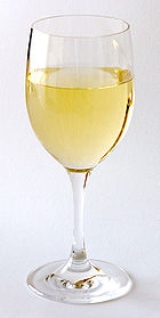
White Wine Glas
Regulations govern the classification and sale of wine in many regions of the world. European wines tend to be classified by region (e.g. Bordeaux
Bordeaux wine

A Bordeaux wine is any wine produced in the Bordeaux region of France. Average vintages produce over 700 million bottles of Bordeaux wine, although in good vintages, this total can exceed over 900 million, ranging from large quantities of everyday table wine, to some of the most expensive and prestigious wines in the world....
 and Chianti
Chianti

Chianti [Pronounced kee-ahn-tee] is a famous red wine of Italy, which takes its name from a traditional region of Tuscany where it is produced....
), while non-European wines are most often classified by grape (e.g. Pinot Noir
Pinot Noir

Pinot noir is a red wine grape variety of the species Vitis vinifera. The name may also refer to wines produced predominantly from Pinot noir grapes....
 and Merlot
Merlot

Merlot is a red wine grape that is used as both a blending grape and for varietal wines. Merlot-based wines usually have body with hints of berry, plum, and Zante currant....
). More and more, however, market recognition of particular regions is leading to their increased prominence on non-European wine labels. Examples of non-European recognized locales include Napa Valley
Napa Valley AVA

Napa Valley AVA is an American Viticultural Area located in Napa County, California, California, USA. Napa Valley is widely considered one of the top wine regions in California, and all of the United States, with a history dating back to the nineteenth century....
 in California
California

California is a U.S. state on the West Coast of the United States of the United States, along the Pacific Ocean. It is bordered by Oregon to the north, Nevada to the east, Arizona to the southeast, and to the south the Mexico state of Baja California....
, Willamette Valley
Willamette Valley

The Willamette Valley is the region in northwest Oregon in the United States that surrounds the Willamette River as it proceeds northward from its emergence from mountains near Eugene, Oregon to its confluence with the Columbia River at Portland, Oregon....
 in Oregon
Oregon

Oregon is a U.S. state in the Pacific Northwest region of the United States. The area was inhabited by many indigenous tribes before the arrival of traders, explorers and settlers....
, Barossa Valley
Barossa Valley

The Barossa Valley is a major list of wine-producing regions and tourism destination of South Australia, located 60 km northeast of Adelaide. It is the valley formed by the North Para River, and the Barossa Valley Way is the main road through the valley, connecting the main towns on the valley floor of Nuriootpa, South Australia, Tanunda, So...
 and Hunter Valley
Hunter Valley

The Hunter Region, more commonly known as the Hunter Valley, is a region of New South Wales, extending from approximately to north of Sydney, Australia with an approximate population of 590,000 people....
 in Australia
Australia

Australia, officially the Commonwealth of Australia, is a country in the southern hemisphere comprising the Australia of the world's smallest continent, the major island of Tasmania, and numerous list of islands of Australia in the Indian Ocean and Pacific Oceans....
, Central Valley in Chile
Chile

Chile, officially the Republic of Chile , is a country in South America occupying a long and narrow coastal strip wedged between the Andes mountains and the Pacific Ocean....
 and Marlborough
Marlborough, New Zealand

Marlborough is one of the List of regions in New Zealand, located in the northeast of the South Island. Marlborough is a unitary authority, both a region and a district, and its council is located at Blenheim, New Zealand....
 in New Zealand
New Zealand

New Zealand is an island country in the south-western Pacific Ocean comprising two main landmasses , and numerous Islands of New Zealand, most notably Stewart Island/Rakiura and the Chatham Islands....
.

Some blended wine names are marketing terms, and the use of these names is governed by trademark
TradeMark

TradeMark is a tall, primarily residential, skyscraper in Charlotte, North Carolina. It was completed in 2007 and has 28 floors. There are 200 hundred residential units....
 or copyright law rather than by specific wine laws. For example, Meritage
Meritage

Meritage is a word used to distinguish wines that are made in the style of red Bordeaux wine but without infringing on that region's legally protected designation of origin....
 (sounds like "heritage") is generally a Bordeaux-style blend of Cabernet Sauvignon
Cabernet Sauvignon

Cabernet Sauvignon is one of the world's most widely recognized red wine List of grape varieties. It is grown in nearly every major List of wine-producing countries among a diverse spectrum of climates from Canadian wine Okanagan Valley to Lebanese wine Beqaa Valley....
 and Merlot, and may also include Cabernet Franc
Cabernet Franc

Cabernet Franc is one of the major red grape varieties of the world. It is mostly grown for blending with Cabernet Sauvignon and Merlot in the Bordeaux style, but can also be vinified alone, such as the Chinon wine from the Loire ....
, Petit Verdot
Petit verdot

Petit verdot is a variety of red wine grape, principally used in classic Bordeaux blends. It ripens much later than the other varieties in Bordeaux, often too late, so it fell out of favour in its home region....
, and Malbec
Malbec

Malbec is a variety of grape used in winemaking red wine. The grapes tend to have an inky dark colour and robust tannins. Long known as one of the six grapes allowed in the blend of red Bordeaux wine, the French plantations of Malbec are now found primarily in Cahors in the South West France region....
. Commercial use of the term "Meritage" is allowed only via licensing agreements with an organization called the "Meritage Association".

Europe classification

France has an appellation
Appellation

An appellation is a geographical indication used to identify where the grapes for a wine were grown. Restrictions other than geographical boundaries, such as what grapes may be grown, maximum grape yields, alcohol level, and other quality factors, may also apply before an appellation name may legally appear on a wine bottle label....
 system based on the concept of terroir, with classifications which range from Vin de Table ("table wine") at the bottom, through Vin de Pays
Vin de pays

Vin de pays is a French language term meaning "country wine". Vins de pays are a step in the French wine classification which is above the table wine classification, but below the VDQS and Appellation d'origine contr?l?e classifications....
 and Vin Délimité de Qualité Supérieure (VDQS) up to Appellation d'Origine Contrôlée
Appellation d'Origine Contrôlée

Appellation d?origine contr?l?e , which translates as "controlled term of origin" is the French certification granted to certain France geographical indications for wines, cheeses, butters, and other agricultural products, all under the auspices of the government bureau Institut National des Appellations d'Origine ....
 (AOC). Portugal has something similar and, in fact, pioneered this technique back in 1756 with a royal charter which created the "Demarcated Douro Region" and regulated wine production and trade. Germany did likewise in 2002, although their system has not yet achieved the authority of those of the other countries'. Spain
Spain

Spain or the Kingdom of Spain , is a country located in Southern Europe on the Iberian Peninsula.The Spanish constitution does not establish any official denomination of the country, even though Espa?a , Estado espa?ol and Naci?n espa?ola are used interchangeably....
 and Italy
Italy

Italy , officially the Italian Republic , is a country located on the Italian Peninsula in Southern Europe and on the two largest islands in the Mediterranean Sea, Sicily and Sardinia....
 have classifications which are based on a dual system of region of origin and quality of product.

Outside of Europe

New World wine
New World wine

New World wines are those wines produced outside the traditional wine-growing areas of Europe, in particular from Argentine wine, Australian wine, Canadian wine, Chilean wine, New Zealand wine, South African wine, Mexican wine and American wine....
—wines from outside of the traditional wine growing regions of Europe tend to be classified by grape rather than by terroir or region of origin, although there have been non-official attempts to classify them by quality.

Vintages

A "vintage wine" is one made from grapes that were all or mostly grown in a particular year, and labeled as such. Most countries allow a vintage wine to include a portion that is not from the labeled vintage. Variations in a wine's character from year to year can include subtle differences in color, palate, nose, body and development. High-quality red table wines can improve in flavor with age if properly stored. Consequently, it is not uncommon for wine enthusiasts and traders to save bottles of an especially good vintage wine for future consumption.

In the United States
United States

The United States of America is a Federal government constitutional republic comprising U.S. state and a federal district. The country is situated mostly in central North America, where its Contiguous United States and Washington, D.C., the Capital districts and territories, lie between the Pacific Ocean and Atlantic Oceans, Borders of the U...
, for a wine to be vintage dated and labeled with a country of origin or American Viticultural Area
American Viticultural Area

An American Viticultural Area is a designated wine grape-growing region in the United States distinguishable by geography features, with boundaries defined by the Alcohol and Tobacco Tax and Trade Bureau , United States Department of the Treasury....
 (AVA) (such as "Sonoma Valley
Sonoma Valley

Sonoma Valley is the birthplace of the California wine industry and often called The Valley of the Moon. Sonoma Valley is home to some of the earliest vineyards and wineries in the state, some of which survived the phylloxera epidemic of the 1870s and the impact of Prohibition....
"), it must contain at least 95% of its volume from grapes harvested in that year. If a wine is not labeled with a country of origin or AVA the percentage requirement is lowered to 85%.

Vintage wines are generally bottled in a single batch so that each bottle will have a similar taste. Climate can have a big impact on the character of a wine to the extent that different vintages from the same vineyard can vary dramatically in flavor and quality. Thus, vintage wines are produced to be individually characteristic of the vintage and to serve as the flagship wines of the producer. Superior vintages, from reputable producers and regions, will often fetch much higher prices than their average vintages. Some vintage wines, like Brunello
Brunello di Montalcino

Brunello di Montalcino is a red Italian wine produced in the vineyards surrounding the town of Montalcino located about southwest of Florence in the Tuscany wine region....
s, are only made in better-than-average years.

Non-vintage wines can be blended from more than one vintage for consistency, a process which allows wine makers to keep a reliable market image and maintain sales even in bad years. One recent study suggests that for normal drinkers, vintage year may not be as significant to perceived wine quality as currently thought, although wine connoisseurs continue to place great importance on it.

Tasting

Wine tasting is the sensory examination and evaluation of wine. Wines are made up of chemical compounds which are similar or identical to those in fruits, vegetables, and spice
Spice

A spice is a dried seed, fruit, root, bark, leaf, or vegetable used in nutritionally insignificant quantities as a food additive for the purpose of flavor, color, or as a preservative that kills harmful bacteria or prevents their growth....
s. The sweetness of wine
Sweetness of wine

The sweetness of a wine is defined by the level of residual sugar in the fermentation process.Residual sugar is the measure of the amount of sugars that remain fermentation in the finished wine....
 is determined by the amount of residual sugar in the wine after fermentation, relative to the acidity present in the wine. Dry wine, for example, has only a small amount of residual sugar. Inexperienced wine drinkers often tend to mistake the taste of ripe fruit for sweetness when, in fact, the wine in question is very dry.

Individual flavors may also be detected, due to the complex mix of organic molecules such as ester
Ester

An ester is an often Aroma compound organic chemistry or partially organic compound formed by the reaction between an acid and an alcohol or aromatic alcohol with the elimination of water....
s and terpene
Terpene

Terpenes are a large and varied class of hydrocarbons, produced primarily by a wide variety of plants, particularly conifers, though also by some insects such as termites or swallowtail butterflies, which emit terpenes from their osmeterium....
s that grape juice and wine can contain. Tasters often can distinguish between flavors characteristic of a specific grape (e.g., Chianti
Chianti

Chianti [Pronounced kee-ahn-tee] is a famous red wine of Italy, which takes its name from a traditional region of Tuscany where it is produced....
 and sour cherry) and flavors that result from other factors in wine making, either intentional or not. The most typical intentional flavor elements in wine are those that are imparted by aging in oak casks; chocolate, vanilla, or coffee almost always come from the oak and not the grape itself.

Banana flavors (isoamyl acetate
Isoamyl acetate

Isoamyl acetate, also known as isopentyl acetate, is an organic compound that is the ester formed from isoamyl alcohol and acetic acid. It is a clear colorless liquid that is only slightly soluble in water, but very soluble in most organic solvents....
) are the product of yeast metabolism, as are spoilage aromas such as sweaty, barnyard, band-aid (4-ethylphenol
4-Ethylphenol

4-Ethylphenol, often abbreviated to 4-EP is a phenolic compound with the molecular formula C8H10O. In wine and beer it is produced by the spoilage yeast Brettanomyces....
 and 4-ethylguaiacol
4-Ethylguaiacol

4-Ethylguaiacol, often abbreviated to 4-EG, is a phenolic compound with the molecular formula C9H12O2. It is produced along with 4-Ethylphenol in wine and beer by the spoilage yeast Brettanomyces....
), and rotten egg (hydrogen sulfide
Hydrogen sulfide

Hydrogen sulfide is the chemical compound with the chemical formula Hydrogen2Sulfur. This colorless, toxic and flammable gas is partially responsible for the foul odor of egg and flatulence....
). Some varietals can also have a mineral flavor, because some salts are soluble in water (like limestone), and are absorbed by the wine.

Wine aroma comes from volatile compounds in the wine that are released into the air. Vaporization of these compounds can be sped up by twirling the wine glass or serving the wine at room temperature. For red wines that are already highly aromatic, like Chinon
Chinon

Chinon is a Communes of France in the Indre-et-Loire Departments of France in central France.In the Middle Ages, Chinon developed especially during the reign of Henry II ....
 and Beaujolais
Beaujolais

Beaujolais is a France Appellation d'Origine Contr?l?e wine generally made of the Gamay grape which has a thin skin and few tannins. Like most AOC wines they are not wine label varietally....
, many people prefer them chilled.

Collecting

Margaux94 1
At the highest end, rare, super-premium wines are the most expensive of all food, and outstanding vintages from the best vineyards may sell for thousands of dollars
United States dollar

The United States dollar is the unit of currency of the United States and was defined by the Coinage Act of 1792 to be between 371 and 416 grains of silver ....
 per bottle, though the broader term fine wine covers bottles typically retailing at over about $US 30-50. "Investment wines" are considered by some to be Veblen goods—that is, goods for which demand increases instead of decreases as its price rises. The most common wines purchased for investment include those from Bordeaux
Bordeaux wine

A Bordeaux wine is any wine produced in the Bordeaux region of France. Average vintages produce over 700 million bottles of Bordeaux wine, although in good vintages, this total can exceed over 900 million, ranging from large quantities of everyday table wine, to some of the most expensive and prestigious wines in the world....
, Burgundy
Burgundy wine

Burgundy wine is wine made in the Burgundy region in eastern France. The most famous wines produced here - those commonly referred to as Burgundies - are red wines made from Pinot Noir grapes or white wines made from Chardonnay grapes....
, cult wines from California
California

California is a U.S. state on the West Coast of the United States of the United States, along the Pacific Ocean. It is bordered by Oregon to the north, Nevada to the east, Arizona to the southeast, and to the south the Mexico state of Baja California....
 and elsewhere, and Vintage port
Port wine

Port wine is a Portuguese wine sherry from the Douro in the Norte, Portugal of Portugal. It is typically a sweet red wine, but also comes in dry, semi-dry and white varieties....
. Characteristics of highly collectible wines include:

  1. A proven track record of holding well over time
  2. A drinking window plateau (i.e., the period for maturity and approachability) that is many years long
  3. A consensus amongst experts as to the quality of the wines
  4. Rigorous production methods at every stage, including grape selection and appropriate barrel-ageing


Investment in fine wine has attracted fraudsters who prey on their victims' ignorance of this sector of the wine market.Couldn't find any evidence that this article ever existed Wine fraud
Wine fraud

Wine fraud is a form of fraud in which wines are sold to a customer illicitly, usually having the customer spend more money than the product is worth, or causing sickness due to harmful chemicals being mixed into the wine....
sters often work by charging excessively high prices for off-vintage or lower-status wines from famous wine regions, while claiming that they are offering a sound investment unaffected by economic cycles. Like any investment, proper research is essential before investing. Counterfeiting of labels and bottles is another scam that is sometimes encountered in auctions of famous wines such as 1982 Pétrus
Château Pétrus

P?trus is a red Bordeaux wine of the Pomerol Appellation d'Origine Contr?l?e made almost entirely from the Merlot grape. The estate belongs to the family of the Libourne wine merchant ?tablissements Jean-Pierre Moueix....
.

Production

Wine production by country 2006
Rank Country
(with link to wine article)
Production
(tonnes)
1France
French wine

French wine is produced in several regions throughout France, in quantities between 50 and 60 million hectolitres per year . France has the world's largest wine production ahead of Italian wine and the second-largest total vineyard area ....
 
5,349,333
2Italy
Italian wine

Italian wine is wine produced in Italy, a country which is home to some of the oldest wine-producing regions in the world. Etruscans and Greeks settlers produced wine in the country long before the Ancient Rome started developing their own vineyards in the second century BC....
 
4,711,665
3Spain
Spanish wine

Spanish wines are wines produced in the southwestern European country of Spain. Located on the Iberian Peninsula, Spain has over 2.9 million acres planted--making it the most widely planted wine producing nation but it is only the third largest producer of wine in the world, the largest being Italy and France....
 
3,643,666
4United States
American wine

American wine has been produced for over 300 years. Today, wine production is performed in all fifty states, with California wine leading the way in wine production followed by Washington wine, Oregon wine and New York wine....
 
2,232,000
5Argentina
Argentine wine

Argentine wine, as with some aspects of Cuisine of Argentina, has its roots in Spain. During the Spanish colonization of the Americas, Juan Cedr?n brought the first vine cuttings to Santiago del Estero in 1557, and the cultivation of the grape and wine production stretched first to neighbouring regions, and then to other parts of the co...
 
1,539,600
6Australia
Australian wine

The Australian wine industry is the fourth-largest exporter in the world, exporting over 400 million litres a year to a large international export market that includes "old world" wine-producing countries such as France, Italy and Spain....
 
1,410,483
71,400,000
8South Africa
South African wine

South African wine has a history dating back to 1659, and at one time Constantia, Cape Town was considered one of the greatest wines in the world....
 
1,012,980
9Chile
Chilean wine

Chilean wine is wine made in the South American country of Chile. The region has a long viticulture history for a New World wine region dating to the 16th century when the Spain conquistadors brought Vitis vinifera vines with them as they Spanish colonization of the Americas....
 
977,087
10Germany
German wine

German wine is primarily produced in the southwest of Germany, along river Rhine and its tributaries, with the oldest plantations going back to the Ancient Rome era....
 
891,600


Wine grapes grow almost exclusively between thirty and fifty degrees north or south of the equator
Equator

The equator is the intersection of the Earth's surface with the Plane perpendicular to the Earth's rotation and containing the Earth's center of mass....
. The world's southernmost vineyards are in the Central Otago
Central Otago

Central Otago is the inland part of the New Zealand Regions of New Zealand of Otago in the South Island. The area commonly known as Central Otago includes both the Central Otago District and the Queenstown-Lakes District to the west....
 region of New Zealand's South Island
South Island

The South Island is the larger of the two major Islands of New Zealand of New Zealand, the other being the more populous North Island. The Maori name for the South Island, Te Wai Pounamu, meaning "The Water/s of Greenstone" , possibly evolved from Te Wahi Pounamu which means "The Place Of Greenstone"....
 near the 45th parallel, and the northernmost are in Flen
Flen

Flen is a town in S?dermanland, Sweden and the seat of Flen Municipality, S?dermanland County.Flen evolved as a railway junction and got the title of a cities in Sweden in 1949....
, Sweden
Sweden

Sweden , officially the Kingdom of Sweden , is a Nordic countries on the Scandinavian Peninsula in Northern Europe. Sweden has land borders with Norway to the west and Finland to the northeast, and it is connected to Denmark by the ?resund Bridge in the south....
, just north of the 59th parallel.

Exporting countries

Top ten wine exporting countries in 2005
RankCountry1000 tonnes
1Italy
Italian wine

Italian wine is wine produced in Italy, a country which is home to some of the oldest wine-producing regions in the world. Etruscans and Greeks settlers produced wine in the country long before the Ancient Rome started developing their own vineyards in the second century BC....
 
1,552.10
2France
French wine

French wine is produced in several regions throughout France, in quantities between 50 and 60 million hectolitres per year . France has the world's largest wine production ahead of Italian wine and the second-largest total vineyard area ....
 
1,367.86
3Spain
Spanish wine

Spanish wines are wines produced in the southwestern European country of Spain. Located on the Iberian Peninsula, Spain has over 2.9 million acres planted--making it the most widely planted wine producing nation but it is only the third largest producer of wine in the world, the largest being Italy and France....
 
1,364.75
4Australia
Australian wine

The Australian wine industry is the fourth-largest exporter in the world, exporting over 400 million litres a year to a large international export market that includes "old world" wine-producing countries such as France, Italy and Spain....
 
695.51
5Chile
Chilean wine

Chilean wine is wine made in the South American country of Chile. The region has a long viticulture history for a New World wine region dating to the 16th century when the Spain conquistadors brought Vitis vinifera vines with them as they Spanish colonization of the Americas....
 
422.42
6South Africa
South African wine

South African wine has a history dating back to 1659, and at one time Constantia, Cape Town was considered one of the greatest wines in the world....
 
349.28
7United States
American wine

American wine has been produced for over 300 years. Today, wine production is performed in all fifty states, with California wine leading the way in wine production followed by Washington wine, Oregon wine and New York wine....
 
345.92
8Germany
German wine

German wine is primarily produced in the southwest of Germany, along river Rhine and its tributaries, with the oldest plantations going back to the Ancient Rome era....
 
284.50
9Moldova
Moldovan wine

Moldova has a well established wine industry. It has a vineyard area of ., of which are used for commercial production. Most of the country's wine production is for export....
 
254.18
10Portugal
Portuguese wine

Portuguese wine is part of the ancient traditions introduced to the region by ancient civilizations such as the Phoenicians, Carthaginians, Greeks, and mostly the Roman Empire....
 
251.47
7,929.85
2005 Export market shares
RankCountryMarket share
(% of value in US$)
1France
French wine

French wine is produced in several regions throughout France, in quantities between 50 and 60 million hectolitres per year . France has the world's largest wine production ahead of Italian wine and the second-largest total vineyard area ....
 
34.01%
2Italy
Italian wine

Italian wine is wine produced in Italy, a country which is home to some of the oldest wine-producing regions in the world. Etruscans and Greeks settlers produced wine in the country long before the Ancient Rome started developing their own vineyards in the second century BC....
 
18.03%
3Australia
Australian wine

The Australian wine industry is the fourth-largest exporter in the world, exporting over 400 million litres a year to a large international export market that includes "old world" wine-producing countries such as France, Italy and Spain....
 
10.24%
4Spain
Spanish wine

Spanish wines are wines produced in the southwestern European country of Spain. Located on the Iberian Peninsula, Spain has over 2.9 million acres planted--making it the most widely planted wine producing nation but it is only the third largest producer of wine in the world, the largest being Italy and France....
 
9.18%
5Chile
Chilean wine

Chilean wine is wine made in the South American country of Chile. The region has a long viticulture history for a New World wine region dating to the 16th century when the Spain conquistadors brought Vitis vinifera vines with them as they Spanish colonization of the Americas....
 
4.13%
6Germany
German wine

German wine is primarily produced in the southwest of Germany, along river Rhine and its tributaries, with the oldest plantations going back to the Ancient Rome era....
 
3.25%
7Portugal
Portuguese wine

Portuguese wine is part of the ancient traditions introduced to the region by ancient civilizations such as the Phoenicians, Carthaginians, Greeks, and mostly the Roman Empire....
 
3.17%
8United States
American wine

American wine has been produced for over 300 years. Today, wine production is performed in all fifty states, with California wine leading the way in wine production followed by Washington wine, Oregon wine and New York wine....
 
3.00%
9South Africa
South African wine

South African wine has a history dating back to 1659, and at one time Constantia, Cape Town was considered one of the greatest wines in the world....
 
2.90%
10New Zealand
New Zealand wine

New Zealand wine is largely produced in ten major list of wine-producing regions spanning latitudes 36? to 45? South and extending 1,600 km . They are, from north to south Northland Region, Auckland , Waikato/Bay of Plenty, Gisborne, Hawke's Bay, Wellington Region, Nelson, New Zealand, Marlborough, New Zealand, Canterbury, New Zealand and C...
 
1.61%


Uses

Wine Consumption World Map
Wine is a popular and important beverage that accompanies and enhances a wide range of European and Mediterranean
Mediterranean diet

The Mediterranean diet is a modern nutritional recommendation inspired by the traditional dietary patterns of some of the countries of the Mediterranean Basin....
-style cuisine
Cuisine

Cuisine is a specific set of cooking traditions and practices, often associated with a specific culture. A cuisine is primarily influenced by the ingredients that are available locally or through trade....
s, from the simple and traditional to the most sophisticated and complex. Wine is important in cuisine not just for its value as a beverage, but as a flavor agent, primarily in stock
Stock (food)

Stock is a flavoured liquid. It forms the basis of many dishes, particularly soups and sauces. Stock is prepared by simmering various ingredients in water, including some or all of the following:...
s and braising
Braising

File:Potroast.JPG#fileBraising , is a combination cooking method using both moist and dry heat; typically the food is first seared at a high temperature and then finished in a covered pot with a variable amount of liquid, resulting in a particular flavour....
, since its acidity lends balance to rich savory or sweet dishes. Red, white and sparkling wines are the most popular, and are known as light wines because they are only 10–14% alcohol
Alcohol

In chemistry, an alcohol is any organic compound in which a hydroxyl Functional group is bound to a carbon atom of an alkyl or substituted alkyl group....
-content by volume. Apéritif
Aperitif

An ap?ritif is an Distilled beverage that is usually served to stimulate the appetite before a meal, as opposed to a digestif, which is said to come after the meal....
 and dessert wine
Dessert wine

Dessert wines are sweet wines typically served with dessert, such as Sauternes and Tokaji. Despite the name, they are often best appreciated alone, or with fruit or bakery sweets....
s contain 14–20% alcohol, and are sometimes fortified to make them richer and sweeter.

Some wine labels suggest opening the bottle and letting the wine "breathe" for a couple hours before serving, while others recommend drinking it immediately. Decanting
Decanter

A decanter is a vessel that is used to hold the decantation of a liquid which may contain sediment.Decanters are normally used as serving vessels for wine....
—the act of pouring a wine into a special container just for breathing—is a controversial subject in wine. In addition to aeration, decanting with a filter allows one to remove bitter sediments that may have formed in the wine. Sediment is more common in older bottles but younger wines usually benefit more from aeration.

During aeration, the exposure of younger wines to air often "relaxes" the flavors and makes them taste smoother and better integrated in aroma, texture, and flavor. Older wines generally fade, or lose their character and flavor intensity, with extended aeration. Despite these general rules, breathing does not necessarily benefit all wines. Wine should be tasted as soon as it is opened to determine how long it should be aerated, if at all.

Religious uses

Mei
The use of wine in religious ceremonies is common to many cultures and regions. Libation
Libation

A libation is a ritual pouring of a drink as an offering to a deity. It was common in the religions of Ancient history, including Judaism:Isaiah uses libation as a metaphor when describing the end of the Suffering Servant figure who: "poured out his life unto death"....
s often included wine, and the religious mysteries
Dionysian Mysteries

The Dionysian Mysteries probably began as an ancient initiation society, or family of similar societies, centred on a primeval nature god , apparently associated with horned animals, serpents and solitary predators , later known to the Greeks in the eclectic figure of Dionysus....
 of Dionysus used wine as a sacramental entheogen
Entheogen

An entheogen , in the strictest sense, is a psychoactive substance used in a religion or shamanism context. Historically, entheogens are derived primarily from plant sources and have been used in a variety of traditional religious contexts....
 to induce a mind-altering state.

Wine is an integral part of Jewish laws and traditions
Halakha

Halakha ? also Hebrew transliteration Halocho and Halacha ? is the collective body of Judaism religious law, including biblical law and later talmudic and rabbinic law, as well as customs and traditions....
. The Kiddush
Kiddush

Kiddush is a blessing recited over wine or grape juice to sanctify the Shabbat or a Jewish holiday. The Torah refers to two requirements concerning Shabbat - to "keep it" and to "remember it" ....
 is a blessing recited over wine or grape juice to sanctify the Shabbat
Shabbat

Shabbat or Shabbos , is the weekly day of rest in Judaism, symbolizing the seventh day in Genesis, after the six days of creation. Though it is commonly said to be the Saturday of each week, it is observed from sundown on Friday until the appearance of three stars in the sky on Saturday night....
 or a Jewish holiday
Jewish holiday

A Jewish holiday or festival is a day or series of days observed by Jews as a holy or secular commemoration of an important event in Jewish history....
. On Pesach (Passover
Passover

Passover is a Jewish and Samaritan holy day and festival commemorating God sparing the Israelites when He killed the first born of Egypt, and is followed by the seven day Feast of the Unleavened Bread commemorating the Exodus from Ancient Egypt and the liberation of the Israelites from Judaism and slavery....
) during the Seder, it is a Rabbinic obligation of men and women to drink four cups of wine. In the Tabernacle and in the Temple in Jerusalem
Temple in Jerusalem

The Temple in Jerusalem or Holy Temple , refers to a series of structures located on the Temple Mount in the old city of Jerusalem. Historically, two temples were built at this location, and a The Third Temple features in Jewish eschatology....
, the libation of wine was part of the sacrificial service. Note that this does not mean that wine is a symbol of blood, a common misconception which contributes to the myth of the blood libel
Blood libel

Blood libels are sensationalized allegations that a person or group engages in human sacrifice, often accompanied by the claim that the blood of victims is used in various rituals and/or acts of cannibalism....
. A blessing over wine said before indulging in the drink is: "Baruch atah Hashem elokeinu melech ha-olam, boray p’ree hagafen"—"Praised be the Eternal, Ruler of the universe, who makes the fruit of the vine."

In Christianity
Christianity

Christianity is a Monotheistic religion #Christian view religion centered on the life and teachings of Jesus as New Testament view on Jesus' life....
, wine or grape juice is used in a sacred rite called the Eucharist
Eucharist

The Eucharist, also called Holy Communion or Lord's Supper and other names, is a Christianity sacrament commemorating, by consecrating bread and wine, the Last Supper, the final meal that Jesus Christ shared with his disciples before his arrest, and eventual crucifixion, when he gave them bread saying, "This is my body", and wine...
, which originates in Gospel
Gospel

In Christianity, a gospel is generally one of the first four books of the New Testament that describe the birth, life, ministry, crucifixion, and resurrection of Jesus....
 accounts of the Last Supper
Last Supper

In the Christian Gospels, the Last Supper was the last meal Jesus shared with his Twelve Apostles and Disciple before Crucifixion of Jesus. The Last Supper has been the subject of many paintings, perhaps The Last Supper by Leonardo da Vinci....
 in which Jesus
Jesus

Jesus of Nazareth , also known as Jesus Christ, is the central figure of Christianity and is revered by most Christian churches as the Son of God and the Incarnation ....
 shared bread and wine with his disciples and commanded his followers to "do this in remembrance of me" (Gospel of Luke
Gospel of Luke

The Gospel of Luke is a Synoptic Gospels, and is the third and longest of the four Biblical canonical Gospels of the New Testament. The text narrates the life of Jesus of Nazareth....
 22:19). Beliefs about the nature of the Eucharist vary among denominations
Christian denomination

A Christian denomination is an identifiable religious body under a common name, structure, and doctrine within Christianity.Worldwide, Christians are divided, often along ethnic and linguistic lines, into separate churches and traditions....
; Roman Catholics, for example, hold that the bread and wine are changed into the real body and blood of Christ in a process called transubstantiation
Transubstantiation

In Roman Catholic theology, transubstantiation is the change of the Substance theory of Host and Sacramental wine into the Body of Christ and Blood of Christ occurring in the Eucharist while all that is accessible to the senses remain as before....
.

Wine was used in the Eucharist by all Protestant groups until an alternative arose in 1869. Methodist
Methodism

Methodism is a movement of Protestant Christianity represented by John Wesley and his younger brother Charles Wesley that sought to keep Methodism as a Revivalism movement within the Church of England....
 minister
Minister of religion

In Christian Church body, a minister is someone who is authorized by a church or religious organization to perform clergy functions such as teaching of beliefs; performing services such as weddings, baptisms or funerals; or otherwise providing spiritual guidance to the community....
-turned-dentist Thomas Bramwell Welch
Thomas Bramwell Welch

Thomas Bramwell Welch was the discoverer of the pasteurization process to prevent the fermentation of grape juice....
 applied new pasteurization
Pasteurization

Pasteurization is a process which slows microbial growth in foods. The process was named after its creator, France chemist and microbiologist Louis Pasteur....
 techniques to stop the natural fermentation process of grape juice
Grape juice

Grape juice is a juice obtained from crushing grapes. The juice is often fermentation and made into wine, brandy, or vinegar. In the wine industry grape juice which contains 7-23 percent of pulp, skins, stems and seeds, is often referred to as "must"....
. Some Christians who were part of the growing temperance movement
Temperance movement

A temperance movement attempts to reduce the amount of alcohol consumed within a community or society in general -- and even to prohibit its production and consumption entirely....
 pressed for a switch from wine to grape juice, and the substitution spread quickly over much of the United States. (However, in such rites the beverage is usually still called "wine" in accordance with scriptural references.) There remains an ongoing debate between some American Protestant denominations as to whether wine can and should be used for the Eucharist or allowed as a regular beverage.

The use of wine is forbidden under Islamic law. Iran used to have a thriving wine industry that disappeared after the Islamic Revolution
Iranian Revolution

The Iranian Revolution was the revolution that transformed Iran from a Iranian monarchy under Shah Mohammad Reza Pahlavi to an Islamic republic under Ayatollah Ruhollah Khomeini, the leader of the revolution and founder of the Islamic Republic....
 in 1979.

Health effects


Although excessive alcohol consumption has adverse health effects, epidemiological studies have consistently demonstrated that moderate consumption of alcohol and wine is statistically associated
Association (statistics)

In statistics, an association comes from two variables that are related and is often confused with causality though association does not imply a causal relationship....
 with a decrease in death due to cardiovascular events such as heart failure. In the United States
United States

The United States of America is a Federal government constitutional republic comprising U.S. state and a federal district. The country is situated mostly in central North America, where its Contiguous United States and Washington, D.C., the Capital districts and territories, lie between the Pacific Ocean and Atlantic Oceans, Borders of the U...
, a boom in red wine consumption was initiated in the 1990s by the TV show 60 Minutes
60 Minutes

or 60 Minutes 60 Minutes is an United States investigative television newsmagazine on United States television, which has run on CBS News since 1968....
, and additional news reports on the French paradox
French paradox

The French paradox is the observation that France suffer a relatively low incidence of coronary heart disease, despite having a diet relatively rich in saturated fats....
. The French paradox refers to the comparatively lower incidence of coronary heart disease
Coronary heart disease

Coronary artery disease is the end result of the accumulation of atheroma within the walls of the Coronary circulation that supply the myocardium with oxygen and nutrients....
 in France despite high levels of saturated fat
Saturated fat

Saturated fat is fat that consists of triglycerides containing only Saturation fatty acid radicals. There are several kinds of naturally occurring saturated fatty acids, which differ by the number of carbon atoms - from 1 to 24....
 in the traditional French diet. Some epidemiologists suspect that this difference is due to the higher consumption of wines by the French, but the scientific evidence for this theory is limited. The average moderate wine drinker is more likely to exercise more, to be more health conscious, and to be of a higher educational and socioeconomic class, evidence that the association between moderate wine drinking and health may be related to confounding factors.

Population studies have observed a J curve
J curve

The term J-curve is used in several different fields to refer to a variety of unrelated J-shaped diagrams where a curve initially falls, but then rises to higher than the starting point....
 association between wine consumption and the risk of heart disease. This means that heavy drinkers have an elevated risk, while moderate drinkers (at most two five-ounce servings of wine per day) have a lower risk than non-drinkers. Studies have also found that moderate consumption of other alcoholic beverages may be cardioprotective, although the association is considerably stronger for wine. Also, some studies have found increased health benefits for red wine over white wine, though other studies have found no difference. Red wine contains more polyphenol
Polyphenol

Polyphenols are a group of chemical substances found in plants, characterized by the presence of more than one phenol unit or building block per molecule....
s than white wine, and these are thought to be particularly protective against cardiovascular disease.

A chemical in red wine called resveratrol
Resveratrol

Resveratrol is a phytoalexin produced naturally by several plants when under attack by pathogens such as bacteria or fungi. Resveratrol has also been produced by chemical synthesis and is sold as a nutritional supplement derived primarily from Japanese knotweed....
 has been shown to have both cardioprotective and chemoprotective effects in animal studies. Low doses of resveratrol in the diet of middle-aged mice has a widespread influence on the genetic levers of aging and may confer special protection on the heart. Specifically, low doses of resveratrol mimic the effects of what is known as caloric restriction - diets with 20-30 percent fewer calories than a typical diet. Resveratrol is produced naturally by grape skins in response to fungal infection, including exposure to yeast during fermentation
Fermentation (wine)

The process of Fermentation in wine is the catalyst function that turns grape juice into an alcoholic beverage. During fermentation yeast interact with sugars in the juice to create ethanol, commonly known as ethyl alcohol, and carbon dioxide ....
. As white wine has minimal contact with grape skins during this process, it generally contains lower levels of the chemical. Other beneficial compounds in wine include other polyphenols, antioxidant
Antioxidant

An antioxidant is a molecule capable of slowing or preventing the Redox of other molecules. Oxidation is a chemical reaction that transfers electrons from a substance to an oxidizing agent....
s, and flavonoid
Flavonoid

The term flavonoid refers to a class of plant secondary metabolites. According to the IUPAC nomenclature, they can be classified into:*flavonoids, derived from 2-phenylchromone structure...
s.

Red wines from the south of France and from Sardinia
Sardinia

Sardinia is the Mediterranean islands#By area island in the Mediterranean Sea . The area of Sardinia is . The island is surrounded by the France island of Corsica, the Italian Peninsula, Tunisia and the Balearic Islands....
 in Italy have been found to have the highest levels of procyanidins
Proanthocyanidin

Proanthocyanidin is a class of flavanols. Proanthocyanidins are essentially polymer chains of flavonoids such as catechins. One was discovered in 1936 by Professor Jacques Masquelier and called Vitamin P, although this name did not gain official category status and has since fallen out of usage....
, which are compounds in grape seeds suspected to be responsible for red wine's heart benefits. Red wines from these areas have between two and four times as much procyanidins as other red wines. Procyanidins suppress the synthesis of a peptide called endothelin-1 that constricts blood vessels.

A 2007 study found that both red and white wines are effective anti-bacterial agents against strains of Streptococcus
Streptococcus

Streptococcus is a genus of sphere Gram-positive bacterium belonging to the phylum Firmicutes and the lactic acid bacteria group. Cell division occurs along a single Coordinate axis in these bacteria, and thus they grow in chains or pairs, hence the name — from Greek language st?ept?? streptos, meaning easily bent or twisted,...
. Also, a report in the October 2008 issue of Cancer Epidemiology, Biomarkers and Prevention, posits that moderate consumption of red wine may decrease the risk of lung cancer
Lung cancer

Lung cancer is a disease of uncontrolled cell growth in tissue of the lung. This growth may lead to metastasis, which is the invasion of adjacent tissue and infiltration beyond the lungs....
 in men.

While evidence from laboratory and epidemiological (observational) studies suggest a cardioprotective effect, no controlled studies have been completed on the effect of alcoholic drinks on the risk of developing heart disease or stroke. Excessive consumption of alcohol can cause cirrhosis
Cirrhosis

Cirrhosis is a consequence of chronic liver disease characterized by replacement of liver Tissue by fibrous scar tissue as well as regenerative Nodule , leading to progressive loss of liver function....
 of the liver and alcoholism
Alcoholism

Alcoholism is a term with multiple and sometimes conflicting definitions to describe the detrimental effects of alcohol intake.In common and historic usage, alcoholism refers to any condition that results in the continued consumption of alcoholic beverages despite health problems and negative social consequences....
; the American Heart Association
American Heart Association

The American Heart Association is a non-profit organization in the United States that fosters appropriate Heart care in an effort to reduce disability and deaths caused by cardiovascular disease and stroke....
 cautions people to "consult your doctor on the benefits and risks of consuming alcohol in moderation."

Wine's effect on the brain is also under study. One study concluded that wine made from the Cabernet Sauvignon
Cabernet Sauvignon

Cabernet Sauvignon is one of the world's most widely recognized red wine List of grape varieties. It is grown in nearly every major List of wine-producing countries among a diverse spectrum of climates from Canadian wine Okanagan Valley to Lebanese wine Beqaa Valley....
 grape reduces the risk of Alzheimer's Disease
Alzheimer's disease

Alzheimer's disease , also called Alzheimer disease, Senile Dementia of the Alzheimer Type or simply Alzheimer's, is the most common form of dementia....
. Another study concluded that among alcoholics, wine damages the hippocampus to a greater degree than other alcoholic beverages.

Sulphites are present in all wines and are formed as a natural product of the fermentation process, and many wine producers add sulfur dioxide
Sulfur dioxide

Sulfur dioxide is the chemical compound with the formula SO2. It is produced by volcanoes and in various industrial processes. Since coal and petroleum often contain sulfur compounds, their combustion generates sulfur dioxide....
 in order to help preserve wine. Sulfur dioxide is also added to foods such as dried apricot
Apricot

The Apricot is a species of Prunus, classified with the plum in the subgenus Prunus. The native range is somewhat uncertain due to its extensive prehistoric cultivation, but most likely in northern and western China and Central Asia, possibly also Korea and Japan....
s and orange juice
Orange juice

Orange juice is a popular beverage. It is a source of vitamin C , potassium, folic acid . Citrus juices also contain flavonoids that are believed to have beneficial health effects....
. The level of added sulfites varies, and some wines have been marketed with low sulfite content. Sulphites in wine can cause some people, particularly those with asthma
Asthma

Asthma is a common chronic obstructive pulmonary disease, in which the Lung constrict, become inflammation, and are lined with excessive amounts of thickened mucus, often in response to one or more triggers....
, to have adverse reactions.

Packaging

Corks019
Most wines are sold in glass bottles
Wine bottle

A wine bottle is a bottle used for holding wine, generally made of glass. Some wines are fermentation in the bottle, others are bottled only after fermentation....
 and are sealed using corks
Cork (material)

Cork material is a prime-subset of generic Cork cambium, harvested for commercial use primarily from the Cork Oak tree, Quercus suber, with Portugal producing 50% of cork worldwide....
. An increasing number of wine producers have been using alternative closures
Alternative wine closures

Alternative wine closures are substitute closure s used in the wine industry for sealing wine bottles in place of traditional Cork closures. The emergence of these alternatives has grown in response to quality control efforts by winemakers to protect against "cork taint" caused by the presence of the chemical Trichloroanisole or ....
 such as screwcaps or synthetic plastic
Plastic

Plastic is the general common term for a wide range of synthetic or semisynthetic organic chemistry solid materials suitable for the manufacture of industrial products....
 "corks". In addition to being less expensive, alternative closures prevent cork taint
Cork taint

Cork taint is a broad term referring to a set of undesirable smells or tastes found in a bottle of wine, especially spoilage that can only be detected after bottling, aging of wine and opening....
, although they have been blamed for other problems such as excessive reduction.

Some wines are packaged in heavy plastic bags within cardboard boxes, and are called box wine
Box wine

A box wine is a wine packaged as a Bag-In-Box#Wine_Casks. Such packages contain a plastic wikt:bladder protected by a box, usually made of corrugated cardboard....
s
, or cask wine. These wines are typically accessed via a tap on the side of the box. Box wine can maintain an acceptable degree of freshness for up to a month after opening, while bottled wine will more rapidly oxidize, and is considerably degraded within a few days.

Environmental considerations of wine packaging reveal benefits and drawbacks of both bottled and box wines. Glass used to make bottles has a decent environmental reputation, as it is completely recyclable, whereas plastics as used in box wines are typically considered to be much less environmentally friendly. However, wine bottle manufacturers have been cited for Clear Air Act violations. A New York Times editorial puported that box wine, being lighter in package weight, has a reduced carbon footprint
Carbon footprint

A carbon footprint is ?the total set of GHG emissions caused directly and indirectly by an individual,organization, event or product? . An individual, nation or organization's carbon footprint is measured by undertaking a GHG emissions assessment....
 from its distribution. Boxed wine plastics, even though possibly recyclable, can be more labor-intensive (and so expensive) to process than glass bottles. And while a wine box is recyclable, its plastic wine bladder most likely isn't.

Storage

Wine cellar
Wine cellar

A wine cellar is a storage room for wine in bottles or barrels, or more rarely in carboys, amphorae or plastic containers. In an active wine cellar, important factors such as temperature and humidity are maintained by a climate control system....
s
, or wine rooms if they are above-ground, are places designed specifically for the storage and aging of wine. In an active wine cellar, temperature and humidity are maintained by a climate control system. Passive wine cellars are not climate-controlled, and so must be carefully located. Wine is a natural, perishable food product; when exposed to heat, light, vibration or fluctuations in temperature and humidity, all types of wine, including red, white, sparkling, and fortified, can spoil. When properly stored, wines can maintain their quality and in some cases improve in aroma, flavor, and complexity as they age. Consensus among wine experts is that the optimal temperature for aging wine is 55 °F(12.8 °C).

Related professions
NameDescription
Cooper
Cooper (profession)

Traditionally, a cooper is someone who makes wooden staff vessels of a conical form, of greater length than breadth, bound together with hoops and possessing flat ends or heads....
Craftsman of wooden barrels and casks.
Garagiste
Garagistes

The garagistes refers to a group of innovative winemakers in the Bordeaux region, producing "Vins de garage", "Garage wine". A group emerged in the mid 1990s in reaction to the traditional style of red Bordeaux wine, which is highly tannic and requires long ageing in the bottle to become drinkable....
An amateur wine maker, or a derogatory term used for small scale operations of recent inception, usually without pedigree and located in Bordeaux.
Négociant
Négociant

A n?gociant is the French language term for a wine merchant who assembles the produce of smaller growers and winemakers and sells the result under its own name....
A wine merchant, most specifically those who assemble the produce of smaller growers and winemakers and sells them under their own name.
OenologistWine scientist or wine chemist; a student of oenology
Oenology

Oenology, ?nology , or enology is the science and study of all aspects of wine and winemaking except vine growing and grape harvesting, which are a subfield called viticulture....
. A winemaker may be trained as oenologist, but often hires a consultant instead.
Sommelier
Sommelier

A sommelier , or wine steward, is a trained and knowledgeable wine professional, commonly working in fine restaurants, who specializes in all aspects of wine service....
A restaurant specialist in charge of assembling the wine list
Wine list

File:Winelistcover.jpgA wine list is a menu of wine selections for purchase, typically in a restaurant setting. A restaurant may include a list of available wines on its main menu, but usually provides a separate menu just for wines....
, educating the staff about wine, and assisting customers with their wine selections.
VintnerA wine merchant or producer.
ViticulturistA person who specializes in the science of grapevines. Can also be someone who manages vineyard pruning, irrigation, and pest control.
WinemakerA person who makes wine and is not necessarily formally trained.


Film and television

  • Falcon Crest
    Falcon Crest

    Falcon Crest is an United States primetime television soap opera which aired on the CBS network for nine seasons, from December 4, 1981 to May 17, 1990....
    , USA 1981–1990: A popular CBS
    CBS

    CBS Broadcasting Inc. is an American radio network and television network. The name is derived from the initials of Columbia Broadcasting System, its former legal name....
     primetime soap opera about the fictional Falcon Crest winery and the family who owned it, set in a fictional "Tuscany Valley" in California. A wine named "Falcon Crest" even went on the market.
  • A Walk in the Clouds
    A Walk in the Clouds

    A Walk in the Clouds is a 1995 in film United States romance film drama film directed by Alfonso Arau. The screenplay by Robert Mark Kamen, Mark Miller , and Harvey Weitzman is based on the 1942 in film Italy film Quattro Passi Fra Le Nuvole by Piero Tellini, Cesare Zavattini, and Vittorio de Benedetti....
     1995. A love story set in a Mexican-American family's traditional vineyard showcasing different moments in the production of wine.
  • Mondovino
    Mondovino

    Mondovino is a 2004 in film documentary film on the impact of globalization on the world's different wine regions written and Film director by American film maker Jonathan Nossiter....
    , USA/France 2004. A documentary film directed by American film maker Jonathan Nossiter
    Jonathan Nossiter

    Award winning film director Jonathan Nossiter, son of Washington Post and New York Times foreign correspondent Bernard Nossiter, was born in the United States in 1961....
    , exploring the impact of globalization
    Globalization

    Globalization in its literal sense is the process of transformation of local or regional phenomena into global ones. It can be described as a process by which the people of the world are unified into a single society and function together....
     on various wine-producing regions.
  • Sideways
    Sideways

    Sideways is an United States comedy-drama film written by Jim Taylor and Alexander Payne and directed by Payne. Adapted from Rex Pickett's Sideways , Sideways follows two forty-something men, portrayed by Paul Giamatti and Thomas Haden Church, who take a week-long road trip to the wine country of Santa Barbara....
    , 2004. A comedy/drama film, directed by Alexander Payne
    Alexander Payne

    Constantine Alexander Payne is an United States film director and screenwriter. His films are noted for their dark humour and satire depictions of contemporary American society....
    , with the tagline: "In search of wine. In search of women. In search of themselves." Wine, particularly Pinot Noir
    Pinot Noir

    Pinot noir is a red wine grape variety of the species Vitis vinifera. The name may also refer to wines produced predominantly from Pinot noir grapes....
    , plays a central role.
  • A Good Year
    A Good Year

    A Good Year is a 2006 in film romantic comedy film, set in London and Provence. It was directed by Ridley Scott, with an international cast including Russell Crowe, Marion Cotillard, Abbie Cornish and Albert Finney....
    , 2006. Ridley Scott directs Russell Crowe in an adaptation of Peter Mayle's novel.
  • Oz and James's Big Wine Adventure
    Oz and James's Big Wine Adventure

    Oz and James's Big Wine Adventure is a BBC television programme of which two series have been broadcast. It is presented by wine expert Oz Clarke and motoring journalist James May , with Clarke aiming to educate May about wine while undertaking a road trip....
    , UK 2006–7. "Wine ponce" Oz Clarke
    Oz Clarke

    Oz Clarke is a United Kingdom wine writer and broadcaster....
     tries to teach motor head James May about wine. The first series saw them traveling through the wine regions of France, and the second series saw them drive throughout California.
  • Crush, USA 2007. Produced and directed by Bret Lyman
    Bret Lyman

    Bret Mathew Lyman is a film director, Film producer, and film editing. Lyman has comprehensive portfolio including film, music video and television commercial credits....
    , this is a documentary short that covers the 2006 grape harvest and crush in California's wine country. It also features winemaker Richard Bruno.
  • Bottle Shock
    Bottle Shock

    Bottle Shock is a 2008 film that tells the story of the events that led up to the Judgment of Paris in 1976, when California wine beat French wine in a blind taste test....
     (USA 2008) tells a story centered around the Paris Wine Tasting of 1976, in addition to portraying the birth of the Napa wine industry.
  • The Judgment of Paris (in production, USA 2010) is to based on journalist George M. Taber
    George M. Taber

    Journalist and entrepreneur George M. Taber was a reporter and editor with Time magazine in the United States and Europe for 21 years, working in Brussels, Bonn, Houston, Washington, DC, and New York....
    's account of the same Paris Wine Tasting of 1976 that was fictionalized in Bottle Shock.


See also


Further reading


External links

  • by wine writer Jamie Goode
    Jamie Goode

    Jamie Goode is a United Kingdom author with a Doctor of Philosophy in Botany, and a wine columnist of Daily Express#Sunday Express. Goode also contributes to wine publications such as Harpers Magazine, The World of Fine Wine and Decanter ....