


Imperator totius Hispaniae

Encyclopedia
Imperator totius Hispaniae is a Latin title meaning "Emperor of all Spain". In Spain in the Middle Ages
, the title "emperor" (from Latin imperator
) was used under a variety of circumstances from the ninth century onwards, but its usage peaked, as a formal and practical title, between 1086 and 1157. It was primarily used by the Kings of León
and Castile, but it also found currency in the Kingdom of Navarre
and was employed by the Counts of Castile and at least one Duke of Galicia
. It signalled at various points the king's equality with the Byzantine Emperor and Holy Roman Emperor
, his rule by conquest or military superiority, his rule over several people groups ethnic or religious, and his claim to suzerainty
over the other kings of the peninsula, both Christian and Muslim. The use of the imperial title received scant recognition outside of Spain and it had become largely forgotten by the thirteenth century.
The analogous feminine title, "empress" (Latin imperatrix), was less frequently used and in only a handful of cases did it refer to a queen regnant and not a consort of the emperor.
of the Diocese of Mondoñedo and Bishop Gonzalo
, designed to bolster that church's claims in a dispute of 1102. The first document, dated to 866 or 867, confirmed by Alfonso, who signs as "I, Alfonso, of all Spain emperor, who is unworthily permitted to be called the Catholic". The other refers to him simply as "Alfonso, Emperor of Spain" (Adefonsus Hispaniae imperator). The forger may have borrowed these exalted titles from the chancery of Alfonso VI, who was using the title imperator totius Hispaniae at the time. The subscription lists of both these charters (that is, the list of those who witnessed or confirmed them) are compatible with the dates, and it has been suggested that the clauses referring to Alfonso as emperor are derived from authentic (albeit now lost) charters.
There exists a letter purportedly written by Alfonso III to the clergy of the Cathedral of Tours
in 906, wherein the king is arranging to purchase an "imperial crown made of gold and precious stones, fitting to his dignity" (corona imperialis) kept at Tours. Alfonso almost invariably calls himself simply "King Alfonso" (Adefonsus rex) in his surviving charters, but in the letter he uses the elaborate and high-ranking style "Alfonso by the power and assent of Christ king of Spain" (Adefonsus pro Christi nutu at que potentia Hispaniae rex). A similarly grandiose title is given to Alfonso in the contemporary Chronica Prophetica
(883): "glorious Alfonso in all the Spains to reign" (gloriosus Adefonsus in omni Spanie regnaturus). The authenticity of the letter is still debated.
Besides the apocryphal charters, there are genuine, posthumous documents referring to Alfonso as emperor. In one that dates from 917, in the reign of his son Ordoño II of León
, the king confirms as "Ordoño, son of the Emperor Alfonso the Great" (Ordonius, filius Adephonsi Magni imperatoris). A document from 950 can also be cited that refers to Alfonso with the imperial title. The pertinent passage reads: "They put in place a border with Gonzalo, son of our lord emperor Prince Alfonso".
(931–51), is not titled "emperor" in any contemporary document, but a charter dated 940 and preserved as a copy in the cartulary of the monastery of Eslonza is dated by "our reigning lord and emperor" (regnante domino et imperatore nostro), the reigning king being Ramiro II. Although he apparently avoided the imperial style himself, his subjects and his successor did not. Private documents of his reign commonly refer to him as the "great king" (rex magnus), as in a document of 930 ("reigning Ramiro, prince and great king in León"). In a charter of Ramiro's son Ordoño III
, from his first regnal year (952), the king is called "our reigning lord prince Ordoño, heir of the lord emperor Ramiro" (regnante principe nostro domno Hordonio, prolis domini Ranimiri imperatoris) and the charter was given "at Simancas in the presence of the emperor" (perrexerunt ad Septemanka in presentia imperatoris).
Contemporary documents of the reign of Ramiro III of León
use the magnified titles basileus
and magnus rex ("great king"). The former is a Latinisation of the Greek for "king" and was the title employed by the Byzantine Emperors. To western European ears it had an imperial inflection. During the regency of Ramiro's aunt, the nun Elvira Ramírez
, the king confirmed a document of 1 May 974 as "Flavius Ramiro, prince, anointed great basileus in the kingdom ... I confirm with my own hand. Elvira, basilea, paternal aunt of the king". The Roman personal name Flavius, which originally meant "blond", was popular among Romanised barbarians, and the kings of the Visigoths took to using it as a Byzantine-sounding title, to give themselves legitimacy. Its use in a document of the tenth century harkens back to Visigothic rule and peninsular unity. A judicial document that emanated from the royal court in 976 refers to a certain royal servant as "in the palace of the most lordly king–emperor ... in obedient service to his most lordly emperor".
Abbot Oliva
referred to the kings of León, Alfonso V
and Bermudo III
, as imperatores. Two charters of Sancho Garcés III of Pamplona
for the monastic house of San Juan de la Peña
, both erroneously dated to 1025, use the same dating clause identify Bermudo III as "emperor in Galicia
". It is not clear what the imperial title means in this charter, which appears to have been issued before Sancho's conquest of the city of León, when Bermudo was reduced to ruling Galicia, for the conquest came in 1034 and the charter was drawn between Bermudo's accession in 1028 and the death of Duke Sancho VI of Gascony on 4 October 1032. There exists a charter of 1036 issued by Ramiro I of Aragon
, which lists the sovereigns then reigning in Spain thus: "Emperor Bermudo in León, and Count Ferdinand in Castile, and King García in Pamplona, and King Ramiro in Aragon, and King Gonzalo in Ribagorza".
conventionally called the "Genealogies of Roda" (Genealogías de Roda), where Sancho Garcés I of Pamplona (905–25) is named "excellent emperor Sancho Garcés". This manuscript is thought to date from the late tenth century and may not reflect contemporary usage. Likewise, it appears to derive from an Iberian Arabic
original, and the imperial title may be an imprecise representation of some Arabic title such as Caliph
. The "Genealogies" also refer to Sancho Garcés's daughter as "Sancha, wife of Emperor Ordoño of León", referring to Ordoño II, whose third and final wife she was. In the Codex the other kings of León
are simply styled "kings" (regis), although Ordoño II's successor, Ramiro II, is called "great king" (Ranimirus rex Magnus).
In 1034 the city of León was conquered by Sancho III of Pamplona, known as "the Great". The imperial pretensions of Sancho and his titulature have been vigorously debated ever since Ramón Menéndez Pidal
referred to him as an "anti-emperor" (antiemperador). Sancho never styled himself "emperor" in any of his charters, but he did occasionally employ imperial terminology. The most extensive title he ever used occurs in a document of 26 December 1032: "the aforementioned most serene King Sancho reigning in Pamplona and in Aragon
and in Sobrarbe
and in Ribagorza
as well as in all Gascony and also in the whole of Castile, and overlording, it may be said, amply in León, that is, in Astorga ruling (inperante) by the grace of God
". In the preceding document the "imperial" term is connected with his rule in Astorga, but in a document dated 19 March 1033 it is connected with Gascony—"King Sancho Garcés reigning in Aragon and in Castile and in León, from Zamora as far as in Barcelona, and ruling (imperante) the whole of Gascony"—while in another of unknown date it refers to his rule of Castile—"the most serene King Sancho reigning by the grace of God in Pamplona, in Aragon, in Sobrarbe, in Ribagorza, in Gascony, and ruling (imperante) in the whole of Castile by God's grace". The only charter that styles Sancho "emperor" is a later forgery found in the cartulary of San Juan de la Peña that reads, "Sancho, King and Emperor in Castile and in Pamplona and in Aragon and in Sobrarbe and in Ribagorza".
In a certain charter Sancho III issued in 1032, while he was in La Rioja
, and preserved in the cartulary of Albelda
, he refers to the city of León as the imperiali culmine ("summit of the empire"): "Our Lord [Jesus Christ] reigning over all and under his empire (imperium) [Sancho] king in Aragon and in Pamplona and in Castile and in the Tierra de Campos
as well as in León the imperial acme". There are also two authentic surviving documents that refer to Sancho's imperium (empire, rule), both from 1034. The first, dated 24 September and preserved in the cartulary of San Juan de la Peña, connects his imperium with all his domains: "[in] the times of King Sancho holding [his] empire in Aragon and in Pamplona and in Castile and in León". The other, from the archives of the Cathedral of León, describes León as an imperium: "the kingdom [and] empire [of] King Sancho in León".
In the twelfth and thirteenth centuries, scribes began to refer to Sancho as rex Hispaniarum—"King of the Spains"—a style which implied his lordship over all the Iberian domains. Two forged charters from the monastery of San Salvador de Oña
, where Sancho was buried, call him this: "Sancho, king by the grace of God of the Spains" There is another charter, likewise forged, from the abbey of San Millán de la Cogolla which calls him "Sancho, by the grace of God of the Spains king, overseeing day by day all Spain". Although they shed no light on Sancho's self-perception, these medieval forgeries are "plainly valid for understanding the vision that later generations had of Sancho the Great as ‘king of the Spains’ and not of an ethnicity or a petty kingdom." An anonymous twelfth-century text recording the refoundation of the Diocese of Palencia by Sancho III notes that "with reason he could be called ‘king of the kings of Spain’."
A title nearly equivalent to rex Hispaniarium was used of Sancho during his lifetime. In the same letter in which he referred to Alfonso V of León as "emperor", Abbot Oliva called Sancho the "Iberian king" (rex ibericus). The letter was addressed to Sancho:
Another contemporary source from outside Sancho's realms refers to him with a title nearly equivalent to the stricly anachronistic rex Hispaniarium. In his Historiarium sui temporis libri quinque, the French chronicler Ralph Glaber lists the kings have maintained friendly relations with Robert II of France
by sending him gifts and petitioning him for aid. Among them is Sancio rege Navarriae Hispaniarium. This title is susceptible to more than one interpretation, and literally translates as "Sancho king of Navarre of the Spains".
Between 1033 and 1035 Sancho III may even have minted coins bearing the imperial title with reference to his capital of Nájera
—NAIARA / IMPERATOR—although these may instead be coins of Sancho I, of Alfonso the Battler, or of Alfonso VII. Menéndez Pidal argued that the coin was issued between 1033 and 1035, after Sancho's conquest of León, but P. Germán de Iruña suggests that it might have been issued before 1030.
The fourteenth-century Chronicle of San Juan de la Peña
, in its fourteenth chapter, notes that "because of the wide lands that he possessed and which he was made to dominate Sancho was called ‘emperor’."
granted to Castrojeriz in 974, which survives in a thirteenth century confirmation, Count García Fernández refers to himself as "I, García Fernández, by the grace of God count and emperor of Castile" (Ego Garssia Ferdinandi, gratia Dei comes et imperator Castelle). Ramón Menéndez Pidal argued that this text originally read imperante Castelle ("ruling Castile") and was mangled at the time of the confirmation. Alfonso García Gallo rejected this on the grounds that an imperante phrase with a different structure is used in the dating clause of the fuero and that two different structures would have been employed for the same terminology. In 987, in a charter of donation to the church of Santillana del Mar
, García Fernández again styled himself emperor: "I, Count García Fernández, and the Countess Doña Eva, from the count [and/of the] emperor eternal greetings in [the name of] the Lord God " (Ego Garcia Fredenandiz comes, et donna Aba cometissa, comitis imperatoris in Domino Deo et eterna salutem).
There also survive documents from Castile which make reference to the imperator terrae ("emperor of the land"), but the relevance of these was disputed by Mayer and Menéndez Pidal, who disagreed whether they referred to the Count of Castile or the King of León. The charters date from 968, when the count was Fernán González and the king was Ramiro III, and 1042, when the count, Ferdinand I, was also king.
, Ramiro refers to his brother as "emperor in Castile and in León and in Astorga". A similarly-worded charter was issued in 1041 and again in 1061, where the order of kingdoms is reversed and Astorga ignored: "emperor in León and in Castile".
Ferdinand is sometimes said to have had himself crowned "Emperor of Spain" in 1056, but this is based only on the first use of the imperial style in a charter of his own, preserved in the cartulary of Arlanza
: "under the rule of the emperor King Ferdinand and the empress Queen Sancha
ruling the kingdom in León and in Galicia as well as in Castile" (sub imperio imperatoris Fredinandi regis et Sancie regine imperatrice regnum regentes in Legione et in Gallecia vel in Castella). This title was only used on one other occasion during his reign. A document of 1058 dates itself "in the time of the most serene prince Lord Ferdinand and his consort Queen Sancha" (in tempore serenissimi principis domni Fredinandi et ejus conjugis Sanciae reginae) and later qualifies him as "this emperor, the aforesaid Ferdinand" (perrexerunt ad ipsum imperatorem jam dictum Fredenandum). The Chronicon complutense
, probably written shortly after Ferdinand's death, extols him as the "exceedingly strong emperor" (imperator fortissimus) when mentioning the Siege of Coimbra.
After Ferdinand's death in 1065, his children took to calling him "emperor". In 1072, Alfonso VI, Fedinand's second son, referred to himself as "offspring of the Emperor Ferdinand". Two years later (1074), Urraca of Zamora
and Elvira of Toro referred to themselves as "daughters of the Emperor Ferdinand the Great". In a later charter of 1087, Ferdinand is referred to first as "king", then as "great emperor", and finally just as "emperor" alongside his consort, who is first called "queen" then "empress".
In the fourteenth century a story appeared in various chronicles according to which the Pope, the Holy Roman Emperor, and the King of France demanded a tribute from Ferdinand I. In certain versions the Pope is named Urban (although it could not have been either Urban I or Urban II) and in other versions Victor (which is plausibly identifiable with Victor II
). According to this late account, the king was prepared to pay, but the Cid
(who in reality was a young and very minor figure during Ferdinand's reign) declared war on Pope, Emperor and Frenchman, who rescinded their demand. For this reason "Don Ferdinand was afterwards called ‘the Great’: the peer of an emperor". In the sixteenth century this account re-appeared, extended and elaborated, in its most complete form in the Jesuit historian Juan de Mariana
. He wrote that in 1055 at the Council of Florence
, the Emperor Henry III
urged Victor II to prohibit under severe penalties the use of the imperial title by Ferdinand of León. This story is generally regarded as apocryphal, although some modern authors have accepted it uncritically or seen a kernel of historical truth in it. Spanish historian A. Ballesteros argued that Ferdinand adopted the title in opposition to Henry III's imperial pretensions. German historian E. E. Stengel believed the version found in Mariana on the grounds that the latter probably used the now lost acts of the Council of Florence. Juan Beneyto Pérez was willing to accept it as based on tradition and Ernst Steindorff
, the nineteenth-century student of the reign of Henry III, as being authentically transmitted via the romancero
. Menéndez Pidal accepted the account of Mariana, but placed it in the year 1065.
calls his second son, Sancho II of León and Castile, rex tocius Castelle et dominator Hyspaniae ("king of all Castile and dominator of Spain"). His youngest son, García, was only posthumously called "emperor" on account of his feats in battle. His second son, Alfonso VI, survived both brothers and, with García in prison, was ruling all of his father's realms by 1072. He was the first Spanish rule to consistently style himself "emperor" (imperator). Before 1079 he also used the titles "King of Spain" (rex Hispaniae) or "King of all Spain" (rex totius Hispaniae).
The first use of the imperial title by Alfonso VI comes from a diploma of 1075, where he is called simply imperator, although he subscribed the charter with the title rex (king).
The earliest use of the imperial title by Alfonso VI that comes down to us is found in a royal charter issued 17 October 1077, but preserved only as a copy. The same notary who wrote up this charter also wrote up a private charter the original of which survives, dated 29 January 1078 and confirmed by Alfonso VI as emperor. The earliest original royal charter to use the imperial style dates to 7 April 1079. The timing of the adoption of the imperial style suggests that it may have been in response to claims by Pope Gregory VII
to suzerainty over the whole Iberian peninsula. A papal letter written 28 June 1077 could not have been received by Alfonso more than twelve weeks before the date of the first known usage of the title "emperor" by him. This letter was addressed to the "kings, counts, and other princes of Spain" (regibus, comitibus, ceterisque principibus Hyspaniae), an indication that Gregory did not regard Alfonso as unique among Spanish rulers. The term "Kingdom of Spain" was employed in this letter to refer to the Christian part of the peninsula and not to Alfonso's kingdom in particular, since the legates Gregory said he was sending there never even entered the latter.
Gregory had perhaps been inspired by his victory over the Holy Roman Emperor
Henry IV
in the Walk to Canossa
that year. In his letter he promised to send two legates
to Spain, Bishop Amadeus of Olorón and Abbot Frotard of Saint-Pons-de-Thomiéres. It is certain that these legates never entered Alfonso's kingdom, although they were in Catalonia
in late 1077 and early 1078, and that the king and his ally, Abbot Hugh I of Cluny, requested another legate. In a papal letter dated 7 May 1078 Gregory confirmed that he was sending Cardinal Richard to Castile "as the King of Spain has asked and your counsel has desired" (sicut rex Hispaniae rogavit et vos consilium dedistis). Alfonso had already been described as "King of the Spains" (Hispaniarum rex) in a letter to Hugh of Cluny on 10 July 1077.
Other possible incentives for Alfonso to stress his hegemony over the Iberian peninsula include the submission of most the taifa
s (Islamic factional kingdoms) to his suzerainty by the payment of parias
(tribute) by 1073, and the annexation of La Rioja
and those parts of Castile belonging to Navarre after the assassination of Sancho Garcés IV
in 1076.
Beginning in 1077 Alfonso instituted the use of the style ego Adefonsus imperator totius Hispaniae ("I, Alfonso, emperor of all Spain") and its use soon became regular. This title was used throughout the period 1079–81, which represents the peak of his imperial pretensions before his capture of the city of Toledo
, ancient capital of the Visigoths. In 1080 he introduced the form ego Adefonsus Hispaniarum imperator ("I, Alfonso, emperor of the Spains"), which he used again in 1090. His most elaborate imperial title was ego Adefonsus imperator totius Castelle et Toleto necnon et Nazare seu Alave ("I, Alfonso, emperor of all Castile and of Toledo also and of Nájera, or Álava").
The charter of consecration of the Cathedral of Toledo
on 18 December 1086, a feast day of the Virgin Mary, is the most copied eleventh-century charter from Spain. The charter is a pseudo-original: a close copy of the original, which was drawn up by the notary Sisnandus Astruariz, with some embellishments, such as the intitulario of Alfonso VI, who is called Esperie imperator ("emperor of Hesperia
") as opposed to the expected Ispanie imperator.
Alfonso seems to have regarded his conquest of Toledo in 1085/6 as having given him dominion over the other kingdoms of Spain, both Christian and Muslim. On four occasions after that date (1087, 1088, 1093, and 1099) he styled himself "I, Alfonso, constituted above all the Spains emperor" (ego, Adefonsus, constitutus super omnes Spanie imperator). Several times he explicitly referred to his rule of Toledo in an imperial styling:
Contemporary private charters also use the imperial title, with variants of "emperor of all Spain" and "emperor of Toledo" both appearing. Twice, in 1098 and 1104, the elaborate dating clause "the king Don Alfonso reigning in Toledo and ruling (imperante) the Christians and the Pagans in all the kingdoms of Spain" is used. The Historia silense, written shortly after his reign in the ambit of the Leonese royal court, refers to Alfonso twice as the "orthodox Spanish emperor" (ortodoxus Yspanus imperator).
Alfonso's imperial title was recognised outside of his kingdom. In 1078, a document from the Diocese of Roda in Aragon, names as the most powerful rulers in Christendom "Henry, ruling (imperante) the Romans; Philip, the Franks; [and] Alfonso, the Spaniards", a possible allusion to Alfonso's imperial rank. On at least four occasions in his dating clauses (1081, 1086, 1092, and 1093), Sanchor Ramírez, ruler of Aragon and Pamplona, referred to Alfonso VI as imperatore domino Adefonso ("the lord emperor Alfonso") ruling either in Legione ("in León") or in Leone et in Castella atque in Toleto ("in León and in Castile and also in Toledo"). In the clause of 1086 and also in dating clauses of the Aragonese king for 1087, 1089, 1090, and 1093 wherein Alfonso's only title is rex (king), the Leonese king is named before the king whose charter it is, a clear indication that Sancho recognised an order of precedence or hierarchy which placed Alfonso at the top. Sancho's brother, García, Bishop of Jaca, was perhaps too keenly aware of the reality of this hierarchy, for Sancho eventually came to suspect that his brother was planning to hand over Alquézar
to Alfonso, "to subvert the kingdom of his brother and exalt the empire of Alfonso" in the words of a contemporary charter. According to the Islamic historian Ibn Khaldun
, Alfonso VI "used the title of emperor, that is to say, king of kings".
Alfonso was also the first Spanish monarch to use the term imperium to refer to an empire, the territory under the rule of an emperor, rather than as a synonym for power or authority. A royal diploma of 1084 refers to his having "convoked the bishops and abbots and also primates of my empire" for a synod. From 1088 there is also a direct reference to the "whole empire of Spain and kingdom of Toledo". Besides these there are the four contemporary references to Alfonso as Toletani imperii magnificus triunphator ("magnificent conqueror of the empire of Toledo") and the reference by Sancho Ramírez to the plot of his brother the bishop to favour the "empire of Alfonso" (Anfusi imperium).
Alfonso VI's son and heir, Sancho Alfónsez
, is known in one interpolated and therefore inaccurate charter, dated 12 January 1102, as "Sancho son of the emperor" (Sancius filius Imperator).
There is some controversy over Alfonso's use of the title "Emperor of the Two Religions" (al-Imbraţūr dhī-l-Millatayn), which appears in a surviving letter he sent to King al-Mu‘tamid ibn Abbād of Seville. The two letters exchanged between the two kings in 1085 are preserved only in Arabic
in the text of the fourteenth-century chronicle Al-Ḥulal al-Mawšiyya fi Ḍikr al-Ajbār al-Marrākušiyya. Most modern historians, such as Ambrosio Huici Miranda and Bernard F. Reilly, have questioned the authenticity of all the documents incorporated into this chronicle. Menéndez Pidal accepted their authenticity in his study of Alfonso's imperial title, and beginning in the late 1970s a debate opened up between medievalist Angus Mackay
and orientalist Muhammad Benaboud on the one hand, arguing for their trustworthiness, and Hebraicist Norman Roth on the other, arguing against it.
dated 21 January 1108 and made "for [the benefit of] the soul of my [late] husband [lit. man] the most glorious Lord Duke Raymond" (pro anima viri mei gloriosissimi ducis domni Ramundi). Raymond had styled himself "Emperor of Galicia" (Gallecie imperator) on 17 March 1107, and the meaning of the title in this case is not clear. It is probable that Urraca's right to succeed Raymond was confirmed at a meeting of the royal court in León in December 1107 and that it was this which led her to briefly adopt the imperial style. There is an "altogether peculiar" charter surviving in a fifteenth-century copy, purportedly issued by Raymond of Galicia at Sahagún
and dated, probably erroneously, to 1 April 1101. It refers to an "imperial army" (exercitatus imperatorum) under Raymond's command probably left to guard the Tagus valley during Alfonso VI's campaign against Valencia.
Two charters of 1112 refer to Queen Urraca as "empress" (imperatrix), including an original of 18 May. All the uses of this title by the queen come early in her reign, and perhaps formed "a conscious device to offset the authority of her ‘imperial’ husband", Alfonso the Battler, who was at the height of his power in the "dark days" of 1112. One of Urraca's most prolific known notaries, Martín Peláez, with fifteen surviving charters, three original, to his name, occasionally paired the title "chancellor
" (cancellarius) for himself with that of "empress" for his sovereign. The use of a more dignified title than "notary" (notarius) may have been designed to buttress the use of the imperial title, which was probably considered excessively masculine, even in comparison to Urraca's regal powers. A charter of 6 September 1110 referring to Urraca as "queen and empress" (regina et imperatrix) and drawn up by a scribe named Petrus Vincentii is probably a falsification. There is another suspect charter, dating to 28 October 1114, while Urraca was wintering at Palencia
with her court and Count Bertrán de Risnel
, probably an ambassador from her husband's court. On that day she made a donation to the see of Palencia in which she appears with the title "Empress of all Spain" (totius hispaniae imperatrix), an exact feminine analogue of her father's usual lofty title, although this diploma survives only as a copy.
Although her use of the imperial styling was limited, much more so than that of her male predecessor and successor, Urraca did employ the title "Queen of Spain" on several occasions from the very beginning of her reign until the end. It is possible that the imperial style had connotations too strongly masculine, making a royal title equivalent in its claim of overarching sovereignty preferable. Her first act as queen, dated 22 July 1109, the day after her father's burial, was to confirm the privileges of the church of León. She signed the document as "Urraca by the pleasure of God queen of all Spain". On 26 June 1110, on the other side of her realm, Urraca issued a diploma to Diego López I de Haro
of the Rioja
, signing as "Queen of Spain" (Ispanie regina) and without mentioning her husband, who was then in Galicia.
Alfonso used the title "emperor" on several occasions after his first coronation in 1111 (in Santiago de Compostela
, as the candidate of a regional faction opposed to his mother) and before his mother's death in 1126: in 1117, 1118, 1124, 1125 and 1126. The first known occurrence of the title is a charter of 9 December 1117 issued at Sahagún, which was confirmed by the Archbishop of Toledo, Bernard, five bishops, and the most powerful lay nobles of the kingdom: Pedro Fróilaz de Traba
, Froila Díaz, and Pedro Ansúrez
.
The general use of the imperial title by Alfonso did not begin until after Urraca's death. The contemporary, anonymous account of his reign, the Chronica Adefonsi imperatoris ("Chronicle of Alfonso the Emperor"), consistently refers to him as "king" (rex) when recounting events prior to 1135 and always "emperor" (imperator) thereafter. In various documents, Alfonso VII had himself called "triumphant and ever undefeated" (triumphator et semper invictus), recalling Alfonso VI's use of a similar title in connexion with the imperial style. Generally Alfonso VII's use of the imperial title is distinct form that of his predecessors in having a clear juridical and hierarchical meaning (at least in his own eyes and probably those of his subjects). The Chronica Adefonsi describes the recognition Alfonso received at the assembly in León in 1135 as being due to his superiority over his neighbours:
Unlike the contemporary Holy Roman Emperors, Alfonso VII was not anointed prior to his imperial coronation, although he had been anointed for his royal coronation. The Estoria de España
composed under the direction of Sancho IV of Castile
in the thirteenth century claims that Alfonso's coronation as emperor was affirmed by Pope Innocent II
upon request, but no Papal documents from Alfonso's reign refer to him as anything other than rex (king). A closer source, the contemporary Annales camaracenses, written by Lambert of Wattrelos (died c.1170), do suggest wider European recognition of Alfonso's imperial stature. Under the year 1159 they refer to "our emperor" (the Holy Roman Emperor, Frederick I
), the "Constantinopolitan emperor" (the Byzantine Emperor, Manuel I
), and the "emperor of Galicia", that is, Alfonso VII.
Alfonso VII's usual title from 1136 on was simply "Emperor Alfonso" with a list of those regions he presumed to rule: e.g., "ruling in Toledo, León, Zaragoza, Nájera, Castile, and Galicia [as well as Barcelona and Provence as far as Mont Cenis
] ". He sometimes mentioned the Muslims territories he had re-conquered: in 1143 he ruled in Corduba (Córdoba
), in 1151 in Baetia et Almariae (Baeza
and Almería
), and in 1156 in Baecie, Anduiar et Almarie (Baeza, Andújar
, and Almería).
Alfonso VII made his acclamation and coronation in 1135 to appear spontaneous, probably a conscious likening to that of Charlemagne
in 800. Contemporary sources both within and without the Iberian peninsula compare Alfonso favourably as "another Julius Caesar, a second Charlemagne [because of his successful campaigns against the Moors]". Herman of Laon (Hermannus monachus, "Herman the monk"), writing in his De miraculis sanctae Mariae Laudunensis de gestis venerabilis Bartholomaei episcopi et sancti Nortberti libri tres ("Three Books on the Miracles of Saint Mary of Lyon, on the Deeds of the Venerable Bishop Bartholomew, and on Saint Norbert"), notes that:
Lines 18–21 of the Poem of Almería
, an fragmentary epic appendix to the Chronica Adefonsi celebrating Alfonso's conquest of Almería, also connects his imperial title to his following in Charlemagne's footsteps:
In the autumn of 1154 Louis VII of France
and his wife Constance
, a daughter of Alfonso VII, took the Way of Saint James and visited the realms of his father-in-law. Impressed by Alfonso's imperial title, on his return trip he issued a charter in which he refers to himself in the address as "ordained by the Providence of God the August Emperor of the Franks" (dei ordinante providentia Francorum Imperator Augustus) at Arzacq on Wednesday 9 February 1155. In the subscription clause he refers to himself merely as "the most serene king of the Franks" (serenissimi Regis francorum). This act, in favour of the Diocese of Maguelonne, does not survive in its original, but in two notarised copies made at Montpellier
on 6 February 1311, now both in the national archives.
Sancha of León
, daughter of Alfonso V and wife of Ferdinand I, was styled "Empress" in the first of the two charters issued by her husband during his reign in which he called himself "Emperor". This one, dated 1056, is preserved in the cartulary of Arlanza and the relevant text reads: "under the rule of the emperor King Ferdinand and the queen-empress Sancha ruling [plural] the kingdom in León and in Galicia as well as in Castile" (sub imperio imperatoris Fredinandi regis et Sancie regine imperatrice regnum regentes in Legione et in Gallecia vel in Castella). The historian Charles Bishko continually refers to Sancha as "queen-empress" on the basis of this charter. In 1087, long after the deaths of Ferdinand (1065) and Sancha (1067), their eldest daughter, Urraca, referred to herself as "daughter of that king and emperor Ferdinand and Empress Sancha" (filia ejusdem regis et imperatoris Federnandi et Sancie imperatricis).
The fourth wife of Alfonso VI, Isabel (Elizabeth), probably of French or Burgundian origin, appears in contemporary charters as his "empress". On 14 May 1100 Alfonso issued his first act with her at his side: "with the will and assent of my consort the Empress Isabel ... on the road to Valencia where I was going to lead the Christians of that place".
used the imperial title after his marriage to Queen Urraca in 1109. According to later sources he ceased using it after her death in 1126. The Chronicle of San Juan de la Peña writes that after Alfonso VII's accession "he [Alfonso the Battler] did not wish to be called ‘emperor’, but rather king of Aragon, Pamplona and Navarre." This has been much repeated by subsequent historians. Despite this, charters survive from late in his reign (1130 and 1132) which show him still using the imperial style without reference to Castile or León, which he had ruled jure uxoris
(in right of his wife). The text of a charter erroneously dated 1115 but actually belonging to 1130 reads: "king and emperor in Aragon and in Pamplona, in Sobrarbe and in Ribagorza".
A forgery dated 3 April 1108, before even his marriage to Urraca, titles Alfonso "emperor in Castile [and] Galicia" (imperator in Castella, Gallicia). A genuine charter dating to August 1115 refers to him as imperator ruling in Toledo and Castile.
, a chronicle focussing on the reign of Ferdinand I and written from a royalist perspective, never refers to Ferdinand as "emperor", but it does describe his third son, García, who ruled Galicia after his death, as a "good emperor" because of his military victories:
The word "emperor" in this context clearly refers to a military role. The word "empire" was used in one later charter from Portugal
(1144), but in this case too it refers only to the authority or territorial power of the Portuguese king, Afonso Henriques:
, reigned 1312–1350, used the title "by the grace of God, Emperor of Spain" (in Old Spanish) in the fuero he granted to Guadalajara
in 1337: Don Alfonso, por la gracia de Dios, emperador de España. It had already been used of him in the Chronicle of Cardeña (1327), which says that "Lord Alfonso inherited the realm and was raised Emperor of Spain" (D. Alfonso heredó el regno, è fue alzado Emperador de España).
In the Late Middle Ages
there spread belief in a "Last World Emperor who, at the end of days, would resign his imperium directly to God in Jerusalem at Golgotha". In Spain this belief was combined with Joachimism and prophecies attributed to Isidore of Seville
to produce belief in a future Spanish emperor, variously named el Encubierto (the Hidden One), el Murciélago (the Bat) or el Nuevo David (the New David). It was thought that each succeeding Spanish king might be the hidden one who would defeat the Antichrist
and begin the conquest of Islamdom from Granada to Mecca
. These expectations reached a fever pitch during the reign of Ferdinand II of Aragon
between 1480 and 1513.
of Charlemagne
(crowned by Pope Leo III
in 800).
Of the historical development of the imperial concept in Spain one historian writes that the "constant idea, analgous to that of the German Emperor
, of the hierarchical superiority of the Spanish Emperor over the other sovereigns of Spain, the restoration of the Gothic kingdom
, the submission of the nobility, the pomp of the court and the fight against Islam
[...] is a mere aspiration in Alfonso III, an attempt in Ordoño II
and only a reality in Alfonso VI". The historian Roger Collins
suggests that "the intermittent use of the title imperator, "emperor", by the rulers of Asturias and León from the tenth century onward seems to have indicated their hegemonial pretentions."
In 1152 Alfonso VII married Richeza of Poland, niece of Conrad III of Germany
and cousin of Holy Roman Emperor Frederick I
. The Catalan historian Joan Beneyto i Pérez has connected this marriage into the German royal family to Alfonso's use of the imperial title. The Jesuit historian Eleuterio Elorduy has connected it with Alfonso's voluntary division of his realm in 1154 between his sons Sancho
and Ferdinand
.
of 1,000 aurei to the Abbey of Cluny. This donation was re-established by Alfonso VI in 1077 and then in 1090 increased to 2,000 aurei by this same monarch. Known as the "Alfonsine census", it was "the biggest donation that Cluny ever received from king or layman, and it was never to be surpassed." "The emphatically imperial character of Cluny's bond with ... the Leonese-Castilian ruling dynasty" can be seen in a late eleventh-century codex of the De virginitate beatae Mariae of Ildephonsus of Toledo
, which was presented by Abbot Hugh I of Cluny to Alfonso VI. This manuscript, now preserved at Parma
, was illuminated at Cluny in gold letters on purple vellum
, a style "reminiscent of the famous imperial presentation codices produced by the Echternach School" for the Holy Roman Emperors in the preceding two centuries. It may have been given on the occasion of the increase of the census in 1077 or perhaps on Hugh's visit to Burgos
in 1090. Cluniac authors from this time, such as Peter the Venerable
and Bernard of Clairvaux
, do refer to the king of León and Castile as "emperor" (imperator). After a large gift to Cluny following his conquest of Huesca
in 1097, Peter I of Aragon and Navarre
was mentioned alongside the king of León in the daily intercessional prayers of the monks of Cluny. Peter's successor, Alfonso the Battler
, may also have been mentioned in their prayers between 1109 and 1113, during his marriage to Alfonso VI's heiress, Queen Urraca.
Spain in the Middle Ages
After the disorders of the passage of the Vandals and Alans down the Mediterranean coast of Hispania from 408, the history of Medieval Spain begins with the Iberian kingdom of the Arianist Visigoths , who were converted to Catholicism with their king Reccared in 587...
, the title "emperor" (from Latin imperator
Imperator
The Latin word Imperator was originally a title roughly equivalent to commander under the Roman Republic. Later it became a part of the titulature of the Roman Emperors as part of their cognomen. The English word emperor derives from imperator via Old French Empreur...
) was used under a variety of circumstances from the ninth century onwards, but its usage peaked, as a formal and practical title, between 1086 and 1157. It was primarily used by the Kings of León
Kings of Leon
Kings of Leon is an American rock band that originated in Albion, Oklahoma but formed in Nashville, Tennessee in 1999. The band is composed of brothers Anthony Caleb Followill , Ivan Nathan Followill and Michael Jared Followill Kings of Leon is an American rock band that originated in Albion,...
and Castile, but it also found currency in the Kingdom of Navarre
Kingdom of Navarre
The Kingdom of Navarre , originally the Kingdom of Pamplona, was a European kingdom which occupied lands on either side of the Pyrenees alongside the Atlantic Ocean....
and was employed by the Counts of Castile and at least one Duke of Galicia
Kingdom of Galicia
The Kingdom of Galicia was a political entity located in southwestern Europe, which at its territorial zenith occupied the entire northwest of the Iberian Peninsula. Founded by Suebic king Hermeric in the year 409, the Galician capital was established in Braga, being the first kingdom which...
. It signalled at various points the king's equality with the Byzantine Emperor and Holy Roman Emperor
Holy Roman Emperor
The Holy Roman Emperor is a term used by historians to denote a medieval ruler who, as German King, had also received the title of "Emperor of the Romans" from the Pope...
, his rule by conquest or military superiority, his rule over several people groups ethnic or religious, and his claim to suzerainty
Suzerainty
Suzerainty occurs where a region or people is a tributary to a more powerful entity which controls its foreign affairs while allowing the tributary vassal state some limited domestic autonomy. The dominant entity in the suzerainty relationship, or the more powerful entity itself, is called a...
over the other kings of the peninsula, both Christian and Muslim. The use of the imperial title received scant recognition outside of Spain and it had become largely forgotten by the thirteenth century.
The analogous feminine title, "empress" (Latin imperatrix), was less frequently used and in only a handful of cases did it refer to a queen regnant and not a consort of the emperor.
Alfonso III
There exist two diplomas dated to the reign of Alfonso III of Asturias and referring to him as emperor, but both are early twelfth-century fabrications emanating from the scriptoriumScriptorium
Scriptorium, literally "a place for writing", is commonly used to refer to a room in medieval European monasteries devoted to the copying of manuscripts by monastic scribes...
of the Diocese of Mondoñedo and Bishop Gonzalo
Saint Gonzalo
Saint Gonzalo , a medieval Galician nobleman and clergyman, was the long-serving Bishop of Mondoñedo from 1071. According to one modern source he was a brother of Pedro Fróilaz de Traba...
, designed to bolster that church's claims in a dispute of 1102. The first document, dated to 866 or 867, confirmed by Alfonso, who signs as "I, Alfonso, of all Spain emperor, who is unworthily permitted to be called the Catholic". The other refers to him simply as "Alfonso, Emperor of Spain" (Adefonsus Hispaniae imperator). The forger may have borrowed these exalted titles from the chancery of Alfonso VI, who was using the title imperator totius Hispaniae at the time. The subscription lists of both these charters (that is, the list of those who witnessed or confirmed them) are compatible with the dates, and it has been suggested that the clauses referring to Alfonso as emperor are derived from authentic (albeit now lost) charters.
There exists a letter purportedly written by Alfonso III to the clergy of the Cathedral of Tours
Cathedral of Tours
Saint Gatien's Cathedral is the Roman Catholic cathedral church of the Tours diocese and the metropolitan cathedral of the Tours ecclesiastic province, in Indre-et-Loire, France....
in 906, wherein the king is arranging to purchase an "imperial crown made of gold and precious stones, fitting to his dignity" (corona imperialis) kept at Tours. Alfonso almost invariably calls himself simply "King Alfonso" (Adefonsus rex) in his surviving charters, but in the letter he uses the elaborate and high-ranking style "Alfonso by the power and assent of Christ king of Spain" (Adefonsus pro Christi nutu at que potentia Hispaniae rex). A similarly grandiose title is given to Alfonso in the contemporary Chronica Prophetica
Chronica Prophetica
The Chronica Prophetica is an anonymous medieval Latin chronicle written by a Christian in April 883 at or near the court of Alfonso III of Asturias in Oviedo. It uses the dating system of the Spanish Era and is essentially an interpretation of the prophecy concerning the fate of Gog found in the...
(883): "glorious Alfonso in all the Spains to reign" (gloriosus Adefonsus in omni Spanie regnaturus). The authenticity of the letter is still debated.
Besides the apocryphal charters, there are genuine, posthumous documents referring to Alfonso as emperor. In one that dates from 917, in the reign of his son Ordoño II of León
Ordoño II of León
Ordoño II was king of Galicia from 910, and king of Galicia and León from 914 until his death. He was the second son of King Alfonso III the Great and his wife, Jimena of Pamplona....
, the king confirms as "Ordoño, son of the Emperor Alfonso the Great" (Ordonius, filius Adephonsi Magni imperatoris). A document from 950 can also be cited that refers to Alfonso with the imperial title. The pertinent passage reads: "They put in place a border with Gonzalo, son of our lord emperor Prince Alfonso".
Tenth century
A royal diploma of 922, where Ordoño II refers to himself as emperor, is the first recorded instance of a Leonese king doing so. The charter reads, "I, the most serene emperor Ordoño" (Ego serenissimus imperator Ordonius). Ordoño II's successor, Ramiro IIRamiro II of León
Ramiro II , son of Ordoño II, was King of León from 931 until his death. Initially titular king only of a lesser part of Asturias, he gained the crown of León after his brother Alfonso IV abdicated in 931...
(931–51), is not titled "emperor" in any contemporary document, but a charter dated 940 and preserved as a copy in the cartulary of the monastery of Eslonza is dated by "our reigning lord and emperor" (regnante domino et imperatore nostro), the reigning king being Ramiro II. Although he apparently avoided the imperial style himself, his subjects and his successor did not. Private documents of his reign commonly refer to him as the "great king" (rex magnus), as in a document of 930 ("reigning Ramiro, prince and great king in León"). In a charter of Ramiro's son Ordoño III
Ordoño III of León
Ordoño III was the King of León from 951 to 956, son and successor of Ramiro II . He confronted Navarre and Castile, who supported his half-brother Sancho the Fat in disputing Ordoño's claim to the throne....
, from his first regnal year (952), the king is called "our reigning lord prince Ordoño, heir of the lord emperor Ramiro" (regnante principe nostro domno Hordonio, prolis domini Ranimiri imperatoris) and the charter was given "at Simancas in the presence of the emperor" (perrexerunt ad Septemanka in presentia imperatoris).
Contemporary documents of the reign of Ramiro III of León
Ramiro III of León
Ramiro III , king of León , was the son of Sancho the Fat and his successor at the age of only five. During his minority, the regency was in the hands of two nuns: his aunt Elvira Ramírez of León, who took the title of queen during the minority, and his mother Teresa Ansúrez, who was put in a...
use the magnified titles basileus
Basileus
Basileus is a Greek term and title that has signified various types of monarchs in history. It is perhaps best known in English as a title used by the Byzantine Emperors, but also has a longer history of use for persons of authority and sovereigns in ancient Greece, as well as for the kings of...
and magnus rex ("great king"). The former is a Latinisation of the Greek for "king" and was the title employed by the Byzantine Emperors. To western European ears it had an imperial inflection. During the regency of Ramiro's aunt, the nun Elvira Ramírez
Elvira Ramírez
Elvira Ramírez was the daughter of King Ramiro II of León by his second wife, Urraca Sánchez of Pamplona, and thus half-sister of Sancho I of León, both grandchildren of Sancho I of Pamplona and Toda Aznárez. Born about 935, she was made a nun by her father, who built the "wonderfully large"...
, the king confirmed a document of 1 May 974 as "Flavius Ramiro, prince, anointed great basileus in the kingdom ... I confirm with my own hand. Elvira, basilea, paternal aunt of the king". The Roman personal name Flavius, which originally meant "blond", was popular among Romanised barbarians, and the kings of the Visigoths took to using it as a Byzantine-sounding title, to give themselves legitimacy. Its use in a document of the tenth century harkens back to Visigothic rule and peninsular unity. A judicial document that emanated from the royal court in 976 refers to a certain royal servant as "in the palace of the most lordly king–emperor ... in obedient service to his most lordly emperor".
Eleventh century
In the first decades of the eleventh century, the CatalanCatalan people
The Catalans or Catalonians are the people from, or with origins in, Catalonia that form a historical nationality in Spain. The inhabitants of the adjacent portion of southern France are sometimes included in this definition...
Abbot Oliva
Abbot Oliva
Oliva was the count of Berga and Ripoll and later bishop of Vic and abbot of Sant Miquel de Cuixà. He was the son of a noble Catalan house who abdicated his secular possessions to take up the Benedictine habit in the Monastery of Santa Maria de Ripoll...
referred to the kings of León, Alfonso V
Alfonso V of León
Alfonso V , called the Noble, was King of León from 999 to 1028. He was the son of Bermudo II by his second wife Elvira García of Castile. The Abbot Oliva called him "Emperor of Spain"....
and Bermudo III
Bermudo III of León
Bermudo III , king of León , son of Alfonso V of León by his wife Elvira Mendes, was the last scion of Peter of Cantabria to rule in the Leonese kingdom...
, as imperatores. Two charters of Sancho Garcés III of Pamplona
Sancho III of Navarre
Sancho III Garcés , called the Great , succeeded as a minor to the Kingdom of Navarre in 1004, and through conquest and political maneuvering increased his power, until at the time of his death in 1035 he controlled the majority of Christian Iberia, bearing the title of rex Hispaniarum...
for the monastic house of San Juan de la Peña
San Juan de la Peña
The monastery of San Juan de la Peña is a religious complex in the town of Santa Cruz de la Serós, at the south-west of Jaca, in the province of Huesca, Spain. It was one of the most important monasteries in Aragon in the Middle Ages. Its two-level church is partially carved in the stone of the...
, both erroneously dated to 1025, use the same dating clause identify Bermudo III as "emperor in Galicia
Kingdom of Galicia
The Kingdom of Galicia was a political entity located in southwestern Europe, which at its territorial zenith occupied the entire northwest of the Iberian Peninsula. Founded by Suebic king Hermeric in the year 409, the Galician capital was established in Braga, being the first kingdom which...
". It is not clear what the imperial title means in this charter, which appears to have been issued before Sancho's conquest of the city of León, when Bermudo was reduced to ruling Galicia, for the conquest came in 1034 and the charter was drawn between Bermudo's accession in 1028 and the death of Duke Sancho VI of Gascony on 4 October 1032. There exists a charter of 1036 issued by Ramiro I of Aragon
Ramiro I of Aragon
Ramiro I was de facto the first King of Aragon from 1035 until his death. Apparently born before 1007, he was the illegitimate son of Sancho III of Navarre by his mistress Sancha de Aybar...
, which lists the sovereigns then reigning in Spain thus: "Emperor Bermudo in León, and Count Ferdinand in Castile, and King García in Pamplona, and King Ramiro in Aragon, and King Gonzalo in Ribagorza".
Kings of Navarre
The imperial title is found in the section of the Roda CodexRoda Codex
The Roda Codex is a medieval manuscript which represents a unique source for details of the 9th century Kingdom of Navarre and neighbouring principalities, now Madrid, Real Academia de la Historia, cód...
conventionally called the "Genealogies of Roda" (Genealogías de Roda), where Sancho Garcés I of Pamplona (905–25) is named "excellent emperor Sancho Garcés". This manuscript is thought to date from the late tenth century and may not reflect contemporary usage. Likewise, it appears to derive from an Iberian Arabic
Al-Andalus
Al-Andalus was the Arabic name given to a nation and territorial region also commonly referred to as Moorish Iberia. The name describes parts of the Iberian Peninsula and Septimania governed by Muslims , at various times in the period between 711 and 1492, although the territorial boundaries...
original, and the imperial title may be an imprecise representation of some Arabic title such as Caliph
Caliph
The Caliph is the head of state in a Caliphate, and the title for the ruler of the Islamic Ummah, an Islamic community ruled by the Shari'ah. It is a transcribed version of the Arabic word which means "successor" or "representative"...
. The "Genealogies" also refer to Sancho Garcés's daughter as "Sancha, wife of Emperor Ordoño of León", referring to Ordoño II, whose third and final wife she was. In the Codex the other kings of León
Kingdom of León
The Kingdom of León was an independent kingdom situated in the northwest region of the Iberian Peninsula. It was founded in AD 910 when the Christian princes of Asturias along the northern coast of the peninsula shifted their capital from Oviedo to the city of León...
are simply styled "kings" (regis), although Ordoño II's successor, Ramiro II, is called "great king" (Ranimirus rex Magnus).
In 1034 the city of León was conquered by Sancho III of Pamplona, known as "the Great". The imperial pretensions of Sancho and his titulature have been vigorously debated ever since Ramón Menéndez Pidal
Ramón Menéndez Pidal
Ramón Menéndez Pidal was a Spanish philologist and historian. He worked extensively on the history of the Spanish language and Spanish folklore and folk poetry. One of his main topics was the history and legend of The Cid....
referred to him as an "anti-emperor" (antiemperador). Sancho never styled himself "emperor" in any of his charters, but he did occasionally employ imperial terminology. The most extensive title he ever used occurs in a document of 26 December 1032: "the aforementioned most serene King Sancho reigning in Pamplona and in Aragon
Kingdom of Aragon
The Kingdom of Aragon was a medieval and early modern kingdom in the Iberian Peninsula, corresponding to the modern-day autonomous community of Aragon, in Spain...
and in Sobrarbe
Kingdom of Sobrarbe
The Kingdom of Sobrarbe was the legendary predecessor to the Kingdom of Aragon and the modern region of Sobrarbe . According to the late medieval legend, the kingdom, with its capital at L'Aïnsa, was a product of the Reconquista...
and in Ribagorza
County of Ribagorza
The County of Ribagorza or Ribagorça was originally the independent creation of a local Basque dynasty, later absorbed into the Kingdom of Navarre, and then into the Crown of Aragon. Historically it had a strong connexion with the counties of Sobrarbe and Pallars. Its territory was the valleys of...
as well as in all Gascony and also in the whole of Castile, and overlording, it may be said, amply in León, that is, in Astorga ruling (inperante) by the grace of God
By the Grace of God
By the Grace of God is an introductory part of the full styles of a monarch taken to be ruling by divine right, not a title in its own right....
". In the preceding document the "imperial" term is connected with his rule in Astorga, but in a document dated 19 March 1033 it is connected with Gascony—"King Sancho Garcés reigning in Aragon and in Castile and in León, from Zamora as far as in Barcelona, and ruling (imperante) the whole of Gascony"—while in another of unknown date it refers to his rule of Castile—"the most serene King Sancho reigning by the grace of God in Pamplona, in Aragon, in Sobrarbe, in Ribagorza, in Gascony, and ruling (imperante) in the whole of Castile by God's grace". The only charter that styles Sancho "emperor" is a later forgery found in the cartulary of San Juan de la Peña that reads, "Sancho, King and Emperor in Castile and in Pamplona and in Aragon and in Sobrarbe and in Ribagorza".
In a certain charter Sancho III issued in 1032, while he was in La Rioja
La Rioja (Spain)
La Rioja is an autonomous community and a province of northern Spain. Its capital is Logroño. Other cities and towns in the province include Calahorra, Arnedo, Alfaro, Haro, Santo Domingo de la Calzada, and Nájera.-History:...
, and preserved in the cartulary of Albelda
Albelda
Albelda is a municipality located in the province of Huesca, Aragon, Spain. According to the 2004 census , the municipality has a population of 877 inhabitants....
, he refers to the city of León as the imperiali culmine ("summit of the empire"): "Our Lord [Jesus Christ] reigning over all and under his empire (imperium) [Sancho] king in Aragon and in Pamplona and in Castile and in the Tierra de Campos
Tierra de Campos
Tierra de Campos is a large historical region or greater comarca that straddles the provinces of León, Zamora, Valladolid and Palencia, in Castile and León, Spain...
as well as in León the imperial acme". There are also two authentic surviving documents that refer to Sancho's imperium (empire, rule), both from 1034. The first, dated 24 September and preserved in the cartulary of San Juan de la Peña, connects his imperium with all his domains: "[in] the times of King Sancho holding [his] empire in Aragon and in Pamplona and in Castile and in León". The other, from the archives of the Cathedral of León, describes León as an imperium: "the kingdom [and] empire [of] King Sancho in León".
In the twelfth and thirteenth centuries, scribes began to refer to Sancho as rex Hispaniarum—"King of the Spains"—a style which implied his lordship over all the Iberian domains. Two forged charters from the monastery of San Salvador de Oña
San Salvador de Oña
San Salvador de Oña is a monastery in Oña, in the province of Burgos, central Spain.It was founded in 1011 by Sancho García, count of Castile, for his daughter Tigridia. In 1033 it was assigned to the Cistercian Order. In 1506 it went to the Benedictines of Valladolid. It was damaged during the...
, where Sancho was buried, call him this: "Sancho, king by the grace of God of the Spains" There is another charter, likewise forged, from the abbey of San Millán de la Cogolla which calls him "Sancho, by the grace of God of the Spains king, overseeing day by day all Spain". Although they shed no light on Sancho's self-perception, these medieval forgeries are "plainly valid for understanding the vision that later generations had of Sancho the Great as ‘king of the Spains’ and not of an ethnicity or a petty kingdom." An anonymous twelfth-century text recording the refoundation of the Diocese of Palencia by Sancho III notes that "with reason he could be called ‘king of the kings of Spain’."
A title nearly equivalent to rex Hispaniarium was used of Sancho during his lifetime. In the same letter in which he referred to Alfonso V of León as "emperor", Abbot Oliva called Sancho the "Iberian king" (rex ibericus). The letter was addressed to Sancho:
For the lord and venerable Iberian king, Oliba, bishop of the holy see of Vic, with all the community of Santa Maria de RipollSanta Maria de RipollThe Monastery of Santa Maria de Ripoll is a Benedictine monastery, built in the Romanesque style, located in the town of Ripoll in Catalonia, Spain...
governed by him, desires the joys of life both present and future.
Another contemporary source from outside Sancho's realms refers to him with a title nearly equivalent to the stricly anachronistic rex Hispaniarium. In his Historiarium sui temporis libri quinque, the French chronicler Ralph Glaber lists the kings have maintained friendly relations with Robert II of France
Robert II of France
Robert II , called the Pious or the Wise , was King of France from 996 until his death. The second reigning member of the House of Capet, he was born in Orléans to Hugh Capet and Adelaide of Aquitaine....
by sending him gifts and petitioning him for aid. Among them is Sancio rege Navarriae Hispaniarium. This title is susceptible to more than one interpretation, and literally translates as "Sancho king of Navarre of the Spains".
Between 1033 and 1035 Sancho III may even have minted coins bearing the imperial title with reference to his capital of Nájera
Nájera
Nájera is a small town located in the "Rioja Alta" region of La Rioja, Spain on the river Najerilla. Nájera is a stopping point on the Way of St James.-History:...
—NAIARA / IMPERATOR—although these may instead be coins of Sancho I, of Alfonso the Battler, or of Alfonso VII. Menéndez Pidal argued that the coin was issued between 1033 and 1035, after Sancho's conquest of León, but P. Germán de Iruña suggests that it might have been issued before 1030.
The fourteenth-century Chronicle of San Juan de la Peña
Chronicle of San Juan de la Peña
The Chronicle of San Juan de la Peña is an Aragonese chronicle written in Latin around 1370 in the monastery of San Juan de la Peña at the behest of Peter IV of Aragon...
, in its fourteenth chapter, notes that "because of the wide lands that he possessed and which he was made to dominate Sancho was called ‘emperor’."
Counts of Castile
The imperial style was used on several occasions by the last Counts of Castile, nominal subjects of the Leonese kings. In a fueroFuero
Fuero , Furs , Foro and Foru is a Spanish legal term and concept.The word comes from Latin forum, an open space used as market, tribunal and meeting place...
granted to Castrojeriz in 974, which survives in a thirteenth century confirmation, Count García Fernández refers to himself as "I, García Fernández, by the grace of God count and emperor of Castile" (Ego Garssia Ferdinandi, gratia Dei comes et imperator Castelle). Ramón Menéndez Pidal argued that this text originally read imperante Castelle ("ruling Castile") and was mangled at the time of the confirmation. Alfonso García Gallo rejected this on the grounds that an imperante phrase with a different structure is used in the dating clause of the fuero and that two different structures would have been employed for the same terminology. In 987, in a charter of donation to the church of Santillana del Mar
Santillana del Mar
Santillana del Mar is a historic town situated in Cantabria, Spain. Certain features of this historical town includes Altamira Caves and many historic buildings, attracting thousands of holiday-makers every year....
, García Fernández again styled himself emperor: "I, Count García Fernández, and the Countess Doña Eva, from the count [and/of the] emperor eternal greetings in [the name of] the Lord God " (Ego Garcia Fredenandiz comes, et donna Aba cometissa, comitis imperatoris in Domino Deo et eterna salutem).
There also survive documents from Castile which make reference to the imperator terrae ("emperor of the land"), but the relevance of these was disputed by Mayer and Menéndez Pidal, who disagreed whether they referred to the Count of Castile or the King of León. The charters date from 968, when the count was Fernán González and the king was Ramiro III, and 1042, when the count, Ferdinand I, was also king.
Ferdinand I
Upon the death of his elder brother García Sánchez III of Navarre in 1054, Ferdinand I of Castile and León gained a position of preeminence among the Christian kings of Iberia. He was first called "emperor" by the notaries employed by his half-brother, Ramiro I of Aragon, the same ones who in 1036 called Ferdinand's predecessor Bermudo III "emperor". In a royal Aragonese charter of that same year, before Ferdinand had even defeated Bermudo and taken his kingdom at the Battle of TamarónBattle of Tamarón
The Battle of Tamarón took place on 4 September 1037 between Ferdinand, Count of Castile, and Vermudo III, King of León. Ferdinand, who had married Vermudo's sister Sancha, defeated and killed his brother-in-law near Tamarón after a brief war...
, Ramiro refers to his brother as "emperor in Castile and in León and in Astorga". A similarly-worded charter was issued in 1041 and again in 1061, where the order of kingdoms is reversed and Astorga ignored: "emperor in León and in Castile".
Ferdinand is sometimes said to have had himself crowned "Emperor of Spain" in 1056, but this is based only on the first use of the imperial style in a charter of his own, preserved in the cartulary of Arlanza
Arlanza
The River Arlanza rises in the Sierra de la Demanda, near Quintanar de la Sierra in an area known as Fuente Sanza. As it flows through the province of Burgos, Spain, it passes through the municipalities of Castrovido, Salas de los Infantes, Covarrubias and Lerma...
: "under the rule of the emperor King Ferdinand and the empress Queen Sancha
Sancha of León
Sancha of León was a daughter of Alfonso V of León by Elvira Mendes and Queen consort of León and Castile. In 1029, a political marriage was arranged between her and count García Sánchez of Castile. However, having traveled to León for the marriage, García was assassinated by a group of...
ruling the kingdom in León and in Galicia as well as in Castile" (sub imperio imperatoris Fredinandi regis et Sancie regine imperatrice regnum regentes in Legione et in Gallecia vel in Castella). This title was only used on one other occasion during his reign. A document of 1058 dates itself "in the time of the most serene prince Lord Ferdinand and his consort Queen Sancha" (in tempore serenissimi principis domni Fredinandi et ejus conjugis Sanciae reginae) and later qualifies him as "this emperor, the aforesaid Ferdinand" (perrexerunt ad ipsum imperatorem jam dictum Fredenandum). The Chronicon complutense
Chronicon complutense
The Chronicon complutense sive alcobacense is a medieval Latin history, in the form of annals, of events in Galicia and Portugal up to the death of Ferdinand I "the Great", whom the anonymous chronicler lauds as an "exceedingly strong emperor" , in 1065...
, probably written shortly after Ferdinand's death, extols him as the "exceedingly strong emperor" (imperator fortissimus) when mentioning the Siege of Coimbra.
After Ferdinand's death in 1065, his children took to calling him "emperor". In 1072, Alfonso VI, Fedinand's second son, referred to himself as "offspring of the Emperor Ferdinand". Two years later (1074), Urraca of Zamora
Urraca of Zamora
Urraca was a Leonese infanta, one of the five children of Ferdinand I the Great, who received the city of Zamora as her inheritance and exercised palatine authority in it...
and Elvira of Toro referred to themselves as "daughters of the Emperor Ferdinand the Great". In a later charter of 1087, Ferdinand is referred to first as "king", then as "great emperor", and finally just as "emperor" alongside his consort, who is first called "queen" then "empress".
In the fourteenth century a story appeared in various chronicles according to which the Pope, the Holy Roman Emperor, and the King of France demanded a tribute from Ferdinand I. In certain versions the Pope is named Urban (although it could not have been either Urban I or Urban II) and in other versions Victor (which is plausibly identifiable with Victor II
Pope Victor II
Pope Victor II , born Gebhard, Count of Calw, Tollenstein, and Hirschberg, was Pope from 1055 to 1057. He was one of a series of German reform Popes.-Life:...
). According to this late account, the king was prepared to pay, but the Cid
El Cid
Rodrigo Díaz de Vivar , known as El Cid Campeador , was a Castilian nobleman, military leader, and diplomat...
(who in reality was a young and very minor figure during Ferdinand's reign) declared war on Pope, Emperor and Frenchman, who rescinded their demand. For this reason "Don Ferdinand was afterwards called ‘the Great’: the peer of an emperor". In the sixteenth century this account re-appeared, extended and elaborated, in its most complete form in the Jesuit historian Juan de Mariana
Juan de Mariana
Juan de Mariana, also known as Father Mariana , was a Spanish Jesuit priest, Scholastic, historian, and member of the Monarchomachs....
. He wrote that in 1055 at the Council of Florence
Council of Florence
The Council of Florence was an Ecumenical Council of the Roman Catholic Church. It began in 1431 in Basel, Switzerland, and became known as the Council of Ferrara after its transfer to Ferrara was decreed by Pope Eugene IV, to convene in 1438...
, the Emperor Henry III
Henry III, Holy Roman Emperor
Henry III , called the Black or the Pious, was a member of the Salian Dynasty of Holy Roman Emperors...
urged Victor II to prohibit under severe penalties the use of the imperial title by Ferdinand of León. This story is generally regarded as apocryphal, although some modern authors have accepted it uncritically or seen a kernel of historical truth in it. Spanish historian A. Ballesteros argued that Ferdinand adopted the title in opposition to Henry III's imperial pretensions. German historian E. E. Stengel believed the version found in Mariana on the grounds that the latter probably used the now lost acts of the Council of Florence. Juan Beneyto Pérez was willing to accept it as based on tradition and Ernst Steindorff
Ernst Steindorff
Ernst Steindorff was a German historian who was a native of Flensburg.He studied history at the Universities of Kiel, Göttingen and Berlin...
, the nineteenth-century student of the reign of Henry III, as being authentically transmitted via the romancero
Romancero
A romancero is any collection of Spanish romances, a type of folk ballad . The romancero is the entire corpus of such ballads...
. Menéndez Pidal accepted the account of Mariana, but placed it in the year 1065.
Alfonso VI
Ferdinand I divided his lands between his sons. The Historia RodericiHistoria Roderici
The Historia Roderici , originally Gesta Roderici Campi Docti and sometimes in Spanish Crónica latina del Cid , is an anonymous Latin prose history of the Castilian folk hero Rodrigo Díaz, better known as El Cid Campeador.It is generally written in a simple, unadorned Latin by...
calls his second son, Sancho II of León and Castile, rex tocius Castelle et dominator Hyspaniae ("king of all Castile and dominator of Spain"). His youngest son, García, was only posthumously called "emperor" on account of his feats in battle. His second son, Alfonso VI, survived both brothers and, with García in prison, was ruling all of his father's realms by 1072. He was the first Spanish rule to consistently style himself "emperor" (imperator). Before 1079 he also used the titles "King of Spain" (rex Hispaniae) or "King of all Spain" (rex totius Hispaniae).
Origins
The first use of the imperial title by Alfonso VI comes from a diploma of 1075, where he is called simply imperator, although he subscribed the charter with the title rex (king).
The earliest use of the imperial title by Alfonso VI that comes down to us is found in a royal charter issued 17 October 1077, but preserved only as a copy. The same notary who wrote up this charter also wrote up a private charter the original of which survives, dated 29 January 1078 and confirmed by Alfonso VI as emperor. The earliest original royal charter to use the imperial style dates to 7 April 1079. The timing of the adoption of the imperial style suggests that it may have been in response to claims by Pope Gregory VII
Pope Gregory VII
Pope St. Gregory VII , born Hildebrand of Sovana , was Pope from April 22, 1073, until his death. One of the great reforming popes, he is perhaps best known for the part he played in the Investiture Controversy, his dispute with Henry IV, Holy Roman Emperor affirming the primacy of the papal...
to suzerainty over the whole Iberian peninsula. A papal letter written 28 June 1077 could not have been received by Alfonso more than twelve weeks before the date of the first known usage of the title "emperor" by him. This letter was addressed to the "kings, counts, and other princes of Spain" (regibus, comitibus, ceterisque principibus Hyspaniae), an indication that Gregory did not regard Alfonso as unique among Spanish rulers. The term "Kingdom of Spain" was employed in this letter to refer to the Christian part of the peninsula and not to Alfonso's kingdom in particular, since the legates Gregory said he was sending there never even entered the latter.
Gregory had perhaps been inspired by his victory over the Holy Roman Emperor
Holy Roman Emperor
The Holy Roman Emperor is a term used by historians to denote a medieval ruler who, as German King, had also received the title of "Emperor of the Romans" from the Pope...
Henry IV
Henry IV, Holy Roman Emperor
Henry IV was King of the Romans from 1056 and Holy Roman Emperor from 1084 until his forced abdication in 1105. He was the third emperor of the Salian dynasty and one of the most powerful and important figures of the 11th century...
in the Walk to Canossa
Walk to Canossa
The Walk to Canossa refers to both the trek itself of Henry IV of the Holy Roman Empire from Speyer to the fortress at Canossa in Emilia Romagna and to the events surrounding his journey, which took place in and around January 1077.-Historical background:When, in his early...
that year. In his letter he promised to send two legates
Papal legate
A papal legate – from the Latin, authentic Roman title Legatus – is a personal representative of the pope to foreign nations, or to some part of the Catholic Church. He is empowered on matters of Catholic Faith and for the settlement of ecclesiastical matters....
to Spain, Bishop Amadeus of Olorón and Abbot Frotard of Saint-Pons-de-Thomiéres. It is certain that these legates never entered Alfonso's kingdom, although they were in Catalonia
Catalonia
Catalonia is an autonomous community in northeastern Spain, with the official status of a "nationality" of Spain. Catalonia comprises four provinces: Barcelona, Girona, Lleida, and Tarragona. Its capital and largest city is Barcelona. Catalonia covers an area of 32,114 km² and has an...
in late 1077 and early 1078, and that the king and his ally, Abbot Hugh I of Cluny, requested another legate. In a papal letter dated 7 May 1078 Gregory confirmed that he was sending Cardinal Richard to Castile "as the King of Spain has asked and your counsel has desired" (sicut rex Hispaniae rogavit et vos consilium dedistis). Alfonso had already been described as "King of the Spains" (Hispaniarum rex) in a letter to Hugh of Cluny on 10 July 1077.
Other possible incentives for Alfonso to stress his hegemony over the Iberian peninsula include the submission of most the taifa
Taifa
In the history of the Iberian Peninsula, a taifa was an independent Muslim-ruled principality, usually an emirate or petty kingdom, though there was one oligarchy, of which a number formed in the Al-Andalus after the final collapse of the Umayyad Caliphate of Córdoba in 1031.-Rise:The origins of...
s (Islamic factional kingdoms) to his suzerainty by the payment of parias
Parias
In medieval Spain, parias were a form of tribute paid by the taifas of al-Andalus to the Christian kingdoms of the north...
(tribute) by 1073, and the annexation of La Rioja
La Rioja (Spain)
La Rioja is an autonomous community and a province of northern Spain. Its capital is Logroño. Other cities and towns in the province include Calahorra, Arnedo, Alfaro, Haro, Santo Domingo de la Calzada, and Nájera.-History:...
and those parts of Castile belonging to Navarre after the assassination of Sancho Garcés IV
Sancho IV of Navarre
Sancho IV Garcés , called Sancho of Peñalén or Sancho the Noble, was King of Navarre from 1054 to 1076. He was the eldest son and heir of García Sánchez III and Estefanía....
in 1076.
Imperator totius Hispaniae
Beginning in 1077 Alfonso instituted the use of the style ego Adefonsus imperator totius Hispaniae ("I, Alfonso, emperor of all Spain") and its use soon became regular. This title was used throughout the period 1079–81, which represents the peak of his imperial pretensions before his capture of the city of Toledo
Toledo, Spain
Toledo's Alcázar became renowned in the 19th and 20th centuries as a military academy. At the outbreak of the Spanish Civil War in 1936 its garrison was famously besieged by Republican forces.-Economy:...
, ancient capital of the Visigoths. In 1080 he introduced the form ego Adefonsus Hispaniarum imperator ("I, Alfonso, emperor of the Spains"), which he used again in 1090. His most elaborate imperial title was ego Adefonsus imperator totius Castelle et Toleto necnon et Nazare seu Alave ("I, Alfonso, emperor of all Castile and of Toledo also and of Nájera, or Álava").
The charter of consecration of the Cathedral of Toledo
Cathedral of Toledo
The Primate Cathedral of Saint Mary of Toledo is a Roman Catholic cathedral in Toledo, Spain, seat of the Metropolitan Archdiocese of Toledo....
on 18 December 1086, a feast day of the Virgin Mary, is the most copied eleventh-century charter from Spain. The charter is a pseudo-original: a close copy of the original, which was drawn up by the notary Sisnandus Astruariz, with some embellishments, such as the intitulario of Alfonso VI, who is called Esperie imperator ("emperor of Hesperia
Hesperia
Hesperia may refer to:Hesperia or Hesper is the Greek goddess of the evening star in Greek mythology,may refer to:* Hesperia, one of the Hesperides in Greek mythology...
") as opposed to the expected Ispanie imperator.
Alfonso seems to have regarded his conquest of Toledo in 1085/6 as having given him dominion over the other kingdoms of Spain, both Christian and Muslim. On four occasions after that date (1087, 1088, 1093, and 1099) he styled himself "I, Alfonso, constituted above all the Spains emperor" (ego, Adefonsus, constitutus super omnes Spanie imperator). Several times he explicitly referred to his rule of Toledo in an imperial styling:
- 1088: "I, Alfonso, of all the empire of Spain and kingdom of Toledo" (ego Adefonsus totius imperii Hispaniae et Toleti regni)
- 1096, 1099, and 1100 (four times total): "I, Alfonso, magnificent conqueror of the empire of Toledo" (ego Adefonsus Toletani imperii magnificus triunphator)
- 1097 and 1099: "I, Alfonso, by the grace of God Toledan emperor" (ego Adefonsus Dei gratia Toletanus imperator)
Contemporary private charters also use the imperial title, with variants of "emperor of all Spain" and "emperor of Toledo" both appearing. Twice, in 1098 and 1104, the elaborate dating clause "the king Don Alfonso reigning in Toledo and ruling (imperante) the Christians and the Pagans in all the kingdoms of Spain" is used. The Historia silense, written shortly after his reign in the ambit of the Leonese royal court, refers to Alfonso twice as the "orthodox Spanish emperor" (ortodoxus Yspanus imperator).
Alfonso's imperial title was recognised outside of his kingdom. In 1078, a document from the Diocese of Roda in Aragon, names as the most powerful rulers in Christendom "Henry, ruling (imperante) the Romans; Philip, the Franks; [and] Alfonso, the Spaniards", a possible allusion to Alfonso's imperial rank. On at least four occasions in his dating clauses (1081, 1086, 1092, and 1093), Sanchor Ramírez, ruler of Aragon and Pamplona, referred to Alfonso VI as imperatore domino Adefonso ("the lord emperor Alfonso") ruling either in Legione ("in León") or in Leone et in Castella atque in Toleto ("in León and in Castile and also in Toledo"). In the clause of 1086 and also in dating clauses of the Aragonese king for 1087, 1089, 1090, and 1093 wherein Alfonso's only title is rex (king), the Leonese king is named before the king whose charter it is, a clear indication that Sancho recognised an order of precedence or hierarchy which placed Alfonso at the top. Sancho's brother, García, Bishop of Jaca, was perhaps too keenly aware of the reality of this hierarchy, for Sancho eventually came to suspect that his brother was planning to hand over Alquézar
Alquézar
Alquézar is a municipality in the province of Huesca, in the autonomous community of Aragon, Spain. In 2004, it had a population of 309.Situated on a limestone outcrop of Eocene age to the west of the canyon of the Rio Vero river in the Sierra de Guara national park, the village has grown around a...
to Alfonso, "to subvert the kingdom of his brother and exalt the empire of Alfonso" in the words of a contemporary charter. According to the Islamic historian Ibn Khaldun
Ibn Khaldun
Ibn Khaldūn or Ibn Khaldoun was an Arab Tunisian historiographer and historian who is often viewed as one of the forerunners of modern historiography, sociology and economics...
, Alfonso VI "used the title of emperor, that is to say, king of kings".
Alfonso was also the first Spanish monarch to use the term imperium to refer to an empire, the territory under the rule of an emperor, rather than as a synonym for power or authority. A royal diploma of 1084 refers to his having "convoked the bishops and abbots and also primates of my empire" for a synod. From 1088 there is also a direct reference to the "whole empire of Spain and kingdom of Toledo". Besides these there are the four contemporary references to Alfonso as Toletani imperii magnificus triunphator ("magnificent conqueror of the empire of Toledo") and the reference by Sancho Ramírez to the plot of his brother the bishop to favour the "empire of Alfonso" (Anfusi imperium).
Alfonso VI's son and heir, Sancho Alfónsez
Sancho Alfónsez
Sancho Alfónsez was the only son of Alfonso VI of Castile and León and his heir from May 1107, eventually co-ruling from Toledo. He predeceased his father, being killed while trying to escape the field of the Battle of Uclés...
, is known in one interpolated and therefore inaccurate charter, dated 12 January 1102, as "Sancho son of the emperor" (Sancius filius Imperator).
Emperor of the Two Religions
There is some controversy over Alfonso's use of the title "Emperor of the Two Religions" (al-Imbraţūr dhī-l-Millatayn), which appears in a surviving letter he sent to King al-Mu‘tamid ibn Abbād of Seville. The two letters exchanged between the two kings in 1085 are preserved only in Arabic
Arabic language
Arabic is a name applied to the descendants of the Classical Arabic language of the 6th century AD, used most prominently in the Quran, the Islamic Holy Book...
in the text of the fourteenth-century chronicle Al-Ḥulal al-Mawšiyya fi Ḍikr al-Ajbār al-Marrākušiyya. Most modern historians, such as Ambrosio Huici Miranda and Bernard F. Reilly, have questioned the authenticity of all the documents incorporated into this chronicle. Menéndez Pidal accepted their authenticity in his study of Alfonso's imperial title, and beginning in the late 1970s a debate opened up between medievalist Angus Mackay
Angus Mackay (historian)
Angus Mackay, born in Lima, Peru in 1939, is a Scottish historian and Hispanist, specialising in Later Medieval Spain.Having spent four years as a lecturer in history at the University of Reading, most of his career has been at University of Edinburgh, where he became a Doctor of Philosophy in 1970...
and orientalist Muhammad Benaboud on the one hand, arguing for their trustworthiness, and Hebraicist Norman Roth on the other, arguing against it.
Urraca
After the death of her husband, Duke Raymond of Galicia, and before the death of her father, the Emperor Alfonso VI, Urraca, in her capacity as ruler of Galicia styled herself "Empress of all Galicia" (tocius Gallecie imperatrix) in a charter of donation to the Diocese of LugoDiocese of Lugo
The Diocese of Lugo is one of the five Roman Catholic sees within Galicia, in north-western Spain. The bishop has cathedra in the Catedral Basílica de Nuestra Señora del Carmen in Lugo; his jurisdiction covers 1,138 parishes in three provinces:* Province of A Coruña; one district with 56 parishes*...
dated 21 January 1108 and made "for [the benefit of] the soul of my [late] husband [lit. man] the most glorious Lord Duke Raymond" (pro anima viri mei gloriosissimi ducis domni Ramundi). Raymond had styled himself "Emperor of Galicia" (Gallecie imperator) on 17 March 1107, and the meaning of the title in this case is not clear. It is probable that Urraca's right to succeed Raymond was confirmed at a meeting of the royal court in León in December 1107 and that it was this which led her to briefly adopt the imperial style. There is an "altogether peculiar" charter surviving in a fifteenth-century copy, purportedly issued by Raymond of Galicia at Sahagún
Sahagún
Sahagún can refer to:*Sahagún, Spain, a town and monastery in Léon, Spain. Cradle of the Mudéjar architecture*Sahagún, Córdoba, the second town in population in Córdoba Department, Colombia, also called "The Cultural City of Cordoba"People...
and dated, probably erroneously, to 1 April 1101. It refers to an "imperial army" (exercitatus imperatorum) under Raymond's command probably left to guard the Tagus valley during Alfonso VI's campaign against Valencia.
Two charters of 1112 refer to Queen Urraca as "empress" (imperatrix), including an original of 18 May. All the uses of this title by the queen come early in her reign, and perhaps formed "a conscious device to offset the authority of her ‘imperial’ husband", Alfonso the Battler, who was at the height of his power in the "dark days" of 1112. One of Urraca's most prolific known notaries, Martín Peláez, with fifteen surviving charters, three original, to his name, occasionally paired the title "chancellor
Chancellor
Chancellor is the title of various official positions in the governments of many nations. The original chancellors were the Cancellarii of Roman courts of justice—ushers who sat at the cancelli or lattice work screens of a basilica or law court, which separated the judge and counsel from the...
" (cancellarius) for himself with that of "empress" for his sovereign. The use of a more dignified title than "notary" (notarius) may have been designed to buttress the use of the imperial title, which was probably considered excessively masculine, even in comparison to Urraca's regal powers. A charter of 6 September 1110 referring to Urraca as "queen and empress" (regina et imperatrix) and drawn up by a scribe named Petrus Vincentii is probably a falsification. There is another suspect charter, dating to 28 October 1114, while Urraca was wintering at Palencia
Palencia
Palencia is a city south of Tierra de Campos, in north-northwest Spain, the capital of the province of Palencia in the autonomous community of Castile-Leon...
with her court and Count Bertrán de Risnel
Bertrán de Risnel
Beltrán or Bertrán de Risnel was an Aragonese or Occitan statesman and general. He was a nephew or cousin of Alfonso the Battler and represented his interests in León and Castile during the reigns of Urraca and Alfonso VII. His main activities took place in these kingdoms, where he held titles and...
, probably an ambassador from her husband's court. On that day she made a donation to the see of Palencia in which she appears with the title "Empress of all Spain" (totius hispaniae imperatrix), an exact feminine analogue of her father's usual lofty title, although this diploma survives only as a copy.
Although her use of the imperial styling was limited, much more so than that of her male predecessor and successor, Urraca did employ the title "Queen of Spain" on several occasions from the very beginning of her reign until the end. It is possible that the imperial style had connotations too strongly masculine, making a royal title equivalent in its claim of overarching sovereignty preferable. Her first act as queen, dated 22 July 1109, the day after her father's burial, was to confirm the privileges of the church of León. She signed the document as "Urraca by the pleasure of God queen of all Spain". On 26 June 1110, on the other side of her realm, Urraca issued a diploma to Diego López I de Haro
Diego López I de Haro
Diego López I de Haro was the third Lord of Biscay, and also the ruler of Álava, Buradón, Grañón, Nájera, Haro, and perhaps Guipúzcoa: the most powerful Castilian magnate in the Basque Country and the Rioja during the first quarter of the twelfth century...
of the Rioja
Rioja
Rioja or La Rioja may refer to:Spain*Rioja, Almería*La Rioja , a province and autonomous community in northern Spain**Rioja , red and white wines from the province**La Rioja **University of La Rioja...
, signing as "Queen of Spain" (Ispanie regina) and without mentioning her husband, who was then in Galicia.
Alfonso VII
Alfonso VI's successors, his daughter Urraca and her second husband Alfonso the Battler, used the imperial title only sporadically. Beginning in 1127 Urraca's son by her first husband, Alfonso VII of León and Castile used the title of his namesake grandfather frequently, and in 1135 he had himself crowned as emperor in León: he was the only Spanish imperator to have himself crowned as such and the last Spanish monarch to consistently employ the imperial style.Alfonso used the title "emperor" on several occasions after his first coronation in 1111 (in Santiago de Compostela
Santiago de Compostela
Santiago de Compostela is the capital of the autonomous community of Galicia, Spain.The city's Cathedral is the destination today, as it has been throughout history, of the important 9th century medieval pilgrimage route, the Way of St. James...
, as the candidate of a regional faction opposed to his mother) and before his mother's death in 1126: in 1117, 1118, 1124, 1125 and 1126. The first known occurrence of the title is a charter of 9 December 1117 issued at Sahagún, which was confirmed by the Archbishop of Toledo, Bernard, five bishops, and the most powerful lay nobles of the kingdom: Pedro Fróilaz de Traba
Pedro Fróilaz de Traba
Pedro Fróilaz de Traba was the most powerful secular magnate in the Kingdom of Galicia during the first quarter of the twelfth century. According to the Historia compostelana, he was "spirited ... warlike ... of great power .....
, Froila Díaz, and Pedro Ansúrez
Pedro Ansúrez
Pedro Ansúrez was a Castilian count of Liébana, Saldaña and Carrión in the closing decades of the eleventh century and the opening decades of the twelfth. He is considered the founder and first lord of Valladolid....
.
The general use of the imperial title by Alfonso did not begin until after Urraca's death. The contemporary, anonymous account of his reign, the Chronica Adefonsi imperatoris ("Chronicle of Alfonso the Emperor"), consistently refers to him as "king" (rex) when recounting events prior to 1135 and always "emperor" (imperator) thereafter. In various documents, Alfonso VII had himself called "triumphant and ever undefeated" (triumphator et semper invictus), recalling Alfonso VI's use of a similar title in connexion with the imperial style. Generally Alfonso VII's use of the imperial title is distinct form that of his predecessors in having a clear juridical and hierarchical meaning (at least in his own eyes and probably those of his subjects). The Chronica Adefonsi describes the recognition Alfonso received at the assembly in León in 1135 as being due to his superiority over his neighbours:
. . . ut vocarent regem imperatorem, pro eo quod rex Garsias, et rex Zafadola sarracenorum, et comes Raymundus barcinonensium, et comes Adefonsus tolosanus, et multi comites et duces Gasconiae et Franciae in omnibus essent obedientes ei.
. . . therefore they called the king [Alfonso VII] “emperor”, since King García [of Navarre] , and King Sayf al-Daula of the Saracens, and Count Raymond [Berengar IV] of the BarcelonansRamon Berenguer IV, Count of BarcelonaRamon Berenguer IV , sometimes called the Holy, was the Count of Barcelona who effected the union between the Kingdom of Aragon and the Principality of Catalonia into the Crown of Aragon....
, and Count Alfonso [Jordan] the Toulousain, and many counts and dukes of Gascony and France were in all things obedient to him [Alfonso VII].
Unlike the contemporary Holy Roman Emperors, Alfonso VII was not anointed prior to his imperial coronation, although he had been anointed for his royal coronation. The Estoria de España
Estoria de España
The Estoria de España, also known in the 1906 edition of Ramón Menéndez Pidal as the Primera Crónica General, is a history book written on the initiative of Alfonso X of Castile "El Sabio" , who was actively involved in the editing...
composed under the direction of Sancho IV of Castile
Sancho IV of Castile
Sancho IV the Brave was the King of Castile, León and Galicia from 1284 to his death. He was the second son of Alfonso X and Yolanda, daughter of James I of Aragon.-Biography:...
in the thirteenth century claims that Alfonso's coronation as emperor was affirmed by Pope Innocent II
Pope Innocent II
Pope Innocent II , born Gregorio Papareschi, was pope from 1130 to 1143, and was probably one of the clergy in personal attendance on the antipope Clement III .-Early years:...
upon request, but no Papal documents from Alfonso's reign refer to him as anything other than rex (king). A closer source, the contemporary Annales camaracenses, written by Lambert of Wattrelos (died c.1170), do suggest wider European recognition of Alfonso's imperial stature. Under the year 1159 they refer to "our emperor" (the Holy Roman Emperor, Frederick I
Frederick I, Holy Roman Emperor
Frederick I Barbarossa was a German Holy Roman Emperor. He was elected King of Germany at Frankfurt on 4 March 1152 and crowned in Aachen on 9 March, crowned King of Italy in Pavia in 1155, and finally crowned Roman Emperor by Pope Adrian IV, on 18 June 1155, and two years later in 1157 the term...
), the "Constantinopolitan emperor" (the Byzantine Emperor, Manuel I
Manuel I Komnenos
Manuel I Komnenos was a Byzantine Emperor of the 12th century who reigned over a crucial turning point in the history of Byzantium and the Mediterranean....
), and the "emperor of Galicia", that is, Alfonso VII.
Alfonso VII's usual title from 1136 on was simply "Emperor Alfonso" with a list of those regions he presumed to rule: e.g., "ruling in Toledo, León, Zaragoza, Nájera, Castile, and Galicia [as well as Barcelona and Provence as far as Mont Cenis
Mont Cenis
Mont Cenis is a massif and pass in Savoie in France which forms the limit between the Cottian and Graian Alps.A road over the pass was built between 1803 and 1810 by Napoleon...
Córdoba, Spain
-History:The first trace of human presence in the area are remains of a Neanderthal Man, dating to c. 32,000 BC. In the 8th century BC, during the ancient Tartessos period, a pre-urban settlement existed. The population gradually learned copper and silver metallurgy...
), in 1151 in Baetia et Almariae (Baeza
Baeza
Baeza is a town of approximately 16,200 inhabitants in Andalusia, Spain, in the province of Jaén, perched on a cliff in the Loma de Baeza, a mountain range between the river Guadalquivir on the south and its tributary the Guadalimar on the north. It is chiefly known today as having many of the...
and Almería
Almería
Almería is a city in Andalusia, Spain, on the Mediterranean Sea. It is the capital of the province of the same name.-Toponym:Tradition says that the name Almería stems from the Arabic المرية Al-Mariyya: "The Mirror", comparing it to "The Mirror of the Sea"...
), and in 1156 in Baecie, Anduiar et Almarie (Baeza, Andújar
Andújar
Andújar is a Spanish municipality of 38,539 people in the province of Jaén, in Andalusia. The municipality is divided by the Guadalquivir River. The northern part of the municipality is where the Natural Park of the Sierra de Andújar is situated. To the south are agricultural fields and...
, and Almería).
Alfonso VII made his acclamation and coronation in 1135 to appear spontaneous, probably a conscious likening to that of Charlemagne
Charlemagne
Charlemagne was King of the Franks from 768 and Emperor of the Romans from 800 to his death in 814. He expanded the Frankish kingdom into an empire that incorporated much of Western and Central Europe. During his reign, he conquered Italy and was crowned by Pope Leo III on 25 December 800...
in 800. Contemporary sources both within and without the Iberian peninsula compare Alfonso favourably as "another Julius Caesar, a second Charlemagne [because of his successful campaigns against the Moors]". Herman of Laon (Hermannus monachus, "Herman the monk"), writing in his De miraculis sanctae Mariae Laudunensis de gestis venerabilis Bartholomaei episcopi et sancti Nortberti libri tres ("Three Books on the Miracles of Saint Mary of Lyon, on the Deeds of the Venerable Bishop Bartholomew, and on Saint Norbert"), notes that:
. . . totaque pene Hispania sibi subjugata adeo nominis sui opinionem dilatavit ut ab aliis alter Julius, ab aliis secundus Carolus vocaretur, ob memoriam illius praeclari Caroli Francorum regis, qui quondam Hispaniam victor subegit.
Lines 18–21 of the Poem of Almería
Poem of Almería
The Poem of Almería , Prefatio de Almaria , or Carmen de expugnatione Almariae urbis is a medieval Latin epic poem in 385½ leonine hexameters...
, an fragmentary epic appendix to the Chronica Adefonsi celebrating Alfonso's conquest of Almería, also connects his imperial title to his following in Charlemagne's footsteps:
|
|
In the autumn of 1154 Louis VII of France
Louis VII of France
Louis VII was King of France, the son and successor of Louis VI . He ruled from 1137 until his death. He was a member of the House of Capet. His reign was dominated by feudal struggles , and saw the beginning of the long rivalry between France and England...
and his wife Constance
Constance of Castile
Constance of Castile may refer to:* Constance of Castile, wife of Louis VII of France* Constance of Penafiel , wife of Alfonso XI of Castile and Peter I of Portugal* Infanta Constance of Castile, claimant to the throne of Castile...
, a daughter of Alfonso VII, took the Way of Saint James and visited the realms of his father-in-law. Impressed by Alfonso's imperial title, on his return trip he issued a charter in which he refers to himself in the address as "ordained by the Providence of God the August Emperor of the Franks" (dei ordinante providentia Francorum Imperator Augustus) at Arzacq on Wednesday 9 February 1155. In the subscription clause he refers to himself merely as "the most serene king of the Franks" (serenissimi Regis francorum). This act, in favour of the Diocese of Maguelonne, does not survive in its original, but in two notarised copies made at Montpellier
Montpellier
-Neighbourhoods:Since 2001, Montpellier has been divided into seven official neighbourhoods, themselves divided into sub-neighbourhoods. Each of them possesses a neighbourhood council....
on 6 February 1311, now both in the national archives.
Empresses consort
Besides the case of Elvira Ramírez, regent of Ramiro III of León, who was styled bassilea once during her lifetime, the title imperatrix (empress) was occasionally used for the consorts of those men who were styled imperator.Sancha of León
Sancha of León
Sancha of León was a daughter of Alfonso V of León by Elvira Mendes and Queen consort of León and Castile. In 1029, a political marriage was arranged between her and count García Sánchez of Castile. However, having traveled to León for the marriage, García was assassinated by a group of...
, daughter of Alfonso V and wife of Ferdinand I, was styled "Empress" in the first of the two charters issued by her husband during his reign in which he called himself "Emperor". This one, dated 1056, is preserved in the cartulary of Arlanza and the relevant text reads: "under the rule of the emperor King Ferdinand and the queen-empress Sancha ruling [plural] the kingdom in León and in Galicia as well as in Castile" (sub imperio imperatoris Fredinandi regis et Sancie regine imperatrice regnum regentes in Legione et in Gallecia vel in Castella). The historian Charles Bishko continually refers to Sancha as "queen-empress" on the basis of this charter. In 1087, long after the deaths of Ferdinand (1065) and Sancha (1067), their eldest daughter, Urraca, referred to herself as "daughter of that king and emperor Ferdinand and Empress Sancha" (filia ejusdem regis et imperatoris Federnandi et Sancie imperatricis).
The fourth wife of Alfonso VI, Isabel (Elizabeth), probably of French or Burgundian origin, appears in contemporary charters as his "empress". On 14 May 1100 Alfonso issued his first act with her at his side: "with the will and assent of my consort the Empress Isabel ... on the road to Valencia where I was going to lead the Christians of that place".
Alfonso the Battler
Alfonso the BattlerAlfonso the Battler
Alfonso I , called the Battler or the Warrior , was the king of Aragon and Navarre from 1104 until his death in 1134. He was the second son of King Sancho Ramírez and successor of his brother Peter I...
used the imperial title after his marriage to Queen Urraca in 1109. According to later sources he ceased using it after her death in 1126. The Chronicle of San Juan de la Peña writes that after Alfonso VII's accession "he [Alfonso the Battler] did not wish to be called ‘emperor’, but rather king of Aragon, Pamplona and Navarre." This has been much repeated by subsequent historians. Despite this, charters survive from late in his reign (1130 and 1132) which show him still using the imperial style without reference to Castile or León, which he had ruled jure uxoris
Jure uxoris
Jure uxoris is a Latin term that means "by right of his wife" or "in right of a wife". It is commonly used to refer to a title held by a man whose wife holds it in her own right. In other words, he acquired the title simply by being her husband....
(in right of his wife). The text of a charter erroneously dated 1115 but actually belonging to 1130 reads: "king and emperor in Aragon and in Pamplona, in Sobrarbe and in Ribagorza".
A forgery dated 3 April 1108, before even his marriage to Urraca, titles Alfonso "emperor in Castile [and] Galicia" (imperator in Castella, Gallicia). A genuine charter dating to August 1115 refers to him as imperator ruling in Toledo and Castile.
Galicia and Portugal
The early twelfth-century Historia silenseHistoria silense
The Historia silense, also called the Chronica silense or Historia seminense, is a medieval Latin narrative history of the Iberian Peninsula from the time of the Visigoths to the first years of the reign of Alfonso VI of León and Castile...
, a chronicle focussing on the reign of Ferdinand I and written from a royalist perspective, never refers to Ferdinand as "emperor", but it does describe his third son, García, who ruled Galicia after his death, as a "good emperor" because of his military victories:
For García placed confidence in his men. Therefore at that time, within the bounds of the empire, he was regarded by all soldiers as a distinguished knight, since in every war he had been accustomed to accomplishing at the same time the duties of a tireless soldier and a good emperor.
The word "emperor" in this context clearly refers to a military role. The word "empire" was used in one later charter from Portugal
Kingdom of Portugal
The Kingdom of Portugal was Portugal's general designation under the monarchy. The kingdom was located in the west of the Iberian Peninsula, Europe and existed from 1139 to 1910...
(1144), but in this case too it refers only to the authority or territorial power of the Portuguese king, Afonso Henriques:
I, King Alfonso, son of Count HenryHenry, Count of PortugalHenry of Burgundy, Count of Portugal was Count of Portugal from 1093 to his death. He was brother of Hugh I, Duke of Burgundy, and Odo I, Duke of Burgundy, all sons of Henry, the heir of Robert I, Duke of Burgundy. His name is Henri in modern French, Henricus in Latin, Enrique in modern Spanish...
, grandson of Alfonso [VI], emperor of Spain, holding the Portuguese empire (imperium Portucalense), make this charter of rights (fueroFueroFuero , Furs , Foro and Foru is a Spanish legal term and concept.The word comes from Latin forum, an open space used as market, tribunal and meeting place...
). . .
Late Middle Ages
Alfonso XI of CastileAlfonso XI of Castile
Alfonso XI was the king of Castile, León and Galicia.He was the son of Ferdinand IV of Castile and his wife Constance of Portugal. Upon his father's death in 1312, several disputes ensued over who would hold regency, which were resolved in 1313...
, reigned 1312–1350, used the title "by the grace of God, Emperor of Spain" (in Old Spanish) in the fuero he granted to Guadalajara
Guadalajara, Spain
Guadalajara is a city and municipality in the autonomous community of Castile-La Mancha, Spain, and in the natural region of La Alcarria. It is the capital of the province of Guadalajara. It is located roughly 60 km northeast of Madrid on the Henares River, and has a population of 83,789...
in 1337: Don Alfonso, por la gracia de Dios, emperador de España. It had already been used of him in the Chronicle of Cardeña (1327), which says that "Lord Alfonso inherited the realm and was raised Emperor of Spain" (D. Alfonso heredó el regno, è fue alzado Emperador de España).
In the Late Middle Ages
Late Middle Ages
The Late Middle Ages was the period of European history generally comprising the 14th to the 16th century . The Late Middle Ages followed the High Middle Ages and preceded the onset of the early modern era ....
there spread belief in a "Last World Emperor who, at the end of days, would resign his imperium directly to God in Jerusalem at Golgotha". In Spain this belief was combined with Joachimism and prophecies attributed to Isidore of Seville
Isidore of Seville
Saint Isidore of Seville served as Archbishop of Seville for more than three decades and is considered, as the historian Montalembert put it in an oft-quoted phrase, "le dernier savant du monde ancien"...
to produce belief in a future Spanish emperor, variously named el Encubierto (the Hidden One), el Murciélago (the Bat) or el Nuevo David (the New David). It was thought that each succeeding Spanish king might be the hidden one who would defeat the Antichrist
Antichrist
The term or title antichrist, in Christian theology, refers to a leader who fulfills Biblical prophecies concerning an adversary of Christ, while resembling him in a deceptive manner...
and begin the conquest of Islamdom from Granada to Mecca
Mecca
Mecca is a city in the Hijaz and the capital of Makkah province in Saudi Arabia. The city is located inland from Jeddah in a narrow valley at a height of above sea level...
. These expectations reached a fever pitch during the reign of Ferdinand II of Aragon
Ferdinand II of Aragon
Ferdinand the Catholic was King of Aragon , Sicily , Naples , Valencia, Sardinia, and Navarre, Count of Barcelona, jure uxoris King of Castile and then regent of that country also from 1508 to his death, in the name of...
between 1480 and 1513.
Interpretation
The imperial title has at times been connected to (i) the independence of Spain from the Carolingian and Holy Roman Empires, (ii) the supremacy of one Spanish king over others, (iii) the king who held the Visigothic capital of Toledo or León, capital of the Visigothic "successor state", (iv) a military commander with success on the battlefield, (v) rule over multiple peoples (in an ethnic or religious sense), or (vi) propaganda, as in the case of Cluny or courtly historians or biographers.Sovereignty and hierarchy
The first historians to seriously study the usage of the imperial title in certain documents pertaining to the kings of León were, around the same time, A. Schunter and Ernesto Mayer, who argued that it had been adopted in order to affirm the independence of the Leonese from the "restored" Roman EmpireRoman Empire
The Roman Empire was the post-Republican period of the ancient Roman civilization, characterised by an autocratic form of government and large territorial holdings in Europe and around the Mediterranean....
of Charlemagne
Charlemagne
Charlemagne was King of the Franks from 768 and Emperor of the Romans from 800 to his death in 814. He expanded the Frankish kingdom into an empire that incorporated much of Western and Central Europe. During his reign, he conquered Italy and was crowned by Pope Leo III on 25 December 800...
(crowned by Pope Leo III
Pope Leo III
Pope Saint Leo III was Pope from 795 to his death in 816. Protected by Charlemagne from his enemies in Rome, he subsequently strengthened Charlemagne's position by crowning him as Roman Emperor....
in 800).
Of the historical development of the imperial concept in Spain one historian writes that the "constant idea, analgous to that of the German Emperor
Holy Roman Emperor
The Holy Roman Emperor is a term used by historians to denote a medieval ruler who, as German King, had also received the title of "Emperor of the Romans" from the Pope...
, of the hierarchical superiority of the Spanish Emperor over the other sovereigns of Spain, the restoration of the Gothic kingdom
Visigothic Kingdom
The Visigothic Kingdom was a kingdom which occupied southwestern France and the Iberian Peninsula from the 5th to 8th century AD. One of the Germanic successor states to the Western Roman Empire, it was originally created by the settlement of the Visigoths under King Wallia in the province of...
, the submission of the nobility, the pomp of the court and the fight against Islam
Reconquista
The Reconquista was a period of almost 800 years in the Middle Ages during which several Christian kingdoms succeeded in retaking the Muslim-controlled areas of the Iberian Peninsula broadly known as Al-Andalus...
[...] is a mere aspiration in Alfonso III, an attempt in Ordoño II
Ordoño II of León
Ordoño II was king of Galicia from 910, and king of Galicia and León from 914 until his death. He was the second son of King Alfonso III the Great and his wife, Jimena of Pamplona....
and only a reality in Alfonso VI". The historian Roger Collins
Roger Collins
Roger J. H. Collins is an English medievalist, currently an honorary fellow in history at the University of Edinburgh.Collins studied at the University of Oxford under Peter Brown and John Michael Wallace-Hadrill. He then taught ancient and medieval history at the universities of Liverpool and...
suggests that "the intermittent use of the title imperator, "emperor", by the rulers of Asturias and León from the tenth century onward seems to have indicated their hegemonial pretentions."
In 1152 Alfonso VII married Richeza of Poland, niece of Conrad III of Germany
Conrad III of Germany
Conrad III was the first King of Germany of the Hohenstaufen dynasty. He was the son of Frederick I, Duke of Swabia, and Agnes, a daughter of the Salian Emperor Henry IV.-Life and reign:...
and cousin of Holy Roman Emperor Frederick I
Frederick I, Holy Roman Emperor
Frederick I Barbarossa was a German Holy Roman Emperor. He was elected King of Germany at Frankfurt on 4 March 1152 and crowned in Aachen on 9 March, crowned King of Italy in Pavia in 1155, and finally crowned Roman Emperor by Pope Adrian IV, on 18 June 1155, and two years later in 1157 the term...
. The Catalan historian Joan Beneyto i Pérez has connected this marriage into the German royal family to Alfonso's use of the imperial title. The Jesuit historian Eleuterio Elorduy has connected it with Alfonso's voluntary division of his realm in 1154 between his sons Sancho
Sancho III of Castile
Sancho III was King of Castile and Toledo for one year, from 1157 to 1158. During the Reconquista, in which he took an active part, he founded the Order of Calatrava...
and Ferdinand
Ferdinand II of Leon
Ferdinand II was King of León and Galicia from 1157 to his death.-Life:Born in Toledo, Castile, he was the son of King Alfonso VII of León and Castile and of Berenguela, of the House of Barcelona. At his father's death, he received León and Galicia, while his brother Sancho received Castile and...
.
Cluny
Sometime between 1053 and 1065 Ferdinand I had pledged an annual censusCensus
A census is the procedure of systematically acquiring and recording information about the members of a given population. It is a regularly occurring and official count of a particular population. The term is used mostly in connection with national population and housing censuses; other common...
of 1,000 aurei to the Abbey of Cluny. This donation was re-established by Alfonso VI in 1077 and then in 1090 increased to 2,000 aurei by this same monarch. Known as the "Alfonsine census", it was "the biggest donation that Cluny ever received from king or layman, and it was never to be surpassed." "The emphatically imperial character of Cluny's bond with ... the Leonese-Castilian ruling dynasty" can be seen in a late eleventh-century codex of the De virginitate beatae Mariae of Ildephonsus of Toledo
Ildephonsus of Toledo
Saint Ildefonsus or Ildephonsus was the metropolitan bishop of Toledo from 657 until his death. He was a Visigoth and his Gothic name was Hildefuns, which evolved into the Castilian name Alfonso. Ildefonsus, however, is known as San Ildefonso in Castilian and there are several places named after him...
, which was presented by Abbot Hugh I of Cluny to Alfonso VI. This manuscript, now preserved at Parma
Parma
Parma is a city in the Italian region of Emilia-Romagna famous for its ham, its cheese, its architecture and the fine countryside around it. This is the home of the University of Parma, one of the oldest universities in the world....
, was illuminated at Cluny in gold letters on purple vellum
Vellum
Vellum is mammal skin prepared for writing or printing on, to produce single pages, scrolls, codices or books. It is generally smooth and durable, although there are great variations depending on preparation, the quality of the skin and the type of animal used...
, a style "reminiscent of the famous imperial presentation codices produced by the Echternach School" for the Holy Roman Emperors in the preceding two centuries. It may have been given on the occasion of the increase of the census in 1077 or perhaps on Hugh's visit to Burgos
Burgos
Burgos is a city of northern Spain, historic capital of Castile. It is situated at the edge of the central plateau, with about 178,966 inhabitants in the city proper and another 20,000 in its suburbs. It is the capital of the province of Burgos, in the autonomous community of Castile and León...
in 1090. Cluniac authors from this time, such as Peter the Venerable
Peter the Venerable
Peter the Venerable , also known as Peter of Montboissier, abbot of the Benedictine abbey of Cluny, born to Blessed Raingarde in Auvergne, France. He has been honored as a saint but has never been formally canonized.-Life:Peter was "Dedicated to God" at birth and given to the monastery at...
and Bernard of Clairvaux
Bernard of Clairvaux
Bernard of Clairvaux, O.Cist was a French abbot and the primary builder of the reforming Cistercian order.After the death of his mother, Bernard sought admission into the Cistercian order. Three years later, he was sent to found a new abbey at an isolated clearing in a glen known as the Val...
, do refer to the king of León and Castile as "emperor" (imperator). After a large gift to Cluny following his conquest of Huesca
Huesca
Huesca is a city in north-eastern Spain, within the autonomous community of Aragon. It is also the capital of the Spanish province of the same name and the comarca of Hoya de Huesca....
in 1097, Peter I of Aragon and Navarre
Peter I of Aragon and Navarre
Peter I was the King of Aragon and Navarre for a decade from 1094 until his death. He was the son and successor of Sancho V Ramírez by his first wife, Isabella of Urgell. He was named in honour of Saint Peter, because of his father's special devotion to the Holy See, to which he had made his...
was mentioned alongside the king of León in the daily intercessional prayers of the monks of Cluny. Peter's successor, Alfonso the Battler
Alfonso the Battler
Alfonso I , called the Battler or the Warrior , was the king of Aragon and Navarre from 1104 until his death in 1134. He was the second son of King Sancho Ramírez and successor of his brother Peter I...
, may also have been mentioned in their prayers between 1109 and 1113, during his marriage to Alfonso VI's heiress, Queen Urraca.
Table
| Image | Emperor | Recorded title or description | Source |
|---|---|---|---|
| Alfonso III of León Alfonso III of León Alfonso III , called the Great, was the king of León, Galicia and Asturias from 866 until his death. He was the son and successor of Ordoño I. In later sources he is the earliest to be called "Emperor of Spain"... (866–910) |
Hispaniae imperator (emperor of Spain) imperator totius Hispaniae (Emperor of all Spain) magnus imperator (great emperor) |
twelfth-century forgeries; posthumous royal charter |
|
| Sancho Garcés I of Pamplona (905–925) |
optime imperator (excellent emperor) | Roda Codex Roda Codex The Roda Codex is a medieval manuscript which represents a unique source for details of the 9th century Kingdom of Navarre and neighbouring principalities, now Madrid, Real Academia de la Historia, cód... |
|
| Ordoño II of León Ordoño II of León Ordoño II was king of Galicia from 910, and king of Galicia and León from 914 until his death. He was the second son of King Alfonso III the Great and his wife, Jimena of Pamplona.... (910–924) |
serenissimus imperator (most serene emperor) imperator Legionensis (Leonese Emperor) |
contemporary royal charter Roda Codex |
|
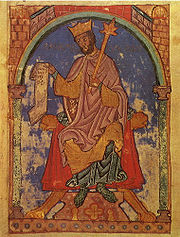 |
Ramiro II of León Ramiro II of León Ramiro II , son of Ordoño II, was King of León from 931 until his death. Initially titular king only of a lesser part of Asturias, he gained the crown of León after his brother Alfonso IV abdicated in 931... (931–951) |
imperator (emperor) | posthumous royal charters |
| Ordoño III of León Ordoño III of León Ordoño III was the King of León from 951 to 956, son and successor of Ramiro II . He confronted Navarre and Castile, who supported his half-brother Sancho the Fat in disputing Ordoño's claim to the throne.... (951–956) |
imperator (emperor) | contemporary royal charter | |
| Ramiro III of León Ramiro III of León Ramiro III , king of León , was the son of Sancho the Fat and his successor at the age of only five. During his minority, the regency was in the hands of two nuns: his aunt Elvira Ramírez of León, who took the title of queen during the minority, and his mother Teresa Ansúrez, who was put in a... (966–984) |
dominissimus imperator (most lordly emperor) Basileus (king/emperor) |
contemporary royal charters | |
 |
Fernán González of Castile (923–970) |
imperator terrae (emperor of the land) | contemporary private charter |
| García Fernández of Castile (970–995) |
imperator Castelle (emperor of Castile) | contemporary charter | |
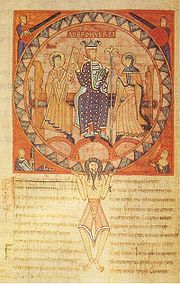 |
Alfonso V of León Alfonso V of León Alfonso V , called the Noble, was King of León from 999 to 1028. He was the son of Bermudo II by his second wife Elvira García of Castile. The Abbot Oliva called him "Emperor of Spain".... (999–1025) |
imperator (emperor) | correspondence of Abbot Oliva Abbot Oliva Oliva was the count of Berga and Ripoll and later bishop of Vic and abbot of Sant Miquel de Cuixà. He was the son of a noble Catalan house who abdicated his secular possessions to take up the Benedictine habit in the Monastery of Santa Maria de Ripoll... |
| Sancho Garcés III of Pamplona (1004–1035) |
imperator in Castella (emperor in Castile) | later forgery | |
| Bermudo III of León Bermudo III of León Bermudo III , king of León , son of Alfonso V of León by his wife Elvira Mendes, was the last scion of Peter of Cantabria to rule in the Leonese kingdom... (1027–1037) |
imperator in Leione or in Gallecia (emperor in León or Galicia) | contemporary charters, correspondence of Abbot Oliva Abbot Oliva Oliva was the count of Berga and Ripoll and later bishop of Vic and abbot of Sant Miquel de Cuixà. He was the son of a noble Catalan house who abdicated his secular possessions to take up the Benedictine habit in the Monastery of Santa Maria de Ripoll... |
|
 |
Ferdinand I of León and Castile (1035–1065) |
imperator magnus (great emperor) | charter of his daughters' |
| García II of Galicia and Portugal García II of Galicia and Portugal García II , King of Galicia and Portugal, was the youngest of the three sons and heirs of Ferdinand I, King of Castile and León, and Sancha of León, whose Leonese inheritance included the lands García would be given.... (1065–1072) |
bonus imperator (good emperor) | Historia silense Historia silense The Historia silense, also called the Chronica silense or Historia seminense, is a medieval Latin narrative history of the Iberian Peninsula from the time of the Visigoths to the first years of the reign of Alfonso VI of León and Castile... |
|
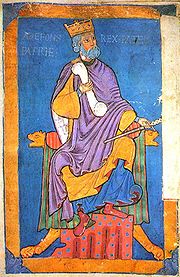 |
Alfonso VI of León and Castile (1065–1109) |
imperator totius Hispaniae (emperor of all Spain) al-Imbraţūr dhī-l-Millatayn (emperor of the two religions) |
contemporary charters and correspondence |
| Raymond of Galicia (1092–1107) |
Gallecie imperator (emperor of Galicia) | contemporary charter | |
| Urraca of León and Castile (1109–1126) |
tocius Gallecie imperatrix (empress of all Galicia) totius hispaniae imperatrix (empress of all Spain) |
contemporary charters | |
| Alfonso I of Aragon and Pamplona Alfonso the Battler Alfonso I , called the Battler or the Warrior , was the king of Aragon and Navarre from 1104 until his death in 1134. He was the second son of King Sancho Ramírez and successor of his brother Peter I... (1104–1134) |
imperator in Castella, Gallicia (emperor in Castile, Galicia) | contemporary charters | |
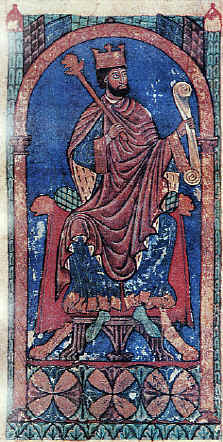 |
Alfonso VII of León and Castile (1126–1157) |
imperator (emperor) | Chronica Adefonsi imperatoris |