


Gristmill

Encyclopedia
The terms gristmill or grist mill (also: corn mill or flour mill) can refer either to a building in which grain
is ground into flour
, or to the grinding mechanism
itself.
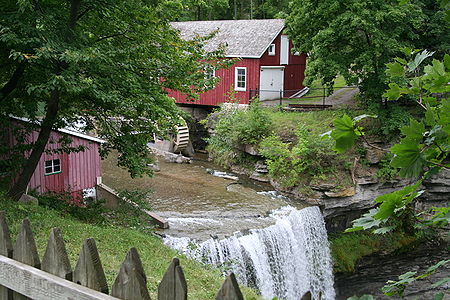 The Greek geographer Strabo
reports in his Geography a water-powered grain-mill to have existed near the palace of king Mithradates VI Eupator at Cabira
, Asia Minor
, before 71 BC.
 The early mills had horizontal paddle wheels, an arrangement which later became known as the "Norse wheel", as many were found in Scandinavia. The paddle wheel was attached to a shaft which was, in turn, attached to the centre of the millstone
called the "runner stone". The turning force produced by the water on the paddles was transferred directly to the runner stone, causing it to grind against a stationary "bed", a stone of a similar size and shape. This simple arrangement required no gear
s, but had the disadvantage that the speed of rotation of the stone was dependent on the volume and flow of water available and was, therefore, only suitable for use in mountainous regions with fast-flowing streams. This dependence on the volume and speed of flow of the water also meant that the speed of rotation of the stone was highly variable and the optimum grinding speed could not always be maintained.
Vertical wheels were in use in the Roman Empire
by the end of the first century BC, and these were described by Vitruvius
. The peak of Roman technology is probably the Barbegal aqueduct and mill
where water with a 19-metre fall drove sixteen water wheels, giving a grinding capacity estimated at 2.4 to 3.2 tonnes per hour. Water mills seem to have remained in use during the post-Roman period, and by 1000 AD, mills in Europe were rarely more than a few miles apart.
In England, the Domesday survey of 1086
gives a precise count of England's water-powered flour mills: There were 5,624, or about one for every 300 inhabitants, and this was probably typical throughout western and southern Europe. From this time onward, water wheels began to be used for purposes other than grist milling. In England, the number of mills in operation followed population growth, and peaked around 17,000 by 1300.
Limited extant examples of gristmills can be found in Europe from the High Middle Ages
. An extant well-preserved waterwheel and gristmill on the Ebro River in Spain is associated with the Real Monasterio de Nuestra Senora de Rueda
, built by the Cistercian monks in 1202. The Cistercians were known for their use of this technology in Western Europe in the period 1100 to 1350.
Geared gristmills were also built in the medieval Near East
and North Africa
, where were used for grinding grain and other seeds to produce meal
s. Gristmills in the Islamic world were powered by both water and wind. The first wind-powered
gristmills were built in the 9th and 10th centuries in what are now Afghanistan, Pakistan and Iran.
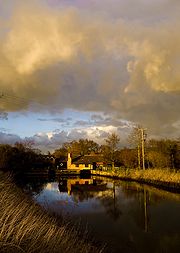 Although the terms "gristmill" or "corn mill" can refer to any mill that grinds grain, the terms were used historically for a local mill where farmers brought their own grain and received back ground meal or flour, minus a percentage called the "miller's toll." Early mills were almost always built and supported by farming communities and the miller received the "miller's toll" in lieu of wages. Most towns and villages had their own mill so that local farmers could easily transport their grain there to be milled. These communities were dependent on their local mill as bread was a staple part of the diet.
Classical mill designs are usually water powered, though some are powered by the wind or by livestock. In a watermill a sluice
gate is opened to allow water to flow onto, or under, a water wheel
to make it turn. In most watermills the water wheel was mounted vertically, i.e., edge-on, in the water, but in some cases horizontally (the tub wheel and so-called Norse wheel). Later designs incorporated horizontal steel or cast iron turbines and these were sometimes refitted into the old wheel mills.
In most wheel-driven mills, a large gear-wheel called the pit wheel is mounted on the same axle as the water wheel and this drives a smaller gear-wheel, the wallower, on a main driveshaft
running vertically from the bottom to the top of the building. This system of gearing ensures that the main shaft turns faster than the water wheel, which typically rotates at around 10 rpm
.
The millstones themselves turn at around 120 rpm. They are laid one on top of the other. The bottom stone, called the bed, is fixed to the floor, while the top stone, the runner, is mounted on a separate spindle, driven by the main shaft. A wheel called the stone nut connects the runner's spindle to the main shaft, and this can be moved out of the way to disconnect the stone and stop it turning, leaving the main shaft turning to drive other machinery. This might include driving a mechanical sieve
to refine the flour, or turning a wooden drum to wind up a chain used to hoist sacks of grain to the top of the mill house. The distance between the stones can be varied to produce the grade of flour required; moving the stones closer together produces finer flour.
The grain is lifted in sacks onto the sack floor at the top of the mill on the hoist
. The sacks are then emptied into bins, where the grain falls down through a hopper to the millstones on the stone floor below. The flow of grain is regulated by shaking it in a gently sloping trough (the slipper) from which it falls into a hole in the center of the runner stone. The milled grain (flour) is collected as it emerges through the grooves in the runner stone from the outer rim of the stones and is fed down a chute to be collected in sacks on the ground or meal floor. A similar process is used for grains such as wheat
to make flour, and for maize
to make corn meal.
In order to prevent the vibrations of the mill machinery from shaking the building apart, a gristmill will often have at least two separate foundations.
American inventor Oliver Evans
revolutionized this labor-intensive process at the end of the eighteenth century when he patented and promoted a fully automated mill design.
from the endosperm. The endosperm is ground to create white flour, which may be recombined with the bran and germ to create whole grain or graham flour
. The different milling techniques produce visibly different results, but can be made to produce nutritionally and functionally equivalent output. Stone-ground flour is, however, preferred by many bakers and natural food advocates because of its texture, nutty flavour, and the belief that it is nutritionally superior and has a better baking quality than steel-roller-milled flour. It is claimed that, as the stones grind relatively slowly, the wheat germ is not exposed to the sort of excessive temperatures that could cause the fat from the germ portion to oxidize and become rancid, which would destroy some of the vitamin content. Stone-milled flour has been found to be relatively high in thiamin, compared to roller-milled flour, especially when milled from hard wheat.
Gristmills only grind "clean" grains from which stalks and chaff
have previously been removed, but historically some mills also housed equipment for threshing
, sorting, and cleaning prior to grinding.
Modern mills are usually "merchant mills" that are either privately owned and accept money or trade for milling grains or are owned by corporations that buy unmilled grain and then own the flour produced.
People
GRAIN
GRAIN is a small international non-profit organisation that works to support small farmers and social movements in their struggles for community-controlled and biodiversity-based food systems. Our support takes the form of independent research and analysis, networking at local, regional and...
is ground into flour
Flour
Flour is a powder which is made by grinding cereal grains, other seeds or roots . It is the main ingredient of bread, which is a staple food for many cultures, making the availability of adequate supplies of flour a major economic and political issue at various times throughout history...
, or to the grinding mechanism
Mill (grinding)
A grinding mill is a unit operation designed to break a solid material into smaller pieces. There are many different types of grinding mills and many types of materials processed in them. Historically mills were powered by hand , working animal , wind or water...
itself.
Early history
Strabo
Strabo, also written Strabon was a Greek historian, geographer and philosopher.-Life:Strabo was born to an affluent family from Amaseia in Pontus , a city which he said was situated the approximate equivalent of 75 km from the Black Sea...
reports in his Geography a water-powered grain-mill to have existed near the palace of king Mithradates VI Eupator at Cabira
Cabira
Cabira , a place in Pontus, at the base of the range of Paryadres, about 150 stadia south of Eupatoria or Magnopolis, which was at the junction of the Iris and the Lycus. Eupatoria was in the midst of the plain, but Cabira, as Strabo says , was at the base of the Paryadres...
, Asia Minor
Asia Minor
Asia Minor is a geographical location at the westernmost protrusion of Asia, also called Anatolia, and corresponds to the western two thirds of the Asian part of Turkey...
, before 71 BC.
Millstone
Millstones or mill stones are used in windmills and watermills, including tide mills, for grinding wheat or other grains.The type of stone most suitable for making millstones is a siliceous rock called burrstone , an open-textured, porous but tough, fine-grained sandstone, or a silicified,...
called the "runner stone". The turning force produced by the water on the paddles was transferred directly to the runner stone, causing it to grind against a stationary "bed", a stone of a similar size and shape. This simple arrangement required no gear
Gear
A gear is a rotating machine part having cut teeth, or cogs, which mesh with another toothed part in order to transmit torque. Two or more gears working in tandem are called a transmission and can produce a mechanical advantage through a gear ratio and thus may be considered a simple machine....
s, but had the disadvantage that the speed of rotation of the stone was dependent on the volume and flow of water available and was, therefore, only suitable for use in mountainous regions with fast-flowing streams. This dependence on the volume and speed of flow of the water also meant that the speed of rotation of the stone was highly variable and the optimum grinding speed could not always be maintained.
Vertical wheels were in use in the Roman Empire
Roman Empire
The Roman Empire was the post-Republican period of the ancient Roman civilization, characterised by an autocratic form of government and large territorial holdings in Europe and around the Mediterranean....
by the end of the first century BC, and these were described by Vitruvius
Vitruvius
Marcus Vitruvius Pollio was a Roman writer, architect and engineer, active in the 1st century BC. He is best known as the author of the multi-volume work De Architectura ....
. The peak of Roman technology is probably the Barbegal aqueduct and mill
Barbegal aqueduct and mill
The Barbegal aqueduct and mill is a Roman watermill complex located on the territory of the commune of Fontvieille, near the town of Arles, in southern France. The complex has been referred to as "the greatest known concentration of mechanical power in the ancient world"...
where water with a 19-metre fall drove sixteen water wheels, giving a grinding capacity estimated at 2.4 to 3.2 tonnes per hour. Water mills seem to have remained in use during the post-Roman period, and by 1000 AD, mills in Europe were rarely more than a few miles apart.
In England, the Domesday survey of 1086
Domesday Book
Domesday Book , now held at The National Archives, Kew, Richmond upon Thames in South West London, is the record of the great survey of much of England and parts of Wales completed in 1086...
gives a precise count of England's water-powered flour mills: There were 5,624, or about one for every 300 inhabitants, and this was probably typical throughout western and southern Europe. From this time onward, water wheels began to be used for purposes other than grist milling. In England, the number of mills in operation followed population growth, and peaked around 17,000 by 1300.
Limited extant examples of gristmills can be found in Europe from the High Middle Ages
High Middle Ages
The High Middle Ages was the period of European history around the 11th, 12th, and 13th centuries . The High Middle Ages were preceded by the Early Middle Ages and followed by the Late Middle Ages, which by convention end around 1500....
. An extant well-preserved waterwheel and gristmill on the Ebro River in Spain is associated with the Real Monasterio de Nuestra Senora de Rueda
Real Monasterio de Nuestra Senora de Rueda
Rueda Abbey or Rueda de Ebro Abbey is a former Cistercian monastery in Sástago in the Ribera Baja del Ebro comarca, province of Zaragoza, Aragon, Spain, 74 kilometres to the south-east of Zaragoza on the left bank of the Ebro...
, built by the Cistercian monks in 1202. The Cistercians were known for their use of this technology in Western Europe in the period 1100 to 1350.
Geared gristmills were also built in the medieval Near East
Near East
The Near East is a geographical term that covers different countries for geographers, archeologists, and historians, on the one hand, and for political scientists, economists, and journalists, on the other...
and North Africa
North Africa
North Africa or Northern Africa is the northernmost region of the African continent, linked by the Sahara to Sub-Saharan Africa. Geopolitically, the United Nations definition of Northern Africa includes eight countries or territories; Algeria, Egypt, Libya, Morocco, South Sudan, Sudan, Tunisia, and...
, where were used for grinding grain and other seeds to produce meal
Meal
A meal is an instance of eating, specifically one that takes place at a specific time and includes specific, prepared food.Meals occur primarily at homes, restaurants, and cafeterias, but may occur anywhere. Regular meals occur on a daily basis, typically several times a day...
s. Gristmills in the Islamic world were powered by both water and wind. The first wind-powered
Windmill
A windmill is a machine which converts the energy of wind into rotational energy by means of vanes called sails or blades. Originally windmills were developed for milling grain for food production. In the course of history the windmill was adapted to many other industrial uses. An important...
gristmills were built in the 9th and 10th centuries in what are now Afghanistan, Pakistan and Iran.
Classical British and American mills
Classical mill designs are usually water powered, though some are powered by the wind or by livestock. In a watermill a sluice
Sluice
A sluice is a water channel that is controlled at its head by a gate . For example, a millrace is a sluice that channels water toward a water mill...
gate is opened to allow water to flow onto, or under, a water wheel
Water wheel
A water wheel is a machine for converting the energy of free-flowing or falling water into useful forms of power. A water wheel consists of a large wooden or metal wheel, with a number of blades or buckets arranged on the outside rim forming the driving surface...
to make it turn. In most watermills the water wheel was mounted vertically, i.e., edge-on, in the water, but in some cases horizontally (the tub wheel and so-called Norse wheel). Later designs incorporated horizontal steel or cast iron turbines and these were sometimes refitted into the old wheel mills.
In most wheel-driven mills, a large gear-wheel called the pit wheel is mounted on the same axle as the water wheel and this drives a smaller gear-wheel, the wallower, on a main driveshaft
Driveshaft
A drive shaft, driveshaft, driving shaft, propeller shaft, or Cardan shaft is a mechanical component for transmitting torque and rotation, usually used to connect other components of a drive train that cannot be connected directly because of distance or the need to allow for relative movement...
running vertically from the bottom to the top of the building. This system of gearing ensures that the main shaft turns faster than the water wheel, which typically rotates at around 10 rpm
Revolutions per minute
Revolutions per minute is a measure of the frequency of a rotation. It annotates the number of full rotations completed in one minute around a fixed axis...
.
The millstones themselves turn at around 120 rpm. They are laid one on top of the other. The bottom stone, called the bed, is fixed to the floor, while the top stone, the runner, is mounted on a separate spindle, driven by the main shaft. A wheel called the stone nut connects the runner's spindle to the main shaft, and this can be moved out of the way to disconnect the stone and stop it turning, leaving the main shaft turning to drive other machinery. This might include driving a mechanical sieve
Sieve
A sieve, or sifter, separates wanted elements from unwanted material using a woven screen such as a mesh or net. However, in cooking, especially with flour, a sifter is used to aerate the substance, among other things. A strainer is a type of sieve typically used to separate a solid from a liquid...
to refine the flour, or turning a wooden drum to wind up a chain used to hoist sacks of grain to the top of the mill house. The distance between the stones can be varied to produce the grade of flour required; moving the stones closer together produces finer flour.
The grain is lifted in sacks onto the sack floor at the top of the mill on the hoist
Hoist
Hoist may refer to:*Hoist , a machine for lifting loads*hoist controller, a machine for raising and lowering goods or personnel by means of a cable*Hydraulic hooklift hoist, another machine* Hoist , another machine...
. The sacks are then emptied into bins, where the grain falls down through a hopper to the millstones on the stone floor below. The flow of grain is regulated by shaking it in a gently sloping trough (the slipper) from which it falls into a hole in the center of the runner stone. The milled grain (flour) is collected as it emerges through the grooves in the runner stone from the outer rim of the stones and is fed down a chute to be collected in sacks on the ground or meal floor. A similar process is used for grains such as wheat
Wheat
Wheat is a cereal grain, originally from the Levant region of the Near East, but now cultivated worldwide. In 2007 world production of wheat was 607 million tons, making it the third most-produced cereal after maize and rice...
to make flour, and for maize
Maize
Maize known in many English-speaking countries as corn or mielie/mealie, is a grain domesticated by indigenous peoples in Mesoamerica in prehistoric times. The leafy stalk produces ears which contain seeds called kernels. Though technically a grain, maize kernels are used in cooking as a vegetable...
to make corn meal.
In order to prevent the vibrations of the mill machinery from shaking the building apart, a gristmill will often have at least two separate foundations.
American inventor Oliver Evans
Oliver Evans
Oliver Evans was an American inventor. Evans was born in Newport, Delaware to a family of Welsh settlers. At the age of 14 he was apprenticed to a wheelwright....
revolutionized this labor-intensive process at the end of the eighteenth century when he patented and promoted a fully automated mill design.
Modern mills
Modern mills typically use electricity or fossil fuels to spin heavy steel, or cast iron, serrated and flat rollers to separate the bran and germWhole grain
Whole grains are cereal grains that contain cereal germ, endosperm, and bran, in contrast to refined grains, which retain only the endosperm. Whole grains can generally be sprouted while refined grains generally will not sprout. Whole-meal products are made by grinding whole grains in order to make...
from the endosperm. The endosperm is ground to create white flour, which may be recombined with the bran and germ to create whole grain or graham flour
Graham flour
Graham flour is a type of whole wheat flour named after the American Presbyterian minister Rev. Sylvester Graham , an early advocate for dietary reform...
. The different milling techniques produce visibly different results, but can be made to produce nutritionally and functionally equivalent output. Stone-ground flour is, however, preferred by many bakers and natural food advocates because of its texture, nutty flavour, and the belief that it is nutritionally superior and has a better baking quality than steel-roller-milled flour. It is claimed that, as the stones grind relatively slowly, the wheat germ is not exposed to the sort of excessive temperatures that could cause the fat from the germ portion to oxidize and become rancid, which would destroy some of the vitamin content. Stone-milled flour has been found to be relatively high in thiamin, compared to roller-milled flour, especially when milled from hard wheat.
Gristmills only grind "clean" grains from which stalks and chaff
Chaff
Chaff is the dry, scaly protective casings of the seeds of cereal grain, or similar fine, dry, scaly plant material such as scaly parts of flowers, or finely chopped straw...
have previously been removed, but historically some mills also housed equipment for threshing
Threshing
Threshing is the process of loosening the edible part of cereal grain from the scaly, inedible chaff that surrounds it. It is the step in grain preparation after harvesting and before winnowing, which separates the loosened chaff from the grain...
, sorting, and cleaning prior to grinding.
Modern mills are usually "merchant mills" that are either privately owned and accept money or trade for milling grains or are owned by corporations that buy unmilled grain and then own the flour produced.
Canada
- Balmoral Grist Mill MuseumBalmoral Grist Mill MuseumThe Balmoral Grist Mill Museum is a restored 1874 water powered grist mill located in Balmoral Mills, Nova Scotia. The site includes a 1 km walking trail along the ravine of Balmoral Brook. The mill is part of the Nova Scotia Museum system. Alexander MacKay owned this water-powered grist mill...
, Nova ScotiaNova ScotiaNova Scotia is one of Canada's three Maritime provinces and is the most populous province in Atlantic Canada. The name of the province is Latin for "New Scotland," but "Nova Scotia" is the recognized, English-language name of the province. The provincial capital is Halifax. Nova Scotia is the... - Kings Landing Historical Settlement, New Brunswick, Canada
- Morningstar Mill, St. Catharines, CanadaCanadaCanada is a North American country consisting of ten provinces and three territories. Located in the northern part of the continent, it extends from the Atlantic Ocean in the east to the Pacific Ocean in the west, and northward into the Arctic Ocean...
- Arva Flour Mill, ArvaArvaArva may refer to:* Arva, Ontario, a community located in Middlesex Centre, Ontario, Canada* Arva, a village in Valea Călugărească Commune, Prahova County, Romania* Arva, a village in Broşteni Commune, Vrancea County, Romania...
, CanadaCanadaCanada is a North American country consisting of ten provinces and three territories. Located in the northern part of the continent, it extends from the Atlantic Ocean in the east to the Pacific Ocean in the west, and northward into the Arctic Ocean... - Watson's MillWatson's MillWatson's Mill is a historic gristmill in Manotick, Ontario, Canada. It was built as the Long Island Flouring Mills by Moss Kent Dickinson and Joseph Merrill Currier. It was one of a series of mills constructed in the area using power from the Rideau Canal. It earned its current name when it was...
, Manotick, OntarioOntarioOntario is a province of Canada, located in east-central Canada. It is Canada's most populous province and second largest in total area. It is home to the nation's most populous city, Toronto, and the nation's capital, Ottawa....
, CanadaCanadaCanada is a North American country consisting of ten provinces and three territories. Located in the northern part of the continent, it extends from the Atlantic Ocean in the east to the Pacific Ocean in the west, and northward into the Arctic Ocean... - Old Stone Mill National Historic Site of Canada, DeltaDeltaDelta commonly refers to:* Delta , Δ or δ in the Greek alphabet, also used as a mathematical symbol* River delta, a landform at the mouth of a river* Delta Air Lines, a major U.S...
, OntarioOntarioOntario is a province of Canada, located in east-central Canada. It is Canada's most populous province and second largest in total area. It is home to the nation's most populous city, Toronto, and the nation's capital, Ottawa....
, CanadaCanadaCanada is a North American country consisting of ten provinces and three territories. Located in the northern part of the continent, it extends from the Atlantic Ocean in the east to the Pacific Ocean in the west, and northward into the Arctic Ocean...
See also
- List of watermills
- GristGristGrist is grain that has been separated from its chaff in preparation for grinding. It can also mean grain that has been ground at a grist mill. Its etymology derives from the verb grind....
- Textile mill
- Tide millTide millA tide mill is a water mill driven by tidal rise and fall. A dam with a sluice is created across a suitable tidal inlet, or a section of river estuary is made into a reservoir. As the tide comes in, it enters the mill pond through a one way gate, and this gate closes automatically when the tide...
- Unifine MillUnifine millA Unifine mill is a single one-pass impact milling system which produces ultrafine-milled whole-grain wheat flour that requires no grain pre-treatment and no screening of the flour. Like the grist or stone mills that had dominated the flour industry for centuries, the bran, germ, and endosperm...
- Water wheelWater wheelA water wheel is a machine for converting the energy of free-flowing or falling water into useful forms of power. A water wheel consists of a large wooden or metal wheel, with a number of blades or buckets arranged on the outside rim forming the driving surface...
- WindmillWindmillA windmill is a machine which converts the energy of wind into rotational energy by means of vanes called sails or blades. Originally windmills were developed for milling grain for food production. In the course of history the windmill was adapted to many other industrial uses. An important...
People
- Robert L. BurnsRobert L. BurnsRobert L. Burns was a Los Angeles school board member between 1923 and 1929 and Los Angeles City Council member between 1929 and 1945. He previously was on the school board in Hutchinson, Kansas. At his death in 1955, he was described as Los Angeles's "elder statesman."Robert L...
, began Consolidated Flour Mills of Kansas
Further reading
- Richard Bennett & John Elton. History of corn milling (London, Simpkin, Marshall and company, 1898).
- Volume 1 - Handstone, Slave and Cattle Mills
- Volume 2 - Water and Wind Mills
- Volume 3 - Feudal Laws and customs of Mills
- Volume 4 - Some famous feudal mills
External links
- Historic Mill Information and Images
- Whitemill, Wimborne, Dorset, England
- The Society for Preservation of Old Mills
- Old Stone Mill National Historic Site of Canada
- Stockdale Mill
- Greenbank Mill
- Gristmill diagram and description
- North American Millers' Association — How Wheat Flour is Milled
- Worlds Grits Festival St. George, SC
- Site of first grist mill in North America, 1607
- Prewetts Mill – a British mill built in 1861 driven by steam until the 1970s
- Working Mill in Pickwick, Minnesota, 1854
- Cooper Mill - Working Grist Mill in Chester, New Jersey 1826
- Newlin Grist Mill
- The Mill at Anselma - A National Historic Landmark
- War Eagle Mill - A Working Water Powered Grist Mill in Rogers, Arkansas
- Peirce Mill and Barn, Rock Creek Park, U.S. National Park Service
- Graue Mill and Museum, Oakbrook, Illinois