
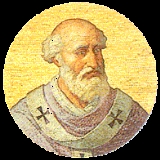
Pope Urban II born
Otho de Lagery (alternatively:
Otto,
Odo or
Eudes), was
PopeThe Pope is the Bishop of Rome, a position that makes him the leader of the worldwide Catholic Church . In the Catholic Church, the Pope is regarded as the successor of Saint Peter, the Apostle...
from 12 March 1088 until his death on July 29 1099. He is most known for starting the
First CrusadeThe First Crusade was a military expedition by Western Christianity to regain the Holy Lands taken in the Muslim conquest of the Levant, ultimately resulting in the recapture of Jerusalem...
(1096–1099) and setting up the modern day
Roman CuriaThe Roman Curia is the administrative apparatus of the Holy See and the central governing body of the entire Catholic Church, together with the Pope...
, in the manner of a royal court, to help run the Church.
Pope Gregory VIIPope St. Gregory VII , born Hildebrand of Sovana , was Pope from April 22, 1073, until his death. One of the great reforming popes, he is perhaps best known for the part he played in the Investiture Controversy, his dispute with Henry IV, Holy Roman Emperor affirming the primacy of the papal...
named him cardinal-bishop of Ostia ca. 1080. He was one of the most prominent and active supporters of the
Gregorian reformThe Gregorian Reforms were a series of reforms initiated by Pope Gregory VII and the circle he formed in the papal curia, circa 1050–80, which dealt with the moral integrity and independence of the clergy...
s, especially as
legateA papal legate – from the Latin, authentic Roman title Legatus – is a personal representative of the pope to foreign nations, or to some part of the Catholic Church. He is empowered on matters of Catholic Faith and for the settlement of ecclesiastical matters....
in Germany in 1084, and was among the few whom Gregory VII nominated as
possible successors to be PopePapabile is an unofficial Italian term first coined by Vaticanologists and now used internationally in many languages to describe a cardinal of whom it is thought likely or possible that he will be elected pope. A literal English translation would be "popeable" or "one who might become pope".In...
. Desiderius, abbot of
Monte CassinoMonte Cassino is a rocky hill about southeast of Rome, Italy, c. to the west of the town of Cassino and altitude. St. Benedict of Nursia established his first monastery, the source of the Benedictine Order, here around 529. It was the site of Battle of Monte Cassino in 1944...
, who became
Pope Victor IIIPope Blessed Victor III , born Daufer , Latinised Dauferius, was the Pope as the successor of Pope Gregory VII, yet his pontificate is far less impressive in history than his time as Desiderius, the great Abbot of Monte Cassino.-Early life and abbacy:He was born in 1026 or 1027 of a non-regnant...
(1086–1087), was chosen Pope initially, but, after his short reign, Otho was elected Pope Urban II by acclamation (March 1088) at a small meeting of cardinals and other
prelateA prelate is a high-ranking member of the clergy who is an ordinary or who ranks in precedence with ordinaries. The word derives from the Latin prælatus, the past participle of præferre, which means "carry before", "be set above or over" or "prefer"; hence, a prelate is one set over others.-Related...
s held in
TerracinaTerracina is a town and comune of the province of Latina - , Italy, 76 km SE of Rome by rail .-Ancient times:...
. He took up the policies of Pope Gregory VII, and while pursuing them with determination, showed greater flexibility, and diplomatic finesse. At the outset, he had to reckon with the presence of the powerful
antipope Clement IIIGuibert or Wibert of Ravenna was a cleric made antipope in 1080 due to perceived abuses of Pope Gregory VII during the Investiture Controversy, a title that lasted to his death....
(1080, 1084–1100) in Rome; but a series of well-attended
synodA synod historically is a council of a church, usually convened to decide an issue of doctrine, administration or application. In modern usage, the word often refers to the governing body of a particular church, whether its members are meeting or not...
s held in
RomeRome is the capital of Italy and the country's largest and most populated city and comune, with over 2.7 million residents in . The city is located in the central-western portion of the Italian Peninsula, on the Tiber River within the Lazio region of Italy.Rome's history spans two and a half...
,
AmalfiAmalfi is a town and comune in the province of Salerno, in the region of Campania, Italy, on the Gulf of Salerno, c. 35 km southeast of Naples. It lies at the mouth of a deep ravine, at the foot of Monte Cerreto , surrounded by dramatic cliffs and coastal scenery...
,
BeneventoBenevento is a town and comune of Campania, Italy, capital of the province of Benevento, 50 km northeast of Naples. It is situated on a hill 130 m above sea-level at the confluence of the Calore Irpino and Sabato...
, and Troia supported him in renewed declarations against
simonySimony is the act of paying for sacraments and consequently for holy offices or for positions in the hierarchy of a church, named after Simon Magus , who appears in the Acts of the Apostles 8:9-24...
,
Investiture ControversyThe Investiture Controversy or Investiture Contest was the most significant conflict between Church and state in medieval Europe. In the 11th and 12th centuries, a series of Popes challenged the authority of European monarchies over control of appointments, or investitures, of church officials such...
, and
clerical marriagesClerical celibacy is the discipline by which some or all members of the clergy in certain religions are required to be unmarried. Since these religions consider deliberate sexual thoughts, feelings, and behavior outside of marriage to be sinful, clerical celibacy also requires abstension from these...
, and a continued opposition to Emperor Henry IV (1050–1106).
In accordance with this last policy, the marriage of the countess
Matilda of TuscanyMatilda of Tuscany was an Italian noblewoman, the principal Italian supporter of Pope Gregory VII during the Investiture Controversy. She is one of the few medieval women to be remembered for her military accomplishments...
with
Guelph of BavariaWelf II , or Welfhard, called Welf the Fat, was duke of Bavaria from 1101 until his death. In the Welf genealogy, he is counted as Welf V.-Life and reign:...
was promoted,
Prince ConradConrad II was the second son of Holy Roman Emperor Henry IV. As such, he was King of Germany from 1087 to 1098 and also King of Italy from 1093 to 1098....
was helped in his rebellion against his father and crowned
King of the RomansKing of the Romans was the title used by the ruler of the Holy Roman Empire following his election to the office by the princes of the Kingdom of Germany...
at
MilanMilan is the second-largest city in Italy and the capital city of the region of Lombardy and of the province of Milan. The city proper has a population of about 1.3 million, while its urban area, roughly coinciding with its administrative province and the bordering Province of Monza and Brianza ,...
in 1093, and the Empress (
Adelaide or PraxedesEupraxia of Kiev was the daughter of Vsevolod I, Prince of Kiev and second wife of Henry IV, Holy Roman Emperor. She was the sister of Vladimir Monomakh....
) encouraged in her charges against her husband. In a protracted struggle also with
Philip I of FrancePhilip I , called the Amorous, was King of France from 1060 to his death. His reign, like that of most of the early Direct Capetians, was extraordinarily long for the time...
(1060–1108), whom he had
excommunicatedExcommunication is a religious censure used to deprive, suspend or limit membership in a religious community. The word means putting [someone] out of communion. In some religions, excommunication includes spiritual condemnation of the member or group...
for his adulterous marriage to
Bertrade de MontfortBertrade de Montfort was the daughter of Simon I de Montfort and Agnes, Countess of Evreux. Her brother was Amaury de Montfort.-Marriages:...
, Urban II finally proved victorious.
Urban II had much correspondence with Archbishop
Anselm of CanterburyAnselm of Canterbury , also called of Aosta for his birthplace, and of Bec for his home monastery, was a Benedictine monk, a philosopher, and a prelate of the church who held the office of Archbishop of Canterbury from 1093 to 1109...
, to whom he extended an order to come urgently to Rome just after the Archbishop's first flight from England, and earlier gave his approval to Anselm's work
De Incarnatione Verbi (The Incarnation of the Word).
Crusades
Urban II's crusading movement took its first public shape at the
Council of PiacenzaThe Council of Piacenza was a mixed synod of ecclesiastics and laymen of the Roman Catholic Church, which took place from March 1 to March 5, 1095, at Piacenza....
, where, in March 1095, Urban II received an ambassador from the Byzantine Emperor
Alexios I KomnenosAlexios I Komnenos, Latinized as Alexius I Comnenus , was Byzantine emperor from 1081 to 1118, and although he was not the founder of the Komnenian dynasty, it was during his reign that the Komnenos family came to full power. The title 'Nobilissimus' was given to senior army commanders,...
(1081–1118) asking for help against Muslim Turks, who had taken over most of formerly Byzantine Anatolia. A great council met, attended by numerous Italian, Burgundian, and French
bishopsIn the Catholic Church, a bishop is an ordained minister who holds the fullness of the sacrament of Holy Orders and is responsible for teaching the Catholic faith and ruling the Church....
in such vast numbers it had to be held in the open air outside the city. At the
Council of ClermontThe Council of Clermont was a mixed synod of ecclesiastics and laymen of the Catholic Church, which was held from November 18 to November 28, 1095 at Clermont, France...
held in November of the same year, Urban II's sermon proved highly effective, as he summoned the attending nobility and the people to wrestle the
Holy LandThe Holy Land is a term which in Judaism refers to the Kingdom of Israel as defined in the Tanakh. For Jews, the Land's identifiction of being Holy is defined in Judaism by its differentiation from other lands by virtue of the practice of Judaism often possible only in the Land of Israel...
and the eastern churches generally from the Seljuk Turks.
There exists no exact transcription of Urban II's speech which was given at the
Council of ClermontThe Council of Clermont was a mixed synod of ecclesiastics and laymen of the Catholic Church, which was held from November 18 to November 28, 1095 at Clermont, France...
on November 27, 1095. The five extant versions of the speech were written down quite a bit later, and they differ widely from one another. All versions of the speech except that by
Fulcher of ChartresFulcher of Chartres was a chronicler of the First Crusade. He wrote in Latin.- Life :His appointment as chaplain of Baldwin of Boulogne in 1097 suggests that he had been trained as a priest, most likely at the school in Chartres...
were probably influenced by the chronicle account of the First Crusade called the
Gesta FrancorumThe so-called Gesta Francorum or in full De Gesta Francorum et aliorum Hierosolimitanorum is a Latin chronicle of the First Crusade written in circa 1100-1101 by an anonymous author connected with Bohemund I of Antioch.It narrates the events of the First Crusade from the inception in November...
(dated c. 1102), whose author also gives a version of the speech. Fulcher of Chartres was present at the Council, but his version of Urban's speech was written 1100-1106;
Robert the MonkRobert the Monk or Robert of Rheims was a chronicler of the First Crusade. He did not participate in the expedition, but rewrote the Gesta Francorum at the request of his abbot, who was appalled at the 'rustic' style of the Gesta....
may have been present, but his version dates about 1106. The two remaining versions are even later, and written by authors who did not attend the speech. The five versions of Urban's speech reflect much more clearly what later authors thought Urban II should have said about the First Crusade, than what Urban II himself actually did say to launch the First Crusade. In contrast, there are four extant letters written by Pope Urban II himself about crusading, to the
FlemishFlanders is the community of the Flemings but also one of the institutions in Belgium, and a geographical region located in parts of present-day Belgium, France and the Netherlands. "Flanders" can also refer to the northern part of Belgium that contains Brussels, Bruges, Ghent and Antwerp...
(dated December 1095); to the
BologneseBologna is the capital city of Emilia-Romagna, in the Po Valley of Northern Italy. The city lies between the Po River and the Apennine Mountains, more specifically, between the Reno River and the Savena River. Bologna is a lively and cosmopolitan Italian college city, with spectacular history,...
(dated September 1096); to
VallombrosaVallombrosa is a Benedictine abbey in the comune of Reggello , c. 30 km south-east of Florence, in the Apennines, surrounded by forests of beech and firs. It was founded by Giovanni Gualberto, a Florentine noble, in 1038 and became the mother house of the Vallumbrosan Order.It was extended...
(dated October 1096); to
CatalonianCatalonia is an autonomous community in northeastern Spain, with the official status of a "nationality" of Spain. Catalonia comprises four provinces: Barcelona, Girona, Lleida, and Tarragona. Its capital and largest city is Barcelona. Catalonia covers an area of 32,114 km² and has an...
counts (dated either 1089 or 1096–1099). It is Urban II's own letters, rather than the paraphrased versions of his speech, that reveal his actual thinking about crusading. Nevertheless, the versions of the speech have had a great influence on popular conceptions and misconceptions about the Crusades, so it is worth comparing the five composed speeches to Urban's actual words. First, some selections from the speeches: Fulcher of Chartres has Urban say:
The chronicler Robert the Monk has put into the mouth of Urban II:
[...] this land which you inhabit, shut in on all sides by the seas and surrounded by the mountain peaks, is too narrow for your large population; nor does it abound in wealth; and it furnishes scarcely food enough for its cultivators. Hence it is that you murder one another, that you wage war, and that frequently you perish by mutual wounds. Let therefore hatred depart from among you, let your quarrels end, let wars cease, and let all dissensions and controversies slumber. Enter upon the road to the Holy SepulchreThe Church of the Holy Sepulchre, also called the Church of the Resurrection by Eastern Christians, is a church within the walled Old City of Jerusalem. It is a few steps away from the Muristan....
; wrest that land from the wicked race, and subject it to yourselves. [...] God has conferred upon you above all nations great glory in arms. Accordingly undertake this journey for the remission of your sins, with the assurance of the imperishable glory of the Kingdom of HeavenThe Kingdom of God or Kingdom of Heaven is a foundational concept in the Abrahamic religions: Judaism, Christianity and Islam.The term "Kingdom of God" is found in all four canonical gospels and in the Pauline epistles...
.
Robert further claims:
When Pope Urban had said these [...] things in his urbane discourse, he so influenced to one purpose the desires of all who were present, that they cried out 'It is the will of God! It is the will of God!'. When the venerable Roman pontiff heard that, [he] said: Most beloved brethren, today is manifest in you what the Lord says in the Gospel, 'Where two or three are gathered together in my name there am I in the midst of them.' Unless the Lord God had been present in your spirits, all of you would not have uttered the same cry. For, although the cry issued from numerous mouths, yet the origin of the cry was one. Therefore I say to you that God, who implanted this in your breasts, has drawn it forth from you. Let this then be your war-cry in combats, because this word is given to you by God. When an armed attack is made upon the enemy, let this one cry be raised by all the soldiers of God: It is the will of God! It is the will of God!
Within Fulcher of Chartres account of pope Urban’s speech, there was a promise of remission of sins for who ever took part in the crusade. However, this was probably in reference to the plenary indulgence attached to the crusade, and not to sacramental absolution.
All who die by the way, whether by land or by sea, or in battle against the pagans, shall have immediate remission of sins. This I grant them through the power of God with which I am invested. O what a disgrace if such a despised and base race, which worships demons, should conquer a people which has the faith of omnipotent God and is made glorious with the name of Christ! With what reproaches will the Lord overwhelm us if you do not aid those who, with us, profess the Christian religion! Let those who have been accustomed unjustly to wage private warfare against the faithful now go against the infidels and end with victory this war which should have been begun long ago. Let those who for a long time, have been robbers, now become knights. Let those who have been fighting against their brothers and relatives now fight in a proper way against the barbarians. Let those who have been serving as mercenaries for small pay now obtain the eternal reward. Let those who have been wearing themselves out in both body and soul now work for a double honor. Behold! on this side will be the sorrowful and poor, on that, the rich; on this side, the enemies of the Lord, on that, his friends. Let those who go not put off the journey, but rent their lands and collect money for their expenses; and as soon as winter is over and spring comes, let them eagerly set out on the way with God as their guide.
It is disputed whether the famous slogan
"God wills it"Deus vult was the cry of the people at the declaration of the First Crusade by Pope Urban II at the Council of Clermont in 1095...
or "It is the will of God" (
deus vult in Latin,
Dieu le veut in French) in fact was established as a rallying cry during the council. While Robert the Monk says so, it is also possible that the slogan was created as a catchy
propagandaPropaganda is a form of communication that is aimed at influencing the attitude of a community toward some cause or position so as to benefit oneself or one's group....
motto afterward.
Urban II's own letter to the Flemish confirms that he granted "remission of all their sins" to those undertaking a "military enterprise" to "liberate the eastern churches." One notable contrast with the speeches of Robert the Monk,
Guibert of NogentGuibert of Nogent was a Benedictine historian, theologian and author of autobiographical memoirs. Guibert was relatively unknown in his own time, going virtually unmentioned by his contemporaries...
and
Baldric of DolBaldric of Dol was abbot of Bourgueil from 1079 to 1106, then bishop of Dol-en-Bretagne from 1107 until his death....
is the lesser emphasis on Jerusalem itself, which Urban only once mentions as his own focus of concern: in the letter to the Flemish he writes "they (the Turks) have seized the Holy City of Christ, embellished by his passion and resurrection, and blasphemy to say---have sold her and her churches into abominable slavery." In the letters to Bologna and Vallombrosa he refers to the crusaders' desire to set out for Jerusalem rather than to his own desire that Jerusalem be freed from Muslim rule. Urban II refers to liberating the church as a whole or the eastern churches generally rather than to reconquering Jerusalem itself. The phrases used are "churches of God in the eastern region" and "the eastern churches" (to the Flemish), "liberation of the Church" (to Bologna), "liberating Christianity [Lat. Christianitatis]" (to Vallombrosa), and "the Asian church" (to Catalonian counts). Coincidentally or not, Fulcher of Chartres' version of Urban's speech makes no explicit reference to Jerusalem. Rather it more generally refers to aiding the crusaders' Christian "brothers of the eastern shore," and to their loss of Asia Minor to the Turks.
Urban II died on July 29, 1099, fourteen days after the
fallThe Siege of Jerusalem took place from June 7 to July 15, 1099 during the First Crusade. The Crusaders stormed and captured the city from Fatimid Egypt.-Background:...
of
Jerusalem to the Crusaders, but before news of the event had reached Italy; his successor was
Pope Paschal IIPope Paschal II , born Ranierius, was Pope from August 13, 1099, until his death. A monk of the Cluniac order, he was created cardinal priest of the Titulus S...
(1099–1118).
Urban II and Sicily
Far more subtle than the Crusades, but far more successful over the long run, was Urban II's program of bringing
CampaniaCampania is a region in southern Italy. The region has a population of around 5.8 million people, making it the second-most-populous region of Italy; its total area of 13,590 km² makes it the most densely populated region in the country...
and
SicilySicily is a region of Italy, and is the largest island in the Mediterranean Sea. Along with the surrounding minor islands, it constitutes an autonomous region of Italy, the Regione Autonoma Siciliana Sicily has a rich and unique culture, especially with regard to the arts, music, literature,...
firmly into the Catholic sphere, after generations of control from the
Byzantine EmpireThe Byzantine Empire was the Eastern Roman Empire during the periods of Late Antiquity and the Middle Ages, centred on the capital of Constantinople. Known simply as the Roman Empire or Romania to its inhabitants and neighbours, the Empire was the direct continuation of the Ancient Roman State...
and the
AghlabidThe Aghlabids were a dynasty of emirs, members of the Arab tribe of Bani Tamim, who ruled Ifriqiya, nominally on behalf of the Abbasid Caliph, for about a century, until overthrown by the new power of the Fatimid.-History:...
and
FatimidThe Fatimid Islamic Caliphate or al-Fāṭimiyyūn was a Berber Shia Muslim caliphate first centered in Tunisia and later in Egypt that ruled over varying areas of the Maghreb, Sudan, Sicily, the Levant, and Hijaz from 5 January 909 to 1171.The caliphate was ruled by the Fatimids, who established the...
emirEmir , meaning "commander", "general", or "prince"; also transliterated as Amir, Aamir or Ameer) is a title of high office, used throughout the Muslim world...
s in Sicily. His agent in the Sicilian
borderlandsA march or mark refers to a border region similar to a frontier, such as the Welsh Marches, the borderland between England and Wales. During the Frankish Carolingian Dynasty, the word spread throughout Europe....
was the Norman ruler
Roger IRoger I , called Bosso and the Great Count, was the Norman Count of Sicily from 1071 to 1101. He was the last great leader of the Norman conquest of southern Italy.-Conquest of Calabria and Sicily:...
(1091–1101). In 1098, after a meeting at the
Siege of CapuaThe Siege of Capua was a military operation involving the states of medieval southern Italy, beginning in May 1098 and lasting forty days. It was an interesting siege historically for the assemblage of great persons it saw and militarily for the cooperation of Norman and Saracen forces which it...
, Urban II bestowed on Roger I extraordinary prerogatives, some of the very same rights that were being withheld from temporal sovereigns elsewhere in Europe. Roger I was to be free to appoint bishops ("lay investiture"), free to collect Church revenues and forward them to the papacy (always a lucrative middle position), and free to sit in judgment on ecclesiastical questions. Roger I was to be virtually a
legateA papal legate – from the Latin, authentic Roman title Legatus – is a personal representative of the pope to foreign nations, or to some part of the Catholic Church. He is empowered on matters of Catholic Faith and for the settlement of ecclesiastical matters....
of the Pope within Sicily. In re-Christianizing Sicily, seats of new
dioceseA diocese is the district or see under the supervision of a bishop. It is divided into parishes.An archdiocese is more significant than a diocese. An archdiocese is presided over by an archbishop whose see may have or had importance due to size or historical significance...
s needed to be established, and the boundaries of
seeAn episcopal see is, in the original sense, the official seat of a bishop. This seat, which is also referred to as the bishop's cathedra, is placed in the bishop's principal church, which is therefore called the bishop's cathedral...
s established, with a church hierarchy re-established after centuries of Muslim domination.
Roger I's consort
AdelaideAdelaide del Vasto was the third wife of Roger I of Sicily and mother of Roger II of Sicily, as well as Queen consort of Jerusalem due to her later marriage to Baldwin I of Jerusalem, as his third wife.-Family:She was the daughter of Manfred del Vasto Adelaide del Vasto (Adelasia, Azalaïs) (c....
brought settlers from the valley of the
PoThe Po |Ligurian]]: Bodincus or Bodencus) is a river that flows either or – considering the length of the Maira, a right bank tributary – eastward across northern Italy, from a spring seeping from a stony hillside at Pian del Re, a flat place at the head of the Val Po under the northwest face...
to colonize eastern Sicily. Roger I as secular ruler seemed a safe proposition, as he was merely a
vassalA vassal or feudatory is a person who has entered into a mutual obligation to a lord or monarch in the context of the feudal system in medieval Europe. The obligations often included military support and mutual protection, in exchange for certain privileges, usually including the grant of land held...
of his kinsman the
Count of ApuliaRoger Borsa was the Norman Duke of Apulia and effective ruler of southern Italy from 1085 until his death. He was the son of Robert Guiscard, the conqueror of southern Italy and Sicily; Roger was not as adept as his father, and most of his reign was spent in feudal anarchy.-Biography:Roger was the...
, himself a vassal of Rome, so as a well-tested military commander it seemed safe to give him these extraordinary powers, which were later to come to terminal confrontations between Roger I's
HohenstaufenThe House of Hohenstaufen was a dynasty of German kings in the High Middle Ages, lasting from 1138 to 1254. Three of these kings were also crowned Holy Roman Emperor. In 1194 the Hohenstaufens also became Kings of Sicily...
heirs.
External links